INTRODUCTION
Bihar Rajya Pul Nirman Nigam (BRPNN) was formed on
11th June, 1975 under Indian Company Act, 1956 as a
Govt. Company.
The Nigam is registered as a Public Company under
Indian Company Act, 1956 and it is a Govt. Company as
total share capital of Rs. 500 Lakhs is pledged in the
name of Governor of Bihar. The Nigam is governed by
Managing Director on behalf of Board of Directors
nominated by the Govt. under guidelines set by
Memorandum of Association and Articles of Association
along with work rules mentioned therein.
Company Profile
HCC Group delivers world-class engineering & construction
services. We are pioneers in the Indian infrastructure
industry. Continuing our legacy of innovation, we achieve
new milestones with every endeavour. HCC is responsible
for landmark projects that have defined the country's
progress. Surging ahead with presence in multiple sectors
and involvement in revolutionary projects, we are creating
opportunities for everyone.
OBJECTIVES
• Capable to travel in all weather conditions.
• Highly reduce the travelling time between the Rohtas and
Aurangabad districts.
• To connect many small cities to the capital of Bihar.
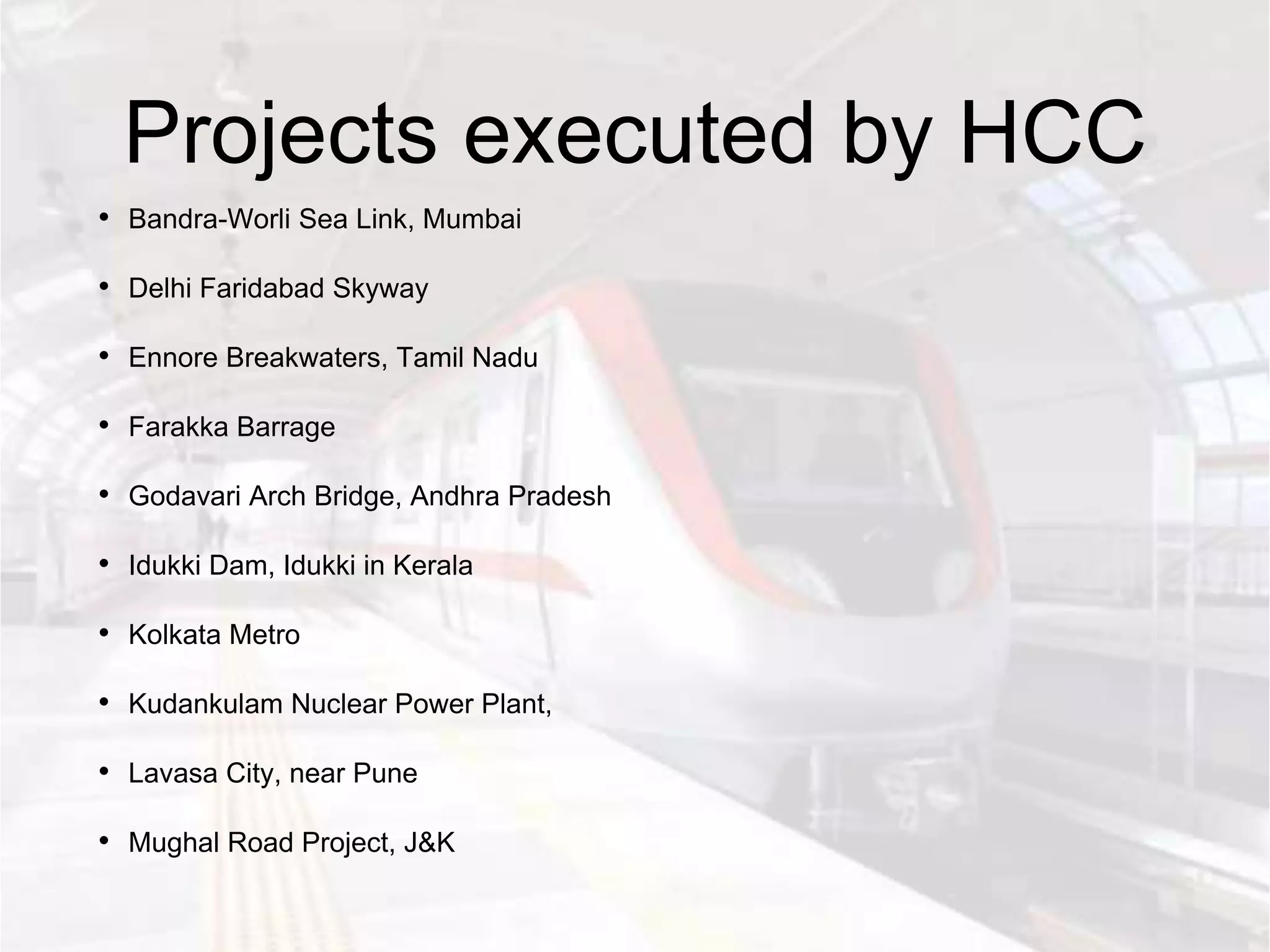
• Bandra-Worli Sea Link, Mumbai
• Delhi Faridabad Skyway
• Ennore Breakwaters, Tamil Nadu
• Farakka Barrage
• Godavari Arch Bridge, Andhra Pradesh
• Idukki Dam, Idukki in Kerala
• Kolkata Metro
• Kudankulam Nuclear Power Plant,
• Lavasa City, near Pune
• Mughal Road Project, J&K
Projects executed by HCC
• Mumbai Pune Expressway
• Nathpa Jhakri Hydroelectric Project: Head Race Tunnel and Surge Shaft
• Nimoo Bazgo Hydel Power Project, J&K
• Pir Panjal Rail Tunnel, J&K
• Rajasthan Atomic Power Plant, Rajasthan
• Aditya Aluminium Project, Sambalpur, ODISHA
• West Bengal Highway Project [NH-34]
• Parama Island Flyover, Kolkata
Projects executed by HCC
TRAINING PROFILE
Bihar Rajya Pul Nirman Nigam(BRPNN) signed a contract
with HCC on 3 MARCH, 2014 to construct a HIGH LEVEL
BRIDGE connecting Daudnagar and Nasirganj including
apporach roads in district Aurngabad and Rohtas.
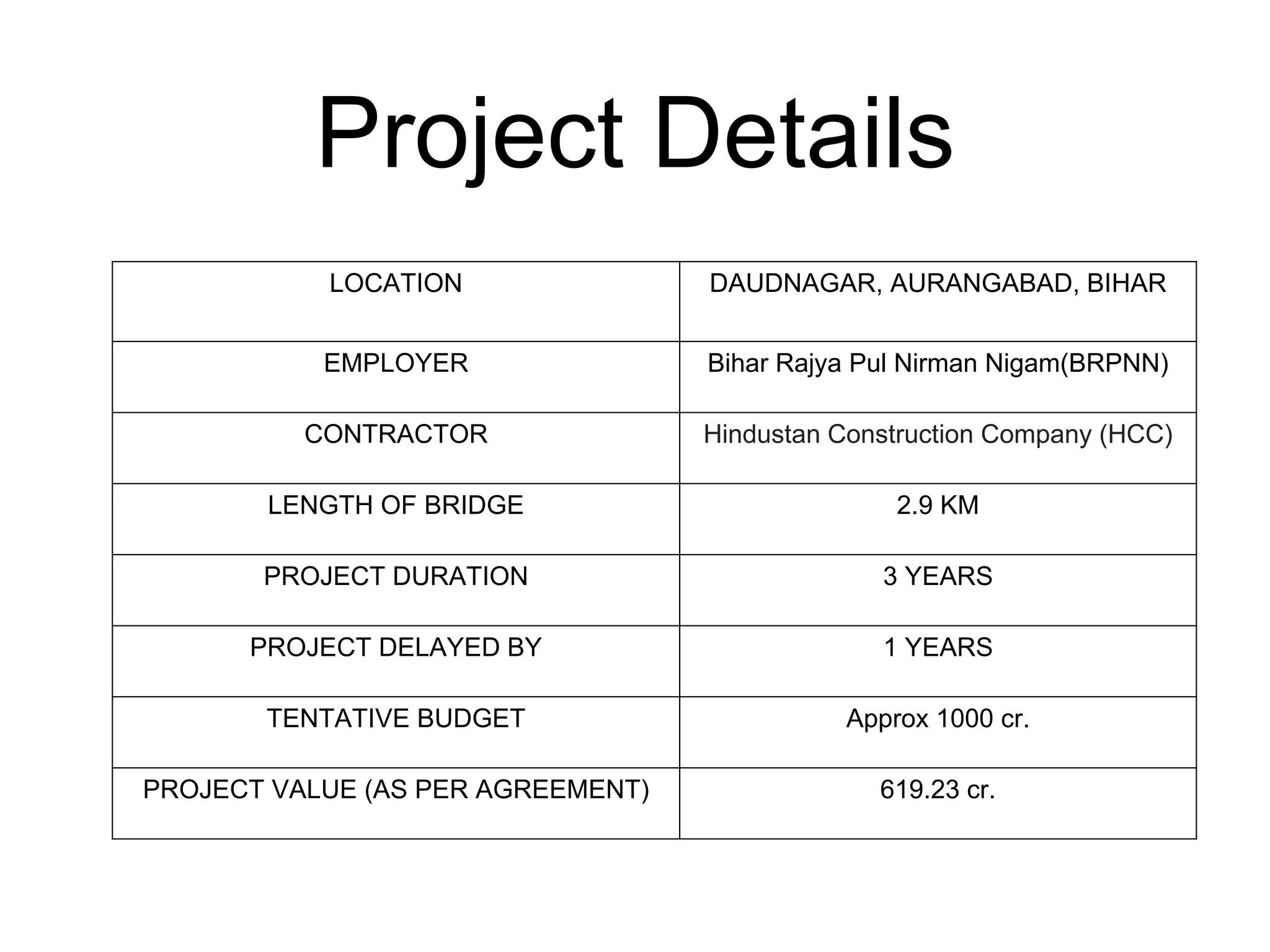
Project Details
LOCATION DAUDNAGAR, AURANGABAD, BIHAR
EMPLOYER Bihar Rajya Pul Nirman Nigam(BRPNN)
CONTRACTOR Hindustan Construction Company (HCC)
LENGTH OF BRIDGE 2.9 KM
PROJECT DURATION 3 YEARS
PROJECT DELAYED BY 1 YEARS
TENTATIVE BUDGET Approx 1000 cr.
PROJECT VALUE (AS PER AGREEMENT) 619.23 cr.
SITE EXECUTION
WELL FOUNDATION
structure, round or rectangular, which is sunk from the Well
foundation is a type of deep foundation which is generally
provided below the water level for bridges. Caisson or well
have been in use for foundations of bridges and other
structures since Roman and Mughal periods.
METHODOLOGY
1. Boring
2. Cage Lowering
3. Flushing
4. Concreting
Boring
First of all the well point is
marked. Now mark two points
(control point) which are
perpendicular to the well point
and at a distance of 1.5m.
Now welling is started by the
use of rig auger. In the
starting, first rock auger is
used. Initial boring of about
1m shall be done by using
this auger. After this the
casing pipe is inserted in the
hole.
Cage Lowering
Prefabricated reinforcement
cage prepared as per the
drawing and approved
depths, is brought and kept
near well location while
boring is in progress. After
getting the permission from
the engineer, the
reinforcement cage will be
gently lifted and lowered by
crane into the bored holes.
Tremie and flushing
The concrete should invariably
place by tremie to avoid
segregation. For concreting
done by tremie the following
requirement should be
ensured.The hopper and tremie
should be a leak proof.
Diameter of tremie shall not be
less than 200mm for use with
20mm down aggregate.After
cage lowering 200mm diameter
tremie pipes in suitable lengths
are to be lowered in the hole.
CONCRETING
The concrete placing shall
not proceed if density of fluid
near about the bottom of
bore hole exceeds
1.12g/cc.After flushing is
completed, tremie head
should be removed and
funnel should be attached to
the tremie pipe. The slump
of the concrete will be
maintained at 150mm to
200mm.
GIRDER
PSC girder are a type of prestress concrete girder that
facilitates rapid construction of a bridge using girder that are
fabricated off site and then transported and erected into
place at the job site. In pretensioned members the
prestressing stands are tensioned against restraining
bulkheads before the concrete is cast. After the concrete has
been placed allowed to harden and attain sufficient strength,
the stands are released and their force is transferred to the
concrete member.
DECK PLANKS
PPC deck planks, a types of stay-in-place form used in
construction of bridge decks, could speed construction of a
bridge deck. Since PPC deck planks replace plywood form,
they eliminate the need to construct, and later strip, the
forms. Also, the bottom layer of reinforcement required in a
typical cast-in-place bridge deck in eliminated with PPC deck
planks. This cut down slightly on time and material required
for reinforcement installation. Precast Prestressed Concrete
deck panels used as permanent forms spanning between
girders and designed to act composite with the cast-in- place
portion of the deck slab. The grade of concrete is used M50.
DECK SLAB
Deck slab is casted in two portions. The total thickness of
Deck slab is 225mm from which 115mm Deck planks are
casted in precast yard than moved at the site and erected.
The remaining 110mm thick slab is cast- in-site and the
grade used for casting this slab is M50.
QUALITY MANAGEMENT
A quality management system (QMS) is a collection of
business processes focused on consistently meeting
customer requirements and enhancing their satisfaction. It is
aligned with an organisation's purpose and strategic direction
(ISO9001:2015). It is expressed as the organisational goals
and aspirations, policies, processes, documented information
and resources needed to implement and maintain it. All the
experiments that are to be carried out for the best quality of
materials are done in the QA/QC lab. Here at CKEC Project,
QA/QC lab is at Padiala by pass Kurali site office.
CONCLUSION
It was a wonderful learning experience at site HCC of project
Sone bridge for six months in high level bridge project. I
gained a lot of insights regarding almost every aspect of site
and experiencing the things at root level.
I am very much thankful for the wonderful hospitality in every
sense from HCC. I fill that, I got the maximum out of the
experience. I hope this experience will surely help me in my
future and will help in shaping my career.
Bihar Rajya Pul Nirman Nigam

Bihar Rajya Pul Nirman Nigam

  • 1.
    INTRODUCTION Bihar Rajya PulNirman Nigam (BRPNN) was formed on 11th June, 1975 under Indian Company Act, 1956 as a Govt. Company. The Nigam is registered as a Public Company under Indian Company Act, 1956 and it is a Govt. Company as total share capital of Rs. 500 Lakhs is pledged in the name of Governor of Bihar. The Nigam is governed by Managing Director on behalf of Board of Directors nominated by the Govt. under guidelines set by Memorandum of Association and Articles of Association along with work rules mentioned therein.
  • 2.
    Company Profile HCC Groupdelivers world-class engineering & construction services. We are pioneers in the Indian infrastructure industry. Continuing our legacy of innovation, we achieve new milestones with every endeavour. HCC is responsible for landmark projects that have defined the country's progress. Surging ahead with presence in multiple sectors and involvement in revolutionary projects, we are creating opportunities for everyone.
  • 3.
    OBJECTIVES • Capable totravel in all weather conditions. • Highly reduce the travelling time between the Rohtas and Aurangabad districts. • To connect many small cities to the capital of Bihar.
  • 4.
    • Bandra-Worli SeaLink, Mumbai • Delhi Faridabad Skyway • Ennore Breakwaters, Tamil Nadu • Farakka Barrage • Godavari Arch Bridge, Andhra Pradesh • Idukki Dam, Idukki in Kerala • Kolkata Metro • Kudankulam Nuclear Power Plant, • Lavasa City, near Pune • Mughal Road Project, J&K Projects executed by HCC
  • 5.
    • Mumbai PuneExpressway • Nathpa Jhakri Hydroelectric Project: Head Race Tunnel and Surge Shaft • Nimoo Bazgo Hydel Power Project, J&K • Pir Panjal Rail Tunnel, J&K • Rajasthan Atomic Power Plant, Rajasthan • Aditya Aluminium Project, Sambalpur, ODISHA • West Bengal Highway Project [NH-34] • Parama Island Flyover, Kolkata Projects executed by HCC
  • 6.
    TRAINING PROFILE Bihar RajyaPul Nirman Nigam(BRPNN) signed a contract with HCC on 3 MARCH, 2014 to construct a HIGH LEVEL BRIDGE connecting Daudnagar and Nasirganj including apporach roads in district Aurngabad and Rohtas.
  • 7.
    Project Details LOCATION DAUDNAGAR,AURANGABAD, BIHAR EMPLOYER Bihar Rajya Pul Nirman Nigam(BRPNN) CONTRACTOR Hindustan Construction Company (HCC) LENGTH OF BRIDGE 2.9 KM PROJECT DURATION 3 YEARS PROJECT DELAYED BY 1 YEARS TENTATIVE BUDGET Approx 1000 cr. PROJECT VALUE (AS PER AGREEMENT) 619.23 cr.
  • 8.
  • 9.
    WELL FOUNDATION structure, roundor rectangular, which is sunk from the Well foundation is a type of deep foundation which is generally provided below the water level for bridges. Caisson or well have been in use for foundations of bridges and other structures since Roman and Mughal periods.
  • 10.
    METHODOLOGY 1. Boring 2. CageLowering 3. Flushing 4. Concreting
  • 11.
    Boring First of allthe well point is marked. Now mark two points (control point) which are perpendicular to the well point and at a distance of 1.5m. Now welling is started by the use of rig auger. In the starting, first rock auger is used. Initial boring of about 1m shall be done by using this auger. After this the casing pipe is inserted in the hole.
  • 12.
    Cage Lowering Prefabricated reinforcement cageprepared as per the drawing and approved depths, is brought and kept near well location while boring is in progress. After getting the permission from the engineer, the reinforcement cage will be gently lifted and lowered by crane into the bored holes.
  • 13.
    Tremie and flushing Theconcrete should invariably place by tremie to avoid segregation. For concreting done by tremie the following requirement should be ensured.The hopper and tremie should be a leak proof. Diameter of tremie shall not be less than 200mm for use with 20mm down aggregate.After cage lowering 200mm diameter tremie pipes in suitable lengths are to be lowered in the hole.
  • 14.
    CONCRETING The concrete placingshall not proceed if density of fluid near about the bottom of bore hole exceeds 1.12g/cc.After flushing is completed, tremie head should be removed and funnel should be attached to the tremie pipe. The slump of the concrete will be maintained at 150mm to 200mm.
  • 15.
    GIRDER PSC girder area type of prestress concrete girder that facilitates rapid construction of a bridge using girder that are fabricated off site and then transported and erected into place at the job site. In pretensioned members the prestressing stands are tensioned against restraining bulkheads before the concrete is cast. After the concrete has been placed allowed to harden and attain sufficient strength, the stands are released and their force is transferred to the concrete member.
  • 16.
    DECK PLANKS PPC deckplanks, a types of stay-in-place form used in construction of bridge decks, could speed construction of a bridge deck. Since PPC deck planks replace plywood form, they eliminate the need to construct, and later strip, the forms. Also, the bottom layer of reinforcement required in a typical cast-in-place bridge deck in eliminated with PPC deck planks. This cut down slightly on time and material required for reinforcement installation. Precast Prestressed Concrete deck panels used as permanent forms spanning between girders and designed to act composite with the cast-in- place portion of the deck slab. The grade of concrete is used M50.
  • 17.
    DECK SLAB Deck slabis casted in two portions. The total thickness of Deck slab is 225mm from which 115mm Deck planks are casted in precast yard than moved at the site and erected. The remaining 110mm thick slab is cast- in-site and the grade used for casting this slab is M50.
  • 18.
    QUALITY MANAGEMENT A qualitymanagement system (QMS) is a collection of business processes focused on consistently meeting customer requirements and enhancing their satisfaction. It is aligned with an organisation's purpose and strategic direction (ISO9001:2015). It is expressed as the organisational goals and aspirations, policies, processes, documented information and resources needed to implement and maintain it. All the experiments that are to be carried out for the best quality of materials are done in the QA/QC lab. Here at CKEC Project, QA/QC lab is at Padiala by pass Kurali site office.
  • 19.
    CONCLUSION It was awonderful learning experience at site HCC of project Sone bridge for six months in high level bridge project. I gained a lot of insights regarding almost every aspect of site and experiencing the things at root level. I am very much thankful for the wonderful hospitality in every sense from HCC. I fill that, I got the maximum out of the experience. I hope this experience will surely help me in my future and will help in shaping my career.