Logistics Control Tower
Control Tower European Coverage, Control Tower Model and Framework, Levels of
Outsourcing and Control, Operational & Organisational Structure
2 | DSV – June, 2016
Air & Sea
● Air Freight
● Ocean Freight (LCL / FCL)
● Inter-Modal (Short Sea / Rail)
Service Levels: Budget – Classic – Priority
Special Services
Temperature Controlled ●
/Cold Chain (GDP Pharma / Fresh) 
Technical Distribution / White Glove ●
1/2-Man Delivery ●
Service Part Logistics (SPL) / Innight ●
Secure Transportation (TAPA TSR) ●
Road (Ground)
Groupage ●
Part Loads (LTL) ●
Full Loads (FTL) ●
Additional Services: ADR (D/G)
Courier Express Parcel (CEP)
● Day Definite (Standard / Economy)
● Time Definite (Express)
● Courier (Premium)
Service Scope: B2B – B2C
Freight Management
Transportation Service Portfolio
3 | DSV – June, 2016
Freight Management
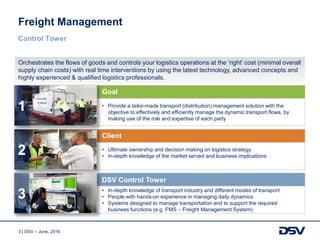
Orchestrates the flows of goods and controls your logistics operations at the ‘right’ cost (minimal overall
supply chain costs) with real time interventions by using the latest technology, advanced concepts and
highly experienced & qualified logistics professionals.
Client
• Ultimate ownership and decision making on logistics strategy
• In-depth knowledge of the market served and business implications
DSV Control Tower
• In-depth knowledge of transport industry and different modes of transport
• People with hands-on experience in managing daily dynamics
• Systems designed to manage transportation and to support the required
business functions (e.g. FMS – Freight Management System)
Goal
• Provide a tailor-made transport (distribution) management solution with the
objective to effectively and efficiently manage the dynamic transport flows, by
making use of the role and expertise of each party
Control Tower
4 | DSV – June, 2016
Control Tower
Operational Execution
Operational Account Management
Subcontractor Coordination
Subcontractor (Carrier) Management
Logistical Concept (Network) Design
Subcontractor Selection (Sourcing)
Distribution Channel Definition
Service Level Definition
Business Strategy
Logistics Strategy & Objectives
CLIENT
3 PL
Today
Operational Execution
Operational Account Management
Subcontractor Coordination
Subcontractor (Carrier) Management
Logistical Concept (Network) Design
Subcontractor Selection (Sourcing)
Distribution Channel Definition
Service Level Definition
Business Strategy
Logistics Strategy & Objectives
CLIENT
DSV
3½ PL
Tomorrow
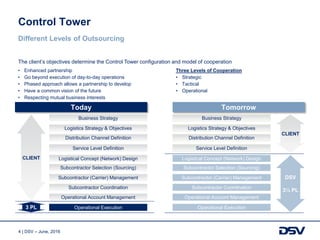
The client’s objectives determine the Control Tower configuration and model of cooperation
• Enhanced partnership
• Go beyond execution of day-to-day operations
• Phased approach allows a partnership to develop
• Have a common vision of the future
• Respecting mutual business interests
Three Levels of Cooperation
• Strategic
• Tactical
• Operational
Different Levels of Outsourcing
5 | DSV – June, 2016
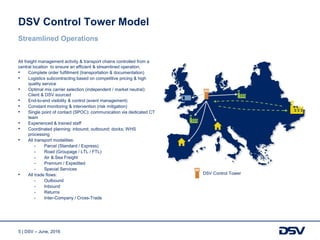
DSV Control Tower Model
All freight management activity & transport chains controlled from a
central location to ensure an efficient & streamlined operation.
• Complete order fulfillment (transportation & documentation)
• Logistics subcontracting based on competitive pricing & high
quality service
• Optimal mix carrier selection (independent / market neutral):
Client & DSV sourced
• End-to-end visibility & control (event management)
• Constant monitoring & intervention (risk mitigation)
• Single point of contact (SPOC): communication via dedicated CT
team
• Experienced & trained staff
• Coordinated planning: inbound; outbound; docks; WHS
processing
• All transport modalities:
- Parcel (Standard / Express)
- Road (Groupage / LTL / FTL)
- Air & Sea Freight
- Premium / Expedited
- Special Services
• All trade flows:
- Outbound
- Inbound
- Returns
- Inter-Company / Cross-Trade
DSV Control Tower
Streamlined Operations
6 | DSV – June, 2016
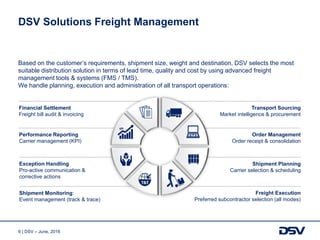
DSV Solutions Freight Management
Based on the customer’s requirements, shipment size, weight and destination, DSV selects the most
suitable distribution solution in terms of lead time, quality and cost by using advanced freight
management tools & systems (FMS / TMS).
We handle planning, execution and administration of all transport operations:
Transport Sourcing
Market intelligence & procurement
Order Management
Order receipt & consolidation
Shipment Planning
Carrier selection & scheduling
Freight Execution
Preferred subcontractor selection (all modes)
Financial Settlement
Freight bill audit & invoicing
Performance Reporting
Carrier management (KPI)
Exception Handling
Pro-active communication &
corrective actions
Shipment Monitoring:
Event management (track & trace)
7 | DSV – June, 2016
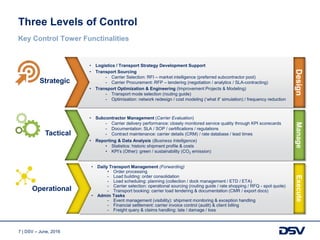
Three Levels of Control
Key Control Tower Functinalities
• Subcontractor Management (Carrier Evaluation)
- Carrier delivery performance: closely monitored service quality through KPI scorecards
- Documentation: SLA / SOP / certifications / regulations
- Contract maintenance: carrier details (CRM) / rate database / lead times
• Reporting & Data Analysis (Business Intelligence)
• Statistics: historic shipment profile & costs
• KPI’s (Other): green / sustainability (CO2 emission)
Tactical
Manage
• Logistics / Transport Strategy Development Support
• Transport Sourcing
- Carrier Selection: RFI – market intelligence (preferred subcontractor pool)
- Carrier Procurement: RFP – tendering (negotiation / analytics / SLA-contracting)
• Transport Optimization & Engineering (Improvement Projects & Modeling)
- Transport mode selection (routing guide)
- Optimisation: network redesign / cost modeling (‘what if’ simulation) / frequency reduction
Strategic
Design
• Daily Transport Management (Forwarding)
• Order processing
- Load building: order consolidation
- Load scheduling: planning (collection / dock management / ETD / ETA)
- Carrier selection: operational sourcing (routing guide / rate shopping / RFQ - spot quote)
- Transport booking: carrier load tendering & documentation (CMR / export docs)
• Admin Tasks
- Event management (visibility): shipment monitoring & exception handling
- Financial settlement: carrier invoice control (audit) & client billing
- Freight query & claims handling: late / damage / loss
Operational
Execute
8 | DSV – June, 2016
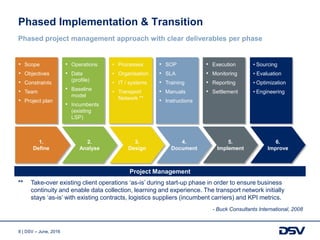
Phased Implementation & Transition
Phased project management approach with clear deliverables per phase
Project Management
• Scope
• Objectives
• Constraints
• Team
• Project plan
• Operations
• Data
(profile)
• Baseline
model
• Incumbents
(existing
LSP)
• Processes
• Organisation
• IT / systems
• Transport
Network **
• SOP
• SLA
• Training
• Manuals
• Instructions
• Execution
• Monitoring
• Reporting
• Settlement
• Sourcing
• Evaluation
• Optimization
• Engineering
1.
Define
2.
Analyse
3.
Design
4.
Document
5.
Implement
6.
Improve
** Take-over existing client operations ‘as-is’ during start-up phase in order to ensure business
continuity and enable data collection, learning and experience. The transport network initially
stays ‘as-is’ with existing contracts, logistics suppliers (incumbent carriers) and KPI metrics.
- Buck Consultants International, 2008
9 | DSV – June, 2016
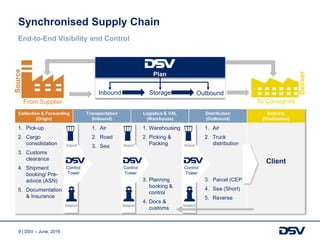
Synchronised Supply Chain
End-to-End Visibility and Control
Inbound Storage Outbound
Plan
Source
Deliver
From Supplier To Consignee
Collection & Forwarding
(Origin)
Transportation
(Inbound)
Logistics & VAL
(Warehouse)
Distribution
(Outbound)
Delivery
(Destination)
1. Pick-up
2. Cargo
consolidation
3. Customs
clearance
4. Shipment
booking/ Pre-
advice (ASN)
5. Documentation
& Insurance
1. Air
2. Road
3. Sea
1. Warehousing
2. Picking &
Packing
3. Planning
booking &
control
4. Docs &
customs
1. Air
2. Truck
distribution
3. Parcel (CEP)
4. Sea (Short)
5. Reverse
Client
Control
Tower
Airport
Seaport
Control
Tower
Airport
Seaport
Control
Tower
Airport
Seaport
10 | DSV – June, 2016
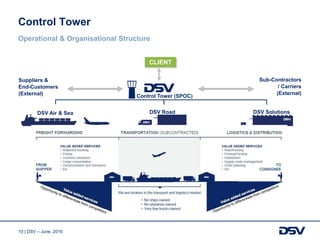
Control Tower
Operational & Organisational Structure
DSV Air & Sea DSV Road DSV Solutions
Control Tower (SPOC)
Sub-Contractors
/ Carriers
(External)
Suppliers &
End-Customers
(External)
CLIENT
11 | DSV – June, 2016
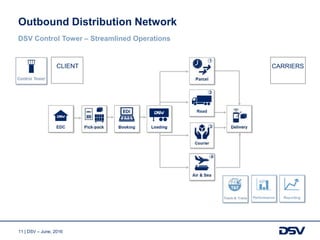
Outbound Distribution Network
1
2
3
4
CLIENT
DSV Control Tower – Streamlined Operations
CARRIERS
12 | DSV – June, 2016
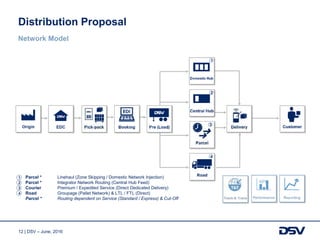
Distribution Proposal
1
2
3
Parcel * Linehaul (Zone Skipping / Domestic Network Injection)
Parcel * Integrator Network Routing (Central Hub Feed)
Courier Premium / Expedited Service (Direct Dedicated Delivery)
Road Groupage (Pallet Network) & LTL / FTL (Direct)
Parcel * Routing dependent on Service (Standard / Express) & Cut-Off
1
2
3
4
Network Model
4
13 | DSV – June, 2016
Distribution Proposal
1
2
3
1
2
3
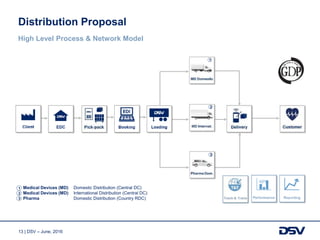
Medical Devices (MD) Domestic Distribution (Central DC)
Medical Devices (MD) International Distribution (Central DC)
Pharma Domestic Distribution (Country RDC)
High Level Process & Network Model
14 | DSV – June, 2016
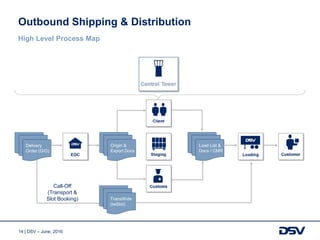
Outbound Shipping & Distribution
Delivery
Order (D/O)
Origin &
Export Docs
Load List &
Docs / CMR
TransWide
(twSlot)
Call-Off
(Transport &
Slot Booking)
High Level Process Map
15 | DSV – June, 2016
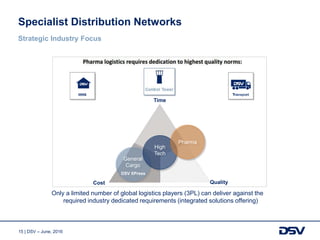
Specialist Distribution Networks
Strategic Industry Focus
Only a limited number of global logistics players (3PL) can deliver against the
required industry dedicated requirements (integrated solutions offering)
Time
Cost Quality
General
Cargo
High
Tech
Pharma
DSV XPress
16 | DSV – June, 2016
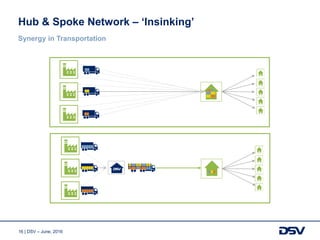
Hub & Spoke Network – ‘Insinking’
Synergy in Transportation
17 | DSV – June, 2016
82.2
11.5
762.0
74.1
11.2
745.0
80.3
10.3
721.1
1
10
100
1000
Road transport Sea transport Air transport
CO2(g/tonne-km)
Energy efficiency - per transport activity
2010 2011 2012
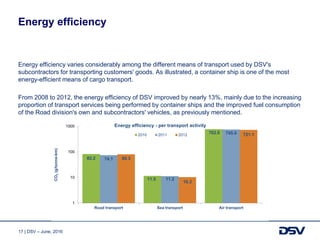
Energy efficiency varies considerably among the different means of transport used by DSV's
subcontractors for transporting customers' goods. As illustrated, a container ship is one of the most
energy-efficient means of cargo transport.
From 2008 to 2012, the energy efficiency of DSV improved by nearly 13%, mainly due to the increasing
proportion of transport services being performed by container ships and the improved fuel consumption
of the Road division's own and subcontractors' vehicles, as previously mentioned.
Energy efficiency
18 | DSV – June, 2016
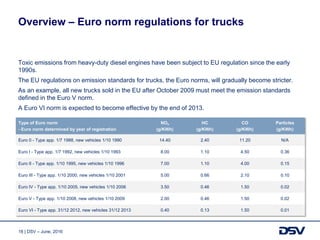
Toxic emissions from heavy-duty diesel engines have been subject to EU regulation since the early
1990s.
The EU regulations on emission standards for trucks, the Euro norms, will gradually become stricter.
As an example, all new trucks sold in the EU after October 2009 must meet the emission standards
defined in the Euro V norm.
A Euro VI norm is expected to become effective by the end of 2013.
Overview – Euro norm regulations for trucks
Type of Euro norm
- Euro norm determined by year of registration
NOx
(g/KWh)
HC
(g/KWh)
CO
(g/KWh)
Particles
(g/KWh)
Euro 0 - Type app. 1/7 1988, new vehicles 1/10 1990 14.40 2.40 11.20 N/A
Euro I - Type app. 1/7 1992, new vehicles 1/10 1993 8.00 1.10 4.50 0.36
Euro II - Type app. 1/10 1995, new vehicles 1/10 1996 7.00 1.10 4.00 0.15
Euro III - Type app. 1/10 2000, new vehicles 1/10 2001 5.00 0.66 2.10 0.10
Euro IV - Type app. 1/10 2005, new vehicles 1/10 2006 3.50 0.46 1.50 0.02
Euro V - Type app. 1/10 2008, new vehicles 1/10 2009 2.00 0.46 1.50 0.02
Euro VI - Type app. 31/12 2012, new vehicles 31/12 2013 0.40 0.13 1.50 0.01
19 | DSV – June, 2016
DSV fuel consumption
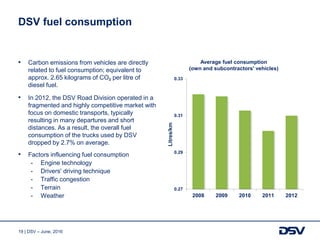
• Carbon emissions from vehicles are directly
related to fuel consumption; equivalent to
approx. 2.65 kilograms of CO2 per litre of
diesel fuel.
• In 2012, the DSV Road Division operated in a
fragmented and highly competitive market with
focus on domestic transports, typically
resulting in many departures and short
distances. As a result, the overall fuel
consumption of the trucks used by DSV
dropped by 2.7% on average.
• Factors influencing fuel consumption
- Engine technology
- Drivers' driving technique
- Traffic congestion
- Terrain
- Weather
0.27
0.29
0.31
0.33
2008 2009 2010 2011 2012
Litres/km
Average fuel consumption
(own and subcontractors' vehicles)
20 | DSV – June, 2016
IT Services
Track & Trace (D-Track)
Ordering Tracking Systems
(D-Chain Pro)
Online Order Management
Statistical evaluation
EDI solutions
E-Billing
DSV Control Tower Update Call to Business Process
Organisation Group
22 | DSV – June, 2016
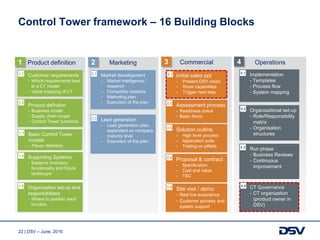
Control Tower framework – 16 Building Blocks
MarketingProduct definition Commercial Operations
Basic Control Tower
models
- Flavor definition
1.3
Product definition
- Business model
- Supply chain scope
- Control Tower functions
1.2
Supporting Systems
- Systems inventory,
functionality and future
landscape
1.4
Customer requirements
- Which requirements lead
to a CT model
- Value mapping of CT
1.1
Organization set-up and
responsibilities
- Where to position each
function
1.5
Market development
- Market intelligence /
research
- Competitor analysis
- Marketing plan
- Execution of the plan
2.1
Lead generation
- Lead generation plan,
dependent on company
maturity level
- Execution of the plan
2.2
1 2
Solution outline
- High level process
- Application suite
- Testing on pitfalls
2.3
Assessment process
- Readiness check
- Basic flavor
2.2
Proposal & contract
- Specification
- Cost and value
- T&C
2.4
Initial sales ppt
- Present DSV vision
- Show capabilities
- Trigger next step
2.1
Site visit / demo
- Real live experience
- Customer process and
system support
2.5
3 4
Implementation
- Templates
- Process flow
- System mapping
4.1
Organisational set-up
- Role/Responsibility
matrix
- Organisation
structures
4.2
Run phase
- Business Reviews
- Continuous
improvement
4.3
CT Governance
- CT organization
(product owner in
DSV)
4.4
23 | DSV – June, 2016
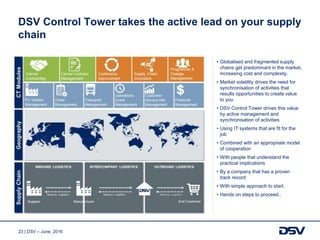
DSV Control Tower takes the active lead on your supply
chain
• Globalised and fragmented supply
chains get predominant in the market,
increasing cost and complexity.
• Market volatility drives the need for
synchronisation of activities that
results opportunities to create value
to you
• DSV Control Tower drives this value
by active management and
synchronisation of activities
• Using IT systems that are fit for the
job
• Combined with an appropriate model
of cooperation
• With people that understand the
practical implications
• By a company that has a proven
track record
• With simple approach to start.
• Hands on steps to proceed..
24 | DSV – June, 2016
DSV Control Towers
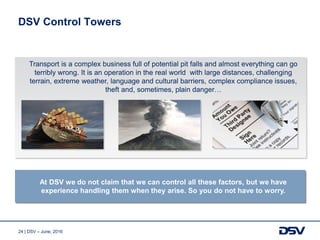
Transport is a complex business full of potential pit falls and almost everything can go
terribly wrong. It is an operation in the real world with large distances, challenging
terrain, extreme weather, language and cultural barriers, complex compliance issues,
theft and, sometimes, plain danger…
At DSV we do not claim that we can control all these factors, but we have
experience handling them when they arise. So you do not have to worry.
25 | DSV – June, 2016
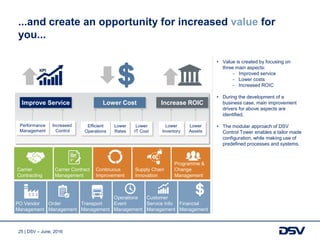
...and create an opportunity for increased value for
you...
• Value is created by focusing on
three main aspects:
- Improved service
- Lower costs
- Increased ROIC
• During the development of a
business case, main improvement
drivers for above aspects are
identified.
• The modular approach of DSV
Control Tower enables a tailor made
configuration, while making use of
predefined processes and systems.
Carrier
Contracting
Carrier Contract
Management
Continuous
Improvement
Supply Chain
Innovation
Programme &
Change
Management
PO Vendor
Management
Order
Management
Transport
Management
Operations
Event
Management
Customer
Service Info
Management
Financial
Management
Improve Service Lower Cost Increase ROIC
Performance
Management
Increased
Control
Efficient
Operations
Lower
Rates
Lower
IT Cost
Lower
Inventory
Lower
Assets
26 | DSV – June, 2016
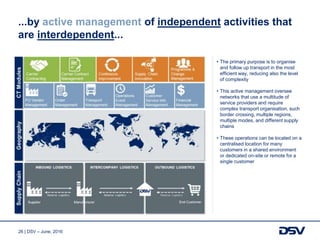
...by active management of independent activities that
are interdependent...
• The primary purpose is to organise
and follow up transport in the most
efficient way, reducing also the level
of complexity
• This active management oversee
networks that use a multitude of
service providers and require
complex transport organisation, such
border crossing, multiple regions,
multiple modes, and different supply
chains
• These operations can be located on a
centralised location for many
customers in a shared environment
or dedicated on-site or remote for a
single customer
27 | DSV – June, 2016
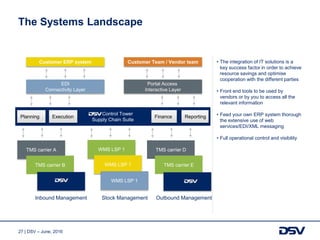
The Systems Landscape
Control Tower
Supply Chain Suite
TMS carrier A
TMS carrier B
TMS carrier D
TMS carrier E
Inbound Management Stock Management Outbound Management
Customer ERP system
Planning Execution Finance Reporting
EDI
Connectivity Layer
Portal Access
Interactive Layer
WMS LSP 1
WMS LSP 1
WMS LSP 1
Customer Team / Vendor team • The integration of IT solutions is a
key success factor in order to achieve
resource savings and optimise
cooperation with the different parties
• Front end tools to be used by
vendors or by you to access all the
relevant information
• Feed your own ERP system thorough
the extensive use of web
services/EDI/XML messaging
• Full operational control and visibility
28 | DSV – June, 2016
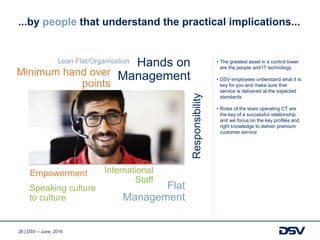
...by people that understand the practical implications...
• The greatest asset in a control tower
are the people and IT technology
• DSV employees understand what it is
key for you and make sure that
service is delivered at the expected
standards
• Roles of the team operating CT are
the key of a successful relationship
and we focus on the key profiles and
right knowledge to deliver premium
customer service
International
Staff
Empowerment
Lean Flat/Organisation
Ownership
Speaking culture
to culture
Flat
Management
Minimum hand over
points
Hands on
Management
Responsibility
29 | DSV – June, 2016
Model  Consultant 4PL Managing agent
/ 3,5 PL
Single carrier
Focus Study / solution
implementation
Streamlining
communication
Optimization /
change
management
Operational
execution
Typically applied Re-engineering
and
implementation of
short term change
Outsourcing of
transport
management
activities
Implement
strategic change
and solve
cost/performance
issues
Stable
environment,
multiple modes of
transport,
Order and
transport
management
Customer 4PL DSV DSV
Customer service
and reporting
Customer 4PL DSV DSV
Financial
management
Customer 4PL on behalf of
Customer
DSV on behalf of
Customer
DSV
Carrier
performance
management
Customer 4PL on behalf of
Customer
DSV on behalf of
Customer
DSV
Contract
management
Customer 4PL on behalf of
Customer
DSV on behalf of
Customer
Only DSV as
carrier
Execution Carriers Carriers DSV as well as
other carriers
DSV
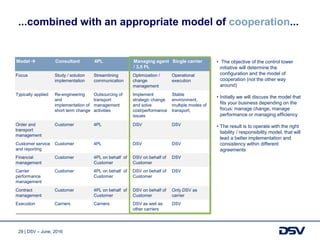
...combined with an appropriate model of cooperation...
• The objective of the control tower
initiative will determine the
configuration and the model of
cooperation (not the other way
around)
• Initially we will discuss the model that
fits your business depending on the
focus: manage change, manage
performance or managing efficiency
• The result is to operate with the right
liability / responsibility model, that will
lead a better implementation and
consistency within different
agreements
30 | DSV – June, 2016
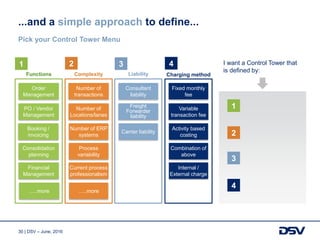
...and a simple approach to define...
Functions Complexity
I want a Control Tower that
is defined by:
Liability
Booking /
invoicing
Consolidation
planning
…..more
Order
Management
Financial
Management
PO / Vendor
Management
Current process
professionalism
…..more
Process
variability
Number of ERP
systems
Number of
Locations/lanes
Number of
transactions
Freight
Forwarder
liability
Carrier liability
Consultant
liability
Charging method
Variable
transaction fee
Activity based
costing
Fixed monthly
fee
Combination of
above
Internal /
External charge
1 2 3 4
1
2
3
4
Pick your Control Tower Menu

Logistics control tower

  • 1.
    Logistics Control Tower ControlTower European Coverage, Control Tower Model and Framework, Levels of Outsourcing and Control, Operational & Organisational Structure
  • 2.
    2 | DSV– June, 2016 Air & Sea ● Air Freight ● Ocean Freight (LCL / FCL) ● Inter-Modal (Short Sea / Rail) Service Levels: Budget – Classic – Priority Special Services Temperature Controlled ● /Cold Chain (GDP Pharma / Fresh)  Technical Distribution / White Glove ● 1/2-Man Delivery ● Service Part Logistics (SPL) / Innight ● Secure Transportation (TAPA TSR) ● Road (Ground) Groupage ● Part Loads (LTL) ● Full Loads (FTL) ● Additional Services: ADR (D/G) Courier Express Parcel (CEP) ● Day Definite (Standard / Economy) ● Time Definite (Express) ● Courier (Premium) Service Scope: B2B – B2C Freight Management Transportation Service Portfolio
  • 3.
    3 | DSV– June, 2016 Freight Management Orchestrates the flows of goods and controls your logistics operations at the ‘right’ cost (minimal overall supply chain costs) with real time interventions by using the latest technology, advanced concepts and highly experienced & qualified logistics professionals. Client • Ultimate ownership and decision making on logistics strategy • In-depth knowledge of the market served and business implications DSV Control Tower • In-depth knowledge of transport industry and different modes of transport • People with hands-on experience in managing daily dynamics • Systems designed to manage transportation and to support the required business functions (e.g. FMS – Freight Management System) Goal • Provide a tailor-made transport (distribution) management solution with the objective to effectively and efficiently manage the dynamic transport flows, by making use of the role and expertise of each party Control Tower
  • 4.
    4 | DSV– June, 2016 Control Tower Operational Execution Operational Account Management Subcontractor Coordination Subcontractor (Carrier) Management Logistical Concept (Network) Design Subcontractor Selection (Sourcing) Distribution Channel Definition Service Level Definition Business Strategy Logistics Strategy & Objectives CLIENT 3 PL Today Operational Execution Operational Account Management Subcontractor Coordination Subcontractor (Carrier) Management Logistical Concept (Network) Design Subcontractor Selection (Sourcing) Distribution Channel Definition Service Level Definition Business Strategy Logistics Strategy & Objectives CLIENT DSV 3½ PL Tomorrow The client’s objectives determine the Control Tower configuration and model of cooperation • Enhanced partnership • Go beyond execution of day-to-day operations • Phased approach allows a partnership to develop • Have a common vision of the future • Respecting mutual business interests Three Levels of Cooperation • Strategic • Tactical • Operational Different Levels of Outsourcing
  • 5.
    5 | DSV– June, 2016 DSV Control Tower Model All freight management activity & transport chains controlled from a central location to ensure an efficient & streamlined operation. • Complete order fulfillment (transportation & documentation) • Logistics subcontracting based on competitive pricing & high quality service • Optimal mix carrier selection (independent / market neutral): Client & DSV sourced • End-to-end visibility & control (event management) • Constant monitoring & intervention (risk mitigation) • Single point of contact (SPOC): communication via dedicated CT team • Experienced & trained staff • Coordinated planning: inbound; outbound; docks; WHS processing • All transport modalities: - Parcel (Standard / Express) - Road (Groupage / LTL / FTL) - Air & Sea Freight - Premium / Expedited - Special Services • All trade flows: - Outbound - Inbound - Returns - Inter-Company / Cross-Trade DSV Control Tower Streamlined Operations
  • 6.
    6 | DSV– June, 2016 DSV Solutions Freight Management Based on the customer’s requirements, shipment size, weight and destination, DSV selects the most suitable distribution solution in terms of lead time, quality and cost by using advanced freight management tools & systems (FMS / TMS). We handle planning, execution and administration of all transport operations: Transport Sourcing Market intelligence & procurement Order Management Order receipt & consolidation Shipment Planning Carrier selection & scheduling Freight Execution Preferred subcontractor selection (all modes) Financial Settlement Freight bill audit & invoicing Performance Reporting Carrier management (KPI) Exception Handling Pro-active communication & corrective actions Shipment Monitoring: Event management (track & trace)
  • 7.
    7 | DSV– June, 2016 Three Levels of Control Key Control Tower Functinalities • Subcontractor Management (Carrier Evaluation) - Carrier delivery performance: closely monitored service quality through KPI scorecards - Documentation: SLA / SOP / certifications / regulations - Contract maintenance: carrier details (CRM) / rate database / lead times • Reporting & Data Analysis (Business Intelligence) • Statistics: historic shipment profile & costs • KPI’s (Other): green / sustainability (CO2 emission) Tactical Manage • Logistics / Transport Strategy Development Support • Transport Sourcing - Carrier Selection: RFI – market intelligence (preferred subcontractor pool) - Carrier Procurement: RFP – tendering (negotiation / analytics / SLA-contracting) • Transport Optimization & Engineering (Improvement Projects & Modeling) - Transport mode selection (routing guide) - Optimisation: network redesign / cost modeling (‘what if’ simulation) / frequency reduction Strategic Design • Daily Transport Management (Forwarding) • Order processing - Load building: order consolidation - Load scheduling: planning (collection / dock management / ETD / ETA) - Carrier selection: operational sourcing (routing guide / rate shopping / RFQ - spot quote) - Transport booking: carrier load tendering & documentation (CMR / export docs) • Admin Tasks - Event management (visibility): shipment monitoring & exception handling - Financial settlement: carrier invoice control (audit) & client billing - Freight query & claims handling: late / damage / loss Operational Execute
  • 8.
    8 | DSV– June, 2016 Phased Implementation & Transition Phased project management approach with clear deliverables per phase Project Management • Scope • Objectives • Constraints • Team • Project plan • Operations • Data (profile) • Baseline model • Incumbents (existing LSP) • Processes • Organisation • IT / systems • Transport Network ** • SOP • SLA • Training • Manuals • Instructions • Execution • Monitoring • Reporting • Settlement • Sourcing • Evaluation • Optimization • Engineering 1. Define 2. Analyse 3. Design 4. Document 5. Implement 6. Improve ** Take-over existing client operations ‘as-is’ during start-up phase in order to ensure business continuity and enable data collection, learning and experience. The transport network initially stays ‘as-is’ with existing contracts, logistics suppliers (incumbent carriers) and KPI metrics. - Buck Consultants International, 2008
  • 9.
    9 | DSV– June, 2016 Synchronised Supply Chain End-to-End Visibility and Control Inbound Storage Outbound Plan Source Deliver From Supplier To Consignee Collection & Forwarding (Origin) Transportation (Inbound) Logistics & VAL (Warehouse) Distribution (Outbound) Delivery (Destination) 1. Pick-up 2. Cargo consolidation 3. Customs clearance 4. Shipment booking/ Pre- advice (ASN) 5. Documentation & Insurance 1. Air 2. Road 3. Sea 1. Warehousing 2. Picking & Packing 3. Planning booking & control 4. Docs & customs 1. Air 2. Truck distribution 3. Parcel (CEP) 4. Sea (Short) 5. Reverse Client Control Tower Airport Seaport Control Tower Airport Seaport Control Tower Airport Seaport
  • 10.
    10 | DSV– June, 2016 Control Tower Operational & Organisational Structure DSV Air & Sea DSV Road DSV Solutions Control Tower (SPOC) Sub-Contractors / Carriers (External) Suppliers & End-Customers (External) CLIENT
  • 11.
    11 | DSV– June, 2016 Outbound Distribution Network 1 2 3 4 CLIENT DSV Control Tower – Streamlined Operations CARRIERS
  • 12.
    12 | DSV– June, 2016 Distribution Proposal 1 2 3 Parcel * Linehaul (Zone Skipping / Domestic Network Injection) Parcel * Integrator Network Routing (Central Hub Feed) Courier Premium / Expedited Service (Direct Dedicated Delivery) Road Groupage (Pallet Network) & LTL / FTL (Direct) Parcel * Routing dependent on Service (Standard / Express) & Cut-Off 1 2 3 4 Network Model 4
  • 13.
    13 | DSV– June, 2016 Distribution Proposal 1 2 3 1 2 3 Medical Devices (MD) Domestic Distribution (Central DC) Medical Devices (MD) International Distribution (Central DC) Pharma Domestic Distribution (Country RDC) High Level Process & Network Model
  • 14.
    14 | DSV– June, 2016 Outbound Shipping & Distribution Delivery Order (D/O) Origin & Export Docs Load List & Docs / CMR TransWide (twSlot) Call-Off (Transport & Slot Booking) High Level Process Map
  • 15.
    15 | DSV– June, 2016 Specialist Distribution Networks Strategic Industry Focus Only a limited number of global logistics players (3PL) can deliver against the required industry dedicated requirements (integrated solutions offering) Time Cost Quality General Cargo High Tech Pharma DSV XPress
  • 16.
    16 | DSV– June, 2016 Hub & Spoke Network – ‘Insinking’ Synergy in Transportation
  • 17.
    17 | DSV– June, 2016 82.2 11.5 762.0 74.1 11.2 745.0 80.3 10.3 721.1 1 10 100 1000 Road transport Sea transport Air transport CO2(g/tonne-km) Energy efficiency - per transport activity 2010 2011 2012 Energy efficiency varies considerably among the different means of transport used by DSV's subcontractors for transporting customers' goods. As illustrated, a container ship is one of the most energy-efficient means of cargo transport. From 2008 to 2012, the energy efficiency of DSV improved by nearly 13%, mainly due to the increasing proportion of transport services being performed by container ships and the improved fuel consumption of the Road division's own and subcontractors' vehicles, as previously mentioned. Energy efficiency
  • 18.
    18 | DSV– June, 2016 Toxic emissions from heavy-duty diesel engines have been subject to EU regulation since the early 1990s. The EU regulations on emission standards for trucks, the Euro norms, will gradually become stricter. As an example, all new trucks sold in the EU after October 2009 must meet the emission standards defined in the Euro V norm. A Euro VI norm is expected to become effective by the end of 2013. Overview – Euro norm regulations for trucks Type of Euro norm - Euro norm determined by year of registration NOx (g/KWh) HC (g/KWh) CO (g/KWh) Particles (g/KWh) Euro 0 - Type app. 1/7 1988, new vehicles 1/10 1990 14.40 2.40 11.20 N/A Euro I - Type app. 1/7 1992, new vehicles 1/10 1993 8.00 1.10 4.50 0.36 Euro II - Type app. 1/10 1995, new vehicles 1/10 1996 7.00 1.10 4.00 0.15 Euro III - Type app. 1/10 2000, new vehicles 1/10 2001 5.00 0.66 2.10 0.10 Euro IV - Type app. 1/10 2005, new vehicles 1/10 2006 3.50 0.46 1.50 0.02 Euro V - Type app. 1/10 2008, new vehicles 1/10 2009 2.00 0.46 1.50 0.02 Euro VI - Type app. 31/12 2012, new vehicles 31/12 2013 0.40 0.13 1.50 0.01
  • 19.
    19 | DSV– June, 2016 DSV fuel consumption • Carbon emissions from vehicles are directly related to fuel consumption; equivalent to approx. 2.65 kilograms of CO2 per litre of diesel fuel. • In 2012, the DSV Road Division operated in a fragmented and highly competitive market with focus on domestic transports, typically resulting in many departures and short distances. As a result, the overall fuel consumption of the trucks used by DSV dropped by 2.7% on average. • Factors influencing fuel consumption - Engine technology - Drivers' driving technique - Traffic congestion - Terrain - Weather 0.27 0.29 0.31 0.33 2008 2009 2010 2011 2012 Litres/km Average fuel consumption (own and subcontractors' vehicles)
  • 20.
    20 | DSV– June, 2016 IT Services Track & Trace (D-Track) Ordering Tracking Systems (D-Chain Pro) Online Order Management Statistical evaluation EDI solutions E-Billing
  • 21.
    DSV Control TowerUpdate Call to Business Process Organisation Group
  • 22.
    22 | DSV– June, 2016 Control Tower framework – 16 Building Blocks MarketingProduct definition Commercial Operations Basic Control Tower models - Flavor definition 1.3 Product definition - Business model - Supply chain scope - Control Tower functions 1.2 Supporting Systems - Systems inventory, functionality and future landscape 1.4 Customer requirements - Which requirements lead to a CT model - Value mapping of CT 1.1 Organization set-up and responsibilities - Where to position each function 1.5 Market development - Market intelligence / research - Competitor analysis - Marketing plan - Execution of the plan 2.1 Lead generation - Lead generation plan, dependent on company maturity level - Execution of the plan 2.2 1 2 Solution outline - High level process - Application suite - Testing on pitfalls 2.3 Assessment process - Readiness check - Basic flavor 2.2 Proposal & contract - Specification - Cost and value - T&C 2.4 Initial sales ppt - Present DSV vision - Show capabilities - Trigger next step 2.1 Site visit / demo - Real live experience - Customer process and system support 2.5 3 4 Implementation - Templates - Process flow - System mapping 4.1 Organisational set-up - Role/Responsibility matrix - Organisation structures 4.2 Run phase - Business Reviews - Continuous improvement 4.3 CT Governance - CT organization (product owner in DSV) 4.4
  • 23.
    23 | DSV– June, 2016 DSV Control Tower takes the active lead on your supply chain • Globalised and fragmented supply chains get predominant in the market, increasing cost and complexity. • Market volatility drives the need for synchronisation of activities that results opportunities to create value to you • DSV Control Tower drives this value by active management and synchronisation of activities • Using IT systems that are fit for the job • Combined with an appropriate model of cooperation • With people that understand the practical implications • By a company that has a proven track record • With simple approach to start. • Hands on steps to proceed..
  • 24.
    24 | DSV– June, 2016 DSV Control Towers Transport is a complex business full of potential pit falls and almost everything can go terribly wrong. It is an operation in the real world with large distances, challenging terrain, extreme weather, language and cultural barriers, complex compliance issues, theft and, sometimes, plain danger… At DSV we do not claim that we can control all these factors, but we have experience handling them when they arise. So you do not have to worry.
  • 25.
    25 | DSV– June, 2016 ...and create an opportunity for increased value for you... • Value is created by focusing on three main aspects: - Improved service - Lower costs - Increased ROIC • During the development of a business case, main improvement drivers for above aspects are identified. • The modular approach of DSV Control Tower enables a tailor made configuration, while making use of predefined processes and systems. Carrier Contracting Carrier Contract Management Continuous Improvement Supply Chain Innovation Programme & Change Management PO Vendor Management Order Management Transport Management Operations Event Management Customer Service Info Management Financial Management Improve Service Lower Cost Increase ROIC Performance Management Increased Control Efficient Operations Lower Rates Lower IT Cost Lower Inventory Lower Assets
  • 26.
    26 | DSV– June, 2016 ...by active management of independent activities that are interdependent... • The primary purpose is to organise and follow up transport in the most efficient way, reducing also the level of complexity • This active management oversee networks that use a multitude of service providers and require complex transport organisation, such border crossing, multiple regions, multiple modes, and different supply chains • These operations can be located on a centralised location for many customers in a shared environment or dedicated on-site or remote for a single customer
  • 27.
    27 | DSV– June, 2016 The Systems Landscape Control Tower Supply Chain Suite TMS carrier A TMS carrier B TMS carrier D TMS carrier E Inbound Management Stock Management Outbound Management Customer ERP system Planning Execution Finance Reporting EDI Connectivity Layer Portal Access Interactive Layer WMS LSP 1 WMS LSP 1 WMS LSP 1 Customer Team / Vendor team • The integration of IT solutions is a key success factor in order to achieve resource savings and optimise cooperation with the different parties • Front end tools to be used by vendors or by you to access all the relevant information • Feed your own ERP system thorough the extensive use of web services/EDI/XML messaging • Full operational control and visibility
  • 28.
    28 | DSV– June, 2016 ...by people that understand the practical implications... • The greatest asset in a control tower are the people and IT technology • DSV employees understand what it is key for you and make sure that service is delivered at the expected standards • Roles of the team operating CT are the key of a successful relationship and we focus on the key profiles and right knowledge to deliver premium customer service International Staff Empowerment Lean Flat/Organisation Ownership Speaking culture to culture Flat Management Minimum hand over points Hands on Management Responsibility
  • 29.
    29 | DSV– June, 2016 Model  Consultant 4PL Managing agent / 3,5 PL Single carrier Focus Study / solution implementation Streamlining communication Optimization / change management Operational execution Typically applied Re-engineering and implementation of short term change Outsourcing of transport management activities Implement strategic change and solve cost/performance issues Stable environment, multiple modes of transport, Order and transport management Customer 4PL DSV DSV Customer service and reporting Customer 4PL DSV DSV Financial management Customer 4PL on behalf of Customer DSV on behalf of Customer DSV Carrier performance management Customer 4PL on behalf of Customer DSV on behalf of Customer DSV Contract management Customer 4PL on behalf of Customer DSV on behalf of Customer Only DSV as carrier Execution Carriers Carriers DSV as well as other carriers DSV ...combined with an appropriate model of cooperation... • The objective of the control tower initiative will determine the configuration and the model of cooperation (not the other way around) • Initially we will discuss the model that fits your business depending on the focus: manage change, manage performance or managing efficiency • The result is to operate with the right liability / responsibility model, that will lead a better implementation and consistency within different agreements
  • 30.
    30 | DSV– June, 2016 ...and a simple approach to define... Functions Complexity I want a Control Tower that is defined by: Liability Booking / invoicing Consolidation planning …..more Order Management Financial Management PO / Vendor Management Current process professionalism …..more Process variability Number of ERP systems Number of Locations/lanes Number of transactions Freight Forwarder liability Carrier liability Consultant liability Charging method Variable transaction fee Activity based costing Fixed monthly fee Combination of above Internal / External charge 1 2 3 4 1 2 3 4 Pick your Control Tower Menu