BIG DATA CONCEPTS

Serkan ÖZAL
Middle East Technical University
Ankara/TURKEY
October 2013
Contents
 Big Data and Scalability
 NoSQL





Column Stores
Key-Value Stores
Document Stores
Graph Database Systems

 Batch Data Processing
 MapReduce
 Hadoop
 Running Analytical Queries over Offline Big Data
 Hive
 Pig

 RealTime Data Processing
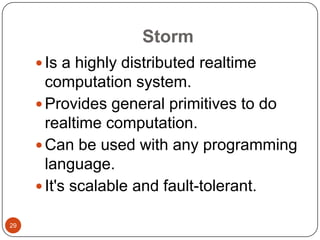
 Storm

2
Big Data
 Collect.
 Store.
 Organize.
 Analyze.
 Share.

Data growth outruns the ability to manage it so we
need scalable solutions.

3
Scalability - Vertical
 Increasing server capacity.

 Adding more CPU, RAM.
 Managing is hard.
 Possible down times
4
Scalability - Horizontal
 Adding servers to existing system with little effort, aka

Elastically scalable.
 Bugs, hardware errors, things fail all the time.
 It should become cheaper. Cost efficiency.







Shared nothing.
Use of commodity/cheap hardware.
Heterogeneous systems.
Controlled Concurrency (avoid locks).
Service Oriented Architecture. Local states.
 Decentralized to reduce bottlenecks.
 Avoid Single point of failures.

 Asynchrony.
 Symmetry, you don’t have to know what is happening. All

nodes should be symmetric.
5
NoSQL
 Stands for Not Only SQL
 Class of non-relational data storage systems

 Usually do not require a fixed table schema nor

do they use the concept of joins
 Offers BASE properties instead of ACID
(Atomicity, Consistency, Isolation, Durability)
properties
 BAsically available: Nodes in the a distributed

6

environment can go down, but the whole system
shouldn’t be affected.
 Soft State (scalable): The state of the system and data
changes over time.
 Eventual Consistency: Given enough time, data will be
consistent across the distributed system.
What is Wrong With RDBMS?
 One size fits all? Not really.
 Rigid schema design.
 Harder to scale.
 Replication.

 Joins across multiple nodes? Hard.
 How does RDMS handle data growth?

Hard.

7
Advantages & Disadvantages
 Advantages
 Flexible schema
 Quicker/cheaper to set up
 Massive scalability
 Evantual consistency

higher performance &

availability

 Disadvantages
 No declarative query language

programming
 Evantual consistency
8

more

fewer guarantees
NoSQL Systems
 Several incarnations
 Column Stores
 Key-Value Stores
 Document Stores
 Graph Databases

9
Column Stores
 Each storage block contains data from only one

column
 More efficient than row (or document) store if:
 Multiple row/record/documents are inserted at the

same time so updates of column blocks can be
aggregated
 Retrievals access only some of the columns in a
row/record/document
 Example Systems
 HBase

10
Key-Value Stores
Extremely simple interface




Data model: (key, value) pairs
Operations:




Insert(key,value), Fetch(key),Update(key), Delete(key)

Implementation: efficiency, scalability, faulttolerance




Records distributed to nodes based on key



Replication



Single-record transactions, “eventual consistency”

Example systems



11

Google BigTable, Amazon Dynamo, Cassandra,
Voldemort, …
Document Stores
 Like Key-Value Stores except value is

document
Data model: (key, document) pairs
Document: JSON, XML, other semistructured
formats
Basic operations:








Insert(key,document), Fetch(key),Update(key),
Delete(key)

Also Fetch based on document contents

 Example systems
 CouchDB, MongoDB, SimpleDB, …
12
Graph Database Systems
 A graph is a collection nodes (things) and edges

(relationships) that connect pairs of nodes.
 Attach properties (key-value pairs) on nodes and

relationships
 Relationships connect two nodes and both nodes

and relationships can hold an arbitrary amount of keyvalue pairs.
 A graph database can be thought of as a key-value

store, with full support for relationships.
 Example systems
 Neo4j, FlockDB, Pregel, …

13
Batch Data Processing
 Batch data processing is an efficient way of

processing high volumes of data is where a group of
transactions is collected over a period of time.
 Data is collected, entered, processed and then the
batch results are produced
 Data is processed by worker nodes and managed by
master node.
 Analytical queries can be executed as distributed on
offline big data. User queries are converted to MapReduce jobs on cluster to process big data.
 Hive: Supports SQL like query language
 Pig: More likely a scripting language
14
Map-Reduce
 MapReduce

is a programming model and
software framework first developed by Google
(Google’s MapReduce paper was submitted in
2004)
 A method for distributing a task across multiple
nodes
 Each node processes data assigned to that node
 Consists of two developer-created phases
 Map
 Reduce

 Nice features of MapReduce systems include:
15

 reliably processing a job even when machines die
 paralellization on thousands of machines
Map
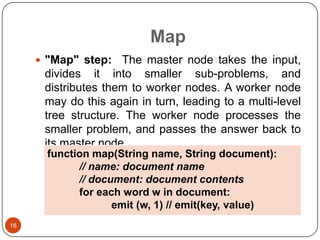
 "Map" step:

The master node takes the input,
divides it into smaller sub-problems, and
distributes them to worker nodes. A worker node
may do this again in turn, leading to a multi-level
tree structure. The worker node processes the
smaller problem, and passes the answer back to
its master node.
function map(String name, String document):
// name: document name
// document: document contents
for each word w in document:
emit (w, 1) // emit(key, value)

16
Reduce
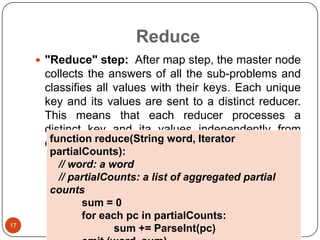
 "Reduce" step: After map step, the master node

collects the answers of all the sub-problems and
classifies all values with their keys. Each unique
key and its values are sent to a distinct reducer.
This means that each reducer processes a
distinct key and ita values independently from
function reduce(String word, Iterator
each other.

17

partialCounts):
// word: a word
// partialCounts: a list of aggregated partial
counts
sum = 0
for each pc in partialCounts:
sum += ParseInt(pc)
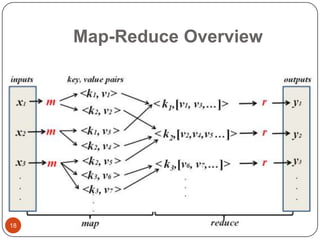
Map-Reduce Overview

18
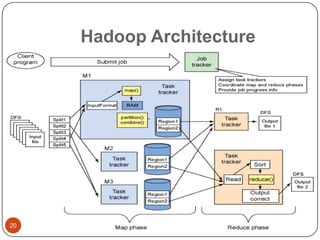
Hadoop
 Hadoop is a scalable fault-tolerant distributed

system for data storage and processing.
 Core Hadoop has two main components:
(1) HDFS: Hadoop Distributed File System is a
reliable, self-healing, redundant, high-bandwidth,
distributed file system optimized for large files.
(2) MapReduce: Fault-tolerant distributed processing
 Operates on unsuctured and structured data
 Open source under the friendly Apache License

19
Hadoop Architecture

20
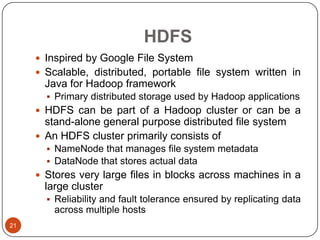
HDFS
 Inspired by Google File System
 Scalable, distributed, portable file system written in

Java for Hadoop framework
 Primary distributed storage used by Hadoop applications

 HDFS can be part of a Hadoop cluster or can be a

stand-alone general purpose distributed file system
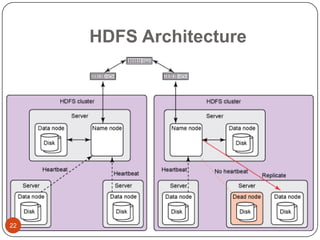
 An HDFS cluster primarily consists of
 NameNode that manages file system metadata
 DataNode that stores actual data

 Stores very large files in blocks across machines in a

large cluster
 Reliability and fault tolerance ensured by replicating data

across multiple hosts
21
HDFS Architecture

22
Running Analytical Queries
over Offline Big Data
 Hadoop is great for large-data processing!
 But writing Java programs for everything is verbose

and slow
 Not everyone wants to (or can) write Java code
 Solution: develop higher-level data processing

languages
 Hive: HQL is like SQL
 Pig: Pig Latin is a bit like Perl

23
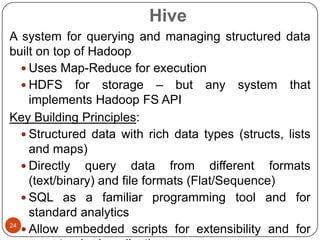
Hive
A system for querying and managing structured data
built on top of Hadoop
 Uses Map-Reduce for execution
 HDFS for storage – but any system that
implements Hadoop FS API
Key Building Principles:
 Structured data with rich data types (structs, lists
and maps)
 Directly query data from different formats
(text/binary) and file formats (Flat/Sequence)
 SQL as a familiar programming tool and for
standard analytics
24
 Allow embedded scripts for extensibility and for
Hive - Example
SELECT foo FROM sample WHERE ds='2012-02-24';

Create HDFS dir for the output

INSERT OVERWRITE DIRECTORY '/tmp/hdfs_out' SELECT * FROM sample
WHERE ds='2012-02-24';
Create local dir for the output
INSERT OVERWRITE LOCAL DIRECTORY '/tmp/hive-sample-out' SELECT *
FROM sample;
SELECT MAX(foo) FROM sample;
SELECT ds, COUNT(*), SUM(foo) FROM sample GROUP BY ds;
Hive allows the From clause to come first !!!

Store the results into a table

FROM sample s INSERT OVERWRITE TABLE bar SELECT s.bar, count(*)
WHERE s.foo > 0 GROUP BY s.bar;
25

25
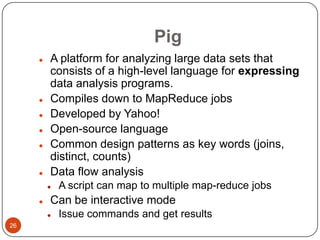
Pig









A platform for analyzing large data sets that
consists of a high-level language for expressing
data analysis programs.
Compiles down to MapReduce jobs
Developed by Yahoo!
Open-source language
Common design patterns as key words (joins,
distinct, counts)
Data flow analysis




Can be interactive mode


26

A script can map to multiple map-reduce jobs
Issue commands and get results
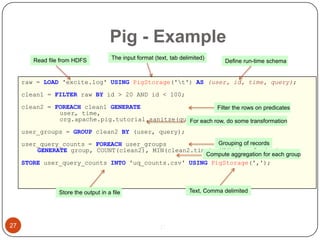
Pig - Example
Read file from HDFS

The input format (text, tab delimited)

Define run-time schema

raw = LOAD 'excite.log' USING PigStorage('t') AS (user, id, time, query);
clean1 = FILTER raw BY id > 20 AND id < 100;
clean2 = FOREACH clean1 GENERATE
Filter the rows on predicates
user, time,
org.apache.pig.tutorial.sanitze(query)each row, do some transformation
For as query;
user_groups = GROUP clean2 BY (user, query);
Grouping of records
user_query_counts = FOREACH user_groups
GENERATE group, COUNT(clean2), MIN(clean2.time), MAX(clean2.time);

Compute aggregation for each group

STORE user_query_counts INTO 'uq_counts.csv' USING PigStorage(',');

Text, Comma delimited

Store the output in a file

27

27
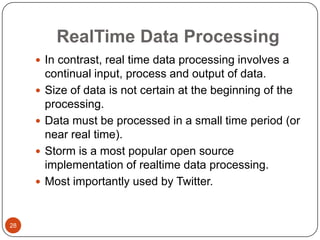
RealTime Data Processing
 In contrast, real time data processing involves a





28

continual input, process and output of data.
Size of data is not certain at the beginning of the
processing.
Data must be processed in a small time period (or
near real time).
Storm is a most popular open source
implementation of realtime data processing.
Most importantly used by Twitter.
Storm
 Is a highly distributed realtime

computation system.
 Provides general primitives to do
realtime computation.
 Can be used with any programming
language.
 It's scalable and fault-tolerant.
29
Architecture – General
Overview

30
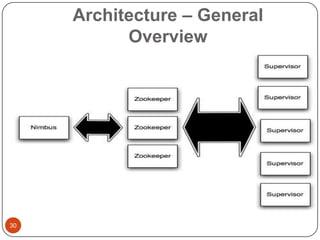
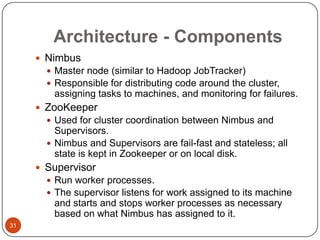
Architecture - Components
 Nimbus
 Master node (similar to Hadoop JobTracker)
 Responsible for distributing code around the cluster,

assigning tasks to machines, and monitoring for failures.
 ZooKeeper
 Used for cluster coordination between Nimbus and

Supervisors.
 Nimbus and Supervisors are fail-fast and stateless; all
state is kept in Zookeeper or on local disk.
 Supervisor
 Run worker processes.
 The supervisor listens for work assigned to its machine

and starts and stops worker processes as necessary
based on what Nimbus has assigned to it.
31
Main Concepts – General
Overview

32
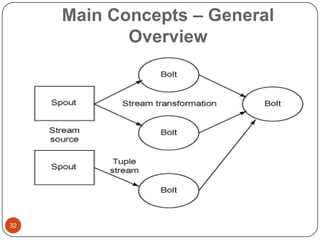
Main Concepts - Components
 Streams
 Unbounded sequence of tuples/datas (input or

output)

 Spouts
 Source of streams
 Such as reading data from Twitter streaming

API

 Bolts
 Processes input streams, does some

processing and possibly emits new streams

 Topologies
33

 Network of spouts and bolts
Thanks for Listening

34

Big data concepts

  • 1.
    BIG DATA CONCEPTS SerkanÖZAL Middle East Technical University Ankara/TURKEY October 2013
  • 2.
    Contents  Big Dataand Scalability  NoSQL     Column Stores Key-Value Stores Document Stores Graph Database Systems  Batch Data Processing  MapReduce  Hadoop  Running Analytical Queries over Offline Big Data  Hive  Pig  RealTime Data Processing  Storm 2
  • 3.
    Big Data  Collect. Store.  Organize.  Analyze.  Share. Data growth outruns the ability to manage it so we need scalable solutions. 3
  • 4.
    Scalability - Vertical Increasing server capacity.  Adding more CPU, RAM.  Managing is hard.  Possible down times 4
  • 5.
    Scalability - Horizontal Adding servers to existing system with little effort, aka Elastically scalable.  Bugs, hardware errors, things fail all the time.  It should become cheaper. Cost efficiency.      Shared nothing. Use of commodity/cheap hardware. Heterogeneous systems. Controlled Concurrency (avoid locks). Service Oriented Architecture. Local states.  Decentralized to reduce bottlenecks.  Avoid Single point of failures.  Asynchrony.  Symmetry, you don’t have to know what is happening. All nodes should be symmetric. 5
  • 6.
    NoSQL  Stands forNot Only SQL  Class of non-relational data storage systems  Usually do not require a fixed table schema nor do they use the concept of joins  Offers BASE properties instead of ACID (Atomicity, Consistency, Isolation, Durability) properties  BAsically available: Nodes in the a distributed 6 environment can go down, but the whole system shouldn’t be affected.  Soft State (scalable): The state of the system and data changes over time.  Eventual Consistency: Given enough time, data will be consistent across the distributed system.
  • 7.
    What is WrongWith RDBMS?  One size fits all? Not really.  Rigid schema design.  Harder to scale.  Replication.  Joins across multiple nodes? Hard.  How does RDMS handle data growth? Hard. 7
  • 8.
    Advantages & Disadvantages Advantages  Flexible schema  Quicker/cheaper to set up  Massive scalability  Evantual consistency higher performance & availability  Disadvantages  No declarative query language programming  Evantual consistency 8 more fewer guarantees
  • 9.
    NoSQL Systems  Severalincarnations  Column Stores  Key-Value Stores  Document Stores  Graph Databases 9
  • 10.
    Column Stores  Eachstorage block contains data from only one column  More efficient than row (or document) store if:  Multiple row/record/documents are inserted at the same time so updates of column blocks can be aggregated  Retrievals access only some of the columns in a row/record/document  Example Systems  HBase 10
  • 11.
    Key-Value Stores Extremely simpleinterface   Data model: (key, value) pairs Operations:   Insert(key,value), Fetch(key),Update(key), Delete(key) Implementation: efficiency, scalability, faulttolerance   Records distributed to nodes based on key  Replication  Single-record transactions, “eventual consistency” Example systems   11 Google BigTable, Amazon Dynamo, Cassandra, Voldemort, …
  • 12.
    Document Stores  LikeKey-Value Stores except value is document Data model: (key, document) pairs Document: JSON, XML, other semistructured formats Basic operations:      Insert(key,document), Fetch(key),Update(key), Delete(key) Also Fetch based on document contents  Example systems  CouchDB, MongoDB, SimpleDB, … 12
  • 13.
    Graph Database Systems A graph is a collection nodes (things) and edges (relationships) that connect pairs of nodes.  Attach properties (key-value pairs) on nodes and relationships  Relationships connect two nodes and both nodes and relationships can hold an arbitrary amount of keyvalue pairs.  A graph database can be thought of as a key-value store, with full support for relationships.  Example systems  Neo4j, FlockDB, Pregel, … 13
  • 14.
    Batch Data Processing Batch data processing is an efficient way of processing high volumes of data is where a group of transactions is collected over a period of time.  Data is collected, entered, processed and then the batch results are produced  Data is processed by worker nodes and managed by master node.  Analytical queries can be executed as distributed on offline big data. User queries are converted to MapReduce jobs on cluster to process big data.  Hive: Supports SQL like query language  Pig: More likely a scripting language 14
  • 15.
    Map-Reduce  MapReduce is aprogramming model and software framework first developed by Google (Google’s MapReduce paper was submitted in 2004)  A method for distributing a task across multiple nodes  Each node processes data assigned to that node  Consists of two developer-created phases  Map  Reduce  Nice features of MapReduce systems include: 15  reliably processing a job even when machines die  paralellization on thousands of machines
  • 16.
    Map  "Map" step: Themaster node takes the input, divides it into smaller sub-problems, and distributes them to worker nodes. A worker node may do this again in turn, leading to a multi-level tree structure. The worker node processes the smaller problem, and passes the answer back to its master node. function map(String name, String document): // name: document name // document: document contents for each word w in document: emit (w, 1) // emit(key, value) 16
  • 17.
    Reduce  "Reduce" step:After map step, the master node collects the answers of all the sub-problems and classifies all values with their keys. Each unique key and its values are sent to a distinct reducer. This means that each reducer processes a distinct key and ita values independently from function reduce(String word, Iterator each other. 17 partialCounts): // word: a word // partialCounts: a list of aggregated partial counts sum = 0 for each pc in partialCounts: sum += ParseInt(pc)
  • 18.
  • 19.
    Hadoop  Hadoop isa scalable fault-tolerant distributed system for data storage and processing.  Core Hadoop has two main components: (1) HDFS: Hadoop Distributed File System is a reliable, self-healing, redundant, high-bandwidth, distributed file system optimized for large files. (2) MapReduce: Fault-tolerant distributed processing  Operates on unsuctured and structured data  Open source under the friendly Apache License 19
  • 20.
  • 21.
    HDFS  Inspired byGoogle File System  Scalable, distributed, portable file system written in Java for Hadoop framework  Primary distributed storage used by Hadoop applications  HDFS can be part of a Hadoop cluster or can be a stand-alone general purpose distributed file system  An HDFS cluster primarily consists of  NameNode that manages file system metadata  DataNode that stores actual data  Stores very large files in blocks across machines in a large cluster  Reliability and fault tolerance ensured by replicating data across multiple hosts 21
  • 22.
  • 23.
    Running Analytical Queries overOffline Big Data  Hadoop is great for large-data processing!  But writing Java programs for everything is verbose and slow  Not everyone wants to (or can) write Java code  Solution: develop higher-level data processing languages  Hive: HQL is like SQL  Pig: Pig Latin is a bit like Perl 23
  • 24.
    Hive A system forquerying and managing structured data built on top of Hadoop  Uses Map-Reduce for execution  HDFS for storage – but any system that implements Hadoop FS API Key Building Principles:  Structured data with rich data types (structs, lists and maps)  Directly query data from different formats (text/binary) and file formats (Flat/Sequence)  SQL as a familiar programming tool and for standard analytics 24  Allow embedded scripts for extensibility and for
  • 25.
    Hive - Example SELECTfoo FROM sample WHERE ds='2012-02-24'; Create HDFS dir for the output INSERT OVERWRITE DIRECTORY '/tmp/hdfs_out' SELECT * FROM sample WHERE ds='2012-02-24'; Create local dir for the output INSERT OVERWRITE LOCAL DIRECTORY '/tmp/hive-sample-out' SELECT * FROM sample; SELECT MAX(foo) FROM sample; SELECT ds, COUNT(*), SUM(foo) FROM sample GROUP BY ds; Hive allows the From clause to come first !!! Store the results into a table FROM sample s INSERT OVERWRITE TABLE bar SELECT s.bar, count(*) WHERE s.foo > 0 GROUP BY s.bar; 25 25
  • 26.
    Pig       A platform foranalyzing large data sets that consists of a high-level language for expressing data analysis programs. Compiles down to MapReduce jobs Developed by Yahoo! Open-source language Common design patterns as key words (joins, distinct, counts) Data flow analysis   Can be interactive mode  26 A script can map to multiple map-reduce jobs Issue commands and get results
  • 27.
    Pig - Example Readfile from HDFS The input format (text, tab delimited) Define run-time schema raw = LOAD 'excite.log' USING PigStorage('t') AS (user, id, time, query); clean1 = FILTER raw BY id > 20 AND id < 100; clean2 = FOREACH clean1 GENERATE Filter the rows on predicates user, time, org.apache.pig.tutorial.sanitze(query)each row, do some transformation For as query; user_groups = GROUP clean2 BY (user, query); Grouping of records user_query_counts = FOREACH user_groups GENERATE group, COUNT(clean2), MIN(clean2.time), MAX(clean2.time); Compute aggregation for each group STORE user_query_counts INTO 'uq_counts.csv' USING PigStorage(','); Text, Comma delimited Store the output in a file 27 27
  • 28.
    RealTime Data Processing In contrast, real time data processing involves a     28 continual input, process and output of data. Size of data is not certain at the beginning of the processing. Data must be processed in a small time period (or near real time). Storm is a most popular open source implementation of realtime data processing. Most importantly used by Twitter.
  • 29.
    Storm  Is ahighly distributed realtime computation system.  Provides general primitives to do realtime computation.  Can be used with any programming language.  It's scalable and fault-tolerant. 29
  • 30.
  • 31.
    Architecture - Components Nimbus  Master node (similar to Hadoop JobTracker)  Responsible for distributing code around the cluster, assigning tasks to machines, and monitoring for failures.  ZooKeeper  Used for cluster coordination between Nimbus and Supervisors.  Nimbus and Supervisors are fail-fast and stateless; all state is kept in Zookeeper or on local disk.  Supervisor  Run worker processes.  The supervisor listens for work assigned to its machine and starts and stops worker processes as necessary based on what Nimbus has assigned to it. 31
  • 32.
    Main Concepts –General Overview 32
  • 33.
    Main Concepts -Components  Streams  Unbounded sequence of tuples/datas (input or output)  Spouts  Source of streams  Such as reading data from Twitter streaming API  Bolts  Processes input streams, does some processing and possibly emits new streams  Topologies 33  Network of spouts and bolts
  • 34.