MYSAFE
github.com/serkan-ozal/mysafe
SERKAN ÖZAL
AGENDA
● WHAT IS MYSAFE?
● MOTIVATION
● STATE OF ART
● HOW TO USE?
● FEATURES & DEMO
● ROADMAP
WHAT IS MYSAFE?
● Intercepts “sun.misc.Unsafe” calls
● Can track memory allocations and frees
● Can track memory accesses (reads/writes)
● Can align memory accesses (reads/writes)
● Can track custom memory allocations/frees
○ Ex. your custom memory manager implementation
● Can track memory allocation paths
○ Find the origins of leaked (non-free) memories
MOTIVATION
● Debugging memory allocations and frees
○ Checking native memory leaks over “Unsafe”
○ Detecting causes of native memory leaks
● Debugging memory accesses (reads/writes)
○ Finding the causes of illegal memory accesses
● Handle unaligned memory accesses (causes SIGBUS)
○ SPARC
○ ...
STATE OF ART
● Inspect application classes while loading
○ At “ClassFileTransformer” level
○ At “Classloader” level
● Redirect “Unsafe” calls to MySafe
● MySafe handles the call
● Proceeds to “Unsafe”
WHY NOT JUST INST. UNSAFE?
● Use “java.lang.Instrument#setNativeMethodPrefix”
● Add new wrapper methods for native methods
● Requires new method addition
● So class redefinition is not an option
● Hook into “Unsafe” classloading process
● “Unsafe” is already loaded before
○ Java agent
○ User classloader
● Use native JVMTI agent at startup (on the roadmap)
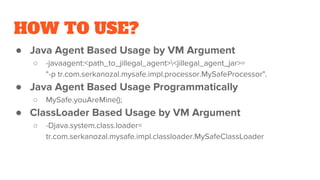
HOW TO USE?
● Java Agent Based Usage by VM Argument
○ -javaagent:<path_to_jillegal_agent><jillegal_agent_jar>=
"-p tr.com.serkanozal.mysafe.impl.processor.MySafeProcessor".
● Java Agent Based Usage Programmatically
○ MySafe.youAreMine();
● ClassLoader Based Usage by VM Argument
○ -Djava.system.class.loader=
tr.com.serkanozal.mysafe.impl.classloader.MySafeClassLoader
FEATURES & DEMO
● Memory Explorer API & Demo
● Memory Listener API & Demo
● Illegal Memory Access Listener API & Demo
● Custom Memory Management & Demo
● Tracing Allocation Path & Demo
Memory Explorer API
● Iterate on allocated memories
● Dump allocated memories
● MemoryExplorerDemo.java
Memory Listener API
● Be notified before/after allocate
● Be notified before/after reallocate
● Be notified before/after free
● MemoryListenerDemo.java
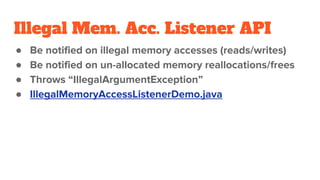
Illegal Mem. Acc. Listener API
● Be notified on illegal memory accesses (reads/writes)
● Be notified on un-allocated memory reallocations/frees
● Throws “IllegalArgumentException”
● IllegalMemoryAccessListenerDemo.java
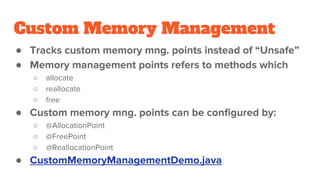
Custom Memory Management
● Tracks custom memory mng. points instead of “Unsafe”
● Memory management points refers to methods which
○ allocate
○ reallocate
○ free
● Custom memory mng. points can be configured by:
○ @AllocationPoint
○ @FreePoint
○ @ReallocationPoint
● CustomMemoryManagementDemo.java
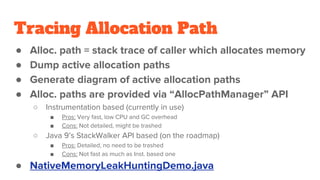
Tracing Allocation Path
● Alloc. path = stack trace of caller which allocates memory
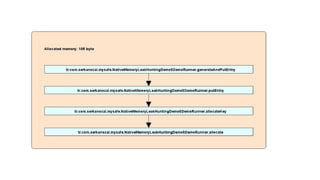
● Dump active allocation paths
● Generate diagram of active allocation paths
● Alloc. paths are provided via “AllocPathManager” API
○ Instrumentation based (currently in use)
■ Pros: Very fast, low CPU and GC overhead
■ Cons: Not detailed, might be trashed
○ Java 9’s StackWalker API based (on the roadmap)
■ Pros: Detailed, no need to be trashed
■ Cons: Not fast as much as Inst. based one
● NativeMemoryLeakHuntingDemo.java
Inst. Based Alloc. Path Manager
● Identify each method which exist in the any alloc. path
● Inject code into methods to provide them as alloc. path
○ Push method identifier to thread-local call stack
○ Proceed actual call
○ Pop method identifier from thread-local call stack
● Generate alloc. path id from alloc. point (method) ids
○ Each alloc. point id is 2 bytes short number
○ Whole alloc. path is represented with 8 bytes long number
○ There can be at most 4 alloc. points, old ones are evicted
foo1 [1]
1
foo1 [1]
bar1 [2]
1 2
foo1 [1]
bar1 [2]
foo2 [3]
1 2 3
foo1 [1]
bar1 [2]
foo2 [3]
bar2 [4]
1 2 3 4
foo1 [1]
bar1 [2]
foo2 [3]
bar2 [4]
foo3 [5]
2 3 4 5
foo1 [1]
bar1 [2]
foo2 [3]
bar2 [4]
foo3 [5]
bar3 [6]
3 4 5 6
foo1 [1]
bar1 [2]
foo2 [3]
bar2 [4]
foo3 [5]
bar3 [6]
malloc
3 4 5 6
foo2 => bar2 => foo3 => bar3
ROADMAP
● Ability to track line numbers also
● More detailed and accurate allocation path detection
● Ability to inspect “Unsafe” directly
● Java 9 support
● Allocation path detection via Java 9’s StackWalker API
● Flame graph support
THANKS

MySafe

  • 1.
  • 2.
    AGENDA ● WHAT ISMYSAFE? ● MOTIVATION ● STATE OF ART ● HOW TO USE? ● FEATURES & DEMO ● ROADMAP
  • 3.
    WHAT IS MYSAFE? ●Intercepts “sun.misc.Unsafe” calls ● Can track memory allocations and frees ● Can track memory accesses (reads/writes) ● Can align memory accesses (reads/writes) ● Can track custom memory allocations/frees ○ Ex. your custom memory manager implementation ● Can track memory allocation paths ○ Find the origins of leaked (non-free) memories
  • 4.
    MOTIVATION ● Debugging memoryallocations and frees ○ Checking native memory leaks over “Unsafe” ○ Detecting causes of native memory leaks ● Debugging memory accesses (reads/writes) ○ Finding the causes of illegal memory accesses ● Handle unaligned memory accesses (causes SIGBUS) ○ SPARC ○ ...
  • 5.
    STATE OF ART ●Inspect application classes while loading ○ At “ClassFileTransformer” level ○ At “Classloader” level ● Redirect “Unsafe” calls to MySafe ● MySafe handles the call ● Proceeds to “Unsafe”
  • 6.
    WHY NOT JUSTINST. UNSAFE? ● Use “java.lang.Instrument#setNativeMethodPrefix” ● Add new wrapper methods for native methods ● Requires new method addition ● So class redefinition is not an option ● Hook into “Unsafe” classloading process ● “Unsafe” is already loaded before ○ Java agent ○ User classloader ● Use native JVMTI agent at startup (on the roadmap)
  • 7.
    HOW TO USE? ●Java Agent Based Usage by VM Argument ○ -javaagent:<path_to_jillegal_agent><jillegal_agent_jar>= "-p tr.com.serkanozal.mysafe.impl.processor.MySafeProcessor". ● Java Agent Based Usage Programmatically ○ MySafe.youAreMine(); ● ClassLoader Based Usage by VM Argument ○ -Djava.system.class.loader= tr.com.serkanozal.mysafe.impl.classloader.MySafeClassLoader
  • 8.
    FEATURES & DEMO ●Memory Explorer API & Demo ● Memory Listener API & Demo ● Illegal Memory Access Listener API & Demo ● Custom Memory Management & Demo ● Tracing Allocation Path & Demo
  • 9.
    Memory Explorer API ●Iterate on allocated memories ● Dump allocated memories ● MemoryExplorerDemo.java
  • 10.
    Memory Listener API ●Be notified before/after allocate ● Be notified before/after reallocate ● Be notified before/after free ● MemoryListenerDemo.java
  • 11.
    Illegal Mem. Acc.Listener API ● Be notified on illegal memory accesses (reads/writes) ● Be notified on un-allocated memory reallocations/frees ● Throws “IllegalArgumentException” ● IllegalMemoryAccessListenerDemo.java
  • 12.
    Custom Memory Management ●Tracks custom memory mng. points instead of “Unsafe” ● Memory management points refers to methods which ○ allocate ○ reallocate ○ free ● Custom memory mng. points can be configured by: ○ @AllocationPoint ○ @FreePoint ○ @ReallocationPoint ● CustomMemoryManagementDemo.java
  • 13.
    Tracing Allocation Path ●Alloc. path = stack trace of caller which allocates memory ● Dump active allocation paths ● Generate diagram of active allocation paths ● Alloc. paths are provided via “AllocPathManager” API ○ Instrumentation based (currently in use) ■ Pros: Very fast, low CPU and GC overhead ■ Cons: Not detailed, might be trashed ○ Java 9’s StackWalker API based (on the roadmap) ■ Pros: Detailed, no need to be trashed ■ Cons: Not fast as much as Inst. based one ● NativeMemoryLeakHuntingDemo.java
  • 15.
    Inst. Based Alloc.Path Manager ● Identify each method which exist in the any alloc. path ● Inject code into methods to provide them as alloc. path ○ Push method identifier to thread-local call stack ○ Proceed actual call ○ Pop method identifier from thread-local call stack ● Generate alloc. path id from alloc. point (method) ids ○ Each alloc. point id is 2 bytes short number ○ Whole alloc. path is represented with 8 bytes long number ○ There can be at most 4 alloc. points, old ones are evicted
  • 16.
  • 17.
  • 18.
  • 19.
    foo1 [1] bar1 [2] foo2[3] bar2 [4] 1 2 3 4
  • 20.
    foo1 [1] bar1 [2] foo2[3] bar2 [4] foo3 [5] 2 3 4 5
  • 21.
    foo1 [1] bar1 [2] foo2[3] bar2 [4] foo3 [5] bar3 [6] 3 4 5 6
  • 22.
    foo1 [1] bar1 [2] foo2[3] bar2 [4] foo3 [5] bar3 [6] malloc 3 4 5 6 foo2 => bar2 => foo3 => bar3
  • 23.
    ROADMAP ● Ability totrack line numbers also ● More detailed and accurate allocation path detection ● Ability to inspect “Unsafe” directly ● Java 9 support ● Allocation path detection via Java 9’s StackWalker API ● Flame graph support
  • 24.