Serkan ÖZAL
JVM UNDER THE HOOD
AGENDA
I. JVM Concepts
II. Memory Management
III. GC
IV. Class Loading
V. Execution Engine
VI. Multi-Threading
VII. JNI
I. JVM CONCEPTS
TERMS
• JVM
• Runs the bytecodes
• Doesn't understand Java source code
• JRE
• Execute java programs
• = JVM + Packages Classes (lang, util, math, ...) + Runtime libraries (native .dll/.so libs)
• JDK
• Compiles and builds java programs
• = JRE + Development/Debugging Tools (javac, javap, javadoc, jdb, …)
HOTSPOT
• Implementation of the JVM
• Originally developed by Sun and now owned by Oracle
• Initially available as an add-on for Java 1.2 (1999)
• Became the default Sun JVM in Java 1.3 (2000)
• = Interpreter + JIT + GC + Class loading + ...
II. MEMORY MANAGEMENT
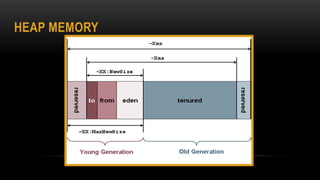
HEAP MEMORY
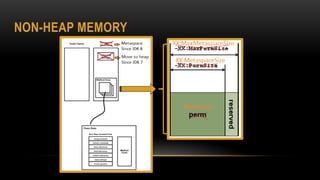
NON-HEAP MEMORY
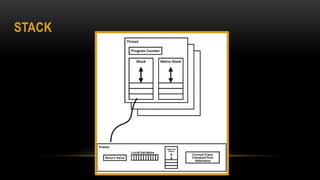
STACK
OBJECT LAYOUT
• Objects are 8 bytes aligned by default
• On JDK 8+, Can be configured by «-XX:ObjectAlignmentInBytes=?»
• Can only be power of 2 between 8-256
• All fields are type aligned
• Fields are packed in the order of their size (except references which are last)
• Sub and parent class fields are never mixed
• Use JOL (Java Object Layout) to analyze object layout
OBJECT SCHEMA
• Objects
• Mark word [4/8 bytes]
• Class pointer [4/8 bytes]
• Fields ...
• Arrays
• Mark word [4/8 bytes]
• Class pointer [4/8 bytes]
• Array length [4 bytes]
• Elements …
COMPRESSED OOPS
• Based on 8x object alignment rule
• Encode/decode by bit shifting (3 bit shift for default (8 bytes) object alignment)
• Can be configured by «-XX:+UseCompressedOops»
• Enabled by default on JDK 7+ (when heap <= 32GB)
• «-XX:+UseCompressedClassPointers» for classes on JDK 8+
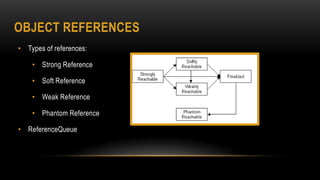
OBJECT REFERENCES
• Types of references:
• Strong Reference
• Soft Reference
• Weak Reference
• Phantom Reference
• ReferenceQueue
III. GC
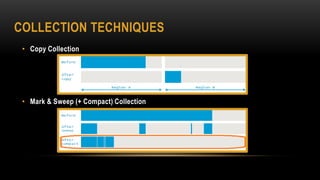
COLLECTION TECHNIQUES
• Copy Collection
• Mark & Sweep (+ Compact) Collection
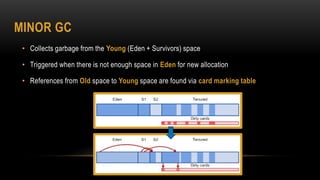
MINOR GC
• Collects garbage from the Young (Eden + Survivors) space
• Triggered when there is not enough space in Eden for new allocation
• References from Old space to Young space are found via card marking table
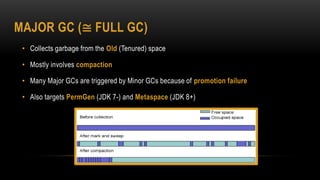
MAJOR GC (≅ FULL GC)
• Collects garbage from the Old (Tenured) space
• Mostly involves compaction
• Many Major GCs are triggered by Minor GCs because of promotion failure
• Also targets PermGen (JDK 7-) and Metaspace (JDK 8+)
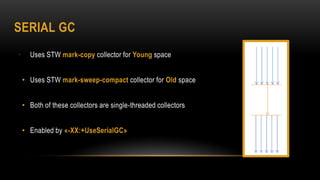
SERIAL GC
• Uses STW mark-copy collector for Young space
• Uses STW mark-sweep-compact collector for Old space
• Both of these collectors are single-threaded collectors
• Enabled by «-XX:+UseSerialGC»
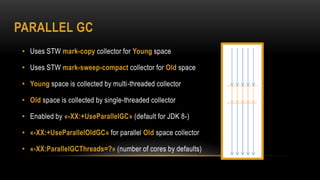
PARALLEL GC
• Uses STW mark-copy collector for Young space
• Uses STW mark-sweep-compact collector for Old space
• Young space is collected by multi-threaded collector
• Old space is collected by single-threaded collector
• Enabled by «-XX:+UseParallelGC» (default for JDK 8-)
• «-XX:+UseParallelOldGC» for parallel Old space collector
• «-XX:ParallelGCThreads=?» (number of cores by defaults)
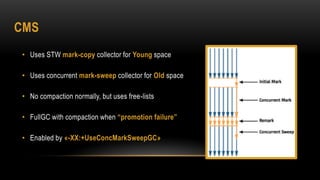
CMS
• Uses STW mark-copy collector for Young space
• Uses concurrent mark-sweep collector for Old space
• No compaction normally, but uses free-lists
• FullGC with compaction when “promotion failure”
• Enabled by «-XX:+UseConcMarkSweepGC»
G1
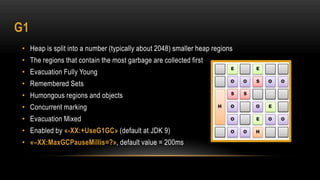
• Heap is split into a number (typically about 2048) smaller heap regions
• The regions that contain the most garbage are collected first
• Evacuation Fully Young
• Remembered Sets
• Humongous regions and objects
• Concurrent marking
• Evacuation Mixed
• Enabled by «-XX:+UseG1GC» (default at JDK 9)
• «–XX:MaxGCPauseMillis=?», default value = 200ms
SHENANDOAH
• JEP 189: Shenandoah: An Ultra-Low-Pause-Time Garbage Collector
• Drived by Red Hat
• First released on Fedore 24 on June 2016
• Not a generational garbage collector
• Concurrent, parallel and region-based garbage collector
• Supports concurrent compaction by Brooks forwarding pointers
IV. CLASS LOADING
CLASS LOADING
• Classes are loaded by classloaders
• Some core classes (java.lang, …) eagerly
• Others lazily when they are first requested
• JVM finds, parses, verifies bytecodes and generates metadata
• Class metadata is saved into Permgen (JDK 7-) / Metaspace (JDK 8+)
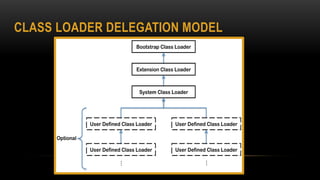
• Classes are searched hierarchically through classloaders
• If a class has already been loaded, it returns it
• Otherwise, it delegates the search to the parent class loader
• If the parent class loader does not find the class, tries to find and load the class itself
CLASS LOADER DELEGATION MODEL
V. EXECUTION ENGINE
INTERPRETER
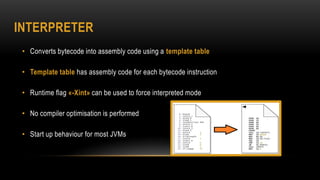
• Converts bytecode into assembly code using a template table
• Template table has assembly code for each bytecode instruction
• Runtime flag «-Xint» can be used to force interpreted mode
• No compiler optimisation is performed
• Start up behaviour for most JVMs
JIT
• JVM continually monitors the code for the following critical metrics:
• Method entry counts
• Loop back branch counts
• Escape Analysis: No Escape, Arg Escape, Global Escape
• CHA: Monomorphic, Bimorphic, Megamorphic calls
• OSR (On-Stack Replacement)
• Inlining
• Intrinsic
• De-optimization
COMPILERS
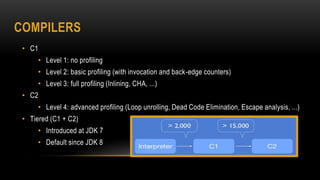
• C1
• Level 1: no profiling
• Level 2: basic profiling (with invocation and back-edge counters)
• Level 3: full profiling (Inlining, CHA, ...)
• C2
• Level 4: advanced profiling (Loop unrolling, Dead Code Elimination, Escape analysis, ...)
• Tiered (C1 + C2)
• Introduced at JDK 7
• Default since JDK 8
VI. MULTI-THREADING
THREAD MANAGEMENT
• 1:1 mapping between Java threads and native OS threads
• Thread states:
• Internal VM Threads:
• VM Thread
• Periodic Task Thread
• GC Threads
• Compiler Threads
• Signal Dispatcher Thread
• Finalizer Thread
• Reference Handler Thread
• Attach Listener Thread
• ...
• _thread_new
• _thread_in_Java
• _thread_in_vm
• _thread_in_native
• _thread_blocked
SYNCHRONIZATION
• Biased Locking
• Can be disabled by «-XX:-UseBiasedLocking»
• Delay can be configured by «-XX:BiasedLockingStartupDelay»
• Can be rebiased to another thread
• Can be revoked to lightweight lock
• Lightweight Locking
• In case of contention, inflated to heavyweight lock
• Heavyweight Locking
• Uses OS mutex/condition variables
SAFEPOINT
• On safepoint
• All threads running java code (interpreted or compiled) are suspended
• Threads running native code may continue to run as long as they do not
• attempt to contact with JVM via JNI API
• return from native to java
• A thread is at safepoint
• while running JNI code
• if it is blocked, waiting or parked
• A thread is not at safepoint while running java code (interpreted or compiled)
WHEN SAFEPOINTS ARE USED?
• Garbage collection pauses
• Code deoptimization
• Class redefinition (e.g. hot swap or instrumentation)
• Biased lock revocation & Monitor deflation
• Various debug operation (e.g. deadlock check or stacktrace dump)
• Heap dumping
HOW SAFEPOINTS WORK?
• Safepoint check (polling) is implemented as memory reads a barrier
• When safepoint is required, JVM unmaps page with that address provoking page fault
• Safepoint polling exist
• between any 2 bytecodes while running in the interpreter (effectively)
• on non-counted loop back edge in C1/C2 compiled code
• on method return in C1/C2 compiled code.
VII. JNI
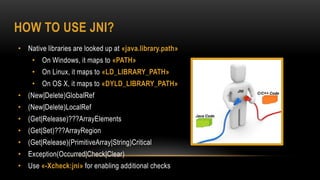
HOW TO USE JNI?
• Native libraries are looked up at «java.library.path»
• On Windows, it maps to «PATH»
• On Linux, it maps to «LD_LIBRARY_PATH»
• On OS X, it maps to «DYLD_LIBRARY_PATH»
• (New|Delete)GlobalRef
• (New|Delete)LocalRef
• (Get|Release)???ArrayElements
• (Get|Set)???ArrayRegion
• (Get|Release)(PrimitiveArray|String)Critical
• Exception(Occurred|Check|Clear)
• Use «-Xcheck:jni» for enabling additional checks
CRITICAL NATIVES
• Critical natives can be inlined
• Supported only in HotSpot JVM starting from JDK 7
• Must satisfy the following conditions:
• must be static and not synchronized
• argument types must be primitive or primitive arrays
• implementation must not call JNI functions
• Starts with «JavaCritical_» instead of «Java_»
• You need both critical and standard implementation
THANKS

JVM Under the Hood

  • 1.
  • 2.
    AGENDA I. JVM Concepts II.Memory Management III. GC IV. Class Loading V. Execution Engine VI. Multi-Threading VII. JNI
  • 3.
  • 4.
    TERMS • JVM • Runsthe bytecodes • Doesn't understand Java source code • JRE • Execute java programs • = JVM + Packages Classes (lang, util, math, ...) + Runtime libraries (native .dll/.so libs) • JDK • Compiles and builds java programs • = JRE + Development/Debugging Tools (javac, javap, javadoc, jdb, …)
  • 5.
    HOTSPOT • Implementation ofthe JVM • Originally developed by Sun and now owned by Oracle • Initially available as an add-on for Java 1.2 (1999) • Became the default Sun JVM in Java 1.3 (2000) • = Interpreter + JIT + GC + Class loading + ...
  • 6.
  • 7.
  • 8.
  • 9.
  • 10.
    OBJECT LAYOUT • Objectsare 8 bytes aligned by default • On JDK 8+, Can be configured by «-XX:ObjectAlignmentInBytes=?» • Can only be power of 2 between 8-256 • All fields are type aligned • Fields are packed in the order of their size (except references which are last) • Sub and parent class fields are never mixed • Use JOL (Java Object Layout) to analyze object layout
  • 11.
    OBJECT SCHEMA • Objects •Mark word [4/8 bytes] • Class pointer [4/8 bytes] • Fields ... • Arrays • Mark word [4/8 bytes] • Class pointer [4/8 bytes] • Array length [4 bytes] • Elements …
  • 12.
    COMPRESSED OOPS • Basedon 8x object alignment rule • Encode/decode by bit shifting (3 bit shift for default (8 bytes) object alignment) • Can be configured by «-XX:+UseCompressedOops» • Enabled by default on JDK 7+ (when heap <= 32GB) • «-XX:+UseCompressedClassPointers» for classes on JDK 8+
  • 13.
    OBJECT REFERENCES • Typesof references: • Strong Reference • Soft Reference • Weak Reference • Phantom Reference • ReferenceQueue
  • 14.
  • 15.
    COLLECTION TECHNIQUES • CopyCollection • Mark & Sweep (+ Compact) Collection
  • 16.
    MINOR GC • Collectsgarbage from the Young (Eden + Survivors) space • Triggered when there is not enough space in Eden for new allocation • References from Old space to Young space are found via card marking table
  • 17.
    MAJOR GC (≅FULL GC) • Collects garbage from the Old (Tenured) space • Mostly involves compaction • Many Major GCs are triggered by Minor GCs because of promotion failure • Also targets PermGen (JDK 7-) and Metaspace (JDK 8+)
  • 18.
    SERIAL GC • UsesSTW mark-copy collector for Young space • Uses STW mark-sweep-compact collector for Old space • Both of these collectors are single-threaded collectors • Enabled by «-XX:+UseSerialGC»
  • 19.
    PARALLEL GC • UsesSTW mark-copy collector for Young space • Uses STW mark-sweep-compact collector for Old space • Young space is collected by multi-threaded collector • Old space is collected by single-threaded collector • Enabled by «-XX:+UseParallelGC» (default for JDK 8-) • «-XX:+UseParallelOldGC» for parallel Old space collector • «-XX:ParallelGCThreads=?» (number of cores by defaults)
  • 20.
    CMS • Uses STWmark-copy collector for Young space • Uses concurrent mark-sweep collector for Old space • No compaction normally, but uses free-lists • FullGC with compaction when “promotion failure” • Enabled by «-XX:+UseConcMarkSweepGC»
  • 21.
    G1 • Heap issplit into a number (typically about 2048) smaller heap regions • The regions that contain the most garbage are collected first • Evacuation Fully Young • Remembered Sets • Humongous regions and objects • Concurrent marking • Evacuation Mixed • Enabled by «-XX:+UseG1GC» (default at JDK 9) • «–XX:MaxGCPauseMillis=?», default value = 200ms
  • 22.
    SHENANDOAH • JEP 189:Shenandoah: An Ultra-Low-Pause-Time Garbage Collector • Drived by Red Hat • First released on Fedore 24 on June 2016 • Not a generational garbage collector • Concurrent, parallel and region-based garbage collector • Supports concurrent compaction by Brooks forwarding pointers
  • 23.
  • 24.
    CLASS LOADING • Classesare loaded by classloaders • Some core classes (java.lang, …) eagerly • Others lazily when they are first requested • JVM finds, parses, verifies bytecodes and generates metadata • Class metadata is saved into Permgen (JDK 7-) / Metaspace (JDK 8+) • Classes are searched hierarchically through classloaders • If a class has already been loaded, it returns it • Otherwise, it delegates the search to the parent class loader • If the parent class loader does not find the class, tries to find and load the class itself
  • 25.
  • 26.
  • 27.
    INTERPRETER • Converts bytecodeinto assembly code using a template table • Template table has assembly code for each bytecode instruction • Runtime flag «-Xint» can be used to force interpreted mode • No compiler optimisation is performed • Start up behaviour for most JVMs
  • 28.
    JIT • JVM continuallymonitors the code for the following critical metrics: • Method entry counts • Loop back branch counts • Escape Analysis: No Escape, Arg Escape, Global Escape • CHA: Monomorphic, Bimorphic, Megamorphic calls • OSR (On-Stack Replacement) • Inlining • Intrinsic • De-optimization
  • 29.
    COMPILERS • C1 • Level1: no profiling • Level 2: basic profiling (with invocation and back-edge counters) • Level 3: full profiling (Inlining, CHA, ...) • C2 • Level 4: advanced profiling (Loop unrolling, Dead Code Elimination, Escape analysis, ...) • Tiered (C1 + C2) • Introduced at JDK 7 • Default since JDK 8
  • 30.
  • 31.
    THREAD MANAGEMENT • 1:1mapping between Java threads and native OS threads • Thread states: • Internal VM Threads: • VM Thread • Periodic Task Thread • GC Threads • Compiler Threads • Signal Dispatcher Thread • Finalizer Thread • Reference Handler Thread • Attach Listener Thread • ... • _thread_new • _thread_in_Java • _thread_in_vm • _thread_in_native • _thread_blocked
  • 32.
    SYNCHRONIZATION • Biased Locking •Can be disabled by «-XX:-UseBiasedLocking» • Delay can be configured by «-XX:BiasedLockingStartupDelay» • Can be rebiased to another thread • Can be revoked to lightweight lock • Lightweight Locking • In case of contention, inflated to heavyweight lock • Heavyweight Locking • Uses OS mutex/condition variables
  • 33.
    SAFEPOINT • On safepoint •All threads running java code (interpreted or compiled) are suspended • Threads running native code may continue to run as long as they do not • attempt to contact with JVM via JNI API • return from native to java • A thread is at safepoint • while running JNI code • if it is blocked, waiting or parked • A thread is not at safepoint while running java code (interpreted or compiled)
  • 34.
    WHEN SAFEPOINTS AREUSED? • Garbage collection pauses • Code deoptimization • Class redefinition (e.g. hot swap or instrumentation) • Biased lock revocation & Monitor deflation • Various debug operation (e.g. deadlock check or stacktrace dump) • Heap dumping
  • 35.
    HOW SAFEPOINTS WORK? •Safepoint check (polling) is implemented as memory reads a barrier • When safepoint is required, JVM unmaps page with that address provoking page fault • Safepoint polling exist • between any 2 bytecodes while running in the interpreter (effectively) • on non-counted loop back edge in C1/C2 compiled code • on method return in C1/C2 compiled code.
  • 36.
  • 37.
    HOW TO USEJNI? • Native libraries are looked up at «java.library.path» • On Windows, it maps to «PATH» • On Linux, it maps to «LD_LIBRARY_PATH» • On OS X, it maps to «DYLD_LIBRARY_PATH» • (New|Delete)GlobalRef • (New|Delete)LocalRef • (Get|Release)???ArrayElements • (Get|Set)???ArrayRegion • (Get|Release)(PrimitiveArray|String)Critical • Exception(Occurred|Check|Clear) • Use «-Xcheck:jni» for enabling additional checks
  • 38.
    CRITICAL NATIVES • Criticalnatives can be inlined • Supported only in HotSpot JVM starting from JDK 7 • Must satisfy the following conditions: • must be static and not synchronized • argument types must be primitive or primitive arrays • implementation must not call JNI functions • Starts with «JavaCritical_» instead of «Java_» • You need both critical and standard implementation
  • 39.