Guido Schmutz | Trivadis
Architektur von Big Data Lösungen
BASEL BERN BRUGG DÜSSELDORF FRANKFURT A.M. FREIBURG I.BR. GENEVA
HAMBURG COPENHAGEN LAUSANNE MUNICH STUTTGART VIENNA ZURICH
Architektur von Big Data Lösungen
Guido Schmutz
Guido Schmutz
Working for Trivadis for more than 19 years
Oracle ACE Director for Fusion Middleware and SOA
Co-Author of different books
Consultant, Trainer Software Architect for Java, Oracle, SOA and
Big Data / Fast Data
Member of Trivadis Architecture Board
Technology Manager @ Trivadis
More than 25 years of software development experience
Contact: guido.schmutz@trivadis.com
Blog: http://guidoschmutz.wordpress.com
Twitter: gschmutz
Agenda
1. Introduction
2. Traditional Architecture for Big Data
3. Streaming Analytics Architecture for Fast Data
4. Lambda/Kappa/Unifed Architecture for Big Data
5. Summary
Introduction
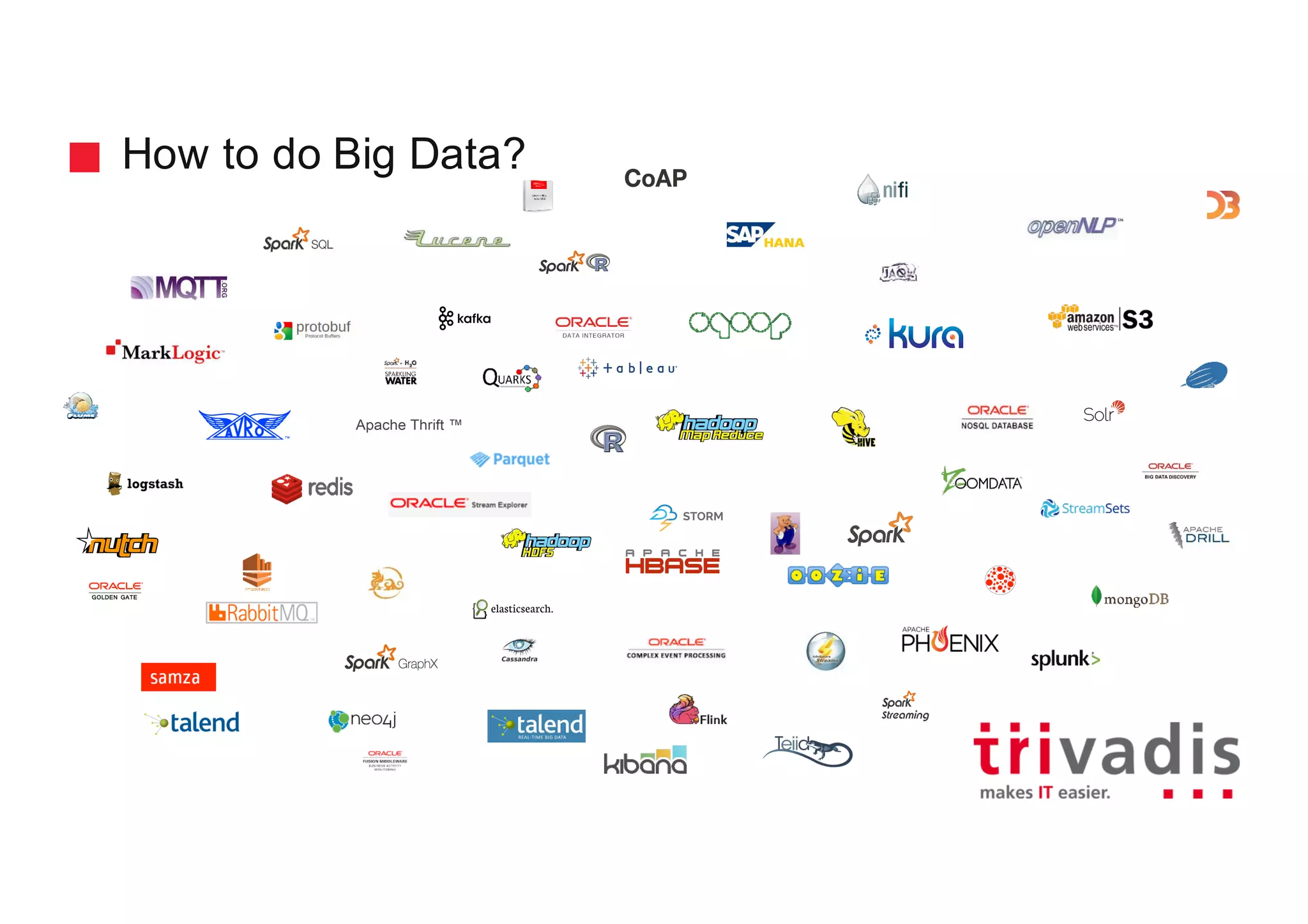
How to do Big Data?
Big Data is still “work in progress”
Choosing the right architecture is key for any (big data) project
Big Data is still quite a young field and therefore there are no standard architectures
available which have been used for years
In the past few years, a few architectures have evolved and have been discussed online
Know the use cases before choosing your architecture
To have one/a few reference architectures can help in choosing the right components
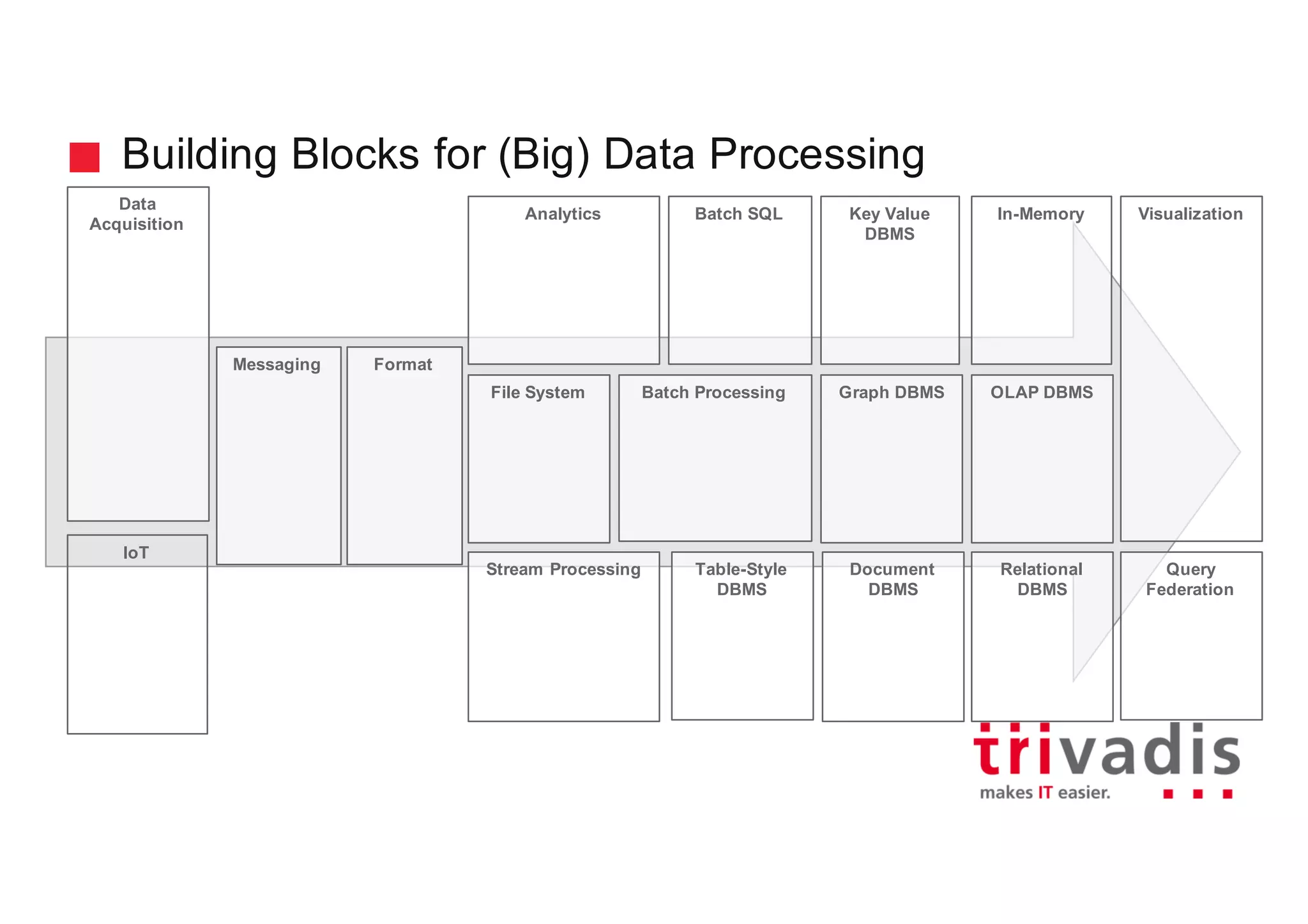
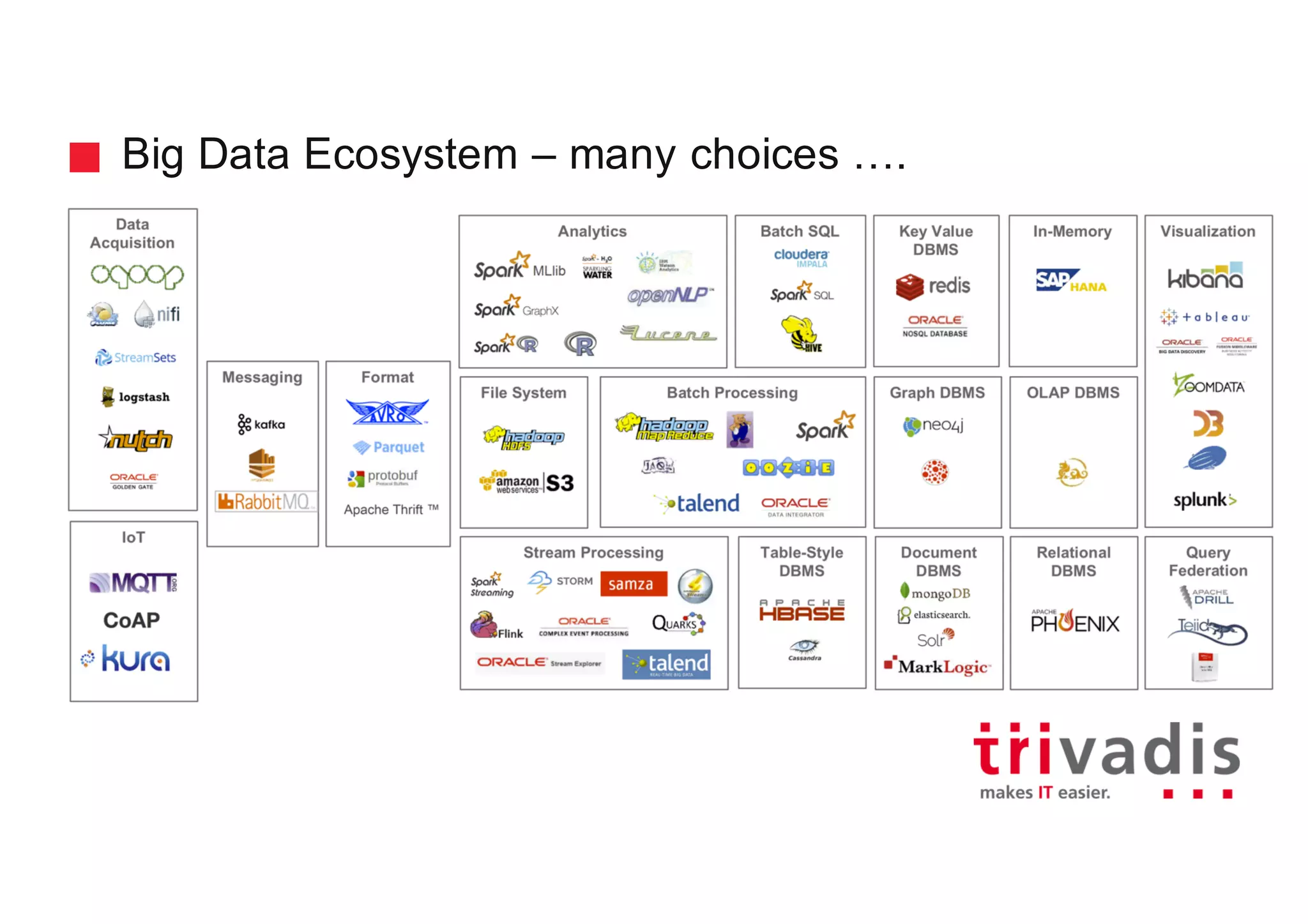
Building Blocks for (Big) Data Processing
Data
Acquisition
Format
File System
Stream Processing
Batch SQL
Graph DBMS
Document
DBMS
Relational
DBMS
Visualization
IoT
Messaging
Analytics
OLAP DBMS
Query
Federation
Table-Style
DBMS
Key Value
DBMS
Batch Processing
In-Memory
Big Data Ecosystem – many choices ….
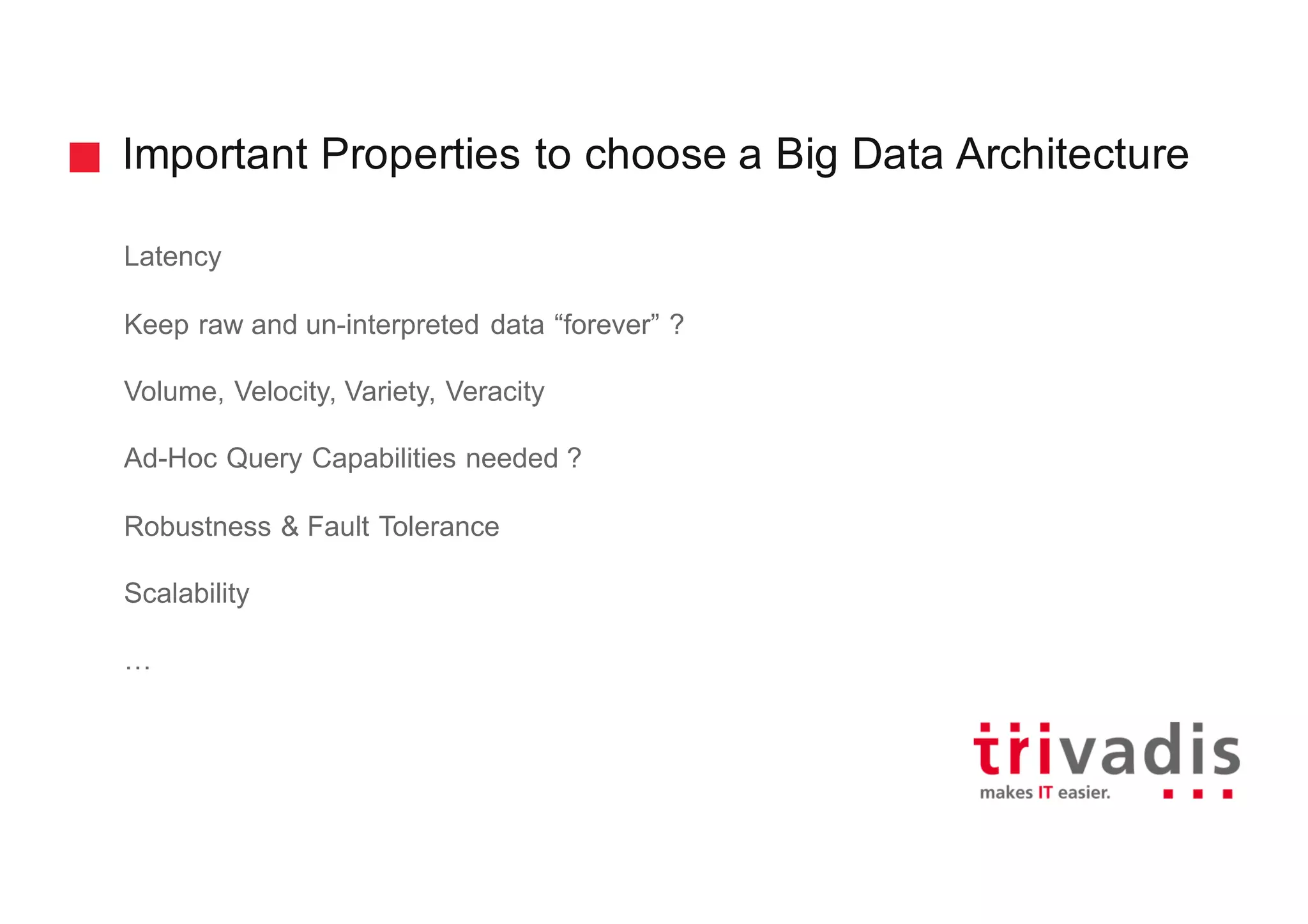
Important Properties to choose a Big Data Architecture
Latency
Keep raw and un-interpreted data “forever” ?
Volume, Velocity, Variety, Veracity
Ad-Hoc Query Capabilities needed ?
Robustness & Fault Tolerance
Scalability
…
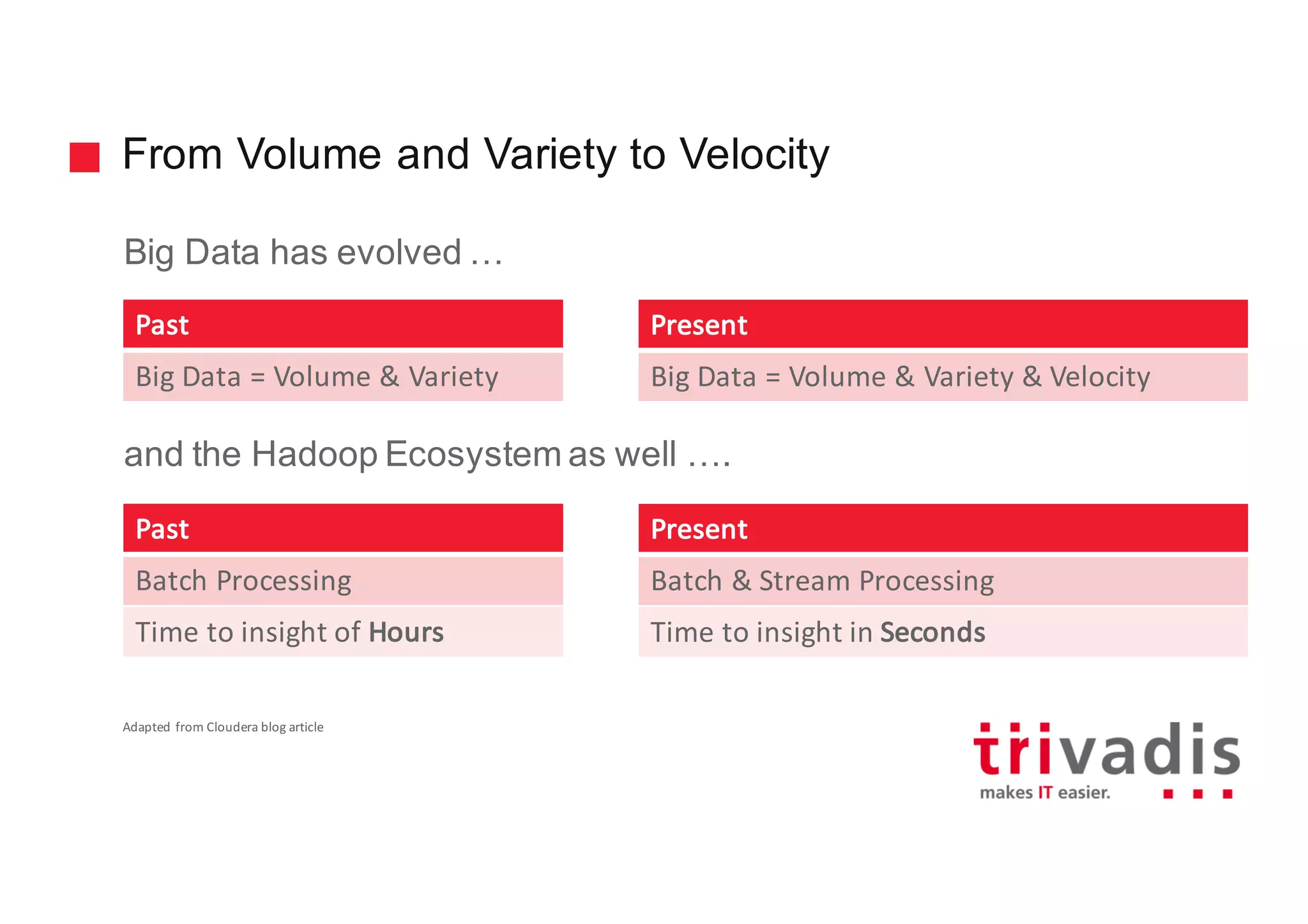
From Volume and Variety to Velocity
Big Data has evolved …
and the Hadoop Ecosystem as well ….
Past
Big	Data =	Volume	&	Variety
Present
Big	Data =	Volume	&	Variety	&	Velocity
Past
Batch	Processing
Time	to	insight	of	Hours
Present
Batch &	Stream	Processing
Time	to	insight in	Seconds
Adapted	from	Cloudera	blog	article
Traditional Architecture for Big
Data
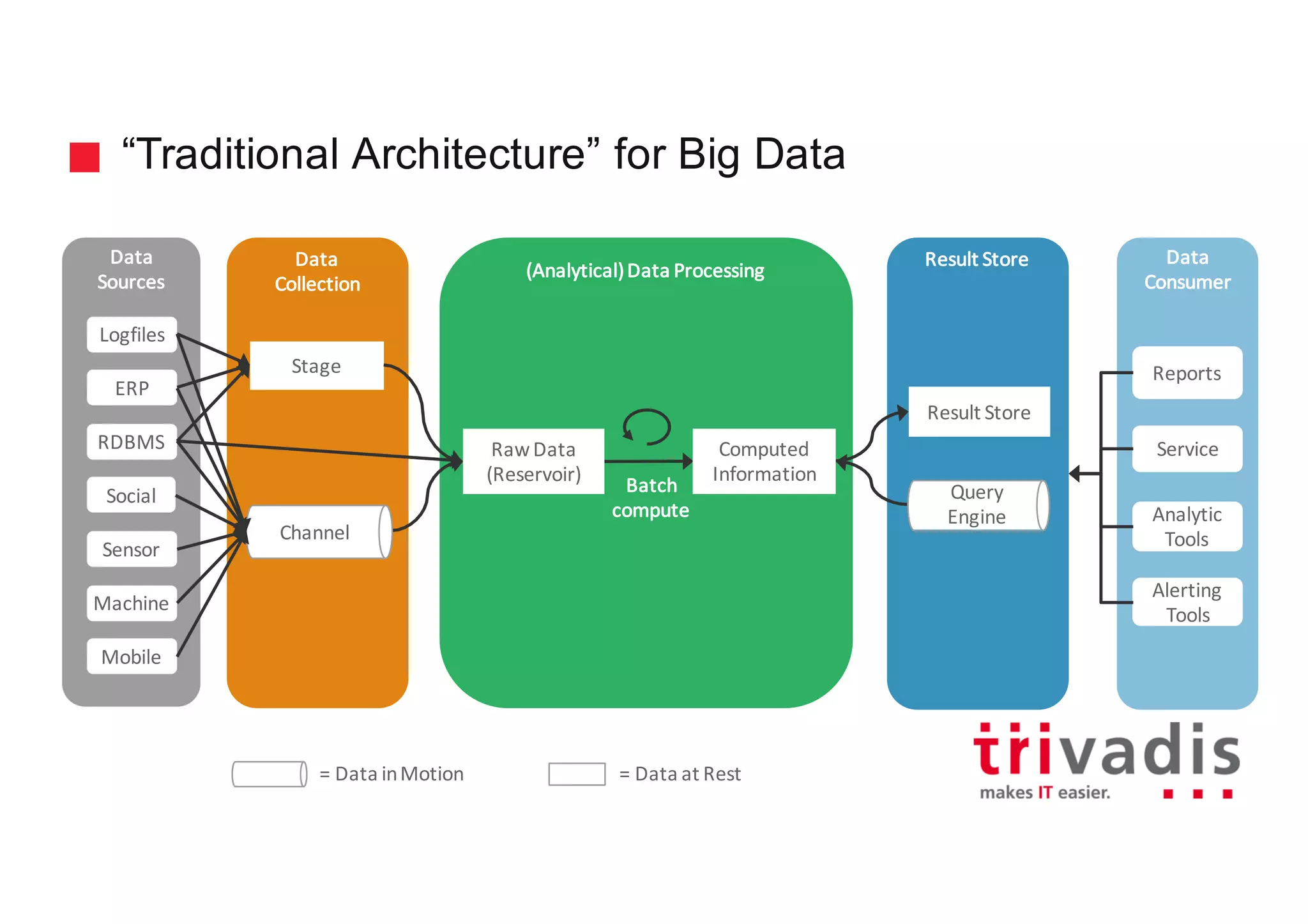
“Traditional Architecture” for Big Data
Data
Collection
(Analytical)	Data	Processing
Result	StoreData
Sources
Channel
Data
Consumer
Reports
Service
Analytic
Tools
Alerting
Tools
Social
RDBMS
Sensor
ERP
Logfiles
Mobile
Machine
Batch
compute
Stage
Result	Store
Query
Engine
Computed	
Information
Raw	Data	
(Reservoir)
=	Data	in	Motion =	Data	at	Rest
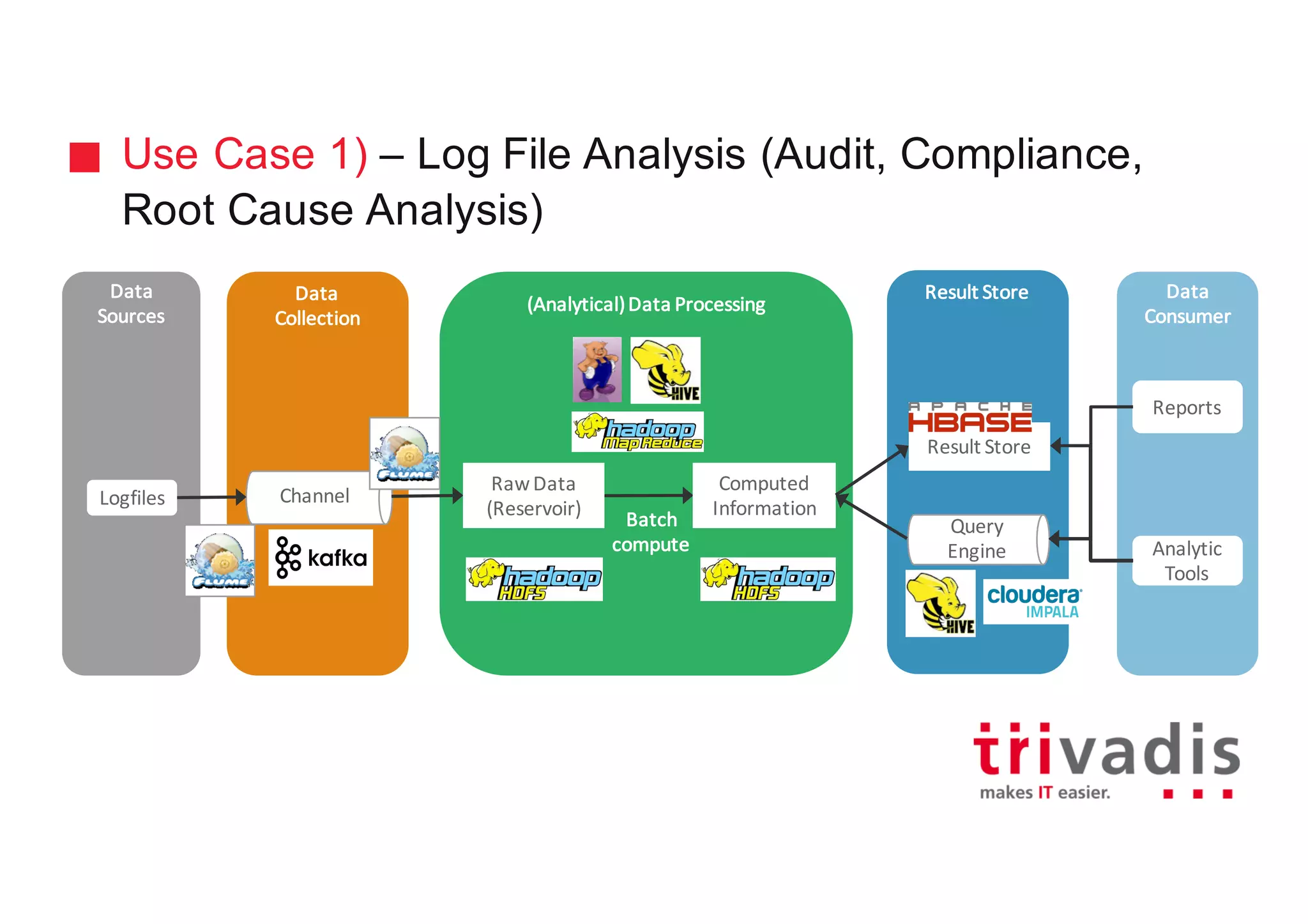
Use Case 1) – Log File Analysis (Audit, Compliance,
Root Cause Analysis)
Data
Collection
(Analytical)	Data	Processing
Result	StoreData
Sources
Data
Consumer
Channel
Batch
compute
Computed	
Information
Raw	Data	
(Reservoir)
Result	Store
Query
Engine
Reports
Analytic
Tools
Logfiles
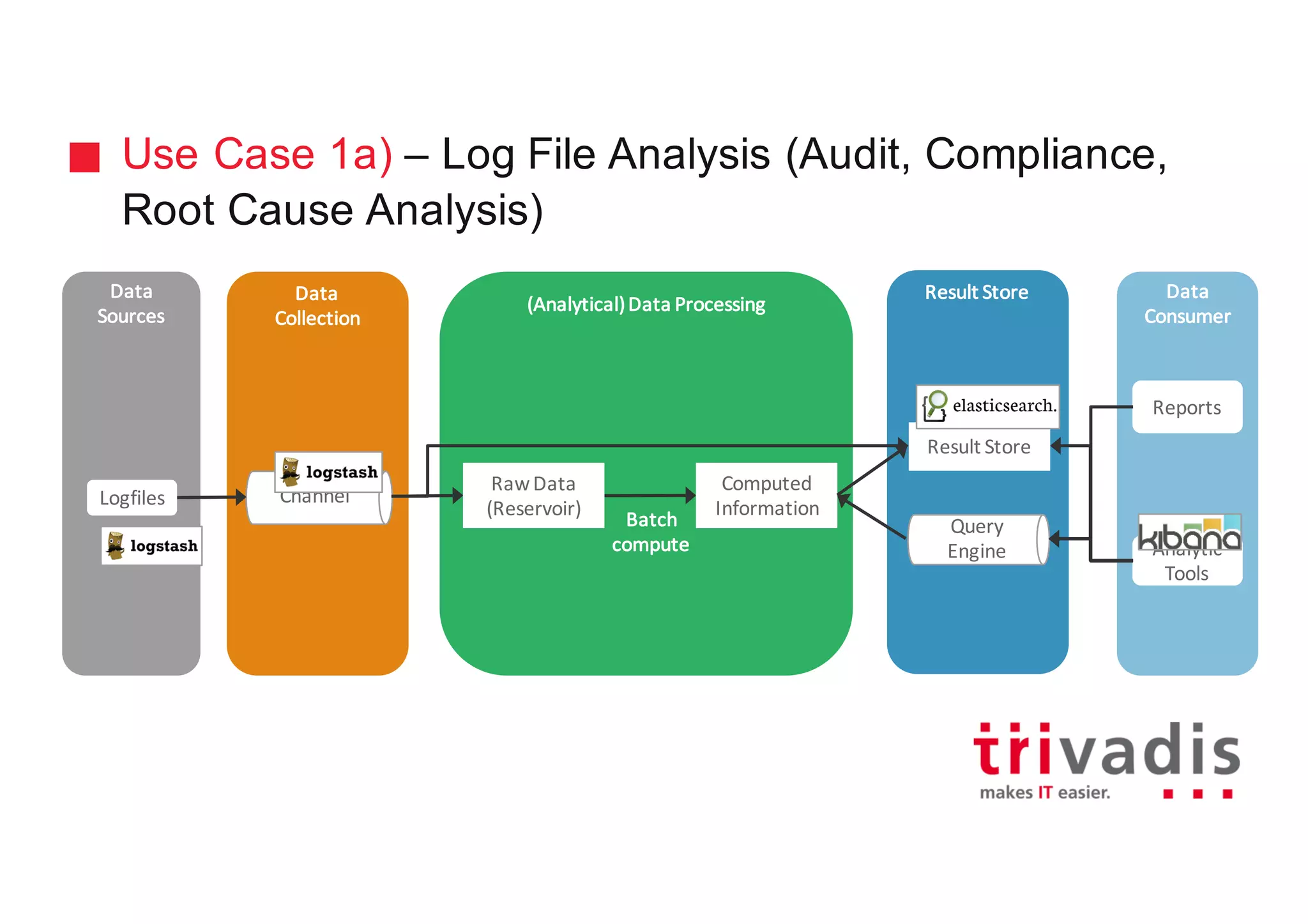
Use Case 1a) – Log File Analysis (Audit, Compliance,
Root Cause Analysis)
Data
Collection
(Analytical)	Data	Processing
Result	StoreData
Sources
Data
Consumer
Channel
Batch
compute
Computed	
Information
Raw	Data	
(Reservoir)
Result	Store
Query
Engine
Reports
Analytic
Tools
Logfiles
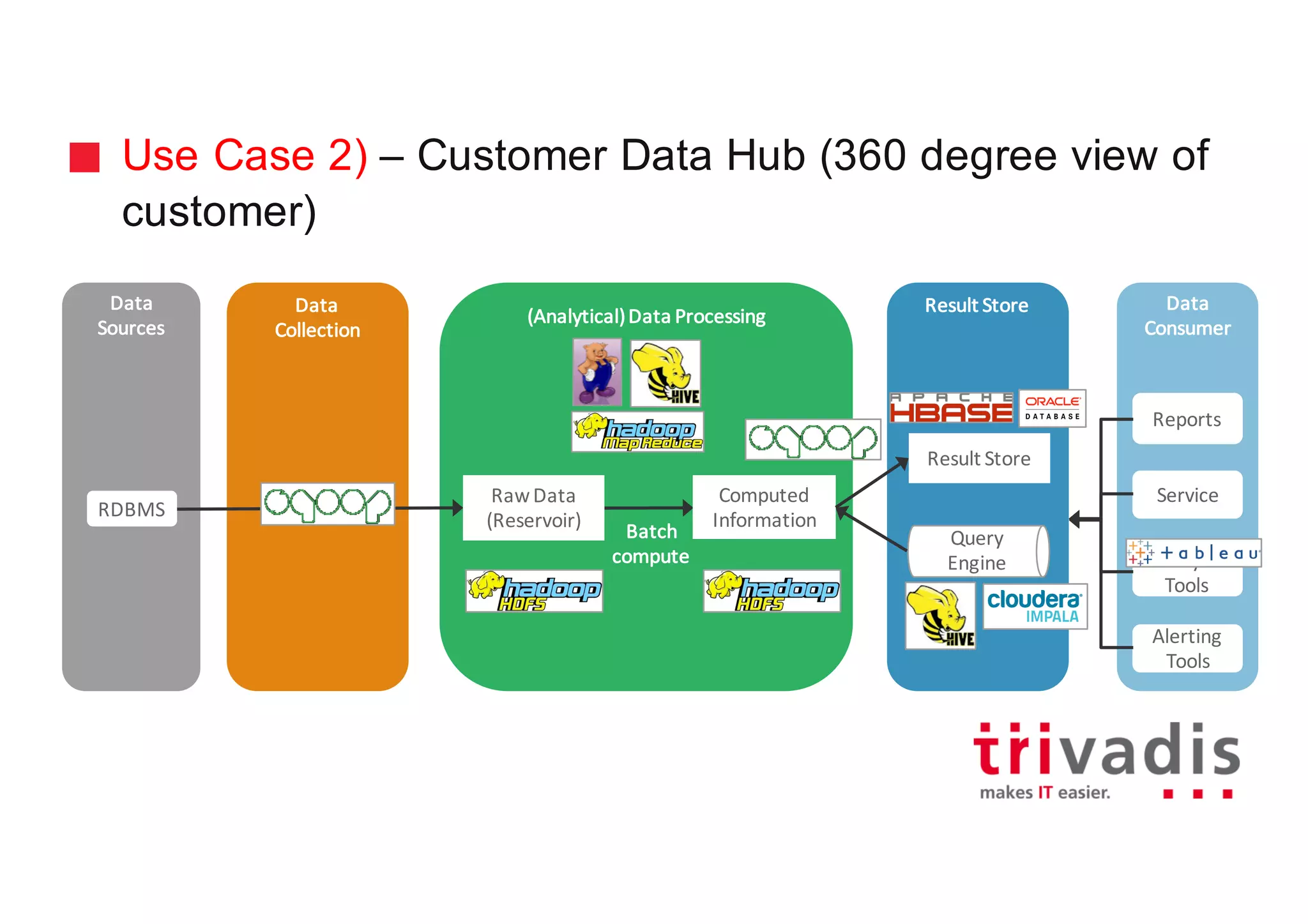
Use Case 2) – Customer Data Hub (360 degree view of
customer)
Data
Collection
(Analytical)	Data	Processing
Result	StoreData
Sources
Data
Consumer
RDBMS
Batch
compute
Computed	
Information
Raw	Data	
(Reservoir)
Result	Store
Query
Engine
Reports
Service
Analytic
Tools
Alerting
Tools
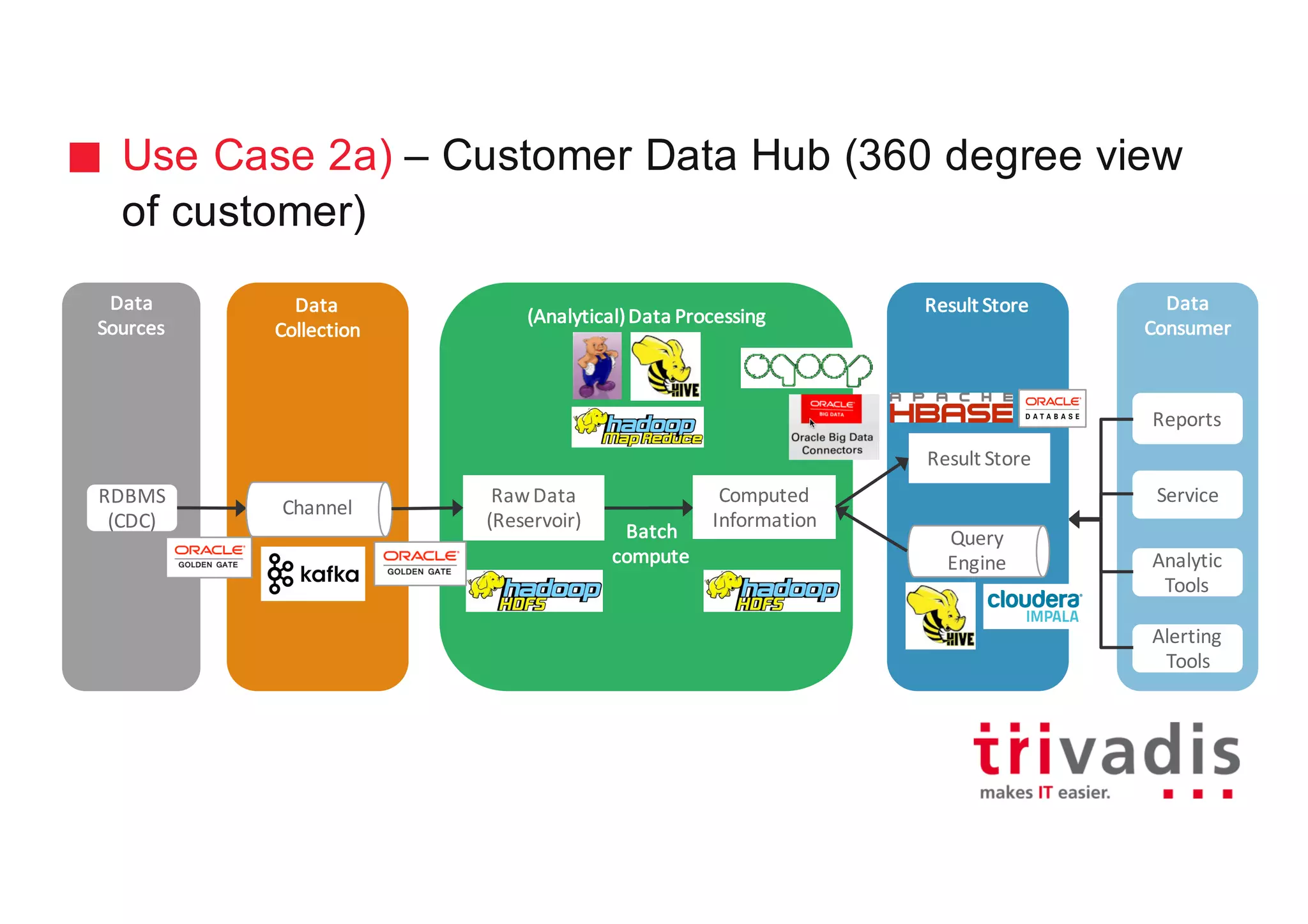
Use Case 2a) – Customer Data Hub (360 degree view
of customer)
Data
Collection
(Analytical)	Data	Processing
Result	StoreData
Sources
Data
Consumer
RDBMS
(CDC) Batch
compute
Computed	
Information
Raw	Data	
(Reservoir)
Result	Store
Query
Engine
Reports
Service
Analytic
Tools
Alerting
Tools
Channel
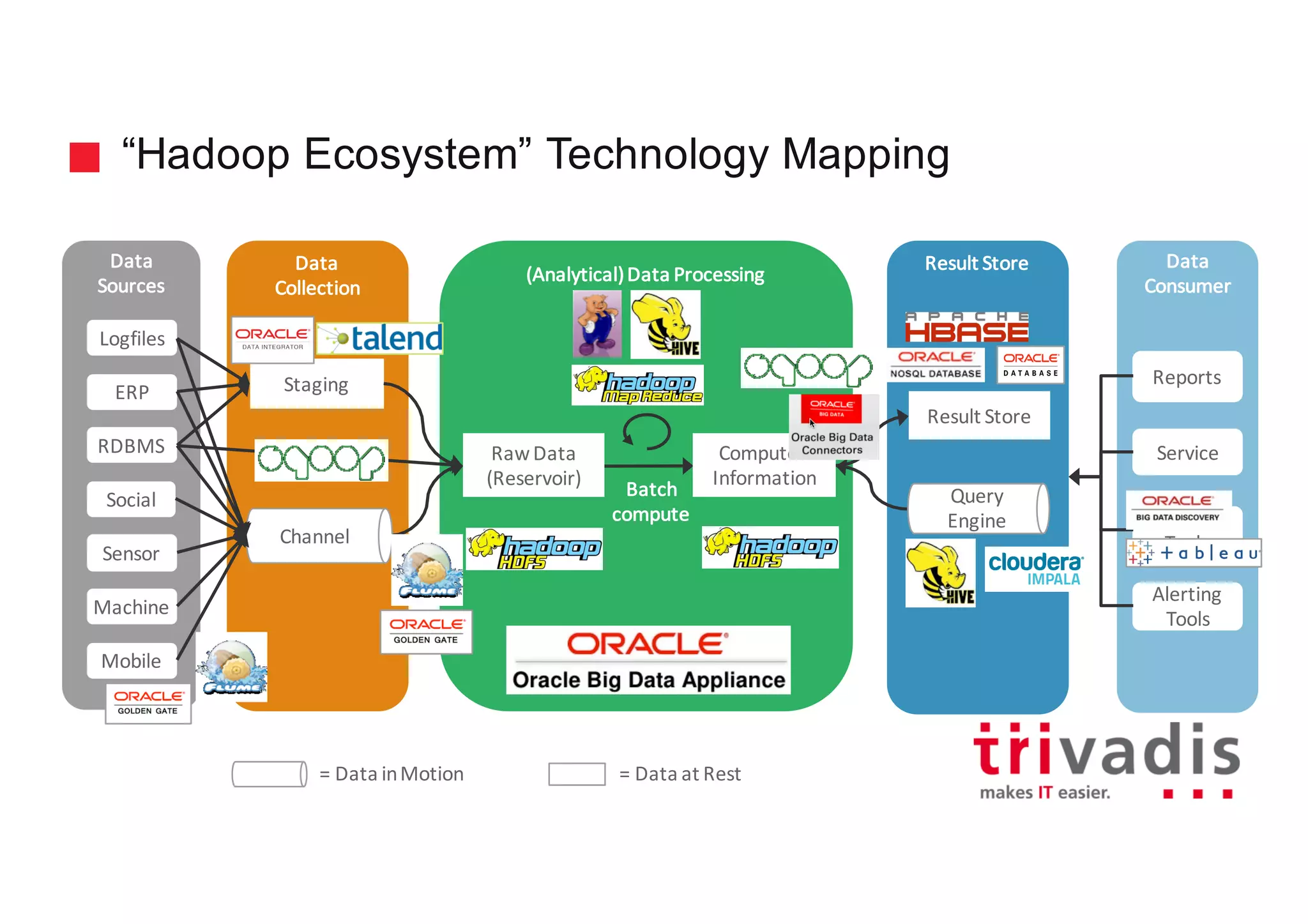
“Hadoop Ecosystem” Technology Mapping
Data
Collection
(Analytical)	Data	Processing
Result	StoreData
Sources
Channel
Data
Consumer
Reports
Service
Analytic
Tools
Alerting
Tools
Social
RDBMS
Sensor
ERP
Logfiles
Mobile
Machine
Batch
compute
Staging
Result	Store
Query
Engine
Computed	
Information
Raw	Data	
(Reservoir)
=	Data	in	Motion =	Data	at	Rest
Apache Spark – the new kid on the block
Apache Spark is a fast and general engine for large-scale data processing
• The hot trend in Big Data!
• Originally developed 2009 in UC Berkley’s AMPLab
• Can run programs up to 100x faster than Hadoop MapReduce in memory, or 10x
faster on disk
• One of the largest OSS communities in big data with over 200 contributors in 50+
organizations
• Open Sourced in 2010 – since 2014 part of Apache Software foundation
• Supported by many vendors
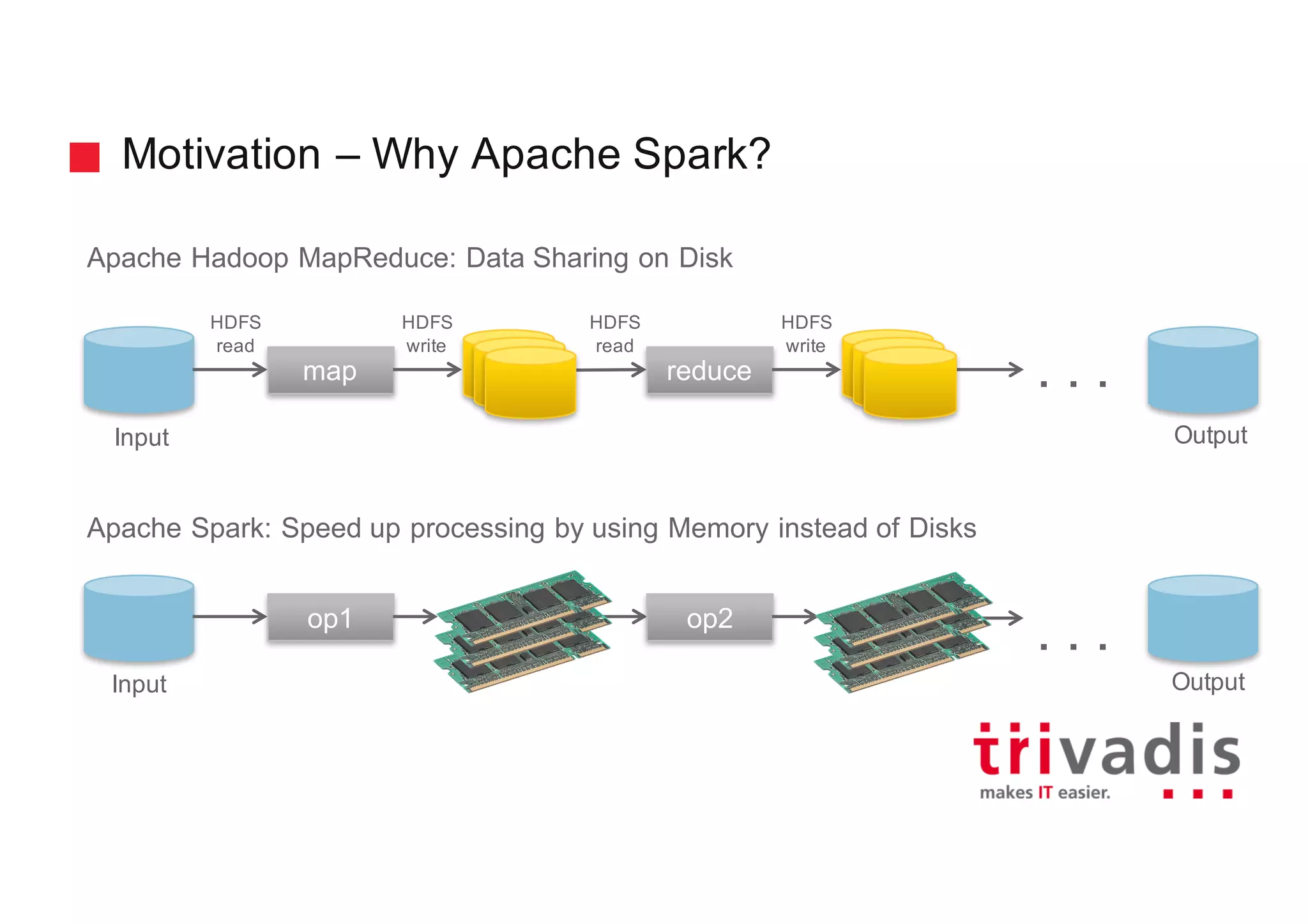
Motivation – Why Apache Spark?
Apache Hadoop MapReduce: Data Sharing on Disk
Apache Spark: Speed up processing by using Memory instead of Disks
map reduce . . .
Input
HDFS
read
HDFS
write
HDFS
read
HDFS
write
op1 op2
. . .
Input
Output
Output
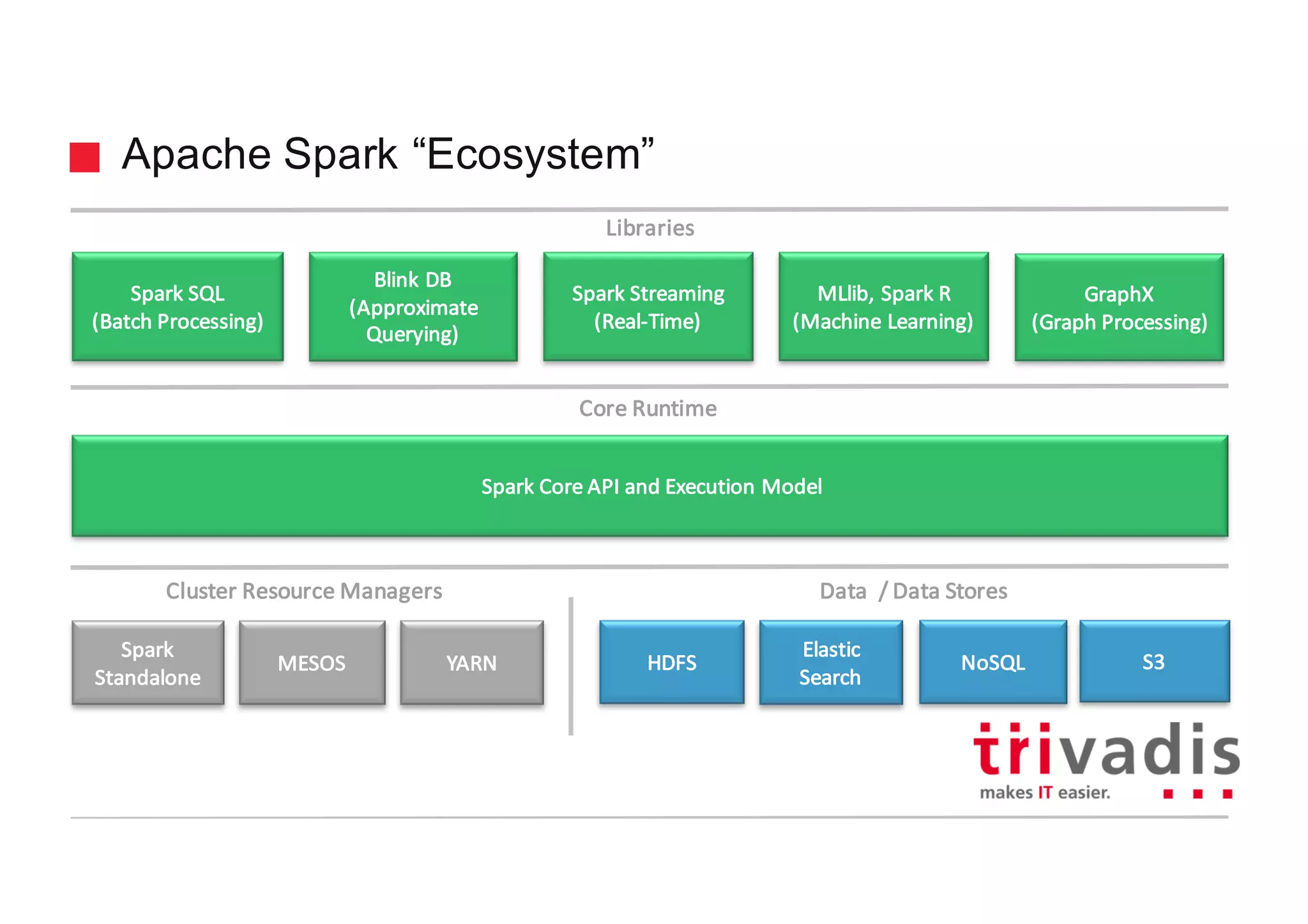
Apache Spark “Ecosystem”
Spark	SQL
(Batch	Processing)
Blink	DB
(Approximate
Querying)
Spark	Streaming
(Real-Time)
MLlib,	Spark	R
(Machine	Learning)
GraphX
(Graph	Processing)
Spark	Core	API	and	Execution	Model
Spark
Standalone
MESOS YARN HDFS
Elastic
Search
NoSQL S3
Libraries
Core	Runtime
Cluster	Resource	Managers Data		/	Data	Stores
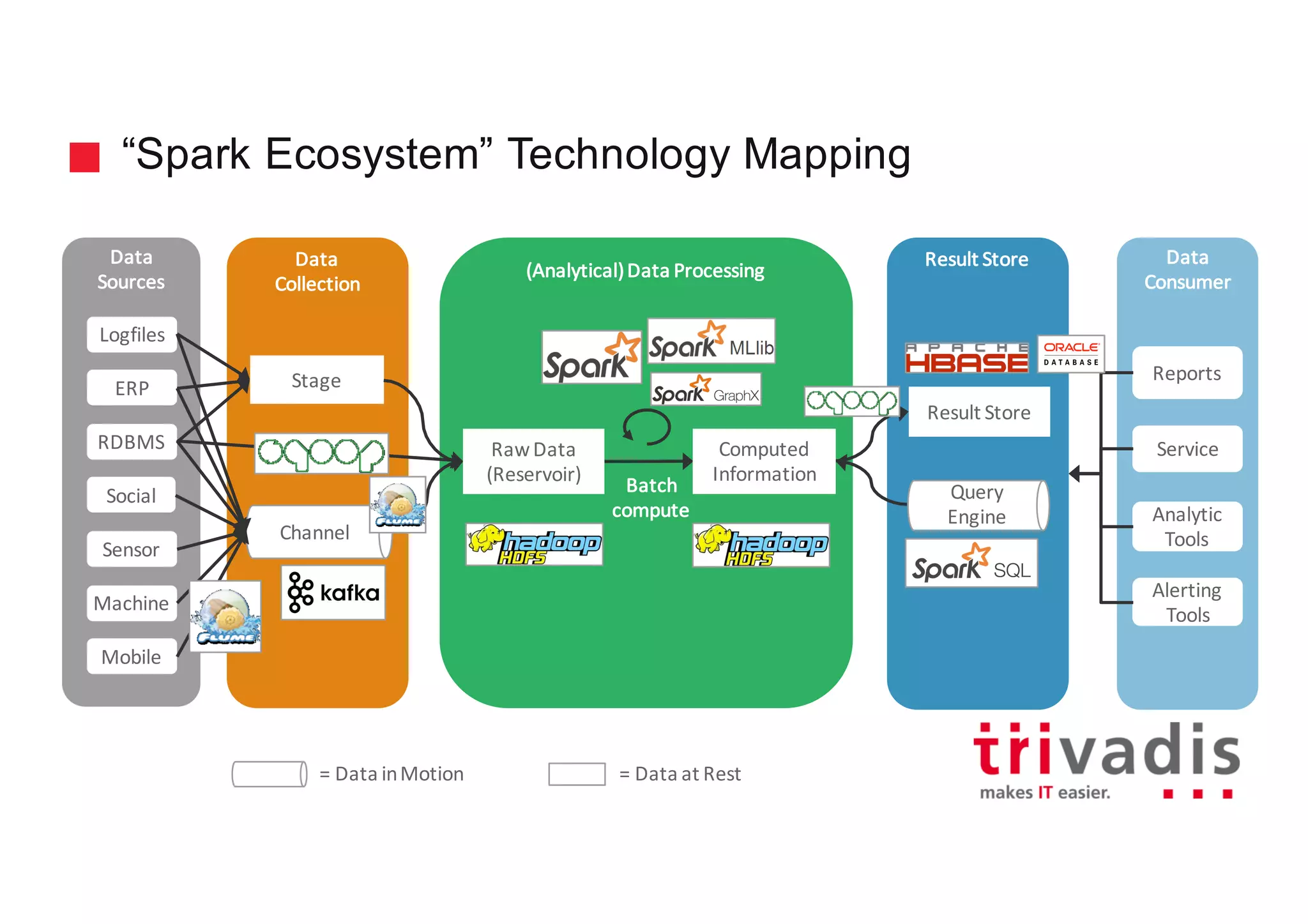
“Spark Ecosystem” Technology Mapping
Data
Collection
(Analytical)	Data	Processing
Result	StoreData
Sources
Channel
Data
Consumer
Reports
Service
Analytic
Tools
Alerting
Tools
Social
RDBMS
Sensor
ERP
Logfiles
Mobile
Machine
Batch
compute
Stage
Result	Store
Query
Engine
Computed	
Information
Raw	Data	
(Reservoir)
=	Data	in	Motion =	Data	at	Rest
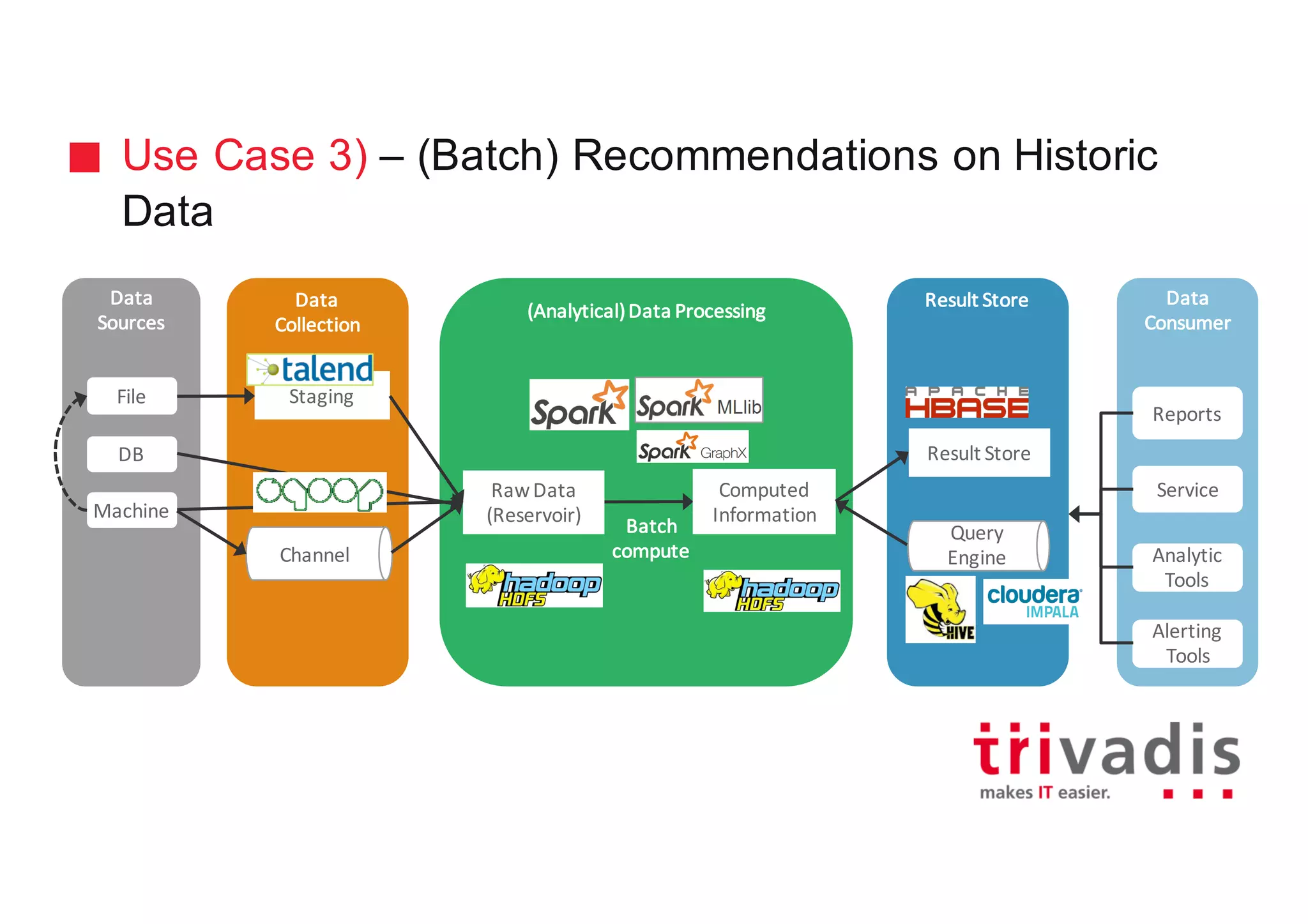
Use Case 3) – (Batch) Recommendations on Historic
Data
Data
Collection
(Analytical)	Data	Processing
Result	StoreData
Sources
Data
Consumer
Machine
Batch
compute
Computed	
Information
Raw	Data	
(Reservoir)
Result	Store
Query
Engine
Reports
Service
Analytic
Tools
Alerting
Tools
DB
StagingFile
Channel
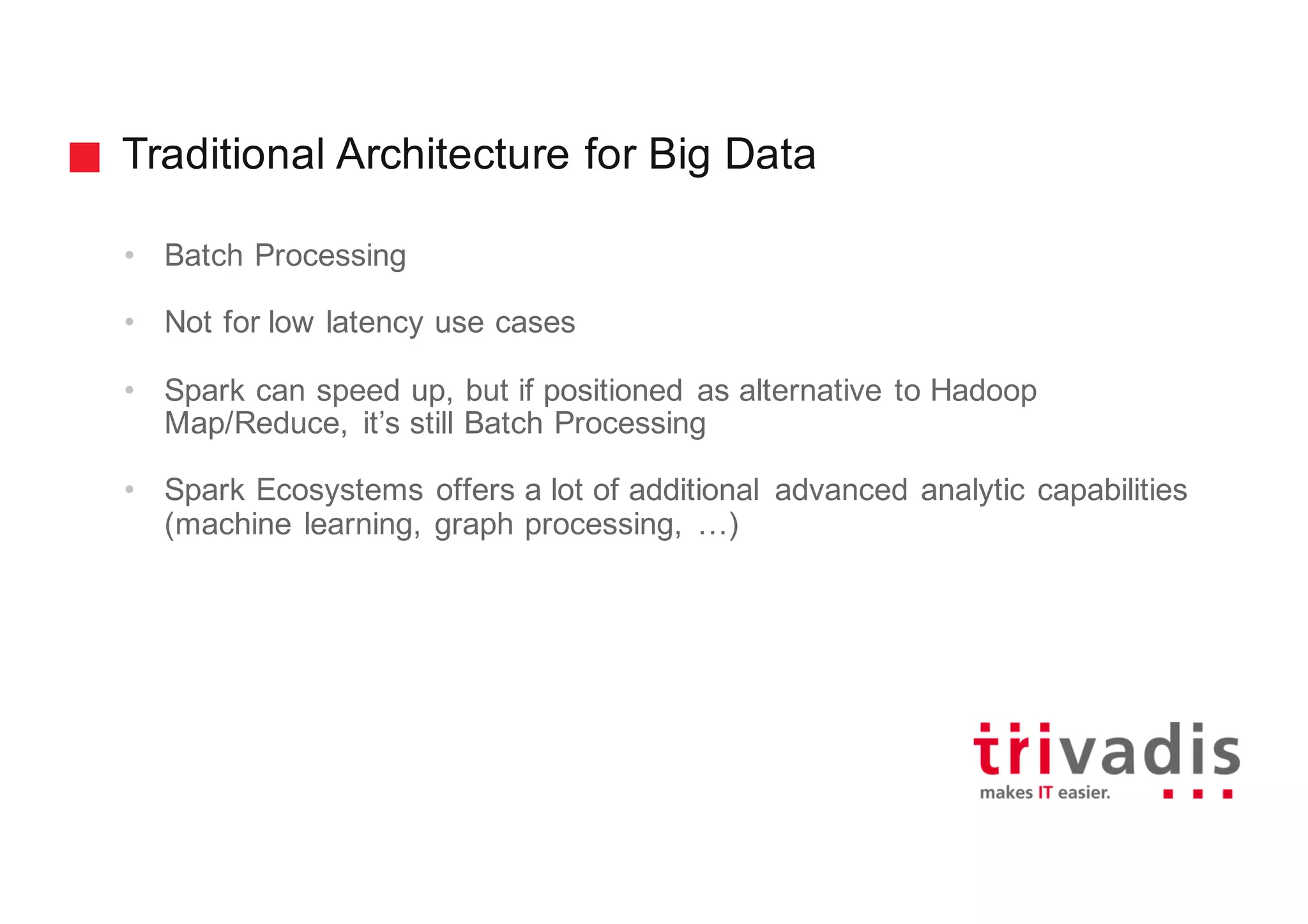
Traditional Architecture for Big Data
• Batch Processing
• Not for low latency use cases
• Spark can speed up, but if positioned as alternative to Hadoop
Map/Reduce, it’s still Batch Processing
• Spark Ecosystems offers a lot of additional advanced analytic capabilities
(machine learning, graph processing, …)
Streaming Analytics Architecture
for Big Data
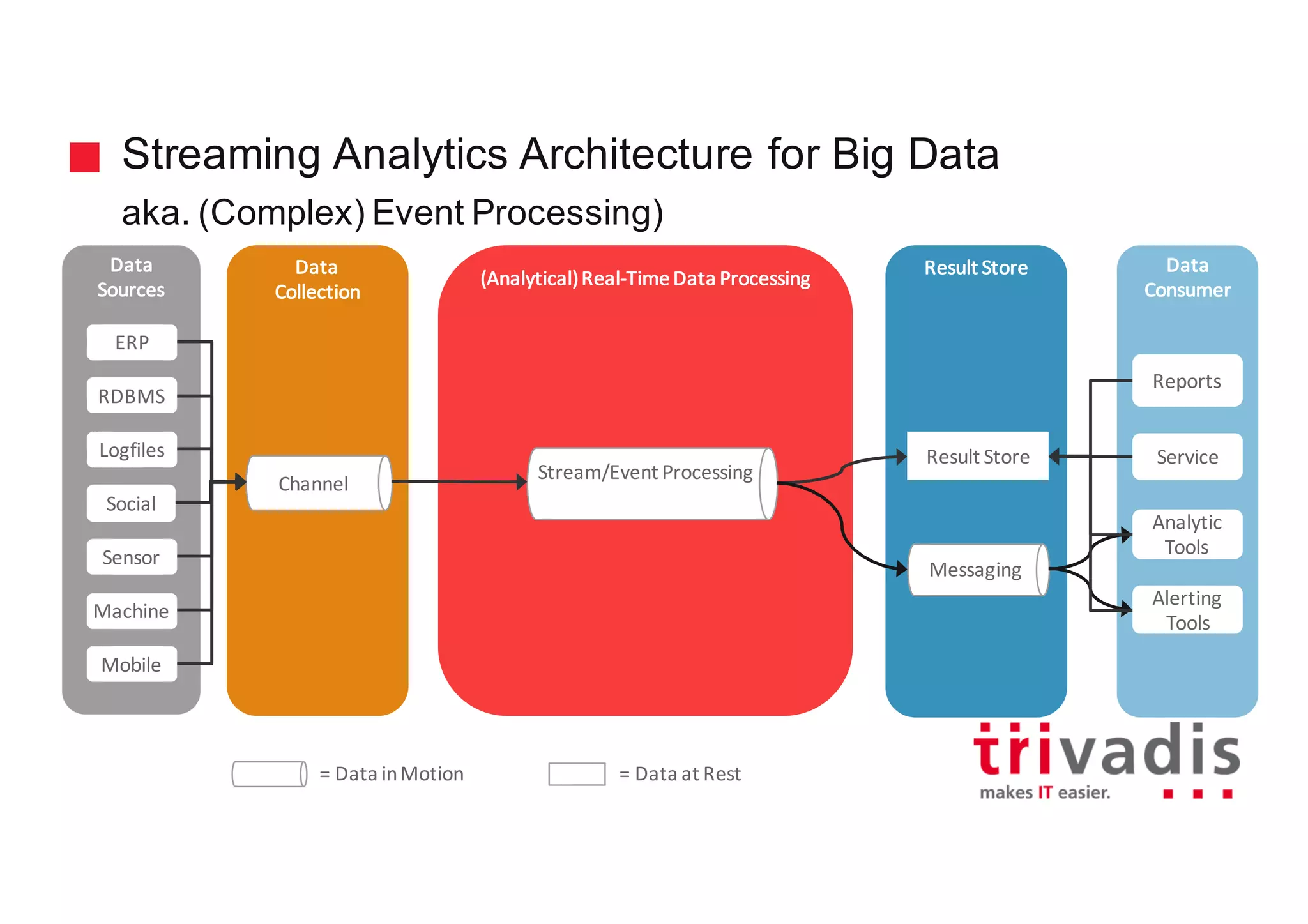
Streaming Analytics Architecture for Big Data
aka. (Complex) Event Processing)
Data
Collection
Batch
compute
Data
Sources
Channel
Data
Consumer
Reports
Service
Analytic
Tools
Alerting
Tools
Social
Logfiles
Sensor
RDBMS
ERP
Mobile
Machine
(Analytical)	Real-Time	Data	Processing
Stream/Event	Processing
Result	Store
Messaging
Result	Store
=	Data	in	Motion =	Data	at	Rest
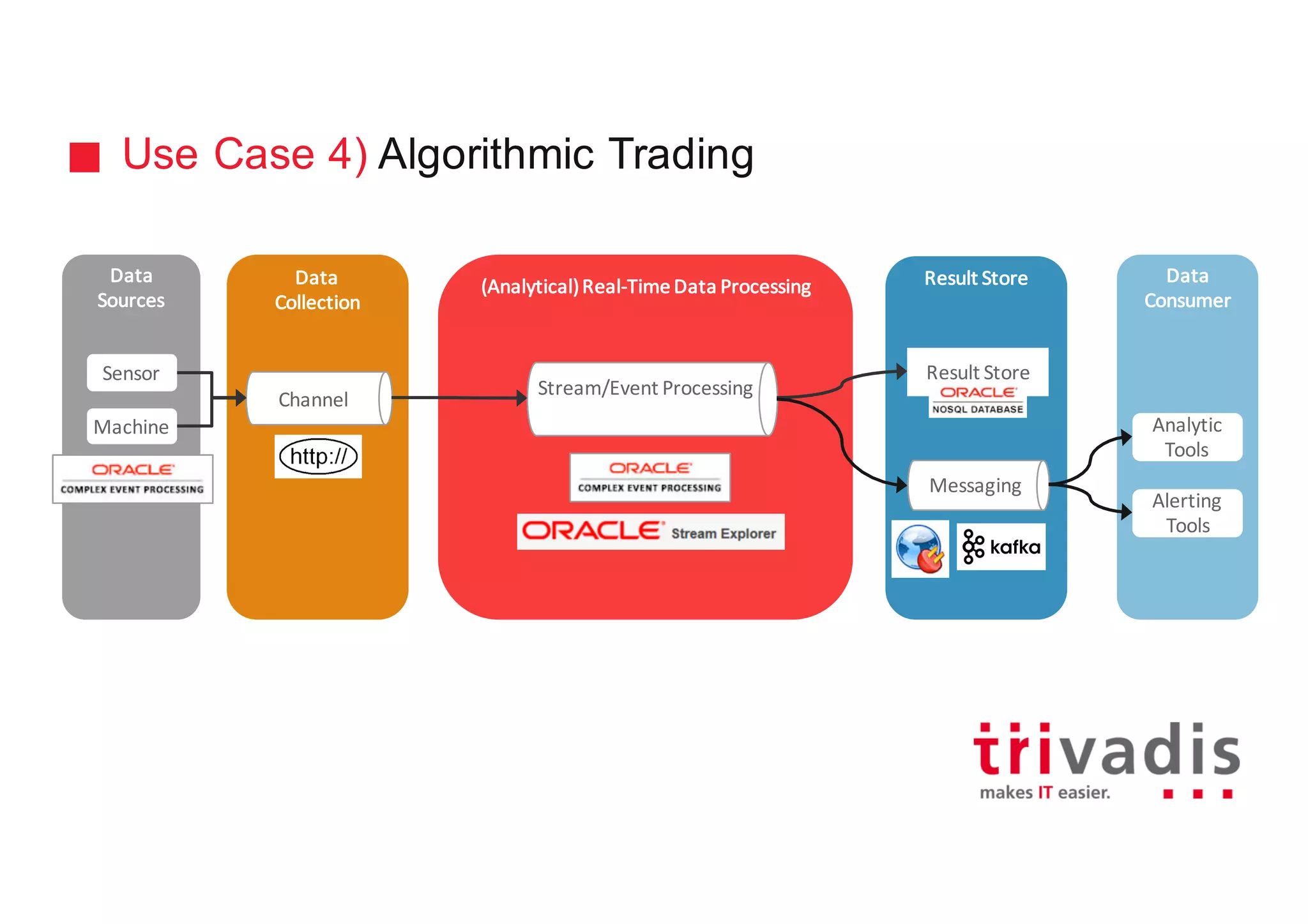
Use Case 4) Algorithmic Trading
Data
Collection
Batch
compute
Data
Sources
Channel
Data
Consumer
Analytic
Tools
Alerting
Tools
Sensor
Machine
(Analytical)	Real-Time	Data	Processing
Stream/Event	Processing
Result	Store
Messaging
Result	Store
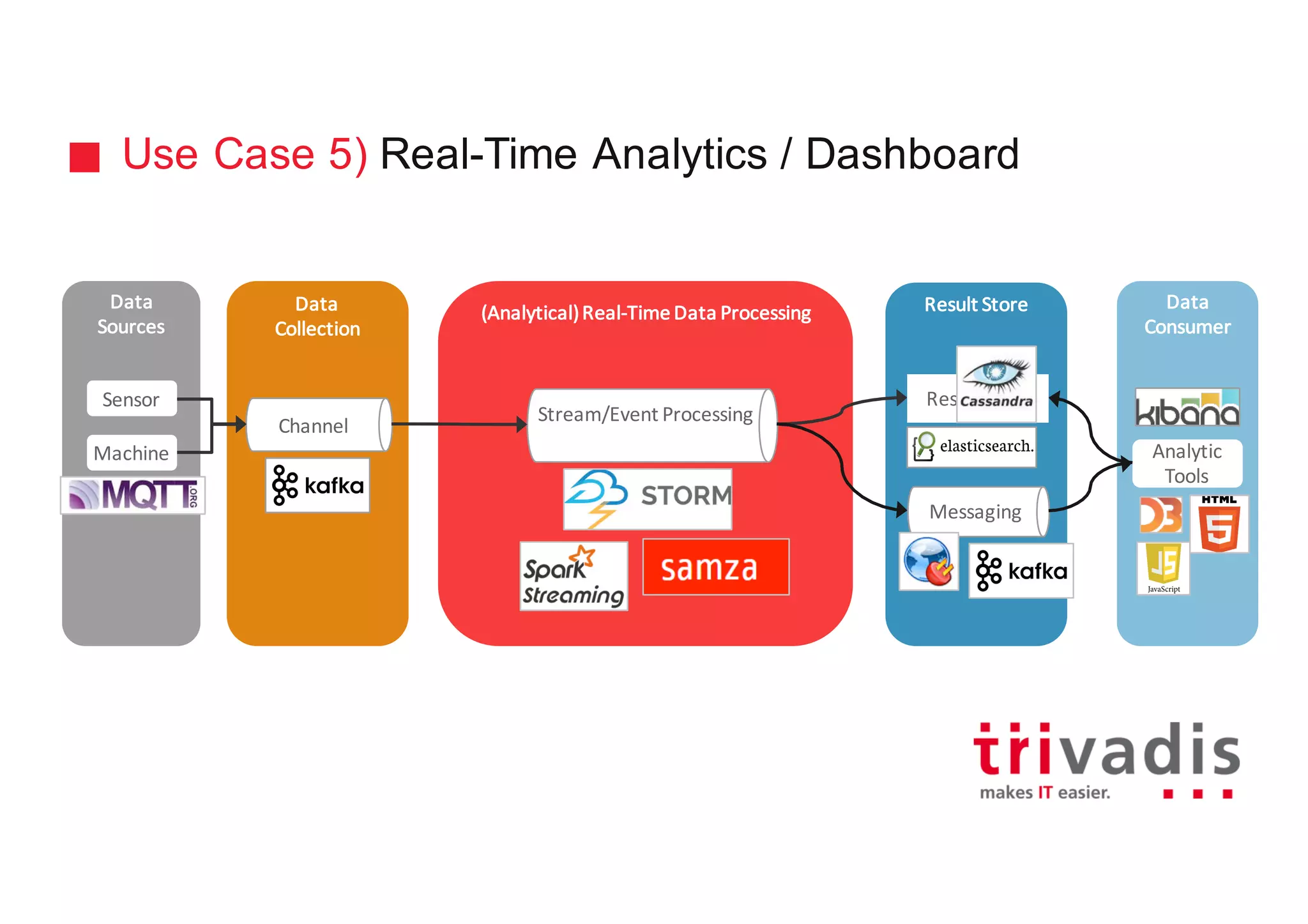
Use Case 5) Real-Time Analytics / Dashboard
Data
Collection
Batch
compute
Data
Sources
Channel
Data
Consumer
Analytic
Tools
Sensor
Machine
(Analytical)	Real-Time	Data	Processing
Stream/Event	Processing
Result	Store
Messaging
Result	Store
Native Streaming vs.
Micro-Batching
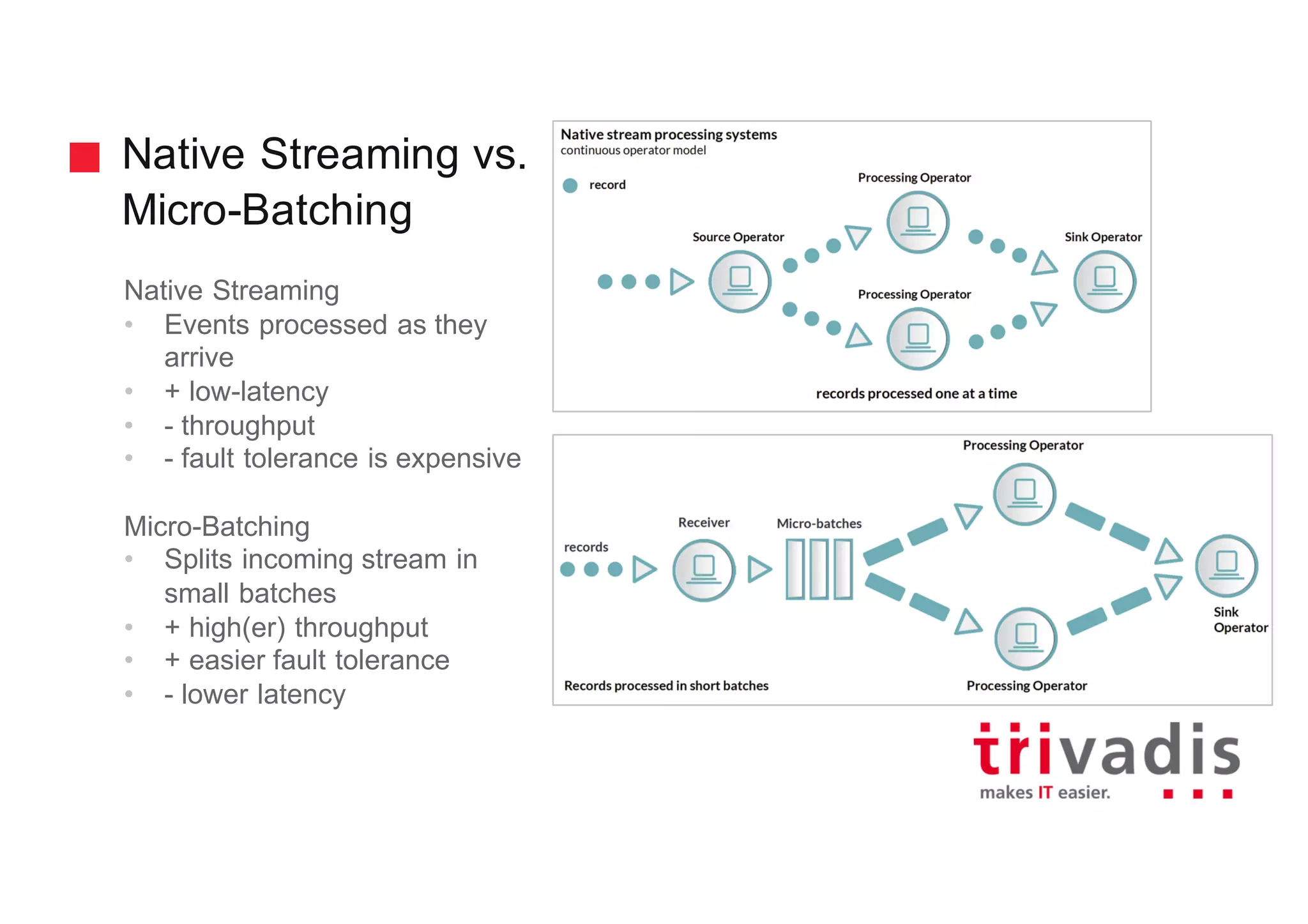
Native Streaming
• Events processed as they
arrive
• + low-latency
• - throughput
• - fault tolerance is expensive
Micro-Batching
• Splits incoming stream in
small batches
• + high(er) throughput
• + easier fault tolerance
• - lower latency
Source:	 Distributed	 Real-Time	Stream	Processing:	
Why	and	How	by	Petr	Zapletal
Unified Log (Event) Processing
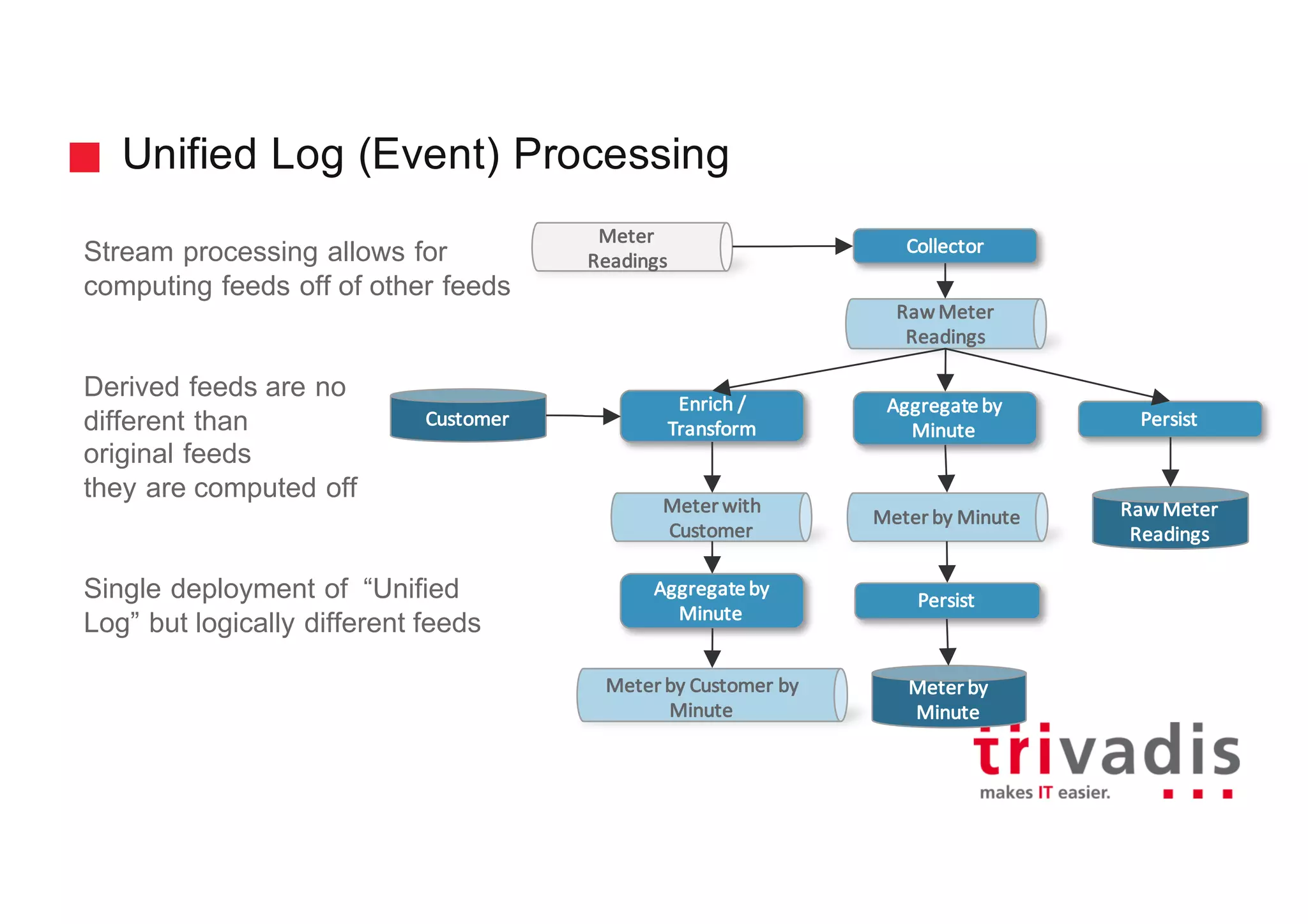
Stream processing allows for
computing feeds off of other feeds
Derived feeds are no
different than
original feeds
they are computed off
Single deployment of “Unified
Log” but logically different feeds
Meter
Readings
Collector
Enrich	/	
Transform
Aggregate	by	
Minute
RawMeter
Readings
Meter	with
Customer
Meter	by Customer	by
Minute
Customer
Aggregate	by	
Minute
Meter	by Minute
Persist
Meter	by	
Minute
Persist
Raw	Meter
Readings
Streaming Analytics Technology Mapping
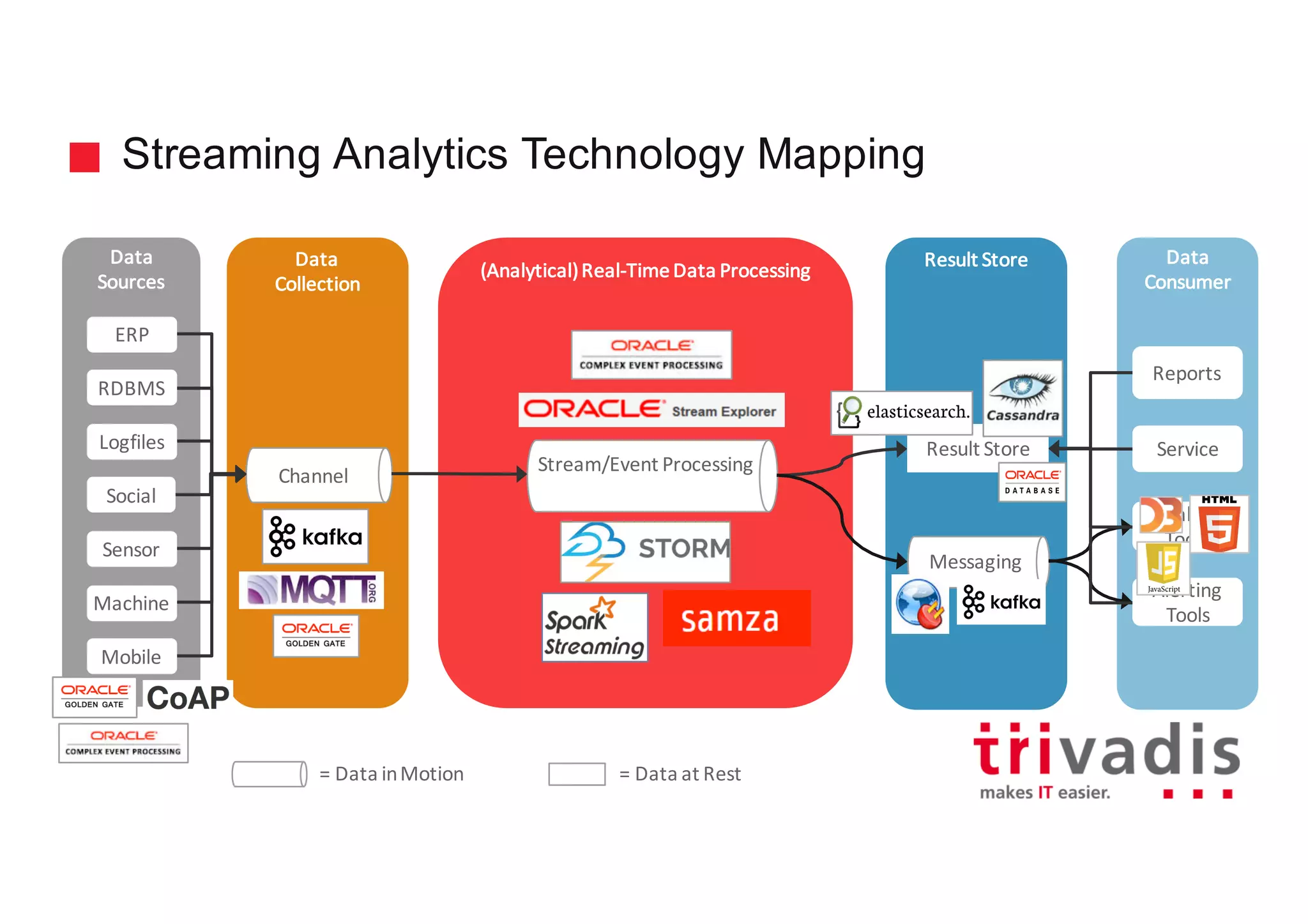
Data
Collection
Batch
compute
Data
Sources
Channel
Data
Consumer
Reports
Service
Analytic
Tools
Alerting
Tools
Social
Logfiles
Sensor
RDBMS
ERP
Mobile
Machine
(Analytical)	Real-Time	Data	Processing
Stream/Event	Processing
Result	Store
Messaging
Result	Store
=	Data	in	Motion =	Data	at	Rest
Streaming Analytics Architecture for Big Data
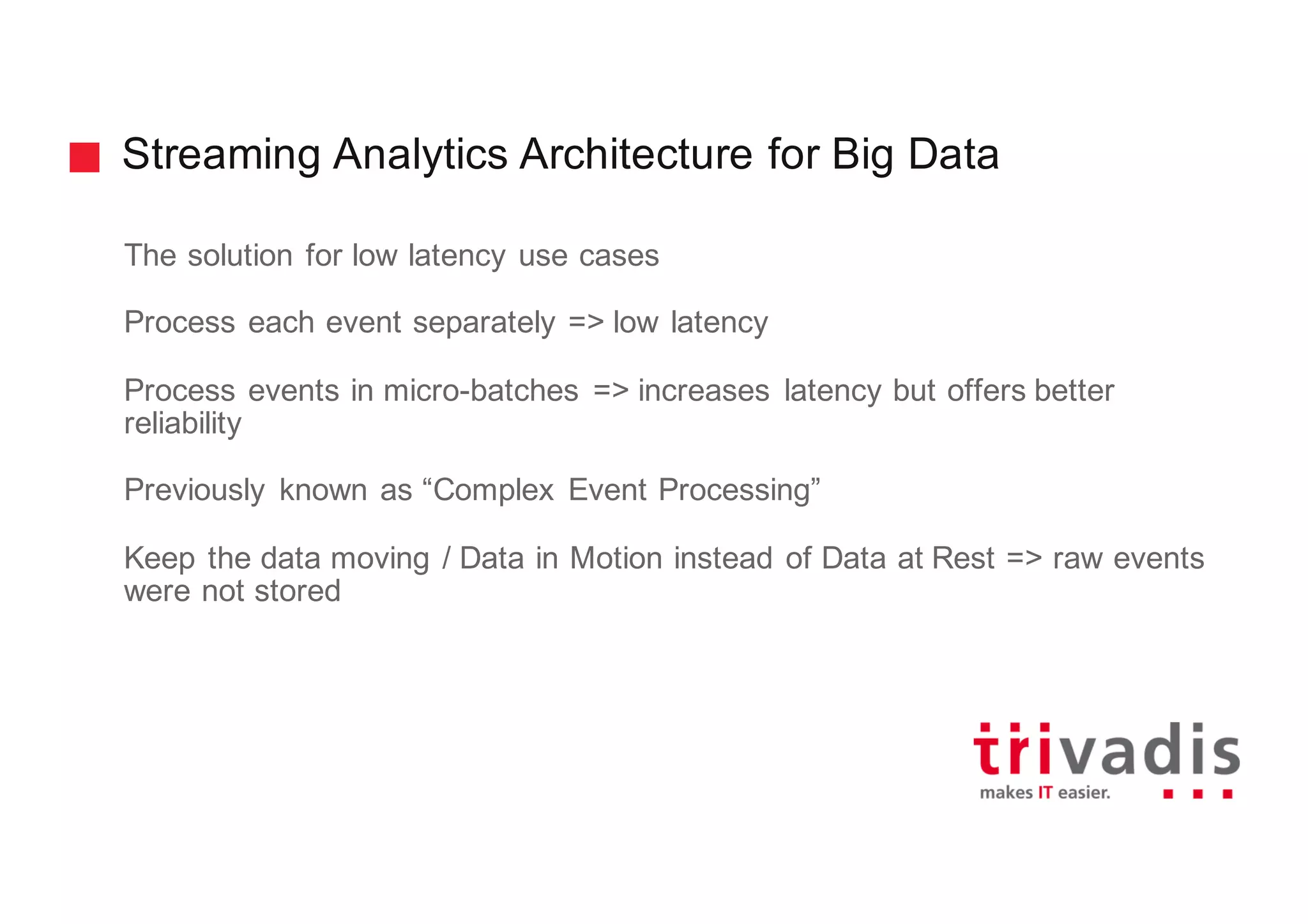
The solution for low latency use cases
Process each event separately => low latency
Process events in micro-batches => increases latency but offers better
reliability
Previously known as “Complex Event Processing”
Keep the data moving / Data in Motion instead of Data at Rest => raw events
were not stored
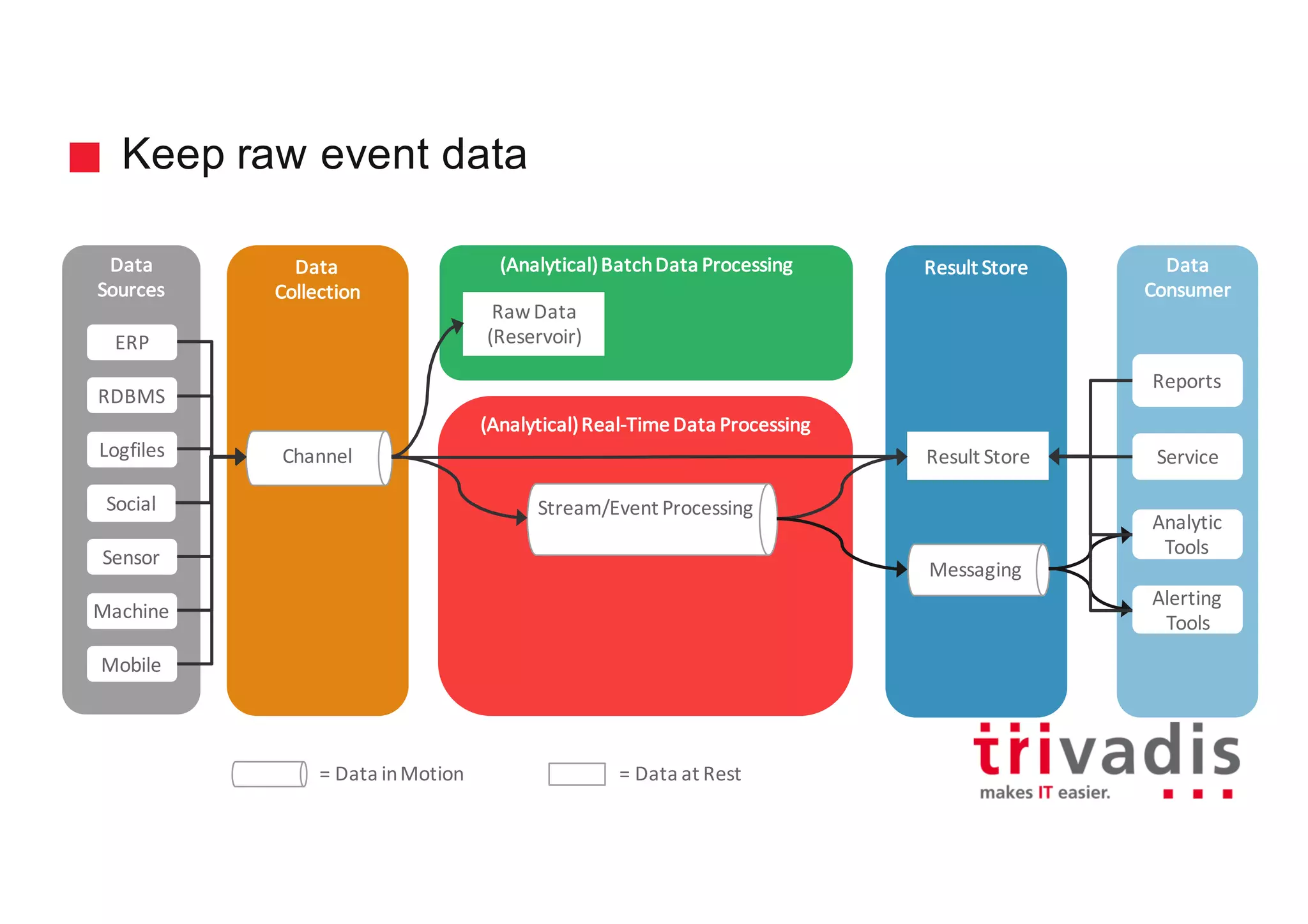
Keep raw event data
Data
Collection
Batch
compute
Data
Sources
Channel
Data
Consumer
Reports
Service
Analytic
Tools
Alerting
Tools
Social
Logfiles
Sensor
RDBMS
ERP
Mobile
Machine
(Analytical)	Real-Time	Data	Processing
Stream/Event	Processing
Result	Store
Messaging
Result	Store
=	Data	in	Motion =	Data	at	Rest
(Analytical)	Batch	Data	Processing
Raw	Data	
(Reservoir)
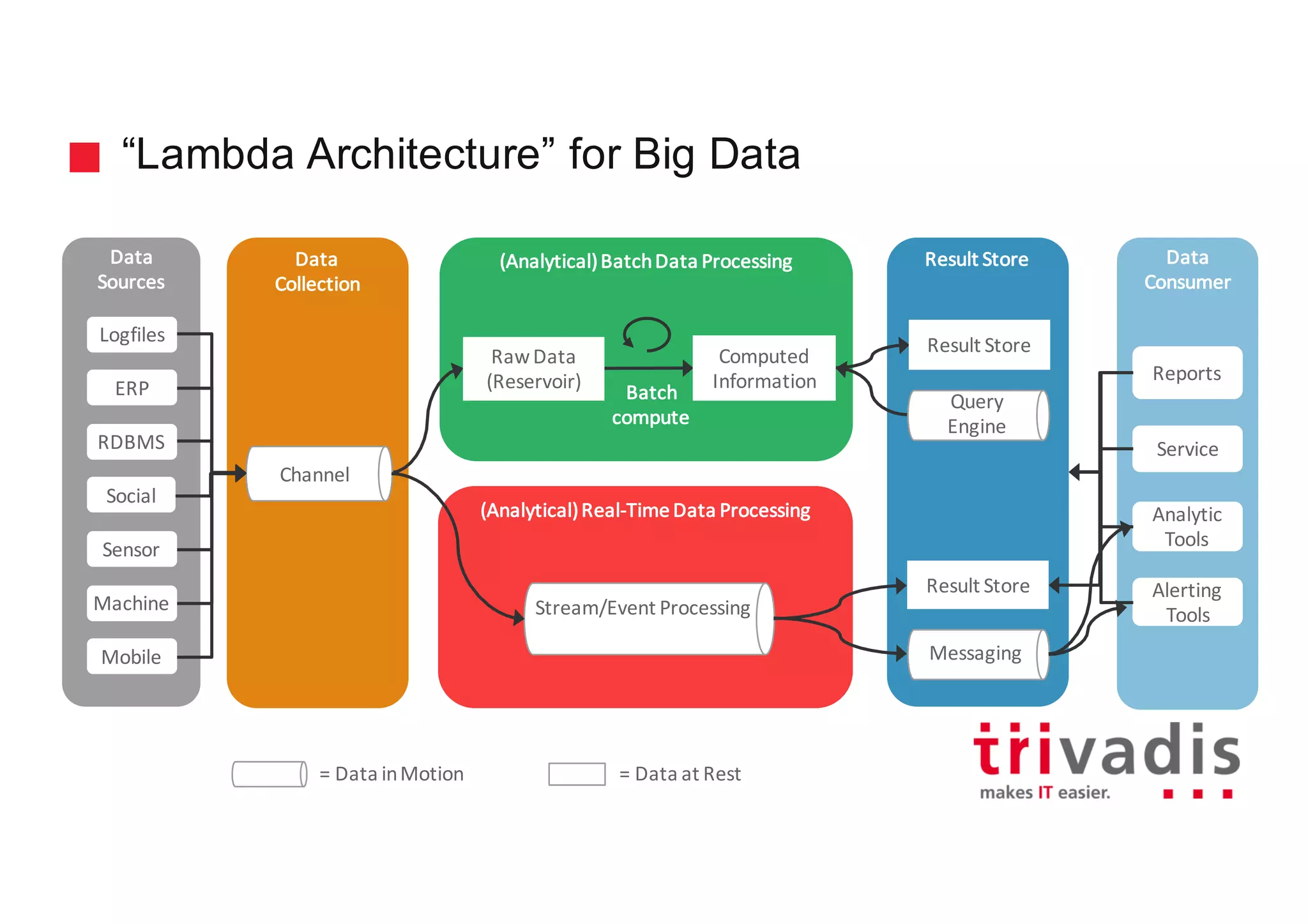
Lambda Architecture for Big Data
“Lambda Architecture” for Big Data
Data
Collection
(Analytical)	Batch	Data	Processing
Batch
compute
Result	StoreData
Sources
Channel
Data
Consumer
Reports
Service
Analytic
Tools
Alerting
Tools
Social
RDBMS
Sensor
ERP
Logfiles
Mobile
Machine
(Analytical)	Real-Time	Data	Processing
Stream/Event	Processing
Batch
compute
Messaging
Result	Store
Query
Engine
Result	Store
Computed	
Information
Raw	Data	
(Reservoir)
=	Data	in	Motion =	Data	at	Rest
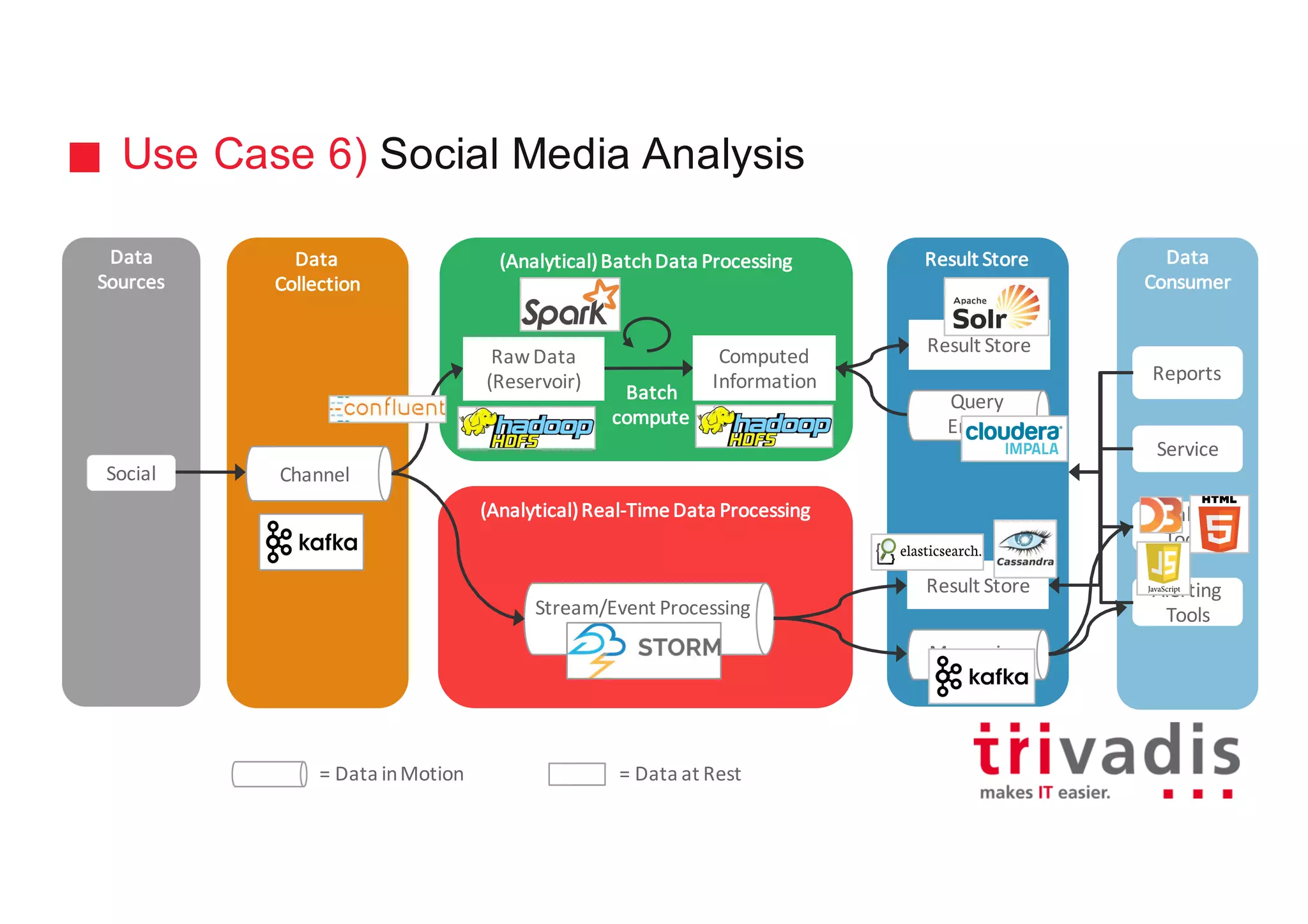
Use Case 6) Social Media Analysis
Data
Collection
(Analytical)	Batch	Data	Processing
Batch
compute
Result	StoreData
Sources
Channel
Data
Consumer
Reports
Service
Analytic
Tools
Alerting
Tools
Social
(Analytical)	Real-Time	Data	Processing
Stream/Event	Processing
Batch
compute
Messaging
Result	Store
Query
Engine
Result	Store
Computed	
Information
Raw	Data	
(Reservoir)
=	Data	in	Motion =	Data	at	Rest
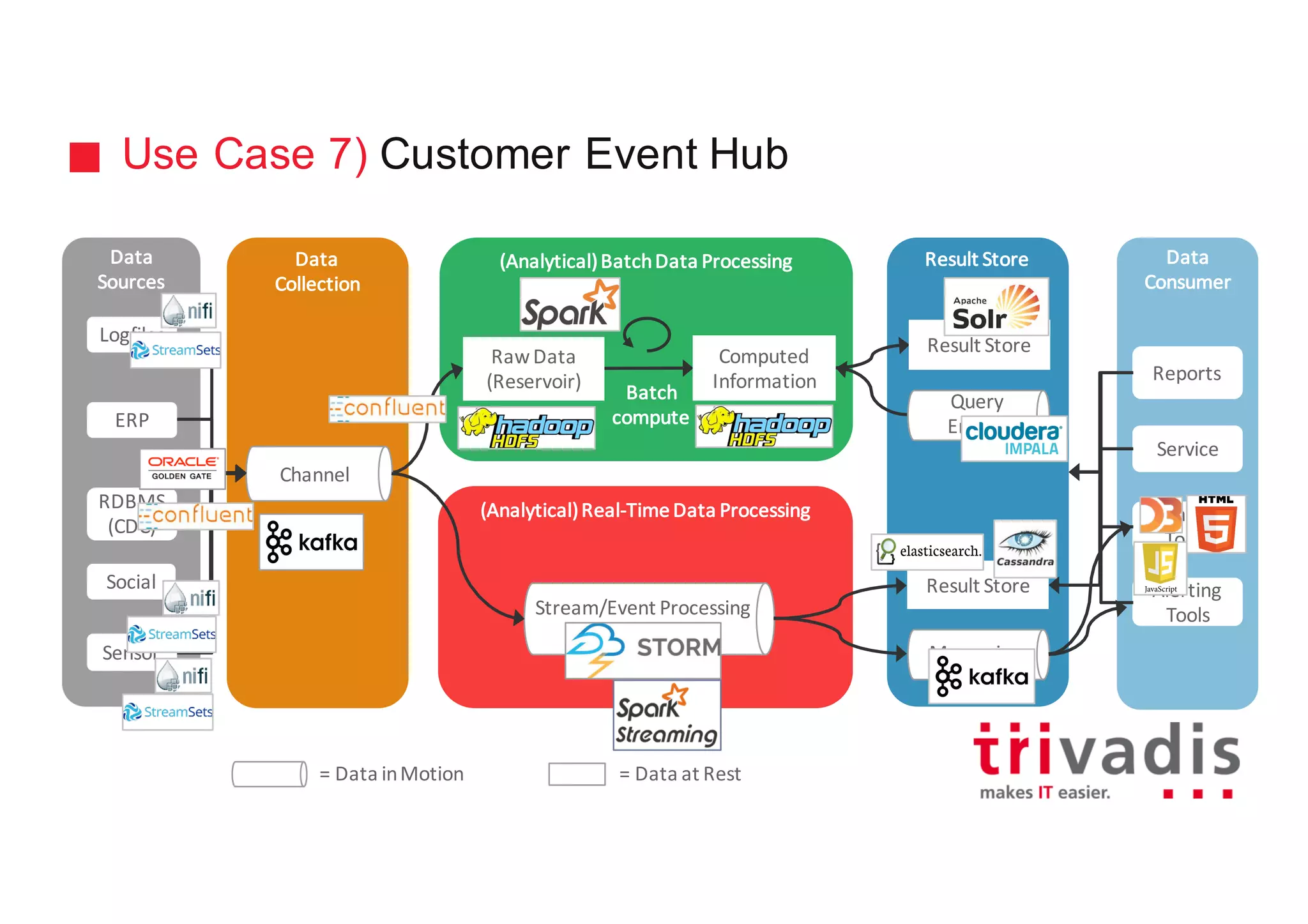
Use Case 7) Customer Event Hub
Data
Collection
(Analytical)	Batch	Data	Processing
Batch
compute
Result	StoreData
Sources
Channel
Data
Consumer
Reports
Service
Analytic
Tools
Alerting
Tools
(Analytical)	Real-Time	Data	Processing
Stream/Event	Processing
Batch
compute
Messaging
Result	Store
Query
Engine
Result	Store
Computed	
Information
Raw	Data	
(Reservoir)
=	Data	in	Motion =	Data	at	Rest
Social
RDBMS	
(CDC)
Sensor
ERP
Logfiles
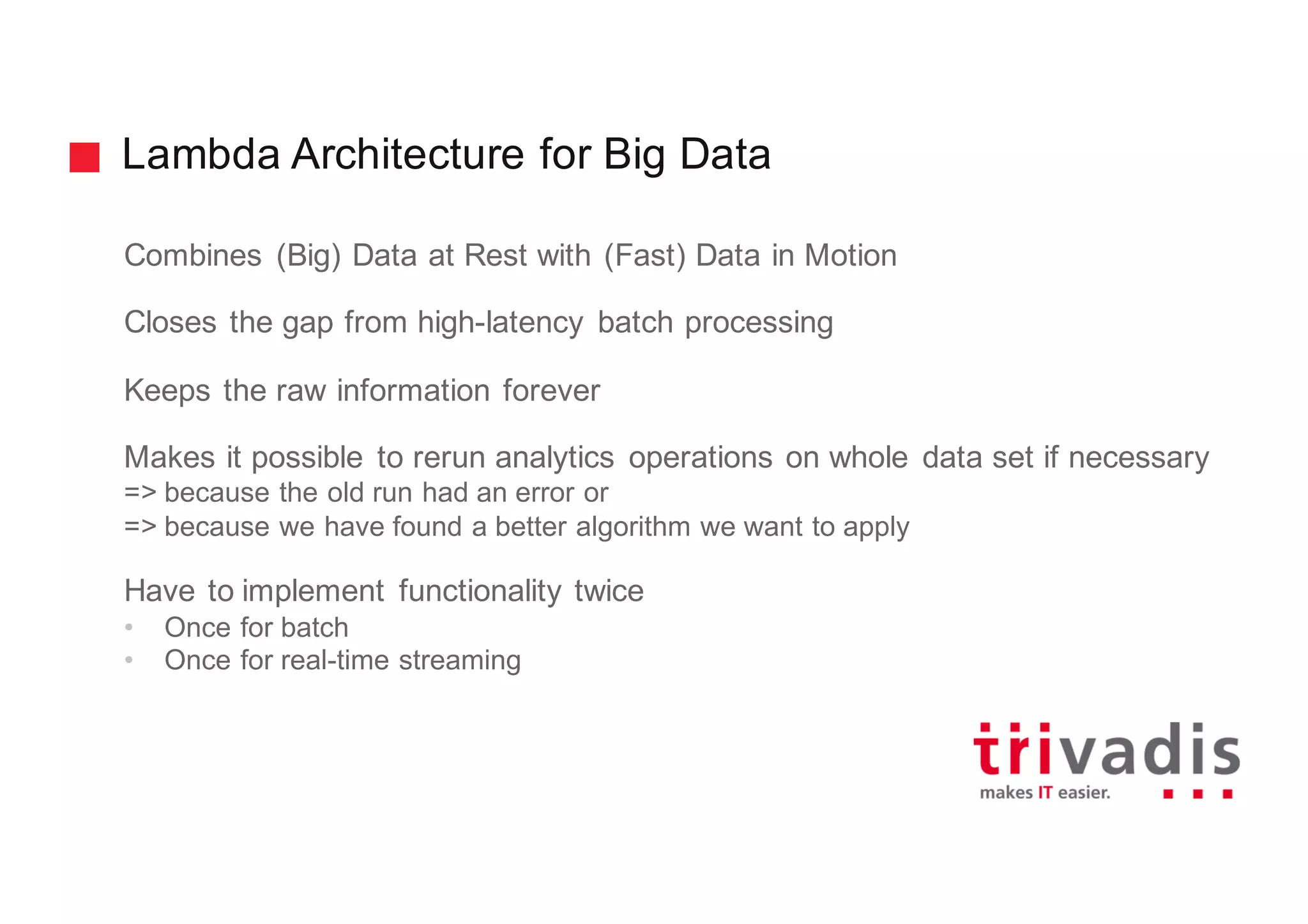
Lambda Architecture for Big Data
Combines (Big) Data at Rest with (Fast) Data in Motion
Closes the gap from high-latency batch processing
Keeps the raw information forever
Makes it possible to rerun analytics operations on whole data set if necessary
=> because the old run had an error or
=> because we have found a better algorithm we want to apply
Have to implement functionality twice
• Once for batch
• Once for real-time streaming
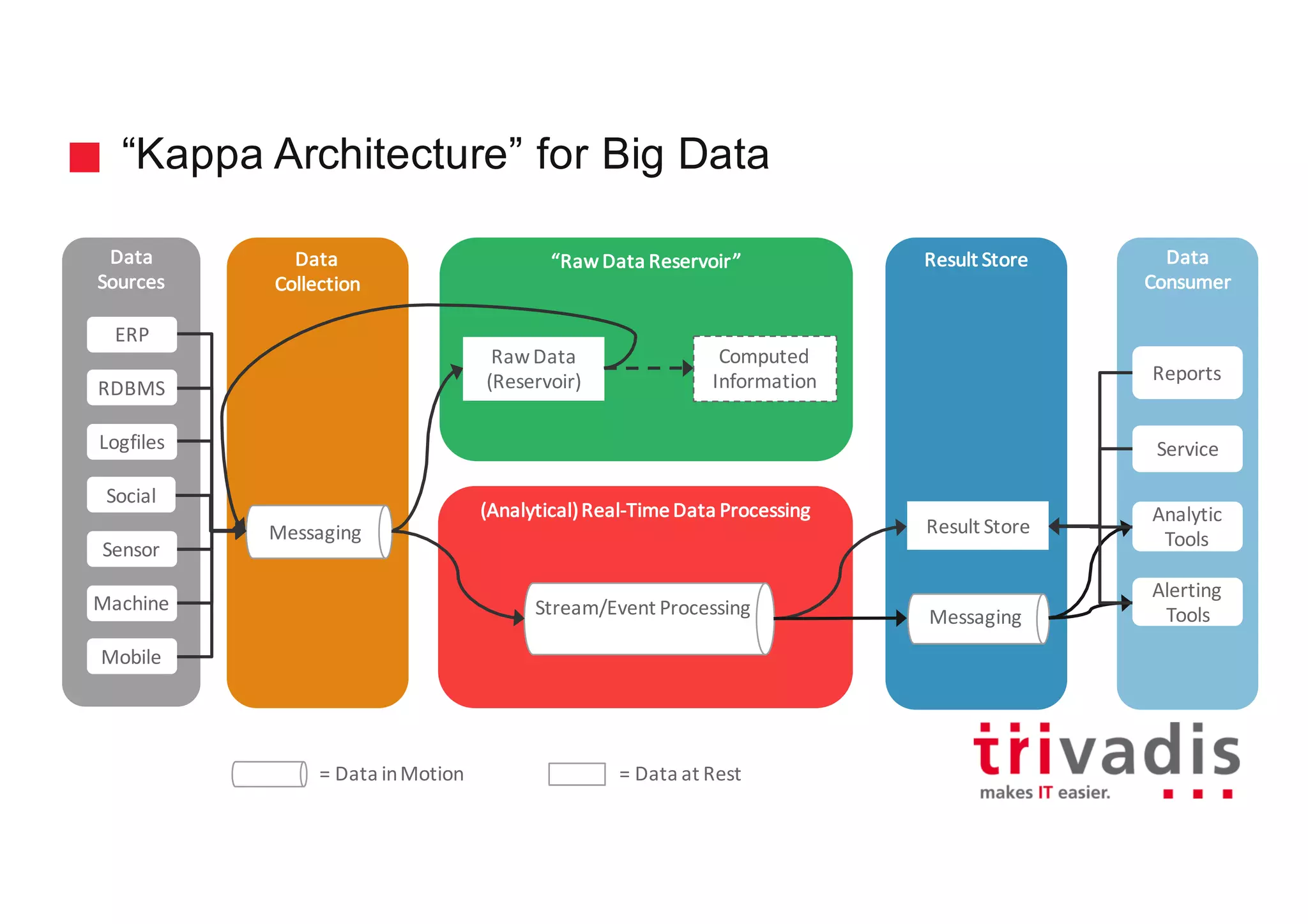
„Kappa“ Architecture for Big Data
“Kappa Architecture” for Big Data
Data
Collection
“Raw	Data	Reservoir”
Batch
compute
Data
Sources
Messaging
Data
Consumer
Reports
Service
Analytic
Tools
Alerting
Tools
Social
Logfiles
Sensor
RDBMS
ERP
Mobile
Machine
(Analytical)	Real-Time	Data	Processing
Stream/Event	Processing
Result	Store
Messaging
Result	Store
Raw	Data	
(Reservoir)
=	Data	in	Motion =	Data	at	Rest
Computed	
Information
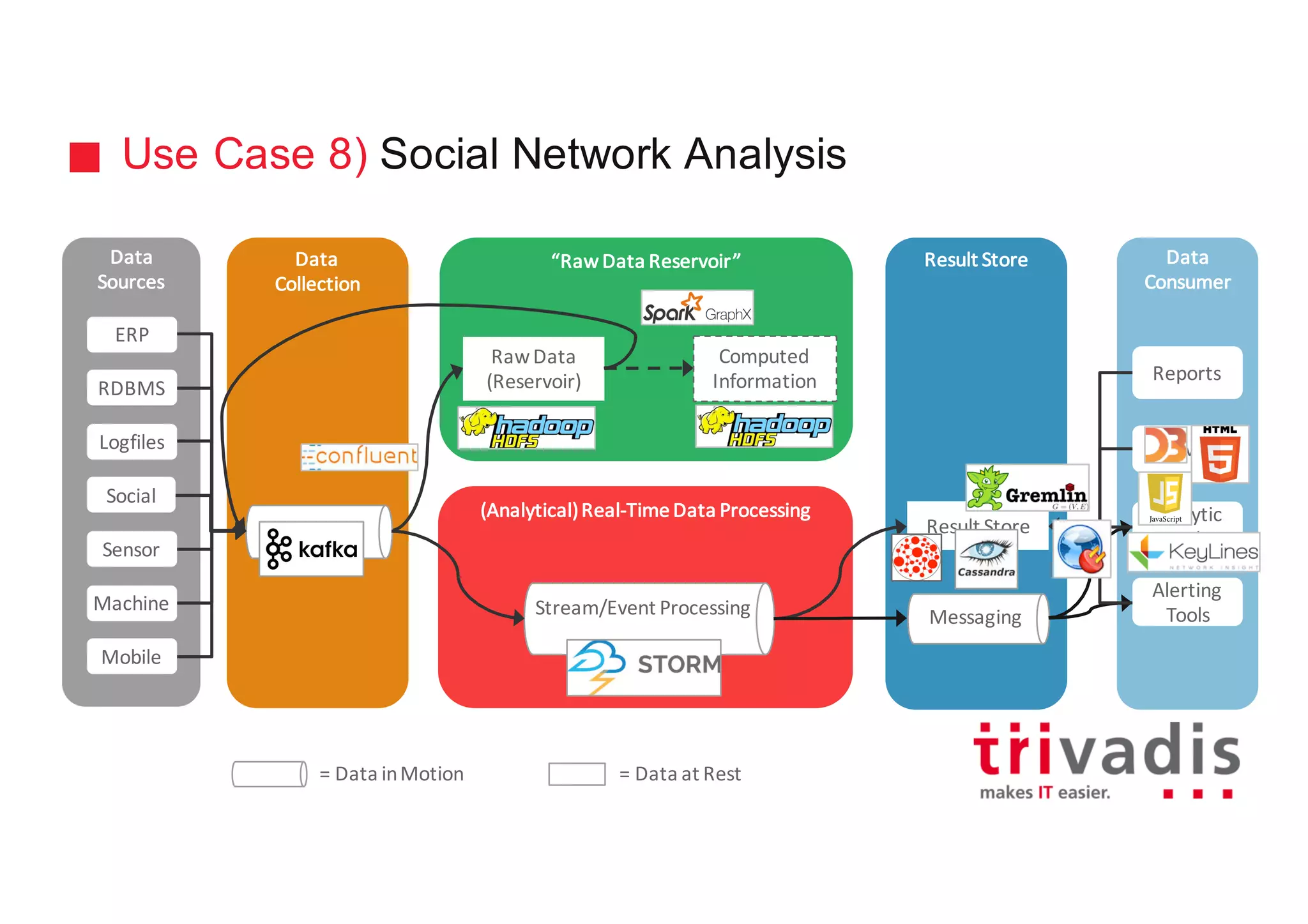
Use Case 8) Social Network Analysis
Data
Collection
“Raw	Data	Reservoir”
Batch
compute
Data
Sources
Messaging
Data
Consumer
Reports
Service
Analytic
Tools
Alerting
Tools
Social
Logfiles
Sensor
RDBMS
ERP
Mobile
Machine
(Analytical)	Real-Time	Data	Processing
Stream/Event	Processing
Result	Store
Messaging
Result	Store
Raw	Data	
(Reservoir)
=	Data	in	Motion =	Data	at	Rest
Computed	
Information
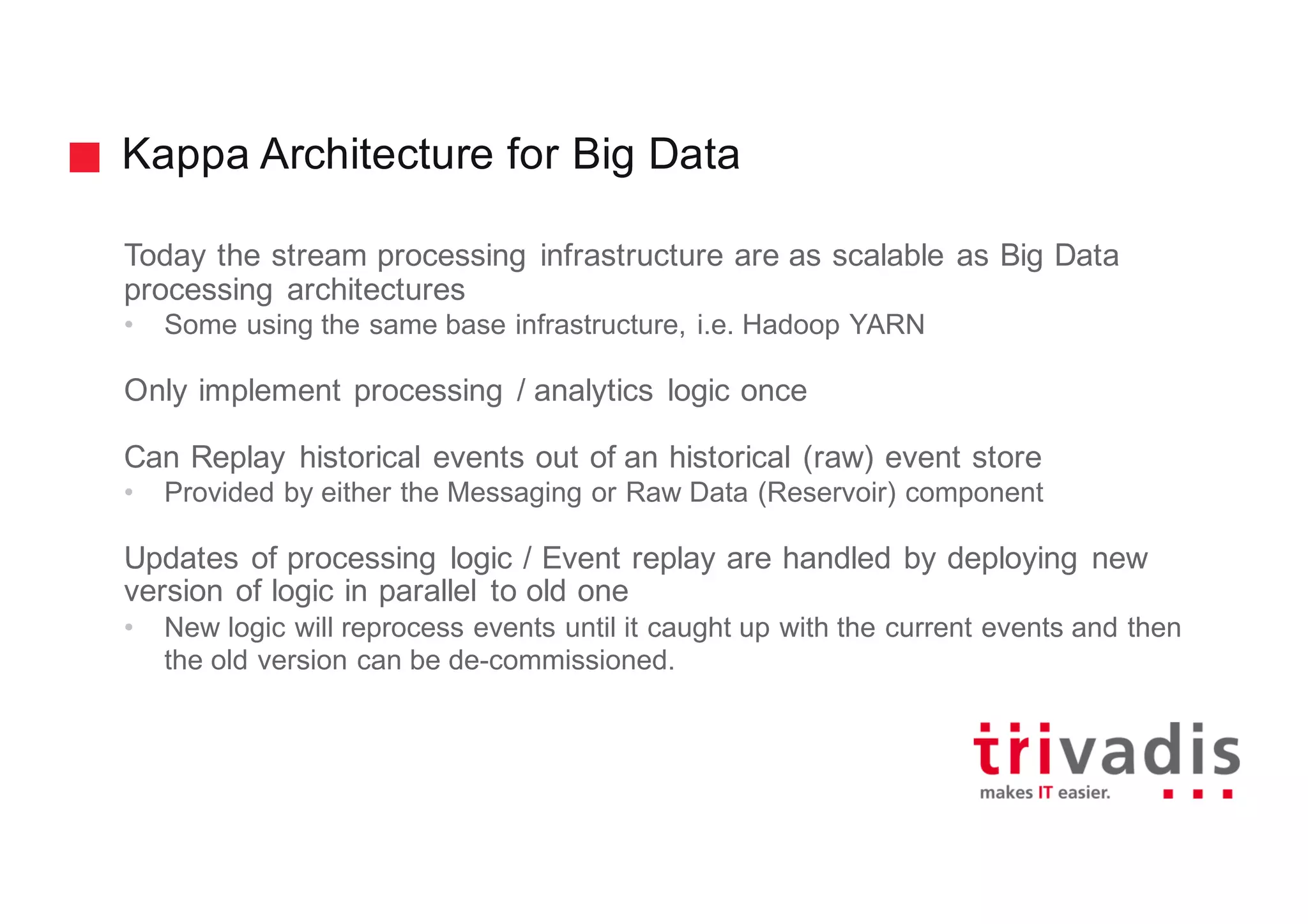
Kappa Architecture for Big Data
Today the stream processing infrastructure are as scalable as Big Data
processing architectures
• Some using the same base infrastructure, i.e. Hadoop YARN
Only implement processing / analytics logic once
Can Replay historical events out of an historical (raw) event store
• Provided by either the Messaging or Raw Data (Reservoir) component
Updates of processing logic / Event replay are handled by deploying new
version of logic in parallel to old one
• New logic will reprocess events until it caught up with the current events and then
the old version can be de-commissioned.
„Unified“ Architecture for Big Data
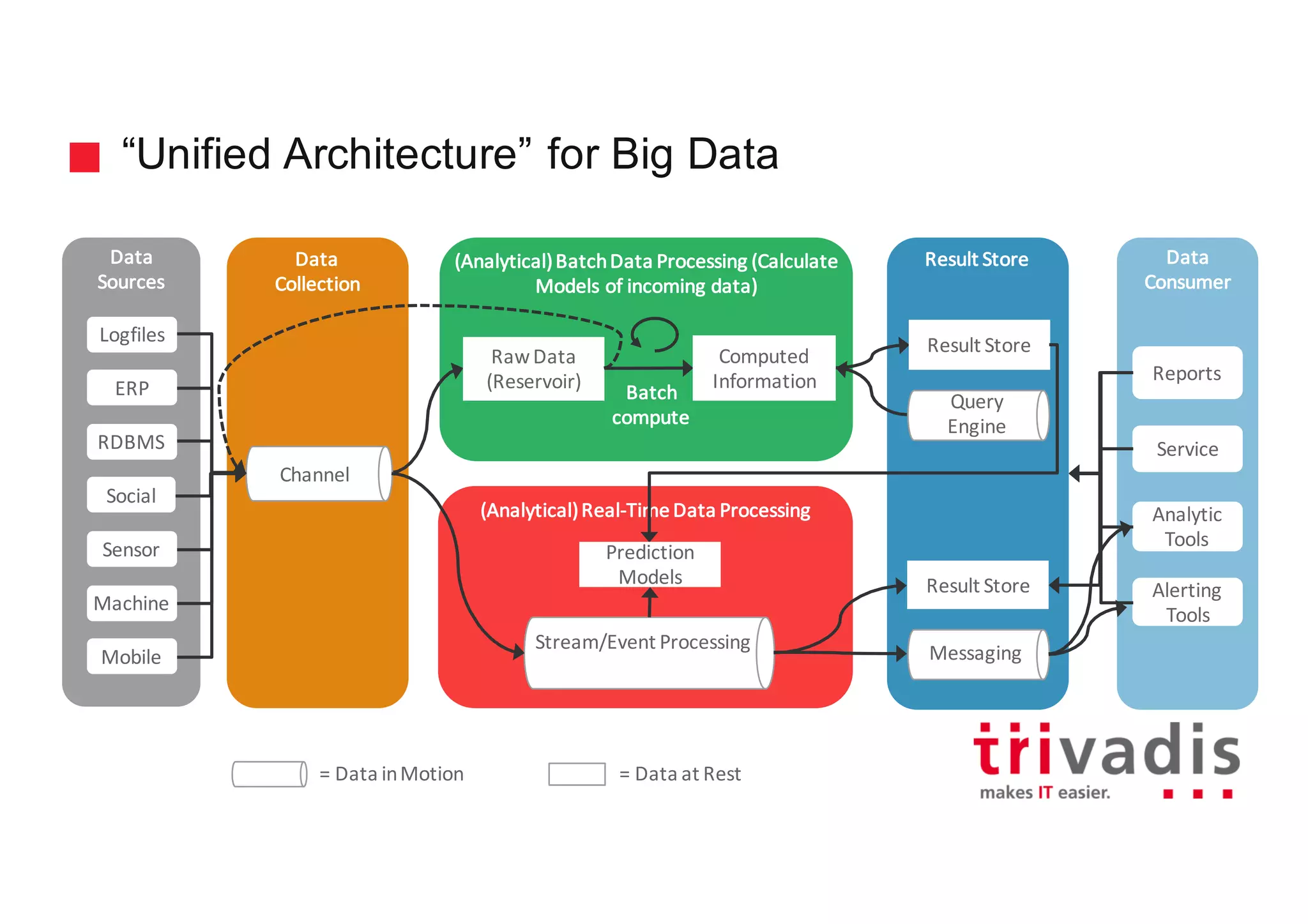
“Unified Architecture” for Big Data
Data
Collection
(Analytical)	Batch	Data	Processing	(Calculate	
Models	of	incoming	data)
Batch
compute
Result	StoreData
Sources
Channel
Data
Consumer
Reports
Service
Analytic
Tools
Alerting
Tools
Social
RDBMS
Sensor
ERP
Logfiles
Mobile
Machine
(Analytical)	Real-Time	Data	Processing
Stream/Event	Processing
Batch
compute
Messaging
Result	Store
Query
Engine
Result	Store
Computed	
Information
Raw	Data	
(Reservoir)
=	Data	in	Motion =	Data	at	Rest
Prediction	
Models
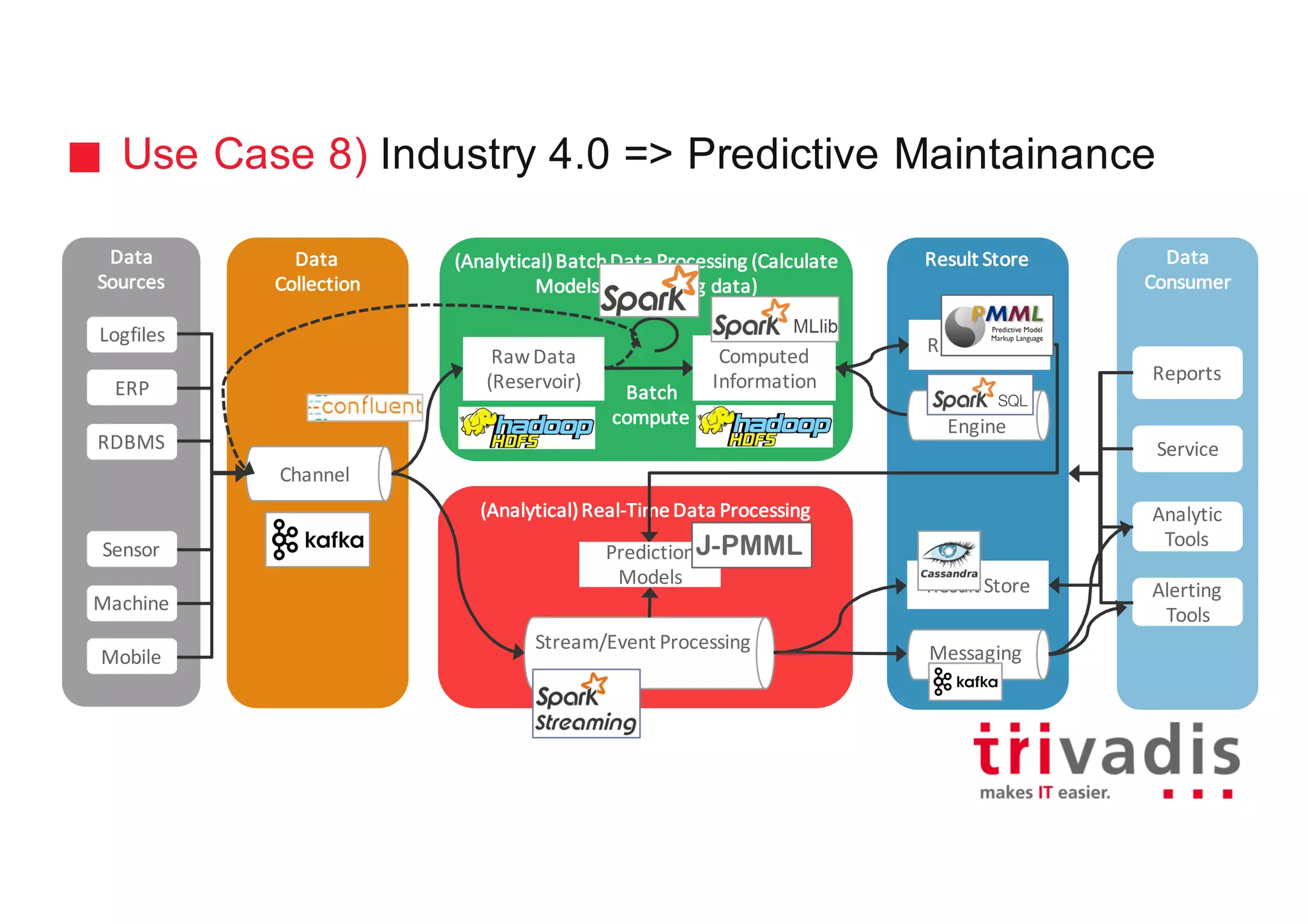
Use Case 8) Industry 4.0 => Predictive Maintainance
Data
Collection
(Analytical)	Batch	Data	Processing	(Calculate	
Models	of	incoming	data)
Batch
compute
Result	StoreData
Sources
Channel
Data
Consumer
Reports
Service
Analytic
Tools
Alerting
Tools
RDBMS
Sensor
ERP
Logfiles
Mobile
Machine
(Analytical)	Real-Time	Data	Processing
Stream/Event	Processing
Batch
compute
Messaging
Result	Store
Query
Engine
Result	Store
Computed	
Information
Raw	Data	
(Reservoir)
Prediction	
Models
J-PMML
Summary
Summary
Know your use cases and then choose your architecture and the relevant
components/products/frameworks
You don’t have to use all the components of the Hadoop Ecosystem to be successful
Big Data is still quite a young field and therefore there are no standard architectures
available which have been used for years
Lambda, Kappa Architecture & Unified Architecture are best practices architectures
which you have to adapt to your environment
=> Combination of traditional Big Data Batch & Complex Event Processing (CEP)
Guido Schmutz
Technology Manager
guido.schmutz@trivadis.com

Big Data Architectures @ JAX / BigDataCon 2016

  • 1.
    Guido Schmutz |Trivadis Architektur von Big Data Lösungen
  • 2.
    BASEL BERN BRUGGDÜSSELDORF FRANKFURT A.M. FREIBURG I.BR. GENEVA HAMBURG COPENHAGEN LAUSANNE MUNICH STUTTGART VIENNA ZURICH Architektur von Big Data Lösungen Guido Schmutz
  • 3.
    Guido Schmutz Working forTrivadis for more than 19 years Oracle ACE Director for Fusion Middleware and SOA Co-Author of different books Consultant, Trainer Software Architect for Java, Oracle, SOA and Big Data / Fast Data Member of Trivadis Architecture Board Technology Manager @ Trivadis More than 25 years of software development experience Contact: guido.schmutz@trivadis.com Blog: http://guidoschmutz.wordpress.com Twitter: gschmutz
  • 4.
    Agenda 1. Introduction 2. TraditionalArchitecture for Big Data 3. Streaming Analytics Architecture for Fast Data 4. Lambda/Kappa/Unifed Architecture for Big Data 5. Summary
  • 5.
  • 6.
    How to doBig Data?
  • 7.
    Big Data isstill “work in progress” Choosing the right architecture is key for any (big data) project Big Data is still quite a young field and therefore there are no standard architectures available which have been used for years In the past few years, a few architectures have evolved and have been discussed online Know the use cases before choosing your architecture To have one/a few reference architectures can help in choosing the right components
  • 8.
    Building Blocks for(Big) Data Processing Data Acquisition Format File System Stream Processing Batch SQL Graph DBMS Document DBMS Relational DBMS Visualization IoT Messaging Analytics OLAP DBMS Query Federation Table-Style DBMS Key Value DBMS Batch Processing In-Memory
  • 9.
    Big Data Ecosystem– many choices ….
  • 10.
    Important Properties tochoose a Big Data Architecture Latency Keep raw and un-interpreted data “forever” ? Volume, Velocity, Variety, Veracity Ad-Hoc Query Capabilities needed ? Robustness & Fault Tolerance Scalability …
  • 11.
    From Volume andVariety to Velocity Big Data has evolved … and the Hadoop Ecosystem as well …. Past Big Data = Volume & Variety Present Big Data = Volume & Variety & Velocity Past Batch Processing Time to insight of Hours Present Batch & Stream Processing Time to insight in Seconds Adapted from Cloudera blog article
  • 12.
  • 13.
    “Traditional Architecture” forBig Data Data Collection (Analytical) Data Processing Result StoreData Sources Channel Data Consumer Reports Service Analytic Tools Alerting Tools Social RDBMS Sensor ERP Logfiles Mobile Machine Batch compute Stage Result Store Query Engine Computed Information Raw Data (Reservoir) = Data in Motion = Data at Rest
  • 14.
    Use Case 1)– Log File Analysis (Audit, Compliance, Root Cause Analysis) Data Collection (Analytical) Data Processing Result StoreData Sources Data Consumer Channel Batch compute Computed Information Raw Data (Reservoir) Result Store Query Engine Reports Analytic Tools Logfiles
  • 15.
    Use Case 1a)– Log File Analysis (Audit, Compliance, Root Cause Analysis) Data Collection (Analytical) Data Processing Result StoreData Sources Data Consumer Channel Batch compute Computed Information Raw Data (Reservoir) Result Store Query Engine Reports Analytic Tools Logfiles
  • 16.
    Use Case 2)– Customer Data Hub (360 degree view of customer) Data Collection (Analytical) Data Processing Result StoreData Sources Data Consumer RDBMS Batch compute Computed Information Raw Data (Reservoir) Result Store Query Engine Reports Service Analytic Tools Alerting Tools
  • 17.
    Use Case 2a)– Customer Data Hub (360 degree view of customer) Data Collection (Analytical) Data Processing Result StoreData Sources Data Consumer RDBMS (CDC) Batch compute Computed Information Raw Data (Reservoir) Result Store Query Engine Reports Service Analytic Tools Alerting Tools Channel
  • 18.
    “Hadoop Ecosystem” TechnologyMapping Data Collection (Analytical) Data Processing Result StoreData Sources Channel Data Consumer Reports Service Analytic Tools Alerting Tools Social RDBMS Sensor ERP Logfiles Mobile Machine Batch compute Staging Result Store Query Engine Computed Information Raw Data (Reservoir) = Data in Motion = Data at Rest
  • 19.
    Apache Spark –the new kid on the block Apache Spark is a fast and general engine for large-scale data processing • The hot trend in Big Data! • Originally developed 2009 in UC Berkley’s AMPLab • Can run programs up to 100x faster than Hadoop MapReduce in memory, or 10x faster on disk • One of the largest OSS communities in big data with over 200 contributors in 50+ organizations • Open Sourced in 2010 – since 2014 part of Apache Software foundation • Supported by many vendors
  • 20.
    Motivation – WhyApache Spark? Apache Hadoop MapReduce: Data Sharing on Disk Apache Spark: Speed up processing by using Memory instead of Disks map reduce . . . Input HDFS read HDFS write HDFS read HDFS write op1 op2 . . . Input Output Output
  • 21.
  • 22.
    “Spark Ecosystem” TechnologyMapping Data Collection (Analytical) Data Processing Result StoreData Sources Channel Data Consumer Reports Service Analytic Tools Alerting Tools Social RDBMS Sensor ERP Logfiles Mobile Machine Batch compute Stage Result Store Query Engine Computed Information Raw Data (Reservoir) = Data in Motion = Data at Rest
  • 23.
    Use Case 3)– (Batch) Recommendations on Historic Data Data Collection (Analytical) Data Processing Result StoreData Sources Data Consumer Machine Batch compute Computed Information Raw Data (Reservoir) Result Store Query Engine Reports Service Analytic Tools Alerting Tools DB StagingFile Channel
  • 24.
    Traditional Architecture forBig Data • Batch Processing • Not for low latency use cases • Spark can speed up, but if positioned as alternative to Hadoop Map/Reduce, it’s still Batch Processing • Spark Ecosystems offers a lot of additional advanced analytic capabilities (machine learning, graph processing, …)
  • 25.
  • 26.
    Streaming Analytics Architecturefor Big Data aka. (Complex) Event Processing) Data Collection Batch compute Data Sources Channel Data Consumer Reports Service Analytic Tools Alerting Tools Social Logfiles Sensor RDBMS ERP Mobile Machine (Analytical) Real-Time Data Processing Stream/Event Processing Result Store Messaging Result Store = Data in Motion = Data at Rest
  • 27.
    Use Case 4)Algorithmic Trading Data Collection Batch compute Data Sources Channel Data Consumer Analytic Tools Alerting Tools Sensor Machine (Analytical) Real-Time Data Processing Stream/Event Processing Result Store Messaging Result Store
  • 28.
    Use Case 5)Real-Time Analytics / Dashboard Data Collection Batch compute Data Sources Channel Data Consumer Analytic Tools Sensor Machine (Analytical) Real-Time Data Processing Stream/Event Processing Result Store Messaging Result Store
  • 29.
    Native Streaming vs. Micro-Batching NativeStreaming • Events processed as they arrive • + low-latency • - throughput • - fault tolerance is expensive Micro-Batching • Splits incoming stream in small batches • + high(er) throughput • + easier fault tolerance • - lower latency Source: Distributed Real-Time Stream Processing: Why and How by Petr Zapletal
  • 30.
    Unified Log (Event)Processing Stream processing allows for computing feeds off of other feeds Derived feeds are no different than original feeds they are computed off Single deployment of “Unified Log” but logically different feeds Meter Readings Collector Enrich / Transform Aggregate by Minute RawMeter Readings Meter with Customer Meter by Customer by Minute Customer Aggregate by Minute Meter by Minute Persist Meter by Minute Persist Raw Meter Readings
  • 31.
    Streaming Analytics TechnologyMapping Data Collection Batch compute Data Sources Channel Data Consumer Reports Service Analytic Tools Alerting Tools Social Logfiles Sensor RDBMS ERP Mobile Machine (Analytical) Real-Time Data Processing Stream/Event Processing Result Store Messaging Result Store = Data in Motion = Data at Rest
  • 32.
    Streaming Analytics Architecturefor Big Data The solution for low latency use cases Process each event separately => low latency Process events in micro-batches => increases latency but offers better reliability Previously known as “Complex Event Processing” Keep the data moving / Data in Motion instead of Data at Rest => raw events were not stored
  • 33.
    Keep raw eventdata Data Collection Batch compute Data Sources Channel Data Consumer Reports Service Analytic Tools Alerting Tools Social Logfiles Sensor RDBMS ERP Mobile Machine (Analytical) Real-Time Data Processing Stream/Event Processing Result Store Messaging Result Store = Data in Motion = Data at Rest (Analytical) Batch Data Processing Raw Data (Reservoir)
  • 34.
  • 35.
    “Lambda Architecture” forBig Data Data Collection (Analytical) Batch Data Processing Batch compute Result StoreData Sources Channel Data Consumer Reports Service Analytic Tools Alerting Tools Social RDBMS Sensor ERP Logfiles Mobile Machine (Analytical) Real-Time Data Processing Stream/Event Processing Batch compute Messaging Result Store Query Engine Result Store Computed Information Raw Data (Reservoir) = Data in Motion = Data at Rest
  • 36.
    Use Case 6)Social Media Analysis Data Collection (Analytical) Batch Data Processing Batch compute Result StoreData Sources Channel Data Consumer Reports Service Analytic Tools Alerting Tools Social (Analytical) Real-Time Data Processing Stream/Event Processing Batch compute Messaging Result Store Query Engine Result Store Computed Information Raw Data (Reservoir) = Data in Motion = Data at Rest
  • 37.
    Use Case 7)Customer Event Hub Data Collection (Analytical) Batch Data Processing Batch compute Result StoreData Sources Channel Data Consumer Reports Service Analytic Tools Alerting Tools (Analytical) Real-Time Data Processing Stream/Event Processing Batch compute Messaging Result Store Query Engine Result Store Computed Information Raw Data (Reservoir) = Data in Motion = Data at Rest Social RDBMS (CDC) Sensor ERP Logfiles
  • 38.
    Lambda Architecture forBig Data Combines (Big) Data at Rest with (Fast) Data in Motion Closes the gap from high-latency batch processing Keeps the raw information forever Makes it possible to rerun analytics operations on whole data set if necessary => because the old run had an error or => because we have found a better algorithm we want to apply Have to implement functionality twice • Once for batch • Once for real-time streaming
  • 39.
  • 40.
    “Kappa Architecture” forBig Data Data Collection “Raw Data Reservoir” Batch compute Data Sources Messaging Data Consumer Reports Service Analytic Tools Alerting Tools Social Logfiles Sensor RDBMS ERP Mobile Machine (Analytical) Real-Time Data Processing Stream/Event Processing Result Store Messaging Result Store Raw Data (Reservoir) = Data in Motion = Data at Rest Computed Information
  • 41.
    Use Case 8)Social Network Analysis Data Collection “Raw Data Reservoir” Batch compute Data Sources Messaging Data Consumer Reports Service Analytic Tools Alerting Tools Social Logfiles Sensor RDBMS ERP Mobile Machine (Analytical) Real-Time Data Processing Stream/Event Processing Result Store Messaging Result Store Raw Data (Reservoir) = Data in Motion = Data at Rest Computed Information
  • 42.
    Kappa Architecture forBig Data Today the stream processing infrastructure are as scalable as Big Data processing architectures • Some using the same base infrastructure, i.e. Hadoop YARN Only implement processing / analytics logic once Can Replay historical events out of an historical (raw) event store • Provided by either the Messaging or Raw Data (Reservoir) component Updates of processing logic / Event replay are handled by deploying new version of logic in parallel to old one • New logic will reprocess events until it caught up with the current events and then the old version can be de-commissioned.
  • 43.
  • 44.
    “Unified Architecture” forBig Data Data Collection (Analytical) Batch Data Processing (Calculate Models of incoming data) Batch compute Result StoreData Sources Channel Data Consumer Reports Service Analytic Tools Alerting Tools Social RDBMS Sensor ERP Logfiles Mobile Machine (Analytical) Real-Time Data Processing Stream/Event Processing Batch compute Messaging Result Store Query Engine Result Store Computed Information Raw Data (Reservoir) = Data in Motion = Data at Rest Prediction Models
  • 45.
    Use Case 8)Industry 4.0 => Predictive Maintainance Data Collection (Analytical) Batch Data Processing (Calculate Models of incoming data) Batch compute Result StoreData Sources Channel Data Consumer Reports Service Analytic Tools Alerting Tools RDBMS Sensor ERP Logfiles Mobile Machine (Analytical) Real-Time Data Processing Stream/Event Processing Batch compute Messaging Result Store Query Engine Result Store Computed Information Raw Data (Reservoir) Prediction Models J-PMML
  • 46.
  • 47.
    Summary Know your usecases and then choose your architecture and the relevant components/products/frameworks You don’t have to use all the components of the Hadoop Ecosystem to be successful Big Data is still quite a young field and therefore there are no standard architectures available which have been used for years Lambda, Kappa Architecture & Unified Architecture are best practices architectures which you have to adapt to your environment => Combination of traditional Big Data Batch & Complex Event Processing (CEP)
  • 49.