Downloaded 163 times
![2
– the corpus is intended or taken to be balanced and/or representative of the modality/register/variety
the study is aimed at;
– the analysis is, or at least attempts to be, systematic and exhaustive, meaning that the corpus does not
simply serve as a database of examples from which some can be chosen ad libitum and others ne-
glected but that the whole (sample of the) corpus is taken into consideration […]. (Gries 2006: 4)
The last feature is related to one of Stubbs’ principles of corpus-based studies ─ namely, “The ob-
server must not influence what is observed”. His second principle, “Repeated events are signifi-
cant”, is crucial for its approach to meaning. Corpora show what is “central and typical, normal
and expected”; they emphasise that language use is highly patterned and that such patterns are not
accidental but cognitively motivated (Stubbs 2004: 111). All combined, it promotes the theory of
“meaning as use” as developed by Wittgenstein, Austin and Firth (Stubbs 2004: 110). Another
important influence of corpora is that they take linguistics “beyond the single word as the basic
semantic unit” (Teubert 2002: 212), posing an important theoretical question as to the minimum
linguistic unit. Taylor, a cognitive linguist, notes that it might be more appropriate to use the term
‘mental phrasicon’ rather than ‘mental lexicon’ since the linguistic description of words must in-
clude constructions they occur in (2006: 575).
On the whole, the main advantages of corpus-based studies of language are as follows: reduced
speculation and subjectivity; authenticity of data; and the potential to verify research hypotheses
systematically and based on more extensive linguistic material. Its disadvantages include prob-
lems with representativeness and balance: any claims and generalisations we make about lan-
guage are representative of the language sample we research, not of the entire language.
As a method, corpus linguistics gives priority to observation over intuition (Stubbs 2004: 107-
8). It is classified as an empirical approach to the description of language use which analyses
authentic data and is inductive/data-driven in that it formulates theoretical statements from ob-
servations of actual use (Tognini-Bonelli 2001: 2). It is mainly a quantitative method but it also
integrates qualitativeness to hypothesise about data provided by the corpus and to form generali-
sations about language use (quantitative-driven qualitativeness); in this sense it is complementary
with an intuition-based approach (McEnery et al. 2006: 7), or with what Fillmore calls armchair
linguistics (Stubbs 2004: 108).
There is some controversy whether corpus linguistics is a methodology or a theory. The preva-
lent view is that it is not a theory or an independent branch of linguistics: as emphasised by Jo-
hansson, “it is not defined by the object of study ... the object of corpus linguistics is not the study
of corpora. It is rather the study of language through corpora” (qtd. in Kenny 2001: 23). It is main-
ly regarded as a methodology which has developed its own systematic methods and principles for
the application of corpora to studies of language use; hence, it is a methodology with a “theoreti-
cal status” used in many areas and theories of linguistics (McEnery et al. 2006: 7-8). For exam-
ple, it is applied to the description of various areas of language (descriptive linguistics): seman-
tics (collocations, colligations), syntax (corpus-based grammars), pragmatics (register variation,
genre analysis, stylistics). Findings of corpus-based studies have been applied in various branches
of linguistics and theoretical frameworks: lexicography (corpus-based dictionaries), sociolinguis-
tics, applied linguistics (language learning), diachronic studies, discourse analysis, cognitive lin-
guistics, as well as what we are mostly interested in: forensic linguistics, contrastive and compa-
rable linguistics, and translation studies.
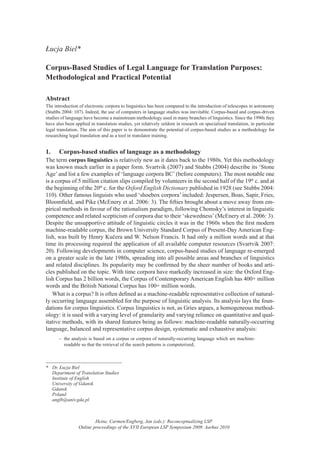
2. Types of corpora
Legal translation may benefit from corpus linguistics in a number of ways: it may be applied for
theoretical and practical purposes. The way corpus linguistics is used is directly related to the type
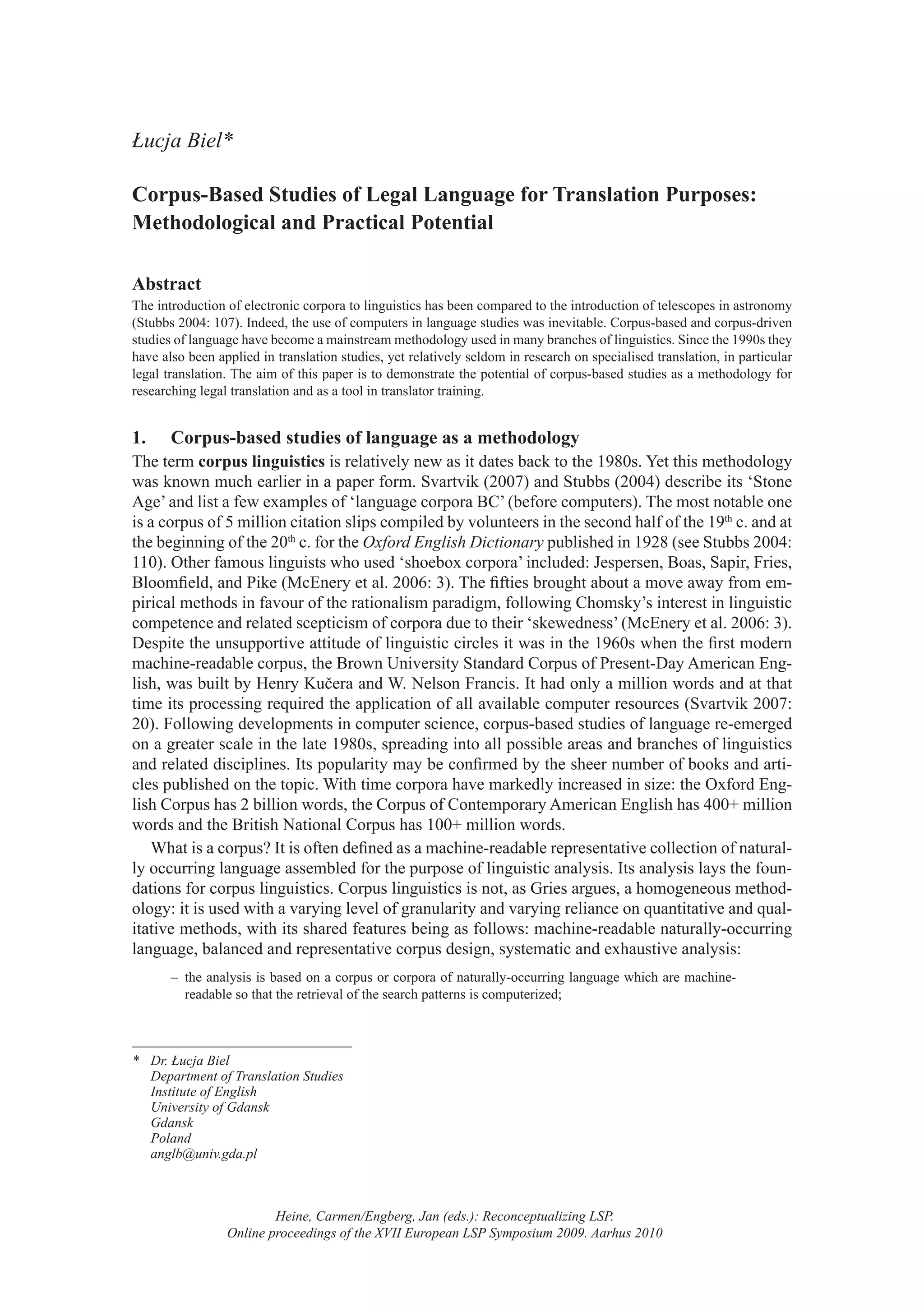
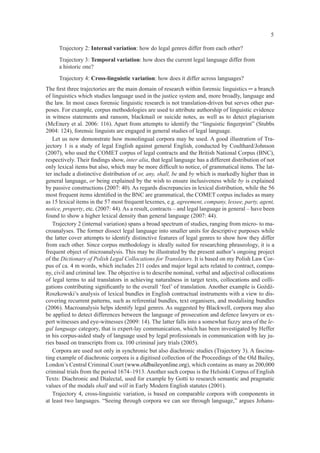
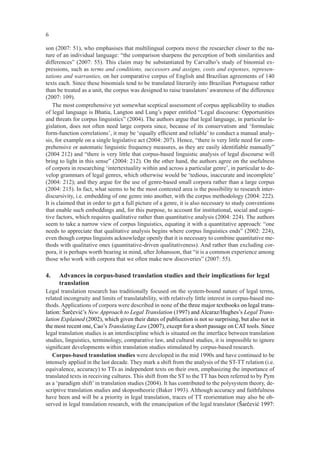
of corpora. From the point of view of translation studies, there are four major types of corpora: 1.
monolingual corpus, 2a. monolingual comparable corpora, 2b. bilingual comparable corpora, 3.
parallel corpus. Table 1 presents a summary of differences between the corpus types.](https://image.slidesharecdn.com/biel-110518173625-phpapp02/85/Corpus-Based-Studies-of-Legal-Language-for-Translation-Purposes-2-320.jpg)
![7
112) and a legal translation being perceived as an independent text which may “function on its
own in the new situation without necessary recourse to the source text” (Engberg 2002: 382).
Focus on target texts drew attention to translated language as such. The early 1990s saw the ac-
celerated development of corpus-based studies in linguistics, which, however, tended to exclude
translations as a non-representative language and, in particular, exclude them from monolingual
corpora (Baker 1996: 175). Recognising the advantages of corpus-based methodology, Baker pi-
oneered its application in translation studies in her seminal papers (1993, 1996), where she propo-
sed to analyse translations against non-translated texts and identify distinctive features of transla-
ted texts using corpus data. This proposal has been eagerly taken up by translation scholars, who
with time “have come to rely on corpora to verify, refine or clarify theories that hitherto had had
little or no empirical support and to achieve a higher degree of descriptive adequacy” (Granger
2003: 19).
The idea that translated language may be different from non-translated language is not new.
The former has been referred to in the literature as: translationese, hybrid language, third code,
third language, or translanguage, the first term being most widespread. Translationese is the lan-
guage of translation usually understood pejoratively as “translation-based deviations from target
language conventions” (Doherty qtd. in Olohan 2004: 29) or as “translated language that appears
to be influenced by the source language, usually in an inappropriate way or to an undue extent”
(Olohan 2004: 90). It is an intermediary, hybrid language between the SL and the TL since a trans-
lated text “is essentially a third code which arises out of the bilateral consideration of the matrix
and target codes: it is, in a sense, a sub-code of each of the codes involved” (Frawly 1984: 168).
As noted by Shamma, an untypical distribution of lexical items may contribute to the translation-
like impression and “leave[s] a vague impression of being culturally exotic” (qtd. in Baker 1993:
245). Obviously, the markedness of translationese may be higher in inexperienced or incompetent
translators or in inverse translation into one’s non-native language where it is coupled with non-
native competence.
The distinctive nature of translationese is caused not only by deviations from the norm due to
SL interferences but also, more interestingly, by distinctive features of the translation process its-
elf referred to by Baker as translation universals. She sees translation as “a mediated communi-
cative event” (1993: 243), “shaped by its own goals, pressures and context of production” (1996:
176). In consequence, translations are believed to show unique recurrent features independent of
language pairs, genres, cultures, etc. According to Baker, they include:
• explicitation: translators’ tendency to explicate what may be implicit in the ST,
• simplification and disambiguation: the tendency to simplify the message and/or language
in TTs,
• normalisation/conservatism: the tendency to exaggerate typical features of the TL, and
• levelling out: the tendency of translations “to gravitate towards the centre of a continuum”
as translations are less idiosyncratic and more similar to each other than original texts (1996:
180-185).
With time the list has been extended to include other features, such as under-representation of
unique TL items or untypical collocations (Mauranen 2006: 95). Seeking generalisations about
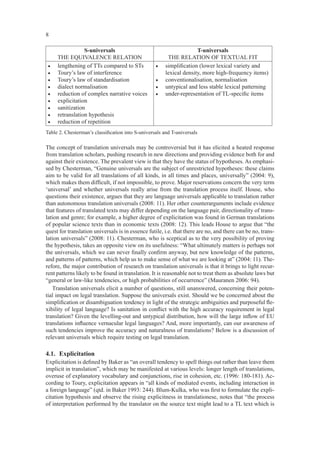
translation, Chesterman divides universals into S-universals and T-universals: the former concern
the equivalence relation which holds between STs and TTs while the latter contribute to the textu-
al fit between translations and naturally occurring non-translated language (2004: 6-7). This clas-
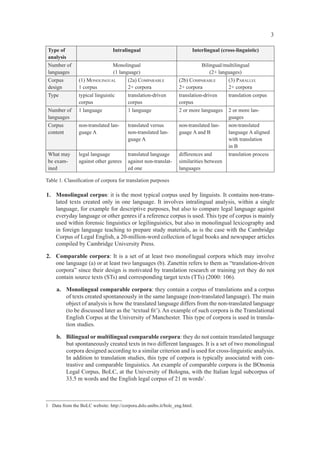
sification neatly reflects two crucial interrelated aspects of any specialised translation: accuracy
and naturalness, respectively (Table 2).](https://image.slidesharecdn.com/biel-110518173625-phpapp02/85/Corpus-Based-Studies-of-Legal-Language-for-Translation-Purposes-7-320.jpg)
![11
stinctive features of the target language and to conform to its typical patterns” (Baker 1996: 183)
to ensure that it is natural and idiomatic. This may lead to reappearance of repetitions in the other
direction, which would not support the hypothesis. For these reasons the avoidance of repetitions
merits more attention.
As pointed out by Baker, simplification is connected with explicitation: “simplification invol-
ves making things easier for the reader (but not necessarily more explicit), but it does tend to in-
volve also selecting an interpretation and blocking other interpretations, and in this sense it raises
the level of explicitness by resolving ambiguity” (1996: 182). Does disambiguation appear in le-
gal translation, and if so, is its extent markedly smaller? While legal language is a compromise
between precision and flexibility, ambiguity and vagueness may be strategic and deliberate. For
example, the flexible language of legislation allows it “to adapt to differing circumstances and
communities (...), to deal with novel situations that are certain to arise in the future as well as
changing norms and standards” (Tiersma 1999: 80). A case in point concerns modifiers, such as
reasonable, proper, due; they become part of legal terms to make their boundaries fuzzy. In the
multilingual EU legislation vague language may reflect a compromise or political disagreement
between the Member States. If a provision is unclear, it is referred by a national court to the ECJ
for interpretation under the preliminary ruling procedure. Disambiguation is perceived as over-
stepping one’s authority as a translator since translators are expected to retain the same degree
of ambiguity and leave disambiguation to courts: “it is generally agreed that the translator has
no authority to resolve an ambiguity in the source text as this would be an act of interpretation”
(Šarčević 1997: 92). As noted by Northcott/Brown, translators may resolve ambiguities in the ST
inadvertently if they lack legal knowledge:
One problem for the translator can be in misunderstanding the deliberate intention to retain ambigu-
ity which can lead to an attempt to make the term more precise and limit possible interpretations by
the court. Translators have no authority to resolve ambiguities in source texts. However, this can be
brought about inadvertently if translators do not have sufficient legal and linguistic expertise. (2006:
362)
Yet it is not only ignorance but also polysemy which disambiguates. This has been demonstra-
ted by a study of adverse on a parallel legal corpus (Goeffroy-Skuce 1997). Polysemy is a natu-
ral phenomenon in language: words form networks of interrelated senses (Langacker 1988: 51).
Since such networks differ across languages, a translator may have no choice but to pick a single
sense and disambiguate in the TL. Again, the scale of disambiguation, whether unavoidable or
avoidable, is unknown.
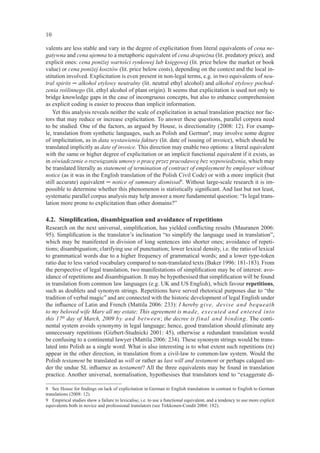
4.3. Textual fit: over-representation, under-representation and untypical
collocations
This group of universals is connected with a hitherto neglected aspect of legal translation ─ the
textual fit, that is how the translated language (translationese) differs from the non-translated lan-
guage. Research on comparable corpora suggests that translated texts show the ‘levelling out ten-
dency’ in that they “gravitate towards the centre of a continuum. […] It involves steering a middle
course between any two extremes, converging towards the centre” (Baker 1996: 184). For examp-
le, lexical density, type-token ratio and mean sentence length are similar in translated texts, while
in non-translated ones they have higher variance (Baker 1996: 184). Furthermore, the distribution
of linguistic features may be marked in translations compared to non-translated language: high-
frequency lexical items which are shared by the SL and the TL tend to be over-represented, whi-
le lexical items which do not have straightforward counterparts in the SL, the so-called unique
items, tend to be under-represented (Tirkkonen-Condit 2004: 177). Unique items may be lexical,
phraseological, syntactic or textual, and “they do not readily suggest themselves as translation
equivalents, as there is no obvious linguistic stimulus for them in the source text” (Tirkkonen-
Condit 2004: 177-178). This is closely related to Mauranen’s untypical collocations hypothesis:
her research shows that translated language is marked by collocations and colligations which are](https://image.slidesharecdn.com/biel-110518173625-phpapp02/85/Corpus-Based-Studies-of-Legal-Language-for-Translation-Purposes-11-320.jpg)
![14
Bhatia, Vijay K./Langton, Nicola M./Lung, Jane 2004: Legal discourse: Opportunities and threats for corpus lingui-
stics. In Connor, Ulla/Upton, Thomas A. (eds.), Discourse in the Professions. Perspectives from Corpus Linguistics.
Amsterdam/Philadelphia: John Benjamins, 203-231.
Biel, Łucja 2009: Organization of background knowledge structures in legal language and related translation problems.
In Comparative Legilinguistics. International Journal for Legal Communication 1, 176-189.
Biel, Łucja 2008: Legal terminology in translation practice: dictionaries, googling or discussion forums? In SKASE
Journal of Translation and Interpretation [online] 3(1). www.skase.sk/Volumes/JTI03/pdf_doc/BielLucja.pdf (ac-
cessed on 28 May 2009).
Blackwell, Sue 2009: Why forensic linguistics needs corpus linguistics. In Comparative Legilinguistics. International
Journal for Legal Communication 1, 5-19.
Blum-Kulka, Shoshana 1986: Shifts of cohesion and coherence in translation. In House, Juliane/Blum-Kulka, Shos-
hana (eds.), Interlingual and Intercultural Communication. Tübingen, Günter Narr Verlag, 17-35.
Cao, Deborah 2007: Translating Law. Clevedon: Multilingual Matters Ltd.
Carvalho, Luciana 2007: Translating contracts and agreements from a corpus linguistics perspective. In Kredens, Kr-
zysztof/Goźdź-Roszkowski, Stanisław (eds.), Language and the Law: International Outlooks. Frankfurt am Main:
Peter Lang, 109-121.
Chesterman, Andrew 2004: Hypotheses about translation universals. In Hansen, Gyde/Malmkjær, Kirsten/Gile, Daniel
(eds.), Claims, Changes and Challenges in Translation Studies. Selected contributions from the EST Congress,
Copenhagen 2001. Amsterdam/Philadelphia: John Benjamins, 1-13.
Coulthard, Malcolm/Johnson, Alison 2007: An Introduction to Forensic Linguistics. Language in Evidence. London/
New York: Routledge.
Engberg, Jan 2002: Legal meaning assumptions – what are the consequences for legal interpretation and legal transla-
tion? In International Journal of the Semiotics of Law 15(4), 375-388.
Frawley, William 1984: Prolegomenon to a theory of translation. In Frawley, William (ed.), Translation: Literary, Lin-
guistic and Philosophical Perspectives. London/Toronto: Associated University Presses, 159-175.
Gizbert-Studnicki, Tomasz 2001: Problem przekładu tekstów prawnych. In Dziedzictwo prawne XX wieku. Księga
pamiątkowa z okazji 150-lecia TBSP UJ. Zakamycze: Kraków, 41-55.
Goeffroy-Skuce, Anne 1997: Polysemous adjectives in legal translation. In Simms, Karl (ed.), Translating Sensitive
Texts: Linguistics Aspects. Amsterdam: Rodopi, 155-168.
Gotti, Maurizio 2001: Semantic and pragmatic values of shall and will in Early Modern English statutes. In: Gotti,
Maurizio/Dossena, Marina (eds.), Modality in Specialized Texts. Bern: Peter Lang, 89-111.
Góźdź-Roszkowski, Stanisław 2006: Frequent phraseology in contractual instruments: a corpus-based study. In Gotti,
Maurizio/Giannoni, Davide S. (eds.), New Trends in Specialized Discourse Analysis. Bern: Peter Lang, 147-162.
Granger, Sylviane 2003: The corpus approach: a common way forward for Contrastive Linguistics and Translation Stu-
dies? In Granger, Sylviane/Lerot, Jacques/Petch-Tyson, Stephanie (eds.), Corpus-based Approaches to Contrastive
Linguistics and Translation Studies. Amsterdam/New York: Rodopi, 17-29.
Gries, Stefan Th. 2006: Introduction. Corpora in Cognitive Linguistics. Corpus-Based Approaches to Syntax and Lexis,
In Gries, Stefan Th./Stefanowitsch, Anatol. Berlin/New York: Mouton de Gruyter, 1-7.
Harvey, Malcolm 2002: What’s so special about legal translation? In Meta [online] 47(2). www.erudit.org/revue/
meta/2002/v47/n2/008007ar.pdf (accessed 5 May 2009).
Heffer, Chris 2005: The Language of Jury Trial. A Corpus-Aided Analysis of Legal-Lay Discourse. Basingstoke: Pal-
grave Macmillan.
House, Juliane 2008: Beyond Intervention: Universals in Translation? In trans-kom [online] 1(1), 6-19. www.trans-
kom.eu (accessed 5 May 2009).
Johansson, Stig 2007: Seeing through multilingual corpora. In Facchinetti, Roberta (ed.), Corpus Linguistics 25 Years
on. Language and Computers. Amsterdam/New York: Rodopi, 51-71.
Kenny, Dorothy 2001: Lexis and creativity in translation. A corpus-based study. Manchester: St Jerome Publishing.
Kierzkowska, Danuta (ed.) 2005: Kodeks tłumacza przysięgłego z komentarzem. Warszawa: Tepis.
Krishnamurthy, Ramesh 2006: Corpus Lexicography. In Brown, Keith (ed.), Encyclopedia of Language and Lingui-
stics. Vol. 3. Oxford: Elsevier, 250-251.
Langacker, Ronald W. 1988: A View of Linguistic Semantics. In Rudzka-Ostyn, Brygida (ed.), Topics in Cognitive
Linguistics. Amsterdam/Philadelphia: John Benjamins, 45-90.
Mattila, Heikki E.S. 2006: Comparative Legal Linguistics. Aldershot: Ashgate.](https://image.slidesharecdn.com/biel-110518173625-phpapp02/85/Corpus-Based-Studies-of-Legal-Language-for-Translation-Purposes-14-320.jpg)
![15
Mauranen, Anna 2006: Translation universals. In Brown, Keith (ed.), Encyclopedia of Language and Linguistics. Vol.
13. Oxford: Elsevier, 93-100.
McEnery, Tony/Xiao, Richard/Tono, Yukio 2006: Corpus-Based Language Studies. An Advanced Resource Book. Lon-
don/New York: Routledge.
Monzó, Esther 2008: Corpus-based activities in legal translator training. In The Interpreter and Translator Trainer
2(2), 221-251.
Northcott, Jill/Brown, Gillian 2006: Legal translator training: Partnership between teachers of English for legal purpo-
ses and legal specialists. In English for Specific Purposes 25(3), 358–375.
Olohan, Maeve 2004: Introducing Corpora in Translation Studies. London/New York: Routledge.
Piehl, Aino 2006: The influence of EU legislation on Finnish Legal Discourse. In Gotti, Maurizio/Giannoni, Davide S.
(eds.), New Trends in Specialized Discourse Analysis. Bern: Peter Lang, 183-194.
Pym, Anthony 2004: Localization from the Perspective of Translation Studies: Overlaps in the Digital Divide? In ELDA
[online]. http://www.elda.org/en/proj/scalla/SCALLA2004/Pymv2.pdf (accessed 10 May 2009).
Šarčević, Susan 2000: Legal Translation and Translation Theory: a Receiver-Oriented Approach. In Genève 2000:
Actes [online]. www.tradulex.org (accessed 5 May 2009).
Šarčević, Susan 1997: New Approach to Legal Translation. The Hague: Kluwer Law International.
Stubbs, Michael 2004: Language Corpora. In Davies, Alan/Elder, Catherine (eds.), Handbook of Applied Linguistics.
Oxford: Blackwell, 106-132.
Svartvik, Jan 2007: Corpus linguistics 25+ years on. In Facchinetti, Roberta (ed.), Corpus Linguistics 25 Years on.
Language and Computers. Amsterdam: Rodopi, 11-25.
Taylor, John 2006: Cognitive Semantics. In Brown, Keith (ed.), Encyclopedia of Language and Linguistics. Vol. 3.
Oxford: Elsevier, 569-582.
Teubert, Wolfgang 2002: The role of parallel corpora in translation and multilingual lexicography. In Atenberg, Bengt/
Granger, Sylviane (eds.), Lexis in Contrast. Amsterdam/Philadelphia: John Benjamins, 189-214.
Tiersma, Peter M. 1999: Legal Language. Chicago/London: University of Chicago Press.
Tirkkonen-Condit, Sonja 2004: Unique items ─ over- or under-represented in translated language? In Mauranen, Anna/
Kujamäki, Pekka (eds.), Translation Universals. Do They Exist? Amsterdam/Philadelphia: John Benjamins, 177-
184.
Tognini-Bonelli, Elena 2001: Corpus Linguistics at Work. Amsterdam/Philadelphia: John Benjamins.
Zanettin, Frederico 2000: Parallel Corpora in Translation Studies. Issues in Corpus Design and Analysis. In Olohan,
Maeve (ed.), Intercultural Faultlines. Research Models in Translation Studies I. Textual and Cognitive Aspects.
Manchester: St Jerome, 105-118.](https://image.slidesharecdn.com/biel-110518173625-phpapp02/85/Corpus-Based-Studies-of-Legal-Language-for-Translation-Purposes-15-320.jpg)

This document discusses the potential of corpus-based studies as a methodology for researching legal translation and as a tool in translator training. It begins by providing background on the history of corpus linguistics and defining key terms. It then describes the main types of corpora relevant to translation studies: monolingual corpora, comparable corpora (monolingual and bilingual), and parallel corpora. The document outlines four major trajectories of corpus-based research on legal language: comparing legal language to general language; comparing legal genres; analyzing temporal variations; and analyzing cross-linguistic variations. Finally, it notes limitations of legal corpora, including availability, size, and over-representation of legislation.


