CORPUS TOOLS
FOR LANGUAGE TEACHING
(PART 2)
LANGUAGE TEACHING WORKSHOP SERIES
2013-2014
Center for Language Acquisition (CLA)
http://language.la.psu.edu
and
Center for Advanced Language Proficiency
Education and Research (CALPER)
http://calper.la.psu.edu
The Pennsylvania State University
CLAandCALPERatPennState
GOALS OF THE WORKSHOP
 Review:
 What is a language corpus?
 Question:
 How are corpora used for language teaching and
learning?
 Model:
 What do corpus-based classroom activities look like?
 Explore:
 Creating a corpus-based learning activity
 Discuss:
 Share your ideas
CLAandCALPERatPennState
PRESENTERS
 Brody Bluemel
 Department of Applied Linguistics & Asian Studies
 Chinese, ESL, German
 Edie Furniss
 Department of Applied Linguistics and IECP
 Russian, ESL, French
 Meredith Doran
 Center for Language Acquisition/Applied Linguistics
 French, Spanish, ESL
CLAandCALPERatPennState
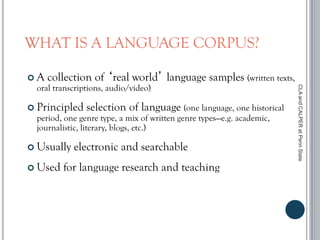
WHAT IS A LANGUAGE CORPUS?
 A collection of ‘real world’ language samples (written texts,
oral transcriptions, audio/video)
 Principled selection of language (one language, one historical
period, one genre type, a mix of written genre types—e.g. academic,
journalistic, literary, blogs, etc.)
 Usually electronic and searchable
 Used for language research and teaching
CLAandCALPERatPennState
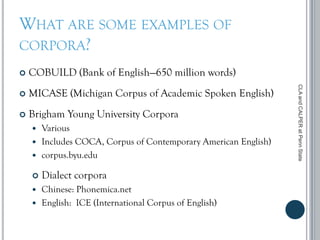
WHAT ARE SOME EXAMPLES OF
CORPORA?
 COBUILD (Bank of English—650 million words)
 MICASE (Michigan Corpus of Academic Spoken English)
 Brigham Young University Corpora
 Various
 Includes COCA, Corpus of Contemporary American English)
 corpus.byu.edu
 Dialect corpora
 Chinese: Phonemica.net
 English: ICE (International Corpus of English)
CLAandCALPERatPennState
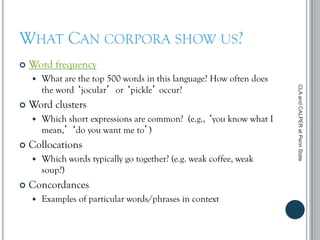
WHAT CAN CORPORA SHOW US?
 Word frequency
 What are the top 500 words in this language? How often does
the word ‘jocular’ or ‘pickle’ occur?
 Word clusters
 Which short expressions are common? (e.g., ‘you know what I
mean,’ ‘do you want me to’)
 Collocations
 Which words typically go together? (e.g. weak coffee, weak
soup?)
 Concordances
 Examples of particular words/phrases in context
CLAandCALPERatPennState
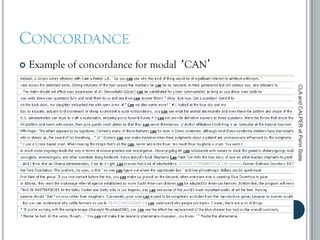
CONCORDANCE
 Example of concordance for modal ‘CAN’
CLAandCALPERatPennState
BENEFITS OF CORPORA FOR LANGUAGE
TEACHING
 More accurate descriptions of language than
textbooks/intuitions
 Exposure to contextualized, meaningful language
in ‘real’ usages
 Examples of specific registers/genres of language
 Reference tool for independent/autonomous
language investigation and learning
 Cited from: Jonathan Smart, Northern Arizona University
CLAandCALPERatPennState
OTHER BENEFITS FOR LEARNERS
 Gives learners exposure to non-textbook language
patterns
 Gives learners access to a much larger language
sample than classes can normally provide
 Can answer questions about everyday usages (Do
people really say/use this? Which constructions
are common? Which vocabulary is frequent/rare?
Is this word or feature typical in speech/writing?)
CLAandCALPERatPennState
SPECIFIC APPLICATIONS OF CORPORA
FOR TEACHING
 Use contextualized examples for quizzes, activities,
explanations
 Share lists of frequent words or expressions with learners
 Research features of language for lesson design (e.g., Are the
modals can, could, may, might, shall, will equally used? Should they be equally
taught?)
 Pre-select materials from corpora to help learners
discover/explore particular language patterns
 Have students search corpora using a search tool
CLAandCALPERatPennState
WHAT TO TEACH WITH A CORPUS?
 Vocabulary
 Word meanings in context, combinations/collocations, parts
of speech, common expressions, differences in meaning
 Grammar
 Differences between similar forms, how forms are used in
context
 Pragmatics
 Greetings, genre features and their cultural meanings (e.g. job
letters, CVs, personal letters, etc.)
CLAandCALPERatPennState
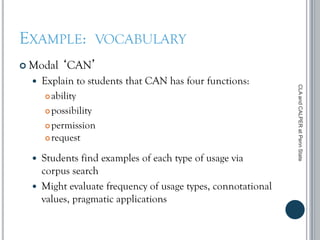
EXAMPLE: VOCABULARY
 Modal ‘CAN’
 Explain to students that CAN has four functions:
 ability
 possibility
 permission
 request
 Students find examples of each type of usage via
corpus search
 Might evaluate frequency of usage types, connotational
values, pragmatic applications
CLAandCALPERatPennState
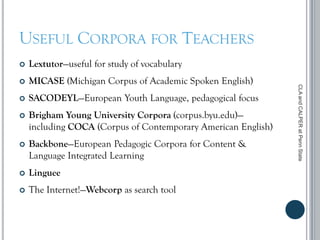
USEFUL CORPORA FOR TEACHERS
 Lextutor—useful for study of vocabulary
 MICASE (Michigan Corpus of Academic Spoken English)
 SACODEYL—European Youth Language, pedagogical focus
 Brigham Young University Corpora (corpus.byu.edu)—
including COCA (Corpus of Contemporary American English)
 Backbone—European Pedagogic Corpora for Content &
Language Integrated Learning
 Linguee
 The Internet!—Webcorp as search tool
CLAandCALPERatPennState
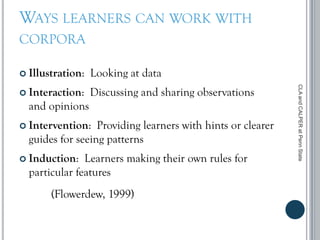
WAYS LEARNERS CAN WORK WITH
CORPORA
 Illustration: Looking at data
 Interaction: Discussing and sharing observations
and opinions
 Intervention: Providing learners with hints or clearer
guides for seeing patterns
 Induction: Learners making their own rules for
particular features
(Flowerdew, 1999)
CLAandCALPERatPennState
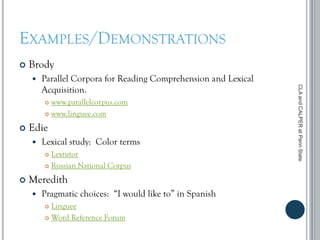
EXAMPLES/DEMONSTRATIONS
 Brody
 Parallel Corpora for Reading Comprehension and Lexical
Acquisition.
 www.parallelcorpus.com
 www.linguee.com
 Edie
 Lexical study: Color terms
 Lextutor
 Russian National Corpus
 Meredith
 Pragmatic choices: “I would like to” in Spanish
 Linguee
 Word Reference Forum
CLAandCALPERatPennState
PARALLEL CORPORA FOR READING &
WRITING
 Activity: 12 Zodiac Animals
Using www.parallelcorpus.com, students were asked
to:
Read the story
Identify 5 new vocab items
Identify the 12 zodiac animals
Write 10 sentences using new vocabulary
Summarize the story in your own words
 12 Zodiac Animals Story
 Vocabulary Term Search: "看"
CLAandCALPERatPennState
OUTCOMES
Beginning level students able to read through and
comprehend the meaning of the story.
Students learned to use new vocabulary items with
multiple meanings and uses.
Sample sentences:
你看,那是一只好看的老虎。
Look, there’s a good-looking tiger.
我看到一个球。
I saw a ball.
Reference for constructing grammatical sentences.
CLAandCALPERatPennState
PARALLEL CORPORA FOR OTHER
LANGUAGES:
 www.linguee.com
 Explore complex terms/structures.
 Identify stories/ content-based websites to work through.
 Reference for using new terms and constructs correctly.
CLAandCALPERatPennState
PRAGMATICS OF REQUESTING IN SPANISH
 Goal:
 Raise students’ awareness of polite request forms in
Spanish (e.g., “I would like . . . “ vs. “I want . . . “)
Step 1: Brainstorming
Have students generate some ways to ‘request’ in
Spanish:
 Yo quiero . . . (“I want . . .’, present tense)
 Me gustaría . . . (“It would please me . . . “, conditional)
 Deseo . . . (“I desire . . . “, present)
 Quisiera . . . (“I was wanting . . . “, imperfect subjunctive)
CLAandCALPERatPennState
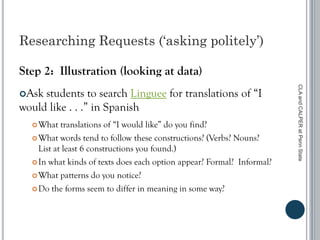
Researching Requests (‘asking politely’)
Step 2: Illustration (looking at data)
Ask students to search Linguee for translations of “I
would like . . .” in Spanish
What translations of “I would like” do you find?
What words tend to follow these constructions? (Verbs? Nouns?
List at least 6 constructions you found.)
In what kinds of texts does each option appear? Formal? Informal?
What patterns do you notice?
Do the forms seem to differ in meaning in some way?
CLAandCALPERatPennState
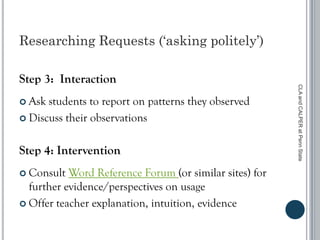
Researching Requests (‘asking politely’)
Step 3: Interaction
 Ask students to report on patterns they observed
 Discuss their observations
Step 4: Intervention
 Consult Word Reference Forum (or similar sites) for
further evidence/perspectives on usage
 Offer teacher explanation, intuition, evidence
CLAandCALPERatPennState
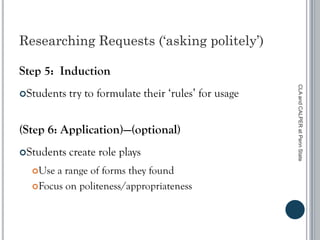
Researching Requests (‘asking politely’)
Step 5: Induction
Students try to formulate their ‘rules’ for usage
(Step 6: Application)—(optional)
Students create role plays
Use a range of forms they found
Focus on politeness/appropriateness
CLAandCALPERatPennState
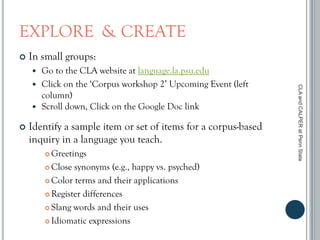
EXPLORE & CREATE
 In small groups:
 Go to the CLA website at language.la.psu.edu
 Click on the ‘Corpus workshop 2’ Upcoming Event (left
column)
 Scroll down, Click on the Google Doc link
 Identify a sample item or set of items for a corpus-based
inquiry in a language you teach.
 Greetings
 Close synonyms (e.g., happy vs. psyched)
 Color terms and their applications
 Register differences
 Slang words and their uses
 Idiomatic expressions
CLAandCALPERatPennState
DISCUSS
 Ideas and applications of corpora generated in
your group
 Key features or aspects of corpora we haven’t yet
considered?
 Questions?
CLAandCALPERatPennState
THANK YOU!
Like us on Facebook
http://www.facebook.com/CALPERPA
CLAandCALPERatPennState

Corpus Tools for Language Teaching

  • 1.
    CORPUS TOOLS FOR LANGUAGETEACHING (PART 2) LANGUAGE TEACHING WORKSHOP SERIES 2013-2014 Center for Language Acquisition (CLA) http://language.la.psu.edu and Center for Advanced Language Proficiency Education and Research (CALPER) http://calper.la.psu.edu The Pennsylvania State University CLAandCALPERatPennState
  • 2.
    GOALS OF THEWORKSHOP  Review:  What is a language corpus?  Question:  How are corpora used for language teaching and learning?  Model:  What do corpus-based classroom activities look like?  Explore:  Creating a corpus-based learning activity  Discuss:  Share your ideas CLAandCALPERatPennState
  • 3.
    PRESENTERS  Brody Bluemel Department of Applied Linguistics & Asian Studies  Chinese, ESL, German  Edie Furniss  Department of Applied Linguistics and IECP  Russian, ESL, French  Meredith Doran  Center for Language Acquisition/Applied Linguistics  French, Spanish, ESL CLAandCALPERatPennState
  • 4.
    WHAT IS ALANGUAGE CORPUS?  A collection of ‘real world’ language samples (written texts, oral transcriptions, audio/video)  Principled selection of language (one language, one historical period, one genre type, a mix of written genre types—e.g. academic, journalistic, literary, blogs, etc.)  Usually electronic and searchable  Used for language research and teaching CLAandCALPERatPennState
  • 5.
    WHAT ARE SOMEEXAMPLES OF CORPORA?  COBUILD (Bank of English—650 million words)  MICASE (Michigan Corpus of Academic Spoken English)  Brigham Young University Corpora  Various  Includes COCA, Corpus of Contemporary American English)  corpus.byu.edu  Dialect corpora  Chinese: Phonemica.net  English: ICE (International Corpus of English) CLAandCALPERatPennState
  • 6.
    WHAT CAN CORPORASHOW US?  Word frequency  What are the top 500 words in this language? How often does the word ‘jocular’ or ‘pickle’ occur?  Word clusters  Which short expressions are common? (e.g., ‘you know what I mean,’ ‘do you want me to’)  Collocations  Which words typically go together? (e.g. weak coffee, weak soup?)  Concordances  Examples of particular words/phrases in context CLAandCALPERatPennState
  • 7.
    CONCORDANCE  Example ofconcordance for modal ‘CAN’ CLAandCALPERatPennState
  • 8.
    BENEFITS OF CORPORAFOR LANGUAGE TEACHING  More accurate descriptions of language than textbooks/intuitions  Exposure to contextualized, meaningful language in ‘real’ usages  Examples of specific registers/genres of language  Reference tool for independent/autonomous language investigation and learning  Cited from: Jonathan Smart, Northern Arizona University CLAandCALPERatPennState
  • 9.
    OTHER BENEFITS FORLEARNERS  Gives learners exposure to non-textbook language patterns  Gives learners access to a much larger language sample than classes can normally provide  Can answer questions about everyday usages (Do people really say/use this? Which constructions are common? Which vocabulary is frequent/rare? Is this word or feature typical in speech/writing?) CLAandCALPERatPennState
  • 10.
    SPECIFIC APPLICATIONS OFCORPORA FOR TEACHING  Use contextualized examples for quizzes, activities, explanations  Share lists of frequent words or expressions with learners  Research features of language for lesson design (e.g., Are the modals can, could, may, might, shall, will equally used? Should they be equally taught?)  Pre-select materials from corpora to help learners discover/explore particular language patterns  Have students search corpora using a search tool CLAandCALPERatPennState
  • 11.
    WHAT TO TEACHWITH A CORPUS?  Vocabulary  Word meanings in context, combinations/collocations, parts of speech, common expressions, differences in meaning  Grammar  Differences between similar forms, how forms are used in context  Pragmatics  Greetings, genre features and their cultural meanings (e.g. job letters, CVs, personal letters, etc.) CLAandCALPERatPennState
  • 12.
    EXAMPLE: VOCABULARY  Modal‘CAN’  Explain to students that CAN has four functions:  ability  possibility  permission  request  Students find examples of each type of usage via corpus search  Might evaluate frequency of usage types, connotational values, pragmatic applications CLAandCALPERatPennState
  • 13.
    USEFUL CORPORA FORTEACHERS  Lextutor—useful for study of vocabulary  MICASE (Michigan Corpus of Academic Spoken English)  SACODEYL—European Youth Language, pedagogical focus  Brigham Young University Corpora (corpus.byu.edu)— including COCA (Corpus of Contemporary American English)  Backbone—European Pedagogic Corpora for Content & Language Integrated Learning  Linguee  The Internet!—Webcorp as search tool CLAandCALPERatPennState
  • 14.
    WAYS LEARNERS CANWORK WITH CORPORA  Illustration: Looking at data  Interaction: Discussing and sharing observations and opinions  Intervention: Providing learners with hints or clearer guides for seeing patterns  Induction: Learners making their own rules for particular features (Flowerdew, 1999) CLAandCALPERatPennState
  • 15.
    EXAMPLES/DEMONSTRATIONS  Brody  ParallelCorpora for Reading Comprehension and Lexical Acquisition.  www.parallelcorpus.com  www.linguee.com  Edie  Lexical study: Color terms  Lextutor  Russian National Corpus  Meredith  Pragmatic choices: “I would like to” in Spanish  Linguee  Word Reference Forum CLAandCALPERatPennState
  • 16.
    PARALLEL CORPORA FORREADING & WRITING  Activity: 12 Zodiac Animals Using www.parallelcorpus.com, students were asked to: Read the story Identify 5 new vocab items Identify the 12 zodiac animals Write 10 sentences using new vocabulary Summarize the story in your own words  12 Zodiac Animals Story  Vocabulary Term Search: "看" CLAandCALPERatPennState
  • 17.
    OUTCOMES Beginning level studentsable to read through and comprehend the meaning of the story. Students learned to use new vocabulary items with multiple meanings and uses. Sample sentences: 你看,那是一只好看的老虎。 Look, there’s a good-looking tiger. 我看到一个球。 I saw a ball. Reference for constructing grammatical sentences. CLAandCALPERatPennState
  • 18.
    PARALLEL CORPORA FOROTHER LANGUAGES:  www.linguee.com  Explore complex terms/structures.  Identify stories/ content-based websites to work through.  Reference for using new terms and constructs correctly. CLAandCALPERatPennState
  • 19.
    PRAGMATICS OF REQUESTINGIN SPANISH  Goal:  Raise students’ awareness of polite request forms in Spanish (e.g., “I would like . . . “ vs. “I want . . . “) Step 1: Brainstorming Have students generate some ways to ‘request’ in Spanish:  Yo quiero . . . (“I want . . .’, present tense)  Me gustaría . . . (“It would please me . . . “, conditional)  Deseo . . . (“I desire . . . “, present)  Quisiera . . . (“I was wanting . . . “, imperfect subjunctive) CLAandCALPERatPennState
  • 20.
    Researching Requests (‘askingpolitely’) Step 2: Illustration (looking at data) Ask students to search Linguee for translations of “I would like . . .” in Spanish What translations of “I would like” do you find? What words tend to follow these constructions? (Verbs? Nouns? List at least 6 constructions you found.) In what kinds of texts does each option appear? Formal? Informal? What patterns do you notice? Do the forms seem to differ in meaning in some way? CLAandCALPERatPennState
  • 21.
    Researching Requests (‘askingpolitely’) Step 3: Interaction  Ask students to report on patterns they observed  Discuss their observations Step 4: Intervention  Consult Word Reference Forum (or similar sites) for further evidence/perspectives on usage  Offer teacher explanation, intuition, evidence CLAandCALPERatPennState
  • 22.
    Researching Requests (‘askingpolitely’) Step 5: Induction Students try to formulate their ‘rules’ for usage (Step 6: Application)—(optional) Students create role plays Use a range of forms they found Focus on politeness/appropriateness CLAandCALPERatPennState
  • 23.
    EXPLORE & CREATE In small groups:  Go to the CLA website at language.la.psu.edu  Click on the ‘Corpus workshop 2’ Upcoming Event (left column)  Scroll down, Click on the Google Doc link  Identify a sample item or set of items for a corpus-based inquiry in a language you teach.  Greetings  Close synonyms (e.g., happy vs. psyched)  Color terms and their applications  Register differences  Slang words and their uses  Idiomatic expressions CLAandCALPERatPennState
  • 24.
    DISCUSS  Ideas andapplications of corpora generated in your group  Key features or aspects of corpora we haven’t yet considered?  Questions? CLAandCALPERatPennState
  • 25.
    THANK YOU! Like uson Facebook http://www.facebook.com/CALPERPA CLAandCALPERatPennState