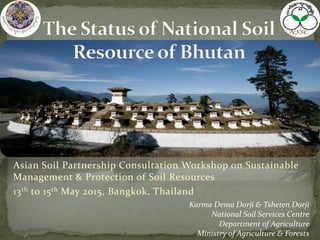

Asian Soil Partnership Consultation Workshop on Sustainable
Management & Protection of Soil Resources
13th to 15th May 2015, Bangkok, Thailand
Karma Dema Dorji & Tsheten Dorji
National Soil Services Centre
Department of Agriculture
Ministry of Agriculture & Forests
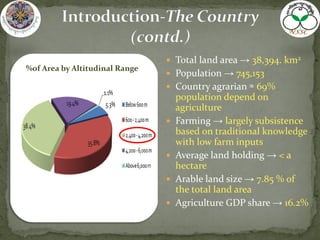
 Total land area → 38,394. km2
 Population → 745,153
 Country agrarian ≈ 69%
population depend on
agriculture
 Farming → largely subsistence
based on traditional knowledge
with low farm inputs
 Average land holding → < a
hectare
 Arable land size → 7.85 % of
the total land area
 Agriculture GDP share → 16.2%
%of Area by Altitudinal Range
0
10
20
30
40
50
60
70
80
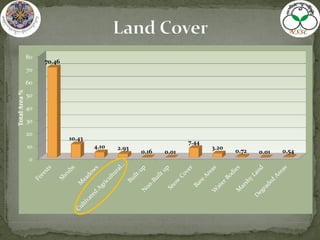
70.46
10.43
4.10 2.93
0.16 0.01
7.44
3.20
0.72 0.01 0.54
TotalArea%
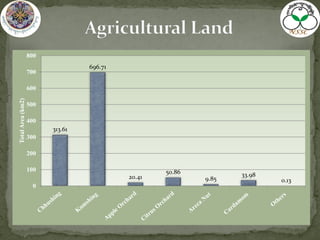
313.61
696.71
20.41
50.86
9.85
33.98
0.13
0
100
200
300
400
500
600
700
800
TotalArea(km2)
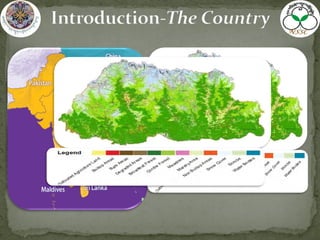
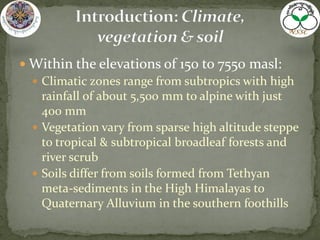
 Within the elevations of 150 to 7550 masl:
 Climatic zones range from subtropics with high
rainfall of about 5,500 mm to alpine with just
400 mm
 Vegetation vary from sparse high altitude steppe
to tropical & subtropical broadleaf forests and
river scrub
 Soils differ from soils formed from Tethyan
meta-sediments in the High Himalayas to
Quaternary Alluvium in the southern foothills
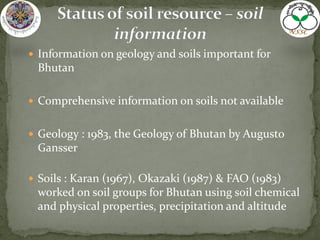
 Information on geology and soils important for
Bhutan
 Comprehensive information on soils not available
 Geology : 1983, the Geology of Bhutan by Augusto
Gansser
 Soils : Karan (1967), Okazaki (1987) & FAO (1983)
worked on soil groups for Bhutan using soil chemical
and physical properties, precipitation and altitude
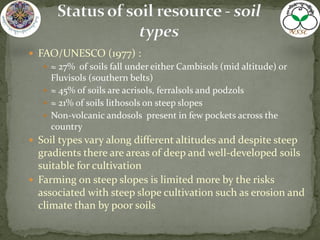
 FAO/UNESCO (1977) :
 ≈ 27% of soils fall under either Cambisols (mid altitude) or
Fluvisols (southern belts)
 ≈ 45% of soils are acrisols, ferralsols and podzols
 ≈ 21% of soils lithosols on steep slopes
 Non-volcanic andosols present in few pockets across the
country
 Soil types vary along different altitudes and despite steep
gradients there are areas of deep and well-developed soils
suitable for cultivation
 Farming on steep slopes is limited more by the risks
associated with steep slope cultivation such as erosion and
climate than by poor soils
 The overall soil nutrient status or chemical properties
of the soils in Bhutan:
 Soil pH : within the low to medium range
 Exchangeable Al saturation % : low to very low indicating
no aluminium toxicity
 Organic Matter content : moderate
 C:N ratio : between 11 to 14.1 (typical for agricultural soils)
 P & K contents : low in most soils (However phosphate
deficiency is considered more severe as the underlying
geology is rich in potassium)
 BS% : low or very low in most soils
 CEC : low in most soils
 Land use and agro-ecological zone are the most important
factors determining variation in soil nutrient status in
Bhutan.
 Dryland soils mostly have a higher soil nutrient status than
wetland soils
 Warm temperate and dry subtropical soils have the most
favourable soil nutrient status while humid and wet
subtropical soils have low nutrient status
 Different soil fertility management practices followed by
farmers on different land use types also contribute to the
variation in soil nutrient status.
 Soil managed largely in traditional ways
 Soil fertility management is mainly through integrated
system of using both organic & inorganic sources of plant
nutrients
 In remote parts of the country where access to modern
agricultural inputs is limited, farming is very traditional
using traditional system of soil fertility management
 Sustainability of the traditional SFM system is very much
dependent on the household labour availability & livestock
number
 Farm labour shortage, decline in livestock size & increasing
distance to forests for leaf litters threaten the sustainability of
the SFM system
 Current SFM practice involves using inorganic
fertilizers along with organic sources of plant
nutrients due to:
 increased awareness among farmers of the benefit
of using inorganic fertilizers;
 increased and improved access to inorganic
fertilizers;
 farmer’s enhanced purchasing power;
 Inorganic fertilizers are used mainly in cash crops
e.g. potatoes & apples
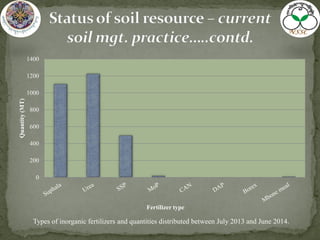
0
200
400
600
800
1000
1200
1400
Quantity(MT)
Fertilizer type
Types of inorganic fertilizers and quantities distributed between July 2013 and June 2014.
 A steady increase in the amount of inorganic fertilizers
imported and distributed : from about 250 MT in 1960 to
2998 MT in 2006
 Import and distribution between July 2013 and June 2014 :
about 2848 MT.
 The long term goal of the country is to produce its food
crops organically or at least provide options to the farmers
between organic and conventional ways of growing food
crops.
 As Bhutan ventures into achieving this objective, the use of
inorganic fertilizers & plant protection chemicals will
decline or keep their use as low as possible
 Current use of inorganic fertilizer is very low as
compared to many countries in the region
 Top soil erosion resulting in declining soil productivity
is a huge problem affecting crop growth and yield
especially in dryland on steep mountain slopes.
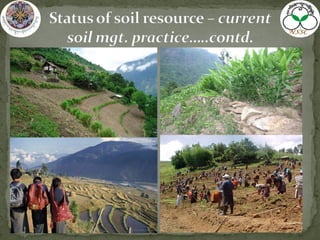
 To prevent soil erosion and other forms of land
degradation, farming on steep slopes are characterized
by series of terraces, contour bunds, hedgerows and
other methods of sustainable land management.
 Four factors have greatly influenced evolution of land
use in Bhutan:
 The biophysical setting, population dynamics, the
history of land allotment and access to public land, and
the level of economic development of the farming
community.
 Inefficient land utilization and low production per area,
environmental degradation, difficulties associated with
intensification of agriculture and the diversification of
rural labour into non-agricultural activities influence
the development of agriculture in the country.
 The naturally limited land resource for agriculture due
to difficult topography, land fragmentation and lack of
landuse policy are other important issues.
 Eastern Himalayas : among the most complicated
landscapes in the world - soil information
gathering is a challenging task
 Difficult terrain & topography & limited resources
including technical and financial resources are the
main constraints in generating good soil
information
 Lack of good comprehensive soil information is a
huge drawback
 No national soil maps, which are crucial for
informed planning and decision making purposes
 The predominantly steep slopes put the limited
productive land resources at risk from various forms of
degradation.
 Direct factors : overgrazing, forest fires, excessive
forest use, unsustainable agricultural, poor irrigation
system management, infrastructure development,
unsustainable mining, industrial activities,
urbanization, and solid waste
 Indirect factors are population growth and structure,
poverty, climate change and policy and institutional
issues
 Labour force availability
 The Poverty-SLM linkage
 Remoteness / input supply costs
 The considerable “gestation time” for long-term SLM
interventions
 Cumbersome approaches: resource-intensive nature of
SLM approaches
 Sectoral approach to combating land or soil
degradation : green sector versus brown sectors
 With increasing population, the already limited arable land
is dwindling both in size and productivity.
 On rugged and steep slopes cultivation in most cases is
practiced without proper soil and water management
measures.
 Improper management of irrigated paddy lands on steep
slopes, shortening of fallow period of tseri (slash and
burn), burning crop residues, and lack of cover crop
establishment when necessary have caused land
degradation in numerous places.
 Intensification of agricultural production as farmers’ move
from traditional subsistence farming to market – based
farming and with the introduction of high yielding
improved crop varieties, use of inorganic fertilizers has
added to the problem.
 Imbalanced use of inorganic fertilizers and nutrient
mining are the main contributing factor under
intensive cultivation. Nutrient mining is also a serious
problem in areas with subsistence farming and poor
soil fertility management.
 In the absence of proper land suitability and capability
classification systems, land is not being used optimally
and sustainably.
 Soil/land degradation : threat to the livelihoods of
subsistence farmers, country’s objective to achieve
food self sufficiency and security and hydropower
generation, the country’s growing revenue source.
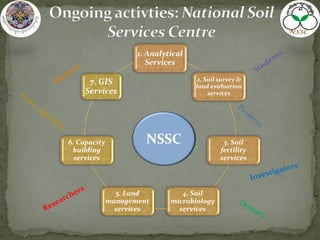
1. Analytical
Services
2. Soil survey &
land evaluation
services
3. Soil
fertility
services
4. Soil
microbiology
services
5. Land
management
services
6. Capacity
building
services
7. GIS
Services
NSSC
 Soil erosion rates for Bhutan being established with
long term erosion plots in several locations across the
country
 Soil surveys being conducted for digital soil mapping
 A systematic soil database viz. Bhutan Soil Database
(BHUSOD) is being established and built upon
 Long term study on the soils of major crops
conducted to study changes in soil fertility status over
time under farmer soil fertility management practices
 Forest soils analyzed for carbon stock as the part of
the country’s forest inventory exercise
 Land swapping and resettlement programs
implemented to protect marginal soil/land from
degradation
 The National Action Program to combat land
degradation being implemented
 UNCCD’s Land Degradation Neutrality (LDN)
Project is being implemented as one of the
fourteen pilot countries
 Sustainable soil/land management technologies
and approaches being implemented with funding
support from GEF/SGP
 Land Degradation mapping of lower Ammo Chhu
basin with financial support from South Asian
Association of Regional Cooperation (SAARC).
 On farm & on station soil fertility trials conducted
to establish crop nutrient requirements and soil
nutrient budget
 Ways and means to supply bio-fertilizers
and bio-pesticides to replace inorganic
fertilizers and plant protection chemicals
are being explored
 Promotion of payment for environmental
services
 Research on using soils as proxies of
environmental fluctuation in the south
eastern slopes of the Bhutan Himalaya
 Mainstreaming sustainable soil & land
management into government policies &
plans
 Finalizing land policy
 Granting land to landless
 Implementing National Action Program
 Promotion of organic agriculture though out
the country
 Producing soil maps
 Building capacities of the regional research
and development centres to enable them to
handle soil and land related issues more
efficiently & effectively
 Building good soil database
 Promoting and implementing SLM
technologies and approaches across the
country
Bhutan

Bhutan

  • 1.
    Asian Soil PartnershipConsultation Workshop on Sustainable Management & Protection of Soil Resources 13th to 15th May 2015, Bangkok, Thailand Karma Dema Dorji & Tsheten Dorji National Soil Services Centre Department of Agriculture Ministry of Agriculture & Forests
  • 2.
     Total landarea → 38,394. km2  Population → 745,153  Country agrarian ≈ 69% population depend on agriculture  Farming → largely subsistence based on traditional knowledge with low farm inputs  Average land holding → < a hectare  Arable land size → 7.85 % of the total land area  Agriculture GDP share → 16.2% %of Area by Altitudinal Range
  • 4.
  • 5.
  • 6.
     Within theelevations of 150 to 7550 masl:  Climatic zones range from subtropics with high rainfall of about 5,500 mm to alpine with just 400 mm  Vegetation vary from sparse high altitude steppe to tropical & subtropical broadleaf forests and river scrub  Soils differ from soils formed from Tethyan meta-sediments in the High Himalayas to Quaternary Alluvium in the southern foothills
  • 7.
     Information ongeology and soils important for Bhutan  Comprehensive information on soils not available  Geology : 1983, the Geology of Bhutan by Augusto Gansser  Soils : Karan (1967), Okazaki (1987) & FAO (1983) worked on soil groups for Bhutan using soil chemical and physical properties, precipitation and altitude
  • 8.
     FAO/UNESCO (1977):  ≈ 27% of soils fall under either Cambisols (mid altitude) or Fluvisols (southern belts)  ≈ 45% of soils are acrisols, ferralsols and podzols  ≈ 21% of soils lithosols on steep slopes  Non-volcanic andosols present in few pockets across the country  Soil types vary along different altitudes and despite steep gradients there are areas of deep and well-developed soils suitable for cultivation  Farming on steep slopes is limited more by the risks associated with steep slope cultivation such as erosion and climate than by poor soils
  • 9.
     The overallsoil nutrient status or chemical properties of the soils in Bhutan:  Soil pH : within the low to medium range  Exchangeable Al saturation % : low to very low indicating no aluminium toxicity  Organic Matter content : moderate  C:N ratio : between 11 to 14.1 (typical for agricultural soils)  P & K contents : low in most soils (However phosphate deficiency is considered more severe as the underlying geology is rich in potassium)  BS% : low or very low in most soils  CEC : low in most soils
  • 10.
     Land useand agro-ecological zone are the most important factors determining variation in soil nutrient status in Bhutan.  Dryland soils mostly have a higher soil nutrient status than wetland soils  Warm temperate and dry subtropical soils have the most favourable soil nutrient status while humid and wet subtropical soils have low nutrient status  Different soil fertility management practices followed by farmers on different land use types also contribute to the variation in soil nutrient status.
  • 11.
     Soil managedlargely in traditional ways  Soil fertility management is mainly through integrated system of using both organic & inorganic sources of plant nutrients  In remote parts of the country where access to modern agricultural inputs is limited, farming is very traditional using traditional system of soil fertility management  Sustainability of the traditional SFM system is very much dependent on the household labour availability & livestock number  Farm labour shortage, decline in livestock size & increasing distance to forests for leaf litters threaten the sustainability of the SFM system
  • 12.
     Current SFMpractice involves using inorganic fertilizers along with organic sources of plant nutrients due to:  increased awareness among farmers of the benefit of using inorganic fertilizers;  increased and improved access to inorganic fertilizers;  farmer’s enhanced purchasing power;  Inorganic fertilizers are used mainly in cash crops e.g. potatoes & apples
  • 13.
    0 200 400 600 800 1000 1200 1400 Quantity(MT) Fertilizer type Types ofinorganic fertilizers and quantities distributed between July 2013 and June 2014.
  • 14.
     A steadyincrease in the amount of inorganic fertilizers imported and distributed : from about 250 MT in 1960 to 2998 MT in 2006  Import and distribution between July 2013 and June 2014 : about 2848 MT.  The long term goal of the country is to produce its food crops organically or at least provide options to the farmers between organic and conventional ways of growing food crops.  As Bhutan ventures into achieving this objective, the use of inorganic fertilizers & plant protection chemicals will decline or keep their use as low as possible
  • 15.
     Current useof inorganic fertilizer is very low as compared to many countries in the region  Top soil erosion resulting in declining soil productivity is a huge problem affecting crop growth and yield especially in dryland on steep mountain slopes.  To prevent soil erosion and other forms of land degradation, farming on steep slopes are characterized by series of terraces, contour bunds, hedgerows and other methods of sustainable land management.
  • 17.
     Four factorshave greatly influenced evolution of land use in Bhutan:  The biophysical setting, population dynamics, the history of land allotment and access to public land, and the level of economic development of the farming community.  Inefficient land utilization and low production per area, environmental degradation, difficulties associated with intensification of agriculture and the diversification of rural labour into non-agricultural activities influence the development of agriculture in the country.  The naturally limited land resource for agriculture due to difficult topography, land fragmentation and lack of landuse policy are other important issues.
  • 18.
     Eastern Himalayas: among the most complicated landscapes in the world - soil information gathering is a challenging task  Difficult terrain & topography & limited resources including technical and financial resources are the main constraints in generating good soil information  Lack of good comprehensive soil information is a huge drawback  No national soil maps, which are crucial for informed planning and decision making purposes
  • 19.
     The predominantlysteep slopes put the limited productive land resources at risk from various forms of degradation.  Direct factors : overgrazing, forest fires, excessive forest use, unsustainable agricultural, poor irrigation system management, infrastructure development, unsustainable mining, industrial activities, urbanization, and solid waste  Indirect factors are population growth and structure, poverty, climate change and policy and institutional issues
  • 20.
     Labour forceavailability  The Poverty-SLM linkage  Remoteness / input supply costs  The considerable “gestation time” for long-term SLM interventions  Cumbersome approaches: resource-intensive nature of SLM approaches  Sectoral approach to combating land or soil degradation : green sector versus brown sectors
  • 21.
     With increasingpopulation, the already limited arable land is dwindling both in size and productivity.  On rugged and steep slopes cultivation in most cases is practiced without proper soil and water management measures.  Improper management of irrigated paddy lands on steep slopes, shortening of fallow period of tseri (slash and burn), burning crop residues, and lack of cover crop establishment when necessary have caused land degradation in numerous places.  Intensification of agricultural production as farmers’ move from traditional subsistence farming to market – based farming and with the introduction of high yielding improved crop varieties, use of inorganic fertilizers has added to the problem.
  • 22.
     Imbalanced useof inorganic fertilizers and nutrient mining are the main contributing factor under intensive cultivation. Nutrient mining is also a serious problem in areas with subsistence farming and poor soil fertility management.  In the absence of proper land suitability and capability classification systems, land is not being used optimally and sustainably.  Soil/land degradation : threat to the livelihoods of subsistence farmers, country’s objective to achieve food self sufficiency and security and hydropower generation, the country’s growing revenue source.
  • 23.
    1. Analytical Services 2. Soilsurvey & land evaluation services 3. Soil fertility services 4. Soil microbiology services 5. Land management services 6. Capacity building services 7. GIS Services NSSC
  • 24.
     Soil erosionrates for Bhutan being established with long term erosion plots in several locations across the country  Soil surveys being conducted for digital soil mapping  A systematic soil database viz. Bhutan Soil Database (BHUSOD) is being established and built upon  Long term study on the soils of major crops conducted to study changes in soil fertility status over time under farmer soil fertility management practices
  • 25.
     Forest soilsanalyzed for carbon stock as the part of the country’s forest inventory exercise  Land swapping and resettlement programs implemented to protect marginal soil/land from degradation  The National Action Program to combat land degradation being implemented  UNCCD’s Land Degradation Neutrality (LDN) Project is being implemented as one of the fourteen pilot countries
  • 26.
     Sustainable soil/landmanagement technologies and approaches being implemented with funding support from GEF/SGP  Land Degradation mapping of lower Ammo Chhu basin with financial support from South Asian Association of Regional Cooperation (SAARC).  On farm & on station soil fertility trials conducted to establish crop nutrient requirements and soil nutrient budget
  • 27.
     Ways andmeans to supply bio-fertilizers and bio-pesticides to replace inorganic fertilizers and plant protection chemicals are being explored  Promotion of payment for environmental services  Research on using soils as proxies of environmental fluctuation in the south eastern slopes of the Bhutan Himalaya
  • 28.
     Mainstreaming sustainablesoil & land management into government policies & plans  Finalizing land policy  Granting land to landless  Implementing National Action Program  Promotion of organic agriculture though out the country
  • 29.
     Producing soilmaps  Building capacities of the regional research and development centres to enable them to handle soil and land related issues more efficiently & effectively  Building good soil database  Promoting and implementing SLM technologies and approaches across the country