
LEVELS OF STRUCTURAL
    ORGANIZATION
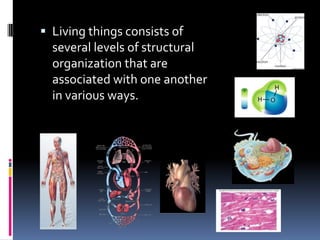
 Living things consists of
  several levels of structural
  organization that are
  associated with one another
  in various ways.
CHEMICAL LEVEL

 It is the lowest level of organization
 It includes atoms and molecules that are
  essential in maintaining life.
CHEMICAL LEVEL
                   Atom
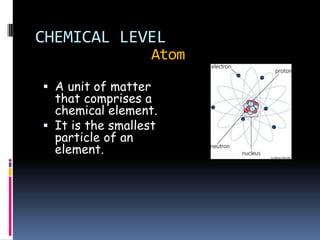
 A unit of matter
  that comprises a
  chemical element.
 It is the smallest
  particle of an
  element.
CHEMICAL LEVEL
                    Atom
 Elements essential for maintaining life
 are:
   Carbon (C)
   Hydrogen (H)
   Oxygen (O)
   Nitrogen (N)
   Calcium (Ca)
   Potassium (K) and
   Sodium (Na)
CHEMICAL LEVEL
                Molecule

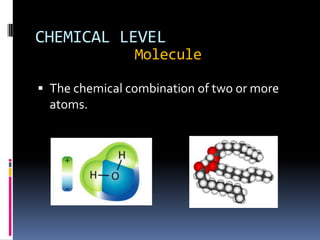
 The chemical combination of two or more
  atoms.
CHEMICAL LEVEL
                   Molecule
 Carbohydrates – includes
  sugars, starches, glycogen and cellulose
   Plants store carbohydrates as starch and use
    the carbohydrates cellulose to build the cell
    wall
   In animals, it provide a readily available source
    of energy to drive metabolic reactions
 Fats – also provides energy and forms adepose
  tissue
 Proteins – for muscle growth and repairs
 Vitamins and minerals – catalyzes metabolic
  reactions
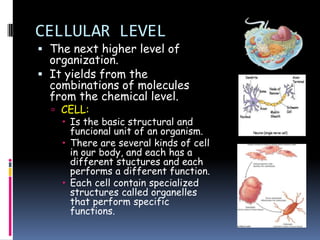
CELLULAR LEVEL
 The next higher level of
  organization.
 It yields from the
  combinations of molecules
  from the chemical level.
   CELL:
     Is the basic structural and
      funcional unit of an organism.
     There are several kinds of cell
      in our body, and each has a
      different stuctures and each
      performs a different function.
     Each cell contain specialized
      structures called organelles
      that perform specific
      functions.
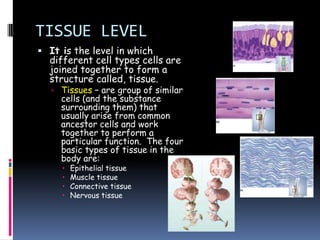
TISSUE LEVEL
 It is the level in which
  different cell types cells are
  joined together to form a
  structure called, tissue.
    Tissues – are group of similar
     cells (and the substance
     surrounding them) that
     usually arise from common
     ancestor cells and work
     together to perform a
     particular function. The four
     basic types of tissue in the
     body are:
        Epithelial tissue
        Muscle tissue
        Connective tissue
        Nervous tissue
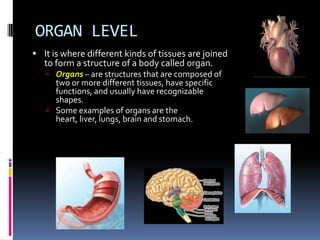
ORGAN LEVEL
 It is where different kinds of tissues are joined
   to form a structure of a body called organ.
    Organs – are structures that are composed of
     two or more different tissues, have specific
     functions, and usually have recognizable
     shapes.
    Some examples of organs are the
     heart, liver, lungs, brain and stomach.
SYSTEM LEVEL

    The level where different organs are
     joined together to form a body
     system.
    Consists of several related organs
     that have a common function.
SYSTEM LEVEL
                    11 systems in the human body
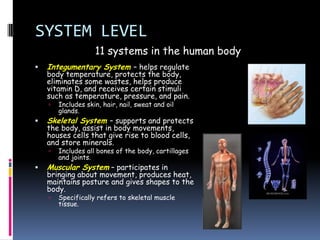
   Integumentary System – helps regulate
    body temperature, protects the body,
    eliminates some wastes, helps produce
    vitamin D, and receives certain stimuli
    such as temperature, pressure, and pain.
       Includes skin, hair, nail, sweat and oil
        glands.
   Skeletal System – supports and protects
    the body, assist in body movements,
    houses cells that give rise to blood cells,
    and store minerals.
       Includes all bones of the body, cartillages
        and joints.
   Muscular System – participates in
    bringing about movement, produces heat,
    maintains posture and gives shapes to the
    body.
       Specifically refers to skeletal muscle
        tissue.
SYSTEM LEVEL
                    11 systems in the human body
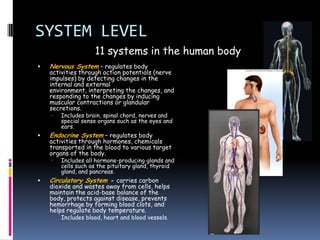
   Nervous System – regulates body
    activities through action potentials (nerve
    impulses) by detecting changes in the
    internal and external
    environment, interpreting the changes, and
    responding to the changes by inducing
    muscular contractions or glandular
    secretions.
       Includes brain, spinal chord, nerves and
        special sense organs such as the eyes and
        ears.
   Endocrine System – regulates body
    activities through hormones, chemicals
    transported in the blood to various target
    organs of the body.
       Includes all hormone-producing glands and
        cells such as the pituitary gland, thyroid
        gland, and pancreas.
   Circulatory System - carries carbon
    dioxide and wastes away from cells, helps
    maintain the acid-base balance of the
    body, protects against disease, prevents
    hemorrhage by forming blood clots, and
    helps regulate body temperature.
       Includes blood, heart and blood vessels.
SYSTEM LEVEL
                    11 systems in the human body
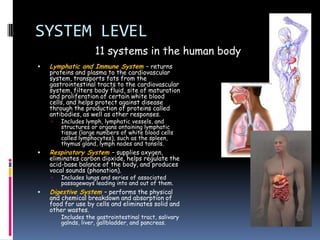
   Lymphatic and Immune System – returns
    proteins and plasma to the cardiovascular
    system, transports fats from the
    gastrointestinal tracts to the cardiovascular
    system, filters body fluid, site of maturation
    and proliferation of certain white blood
    cells, and helps protect against disease
    through the production of proteins called
    antibodies, as well as other responses.
       Includes lymph, lymphatic vessels, and
        structures or organs ontaining lymphatic
        tissue (large numbers of white blood cells
        called lymphocytes), such as the spleen,
        thymus gland, lymph nodes and tonsils.
   Respiratory System – supplies oxygen,
    eliminates carbon dioxide, helps regulate the
    acid-base balance of the body, and produces
    vocal sounds (phonation).
       Includes lungs and series of associated
        passageways leading into and out of them.
   Digestive System – performs the physical
    and chemical breakdown and absorption of
    food for use by cells and eliminates solid and
    other wastes.
       Includes the gastrointestinal tract, salivary
        galnds, liver, gallbladder, and pancreas.
SYSTEM LEVEL
                   11 systems in the human body
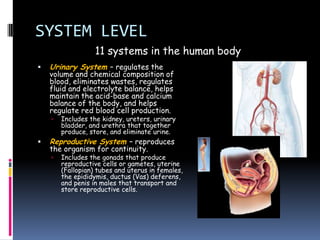
   Urinary System – regulates the
    volume and chemical composition of
    blood, eliminates wastes, regulates
    fluid and electrolyte balance, helps
    maintain the acid-base and calcium
    balance of the body, and helps
    regulate red blood cell production.
       Includes the kidney, ureters, urinary
        bladder, and urethra that together
        produce, store, and eliminate urine.
   Reproductive System – reproduces
    the organism for continuity.
       Includes the gonads that produce
        reproductive cells or gametes, uterine
        (Fallopian) tubes and uterus in females,
        the epididymis, ductus (Vas) deferens,
        and penis in males that transport and
        store reproductive cells.
11 Systems of the Human Body
     Integumentary System
     Skeletal System
     Muscular System
     Nervous System
     Endocrine System
     Circulatory System
     Lymphatic / Immune System
     Respiratory System
     Digestive System
     Urinary System
     Reproductive System
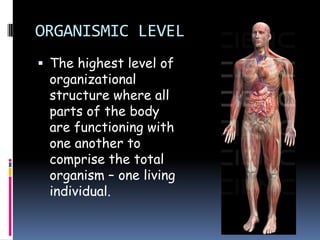
ORGANISMIC LEVEL
 The highest level of
 organizational
 structure where all
 parts of the body
 are functioning with
 one another to
 comprise the total
 organism – one living
 individual.
LEVELS OF STRUCTURAL
    ORGANIZATION
     Chemical Level
     Cellular Level
     Tissue Level
     Organ Level
     System Level
     Organismic Level
Up next…


    LIFE PROCESSES

Level of structural organization

  • 1.
  • 2.
     Living thingsconsists of several levels of structural organization that are associated with one another in various ways.
  • 3.
    CHEMICAL LEVEL  Itis the lowest level of organization  It includes atoms and molecules that are essential in maintaining life.
  • 4.
    CHEMICAL LEVEL Atom  A unit of matter that comprises a chemical element.  It is the smallest particle of an element.
  • 5.
    CHEMICAL LEVEL Atom  Elements essential for maintaining life are:  Carbon (C)  Hydrogen (H)  Oxygen (O)  Nitrogen (N)  Calcium (Ca)  Potassium (K) and  Sodium (Na)
  • 6.
    CHEMICAL LEVEL Molecule  The chemical combination of two or more atoms.
  • 7.
    CHEMICAL LEVEL Molecule  Carbohydrates – includes sugars, starches, glycogen and cellulose  Plants store carbohydrates as starch and use the carbohydrates cellulose to build the cell wall  In animals, it provide a readily available source of energy to drive metabolic reactions  Fats – also provides energy and forms adepose tissue  Proteins – for muscle growth and repairs  Vitamins and minerals – catalyzes metabolic reactions
  • 8.
    CELLULAR LEVEL  Thenext higher level of organization.  It yields from the combinations of molecules from the chemical level.  CELL:  Is the basic structural and funcional unit of an organism.  There are several kinds of cell in our body, and each has a different stuctures and each performs a different function.  Each cell contain specialized structures called organelles that perform specific functions.
  • 9.
    TISSUE LEVEL  Itis the level in which different cell types cells are joined together to form a structure called, tissue.  Tissues – are group of similar cells (and the substance surrounding them) that usually arise from common ancestor cells and work together to perform a particular function. The four basic types of tissue in the body are:  Epithelial tissue  Muscle tissue  Connective tissue  Nervous tissue
  • 10.
    ORGAN LEVEL  Itis where different kinds of tissues are joined to form a structure of a body called organ.  Organs – are structures that are composed of two or more different tissues, have specific functions, and usually have recognizable shapes.  Some examples of organs are the heart, liver, lungs, brain and stomach.
  • 11.
    SYSTEM LEVEL  The level where different organs are joined together to form a body system.  Consists of several related organs that have a common function.
  • 12.
    SYSTEM LEVEL 11 systems in the human body  Integumentary System – helps regulate body temperature, protects the body, eliminates some wastes, helps produce vitamin D, and receives certain stimuli such as temperature, pressure, and pain.  Includes skin, hair, nail, sweat and oil glands.  Skeletal System – supports and protects the body, assist in body movements, houses cells that give rise to blood cells, and store minerals.  Includes all bones of the body, cartillages and joints.  Muscular System – participates in bringing about movement, produces heat, maintains posture and gives shapes to the body.  Specifically refers to skeletal muscle tissue.
  • 13.
    SYSTEM LEVEL 11 systems in the human body  Nervous System – regulates body activities through action potentials (nerve impulses) by detecting changes in the internal and external environment, interpreting the changes, and responding to the changes by inducing muscular contractions or glandular secretions.  Includes brain, spinal chord, nerves and special sense organs such as the eyes and ears.  Endocrine System – regulates body activities through hormones, chemicals transported in the blood to various target organs of the body.  Includes all hormone-producing glands and cells such as the pituitary gland, thyroid gland, and pancreas.  Circulatory System - carries carbon dioxide and wastes away from cells, helps maintain the acid-base balance of the body, protects against disease, prevents hemorrhage by forming blood clots, and helps regulate body temperature.  Includes blood, heart and blood vessels.
  • 14.
    SYSTEM LEVEL 11 systems in the human body  Lymphatic and Immune System – returns proteins and plasma to the cardiovascular system, transports fats from the gastrointestinal tracts to the cardiovascular system, filters body fluid, site of maturation and proliferation of certain white blood cells, and helps protect against disease through the production of proteins called antibodies, as well as other responses.  Includes lymph, lymphatic vessels, and structures or organs ontaining lymphatic tissue (large numbers of white blood cells called lymphocytes), such as the spleen, thymus gland, lymph nodes and tonsils.  Respiratory System – supplies oxygen, eliminates carbon dioxide, helps regulate the acid-base balance of the body, and produces vocal sounds (phonation).  Includes lungs and series of associated passageways leading into and out of them.  Digestive System – performs the physical and chemical breakdown and absorption of food for use by cells and eliminates solid and other wastes.  Includes the gastrointestinal tract, salivary galnds, liver, gallbladder, and pancreas.
  • 15.
    SYSTEM LEVEL 11 systems in the human body  Urinary System – regulates the volume and chemical composition of blood, eliminates wastes, regulates fluid and electrolyte balance, helps maintain the acid-base and calcium balance of the body, and helps regulate red blood cell production.  Includes the kidney, ureters, urinary bladder, and urethra that together produce, store, and eliminate urine.  Reproductive System – reproduces the organism for continuity.  Includes the gonads that produce reproductive cells or gametes, uterine (Fallopian) tubes and uterus in females, the epididymis, ductus (Vas) deferens, and penis in males that transport and store reproductive cells.
  • 16.
    11 Systems ofthe Human Body  Integumentary System  Skeletal System  Muscular System  Nervous System  Endocrine System  Circulatory System  Lymphatic / Immune System  Respiratory System  Digestive System  Urinary System  Reproductive System
  • 17.
    ORGANISMIC LEVEL  Thehighest level of organizational structure where all parts of the body are functioning with one another to comprise the total organism – one living individual.
  • 18.
    LEVELS OF STRUCTURAL ORGANIZATION  Chemical Level  Cellular Level  Tissue Level  Organ Level  System Level  Organismic Level
  • 19.
    Up next… LIFE PROCESSES