Brief Review on
Bharat Bhaisajya Ratnakar
Presenter:
Mangesh Dhote
PG Scholar, Dept of Rasashastra &
Bhashajya kalpana
Mahatma Gandhi Ayurveda
College & Research Center
Guided by:
Dr. Bharat Rathi
Professor ,
Dr. Dhiraj Singh Rajput
Asso. Professor
Dept. of Rasashastra & Bhashajya
kalpana
Introduction:
• In ayurved there are two types of texts available original or fundamental texts
(ekSfydxzaFk) as well as collection volume(laxzgxzaFk).
• Bharat Bhaisajya Ratnakar is a compiled book of ayurvedic preparations both
herbal and minerals.
• It is a compilation of various ayurvedic pharmaceutical formulation(s) i.e.
formulas and methods of preparations
• Bharat bhaisajya ratnakar is divided into five volumes.
• In each, all ayurvedic formulations are arranged according to starting word of
their name of hindi varnamala.
2
• Every word of hindi varnamala is then further grouped by16 types of
preparations i.e kashaya, churna, gutika, guggulu, ghrut, pak, avleh,
asavarishta, anjan, tail, lep, dhup, dhumra, nasya, kalpa, ras, and mishra.
• At last of each volumes, names of preparations are grouped by Rogadhikar are
also arranged and grouped according to hindi varnamala.
• This book was blessed with thankfullness on 25th session of Akhil Bharat
Varshiya Ayurved Mahamandal.
3
Author and Publisher:
• Bharat Bhaisajya Ratnakar was compiled by Shri Nagindas
Chaganlal Shah Rasavaidhya president unjha ayurvedic
pharmacy then it was translated by Pandit Gopinath Gupt
Bhisagratna and edited by Pandit Nivaranchandra
Bhattacharya.
• First published in 1923.
• In aug1999 2nd edition was reprinted by B.jain publisher’s pvt
ltd,New Delhi
4
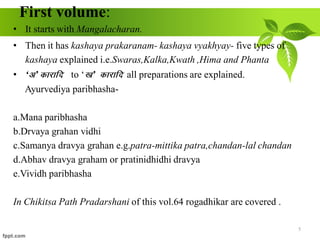
First volume:
• It starts with Mangalacharan.
• Then it has kashaya prakaranam- kashaya vyakhyay- five types of
kashaya explained i.e.Swaras,Kalka,Kwath ,Hima and Phanta
• ‘v’ dkjkfn to ‘[k’ dkjkfn all preparations are explained.
Ayurvediya paribhasha-
a.Mana paribhasha
b.Drvaya grahan vidhi
c.Samanya dravya grahan e.g.patra-mittika patra,chandan-lal chandan
d.Abhav dravya graham or pratinidhidhi dravya
e.Vividh paribhasha
In Chikitsa Path Pradarshani of this vol.64 rogadhikar are covered .
5
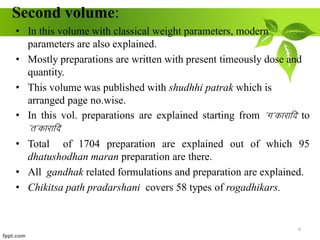
Second volume:
• In this volume with classical weight parameters, modern
parameters are also explained.
• Mostly preparations are written with present timeously dose and
quantity.
• This volume was published with shudhhi patrak which is
arranged page no.wise.
• In this vol. preparations are explained starting from *x*dkjkfn to
*r*dkjkfn
• Total of 1704 preparation are explained out of which 95
dhatushodhan maran preparation are there.
• All gandhak related formulations and preparation are explained.
• Chikitsa path pradarshani covers 58 types of rogadhikars.
6
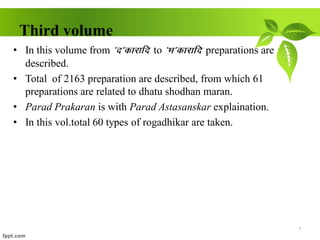
Third volume
• In this volume from *n*dkjkfn to *Hk*dkjkfn preparations are
described.
• Total of 2163 preparation are described, from which 61
preparations are related to dhatu shodhan maran.
• Parad Prakaran is with Parad Astasanskar explaination.
• In this vol.total 60 types of rogadhikar are taken.
7
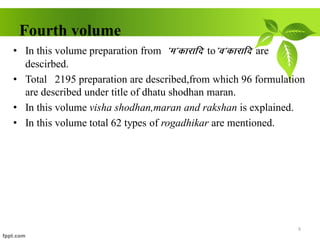
Fourth volume
• In this volume preparation from *e*dkjkfn to*o*dkjkfn are
descirbed.
• Total 2195 preparation are described,from which 96 formulation
are described under title of dhatu shodhan maran.
• In this volume visha shodhan,maran and rakshan is explained.
• In this volume total 62 types of rogadhikar are mentioned.
8
Fifth volume
• In this volume preparations from *’k*dkjkfn to *K*dkjkfn are
described.
• Total 1607 preparation are described, from which 56
preparations are related to Rasopras Shodhanmaran.
• There are 20 types of swarna maran,9 types of swarna yog
and 4 types of swarna shodhan methods are explained.
• Total 63 types of rogadhikar are taken.
9
Conclusion
• Bharat Bhaisajya Ratnakar was First compilation to be called as
Ayurvedic Pharmacopoeia of india.
• Covered almost all the formulation or preparation (i.e
9598)present in available classical texts of Ayurveda of all
branches.
• It explained some preparations with miraculous or magical
results grouped under Mishradhikar in each volume.
• In every vol.Chikitsa Path Pradarshani makes easy for
practitioners to search for better formulations.
10
• The boon for todays Ayurveda world from Bharat Bhaisajya
Ratnakar is that several formulations mentioned in the extinct
text of ayurveda are compiled in Bharat Bhaisajya Ratnakar.
• It seems to be very vast compilation of Ayurvedic preparations
but arranged in such a beautiful and proper manner so one can
easily search needed preparation with there all details.
11
12

Bharat Bhaishajya Ratnakar

  • 1.
    Brief Review on BharatBhaisajya Ratnakar Presenter: Mangesh Dhote PG Scholar, Dept of Rasashastra & Bhashajya kalpana Mahatma Gandhi Ayurveda College & Research Center Guided by: Dr. Bharat Rathi Professor , Dr. Dhiraj Singh Rajput Asso. Professor Dept. of Rasashastra & Bhashajya kalpana
  • 2.
    Introduction: • In ayurvedthere are two types of texts available original or fundamental texts (ekSfydxzaFk) as well as collection volume(laxzgxzaFk). • Bharat Bhaisajya Ratnakar is a compiled book of ayurvedic preparations both herbal and minerals. • It is a compilation of various ayurvedic pharmaceutical formulation(s) i.e. formulas and methods of preparations • Bharat bhaisajya ratnakar is divided into five volumes. • In each, all ayurvedic formulations are arranged according to starting word of their name of hindi varnamala. 2
  • 3.
    • Every wordof hindi varnamala is then further grouped by16 types of preparations i.e kashaya, churna, gutika, guggulu, ghrut, pak, avleh, asavarishta, anjan, tail, lep, dhup, dhumra, nasya, kalpa, ras, and mishra. • At last of each volumes, names of preparations are grouped by Rogadhikar are also arranged and grouped according to hindi varnamala. • This book was blessed with thankfullness on 25th session of Akhil Bharat Varshiya Ayurved Mahamandal. 3
  • 4.
    Author and Publisher: •Bharat Bhaisajya Ratnakar was compiled by Shri Nagindas Chaganlal Shah Rasavaidhya president unjha ayurvedic pharmacy then it was translated by Pandit Gopinath Gupt Bhisagratna and edited by Pandit Nivaranchandra Bhattacharya. • First published in 1923. • In aug1999 2nd edition was reprinted by B.jain publisher’s pvt ltd,New Delhi 4
  • 5.
    First volume: • Itstarts with Mangalacharan. • Then it has kashaya prakaranam- kashaya vyakhyay- five types of kashaya explained i.e.Swaras,Kalka,Kwath ,Hima and Phanta • ‘v’ dkjkfn to ‘[k’ dkjkfn all preparations are explained. Ayurvediya paribhasha- a.Mana paribhasha b.Drvaya grahan vidhi c.Samanya dravya grahan e.g.patra-mittika patra,chandan-lal chandan d.Abhav dravya graham or pratinidhidhi dravya e.Vividh paribhasha In Chikitsa Path Pradarshani of this vol.64 rogadhikar are covered . 5
  • 6.
    Second volume: • Inthis volume with classical weight parameters, modern parameters are also explained. • Mostly preparations are written with present timeously dose and quantity. • This volume was published with shudhhi patrak which is arranged page no.wise. • In this vol. preparations are explained starting from *x*dkjkfn to *r*dkjkfn • Total of 1704 preparation are explained out of which 95 dhatushodhan maran preparation are there. • All gandhak related formulations and preparation are explained. • Chikitsa path pradarshani covers 58 types of rogadhikars. 6
  • 7.
    Third volume • Inthis volume from *n*dkjkfn to *Hk*dkjkfn preparations are described. • Total of 2163 preparation are described, from which 61 preparations are related to dhatu shodhan maran. • Parad Prakaran is with Parad Astasanskar explaination. • In this vol.total 60 types of rogadhikar are taken. 7
  • 8.
    Fourth volume • Inthis volume preparation from *e*dkjkfn to*o*dkjkfn are descirbed. • Total 2195 preparation are described,from which 96 formulation are described under title of dhatu shodhan maran. • In this volume visha shodhan,maran and rakshan is explained. • In this volume total 62 types of rogadhikar are mentioned. 8
  • 9.
    Fifth volume • Inthis volume preparations from *’k*dkjkfn to *K*dkjkfn are described. • Total 1607 preparation are described, from which 56 preparations are related to Rasopras Shodhanmaran. • There are 20 types of swarna maran,9 types of swarna yog and 4 types of swarna shodhan methods are explained. • Total 63 types of rogadhikar are taken. 9
  • 10.
    Conclusion • Bharat BhaisajyaRatnakar was First compilation to be called as Ayurvedic Pharmacopoeia of india. • Covered almost all the formulation or preparation (i.e 9598)present in available classical texts of Ayurveda of all branches. • It explained some preparations with miraculous or magical results grouped under Mishradhikar in each volume. • In every vol.Chikitsa Path Pradarshani makes easy for practitioners to search for better formulations. 10
  • 11.
    • The boonfor todays Ayurveda world from Bharat Bhaisajya Ratnakar is that several formulations mentioned in the extinct text of ayurveda are compiled in Bharat Bhaisajya Ratnakar. • It seems to be very vast compilation of Ayurvedic preparations but arranged in such a beautiful and proper manner so one can easily search needed preparation with there all details. 11
  • 12.