Introduction
इह खल्वायुवेदं नामोपाग्ङमथवववेदस्यानुत्पाद्यैव ्रजाःा
श्लोकशतसहस्रमध्यायसहस्रं च कृ तवान् स्वयम्भ
ततोऽल्पायुष्यमल्पमेधस्त्वं चालोक्य नराणां ्भयोऽष्टधा ्रजणीतवान्
॥
(सु.सभ.१/६)Athrvaveda
Ayurveda
Shoka-
shatasahastra
Adhyaya-
sahastra
Ashtanga
Rasasastra
?
Kaya
Bala
Graha
Urdhvanga
Shalya
Damshtra
Jara
Vrushana
• Rasasastra is a supportive branch to Ashtanga
Ayurveda which had developed in medieval
period i.e. 8th / 9th Cent. A.D. and onwards.
्रजधानं भ्षगर तु; तदनु ्ेषाःं,
चचककत्सायां ्रजधानकारण्भतत्वात्(चक्र)
Rasasatra
“रसनात ् सर्व धातूनाां रस इत्यभिधधयते।
तम् अधधकृ त्यकृ तां शास्त्रां रसशास्त्रां ॥”
• Although the word “Rasa” literally means
“Mercury” & “Rasasastra” is therefore
translated as science of ‘Mercury’.
• In other word we can define Rasasastra as it is
essentially the science of inorganic
pharmaceutical preparations of Ayurveda.
Rasasastra Pratipadya Vishaya
रसोपरसलोहानन यन्त्राददकरणानन च
शुध्यथवमपप लोहानां तन्त्राददकरणानन च
शुधध्द सत्वं द्रुनत्वस्मकरणं च ्रजवष्यतयते॥
(र.र.समु.१)
Origin of Rasasastra
Dehavada
Dhatuvada
Chikitsavada
Dehavada
• Parada was used for Jeevan mukti by Raseswar
Darshana which was ultimate aim of
Rasasastra.
• When Parada undergoes different procedures
like Ashtadasha samskara’ it becomes so much
potent and known as
‘Mahushadha – Haragauri Rasa’
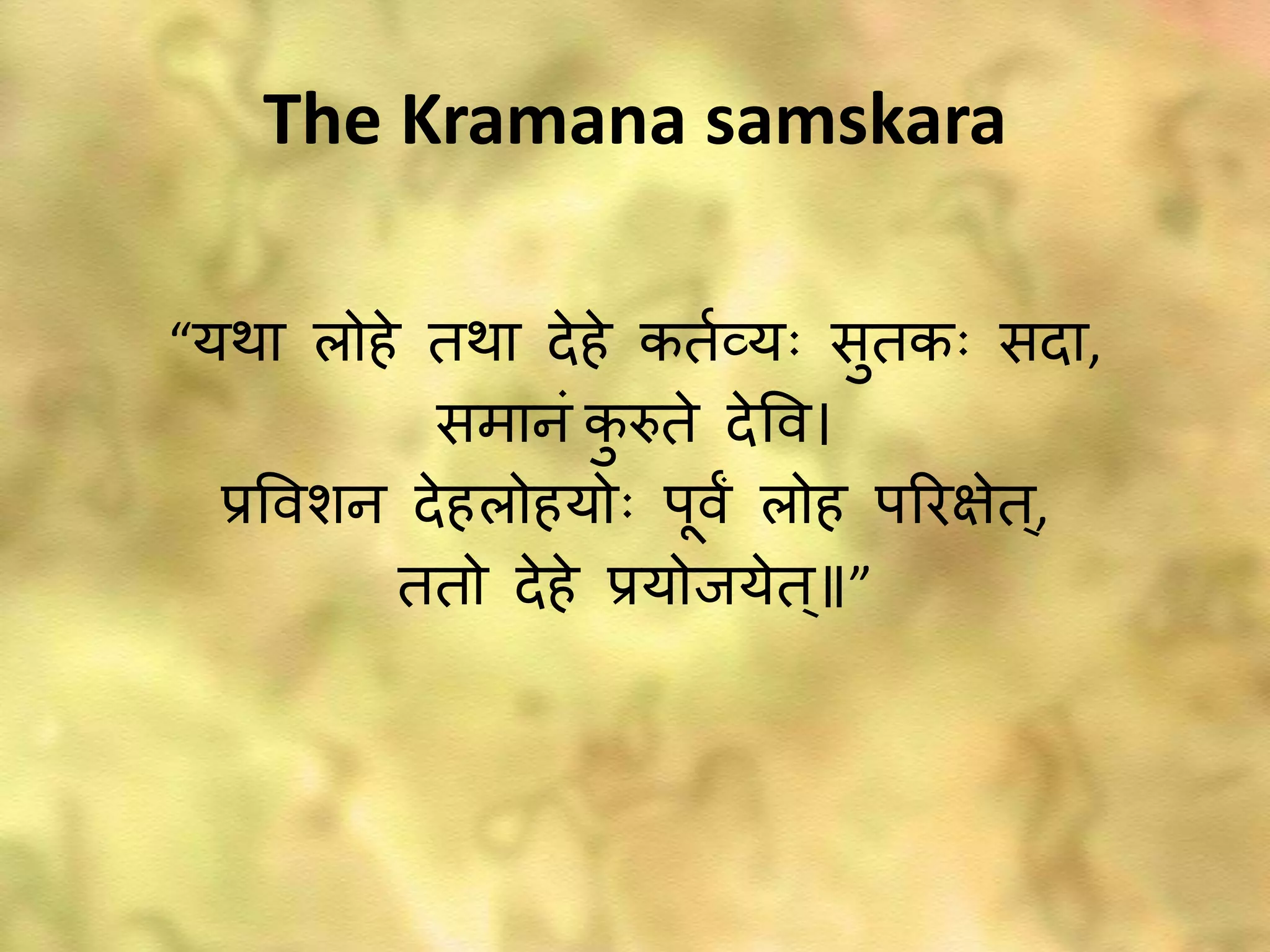
The Kramana samskara
“यथा लोहे तथा देहे कतवव्य सुतक सदा,
समानं कु रुते देपव।
्रजपवशन देहलोहयो पभवं लोह पररक्षेत्,
ततो देहे ्रजयोाःयेत्॥”
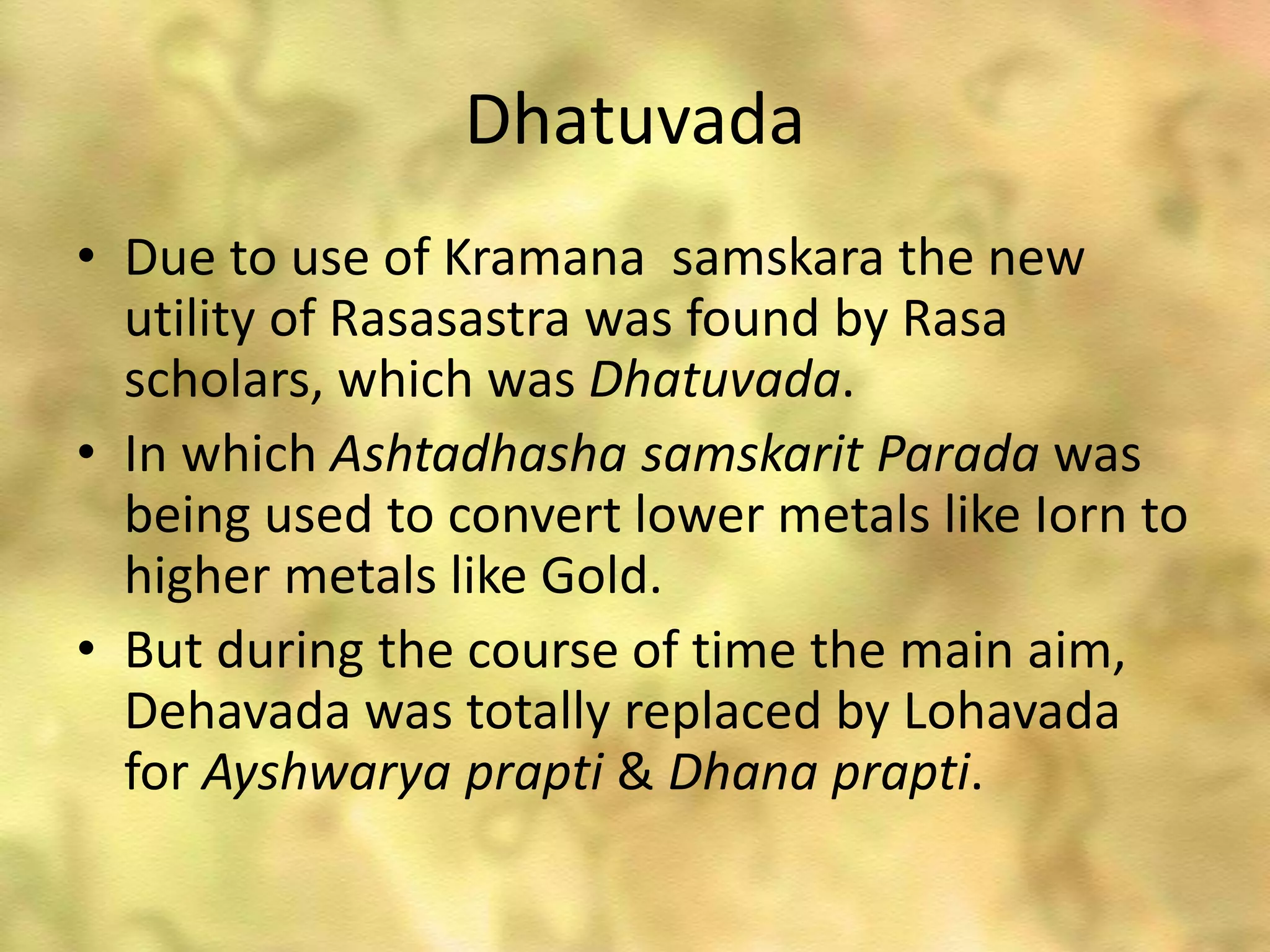
Dhatuvada
• Due to use of Kramana samskara the new
utility of Rasasastra was found by Rasa
scholars, which was Dhatuvada.
• In which Ashtadhasha samskarit Parada was
being used to convert lower metals like Iorn to
higher metals like Gold.
• But during the course of time the main aim,
Dehavada was totally replaced by Lohavada
for Ayshwarya prapti & Dhana prapti.
Chikitsavada
• During the Boudhakala Rasasastra was in its
peak popularity.
• In late Boudhakala priority of the Rasasastra
was change from the Dhatuvada to the
Chikitsavada.
• So from that period Rasasastra was being used
to strengthen the body and to cure various
diseases.
‘Rasavidyaavtarana’
Mahadev
Parvati
Shivasuchara Nandi
Bhardvaja
Agstya
Pulastya
22 Shishyas of Pulastya
Dhanvantari
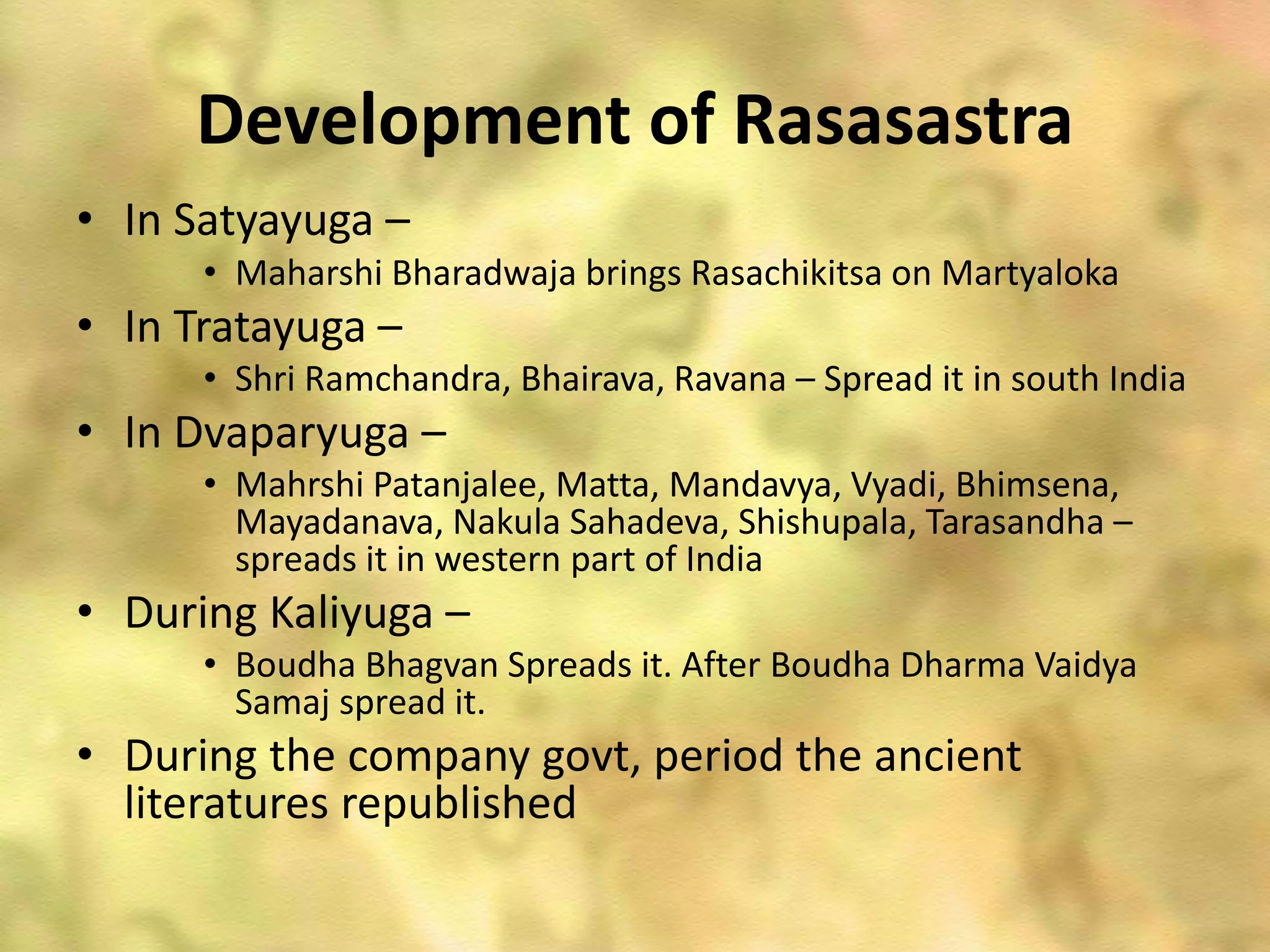
Development of Rasasastra
• In Satyayuga –
• Maharshi Bharadwaja brings Rasachikitsa on Martyaloka
• In Tratayuga –
• Shri Ramchandra, Bhairava, Ravana – Spread it in south India
• In Dvaparyuga –
• Mahrshi Patanjalee, Matta, Mandavya, Vyadi, Bhimsena,
Mayadanava, Nakula Sahadeva, Shishupala, Tarasandha –
spreads it in western part of India
• During Kaliyuga –
• Boudha Bhagvan Spreads it. After Boudha Dharma Vaidya
Samaj spread it.
• During the company govt, period the ancient
literatures republished
Chronological Involution of
Rasasastra
Vedic period
• Atharva veda – Kanda 2, sukta3, mantra 4-8
– Loha, Trapu
• Atharva veda – Kanda1, sukta35
– Hiranya dharana & its internal use
• Atharva veda – Kanda 7, sukta50
– Parada
• Chandogya upanishada (6-1to5)
– Tikshanaloha used as medicine
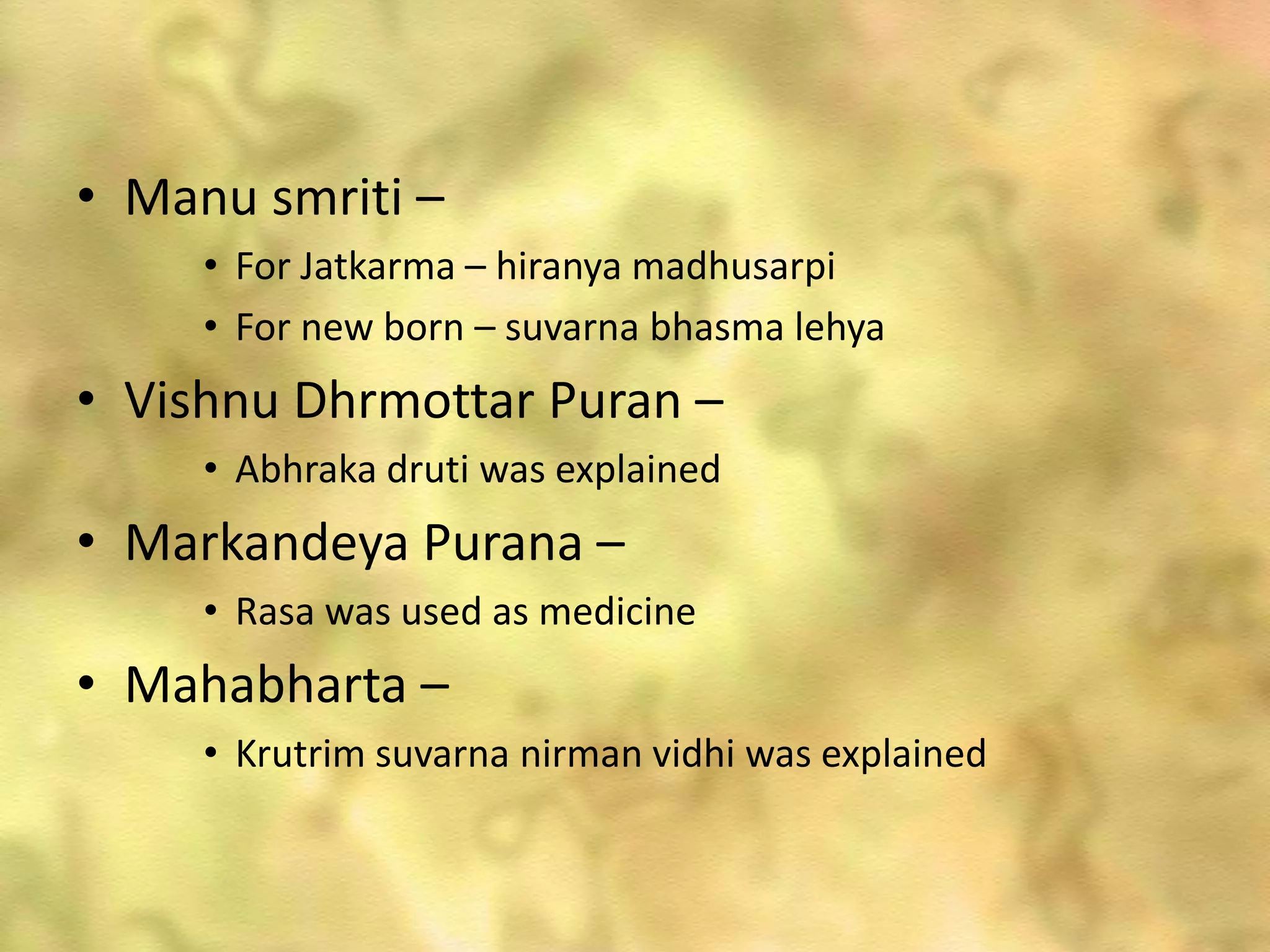
• Manu smriti –
• For Jatkarma – hiranya madhusarpi
• For new born – suvarna bhasma lehya
• Vishnu Dhrmottar Puran –
• Abhraka druti was explained
• Markandeya Purana –
• Rasa was used as medicine
• Mahabharta –
• Krutrim suvarna nirman vidhi was explained
Samhita period
1. Charaka samhita -
– Charaka chikitsa 3/4
• Manhashila, Haritala, Kasisa are used for
external application for purpose of external
application
– Charaka chikitsa 1 (3 rasayanapada) 15-23
• Lohadi rasyana for Rasayana karma
– Charaka chikitsa 1 (3 rasayanapada) 48-65
• Shilajatu Rasayana used as rasyana & vajikarna
• Charaka chikitsa 4/79
– Vaidurya, Mukta, Manibhasama, Garika, shhankha,
suvarna bhasma has used in Udka Kalpana for
Raktapitta chikitsa.
• Charaka chikitsa 7/70
– Gandhaka, Parada & suvaranamakshika has used as
lepana in kushtha chikitsa.
• Charaka chikitsa 13/73
– In Kaphaja udara roga – Ayaskruti
• Charaka chikitsa 16
– Different types of Loha, Tapya, Adrija, Raopya,
Makshika etc. has used in Varity of yogas for
Panduchikitsa
• Charaka chikitsa 17/125 to 128
– Mukta, praval, vaidurya, shankha, sphatika, anjana,
Gandhaka has used in Shvasa vyadhi as Muktadya
churna with madhu & sarpi.
• Charaka chikitsa 23/239
– Tamra used in garavisha for vamana & Suvarna with
madhu as vishagha yoga.
• Charaka chikitsa 23/252
– Vajra, Markata, Vishamushika, Vaidurya are used for
sarpadanshanivaran
• Charaka chikitsa 26/152
– Manhashila used as pradhaman nasya in kaphaja
pratishyaya
• Charaka chikitsa 26/266
– Manhashila, Hartal, Yavakshara, Saindhava, has
used in PitakCHuna to treat mukharoga
• Charaka chikitsa 7/88
– Trapu, Sisa, Loha, churna used in mandal kushtha
for external application
• Charaka chikitsa 16
– Different types of Loha, Tapya, Adrija, Roupya,
Makshika etc. are used in varity of yogas for
Panduchikista.
• Charaka chikitsa 13/73
– In kaphaja udar raga ayaskruti is mentioned.
2. Sushruta samhita -
• Sushruta sutra 37/14
– Trapvadi gana which includes all the metals and used
as- Garakrimihara param
• Sushruta chikitsa 9/60
– Gandhaka is used in Mahavajrataila for kushta chikitsa
• Sushruta chikitsa 10/11-12
– Ayaskruti preparation is mentioned in Mahakustha
chikitsa internally
• Sushruta chikitsa 25/29
– Parade used externally in Ghruta from for kushta,
vaipadika
• Sushruta kalpa 2/5
– Fenashma was first time introduced in Ayurvediya
samhita.
3. Ashtanga Sangrha & Hrudaya
• Ashtanga sangraha chikitsa 19/84
– Siktha, Sindoor, Tutha, Tarkshya are used in taila
form for vicharchika.
• Ashtanga sangraha chikitsa 30/13-14
– Bhasma nirmana vidhi mentioned
• Ashtanga sangraha chikitsa 30/18
– For Lohamarana Bhanupaka vidhi introduced
• Ashtanga sangraha uttarasthan 50/245
– Shukravaradhanartha kalpa explained which
contain Parada, Gandhaka, and Shilajatu etc.
• Vagbhatacharya introduced Andhamusha first
time
Chanakya’s period
• At that time three types of Suvarana used –
– Jatiroop (native)
– Rasavidha (from vedha of mercury)
– Akarodbhav (from ores)
• In this period lohavidya is in its peak level of
development.
• Suvarna made from Rasa i.e. Parada is mentioned
as Rasavidha.
• For suvarna shodhana they used sisakam & for
suvarna vikrutikaran they used Hingulam.
Varaha Mihira’s period
• Although he was the Acharya of Jyotishastra, he
had the basic knowledge of Ayurveda and also of
Rasasastra.
• In his literature he explains all Dhatu, Ratna,
Manhashila, Gairika etc.
• He also made a shukravardhak kalpa which
includes Parada, Makshika, Loha bhasma,
Gandhaka, Shilajatu. This kalpa resembles with
the shukra vardhaka yoga of Ashtanga Sangraha.
• He again explains the payanavidhi of Shastra.
Development after 8th century
1. Nagarjunacharya. (8th century)
• The Rasasastra mainly developed in 8th century
by Rasasidha Nagarjuna. So he has known as first
Acharya of Rasasastra. He learned this knowledge
from Acharya Sarabha in Nalanda Vidyapitha.
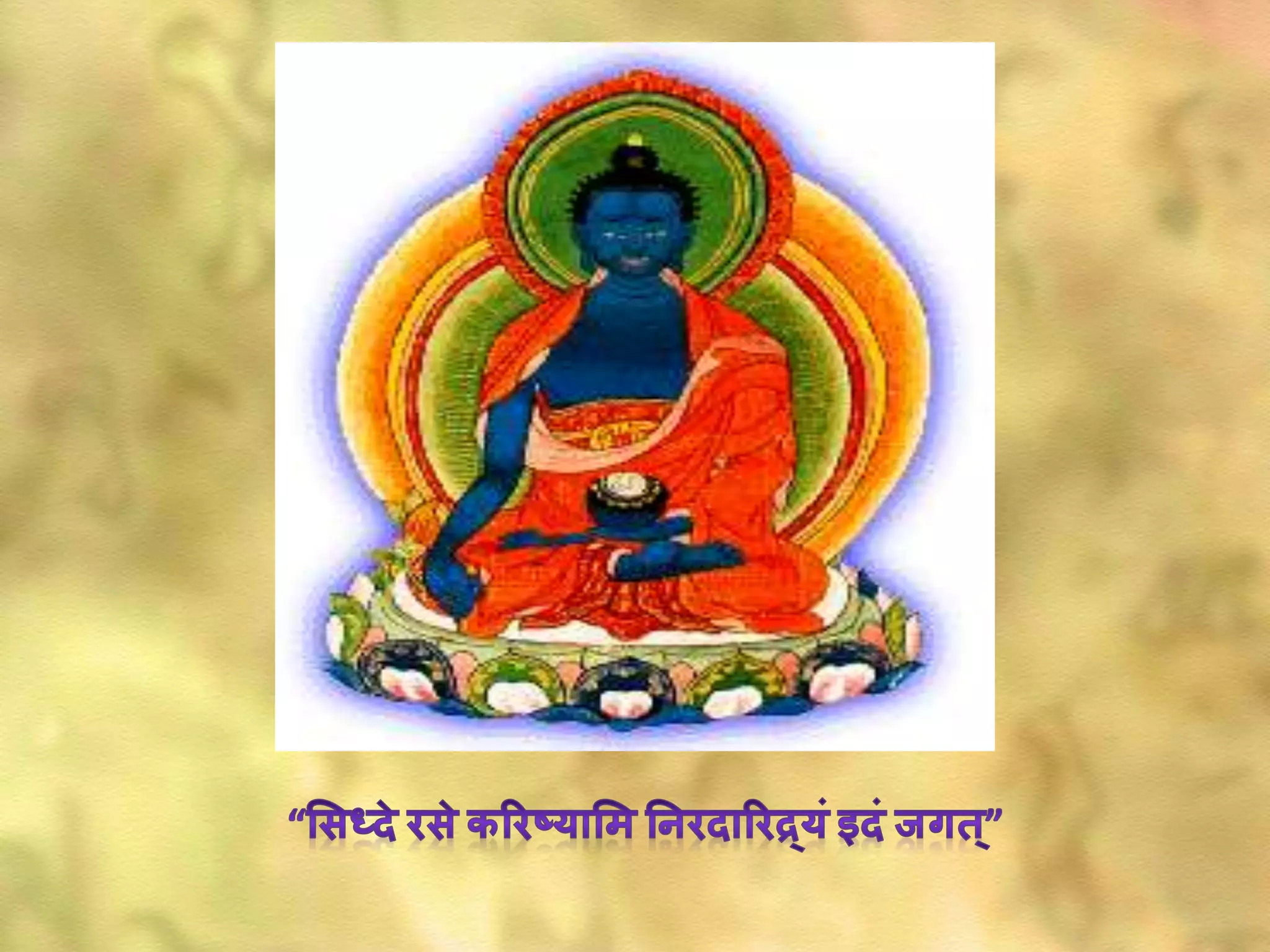
• He knows about Mayurividya and krutrim
Suvarana nirmana from Parada, so he said that
“भसध्दे रसे कररष्याभम ननरदाररद्र्यं इदं ाःगत ्”
2. Vyadi (9th century)
• He is a one of the rasasidha acharya.
• Literature – Rasasidha Shastra, Dhatuvada
Shastra
3. Acharya Gorakshanath (12th century)
• He made the Khechari Gutika and suvarna
nirmanartha gutika kalpa.
4. Rasa vagbhata (13th century)
• He wrote a book on Rasashastra named as Ras
Ratna Sammuchaya which has many Rasakalpa
descriptions.
• It is the best book of Rasasastra now days.
5. Acharya Nityanath (13th century)
– He explained krutrim Manikya nirmana & Indranil
nirmana in his book – Rasaratnakara.
6. Acharya Sadanada Sharma (20th century)
– Acharya wrote ‘ Rastrarangini’ which has some
advance procedures of Raskalpa nirman vidhi. He
mentioned some acids like sulphuric acid,
sorakamla, Lavanamal, & also oxygen
suvarnamandal, rajatmandal, suvarnalavan etc.
– This book is very famous now days for
Rasaushadhi Nirmana.
Historical backround of rasashastra

Historical backround of rasashastra

  • 2.
    Introduction इह खल्वायुवेदं नामोपाग्ङमथवववेदस्यानुत्पाद्यैव्रजाःा श्लोकशतसहस्रमध्यायसहस्रं च कृ तवान् स्वयम्भ ततोऽल्पायुष्यमल्पमेधस्त्वं चालोक्य नराणां ्भयोऽष्टधा ्रजणीतवान् ॥ (सु.सभ.१/६)Athrvaveda Ayurveda Shoka- shatasahastra Adhyaya- sahastra Ashtanga
  • 3.
  • 5.
    • Rasasastra isa supportive branch to Ashtanga Ayurveda which had developed in medieval period i.e. 8th / 9th Cent. A.D. and onwards. ्रजधानं भ्षगर तु; तदनु ्ेषाःं, चचककत्सायां ्रजधानकारण्भतत्वात्(चक्र)
  • 6.
    Rasasatra “रसनात ् सर्वधातूनाां रस इत्यभिधधयते। तम् अधधकृ त्यकृ तां शास्त्रां रसशास्त्रां ॥” • Although the word “Rasa” literally means “Mercury” & “Rasasastra” is therefore translated as science of ‘Mercury’. • In other word we can define Rasasastra as it is essentially the science of inorganic pharmaceutical preparations of Ayurveda.
  • 7.
    Rasasastra Pratipadya Vishaya रसोपरसलोहाननयन्त्राददकरणानन च शुध्यथवमपप लोहानां तन्त्राददकरणानन च शुधध्द सत्वं द्रुनत्वस्मकरणं च ्रजवष्यतयते॥ (र.र.समु.१)
  • 8.
  • 9.
    Dehavada • Parada wasused for Jeevan mukti by Raseswar Darshana which was ultimate aim of Rasasastra. • When Parada undergoes different procedures like Ashtadasha samskara’ it becomes so much potent and known as ‘Mahushadha – Haragauri Rasa’
  • 10.
    The Kramana samskara “यथालोहे तथा देहे कतवव्य सुतक सदा, समानं कु रुते देपव। ्रजपवशन देहलोहयो पभवं लोह पररक्षेत्, ततो देहे ्रजयोाःयेत्॥”
  • 11.
    Dhatuvada • Due touse of Kramana samskara the new utility of Rasasastra was found by Rasa scholars, which was Dhatuvada. • In which Ashtadhasha samskarit Parada was being used to convert lower metals like Iorn to higher metals like Gold. • But during the course of time the main aim, Dehavada was totally replaced by Lohavada for Ayshwarya prapti & Dhana prapti.
  • 12.
    Chikitsavada • During theBoudhakala Rasasastra was in its peak popularity. • In late Boudhakala priority of the Rasasastra was change from the Dhatuvada to the Chikitsavada. • So from that period Rasasastra was being used to strengthen the body and to cure various diseases.
  • 13.
  • 14.
    Development of Rasasastra •In Satyayuga – • Maharshi Bharadwaja brings Rasachikitsa on Martyaloka • In Tratayuga – • Shri Ramchandra, Bhairava, Ravana – Spread it in south India • In Dvaparyuga – • Mahrshi Patanjalee, Matta, Mandavya, Vyadi, Bhimsena, Mayadanava, Nakula Sahadeva, Shishupala, Tarasandha – spreads it in western part of India • During Kaliyuga – • Boudha Bhagvan Spreads it. After Boudha Dharma Vaidya Samaj spread it. • During the company govt, period the ancient literatures republished
  • 15.
  • 16.
    Vedic period • Atharvaveda – Kanda 2, sukta3, mantra 4-8 – Loha, Trapu • Atharva veda – Kanda1, sukta35 – Hiranya dharana & its internal use • Atharva veda – Kanda 7, sukta50 – Parada • Chandogya upanishada (6-1to5) – Tikshanaloha used as medicine
  • 17.
    • Manu smriti– • For Jatkarma – hiranya madhusarpi • For new born – suvarna bhasma lehya • Vishnu Dhrmottar Puran – • Abhraka druti was explained • Markandeya Purana – • Rasa was used as medicine • Mahabharta – • Krutrim suvarna nirman vidhi was explained
  • 18.
    Samhita period 1. Charakasamhita - – Charaka chikitsa 3/4 • Manhashila, Haritala, Kasisa are used for external application for purpose of external application – Charaka chikitsa 1 (3 rasayanapada) 15-23 • Lohadi rasyana for Rasayana karma – Charaka chikitsa 1 (3 rasayanapada) 48-65 • Shilajatu Rasayana used as rasyana & vajikarna
  • 19.
    • Charaka chikitsa4/79 – Vaidurya, Mukta, Manibhasama, Garika, shhankha, suvarna bhasma has used in Udka Kalpana for Raktapitta chikitsa. • Charaka chikitsa 7/70 – Gandhaka, Parada & suvaranamakshika has used as lepana in kushtha chikitsa. • Charaka chikitsa 13/73 – In Kaphaja udara roga – Ayaskruti • Charaka chikitsa 16 – Different types of Loha, Tapya, Adrija, Raopya, Makshika etc. has used in Varity of yogas for Panduchikitsa
  • 20.
    • Charaka chikitsa17/125 to 128 – Mukta, praval, vaidurya, shankha, sphatika, anjana, Gandhaka has used in Shvasa vyadhi as Muktadya churna with madhu & sarpi. • Charaka chikitsa 23/239 – Tamra used in garavisha for vamana & Suvarna with madhu as vishagha yoga. • Charaka chikitsa 23/252 – Vajra, Markata, Vishamushika, Vaidurya are used for sarpadanshanivaran • Charaka chikitsa 26/152 – Manhashila used as pradhaman nasya in kaphaja pratishyaya
  • 21.
    • Charaka chikitsa26/266 – Manhashila, Hartal, Yavakshara, Saindhava, has used in PitakCHuna to treat mukharoga • Charaka chikitsa 7/88 – Trapu, Sisa, Loha, churna used in mandal kushtha for external application • Charaka chikitsa 16 – Different types of Loha, Tapya, Adrija, Roupya, Makshika etc. are used in varity of yogas for Panduchikista. • Charaka chikitsa 13/73 – In kaphaja udar raga ayaskruti is mentioned.
  • 22.
    2. Sushruta samhita- • Sushruta sutra 37/14 – Trapvadi gana which includes all the metals and used as- Garakrimihara param • Sushruta chikitsa 9/60 – Gandhaka is used in Mahavajrataila for kushta chikitsa • Sushruta chikitsa 10/11-12 – Ayaskruti preparation is mentioned in Mahakustha chikitsa internally • Sushruta chikitsa 25/29 – Parade used externally in Ghruta from for kushta, vaipadika • Sushruta kalpa 2/5 – Fenashma was first time introduced in Ayurvediya samhita.
  • 23.
    3. Ashtanga Sangrha& Hrudaya • Ashtanga sangraha chikitsa 19/84 – Siktha, Sindoor, Tutha, Tarkshya are used in taila form for vicharchika. • Ashtanga sangraha chikitsa 30/13-14 – Bhasma nirmana vidhi mentioned • Ashtanga sangraha chikitsa 30/18 – For Lohamarana Bhanupaka vidhi introduced • Ashtanga sangraha uttarasthan 50/245 – Shukravaradhanartha kalpa explained which contain Parada, Gandhaka, and Shilajatu etc. • Vagbhatacharya introduced Andhamusha first time
  • 24.
    Chanakya’s period • Atthat time three types of Suvarana used – – Jatiroop (native) – Rasavidha (from vedha of mercury) – Akarodbhav (from ores) • In this period lohavidya is in its peak level of development. • Suvarna made from Rasa i.e. Parada is mentioned as Rasavidha. • For suvarna shodhana they used sisakam & for suvarna vikrutikaran they used Hingulam.
  • 25.
    Varaha Mihira’s period •Although he was the Acharya of Jyotishastra, he had the basic knowledge of Ayurveda and also of Rasasastra. • In his literature he explains all Dhatu, Ratna, Manhashila, Gairika etc. • He also made a shukravardhak kalpa which includes Parada, Makshika, Loha bhasma, Gandhaka, Shilajatu. This kalpa resembles with the shukra vardhaka yoga of Ashtanga Sangraha. • He again explains the payanavidhi of Shastra.
  • 26.
    Development after 8thcentury 1. Nagarjunacharya. (8th century) • The Rasasastra mainly developed in 8th century by Rasasidha Nagarjuna. So he has known as first Acharya of Rasasastra. He learned this knowledge from Acharya Sarabha in Nalanda Vidyapitha. • He knows about Mayurividya and krutrim Suvarana nirmana from Parada, so he said that “भसध्दे रसे कररष्याभम ननरदाररद्र्यं इदं ाःगत ्”
  • 27.
    2. Vyadi (9thcentury) • He is a one of the rasasidha acharya. • Literature – Rasasidha Shastra, Dhatuvada Shastra 3. Acharya Gorakshanath (12th century) • He made the Khechari Gutika and suvarna nirmanartha gutika kalpa. 4. Rasa vagbhata (13th century) • He wrote a book on Rasashastra named as Ras Ratna Sammuchaya which has many Rasakalpa descriptions. • It is the best book of Rasasastra now days.
  • 28.
    5. Acharya Nityanath(13th century) – He explained krutrim Manikya nirmana & Indranil nirmana in his book – Rasaratnakara. 6. Acharya Sadanada Sharma (20th century) – Acharya wrote ‘ Rastrarangini’ which has some advance procedures of Raskalpa nirman vidhi. He mentioned some acids like sulphuric acid, sorakamla, Lavanamal, & also oxygen suvarnamandal, rajatmandal, suvarnalavan etc. – This book is very famous now days for Rasaushadhi Nirmana.