GUIDE
Dr. Shankar gowda,
HOD(UG), Dept of RS&BK,
T.G.A.M.C bellary.
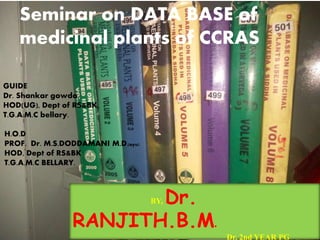
Seminar on DATA BASE of
medicinal plants of CCRAS
H.O.D
PROF. Dr. M.S.DODDAMANI M.D.(ayu)
HOD, Dept of RS&BK
T.G.A.M.C BELLARY.
BY, Dr.
RANJITH.B.M.
Dr. 2nd YEAR PG
• Database means – a structured set of data held in
computer especially one that is accessible in various
ways
• In simplest way database is a collection of
information that is organized so that it can be
accessed, managed, updated.
Database…?
• To make available the data at a glance to the
scientific community/academicians/ industries/
policy makers etc.,
• Would help in appraising the research for
- Further planning
- To avoid repetition
- To find out collaboration
- Exploration
Data base is required for our science on Plant, Metal,
Mineral Based and Folklore etc.
Need for Research database
Considering the need of the day, the Council
intends to generate Research Database on
Ayurveda, Siddha and Other Traditional
Medicine & Related Sciences through
gathering authentic published data by
inviting information from individuals,
Scientists, Academicians, Industries and
Universities and so on who are working in all
related fields.
Initiation of Database
Mainly ,
• Scientists
• Academicians
• Industries
• Universities
Wide range contributory disciplines like Ayurveda, Siddha, Botany,
Biotechnology, Pure and Applied Chemistry, Biochemistry,
Photochemistry, Inorganic Chemistry, Pharmacology, Veterinary
sciences, Agriculture, Horticulture, Food Science & Technology,
Pharmaceutical Sciences, Systems Biology and all other related
disciplines. This Data base is developed from information and
research works carried out in various CCRAS noted research centers
and from The Scientists, Academics.
Who are all contributors to develop the
Database??
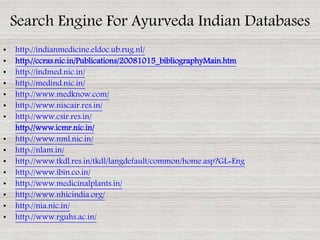
• http://indianmedicine.eldoc.ub.rug.nl/
• http://ccras.nic.in/Publications/20081015_bibliographyMain.htm
• http://indmed.nic.in/
• http://medind.nic.in/
• http://www.medknow.com/
• http://www.niscair.res.in/
• http://www.csir.res.in/
• http://www.icmr.nic.in/
• http://www.nml.nic.in/
• http://nlam.in/
• http://www.tkdl.res.in/tkdl/langdefault/common/home.asp?GL=Eng
• http://www.ibin.co.in/
• http://www.medicinalplants.in/
• http://www.nhicindia.org/
• http://nia.nic.in/
• http://www.rguhs.ac.in/
Search Engine For Ayurveda Indian Databases
IN THIS SEMINAR ONLY CONSENTRATED
ON
CCRAS (Central Council for Research in
Ayurvedic Sciences )
 The Central Council for Research in Ayurvedic Sciences (CCRAS), an
apex body for the formulation, coordination and development of
research in Ayurveda on scientific lines was established in March
1978 after reorganization of Central Council for Research Indian
Medicine & Homoeopathy. The Minister of Health & Family Welfare
is the President of the Governing Body of the Council, while the Joint
Secretary chairs the Standing Finance Committee. The
Scientific/Research Programmes are supervised by the Scientific
Advisory Board.
 The Council has been executing its research programmes with a
network of 30 peripheral Institutes/centres/units with the
headquarters office responsible for control, monitoring and
supervision. Research work of the Council is executed by 931
officers and staff, though the sanctioned strength of officers and staff
is 1813.
CCRAS
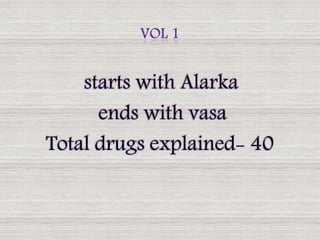
starts with Alarka
ends with vasa
Total drugs explained- 40
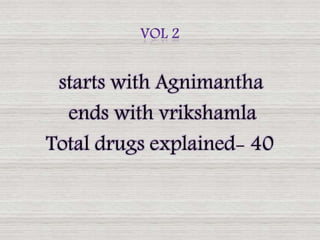
starts with Agnimantha
ends with vrikshamla
Total drugs explained- 40
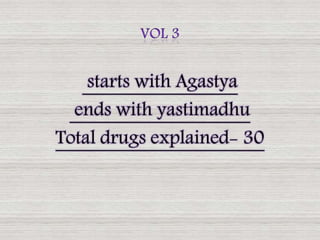
starts with Agastya
ends with yastimadhu
Total drugs explained- 30
starts with Akshota
ends with tvak
Total drugs explained- 30
starts with Ajagandha
ends with yava
Total drugs explained- 30
starts with Ambastaki
ends with vidari
Total drugs explained- 30
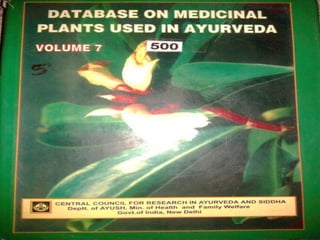
starts with Ankola
ends with yavani
Total drugs explained- 30
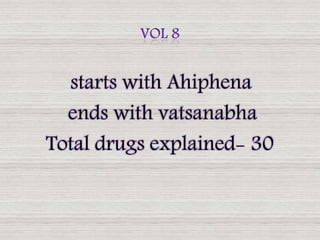
starts with Ahiphena
ends with vatsanabha
Total drugs explained- 30
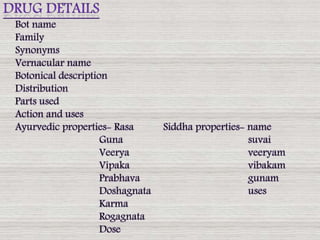
Bot name
Family
Synonyms
Vernacular name
Botonical description
Distribution
Parts used
Action and uses
Ayurvedic properties- Rasa Siddha properties- name
Guna suvai
Veerya veeryam
Vipaka vibakam
Prabhava gunam
Doshagnata uses
Karma
Rogagnata
Dose
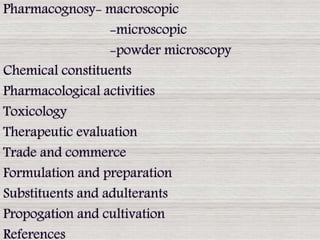
Pharmacognosy- macroscopic
-microscopic
-powder microscopy
Chemical constituents
Pharmacological activities
Toxicology
Therapeutic evaluation
Trade and commerce
Formulation and preparation
Substituents and adulterants
Propogation and cultivation
References
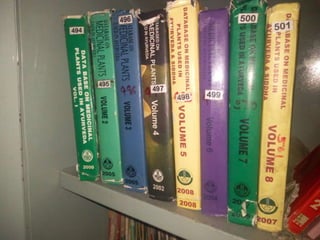
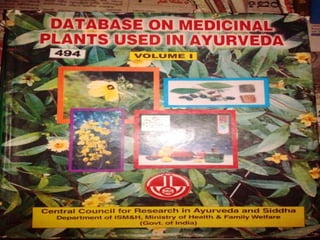
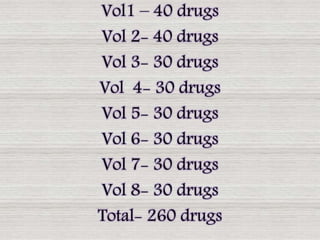
Vol1 – 40 drugs
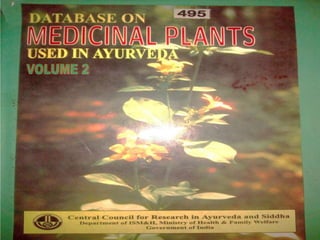
Vol 2- 40 drugs
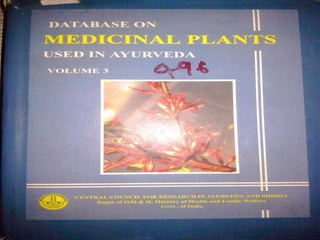
Vol 3- 30 drugs
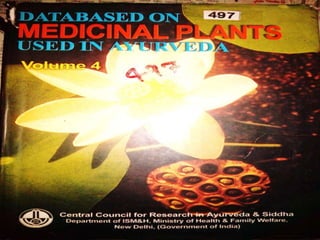
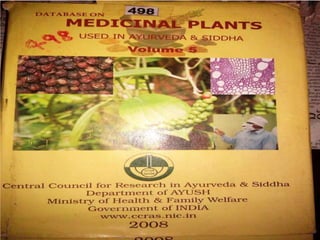
Vol 4- 30 drugs
Vol 5- 30 drugs
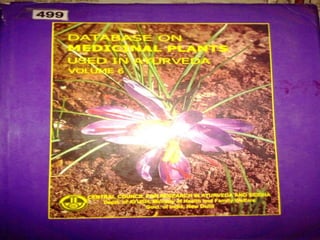
Vol 6- 30 drugs
Vol 7- 30 drugs
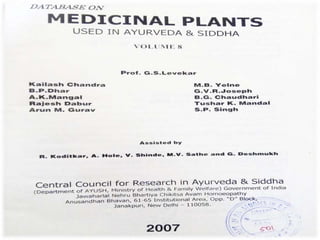
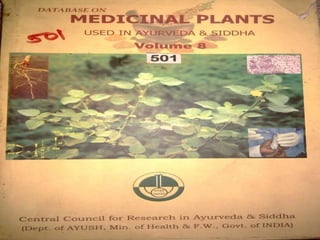
Vol 8- 30 drugs
Total- 260 drugs
Merits of the data base
• Indexing
• Helps in easy identification of plants.
• Reduces confusion.
• It gives clear knowledge about various parameters
of a plant which are not mentioned in our classics
for ex- macroscopic, microscopic, analytical
parameters.
• TLC is no where mentioned but this book works on
it.
• It helps us to prove that the drug what we have
taken is authenticated.
CONCLUSION
Data bases are created to develop the standard protocol
for the drug manufacturing and to convince the myths
in the people about plants and its properties.
Creating the Data base help to researchers and
clinicians to use plants with no hesitation.
Now a days burning issue is the taking of patency on
Indian medicine system and drugs. Data base will help
to clime that these drugs are of Indian System of
medicine and it also help to check the Patency act.
Data bases are helpful to research students and
Academics to undertake the further research activities
and it gives strong support for the research review.
THANK YOU
Dr. RANJITH.B.M.

Data base

  • 1.
    GUIDE Dr. Shankar gowda, HOD(UG),Dept of RS&BK, T.G.A.M.C bellary. Seminar on DATA BASE of medicinal plants of CCRAS H.O.D PROF. Dr. M.S.DODDAMANI M.D.(ayu) HOD, Dept of RS&BK T.G.A.M.C BELLARY. BY, Dr. RANJITH.B.M. Dr. 2nd YEAR PG
  • 3.
    • Database means– a structured set of data held in computer especially one that is accessible in various ways • In simplest way database is a collection of information that is organized so that it can be accessed, managed, updated. Database…?
  • 4.
    • To makeavailable the data at a glance to the scientific community/academicians/ industries/ policy makers etc., • Would help in appraising the research for - Further planning - To avoid repetition - To find out collaboration - Exploration Data base is required for our science on Plant, Metal, Mineral Based and Folklore etc. Need for Research database
  • 5.
    Considering the needof the day, the Council intends to generate Research Database on Ayurveda, Siddha and Other Traditional Medicine & Related Sciences through gathering authentic published data by inviting information from individuals, Scientists, Academicians, Industries and Universities and so on who are working in all related fields. Initiation of Database
  • 6.
    Mainly , • Scientists •Academicians • Industries • Universities Wide range contributory disciplines like Ayurveda, Siddha, Botany, Biotechnology, Pure and Applied Chemistry, Biochemistry, Photochemistry, Inorganic Chemistry, Pharmacology, Veterinary sciences, Agriculture, Horticulture, Food Science & Technology, Pharmaceutical Sciences, Systems Biology and all other related disciplines. This Data base is developed from information and research works carried out in various CCRAS noted research centers and from The Scientists, Academics. Who are all contributors to develop the Database??
  • 7.
    • http://indianmedicine.eldoc.ub.rug.nl/ • http://ccras.nic.in/Publications/20081015_bibliographyMain.htm •http://indmed.nic.in/ • http://medind.nic.in/ • http://www.medknow.com/ • http://www.niscair.res.in/ • http://www.csir.res.in/ • http://www.icmr.nic.in/ • http://www.nml.nic.in/ • http://nlam.in/ • http://www.tkdl.res.in/tkdl/langdefault/common/home.asp?GL=Eng • http://www.ibin.co.in/ • http://www.medicinalplants.in/ • http://www.nhicindia.org/ • http://nia.nic.in/ • http://www.rguhs.ac.in/ Search Engine For Ayurveda Indian Databases
  • 8.
    IN THIS SEMINARONLY CONSENTRATED ON CCRAS (Central Council for Research in Ayurvedic Sciences )
  • 9.
     The CentralCouncil for Research in Ayurvedic Sciences (CCRAS), an apex body for the formulation, coordination and development of research in Ayurveda on scientific lines was established in March 1978 after reorganization of Central Council for Research Indian Medicine & Homoeopathy. The Minister of Health & Family Welfare is the President of the Governing Body of the Council, while the Joint Secretary chairs the Standing Finance Committee. The Scientific/Research Programmes are supervised by the Scientific Advisory Board.  The Council has been executing its research programmes with a network of 30 peripheral Institutes/centres/units with the headquarters office responsible for control, monitoring and supervision. Research work of the Council is executed by 931 officers and staff, though the sanctioned strength of officers and staff is 1813. CCRAS
  • 15.
    starts with Alarka endswith vasa Total drugs explained- 40
  • 17.
    starts with Agnimantha endswith vrikshamla Total drugs explained- 40
  • 19.
    starts with Agastya endswith yastimadhu Total drugs explained- 30
  • 21.
    starts with Akshota endswith tvak Total drugs explained- 30
  • 23.
    starts with Ajagandha endswith yava Total drugs explained- 30
  • 25.
    starts with Ambastaki endswith vidari Total drugs explained- 30
  • 27.
    starts with Ankola endswith yavani Total drugs explained- 30
  • 29.
    starts with Ahiphena endswith vatsanabha Total drugs explained- 30
  • 30.
    Bot name Family Synonyms Vernacular name Botonicaldescription Distribution Parts used Action and uses Ayurvedic properties- Rasa Siddha properties- name Guna suvai Veerya veeryam Vipaka vibakam Prabhava gunam Doshagnata uses Karma Rogagnata Dose
  • 31.
    Pharmacognosy- macroscopic -microscopic -powder microscopy Chemicalconstituents Pharmacological activities Toxicology Therapeutic evaluation Trade and commerce Formulation and preparation Substituents and adulterants Propogation and cultivation References
  • 32.
    Vol1 – 40drugs Vol 2- 40 drugs Vol 3- 30 drugs Vol 4- 30 drugs Vol 5- 30 drugs Vol 6- 30 drugs Vol 7- 30 drugs Vol 8- 30 drugs Total- 260 drugs
  • 33.
    Merits of thedata base • Indexing • Helps in easy identification of plants. • Reduces confusion. • It gives clear knowledge about various parameters of a plant which are not mentioned in our classics for ex- macroscopic, microscopic, analytical parameters. • TLC is no where mentioned but this book works on it. • It helps us to prove that the drug what we have taken is authenticated.
  • 34.
    CONCLUSION Data bases arecreated to develop the standard protocol for the drug manufacturing and to convince the myths in the people about plants and its properties. Creating the Data base help to researchers and clinicians to use plants with no hesitation. Now a days burning issue is the taking of patency on Indian medicine system and drugs. Data base will help to clime that these drugs are of Indian System of medicine and it also help to check the Patency act. Data bases are helpful to research students and Academics to undertake the further research activities and it gives strong support for the research review.
  • 35.