MENU ENGINEERING
The Psychology Of
Menu Design – Why
It Is So Important
Menu engineering is the practice of analyzing and
strategically designing your menu to maximize
restaurant profits. By highlighting your restaurant’s
most popular and profitable items with menu
psychology techniques, menu engineering constructs
your menu in the most effective way.
WHAT IS MENU
ENGINEERING?
We have reached a point where customers have
become more conscious of what they consume.
According to David Henkes, Technomic’s senior
principal, 69% of consumers worldwide cited the
availability of healthy options being a very important
factor in choosing where to buy a meal.
Along with the healthy food trend, are concepts of
locally sourced and organic, which bring higher price
points and lower shelf life. Buying healthy, locally
sourced, organic ingredients will most definitely cause
your food cost to be higher, in turn making the menu
price higher. This why knowing your target market is
so crucial to menu engineering.
CUSTOMER
RESEARCH AND
MENU
ENGINEERING
Research about the area/neighborhood the restaurant
is located in will give you a better idea of the average
household income, spending patterns, and
competition, and if locally sourced/organic is
something to consider.
These will be key decisions as you go through the
menu engineering process. The average household
income of the surrounding area is usually
representative of how much they are willing to spend.
When selecting a restaurant, 44% of consumers name
the overall price as a top priority.
CUSTOMER
RESEARCH AND
MENU
ENGINEERING
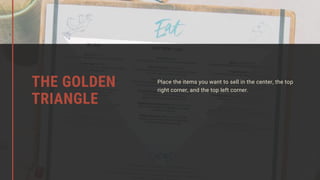
THE GOLDEN
TRIANGLE
Place the items you want to sell in the center, the top
right corner, and the top left corner.
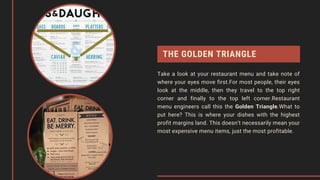
THE GOLDEN TRIANGLE
Take a look at your restaurant menu and take note of
where your eyes move first.For most people, their eyes
look at the middle, then they travel to the top right
corner and finally to the top left corner.Restaurant
menu engineers call this the Golden Triangle.What to
put here? This is where your dishes with the highest
profit margins land. This doesn’t necessarily mean your
most expensive menu items, just the most profitable.
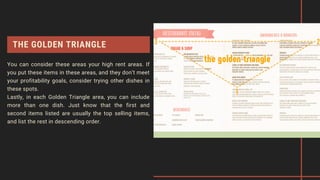
THE GOLDEN TRIANGLE
You can consider these areas your high rent areas. If
you put these items in these areas, and they don’t meet
your profitability goals, consider trying other dishes in
these spots.
Lastly, in each Golden Triangle area, you can include
more than one dish. Just know that the first and
second items listed are usually the top selling items,
and list the rest in descending order.
Another way to use psychology to your advantage in
your menu design is with color.
COLOR IS
DEFINITIVE
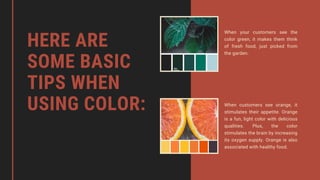
HERE ARE
SOME BASIC
TIPS WHEN
USING COLOR:
When your customers see the
color green, it makes them think
of fresh food, just picked from
the garden.
When customers see orange, it
stimulates their appetite. Orange
is a fun, light color with delicious
qualities. Plus, the color
stimulates the brain by increasing
its oxygen supply. Orange is also
associated with healthy food.
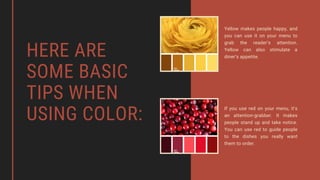
HERE ARE
SOME BASIC
TIPS WHEN
USING COLOR:
Yellow makes people happy, and
you can use it on your menu to
grab the reader’s attention.
Yellow can also stimulate a
diner’s appetite.
If you use red on your menu, it’s
an attention-grabber. It makes
people stand up and take notice.
You can use red to guide people
to the dishes you really want
them to order.
When it comes to pricing your menu, how you do it
matters.
THE USE OF
DOLLAR SIGNS
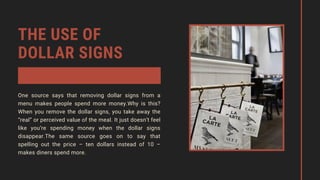
THE USE OF
DOLLAR SIGNS
One source says that removing dollar signs from a
menu makes people spend more money.Why is this?
When you remove the dollar signs, you take away the
“real” or perceived value of the meal. It just doesn’t feel
like you’re spending money when the dollar signs
disappear.The same source goes on to say that
spelling out the price – ten dollars instead of 10 –
makes diners spend more.
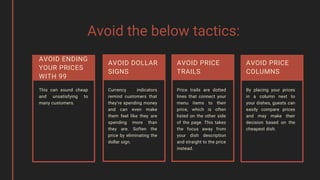
Avoid the below tactics:
Currency indicators
remind customers that
they’re spending money
and can even make
them feel like they are
spending more than
they are. Soften the
price by eliminating the
dollar sign.
AVOID DOLLAR
SIGNS
Price trails are dotted
lines that connect your
menu items to their
price, which is often
listed on the other side
of the page. This takes
the focus away from
your dish description
and straight to the price
instead.
AVOID PRICE
TRAILS
By placing your prices
in a column next to
your dishes, guests can
easily compare prices
and may make their
decision based on the
cheapest dish.
AVOID PRICE
COLUMNS
This can sound cheap
and unsatisfying to
many customers.
AVOID ENDING
YOUR PRICES
WITH 99
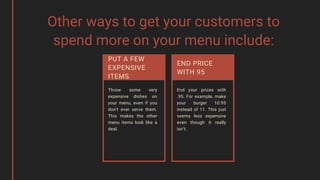
Other ways to get your customers to
spend more on your menu include:
Throw some very
expensive dishes on
your menu, even if you
don’t ever serve them.
This makes the other
menu items look like a
deal.
End your prices with
.95. For example, make
your burger 10.95
instead of 11. This just
seems less expensive
even though it really
isn’t.
END PRICE
WITH 95
PUT A FEW
EXPENSIVE
ITEMS
Use the description of your menu items to play into
the psychology of the purchase.
APPEAL TO THE
IMAGINATION
APPEAL TO THE IMAGINATION
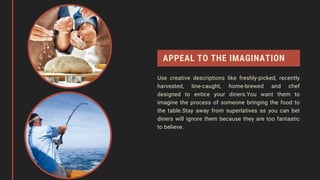
Use creative descriptions like freshly-picked, recently
harvested, line-caught, home-brewed and chef
designed to entice your diners.You want them to
imagine the process of someone bringing the food to
the table.Stay away from superlatives as you can bet
diners will ignore them because they are too fantastic
to believe.
APPEAL TO THE IMAGINATION
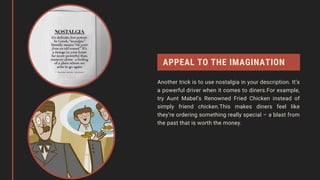
Another trick is to use nostalgia in your description. It’s
a powerful driver when it comes to diners.For example,
try Aunt Mabel’s Renowned Fried Chicken instead of
simply friend chicken.This makes diners feel like
they’re ordering something really special – a blast from
the past that is worth the money.
Put your most cost-effective dishes in prime spots.
LIST
MANAGEMENT
MATTER
LIST MANAGEMENT
MATTER
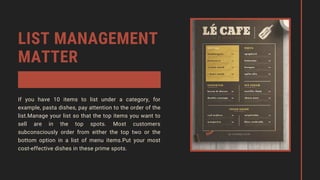
If you have 10 items to list under a category, for
example, pasta dishes, pay attention to the order of the
list.Manage your list so that the top items you want to
sell are in the top spots. Most customers
subconsciously order from either the top two or the
bottom option in a list of menu items.Put your most
cost-effective dishes in these prime spots.
People may be willing to pay more because they
perceive the value to be better.
DECOYS ARE
SMART
DECOYS ARE
SMART
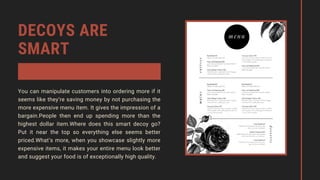
You can manipulate customers into ordering more if it
seems like they’re saving money by not purchasing the
more expensive menu item. It gives the impression of a
bargain.People then end up spending more than the
highest dollar item.Where does this smart decoy go?
Put it near the top so everything else seems better
priced.What’s more, when you showcase slightly more
expensive items, it makes your entire menu look better
and suggest your food is of exceptionally high quality.
DECOYS ARE
SMART
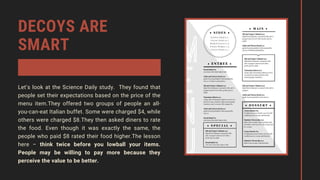
Let’s look at the Science Daily study. They found that
people set their expectations based on the price of the
menu item.They offered two groups of people an all-
you-can-eat Italian buffet. Some were charged $4, while
others were charged $8.They then asked diners to rate
the food. Even though it was exactly the same, the
people who paid $8 rated their food higher.The lesson
here – think twice before you lowball your items.
People may be willing to pay more because they
perceive the value to be better.
On a similar note to "decoy"
“BRACKETING"
“BRACKETING"
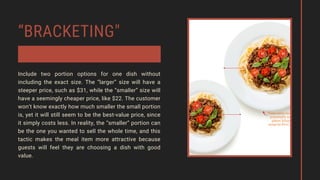
Include two portion options for one dish without
including the exact size. The “larger” size will have a
steeper price, such as $31, while the “smaller” size will
have a seemingly cheaper price, like $22. The customer
won’t know exactly how much smaller the small portion
is, yet it will still seem to be the best-value price, since
it simply costs less. In reality, the “smaller” portion can
be the one you wanted to sell the whole time, and this
tactic makes the meal item more attractive because
guests will feel they are choosing a dish with good
value.
ATTENTION-
GRABBING
TECHNIQUE
Including a nice-looking picture alongside a food item
increases sales by 30 percent
ATTENTION-GRABBING TECHNIQUE
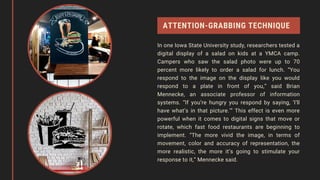
In one Iowa State University study, researchers tested a
digital display of a salad on kids at a YMCA camp.
Campers who saw the salad photo were up to 70
percent more likely to order a salad for lunch. “You
respond to the image on the display like you would
respond to a plate in front of you,” said Brian
Mennecke, an associate professor of information
systems. “If you’re hungry you respond by saying, ‘I’ll
have what’s in that picture.’” This effect is even more
powerful when it comes to digital signs that move or
rotate, which fast food restaurants are beginning to
implement. “The more vivid the image, in terms of
movement, color and accuracy of representation, the
more realistic, the more it’s going to stimulate your
response to it,” Mennecke said.
ATTENTION-GRABBING TECHNIQUE
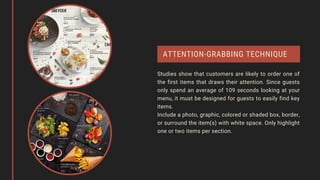
Studies show that customers are likely to order one of
the first items that draws their attention. Since guests
only spend an average of 109 seconds looking at your
menu, it must be designed for guests to easily find key
items.
Include a photo, graphic, colored or shaded box, border,
or surround the item(s) with white space. Only highlight
one or two items per section.
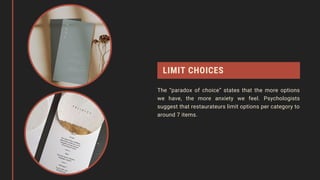
The “paradox of choice”LIMIT CHOICES
LIMIT CHOICES
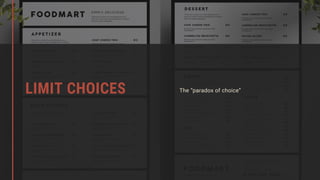
The “paradox of choice” states that the more options
we have, the more anxiety we feel. Psychologists
suggest that restaurateurs limit options per category to
around 7 items.
Include a separate dessert menuDESSERT MENU
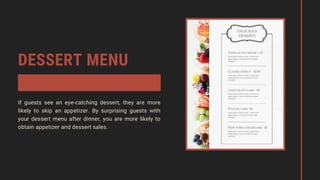
DESSERT MENU
If guests see an eye-catching dessert, they are more
likely to skip an appetizer. By surprising guests with
your dessert menu after dinner, you are more likely to
obtain appetizer and dessert sales.
Track weekly revenue and cross reference with your
weekly food costs
TEST NEW MENU
DESIGN
TEST NEW MENU
DESIGN
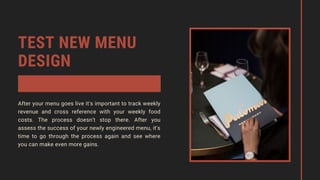
After your menu goes live it's important to track weekly
revenue and cross reference with your weekly food
costs. The process doesn't stop there. After you
assess the success of your newly engineered menu, it's
time to go through the process again and see where
you can make even more gains.

Menu engineering

  • 1.
    MENU ENGINEERING The PsychologyOf Menu Design – Why It Is So Important
  • 2.
    Menu engineering isthe practice of analyzing and strategically designing your menu to maximize restaurant profits. By highlighting your restaurant’s most popular and profitable items with menu psychology techniques, menu engineering constructs your menu in the most effective way. WHAT IS MENU ENGINEERING?
  • 3.
    We have reacheda point where customers have become more conscious of what they consume. According to David Henkes, Technomic’s senior principal, 69% of consumers worldwide cited the availability of healthy options being a very important factor in choosing where to buy a meal. Along with the healthy food trend, are concepts of locally sourced and organic, which bring higher price points and lower shelf life. Buying healthy, locally sourced, organic ingredients will most definitely cause your food cost to be higher, in turn making the menu price higher. This why knowing your target market is so crucial to menu engineering. CUSTOMER RESEARCH AND MENU ENGINEERING
  • 4.
    Research about thearea/neighborhood the restaurant is located in will give you a better idea of the average household income, spending patterns, and competition, and if locally sourced/organic is something to consider. These will be key decisions as you go through the menu engineering process. The average household income of the surrounding area is usually representative of how much they are willing to spend. When selecting a restaurant, 44% of consumers name the overall price as a top priority. CUSTOMER RESEARCH AND MENU ENGINEERING
  • 5.
    THE GOLDEN TRIANGLE Place theitems you want to sell in the center, the top right corner, and the top left corner.
  • 6.
    THE GOLDEN TRIANGLE Takea look at your restaurant menu and take note of where your eyes move first.For most people, their eyes look at the middle, then they travel to the top right corner and finally to the top left corner.Restaurant menu engineers call this the Golden Triangle.What to put here? This is where your dishes with the highest profit margins land. This doesn’t necessarily mean your most expensive menu items, just the most profitable.
  • 7.
    THE GOLDEN TRIANGLE Youcan consider these areas your high rent areas. If you put these items in these areas, and they don’t meet your profitability goals, consider trying other dishes in these spots. Lastly, in each Golden Triangle area, you can include more than one dish. Just know that the first and second items listed are usually the top selling items, and list the rest in descending order.
  • 8.
    Another way touse psychology to your advantage in your menu design is with color. COLOR IS DEFINITIVE
  • 9.
    HERE ARE SOME BASIC TIPSWHEN USING COLOR: When your customers see the color green, it makes them think of fresh food, just picked from the garden. When customers see orange, it stimulates their appetite. Orange is a fun, light color with delicious qualities. Plus, the color stimulates the brain by increasing its oxygen supply. Orange is also associated with healthy food.
  • 10.
    HERE ARE SOME BASIC TIPSWHEN USING COLOR: Yellow makes people happy, and you can use it on your menu to grab the reader’s attention. Yellow can also stimulate a diner’s appetite. If you use red on your menu, it’s an attention-grabber. It makes people stand up and take notice. You can use red to guide people to the dishes you really want them to order.
  • 11.
    When it comesto pricing your menu, how you do it matters. THE USE OF DOLLAR SIGNS
  • 12.
    THE USE OF DOLLARSIGNS One source says that removing dollar signs from a menu makes people spend more money.Why is this? When you remove the dollar signs, you take away the “real” or perceived value of the meal. It just doesn’t feel like you’re spending money when the dollar signs disappear.The same source goes on to say that spelling out the price – ten dollars instead of 10 – makes diners spend more.
  • 13.
    Avoid the belowtactics: Currency indicators remind customers that they’re spending money and can even make them feel like they are spending more than they are. Soften the price by eliminating the dollar sign. AVOID DOLLAR SIGNS Price trails are dotted lines that connect your menu items to their price, which is often listed on the other side of the page. This takes the focus away from your dish description and straight to the price instead. AVOID PRICE TRAILS By placing your prices in a column next to your dishes, guests can easily compare prices and may make their decision based on the cheapest dish. AVOID PRICE COLUMNS This can sound cheap and unsatisfying to many customers. AVOID ENDING YOUR PRICES WITH 99
  • 14.
    Other ways toget your customers to spend more on your menu include: Throw some very expensive dishes on your menu, even if you don’t ever serve them. This makes the other menu items look like a deal. End your prices with .95. For example, make your burger 10.95 instead of 11. This just seems less expensive even though it really isn’t. END PRICE WITH 95 PUT A FEW EXPENSIVE ITEMS
  • 15.
    Use the descriptionof your menu items to play into the psychology of the purchase. APPEAL TO THE IMAGINATION
  • 16.
    APPEAL TO THEIMAGINATION Use creative descriptions like freshly-picked, recently harvested, line-caught, home-brewed and chef designed to entice your diners.You want them to imagine the process of someone bringing the food to the table.Stay away from superlatives as you can bet diners will ignore them because they are too fantastic to believe.
  • 17.
    APPEAL TO THEIMAGINATION Another trick is to use nostalgia in your description. It’s a powerful driver when it comes to diners.For example, try Aunt Mabel’s Renowned Fried Chicken instead of simply friend chicken.This makes diners feel like they’re ordering something really special – a blast from the past that is worth the money.
  • 18.
    Put your mostcost-effective dishes in prime spots. LIST MANAGEMENT MATTER
  • 19.
    LIST MANAGEMENT MATTER If youhave 10 items to list under a category, for example, pasta dishes, pay attention to the order of the list.Manage your list so that the top items you want to sell are in the top spots. Most customers subconsciously order from either the top two or the bottom option in a list of menu items.Put your most cost-effective dishes in these prime spots.
  • 20.
    People may bewilling to pay more because they perceive the value to be better. DECOYS ARE SMART
  • 21.
    DECOYS ARE SMART You canmanipulate customers into ordering more if it seems like they’re saving money by not purchasing the more expensive menu item. It gives the impression of a bargain.People then end up spending more than the highest dollar item.Where does this smart decoy go? Put it near the top so everything else seems better priced.What’s more, when you showcase slightly more expensive items, it makes your entire menu look better and suggest your food is of exceptionally high quality.
  • 22.
    DECOYS ARE SMART Let’s lookat the Science Daily study. They found that people set their expectations based on the price of the menu item.They offered two groups of people an all- you-can-eat Italian buffet. Some were charged $4, while others were charged $8.They then asked diners to rate the food. Even though it was exactly the same, the people who paid $8 rated their food higher.The lesson here – think twice before you lowball your items. People may be willing to pay more because they perceive the value to be better.
  • 23.
    On a similarnote to "decoy" “BRACKETING"
  • 24.
    “BRACKETING" Include two portionoptions for one dish without including the exact size. The “larger” size will have a steeper price, such as $31, while the “smaller” size will have a seemingly cheaper price, like $22. The customer won’t know exactly how much smaller the small portion is, yet it will still seem to be the best-value price, since it simply costs less. In reality, the “smaller” portion can be the one you wanted to sell the whole time, and this tactic makes the meal item more attractive because guests will feel they are choosing a dish with good value.
  • 25.
    ATTENTION- GRABBING TECHNIQUE Including a nice-lookingpicture alongside a food item increases sales by 30 percent
  • 26.
    ATTENTION-GRABBING TECHNIQUE In oneIowa State University study, researchers tested a digital display of a salad on kids at a YMCA camp. Campers who saw the salad photo were up to 70 percent more likely to order a salad for lunch. “You respond to the image on the display like you would respond to a plate in front of you,” said Brian Mennecke, an associate professor of information systems. “If you’re hungry you respond by saying, ‘I’ll have what’s in that picture.’” This effect is even more powerful when it comes to digital signs that move or rotate, which fast food restaurants are beginning to implement. “The more vivid the image, in terms of movement, color and accuracy of representation, the more realistic, the more it’s going to stimulate your response to it,” Mennecke said.
  • 27.
    ATTENTION-GRABBING TECHNIQUE Studies showthat customers are likely to order one of the first items that draws their attention. Since guests only spend an average of 109 seconds looking at your menu, it must be designed for guests to easily find key items. Include a photo, graphic, colored or shaded box, border, or surround the item(s) with white space. Only highlight one or two items per section.
  • 28.
    The “paradox ofchoice”LIMIT CHOICES
  • 29.
    LIMIT CHOICES The “paradoxof choice” states that the more options we have, the more anxiety we feel. Psychologists suggest that restaurateurs limit options per category to around 7 items.
  • 30.
    Include a separatedessert menuDESSERT MENU
  • 31.
    DESSERT MENU If guestssee an eye-catching dessert, they are more likely to skip an appetizer. By surprising guests with your dessert menu after dinner, you are more likely to obtain appetizer and dessert sales.
  • 32.
    Track weekly revenueand cross reference with your weekly food costs TEST NEW MENU DESIGN
  • 33.
    TEST NEW MENU DESIGN Afteryour menu goes live it's important to track weekly revenue and cross reference with your weekly food costs. The process doesn't stop there. After you assess the success of your newly engineered menu, it's time to go through the process again and see where you can make even more gains.