Between the Wars set the stage for WWII Kellog-Briand Pact Weak treaty that had no enforcement Because it appeared something was being done, others did not initiate new actions Simply countries stating that they support peace Balfour Declaration Lord Balfour stating their should be a Jewish state (support of Zionism in 1917) Red Scare Lenin’s new communism which encouraged spread of the revolution created a reaction which supported suspension of democratic ideals Economic Distress The retribution of the Treaty of Versailles created attitudes which supported nationalism ( Lebenshraum )
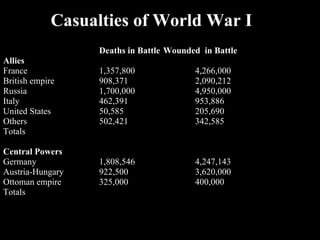
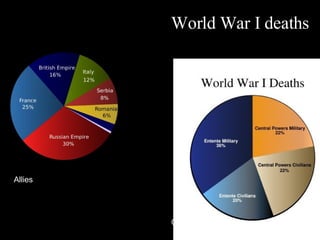
Casualties of World War I Deaths in Battle Wounded  in Battle Allies France 1,357,800 4,266,000 British empire 908,371 2,090,212 Russia 1,700,000 4,950,000 Italy 462,391 953,886 United States 50,585 205,690 Others 502,421 342,585 Totals Central Powers Germany 1,808,546 4,247,143 Austria-Hungary 922,500 3,620,000 Ottoman empire 325,000 400,000 Totals
More dead and wounded than any other conflict EVER Millions became refugees and immigrated (US closes doors) Pandemic flu kills about 30 million Serious damage to environment Focus of damage in Western Europe Farmland Electrical wires Telephone wires Barns Means of production interrupted Physical Impact of the War
World War I deaths Allies Central Powers
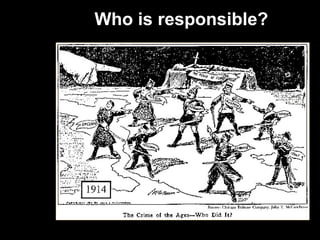
Who is responsible?
Germany and Austria are held responsible although Ottomans destroyed as well Treaty of Sèvres  Ottomans get out of war by Armistice in October 1918 and peace treaty is negotiated at Paris Peace conference Mandates of French and British French – Lebanon and Syria British – (Jordan, Israel and West Bank) – Palestine, Iraq Kurdistan was created but Kurds could not agree Clause 231 in Treaty of Versailles   " The Allied and Associated Governments affirm and Germany accepts the responsibility of Germany and her allies for causing all the loss and damage to which the Allied and Associated Governments and their nationals have been subjected as a consequence of the war imposed upon them by the aggression of Germany and her allies.
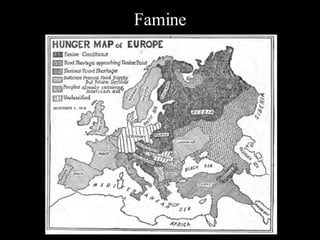
Famine
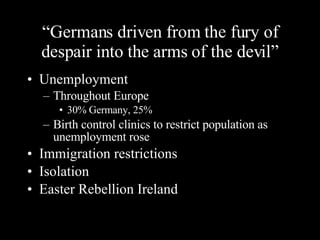
“ Germans driven from the fury of despair into the arms of the devil” Unemployment Throughout Europe 30% Germany, 25% Birth control clinics to restrict population as unemployment rose Immigration restrictions Isolation Easter Rebellion Ireland
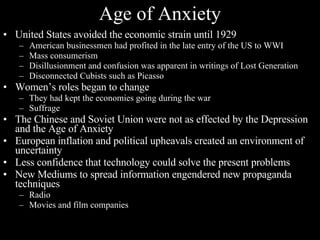
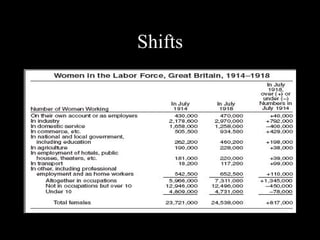
Age of Anxiety United States avoided the economic strain until 1929 American businessmen had profited in the late entry of the US to WWI Mass consumerism Disillusionment and confusion was apparent in writings of Lost Generation Disconnected Cubists such as Picasso Women’s roles began to change They had kept the economies going during the war Suffrage The Chinese and Soviet Union were not as effected by the Depression and the Age of Anxiety European inflation and political upheavals created an environment of uncertainty Less confidence that technology could solve the present problems New Mediums to spread information engendered new propaganda techniques Radio Movies and film companies
Social Shifts of the Pendulum  Pre WWI Post WWI
Shifts
During War Governments controlled some sectors of the economy Used newspapers to distribute information and control information Use of propaganda increased between the wars
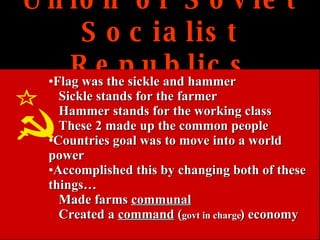
Union of Soviet Socialist Republics Flag was the sickle and hammer Sickle stands for the farmer Hammer stands for the working class These 2 made up the common people Countries goal was to move into a world power Accomplished this by changing both of these things… Made farms  communal   Created a  command  ( govt in charge ) economy
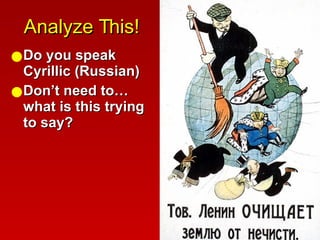
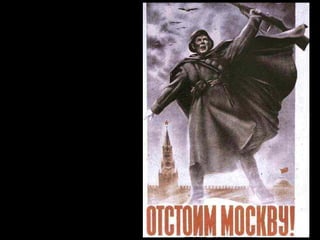
Analyze This! Do you speak Cyrillic (Russian) Don’t need to… what is this trying to say?
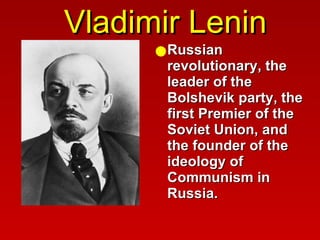
Vladimir Lenin Russian revolutionary, the leader of the Bolshevik party, the first Premier of the Soviet Union, and the founder of the ideology of Communism in Russia.
Lenin’s policies Creates the NEP (New Economic Policy) which had some capitalistic aspects such as allowing farmers to sell portions of their grain for their own profit (this sure does NOT sound like socialism!) This was successful in agriculture Lenin becomes ill and is not able to pursue this policy to other sectors of the Soviet economy… a successor will be in charge of this… but who could it be?
Stalin and Trotsky Stalin and Trotsky were two of Lenin’s chief advisors; both jockey to be Lenin’s successor Trotsky was favored by many, including Lenin. However, Stalin moved more quickly to consolidate his power in the Central Committee. Trotsky criticized Stalin’s violation of democracy in the party and the failure to develop adequate economic planning.
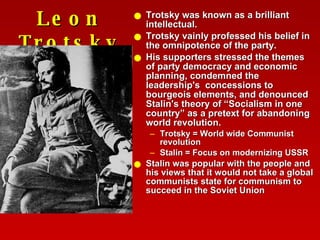
Leon Trotsky Trotsky was known as a brilliant intellectual. Trotsky vainly professed his belief in the omnipotence of the party.  His supporters stressed the themes of party democracy and economic planning, condemned the leadership's  concessions to bourgeois elements, and denounced Stalin's theory of “Socialism in one country” as a pretext for abandoning world revolution.  Trotsky = World wide Communist revolution Stalin = Focus on modernizing USSR Stalin was popular with the people and his views that it would not take a global communists state for communism to succeed in the Soviet Union
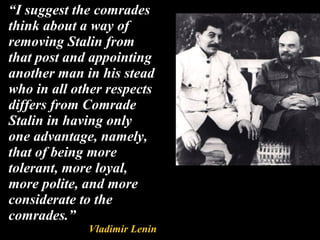
“ I suggest the comrades think about a way of removing Stalin from that post and appointing another man in his stead who in all other respects differs from Comrade Stalin in having only one advantage, namely, that of being more tolerant, more loyal, more polite, and more considerate to the comrades.” Vladimir Lenin
Lenin is dying, and talking things over with Stalin, his successor. "The one worry I have," says Lenin, "is this: will the people follow you? What do you think, comrade Stalin?" "They will," says Stalin, "they surely will." "I hope so," says Lenin, "but what if they don't follow you?"  "No problem," says Stalin, "then they'll follow you."  But Lenin will die soon after the revolution
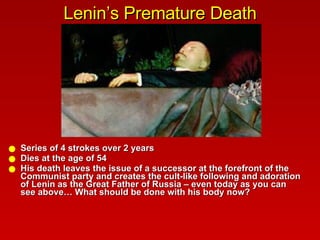
Lenin’s Premature Death Series of 4 strokes over 2 years  Dies at the age of 54 His death leaves the issue of a successor at the forefront of the Communist party and creates the cult-like following and adoration of Lenin as the Great Father of Russia – even today as you can see above… What should be done with his body now?
The party, lead by Stalin, opposed Trotskyism to Leninism, accusation of differences were vague and denigrated Trotsky's role in the Revolution. Trotsky was expelled from the party in 1926  Then exiled from the USSR. He was represented as the principal conspirator in the treason trials of former Communist opposition leaders. The evidence of treasonable plotting, however, was later proven to be fictitious.  Trotsky flees to Latin America (region ripe for Socialist ideas)
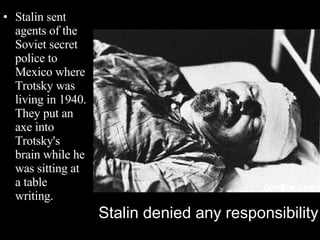
Stalin sent agents of the Soviet secret police to Mexico where Trotsky was living in 1940. They put an axe into Trotsky's brain while he was sitting at a table writing. Stalin denied any responsibility
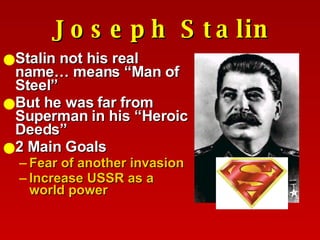
Joseph Stalin Stalin not his real name… means “Man of Steel” But he was far from Superman in his “Heroic Deeds” 2 Main Goals Fear of another invasion Increase USSR as a world power
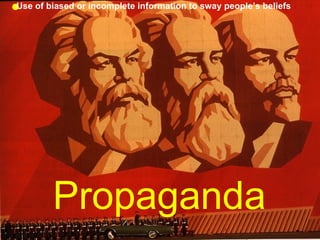
Propaganda Use of biased or incomplete information to sway people’s beliefs
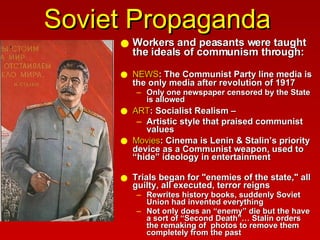
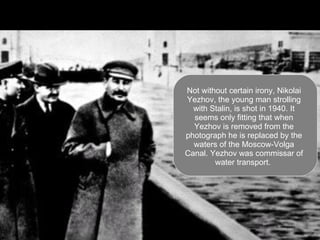
Soviet Propaganda Workers and peasants were taught the ideals of communism through: NEWS : The Communist Party line media is the only media after revolution of 1917  Only one newspaper censored by the State is allowed ART : Socialist Realism –   Artistic style that praised communist values Movies : Cinema is Lenin & Stalin’s priority device as a Communist weapon, used to “hide” ideology in entertainment Trials began for "enemies of the state," all guilty, all executed, terror reigns Rewrites history books, suddenly Soviet Union had invented everything  Not only does an “enemy” die but the have a sort of “Second Death”… Stalin orders the remaking of  photos to remove them completely from the past
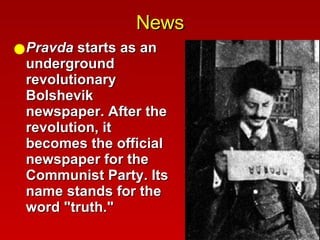
News Pravda  starts as an underground revolutionary Bolshevik newspaper. After the revolution, it becomes the official newspaper for the Communist Party. Its name stands for the word "truth."
Propaganda vs. Censorship Propaganda can be even worse than censorship. Censors keep facts from the public; propagandists twist facts into lies. Under a state-controlled press system, the government can order newspaper editors to print stories the editors know are not true. Early on, Russian revolutionary leaders realize they can force newspapers to print only the simple concepts, slogans and ideas of Bolshevism
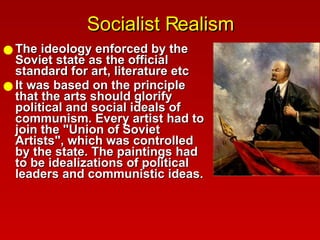
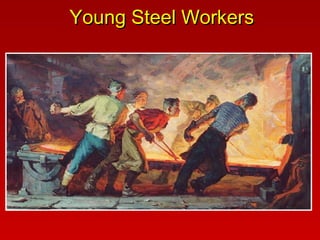
Socialist Realism The ideology enforced by the Soviet state as the official standard for art, literature etc  It was based on the principle that the arts should glorify political and social ideals of communism. Every artist had to join the "Union of Soviet Artists", which was controlled by the state. The paintings had to be idealizations of political leaders and communistic ideas.
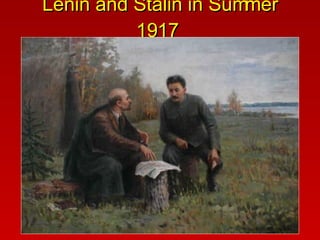
Lenin and Stalin in Summer 1917
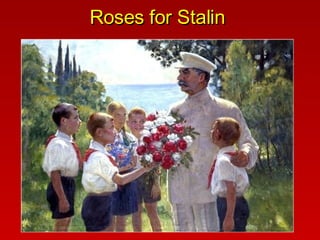
Roses for Stalin
Young Steel Workers
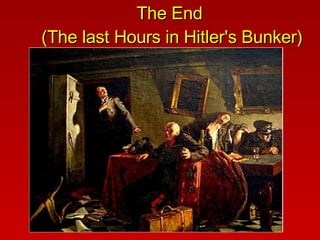
The End  (The last Hours in Hitler's Bunker)
 
Not without certain irony, Nikolai Yezhov, the young man strolling with Stalin, is shot in 1940. It seems only fitting that when Yezhov is removed from the photograph he is replaced by the waters of the Moscow-Volga Canal. Yezhov was commissar of water transport.
 
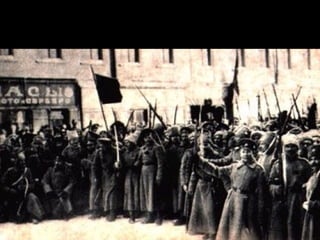
Propagandists seize every opportunity to get their message across. In the original of this photo, the sign on the building says, "Watches, gold and silver." Now it reads, "Struggle for your rights." Likewise the flag being waved says, "Down with the monarchy - long live the Republic!" has no visible words in the original.
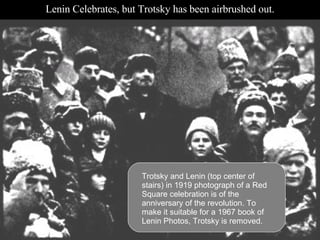
Lenin and Trotsky celebrate the second anniversary of the Russian Revolution in Red Square.
Lenin Celebrates, but Trotsky has been airbrushed out. Trotsky and Lenin (top center of stairs) in 1919 photograph of a Red Square celebration is of the anniversary of the revolution. To make it suitable for a 1967 book of Lenin Photos, Trotsky is removed.
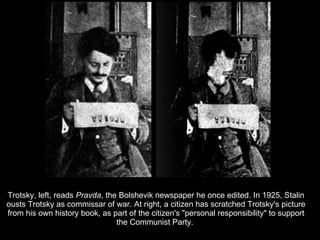
Trotsky, left, reads  Pravda , the Bolshevik newspaper he once edited. In 1925, Stalin ousts Trotsky as commissar of war. At right, a citizen has scratched Trotsky's picture from his own history book, as part of the citizen's "personal responsibility" to support the Communist Party.
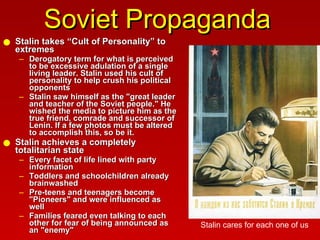
Soviet Propaganda Stalin takes “Cult of Personality” to extremes  Derogatory term for what is perceived to be excessive adulation of a single living leader. Stalin used his cult of personality to help crush his political opponents Stalin saw himself as the "great leader and teacher of the Soviet people." He wished the media to picture him as the true friend, comrade and successor of Lenin. If a few photos must be altered to accomplish this, so be it.  Stalin achieves a completely totalitarian state Every facet of life lined with party information Toddlers and schoolchildren already brainwashed  Pre-teens and teenagers become "Pioneers" and were influenced as well Families feared even talking to each other for fear of being announced as an "enemy" Stalin cares for each one of us
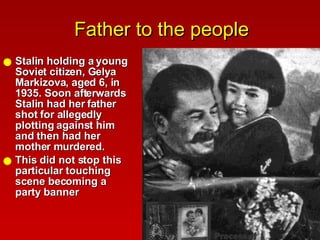
Father to the people Stalin holding a young Soviet citizen, Gelya Markizova, aged 6, in 1935. Soon afterwards Stalin had her father shot for allegedly plotting against him and then had her mother murdered.  This did not stop this particular touching scene becoming a party banner
Its All About Stalin! Appeared as a god-like omniscient ruler, destined to rule the nation for all eternity.  Government orders prescribed the hanging of his portrait in every home and public building, and many artists and poets were instructed to only produce works that glorified the leader.  To justify this level of worship, Stalin tried to present himself as personally humble and modest, and would often characterize this vast personality cults as nothing more than a spontaneous show of affection by his people (Mao in China will copy much of this) Cities named after Stalin Oraşul Stalin , 1951-1961 — Romania   Qyteti Stalin , 1950-1990 — Albania   Stalin , 1949-1956 — Bulgaria   Stalinabad , 1929-1961 — Tajikistan   Stalingrad , 1925-1961 — Russia   Stalingrad  —,  Czech Republic   Staliniri , 1934-1961 — Georgia   Stalino , 1924-1961 — Ukraine   Stalinogorsk , 1934-1961 — Russia   Stalinogród , 1953-1956 — Poland   Stalinsk , 1932-1961 — Russia   Stalinstadt , 1953-1961 — East Germany   Sztálinváros , 1951-1961 — Hungary
 
Stalin takes control of the economy Called for a  command economy  – system which the government makes all economic decisions Political leaders identify economic needs and determine how to fulfill them Creates a Five Year Plan (two of them in fact) in order to create a goal for the nation to strive towards. Felt the NEP was too slow  Five year plan set unrealistically high goals – consumer production had to be limited to try to teach these goals, causing widespread shortages of foot, housing, clothes, etc Government controlled all aspects of people’s lives – chose jobs, assigned hours, needed permission of the police to move Those who did not cooperate could be executed or sent to the gulags
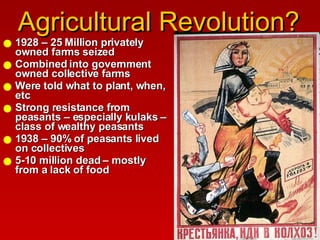
Agricultural Revolution? 1928 – 25 Million privately owned farms seized Combined into government owned collective farms  Were told what to plant, when, etc Strong resistance from peasants – especially kulaks – class of wealthy peasants 1938 – 90% of peasants lived on collectives  5-10 million dead – mostly from a lack of food
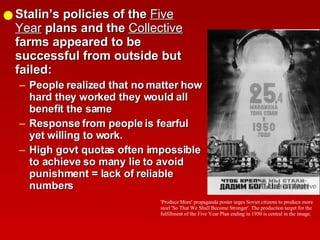
Stalin’s policies of the  Five Year  plans and the  Collective  farms appeared to be successful from outside but failed: People realized that no matter how hard they worked they would all benefit the same Response from people is fearful yet willing to work. High govt quotas often impossible to achieve so many lie to avoid punishment = lack of reliable numbers 'Produce More' propaganda poster urges Soviet citizens to produce more steel 'So That We Shall Become Stronger'. The production target for the fulfillment of the Five Year Plan ending in 1950 is central in the image.
Weapons of Totalitarianism  Police terror – destroyed enemies of Stalin Monitored telephone lines, read mail, planted informants Many children told on parents for “disloyal” comments Great Purge – term used to describe the systematic killed of many enemies of the state such as: Bolshevik party members who helped in the Revolution of 1917 (free thinkers) Kulaks: wealthy peasants who deliberately destroyed fields rather than have them taken by the state
How Many Were Killed by Stalin? famines, prison and labor camp mortality, and state terrorism (deportations and political purges) are taken into account, Stalin and his colleagues were directly or indirectly responsible for the deaths of millions. How many millions died under Stalin is greatly disputed. Although no official figures have been released by the Soviet or Russian governments, most estimates put the figure between  8 and 20 million "The death of one man is a tragedy. The death of millions is a statistic."
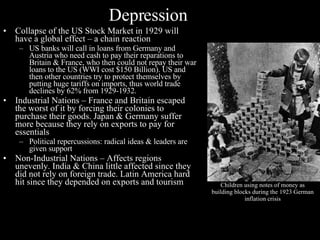
Depression Collapse of the US Stock Market in 1929 will have a global effect – a chain reaction US banks will call in loans from Germany and Austria who need cash to pay their reparations to Britain & France, who then could not repay their war loans to the US (WWI cost $150 Billion). US and then other countries try to protect themselves by putting huge tariffs on imports, thus world trade declines by 62% from 1929-1932. Industrial Nations – France and Britain escaped the worst of it by forcing their colonies to purchase their goods. Japan & Germany suffer more because they rely on exports to pay for essentials Political repercussions: radical ideas & leaders are given support  Non-Industrial Nations – Affects regions unevenly. India & China little affected since they did not rely on foreign trade. Latin America hard hit since they depended on exports and tourism Children using notes of money as building blocks during the 1923 German inflation crisis
Italy Post war issues: Feeling of national shame and humiliation stemming from its 'mutilated victory' at the hands of the World War I peace treaties World Wide Depression hits  Rise of Nationalism (still relatively “NEW” in terms of nation-hood) and lacks colonies Fear of communism and capitalists Fascism emerged as a "third way"
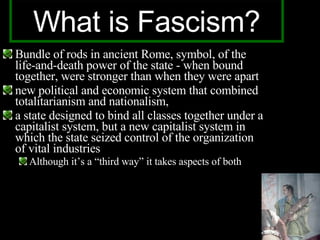
What is Fascism? Bundle of rods in ancient Rome, symbol, of the life-and-death power of the state - when bound together, were stronger than when they were apart new political and economic system that combined  totalitarianism and nationalism,  a state designed to bind all classes together under a capitalist system, but a new capitalist system in which the state seized control of the organization of vital industries Although it’s a “third way” it takes aspects of both
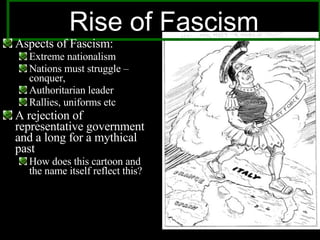
Rise of Fascism Aspects of Fascism: Extreme nationalism Nations must struggle – conquer, Authoritarian leader  Rallies, uniforms etc A rejection of representative government and a long for a mythical past How does this cartoon and the name itself reflect this?
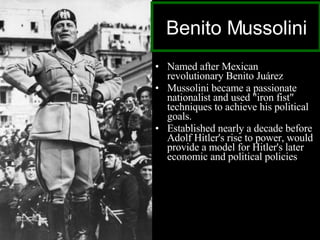
Named after Mexican revolutionary Benito Juárez Mussolini became a passionate nationalist and used "iron fist" techniques to achieve his political goals. Established nearly a decade before Adolf Hitler's rise to power, would provide a model for Hitler's later economic and political policies  Benito Mussolini
Totalitarianism The term which will applied to other regimes in the 20 th  century will be coined by Mussolini State controls nearly every aspect of the individual's life. Totalitarian governments do not tolerate activities by individuals or groups such as labor unions that are not directed by the state's goals. Totalitarian regimes maintain themselves in power through secret police, propaganda disseminated through the media, the elimination of open criticism of the regime, and use of terror tactics. Internal and external threats are created to foster unity through fear. He creates the legend of  Il duce , a man who never slept, was always right, and could solve all the problems of politics and economics. Mussolini personally took over the ministries of the interior, of foreign affairs, of the colonies, of the corporations, of the army and the other armed services, and of public works.  Sometimes he held as many as seven departments simultaneously, as well as the premiership.  He was also head of the all-powerful Fascist party and the armed local Fascist militia, or Blackshirts that terrorized incipient resistances in the cities and provinces
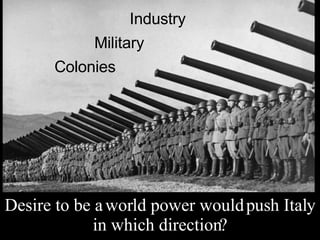
Desire to be a world power would push Italy in which direction? Industry Military Colonies
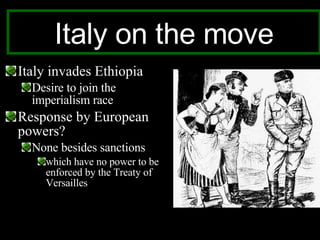
Italy on the move Italy invades Ethiopia Desire to join the imperialism race Response by European powers? None besides sanctions which have no power to be enforced by the Treaty of Versailles
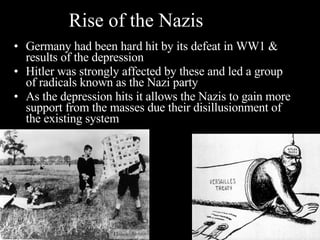
Rise of the Nazis Germany had been hard hit by its defeat in WW1 & results of the depression Hitler was strongly affected by these and led a group of radicals known as the Nazi party As the depression hits it allows the Nazis to gain more support from the masses due their disillusionment of the existing system
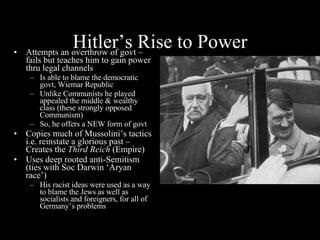
Hitler’s Rise to Power Attempts an overthrow of govt – fails but teaches him to gain power thru legal channels Is able to blame the democratic govt, Wiemar Republic Unlike Communists he played appealed the middle & wealthy class (these strongly opposed Communism) So, he offers a NEW form of govt Copies much of Mussolini’s tactics i.e. reinstate a glorious past – Creates the  Third Reich  (Empire) Uses deep rooted anti-Semitism (ties with Soc Darwin ‘Aryan race’) His racist ideas were used as a way to blame the Jews as well as socialists and foreigners, for all of Germany’s problems
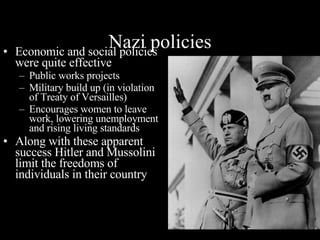
Nazi policies Economic and social policies were quite effective Public works projects Military build up (in violation of Treaty of Versailles) Encourages women to leave work, lowering unemployment and rising living standards Along with these apparent success Hitler and Mussolini limit the freedoms of individuals in their country
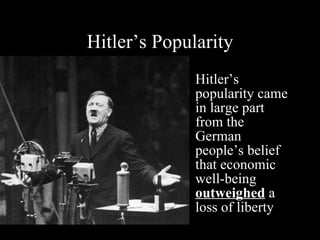
Hitler’s popularity came in large part from the German people’s belief that economic well-being  outweighed  a loss of liberty Hitler’s Popularity
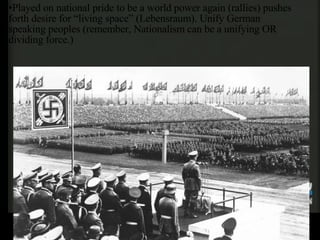
Played on national pride to be a world power again (rallies) pushes forth desire for “living space” (Lebensraum). Unify German speaking peoples (remember, Nationalism can be a unifying OR dividing force.)
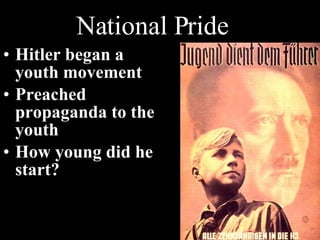
National Pride  Hitler began a youth movement  Preached propaganda to the youth How young did he start?
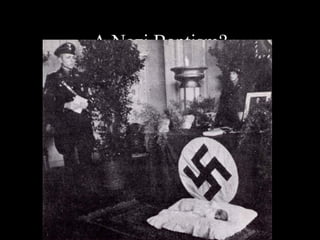
A Nazi Baptism?
Nationalism This was a driving force in the 19 th  and 20 th  centuries but it was quite different in Europe and Japan than in its colonies In Europe and Japan it fueled extreme racism, fascism, and domination. Becomes synonymous with national expansion and conquest of other peoples In the colonies it meant self-determination, the ability to free the nation from rule by another and determine one’s own destiny. National pride = National sovereignty
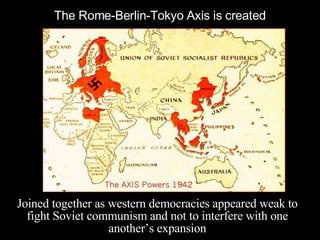
The Rome-Berlin-Tokyo Axis is created Joined together as western democracies appeared weak to fight Soviet communism and not to interfere with one another’s expansion
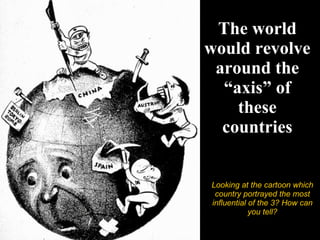
The world would revolve around the “axis” of these countries Looking at the cartoon which country portrayed the most influential of the 3? How can you tell?
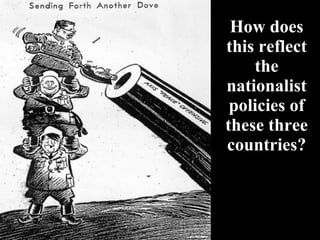
How does this reflect the nationalist policies of these three countries?
Road to War As we have seen: Japan invades China Leads to the Sino-Japanese war  Italy Invades Ethiopia Now what about Germany???
Spanish Civil War: Test run for new weapons Italy & German aid (The fascist military general) in Spain during their civil war No defense from Britain or France Brings Franco to power Opportunity to test new types of weapons – Blitzkrieg  This new type of war very different from WWI Trench warfare Long periods of relative inaction Followed by sharp thrusts of great power
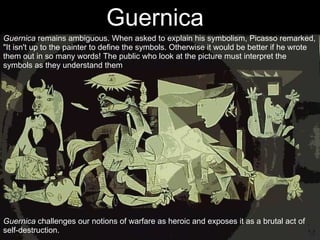
Guernica On April 27th, 1937, unprecedented atrocities are perpetrated on behalf of Franco against the civilian population of a little Basque village in northern Spain. Chosen for bombing practice by Hitler's burgeoning war machine, the hamlet is pounded with high-explosive and incendiary bombs for over three hours. Townspeople are cut down as they run from the crumbling buildings. Guernica burns for three days. 1,600 civilians are killed or wounded.  It is modern art's most powerful antiwar statement... What was the most powerful antiwar novel to this date?
Guernica  Guernica  challenges our notions of warfare as heroic and exposes it as a brutal act of self-destruction. Guernica  remains ambiguous. When asked to explain his symbolism, Picasso remarked, "It isn't up to the painter to define the symbols. Otherwise it would be better if he wrote them out in so many words! The public who look at the picture must interpret the symbols as they understand them
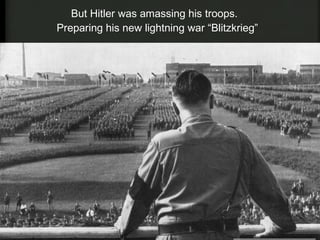
But Hitler was amassing his troops.  Preparing his new lightning war “Blitzkrieg”
How will Western Democracies react to German massive military build up – violation of Treaty of Versailles German advance into de-militarized zone in the Rhineland between France & Germany Invasion of Austria next eyes Czechoslovakia Remember the response to Italy’s aggression?
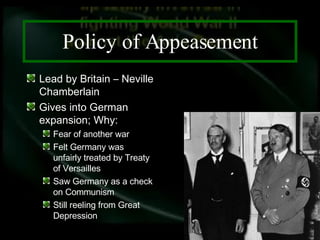
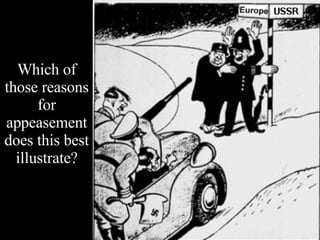
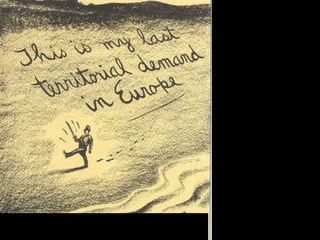
Policy of Appeasement Lead by Britain – Neville Chamberlain Gives into German expansion; Why: Fear of another war Felt Germany was unfairly treated by Treaty of Versailles Saw Germany as a check on Communism Still reeling from Great Depression
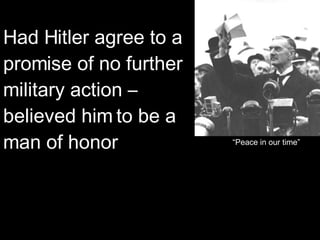
Had Hitler agree to a promise of no further military action – believed him to be a man of honor “Peace in our time”
Which of those reasons for appeasement does this best illustrate?
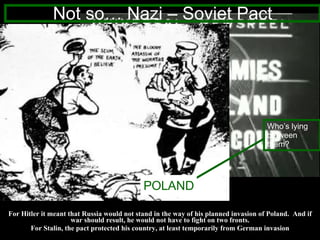
For Hitler it meant that Russia would not stand in the way of his planned invasion of Poland.  And if war should result, he would not have to fight on two fronts. For Stalin, the pact protected his country, at least temporarily from German invasion Not so… Nazi – Soviet Pact ? POLAND Who’s lying between them?
 
Synopsis Fought on 2 fronts Immediate Allied fear of a British & Soviet loss to the Germans focused the war effort to Europe Allied plan: Control sea lanes – shipping of goods Emphasis on air power Supply Soviets on Eastern Front China forced to defend against Japan alone US forced to defend Philippines alone
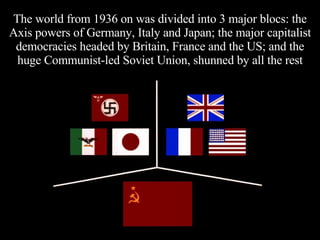
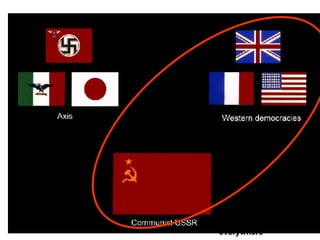
The world from 1936 on was divided into 3 major blocs: the Axis powers of Germany, Italy and Japan; the major capitalist democracies headed by Britain, France and the US; and the huge Communist-led Soviet Union, shunned by all the rest
Anti-communist Deplored fascism but saw Communism as a bigger threat Pledged in theory to overthrow capitalism everywhere
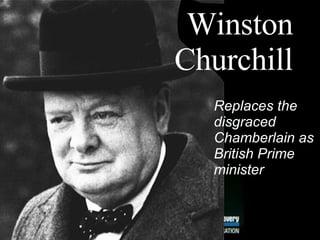
Winston Churchill Replaces the disgraced Chamberlain as British Prime minister
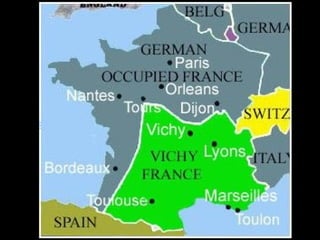
Axis Advances Blitzkrieg strikes France in 1940 – fighting lasts only 6 weeks As France is about to fall, over 300,000 troops are ferried to safety from Dunkirk to Britain France forced to surrender to Germany.  Sign treaty which creates a puppet “Vichy Regime” Hitler avenges the Treaty of Versailles & WWI
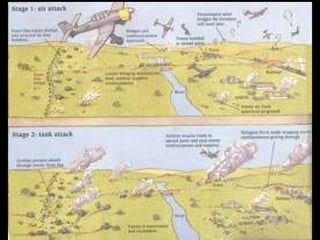
Very different war then WWI… Offensive in nature as opposed to the defensive trench warfare earlier – Germans were best equipped and ready for war Offensive approach came about as technology of war improved Aircraft – bombers & fighters Tanks Aircraft carriers Speed of movement across the globe Little can stop or even slow Hitler in Europe Excelled in land warfare
 
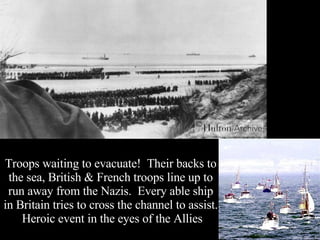
Troops waiting to evacuate!  Their backs to the sea, British & French troops line up to run away from the Nazis.  Every able ship in Britain tries to cross the channel to assist.  Heroic event in the eyes of the Allies
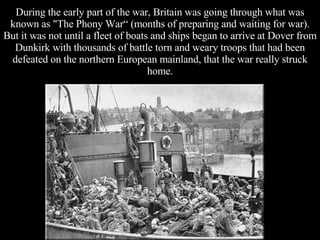
During the early part of the war, Britain was going through what was known as "The Phony War“ (months of preparing and waiting for war). But it was not until a fleet of boats and ships began to arrive at Dover from Dunkirk with thousands of battle torn and weary troops that had been defeated on the northern European mainland, that the war really struck home.
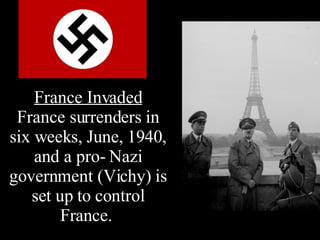
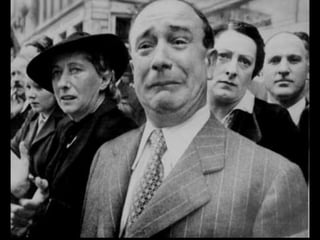
France Invaded France surrenders in six weeks, June, 1940, and a pro- Nazi government (Vichy) is set up to control France.
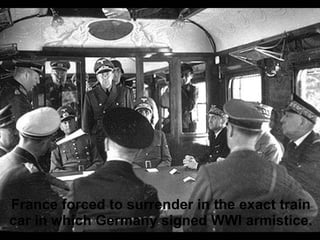
France forced to surrender in the exact train car in which Germany signed WWI armistice.
 
 
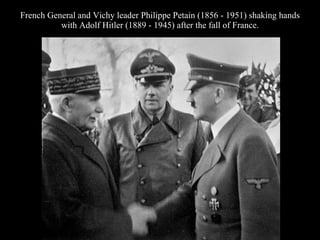
French General and Vichy leader Philippe Petain (1856 - 1951) shaking hands with Adolf Hitler (1889 - 1945) after the fall of France.
 
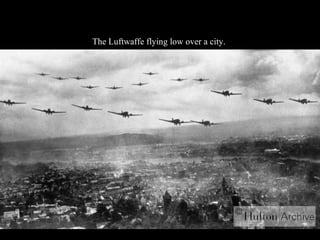
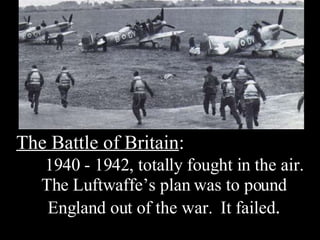
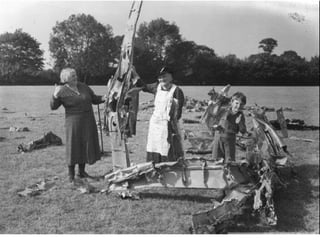
Battle of Britain Britain was now the lone democratic nation in Western Europe German Luftwaffe begins bombing southern cities RAF is only the defense New device: Radar allows them to know of Germans attacks Churchill and the British defend themselves and boost morale Germany fails; one of his costliest mistakes, loses much of the Luftwaffe Compounds one mistake with another: attacking the USSR!
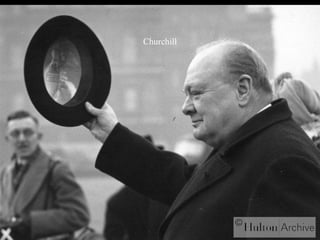
Churchill
The Luftwaffe flying low over a city.
A formation of Luftwaffe Junkers Ju87D Stuka dive-bombers in the air.
The Battle of Britain :  1940 - 1942, totally fought in the air.  The Luftwaffe’s plan was to pound England out of the war.  It failed .


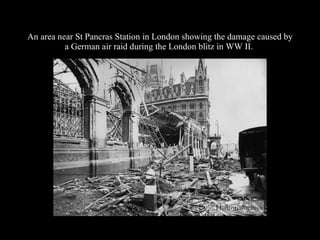
An area near St Pancras Station in London showing the damage caused by a German air raid during the London blitz in WW II.
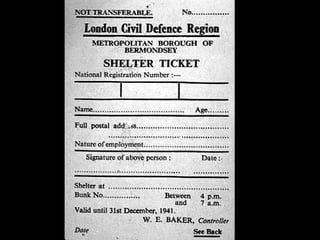
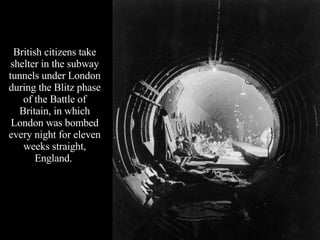
British citizens take shelter in the subway tunnels under London during the Blitz phase of the Battle of Britain, in which London was bombed every night for eleven weeks straight, England.
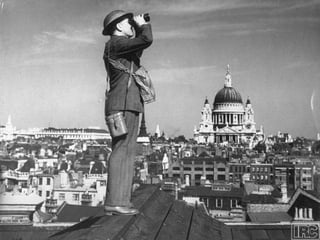
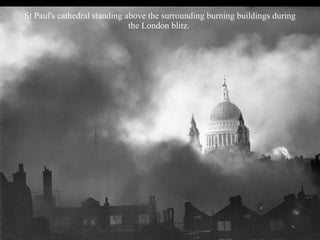
St Paul's cathedral standing above the surrounding burning buildings during the London blitz.
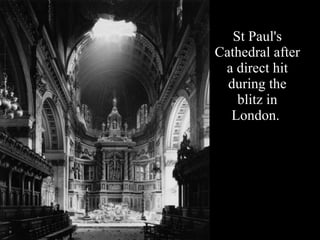
St Paul's Cathedral after a direct hit during the blitz in London.
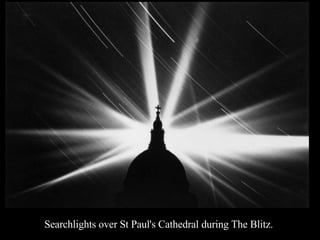
Searchlights over St Paul's Cathedral during The Blitz.
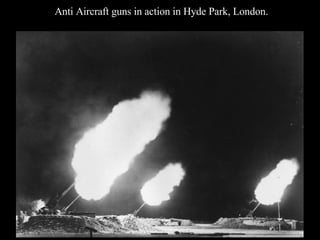
Anti Aircraft guns in action in Hyde Park, London.
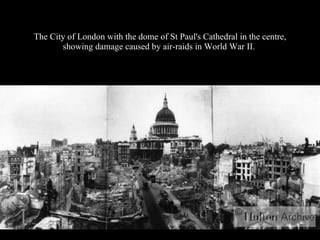
The City of London with the dome of St Paul's Cathedral in the centre, showing damage caused by air-raids in World War II.
 
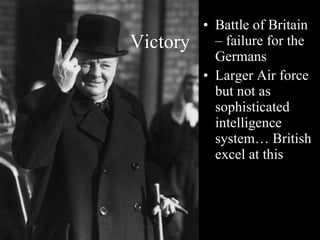
Victory Battle of Britain – failure for the Germans  Larger Air force but not as sophisticated intelligence system… British excel at this
Operation Barbarossa
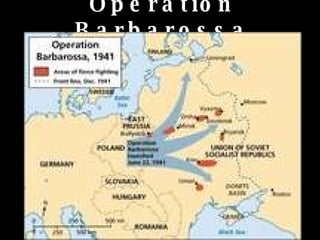
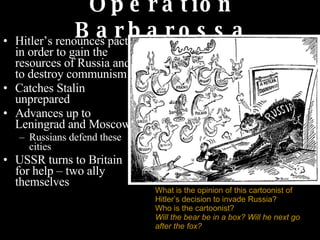
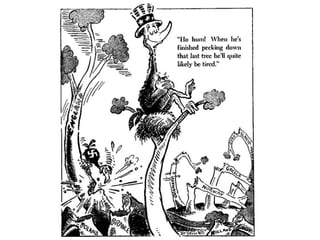
Operation Barbarossa Hitler’s renounces pact in order to gain the resources of Russia and to destroy communism Catches Stalin unprepared Advances up to Leningrad and Moscow Russians defend these cities USSR turns to Britain for help – two ally themselves What is the opinion of this cartoonist of Hitler’s decision to invade Russia? Who is the cartoonist? Will the bear be in a box? Will he next go after the fox?
 
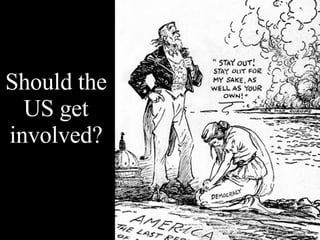
Should the US get involved?
 
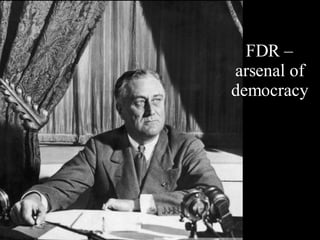
FDR – arsenal of democracy
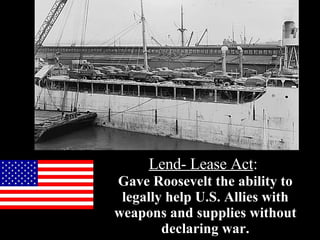
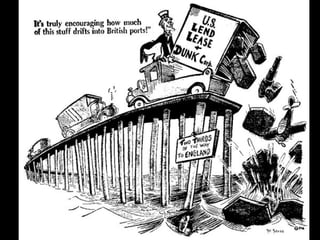
Lend- Lease Act :   Gave Roosevelt the ability to legally help U.S. Allies with weapons and supplies without declaring war.
 
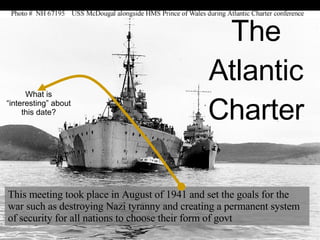
The Atlantic Charter This meeting took place in August of 1941 and set the goals for the war such as destroying Nazi tyranny and creating a permanent system of security for all nations to choose their form of govt What is “interesting” about this date?
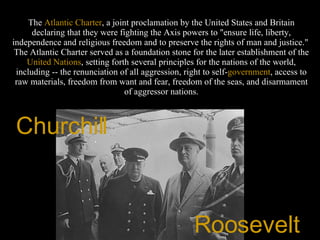
The  Atlantic   Charter , a joint proclamation by the United States and Britain declaring that they were fighting the Axis powers to "ensure life, liberty, independence and religious freedom and to preserve the rights of man and justice."  The Atlantic Charter served as a foundation stone for the later establishment of the  United   Nations , setting forth several principles for the nations of the world, including -- the renunciation of all aggression, right to self- government , access to raw materials, freedom from want and fear, freedom of the seas, and disarmament of aggressor nations. Churchill  Roosevelt
But what about the Pacific?  As Japan continues expanding its sphere of influence in East Asia, it will soon see the US as a threat to its expansion.
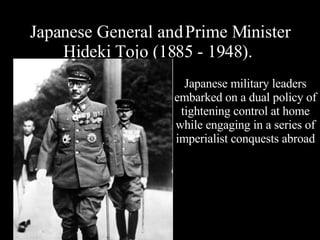
Japanese General and Prime Minister Hideki Tojo (1885 - 1948).  Japanese military leaders embarked on a dual policy of tightening control at home while engaging in a series of imperialist conquests abroad
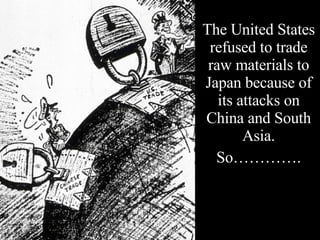
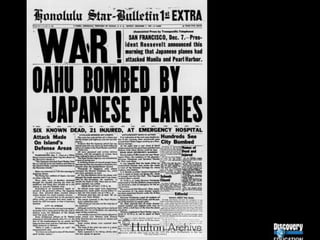
The United States refused to trade raw materials to Japan because of its attacks on China and South Asia. So………….
 
 
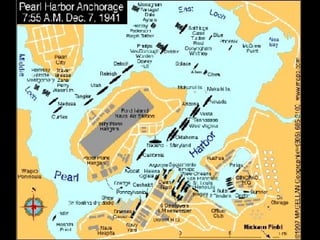
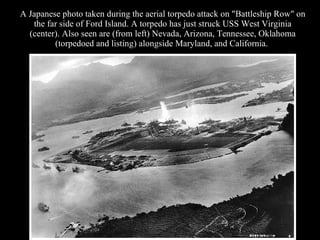
A Japanese photo taken during the aerial torpedo attack on "Battleship Row" on the far side of Ford Island. A torpedo has just struck USS West Virginia (center). Also seen are (from left) Nevada, Arizona, Tennessee, Oklahoma (torpedoed and listing) alongside Maryland, and California.
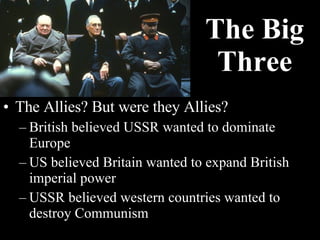
The Big Three The Allies? But were they Allies? British believed USSR wanted to dominate Europe US believed Britain wanted to expand British imperial power USSR believed western countries wanted to destroy Communism
Total War Much like WWI this war required the total commitment from the home front Rationing became standard as goods were used for war effort Mobilization for war did end the unemployment of depression
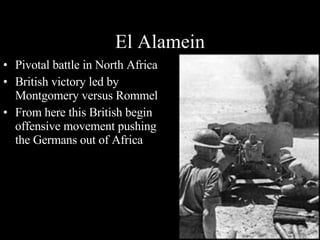
El Alamein Pivotal battle in North Africa British victory led by Montgomery versus Rommel From here this British begin offensive movement pushing the Germans out of Africa
Invasion of Italy Germans have prepared for this invasion by reinforcing Italy with their best troops Allies strike and slowly gain control of Italy Use of intelligence and counter-intelligence used Mussolini is deposed and Italy resigns from the war Germans continue to fight in Italy burn many books and museums as retribution for Italy’s betrayal
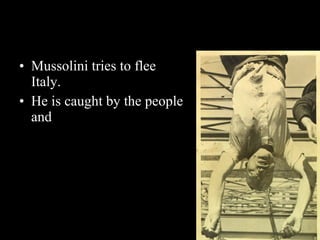
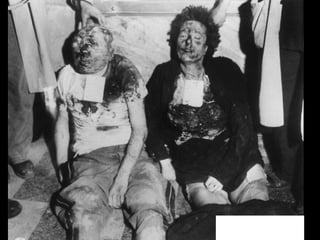
Mussolini tries to flee Italy. He is caught by the people and
 
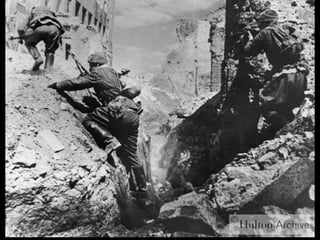
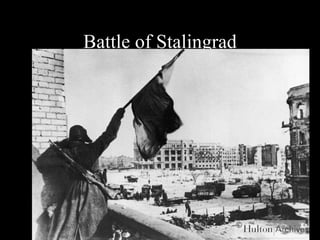
Stalingrad Having been stopped at Leningrad and Moscow, the Germans shifted their offensive southward, aiming for the rich oil fields located between the Black and Caspian. Seas. The Germans were desperate for more oil supplies  and Hitler wanted to crush the namesake of his enemy The Soviet army held its position for seven weeks of severe winter and fierce combat. After a desperate effort by the Germans failed to break the Russian hold, the German general surrendered. The Russian victory marks the end of the German offensive in Russia, and Germany begins its long retreat from the Eastern Front
 
Battle of Stalingrad
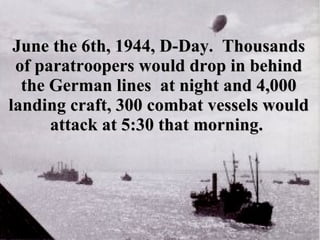
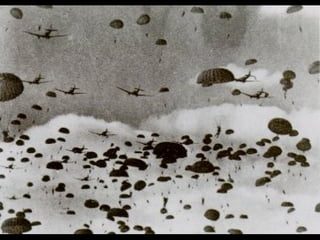
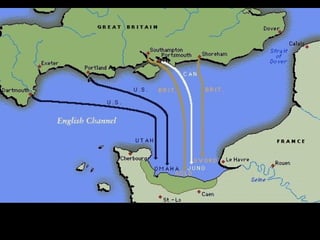
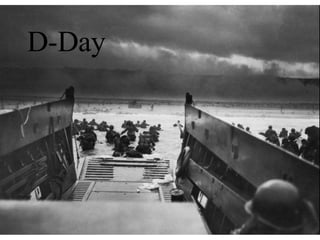
June the 6th, 1944, D-Day.  Thousands of paratroopers would drop in behind the German lines  at night and 4,000 landing craft, 300 combat vessels would attack at 5:30 that morning.
 
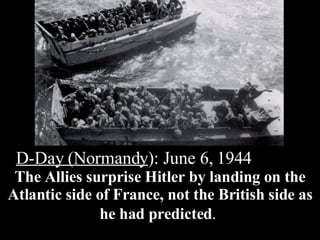
D-Day (Normandy ): June 6, 1944  The Allies surprise Hitler by landing on the Atlantic side of France, not the British side as he had predicted .
 
D-Day
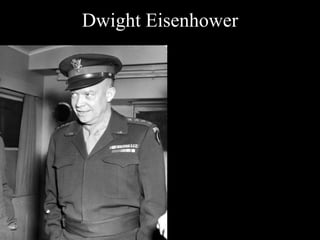
Dwight Eisenhower
 
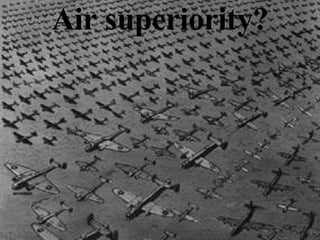
Air superiority?
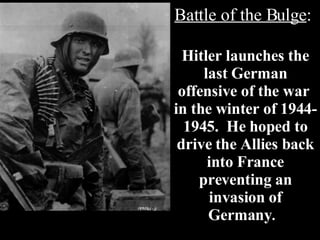
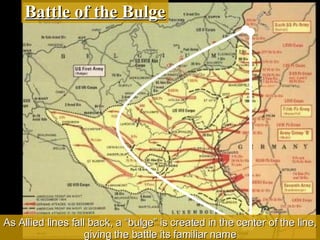
Battle of the Bulge :   Hitler launches the last German offensive of the war  in the winter of 1944-1945.  He hoped to drive the Allies back into France preventing an invasion of Germany .
Battle of the Bulge As Allied lines fall back, a “bulge” is created in the center of the line, giving the battle its familiar name
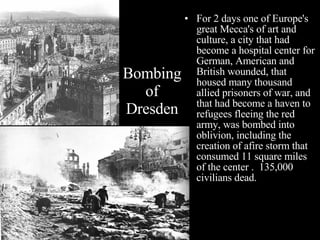
For 2 days one of Europe's great Mecca's of art and culture, a city that had become a hospital center for German, American and British wounded, that housed many thousand allied prisoners of war, and that had become a haven to refugees fleeing the red army, was bombed into oblivion, including the  creation of afire storm that consumed 11 square miles of the center .  135,000 civilians dead. Bombing of Dresden
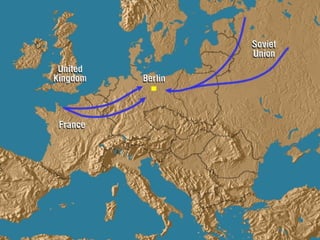
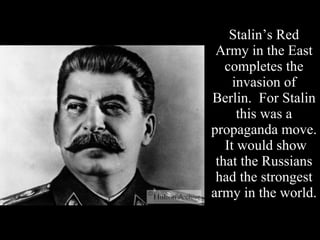
Stalin’s Red Army in the East completes the invasion of Berlin.  For Stalin this was a propaganda move.  It would show that the Russians had the strongest army in the world.
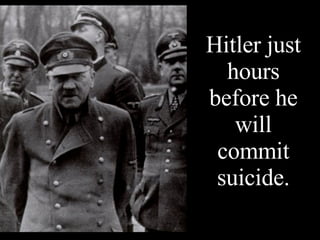
Hitler just hours before he will commit suicide.
 
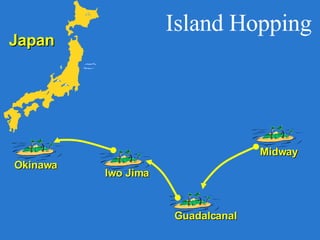
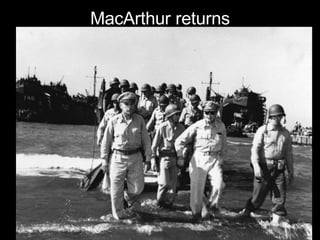
End of the war in Japan Pacific theater; very different from Europe Fought on sea, in air, islands, and jungles MacArthur (US General) forced to give up US controlled Philippines but promises to return “ I shall return”  Battle of Midway signifies the extent of Japanese control and beginning of Allied offensive Japan loses 4 aircraft carriers – most important weapon in naval warfare Islands need to be re-conquered 1 by 1; known as “island hoping”… not all were to be taken, just enough to make stepping stones to Japan
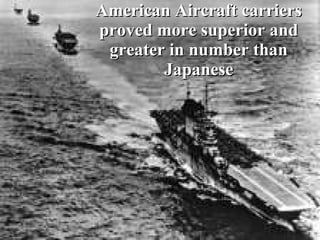
American Aircraft carriers proved more superior and greater in number than Japanese
Island Hopping Midway Guadalcanal Iwo Jima Okinawa Japan
Taking of islands became costly for all sides Iwo Jima & Okinawa proved the Japanese would choose to fight to the death rather than surrender Philippines were taken back after 3 years
MacArthur returns
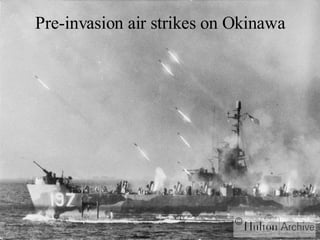
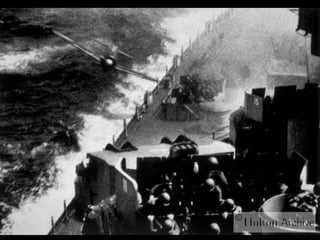
Towards the end of the war Japan attempts to prevent an invasion of Japan itself at Okinawa  Suicide “Kamikaze” missions become a constant threat to Allied ships are first used here Reference to their glorious past; assistance by gods (divine wind) when all seemed lost against the Chinese
Pre-invasion air strikes on Okinawa
Battle of Okinawa Last major campaign of the Pacific War  More people died during the Battle of Okinawa than all those killed during the atomic bombings of Hiroshima and Nagasaki.  The battle of Okinawa proved to be the bloodiest battle of the Pacific War  34 allied ships sunk, mostly by kamikazes, and 368 ships and craft damaged. The fleet had lost 763 aircraft. Total American casualties in the operation numbered over 12,000 killed  Japanese human losses were enormous: 107,539 soldiers killed and 23,764 sealed in caves or buried by the Japanese themselves  Japanese lost 7,830 aircraft and 16 combat ships
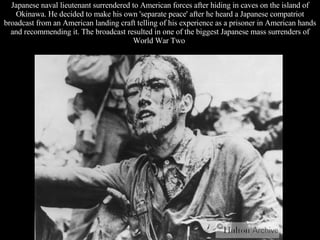
Japanese naval lieutenant surrendered to American forces after hiding in caves on the island of Okinawa. He decided to make his own 'separate peace' after he heard a Japanese compatriot broadcast from an American landing craft telling of his experience as a prisoner in American hands and recommending it. The broadcast resulted in one of the biggest Japanese mass surrenders of World War Two
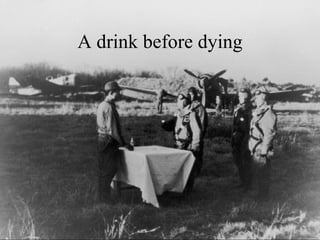
A drink before dying
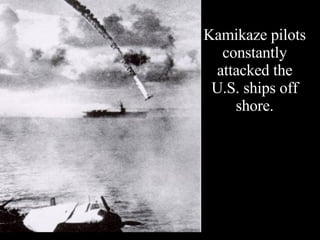
Kamikaze pilots constantly attacked the U.S. ships off shore.
 
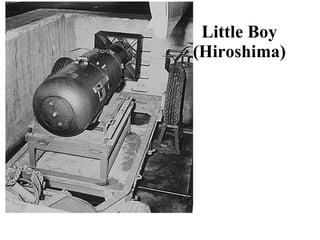
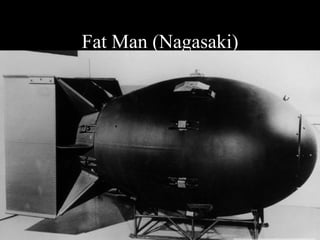
Invasion vs. the Bomb Reasons for: Save lives? US believed Japan would fight to the end; no surrender without invasion Soldiers & Citizens were believed to take up arms Saw numbers of deaths on island campaigns (such as Okinawa – highest numbers yet) and invasion of Germany Speed? Japan’s defeat was inevitable; the bomb was believed to quicken the speed in which surrender would occur Show of force? Prove to the Russians that the US has the bomb.  The inevitable struggle for supremacy after the war was on… who would it be, the US or USSR?
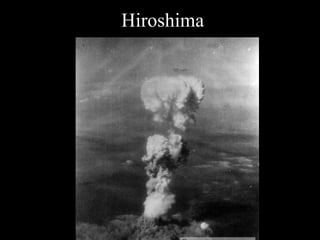
Invasion vs. the Bomb Reasons against: Hiroshima - 70,000 Nagasaki – 40,000 Civilians, women, children Huger numbers of people suffered long term effects Radiation sickness, cancer
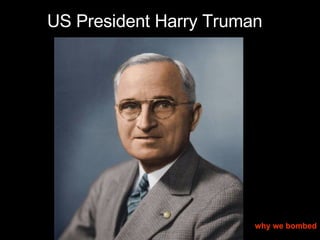
US President Harry Truman why we bombed
Little Boy (Hiroshima)
Fat Man (Nagasaki)
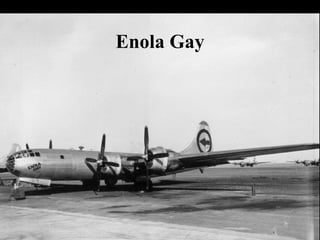
Enola Gay
Hiroshima
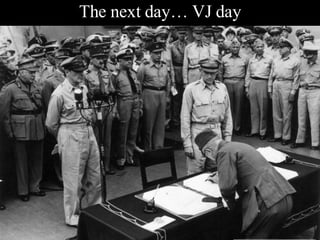
The next day… VJ day
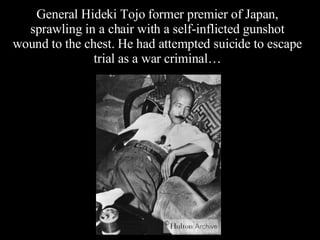
General Hideki Tojo former premier of Japan, sprawling in a chair with a self-inflicted gunshot wound to the chest. He had attempted suicide to escape trial as a war criminal…
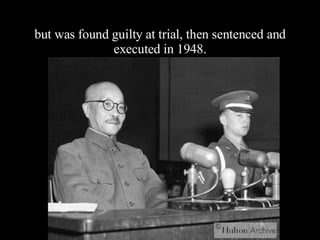
but was found guilty at trial, then sentenced and executed in 1948.
WWII Statistics Most devastating war in  History on Mankind . Lasted 6 years 1939-1945 Involved 5 of the 7 continents.  61 countries involved 1.7 billion people involved. $1,000,000,000,000 (trillion) spent
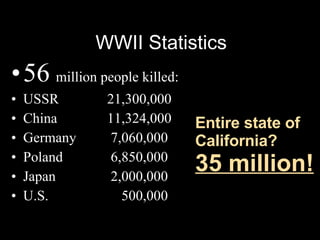
WWII Statistics 56  million people killed: USSR   21,300,000 China 11,324,000 Germany  7,060,000 Poland  6,850,000 Japan  2,000,000 U.S.   500,000 Entire state of California? 35 million!
CHINA
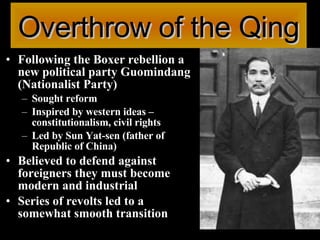
Overthrow of the Qing Following the Boxer rebellion a new political party Guomindang (Nationalist Party) Sought reform  Inspired by western ideas – constitutionalism, civil rights Led by Sun Yat-sen (father of Republic of China) Believed to defend against foreigners they must become modern and industrial Series of revolts led to a somewhat smooth transition
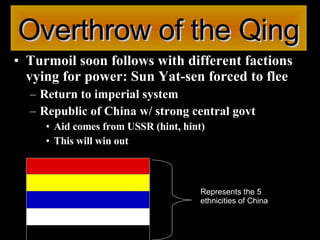
Overthrow of the Qing Turmoil soon follows with different factions vying for power: Sun Yat-sen forced to flee Return to imperial system Republic of China w/ strong central govt Aid comes from USSR (hint, hint) This will win out Represents the 5 ethnicities of China
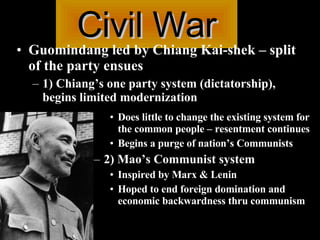
Civil War Guomindang led by Chiang Kai-shek – split of the party ensues 1) Chiang’s one party system (dictatorship), begins limited modernization Does little to change the existing system for the common people – resentment continues Begins a purge of nation’s Communists 2) Mao’s Communist system  Inspired by Marx & Lenin Hoped to end foreign domination and economic backwardness thru communism
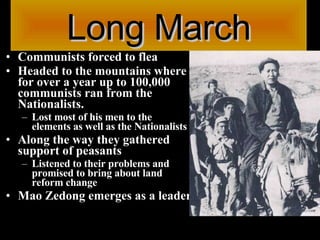
Long March Communists forced to flea  Headed to the mountains where for over a year up to 100,000 communists ran from the Nationalists.  Lost most of his men to the elements as well as the Nationalists Along the way they gathered support of peasants  Listened to their problems and promised to bring about land reform change Mao Zedong emerges as a leader
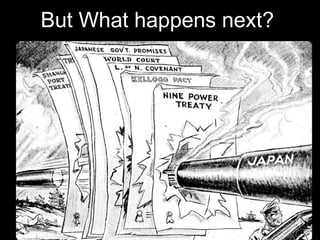
But What happens next?
 
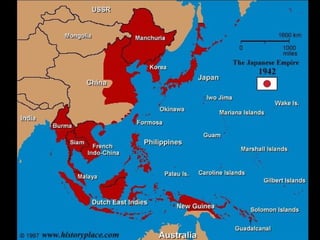
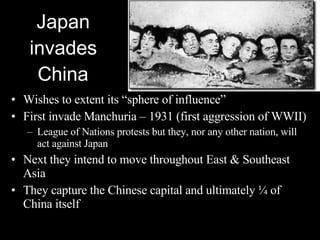
Japan invades China Wishes to extent its “sphere of influence” First invade Manchuria – 1931 (first aggression of WWII) League of Nations protests but they, nor any other nation, will act against Japan Next they intend to move throughout East & Southeast Asia They capture the Chinese capital and ultimately ¼ of China itself
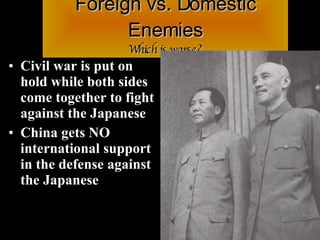
Foreign vs. Domestic Enemies Which is worse? Civil war is put on hold while both sides come together to fight against the Japanese China gets NO international support in the defense against the Japanese
All are present post WWII and lead us into the Cold War Weak Treaty of Versailles Isolationism Appeasement Nationalism Imperialism Militarism System of Alliances

Between the Wars & WWII

  • 1.
    Between the Warsset the stage for WWII Kellog-Briand Pact Weak treaty that had no enforcement Because it appeared something was being done, others did not initiate new actions Simply countries stating that they support peace Balfour Declaration Lord Balfour stating their should be a Jewish state (support of Zionism in 1917) Red Scare Lenin’s new communism which encouraged spread of the revolution created a reaction which supported suspension of democratic ideals Economic Distress The retribution of the Treaty of Versailles created attitudes which supported nationalism ( Lebenshraum )
  • 2.
    Casualties of WorldWar I Deaths in Battle Wounded  in Battle Allies France 1,357,800 4,266,000 British empire 908,371 2,090,212 Russia 1,700,000 4,950,000 Italy 462,391 953,886 United States 50,585 205,690 Others 502,421 342,585 Totals Central Powers Germany 1,808,546 4,247,143 Austria-Hungary 922,500 3,620,000 Ottoman empire 325,000 400,000 Totals
  • 3.
    More dead andwounded than any other conflict EVER Millions became refugees and immigrated (US closes doors) Pandemic flu kills about 30 million Serious damage to environment Focus of damage in Western Europe Farmland Electrical wires Telephone wires Barns Means of production interrupted Physical Impact of the War
  • 4.
    World War Ideaths Allies Central Powers
  • 5.
  • 6.
    Germany and Austriaare held responsible although Ottomans destroyed as well Treaty of Sèvres Ottomans get out of war by Armistice in October 1918 and peace treaty is negotiated at Paris Peace conference Mandates of French and British French – Lebanon and Syria British – (Jordan, Israel and West Bank) – Palestine, Iraq Kurdistan was created but Kurds could not agree Clause 231 in Treaty of Versailles " The Allied and Associated Governments affirm and Germany accepts the responsibility of Germany and her allies for causing all the loss and damage to which the Allied and Associated Governments and their nationals have been subjected as a consequence of the war imposed upon them by the aggression of Germany and her allies.
  • 7.
  • 8.
    “ Germans drivenfrom the fury of despair into the arms of the devil” Unemployment Throughout Europe 30% Germany, 25% Birth control clinics to restrict population as unemployment rose Immigration restrictions Isolation Easter Rebellion Ireland
  • 9.
    Age of AnxietyUnited States avoided the economic strain until 1929 American businessmen had profited in the late entry of the US to WWI Mass consumerism Disillusionment and confusion was apparent in writings of Lost Generation Disconnected Cubists such as Picasso Women’s roles began to change They had kept the economies going during the war Suffrage The Chinese and Soviet Union were not as effected by the Depression and the Age of Anxiety European inflation and political upheavals created an environment of uncertainty Less confidence that technology could solve the present problems New Mediums to spread information engendered new propaganda techniques Radio Movies and film companies
  • 10.
    Social Shifts ofthe Pendulum Pre WWI Post WWI
  • 11.
  • 12.
    During War Governmentscontrolled some sectors of the economy Used newspapers to distribute information and control information Use of propaganda increased between the wars
  • 13.
    Union of SovietSocialist Republics Flag was the sickle and hammer Sickle stands for the farmer Hammer stands for the working class These 2 made up the common people Countries goal was to move into a world power Accomplished this by changing both of these things… Made farms communal Created a command ( govt in charge ) economy
  • 14.
    Analyze This! Doyou speak Cyrillic (Russian) Don’t need to… what is this trying to say?
  • 15.
    Vladimir Lenin Russianrevolutionary, the leader of the Bolshevik party, the first Premier of the Soviet Union, and the founder of the ideology of Communism in Russia.
  • 16.
    Lenin’s policies Createsthe NEP (New Economic Policy) which had some capitalistic aspects such as allowing farmers to sell portions of their grain for their own profit (this sure does NOT sound like socialism!) This was successful in agriculture Lenin becomes ill and is not able to pursue this policy to other sectors of the Soviet economy… a successor will be in charge of this… but who could it be?
  • 17.
    Stalin and TrotskyStalin and Trotsky were two of Lenin’s chief advisors; both jockey to be Lenin’s successor Trotsky was favored by many, including Lenin. However, Stalin moved more quickly to consolidate his power in the Central Committee. Trotsky criticized Stalin’s violation of democracy in the party and the failure to develop adequate economic planning.
  • 18.
    Leon Trotsky Trotskywas known as a brilliant intellectual. Trotsky vainly professed his belief in the omnipotence of the party. His supporters stressed the themes of party democracy and economic planning, condemned the leadership's concessions to bourgeois elements, and denounced Stalin's theory of “Socialism in one country” as a pretext for abandoning world revolution. Trotsky = World wide Communist revolution Stalin = Focus on modernizing USSR Stalin was popular with the people and his views that it would not take a global communists state for communism to succeed in the Soviet Union
  • 19.
    “ I suggestthe comrades think about a way of removing Stalin from that post and appointing another man in his stead who in all other respects differs from Comrade Stalin in having only one advantage, namely, that of being more tolerant, more loyal, more polite, and more considerate to the comrades.” Vladimir Lenin
  • 20.
    Lenin is dying,and talking things over with Stalin, his successor. "The one worry I have," says Lenin, "is this: will the people follow you? What do you think, comrade Stalin?" "They will," says Stalin, "they surely will." "I hope so," says Lenin, "but what if they don't follow you?" "No problem," says Stalin, "then they'll follow you." But Lenin will die soon after the revolution
  • 21.
    Lenin’s Premature DeathSeries of 4 strokes over 2 years Dies at the age of 54 His death leaves the issue of a successor at the forefront of the Communist party and creates the cult-like following and adoration of Lenin as the Great Father of Russia – even today as you can see above… What should be done with his body now?
  • 22.
    The party, leadby Stalin, opposed Trotskyism to Leninism, accusation of differences were vague and denigrated Trotsky's role in the Revolution. Trotsky was expelled from the party in 1926 Then exiled from the USSR. He was represented as the principal conspirator in the treason trials of former Communist opposition leaders. The evidence of treasonable plotting, however, was later proven to be fictitious. Trotsky flees to Latin America (region ripe for Socialist ideas)
  • 23.
    Stalin sent agentsof the Soviet secret police to Mexico where Trotsky was living in 1940. They put an axe into Trotsky's brain while he was sitting at a table writing. Stalin denied any responsibility
  • 24.
    Joseph Stalin Stalinnot his real name… means “Man of Steel” But he was far from Superman in his “Heroic Deeds” 2 Main Goals Fear of another invasion Increase USSR as a world power
  • 25.
    Propaganda Use ofbiased or incomplete information to sway people’s beliefs
  • 26.
    Soviet Propaganda Workersand peasants were taught the ideals of communism through: NEWS : The Communist Party line media is the only media after revolution of 1917 Only one newspaper censored by the State is allowed ART : Socialist Realism – Artistic style that praised communist values Movies : Cinema is Lenin & Stalin’s priority device as a Communist weapon, used to “hide” ideology in entertainment Trials began for "enemies of the state," all guilty, all executed, terror reigns Rewrites history books, suddenly Soviet Union had invented everything Not only does an “enemy” die but the have a sort of “Second Death”… Stalin orders the remaking of photos to remove them completely from the past
  • 27.
    News Pravda starts as an underground revolutionary Bolshevik newspaper. After the revolution, it becomes the official newspaper for the Communist Party. Its name stands for the word "truth."
  • 28.
    Propaganda vs. CensorshipPropaganda can be even worse than censorship. Censors keep facts from the public; propagandists twist facts into lies. Under a state-controlled press system, the government can order newspaper editors to print stories the editors know are not true. Early on, Russian revolutionary leaders realize they can force newspapers to print only the simple concepts, slogans and ideas of Bolshevism
  • 29.
    Socialist Realism Theideology enforced by the Soviet state as the official standard for art, literature etc It was based on the principle that the arts should glorify political and social ideals of communism. Every artist had to join the "Union of Soviet Artists", which was controlled by the state. The paintings had to be idealizations of political leaders and communistic ideas.
  • 30.
    Lenin and Stalinin Summer 1917
  • 31.
  • 32.
  • 33.
    The End (The last Hours in Hitler's Bunker)
  • 34.
  • 35.
    Not without certainirony, Nikolai Yezhov, the young man strolling with Stalin, is shot in 1940. It seems only fitting that when Yezhov is removed from the photograph he is replaced by the waters of the Moscow-Volga Canal. Yezhov was commissar of water transport.
  • 36.
  • 37.
    Propagandists seize everyopportunity to get their message across. In the original of this photo, the sign on the building says, "Watches, gold and silver." Now it reads, "Struggle for your rights." Likewise the flag being waved says, "Down with the monarchy - long live the Republic!" has no visible words in the original.
  • 38.
    Lenin and Trotskycelebrate the second anniversary of the Russian Revolution in Red Square.
  • 39.
    Lenin Celebrates, butTrotsky has been airbrushed out. Trotsky and Lenin (top center of stairs) in 1919 photograph of a Red Square celebration is of the anniversary of the revolution. To make it suitable for a 1967 book of Lenin Photos, Trotsky is removed.
  • 40.
    Trotsky, left, reads Pravda , the Bolshevik newspaper he once edited. In 1925, Stalin ousts Trotsky as commissar of war. At right, a citizen has scratched Trotsky's picture from his own history book, as part of the citizen's "personal responsibility" to support the Communist Party.
  • 41.
    Soviet Propaganda Stalintakes “Cult of Personality” to extremes Derogatory term for what is perceived to be excessive adulation of a single living leader. Stalin used his cult of personality to help crush his political opponents Stalin saw himself as the "great leader and teacher of the Soviet people." He wished the media to picture him as the true friend, comrade and successor of Lenin. If a few photos must be altered to accomplish this, so be it. Stalin achieves a completely totalitarian state Every facet of life lined with party information Toddlers and schoolchildren already brainwashed Pre-teens and teenagers become "Pioneers" and were influenced as well Families feared even talking to each other for fear of being announced as an "enemy" Stalin cares for each one of us
  • 42.
    Father to thepeople Stalin holding a young Soviet citizen, Gelya Markizova, aged 6, in 1935. Soon afterwards Stalin had her father shot for allegedly plotting against him and then had her mother murdered. This did not stop this particular touching scene becoming a party banner
  • 43.
    Its All AboutStalin! Appeared as a god-like omniscient ruler, destined to rule the nation for all eternity. Government orders prescribed the hanging of his portrait in every home and public building, and many artists and poets were instructed to only produce works that glorified the leader. To justify this level of worship, Stalin tried to present himself as personally humble and modest, and would often characterize this vast personality cults as nothing more than a spontaneous show of affection by his people (Mao in China will copy much of this) Cities named after Stalin Oraşul Stalin , 1951-1961 — Romania Qyteti Stalin , 1950-1990 — Albania Stalin , 1949-1956 — Bulgaria Stalinabad , 1929-1961 — Tajikistan Stalingrad , 1925-1961 — Russia Stalingrad —, Czech Republic Staliniri , 1934-1961 — Georgia Stalino , 1924-1961 — Ukraine Stalinogorsk , 1934-1961 — Russia Stalinogród , 1953-1956 — Poland Stalinsk , 1932-1961 — Russia Stalinstadt , 1953-1961 — East Germany Sztálinváros , 1951-1961 — Hungary
  • 44.
  • 45.
    Stalin takes controlof the economy Called for a command economy – system which the government makes all economic decisions Political leaders identify economic needs and determine how to fulfill them Creates a Five Year Plan (two of them in fact) in order to create a goal for the nation to strive towards. Felt the NEP was too slow Five year plan set unrealistically high goals – consumer production had to be limited to try to teach these goals, causing widespread shortages of foot, housing, clothes, etc Government controlled all aspects of people’s lives – chose jobs, assigned hours, needed permission of the police to move Those who did not cooperate could be executed or sent to the gulags
  • 46.
    Agricultural Revolution? 1928– 25 Million privately owned farms seized Combined into government owned collective farms Were told what to plant, when, etc Strong resistance from peasants – especially kulaks – class of wealthy peasants 1938 – 90% of peasants lived on collectives 5-10 million dead – mostly from a lack of food
  • 47.
    Stalin’s policies ofthe Five Year plans and the Collective farms appeared to be successful from outside but failed: People realized that no matter how hard they worked they would all benefit the same Response from people is fearful yet willing to work. High govt quotas often impossible to achieve so many lie to avoid punishment = lack of reliable numbers 'Produce More' propaganda poster urges Soviet citizens to produce more steel 'So That We Shall Become Stronger'. The production target for the fulfillment of the Five Year Plan ending in 1950 is central in the image.
  • 48.
    Weapons of Totalitarianism Police terror – destroyed enemies of Stalin Monitored telephone lines, read mail, planted informants Many children told on parents for “disloyal” comments Great Purge – term used to describe the systematic killed of many enemies of the state such as: Bolshevik party members who helped in the Revolution of 1917 (free thinkers) Kulaks: wealthy peasants who deliberately destroyed fields rather than have them taken by the state
  • 49.
    How Many WereKilled by Stalin? famines, prison and labor camp mortality, and state terrorism (deportations and political purges) are taken into account, Stalin and his colleagues were directly or indirectly responsible for the deaths of millions. How many millions died under Stalin is greatly disputed. Although no official figures have been released by the Soviet or Russian governments, most estimates put the figure between 8 and 20 million "The death of one man is a tragedy. The death of millions is a statistic."
  • 50.
    Depression Collapse ofthe US Stock Market in 1929 will have a global effect – a chain reaction US banks will call in loans from Germany and Austria who need cash to pay their reparations to Britain & France, who then could not repay their war loans to the US (WWI cost $150 Billion). US and then other countries try to protect themselves by putting huge tariffs on imports, thus world trade declines by 62% from 1929-1932. Industrial Nations – France and Britain escaped the worst of it by forcing their colonies to purchase their goods. Japan & Germany suffer more because they rely on exports to pay for essentials Political repercussions: radical ideas & leaders are given support Non-Industrial Nations – Affects regions unevenly. India & China little affected since they did not rely on foreign trade. Latin America hard hit since they depended on exports and tourism Children using notes of money as building blocks during the 1923 German inflation crisis
  • 51.
    Italy Post warissues: Feeling of national shame and humiliation stemming from its 'mutilated victory' at the hands of the World War I peace treaties World Wide Depression hits Rise of Nationalism (still relatively “NEW” in terms of nation-hood) and lacks colonies Fear of communism and capitalists Fascism emerged as a "third way"
  • 52.
    What is Fascism?Bundle of rods in ancient Rome, symbol, of the life-and-death power of the state - when bound together, were stronger than when they were apart new political and economic system that combined totalitarianism and nationalism, a state designed to bind all classes together under a capitalist system, but a new capitalist system in which the state seized control of the organization of vital industries Although it’s a “third way” it takes aspects of both
  • 53.
    Rise of FascismAspects of Fascism: Extreme nationalism Nations must struggle – conquer, Authoritarian leader Rallies, uniforms etc A rejection of representative government and a long for a mythical past How does this cartoon and the name itself reflect this?
  • 54.
    Named after Mexicanrevolutionary Benito Juárez Mussolini became a passionate nationalist and used "iron fist" techniques to achieve his political goals. Established nearly a decade before Adolf Hitler's rise to power, would provide a model for Hitler's later economic and political policies Benito Mussolini
  • 55.
    Totalitarianism The termwhich will applied to other regimes in the 20 th century will be coined by Mussolini State controls nearly every aspect of the individual's life. Totalitarian governments do not tolerate activities by individuals or groups such as labor unions that are not directed by the state's goals. Totalitarian regimes maintain themselves in power through secret police, propaganda disseminated through the media, the elimination of open criticism of the regime, and use of terror tactics. Internal and external threats are created to foster unity through fear. He creates the legend of Il duce , a man who never slept, was always right, and could solve all the problems of politics and economics. Mussolini personally took over the ministries of the interior, of foreign affairs, of the colonies, of the corporations, of the army and the other armed services, and of public works. Sometimes he held as many as seven departments simultaneously, as well as the premiership. He was also head of the all-powerful Fascist party and the armed local Fascist militia, or Blackshirts that terrorized incipient resistances in the cities and provinces
  • 56.
    Desire to bea world power would push Italy in which direction? Industry Military Colonies
  • 57.
    Italy on themove Italy invades Ethiopia Desire to join the imperialism race Response by European powers? None besides sanctions which have no power to be enforced by the Treaty of Versailles
  • 58.
    Rise of theNazis Germany had been hard hit by its defeat in WW1 & results of the depression Hitler was strongly affected by these and led a group of radicals known as the Nazi party As the depression hits it allows the Nazis to gain more support from the masses due their disillusionment of the existing system
  • 59.
    Hitler’s Rise toPower Attempts an overthrow of govt – fails but teaches him to gain power thru legal channels Is able to blame the democratic govt, Wiemar Republic Unlike Communists he played appealed the middle & wealthy class (these strongly opposed Communism) So, he offers a NEW form of govt Copies much of Mussolini’s tactics i.e. reinstate a glorious past – Creates the Third Reich (Empire) Uses deep rooted anti-Semitism (ties with Soc Darwin ‘Aryan race’) His racist ideas were used as a way to blame the Jews as well as socialists and foreigners, for all of Germany’s problems
  • 60.
    Nazi policies Economicand social policies were quite effective Public works projects Military build up (in violation of Treaty of Versailles) Encourages women to leave work, lowering unemployment and rising living standards Along with these apparent success Hitler and Mussolini limit the freedoms of individuals in their country
  • 61.
    Hitler’s popularity camein large part from the German people’s belief that economic well-being outweighed a loss of liberty Hitler’s Popularity
  • 62.
    Played on nationalpride to be a world power again (rallies) pushes forth desire for “living space” (Lebensraum). Unify German speaking peoples (remember, Nationalism can be a unifying OR dividing force.)
  • 63.
    National Pride Hitler began a youth movement Preached propaganda to the youth How young did he start?
  • 64.
  • 65.
    Nationalism This wasa driving force in the 19 th and 20 th centuries but it was quite different in Europe and Japan than in its colonies In Europe and Japan it fueled extreme racism, fascism, and domination. Becomes synonymous with national expansion and conquest of other peoples In the colonies it meant self-determination, the ability to free the nation from rule by another and determine one’s own destiny. National pride = National sovereignty
  • 66.
    The Rome-Berlin-Tokyo Axisis created Joined together as western democracies appeared weak to fight Soviet communism and not to interfere with one another’s expansion
  • 67.
    The world wouldrevolve around the “axis” of these countries Looking at the cartoon which country portrayed the most influential of the 3? How can you tell?
  • 68.
    How does thisreflect the nationalist policies of these three countries?
  • 69.
    Road to WarAs we have seen: Japan invades China Leads to the Sino-Japanese war Italy Invades Ethiopia Now what about Germany???
  • 70.
    Spanish Civil War:Test run for new weapons Italy & German aid (The fascist military general) in Spain during their civil war No defense from Britain or France Brings Franco to power Opportunity to test new types of weapons – Blitzkrieg This new type of war very different from WWI Trench warfare Long periods of relative inaction Followed by sharp thrusts of great power
  • 71.
    Guernica On April27th, 1937, unprecedented atrocities are perpetrated on behalf of Franco against the civilian population of a little Basque village in northern Spain. Chosen for bombing practice by Hitler's burgeoning war machine, the hamlet is pounded with high-explosive and incendiary bombs for over three hours. Townspeople are cut down as they run from the crumbling buildings. Guernica burns for three days. 1,600 civilians are killed or wounded. It is modern art's most powerful antiwar statement... What was the most powerful antiwar novel to this date?
  • 72.
    Guernica Guernica challenges our notions of warfare as heroic and exposes it as a brutal act of self-destruction. Guernica remains ambiguous. When asked to explain his symbolism, Picasso remarked, "It isn't up to the painter to define the symbols. Otherwise it would be better if he wrote them out in so many words! The public who look at the picture must interpret the symbols as they understand them
  • 73.
    But Hitler wasamassing his troops. Preparing his new lightning war “Blitzkrieg”
  • 74.
    How will WesternDemocracies react to German massive military build up – violation of Treaty of Versailles German advance into de-militarized zone in the Rhineland between France & Germany Invasion of Austria next eyes Czechoslovakia Remember the response to Italy’s aggression?
  • 75.
    Policy of AppeasementLead by Britain – Neville Chamberlain Gives into German expansion; Why: Fear of another war Felt Germany was unfairly treated by Treaty of Versailles Saw Germany as a check on Communism Still reeling from Great Depression
  • 76.
    Had Hitler agreeto a promise of no further military action – believed him to be a man of honor “Peace in our time”
  • 77.
    Which of thosereasons for appeasement does this best illustrate?
  • 78.
    For Hitler itmeant that Russia would not stand in the way of his planned invasion of Poland. And if war should result, he would not have to fight on two fronts. For Stalin, the pact protected his country, at least temporarily from German invasion Not so… Nazi – Soviet Pact ? POLAND Who’s lying between them?
  • 79.
  • 80.
    Synopsis Fought on2 fronts Immediate Allied fear of a British & Soviet loss to the Germans focused the war effort to Europe Allied plan: Control sea lanes – shipping of goods Emphasis on air power Supply Soviets on Eastern Front China forced to defend against Japan alone US forced to defend Philippines alone
  • 81.
    The world from1936 on was divided into 3 major blocs: the Axis powers of Germany, Italy and Japan; the major capitalist democracies headed by Britain, France and the US; and the huge Communist-led Soviet Union, shunned by all the rest
  • 82.
    Anti-communist Deplored fascismbut saw Communism as a bigger threat Pledged in theory to overthrow capitalism everywhere
  • 83.
    Winston Churchill Replacesthe disgraced Chamberlain as British Prime minister
  • 84.
    Axis Advances Blitzkriegstrikes France in 1940 – fighting lasts only 6 weeks As France is about to fall, over 300,000 troops are ferried to safety from Dunkirk to Britain France forced to surrender to Germany. Sign treaty which creates a puppet “Vichy Regime” Hitler avenges the Treaty of Versailles & WWI
  • 85.
    Very different warthen WWI… Offensive in nature as opposed to the defensive trench warfare earlier – Germans were best equipped and ready for war Offensive approach came about as technology of war improved Aircraft – bombers & fighters Tanks Aircraft carriers Speed of movement across the globe Little can stop or even slow Hitler in Europe Excelled in land warfare
  • 86.
  • 87.
    Troops waiting toevacuate! Their backs to the sea, British & French troops line up to run away from the Nazis. Every able ship in Britain tries to cross the channel to assist. Heroic event in the eyes of the Allies
  • 88.
    During the earlypart of the war, Britain was going through what was known as "The Phony War“ (months of preparing and waiting for war). But it was not until a fleet of boats and ships began to arrive at Dover from Dunkirk with thousands of battle torn and weary troops that had been defeated on the northern European mainland, that the war really struck home.
  • 89.
    France Invaded Francesurrenders in six weeks, June, 1940, and a pro- Nazi government (Vichy) is set up to control France.
  • 90.
    France forced tosurrender in the exact train car in which Germany signed WWI armistice.
  • 91.
  • 92.
  • 93.
    French General andVichy leader Philippe Petain (1856 - 1951) shaking hands with Adolf Hitler (1889 - 1945) after the fall of France.
  • 94.
  • 95.
    Battle of BritainBritain was now the lone democratic nation in Western Europe German Luftwaffe begins bombing southern cities RAF is only the defense New device: Radar allows them to know of Germans attacks Churchill and the British defend themselves and boost morale Germany fails; one of his costliest mistakes, loses much of the Luftwaffe Compounds one mistake with another: attacking the USSR!
  • 96.
  • 97.
    The Luftwaffe flyinglow over a city.
  • 98.
    A formation ofLuftwaffe Junkers Ju87D Stuka dive-bombers in the air.
  • 99.
    The Battle ofBritain : 1940 - 1942, totally fought in the air. The Luftwaffe’s plan was to pound England out of the war. It failed .
  • 100.
  • 101.
  • 102.
  • 103.
  • 104.
  • 105.
    An area nearSt Pancras Station in London showing the damage caused by a German air raid during the London blitz in WW II.
  • 106.
    British citizens takeshelter in the subway tunnels under London during the Blitz phase of the Battle of Britain, in which London was bombed every night for eleven weeks straight, England.
  • 107.
    St Paul's cathedralstanding above the surrounding burning buildings during the London blitz.
  • 108.
    St Paul's Cathedralafter a direct hit during the blitz in London.
  • 109.
    Searchlights over StPaul's Cathedral during The Blitz.
  • 110.
    Anti Aircraft gunsin action in Hyde Park, London.
  • 111.
    The City ofLondon with the dome of St Paul's Cathedral in the centre, showing damage caused by air-raids in World War II.
  • 112.
  • 113.
    Victory Battle ofBritain – failure for the Germans Larger Air force but not as sophisticated intelligence system… British excel at this
  • 114.
  • 115.
    Operation Barbarossa Hitler’srenounces pact in order to gain the resources of Russia and to destroy communism Catches Stalin unprepared Advances up to Leningrad and Moscow Russians defend these cities USSR turns to Britain for help – two ally themselves What is the opinion of this cartoonist of Hitler’s decision to invade Russia? Who is the cartoonist? Will the bear be in a box? Will he next go after the fox?
  • 116.
  • 117.
    Should the USget involved?
  • 118.
  • 119.
    FDR – arsenalof democracy
  • 120.
    Lend- Lease Act: Gave Roosevelt the ability to legally help U.S. Allies with weapons and supplies without declaring war.
  • 121.
  • 122.
    The Atlantic CharterThis meeting took place in August of 1941 and set the goals for the war such as destroying Nazi tyranny and creating a permanent system of security for all nations to choose their form of govt What is “interesting” about this date?
  • 123.
    The Atlantic Charter , a joint proclamation by the United States and Britain declaring that they were fighting the Axis powers to "ensure life, liberty, independence and religious freedom and to preserve the rights of man and justice." The Atlantic Charter served as a foundation stone for the later establishment of the United Nations , setting forth several principles for the nations of the world, including -- the renunciation of all aggression, right to self- government , access to raw materials, freedom from want and fear, freedom of the seas, and disarmament of aggressor nations. Churchill Roosevelt
  • 124.
    But what aboutthe Pacific? As Japan continues expanding its sphere of influence in East Asia, it will soon see the US as a threat to its expansion.
  • 125.
    Japanese General andPrime Minister Hideki Tojo (1885 - 1948). Japanese military leaders embarked on a dual policy of tightening control at home while engaging in a series of imperialist conquests abroad
  • 126.
    The United Statesrefused to trade raw materials to Japan because of its attacks on China and South Asia. So………….
  • 127.
  • 128.
  • 129.
    A Japanese phototaken during the aerial torpedo attack on "Battleship Row" on the far side of Ford Island. A torpedo has just struck USS West Virginia (center). Also seen are (from left) Nevada, Arizona, Tennessee, Oklahoma (torpedoed and listing) alongside Maryland, and California.
  • 130.
    The Big ThreeThe Allies? But were they Allies? British believed USSR wanted to dominate Europe US believed Britain wanted to expand British imperial power USSR believed western countries wanted to destroy Communism
  • 131.
    Total War Muchlike WWI this war required the total commitment from the home front Rationing became standard as goods were used for war effort Mobilization for war did end the unemployment of depression
  • 132.
    El Alamein Pivotalbattle in North Africa British victory led by Montgomery versus Rommel From here this British begin offensive movement pushing the Germans out of Africa
  • 133.
    Invasion of ItalyGermans have prepared for this invasion by reinforcing Italy with their best troops Allies strike and slowly gain control of Italy Use of intelligence and counter-intelligence used Mussolini is deposed and Italy resigns from the war Germans continue to fight in Italy burn many books and museums as retribution for Italy’s betrayal
  • 134.
    Mussolini tries toflee Italy. He is caught by the people and
  • 135.
  • 136.
    Stalingrad Having beenstopped at Leningrad and Moscow, the Germans shifted their offensive southward, aiming for the rich oil fields located between the Black and Caspian. Seas. The Germans were desperate for more oil supplies and Hitler wanted to crush the namesake of his enemy The Soviet army held its position for seven weeks of severe winter and fierce combat. After a desperate effort by the Germans failed to break the Russian hold, the German general surrendered. The Russian victory marks the end of the German offensive in Russia, and Germany begins its long retreat from the Eastern Front
  • 137.
  • 138.
  • 139.
    June the 6th,1944, D-Day. Thousands of paratroopers would drop in behind the German lines at night and 4,000 landing craft, 300 combat vessels would attack at 5:30 that morning.
  • 140.
  • 141.
    D-Day (Normandy ):June 6, 1944 The Allies surprise Hitler by landing on the Atlantic side of France, not the British side as he had predicted .
  • 142.
  • 143.
  • 144.
  • 145.
  • 146.
  • 147.
    Battle of theBulge : Hitler launches the last German offensive of the war in the winter of 1944-1945. He hoped to drive the Allies back into France preventing an invasion of Germany .
  • 148.
    Battle of theBulge As Allied lines fall back, a “bulge” is created in the center of the line, giving the battle its familiar name
  • 149.
    For 2 daysone of Europe's great Mecca's of art and culture, a city that had become a hospital center for German, American and British wounded, that housed many thousand allied prisoners of war, and that had become a haven to refugees fleeing the red army, was bombed into oblivion, including the creation of afire storm that consumed 11 square miles of the center . 135,000 civilians dead. Bombing of Dresden
  • 150.
    Stalin’s Red Armyin the East completes the invasion of Berlin. For Stalin this was a propaganda move. It would show that the Russians had the strongest army in the world.
  • 151.
    Hitler just hoursbefore he will commit suicide.
  • 152.
  • 153.
    End of thewar in Japan Pacific theater; very different from Europe Fought on sea, in air, islands, and jungles MacArthur (US General) forced to give up US controlled Philippines but promises to return “ I shall return” Battle of Midway signifies the extent of Japanese control and beginning of Allied offensive Japan loses 4 aircraft carriers – most important weapon in naval warfare Islands need to be re-conquered 1 by 1; known as “island hoping”… not all were to be taken, just enough to make stepping stones to Japan
  • 154.
    American Aircraft carriersproved more superior and greater in number than Japanese
  • 155.
    Island Hopping MidwayGuadalcanal Iwo Jima Okinawa Japan
  • 156.
    Taking of islandsbecame costly for all sides Iwo Jima & Okinawa proved the Japanese would choose to fight to the death rather than surrender Philippines were taken back after 3 years
  • 157.
  • 158.
    Towards the endof the war Japan attempts to prevent an invasion of Japan itself at Okinawa Suicide “Kamikaze” missions become a constant threat to Allied ships are first used here Reference to their glorious past; assistance by gods (divine wind) when all seemed lost against the Chinese
  • 159.
  • 160.
    Battle of OkinawaLast major campaign of the Pacific War More people died during the Battle of Okinawa than all those killed during the atomic bombings of Hiroshima and Nagasaki. The battle of Okinawa proved to be the bloodiest battle of the Pacific War 34 allied ships sunk, mostly by kamikazes, and 368 ships and craft damaged. The fleet had lost 763 aircraft. Total American casualties in the operation numbered over 12,000 killed Japanese human losses were enormous: 107,539 soldiers killed and 23,764 sealed in caves or buried by the Japanese themselves Japanese lost 7,830 aircraft and 16 combat ships
  • 161.
    Japanese naval lieutenantsurrendered to American forces after hiding in caves on the island of Okinawa. He decided to make his own 'separate peace' after he heard a Japanese compatriot broadcast from an American landing craft telling of his experience as a prisoner in American hands and recommending it. The broadcast resulted in one of the biggest Japanese mass surrenders of World War Two
  • 162.
  • 163.
    Kamikaze pilots constantlyattacked the U.S. ships off shore.
  • 164.
  • 165.
    Invasion vs. theBomb Reasons for: Save lives? US believed Japan would fight to the end; no surrender without invasion Soldiers & Citizens were believed to take up arms Saw numbers of deaths on island campaigns (such as Okinawa – highest numbers yet) and invasion of Germany Speed? Japan’s defeat was inevitable; the bomb was believed to quicken the speed in which surrender would occur Show of force? Prove to the Russians that the US has the bomb. The inevitable struggle for supremacy after the war was on… who would it be, the US or USSR?
  • 166.
    Invasion vs. theBomb Reasons against: Hiroshima - 70,000 Nagasaki – 40,000 Civilians, women, children Huger numbers of people suffered long term effects Radiation sickness, cancer
  • 167.
    US President HarryTruman why we bombed
  • 168.
  • 169.
  • 170.
  • 171.
  • 172.
  • 173.
    General Hideki Tojoformer premier of Japan, sprawling in a chair with a self-inflicted gunshot wound to the chest. He had attempted suicide to escape trial as a war criminal…
  • 174.
    but was foundguilty at trial, then sentenced and executed in 1948.
  • 175.
    WWII Statistics Mostdevastating war in History on Mankind . Lasted 6 years 1939-1945 Involved 5 of the 7 continents. 61 countries involved 1.7 billion people involved. $1,000,000,000,000 (trillion) spent
  • 176.
    WWII Statistics 56 million people killed: USSR 21,300,000 China 11,324,000 Germany 7,060,000 Poland 6,850,000 Japan 2,000,000 U.S. 500,000 Entire state of California? 35 million!
  • 177.
  • 178.
    Overthrow of theQing Following the Boxer rebellion a new political party Guomindang (Nationalist Party) Sought reform Inspired by western ideas – constitutionalism, civil rights Led by Sun Yat-sen (father of Republic of China) Believed to defend against foreigners they must become modern and industrial Series of revolts led to a somewhat smooth transition
  • 179.
    Overthrow of theQing Turmoil soon follows with different factions vying for power: Sun Yat-sen forced to flee Return to imperial system Republic of China w/ strong central govt Aid comes from USSR (hint, hint) This will win out Represents the 5 ethnicities of China
  • 180.
    Civil War Guomindangled by Chiang Kai-shek – split of the party ensues 1) Chiang’s one party system (dictatorship), begins limited modernization Does little to change the existing system for the common people – resentment continues Begins a purge of nation’s Communists 2) Mao’s Communist system Inspired by Marx & Lenin Hoped to end foreign domination and economic backwardness thru communism
  • 181.
    Long March Communistsforced to flea Headed to the mountains where for over a year up to 100,000 communists ran from the Nationalists. Lost most of his men to the elements as well as the Nationalists Along the way they gathered support of peasants Listened to their problems and promised to bring about land reform change Mao Zedong emerges as a leader
  • 182.
  • 183.
  • 184.
    Japan invades ChinaWishes to extent its “sphere of influence” First invade Manchuria – 1931 (first aggression of WWII) League of Nations protests but they, nor any other nation, will act against Japan Next they intend to move throughout East & Southeast Asia They capture the Chinese capital and ultimately ¼ of China itself
  • 185.
    Foreign vs. DomesticEnemies Which is worse? Civil war is put on hold while both sides come together to fight against the Japanese China gets NO international support in the defense against the Japanese
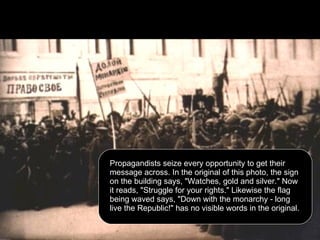
  • 186.
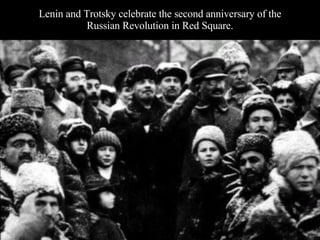
    All are presentpost WWII and lead us into the Cold War Weak Treaty of Versailles Isolationism Appeasement Nationalism Imperialism Militarism System of Alliances