BEST PRACTICE: TRANSFORMATIONAL LEADERSHIP;
BALANCED SCORECARD AND PERFORMANCE
MANAGEMENT
SUMMIT MANAGEMENT CONSULTANTS
RANDBURG TOWERS
25 FEBRUARY 2015
CHARLES COTTER
• #1: Leadership
• #2: Balanced Scorecard
• #3: Performance Management Framework
THE NATURE AND DEFINITION OF
LEADERSHIP
• Defining leadership
• The leadership process
• Transformation leadership – principles and
characteristics
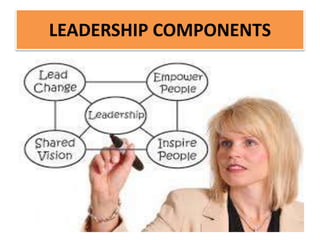
LEADERSHIP COMPONENTS
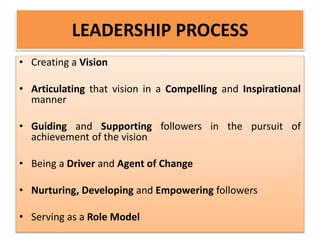
LEADERSHIP PROCESS
• Creating a Vision
• Articulating that vision in a Compelling and Inspirational
manner
• Guiding and Supporting followers in the pursuit of
achievement of the vision
• Being a Driver and Agent of Change
• Nurturing, Developing and Empowering followers
• Serving as a Role Model
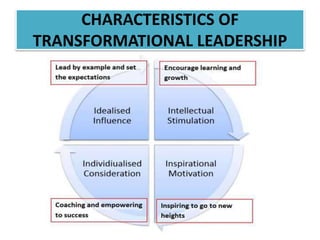
CHARACTERISTICS OF
TRANSFORMATIONAL LEADERSHIP
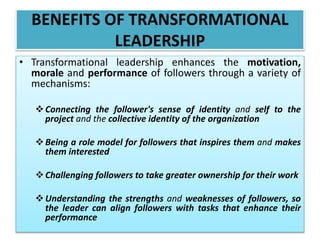
BENEFITS OF TRANSFORMATIONAL
LEADERSHIP
• Transformational leadership enhances the motivation,
morale and performance of followers through a variety of
mechanisms:
Connecting the follower's sense of identity and self to the
project and the collective identity of the organization
Being a role model for followers that inspires them and makes
them interested
Challenging followers to take greater ownership for their work
Understanding the strengths and weaknesses of followers, so
the leader can align followers with tasks that enhance their
performance
SYNDICATE GROUP LEARNING
ACTIVITY
• Refer to page 9 of the Learner Manual
• By referring to the characteristics of a
Transformational Leader, describe how you’ll
apply these to optimize performance from
your followers in the field of Higher
Education
• Provide feedback in the form of a summation
of your group discussion
BALANCED SCORECARD
• Defining a Balance Scorecard (BSC)
• BSC Perspectives/dimensions
• The value, purpose and benefits of Balanced
Scorecards
• The key benefits of using Balanced Scorecards
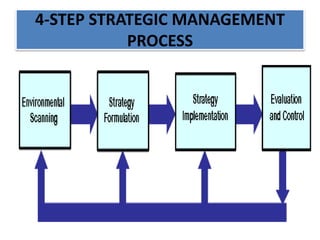
• The Steps in Strategic Planning and Management
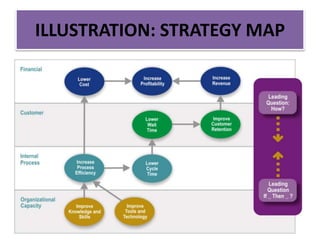
• Strategy Mapping
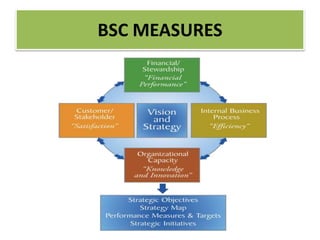
BSC MEASURES
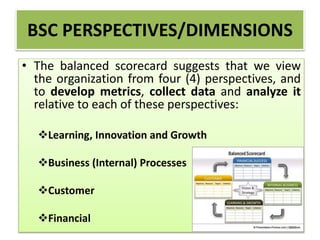
• The balanced scorecard suggests that we view
the organization from four (4) perspectives, and
to develop metrics, collect data and analyze it
relative to each of these perspectives:
Learning, Innovation and Growth
Business (Internal) Processes
Customer
Financial
BSC PERSPECTIVES/DIMENSIONS
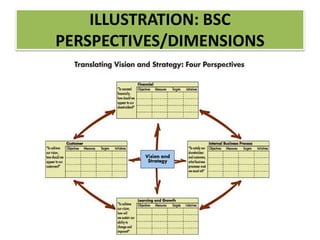
ILLUSTRATION: BSC
PERSPECTIVES/DIMENSIONS
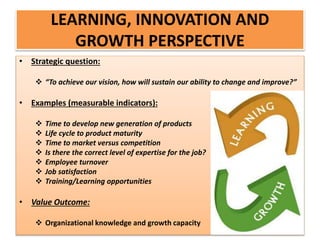
• Strategic question:
 “To achieve our vision, how will sustain our ability to change and improve?”
• Examples (measurable indicators):
 Time to develop new generation of products
 Life cycle to product maturity
 Time to market versus competition
 Is there the correct level of expertise for the job?
 Employee turnover
 Job satisfaction
 Training/Learning opportunities
• Value Outcome:
 Organizational knowledge and growth capacity
LEARNING, INNOVATION AND
GROWTH PERSPECTIVE
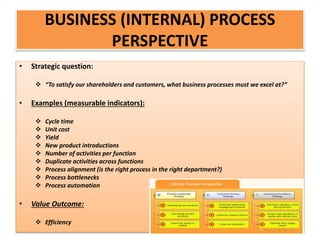
• Strategic question:
 “To satisfy our shareholders and customers, what business processes must we excel at?”
• Examples (measurable indicators):
 Cycle time
 Unit cost
 Yield
 New product introductions
 Number of activities per function
 Duplicate activities across functions
 Process alignment (is the right process in the right department?)
 Process bottlenecks
 Process automation
• Value Outcome:
 Efficiency
BUSINESS (INTERNAL) PROCESS
PERSPECTIVE
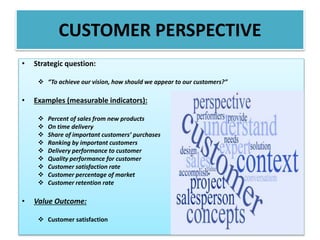
• Strategic question:
 “To achieve our vision, how should we appear to our customers?”
• Examples (measurable indicators):
 Percent of sales from new products
 On time delivery
 Share of important customers’ purchases
 Ranking by important customers
 Delivery performance to customer
 Quality performance for customer
 Customer satisfaction rate
 Customer percentage of market
 Customer retention rate
• Value Outcome:
 Customer satisfaction
CUSTOMER PERSPECTIVE
• Strategic question:
 “To succeed financially, how should we appear to our shareholders?”
• Examples (measurable indicators):
 Cash flow
 Sales growth
 Operating income
 Return on Equity (RoE)
 Return On Investment (ROI)
 Return on Capital Employed (RoCE)
 Financial Results (Quarterly/Yearly)
• Value Outcome:
 Financial performance/profitability
FINANCIAL PERSPECTIVE
• Articulate the business's vision and strategy
• Identify the performance categories that best link the business's vision and
strategy to its results (e.g., financial performance, operations, innovation,
employee performance)
• Establish objectives that support the business's vision and strategy
• Develop effective measures and meaningful standards, establishing both short-
term milestones and long-term targets
• Ensure company-wide acceptance (ownership) of the measures
• Create appropriate budgeting, tracking, communication, and reward systems
• Collect and analyze performance data and compare actual results with desired
performance
• Take action to close unfavourable gaps
PURPOSES OF THE BSC
• Clarify or update a business's strategy
• Link strategic objectives to long-term targets and annual budgets
• Track the key elements of the business strategy
• Incorporate strategic objectives into resource allocation processes
• Facilitate organizational change
• Compare performance of geographically diverse business units
• Increase company-wide understanding of the corporate vision and
strategy
STRATEGIC UTILITY AND FUNCTIONAL VALUE
OF BSC’S
4-STEP STRATEGIC MANAGEMENT
PROCESS
ILLUSTRATION: STRATEGY MAP
• Refer to page 20 in Learner Guide
• By means of a cost-benefit analysis, develop a
business case for BSC.
Viability
Feasibility
Sustainability
• Present a summary of group discussion
SYNDICATE GROUP LEARNING
ACTIVITY
• #1: BSC is aligned with organization’s strategic business plans
• #2: BSC is future-focused, adopting a strategic, medium to long-term approach
• #3: BSC is pro-active, sensitive and responsive to (internal and external)
environmental change and trends
• #4: BSC enjoys company-wide acceptance (ownership) of the measures and
processes
• #5: BSC is organized, well-coordinated and systematic approach
• #6: BSC is a collaborative and partnering effort (managers have co-opted business
partners to the process)
• #7: BSC is integrated (with other business management and administrative) and
cohesive process
BEST PRACTICE GUIDELINES FOR BSC
• #8: BSC generates meaningful business intelligence which informs business planning
and supports strategic decision-making
• #9: BSC integrates both scientific (metrics and analytics) and artistic (planning)
principles
• #10: BSC utilizes cutting-edge and innovative technology and software
• #11: BSC is continuously monitored, reviewed, evaluated and adapted
• #12: BSC yields a positive business ROI, with tangible/demonstrable outcomes and
impact – creates sustainable competitive advantages and organizational change
• #13: BSC incorporates strategic objectives into resource allocation processes e.g.
financing/budgeting
• #14: BSC is a logical and rational process making use of cause-effect logic
BEST PRACTICE GUIDELINES FOR BSC
• Refer to page 22 in Learner Guide
• Critically evaluate your organization’s current
Balanced Scorecard processes and systems
against the best practice criteria.
• Identify gaps and recommend improvement
strategies.
• Present a summary of group discussion
SYNDICATE GROUP LEARNING
ACTIVITY
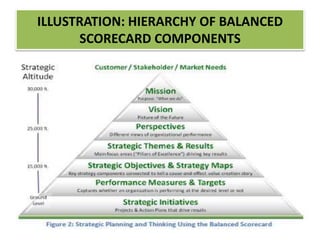
ILLUSTRATION: HIERARCHY OF BALANCED
SCORECARD COMPONENTS
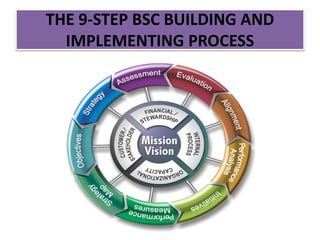
THE 9-STEP BSC BUILDING AND
IMPLEMENTING PROCESS
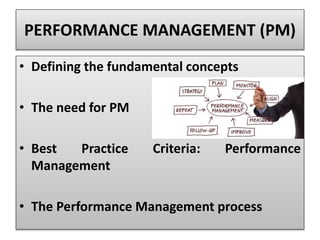
PERFORMANCE MANAGEMENT (PM)
• Defining the fundamental concepts
• The need for PM
• Best Practice Criteria: Performance
Management
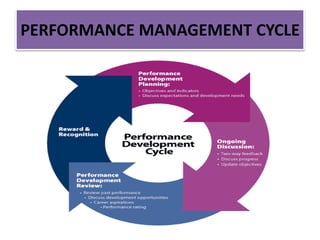
• The Performance Management process
• Refer to pages 28-29 in Learner Guide
• Critically evaluate your organization’s current
Performance Management processes and
systems against the best practice criteria.
• Identify gaps and recommend improvement
strategies.
LEARNING ACTIVITY
PERFORMANCE MANAGEMENT CYCLE
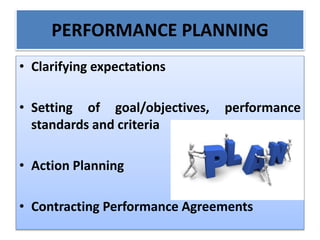
PERFORMANCE PLANNING
• Clarifying expectations
• Setting of goal/objectives, performance
standards and criteria
• Action Planning
• Contracting Performance Agreements
PERFORMANCE REVIEW/APPRAISAL
• Monitoring, Measuring/Evaluating performance
against the pre-determined performance
goals/objectives and standards and criteria.
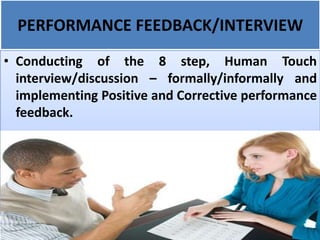
PERFORMANCE FEEDBACK/INTERVIEW
• Conducting of the 8 step, Human Touch
interview/discussion – formally/informally and
implementing Positive and Corrective performance
feedback.
8-STEP HUMAN TOUCH
PERFORMANCE INTERVIEW
• Step 1: Control the environment
• Step 2: State the purpose of the discussion
• Step 3: Ask for the employee’s opinion
• Step 4: Present your assessment
• Step 5: Build on employee’s strengths
• Step 6: Ask for employee’s reaction to your assessment
• Step 7: Set specific goals
• Step 8: Close the discussion
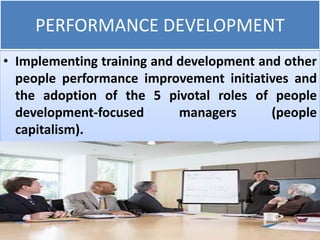
PERFORMANCE DEVELOPMENT
• Implementing training and development and other
people performance improvement initiatives and
the adoption of the 5 pivotal roles of people
development-focused managers (people
capitalism).
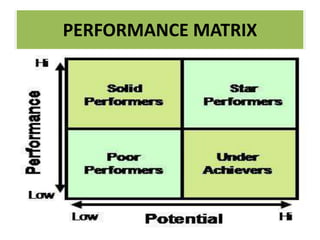
PERFORMANCE MATRIX
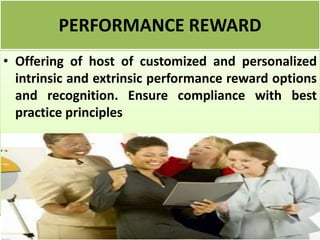
PERFORMANCE REWARD
• Offering of host of customized and personalized
intrinsic and extrinsic performance reward options
and recognition. Ensure compliance with best
practice principles
• Refer to page 38 in Learner Guide
• Outline the performance management
process in your organization by discussing the
key managerial actions in the 5 stages.
• Identify gaps and recommend improvement
strategies.
LEARNING ACTIVITY
• Summary of the key learning points
• Questions
• Conclusion
• Good luck with the application of the best
practice principles.
CONCLUSION
• CHARLES COTTER
• 084 562 9446
• charlescot@polka.co.za
• LINKED IN
• TWITTER: Charles_Cotter
CONTACT DETAILS

Best Practice: Transformational Leadership_BSC_PM

  • 1.
    BEST PRACTICE: TRANSFORMATIONALLEADERSHIP; BALANCED SCORECARD AND PERFORMANCE MANAGEMENT SUMMIT MANAGEMENT CONSULTANTS RANDBURG TOWERS 25 FEBRUARY 2015 CHARLES COTTER
  • 2.
    • #1: Leadership •#2: Balanced Scorecard • #3: Performance Management Framework
  • 3.
    THE NATURE ANDDEFINITION OF LEADERSHIP • Defining leadership • The leadership process • Transformation leadership – principles and characteristics
  • 4.
  • 5.
    LEADERSHIP PROCESS • Creatinga Vision • Articulating that vision in a Compelling and Inspirational manner • Guiding and Supporting followers in the pursuit of achievement of the vision • Being a Driver and Agent of Change • Nurturing, Developing and Empowering followers • Serving as a Role Model
  • 7.
  • 8.
    BENEFITS OF TRANSFORMATIONAL LEADERSHIP •Transformational leadership enhances the motivation, morale and performance of followers through a variety of mechanisms: Connecting the follower's sense of identity and self to the project and the collective identity of the organization Being a role model for followers that inspires them and makes them interested Challenging followers to take greater ownership for their work Understanding the strengths and weaknesses of followers, so the leader can align followers with tasks that enhance their performance
  • 9.
    SYNDICATE GROUP LEARNING ACTIVITY •Refer to page 9 of the Learner Manual • By referring to the characteristics of a Transformational Leader, describe how you’ll apply these to optimize performance from your followers in the field of Higher Education • Provide feedback in the form of a summation of your group discussion
  • 10.
    BALANCED SCORECARD • Defininga Balance Scorecard (BSC) • BSC Perspectives/dimensions • The value, purpose and benefits of Balanced Scorecards • The key benefits of using Balanced Scorecards • The Steps in Strategic Planning and Management • Strategy Mapping
  • 11.
  • 12.
    • The balancedscorecard suggests that we view the organization from four (4) perspectives, and to develop metrics, collect data and analyze it relative to each of these perspectives: Learning, Innovation and Growth Business (Internal) Processes Customer Financial BSC PERSPECTIVES/DIMENSIONS
  • 13.
  • 14.
    • Strategic question: “To achieve our vision, how will sustain our ability to change and improve?” • Examples (measurable indicators):  Time to develop new generation of products  Life cycle to product maturity  Time to market versus competition  Is there the correct level of expertise for the job?  Employee turnover  Job satisfaction  Training/Learning opportunities • Value Outcome:  Organizational knowledge and growth capacity LEARNING, INNOVATION AND GROWTH PERSPECTIVE
  • 15.
    • Strategic question: “To satisfy our shareholders and customers, what business processes must we excel at?” • Examples (measurable indicators):  Cycle time  Unit cost  Yield  New product introductions  Number of activities per function  Duplicate activities across functions  Process alignment (is the right process in the right department?)  Process bottlenecks  Process automation • Value Outcome:  Efficiency BUSINESS (INTERNAL) PROCESS PERSPECTIVE
  • 17.
    • Strategic question: “To achieve our vision, how should we appear to our customers?” • Examples (measurable indicators):  Percent of sales from new products  On time delivery  Share of important customers’ purchases  Ranking by important customers  Delivery performance to customer  Quality performance for customer  Customer satisfaction rate  Customer percentage of market  Customer retention rate • Value Outcome:  Customer satisfaction CUSTOMER PERSPECTIVE
  • 18.
    • Strategic question: “To succeed financially, how should we appear to our shareholders?” • Examples (measurable indicators):  Cash flow  Sales growth  Operating income  Return on Equity (RoE)  Return On Investment (ROI)  Return on Capital Employed (RoCE)  Financial Results (Quarterly/Yearly) • Value Outcome:  Financial performance/profitability FINANCIAL PERSPECTIVE
  • 19.
    • Articulate thebusiness's vision and strategy • Identify the performance categories that best link the business's vision and strategy to its results (e.g., financial performance, operations, innovation, employee performance) • Establish objectives that support the business's vision and strategy • Develop effective measures and meaningful standards, establishing both short- term milestones and long-term targets • Ensure company-wide acceptance (ownership) of the measures • Create appropriate budgeting, tracking, communication, and reward systems • Collect and analyze performance data and compare actual results with desired performance • Take action to close unfavourable gaps PURPOSES OF THE BSC
  • 20.
    • Clarify orupdate a business's strategy • Link strategic objectives to long-term targets and annual budgets • Track the key elements of the business strategy • Incorporate strategic objectives into resource allocation processes • Facilitate organizational change • Compare performance of geographically diverse business units • Increase company-wide understanding of the corporate vision and strategy STRATEGIC UTILITY AND FUNCTIONAL VALUE OF BSC’S
  • 22.
  • 23.
  • 24.
    • Refer topage 20 in Learner Guide • By means of a cost-benefit analysis, develop a business case for BSC. Viability Feasibility Sustainability • Present a summary of group discussion SYNDICATE GROUP LEARNING ACTIVITY
  • 25.
    • #1: BSCis aligned with organization’s strategic business plans • #2: BSC is future-focused, adopting a strategic, medium to long-term approach • #3: BSC is pro-active, sensitive and responsive to (internal and external) environmental change and trends • #4: BSC enjoys company-wide acceptance (ownership) of the measures and processes • #5: BSC is organized, well-coordinated and systematic approach • #6: BSC is a collaborative and partnering effort (managers have co-opted business partners to the process) • #7: BSC is integrated (with other business management and administrative) and cohesive process BEST PRACTICE GUIDELINES FOR BSC
  • 26.
    • #8: BSCgenerates meaningful business intelligence which informs business planning and supports strategic decision-making • #9: BSC integrates both scientific (metrics and analytics) and artistic (planning) principles • #10: BSC utilizes cutting-edge and innovative technology and software • #11: BSC is continuously monitored, reviewed, evaluated and adapted • #12: BSC yields a positive business ROI, with tangible/demonstrable outcomes and impact – creates sustainable competitive advantages and organizational change • #13: BSC incorporates strategic objectives into resource allocation processes e.g. financing/budgeting • #14: BSC is a logical and rational process making use of cause-effect logic BEST PRACTICE GUIDELINES FOR BSC
  • 27.
    • Refer topage 22 in Learner Guide • Critically evaluate your organization’s current Balanced Scorecard processes and systems against the best practice criteria. • Identify gaps and recommend improvement strategies. • Present a summary of group discussion SYNDICATE GROUP LEARNING ACTIVITY
  • 28.
    ILLUSTRATION: HIERARCHY OFBALANCED SCORECARD COMPONENTS
  • 30.
    THE 9-STEP BSCBUILDING AND IMPLEMENTING PROCESS
  • 31.
    PERFORMANCE MANAGEMENT (PM) •Defining the fundamental concepts • The need for PM • Best Practice Criteria: Performance Management • The Performance Management process
  • 32.
    • Refer topages 28-29 in Learner Guide • Critically evaluate your organization’s current Performance Management processes and systems against the best practice criteria. • Identify gaps and recommend improvement strategies. LEARNING ACTIVITY
  • 34.
  • 35.
    PERFORMANCE PLANNING • Clarifyingexpectations • Setting of goal/objectives, performance standards and criteria • Action Planning • Contracting Performance Agreements
  • 36.
    PERFORMANCE REVIEW/APPRAISAL • Monitoring,Measuring/Evaluating performance against the pre-determined performance goals/objectives and standards and criteria.
  • 37.
    PERFORMANCE FEEDBACK/INTERVIEW • Conductingof the 8 step, Human Touch interview/discussion – formally/informally and implementing Positive and Corrective performance feedback.
  • 38.
    8-STEP HUMAN TOUCH PERFORMANCEINTERVIEW • Step 1: Control the environment • Step 2: State the purpose of the discussion • Step 3: Ask for the employee’s opinion • Step 4: Present your assessment • Step 5: Build on employee’s strengths • Step 6: Ask for employee’s reaction to your assessment • Step 7: Set specific goals • Step 8: Close the discussion
  • 39.
    PERFORMANCE DEVELOPMENT • Implementingtraining and development and other people performance improvement initiatives and the adoption of the 5 pivotal roles of people development-focused managers (people capitalism).
  • 40.
  • 41.
    PERFORMANCE REWARD • Offeringof host of customized and personalized intrinsic and extrinsic performance reward options and recognition. Ensure compliance with best practice principles
  • 43.
    • Refer topage 38 in Learner Guide • Outline the performance management process in your organization by discussing the key managerial actions in the 5 stages. • Identify gaps and recommend improvement strategies. LEARNING ACTIVITY
  • 44.
    • Summary ofthe key learning points • Questions • Conclusion • Good luck with the application of the best practice principles. CONCLUSION
  • 45.
    • CHARLES COTTER •084 562 9446 • charlescot@polka.co.za • LINKED IN • TWITTER: Charles_Cotter CONTACT DETAILS