Balanced Scorecard and Strategy Maps
Lecture 3
1
Contents
1. Introduction to Strategic planning & Management
2. Introduction to Balance Scorecard (BSC)
3. The four perspectives
4. Basic Concepts of Strategy Maps
5. Characteristics of Balance Scorecard
6. Steps to Develop Balanced Scorecards and Strategy Maps
7. Four Perspective Goals & Risk
2
Strategy Performance Management Tool
3
Introduction to BSC
 The Balance Scorecard is a strategic planning and management system used to align
business activities to the vision and strategy of the organization by monitoring performance
against strategic goals.
 The Balance Scorecard BSC is a strategy performance management tool , a semi structured
report, supported by design methods and automation tools, that can be used by managers to
keep the track of the execution of activities by the staff within their control and to monitor
the consequences arising from these actions.
4
Balance Scorecard Concept
 Balance scorecard was first published in 1992 by Kaplan and Norton, a book followed in
1996.
 The approach is to provide ‘balance’ to the financial perspective.
5
Basic Concepts of Balanced Scorecard
 The five principles of successful strategy-focused organizations are:
1. Translate the Strategy to Operational Terms
2. Align the Organization to the Strategy
3. Make Strategy Everyone’s Everyday Job
4. Make Strategy a Continual Process
5. Organize Change Through Executive Leadership
6
Balanced scorecard (BSC)
 The balanced scorecard (BSC) is a strategy performance
management tool - a structured report.
 Used by managers to keep track of the execution of activities
by the staff within their control
 and to monitor the consequences arising from these actions.
 It is perhaps the best known of several such frameworks
7
Introduction to BSC
 The balanced scorecard was first introduced
“to overcome the limitations of managing only with financial
measures.”
 We will now look at the structure and content of strategy
maps and see how they make strategies for value creation
more clear from four different perspectives.
8
The four perspectives
9
Figure 1
The four perspectives
10
Figure 2
The four perspectives
 All balanced scorecards break your organization down into several
Perspectives,
 Usually they are the same four:
 Learning and Growth
 Internal Business Processes
 Customer
 Financial
 The idea is that each perspective builds on the previous one. If you
train your employees (Learning and Growth) they’ll make your
company run more smoothly (Internal Business Processes). A better
running business takes better care of its customers (Customer), and
happy customers buy more stuff (Financial).
11
4 Business Perspectives Questions
Financial
What must we do to create sustainable economic value?
Internal Business Process
To satisfy our stakeholders, what must be our levels of productivity,
efficiency, and quality?
Learning and Growth
How does our employee performance management system, including
feedback to employees, support high performance?
Customer
What do our customers require from us and how are we doing according to
those requirements?
12
Strategy maps show the dependent components of a strategic
plan:
13
Figure 3
Strategy Maps for Public sector and
private sector
 Read it yourself from provided course book Chapter 2
14
Characteristics of Balanced scorecard
 As a model of performance, it clears the links between:
Leading inputs (human and physical),
Processes,
Lagging outcomes
And focuses on the importance of managing these
components to achieve the organization's strategic
priorities.
15
Characteristics of Balanced scorecard (2)
1. BSC is the arrangement of a mixture of financial and non-financial
measures each compared to a 'target' value.
2. You can track them on paper, in spreadsheets, or via specialized
software.
3. A balanced scorecard made for government may look very different from
one made for manufacturing. In spite of these variations, however, there
are certain ways in which they’re all alike.
4. The balanced scorecard also gives light to the company's vision and
mission. These two elements must always be referred to when preparing
a balance scorecard.
16
BSC Strategic Objectives
 In building a BSC is to come up with several Strategic Objectives
for each perspective. It’s important to choose these carefully because
they’re the real foundation of your scorecard.
17
Steps to Develop Balanced Scorecards and Strategy Maps
1. Assess the competitive environment.
2. Learn about customer preferences and segments.
3. Select the targeted customer segments.
4. Determine the value proposition for the targeted customers.
5. Define a strategy to generate breakthrough financial performance.
6. Articulate the balance between growth and productivity.
7. Identify the critical internal business processes to deliver the value
proposition to customers and for the financial and productivity objectives.
8. Develop the skills, competencies, motivation, databases, and technology
required to excel at internal processes and customer value delivery.
18
Strategy Map
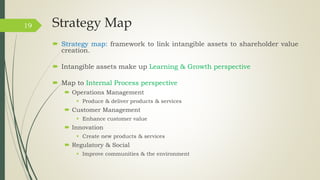
 Strategy map: framework to link intangible assets to shareholder value
creation.
 Intangible assets make up Learning & Growth perspective
 Map to Internal Process perspective
 Operations Management
 Produce & deliver products & services
 Customer Management
 Enhance customer value
 Innovation
 Create new products & services
 Regulatory & Social
 Improve communities & the environment
19
Strategy Map (2)
 Customer perspective
 Price, quality, availability, selection, functionality, service, partnership,
brand
 Financial perspective
 Productivity strategy
 Improve cost structure
 Increase asset utilization
 Revenue growth strategy
 Enhance customer value
 Expand revenue opportunities
20
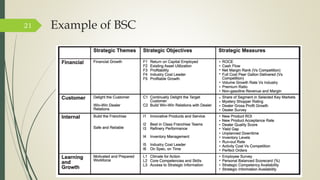
Example of BSC
21
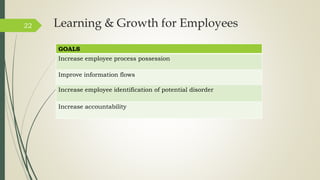
Learning & Growth for Employees
GOALS
Increase employee process possession
Improve information flows
Increase employee identification of potential disorder
Increase accountability
22
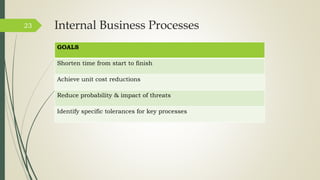
Internal Business Processes
GOALS
Shorten time from start to finish
Achieve unit cost reductions
Reduce probability & impact of threats
Identify specific tolerances for key processes
23
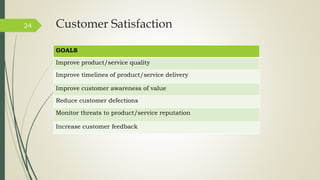
Customer Satisfaction
GOALS
Improve product/service quality
Improve timelines of product/service delivery
Improve customer awareness of value
Reduce customer defections
Monitor threats to product/service reputation
Increase customer feedback
24
Financial Performance
GOALS
Higher profit margins
Revenue growth
Reduce cost overruns
25

balance-scorecard-bsc.pptx

  • 1.
    Balanced Scorecard andStrategy Maps Lecture 3 1
  • 2.
    Contents 1. Introduction toStrategic planning & Management 2. Introduction to Balance Scorecard (BSC) 3. The four perspectives 4. Basic Concepts of Strategy Maps 5. Characteristics of Balance Scorecard 6. Steps to Develop Balanced Scorecards and Strategy Maps 7. Four Perspective Goals & Risk 2
  • 3.
  • 4.
    Introduction to BSC The Balance Scorecard is a strategic planning and management system used to align business activities to the vision and strategy of the organization by monitoring performance against strategic goals.  The Balance Scorecard BSC is a strategy performance management tool , a semi structured report, supported by design methods and automation tools, that can be used by managers to keep the track of the execution of activities by the staff within their control and to monitor the consequences arising from these actions. 4
  • 5.
    Balance Scorecard Concept Balance scorecard was first published in 1992 by Kaplan and Norton, a book followed in 1996.  The approach is to provide ‘balance’ to the financial perspective. 5
  • 6.
    Basic Concepts ofBalanced Scorecard  The five principles of successful strategy-focused organizations are: 1. Translate the Strategy to Operational Terms 2. Align the Organization to the Strategy 3. Make Strategy Everyone’s Everyday Job 4. Make Strategy a Continual Process 5. Organize Change Through Executive Leadership 6
  • 7.
    Balanced scorecard (BSC) The balanced scorecard (BSC) is a strategy performance management tool - a structured report.  Used by managers to keep track of the execution of activities by the staff within their control  and to monitor the consequences arising from these actions.  It is perhaps the best known of several such frameworks 7
  • 8.
    Introduction to BSC The balanced scorecard was first introduced “to overcome the limitations of managing only with financial measures.”  We will now look at the structure and content of strategy maps and see how they make strategies for value creation more clear from four different perspectives. 8
  • 9.
  • 10.
  • 11.
    The four perspectives All balanced scorecards break your organization down into several Perspectives,  Usually they are the same four:  Learning and Growth  Internal Business Processes  Customer  Financial  The idea is that each perspective builds on the previous one. If you train your employees (Learning and Growth) they’ll make your company run more smoothly (Internal Business Processes). A better running business takes better care of its customers (Customer), and happy customers buy more stuff (Financial). 11
  • 12.
    4 Business PerspectivesQuestions Financial What must we do to create sustainable economic value? Internal Business Process To satisfy our stakeholders, what must be our levels of productivity, efficiency, and quality? Learning and Growth How does our employee performance management system, including feedback to employees, support high performance? Customer What do our customers require from us and how are we doing according to those requirements? 12
  • 13.
    Strategy maps showthe dependent components of a strategic plan: 13 Figure 3
  • 14.
    Strategy Maps forPublic sector and private sector  Read it yourself from provided course book Chapter 2 14
  • 15.
    Characteristics of Balancedscorecard  As a model of performance, it clears the links between: Leading inputs (human and physical), Processes, Lagging outcomes And focuses on the importance of managing these components to achieve the organization's strategic priorities. 15
  • 16.
    Characteristics of Balancedscorecard (2) 1. BSC is the arrangement of a mixture of financial and non-financial measures each compared to a 'target' value. 2. You can track them on paper, in spreadsheets, or via specialized software. 3. A balanced scorecard made for government may look very different from one made for manufacturing. In spite of these variations, however, there are certain ways in which they’re all alike. 4. The balanced scorecard also gives light to the company's vision and mission. These two elements must always be referred to when preparing a balance scorecard. 16
  • 17.
    BSC Strategic Objectives In building a BSC is to come up with several Strategic Objectives for each perspective. It’s important to choose these carefully because they’re the real foundation of your scorecard. 17
  • 18.
    Steps to DevelopBalanced Scorecards and Strategy Maps 1. Assess the competitive environment. 2. Learn about customer preferences and segments. 3. Select the targeted customer segments. 4. Determine the value proposition for the targeted customers. 5. Define a strategy to generate breakthrough financial performance. 6. Articulate the balance between growth and productivity. 7. Identify the critical internal business processes to deliver the value proposition to customers and for the financial and productivity objectives. 8. Develop the skills, competencies, motivation, databases, and technology required to excel at internal processes and customer value delivery. 18
  • 19.
    Strategy Map  Strategymap: framework to link intangible assets to shareholder value creation.  Intangible assets make up Learning & Growth perspective  Map to Internal Process perspective  Operations Management  Produce & deliver products & services  Customer Management  Enhance customer value  Innovation  Create new products & services  Regulatory & Social  Improve communities & the environment 19
  • 20.
    Strategy Map (2) Customer perspective  Price, quality, availability, selection, functionality, service, partnership, brand  Financial perspective  Productivity strategy  Improve cost structure  Increase asset utilization  Revenue growth strategy  Enhance customer value  Expand revenue opportunities 20
  • 21.
  • 22.
    Learning & Growthfor Employees GOALS Increase employee process possession Improve information flows Increase employee identification of potential disorder Increase accountability 22
  • 23.
    Internal Business Processes GOALS Shortentime from start to finish Achieve unit cost reductions Reduce probability & impact of threats Identify specific tolerances for key processes 23
  • 24.
    Customer Satisfaction GOALS Improve product/servicequality Improve timelines of product/service delivery Improve customer awareness of value Reduce customer defections Monitor threats to product/service reputation Increase customer feedback 24
  • 25.
    Financial Performance GOALS Higher profitmargins Revenue growth Reduce cost overruns 25

Editor's Notes

  • #9 value creation : The performance of actions that increase the worth of goods, services or even a business. A subjective measure of how well a firm can use assets from its primary mode of business and generate revenues
  • #22 ROCE: Return on capital employed is an accounting ratio used in finance, valuation, and accounting. An accounting statement called the "statement of cash flows", which shows the amount of cash generated and used by a company in a given period.