Generational Change: Meet
the Public Sector
Presented by:
Gary O’Bannon, Human Resources Director
Today’s Goals
 Provide an informative look at multi-generational
employees
 Demonstrate how different perspectives affect
the employee-supervisor relationship
 Understand opportunities and challenges
To maximize workforce potential, you must:
 Acknowledge generational differences as a
diversity issue
 Recognize and understand differences
 Find ways to value differences and turn
them into positive outcomes
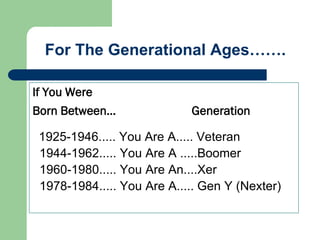
For The Generational Ages…….
If You Were
Born Between… Generation
1925-1946..... You Are A..... Veteran
1944-1962..... You Are A .....Boomer
1960-1980..... You Are An....Xer
1978-1984..... You Are A..... Gen Y (Nexter)
Generational World Views
Generations share a
place in history together
and so often share
similar world views.
 When is a person’s “world
view” formed?
 What factors influence a
person’s world view?
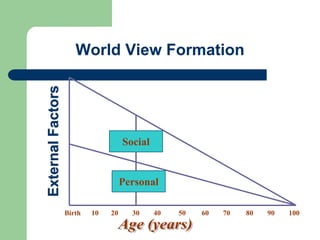
World View Formation
Social
Personal
Birth 10 20 30 40 50 60 70 80 90 100
ExternalFactors
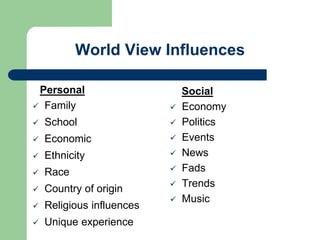
World View Influences
Personal
 Family
 School
 Economic
 Ethnicity
 Race
 Country of origin
 Religious influences
 Unique experience
Social
 Economy
 Politics
 Events
 News
 Fads
 Trends
 Music
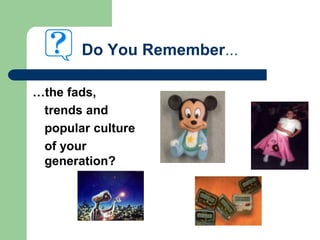
Do You Remember...
…the fads,
trends and
popular culture
of your
generation?
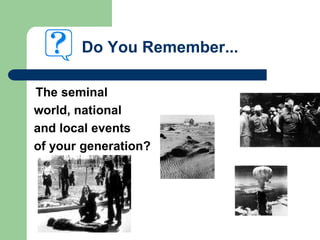
Do You Remember...
The seminal
world, national
and local events
of your generation?
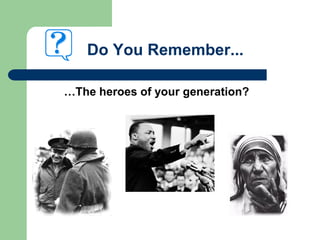
Do You Remember...
…The heroes of your generation?
Veterans
 Born 1925-1946
 Great Depression, World War II and the Korean War,
rise of America as a super-power
 Grew up and entered the workforce during a time when
roles related to race, ethnicity & gender were clearly
defined and often discriminatory
 Taught to be loyal, to country, to marriages and
companies
 Taught to be disciplined and patient, to wait for rewards
Veterans
Thematic Core Values
 Dedication/sacrifice
 Hard work
 Conformity & patience
 Respect for authority
 Delayed rewards
 Adherence to rules
 Duty before pleasure
 Law & order
Boomers
 Born 1944-1962
 Part of the post-war Baby Boom; 1 baby born every 17
minutes for 19 years, 76 million in all
 Advances in medicine meant more survived infancy and
childhood
 Coddled and cherished by parents who had sacrificed
during Depression and War
 Experienced the greatest economic expansion in the
history of America, Cold War, Vietnam
Boomers
Thematic Core Values
 Optimism
 Team orientation
 Personal gratification
 Health and wellness
 Personal growth
 Youth
 Work and Involvement
Gen Xers
 Born 1960-1980
 Part of the Baby Bust; only 51 million in 20 year time
period
 Grew up during Watergate, gasoline shortages,
recession, rise of the global economy and fall of
American industry
 Parents were absent; at work, divorced
 Came of age with the Information Age—technology
an integral part of life
Gen Xers
Thematic Core Values
 Diversity
 Thinking globally
 Balance
 Techno-literacy
 Fun
 Informality
 Self-Reliance
 Pragmatism
Gen Y
 Born 1978-1984
 Part of the Baby Boomlet; 73 million strong. Will
become 1/3 of the US population
 Grew up in the booming economy of the 90s
 Raised in an environment of increased emphasis on
family, busy, planned lives
 Influenced by 24 hour news, unlimited internet
access, school shootings, international and domestic
terrorism
Gen Y
Thematic Core Values
 Civic Duty
 Confidence
 Achievement
 Morality
 Optimism
 Sociability
 Street Smarts
 Diversity
Generations Speak Out
Activity Directions
 On page 12, in the box representing your
generation, write 2 -3 motivators and 2 – 3
demotivators for yourself
 Consider things like physical environment,
methods of supervision, types of
assignments, and rewards
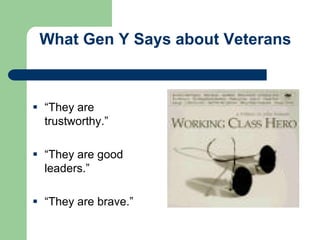
What Gen Y Says about Veterans
 “They are
trustworthy.”
 “They are good
leaders.”
 “They are brave.”
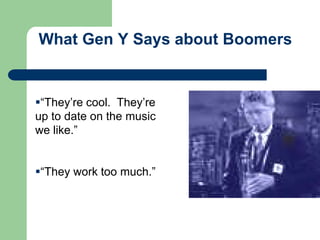
What Gen Y Says about Boomers
“They’re cool. They’re
up to date on the music
we like.”
“They work too much.”
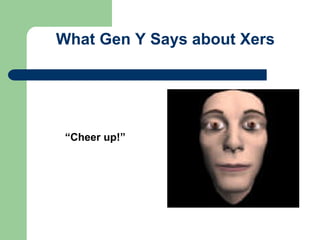
What Gen Y Says about Xers
“Cheer up!”
What Veterans Say about Gen Y
 “They have good manners.”
 “They’re smart little critters.”
 “They need to toughen up.”
 “They watch too much
TV…with crude language
and violence.”
What Boomers Say about Gen Y
 “They’re cute.”
 “They need more discipline
from their parents.”
 “They can set the time on
the VCR.”
 “They need to learn to
entertain themselves; they
need too much attention.”
 “Can they do my web page
for me?”
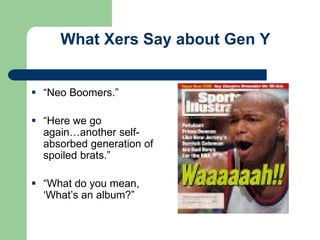
What Xers Say about Gen Y
 “Neo Boomers.”
 “Here we go
again…another self-
absorbed generation of
spoiled brats.”
 “What do you mean,
‘What’s an album?”
So What Does This All Mean?
Questions to Consider...
 What are the workplace implications of this
data?
 Where are the potential conflicts in the
multigenerational workplace?
 What are the potential benefits of a
multigenerational workplace?
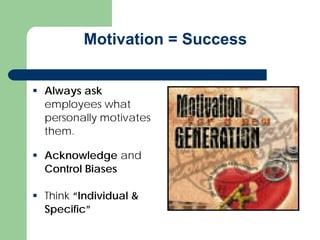
Motivation = Success
 Always ask
employees what
personally motivates
them.
 Acknowledge and
Control Biases
 Think “Individual &
Specific”
Gen Y “On The Job”
Assets
 Collective action
 Optimism
 Tenacity
 Heroic spirit
 Multi-tasking capability
 Technological savvy
Liabilities
 Need for supervision
and structure
 Inexperienced,
particularly with
handling difficult people
issues
 Need more attention
and lots of
communication
Motivating & Supervising Gen Y
 Throw out Preconceived Notions of
Traditional Roles
 Establish Mentoring Programs
 Continually Provide More Training
 Communicate frequently and
communicate the “whys”
Messages That Motivate Gen Y
“ Your boss is in his/her sixties.”
“You and your co-workers can turn this company
around.”
“You’ll be working with other bright, creative people.”
“We value input and innovation.”
“Teamwork is important to our company”s success.”
“You can make a difference.”
What’s Next?: Generation Y
 What opportunities do we
have to attract Gen Y to
public service?
 How can we retain this
new generation of
workers?
WHY
In Closing
 Be open with communication
 Develop a culture that
promotes on-going learning
 Recognize interdependence
 Set goals & PARTNER with
employees to achieve full
potential

Managing a Multigenerational Workforce

  • 1.
    Generational Change: Meet thePublic Sector Presented by: Gary O’Bannon, Human Resources Director
  • 2.
    Today’s Goals  Providean informative look at multi-generational employees  Demonstrate how different perspectives affect the employee-supervisor relationship  Understand opportunities and challenges
  • 3.
    To maximize workforcepotential, you must:  Acknowledge generational differences as a diversity issue  Recognize and understand differences  Find ways to value differences and turn them into positive outcomes
  • 4.
    For The GenerationalAges……. If You Were Born Between… Generation 1925-1946..... You Are A..... Veteran 1944-1962..... You Are A .....Boomer 1960-1980..... You Are An....Xer 1978-1984..... You Are A..... Gen Y (Nexter)
  • 5.
    Generational World Views Generationsshare a place in history together and so often share similar world views.  When is a person’s “world view” formed?  What factors influence a person’s world view?
  • 6.
    World View Formation Social Personal Birth10 20 30 40 50 60 70 80 90 100 ExternalFactors
  • 7.
    World View Influences Personal Family  School  Economic  Ethnicity  Race  Country of origin  Religious influences  Unique experience Social  Economy  Politics  Events  News  Fads  Trends  Music
  • 8.
    Do You Remember... …thefads, trends and popular culture of your generation?
  • 9.
    Do You Remember... Theseminal world, national and local events of your generation?
  • 10.
    Do You Remember... …Theheroes of your generation?
  • 11.
    Veterans  Born 1925-1946 Great Depression, World War II and the Korean War, rise of America as a super-power  Grew up and entered the workforce during a time when roles related to race, ethnicity & gender were clearly defined and often discriminatory  Taught to be loyal, to country, to marriages and companies  Taught to be disciplined and patient, to wait for rewards
  • 12.
    Veterans Thematic Core Values Dedication/sacrifice  Hard work  Conformity & patience  Respect for authority  Delayed rewards  Adherence to rules  Duty before pleasure  Law & order
  • 13.
    Boomers  Born 1944-1962 Part of the post-war Baby Boom; 1 baby born every 17 minutes for 19 years, 76 million in all  Advances in medicine meant more survived infancy and childhood  Coddled and cherished by parents who had sacrificed during Depression and War  Experienced the greatest economic expansion in the history of America, Cold War, Vietnam
  • 14.
    Boomers Thematic Core Values Optimism  Team orientation  Personal gratification  Health and wellness  Personal growth  Youth  Work and Involvement
  • 15.
    Gen Xers  Born1960-1980  Part of the Baby Bust; only 51 million in 20 year time period  Grew up during Watergate, gasoline shortages, recession, rise of the global economy and fall of American industry  Parents were absent; at work, divorced  Came of age with the Information Age—technology an integral part of life
  • 16.
    Gen Xers Thematic CoreValues  Diversity  Thinking globally  Balance  Techno-literacy  Fun  Informality  Self-Reliance  Pragmatism
  • 17.
    Gen Y  Born1978-1984  Part of the Baby Boomlet; 73 million strong. Will become 1/3 of the US population  Grew up in the booming economy of the 90s  Raised in an environment of increased emphasis on family, busy, planned lives  Influenced by 24 hour news, unlimited internet access, school shootings, international and domestic terrorism
  • 18.
    Gen Y Thematic CoreValues  Civic Duty  Confidence  Achievement  Morality  Optimism  Sociability  Street Smarts  Diversity
  • 19.
    Generations Speak Out ActivityDirections  On page 12, in the box representing your generation, write 2 -3 motivators and 2 – 3 demotivators for yourself  Consider things like physical environment, methods of supervision, types of assignments, and rewards
  • 20.
    What Gen YSays about Veterans  “They are trustworthy.”  “They are good leaders.”  “They are brave.”
  • 21.
    What Gen YSays about Boomers “They’re cool. They’re up to date on the music we like.” “They work too much.”
  • 22.
    What Gen YSays about Xers “Cheer up!”
  • 23.
    What Veterans Sayabout Gen Y  “They have good manners.”  “They’re smart little critters.”  “They need to toughen up.”  “They watch too much TV…with crude language and violence.”
  • 24.
    What Boomers Sayabout Gen Y  “They’re cute.”  “They need more discipline from their parents.”  “They can set the time on the VCR.”  “They need to learn to entertain themselves; they need too much attention.”  “Can they do my web page for me?”
  • 25.
    What Xers Sayabout Gen Y  “Neo Boomers.”  “Here we go again…another self- absorbed generation of spoiled brats.”  “What do you mean, ‘What’s an album?”
  • 26.
    So What DoesThis All Mean? Questions to Consider...  What are the workplace implications of this data?  Where are the potential conflicts in the multigenerational workplace?  What are the potential benefits of a multigenerational workplace?
  • 27.
    Motivation = Success Always ask employees what personally motivates them.  Acknowledge and Control Biases  Think “Individual & Specific”
  • 28.
    Gen Y “OnThe Job” Assets  Collective action  Optimism  Tenacity  Heroic spirit  Multi-tasking capability  Technological savvy Liabilities  Need for supervision and structure  Inexperienced, particularly with handling difficult people issues  Need more attention and lots of communication
  • 29.
    Motivating & SupervisingGen Y  Throw out Preconceived Notions of Traditional Roles  Establish Mentoring Programs  Continually Provide More Training  Communicate frequently and communicate the “whys”
  • 30.
    Messages That MotivateGen Y “ Your boss is in his/her sixties.” “You and your co-workers can turn this company around.” “You’ll be working with other bright, creative people.” “We value input and innovation.” “Teamwork is important to our company”s success.” “You can make a difference.”
  • 31.
    What’s Next?: GenerationY  What opportunities do we have to attract Gen Y to public service?  How can we retain this new generation of workers? WHY
  • 32.
    In Closing  Beopen with communication  Develop a culture that promotes on-going learning  Recognize interdependence  Set goals & PARTNER with employees to achieve full potential