 Introduction
 What is a driverless car ?
 Features of car.
 Technologies making a system fully autonomous.
 Adavantage
 Limitation
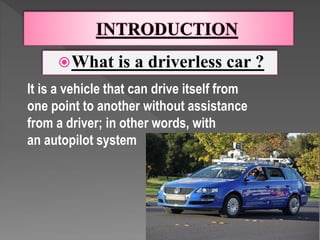
What is a driverless car ?
It is a vehicle that can drive itself from
one point to another without assistance
from a driver; in other words, with
an autopilot system
 Detection of traffic light automatically.
 A.N.V( automated night vision)
 Back up camera & parking sensor
 Automatic brake
 Self parking.
 A sensor “actinometer “ is used to detect the
intensity of radiation
 Light of different colors will radiate different -2-
intensity of radiation
 Which will be detected by the sensor
 If the detected intensity is of red colour or yellow
colour then controller will send a command to stop
the vehicle .
 The command will be followed by robot(to convert
the computer command into mechanical input)
 increases a vehicle driver's perception and seeing distance
in darkness or poor weather beyond the reach of the
vehicle's headlights.
 Special type of video camera attached to the rear of a
vehicle to aid in backing up.
 Parking sensors are proximity detectors which can alert
the driver to unseen obstacles during parking.
 Senses an imminent
distance with another
vehicle or a velocity
related danger.
 Responds by either
precharging the brakes or
by applying the brakes to
slow the vehicle without
any driver input.
 Detects by radar, video,
infrared, ultrasonic, GPS
sensors.
 Introduced by Toyota.
 System uses sensors all around the car to guide it into a
parallel parking space
 Lexus LS 460 L with Advance Parking Guidance System
 The driver has to find a parking space,
 Position the car next to it, and use the in-cabin navigation
screen to tell the car where it should go.
 The parking space needs to be 6 feet (1.8 meters) longer
than the car
 Anti-lock brakes(ABS)
 Electronic stability control
(ESC)
 Cruise control
 Lane Departure Warning
System
 Automated Guided Vehicle
Systems
 An ABS generally offers improved vehicle control and
decreases stopping distances on dry and slippery surfaces
for many drivers.
 Speed sensors
 Valves
 Pump
 Controller
 A computerized
technology improves
vehicle's stability by
detecting and minimizing
skids.
 Automatically applies the
brakes.
 Helps to minimize a loss of
control.
 ESC compares the
driver's intended direction
to the vehicle's actual
direction
 Wheel-speed sensors
 Steering-angle sensors
 Rotational-speed sensor
 Cruise control keeps the car at a constant speed by taking
over the throttle of the car
 It also maintain a set distance between it and the car in
front of it
 A mechanism designed to
warn a driver when the
vehicle begins to move out
of its lane
 Designed to minimize
accidents by addressing
the main causes of
collisions: driving error,
distraction and
drowsiness.
 Uses FROG (Free
Ranging On
Grid) technology
 FROG vehicles
are equipped
with a computer
that contains a
map of the area
 Managing traffic flow to increase road capacity.
 Keeping the driver relax.
 To avoid accidents .
 Increasing roadway capacity by reducing the distances
between cars.
 The current location of vehicle can be determine using
global positioning system (G.P.S) .
 Providing high security to vehicles
 If the vehicle is using internet which is have less security
then From the hackers point of view in some cases the
vehicle can be switched off on the road(in rare cases)
 Hackers can change the rout which is plotted in the
system(in rare cases)
 In case of failure of main sensor and backup sensors the
vehicle can create a chance of accident
 The driver less car’s technologies improves vehicle's
stability helps to minimize loss of control.
 Driver less cars are designed to minimize accidents by
addressing the main causes of collisions: driving error,
distraction and drowsiness.
 http://en.wikipedia.org/wiki/driverless car
 http://autocontrols.com.au/
 http://www.howstuffworks.com/cruise-control
 http://www.howstuffworks.com/electronic
stability control
THANK YOU

Driverless Car

  • 2.
     Introduction  Whatis a driverless car ?  Features of car.  Technologies making a system fully autonomous.  Adavantage  Limitation
  • 3.
    What is adriverless car ? It is a vehicle that can drive itself from one point to another without assistance from a driver; in other words, with an autopilot system
  • 5.
     Detection oftraffic light automatically.  A.N.V( automated night vision)  Back up camera & parking sensor  Automatic brake  Self parking.
  • 6.
     A sensor“actinometer “ is used to detect the intensity of radiation  Light of different colors will radiate different -2- intensity of radiation  Which will be detected by the sensor  If the detected intensity is of red colour or yellow colour then controller will send a command to stop the vehicle .  The command will be followed by robot(to convert the computer command into mechanical input)
  • 7.
     increases avehicle driver's perception and seeing distance in darkness or poor weather beyond the reach of the vehicle's headlights.
  • 8.
     Special typeof video camera attached to the rear of a vehicle to aid in backing up.  Parking sensors are proximity detectors which can alert the driver to unseen obstacles during parking.
  • 9.
     Senses animminent distance with another vehicle or a velocity related danger.  Responds by either precharging the brakes or by applying the brakes to slow the vehicle without any driver input.  Detects by radar, video, infrared, ultrasonic, GPS sensors.  Introduced by Toyota.
  • 10.
     System usessensors all around the car to guide it into a parallel parking space  Lexus LS 460 L with Advance Parking Guidance System  The driver has to find a parking space,  Position the car next to it, and use the in-cabin navigation screen to tell the car where it should go.  The parking space needs to be 6 feet (1.8 meters) longer than the car
  • 12.
     Anti-lock brakes(ABS) Electronic stability control (ESC)  Cruise control  Lane Departure Warning System  Automated Guided Vehicle Systems
  • 13.
     An ABSgenerally offers improved vehicle control and decreases stopping distances on dry and slippery surfaces for many drivers.
  • 14.
     Speed sensors Valves  Pump  Controller
  • 15.
     A computerized technologyimproves vehicle's stability by detecting and minimizing skids.  Automatically applies the brakes.  Helps to minimize a loss of control.  ESC compares the driver's intended direction to the vehicle's actual direction
  • 16.
     Wheel-speed sensors Steering-angle sensors  Rotational-speed sensor
  • 18.
     Cruise controlkeeps the car at a constant speed by taking over the throttle of the car  It also maintain a set distance between it and the car in front of it
  • 19.
     A mechanismdesigned to warn a driver when the vehicle begins to move out of its lane  Designed to minimize accidents by addressing the main causes of collisions: driving error, distraction and drowsiness.
  • 20.
     Uses FROG(Free Ranging On Grid) technology  FROG vehicles are equipped with a computer that contains a map of the area
  • 21.
     Managing trafficflow to increase road capacity.  Keeping the driver relax.  To avoid accidents .  Increasing roadway capacity by reducing the distances between cars.  The current location of vehicle can be determine using global positioning system (G.P.S) .  Providing high security to vehicles
  • 22.
     If thevehicle is using internet which is have less security then From the hackers point of view in some cases the vehicle can be switched off on the road(in rare cases)  Hackers can change the rout which is plotted in the system(in rare cases)  In case of failure of main sensor and backup sensors the vehicle can create a chance of accident
  • 23.
     The driverless car’s technologies improves vehicle's stability helps to minimize loss of control.  Driver less cars are designed to minimize accidents by addressing the main causes of collisions: driving error, distraction and drowsiness.
  • 24.
     http://en.wikipedia.org/wiki/driverless car http://autocontrols.com.au/  http://www.howstuffworks.com/cruise-control  http://www.howstuffworks.com/electronic stability control
  • 25.