Bretton Woods Agreement
A Presentation By-
Shivam Baghele
Introduction To The Bretton Woods
Agreement.
• The Bretton Woods agreement is the landmark
system for monetary and exchange rate
management.
• The Bretton Woods system of monetary
management established the rules for
commercial and financial relations among the
United States, Canada, Western Europe,
Australia and Japan in the mid-20th century.
What Was The
Bretton Woods System?
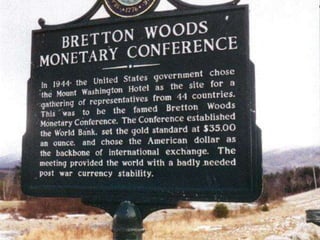
• In 1944 representatives form 44 countries met at
Bretton Woods, New Hampshire, to design the new
international monetary system that would facilitate the
postwar economic growth.
• Under the new agreement
– A fix exchange rate system was established.
– All currencies were fixed to gold, but only the U.S. dollar
was directly convertible to gold.
– Devaluation could not be used as a competitive purposes.
– A country could not devalue its currency by more than 10%
without permission to IMF approval.
Design Of The System
1. Members were obliged to declared a par value
for their national money.
2. If the exchange rate were not float freely, there
will be adequate supply of monetary reserve.
3. It was necessary to avoid recurrence of the kind
of economic warfare that has characterized of
decade of 1930’s.
4. The negotiators agreed that there was a need for
an institutional forum for international
corporation on monetary matters.
Implication
• All those four points defines that the Bretton
Woods System
– A monetary regime joining an essentially
unchanged gold exchange standard .
– Supplemented only by a centralized pool of gold
and national currencies with an entirely new
exchange rate system of adjustable pegs.
– IMF was expected to perform 3 functions (1)
Regulatory (2) Financial and (3) Consultative.
Bretton Woods International Dollar
Standard.
• It was US dollar based system.
• It was an adjustable peg system.
• There was a tight capital control system (it was
the big difference the classical gold standard
1879-1914, when there was free capital
mobility).
• There was a better macroeconomics
performance.
How Did Bretton Wood System
Collapse?
Economists still debate on this question, but it
is undeniable that there was a nominal anchor
problem.
The collapse of the classical gold standard was
externally forced but the collapse of the woods
system was due to internal inconsistency.
But History Has Answer To Every
Questions.
• The 1950’s was the period of dollar shortage.
• In 1960’s there was the oversupply of dollar in world
economy.
• In mid 1960’s US domestic inflation began to
accelerate, which strained the Bretton wood system.
• In 1968, the fixed linkage between dollar and gold was
abandoned.
• Finally, in 1971, the fixed linkage between dollar and
other currencies was given up, US president Richard
Nixon appeared on TV and declared that the US would
no longer sell gold to foreign central banks against the
dollar.
Thank You
And Have A Nice Day!!

Bertton woods agreement

  • 1.
    Bretton Woods Agreement APresentation By- Shivam Baghele
  • 3.
    Introduction To TheBretton Woods Agreement. • The Bretton Woods agreement is the landmark system for monetary and exchange rate management. • The Bretton Woods system of monetary management established the rules for commercial and financial relations among the United States, Canada, Western Europe, Australia and Japan in the mid-20th century.
  • 4.
    What Was The BrettonWoods System? • In 1944 representatives form 44 countries met at Bretton Woods, New Hampshire, to design the new international monetary system that would facilitate the postwar economic growth. • Under the new agreement – A fix exchange rate system was established. – All currencies were fixed to gold, but only the U.S. dollar was directly convertible to gold. – Devaluation could not be used as a competitive purposes. – A country could not devalue its currency by more than 10% without permission to IMF approval.
  • 5.
    Design Of TheSystem 1. Members were obliged to declared a par value for their national money. 2. If the exchange rate were not float freely, there will be adequate supply of monetary reserve. 3. It was necessary to avoid recurrence of the kind of economic warfare that has characterized of decade of 1930’s. 4. The negotiators agreed that there was a need for an institutional forum for international corporation on monetary matters.
  • 6.
    Implication • All thosefour points defines that the Bretton Woods System – A monetary regime joining an essentially unchanged gold exchange standard . – Supplemented only by a centralized pool of gold and national currencies with an entirely new exchange rate system of adjustable pegs. – IMF was expected to perform 3 functions (1) Regulatory (2) Financial and (3) Consultative.
  • 7.
    Bretton Woods InternationalDollar Standard. • It was US dollar based system. • It was an adjustable peg system. • There was a tight capital control system (it was the big difference the classical gold standard 1879-1914, when there was free capital mobility). • There was a better macroeconomics performance.
  • 8.
    How Did BrettonWood System Collapse? Economists still debate on this question, but it is undeniable that there was a nominal anchor problem. The collapse of the classical gold standard was externally forced but the collapse of the woods system was due to internal inconsistency.
  • 9.
    But History HasAnswer To Every Questions. • The 1950’s was the period of dollar shortage. • In 1960’s there was the oversupply of dollar in world economy. • In mid 1960’s US domestic inflation began to accelerate, which strained the Bretton wood system. • In 1968, the fixed linkage between dollar and gold was abandoned. • Finally, in 1971, the fixed linkage between dollar and other currencies was given up, US president Richard Nixon appeared on TV and declared that the US would no longer sell gold to foreign central banks against the dollar.
  • 10.
    Thank You And HaveA Nice Day!!