BERA 2014 
Presentation 
Creativity in Ludoliteracy, Games 
Development and Games Studies in the UK 
885 
Nia Wearn
Introduction 
Nia Wearn BSc (Hons), MA 
Staffordshire University 
Senior Lecturer in Computer Games Design 
Award Leader for BSc Hons / BEng Hons Computer Gameplay Design & Production 
n.h.wearn@staffs.ac.uk 
@wormella 
Currently working part time on a Phd currently 
entitled "Identifying commonalities in the 
working practices of students during a Global 
Games Jam event in line with their education at 
Staffordshire University. 
I’m passionate about encouraging play, creativity 
and fun in education, especially where games are 
concerned. 
Ludoliteracy defined 
• Having the ability to play games. 
• Having the ability to understand 
meanings with respect to games. 
• Having the ability to make games. 
• (Zagal, 2010, p. 23)
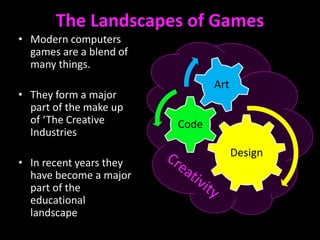
The Landscapes of Games 
• Modern computers 
games are a blend of 
many things. 
• They form a major 
part of the make up 
of ‘The Creative 
Industries 
• In recent years they 
have become a major 
part of the 
educational 
landscape 
Design 
Code 
Art
Current state of UK Games Education 
- FE 
• 140 Results for Level 2, 3 & 4 courses on the 
National Career Services 
• Wide Variety – covering Art, Programming & 
Design – or a combination of all three 
– Little or no consistency 
• Often Courses combined with Multimedia or 
IT
BTEC National Diploma 
• Pearson / Edexcel BTEC National Diploma in 
Media Production (Games Development) is 
the most common structure of FE Games 
Related Courses 
• BTEC National Diploma in Media Production 
(Games Development) has a wide collection of 
units, some mandatory, others optional
BTEC National Diploma 
Vocational slant to learning 
Edexcel BTEC Level 3 Certificate 
– 30 credits 
Edexcel BTEC Level 3 Subsidiary 
Diploma – 60 credits 
Edexcel BTEC Level 3 90-credit 
Diploma – 90 credits 
Edexcel BTEC Level 3 Diploma – 
120 credits 
Edexcel BTEC Level 3 Extended 
Diploma – 180 credits 
Pearson / Edexcel . (2010). Edexcel BTEC Level 3 Nationals specification in Creative Media Production. Available: 
http://www.edexcel.com/migrationdocuments/BTEC%20Nationals%20from%202010/Unit_69_Drawing_Concept_Art_for_Comp 
uter_Games.pdf. Last accessed 9th Sept 2014.
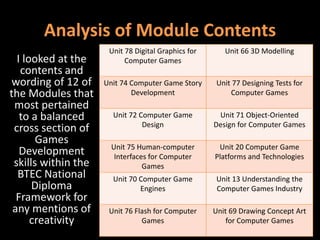
Analysis of Module Contents 
I looked at the 
contents and 
wording of 12 of 
the Modules that 
most pertained 
to a balanced 
cross section of 
Games 
Development 
skills within the 
BTEC National 
Diploma 
Framework for 
any mentions of 
creativity 
Unit 78 Digital Graphics for 
Computer Games 
Unit 66 3D Modelling 
Unit 74 Computer Game Story 
Development 
Unit 77 Designing Tests for 
Computer Games 
Unit 72 Computer Game 
Design 
Unit 71 Object-Oriented 
Design for Computer Games 
Unit 75 Human-computer 
Interfaces for Computer 
Games 
Unit 20 Computer Game 
Platforms and Technologies 
Unit 70 Computer Game 
Engines 
Unit 13 Understanding the 
Computer Games Industry 
Unit 76 Flash for Computer 
Games 
Unit 69 Drawing Concept Art 
for Computer Games
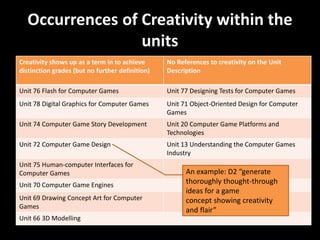
Occurrences of Creativity within the 
units 
Creativity shows up as a term in to achieve 
distinction grades (but no further definition) 
No References to creativity on the Unit 
Description 
Unit 76 Flash for Computer Games Unit 77 Designing Tests for Computer Games 
Unit 78 Digital Graphics for Computer Games Unit 71 Object-Oriented Design for Computer 
Games 
Unit 74 Computer Game Story Development Unit 20 Computer Game Platforms and 
Technologies 
Unit 72 Computer Game Design Unit 13 Understanding the Computer Games 
Industry 
Unit 75 Human-computer Interfaces for 
Computer Games 
Unit 70 Computer Game Engines 
Unit 69 Drawing Concept Art for Computer 
Games 
Unit 66 3D Modelling 
An example: D2 “generate 
thoroughly thought-through 
ideas for a game 
concept showing creativity 
and flair”
Unit 13’s definition of the Games 
Industry 
“The business of computer games depends 
ultimately on both creativity and finance and 
some understanding of the economics of the 
business is required. It is important that learners 
gain an appreciation of the costs, turnover and 
profits available to each company in the 
development, publishing and distribution of a 
title. They should also keep abreast of market 
trends affecting the industry.”
Fuse & Brighton Fuse 
• The Fuse Report – September 2010 
– Report on Creative, Digital and Information 
Technology Industries in the UK 
– Overview of clusters, partnerships and makes the 
case for CDIT Industries to be a priority 
• Brighton Fuse Report – October 2013 
– Localised version of the Fuse Report for the 
Brighton area
Next Gen Skills 
• January 2011 – Report on skills UK Computer 
Games and Visual Effects industries 
“The video games and visual effects industries play 
to the UK’s twin strengths in creativity and 
technology” 
• Creativity is mentioned as a desirable by product 
of a cross over from Art and Technology based 
clubs – but no specific mention of it as a skill in 
it’s own right
Next Gen Skills 
• Next Gen Skills is campaigning for: 
• The introduction of an industry relevant 
Computer Science course within the framework 
of the National Curriculum 
• A review of ICT in its current form and to embed 
essential ICT skills across the wider curriculum 
• The promotion of the vital role that teaching 
maths, physics, art and computer science will play 
in ensuring the growth of UK’s digital, creative 
and hi-tech industries
Current state of UK Games Education 
- HE 
• 180+ Games related courses listed on UCAS 
• Wide Variety – covering Art, Programming & 
Design – or a combination of all three 
– Little or no consistency 
• In what is taught 
• In what area of the university they may sit 
– Primarily vocationally based courses 
• Focus on employability and skills
IGDA Framework 
• 2008 - International 
Games Developers 
Association Game 
Education Special Interest 
Group published a 
curriculum framework for 
‘The Study of Games and 
Game Development’ 
– References to creative 
practices but not creativity 
– Primarily Skills Based 
Core suggested topics in the IGDA 
Curriculum http://wiki.igda.org/images/e/ee/Igda2008cf.pdf 
Critical Game Studies 
Games and Society 
Game Design 
Game Programming 
Visual Design 
Audio Design 
Interactive Storytelling 
Game Production 
Business of Gaming
Skill Set 
• Focus on practice based ‘Games and Interactive’ 
undergraduate & postgraduate university courses 
• Art path: Digital Art for Computer Games, with a 
focus on either of the following: art, graphics, 
animation 
• Technical Path: Programming for Computer 
Games, with a focus on either of the following: 
algorithm development, technology, computer 
games, tools programming
Skill Set 
• Focus on practice based ‘Games and Interactive’ 
undergraduate & postgraduate university courses 
• Art path: Digital Art for Computer Games, with a focus 
on either of the following: art, graphics, animation 
• Technical Path: Programming for Computer Games, 
with a focus on either of the following: algorithm 
development, technology, computer games, tools 
programming 
• No Mention of the need for ‘Creativity’ to be an 
address subject – entirely skills based criteria
Why does Creativity matter? 
• The UK games industry was worth close to £3.5bn in 
consumer spend in 2013, up 17% from 2012 (UKIE) 
• The UK games development sector contributes 
approximately £1 billion to UK Gross Domestic 
Product per annum. (TIGA) 
• The UK games sector generates £2bn in global sales 
each year (TIGA) 
• Combined direct and indirect tax revenues generated 
by the sector for the Treasury increased from £390m 
to £419m, a 7% increase (Games Investor Consulting)
Economic Focus on Creativity 
Made in Creative UK is a campaign whose aim 
to increase awareness of video game and digital 
media development in the United Kingdom. 
http://madeincreativeuk.com/ 
Create UK is a series of events 
and initiatives highlighting the role of the UK 
creative industries as an economic force and 
source of global influence. 
http://www.thecreativeindustries.co.uk/ 
UK Creative Industries – International Strategy 
Driving global growth for the UK creative industries is a plan 
to double creative industries services exports by 2020 to £31 
billion 
https://www.gov.uk/government/publications/uk-creative-industries-international-strategy
Summery of Analysis 
• All of the focus of the Education relating to 
Computer Games in the UK is skills based 
• At no point in any level of structured FE or HE 
is Creativity specified as a distinct skill, or area 
for development - Nor is it defined 
• Yet there are countless papers, reports, 
studies on creativity in education.
Summery of Analysis 
• This is in sharp contrast to the focus on 
Creativity that the UK Games Industry is 
traded upon 
• There is a disconnect in the education 
approach – and the desired output – can only 
widen as education reforms embed in. 
• This has the potential to create technically 
proficient workers, where a creative spark 
isn’t nurtured.
Thank You - Any Questions? 
Feel free to contact me to carry on the conversation 
Nia Wearn - Staffordshire University 
n.h.wearn@staffs.ac.uk 
@wormella
Links to Reports mentioned 
• Pearson / Edexcel BTEC Nationals in Creative Media Production - 
http://www.edexcel.com/quals/nationals10/media/Pages/default.aspx 
• Fuse Report - http://www.ncub.co.uk/reports/the-fuse-igniting-high-growth-for- 
creative-digital-and-information-technology-industries-in-the-uk.html 
• Brighton Fuse Report - http://www.brightonfuse.com/the-brighton-fuse-final-report 
• Livingstone Hope – Next Gen (Nesta) - 
http://www.nesta.org.uk/publications/next-gen 
• IGDA Curriculum Framework - 
http://wiki.igda.org/index.php/Game_Education_SIG/Curriculum 
• Creative Skillset Accreditation Documents - 
http://creativeskillset.org/who_we_help/training_educators/tick_course_accr 
editation/animation_games_screenwriting_accreditation

Creativity in Ludoliteracy, Games Development and Games Studies in the UK

  • 1.
    BERA 2014 Presentation Creativity in Ludoliteracy, Games Development and Games Studies in the UK 885 Nia Wearn
  • 2.
    Introduction Nia WearnBSc (Hons), MA Staffordshire University Senior Lecturer in Computer Games Design Award Leader for BSc Hons / BEng Hons Computer Gameplay Design & Production n.h.wearn@staffs.ac.uk @wormella Currently working part time on a Phd currently entitled "Identifying commonalities in the working practices of students during a Global Games Jam event in line with their education at Staffordshire University. I’m passionate about encouraging play, creativity and fun in education, especially where games are concerned. Ludoliteracy defined • Having the ability to play games. • Having the ability to understand meanings with respect to games. • Having the ability to make games. • (Zagal, 2010, p. 23)
  • 3.
    The Landscapes ofGames • Modern computers games are a blend of many things. • They form a major part of the make up of ‘The Creative Industries • In recent years they have become a major part of the educational landscape Design Code Art
  • 4.
    Current state ofUK Games Education - FE • 140 Results for Level 2, 3 & 4 courses on the National Career Services • Wide Variety – covering Art, Programming & Design – or a combination of all three – Little or no consistency • Often Courses combined with Multimedia or IT
  • 5.
    BTEC National Diploma • Pearson / Edexcel BTEC National Diploma in Media Production (Games Development) is the most common structure of FE Games Related Courses • BTEC National Diploma in Media Production (Games Development) has a wide collection of units, some mandatory, others optional
  • 6.
    BTEC National Diploma Vocational slant to learning Edexcel BTEC Level 3 Certificate – 30 credits Edexcel BTEC Level 3 Subsidiary Diploma – 60 credits Edexcel BTEC Level 3 90-credit Diploma – 90 credits Edexcel BTEC Level 3 Diploma – 120 credits Edexcel BTEC Level 3 Extended Diploma – 180 credits Pearson / Edexcel . (2010). Edexcel BTEC Level 3 Nationals specification in Creative Media Production. Available: http://www.edexcel.com/migrationdocuments/BTEC%20Nationals%20from%202010/Unit_69_Drawing_Concept_Art_for_Comp uter_Games.pdf. Last accessed 9th Sept 2014.
  • 7.
    Analysis of ModuleContents I looked at the contents and wording of 12 of the Modules that most pertained to a balanced cross section of Games Development skills within the BTEC National Diploma Framework for any mentions of creativity Unit 78 Digital Graphics for Computer Games Unit 66 3D Modelling Unit 74 Computer Game Story Development Unit 77 Designing Tests for Computer Games Unit 72 Computer Game Design Unit 71 Object-Oriented Design for Computer Games Unit 75 Human-computer Interfaces for Computer Games Unit 20 Computer Game Platforms and Technologies Unit 70 Computer Game Engines Unit 13 Understanding the Computer Games Industry Unit 76 Flash for Computer Games Unit 69 Drawing Concept Art for Computer Games
  • 8.
    Occurrences of Creativitywithin the units Creativity shows up as a term in to achieve distinction grades (but no further definition) No References to creativity on the Unit Description Unit 76 Flash for Computer Games Unit 77 Designing Tests for Computer Games Unit 78 Digital Graphics for Computer Games Unit 71 Object-Oriented Design for Computer Games Unit 74 Computer Game Story Development Unit 20 Computer Game Platforms and Technologies Unit 72 Computer Game Design Unit 13 Understanding the Computer Games Industry Unit 75 Human-computer Interfaces for Computer Games Unit 70 Computer Game Engines Unit 69 Drawing Concept Art for Computer Games Unit 66 3D Modelling An example: D2 “generate thoroughly thought-through ideas for a game concept showing creativity and flair”
  • 9.
    Unit 13’s definitionof the Games Industry “The business of computer games depends ultimately on both creativity and finance and some understanding of the economics of the business is required. It is important that learners gain an appreciation of the costs, turnover and profits available to each company in the development, publishing and distribution of a title. They should also keep abreast of market trends affecting the industry.”
  • 10.
    Fuse & BrightonFuse • The Fuse Report – September 2010 – Report on Creative, Digital and Information Technology Industries in the UK – Overview of clusters, partnerships and makes the case for CDIT Industries to be a priority • Brighton Fuse Report – October 2013 – Localised version of the Fuse Report for the Brighton area
  • 11.
    Next Gen Skills • January 2011 – Report on skills UK Computer Games and Visual Effects industries “The video games and visual effects industries play to the UK’s twin strengths in creativity and technology” • Creativity is mentioned as a desirable by product of a cross over from Art and Technology based clubs – but no specific mention of it as a skill in it’s own right
  • 12.
    Next Gen Skills • Next Gen Skills is campaigning for: • The introduction of an industry relevant Computer Science course within the framework of the National Curriculum • A review of ICT in its current form and to embed essential ICT skills across the wider curriculum • The promotion of the vital role that teaching maths, physics, art and computer science will play in ensuring the growth of UK’s digital, creative and hi-tech industries
  • 13.
    Current state ofUK Games Education - HE • 180+ Games related courses listed on UCAS • Wide Variety – covering Art, Programming & Design – or a combination of all three – Little or no consistency • In what is taught • In what area of the university they may sit – Primarily vocationally based courses • Focus on employability and skills
  • 14.
    IGDA Framework •2008 - International Games Developers Association Game Education Special Interest Group published a curriculum framework for ‘The Study of Games and Game Development’ – References to creative practices but not creativity – Primarily Skills Based Core suggested topics in the IGDA Curriculum http://wiki.igda.org/images/e/ee/Igda2008cf.pdf Critical Game Studies Games and Society Game Design Game Programming Visual Design Audio Design Interactive Storytelling Game Production Business of Gaming
  • 15.
    Skill Set •Focus on practice based ‘Games and Interactive’ undergraduate & postgraduate university courses • Art path: Digital Art for Computer Games, with a focus on either of the following: art, graphics, animation • Technical Path: Programming for Computer Games, with a focus on either of the following: algorithm development, technology, computer games, tools programming
  • 16.
    Skill Set •Focus on practice based ‘Games and Interactive’ undergraduate & postgraduate university courses • Art path: Digital Art for Computer Games, with a focus on either of the following: art, graphics, animation • Technical Path: Programming for Computer Games, with a focus on either of the following: algorithm development, technology, computer games, tools programming • No Mention of the need for ‘Creativity’ to be an address subject – entirely skills based criteria
  • 17.
    Why does Creativitymatter? • The UK games industry was worth close to £3.5bn in consumer spend in 2013, up 17% from 2012 (UKIE) • The UK games development sector contributes approximately £1 billion to UK Gross Domestic Product per annum. (TIGA) • The UK games sector generates £2bn in global sales each year (TIGA) • Combined direct and indirect tax revenues generated by the sector for the Treasury increased from £390m to £419m, a 7% increase (Games Investor Consulting)
  • 18.
    Economic Focus onCreativity Made in Creative UK is a campaign whose aim to increase awareness of video game and digital media development in the United Kingdom. http://madeincreativeuk.com/ Create UK is a series of events and initiatives highlighting the role of the UK creative industries as an economic force and source of global influence. http://www.thecreativeindustries.co.uk/ UK Creative Industries – International Strategy Driving global growth for the UK creative industries is a plan to double creative industries services exports by 2020 to £31 billion https://www.gov.uk/government/publications/uk-creative-industries-international-strategy
  • 19.
    Summery of Analysis • All of the focus of the Education relating to Computer Games in the UK is skills based • At no point in any level of structured FE or HE is Creativity specified as a distinct skill, or area for development - Nor is it defined • Yet there are countless papers, reports, studies on creativity in education.
  • 20.
    Summery of Analysis • This is in sharp contrast to the focus on Creativity that the UK Games Industry is traded upon • There is a disconnect in the education approach – and the desired output – can only widen as education reforms embed in. • This has the potential to create technically proficient workers, where a creative spark isn’t nurtured.
  • 21.
    Thank You -Any Questions? Feel free to contact me to carry on the conversation Nia Wearn - Staffordshire University n.h.wearn@staffs.ac.uk @wormella
  • 22.
    Links to Reportsmentioned • Pearson / Edexcel BTEC Nationals in Creative Media Production - http://www.edexcel.com/quals/nationals10/media/Pages/default.aspx • Fuse Report - http://www.ncub.co.uk/reports/the-fuse-igniting-high-growth-for- creative-digital-and-information-technology-industries-in-the-uk.html • Brighton Fuse Report - http://www.brightonfuse.com/the-brighton-fuse-final-report • Livingstone Hope – Next Gen (Nesta) - http://www.nesta.org.uk/publications/next-gen • IGDA Curriculum Framework - http://wiki.igda.org/index.php/Game_Education_SIG/Curriculum • Creative Skillset Accreditation Documents - http://creativeskillset.org/who_we_help/training_educators/tick_course_accr editation/animation_games_screenwriting_accreditation

Editor's Notes

  • #16 Like ND - mentions creativity but without context or teaching
  • #17 Like ND - mentions creativity but without context or teaching