LEAN !

A POWERFUL INTRODUCTION!
Part One in the Operational Excellence Mini Webinar Series – “WHAT IS LEAN?”

2014 Copyright | Patrick. J. Powers | All Rights Reserved
•  To provide the participants an understanding of Lean, as well as some of its key
principles and concepts."
•  At the end of this webinar, you will be able to:"
  Understand the principles that act as guideposts for implementing Lean"
  Describe Value and who determine it"
  Define Waste, its sources and the types of Non Valued Added Activities"
  Describe Work and its categories"

2014 Copyright | Patrick. J. Powers | All Rights Reserved

2
 

A term coined by researchers that described Toyota’s business system in comparison with
the US auto industry"
  Better Quality (Less Rework)"
  Lower Cost (Less Waste, Inventory)"
  Shorter Delivery Time (Less Processing)"

 

Lean is a business system focused on maximizing value for customers by eliminating all
sources of waste from all aspects of an organization"

 

The goal of Lean is to deliver sustainable customer value with the highest possible quality at
the lowest cost in the shortest time "

 

Management’s focus changes from optimizing vertical departments (silo mentality) to
optimizing flow of our products and services across departments"

 

Lean creates processes that require"
  Less human effort"
  Less space"
  Less capital"
  Less time"

2014 Copyright | Patrick. J. Powers | All Rights Reserved

3
 

The core of Lean Thinking is “people solving problems”"
 
 

Solving problems logically and systemically"

 

Verifying the new process eliminates the problem
permanently"

 

Standardizing the new process"

 

Repeating the cycle for continuous improvement"

 
 

Proactively identifying problems"

W. Edward Deming’s PDCA Methodology"

Fire-fighting is a wasteful activity"
 

Does not prevent problems from reoccurring"

2014 Copyright | Patrick. J. Powers | All Rights Reserved

4
• 
• 
• 

The competitive landscape is becoming tougher "
Traditional operating methods are not good enough anymore"
Lean also allows an organization to deliver its products and services at the
optimal utilization of its resources"
− 

These resources are:"
 

People"

 

Equipment"

 

Technology"

 

Material"

 

Time"

2014 Copyright | Patrick. J. Powers | All Rights Reserved

5
The application of Lean tools, techniques and methods on product
and services will results in:!
1.  Improved Quality and Delivery of products and services"
2.  Reduction in Costs to provide products and services"
3.  Increased Customer Satisfaction"
4.  Increased Market Share / Growth"
5.  Improved Organizational Learning and Development"
6.  Increased Employee Morale"

2014 Copyright | Patrick. J. Powers | All Rights Reserved

6
Philosophy as the Foundation!
•  Base management decisions on a long-term philosophy"

The Right Process Will Produce the Right Results!
•  Create a continuous process flow to bring problems to the surface"
•  Build a culture of stopping to fix problems, to get quality right the first time"
•  Standardized tasks and processes are the foundation for continuous improvement and employee
empowerment"
•  Use visual control so no problems are hidden"
•  Use only reliable, thoroughly tested technology that serves your people and process"

Add Value to the Organization by Developing Your People!
•  Grow leaders who thoroughly understand the work, live the philosophy, teach it to others "
•  Develop exceptional people and teams to follow your company’s philosophy "

Continuously Solving Root Problems Drive Organizational Learning !
•  “Go and see” for yourself to thoroughly understand the situation [aka “Gemba”]!
•  Become a learning organization through relentless reflection and continuous improvement
2014 Copyright | Patrick. J. Powers | All Rights Reserved

7

7
CONCEPTS OF !
VALUE, WASTE & WORK!

2014 Copyright | Patrick. J. Powers | All Rights Reserved
What is Value?!
  Value is any activity or task that transforms the
“deliverables” of a process in such a way that it
meets or exceeds the customer expectations."
  Value is a “Moment of Truth” experience. At the
point of the transaction, the customer receiving the
exact product or service they requested, in the right
quantity, at the right time, with perfect quality and at
the right price."

2014 Copyright | Patrick. J. Powers | All Rights Reserved

9
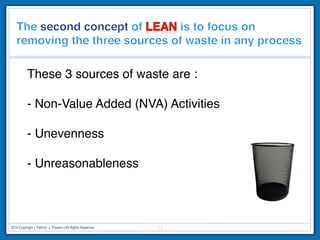
These 3 sources of waste are :"
- Non-Value Added (NVA) Activities"
"
- Unevenness"
"
- Unreasonableness"

2014 Copyright | Patrick. J. Powers | All Rights Reserved

10
NVA Types!
Behavioral

What does it look like?!
Ignoring the knowledge your people bring by failing to engage them in the process,
blaming one another when things go wrong or ignoring our customers’ concerns"

Motion

Walking to/from (a) copiers, (b) central filing locations while executing a process
or (c) scattered departments in a building"

Waiting

Waiting for people to be available, waiting on information, IT applications
downtime or customers waiting for their reports"

Over Production

Processing paperwork before the next person is ready for it, adding features or
functionality that are not needed or the customer does not want"

Processing

Redundant steps in a process, unnecessary sign-offs, approvals, entering the
same data fields multiple times or undefined or unclear customer requirements"

Defects

Anything that is not correct and has to be re-worked, incorrect data entry, wrong
claims billed or missing information on documents"

Inventory/Backlogs

Transportation

2014 Copyright | Patrick. J. Powers | All Rights Reserved

Work that is waiting to be started or completed in our queues, excessive Marketing
and Sales literature, documents/records held beyond the retention period"
Multiple handoffs, multiple approvals, excessive e-mail attachments"

11
•  Unevenness is defined as work activities that fluctuate
significantly"

"- Example: End of the month processing"
•  Unevenness creates unnecessary non-value added activities
such as overproduction, waiting, and inventory"
"

2014 Copyright | Patrick. J. Powers | All Rights Reserved

12
"

•  Unreasonableness is defined as overburdening people or
equipment by pushing beyond the natural limit of their capacity"
•  Overburdening of people causes undue stress which results in
safety, ergonomic, and quality problems"
•  Overburdening of equipment and IT hardware results in
breakdowns and defects"

2014 Copyright | Patrick. J. Powers | All Rights Reserved

13
Current	
  Process	
  

Waste"
< 5%

Process	
  Start	
  

> 95%

Value	
  

2 hrs

6 hrs
Process	
  Lead	
  Time	
  

8 hrs

= True Value-Added Work"

Lean	
  Process	
  

Typical Service Process
!
−  5% of activities add
value!
−  35% are “necessary’”
non-value adding
activities!
−  60% add no value at all!

Process	
  Start	
  

Value	
  

2 hrs

Waste	
  

Process End

+

3 hrs

Process	
  Lead	
  Time	
  

5 hrs
2014 Copyright | Patrick. J. Powers | All Rights Reserved

Process End

Waste	
  

14

3 hrs

Capacity	
  
Work is defined as the tasks and activities that must be performed to deliver a product or
service to a customer

Descriptions

Categories

Actions To Take

- There is a physical change towards completion

Value-Added

- It is done right the first time

Standardize & Optimize

- Customer is willing to pay for it

Non Value-Added
But Necessary

- Activities to meet regulatory requirements

Non Value-Added

- Only adds cost and time

Question & Minimize the
Impact on the Customer

Eliminate

An experienced Lean practitioner has developed the capability to have Eyes for Flow and
Eyes for Waste – “Learning to See” through Lean eyes"
2014 Copyright | Patrick. J. Powers | All Rights Reserved

15
• 

Lean is a proven business system to enhance the effectiveness and
efficiency of any organization which leads to a competitive advantage"

• 

In order to deliver sustainable customer value, employees should apply
and practice Lean Thinking in their daily work life"

• 

To maximize customer value, value has to be determine by the customer!

• 

“Eyes for Waste, Eyes for Flow” – There are many sources of transactional
waste which can prevent employees from meeting and exceeding customer
expectations in a timely and quality manner"

• 

Employees’ primary focus should be on the elimination of those tasks/
activities that are categorized as Non-Value Added"

2014 Copyright | Patrick. J. Powers | All Rights Reserved

16
LEAN

GET IN TOUCH
Website:

www.PatrickJamesPowers.com

Email:

ppowers007@gmail.com

Phone:

404-808-5372
!

Patrick J. Powers, Lean Sensei
2014 Copyright | Patrick. J. Powers | All Rights Reserved

17

LEAN: A Powerful Introduction

  • 1.
    LEAN ! A POWERFULINTRODUCTION! Part One in the Operational Excellence Mini Webinar Series – “WHAT IS LEAN?” 2014 Copyright | Patrick. J. Powers | All Rights Reserved
  • 2.
    •  To providethe participants an understanding of Lean, as well as some of its key principles and concepts." •  At the end of this webinar, you will be able to:"   Understand the principles that act as guideposts for implementing Lean"   Describe Value and who determine it"   Define Waste, its sources and the types of Non Valued Added Activities"   Describe Work and its categories" 2014 Copyright | Patrick. J. Powers | All Rights Reserved 2
  • 3.
      A term coinedby researchers that described Toyota’s business system in comparison with the US auto industry"   Better Quality (Less Rework)"   Lower Cost (Less Waste, Inventory)"   Shorter Delivery Time (Less Processing)"   Lean is a business system focused on maximizing value for customers by eliminating all sources of waste from all aspects of an organization"   The goal of Lean is to deliver sustainable customer value with the highest possible quality at the lowest cost in the shortest time "   Management’s focus changes from optimizing vertical departments (silo mentality) to optimizing flow of our products and services across departments"   Lean creates processes that require"   Less human effort"   Less space"   Less capital"   Less time" 2014 Copyright | Patrick. J. Powers | All Rights Reserved 3
  • 4.
      The core ofLean Thinking is “people solving problems”"     Solving problems logically and systemically"   Verifying the new process eliminates the problem permanently"   Standardizing the new process"   Repeating the cycle for continuous improvement"     Proactively identifying problems" W. Edward Deming’s PDCA Methodology" Fire-fighting is a wasteful activity"   Does not prevent problems from reoccurring" 2014 Copyright | Patrick. J. Powers | All Rights Reserved 4
  • 5.
    •  •  •  The competitive landscapeis becoming tougher " Traditional operating methods are not good enough anymore" Lean also allows an organization to deliver its products and services at the optimal utilization of its resources" −  These resources are:"   People"   Equipment"   Technology"   Material"   Time" 2014 Copyright | Patrick. J. Powers | All Rights Reserved 5
  • 6.
    The application ofLean tools, techniques and methods on product and services will results in:! 1.  Improved Quality and Delivery of products and services" 2.  Reduction in Costs to provide products and services" 3.  Increased Customer Satisfaction" 4.  Increased Market Share / Growth" 5.  Improved Organizational Learning and Development" 6.  Increased Employee Morale" 2014 Copyright | Patrick. J. Powers | All Rights Reserved 6
  • 7.
    Philosophy as theFoundation! •  Base management decisions on a long-term philosophy" The Right Process Will Produce the Right Results! •  Create a continuous process flow to bring problems to the surface" •  Build a culture of stopping to fix problems, to get quality right the first time" •  Standardized tasks and processes are the foundation for continuous improvement and employee empowerment" •  Use visual control so no problems are hidden" •  Use only reliable, thoroughly tested technology that serves your people and process" Add Value to the Organization by Developing Your People! •  Grow leaders who thoroughly understand the work, live the philosophy, teach it to others " •  Develop exceptional people and teams to follow your company’s philosophy " Continuously Solving Root Problems Drive Organizational Learning ! •  “Go and see” for yourself to thoroughly understand the situation [aka “Gemba”]! •  Become a learning organization through relentless reflection and continuous improvement 2014 Copyright | Patrick. J. Powers | All Rights Reserved 7 7
  • 8.
    CONCEPTS OF ! VALUE,WASTE & WORK! 2014 Copyright | Patrick. J. Powers | All Rights Reserved
  • 9.
    What is Value?!  Value is any activity or task that transforms the “deliverables” of a process in such a way that it meets or exceeds the customer expectations."   Value is a “Moment of Truth” experience. At the point of the transaction, the customer receiving the exact product or service they requested, in the right quantity, at the right time, with perfect quality and at the right price." 2014 Copyright | Patrick. J. Powers | All Rights Reserved 9
  • 10.
    These 3 sourcesof waste are :" - Non-Value Added (NVA) Activities" " - Unevenness" " - Unreasonableness" 2014 Copyright | Patrick. J. Powers | All Rights Reserved 10
  • 11.
    NVA Types! Behavioral What doesit look like?! Ignoring the knowledge your people bring by failing to engage them in the process, blaming one another when things go wrong or ignoring our customers’ concerns" Motion Walking to/from (a) copiers, (b) central filing locations while executing a process or (c) scattered departments in a building" Waiting Waiting for people to be available, waiting on information, IT applications downtime or customers waiting for their reports" Over Production Processing paperwork before the next person is ready for it, adding features or functionality that are not needed or the customer does not want" Processing Redundant steps in a process, unnecessary sign-offs, approvals, entering the same data fields multiple times or undefined or unclear customer requirements" Defects Anything that is not correct and has to be re-worked, incorrect data entry, wrong claims billed or missing information on documents" Inventory/Backlogs Transportation 2014 Copyright | Patrick. J. Powers | All Rights Reserved Work that is waiting to be started or completed in our queues, excessive Marketing and Sales literature, documents/records held beyond the retention period" Multiple handoffs, multiple approvals, excessive e-mail attachments" 11
  • 12.
    •  Unevenness isdefined as work activities that fluctuate significantly" "- Example: End of the month processing" •  Unevenness creates unnecessary non-value added activities such as overproduction, waiting, and inventory" " 2014 Copyright | Patrick. J. Powers | All Rights Reserved 12
  • 13.
    " •  Unreasonableness isdefined as overburdening people or equipment by pushing beyond the natural limit of their capacity" •  Overburdening of people causes undue stress which results in safety, ergonomic, and quality problems" •  Overburdening of equipment and IT hardware results in breakdowns and defects" 2014 Copyright | Patrick. J. Powers | All Rights Reserved 13
  • 14.
    Current  Process   Waste" <5% Process  Start   > 95% Value   2 hrs 6 hrs Process  Lead  Time   8 hrs = True Value-Added Work" Lean  Process   Typical Service Process ! −  5% of activities add value! −  35% are “necessary’” non-value adding activities! −  60% add no value at all! Process  Start   Value   2 hrs Waste   Process End + 3 hrs Process  Lead  Time   5 hrs 2014 Copyright | Patrick. J. Powers | All Rights Reserved Process End Waste   14 3 hrs Capacity  
  • 15.
    Work is definedas the tasks and activities that must be performed to deliver a product or service to a customer Descriptions Categories Actions To Take - There is a physical change towards completion Value-Added - It is done right the first time Standardize & Optimize - Customer is willing to pay for it Non Value-Added But Necessary - Activities to meet regulatory requirements Non Value-Added - Only adds cost and time Question & Minimize the Impact on the Customer Eliminate An experienced Lean practitioner has developed the capability to have Eyes for Flow and Eyes for Waste – “Learning to See” through Lean eyes" 2014 Copyright | Patrick. J. Powers | All Rights Reserved 15
  • 16.
    •  Lean is aproven business system to enhance the effectiveness and efficiency of any organization which leads to a competitive advantage" •  In order to deliver sustainable customer value, employees should apply and practice Lean Thinking in their daily work life" •  To maximize customer value, value has to be determine by the customer! •  “Eyes for Waste, Eyes for Flow” – There are many sources of transactional waste which can prevent employees from meeting and exceeding customer expectations in a timely and quality manner" •  Employees’ primary focus should be on the elimination of those tasks/ activities that are categorized as Non-Value Added" 2014 Copyright | Patrick. J. Powers | All Rights Reserved 16
  • 17.
    LEAN GET IN TOUCH Website: www.PatrickJamesPowers.com Email: ppowers007@gmail.com Phone: 404-808-5372 ! PatrickJ. Powers, Lean Sensei 2014 Copyright | Patrick. J. Powers | All Rights Reserved 17

Editor's Notes

  • #14 Instructor Should Say:As we eliminate waste in our process, we are able to increase our capacity to performed more work.In other words, the time we are currently using to performed non value add work can be use to perform value add work.