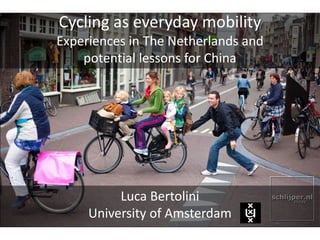
Cycling as everyday mobility
Experiences in The Netherlands and
potential lessons for China
Luca Bertolini
University of Amsterdam
Cycling, why bother?
• Together with walking most environmentally
sustainable transport mode
• Clean, quiet, space efficient
• Contributes to, rather than detracts from the
quality of public space
• Inexpensive, for both the individual and the
public
• Healthy
• Fun
• Cool
Share of cycling as percentage of all trips in 14 countries
(Buehler and Pucher, 2012)
To see what a world where cycling is a significant part
of everyday mobility would look like , The Netherlands
is the place to go
27%
Amsterdam streets
Weekday rush-hour
Saturday shopping
Out on a date
Walking the dog
‘Sports Utility Vehicle’
‘Station Wagon’
‘Pick Up Truck’
Whatever the age
Whatever the age
Whatever the weather
In Amsterdam, 31% of all trips are by bike – and
the share is growing, mostly at the expense of
the car
0%
10%
20%
30%
40%
50%
60%
70%
80%
90%
100%
1986-
1991
1994-
1997
1998-
2000
2001-
2004
2005-
2008
2011 2013
walking
cycling
PT
car
(O+S Amsterdam)
walking 28%
PT 17%
cycling 31%
car 20%
• Gaining insight-1: who, what for, and where is
cycling in the Netherlands?
Who?
• No major differences by:
– Sex
– Household composition
– Income
– Education levels
The share of cycling is high among children, peaks at
teen-age, then declines and stabilizes, and falls past 75
Age group Cycling share
Total 27
0–11 years 39
12–17 years 63
18–29 years 21
30–39 years 19
40–49 years 22
50–64 years 23
65–74 years 20
≥ 75 years 13
Share of cycling in total trips by age group
(NTS 2010/2011)
Cycling share growing among the younger and
the older generations
Changes in cycling share by age group 1985–2007
(NTS 1985-2007)
Migrants cycle less than natives, those with a
non-western background much less
Cycling share
Total 27
Native Dutch 28
Western migrant 25
Non-Western migrant 18
Share of cycling in total trips by ethnic background
(NTS 2010/2011)
Growing, possibly because of
diminished car-orientation,
studying longer, forming a
family later
How to maintain?
Low, possibly because of lack of
habit and status
How to stimulate?
Growing, possibly because of
better health, more active
lifestyle
How to facilitate?
What for?
Cycling share
Total 27
Work 25
Education 46
Shopping 29
Leisure 23
Dutch cycle for all purposes, but (much) more
for education, and (somewhat) less for leisure
Share of cycling by trip purpose
(NTS 2010/2011)
Where?
Cycling share
Total 27
Very highly urbanized 27
Highly urbanized 26
Moderately urbanized 28
Less urbanized 27
Not urbanized 23
Dutch cycle in all spatial contexts, more in
urbanized than in non urbanized areas
Share of cycling by urbanization rate
(NTS 2010/2011)
In cities, the share of cycling is growing,
in rural areas it is declining
Urban Rural
1994-96 2007-09 1994-96 2007-09
Cycling
share
25% 27% 27% 25%
Changes in cycling share by urbanization rate 1994–2009
(NTS 1994-2009)
Differences in cycling volumes are becoming
much greater
Cycling volumes by urbanization rate 1994–2012
(NTS 2012 / Statistics Netherlands 1994–2012)
Growing, because of
more, and younger
people moving to cities,
or staying there longer
How to accommodate
the growth?
Declining, because of
people leaving,
especially young people,
and because jobs and
services are thinning out
How to stem the
decline?
Beyond the general patterns, large differences at
the individual city level
Cycling share in medium sized Dutch cities, 2010-2012
(NTS 2010-2012)
• What explains individual differences?
• Gaining insight-2: what is the role of policy in
the performance of cycling in The
Netherlands?
Conceptual model
Performance measures
(change in)
Cycling share
Cycling safety
Perception of cycling
conditions
Critical success factors
(change in)
Hardware - pull conditions
Hardware - push conditions
Software conditions
Orgware conditions
Social context
Spatial context
-Changes since 2000
-In 22 mid sized cities
-By means of Rough Set Analysis
Hardware - pull conditions
Cycling network quantity
Cycling network quality
Cycling network safety
Cycling network facilities (parking)
Hardware - push conditions
Cycling network speed relative to car
Car parking tariffs
Area size with car parking regulation
Software conditions
Educating children
Educating adults
Marketing campaigns with incentive
Marketing campaigns without incentive
Orgware conditions
Formulation of policy goals
Implementation of policy measures
Financial sources for cycling policy
Allowing scope for experimental measures
Policy adaptability
Institutional arrangement of cycling policy
Involvement of actors outside policy arena
Relationship between actors inside and outside policy arena
Levels of citizen participation
Leadership
Social context
Population size
Number of households
Composition of households
Spatial context
Number of destinations within 3 km
• Cycling shares have been increasing in
cities characterized by…
Hardware
- an increase in the speed of bike trips relative to car
trips
Orgware
- successful in implementing most of the proposed
interventions
- high levels of citizen participation
- a combination of the above factors
• Cycling safety has been increasing in
cities characterized by…
Hardware
- an increase of on-street car parking tariffs and
enlargement of the area of paid on-street car parking
- an increase in #crossings where cyclists have priority
- an increase in % asphalt/tarmac on bike paths
Software
- giving much attention to cycling education for
children
Orgware
- high degree of flexibility in policy
- authoritative (or charismatic) leaders
• The perception of cycling conditions
has been improving in cities
characterized by…
Hardware
- enlargement of the area of paid on-street car parking
- an increase in the supply of bicycle parking facilities
at stations areas
Orgware
- high levels of citizen participation
- successful in implementing most of the proposed
interventions
- authoritative (or charismatic) leaders
- much scope for experimental interventions
• Overall, adding to the literature:
– Both pull (pro-bike) and push (anti-car) hardware
– Not only hardware
– Combinations important
Also for China?
The potential benefits seem evident,
but can it be done?
• Chinese cities now, reminding of cities in
Western Europe in the 1960s
Share of cycling in all trips in selected European cities,
1920-1995
(Bruheze & Veraart, 1999)
Amsterdam 1969: modernizing the city,
facilitating the car
46
“Stop the child murder”
“Safe pedestrian and bike paths”
“Stay out our neighborhood”
““Together with the neighborhoods we can also
make plans!”
Amsterdam, 2013: street priorities reassessed
Amsterdam, 2013: the urban fabric/mix preserved
Not only in the centre:
Amsterdam, main cycle network
Not only in the centre:
Amsterdam, functional mix at street level
Services
Employment
Residential
Also in new developments: e.g. Houten new town
Houten: main cycle network
Cycle paths
Shared roads
Main roads
Railways
(Zhao, 2014)
China, reversing the trend?
Share of cycling in all trips in major Chinese
cities, 1986-2011
China: reassessing priorities on streets?
Guangzhou
China: preserving the urban fabric/mix?
Guangzhou
China: also out of centre & in new developments?
?
“Not for Chinese cities”
• “Trips too long”
– Many trips are within bike range (3-6 km at
leisurely pace)
– And: more trips can be brought within bike range
(by mixing functions)
– Innovations and combinations can expand the
spatial reach of the bike
Innovation-1: the e-bike
• In The Netherlands, by now around half of the
bike-km of those aged 65 or more are by e-bike
Innovation-2: bike highways
potential
existing
potential
under development
potentialpotentialpotentialpotential
Combination: bike-train
47%
Combination: bike-train
12%
• Why so successful?
• Train fast, bike flexible
– Faster than walk-train
– More flexible than bus/tram-train
• Competitive with car
– Not bike alone, too slow
– Not train alone, too rigid
• NB: train in the Netherlands � metro in
Chinese cities
Combination: bike-train
• “Not enough space”
– Bike 7 x more space efficient than car (10 x when
parked)
– Bike 1,5 more space efficient than bus
• “Air too polluted”
– Not cycling, but pollution is the problem
– Pollution problem for everybody, not only cyclists
– Cycling can be a part of the solution
• “Too unsafe”
– It is not, when infrastructure, laws, attitudes and
numbers are there
Risk of death from traffic accidents in
The Netherlands 2010-2012
Deaths per Bike Car
billion trips 32,6 37,4
billion mins 1,9 1,2
(Institute for Road Safety Research, Statistics Netherlands)
Thanks, let’s discuss!
Bike friendly urban form & streets
Amsterdam
Urban district form (illustrative)
Transport: pedestrians, bicycles, cars, freight, urban public
transport
Land use: mixed, continuous commercial plinth, some fully
commercial buildings
Transport: pedestrians, bicycles, cars and freight with
restrictions (e.g. one way, speed limit, time windows)
Land use: mixed, continuous commercial plinth, mainly
residential upper floors
Urban district form (illustrative)
Transport: pedestrians, bicycles, cars & freight exceptional (e.g. for
moving or construction)
Land use: mixed, plinth alternating residential and commercial,
residential upper floors
Urban district form (illustrative)
Transport: pedestrians, bicycles with restrictions (one way,
speed limit)
Land use: residential (but including working from home)
Urban district form (illustrative)
Bike friendly urban form & streets
Guangzhou
Transport: pedestrians, bicycles, cars, freight, urban public
transport
Land use: mixed, continuous commercial plinth, some fully
commercial buildings
Urban district form (illustrative)
Transport: pedestrians, bicycles, cars and freight with
restrictions (e.g. one way, speed limit, time windows)
Land use: mixed, continuous commercial plinth, mainly
residential upper floors
Urban district form (illustrative)
Transport: pedestrians, bicycles, cars & freight exceptional (e.g. for
moving or construction)
Land use: mixed, plinth alternating residential and commercial,
residential upper floors
Urban district form (illustrative)
Transport: pedestrians, bicycles with restrictions (one way,
speed limit)
Land use: residential (but including working from home)
Urban district form (illustrative)
(Zhao, 2014)
China, reversing the trend?
Share of the car in all trips in major Chinese
cities, 1986-2011
China, reversing the trend?
Transportation mode share in total trips - excluding
walking - in Beijing City
62,7
38,5
30,3
23
20,3
18,1 16,4
0
10
20
30
40
50
60
70
1986 2000 2005 2007 2008 2009 2010
Private Car
Bus
Subway
Bike
Taxi
Share: %
(Beijing Transportation Research Centre)

Beijing 2014

  • 1.
    Cycling as everydaymobility Experiences in The Netherlands and potential lessons for China Luca Bertolini University of Amsterdam
  • 2.
    Cycling, why bother? •Together with walking most environmentally sustainable transport mode • Clean, quiet, space efficient • Contributes to, rather than detracts from the quality of public space • Inexpensive, for both the individual and the public • Healthy • Fun • Cool
  • 3.
    Share of cyclingas percentage of all trips in 14 countries (Buehler and Pucher, 2012) To see what a world where cycling is a significant part of everyday mobility would look like , The Netherlands is the place to go 27%
  • 4.
  • 5.
  • 6.
  • 7.
  • 8.
  • 9.
  • 10.
  • 11.
  • 12.
  • 13.
  • 14.
  • 15.
  • 16.
    In Amsterdam, 31%of all trips are by bike – and the share is growing, mostly at the expense of the car 0% 10% 20% 30% 40% 50% 60% 70% 80% 90% 100% 1986- 1991 1994- 1997 1998- 2000 2001- 2004 2005- 2008 2011 2013 walking cycling PT car (O+S Amsterdam) walking 28% PT 17% cycling 31% car 20%
  • 17.
    • Gaining insight-1:who, what for, and where is cycling in the Netherlands?
  • 18.
  • 19.
    • No majordifferences by: – Sex – Household composition – Income – Education levels
  • 20.
    The share ofcycling is high among children, peaks at teen-age, then declines and stabilizes, and falls past 75 Age group Cycling share Total 27 0–11 years 39 12–17 years 63 18–29 years 21 30–39 years 19 40–49 years 22 50–64 years 23 65–74 years 20 ≥ 75 years 13 Share of cycling in total trips by age group (NTS 2010/2011)
  • 21.
    Cycling share growingamong the younger and the older generations Changes in cycling share by age group 1985–2007 (NTS 1985-2007)
  • 22.
    Migrants cycle lessthan natives, those with a non-western background much less Cycling share Total 27 Native Dutch 28 Western migrant 25 Non-Western migrant 18 Share of cycling in total trips by ethnic background (NTS 2010/2011)
  • 23.
    Growing, possibly becauseof diminished car-orientation, studying longer, forming a family later How to maintain? Low, possibly because of lack of habit and status How to stimulate? Growing, possibly because of better health, more active lifestyle How to facilitate?
  • 24.
  • 25.
    Cycling share Total 27 Work25 Education 46 Shopping 29 Leisure 23 Dutch cycle for all purposes, but (much) more for education, and (somewhat) less for leisure Share of cycling by trip purpose (NTS 2010/2011)
  • 26.
  • 27.
    Cycling share Total 27 Veryhighly urbanized 27 Highly urbanized 26 Moderately urbanized 28 Less urbanized 27 Not urbanized 23 Dutch cycle in all spatial contexts, more in urbanized than in non urbanized areas Share of cycling by urbanization rate (NTS 2010/2011)
  • 28.
    In cities, theshare of cycling is growing, in rural areas it is declining Urban Rural 1994-96 2007-09 1994-96 2007-09 Cycling share 25% 27% 27% 25% Changes in cycling share by urbanization rate 1994–2009 (NTS 1994-2009)
  • 29.
    Differences in cyclingvolumes are becoming much greater Cycling volumes by urbanization rate 1994–2012 (NTS 2012 / Statistics Netherlands 1994–2012)
  • 30.
    Growing, because of more,and younger people moving to cities, or staying there longer How to accommodate the growth? Declining, because of people leaving, especially young people, and because jobs and services are thinning out How to stem the decline?
  • 31.
    Beyond the generalpatterns, large differences at the individual city level Cycling share in medium sized Dutch cities, 2010-2012 (NTS 2010-2012)
  • 32.
    • What explainsindividual differences? • Gaining insight-2: what is the role of policy in the performance of cycling in The Netherlands?
  • 33.
    Conceptual model Performance measures (changein) Cycling share Cycling safety Perception of cycling conditions Critical success factors (change in) Hardware - pull conditions Hardware - push conditions Software conditions Orgware conditions Social context Spatial context -Changes since 2000 -In 22 mid sized cities -By means of Rough Set Analysis
  • 34.
    Hardware - pullconditions Cycling network quantity Cycling network quality Cycling network safety Cycling network facilities (parking) Hardware - push conditions Cycling network speed relative to car Car parking tariffs Area size with car parking regulation
  • 35.
    Software conditions Educating children Educatingadults Marketing campaigns with incentive Marketing campaigns without incentive
  • 36.
    Orgware conditions Formulation ofpolicy goals Implementation of policy measures Financial sources for cycling policy Allowing scope for experimental measures Policy adaptability Institutional arrangement of cycling policy Involvement of actors outside policy arena Relationship between actors inside and outside policy arena Levels of citizen participation Leadership
  • 37.
    Social context Population size Numberof households Composition of households Spatial context Number of destinations within 3 km
  • 38.
    • Cycling shareshave been increasing in cities characterized by… Hardware - an increase in the speed of bike trips relative to car trips Orgware - successful in implementing most of the proposed interventions - high levels of citizen participation - a combination of the above factors
  • 39.
    • Cycling safetyhas been increasing in cities characterized by… Hardware - an increase of on-street car parking tariffs and enlargement of the area of paid on-street car parking - an increase in #crossings where cyclists have priority - an increase in % asphalt/tarmac on bike paths Software - giving much attention to cycling education for children Orgware - high degree of flexibility in policy - authoritative (or charismatic) leaders
  • 40.
    • The perceptionof cycling conditions has been improving in cities characterized by… Hardware - enlargement of the area of paid on-street car parking - an increase in the supply of bicycle parking facilities at stations areas Orgware - high levels of citizen participation - successful in implementing most of the proposed interventions - authoritative (or charismatic) leaders - much scope for experimental interventions
  • 41.
    • Overall, addingto the literature: – Both pull (pro-bike) and push (anti-car) hardware – Not only hardware – Combinations important
  • 42.
  • 43.
    The potential benefitsseem evident, but can it be done? • Chinese cities now, reminding of cities in Western Europe in the 1960s
  • 44.
    Share of cyclingin all trips in selected European cities, 1920-1995 (Bruheze & Veraart, 1999)
  • 45.
    Amsterdam 1969: modernizingthe city, facilitating the car
  • 46.
    46 “Stop the childmurder” “Safe pedestrian and bike paths”
  • 47.
    “Stay out ourneighborhood” ““Together with the neighborhoods we can also make plans!”
  • 48.
    Amsterdam, 2013: streetpriorities reassessed
  • 49.
    Amsterdam, 2013: theurban fabric/mix preserved
  • 50.
    Not only inthe centre: Amsterdam, main cycle network
  • 51.
    Not only inthe centre: Amsterdam, functional mix at street level Services Employment Residential
  • 52.
    Also in newdevelopments: e.g. Houten new town
  • 53.
    Houten: main cyclenetwork Cycle paths Shared roads Main roads Railways
  • 54.
    (Zhao, 2014) China, reversingthe trend? Share of cycling in all trips in major Chinese cities, 1986-2011
  • 55.
    China: reassessing prioritieson streets? Guangzhou
  • 56.
    China: preserving theurban fabric/mix? Guangzhou
  • 57.
    China: also outof centre & in new developments? ?
  • 58.
    “Not for Chinesecities” • “Trips too long” – Many trips are within bike range (3-6 km at leisurely pace) – And: more trips can be brought within bike range (by mixing functions) – Innovations and combinations can expand the spatial reach of the bike
  • 59.
  • 60.
    Innovation-1: the e-bike •In The Netherlands, by now around half of the bike-km of those aged 65 or more are by e-bike
  • 61.
    Innovation-2: bike highways potential existing potential underdevelopment potentialpotentialpotentialpotential
  • 62.
  • 63.
  • 64.
    • Why sosuccessful? • Train fast, bike flexible – Faster than walk-train – More flexible than bus/tram-train • Competitive with car – Not bike alone, too slow – Not train alone, too rigid • NB: train in the Netherlands � metro in Chinese cities Combination: bike-train
  • 65.
    • “Not enoughspace” – Bike 7 x more space efficient than car (10 x when parked) – Bike 1,5 more space efficient than bus
  • 66.
    • “Air toopolluted” – Not cycling, but pollution is the problem – Pollution problem for everybody, not only cyclists – Cycling can be a part of the solution
  • 67.
    • “Too unsafe” –It is not, when infrastructure, laws, attitudes and numbers are there
  • 68.
    Risk of deathfrom traffic accidents in The Netherlands 2010-2012 Deaths per Bike Car billion trips 32,6 37,4 billion mins 1,9 1,2 (Institute for Road Safety Research, Statistics Netherlands)
  • 69.
  • 71.
    Bike friendly urbanform & streets Amsterdam
  • 72.
    Urban district form(illustrative) Transport: pedestrians, bicycles, cars, freight, urban public transport Land use: mixed, continuous commercial plinth, some fully commercial buildings
  • 73.
    Transport: pedestrians, bicycles,cars and freight with restrictions (e.g. one way, speed limit, time windows) Land use: mixed, continuous commercial plinth, mainly residential upper floors Urban district form (illustrative)
  • 74.
    Transport: pedestrians, bicycles,cars & freight exceptional (e.g. for moving or construction) Land use: mixed, plinth alternating residential and commercial, residential upper floors Urban district form (illustrative)
  • 75.
    Transport: pedestrians, bicycleswith restrictions (one way, speed limit) Land use: residential (but including working from home) Urban district form (illustrative)
  • 76.
    Bike friendly urbanform & streets Guangzhou
  • 77.
    Transport: pedestrians, bicycles,cars, freight, urban public transport Land use: mixed, continuous commercial plinth, some fully commercial buildings Urban district form (illustrative)
  • 78.
    Transport: pedestrians, bicycles,cars and freight with restrictions (e.g. one way, speed limit, time windows) Land use: mixed, continuous commercial plinth, mainly residential upper floors Urban district form (illustrative)
  • 79.
    Transport: pedestrians, bicycles,cars & freight exceptional (e.g. for moving or construction) Land use: mixed, plinth alternating residential and commercial, residential upper floors Urban district form (illustrative)
  • 80.
    Transport: pedestrians, bicycleswith restrictions (one way, speed limit) Land use: residential (but including working from home) Urban district form (illustrative)
  • 82.
    (Zhao, 2014) China, reversingthe trend? Share of the car in all trips in major Chinese cities, 1986-2011
  • 83.
    China, reversing thetrend? Transportation mode share in total trips - excluding walking - in Beijing City 62,7 38,5 30,3 23 20,3 18,1 16,4 0 10 20 30 40 50 60 70 1986 2000 2005 2007 2008 2009 2010 Private Car Bus Subway Bike Taxi Share: % (Beijing Transportation Research Centre)