Normalising
cycling
or: how we can talk inclusively about cycling______________________________________________________
Katja Leyendecker EurIng CEng
Researcher at Northumbria University, UK
Prepared for Aalto University:
Summer School on Transportation 2018
“Enabling human-centered mobility systems”
1
Why bother with cycling?
Cycling is…
• Good for our environments
• Good for personal wellbeing and public health
• Good for the local economy
• Good for community and neighbourhoods, active citizens
• Good for the individual’s pocket
• Good for public purse
Cycling addresses big needs of today:
climate change / carbon emission reduction
public health / obesity
environmental improvement
(social, economic and environmental justice)
2
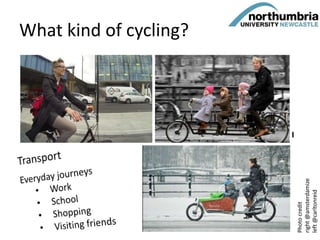
What kind of cycling?
Photocredit
right@amsterdamize
left@carltonreid
3
Fiona Spotswood et al (2015)
Despite significant national and local
efforts over the last decade to
stimulate uptake of cycling in the UK,
levels of cycling (particularly utility
cycling) remain at around 2% of
journeys
From the academic message boards
4
“stubbornly unshifting”
It is clear from our research that most
non-cyclists and recreational cyclists will
only consider cycling regularly if they are
segregated from [motor vehicle] traffic
Pooley et al (2013:176)
From the academic message boards
5
No city in Europe or North America has achieved
high level of cycling without an extensive network
of well-integrated bike lanes and paths that
provide separation from motor vehicle traffic. […]
Separate cycling facilities are a crucial first step
towards increasing cycling and making it socially
inclusive.
Pucher & Buehler (2012:351)
From the academic message boards
6
Urban environment and people
People typically know the benefits of cycling
People cycle when
• their local environments are supportive
• it is designed into the urban fabric
Key ingredient
Protected cycleways on main roads ie on direct routes (Pooley, Pucher)
But
People’s view can be fast/ snap, static/engrained, habitual
People ‘support’ perceived status quo and social norm
People’s view can be irrational
People may have fear / anxiety of change
People find it hard to imagine (spatial) change
Recent cycleway schemes saw backlash
f.e. Sadik-Khan (2016)
7
Some data
8
UK Census 2011
• high coverage 19/20
• every 10 years
• Tight, and only, travel question
"how do you usually travel to work"
• main mode, by distance
• commute / working population only
9
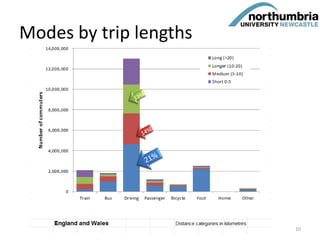
Modes by trip lengths
10
8%
15%
20%
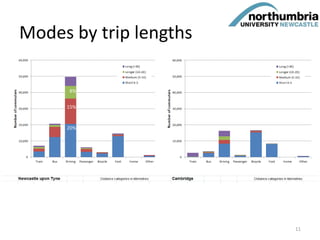
Modes by trip lengths
11
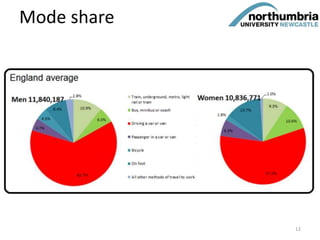
Mode share
12
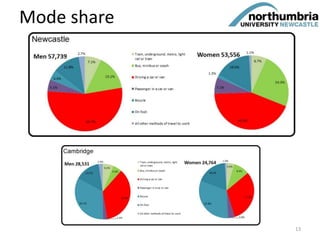
Mode share
13
Beyond the commute
14
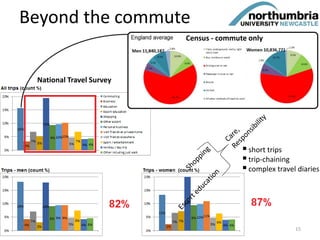
Beyond the commute
Census - commute only
short trips
trip-chaining
complex travel diaries
National Travel Survey
15
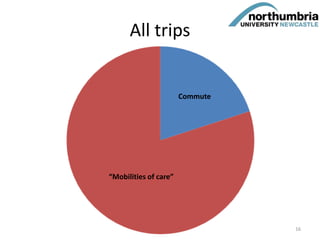
All trips
Commute
“Mobilities of care”
16
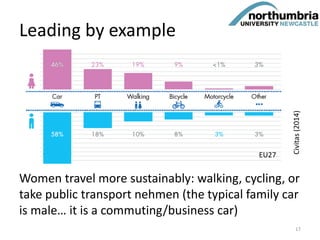
Leading by example
Women travel more sustainably: walking, cycling, or
take public transport nehmen (the typical family car
is male… it is a commuting/business car)
EU27
Civitas(2014)
17
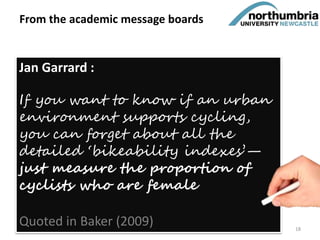
From the academic message boards
Jan Garrard :
If you want to know if an urban
environment supports cycling,
you can forget about all the
detailed ‘bikeability indexes’—
just measure the proportion of
cyclists who are female
Quoted in Baker (2009) 18
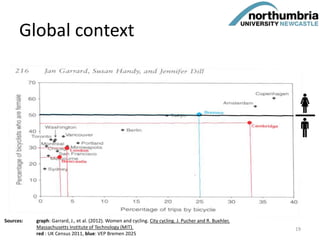
Global context
Sources: graph: Garrard, J., et al. (2012). Women and cycling. City cycling. J. Pucher and R. Buehler,
Massachusetts Institute of Technology (MIT).
red : UK Census 2011, blue: VEP Bremen 2025
19
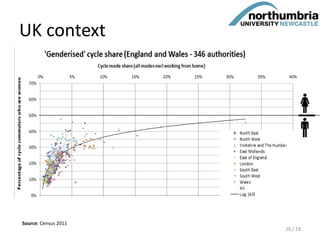
UK context
Source: Census 2011
20 / 18
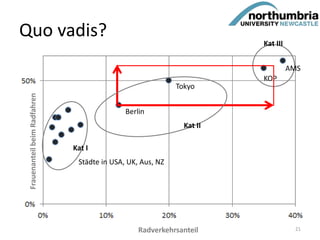
Quo vadis?FrauenanteilbeimRadfahren
Radverkehrsanteil
Berlin
Tokyo
Städte in USA, UK, Aus, NZ
KOP
AMS
Kat I
Kat II
Kat III
21
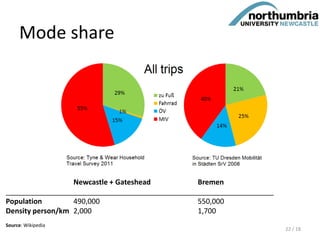
Mode share
Newcastle + Gateshead Bremen
___________________________________________________________________
Population 490,000 550,000
Density person/km 2,000 1,700
Source: Wikipedia
22 / 18
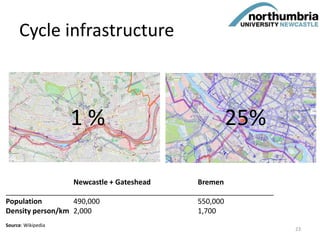
Cycle infrastructure
Newcastle + Gateshead Bremen
___________________________________________________________________
Population 490,000 550,000
Density person/km 2,000 1,700
Source: Wikipedia
1 % 25%
23
Some sociology
Putting the social into the technocratic practices
of highway engineering and transport planning
24
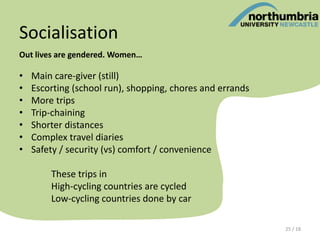
Socialisation
Out lives are gendered. Women…
• Main care-giver (still)
• Escorting (school run), shopping, chores and errands
• More trips
• Trip-chaining
• Shorter distances
• Complex travel diaries
• Safety / security (vs) comfort / convenience
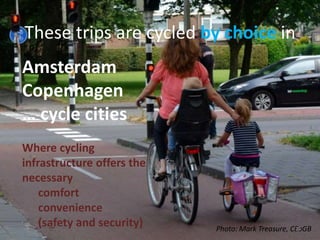
These trips in
High-cycling countries are cycled
Low-cycling countries done by car
25 / 18
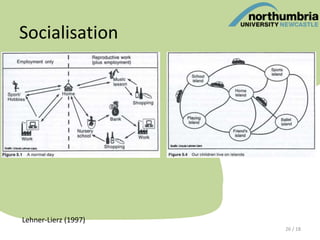
Socialisation
26 / 18
Lehner-Lierz (1997)
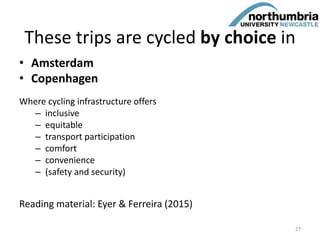
These trips are cycled by choice in
• Amsterdam
• Copenhagen
Where cycling infrastructure offers
– inclusive
– equitable
– transport participation
– comfort
– convenience
– (safety and security)
Reading material: Eyer & Ferreira (2015)
27
These trips are cycled by choice in
Amsterdam
Copenhagen
… cycle cities
Where cycling
infrastructure offers the
necessary
comfort
convenience
(safety and security) Photo: Mark Treasure, CEoGB28
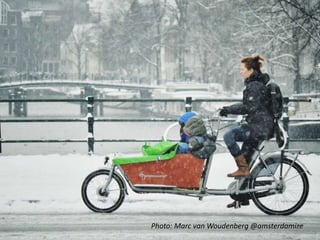
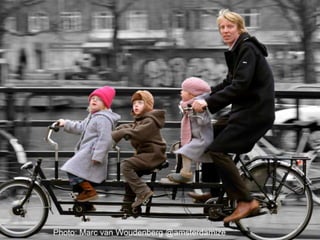
Photo: Marc van Woudenberg @amsterdamize29
30
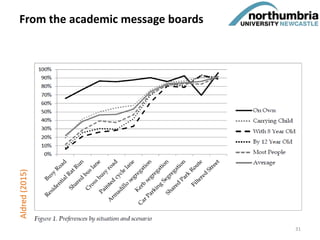
From the academic message boardsAldred(2015)
31
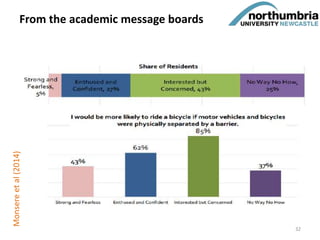
Monsereetal(2014)From the academic message boards
32
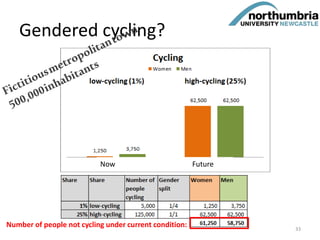
Gendered cycling?
Now Future
Number of people not cycling under current condition: 33
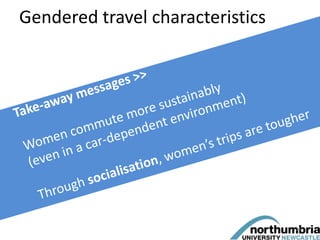
Gendered travel characteristics
34
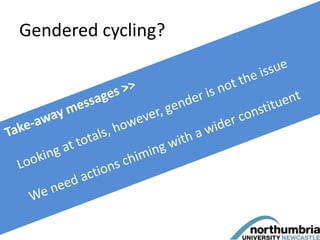
Gendered cycling?
35
Interested but concerned
36
What’s needed?
New concepts
“Mobility of care”
Sanchez de Madariaga (2013)
37
The S.E.M.
38
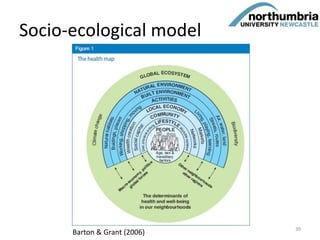
Socio-ecological model
Barton & Grant (2006) 39
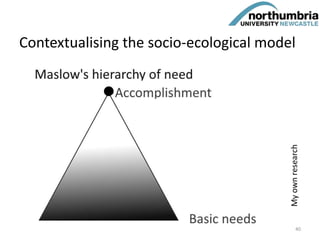
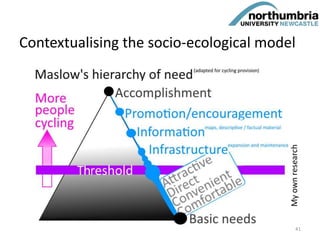
Contextualising the socio-ecological model
Myownresearch
40
Contextualising the socio-ecological model
Myownresearch
41
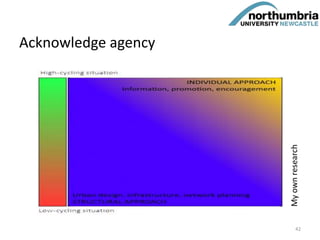
Acknowledge agency
Myownresearch
42
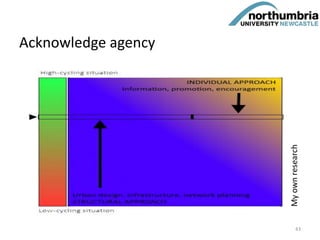
Acknowledge agency
Myownresearch
43
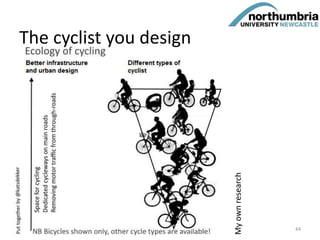
The cyclist you design
Myownresearch
44
Why is change so slow?
45
Fiona Spotswood et al (2015)
Despite significant national and local
efforts over the last decade to
stimulate uptake of cycling in the UK,
levels of cycling (particularly utility
cycling) remain at around 2% of
journeys
From the academic message boards
46
“stubbornly unshifting”
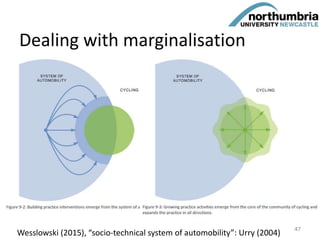
Dealing with marginalisation
Wesslowski (2015), “socio-technical system of automobility”: Urry (2004)
47
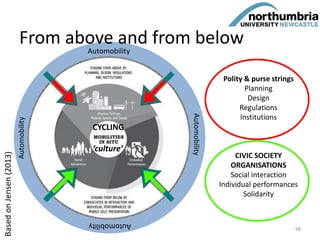
From above and from below
BasedonJensen(2013)
CYCLING
‘culture’
Automobility
Automobility
Automobility
Automobility
Polity & purse strings
Planning
Design
Regulations
Institutions
CIVIC SOCIETY
ORGANISATIONS
Social interaction
Individual performances
Solidarity
48
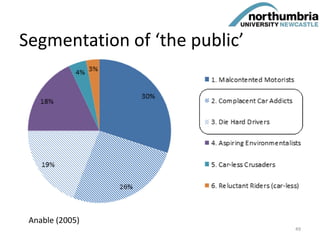
Segmentation of ‘the public’
Anable (2005)
49
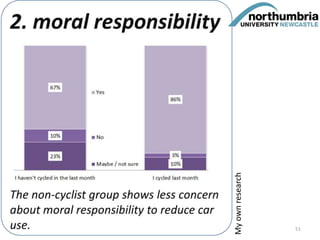
Myownresearch
50
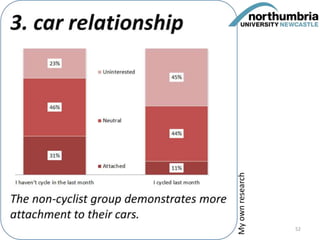
Myownresearch
51
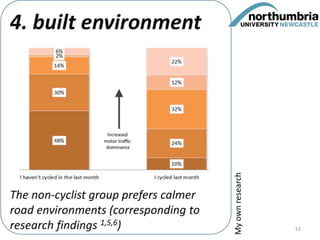
Myownresearch
52
Myownresearch
53
Social dilemma
• Car dependent society
• Material alternatives currently limited (…only
as good as the nearest alternative)
• Neoliberal politics (big business first, detached
from citizens and their needs)
… The citizen you design
54
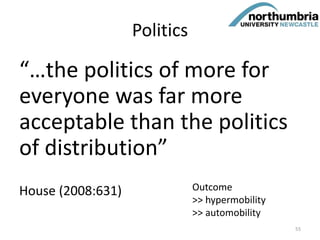
Politics
“…the politics of more for
everyone was far more
acceptable than the politics
of distribution”
House (2008:631)
55
Outcome
>> hypermobility
>> automobility
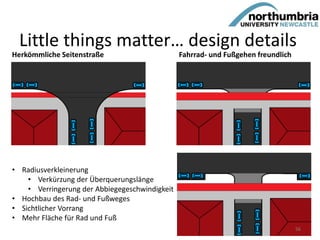
Herkömmliche Seitenstraße Fahrrad- und Fußgehen freundlich
• Radiusverkleinerung
• Verkürzung der Überquerungslänge
• Verringerung der Abbiegegeschwindigkeit
• Hochbau des Rad- und Fußweges
• Sichtlicher Vorrang
• Mehr Fläche für Rad und Fuß
Little things matter… design details
56
Taking position
Clear message:
To make cycling comfortable for all, we need a network of good
quality protected cycleways – inclusive for people of all ages
and abilities
• Direct, along main roads
• Space taken from carriageway
• Footway not compromised
For whom are we speaking (out) / designing?
57
More studies…
• To show that building cycleways works
i.e. increases transport cycling
• Segmentation of population: what do
people want?
58
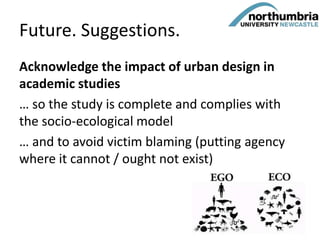
Future. Suggestions.
Acknowledge the impact of urban design in
academic studies
… so the study is complete and complies with
the socio-ecological model
… and to avoid victim blaming (putting agency
where it cannot / ought not exist)
59
References
Aldred, Rachel. 2015. “Adults’ Attitudes towards Child Cycling: A Study of the Impact of Infrastructure.” European Journal of Transport and
Infrastructure Research 15 (2): 92–115.
Anable, Jillian. 2005. “‘Complacent Car Addicts’ or ‘Aspiring Environmentalists’? Identifying Travel Behaviour Segments Using Attitude
Theory.” Transport Policy 12 (1): 65–78. https://doi.org/10.1016/j.tranpol.2004.11.004.
Baker, Linda. 2009. “How to Get More Bicyclists on the Road.” Scientific American, September 21, 2009.
http://www.scientificamerican.com/article/getting-more-bicyclists-on-the-road/?page=1.
Barton, Hugh, and Marcus Grant. 2006. “A Health Map for the Local Human Habitat.” Journal of The Royal Society for the Promotion of Health
126 (6): 252–53. https://doi.org/10.1177/1466424006070466.
Civitas. 2014. “Smart Choices for Cities - Gender Equality and Mobility: Mind the Gap!” Policy Note. Civitas Policy Notes.
http://civitas.eu/sites/default/files/civ_pol-an2_m_web.pdf.
Eyer, Amanda, and Antonio Ferreira. 2015. “Taking the Tyke on a Bike: Mother’s; and Childless Women’s Space- Time Geographies in
Amsterdam Compared.” Environment and Planning A: Economy and Space 47 (3): 691–708. https://doi.org/10.1068/a140373p.
Garrard, Jan, Susan Handy, and Jennifer Dill. 2012. “Women and Cycling.” In City Cycling, edited by John Pucher and Ralph Buehler. MIT Press.
House, Ernest R. 2008. “Qualitative Evaluation and Changing Social Policy.” In Collecting and Interpreting Qualitative Materials (3rd Edition),
edited by Norman K. Denzin and Yvonna S. Lincoln. Sage Publications.
Jensen, Ole B. 2013. Staging Mobilities. Book, Whole. Routledge.
Lehner-Lierz, Ursula. 1997. “The Role of Cycling for Women.” In The Greening of Urban Transport: Planning for Walking & Cycling in Western
Cities, edited by Rodney Tolley. Wiley and Son.
Pooley, Colin G, Tim Jones, Miles Tight, Dave Horton, Griet Scheldeman, Caroline Mullen, Ann Jopson, and Emanuele Strano. 2013. Promoting
Walking and Cycling : New Perspectives on Sustainable Travel. Bristol, UK: Policy Press.
Pucher, John R., and Ralph Buehler. 2012. City Cycling. Book, Whole. Cambridge, MA, USA: MIT Press.
Spotswood, Fiona, Tim Chatterton, Alan Tapp, and David Williams. 2015. “Analysing Cycling as a Social Practice: An Empirical Grounding for
Behaviour Change.” Transportation Research Part F: Traffic Psychology and Behaviour 29: 22–33. https://doi.org/10.1016/j.trf.2014.12.001.
Urry, J. 2004. “The ‘System’ of Automobility.” Theory, Culture & Society 21 (4–5): 25–39. https://doi.org/10.1177/0263276404046059.
Wesslowski, Viktoria. 2014. “Facilitating a Contested Practice: Building and Growing Urban Transport Cycling in Santiago de Chile.”
Manchester. https://www.escholar.manchester.ac.uk/uk-ac-man-scw:224324. 60

Aalto Summer School lecture "normalising cycling"

  • 1.
    Normalising cycling or: how wecan talk inclusively about cycling______________________________________________________ Katja Leyendecker EurIng CEng Researcher at Northumbria University, UK Prepared for Aalto University: Summer School on Transportation 2018 “Enabling human-centered mobility systems” 1
  • 2.
    Why bother withcycling? Cycling is… • Good for our environments • Good for personal wellbeing and public health • Good for the local economy • Good for community and neighbourhoods, active citizens • Good for the individual’s pocket • Good for public purse Cycling addresses big needs of today: climate change / carbon emission reduction public health / obesity environmental improvement (social, economic and environmental justice) 2
  • 3.
    What kind ofcycling? Photocredit right@amsterdamize left@carltonreid 3
  • 4.
    Fiona Spotswood etal (2015) Despite significant national and local efforts over the last decade to stimulate uptake of cycling in the UK, levels of cycling (particularly utility cycling) remain at around 2% of journeys From the academic message boards 4 “stubbornly unshifting”
  • 5.
    It is clearfrom our research that most non-cyclists and recreational cyclists will only consider cycling regularly if they are segregated from [motor vehicle] traffic Pooley et al (2013:176) From the academic message boards 5
  • 6.
    No city inEurope or North America has achieved high level of cycling without an extensive network of well-integrated bike lanes and paths that provide separation from motor vehicle traffic. […] Separate cycling facilities are a crucial first step towards increasing cycling and making it socially inclusive. Pucher & Buehler (2012:351) From the academic message boards 6
  • 7.
    Urban environment andpeople People typically know the benefits of cycling People cycle when • their local environments are supportive • it is designed into the urban fabric Key ingredient Protected cycleways on main roads ie on direct routes (Pooley, Pucher) But People’s view can be fast/ snap, static/engrained, habitual People ‘support’ perceived status quo and social norm People’s view can be irrational People may have fear / anxiety of change People find it hard to imagine (spatial) change Recent cycleway schemes saw backlash f.e. Sadik-Khan (2016) 7
  • 8.
  • 9.
    UK Census 2011 •high coverage 19/20 • every 10 years • Tight, and only, travel question "how do you usually travel to work" • main mode, by distance • commute / working population only 9
  • 10.
    Modes by triplengths 10
  • 11.
  • 12.
  • 13.
  • 14.
  • 15.
    Beyond the commute Census- commute only short trips trip-chaining complex travel diaries National Travel Survey 15
  • 16.
  • 17.
    Leading by example Womentravel more sustainably: walking, cycling, or take public transport nehmen (the typical family car is male… it is a commuting/business car) EU27 Civitas(2014) 17
  • 18.
    From the academicmessage boards Jan Garrard : If you want to know if an urban environment supports cycling, you can forget about all the detailed ‘bikeability indexes’— just measure the proportion of cyclists who are female Quoted in Baker (2009) 18
  • 19.
    Global context Sources: graph:Garrard, J., et al. (2012). Women and cycling. City cycling. J. Pucher and R. Buehler, Massachusetts Institute of Technology (MIT). red : UK Census 2011, blue: VEP Bremen 2025 19
  • 20.
  • 21.
  • 22.
    Mode share Newcastle +Gateshead Bremen ___________________________________________________________________ Population 490,000 550,000 Density person/km 2,000 1,700 Source: Wikipedia 22 / 18
  • 23.
    Cycle infrastructure Newcastle +Gateshead Bremen ___________________________________________________________________ Population 490,000 550,000 Density person/km 2,000 1,700 Source: Wikipedia 1 % 25% 23
  • 24.
    Some sociology Putting thesocial into the technocratic practices of highway engineering and transport planning 24
  • 25.
    Socialisation Out lives aregendered. Women… • Main care-giver (still) • Escorting (school run), shopping, chores and errands • More trips • Trip-chaining • Shorter distances • Complex travel diaries • Safety / security (vs) comfort / convenience These trips in High-cycling countries are cycled Low-cycling countries done by car 25 / 18
  • 26.
  • 27.
    These trips arecycled by choice in • Amsterdam • Copenhagen Where cycling infrastructure offers – inclusive – equitable – transport participation – comfort – convenience – (safety and security) Reading material: Eyer & Ferreira (2015) 27
  • 28.
    These trips arecycled by choice in Amsterdam Copenhagen … cycle cities Where cycling infrastructure offers the necessary comfort convenience (safety and security) Photo: Mark Treasure, CEoGB28
  • 29.
    Photo: Marc vanWoudenberg @amsterdamize29
  • 30.
  • 31.
    From the academicmessage boardsAldred(2015) 31
  • 32.
  • 33.
    Gendered cycling? Now Future Numberof people not cycling under current condition: 33
  • 34.
  • 35.
  • 36.
  • 37.
    What’s needed? New concepts “Mobilityof care” Sanchez de Madariaga (2013) 37
  • 38.
  • 39.
  • 40.
  • 41.
  • 42.
  • 43.
  • 44.
    The cyclist youdesign Myownresearch 44
  • 45.
    Why is changeso slow? 45
  • 46.
    Fiona Spotswood etal (2015) Despite significant national and local efforts over the last decade to stimulate uptake of cycling in the UK, levels of cycling (particularly utility cycling) remain at around 2% of journeys From the academic message boards 46 “stubbornly unshifting”
  • 47.
    Dealing with marginalisation Wesslowski(2015), “socio-technical system of automobility”: Urry (2004) 47
  • 48.
    From above andfrom below BasedonJensen(2013) CYCLING ‘culture’ Automobility Automobility Automobility Automobility Polity & purse strings Planning Design Regulations Institutions CIVIC SOCIETY ORGANISATIONS Social interaction Individual performances Solidarity 48
  • 49.
    Segmentation of ‘thepublic’ Anable (2005) 49
  • 50.
  • 51.
  • 52.
  • 53.
  • 54.
    Social dilemma • Cardependent society • Material alternatives currently limited (…only as good as the nearest alternative) • Neoliberal politics (big business first, detached from citizens and their needs) … The citizen you design 54
  • 55.
    Politics “…the politics ofmore for everyone was far more acceptable than the politics of distribution” House (2008:631) 55 Outcome >> hypermobility >> automobility
  • 56.
    Herkömmliche Seitenstraße Fahrrad-und Fußgehen freundlich • Radiusverkleinerung • Verkürzung der Überquerungslänge • Verringerung der Abbiegegeschwindigkeit • Hochbau des Rad- und Fußweges • Sichtlicher Vorrang • Mehr Fläche für Rad und Fuß Little things matter… design details 56
  • 57.
    Taking position Clear message: Tomake cycling comfortable for all, we need a network of good quality protected cycleways – inclusive for people of all ages and abilities • Direct, along main roads • Space taken from carriageway • Footway not compromised For whom are we speaking (out) / designing? 57
  • 58.
    More studies… • Toshow that building cycleways works i.e. increases transport cycling • Segmentation of population: what do people want? 58
  • 59.
    Future. Suggestions. Acknowledge theimpact of urban design in academic studies … so the study is complete and complies with the socio-ecological model … and to avoid victim blaming (putting agency where it cannot / ought not exist) 59
  • 60.
    References Aldred, Rachel. 2015.“Adults’ Attitudes towards Child Cycling: A Study of the Impact of Infrastructure.” European Journal of Transport and Infrastructure Research 15 (2): 92–115. Anable, Jillian. 2005. “‘Complacent Car Addicts’ or ‘Aspiring Environmentalists’? Identifying Travel Behaviour Segments Using Attitude Theory.” Transport Policy 12 (1): 65–78. https://doi.org/10.1016/j.tranpol.2004.11.004. Baker, Linda. 2009. “How to Get More Bicyclists on the Road.” Scientific American, September 21, 2009. http://www.scientificamerican.com/article/getting-more-bicyclists-on-the-road/?page=1. Barton, Hugh, and Marcus Grant. 2006. “A Health Map for the Local Human Habitat.” Journal of The Royal Society for the Promotion of Health 126 (6): 252–53. https://doi.org/10.1177/1466424006070466. Civitas. 2014. “Smart Choices for Cities - Gender Equality and Mobility: Mind the Gap!” Policy Note. Civitas Policy Notes. http://civitas.eu/sites/default/files/civ_pol-an2_m_web.pdf. Eyer, Amanda, and Antonio Ferreira. 2015. “Taking the Tyke on a Bike: Mother’s; and Childless Women’s Space- Time Geographies in Amsterdam Compared.” Environment and Planning A: Economy and Space 47 (3): 691–708. https://doi.org/10.1068/a140373p. Garrard, Jan, Susan Handy, and Jennifer Dill. 2012. “Women and Cycling.” In City Cycling, edited by John Pucher and Ralph Buehler. MIT Press. House, Ernest R. 2008. “Qualitative Evaluation and Changing Social Policy.” In Collecting and Interpreting Qualitative Materials (3rd Edition), edited by Norman K. Denzin and Yvonna S. Lincoln. Sage Publications. Jensen, Ole B. 2013. Staging Mobilities. Book, Whole. Routledge. Lehner-Lierz, Ursula. 1997. “The Role of Cycling for Women.” In The Greening of Urban Transport: Planning for Walking & Cycling in Western Cities, edited by Rodney Tolley. Wiley and Son. Pooley, Colin G, Tim Jones, Miles Tight, Dave Horton, Griet Scheldeman, Caroline Mullen, Ann Jopson, and Emanuele Strano. 2013. Promoting Walking and Cycling : New Perspectives on Sustainable Travel. Bristol, UK: Policy Press. Pucher, John R., and Ralph Buehler. 2012. City Cycling. Book, Whole. Cambridge, MA, USA: MIT Press. Spotswood, Fiona, Tim Chatterton, Alan Tapp, and David Williams. 2015. “Analysing Cycling as a Social Practice: An Empirical Grounding for Behaviour Change.” Transportation Research Part F: Traffic Psychology and Behaviour 29: 22–33. https://doi.org/10.1016/j.trf.2014.12.001. Urry, J. 2004. “The ‘System’ of Automobility.” Theory, Culture & Society 21 (4–5): 25–39. https://doi.org/10.1177/0263276404046059. Wesslowski, Viktoria. 2014. “Facilitating a Contested Practice: Building and Growing Urban Transport Cycling in Santiago de Chile.” Manchester. https://www.escholar.manchester.ac.uk/uk-ac-man-scw:224324. 60