Aalborg Universitet 
Transport Modelling in the Context of the ‘Predict and Provide’ Paradigm 
Næss, Petter; Andersen, Jeppe Astrup; Nicolaisen, Morten Skou; Strand, Arvid 
Published in: 
European Journal of Transport and Infrastructure Research 
Publication date: 
2014 
Link to publication from Aalborg University 
Citation for published version (APA): 
Næss, P., Andersen, J., Nicolaisen, M. S., & Strand, A. (2014). Transport Modelling in the Context of the ‘Predict 
and Provide’ Paradigm. European Journal of Transport and Infrastructure Research, 14(2), 102-121. 
General rights 
Copyright and moral rights for the publications made accessible in the public portal are retained by the authors and/or other copyright owners 
and it is a condition of accessing publications that users recognise and abide by the legal requirements associated with these rights. 
? Users may download and print one copy of any publication from the public portal for the purpose of private study or research. 
? You may not further distribute the material or use it for any profit-making activity or commercial gain 
? You may freely distribute the URL identifying the publication in the public portal ? 
Take down policy 
If you believe that this document breaches copyright please contact us at vbn@aub.aau.dk providing details, and we will remove access to 
the work immediately and investigate your claim. 
Downloaded from vbn.aau.dk on: October 31, 2014
EJTIR Issue 14(2), 2014 
pp. 102-121 
ISSN: 1567-7141 
www.ejtir.tbm.tudelft.nl 
Transport modelling in the context of the ‘predict and provide’ 
paradigm 
Petter Næss1 
Norwegian University of Life Sciences, Dept. of Landscape Architecture and Spatial Planning, Aas, 
Norway 
Jeppe Andersen2, Morten Skou Nicolaisen3 
Aalborg University, Dept. of Development and Planning, Aalborg, Denmark 
Arvid Strand4 
Institute of Transport Economics, Oslo, Norway 
The central concern of this paper is why the traffic-increasing effect of road capacity expansion 
(induced traffic) is still frequently ignored when preparing decision-support material for 
proposed infrastructure investments. Earlier research has pointed at ignorance or technical 
difficulties as likely reasons. This paper offers an additional explanation. Based on an 
investigation of the opinions of transport modellers, consultants, transport planners and 
politicians concerning the usefulness, shortcomings and application of forecasting models in 
transport planning, this paper suggests that transport model forecasts are used in project 
evaluations primarily to throw light on where and when to build a proposed road infrastructure, 
not for assessing whether to build it. Since induced traffic is usually not differing so much 
between the different ‘build’-alternatives, the errors caused by omitting induced traffic in the 
models are accepted. This way of framing the decision problem is often associated with what has 
been termed the ‘predict and provide’ paradigm. 
Keywords: induced traffic, modelling, predict and provide, planners, consultants, qualitative interviews, 
survey. 
1. Introduction 
Traffic forecasting plays a key role in contemporary transport policy, planning, and engineering. 
Traffic models are used not only to optimize the design of proposed projects, but also to produce 
key input data for environmental impact assessments and cost-benefit analyses, such as expected 
time savings, safety effects and changes in pollution and noise levels. Needless to say, it is of vital 
importance to informed decision-making that the model outputs are based on valid assumptions. 
Theories of transport economics and transport geography as well as a number of empirical 
studies in Europe and the USA indicate that road development facilitating higher travel speeds 
will release latent demand and hence attract more car drivers. An immediate congestion relief is 
sometimes observed, but often this is only temporary (Downs, 1962; Thomson, 1977; SACTRA, 
1994; Hills, 1996; Mogridge, 1997; Noland and Lem, 2002; Næss, Mogridge and Sandberg, 2001; 
1 A: P.O. Box 5003, N-1432 Aas, Norway T: +47 649 653 77 E: petter.nass@nmbu.no 
2 A: Skibbrogade 5, DK-9000 Aalborg, Denmark T: +45 994 072 03 E: jeppe@plan.aau.dk 
3 A: Skibbrogade 5, DK-9000 Aalborg, Denmark T: +45 994 083 72 E: mortenn@plan.aau.dk 
4 A: Gaustadallen 21, N-0349, Oslo, Norway T: +47 916 476 48 E: ast@toi.no
EJTIR 14(2), 2014, pp.102-121 103 
Næss, Andersen, Nicolaisen and Strand 
Transport modelling in the context of the ‘predict and provide’ paradigm 
Goodwin and Noland, 2003; Litman 2012). If the strategy of combatting congestion by increasing 
road capacity is chosen, the capacity must repeatedly be increased in order for the expected 
benefits to materialize, following what has been termed the ‘predict and provide’ approach 
(Owens, 1995). 
In line with Schmidt and Campbell (1956, quoted from Cervero, 2001:4), we define induced traffic 
as ‘the added component of traffic volume which did not previously exist in any form, but which 
results when new or improved transportation facilities are provided’. This includes vehicle traffic 
resulting from increased distances between origins and destinations, changes in travel routes, 
changes in travel modes as well as changes in trip frequencies (Hills, 1996). Diverting of traffic 
from one route to another (apart from any difference in route length) is not included in the 
concept of induced traffic as we use it, although such diversion may contribute to the rise of 
congestion on a new or expanded road scheme and is included in the notion of generated traffic 
(Litman, 2012). Induced traffic as understood here should be measured in terms of vehicle 
kilometres travelled (VMT), although in empirical studies simpler approaches such as traffic 
counts at selected screen-lines have often been applied (Cervero, ibid.) 
The magnitude of induced traffic in a particular situation depends on the specific situation at 
hand. Usually, more traffic tends to be induced by road capacity increases in congested areas 
where there is considerable suppressed demand (typically in urban contexts) than in areas where 
congestion does not at the outset make up any deterrent against driving (e.g. in rural areas). Road 
improvements will, however, often induce traffic growth also in non-congested areas; this is, for 
example, likely to happen if the new road allows faster driving (e.g. with a higher speed limit) 
and thus reduces travel time. Reflecting the various contexts at hand, a number of investigations 
in the United Kingdom and the USA indicate that a 10% increase in road capacity (measured in 
the number of kilometres of driving lanes in each direction within a traffic corridor) seems to 
result in traffic increases of around 3 – 5% in a short term and between 5 and 10% in a long term 
(Noland and Lem, 2002:16; Litman, 2012:9). In a study of 45 Danish road projects, Twitchett 
(2013) found the immediate induced traffic (i.e. within the first year after opening) to be on 
average 9 %, with lower-than-average figures for bypasses and highways and higher-than-average 
figures for motorways and especially for fixed-link motorway bridges replacing ferries. 
For the few Danish projects where traffic counts were available over a longer period after 
opening, the amount of induced traffic after four years was typically found to be twice or three 
times as much as in the first year after opening (Twitchett, ibid). 
Despite the fact that induced traffic has been understood theoretically for at least one-and-a-half 
centuries (Schram and Hjort 1840) and demonstrated empirically in several studies over the latest 
eight decades (Christiani and Nielsen et al. 1936; Schmidt and Campbell 1956; Ladd 2012), 
disregard or severe underestimation of induced traffic in the forecasting models used in 
infrastructure project evaluation is a quite widespread phenomenon internationally (Button and 
Henscher, 2001; Marte, 2003; Goodwin and Noland, 2003; MOTOS, 2007; Litman, 2012). This is 
also the case in Scandinavia. In Denmark, induced traffic has usually been underestimated or 
totally ignored in local and regional traffic models (Nielsen and Fosgerau 2005; Næss, 2011; 
Twitchett, 2013; Andersen, 2013), which has led to a general underestimation of traffic on new 
roads (Nicolaisen, 2012). The main exception is the so-called Ørestadens Trafik Model (OTM), 
covering the Greater Copenhagen Area. 
The situation in Norway and Sweden does not seem very different (Minken, 2005; Welde and 
Odeck, 2011; UNITE, 2011). Omission of induced traffic can lead to serious bias in the 
assessments of environmental impacts as well as the economic viability of proposed road 
projects, especially in situations where there is a latent demand for more road capacity (for an 
illustrative example, see Næss, Strand and Nicolaisen, 2012). 
Omission of induced traffic in the traffic models implies that the forecasted traffic volume will be 
the same for the road-building alternatives as in the case where no new capacity is added.
EJTIR 14(2), 2014, pp.102-121 104 
Næss, Andersen, Nicolaisen and Strand 
Transport modelling in the context of the ‘predict and provide’ paradigm 
Neglect of induced traffic can thus also lead to overestimated forecasts for the ‘no-build’ (or zero) 
alternatives (Næss, 2011). This may happen if the future traffic volumes are estimated on the 
basis of trend extrapolation (as in several regional/local models used until recently or still in use 
in Denmark, such as the so-called Aalborg model), since observed trends in traffic growth are 
often themselves partly a result of prior capacity expansions. Neglect of induced traffic will then 
mean that the deterrent effects of congestion on future traffic growth for the zero-alternatives are 
ignored, resulting in unrealistically high forecasts for the future traffic volumes in cases where no 
new capacity is added. 
Different explanations for omission of induced traffic have been put forth. The philosophy that 
has for several decades underpinned the process of traffic forecasting is the so-called ‘predict and 
provide’ paradigm, according to which demands are projected, equated with need and met by 
infrastructure provision to the extent that funding can be made available (Owens, 1995). 
Omission of induced traffic in the traffic models has often been associated with this paradigm. 
In academic transport research, neglect of induced traffic in traffic modelling has frequently been 
considered as reflecting an assumption of inelastic relationship between road capacity and car 
travel demand (Cerwenka and Hauger, 1998, Noland and Lem, 2002). This does, however, not 
always fit well with empirical evidence (Andersen 2013; Goodwin 1998). Induced traffic was not 
at the outset included in the standard computerized four-step transport models, and due to 
convenience and a certain path dependency established as the use of these models was sustained, 
it became difficult to modify what was seen as a tested procedure (Goodwin, 1998). It is, 
however, possible to include induced traffic in traffic models (SACTRA, 1994; Litman, 2012). 
Based on an investigation of the opinions of Scandinavian transport modellers, consultants, 
transport planners and politicians concerning the usefulness, shortcomings and application of 
forecasting models in transport planning, this paper aims to illuminate why model-based traffic 
forecasts are generally considered important and valuable despite recognized limitations in their 
ways of dealing with induced traffic. The structure of the paper is as follows: In the next section 
(2), the research design and methods of the study will be outlined. Section 3 presents the key 
findings from qualitative interviews and a questionnaire survey involving planners, modellers 
and politicians. A brief discussion and some concluding remarks are given in the last section (4). 
2. Research design and methods 
The study on which this paper is based was carried out as part of a larger research project, 
‘Uncertainties in transport project evaluations’ (UNITE), conducted jointly by the Danish 
Technical University, Aalborg University and a number of sub-contractors. The main data 
sources of the paper are interviews and a questionnaire survey. 
16 qualitative interviews were carried out from 2010 to 2012 with key stakeholders in the 
production or use of traffic forecasts as decision support: model developers, consultants, traffic 
planners, transport-sector bureaucrats involved in policy-making at national or local level, and 
politicians with transportation policy as a field of responsibility (e.g. members of the National 
Parliamentary Committee on Transport). The selection of interviewees was made in order to gain 
information from persons representing different roles in the forecasting process. Apart from two 
Swedish researchers involved in the development of what had been characterized by other 
interviewees as ‘state-of-the-art’ transport models, all the interviewees were from Danish 
institutions. The reason for the Danish focus was mainly practical, since all interviews were 
conducted by researchers located at Aalborg University. The interviews lasted from one to three 
hours and were tape-recorded and subsequently transcribed. 
The questionnaire material is based on a survey carried out in 2010 among the same categories of 
stakeholders. Many of the questions of the questionnaire were formulated as statements with
EJTIR 14(2), 2014, pp.102-121 105 
Næss, Andersen, Nicolaisen and Strand 
Transport modelling in the context of the ‘predict and provide’ paradigm 
which the respondents were asked to indicate their extent of agreement along a five-point Likert 
scale. Distinct from the interviews, the questionnaires covered a broader Scandinavian context. 
Invitations to respond to the web-based questionnaires were distributed to transport-related 
research units at universities, transport units in consultancy firms, road and rail directorates, 
transport sections in regions/municipalities, transport/environment-related NGOs, and 
parliamentary transport committees in Denmark, Norway and Sweden. The mail recipient at the 
contact address was asked to forward the invitation mail to those employees or elected officials 
for whom the questionnaire would be relevant. For each country, national-language versions of 
the questionnaire were provided. After having sent one set of reminder mails, we received in 
total 453 completed questionnaires. Roughly two fifths of the respondents were from Denmark, 
another two fifths from Norway and the remaining 20% from Sweden. 
Additionally, during the preparation of this paper, some follow-up e-mail questions were sent in 
the summer of 2013 to twelve of the interviewees (i.e. those interviewees considered as the ones 
most closely involved in model-based infrastructure planning), asking particularly about the 
usefulness of traffic models for different purposes. Nine of the interviewees responded, 
answering four questions with closed answer alternatives (Likert-scale) as well as writing 
qualitative elaborations of these answers. 
In addition to interviews and questionnaires, the paper also draws on documents where 
information has been found about, respectively, forecasting inaccuracy for Danish, other 
Scandinavian and British road projects and the extent to which Danish traffic forecasters and 
transport modellers have been aware of the phenomenon of induced traffic. Each of these two 
main categories of information were first systematized and analysed in two Ph.D. theses 
(Nicolaisen, 2012; Andersen, 2013). 
The interview material has been analysed based on two different approaches. First, a qualitative 
content analysis was conducted, following an interpretation scheme tailor-made for the present 
study. This scheme comprised four detailed research questions which we, as researchers, tried to 
answer, based on the information given by the interviewees (first interpreting the statements in 
each separate interview and then synthesizing across the 16 interviews). Second, selected 
formulations used by the interviewees in their description and discussion on the practice and role 
of traffic forecasting were scrutinized, inspired by methods of critical discourse analysis (CDA) 
(Wodak and Meyer, 2009) and drawing in particular on the dialectical-relational (Fairclough, 
2009) and the discourse-historical (Reisigl and Wodak, 2009) approaches to CDA. 
3. Findings 
In this section, the key findings of the study will be structured according to topics. Under each 
topic, findings from the qualitative interviews as well as from the questionnaire survey will 
therefore be presented. The material will be grouped into the following three broad topics: 
purposes of using traffic models, awareness about model uncertainties and shortcomings, and 
‘predict and provide’ as a tacit underlying assumption. A more detailed account of the 
conclusions from the individual interview interpretations on which the following analysis is 
based can be found in the Appendix. 
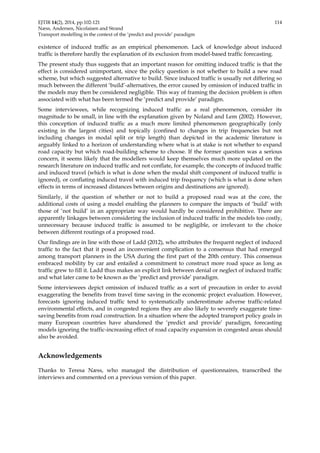
Key results from the questionnaire survey are displayed in Table 1, showing the proportions 
among the total sample of respondents as well as within particular groups of respondents 
(researchers, consultants, civil servants/clients, and politicians) who have expressed that they 
agree and disagree fully or partially with the various statements listed. Some of the respondents 
are having more than one of the roles indicated by the column headings; for example, some are 
both consultants and researchers or both politicians and consultants. Therefore, the sum of the 
number of respondents in the four sub-groups of respondents (477) is higher than the total 
number of respondents (453).
EJTIR 14(2), 2014, pp.102-121 106 
Næss, Andersen, Nicolaisen and Strand 
Transport modelling in the context of the ‘predict and provide’ paradigm 
3.1 Purposes of using traffic models 
The respondents of the questionnaire survey generally find model-based traffic forecasts 
important and valuable for several reasons. There is generally strong support of the statements 
that traffic forecasts are important in order to gain knowledge of future traffic conditions (93 % 
fully or partially agree; cf. Table 1); that traffic models are important in order to get an overview 
on complex systems (89 % fully or partially agree); and that traffic forecasts are important in 
order to design the details of a project (78 % fully or partially agree), with relatively small 
variations between the different groups of respondents. A clear majority among the respondents 
also believe that traffic forecasts provide objective information on the traffic impacts of a 
transport project (69 % fully or partially agree), although the support of this statement varies 
somewhat between researchers (64 % support) and consultants (81 % support), with politicians 
and civil servants/clients in-between. 
Three out of four respondents think that traffic forecasts have a high influence on what projects 
will be approved, but there is quite some variation between respondent groups, with the highest 
support of the statement found among politicians (83 % fully or partially agree) and the lowest 
among researchers (68 % fully or partially agree). There is, however, also a considerable 
proportion of respondents who think that traffic forecasts are often used to justify projects for 
which a political decision to build has already been taken (56 % fully or partially agree, with 
moderate variations between respondent groups). 
The interviewees of the qualitative part of the study also consider the preparation of decision 
support about transport infrastructure projects to be an important purpose of traffic modelling. 
Although model-based forecasts may not be so important for identifying the need for a new 
infrastructure project, they are important to legitimize project implementation and as a base for 
arguments to this end, as illustrated in the following statement by a politician: 
They don’t matter so much at the early stage. But they become important if you are to proceed with 
an idea. …. Then they are decisive for the acceptance of the arguments. (Former city council 
member and chairman of the municipal transport committee, in interview November 2010.) 
According to one interviewee, planners need the quantitative figures provided by the traffic 
models to be able to communicate on a level that is useful for the politicians. Why the 
communication with politicians should be on a quantitative level is not specified by this 
interviewee, but a plausible interpretation is that quantified information is perceived by the 
politicians to be more objective and reliable than more qualitative assessments (Porter, 1996). 
Some interviewees also emphasize quantitative, model-based traffic forecasts as necessary input 
to the mandatory cost-benefit analyses and environmental impact assessments of governmental 
transport infrastructure investments. 
In particular, model-based forecasts are considered helpful in order to compare different 
alternative layouts of a proposed project: 
Models are just [producing] a mathematical description of people’s behaviour, which you can apply 
particularly to compare alternatives in a good manner - in a good and consistent way. You can use 
models in particular when comparing alternatives, because the calculations for both – or all three or 
whatever – alternatives are based on the same assumptions, [enabling you] to say: Which one is the best, 
given these assumptions? (Consultant, Denmark, in interview July 2010)
EJTIR 14(2), 2014, pp.102-121 107 
Næss, Andersen, Nicolaisen and Strand 
Transport modelling in the context of the ‘predict and provide’ paradigm 
Table 1. Proportions of respondents agreeing and disagreeing fully or partially with various 
statements about induced traffic, forecasts and traffic models 
Statement Proportions fully or partially agreeing and disagreeing (valid percent) 
All 
respondents 
(N = 453) 
Researchers 
(N = 51) 
Consultants 
(N = 83) 
Civil 
servants and 
clients (N = 
170) 
Politicians 
(N = 173) 
Traffic forecasts are important 
in order to gain knowledge of 
future traffic conditions 
Agree: 93% 
Disagree: 3% 
(N=440) 
Agree: 98% 
Disagree: 2% 
(N=51) 
Agree: 96% 
Disagree: 2% 
(N=81) 
Agree: 93% 
Disagree: 4% 
(N=168) 
Agree: 92% 
Disagree: 2% 
(N=167) 
Traffic models are important 
in order to get an overview on 
complex systems 
Agree: 89% 
Disagree: 3% 
(N=435) 
Agree: 88% 
Disagree: 2% 
(N=51) 
Agree: 95% 
Disagree: 1% 
(N=81) 
Agree: 92% 
Disagree: 3% 
(N=166) 
Agree: 82% 
Disagree: 4% 
(N=165) 
Traffic forecasts are important 
in order to design the details 
of a project 
Agree: 78% 
Disagree: 9% 
(N=438) 
Agree: 73% 
Disagree:10% 
(N=51) 
Agree: 88% 
Disagree: 6% 
(N=81) 
Agree: 78% 
Disagree:13% 
(N=167) 
Agree: 78% 
Disagree: 7% 
(N=167) 
Traffic forecasts provide 
objective information on the 
traffic impacts of a transport 
project 
Agree: 69% 
Disagree:23% 
(N=438) 
Agree: 64% 
Disagree: 8% 
(N=50) 
Agree: 81% 
Disagree: 7% 
(N=80) 
Agree: 70% 
Disagree:21% 
(N=166) 
Agree: 70% 
Disagree:22% 
(N=167) 
Traffic forecasts are often used 
to justify projects for which a 
political decision to build 
have already been taken 
Agree: 56% 
Disagree:24% 
(N=418) 
Agree: 60% 
Disagree:25% 
(N=48) 
Agree: 62% 
Disagree:27% 
(N=74) 
Agree: 55% 
Disagree:22% 
(N=155) 
Agree: 51% 
Disagree:27% 
(N=151) 
Traffic forecasts have a high 
influence on what projects 
will be approved 
Agree: 75% 
Disagree:13% 
(N=439) 
Agree: 68% 
Disagree:24% 
(N=50) 
Agree: 70% 
Disagree:15% 
(N=80) 
Agree: 71% 
Disagree:15% 
(N=164) 
Agree: 83% 
Disagree: 9% 
(N=169) 
Traffic forecasts are often 
biased and therefore 
misleading 
Agree: 37% 
Disagree:40% 
(N=429) 
Agree: 48% 
Disagree:40% 
(N=50) 
Agree: 39% 
Disagree:38% 
(N=79) 
Agree: 27% 
Disagree:47% 
(N=165) 
Agree: 40% 
Disagree:36% 
(N=159) 
If forecasts are inaccurate, are 
they in your experience 
generally underestimating or 
overestimating future 
amounts of traffic for the 
approved projects? 
Underest:38% 
Overest: 18% 
(N=444) 
Underest:18% 
Overest.: 29% 
(N=49) 
Underest:17% 
Overest: 22% 
(N=82) 
Underest:27% 
Overest: 21% 
(N=168) 
Underest:61% 
Overest:11% 
(N=170) 
If forecasts are inaccurate, are 
they in your experience 
generally underestimating or 
overestimating future 
amounts of traffic for the zero 
alternative? 
Underest:38% 
Overest: 8% 
(N=128) 
Underest: 7% 
Overest: 14% 
(N=14) 
Underest:17% 
Overest: 10% 
(N=29) 
Underest:39% 
Overest: 6% 
(N=66) 
Underest:53% 
Overest: 9% 
(N=34) 
Expansion of road capacity in 
congested areas result in an 
overall increase in traffic 
Agree: 77% 
Disagree:11% 
(N=424) 
Agree: 88% 
Disagree: 6% 
(N=50) 
Agree: 89% 
Disagree: 3% 
(N=76) 
Agree: 76% 
Disagree: 8% 
(N=161) 
Agree: 65% 
Disagree:22% 
(N=164) 
Traffic models are poor at 
forecasting the effects of 
induced traffic 
Agree: 61% 
Disagree:20% 
(N=238) 
Agree: 59% 
Disagree:33% 
(N=49) 
Agree: 68% 
Disagree:23% 
(N=71) 
Agree: 61% 
Disagree:15% 
(N=149) 
--- 
Traffic forecasts usually 
exaggerate the risk of 
congestion if no new 
infrastructure is built 
Agree: 40% 
Disagree:36% 
(N=403) 
Agree: 47% 
Disagree: 6% 
(N=45) 
Agree: 49% 
Disagree:38% 
(N=72) 
Agree: 41% 
Disagree:32% 
(N=144) 
Agree: 36% 
Disagree:40% 
(N=161) 
Traffic models are considered a basic condition for this purpose, especially as a tool for 
identifying ‘when problems will occur’ (i.e. at what time, and where, congestion problems will 
occur with the assumed traffic growth rate), but also for identifying how different parts of the 
existing road network would be relieved.
EJTIR 14(2), 2014, pp.102-121 108 
Næss, Andersen, Nicolaisen and Strand 
Transport modelling in the context of the ‘predict and provide’ paradigm 
Several interviewees also point at traffic models as a necessary tool in order to get an overview of 
a complex system, in particular for shedding light on the consequences to other affected variables 
if one or more of the assumptions fed into the model are changed. One important such 
exogenously set assumption, mentioned by one of the interviewees, is the presupposed annual 
traffic growth. The traffic model enables the planners to make ‘what if’-analyses where the 
consequences of varying growth rates in terms of traffic volumes on different links of the road 
network can be explored. 
3.2 Awareness about model uncertainties and shortcomings 
The respondents are more divided in their views on whether or not traffic forecasts are often 
biased and therefore misleading. 37 % of the total sample more or less agree while 40 % more or 
less disagree, with a relatively large percentage (23 %) expressing a neutral attitude. Researchers 
are more prone to consider forecasts to be biased (48 %) than among the sample as a whole, 
whereas the opposite is the case among civil servants and clients (27%). This might indicate a 
lower awareness about limitations in the models among transport planners and bureaucrats who 
are not themselves developing or running transport models than among those respondents who 
have more first-hand experience with modelling. 
Apart from the politicians, the remaining respondents were also asked about reasons for 
potential forecasting inaccuracies. One of these questions explicitly addressed poor ability of 
models to deal with induced traffic as a potential cause of inaccuracy. On average, more than 
three out of five respondents (61 %) agreed fully or partially that this was a cause of inaccuracy, 
with only little variation between researchers, consultants and civil servants/clients. There was 
also only small difference between respondents whose experience was mainly with road projects 
and rail projects, respectively. This might seem a bit surprising, since the qualitative interviews 
indicate that induced traffic is normally included in the forecasts for rail projects while often 
being ignored in forecasts for road projects. 
It is also noteworthy that several of the interviewees consider the inaccuracy caused by omission 
of induced traffic to be rather modest (see also the next section). This may in some cases reflect a 
widespread understanding among Danish transport modellers of induced traffic as a much 
narrower concept than the definition referred to above (cf. Schmidt and Campbell, 1956; 
SACTRA, 1994 and Hills, 1996). For example, according to one of the leading Danish model 
developers, ‘induced traffic is a result of infrastructure improvements causing the total number 
of trips to increase. It has nothing to do with changes in travel mode’ (Overgaard, 2012). Another 
example of a narrow conception of the phenomenon of induced traffic is the following statement 
by one of our interviewees: 
The models offer an estimate of the magnitude of traffic relief on the existing road network provided by 
different line layouts proposed for a new road. Redistribution of existing traffic between different routes 
is usually the main effect of a [road] building scheme; hence benefits and drawbacks of a project may 
well be calculated even without calculating changes in the total traffic demand. (Chief consultant in the 
Danish Road Directorate, in follow-up e-mail communication August 2013 after interview September 
2010.) 
Here, induced traffic is conceptualized as only including traffic increase on the new road scheme, 
with no consideration of indirect effects on the surrounding network. The above statement does 
not take into account that induced traffic must also be expected to occur on the existing road 
network after the initial relief, contributing to congestion rising again toward the original level5. 
5 It might be argued that congestion would not rise towards the original level fully due to induced demand, since 
if congestion grew to that level, there would be no further travel time gains and hence no further induced 
demand. And since a part of the traffic growth is usually reflecting the general, ‘background’ growth in mobility 
at a national/regional scale, only a part of the traffic growth leading to a new equilibrium would be induced 
traffic. While this is true, there are also imaginable situations where induced traffic causes congestion to reach a 
worse level than before the road capacity expansion. This phenomenon, sometimes referred to as the ‘Downs-
EJTIR 14(2), 2014, pp.102-121 109 
Næss, Andersen, Nicolaisen and Strand 
Transport modelling in the context of the ‘predict and provide’ paradigm 
Although recognizing the phenomenon of induced traffic, this interviewee does not consider its 
magnitude to be very significant. 
In a similar vein, another interviewee, asked to comment on the likely consequence of replacing 
one of the two existing car lanes in each direction with separate bus lanes on the only road bridge 
across the Limfjord sound in central Aalborg, considered that this would have negligible effect on 
the modal split: 
I think you get very, very little shift of traffic from cars to transit by doing this. (Project manager in the 
transport department of a Danish consultancy firm, in interview June 2010.) 
The latter statement is at odds with findings from empirical studies in Scandinavia (Municipality 
of Trondheim, 2009) and the United Kingdom (Cairns et al., 2002). 
On the other hand, some of the traffic planners interviewed recognize that induced traffic may be 
substantial and consider it to be generally profitable for society since more drivers will then 
benefit from the improved travel opportunities brought about by road construction, as stated in 
the following quote: 
…. you have to acknowledge that induced traffic occurs … and in a cost-benefit analysis, the benefits 
will be underestimated if induced traffic is ignored. … There are consumer benefits from the induced 
traffic. At the same time, there are of course also greater environmental impacts, but in the economic 
analyses they represent a much smaller amount of money. … if a road is expanded, then the capacity is 
enlarged by nearly 50%. Traffic has to increase a lot before congestion reaches the same level as before 
the expansion... I fear that we have overestimated the effect of induced traffic in some of the more recent 
projects. (Chief consultant in the Danish Road Directorate, in interview September 2010.) 
Here, the interviewee admits that neglect of induced traffic entails an underestimation of 
environmental impacts, but since travel time savings account for a much larger benefit item in the 
cost-benefit calculation, the omission of induced traffic is still conceived to result in a 
conservative estimate of the net benefits of the project. The neglect is therefore considered as 
legitimate. 
Omission of induced traffic is thus sometimes depicted as a sort of precaution in order to avoid 
exaggerating the benefits from travel time saving in the economic project evaluation. While this 
way of reasoning may be relevant for road improvements in uncongested areas (cf. Welde and 
Odeck, 2011), induced traffic cannot generally be said to increase the time-saving benefits of a 
project. In congested transport corridors, induced traffic can, as discussed in Section 1, cause 
traffic to increase to a level where congestion arises anew and reduces time-saving per driver 
significantly, compared to the situation if no extra traffic appeared. While most of the 
questionnaire respondents and interviewees recognize the existence of induced traffic, the fact 
that such traffic increase can result in new congestion is mentioned by fewer. As shown by Næss, 
Nicolaisen and Strand (2012), neglect of induced traffic in the cost-benefit analyses of a proposed 
road scheme in a congested area can lead to severely biased estimates of the economic 
performance of the project. 
Some interviewees hold that congestion resulting from induced traffic is a phenomenon 
occurring only in the central parts of the Copenhagen area, not in other parts of Denmark. This 
conception is, however, at odds with the fact that a main argument put forth for the construction 
of the 3rd Limfjord Crossing in North Jutland, far away from Copenhagen, has throughout the 
different planning phases been to relieve future congestion. In the case of the moderately 
congested Frederikssund motorway in the outer parts of Copenhagen metropolitan area (also 
analysed by Næss, Nicolaisen and Strand, ibid.), the inclusion of induced traffic also resulted in a 
Thomson paradox’, can occur if the initial induced car traffic includes a shift from public to private transport 
leading to loss of ticket revenues for the transit companies eventually resulting in a reduced level of service. A 
new modal share equilibrium may then be established at a lower average speed – also for car traffic – than before 
the road expansion (Mogridge, 1997).
EJTIR 14(2), 2014, pp.102-121 110 
Næss, Andersen, Nicolaisen and Strand 
Transport modelling in the context of the ‘predict and provide’ paradigm 
lower net present value than if induced traffic was omitted. Regardless of time-saving benefits, 
negative environmental impacts will be underestimated if induced traffic is ignored. 
Nearly four out of ten (38 %) among the total sample are of the opinion that traffic forecasts, if 
they are inaccurate, tend to underestimate the future volume of traffic of the approved projects, 
whereas less than one out of five (18 %) think that the forecasts tend to overestimate the actual 
volume of traffic. As evident from these figures, a rather high proportion of the respondents 
either do not feel able to state any opinion or consider that the inaccuracies vary too much to 
make any particular statement. Among the remaining respondents, the preponderance of 
conceptions of forecasts as being underestimated is in line with the actual inaccuracies found by 
Nicolaisen (2012) as well as in several other studies (e.g. National Audit Office (UK), 1988; 
Flyvbjerg et al., 2005; Parthasarathi and Levinson, 2010; Welde and Odeck, 2011). Interestingly, 
the conception of traffic forecasts for the approved alternative as being often underestimated is 
especially pronounced among politicians (61%), whereas researchers and consultants tend to 
consider the forecasts to be overestimated (25 %) rather than underestimated (18 %). Apparently, 
the politicians’ opinions on this issue are more in line with state-of-the-art research than those 
among researchers and consultants developing and using transport models. 
We also asked the respondents to state the direction of inaccuracy, if any, of the traffic forecasts 
for the no-build (zero) alternatives. However, in this case, a large proportion of the respondents 
apparently found it difficult to state any opinion. Among the total sample, nearly three out of 
four (72 %) failed to give any answer to this question, compared to only 2 % for the 
corresponding question about the approved (‘build’) project alternative. The proportion of 
missing answers was high among all groups of respondents, varying from 61 % among civil 
servants and clients to 80 % among politicians. Moreover, among those who did state an opinion, 
the proportion who considered forecasts for the zero alternatives to be mostly underestimated 
was five times as high as the proportion considering such forecasts to be most often 
overestimated. Apparently, the level of reflection about forecasts for the ‘no-build’ alternatives is 
not very high, and among those who do reflect on this issue, the assumptions about the direction 
of forecasting inaccuracy is largely out of phase with the inaccuracies demonstrated empirically 
by, for example, Nicolaisen (2012) (who found traffic in the ‘no-build’ alternatives to be 
overestimated by 7 % on average) and discussed theoretically by Næss (2011). 
The respondents were also asked to state whether or not they agreed in the claim that traffic 
forecasts usually exaggerate the risk of congestion if no new infrastructure is built. The 
respondents had divided opinions on this issue, but a slight majority (40 % compared to 36 %) 
expressed full or partial support of the claim, with somewhat stronger support among 
researchers and somewhat greater disagreement among politicians. 
Several among the interviewees recognize that model-based traffic forecasts are encumbered with 
uncertainties. In particular, the difficulty of predicting the (general) traffic growth is pointed at 
by a high number of interviewees. 
Some interviewees also mention neglect of induced traffic as a shortcoming. Referring to the 
transport model used for several rounds of Environmental Impact Assessments for a proposed 
third crossing over the Limfjord sound in the outskirts of Aalborg, a transport planner and 
modeller explicitly states that the model used for these analyses ignored induced traffic: 
The OD [origin-destination] matrix is not affected by accessibility. That’s one of the things you could 
criticize about the model we use […] If you make things more accessible, then that generates more 
traffic. It has always been like that. It also goes the other way; if you get more congestion, then that 
generates less traffic due to more resistance. And that is not reflected. … (Model developer/Consultant, 
Denmark, in interview June 2010) 
Here, it is clearly stated that the model used for the Limfjord forecasts does not include induced 
traffic. This is, however, not because the interviewee does not accept induced traffic as a real 
phenomenon. In his opinion, new models ought to include such effects. On the other hand, this
EJTIR 14(2), 2014, pp.102-121 111 
Næss, Andersen, Nicolaisen and Strand 
Transport modelling in the context of the ‘predict and provide’ paradigm 
interviewee seems to consider induced traffic as something that should only be included in a 
sensitivity analysis (or robustness analysis, as he states it). This would imply that the main results 
communicated from the analysis would still be those without induced traffic included, since the 
purpose of a sensitivity analysis is normally to illuminate how the results are affected if the 
calculations are based on presuppositions other than those forming the base of the main analysis. 
In some of the later assessments of Danish road infrastructure projects, attempts have been made 
to include induced traffic in the analyses. In cases where this is not incorporated in the model, an 
amount of induced traffic can be added by manually raising the values of the origin-destination 
matrix applying a certain elasticity, as illustrated by this comment from a model 
developer/consultant about the possibilities to incorporate induced traffic in a traffic model 
where this is not dealt with at the outset: 
You can [include induced demand in the model], but then it is something you do manually when you 
have some specific solutions. And then you can say: What impact do we then think the elasticity would 
have made? And then we can increase our OD matrix with that figure, and things like that. (Model 
developer/Consultant, Denmark, in interview June 2010) 
Such an adjustment was, however, not carried out in the case referred to by this interviewee. 
Other interviewees emphasize that the magnitude of adjustments like this is based on highly 
uncertain judgments (see Næss and Strand, 2012 for a discussion of the latter issue). 
As could be seen from the questionnaire survey, few respondents believed that there was any 
tendency for forecasts for the zero (no-build) alternatives to be overestimated – the respondents 
rather thought that such forecasts tended to be underestimated, despite empirical evidence 
suggesting otherwise (Nicolaisen, 2012). Some of the interviewees do, however, illustrate how 
neglect of induced traffic is likely to result in overestimated forecasts for future traffic volumes in 
the absence of the proposed road scheme, thus supporting theoretical work on this issue (Næss 
and Andersen, 2010; Næss, 2011). A chief consultant in the Danish Road Directorate puts it this 
way: 
Actually, when we make the projection we have already included the induced demand. Otherwise there 
would be a negative effect, right? I mean, if we don’t expand it, then there is no room for traffic to grow. 
And then it cannot possibly reach the figures that the [national] forecasts we use to estimate growth 
indicate. But if we expand it, then we get the growth we expect. (Chief consultant in the Danish Road 
Directorate, in interview September 2010.) 
Judged from the interviews, the input variable most prone to be subject to arbitrary choice is the 
annual traffic growth rate. Choosing a high or a low percentage of assumed annual traffic growth 
will influence the time at which congestion has grown to a level necessitating capacity increase. If 
the politicians want to argue that it is urgent to get funding for a given road building scheme in a 
heavily trafficked corridor, more weight may be added to the argument if the forecasts depict the 
situation as one where traffic growth will cause almost intolerable congestion in a few years 
unless additional road capacity is added. 
3.3 ‘Predict and provide’ as a tacit underlying assumption 
The questionnaire survey shows that the professionals and politicians involved in developing 
and using traffic forecasts generally accept the phenomenon of induced traffic as a real 
phenomenon (cf. Table 1). Among the total sample, 77 % wholly or partly agree in the statement 
that expansion of road capacity in congested areas results in an overall increase in traffic, while 
only 11 % wholly or partly disagree. The proportions expressing full or partial agreement are 
especially high among researchers and consultants (88% and 89 %, respectively), but also among 
politicians there is a majority who wholly or partially agree (65 %). These figures are in line with 
the findings of Andersen (2013), who has documented that induced traffic has been 
acknowledged as an important and relevant phenomenon in traffic forecasting in a Danish 
context for more than eight decades.
EJTIR 14(2), 2014, pp.102-121 112 
Næss, Andersen, Nicolaisen and Strand 
Transport modelling in the context of the ‘predict and provide’ paradigm 
A premise of the above-mentioned argument that new road capacity must be added in order to 
prevent forecasted traffic growth from causing intolerable congestion is that traffic should flow 
as freely as possible, and that congestion will not in itself slow down or stop further traffic 
growth and thereby prevent congestion from reaching an intolerable level. Instead, capacity 
should be added to allow for traffic to grow at a rate reflecting the observed or latent demand in 
the transportation market. These assumptions are often associated with what has been termed the 
‘predict and provide’ paradigm (Owens, 1995), cf. Section 1. 
According to one of our most experienced interviewees, who had been working as a traffic 
modeller since the 1960s, ‘many traffic model calculations have over the course of time been 
conducted primarily in order to establish the need for future road capacity’ (Traffic modeller and 
consultant, now retired, in follow-up e-mail communication July 2013 after interview in the 
spring of 2012). The following quote by a civil servant of the Danish Road Directorate clearly 
indicates the prevalence of this paradigm also in contemporary Danish transport policy: 
What they [the politicians] care about is whether there are queues in the system. Then they think we 
need an expansion here. (Civil servant in the Danish Road Directorate, in interview September 2010.) 
In situations of congestion, the main decision-making question within this paradigm will hence 
not be whether or not to increase road capacity, but rather where it should be expanded and 
when. In this perspective, the issue of induced traffic may not be perceived to be very important, 
since the amount of traffic induced by a new road scheme will usually not differ much between 
the alternative layouts. The following statement is illustrative: 
Then you may well use a traffic model that is not as top-tuned as it ought to be. But since the same 
model is used to analyse all four [alternatives], some of its errors will be eliminated when comparing 
across. (Model developer/Consultant, Denmark, in interview June 2010.) 
The alternatives referred to here are the different road building alternatives, not including the 
‘no-build’ option. The fact that the errors are not insignificant when comparing road building 
with non-building is not commented on by the interviewee. Although the same interviewee 
admitted that it was possible to adjust for induced traffic ‘manually’ by raising the sum values of 
the origin-destination matrix (cf. an earlier quote), this was not done in the case in question. 
Seemingly, the solution to the forecasted capacity problem was framed around road capacity 
enlargements. Politically, and probably also among the planners, the dominant opinion is that we 
need to expand the capacity (see, e.g. Barfoed, 2009; Ehrenreich, 2013; Region Nordjylland, 2013). 
Otherwise, future traffic growth will not be accommodated in a satisfactory way. 
A horizon of understanding where traffic growth is seen as inevitable and something to be 
accommodated can be an important reason why modellers, consultants and planners consider 
traffic models to be helpful decision-making tools even if the models are unable to take induced 
traffic into due consideration. The following statement by a model developer and consultant is 
illustrative: 
There are some capacity limits around in the city – for example in the motorway tunnel. We’re talking 
about system lifetime [before capacity is exceeded] … Politicians cannot grasp traffic models. What they 
can understand are some assessments of when traffic will ‘sand up’. …. Well, if traffic turns up not to 
increase by the forecasted 2 % annually …. with 2% the tunnel would have a lifetime until 2022. If it 
increased by 3% it would only be until 2015. Or with 1% it would be until 2030. (Model 
developer/Consultant, Denmark, in interview June 2010) 
Here, the interviewee first says that traffic model forecasts must be ‘translated’ into statements 
about the remaining lifetime of the existing capacity of the road system, for example a motorway 
tunnel, in order to be meaningful for politicians. The question is how many years it will take until 
traffic on the stretch in question will ‘sand up’. The tacit presupposition here is that the capacity 
will have to be expanded before that time in order to avoid the ‘sanded-up’ situation, which is 
clearly considered undesirable. The interviewee’s use of the term ‘lifetime of the tunnel’ is based 
on the implicit presupposition that it is necessary to secure some level of free-flowing traffic. If
EJTIR 14(2), 2014, pp.102-121 113 
Næss, Andersen, Nicolaisen and Strand 
Transport modelling in the context of the ‘predict and provide’ paradigm 
the free flow is obstructed (i.e. the tunnel has become ‘sanded up’), then the lifetime of the tunnel 
has expired. 
Moreover, the entire idea that traffic on the existing network will grow to a level where 
congestion evolves into a ‘sanded-up’ situation is based on the assumption that traffic (on the 
relevant road/in the corridor) will continue to grow also when the capacity limit is being 
approached. Such an understanding forms an important pillar of the conception that capacity 
increase is necessary and is thus closely associated with the ‘predict and provide’ paradigm. The 
neglect of the deterrent effect of congestion on further traffic growth at the same time reveals a 
limited understanding of the phenomenon of induced traffic. The way in which the general traffic 
growth is taken as an external input, common to the zero and the build alternatives, with 
forecasts pointing toward capacity increase as the ‘natural’ policy, is maybe even more outspoken 
in the following quote: 
Well, overall you started making some forecasts of expected traffic volumes. And you didn’t really use 
the model for that purpose. Because what it was all about was that there would be an overload on the 
existing connections with the forecasted traffic volumes. (University teacher and modeller in 
consultancy firm, Denmark, interviewed October 2010.) 
The ‘predict and provide’ paradigm has as its ideal a frictionless transport system. Within such a 
horizon, the suppression of travel demand is not considered acceptable. Latent demand can then 
be used as an argument for road expansion since it will release suppressed demand. In a 
historical Danish context, this has been an explicit argument in support of urban road capacity 
increases (Stadsingeniørens Direktorat, 1967). This might seem contradictory to our statement 
above that omitting of induced traffic in forecasting is accepted under the ‘predict and provide’ 
paradigm because the policy question is which layout alternative of a proposed project to choose, 
rather than whether to build the project. However, given contemporary policy objectives of 
limiting the growth in urban motoring, advocating new urban road schemes on the ground of 
their likely traffic-increasing effects will probably not be considered very appropriate, since this 
might draw attention to the conflict between the ‘predict and provide’ approach and adopted 
policy goals of sustainable mobility. 
If it is not shown explicitly in the analyses that proposed urban road projects are likely to lead to 
traffic growth, decision-makers will not be confronted with these inconsistencies. Together with 
the technical challenges of representing induced traffic correctly in transport models, this implies 
that there is a lack of any strong incentive for including induced traffic in the forecasts, at least as 
long as the provision of capacity to meet latent demand is seen as generally desirable. A member 
of the Danish parliament comments as follows on the gap between environmental objectives and 
the predict-and-provide policies actually pursued: 
I think some politicians are quite aware that this is something you should not be too curious about, 
because then you might be faced with the need to make a choice. (Member of the Danish Parliament, in 
interview January 2011.) 
4. Discussion and concluding remarks 
Despite having been understood theoretically for more than 150 years and demonstrated 
empirically in numerous studies since the 1930s, the traffic-increasing effect of transport 
infrastructure construction is often neglected or severely underestimated in transport planning. 
Technical difficulties are sometimes mentioned as reasons for non-inclusion of induced traffic in 
transport modelling. It is, however, possible to include induced traffic in traffic models 
(SACTRA, 1994; Litman, 2012). If induced traffic had been recognized as an important issue, it 
seems reasonable to assume that such models would have been much more commonly used. 
Moreover, a vast majority of the survey respondents as well as the interviewees recognize the
EJTIR 14(2), 2014, pp.102-121 114 
Næss, Andersen, Nicolaisen and Strand 
Transport modelling in the context of the ‘predict and provide’ paradigm 
existence of induced traffic as an empirical phenomenon. Lack of knowledge about induced 
traffic is therefore hardly the explanation of its exclusion from model-based traffic forecasting. 
The present study thus suggests that an important reason for omitting induced traffic is that the 
effect is considered unimportant, since the policy question is not whether to build a new road 
scheme, but which suggested alternative to build. Since induced traffic is usually not differing so 
much between the different ‘build’-alternatives, the error caused by omission of induced traffic in 
the models may then be considered negligible. This way of framing the decision problem is often 
associated with what has been termed the ‘predict and provide’ paradigm. 
Some interviewees, while recognizing induced traffic as a real phenomenon, consider its 
magnitude to be small, in line with the explanation given by Noland and Lem (2002). However, 
this conception of induced traffic as a much more limited phenomenon geographically (only 
existing in the largest cities) and topically (confined to changes in trip frequencies but not 
including changes in modal split or trip length) than depicted in the academic literature is 
arguably linked to a horizon of understanding where what is at stake is not whether to expand 
road capacity but which road-building scheme to choose. If the former question was a serious 
concern, it seems likely that the modellers would keep themselves much more updated on the 
research literature on induced traffic and not conflate, for example, the concepts of induced traffic 
and induced travel (which is what is done when the modal shift component of induced traffic is 
ignored), or conflating induced travel with induced trip frequency (which is what is done when 
effects in terms of increased distances between origins and destinations are ignored). 
Similarly, if the question of whether or not to build a proposed road was at the core, the 
additional costs of using a model enabling the planners to compare the impacts of ‘build’ with 
those of ‘not build’ in an appropriate way would hardly be considered prohibitive. There are 
apparently linkages between considering the inclusion of induced traffic in the models too costly, 
unnecessary because induced traffic is assumed to be negligible, or irrelevant to the choice 
between different routings of a proposed road. 
Our findings are in line with those of Ladd (2012), who attributes the frequent neglect of induced 
traffic to the fact that it posed an inconvenient complication to a consensus that had emerged 
among transport planners in the USA during the first part of the 20th century. This consensus 
embraced mobility by car and entailed a commitment to construct more road space as long as 
traffic grew to fill it. Ladd thus makes an explicit link between denial or neglect of induced traffic 
and what later came to be known as the ‘predict and provide’ paradigm. 
Some interviewees depict omission of induced traffic as a sort of precaution in order to avoid 
exaggerating the benefits from travel time saving in the economic project evaluation. However, 
forecasts ignoring induced traffic tend to systematically underestimate adverse traffic-related 
environmental effects, and in congested regions they are also likely to severely exaggerate time-saving 
benefits from road construction. In a situation where the adopted transport policy goals in 
many European countries have abandoned the ‘predict and provide’ paradigm, forecasting 
models ignoring the traffic-increasing effect of road capacity expansion in congested areas should 
also be avoided. 
Acknowledgements 
Thanks to Teresa Næss, who managed the distribution of questionnaires, transcribed the 
interviews and commented on a previous version of this paper.
EJTIR 14(2), 2014, pp.102-121 115 
Næss, Andersen, Nicolaisen and Strand 
Transport modelling in the context of the ‘predict and provide’ paradigm 
References 
Andersen, J. A. (2013). The shaping of transport model based knowledge production: An embedded case 
study of Danish transport modelling practice in a contemporary and historical perspective, Ph.D. thesis, 
Aalborg University, Aalborg. 
National Audit Office (UK), Department of Transport, Scottish Development Department and 
Welsh Office (1988). Road Planning, National Audit Office, London. 
Barfoed, L. (2009). Interview in the newspaper Information, January 8, 2009. Accessed December 1, 
2012 at http://www.information.dk/178877. 
Button, K. and Henscher, D. A. (2001.) Handbook of Transport Systems and Traffic Control, 
Pergamon/Elsevier, Amsterdam/San Diego/Oxford/London. 
Cairns, C., Atkins, S. and Goodwin, P. (2002). Disappearing Traffic? The Story So Far. Proceedings 
of the Institution of Civil Engineers; Municipal Engineer, 151(1), 13-22. 
Cervero, R. (2001). Induced Demand: An Urban and Metropolitan Perspective. University of 
California, Department of City and Regional Planning, Berkeley. Accessed December 1, 2013 at 
http://www.uctc.net/papers/648.pdf 
Cerwenka, P. and Hauger, G. (1998). Austria. In Report of the hundred and fifth Round Table on 
Transport Economics, Nov. 1996, Paris. 
Christiani & Nielsen; Højgaard & Schultz A/S; Kampmann & Kierulff and Saxild A/S (1936). 
Motorveje med Broer over Storebælt og Øresund. Egmont H. Petersen, Copenhagen. 
Downs, A. (1962). The law of peak-hour expressway congestion. Traffic Quarterly, 16(3), 393–409. 
Ehrenreich, A. (2013). Newspaper interview in connection with the Danish local authority 
elections in the autumn of 2013, accessed December 1, 2013 at 
http://hoersholm.lokalavisen.dk/debat-venstre-gaar-paa-to-ben-i-forhold-til-traengslen- 
/20131105/valglaeserbrev/711059256/1260. 
Fairclough, N. (2009). A dialectical-relational approach to critical discourse analysis in social 
research. In Wodak, R. and Meyer, M. (eds) Methods of Critical Discourse Analysis (Second Edition), 
Sage, Los Angeles/London/New Delhi/Singapore/Washington DC. 
Flyvbjerg, B., Holm, M. S. and Buhl, S. (2005). How (in)accurate are demand forecasts in public 
works projects? The case of transportation’. Journal of the American Planning Association, 71(2), 
131–146. 
Goodwin, P.B. (1998). Extra traffic induced by road construction: Empirical evidence, economic 
effects and policy implications. In Report of the hundred and fifth Round Table on Transport 
Economics, on Nov. 1996, Paris. 
Goodwin, P. and Noland, R. B. (2003). Building new roads really does create extra traffic: a 
response to Prakash et al. Applied Economics, 35(13), 1451-1457. 
Hills, P. J. (1996). What is induced traffic? Transportation, 23(1), 5-16. 
Ladd, B. (2012). You can't build your way out of congestion – Or can you? A Century of Highway 
Plans and Induced Traffic. DISP, 48(3), 16-23. 
Litman, T. (2012). Generated Traffic and Induced Travel. Implications for Transport Planning, Victoria 
Transport Policy Institute, Victoria, http://www.vtpi.org/gentraf.pdf. 
Marte, G. (2003). Slow vehicle traffic is a more attractive alternative to fast vehicle traffic than 
public transport. World Transport Policy & Practice, 9(2), 18–23.
EJTIR 14(2), 2014, pp.102-121 116 
Næss, Andersen, Nicolaisen and Strand 
Transport modelling in the context of the ‘predict and provide’ paradigm 
Minken, H. (2005). Transportmodeller, forutsetninger, norsk praksis [Transport models, assumptions, 
Norwegian practice], TØI Working Paper 1793/2005, Institute of Transport Economics, Oslo. 
Mogridge, M. J. H. (1997). The self-defeating nature of urban road capacity policy. A review of 
theories, disputes and available evidence. Transport Policy, 4(1), 5-23. 
MOTOS (2007). Transport modelling: towards operational standards in Europe. Available at: 
http://www.motosproject.eu/?po_id=handbook (accessed 12 June 2010). 
Municipality of Trondheim (2009). Evaluation of the transfer of car lanes to bus lanes in Elgeseter 
gate, Municipality of Trondheim, the Environmental Agency, Trondheim. 
Næss, P. (2011). The Third Limfjord Crossing. A case of pessimism bias and knowledge filtering. 
Transport Reviews, 31(2), 231-249. 
Næss, P., Mogridge, M.J.H. and Sandberg, S.L. (2001). Wider roads, more cars. Natural Resources 
Forum, 25(2), 147-155. 
Næss, P., Nicolaisen, M. S. and Strand, A. (2012). Traffic forecasts ignoring induced demand: a 
shaky fundament for cost-benefit analyses. European Journal of Transport and Infrastructure 
Research, 12(3), 291-309. 
Næss, P. and Strand, A. (2012). What kinds of traffic forecasts are possible? Journal of Critical 
Realism, 11(3), 277-295. 
Nicolaisen, M. S. (2012). Forecasts: Fact or Fiction? Uncertainty and Inaccuracy in Transport Project 
Evaluation, Ph.D. thesis, Aalborg University, Aalborg. 
Nielsen, O. A. and Fosgerau, M. (2005). Overvurderes tidsbenefit af vejprojekter? [Are time 
benefits from road projects being overestimated?] Paper presented at the conference Traffic Days 
at Aalborg University, Aug. 2005, Aalborg. 
Noland, R. B. and Lem, L. L. (2002). A review of the evidence for induced travel and changes in 
transportation and environmental policy in the US and the UK. Transportation Research Part D, 
7(1), 1-26. 
Overgaard, C. H. (2012). Personal communication (e-mail), January 6, 2012. 
Owens, S. (1995). From “predict and provide” to “predict and prevent”?: Pricing and planning in 
transport policy. Transport Policy, 2(1), 43–49. 
Parthasarathi, P. and Levinson, D. (2010). Post-construction evaluation of traffic forecast 
accuracy. Transport Policy, 12(6), 428-443. 
Porter, T. M. (1996). Trust in Numbers: The Pursuit of Objectivity in Science and Public Life. Princeton 
University Press, Princeton. 
Region Nordjylland (2013). Nu skal 3. Limfjordsforbindelse fastlægges som en vestlig linjeføring 
over Egholm. Accessed December 1, 2013 at 
http://www.rn.dk/Regionen/Nyheder/NyhedsArkiv/2012/NuSkal3LimfjordsforbindelseFastl 
aeggesSomEnVestligLinjefoeringOverEgholm.htm 
Reisigl, M. and Wodak, R. (2009). The discourse-historical approach (DHA). In Wodak. R. and 
Meyer, M. (eds) Methods of Critical Discourse Analysis (Second Edition),, Sage, Los 
Angeles/London/New Delhi/Singapore/Washington DC. 
SACTRA (1994). Trunk Roads and the Generation of Traffic, Standing Advisory Committee on Trunk 
Road Assessment. UKDoT, HMSO, London. Available at: www.roads.detr.gov.uk/roadnetwork. 
Schmidt, R. E. and Campbell, E. M. (1956). Highway Traffic Estimation. Eno Foundation for 
Highway Traffic Control, Saugatuck, CT.
EJTIR 14(2), 2014, pp.102-121 117 
Næss, Andersen, Nicolaisen and Strand 
Transport modelling in the context of the ‘predict and provide’ paradigm 
Schram, G. and Hjort, S. (1840). Jernbane imellem Kjøbenhavn og Roskilde (Railway between 
Copenhagen and Roskilde). Second edition. Copenhagen. 
Stadsingeniørens Direktorat (1967). Amager og Generalplanen, Municipality of Copenhagen, 
Copenhagen. 
Thomson, J. M. (1977). Great cities and their traffic, Gollancz, London. 
Twitchett, J. C. (2013). Ignoring Induced Traffic – An Empirical Study of Induced Traffic, Master’s 
thesis, Aalborg University, Aalborg. 
UNITE (2011). Transcriptions from interviews 2010-2011, unpublished database from the research 
project UNITE, Aalborg University, Aalborg. 
Welde, M. and Odeck, J. (2011). Do planners get it right? The accuracy of travel demand 
forecasting in Norway. European Journal of Transport and Infrastructure Research, 11 (1), 80-95. 
Wodak. R. and Meyer, M. (2009). Methods of Critical Discourse Analysis (Second Edition), Sage, Los 
Angeles/London/New Delhi/Singapore/Washington DC.
EJTIR 14(2), 2014, pp.102-121 118 
Næss, Andersen, Nicolaisen and Strand 
Transport modelling in the context of the ‘predict and provide’ paradigm 
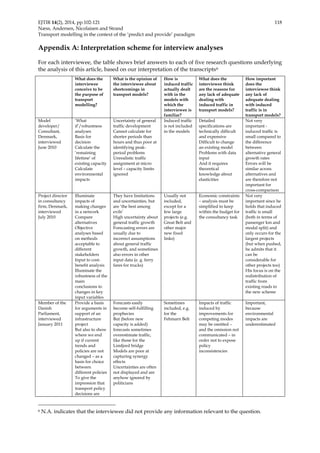
Appendix A: Interpretation scheme for interview analyses 
For each interviewee, the table shows brief answers to each of five research questions underlying 
the analysis of this article, based on our interpretation of the transcripts6 
What does the 
interviewee 
conceive to be 
the purpose of 
transport 
modelling? 
What is the opinion of 
the interviewee about 
shortcomings in 
transport models? 
How is 
induced traffic 
actually dealt 
with in the 
models with 
which the 
interviewee is 
familiar? 
What does the 
interviewee think 
are the reasons for 
any lack of adequate 
dealing with 
induced traffic in 
transport models? 
How important 
does the 
interviewee think 
any lack of 
adequate dealing 
with induced 
traffic is in 
transport models? 
Model 
developer/ 
Consultant, 
Denmark, 
interviewed 
June 2010 
‘What 
if’/robustness 
analyses 
Basis for 
decision 
Calculate the 
‘remaining 
lifetime’ of 
existing capacity 
Calculate 
environmental 
impacts 
Uncertainty of general 
traffic development 
Cannot calculate for 
shorter periods than 
hours and thus poor at 
identifying peak-period 
problems 
Unrealistic traffic 
assignment at micro 
level – capacity limits 
ignored 
Induced traffic 
is not included 
in the models 
Detailed 
specifications are 
technically difficult 
and expensive 
Difficult to change 
an existing model 
Problems with data 
input 
And it requires 
theoretical 
knowledge about 
elasticities 
Not very 
important - 
induced traffic is 
small compared to 
the difference 
between 
alternative general 
growth rates 
Errors will be 
similar across 
alternatives and 
are therefore not 
important for 
cross-comparison 
Project director 
in consultancy 
firm, Denmark, 
interviewed 
July 2010 
Illuminate 
impacts of 
making changes 
in a network 
Compare 
alternatives 
Objective 
analyses based 
on methods 
acceptable to 
different 
stakeholders 
Input to cost-benefit 
analysis 
Illuminate the 
robustness of the 
main 
conclusions to 
changes in key 
input variables 
They have limitations 
and uncertainties, but 
are ‘the best among 
evils’ 
High uncertainty about 
general traffic growth 
Forecasting errors are 
usually due to 
incorrect assumptions 
about general traffic 
growth, and sometimes 
also errors in other 
input data (e. g. ferry 
fares for trucks) 
Usually not 
included, 
except for a 
few large 
projects (e.g. 
Great Belt and 
other major 
new fixed 
links) 
Economic constraints 
– analysis must be 
simplified to keep 
within the budget for 
the consultancy task 
Not very 
important since he 
holds that induced 
traffic is small 
(both in terms of 
passenger km and 
modal split) and 
only occurs for the 
largest projects 
(but when pushed, 
he admits that it 
can be 
considerable for 
other projects too) 
His focus is on the 
redistribution of 
traffic from 
existing roads to 
the new scheme 
Member of the 
Danish 
Parliament, 
interviewed 
January 2011 
Provide a basis 
for arguments in 
support of an 
infrastructure 
project 
But also to show 
where we end 
up if current 
trends and 
policies are not 
changed – as a 
basis for choice 
between 
different policies 
To give the 
impression that 
transport policy 
decisions are 
Forecasts easily 
become self-fulfilling 
prophecies 
But (before new 
capacity is added) 
forecasts sometimes 
overestimate traffic, 
like those for the 
Limfjord bridge 
Models are poor at 
capturing synergy 
effects 
Uncertainties are often 
not displayed and are 
anyhow ignored by 
politicians 
Sometimes 
included, e.g. 
for the 
Fehmarn Belt 
Impacts of traffic 
induced by 
improvements for 
competing modes 
may be omitted – 
and the omission not 
communicated – in 
order not to expose 
policy 
inconsistencies 
Important, 
because 
environmental 
impacts are 
underestimated 
6 N.A. indicates that the interviewee did not provide any information relevant to the question.
EJTIR 14(2), 2014, pp.102-121 119 
Næss, Andersen, Nicolaisen and Strand 
Transport modelling in the context of the ‘predict and provide’ paradigm 
objective and 
well-founded 
Model 
developer and 
civil servant in 
the Road 
Directorate, 
Denmark, 
interviewed 
September 2010 
Enabling 
evaluation of the 
impact of some 
measure 
Models are just 
approximations of 
reality 
Uncertain input data 
about growth in car 
ownership 
Aggregation at zone 
level hides important 
intra-zonal differences 
The models 
developed by 
the Road 
Directorate 
since 2009 
include 
induced traffic 
Time pressure 
prevents post-opening 
evaluations 
as well as sufficient 
quality checks 
Consultants have too 
little knowledge 
about the models 
they use, and their 
clients usually do not 
pose critical 
questions (general 
statements not 
specifically referring 
to induced traffic) 
Induced traffic in 
West Jutland is 
considered very 
insignificant, so in 
order to save 
resources this is 
ignored in 
modelling practice 
Predict and 
provide paradigm 
prevails in the 
highway 
directorate (but 
they have long ago 
acknowledged the 
existence of 
induced traffic) 
Civil servant in 
the Ministry of 
Transport, 
Denmark, 
interviewed 
July 2011 
Make traffic 
planners more 
aware about 
some causal 
relationships 
Provide input to 
economic 
analyses 
Difficult/impossible to 
predict general traffic 
growth 
Model unable 
to deal 
adequately 
with 
competition 
between rail 
and road 
Some speed 
reduction due 
to capacity 
restraint was 
tried manually 
(but not 
implemented 
in the main 
forecast?) 
Technically difficult 
to include capacity 
restraints on road 
network 
It was considered 
more important to 
model the demand, 
and then later to 
assess whether and 
how the demand can 
be met 
Competition 
between rail and 
road considered 
unimportant (in the 
Køge Bugt case) 
N. A. 
University 
teacher and 
modeler in 
consultancy 
firm, Denmark, 
interviewed 
October 2010 
To find the best 
location of a 
proposed new 
road link (Third 
Limfjord 
Crossing) and to 
identify how the 
existing road 
network would 
be relieved 
To influence the 
design of a 
scheme (e.g. 
light rail on 
separate lane) 
Uncertainties increase 
as the model gets older 
Uncertainties 
undercommunicated 
due to political 
pressure 
The Aalborg model is a 
mere car traffic model 
Other models have 
added public transport 
and bike on this, but 
with poor results 
Cultural (and 
discursive) factors not 
included 
The Aalborg 
model ignores 
induced traffic 
as well as the 
impact of 
parking 
availability 
Economic constraints 
on what model 
improvements can 
be made – politicians 
decide on funding 
Since the purpose of 
modelling was to 
find the best road 
line alternative, the 
relationship between 
car and other modes 
was considered 
unimportant 
N. A. 
Project manager 
in public 
transport 
company, 
Denmark, 
interviewed 
May 2011 
Overview of 
complex 
material that 
cannot be 
comprehended 
without 
calculations 
Compare the 
performance of 
different 
alternative line 
layouts 
Basis for 
decisions about 
large-scale 
infrastructure 
investments 
Input to the 
budgets of the 
Inherent uncertainty in 
forecasts of general 
traffic development – 
and also model 
uncertainty (about the 
effects of endogenous 
variables, notably the 
amount of induced rail 
traffic created by the 
metro) 
Generated 
metro 
travelling (and 
probably also 
induced public 
transport 
travel in 
general) is 
included in the 
modelling of 
the company. 
Previous 
forecasts were 
based on 
stated 
preferences, 
but they have 
now been 
updated with 
N. A. N. A.
EJTIR 14(2), 2014, pp.102-121 120 
Næss, Andersen, Nicolaisen and Strand 
Transport modelling in the context of the ‘predict and provide’ paradigm 
metro company forecasts based 
on revealed 
preferences 
Project manager 
for a regional 
public transport 
project, 
Denmark, 
interviewed 
July 2010 
Provide input 
for cost-benefit 
analysis and EIA 
Not very 
important for 
local political 
decision, but 
since Ministry of 
Finance requires 
CBA, modelling 
has to be done 
Analyze impacts 
of replacing full-length 
bus trips 
with combined 
bus and light 
rail trips 
Overview of 
complex 
transport system 
Uncertainty about how 
the model deals with 
modal split and also 
about the distribution 
between regional and 
local buses 
Uncertainty about the 
‘light rail effect’ 
Generated 
light rail 
travelling (and 
probably also 
induced public 
transport 
travel in 
general) is 
included in the 
modelling of 
the Midttrafik 
company 
N. A. N. A. 
Civil servant in 
the Traffic 
Agency, 
Denmark, 
interviewed 
May and 
September 2011 
Estimation of 
passenger 
impacts of new 
route schedules 
(including 
impacts of new 
lines) 
Getting 
overview of the 
traffic within 
complex route 
configurations 
Inaccurate input data 
Errors in the model 
(e.g. for the OTM-based 
Ring Rail 
forecast) 
Impacts of planned, 
but not yet adopted 
road projects in the 
same corridor are 
ignored. This may lead 
to exaggerated 
estimates of the 
amount of traffic 
induced (unless 
counterfactual thinking 
is applied) 
Induced rail 
traffic is 
included in a 
very simplified 
way (a little 
more 
sophisticated 
in the model 
for Khb- 
Ringsted) 
N. A. N. A. 
Civil servant in 
the Road 
Directorate, 
Denmark, 
interviewed 
September 2010 
N. A. Difficult to forecast 
general traffic growth 
Induced traffic only 
included in some 
models 
Omission of induced 
traffic leading to 
overestimated traffic in 
the zero alternative 
N. A. Apart from some 
recent large projects 
(new fixed links like 
the Great Belt and 
Øresund), induced 
traffic has been 
considered 
insignificant 
Not very 
important, since 
politicians want to 
expand capacity 
where there is 
congestion, 
without caring 
much about cost-benefit 
analyses. 
But if induced 
traffic is ignored, 
then the economic 
benefits of road 
projects tend to be 
underestimated 
Previous 
municipal 
politician 
responsible for 
the technical 
sector, 
Denmark, 
interviewed 
December 2010 
Input to cost-benefit 
analysis 
as a basis for 
prioritizing 
between 
different 
investments at a 
national scale 
Model results are often 
reified and considered 
as truths, whereas they 
are in fact heavily 
dependent on the 
assumptions about its 
input variables and on 
what variables are 
included or excluded 
Inconsistency between 
assumptions of traffic 
models and 
assumptions on which 
other policies are based 
N. A. N. A. Politicians know 
what they want to 
go in for, almost 
independently of 
what numbers the 
tables show 
[general statement, 
not referring 
particularly to 
induced traffic] 
Transport Provide Black-box nature of N. A. N. A. N. A.
EJTIR 14(2), 2014, pp.102-121 121 
Næss, Andersen, Nicolaisen and Strand 
Transport modelling in the context of the ‘predict and provide’ paradigm 
model 
researcher, 
Sweden, 
interviewed 
October 2011 
different 
stakeholder with 
objective 
information as a 
basis for their 
argumentation 
Sensitivity 
analyses of the 
impacts of 
changes in 
different input 
variables, e.g. 
petrol price 
models - models are 
owned by agencies 
denying other people 
access to information 
about model 
assumptions 
Transport 
model 
researcher and 
consultant, 
Sweden, 
interviewed 
October 2011 
N. A. N. A. N. A. Unrealistic travel 
time assumptions for 
a proposed rail 
project caused 
exaggerated 
estimates of time 
savings and as a 
consequence 
exaggerated induced 
traffic for the 
railway. Could be 
due to optimism bias 
or even strategic 
misrepresentation 
N. A. 
Previous 
municipal 
politician 
responsible for 
the technical 
and 
environmental 
sector, 
Denmark, 
interviewed 
December 2010 
Provide a basis 
for arguments in 
support of an 
infrastructure 
project 
N. A. N. A. N. A. N. A. 
Retired traffic 
analyst, 
Denmark, 
interviewed 
January 2012 
N. A. N. A. N. A. N. A. N. A. 
Project analyst 
in consultancy 
firm, Denmark, 
interviewed 
June 2012 
N. A. N. A. N. A. N. A. N. A.

N ss et_al._2014_transport_modelling_in_the_context_of_the_predict_and_provide_paradigm

  • 1.
    Aalborg Universitet TransportModelling in the Context of the ‘Predict and Provide’ Paradigm Næss, Petter; Andersen, Jeppe Astrup; Nicolaisen, Morten Skou; Strand, Arvid Published in: European Journal of Transport and Infrastructure Research Publication date: 2014 Link to publication from Aalborg University Citation for published version (APA): Næss, P., Andersen, J., Nicolaisen, M. S., & Strand, A. (2014). Transport Modelling in the Context of the ‘Predict and Provide’ Paradigm. European Journal of Transport and Infrastructure Research, 14(2), 102-121. General rights Copyright and moral rights for the publications made accessible in the public portal are retained by the authors and/or other copyright owners and it is a condition of accessing publications that users recognise and abide by the legal requirements associated with these rights. ? Users may download and print one copy of any publication from the public portal for the purpose of private study or research. ? You may not further distribute the material or use it for any profit-making activity or commercial gain ? You may freely distribute the URL identifying the publication in the public portal ? Take down policy If you believe that this document breaches copyright please contact us at vbn@aub.aau.dk providing details, and we will remove access to the work immediately and investigate your claim. Downloaded from vbn.aau.dk on: October 31, 2014
  • 2.
    EJTIR Issue 14(2),2014 pp. 102-121 ISSN: 1567-7141 www.ejtir.tbm.tudelft.nl Transport modelling in the context of the ‘predict and provide’ paradigm Petter Næss1 Norwegian University of Life Sciences, Dept. of Landscape Architecture and Spatial Planning, Aas, Norway Jeppe Andersen2, Morten Skou Nicolaisen3 Aalborg University, Dept. of Development and Planning, Aalborg, Denmark Arvid Strand4 Institute of Transport Economics, Oslo, Norway The central concern of this paper is why the traffic-increasing effect of road capacity expansion (induced traffic) is still frequently ignored when preparing decision-support material for proposed infrastructure investments. Earlier research has pointed at ignorance or technical difficulties as likely reasons. This paper offers an additional explanation. Based on an investigation of the opinions of transport modellers, consultants, transport planners and politicians concerning the usefulness, shortcomings and application of forecasting models in transport planning, this paper suggests that transport model forecasts are used in project evaluations primarily to throw light on where and when to build a proposed road infrastructure, not for assessing whether to build it. Since induced traffic is usually not differing so much between the different ‘build’-alternatives, the errors caused by omitting induced traffic in the models are accepted. This way of framing the decision problem is often associated with what has been termed the ‘predict and provide’ paradigm. Keywords: induced traffic, modelling, predict and provide, planners, consultants, qualitative interviews, survey. 1. Introduction Traffic forecasting plays a key role in contemporary transport policy, planning, and engineering. Traffic models are used not only to optimize the design of proposed projects, but also to produce key input data for environmental impact assessments and cost-benefit analyses, such as expected time savings, safety effects and changes in pollution and noise levels. Needless to say, it is of vital importance to informed decision-making that the model outputs are based on valid assumptions. Theories of transport economics and transport geography as well as a number of empirical studies in Europe and the USA indicate that road development facilitating higher travel speeds will release latent demand and hence attract more car drivers. An immediate congestion relief is sometimes observed, but often this is only temporary (Downs, 1962; Thomson, 1977; SACTRA, 1994; Hills, 1996; Mogridge, 1997; Noland and Lem, 2002; Næss, Mogridge and Sandberg, 2001; 1 A: P.O. Box 5003, N-1432 Aas, Norway T: +47 649 653 77 E: petter.nass@nmbu.no 2 A: Skibbrogade 5, DK-9000 Aalborg, Denmark T: +45 994 072 03 E: jeppe@plan.aau.dk 3 A: Skibbrogade 5, DK-9000 Aalborg, Denmark T: +45 994 083 72 E: mortenn@plan.aau.dk 4 A: Gaustadallen 21, N-0349, Oslo, Norway T: +47 916 476 48 E: ast@toi.no
  • 3.
    EJTIR 14(2), 2014,pp.102-121 103 Næss, Andersen, Nicolaisen and Strand Transport modelling in the context of the ‘predict and provide’ paradigm Goodwin and Noland, 2003; Litman 2012). If the strategy of combatting congestion by increasing road capacity is chosen, the capacity must repeatedly be increased in order for the expected benefits to materialize, following what has been termed the ‘predict and provide’ approach (Owens, 1995). In line with Schmidt and Campbell (1956, quoted from Cervero, 2001:4), we define induced traffic as ‘the added component of traffic volume which did not previously exist in any form, but which results when new or improved transportation facilities are provided’. This includes vehicle traffic resulting from increased distances between origins and destinations, changes in travel routes, changes in travel modes as well as changes in trip frequencies (Hills, 1996). Diverting of traffic from one route to another (apart from any difference in route length) is not included in the concept of induced traffic as we use it, although such diversion may contribute to the rise of congestion on a new or expanded road scheme and is included in the notion of generated traffic (Litman, 2012). Induced traffic as understood here should be measured in terms of vehicle kilometres travelled (VMT), although in empirical studies simpler approaches such as traffic counts at selected screen-lines have often been applied (Cervero, ibid.) The magnitude of induced traffic in a particular situation depends on the specific situation at hand. Usually, more traffic tends to be induced by road capacity increases in congested areas where there is considerable suppressed demand (typically in urban contexts) than in areas where congestion does not at the outset make up any deterrent against driving (e.g. in rural areas). Road improvements will, however, often induce traffic growth also in non-congested areas; this is, for example, likely to happen if the new road allows faster driving (e.g. with a higher speed limit) and thus reduces travel time. Reflecting the various contexts at hand, a number of investigations in the United Kingdom and the USA indicate that a 10% increase in road capacity (measured in the number of kilometres of driving lanes in each direction within a traffic corridor) seems to result in traffic increases of around 3 – 5% in a short term and between 5 and 10% in a long term (Noland and Lem, 2002:16; Litman, 2012:9). In a study of 45 Danish road projects, Twitchett (2013) found the immediate induced traffic (i.e. within the first year after opening) to be on average 9 %, with lower-than-average figures for bypasses and highways and higher-than-average figures for motorways and especially for fixed-link motorway bridges replacing ferries. For the few Danish projects where traffic counts were available over a longer period after opening, the amount of induced traffic after four years was typically found to be twice or three times as much as in the first year after opening (Twitchett, ibid). Despite the fact that induced traffic has been understood theoretically for at least one-and-a-half centuries (Schram and Hjort 1840) and demonstrated empirically in several studies over the latest eight decades (Christiani and Nielsen et al. 1936; Schmidt and Campbell 1956; Ladd 2012), disregard or severe underestimation of induced traffic in the forecasting models used in infrastructure project evaluation is a quite widespread phenomenon internationally (Button and Henscher, 2001; Marte, 2003; Goodwin and Noland, 2003; MOTOS, 2007; Litman, 2012). This is also the case in Scandinavia. In Denmark, induced traffic has usually been underestimated or totally ignored in local and regional traffic models (Nielsen and Fosgerau 2005; Næss, 2011; Twitchett, 2013; Andersen, 2013), which has led to a general underestimation of traffic on new roads (Nicolaisen, 2012). The main exception is the so-called Ørestadens Trafik Model (OTM), covering the Greater Copenhagen Area. The situation in Norway and Sweden does not seem very different (Minken, 2005; Welde and Odeck, 2011; UNITE, 2011). Omission of induced traffic can lead to serious bias in the assessments of environmental impacts as well as the economic viability of proposed road projects, especially in situations where there is a latent demand for more road capacity (for an illustrative example, see Næss, Strand and Nicolaisen, 2012). Omission of induced traffic in the traffic models implies that the forecasted traffic volume will be the same for the road-building alternatives as in the case where no new capacity is added.
  • 4.
    EJTIR 14(2), 2014,pp.102-121 104 Næss, Andersen, Nicolaisen and Strand Transport modelling in the context of the ‘predict and provide’ paradigm Neglect of induced traffic can thus also lead to overestimated forecasts for the ‘no-build’ (or zero) alternatives (Næss, 2011). This may happen if the future traffic volumes are estimated on the basis of trend extrapolation (as in several regional/local models used until recently or still in use in Denmark, such as the so-called Aalborg model), since observed trends in traffic growth are often themselves partly a result of prior capacity expansions. Neglect of induced traffic will then mean that the deterrent effects of congestion on future traffic growth for the zero-alternatives are ignored, resulting in unrealistically high forecasts for the future traffic volumes in cases where no new capacity is added. Different explanations for omission of induced traffic have been put forth. The philosophy that has for several decades underpinned the process of traffic forecasting is the so-called ‘predict and provide’ paradigm, according to which demands are projected, equated with need and met by infrastructure provision to the extent that funding can be made available (Owens, 1995). Omission of induced traffic in the traffic models has often been associated with this paradigm. In academic transport research, neglect of induced traffic in traffic modelling has frequently been considered as reflecting an assumption of inelastic relationship between road capacity and car travel demand (Cerwenka and Hauger, 1998, Noland and Lem, 2002). This does, however, not always fit well with empirical evidence (Andersen 2013; Goodwin 1998). Induced traffic was not at the outset included in the standard computerized four-step transport models, and due to convenience and a certain path dependency established as the use of these models was sustained, it became difficult to modify what was seen as a tested procedure (Goodwin, 1998). It is, however, possible to include induced traffic in traffic models (SACTRA, 1994; Litman, 2012). Based on an investigation of the opinions of Scandinavian transport modellers, consultants, transport planners and politicians concerning the usefulness, shortcomings and application of forecasting models in transport planning, this paper aims to illuminate why model-based traffic forecasts are generally considered important and valuable despite recognized limitations in their ways of dealing with induced traffic. The structure of the paper is as follows: In the next section (2), the research design and methods of the study will be outlined. Section 3 presents the key findings from qualitative interviews and a questionnaire survey involving planners, modellers and politicians. A brief discussion and some concluding remarks are given in the last section (4). 2. Research design and methods The study on which this paper is based was carried out as part of a larger research project, ‘Uncertainties in transport project evaluations’ (UNITE), conducted jointly by the Danish Technical University, Aalborg University and a number of sub-contractors. The main data sources of the paper are interviews and a questionnaire survey. 16 qualitative interviews were carried out from 2010 to 2012 with key stakeholders in the production or use of traffic forecasts as decision support: model developers, consultants, traffic planners, transport-sector bureaucrats involved in policy-making at national or local level, and politicians with transportation policy as a field of responsibility (e.g. members of the National Parliamentary Committee on Transport). The selection of interviewees was made in order to gain information from persons representing different roles in the forecasting process. Apart from two Swedish researchers involved in the development of what had been characterized by other interviewees as ‘state-of-the-art’ transport models, all the interviewees were from Danish institutions. The reason for the Danish focus was mainly practical, since all interviews were conducted by researchers located at Aalborg University. The interviews lasted from one to three hours and were tape-recorded and subsequently transcribed. The questionnaire material is based on a survey carried out in 2010 among the same categories of stakeholders. Many of the questions of the questionnaire were formulated as statements with
  • 5.
    EJTIR 14(2), 2014,pp.102-121 105 Næss, Andersen, Nicolaisen and Strand Transport modelling in the context of the ‘predict and provide’ paradigm which the respondents were asked to indicate their extent of agreement along a five-point Likert scale. Distinct from the interviews, the questionnaires covered a broader Scandinavian context. Invitations to respond to the web-based questionnaires were distributed to transport-related research units at universities, transport units in consultancy firms, road and rail directorates, transport sections in regions/municipalities, transport/environment-related NGOs, and parliamentary transport committees in Denmark, Norway and Sweden. The mail recipient at the contact address was asked to forward the invitation mail to those employees or elected officials for whom the questionnaire would be relevant. For each country, national-language versions of the questionnaire were provided. After having sent one set of reminder mails, we received in total 453 completed questionnaires. Roughly two fifths of the respondents were from Denmark, another two fifths from Norway and the remaining 20% from Sweden. Additionally, during the preparation of this paper, some follow-up e-mail questions were sent in the summer of 2013 to twelve of the interviewees (i.e. those interviewees considered as the ones most closely involved in model-based infrastructure planning), asking particularly about the usefulness of traffic models for different purposes. Nine of the interviewees responded, answering four questions with closed answer alternatives (Likert-scale) as well as writing qualitative elaborations of these answers. In addition to interviews and questionnaires, the paper also draws on documents where information has been found about, respectively, forecasting inaccuracy for Danish, other Scandinavian and British road projects and the extent to which Danish traffic forecasters and transport modellers have been aware of the phenomenon of induced traffic. Each of these two main categories of information were first systematized and analysed in two Ph.D. theses (Nicolaisen, 2012; Andersen, 2013). The interview material has been analysed based on two different approaches. First, a qualitative content analysis was conducted, following an interpretation scheme tailor-made for the present study. This scheme comprised four detailed research questions which we, as researchers, tried to answer, based on the information given by the interviewees (first interpreting the statements in each separate interview and then synthesizing across the 16 interviews). Second, selected formulations used by the interviewees in their description and discussion on the practice and role of traffic forecasting were scrutinized, inspired by methods of critical discourse analysis (CDA) (Wodak and Meyer, 2009) and drawing in particular on the dialectical-relational (Fairclough, 2009) and the discourse-historical (Reisigl and Wodak, 2009) approaches to CDA. 3. Findings In this section, the key findings of the study will be structured according to topics. Under each topic, findings from the qualitative interviews as well as from the questionnaire survey will therefore be presented. The material will be grouped into the following three broad topics: purposes of using traffic models, awareness about model uncertainties and shortcomings, and ‘predict and provide’ as a tacit underlying assumption. A more detailed account of the conclusions from the individual interview interpretations on which the following analysis is based can be found in the Appendix. Key results from the questionnaire survey are displayed in Table 1, showing the proportions among the total sample of respondents as well as within particular groups of respondents (researchers, consultants, civil servants/clients, and politicians) who have expressed that they agree and disagree fully or partially with the various statements listed. Some of the respondents are having more than one of the roles indicated by the column headings; for example, some are both consultants and researchers or both politicians and consultants. Therefore, the sum of the number of respondents in the four sub-groups of respondents (477) is higher than the total number of respondents (453).
  • 6.
    EJTIR 14(2), 2014,pp.102-121 106 Næss, Andersen, Nicolaisen and Strand Transport modelling in the context of the ‘predict and provide’ paradigm 3.1 Purposes of using traffic models The respondents of the questionnaire survey generally find model-based traffic forecasts important and valuable for several reasons. There is generally strong support of the statements that traffic forecasts are important in order to gain knowledge of future traffic conditions (93 % fully or partially agree; cf. Table 1); that traffic models are important in order to get an overview on complex systems (89 % fully or partially agree); and that traffic forecasts are important in order to design the details of a project (78 % fully or partially agree), with relatively small variations between the different groups of respondents. A clear majority among the respondents also believe that traffic forecasts provide objective information on the traffic impacts of a transport project (69 % fully or partially agree), although the support of this statement varies somewhat between researchers (64 % support) and consultants (81 % support), with politicians and civil servants/clients in-between. Three out of four respondents think that traffic forecasts have a high influence on what projects will be approved, but there is quite some variation between respondent groups, with the highest support of the statement found among politicians (83 % fully or partially agree) and the lowest among researchers (68 % fully or partially agree). There is, however, also a considerable proportion of respondents who think that traffic forecasts are often used to justify projects for which a political decision to build has already been taken (56 % fully or partially agree, with moderate variations between respondent groups). The interviewees of the qualitative part of the study also consider the preparation of decision support about transport infrastructure projects to be an important purpose of traffic modelling. Although model-based forecasts may not be so important for identifying the need for a new infrastructure project, they are important to legitimize project implementation and as a base for arguments to this end, as illustrated in the following statement by a politician: They don’t matter so much at the early stage. But they become important if you are to proceed with an idea. …. Then they are decisive for the acceptance of the arguments. (Former city council member and chairman of the municipal transport committee, in interview November 2010.) According to one interviewee, planners need the quantitative figures provided by the traffic models to be able to communicate on a level that is useful for the politicians. Why the communication with politicians should be on a quantitative level is not specified by this interviewee, but a plausible interpretation is that quantified information is perceived by the politicians to be more objective and reliable than more qualitative assessments (Porter, 1996). Some interviewees also emphasize quantitative, model-based traffic forecasts as necessary input to the mandatory cost-benefit analyses and environmental impact assessments of governmental transport infrastructure investments. In particular, model-based forecasts are considered helpful in order to compare different alternative layouts of a proposed project: Models are just [producing] a mathematical description of people’s behaviour, which you can apply particularly to compare alternatives in a good manner - in a good and consistent way. You can use models in particular when comparing alternatives, because the calculations for both – or all three or whatever – alternatives are based on the same assumptions, [enabling you] to say: Which one is the best, given these assumptions? (Consultant, Denmark, in interview July 2010)
  • 7.
    EJTIR 14(2), 2014,pp.102-121 107 Næss, Andersen, Nicolaisen and Strand Transport modelling in the context of the ‘predict and provide’ paradigm Table 1. Proportions of respondents agreeing and disagreeing fully or partially with various statements about induced traffic, forecasts and traffic models Statement Proportions fully or partially agreeing and disagreeing (valid percent) All respondents (N = 453) Researchers (N = 51) Consultants (N = 83) Civil servants and clients (N = 170) Politicians (N = 173) Traffic forecasts are important in order to gain knowledge of future traffic conditions Agree: 93% Disagree: 3% (N=440) Agree: 98% Disagree: 2% (N=51) Agree: 96% Disagree: 2% (N=81) Agree: 93% Disagree: 4% (N=168) Agree: 92% Disagree: 2% (N=167) Traffic models are important in order to get an overview on complex systems Agree: 89% Disagree: 3% (N=435) Agree: 88% Disagree: 2% (N=51) Agree: 95% Disagree: 1% (N=81) Agree: 92% Disagree: 3% (N=166) Agree: 82% Disagree: 4% (N=165) Traffic forecasts are important in order to design the details of a project Agree: 78% Disagree: 9% (N=438) Agree: 73% Disagree:10% (N=51) Agree: 88% Disagree: 6% (N=81) Agree: 78% Disagree:13% (N=167) Agree: 78% Disagree: 7% (N=167) Traffic forecasts provide objective information on the traffic impacts of a transport project Agree: 69% Disagree:23% (N=438) Agree: 64% Disagree: 8% (N=50) Agree: 81% Disagree: 7% (N=80) Agree: 70% Disagree:21% (N=166) Agree: 70% Disagree:22% (N=167) Traffic forecasts are often used to justify projects for which a political decision to build have already been taken Agree: 56% Disagree:24% (N=418) Agree: 60% Disagree:25% (N=48) Agree: 62% Disagree:27% (N=74) Agree: 55% Disagree:22% (N=155) Agree: 51% Disagree:27% (N=151) Traffic forecasts have a high influence on what projects will be approved Agree: 75% Disagree:13% (N=439) Agree: 68% Disagree:24% (N=50) Agree: 70% Disagree:15% (N=80) Agree: 71% Disagree:15% (N=164) Agree: 83% Disagree: 9% (N=169) Traffic forecasts are often biased and therefore misleading Agree: 37% Disagree:40% (N=429) Agree: 48% Disagree:40% (N=50) Agree: 39% Disagree:38% (N=79) Agree: 27% Disagree:47% (N=165) Agree: 40% Disagree:36% (N=159) If forecasts are inaccurate, are they in your experience generally underestimating or overestimating future amounts of traffic for the approved projects? Underest:38% Overest: 18% (N=444) Underest:18% Overest.: 29% (N=49) Underest:17% Overest: 22% (N=82) Underest:27% Overest: 21% (N=168) Underest:61% Overest:11% (N=170) If forecasts are inaccurate, are they in your experience generally underestimating or overestimating future amounts of traffic for the zero alternative? Underest:38% Overest: 8% (N=128) Underest: 7% Overest: 14% (N=14) Underest:17% Overest: 10% (N=29) Underest:39% Overest: 6% (N=66) Underest:53% Overest: 9% (N=34) Expansion of road capacity in congested areas result in an overall increase in traffic Agree: 77% Disagree:11% (N=424) Agree: 88% Disagree: 6% (N=50) Agree: 89% Disagree: 3% (N=76) Agree: 76% Disagree: 8% (N=161) Agree: 65% Disagree:22% (N=164) Traffic models are poor at forecasting the effects of induced traffic Agree: 61% Disagree:20% (N=238) Agree: 59% Disagree:33% (N=49) Agree: 68% Disagree:23% (N=71) Agree: 61% Disagree:15% (N=149) --- Traffic forecasts usually exaggerate the risk of congestion if no new infrastructure is built Agree: 40% Disagree:36% (N=403) Agree: 47% Disagree: 6% (N=45) Agree: 49% Disagree:38% (N=72) Agree: 41% Disagree:32% (N=144) Agree: 36% Disagree:40% (N=161) Traffic models are considered a basic condition for this purpose, especially as a tool for identifying ‘when problems will occur’ (i.e. at what time, and where, congestion problems will occur with the assumed traffic growth rate), but also for identifying how different parts of the existing road network would be relieved.
  • 8.
    EJTIR 14(2), 2014,pp.102-121 108 Næss, Andersen, Nicolaisen and Strand Transport modelling in the context of the ‘predict and provide’ paradigm Several interviewees also point at traffic models as a necessary tool in order to get an overview of a complex system, in particular for shedding light on the consequences to other affected variables if one or more of the assumptions fed into the model are changed. One important such exogenously set assumption, mentioned by one of the interviewees, is the presupposed annual traffic growth. The traffic model enables the planners to make ‘what if’-analyses where the consequences of varying growth rates in terms of traffic volumes on different links of the road network can be explored. 3.2 Awareness about model uncertainties and shortcomings The respondents are more divided in their views on whether or not traffic forecasts are often biased and therefore misleading. 37 % of the total sample more or less agree while 40 % more or less disagree, with a relatively large percentage (23 %) expressing a neutral attitude. Researchers are more prone to consider forecasts to be biased (48 %) than among the sample as a whole, whereas the opposite is the case among civil servants and clients (27%). This might indicate a lower awareness about limitations in the models among transport planners and bureaucrats who are not themselves developing or running transport models than among those respondents who have more first-hand experience with modelling. Apart from the politicians, the remaining respondents were also asked about reasons for potential forecasting inaccuracies. One of these questions explicitly addressed poor ability of models to deal with induced traffic as a potential cause of inaccuracy. On average, more than three out of five respondents (61 %) agreed fully or partially that this was a cause of inaccuracy, with only little variation between researchers, consultants and civil servants/clients. There was also only small difference between respondents whose experience was mainly with road projects and rail projects, respectively. This might seem a bit surprising, since the qualitative interviews indicate that induced traffic is normally included in the forecasts for rail projects while often being ignored in forecasts for road projects. It is also noteworthy that several of the interviewees consider the inaccuracy caused by omission of induced traffic to be rather modest (see also the next section). This may in some cases reflect a widespread understanding among Danish transport modellers of induced traffic as a much narrower concept than the definition referred to above (cf. Schmidt and Campbell, 1956; SACTRA, 1994 and Hills, 1996). For example, according to one of the leading Danish model developers, ‘induced traffic is a result of infrastructure improvements causing the total number of trips to increase. It has nothing to do with changes in travel mode’ (Overgaard, 2012). Another example of a narrow conception of the phenomenon of induced traffic is the following statement by one of our interviewees: The models offer an estimate of the magnitude of traffic relief on the existing road network provided by different line layouts proposed for a new road. Redistribution of existing traffic between different routes is usually the main effect of a [road] building scheme; hence benefits and drawbacks of a project may well be calculated even without calculating changes in the total traffic demand. (Chief consultant in the Danish Road Directorate, in follow-up e-mail communication August 2013 after interview September 2010.) Here, induced traffic is conceptualized as only including traffic increase on the new road scheme, with no consideration of indirect effects on the surrounding network. The above statement does not take into account that induced traffic must also be expected to occur on the existing road network after the initial relief, contributing to congestion rising again toward the original level5. 5 It might be argued that congestion would not rise towards the original level fully due to induced demand, since if congestion grew to that level, there would be no further travel time gains and hence no further induced demand. And since a part of the traffic growth is usually reflecting the general, ‘background’ growth in mobility at a national/regional scale, only a part of the traffic growth leading to a new equilibrium would be induced traffic. While this is true, there are also imaginable situations where induced traffic causes congestion to reach a worse level than before the road capacity expansion. This phenomenon, sometimes referred to as the ‘Downs-
  • 9.
    EJTIR 14(2), 2014,pp.102-121 109 Næss, Andersen, Nicolaisen and Strand Transport modelling in the context of the ‘predict and provide’ paradigm Although recognizing the phenomenon of induced traffic, this interviewee does not consider its magnitude to be very significant. In a similar vein, another interviewee, asked to comment on the likely consequence of replacing one of the two existing car lanes in each direction with separate bus lanes on the only road bridge across the Limfjord sound in central Aalborg, considered that this would have negligible effect on the modal split: I think you get very, very little shift of traffic from cars to transit by doing this. (Project manager in the transport department of a Danish consultancy firm, in interview June 2010.) The latter statement is at odds with findings from empirical studies in Scandinavia (Municipality of Trondheim, 2009) and the United Kingdom (Cairns et al., 2002). On the other hand, some of the traffic planners interviewed recognize that induced traffic may be substantial and consider it to be generally profitable for society since more drivers will then benefit from the improved travel opportunities brought about by road construction, as stated in the following quote: …. you have to acknowledge that induced traffic occurs … and in a cost-benefit analysis, the benefits will be underestimated if induced traffic is ignored. … There are consumer benefits from the induced traffic. At the same time, there are of course also greater environmental impacts, but in the economic analyses they represent a much smaller amount of money. … if a road is expanded, then the capacity is enlarged by nearly 50%. Traffic has to increase a lot before congestion reaches the same level as before the expansion... I fear that we have overestimated the effect of induced traffic in some of the more recent projects. (Chief consultant in the Danish Road Directorate, in interview September 2010.) Here, the interviewee admits that neglect of induced traffic entails an underestimation of environmental impacts, but since travel time savings account for a much larger benefit item in the cost-benefit calculation, the omission of induced traffic is still conceived to result in a conservative estimate of the net benefits of the project. The neglect is therefore considered as legitimate. Omission of induced traffic is thus sometimes depicted as a sort of precaution in order to avoid exaggerating the benefits from travel time saving in the economic project evaluation. While this way of reasoning may be relevant for road improvements in uncongested areas (cf. Welde and Odeck, 2011), induced traffic cannot generally be said to increase the time-saving benefits of a project. In congested transport corridors, induced traffic can, as discussed in Section 1, cause traffic to increase to a level where congestion arises anew and reduces time-saving per driver significantly, compared to the situation if no extra traffic appeared. While most of the questionnaire respondents and interviewees recognize the existence of induced traffic, the fact that such traffic increase can result in new congestion is mentioned by fewer. As shown by Næss, Nicolaisen and Strand (2012), neglect of induced traffic in the cost-benefit analyses of a proposed road scheme in a congested area can lead to severely biased estimates of the economic performance of the project. Some interviewees hold that congestion resulting from induced traffic is a phenomenon occurring only in the central parts of the Copenhagen area, not in other parts of Denmark. This conception is, however, at odds with the fact that a main argument put forth for the construction of the 3rd Limfjord Crossing in North Jutland, far away from Copenhagen, has throughout the different planning phases been to relieve future congestion. In the case of the moderately congested Frederikssund motorway in the outer parts of Copenhagen metropolitan area (also analysed by Næss, Nicolaisen and Strand, ibid.), the inclusion of induced traffic also resulted in a Thomson paradox’, can occur if the initial induced car traffic includes a shift from public to private transport leading to loss of ticket revenues for the transit companies eventually resulting in a reduced level of service. A new modal share equilibrium may then be established at a lower average speed – also for car traffic – than before the road expansion (Mogridge, 1997).
  • 10.
    EJTIR 14(2), 2014,pp.102-121 110 Næss, Andersen, Nicolaisen and Strand Transport modelling in the context of the ‘predict and provide’ paradigm lower net present value than if induced traffic was omitted. Regardless of time-saving benefits, negative environmental impacts will be underestimated if induced traffic is ignored. Nearly four out of ten (38 %) among the total sample are of the opinion that traffic forecasts, if they are inaccurate, tend to underestimate the future volume of traffic of the approved projects, whereas less than one out of five (18 %) think that the forecasts tend to overestimate the actual volume of traffic. As evident from these figures, a rather high proportion of the respondents either do not feel able to state any opinion or consider that the inaccuracies vary too much to make any particular statement. Among the remaining respondents, the preponderance of conceptions of forecasts as being underestimated is in line with the actual inaccuracies found by Nicolaisen (2012) as well as in several other studies (e.g. National Audit Office (UK), 1988; Flyvbjerg et al., 2005; Parthasarathi and Levinson, 2010; Welde and Odeck, 2011). Interestingly, the conception of traffic forecasts for the approved alternative as being often underestimated is especially pronounced among politicians (61%), whereas researchers and consultants tend to consider the forecasts to be overestimated (25 %) rather than underestimated (18 %). Apparently, the politicians’ opinions on this issue are more in line with state-of-the-art research than those among researchers and consultants developing and using transport models. We also asked the respondents to state the direction of inaccuracy, if any, of the traffic forecasts for the no-build (zero) alternatives. However, in this case, a large proportion of the respondents apparently found it difficult to state any opinion. Among the total sample, nearly three out of four (72 %) failed to give any answer to this question, compared to only 2 % for the corresponding question about the approved (‘build’) project alternative. The proportion of missing answers was high among all groups of respondents, varying from 61 % among civil servants and clients to 80 % among politicians. Moreover, among those who did state an opinion, the proportion who considered forecasts for the zero alternatives to be mostly underestimated was five times as high as the proportion considering such forecasts to be most often overestimated. Apparently, the level of reflection about forecasts for the ‘no-build’ alternatives is not very high, and among those who do reflect on this issue, the assumptions about the direction of forecasting inaccuracy is largely out of phase with the inaccuracies demonstrated empirically by, for example, Nicolaisen (2012) (who found traffic in the ‘no-build’ alternatives to be overestimated by 7 % on average) and discussed theoretically by Næss (2011). The respondents were also asked to state whether or not they agreed in the claim that traffic forecasts usually exaggerate the risk of congestion if no new infrastructure is built. The respondents had divided opinions on this issue, but a slight majority (40 % compared to 36 %) expressed full or partial support of the claim, with somewhat stronger support among researchers and somewhat greater disagreement among politicians. Several among the interviewees recognize that model-based traffic forecasts are encumbered with uncertainties. In particular, the difficulty of predicting the (general) traffic growth is pointed at by a high number of interviewees. Some interviewees also mention neglect of induced traffic as a shortcoming. Referring to the transport model used for several rounds of Environmental Impact Assessments for a proposed third crossing over the Limfjord sound in the outskirts of Aalborg, a transport planner and modeller explicitly states that the model used for these analyses ignored induced traffic: The OD [origin-destination] matrix is not affected by accessibility. That’s one of the things you could criticize about the model we use […] If you make things more accessible, then that generates more traffic. It has always been like that. It also goes the other way; if you get more congestion, then that generates less traffic due to more resistance. And that is not reflected. … (Model developer/Consultant, Denmark, in interview June 2010) Here, it is clearly stated that the model used for the Limfjord forecasts does not include induced traffic. This is, however, not because the interviewee does not accept induced traffic as a real phenomenon. In his opinion, new models ought to include such effects. On the other hand, this
  • 11.
    EJTIR 14(2), 2014,pp.102-121 111 Næss, Andersen, Nicolaisen and Strand Transport modelling in the context of the ‘predict and provide’ paradigm interviewee seems to consider induced traffic as something that should only be included in a sensitivity analysis (or robustness analysis, as he states it). This would imply that the main results communicated from the analysis would still be those without induced traffic included, since the purpose of a sensitivity analysis is normally to illuminate how the results are affected if the calculations are based on presuppositions other than those forming the base of the main analysis. In some of the later assessments of Danish road infrastructure projects, attempts have been made to include induced traffic in the analyses. In cases where this is not incorporated in the model, an amount of induced traffic can be added by manually raising the values of the origin-destination matrix applying a certain elasticity, as illustrated by this comment from a model developer/consultant about the possibilities to incorporate induced traffic in a traffic model where this is not dealt with at the outset: You can [include induced demand in the model], but then it is something you do manually when you have some specific solutions. And then you can say: What impact do we then think the elasticity would have made? And then we can increase our OD matrix with that figure, and things like that. (Model developer/Consultant, Denmark, in interview June 2010) Such an adjustment was, however, not carried out in the case referred to by this interviewee. Other interviewees emphasize that the magnitude of adjustments like this is based on highly uncertain judgments (see Næss and Strand, 2012 for a discussion of the latter issue). As could be seen from the questionnaire survey, few respondents believed that there was any tendency for forecasts for the zero (no-build) alternatives to be overestimated – the respondents rather thought that such forecasts tended to be underestimated, despite empirical evidence suggesting otherwise (Nicolaisen, 2012). Some of the interviewees do, however, illustrate how neglect of induced traffic is likely to result in overestimated forecasts for future traffic volumes in the absence of the proposed road scheme, thus supporting theoretical work on this issue (Næss and Andersen, 2010; Næss, 2011). A chief consultant in the Danish Road Directorate puts it this way: Actually, when we make the projection we have already included the induced demand. Otherwise there would be a negative effect, right? I mean, if we don’t expand it, then there is no room for traffic to grow. And then it cannot possibly reach the figures that the [national] forecasts we use to estimate growth indicate. But if we expand it, then we get the growth we expect. (Chief consultant in the Danish Road Directorate, in interview September 2010.) Judged from the interviews, the input variable most prone to be subject to arbitrary choice is the annual traffic growth rate. Choosing a high or a low percentage of assumed annual traffic growth will influence the time at which congestion has grown to a level necessitating capacity increase. If the politicians want to argue that it is urgent to get funding for a given road building scheme in a heavily trafficked corridor, more weight may be added to the argument if the forecasts depict the situation as one where traffic growth will cause almost intolerable congestion in a few years unless additional road capacity is added. 3.3 ‘Predict and provide’ as a tacit underlying assumption The questionnaire survey shows that the professionals and politicians involved in developing and using traffic forecasts generally accept the phenomenon of induced traffic as a real phenomenon (cf. Table 1). Among the total sample, 77 % wholly or partly agree in the statement that expansion of road capacity in congested areas results in an overall increase in traffic, while only 11 % wholly or partly disagree. The proportions expressing full or partial agreement are especially high among researchers and consultants (88% and 89 %, respectively), but also among politicians there is a majority who wholly or partially agree (65 %). These figures are in line with the findings of Andersen (2013), who has documented that induced traffic has been acknowledged as an important and relevant phenomenon in traffic forecasting in a Danish context for more than eight decades.
  • 12.
    EJTIR 14(2), 2014,pp.102-121 112 Næss, Andersen, Nicolaisen and Strand Transport modelling in the context of the ‘predict and provide’ paradigm A premise of the above-mentioned argument that new road capacity must be added in order to prevent forecasted traffic growth from causing intolerable congestion is that traffic should flow as freely as possible, and that congestion will not in itself slow down or stop further traffic growth and thereby prevent congestion from reaching an intolerable level. Instead, capacity should be added to allow for traffic to grow at a rate reflecting the observed or latent demand in the transportation market. These assumptions are often associated with what has been termed the ‘predict and provide’ paradigm (Owens, 1995), cf. Section 1. According to one of our most experienced interviewees, who had been working as a traffic modeller since the 1960s, ‘many traffic model calculations have over the course of time been conducted primarily in order to establish the need for future road capacity’ (Traffic modeller and consultant, now retired, in follow-up e-mail communication July 2013 after interview in the spring of 2012). The following quote by a civil servant of the Danish Road Directorate clearly indicates the prevalence of this paradigm also in contemporary Danish transport policy: What they [the politicians] care about is whether there are queues in the system. Then they think we need an expansion here. (Civil servant in the Danish Road Directorate, in interview September 2010.) In situations of congestion, the main decision-making question within this paradigm will hence not be whether or not to increase road capacity, but rather where it should be expanded and when. In this perspective, the issue of induced traffic may not be perceived to be very important, since the amount of traffic induced by a new road scheme will usually not differ much between the alternative layouts. The following statement is illustrative: Then you may well use a traffic model that is not as top-tuned as it ought to be. But since the same model is used to analyse all four [alternatives], some of its errors will be eliminated when comparing across. (Model developer/Consultant, Denmark, in interview June 2010.) The alternatives referred to here are the different road building alternatives, not including the ‘no-build’ option. The fact that the errors are not insignificant when comparing road building with non-building is not commented on by the interviewee. Although the same interviewee admitted that it was possible to adjust for induced traffic ‘manually’ by raising the sum values of the origin-destination matrix (cf. an earlier quote), this was not done in the case in question. Seemingly, the solution to the forecasted capacity problem was framed around road capacity enlargements. Politically, and probably also among the planners, the dominant opinion is that we need to expand the capacity (see, e.g. Barfoed, 2009; Ehrenreich, 2013; Region Nordjylland, 2013). Otherwise, future traffic growth will not be accommodated in a satisfactory way. A horizon of understanding where traffic growth is seen as inevitable and something to be accommodated can be an important reason why modellers, consultants and planners consider traffic models to be helpful decision-making tools even if the models are unable to take induced traffic into due consideration. The following statement by a model developer and consultant is illustrative: There are some capacity limits around in the city – for example in the motorway tunnel. We’re talking about system lifetime [before capacity is exceeded] … Politicians cannot grasp traffic models. What they can understand are some assessments of when traffic will ‘sand up’. …. Well, if traffic turns up not to increase by the forecasted 2 % annually …. with 2% the tunnel would have a lifetime until 2022. If it increased by 3% it would only be until 2015. Or with 1% it would be until 2030. (Model developer/Consultant, Denmark, in interview June 2010) Here, the interviewee first says that traffic model forecasts must be ‘translated’ into statements about the remaining lifetime of the existing capacity of the road system, for example a motorway tunnel, in order to be meaningful for politicians. The question is how many years it will take until traffic on the stretch in question will ‘sand up’. The tacit presupposition here is that the capacity will have to be expanded before that time in order to avoid the ‘sanded-up’ situation, which is clearly considered undesirable. The interviewee’s use of the term ‘lifetime of the tunnel’ is based on the implicit presupposition that it is necessary to secure some level of free-flowing traffic. If
  • 13.
    EJTIR 14(2), 2014,pp.102-121 113 Næss, Andersen, Nicolaisen and Strand Transport modelling in the context of the ‘predict and provide’ paradigm the free flow is obstructed (i.e. the tunnel has become ‘sanded up’), then the lifetime of the tunnel has expired. Moreover, the entire idea that traffic on the existing network will grow to a level where congestion evolves into a ‘sanded-up’ situation is based on the assumption that traffic (on the relevant road/in the corridor) will continue to grow also when the capacity limit is being approached. Such an understanding forms an important pillar of the conception that capacity increase is necessary and is thus closely associated with the ‘predict and provide’ paradigm. The neglect of the deterrent effect of congestion on further traffic growth at the same time reveals a limited understanding of the phenomenon of induced traffic. The way in which the general traffic growth is taken as an external input, common to the zero and the build alternatives, with forecasts pointing toward capacity increase as the ‘natural’ policy, is maybe even more outspoken in the following quote: Well, overall you started making some forecasts of expected traffic volumes. And you didn’t really use the model for that purpose. Because what it was all about was that there would be an overload on the existing connections with the forecasted traffic volumes. (University teacher and modeller in consultancy firm, Denmark, interviewed October 2010.) The ‘predict and provide’ paradigm has as its ideal a frictionless transport system. Within such a horizon, the suppression of travel demand is not considered acceptable. Latent demand can then be used as an argument for road expansion since it will release suppressed demand. In a historical Danish context, this has been an explicit argument in support of urban road capacity increases (Stadsingeniørens Direktorat, 1967). This might seem contradictory to our statement above that omitting of induced traffic in forecasting is accepted under the ‘predict and provide’ paradigm because the policy question is which layout alternative of a proposed project to choose, rather than whether to build the project. However, given contemporary policy objectives of limiting the growth in urban motoring, advocating new urban road schemes on the ground of their likely traffic-increasing effects will probably not be considered very appropriate, since this might draw attention to the conflict between the ‘predict and provide’ approach and adopted policy goals of sustainable mobility. If it is not shown explicitly in the analyses that proposed urban road projects are likely to lead to traffic growth, decision-makers will not be confronted with these inconsistencies. Together with the technical challenges of representing induced traffic correctly in transport models, this implies that there is a lack of any strong incentive for including induced traffic in the forecasts, at least as long as the provision of capacity to meet latent demand is seen as generally desirable. A member of the Danish parliament comments as follows on the gap between environmental objectives and the predict-and-provide policies actually pursued: I think some politicians are quite aware that this is something you should not be too curious about, because then you might be faced with the need to make a choice. (Member of the Danish Parliament, in interview January 2011.) 4. Discussion and concluding remarks Despite having been understood theoretically for more than 150 years and demonstrated empirically in numerous studies since the 1930s, the traffic-increasing effect of transport infrastructure construction is often neglected or severely underestimated in transport planning. Technical difficulties are sometimes mentioned as reasons for non-inclusion of induced traffic in transport modelling. It is, however, possible to include induced traffic in traffic models (SACTRA, 1994; Litman, 2012). If induced traffic had been recognized as an important issue, it seems reasonable to assume that such models would have been much more commonly used. Moreover, a vast majority of the survey respondents as well as the interviewees recognize the
  • 14.
    EJTIR 14(2), 2014,pp.102-121 114 Næss, Andersen, Nicolaisen and Strand Transport modelling in the context of the ‘predict and provide’ paradigm existence of induced traffic as an empirical phenomenon. Lack of knowledge about induced traffic is therefore hardly the explanation of its exclusion from model-based traffic forecasting. The present study thus suggests that an important reason for omitting induced traffic is that the effect is considered unimportant, since the policy question is not whether to build a new road scheme, but which suggested alternative to build. Since induced traffic is usually not differing so much between the different ‘build’-alternatives, the error caused by omission of induced traffic in the models may then be considered negligible. This way of framing the decision problem is often associated with what has been termed the ‘predict and provide’ paradigm. Some interviewees, while recognizing induced traffic as a real phenomenon, consider its magnitude to be small, in line with the explanation given by Noland and Lem (2002). However, this conception of induced traffic as a much more limited phenomenon geographically (only existing in the largest cities) and topically (confined to changes in trip frequencies but not including changes in modal split or trip length) than depicted in the academic literature is arguably linked to a horizon of understanding where what is at stake is not whether to expand road capacity but which road-building scheme to choose. If the former question was a serious concern, it seems likely that the modellers would keep themselves much more updated on the research literature on induced traffic and not conflate, for example, the concepts of induced traffic and induced travel (which is what is done when the modal shift component of induced traffic is ignored), or conflating induced travel with induced trip frequency (which is what is done when effects in terms of increased distances between origins and destinations are ignored). Similarly, if the question of whether or not to build a proposed road was at the core, the additional costs of using a model enabling the planners to compare the impacts of ‘build’ with those of ‘not build’ in an appropriate way would hardly be considered prohibitive. There are apparently linkages between considering the inclusion of induced traffic in the models too costly, unnecessary because induced traffic is assumed to be negligible, or irrelevant to the choice between different routings of a proposed road. Our findings are in line with those of Ladd (2012), who attributes the frequent neglect of induced traffic to the fact that it posed an inconvenient complication to a consensus that had emerged among transport planners in the USA during the first part of the 20th century. This consensus embraced mobility by car and entailed a commitment to construct more road space as long as traffic grew to fill it. Ladd thus makes an explicit link between denial or neglect of induced traffic and what later came to be known as the ‘predict and provide’ paradigm. Some interviewees depict omission of induced traffic as a sort of precaution in order to avoid exaggerating the benefits from travel time saving in the economic project evaluation. However, forecasts ignoring induced traffic tend to systematically underestimate adverse traffic-related environmental effects, and in congested regions they are also likely to severely exaggerate time-saving benefits from road construction. In a situation where the adopted transport policy goals in many European countries have abandoned the ‘predict and provide’ paradigm, forecasting models ignoring the traffic-increasing effect of road capacity expansion in congested areas should also be avoided. Acknowledgements Thanks to Teresa Næss, who managed the distribution of questionnaires, transcribed the interviews and commented on a previous version of this paper.
  • 15.
    EJTIR 14(2), 2014,pp.102-121 115 Næss, Andersen, Nicolaisen and Strand Transport modelling in the context of the ‘predict and provide’ paradigm References Andersen, J. A. (2013). The shaping of transport model based knowledge production: An embedded case study of Danish transport modelling practice in a contemporary and historical perspective, Ph.D. thesis, Aalborg University, Aalborg. National Audit Office (UK), Department of Transport, Scottish Development Department and Welsh Office (1988). Road Planning, National Audit Office, London. Barfoed, L. (2009). Interview in the newspaper Information, January 8, 2009. Accessed December 1, 2012 at http://www.information.dk/178877. Button, K. and Henscher, D. A. (2001.) Handbook of Transport Systems and Traffic Control, Pergamon/Elsevier, Amsterdam/San Diego/Oxford/London. Cairns, C., Atkins, S. and Goodwin, P. (2002). Disappearing Traffic? The Story So Far. Proceedings of the Institution of Civil Engineers; Municipal Engineer, 151(1), 13-22. Cervero, R. (2001). Induced Demand: An Urban and Metropolitan Perspective. University of California, Department of City and Regional Planning, Berkeley. Accessed December 1, 2013 at http://www.uctc.net/papers/648.pdf Cerwenka, P. and Hauger, G. (1998). Austria. In Report of the hundred and fifth Round Table on Transport Economics, Nov. 1996, Paris. Christiani & Nielsen; Højgaard & Schultz A/S; Kampmann & Kierulff and Saxild A/S (1936). Motorveje med Broer over Storebælt og Øresund. Egmont H. Petersen, Copenhagen. Downs, A. (1962). The law of peak-hour expressway congestion. Traffic Quarterly, 16(3), 393–409. Ehrenreich, A. (2013). Newspaper interview in connection with the Danish local authority elections in the autumn of 2013, accessed December 1, 2013 at http://hoersholm.lokalavisen.dk/debat-venstre-gaar-paa-to-ben-i-forhold-til-traengslen- /20131105/valglaeserbrev/711059256/1260. Fairclough, N. (2009). A dialectical-relational approach to critical discourse analysis in social research. In Wodak, R. and Meyer, M. (eds) Methods of Critical Discourse Analysis (Second Edition), Sage, Los Angeles/London/New Delhi/Singapore/Washington DC. Flyvbjerg, B., Holm, M. S. and Buhl, S. (2005). How (in)accurate are demand forecasts in public works projects? The case of transportation’. Journal of the American Planning Association, 71(2), 131–146. Goodwin, P.B. (1998). Extra traffic induced by road construction: Empirical evidence, economic effects and policy implications. In Report of the hundred and fifth Round Table on Transport Economics, on Nov. 1996, Paris. Goodwin, P. and Noland, R. B. (2003). Building new roads really does create extra traffic: a response to Prakash et al. Applied Economics, 35(13), 1451-1457. Hills, P. J. (1996). What is induced traffic? Transportation, 23(1), 5-16. Ladd, B. (2012). You can't build your way out of congestion – Or can you? A Century of Highway Plans and Induced Traffic. DISP, 48(3), 16-23. Litman, T. (2012). Generated Traffic and Induced Travel. Implications for Transport Planning, Victoria Transport Policy Institute, Victoria, http://www.vtpi.org/gentraf.pdf. Marte, G. (2003). Slow vehicle traffic is a more attractive alternative to fast vehicle traffic than public transport. World Transport Policy & Practice, 9(2), 18–23.
  • 16.
    EJTIR 14(2), 2014,pp.102-121 116 Næss, Andersen, Nicolaisen and Strand Transport modelling in the context of the ‘predict and provide’ paradigm Minken, H. (2005). Transportmodeller, forutsetninger, norsk praksis [Transport models, assumptions, Norwegian practice], TØI Working Paper 1793/2005, Institute of Transport Economics, Oslo. Mogridge, M. J. H. (1997). The self-defeating nature of urban road capacity policy. A review of theories, disputes and available evidence. Transport Policy, 4(1), 5-23. MOTOS (2007). Transport modelling: towards operational standards in Europe. Available at: http://www.motosproject.eu/?po_id=handbook (accessed 12 June 2010). Municipality of Trondheim (2009). Evaluation of the transfer of car lanes to bus lanes in Elgeseter gate, Municipality of Trondheim, the Environmental Agency, Trondheim. Næss, P. (2011). The Third Limfjord Crossing. A case of pessimism bias and knowledge filtering. Transport Reviews, 31(2), 231-249. Næss, P., Mogridge, M.J.H. and Sandberg, S.L. (2001). Wider roads, more cars. Natural Resources Forum, 25(2), 147-155. Næss, P., Nicolaisen, M. S. and Strand, A. (2012). Traffic forecasts ignoring induced demand: a shaky fundament for cost-benefit analyses. European Journal of Transport and Infrastructure Research, 12(3), 291-309. Næss, P. and Strand, A. (2012). What kinds of traffic forecasts are possible? Journal of Critical Realism, 11(3), 277-295. Nicolaisen, M. S. (2012). Forecasts: Fact or Fiction? Uncertainty and Inaccuracy in Transport Project Evaluation, Ph.D. thesis, Aalborg University, Aalborg. Nielsen, O. A. and Fosgerau, M. (2005). Overvurderes tidsbenefit af vejprojekter? [Are time benefits from road projects being overestimated?] Paper presented at the conference Traffic Days at Aalborg University, Aug. 2005, Aalborg. Noland, R. B. and Lem, L. L. (2002). A review of the evidence for induced travel and changes in transportation and environmental policy in the US and the UK. Transportation Research Part D, 7(1), 1-26. Overgaard, C. H. (2012). Personal communication (e-mail), January 6, 2012. Owens, S. (1995). From “predict and provide” to “predict and prevent”?: Pricing and planning in transport policy. Transport Policy, 2(1), 43–49. Parthasarathi, P. and Levinson, D. (2010). Post-construction evaluation of traffic forecast accuracy. Transport Policy, 12(6), 428-443. Porter, T. M. (1996). Trust in Numbers: The Pursuit of Objectivity in Science and Public Life. Princeton University Press, Princeton. Region Nordjylland (2013). Nu skal 3. Limfjordsforbindelse fastlægges som en vestlig linjeføring over Egholm. Accessed December 1, 2013 at http://www.rn.dk/Regionen/Nyheder/NyhedsArkiv/2012/NuSkal3LimfjordsforbindelseFastl aeggesSomEnVestligLinjefoeringOverEgholm.htm Reisigl, M. and Wodak, R. (2009). The discourse-historical approach (DHA). In Wodak. R. and Meyer, M. (eds) Methods of Critical Discourse Analysis (Second Edition),, Sage, Los Angeles/London/New Delhi/Singapore/Washington DC. SACTRA (1994). Trunk Roads and the Generation of Traffic, Standing Advisory Committee on Trunk Road Assessment. UKDoT, HMSO, London. Available at: www.roads.detr.gov.uk/roadnetwork. Schmidt, R. E. and Campbell, E. M. (1956). Highway Traffic Estimation. Eno Foundation for Highway Traffic Control, Saugatuck, CT.
  • 17.
    EJTIR 14(2), 2014,pp.102-121 117 Næss, Andersen, Nicolaisen and Strand Transport modelling in the context of the ‘predict and provide’ paradigm Schram, G. and Hjort, S. (1840). Jernbane imellem Kjøbenhavn og Roskilde (Railway between Copenhagen and Roskilde). Second edition. Copenhagen. Stadsingeniørens Direktorat (1967). Amager og Generalplanen, Municipality of Copenhagen, Copenhagen. Thomson, J. M. (1977). Great cities and their traffic, Gollancz, London. Twitchett, J. C. (2013). Ignoring Induced Traffic – An Empirical Study of Induced Traffic, Master’s thesis, Aalborg University, Aalborg. UNITE (2011). Transcriptions from interviews 2010-2011, unpublished database from the research project UNITE, Aalborg University, Aalborg. Welde, M. and Odeck, J. (2011). Do planners get it right? The accuracy of travel demand forecasting in Norway. European Journal of Transport and Infrastructure Research, 11 (1), 80-95. Wodak. R. and Meyer, M. (2009). Methods of Critical Discourse Analysis (Second Edition), Sage, Los Angeles/London/New Delhi/Singapore/Washington DC.
  • 18.
    EJTIR 14(2), 2014,pp.102-121 118 Næss, Andersen, Nicolaisen and Strand Transport modelling in the context of the ‘predict and provide’ paradigm Appendix A: Interpretation scheme for interview analyses For each interviewee, the table shows brief answers to each of five research questions underlying the analysis of this article, based on our interpretation of the transcripts6 What does the interviewee conceive to be the purpose of transport modelling? What is the opinion of the interviewee about shortcomings in transport models? How is induced traffic actually dealt with in the models with which the interviewee is familiar? What does the interviewee think are the reasons for any lack of adequate dealing with induced traffic in transport models? How important does the interviewee think any lack of adequate dealing with induced traffic is in transport models? Model developer/ Consultant, Denmark, interviewed June 2010 ‘What if’/robustness analyses Basis for decision Calculate the ‘remaining lifetime’ of existing capacity Calculate environmental impacts Uncertainty of general traffic development Cannot calculate for shorter periods than hours and thus poor at identifying peak-period problems Unrealistic traffic assignment at micro level – capacity limits ignored Induced traffic is not included in the models Detailed specifications are technically difficult and expensive Difficult to change an existing model Problems with data input And it requires theoretical knowledge about elasticities Not very important - induced traffic is small compared to the difference between alternative general growth rates Errors will be similar across alternatives and are therefore not important for cross-comparison Project director in consultancy firm, Denmark, interviewed July 2010 Illuminate impacts of making changes in a network Compare alternatives Objective analyses based on methods acceptable to different stakeholders Input to cost-benefit analysis Illuminate the robustness of the main conclusions to changes in key input variables They have limitations and uncertainties, but are ‘the best among evils’ High uncertainty about general traffic growth Forecasting errors are usually due to incorrect assumptions about general traffic growth, and sometimes also errors in other input data (e. g. ferry fares for trucks) Usually not included, except for a few large projects (e.g. Great Belt and other major new fixed links) Economic constraints – analysis must be simplified to keep within the budget for the consultancy task Not very important since he holds that induced traffic is small (both in terms of passenger km and modal split) and only occurs for the largest projects (but when pushed, he admits that it can be considerable for other projects too) His focus is on the redistribution of traffic from existing roads to the new scheme Member of the Danish Parliament, interviewed January 2011 Provide a basis for arguments in support of an infrastructure project But also to show where we end up if current trends and policies are not changed – as a basis for choice between different policies To give the impression that transport policy decisions are Forecasts easily become self-fulfilling prophecies But (before new capacity is added) forecasts sometimes overestimate traffic, like those for the Limfjord bridge Models are poor at capturing synergy effects Uncertainties are often not displayed and are anyhow ignored by politicians Sometimes included, e.g. for the Fehmarn Belt Impacts of traffic induced by improvements for competing modes may be omitted – and the omission not communicated – in order not to expose policy inconsistencies Important, because environmental impacts are underestimated 6 N.A. indicates that the interviewee did not provide any information relevant to the question.
  • 19.
    EJTIR 14(2), 2014,pp.102-121 119 Næss, Andersen, Nicolaisen and Strand Transport modelling in the context of the ‘predict and provide’ paradigm objective and well-founded Model developer and civil servant in the Road Directorate, Denmark, interviewed September 2010 Enabling evaluation of the impact of some measure Models are just approximations of reality Uncertain input data about growth in car ownership Aggregation at zone level hides important intra-zonal differences The models developed by the Road Directorate since 2009 include induced traffic Time pressure prevents post-opening evaluations as well as sufficient quality checks Consultants have too little knowledge about the models they use, and their clients usually do not pose critical questions (general statements not specifically referring to induced traffic) Induced traffic in West Jutland is considered very insignificant, so in order to save resources this is ignored in modelling practice Predict and provide paradigm prevails in the highway directorate (but they have long ago acknowledged the existence of induced traffic) Civil servant in the Ministry of Transport, Denmark, interviewed July 2011 Make traffic planners more aware about some causal relationships Provide input to economic analyses Difficult/impossible to predict general traffic growth Model unable to deal adequately with competition between rail and road Some speed reduction due to capacity restraint was tried manually (but not implemented in the main forecast?) Technically difficult to include capacity restraints on road network It was considered more important to model the demand, and then later to assess whether and how the demand can be met Competition between rail and road considered unimportant (in the Køge Bugt case) N. A. University teacher and modeler in consultancy firm, Denmark, interviewed October 2010 To find the best location of a proposed new road link (Third Limfjord Crossing) and to identify how the existing road network would be relieved To influence the design of a scheme (e.g. light rail on separate lane) Uncertainties increase as the model gets older Uncertainties undercommunicated due to political pressure The Aalborg model is a mere car traffic model Other models have added public transport and bike on this, but with poor results Cultural (and discursive) factors not included The Aalborg model ignores induced traffic as well as the impact of parking availability Economic constraints on what model improvements can be made – politicians decide on funding Since the purpose of modelling was to find the best road line alternative, the relationship between car and other modes was considered unimportant N. A. Project manager in public transport company, Denmark, interviewed May 2011 Overview of complex material that cannot be comprehended without calculations Compare the performance of different alternative line layouts Basis for decisions about large-scale infrastructure investments Input to the budgets of the Inherent uncertainty in forecasts of general traffic development – and also model uncertainty (about the effects of endogenous variables, notably the amount of induced rail traffic created by the metro) Generated metro travelling (and probably also induced public transport travel in general) is included in the modelling of the company. Previous forecasts were based on stated preferences, but they have now been updated with N. A. N. A.
  • 20.
    EJTIR 14(2), 2014,pp.102-121 120 Næss, Andersen, Nicolaisen and Strand Transport modelling in the context of the ‘predict and provide’ paradigm metro company forecasts based on revealed preferences Project manager for a regional public transport project, Denmark, interviewed July 2010 Provide input for cost-benefit analysis and EIA Not very important for local political decision, but since Ministry of Finance requires CBA, modelling has to be done Analyze impacts of replacing full-length bus trips with combined bus and light rail trips Overview of complex transport system Uncertainty about how the model deals with modal split and also about the distribution between regional and local buses Uncertainty about the ‘light rail effect’ Generated light rail travelling (and probably also induced public transport travel in general) is included in the modelling of the Midttrafik company N. A. N. A. Civil servant in the Traffic Agency, Denmark, interviewed May and September 2011 Estimation of passenger impacts of new route schedules (including impacts of new lines) Getting overview of the traffic within complex route configurations Inaccurate input data Errors in the model (e.g. for the OTM-based Ring Rail forecast) Impacts of planned, but not yet adopted road projects in the same corridor are ignored. This may lead to exaggerated estimates of the amount of traffic induced (unless counterfactual thinking is applied) Induced rail traffic is included in a very simplified way (a little more sophisticated in the model for Khb- Ringsted) N. A. N. A. Civil servant in the Road Directorate, Denmark, interviewed September 2010 N. A. Difficult to forecast general traffic growth Induced traffic only included in some models Omission of induced traffic leading to overestimated traffic in the zero alternative N. A. Apart from some recent large projects (new fixed links like the Great Belt and Øresund), induced traffic has been considered insignificant Not very important, since politicians want to expand capacity where there is congestion, without caring much about cost-benefit analyses. But if induced traffic is ignored, then the economic benefits of road projects tend to be underestimated Previous municipal politician responsible for the technical sector, Denmark, interviewed December 2010 Input to cost-benefit analysis as a basis for prioritizing between different investments at a national scale Model results are often reified and considered as truths, whereas they are in fact heavily dependent on the assumptions about its input variables and on what variables are included or excluded Inconsistency between assumptions of traffic models and assumptions on which other policies are based N. A. N. A. Politicians know what they want to go in for, almost independently of what numbers the tables show [general statement, not referring particularly to induced traffic] Transport Provide Black-box nature of N. A. N. A. N. A.
  • 21.
    EJTIR 14(2), 2014,pp.102-121 121 Næss, Andersen, Nicolaisen and Strand Transport modelling in the context of the ‘predict and provide’ paradigm model researcher, Sweden, interviewed October 2011 different stakeholder with objective information as a basis for their argumentation Sensitivity analyses of the impacts of changes in different input variables, e.g. petrol price models - models are owned by agencies denying other people access to information about model assumptions Transport model researcher and consultant, Sweden, interviewed October 2011 N. A. N. A. N. A. Unrealistic travel time assumptions for a proposed rail project caused exaggerated estimates of time savings and as a consequence exaggerated induced traffic for the railway. Could be due to optimism bias or even strategic misrepresentation N. A. Previous municipal politician responsible for the technical and environmental sector, Denmark, interviewed December 2010 Provide a basis for arguments in support of an infrastructure project N. A. N. A. N. A. N. A. Retired traffic analyst, Denmark, interviewed January 2012 N. A. N. A. N. A. N. A. N. A. Project analyst in consultancy firm, Denmark, interviewed June 2012 N. A. N. A. N. A. N. A. N. A.