July 6th ,2019
NOVEMBER , 2022 1
Behavioral economics is a
branch of economic theory
that studies the influence
of psychological factors on
people’s decisions in
various life situations.
1/2/2023 2
Intro…
 People behave
differently than
predicted by classical
economic theory with
its assumption of
rationality and
selfishness.
Interesting possibility
of application of
behavioral economic
in various spheres of
human life and
society.
 For example, reforms
introducing,
insurance system,
public health and
medicine (healthy
living, disease
prevention, following-
up to the doctor’s
recommendations,
improving the quality
of care, etc.).
1/2/2023 3
Importance Behavioral Economics:
 it helps governments and businesses
understand, predict and influence the
decisions that people make.
 it apply economic principles for
developing market strategies.
For example, many promotional
campaigns include a "buy one, get one
free" offer that appeals to customer
emotions.
1/2/2023
4
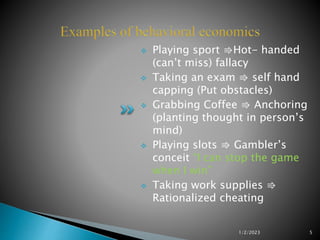
 Playing sport ⇛Hot- handed
(can’t miss) fallacy
 Taking an exam ⇛ self hand
capping (Put obstacles)
 Grabbing Coffee ⇛ Anchoring
(planting thought in person’s
mind)
 Playing slots ⇛ Gambler’s
conceit “I can stop the game
when I win”
 Taking work supplies ⇛
Rationalized cheating
1/2/2023 5
Decision making is the process of making choices. It is
about identifying a problem or decision, gathering
information, and assessing alternatives and solutions
 Depending up on the degree of knowledge we
have, there are three conditions that we face
when making decision: Certainty, risk and
Uncertainty
1.Making decision under Certainty ⇛Accurate,
measurable, and reliable more information ⇛ The
better the decision will be.
1/2/2023 6
1/2/2023 7
2.Making decision under risk ⇛ (“I know the
probability estimates”) ⇛ You have incomplete
or some knowledge regarding the likelihood
occurrences of each output. Provide subjective
probabilities regarding each event.
3.Making decision under pure uncertainty ⇛(“I
don’t know”) ⇛ You are ignorant, have absolute
no knowledge⇛ Your behavior is purely based
on your attitude towards the unknown ⇛ The
future outcome are unpredictable.
⇛ You are not aware of the likelihood and
extent of your success.
 Intertemporal choice is an economic
term describing how current decisions affect
what options become available in the
future. Theoretically, by not consuming today,
consumption levels could increase significantly
in the future, and vice versa.
 Decisions that have consequences in multiple
time periods are intertemporal choices.
Most choices require decision-makers to trade-
off costs and benefits at different points in
time. Decisions about savings, work effort,
education, nutrition, exercise, and health care
are all intertemporal choices.
8
1/2/2023
Keynes’ absolute income hypothesis
advocates that current consumption depends
only on current income. However, Irving
Fisher argues that current consumption
depends on lifetime income.
According to him, time of income is irrelevant
as the consumer can borrow or lend between
periods.
Fisher’s model of intertemporal choice takes
two important assumptions as:
Consumer is forward-looking and chooses
consumption for the present and future
Consumer’s choices are subject to an
intertemporal budget constraint.
1/2/2023 9
Decision Making
1/2/2023 10
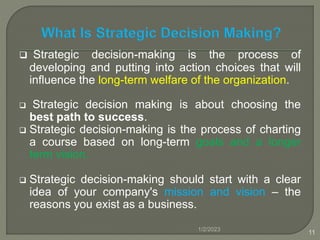
 Strategic decision-making is the process of
developing and putting into action choices that will
influence the long-term welfare of the organization.
 Strategic decision making is about choosing the
best path to success.
 Strategic decision-making is the process of charting
a course based on long-term goals and a longer
term vision.
 Strategic decision-making should start with a clear
idea of your company's mission and vision – the
reasons you exist as a business.
1/2/2023
11
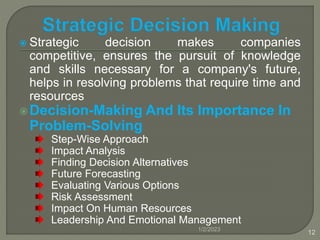
 Strategic decision makes companies
competitive, ensures the pursuit of knowledge
and skills necessary for a company's future,
helps in resolving problems that require time and
resources
Decision-Making And Its Importance In
Problem-Solving
Step-Wise Approach
Impact Analysis
Finding Decision Alternatives
Future Forecasting
Evaluating Various Options
Risk Assessment
Impact On Human Resources
Leadership And Emotional Management
1/2/2023
12
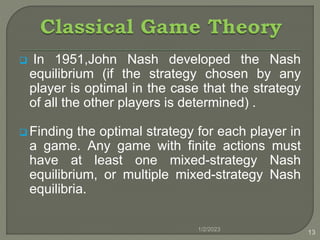
 In 1951,John Nash developed the Nash
equilibrium (if the strategy chosen by any
player is optimal in the case that the strategy
of all the other players is determined) .
 Finding the optimal strategy for each player in
a game. Any game with finite actions must
have at least one mixed-strategy Nash
equilibrium, or multiple mixed-strategy Nash
equilibria.
1/2/2023
13
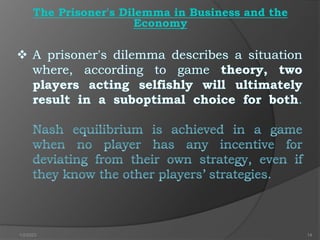
The Prisoner's Dilemma in Business and the
Economy
1/2/2023 14
Behavioral Game Theory
 Behavioral game theory seeks to examine
how people's strategic decision-making
behavior is shaped by social preferences,
social utility and other psychological factors.
 Behavioral game theory analyzes
interactive strategic decisions and
behavior using the methods of game
theory, experimental economics,
and experimental psychology.
1/2/2023 15
1/2/2023 16
Social preferences assume that people not only
have a self-interested desire to receive high payoffs,
but are also concerned about the payoffs of others.
 Theory of social preferences: a new, tractable way
to capture fairness and justice principles.
It shows how Elastic are preferences for
Redistribution or income share for others.
The motivation for studying social preference is
the rising of inequality and no demand for
redistribution.
1/2/2023 17
Social preference refers to having non-selfish motive.
Policymakers do not always act selfishly, that is, choose a
policy that maximizes their own payoffs.
Elected leaders who act non-selfishly will favor the voter
rather than the losing candidate, while appointed leaders
show no tendency to favor the voter over the losing
candidate.
Social preferences-motives like (altruism, envy, spite,
fairness, reciprocity, etc.)
A substantial number of people exhibit social
preferences, which means they are not solely motivated
by material self-interest but also care positively.
1/2/2023 18
Non-selfish behavior of leaders
reflects a reciprocity motive
The leader responsiveness to
citizens and how this is affected
by the procedure through which
they came to office should yield
rich insights.
1/2/2023 19
1/2/2023 20

BEHAVIOURAL ECONOMICS.pptx

  • 1.
  • 2.
    Behavioral economics isa branch of economic theory that studies the influence of psychological factors on people’s decisions in various life situations. 1/2/2023 2
  • 3.
    Intro…  People behave differentlythan predicted by classical economic theory with its assumption of rationality and selfishness. Interesting possibility of application of behavioral economic in various spheres of human life and society.  For example, reforms introducing, insurance system, public health and medicine (healthy living, disease prevention, following- up to the doctor’s recommendations, improving the quality of care, etc.). 1/2/2023 3
  • 4.
    Importance Behavioral Economics: it helps governments and businesses understand, predict and influence the decisions that people make.  it apply economic principles for developing market strategies. For example, many promotional campaigns include a "buy one, get one free" offer that appeals to customer emotions. 1/2/2023 4
  • 5.
     Playing sport⇛Hot- handed (can’t miss) fallacy  Taking an exam ⇛ self hand capping (Put obstacles)  Grabbing Coffee ⇛ Anchoring (planting thought in person’s mind)  Playing slots ⇛ Gambler’s conceit “I can stop the game when I win”  Taking work supplies ⇛ Rationalized cheating 1/2/2023 5
  • 6.
    Decision making isthe process of making choices. It is about identifying a problem or decision, gathering information, and assessing alternatives and solutions  Depending up on the degree of knowledge we have, there are three conditions that we face when making decision: Certainty, risk and Uncertainty 1.Making decision under Certainty ⇛Accurate, measurable, and reliable more information ⇛ The better the decision will be. 1/2/2023 6
  • 7.
    1/2/2023 7 2.Making decisionunder risk ⇛ (“I know the probability estimates”) ⇛ You have incomplete or some knowledge regarding the likelihood occurrences of each output. Provide subjective probabilities regarding each event. 3.Making decision under pure uncertainty ⇛(“I don’t know”) ⇛ You are ignorant, have absolute no knowledge⇛ Your behavior is purely based on your attitude towards the unknown ⇛ The future outcome are unpredictable. ⇛ You are not aware of the likelihood and extent of your success.
  • 8.
     Intertemporal choiceis an economic term describing how current decisions affect what options become available in the future. Theoretically, by not consuming today, consumption levels could increase significantly in the future, and vice versa.  Decisions that have consequences in multiple time periods are intertemporal choices. Most choices require decision-makers to trade- off costs and benefits at different points in time. Decisions about savings, work effort, education, nutrition, exercise, and health care are all intertemporal choices. 8 1/2/2023
  • 9.
    Keynes’ absolute incomehypothesis advocates that current consumption depends only on current income. However, Irving Fisher argues that current consumption depends on lifetime income. According to him, time of income is irrelevant as the consumer can borrow or lend between periods. Fisher’s model of intertemporal choice takes two important assumptions as: Consumer is forward-looking and chooses consumption for the present and future Consumer’s choices are subject to an intertemporal budget constraint. 1/2/2023 9
  • 10.
  • 11.
     Strategic decision-makingis the process of developing and putting into action choices that will influence the long-term welfare of the organization.  Strategic decision making is about choosing the best path to success.  Strategic decision-making is the process of charting a course based on long-term goals and a longer term vision.  Strategic decision-making should start with a clear idea of your company's mission and vision – the reasons you exist as a business. 1/2/2023 11
  • 12.
     Strategic decisionmakes companies competitive, ensures the pursuit of knowledge and skills necessary for a company's future, helps in resolving problems that require time and resources Decision-Making And Its Importance In Problem-Solving Step-Wise Approach Impact Analysis Finding Decision Alternatives Future Forecasting Evaluating Various Options Risk Assessment Impact On Human Resources Leadership And Emotional Management 1/2/2023 12
  • 13.
     In 1951,JohnNash developed the Nash equilibrium (if the strategy chosen by any player is optimal in the case that the strategy of all the other players is determined) .  Finding the optimal strategy for each player in a game. Any game with finite actions must have at least one mixed-strategy Nash equilibrium, or multiple mixed-strategy Nash equilibria. 1/2/2023 13
  • 14.
    The Prisoner's Dilemmain Business and the Economy 1/2/2023 14
  • 15.
    Behavioral Game Theory Behavioral game theory seeks to examine how people's strategic decision-making behavior is shaped by social preferences, social utility and other psychological factors.  Behavioral game theory analyzes interactive strategic decisions and behavior using the methods of game theory, experimental economics, and experimental psychology. 1/2/2023 15
  • 16.
  • 17.
    Social preferences assumethat people not only have a self-interested desire to receive high payoffs, but are also concerned about the payoffs of others.  Theory of social preferences: a new, tractable way to capture fairness and justice principles. It shows how Elastic are preferences for Redistribution or income share for others. The motivation for studying social preference is the rising of inequality and no demand for redistribution. 1/2/2023 17
  • 18.
    Social preference refersto having non-selfish motive. Policymakers do not always act selfishly, that is, choose a policy that maximizes their own payoffs. Elected leaders who act non-selfishly will favor the voter rather than the losing candidate, while appointed leaders show no tendency to favor the voter over the losing candidate. Social preferences-motives like (altruism, envy, spite, fairness, reciprocity, etc.) A substantial number of people exhibit social preferences, which means they are not solely motivated by material self-interest but also care positively. 1/2/2023 18
  • 19.
    Non-selfish behavior ofleaders reflects a reciprocity motive The leader responsiveness to citizens and how this is affected by the procedure through which they came to office should yield rich insights. 1/2/2023 19
  • 20.