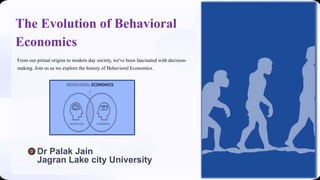
The Evolution of Behavioral
Economics
From our primal origins to modern day society, we've been fascinated with decision-
making. Join us as we explore the history of Behavioral Economics.
Dr Palak Jain
Jagran Lake city University
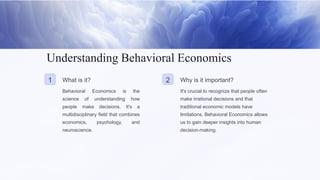
Understanding Behavioral Economics
1 What is it?
Behavioral Economics is the
science of understanding how
people make decisions. It's a
multidisciplinary field that combines
economics, psychology, and
neuroscience.
2 Why is it important?
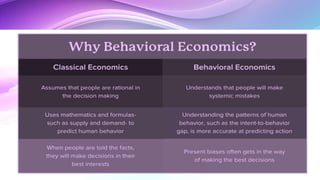
It's crucial to recognize that people often
make irrational decisions and that
traditional economic models have
limitations. Behavioral Economics allows
us to gain deeper insights into human
decision-making.
Introduction to Behavioral
Economics: Historical Context
1 The Rise of Behavioral Economics
Learn how traditional economic theories
were challenged by the emergence of
Behavioral Economics.
2 Understanding Human Behavior
Discover the shift in focus from rational
decision-making to the study of human
biases and cognitive processes.
3 Applications in Real-World
Scenarios
Explore how Behavioral Economics has
revolutionized fields like finance,
marketing, and public policy.
4 Impact of Technological
Advancements
See how Behavioral Economics
intersects with cutting-edge technologies
like AI in shaping our behavior and
choices.
Major Historical Events
Great Depression
The economic and
financial devastation
of the Great
Depression exposed
the limits of traditional
economic models and
opened the door for
alternative
approaches to
economics.
Manhattan
Project
The project relied on
expert opinion and
quantitative analysis,
furthering the idea
that traditional
economic models
could be
supplemented by
psychology and
decision-science
research.
Baby Boomers
The post-war
generation's
emergence shaped
society and its
preferences,
influencing decision-
making and the field
of Behavioral
Economics as we
know it today.
9/11
The terrorist attacks
on September 11,
2001 shook the world
and demonstrated
how irrational
decisions can be
made in times of
crisis.
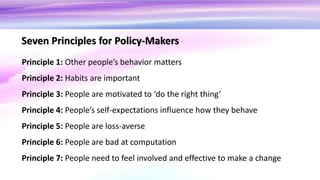
Principle 1: Other people’s behavior matters
Principle 2: Habits are important
Principle 3: People are motivated to ‘do the right thing’
Principle 4: People’s self-expectations influence how they behave
Principle 5: People are loss-averse
Principle 6: People are bad at computation
Principle 7: People need to feel involved and effective to make a change
Seven Principles for Policy-Makers
Key Figures and Contributions
1 Daniel Kahneman & Amos
Tversky
Discovered heuristics and cognitive
biases, helping us understand why
people make irrational decisions.
2
Richard Thaler
Developed the concept of behavioral
finance, which explains how emotions
and cognitive errors influence financial
decision-making. 3 Herbert Simon
Introduced the concept of bounded
rationality, which suggests that people
make rational, yet limited, decisions
based on the information available to
them.
Key Historical Events Leading to
the Development of Behavioral
Economics
1 The Prospect Theory
1950s - Prospect Theory challenges the long-standing assumption of rational
decision-making, introducing the concept of human biases.
2 Cognitive Biases and Heuristics
1970s - The research of Kahneman and Tversky sheds light on the systematic
cognitive biases that affect our decision-making processes.
3 The Nudge Theory
2000s - Thaler and Sunstein's concept of nudges highlights the power of subtle
interventions in shaping behavior without restricting choice.
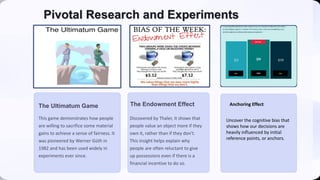
Pivotal Research and Experiments
The Ultimatum Game
This game demonstrates how people
are willing to sacrifice some material
gains to achieve a sense of fairness. It
was pioneered by Werner Güth in
1982 and has been used widely in
experiments ever since.
The Endowment Effect
Discovered by Thaler, it shows that
people value an object more if they
own it, rather than if they don't.
This insight helps explain why
people are often reluctant to give
up possessions even if there is a
financial incentive to do so.
Uncover the cognitive bias that
shows how our decisions are
heavily influenced by initial
reference points, or anchors.
Anchoring Effect
Discovered by Kahneman and
Tversky, this theory shows people
are more likely to act to avoid
losses than they are to achieve
gains.
Prospect Theory
This research shows how
expectations performance.
When people are told they are
expected to perform well,
they tend to rise to meet the
challenge.
The Pygmalion Effect
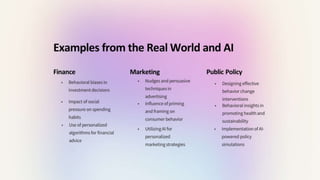
Examples from the Real World and AI
Finance
• Behavioral biases in
investment decisions
• Impact of social
pressure on spending
habits
• Use of personalized
algorithms for
financial advice
Marketing
• Nudges and
persuasive
techniques in
advertising
• Influence of priming
and framing on
consumer behavior
• Utilizing AI for
personalized
marketing strategies
Public Policy
• Designing effective
behavior change
interventions
• Behavioral insights in
promoting health and
sustainability
• Implementation of AI-
powered policy
simulations
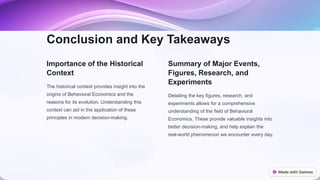
Conclusion and Key Takeaways
Importance of the Historical
Context
The historical context provides insight into the
origins of Behavioral Economics and the
reasons for its evolution. Understanding this
context can aid in the application of these
principles in modern decision-making.
Summary of Major Events,
Figures, Research, and
Experiments
Detailing the key figures, research, and
experiments allows for a comprehensive
understanding of the field of Behavioral
Economics. These provide valuable insights into
better decision-making, and help explain the
real-world phenomenon we encounter every day.
Advancements in
Behavioral Economics
The field of Behavioral Economics continues to make strides in
understanding decision-making processes. Continuing research in
heuristics, cognitive biases, and moral dilemmas will continue to shape
the field.
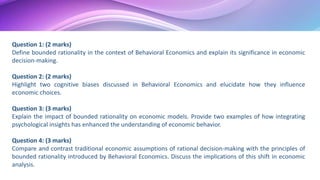
Question 1: (2 marks)
Define bounded rationality in the context of Behavioral Economics and explain its significance in economic
decision-making.
Question 2: (2 marks)
Highlight two cognitive biases discussed in Behavioral Economics and elucidate how they influence
economic choices.
Question 3: (3 marks)
Explain the impact of bounded rationality on economic models. Provide two examples of how integrating
psychological insights has enhanced the understanding of economic behavior.
Question 4: (3 marks)
Compare and contrast traditional economic assumptions of rational decision-making with the principles of
bounded rationality introduced by Behavioral Economics. Discuss the implications of this shift in economic
analysis.
Impact of Technological Advancements

The-Evolution-of-Behavioral-Economics (1).pptx

  • 1.
    The Evolution ofBehavioral Economics From our primal origins to modern day society, we've been fascinated with decision- making. Join us as we explore the history of Behavioral Economics. Dr Palak Jain Jagran Lake city University
  • 2.
    Understanding Behavioral Economics 1What is it? Behavioral Economics is the science of understanding how people make decisions. It's a multidisciplinary field that combines economics, psychology, and neuroscience. 2 Why is it important? It's crucial to recognize that people often make irrational decisions and that traditional economic models have limitations. Behavioral Economics allows us to gain deeper insights into human decision-making.
  • 4.
    Introduction to Behavioral Economics:Historical Context 1 The Rise of Behavioral Economics Learn how traditional economic theories were challenged by the emergence of Behavioral Economics. 2 Understanding Human Behavior Discover the shift in focus from rational decision-making to the study of human biases and cognitive processes. 3 Applications in Real-World Scenarios Explore how Behavioral Economics has revolutionized fields like finance, marketing, and public policy. 4 Impact of Technological Advancements See how Behavioral Economics intersects with cutting-edge technologies like AI in shaping our behavior and choices.
  • 5.
    Major Historical Events GreatDepression The economic and financial devastation of the Great Depression exposed the limits of traditional economic models and opened the door for alternative approaches to economics. Manhattan Project The project relied on expert opinion and quantitative analysis, furthering the idea that traditional economic models could be supplemented by psychology and decision-science research. Baby Boomers The post-war generation's emergence shaped society and its preferences, influencing decision- making and the field of Behavioral Economics as we know it today. 9/11 The terrorist attacks on September 11, 2001 shook the world and demonstrated how irrational decisions can be made in times of crisis.
  • 6.
    Principle 1: Otherpeople’s behavior matters Principle 2: Habits are important Principle 3: People are motivated to ‘do the right thing’ Principle 4: People’s self-expectations influence how they behave Principle 5: People are loss-averse Principle 6: People are bad at computation Principle 7: People need to feel involved and effective to make a change Seven Principles for Policy-Makers
  • 7.
    Key Figures andContributions 1 Daniel Kahneman & Amos Tversky Discovered heuristics and cognitive biases, helping us understand why people make irrational decisions. 2 Richard Thaler Developed the concept of behavioral finance, which explains how emotions and cognitive errors influence financial decision-making. 3 Herbert Simon Introduced the concept of bounded rationality, which suggests that people make rational, yet limited, decisions based on the information available to them.
  • 8.
    Key Historical EventsLeading to the Development of Behavioral Economics 1 The Prospect Theory 1950s - Prospect Theory challenges the long-standing assumption of rational decision-making, introducing the concept of human biases. 2 Cognitive Biases and Heuristics 1970s - The research of Kahneman and Tversky sheds light on the systematic cognitive biases that affect our decision-making processes. 3 The Nudge Theory 2000s - Thaler and Sunstein's concept of nudges highlights the power of subtle interventions in shaping behavior without restricting choice.
  • 9.
    Pivotal Research andExperiments The Ultimatum Game This game demonstrates how people are willing to sacrifice some material gains to achieve a sense of fairness. It was pioneered by Werner Güth in 1982 and has been used widely in experiments ever since. The Endowment Effect Discovered by Thaler, it shows that people value an object more if they own it, rather than if they don't. This insight helps explain why people are often reluctant to give up possessions even if there is a financial incentive to do so. Uncover the cognitive bias that shows how our decisions are heavily influenced by initial reference points, or anchors. Anchoring Effect
  • 10.
    Discovered by Kahnemanand Tversky, this theory shows people are more likely to act to avoid losses than they are to achieve gains. Prospect Theory This research shows how expectations performance. When people are told they are expected to perform well, they tend to rise to meet the challenge. The Pygmalion Effect
  • 11.
    Examples from theReal World and AI Finance • Behavioral biases in investment decisions • Impact of social pressure on spending habits • Use of personalized algorithms for financial advice Marketing • Nudges and persuasive techniques in advertising • Influence of priming and framing on consumer behavior • Utilizing AI for personalized marketing strategies Public Policy • Designing effective behavior change interventions • Behavioral insights in promoting health and sustainability • Implementation of AI- powered policy simulations
  • 14.
    Conclusion and KeyTakeaways Importance of the Historical Context The historical context provides insight into the origins of Behavioral Economics and the reasons for its evolution. Understanding this context can aid in the application of these principles in modern decision-making. Summary of Major Events, Figures, Research, and Experiments Detailing the key figures, research, and experiments allows for a comprehensive understanding of the field of Behavioral Economics. These provide valuable insights into better decision-making, and help explain the real-world phenomenon we encounter every day.
  • 15.
    Advancements in Behavioral Economics Thefield of Behavioral Economics continues to make strides in understanding decision-making processes. Continuing research in heuristics, cognitive biases, and moral dilemmas will continue to shape the field.
  • 16.
    Question 1: (2marks) Define bounded rationality in the context of Behavioral Economics and explain its significance in economic decision-making. Question 2: (2 marks) Highlight two cognitive biases discussed in Behavioral Economics and elucidate how they influence economic choices. Question 3: (3 marks) Explain the impact of bounded rationality on economic models. Provide two examples of how integrating psychological insights has enhanced the understanding of economic behavior. Question 4: (3 marks) Compare and contrast traditional economic assumptions of rational decision-making with the principles of bounded rationality introduced by Behavioral Economics. Discuss the implications of this shift in economic analysis.
  • 19.