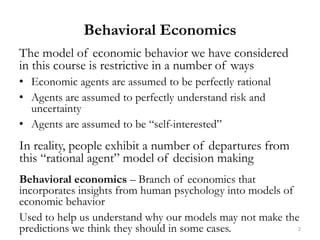
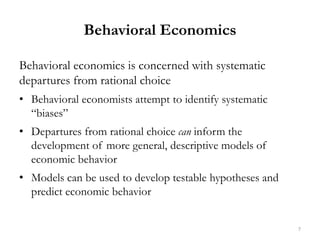
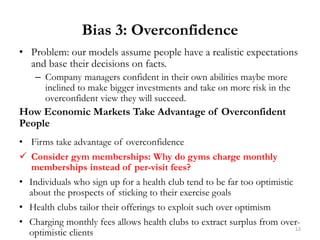
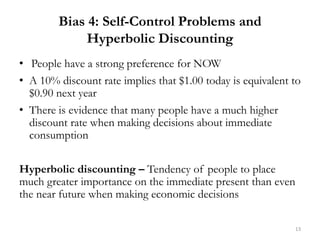
Behavioral economics is a branch of economics that incorporates insights from psychology about human decision making. The traditional model of economic behavior assumes people are perfectly rational, but behavioral economics recognizes systematic departures from this rational choice model. Some examples of irrational behaviors include paying attention to sunk costs, overconfidence, problems with self control and hyperbolic discounting, and being influenced by the framing of choices. Behavioral economics uses experiments and real data to better understand these biases and inform more accurate models of economic behavior. While the rational choice model still predicts behavior well in many cases, behavioral economics provides a more complete picture of human decision making.