ROCK MASS CLASSIFICATION
Rock mass classification:
• In rock engineering, the first major classification system was proposed over 40
years ago for tunneling with steel supports. Considering the three main design
approaches for excavation in rock –analytical, observational and empirical – as
practiced in mining and civil engineering, rock mass classification today form an
integral part of the most predominant design approach, the empirical design
methods.
• Many underground construction and mining projects, rock mass classification
have provided the only systematic design aid in an otherwise haphazard “trial-
and-error” procedure.
• Modern rock mass classification have never been intended as the ultimate
solution to design problems, but only a means toward this end.
Objectives of rock mass classification:
• Identify the most significant parameters influencing the behavior of a rock mass.
• Divide a particular rock mass formation into groups of similar behavior, that is
rock mass classes of varying quality.
• Provide a basis for understanding the characteristics of each rock mass class.
• Relate the experience of rock conditions at one site to the conditions and
experience encountered at others.
• Derive quantitative data and guidelines for engineering design.
• Provide a common basis for communication between engineers and geologists.
Benefits of rock mass classification:
• Improving the quality of site investigation by calling for the minimum input data
as classification parameters.
• Providing quantitative information for design purpose.
• Enabling better engineering judgement and more effective communication on a
project.
Rock mass classification system:
• Rock load classification (Terzaghi,1946)
• Stand-up time classification (Lauffer,1958)
• RQD (Deere et al.,1967)
• RSR (Wickham et al.,1972)
• RMR system (Bieniawski,1973)
• Q-system (Barton et al.,1974)
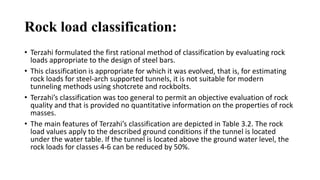
Rock load classification:
• Terzahi formulated the first rational method of classification by evaluating rock
loads appropriate to the design of steel bars.
• This classification is appropriate for which it was evolved, that is, for estimating
rock loads for steel-arch supported tunnels, it is not suitable for modern
tunneling methods using shotcrete and rockbolts.
• Terzahi’s classification was too general to permit an objective evaluation of rock
quality and that is provided no quantitative information on the properties of rock
masses.
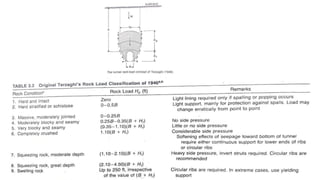
• The main features of Terzahi’s classification are depicted in Table 3.2. The rock
load values apply to the described ground conditions if the tunnel is located
under the water table. If the tunnel is located above the ground water level, the
rock loads for classes 4-6 can be reduced by 50%.
Stand up time classification:
• Lauffer proposed that the stand-up time for any active unsupported rock span is
related to the various rock mass classes.
• An active unsupported span is the width of the tunnel or the distance from the
face to the support if this is less than the tunnel width. The stand-up time is the
period of time that a tunnel will stand unsupported after excavation.
• Number of factors may affect the stand-up time, such as orientation of tunnel
axis, shape of cross-section, excavation method, and support method.
• The main significance of the Lauffer classification is that an increase in tunnel
span leads to a major reduction in the stand-up time.
• This classification introduced the stand –up time and span as relevant parameters
in determining the type and amount of tunnel support, and it has influenced the
development of more recent rock mass classification systems.
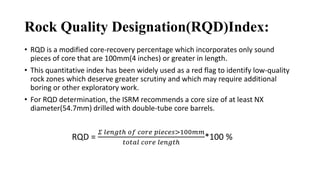
Rock Quality Designation(RQD)Index:
• RQD is a modified core-recovery percentage which incorporates only sound
pieces of core that are 100mm(4 inches) or greater in length.
• This quantitative index has been widely used as a red flag to identify low-quality
rock zones which deserve greater scrutiny and which may require additional
boring or other exploratory work.
• For RQD determination, the ISRM recommends a core size of at least NX
diameter(54.7mm) drilled with double-tube core barrels.
RQD =
𝛴 𝑙𝑒𝑛𝑔𝑡ℎ 𝑜𝑓 𝑐𝑜𝑟𝑒 𝑝𝑖𝑒𝑐𝑒𝑠>100𝑚𝑚
𝑡𝑜𝑡𝑎𝑙 𝑐𝑜𝑟𝑒 𝑙𝑒𝑛𝑔𝑡ℎ
*100 %
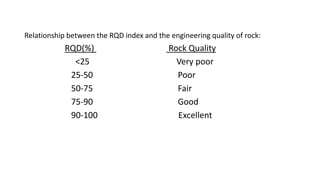
Relationship between the RQD index and the engineering quality of rock:
RQD(%) Rock Quality
<25 Very poor
25-50 Poor
50-75 Fair
75-90 Good
90-100 Excellent
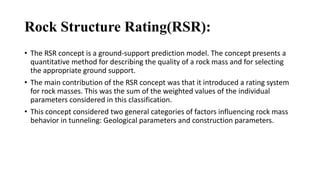
Rock Structure Rating(RSR):
• The RSR concept is a ground-support prediction model. The concept presents a
quantitative method for describing the quality of a rock mass and for selecting
the appropriate ground support.
• The main contribution of the RSR concept was that it introduced a rating system
for rock masses. This was the sum of the weighted values of the individual
parameters considered in this classification.
• This concept considered two general categories of factors influencing rock mass
behavior in tunneling: Geological parameters and construction parameters.
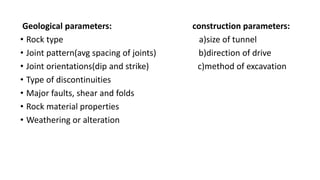
Geological parameters: construction parameters:
• Rock type a)size of tunnel
• Joint pattern(avg spacing of joints) b)direction of drive
• Joint orientations(dip and strike) c)method of excavation
• Type of discontinuities
• Major faults, shear and folds
• Rock material properties
• Weathering or alteration
All the factors were grouped into three basic parameters A,B and C
Parameter A: General appraisal of a rock structure on the basis of
a)Rock type origin (igneous, metamorphic and sedimentary).
b)Rock hardness (hard, medium, soft, decomposed).
c)Geological structure (massive, slightly faulted/folded, moderately faulted/folded,
intensely faulted/folded).
Parameter B: Effect of discontinuity pattern with respect to the direction of tunnel
drive is on the basis of
a)Joint spacing.
b)Joint orientation (strike and dip).
c)Direction of tunnel drive.
Parameter C: Effect of groundwater inflow based on
a)Overall rock mass quality due to parameters A and B combined.
b)Joint condition (good, fair, poor).
c)Amount of water inflow (in gallons per minute per 1000feet of tunnel).
• The RSR value of any tunnel section is obtained by summing the weighted
numerical values determined for each parameter.
RSR = A+B+C
• The RSR reflects the quality of the rock mass with respect to its need for support.
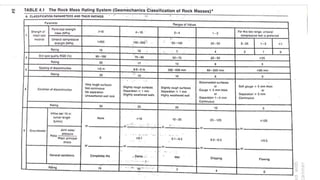
Rock Mass Rating(RMR):
The RMR system also called as Geomechanics classification.
The following six parameters are used to classify a rock mass using the RMR system.
1. Uniaxial compressive strength of rock material.
2. RQD.
3. Spacing of discontinuities.
4. Condition of discontinuities.
5. Ground water conditions.
6. Orientation of discontinuites.
Q- system:
The Q-system is based on a numerical assessment of the rock mass quality using
six different parameters:
1. RQD.
2. Number of joint sets.
3. Roughness of the most unfavorable joint or discontinuity.
4. Degree of alteration or filling along the weakest joint.
5. Water inflow.
6. Stress condition.
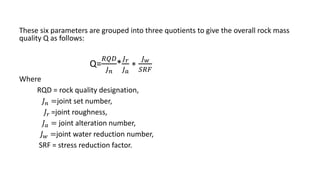
These six parameters are grouped into three quotients to give the overall rock mass
quality Q as follows:
Q=
𝑅𝑄𝐷
𝐽𝑛
*
𝐽𝑟
𝐽𝑎
∗
𝐽𝑤
𝑆𝑅𝐹
Where
RQD = rock quality designation,
𝐽𝑛 =joint set number,
𝐽𝑟 =joint roughness,
𝐽𝑎 = joint alteration number,
𝐽𝑤 =joint water reduction number,
SRF = stress reduction factor.
Name of classification Application
Rock load Tunnels with steel supports
Stand-up time Tunneling
RQD Core logging, tunneling
RSR Tunneling
RMR Tunnels, mines, slope stability, roof bolting coal
mines, foundations, weatherability, rippability
Q-system Tunnels, excavatability
THANK YOU
•

ROCK MASS CLASSIFICATION.pptx

  • 1.
  • 2.
    Rock mass classification: •In rock engineering, the first major classification system was proposed over 40 years ago for tunneling with steel supports. Considering the three main design approaches for excavation in rock –analytical, observational and empirical – as practiced in mining and civil engineering, rock mass classification today form an integral part of the most predominant design approach, the empirical design methods. • Many underground construction and mining projects, rock mass classification have provided the only systematic design aid in an otherwise haphazard “trial- and-error” procedure. • Modern rock mass classification have never been intended as the ultimate solution to design problems, but only a means toward this end.
  • 3.
    Objectives of rockmass classification: • Identify the most significant parameters influencing the behavior of a rock mass. • Divide a particular rock mass formation into groups of similar behavior, that is rock mass classes of varying quality. • Provide a basis for understanding the characteristics of each rock mass class. • Relate the experience of rock conditions at one site to the conditions and experience encountered at others. • Derive quantitative data and guidelines for engineering design. • Provide a common basis for communication between engineers and geologists.
  • 4.
    Benefits of rockmass classification: • Improving the quality of site investigation by calling for the minimum input data as classification parameters. • Providing quantitative information for design purpose. • Enabling better engineering judgement and more effective communication on a project. Rock mass classification system: • Rock load classification (Terzaghi,1946) • Stand-up time classification (Lauffer,1958) • RQD (Deere et al.,1967) • RSR (Wickham et al.,1972) • RMR system (Bieniawski,1973) • Q-system (Barton et al.,1974)
  • 5.
    Rock load classification: •Terzahi formulated the first rational method of classification by evaluating rock loads appropriate to the design of steel bars. • This classification is appropriate for which it was evolved, that is, for estimating rock loads for steel-arch supported tunnels, it is not suitable for modern tunneling methods using shotcrete and rockbolts. • Terzahi’s classification was too general to permit an objective evaluation of rock quality and that is provided no quantitative information on the properties of rock masses. • The main features of Terzahi’s classification are depicted in Table 3.2. The rock load values apply to the described ground conditions if the tunnel is located under the water table. If the tunnel is located above the ground water level, the rock loads for classes 4-6 can be reduced by 50%.
  • 7.
    Stand up timeclassification: • Lauffer proposed that the stand-up time for any active unsupported rock span is related to the various rock mass classes. • An active unsupported span is the width of the tunnel or the distance from the face to the support if this is less than the tunnel width. The stand-up time is the period of time that a tunnel will stand unsupported after excavation. • Number of factors may affect the stand-up time, such as orientation of tunnel axis, shape of cross-section, excavation method, and support method. • The main significance of the Lauffer classification is that an increase in tunnel span leads to a major reduction in the stand-up time. • This classification introduced the stand –up time and span as relevant parameters in determining the type and amount of tunnel support, and it has influenced the development of more recent rock mass classification systems.
  • 8.
    Rock Quality Designation(RQD)Index: •RQD is a modified core-recovery percentage which incorporates only sound pieces of core that are 100mm(4 inches) or greater in length. • This quantitative index has been widely used as a red flag to identify low-quality rock zones which deserve greater scrutiny and which may require additional boring or other exploratory work. • For RQD determination, the ISRM recommends a core size of at least NX diameter(54.7mm) drilled with double-tube core barrels. RQD = 𝛴 𝑙𝑒𝑛𝑔𝑡ℎ 𝑜𝑓 𝑐𝑜𝑟𝑒 𝑝𝑖𝑒𝑐𝑒𝑠>100𝑚𝑚 𝑡𝑜𝑡𝑎𝑙 𝑐𝑜𝑟𝑒 𝑙𝑒𝑛𝑔𝑡ℎ *100 %
  • 9.
    Relationship between theRQD index and the engineering quality of rock: RQD(%) Rock Quality <25 Very poor 25-50 Poor 50-75 Fair 75-90 Good 90-100 Excellent
  • 10.
    Rock Structure Rating(RSR): •The RSR concept is a ground-support prediction model. The concept presents a quantitative method for describing the quality of a rock mass and for selecting the appropriate ground support. • The main contribution of the RSR concept was that it introduced a rating system for rock masses. This was the sum of the weighted values of the individual parameters considered in this classification. • This concept considered two general categories of factors influencing rock mass behavior in tunneling: Geological parameters and construction parameters.
  • 11.
    Geological parameters: constructionparameters: • Rock type a)size of tunnel • Joint pattern(avg spacing of joints) b)direction of drive • Joint orientations(dip and strike) c)method of excavation • Type of discontinuities • Major faults, shear and folds • Rock material properties • Weathering or alteration
  • 12.
    All the factorswere grouped into three basic parameters A,B and C Parameter A: General appraisal of a rock structure on the basis of a)Rock type origin (igneous, metamorphic and sedimentary). b)Rock hardness (hard, medium, soft, decomposed). c)Geological structure (massive, slightly faulted/folded, moderately faulted/folded, intensely faulted/folded). Parameter B: Effect of discontinuity pattern with respect to the direction of tunnel drive is on the basis of a)Joint spacing. b)Joint orientation (strike and dip). c)Direction of tunnel drive.
  • 13.
    Parameter C: Effectof groundwater inflow based on a)Overall rock mass quality due to parameters A and B combined. b)Joint condition (good, fair, poor). c)Amount of water inflow (in gallons per minute per 1000feet of tunnel). • The RSR value of any tunnel section is obtained by summing the weighted numerical values determined for each parameter. RSR = A+B+C • The RSR reflects the quality of the rock mass with respect to its need for support.
  • 14.
    Rock Mass Rating(RMR): TheRMR system also called as Geomechanics classification. The following six parameters are used to classify a rock mass using the RMR system. 1. Uniaxial compressive strength of rock material. 2. RQD. 3. Spacing of discontinuities. 4. Condition of discontinuities. 5. Ground water conditions. 6. Orientation of discontinuites.
  • 17.
    Q- system: The Q-systemis based on a numerical assessment of the rock mass quality using six different parameters: 1. RQD. 2. Number of joint sets. 3. Roughness of the most unfavorable joint or discontinuity. 4. Degree of alteration or filling along the weakest joint. 5. Water inflow. 6. Stress condition.
  • 18.
    These six parametersare grouped into three quotients to give the overall rock mass quality Q as follows: Q= 𝑅𝑄𝐷 𝐽𝑛 * 𝐽𝑟 𝐽𝑎 ∗ 𝐽𝑤 𝑆𝑅𝐹 Where RQD = rock quality designation, 𝐽𝑛 =joint set number, 𝐽𝑟 =joint roughness, 𝐽𝑎 = joint alteration number, 𝐽𝑤 =joint water reduction number, SRF = stress reduction factor.
  • 19.
    Name of classificationApplication Rock load Tunnels with steel supports Stand-up time Tunneling RQD Core logging, tunneling RSR Tunneling RMR Tunnels, mines, slope stability, roof bolting coal mines, foundations, weatherability, rippability Q-system Tunnels, excavatability
  • 20.