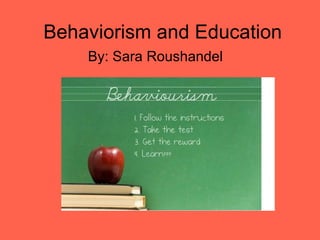
Behaviorism and Education
    By: Sara Roushandel
Menu Page
• What is Behaviorism
  – Classical vs. Operant Conditioning
• Behaviorism theorist’s
  – B.F. Skinner and John B. Watson
• Behaviorism in the classroom
  – Teachers and Students
• Behaviorism and my educational philosophy
• Final thoughts: Pros and Cons to Behaviorism
What is Behaviorism?
• Idea that behavior is acquired
  through conditioning.
• Measures behavior by
  a learner’s response to
  stimuli.
• A learner’s response to stimuli
  can be reinforced using positive or
  negative feedback.
• There are 2 types of
  conditioning…
Classical Conditioning


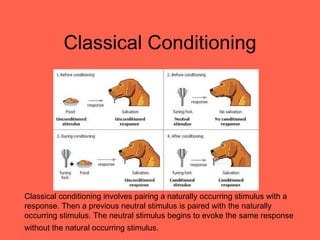
Classical conditioning involves pairing a naturally occurring stimulus with a
response. Then a previous neutral stimulus is paired with the naturally
occurring stimulus. The neutral stimulus begins to evoke the same response
without the natural occurring stimulus.
Operant Conditioning
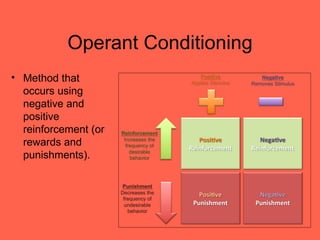
• Method that
  occurs using
  negative and
  positive
  reinforcement (or
  rewards and
  punishments).
B.F. Skinner
• Invented the “Skinner
  Box”- associated with
  operant conditioning
• “Education is what
  survives when what
  has been learned
  has been forgotten”
• “The consequences
  of an act affect the
  probability of it
  happening again”        March 1904 - August 1990
John B. Watson
•   “Give me a dozen healthy infants, well-
    formed, and my own specified world to
    bring them up in and I guarantee to take
    any one at random and train him to
    become any type of specialist I might
    select- doctor, lawyer, artist, merchant-
    chief and, yes, even beggar-man and
    thief, regardless of his talents, penchants,
    tendencies, abilities, vocations, and race
    of his ancestors.”


• Known for publishing an article titled
“Psychology as the Behaviorist Views It”           Jan. 1878- Sept. 1958
also called “The Behaviorist Manifesto”.
Behaviorism and Teachers
•   Behaviorism is seen when teachers use the
    following methods:
     – Testing specific skills
     – More individual work than group learning
     – Using positive and negative reinforcement
• One specific way teachers could incorporate
behaviorism is using a point or sticker system
to reward students good behavior or good
academic performance.
Behaviorism and Students
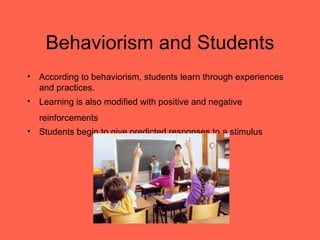
• According to behaviorism, students learn through experiences
  and practices.
• Learning is also modified with positive and negative
   reinforcements
• Students begin to give predicted responses to a stimulus
Behaviorism and My
                Classroom
•       Ways in which I could use behaviorism
        theory in my classroom:
    –     Have objectives and expectations clearly stated
    –     Give weekly quizzes/tests
    –     Use positive/negative reinforcement to encourage and
          reward my students for good behavior and to punish bad
          behavior.
Final Thoughts
• Pros:
   – Behaviorism is based on observable behaviors, making it easier to
     conduct and collect data and research.
   – Can be applicable/helpful for therapy of children with behavioral
     disorders

• Cons:
   – Does not account for other ways of learning that do no involve
     positive/negative reinforcement
   – People can change their behavior when presented with new
     information, even if they have previously established a different
     behavior through reinforcement

Behaviorism

  • 1.
    Behaviorism and Education By: Sara Roushandel
  • 2.
    Menu Page • Whatis Behaviorism – Classical vs. Operant Conditioning • Behaviorism theorist’s – B.F. Skinner and John B. Watson • Behaviorism in the classroom – Teachers and Students • Behaviorism and my educational philosophy • Final thoughts: Pros and Cons to Behaviorism
  • 3.
    What is Behaviorism? •Idea that behavior is acquired through conditioning. • Measures behavior by a learner’s response to stimuli. • A learner’s response to stimuli can be reinforced using positive or negative feedback. • There are 2 types of conditioning…
  • 4.
    Classical Conditioning Classical conditioninginvolves pairing a naturally occurring stimulus with a response. Then a previous neutral stimulus is paired with the naturally occurring stimulus. The neutral stimulus begins to evoke the same response without the natural occurring stimulus.
  • 5.
    Operant Conditioning • Methodthat occurs using negative and positive reinforcement (or rewards and punishments).
  • 6.
    B.F. Skinner • Inventedthe “Skinner Box”- associated with operant conditioning • “Education is what survives when what has been learned has been forgotten” • “The consequences of an act affect the probability of it happening again” March 1904 - August 1990
  • 7.
    John B. Watson • “Give me a dozen healthy infants, well- formed, and my own specified world to bring them up in and I guarantee to take any one at random and train him to become any type of specialist I might select- doctor, lawyer, artist, merchant- chief and, yes, even beggar-man and thief, regardless of his talents, penchants, tendencies, abilities, vocations, and race of his ancestors.” • Known for publishing an article titled “Psychology as the Behaviorist Views It” Jan. 1878- Sept. 1958 also called “The Behaviorist Manifesto”.
  • 8.
    Behaviorism and Teachers • Behaviorism is seen when teachers use the following methods: – Testing specific skills – More individual work than group learning – Using positive and negative reinforcement • One specific way teachers could incorporate behaviorism is using a point or sticker system to reward students good behavior or good academic performance.
  • 9.
    Behaviorism and Students •According to behaviorism, students learn through experiences and practices. • Learning is also modified with positive and negative reinforcements • Students begin to give predicted responses to a stimulus
  • 10.
    Behaviorism and My Classroom • Ways in which I could use behaviorism theory in my classroom: – Have objectives and expectations clearly stated – Give weekly quizzes/tests – Use positive/negative reinforcement to encourage and reward my students for good behavior and to punish bad behavior.
  • 11.
    Final Thoughts • Pros: – Behaviorism is based on observable behaviors, making it easier to conduct and collect data and research. – Can be applicable/helpful for therapy of children with behavioral disorders • Cons: – Does not account for other ways of learning that do no involve positive/negative reinforcement – People can change their behavior when presented with new information, even if they have previously established a different behavior through reinforcement