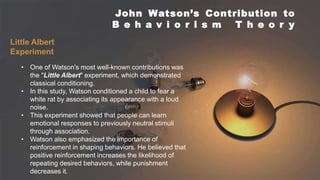
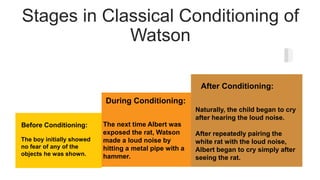
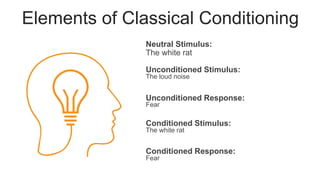
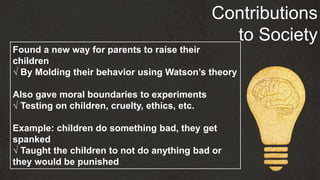
Watson's behaviorism theory emphasizes observable behaviors, suggesting that human behavior is controlled by environmental factors and past experiences rather than mental processes. The theory gained prominence after World War I and is exemplified by the 'Little Albert' experiment, which demonstrated classical conditioning in inducing fear. Watson's work also focused on reinforcement's role in shaping behavior, advocating for behavioral management strategies in parenting and educational settings.




![MEDICAL_BEHAVIORAL_SCIENCE[1] [Autosaved].pptx](https://cdn.slidesharecdn.com/ss_thumbnails/medicalbehavioralscience1autosaved-241126100112-21c18b33-thumbnail.jpg?width=640&height=640&fit=bounds)


