
What is behaviorism ?

   be·hav·ior·ism: is the prediction and control of human
    behavior in which introspection and/or independent thing
    play no essential part of its teaching methods.
   A theory that both human and animal behaviors can be
    explained in terms of conditioning, without appeal to
    thoughts or feelings
  Positive reinforcements and negative
 reinforcements are used
 Behaviors can be observed, measured and changed
   unlike the internal events like thinking
 Behaviors are learned through conditioning
 There are two types of conditioning
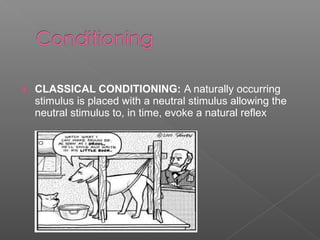
1.   CLASSICAL CONDITIONING: A naturally occurring
     stimulus is placed with a neutral stimulus allowing the
     neutral stimulus to, in time, evoke a natural reflex
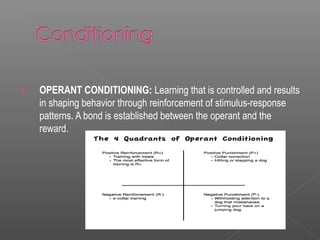
1.   OPERANT CONDITIONING: Learning that is controlled and results
     in shaping behavior through reinforcement of stimulus-response
     patterns. A bond is established between the operant and the
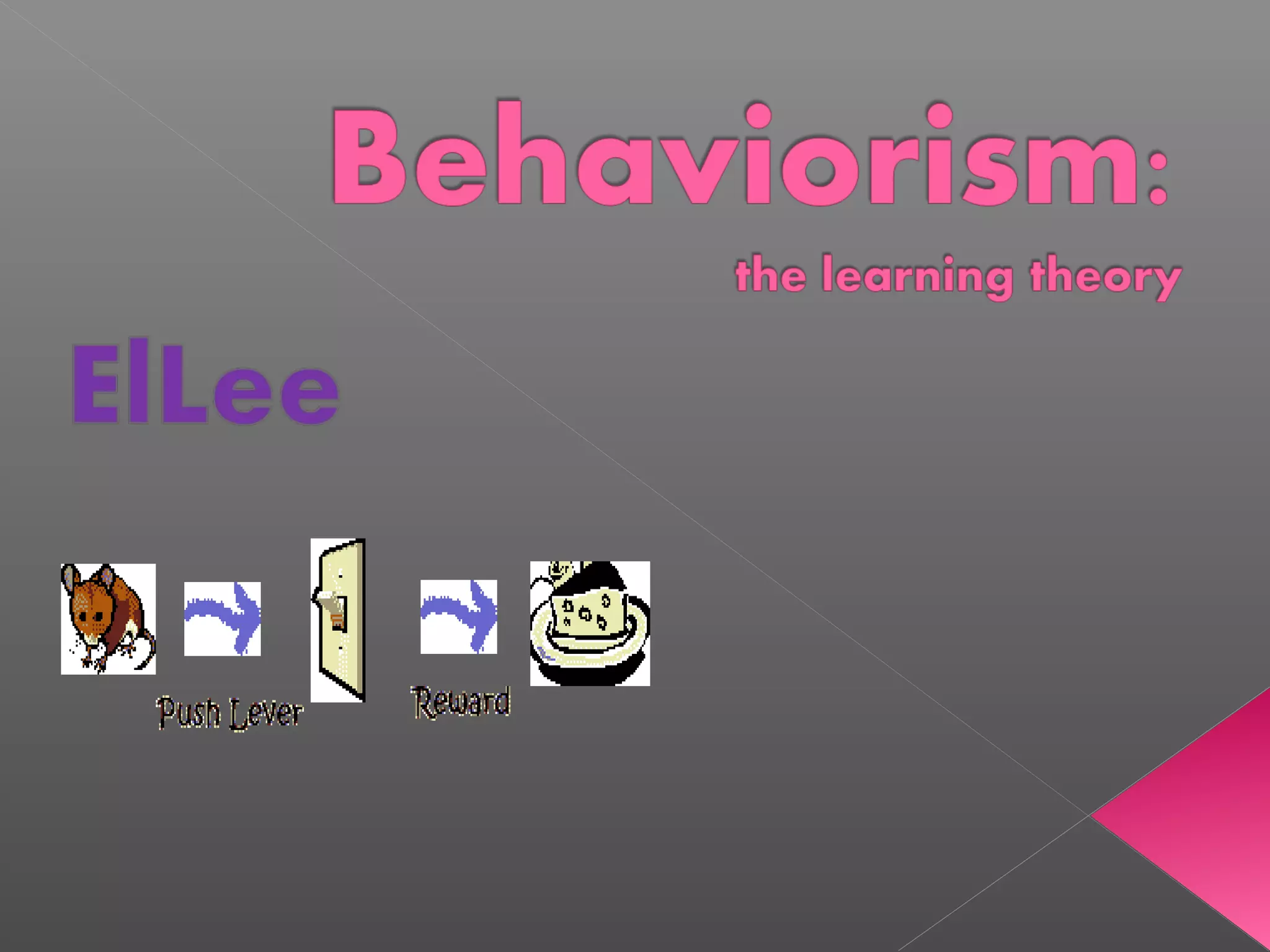
     reward.
   B. F. Skinner (1904-1990)
   Albert Bandura (1925- )
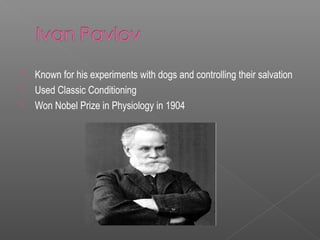
   Ivan Pavlov (1849-1936)
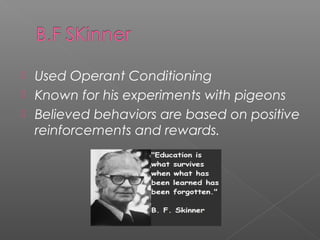
   Used Operant Conditioning
   Known for his experiments with pigeons
   Believed behaviors are based on positive
    reinforcements and rewards.
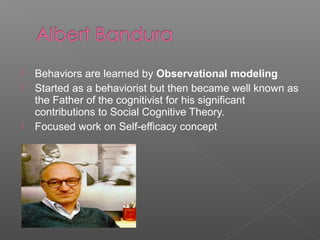
   Behaviors are learned by Observational modeling
   Started as a behaviorist but then became well known as
    the Father of the cognitivist for his significant
    contributions to Social Cognitive Theory.
   Focused work on Self-efficacy concept
   Known for his experiments with dogs and controlling their salvation
   Used Classic Conditioning
   Won Nobel Prize in Physiology in 1904
   Motivator and facilitator of educating
   Provides stimulus: materials and
    repeated practice
   Reinforcements: stickers, duties, bonus
    points, verbal reinforcement for good
    and bad behavior
   Maintains classroom participation
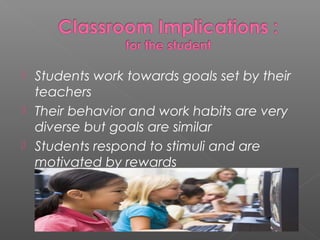
   Students work towards goals set by their
    teachers
   Their behavior and work habits are very
    diverse but goals are similar
   Students respond to stimuli and are
    motivated by rewards
   Software programs implement rewards
    such as games, funny videos or other fun
    activities which are reached after a goal
    is met.
   Teachers have their students use these
    programs and in return the students are
    rewarded for work with fun activities.
   Using computers can also be a reward
   I like using a reward system in the
    classroom as well as positive
    reinforcements.
   By rewarding good behaviors my
    students will want to be rewarded and
    follow good behaviors
   By pointing out bad behaviors and not
    rewarding them my students will learn
    what not to do if they want to be
    rewarded
Sources:

http://www.learning-theories.com/

http://psychology.about.com/od/behavioralpsychology/f/behaviorism.htm

Googleimages

Integrating Technology in a Connected World 7 th Ed.: Teachers Discovering
Computers, Shelly, Gunter, and Gunter (2012).

Behaviorism

  • 2.
    What is behaviorism ?  be·hav·ior·ism: is the prediction and control of human behavior in which introspection and/or independent thing play no essential part of its teaching methods.  A theory that both human and animal behaviors can be explained in terms of conditioning, without appeal to thoughts or feelings
  • 3.
     Positivereinforcements and negative reinforcements are used  Behaviors can be observed, measured and changed unlike the internal events like thinking  Behaviors are learned through conditioning  There are two types of conditioning
  • 4.
    1. CLASSICAL CONDITIONING: A naturally occurring stimulus is placed with a neutral stimulus allowing the neutral stimulus to, in time, evoke a natural reflex
  • 5.
    1. OPERANT CONDITIONING: Learning that is controlled and results in shaping behavior through reinforcement of stimulus-response patterns. A bond is established between the operant and the reward.
  • 6.
    B. F. Skinner (1904-1990)  Albert Bandura (1925- )  Ivan Pavlov (1849-1936)
  • 7.
    Used Operant Conditioning  Known for his experiments with pigeons  Believed behaviors are based on positive reinforcements and rewards.
  • 8.
    Behaviors are learned by Observational modeling  Started as a behaviorist but then became well known as the Father of the cognitivist for his significant contributions to Social Cognitive Theory.  Focused work on Self-efficacy concept
  • 9.
    Known for his experiments with dogs and controlling their salvation  Used Classic Conditioning  Won Nobel Prize in Physiology in 1904
  • 10.
    Motivator and facilitator of educating  Provides stimulus: materials and repeated practice  Reinforcements: stickers, duties, bonus points, verbal reinforcement for good and bad behavior  Maintains classroom participation
  • 11.
    Students work towards goals set by their teachers  Their behavior and work habits are very diverse but goals are similar  Students respond to stimuli and are motivated by rewards
  • 12.
    Software programs implement rewards such as games, funny videos or other fun activities which are reached after a goal is met.  Teachers have their students use these programs and in return the students are rewarded for work with fun activities.  Using computers can also be a reward
  • 13.
    I like using a reward system in the classroom as well as positive reinforcements.  By rewarding good behaviors my students will want to be rewarded and follow good behaviors  By pointing out bad behaviors and not rewarding them my students will learn what not to do if they want to be rewarded
  • 14.