POLICE OPERATIONAL PLANNING
In this chapter, the basic concepts in
POLICE planning are being discussed to
reinforce the topics in the previous chapters.
This is so because the word PLANNING
became a common terminology in Police
Organizations, in Police Management and
Administration as well as in the other fields
of Criminal Justice.
Police administrators sometimes do not appreciate the
importance of planning because of the pattern of career
development. It is ironic that the pattern of career
development for typical police managers carries with it
seeds that sometimes blossom into a negative view of
planning. However, planning is an integral element of
good management and good decision-making.
Management needs to anticipate and shape events; it is
weak if it merely responds to them.
What is a Plan?
A plan is an organize schedule or
sequence by methodical activities intended to
attain a goal and objectives for the
accomplishment of mission or assignment. It is a
method or way of doing something in order to
attain objectives. Plan provides answer to 5W’s
and 1 H.
What is Planning?
Hudzik and Cordner defined planning as
“thinking about the future, thinking about what
we want the future would be, and thinking about
what we need to do now to achieve it.”
Planning is a management function
concerned with visualizing future situations,
making estimates concerning them, identifying
issues, needs and potential danger points,
analyzing and evaluating the alternative ways and
means for reaching desired goals according to a
certain schedule, estimating the necessary funds,
and resources to do the work, and initiating action
in time to prepare what may be needed to cope
with the changing conditions and contingent
events.
What is Police Planning?
Police Planning is an attempt by
police administrators in trying to allocate
anticipated resources to meet anticipated
service demands. It is the systematic and
orderly determination of facts and events as
basis for policy formulation and decision
affecting law enforcement management.
What is Operational Planning?
• Operational Planning is the use of
rational design or pattern for all
departmental undertaking rather than
relying on change in an operational
environment. It is the preparation and
development of procedures and
techniques in accomplishing of each of
the primary tasks and functions of an
organization.
What is Police Operational
Planning?
• Police Operational Planning is the act of
determining policies and guidelines for police activities
and operations and providing controls and safeguards
for such activities and operations in the department. It
may also be the process of formulating coordinated
sequence of methodical activities and allocation of
resources to the line units of the police organization for
the attainment of the mandated objectives or goals.
• Objectives are a specific commitment to achieve a
measurable result within a specific period of time.
Goals are general statement of intention and typically
with time horizon, or it is an achievable end state that
can be measured and observed. Making choices about
goals is one of the most important aspects of planning.
Relate this definitions with their description as defined
in chapter one.
• The process of police operational planning
involves strategies or tactics, procedures, policies
or guidelines. A Strategy is a broad design or
method; or a plan to attain a stated goal or
objectives. Tactics are specific design, method or
course of action to attain a particular objective in
consonance with strategy. Procedures are
sequences of activities to reach a point or to attain
what is desired. A policy is a product of prudence
or wisdom in the management of human affairs, or
policy is a course of action which could be a
program of actions adopted by an individual,
group, organization, or government, or the set of
principles on which they are based. Guidelines are
rules of action for the rank and file to show them
how they are expected to obtain the desired
effect.
STRATEGIC PLANNING
Strategic planning is a series of preliminary
decisions on a framework, which in turn guides
subsequent decisions that generate the nature
and direction of an organization. This is usually
long range in nature. The reasons for Strategic
Planning are:
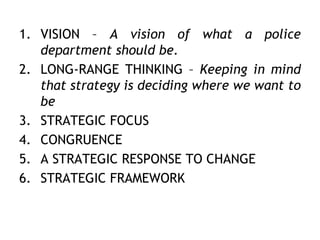
1. VISION – A vision of what a police
department should be.
2. LONG-RANGE THINKING – Keeping in mind
that strategy is deciding where we want to
be
3. STRATEGIC FOCUS
4. CONGRUENCE
5. A STRATEGIC RESPONSE TO CHANGE
6. STRATEGIC FRAMEWORK
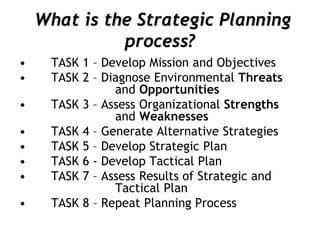
What is the Strategic Planning
process?
• TASK 1 – Develop Mission and Objectives
• TASK 2 – Diagnose Environmental Threats
and Opportunities
• TASK 3 – Assess Organizational Strengths
and Weaknesses
• TASK 4 – Generate Alternative Strategies
• TASK 5 – Develop Strategic Plan
• TASK 6 - Develop Tactical Plan
• TASK 7 – Assess Results of Strategic and
Tactical Plan
• TASK 8 – Repeat Planning Process
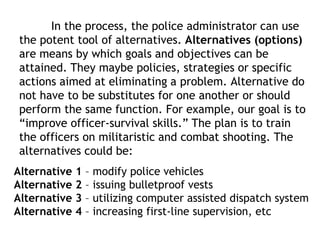
In the process, the police administrator can use
the potent tool of alternatives. Alternatives (options)
are means by which goals and objectives can be
attained. They maybe policies, strategies or specific
actions aimed at eliminating a problem. Alternative do
not have to be substitutes for one another or should
perform the same function. For example, our goal is to
“improve officer-survival skills.” The plan is to train
the officers on militaristic and combat shooting. The
alternatives could be:
Alternative 1 – modify police vehicles
Alternative 2 – issuing bulletproof vests
Alternative 3 – utilizing computer assisted dispatch system
Alternative 4 – increasing first-line supervision, etc
FUNDAMENTALS OF POLICE
PLANNING
What are the Objectives of Police Planning?
1. To increase the chances of success by focusing on results and not so much on the
objectives.
2. To force analytical thinking and evaluation of alternatives for better decisions.
3. To establish a framework for decision making consistent with the goal of the
organization.
4. To orient people to action instead of reaction.
5. To modify the day-to-day style of operation to future management.
6. To provide decision making with flexibility.
7. To provide basis for measuring original accomplishments or individual
performance.
8. To increase employee and personnel involvement and to improve
communication.
What can be expected in
planning?
1. Improve analysis of problems
2. Provide better information for decision-making
3. Help to clarify goals, objectives, priorities
4. Result is more effective allocation of resources
5. Improve inter-and intradepartmental cooperation
and coordination
6. Improve the performance of programs
7. Give the police department a clear sense of
direction
8. Provide the opportunity for greater public support
9. Increase the commitment of personnel
What are the characteristics of
a good police plan?
1. With clearly defined Objectives or Goals.
2. Simplicity, Directness and Clarity
3. Flexibility
4. Possibility of Attainment
5. Must provide Standard of Operation
6. Economy in terms of Resources needed for
implementation
What are the guidelines in
Planning?
The five (5) W’s and one (1) H
1.What to do – mission/objective
2.Why to do – reason/philosophy
3.When to do – date/time
4.Where to do – place
5.Who will do – people involve
6.How to do – strategy
What are the responsibilities in
Planning?
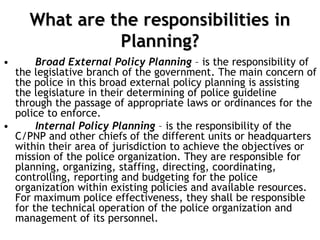
• Broad External Policy Planning – is the responsibility of
the legislative branch of the government. The main concern of
the police in this broad external policy planning is assisting
the legislature in their determining of police guideline
through the passage of appropriate laws or ordinances for the
police to enforce.
• Internal Policy Planning – is the responsibility of the
C/PNP and other chiefs of the different units or headquarters
within their area of jurisdiction to achieve the objectives or
mission of the police organization. They are responsible for
planning, organizing, staffing, directing, coordinating,
controlling, reporting and budgeting for the police
organization within existing policies and available resources.
For maximum police effectiveness, they shall be responsible
for the technical operation of the police organization and
management of its personnel.
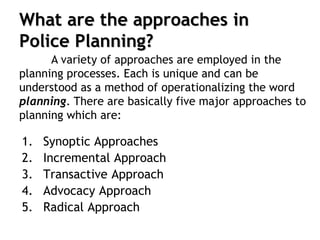
What are the approaches in
Police Planning?
1. Synoptic Approaches
2. Incremental Approach
3. Transactive Approach
4. Advocacy Approach
5. Radical Approach
A variety of approaches are employed in the
planning processes. Each is unique and can be
understood as a method of operationalizing the word
planning. There are basically five major approaches to
planning which are:
What is Synoptic Planning?
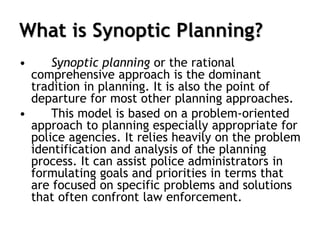
• Synoptic planning or the rational
comprehensive approach is the dominant
tradition in planning. It is also the point of
departure for most other planning approaches.
• This model is based on a problem-oriented
approach to planning especially appropriate for
police agencies. It relies heavily on the problem
identification and analysis of the planning
process. It can assist police administrators in
formulating goals and priorities in terms that
are focused on specific problems and solutions
that often confront law enforcement.
Steps in Synoptic Planning
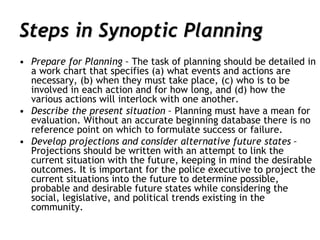
• Prepare for Planning – The task of planning should be detailed in
a work chart that specifies (a) what events and actions are
necessary, (b) when they must take place, (c) who is to be
involved in each action and for how long, and (d) how the
various actions will interlock with one another.
• Describe the present situation – Planning must have a mean for
evaluation. Without an accurate beginning database there is no
reference point on which to formulate success or failure.
• Develop projections and consider alternative future states –
Projections should be written with an attempt to link the
current situation with the future, keeping in mind the desirable
outcomes. It is important for the police executive to project the
current situations into the future to determine possible,
probable and desirable future states while considering the
social, legislative, and political trends existing in the
community.
• Identify and analyze problems – the discovery of the problems
assumes that a system to monitor and evaluate the current
arena is already on place. Closely related to the detection and
identification of issues is the ability of the police to define the
nature of the problem, that is to able to describe the
magnitude, cause, duration, and the expense of the issues at
hand. A complete understanding of the problem leads to the
development of the means to deal with the issues.
• Set goals – Making choices about goals is one of the most
important aspects of planning. It makes no sense to establish a
goal that does not address a specific problem. Remembering
that the police departments are problem oriented, choices
about goals and objectives should adhere to the synoptic
model.
• Identify alternative course of action – As stated earlier,
alternatives are means by which goals and objectives can be
attained. These are options or possible things to be done in
case the main or original plan is not applicable.
Select preferred alternatives – there are three
techniques to select alternative:
1. Strategic analysis – this include the study on the courses of
actions; suitability studies; feasibility studies; acceptability
studies; and judgment.
• Suitability – each course of action is evaluated in
accordance with general policies, rules and laws.
• Feasibility – these include the appraisal of the effects of a
number of factors weigh separately and together.
• Acceptability – those judged to be suitable and feasible are
then realized in acceptability studies.
2. Cost – effectiveness Analysis – This technique is sometimes
called cost-benefit or cost performance analysis. The purpose of
this form of selection is that the alternative chosen should
maximize the ratio of benefit to cost.
3. Must-wants Analysis – This method of selecting a preferred
course of action combines the strengths of both strategic and
cost effectiveness analysis. Must wants analysis is concerned
with both the subjective weights of suitability, feasibility, and
acceptability and the objectives weights of cost versus benefits.
• Plan and carryout implementation – The police administrator must
be aware that the implementation requires a great deal of tact and
skill. It maybe more important how an alternative is introduced to
a police department than what actually is.
• Monitor and evaluate progress – Evaluation requires comparing
what actually happened with what was planned for-and this may
not be a simple undertaking. Feedback must be obtained
concerning the results of the planning cycle, the efficiency of the
implementation process, and the effectiveness of new procedures,
projects or programs. This is an important step of synoptic
planning, trying to figure out what, if anything happened as a result
of implementing a selected alternative.
• Summation of the synoptic planning approach – This can be done by
making a summary of the presentation, could be tabular or other
forms of presentation.
• Repeat the Planning Process – repetition of the process of planning
enables the planner to thresh out possible flaws in the plan.
What is Incremental Planning?
Incrementalism concludes that long range and
comprehensive planning are not only too difficult, but
inherently bad. The problems are seen as too difficult
when they are grouped together and easier to solve
when they are taken one at a time and broken down
into gradual adjustments over time.
What is Transactive Planning?
Transactive planning is carried out in face-to-face
interaction with the people who are to be affected by
the plan and not to an anonymous target community of
beneficiaries. Techniques include field surveys and
interpersonal dialogue marked by a process of mutual
learning.
What is Advocacy Planning?
Beneficial aspects of this approach include a
greater sensitivity to the unintended and negative side
effects of plans.
What is Radical Planning?
The first mainstream involves collective actions to
achieve concrete results in the immediate future. The
second mainstream is critical of large-scale social
processes and how they permeate the character of
social and economic life at all levels, which, in turn,
determine the structure and evolution of social
problems.
CONSIDERATIONS IN POLICE PLANNING
1. Primary Doctrines
• Fundamental Doctrines – These are the basic principles in
planning, organization and management of the PNP in
support of the overall pursuits of the PNP Vision, Mission
and strategic action plan of the attainment of the national
objectives.
• Operational Doctrines – These are the principles and rules
governing the planning, organization and direction and
employment of the PNP forces in the accomplishment of
basic security operational mission in the maintenance of
peace and order, crime prevention and suppression,
internal security and public safety operation.
• Functional Doctrines – These provide guidance for
specialized activities of the PNP in the broad field of
interest such as personnel, intelligence, operations,
logistics, planning, etc.
2. Secondary Doctrines
• Complimentary Doctrines – Formulated jointly by two or more
bureaus in order to effect a certain operation with regard to public
safety and peace and order. These essentially involve the
participation of the other bureaus of the Bureau of Jail and
Management and Penology (BJMP), Bureau of Fire and Protection
(BFP), Philippine National Public Safety College (PPSC), National
Bureau of Investigation (NBI) and other law enforcement agencies.
• Ethical Doctrines – These define the fundamental principles
governing the rules of conduct, attitude, behavior and ethical norm
of the PNP.
3. The Principles of Police Organization
The principles of organization are presented in chapter
three. These principles are considered in police planning in
order not to violate them but rather for the effective and efficient
development of police plans.
4. The Four (4) Primal Conditions of the Police
Organization
• Authority – The right to exercise, to decide, and to
command by virtue of rank and position. Doctrine –
It provides for the organizations objectives. It
provides the various actions. Hence, policies,
procedures, rules and regulations of the
organization are based on the statement of
doctrines.
• Cooperation or Coordination
• Discipline – It is imposed by command or self-
restraint to insure supportive behavior.
Classifications of Police Plan
According to coverage: Police Plans could be Local
Plans (within police precincts, sub-stations, and
stations), Regional Plans, and National Plans.
According to Time: Police Plans are classified as:
1. Strategic or Long Range Plan – It relates to plan
which are strategic or long range in application and
it determine the organization’s original goals and
strategy.
Example: Police Action Plan on the Strategy
DREAMS and Program P-O-L-I-C-E 2000, Three Point
Agenda, and GLORIA (These are discussed on the
latter part of this Chapter).
2. Intermediate or Medium Range Planning – It relates to plans,
which determine quantity and quality efforts and
accomplishments. It refers to the process of determining the
contribution on efforts that can make or provide with allocated
resources.
Example: 6 Masters Plans:
• Master Plan Sandigan-Milenyo (Anti-Crime Master Plan)
• Master Plan Sandugo (Support to Internal Security Operations
Master Plan)
• Master Plan Banat (Anti-Illegal Drugs Master Plan)
• Master Plan Sang-ingat (Security Operations Master Plan)
• Master Plan Saklolo (Disaster Management Master Plan)
• Sangyaman (Protection and Preservtion of Environment, Cultural
Properties, and Natural resources Master Plan)
3. Operational or Short Range Planning – Refers to the
productions of plans, which determine the schedule of special
activity and are applicable from one week or less than year
duration. Plan that addresses immediate need which are specific
and how it can be accomplished on time with available allocated
resources.
Examples of OPLANS
• Oplan Jumbo – Aviation Security Group Strategic Plan against
terrorist attacks
• Oplan Salikop – Criminal Investigation and Detection Group
(CIDG) Strategic Plan against Organized Crime Groups
• LOI PAGPAPALA is the entry point in the conceptualization of the
PNP Pastoral Program for the next five years with a Total Human
Development Approach (THD Approach).
• The TMG through its “OPLAN DISIPLINA” that resulted in the
apprehension of 110,975 persons, the confiscation of 470
unlawfully attached gadgets to vehicles, and rendering various
forms of motorists’ assistance.
• OPLAN BANTAY DALAMPASIGAN that sets forth the operational
guidelines on the heightened security measures and sea borne
security patrols.
Factors affecting Police Planning
1. Condition – a consideration of political atmosphere, public opinion;
ideological aspirations; peace and order; national/community ethics,
behavior and discipline in the area where the plan will be
implemented.
2. Time – It is the period available to establish plan before putting it into
effort. Consider the time of execution/implementation, the time
interval and time allowed for the revisions and modifications of plan.
3. Resources Available – Allocation of manpower, money and materials
4. Skills and Attitudes of Management – Refers to the level of
experiences of the personnel who are involved in the preparation of
the plan and those who will execute the plan. Applicability of good
management principles shall be exploited.
5. Social and Political Environment – Refers to social and political
practices, which will be affected b the plan or plan affecting these
practices, beliefs and norms of society.
6. Physical Facilities – Refers to machinery, instrument or tools in the
attainment of the goals of the plan. A certain system or structural
designs in order to meet expected results.
7. Collection and Analysis of Data – Ready sources and basis of good
decision-making by the makers of the plan may be properly obtain
through research and other means of information gathering
techniques.
Parts of a Police Operational Plan
1. Security Classification
2. Number of Copies and Pages
3. Name of Headquarters
4. Plan Title or Name
5. Reference – The source of authority in formulating a
plan is based on:
• Organizational Policy or Guidelines
• Orders of Superior Officers or Authorities
• Documents, maps, books, etc.
6. Situation – General Situation and Specific Situation
7. Mission
8. Task Allocation
9. Coordinating Instructions – Refers to the manner of
giving alarm or signal when encountering such
problems which needs immediate action
10. Command – Refers to the relationship between
operating personnel or units with that of Police
Headquarters; who to summon for assistance.
11. Signal – Defines communication network, which is to
be used during a particular operation like using
passwords.
12. Signature
13. Distribution – Refers to what unit will be given copies
of the plan. For instance, A – All units, B – Selected
units, C – Very selected, and D – Only 1 unit
TYPES OF PLAN in general
• Reactive Plans are developed as a result of crisis.
A particular problem may occur for which the
department has no plan and must quickly develop one,
sometimes without careful preparation.
• Proactive Plans are developed in anticipation of
problems. Although not all police problems are
predictable, many are, and it is possible for a police
department to prepare a response in advance.
• Visionary Plans are essential statements that
identify the role of the police in the community and
the future condition or state to which the department
can aspire. A vision may also include a statement of
values to be used to guide the decision making process
in the department.
• Strategic Plans are designed to meet the long-range,
overall goals of the organization. Such plans allow the
department to adapt anticipated changes or develop a new
philosophy or model of policing (e.g. community policing).
One of the most important aspects of strategic planning is
to focus on external environmental factors that affect the
goals and objectives of the department and how they will
be achieved. Important environmental factors include
personnel needs, population trends, technological
innovations, business trends and demand, crime problems,
and community attitudes.
• Operational Plans are designed to meet the specific
tasks requires to implement strategic plans. There are four
types of operational plan:
1. Standing Plans provide the basic framework for
responding to organizational problems. The
organizational vision and values, strategic statement,
policies, procedures, and rules and regulations are
examples of standing plans. Standing plans also
include guidelines for responding to different types of
incidents; for example, a civil disturbance, hostage
situation, crime in progress, and felony car stops.
2. Functional Plans include the framework for the
operation of the major functional units in the
organization, such as patrol and investigations. It also
includes the design of the structure, how different
functions and units are to relate and coordinate
activities, and how resources are to be allocated.
3. Operational-efficiency, effectiveness, and
productivity plans are essentially the measures or
comparisons to be used to assess police activities and
behavior (outputs) and results (outcomes). If one of
the goals of the police department is to reduce the
crime rate, any change that occurs can be compared
to past crime rates in the same community or crime in
other communities, a state, or the nation. If the crime
rates were reduced while holding or reducing costs, it
would reflect an improvement not only in
effectiveness but also in departmental productivity.
4. Time-specific Plans are concerned with specific
purpose and conclude when an objective is
accomplished or a problem is solved. Specific police
programs or projects such as drug crackdown, crime
prevention program, and neighborhood clean-up
campaign are good examples of time-specific plans.
KINDS OF POLICE PLANS
• Policy and Procedural Plans – to properly achieve the
administrative planning responsibility within in the unit, the
Commander shall develop unit plans relating to: (a) policies or
procedure; (b) tactics; (c) operations; (d) extra-office activities;
and (e) management.
Further, standard-operating procedures shall be planned to
guide members in routine and field operations and in some
special operations in accordance with the following procedures:
Field Procedure – Procedures intended to be used in
all situations of all kinds shall be outlined as a guide to
officers and men in the field. Examples o these procedures
are those related to reporting, to dispatching, to raids, arrest,
stopping suspicious persons, receiving complaints, touring beats,
and investigation of crimes. The use of physical force and clubs,
restraining devices, firearms, tear gas and the like shall, in
dealing with groups or individuals, shall also be outlined.
Headquarters Procedures – Included in these
procedures are the duties of the dispatcher, jailer,
matron, and other personnel concerned which may be
reflected in the duty manual. Procedures that involve
coordinated action on activity of several offices,
however, shall be established separately as in the case
of using telephone for local or long distance calls, the
radio teletype, and other similar devices.
Special Operation Procedures – Certain special
operations also necessitate the preparation of
procedures as guides. Included are the operation of the
special unit charged with the searching and
preservation of physical evidence at the crime scenes
and accidents, the control o licenses, dissemination of
information about wanted persons, inspection of the
PNP headquarters, and the like.
• Tactical Plans – These are the procedures for coping with
specific situations at known locations. Included in this category
are plans for dealing with an attack against buildings with alarm
systems and an attack against the PNP headquarters by lawless
elements. Plans shall be likewise be made for blockade and jail
emergencies and for special community events, such as longer
public meetings, athletic contests, parades, religious activities,
carnivals, strikes, demonstrations, and other street affairs.
• Operational Plans – these are plans for the operations of
special divisions like the patrol, detective, traffic, fire and
juvenile divisions. Operational plans shall be prepared to
accomplish each of the primary police tasks. For example,
patrol activities must be planned, the force must be distributed
among the shifts and territorially among beats, in proportion to
the needs of the service, and special details must be planned to
meet unexpected needs. Likewise in the crime prevention and in
traffic, juvenile and
vice control, campaigns must be planned and
assignments made to assure the accomplishment of the
police purpose in meeting both average and regular needs.
Each division or unit has primary responsibility to plan
operations in its field and also to execute the plans, either
by its own personnel or, as staff agency, by utilizing
members of the other divisions.
Plans for operations of special division consist of two
types, namely: (1) those designed to meet everyday, year-
around needs, which are the regular operating program of
the divisions; and (2) those designed to meet usual needs,
the result of intermittent and usually unexpected
variations in activities that demand their attention.
Regular Operating Programs – these operating
division/units shall have specific plans to meet current
needs. The manpower shall be distributed throughout the
area of jurisdiction in proportion to need. Assignments
schedules shall be prepared that integrate such factors
as relief days, lunch periods, hours, nature, and
location of regular work. Plans shall assure suitable
supervision, which become difficult when the regular
assignment is integrated to deal with this short time
periodic needs.
Meeting usual needs – the usual needs may arise in
any field of police activity and nearly always met in the
detective, vise and juvenile division by temporary
readjustment of regular assignment.
• Extra-office Plans – the active interest and the
participation of individual citizen is also a vital to the
success of the PNP programs that the PNP shall
continuously seek to motivate, promote and maintain
an active public concern in its affairs. These are plans
made to organize the community to assist in the
accomplishment of objectives in the fields of traffic
control, organize crime, and juvenile delinquency
prevention. The organization may be called safety
councils for crime commissions and community councils
for the delinquency prevention. They shall assist
in coordinating community effort, in promoting public
support, and in combating organized crime.
Organization and operating plans for civil defense shall
also be prepared or used in case of emergency or war
in coordination with the office of the Civil Defense.
• Management Plans – Plans of management shall
map out in advance all operations involved in the
organization management of personnel and
material and in procurement and disbursement of
money, such as the following:
Budget Planning – present and future money needs for
personal, equipment and capital investments must be
estimated. Plans for supporting budget request must be
made if needed appropriations are to be obtained.
Accounting Procedures – procedures shall be established
and expenditure reports be provided to assist in making
administrative decisions and holding expenditures within
the appropriations.
Specifications and Purchasing Procedures –
Specifications shall be drawn for equipment and supplies.
Purchasing procedures shall likewise be established to
insure the checking of deliveries against specification
of orders. Plans and specifications shall be drafted for
new building and for modeling old ones.
Personnel – procedures shall be established to assure
the carrying out of personnel programs and the
allocation of personnel among the component
organization units in proportions need.
Organization – a basic organization plan of the
command/unit shall be made and be posted for the
guidance of the force. For the organization to be
meaningful, it shall be accompanied by the duty
manual which shall define relationships between the
component units in terms of specific responsibilities.
The duty manual incorporates rules and regulations
and shall contain the following: definition of terms,
organization of rank, and the like, provided the same
shall not be in conflict with this manual.
STEPS IN POLICE OPERATIONAL
PLANNING
1. Frame of Reference – This shall based on a careful
view of the matters relating to the situation for
which plans are being developed. Opinions or ideas of
persons who may speak with authority of the subjects
and views of the police commanders, other
government officials, and other professionals shall be
considered.
2. Clarifying the Problems – This calls for the
identification of the problems, understanding both its
records and its possible solution. A situation must
exist for which something must and can be done. For
example, an area in a city or municipality is
victimized by a series of robbers. There is a need for
reaching the preliminary decision that robberies may
be reduced in the area, and that the pattern of
operation, in general, is one by which the police can
reduce them.
3. Collecting all Pertinent Facts – No attempt shall be
made to develop a plan until all facts relating to it
have been carefully reviewed to determine the
modus operandi, suspects, types of victims, and such
other information as may be necessary. Facts relating
to such matters as availability, deployment, and the
use of present personnel shall be gathered.
4. Developing the Facts – After all data have been
gathered, a careful analysis and evaluation shall be
made. These provide the basis from which a plan or
plans are evolved. Only such facts as any have
relevance shall be considered.
5. Developing Alternative Plans – In the initial phases
of plan development, several alternative measures
shall appear to be logically comparable to the needs
of a situation. As the alternative solutions are
evaluated, one of the proposed plans shall usually
prove more logical than the others.
6. Selecting the Most Appropriate Alternative – A
careful consideration of all facts usually leads to the
selection of the best alternative proposal.
7. Selling the Plans – A plan, to be effectively carried
out, must be accepted by persons concerned at the
appropriate level of the plan’s development. For
example, in a robbery case, the patrol division head
may be preparing the plan. At the outset, the
detective chief is concerned and shall be consulted.
As the planning develops, there may be a need it
involve the head of the personnel, records and
communication units and all patrol officers.
8. Arranging for the Execution of the Plan – the execution
of a plan requires the issuance of orders and directives
to units and personnel concern, the establishment of a
schedule, and the provision of manpower and the
equipment for carrying out the plan. Briefing shall be
held and assurance shall be received that all involved
personnel understood when, how, and what is to be
done.
9. Evaluating the Effectiveness of the Plan – The results
of the plan shall be determined. This is necessary in
order to know whether a correct alternative was
chosen, whether the plan was correct, which phase was
poorly implemented, and whether additional planning
may be necessary. Also, the effects of the executed
plan or other operations and on total police operations
shall be determined. Follow-up is the control factor
essential for effective command management.
How Operational plans are
executed in the PNP?
The plans are made, same shall be put into operation and
the result thereof evaluated accordingly. Operations in the PNP
shall be directed by the police commander to attain the
following objectives: (1) protection of persons and property; (2)
preservation of peace and order; (3) prevention of crimes; (4)
repression of suppression of criminal activities; (5) apprehension
of criminals; (6) enforcement of laws and ordinances and
regulations of conduct; (8) prompt execution of criminal writs
and processes of the courts; and (9) coordination and
cooperation with other law enforcement agencies.
• Prevention of Crimes – This activity requires the members
of the PNP to mingle with the members of the community where
criminal activities originate and bred and criminalistic
tendencies of individuals are motivated to indulge in anti-social
behavior; and seek to minimize the causes of crime. This
activity or mission also requires the individual members of the
PNP to understand the people and the environment in which
they live.
• Repression or Suppression of Criminal Activities –
This activity or mission emphasizes the presence of an
adequate patrol system including the continuous effort
toward eliminating or reducing hazards as the principal
means of reducing the opportunities for criminal
action. The saying “the mouse will play while the cat is
away” is equally true in law enforcement and in public
safety. The presence of a policeman in uniform would
be deterred or discouraged the would-be criminal or
would-be offender-regulations. Crime repression means
the elimination of the opportunity that exists on the
part of the would-be criminal to commit a crime.
• Preservation of Peace and Order – This activity or
mission requires the individual members of the PNP to
gain the sympathy of the community to close ranks in
combating crimes and any other anti-social behavior of
the non-conformists of the law and order. The
community, therefore, should be informed through
proper education, of their share and involvement in law
enforcement and public safety.
• Protection of Lives Properties – The responsibilities of the
members of the PNP in providing for the safety and convenience
of the public are analogous with those of the doctor. The doctor
protects life by combating diseases while the PNP promotes public
safety of accidents and in guarding the citizens public safety by
the elimination of hazards of accidents and in guarding the
citizens against the attacks of the bad elements of the society.
The policeman though, has a collateral responsibility in his
obligation to protect life and property – a responsibility that is
fundamental to every duty he performs. The police have the
obligation to preserve the citizen’s constitutional guarantees of
liberty and the pursuit of happiness.
• Enforcement of Laws and Ordinances - these activities and
mission requires the members of the PNP to constructively
integrate or enforce and implement the laws of the land and
city/municipal ordinances without regard to the personal
circumstances of the individual citizens and any other persons
sojourning in the Philippines. This is to provide tranquility among
members of society. These also include the regulations of non-
criminal conduct, specifically to obtain compliance through
education of the public in the dangers inherent in the
disobedience of regulations. This makes use of warnings, either
oral or written, which informs the citizen but not to personalize.
• Apprehension of Criminals – this activity defines
specifically the power of the police as possessed by every
member of the integrated police, as a means to discourage the
would-be offender. The consequence of arrest and prosecution
has a deterrent effect intended to make crime or any unlawful
act less worthwhile. Consequently, apprehension and the
imposition of punishment for the corresponding unlawful act are
committed, lessens repetition by causing suspects to be
incarcerated, and provides an opportunity for reformation of
those convicted by final judgment. This activity also includes
the recovery of stolen property in order to restrain those who
are accessories to the crime and thereby benefiting from the
gains of crime.
• Coordination and Cooperation with other Agencies – This
activity requires the duty of a commander of any unit of the PNP
and its unit subordinates to establish report or good relationship
with other law enforcement agencies of the government.
Through rapport, a police station commander and his
subordinates ma be able to maintain a harmonious working
relationship with other law enforcement agencies of the
government whereby coordination and cooperation between
them maybe established. Coordination is an essential conduct of
command.
• Safeguard Public Health and Morals – This
involves many activities or mission peripheral to
basic law enforcement and public safety. Such as
for instance, sanitation, search and rescue
operations, licensing, inspection of buildings in
order to determine whether or not the
Presidential Decree on fire prevention is strictly
obeyed. This also includes supervising elections,
escorts duties, civic actions, and many other
activities or missions related to law-enforcement
and public safety.
FIELD OPERATIONS: How planning
affects them?
Field Operations shall be directed by the police
commander and the subordinate commanders and the
same shall be aimed at the accomplishment of the
following primary tasks more effectively and
economically:
• Patrol – The patrol force shall accomplish the
primary responsibility of safeguarding the community
through the protection of persons and property, the
preservation of the peace, the prevention o crime, the
suppression of criminal activities, the apprehension of
criminals, the enforcement of laws and ordinances and
regulations of conduct, and performing necessary
service and inspections.
• Investigation – The basic purpose of the
investigation division unit shall be to investigate
certain designated crimes and clear them by the
recovery of stolen property and the arrest and
conviction of the perpetrators. To this end, the
investigation division shall supervise the investigation
made by patrolman and undertake additional
investigation as may be necessary of all felonies.
• Traffic Patrol – Police control of streets ort
highways, vehicles, and people shall facilitate the
safe and rapid movement of vehicles and pedestrians.
To this end, the inconvenience, dangers and
economic losses that arise from this moment,
congestion, delays, stopping and parking of vehicles
must be lessened. Control of traffic shall be
accomplished in three (3) ways:
a. Causes of accidents and congestion shall be
discovered, facts gathered and analyzed for this
purpose;
b. Causes shall be remedied; charges shall be made in
physical condition that create hazards, and
legislation shall be enacted to regulated drivers and
pedestrians; and
c. The public shall be educated in the provisions of
traffic and ordinances. Motorists and pedestrians
shall be trained in satisfactory movement habits,
and compliance with regulations shall be obtained
by enforcement. The police shall initiate action and
coordinate the efforts of the agencies that are
concerned in the activities.
• Vice Control – it shall be the determinant of the PNP in
the control of vices to treat vice offenses as they shall do
to any violation, and exert efforts to eliminate them, as
there attempt to eliminate robbery, theft, and public
disturbance. Control of vice, shall be based on law rather
than on moral precepts, and intensive operations shall be
directed towards their elimination. A primary interest in
vice control results from the close coordination between
vice and criminal activities. Constant raids of known vice
dens shall be undertaken.
• Juvenile Delinquency Control – effective crime
control necessitates preventing the development of
individuals as criminals. The police commander shall
recognize a need for preventing crime or correcting
conditions that induce criminality and by rehabilitating the
delinquent.
STANDARD OPERATING
PROCEDURES (SOPs)
Standard Operating Procedures or SOPs
are products of police operational planning
adopted by the police organization to
guide the police officer5s in the conduct of
their duties and functions, especially
during field operations.
The following are Police Security Service Package of
the PNP with the following standard operating procedures
and guidelines:
a. SOP #01 – POLICE BEAT PATROL PROCEDURES – This SOP
prescribes the basic procedures to be observed by all PNP
Units and mobile patrol elements in the conduct of
visibility patrols.
b. SOP #02 – BANTAY KALYE – This SOP prescribes the
deployment of 85% of the PNP in the field to increase
police visibility and intensifies anti-crime campaign
nationwide.
c. SOP #03 – SIYASAT – this SOP prescribes the guidelines in
the conduct of inspections to ensure police visibility.
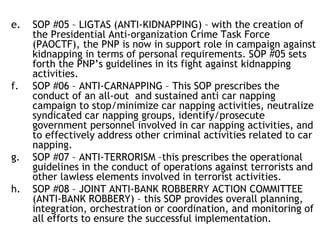
e. SOP #05 – LIGTAS (ANTI-KIDNAPPING) – with the creation of
the Presidential Anti-organization Crime Task Force
(PAOCTF), the PNP is now in support role in campaign against
kidnapping in terms of personal requirements. SOP #05 sets
forth the PNP’s guidelines in its fight against kidnapping
activities.
f. SOP #06 – ANTI-CARNAPPING – This SOP prescribes the
conduct of an all-out and sustained anti car napping
campaign to stop/minimize car napping activities, neutralize
syndicated car napping groups, identify/prosecute
government personnel involved in car napping activities, and
to effectively address other criminal activities related to car
napping.
g. SOP #07 – ANTI-TERRORISM –this prescribes the operational
guidelines in the conduct of operations against terrorists and
other lawless elements involved in terrorist activities.
h. SOP #08 – JOINT ANTI-BANK ROBBERRY ACTION COMMITTEE
(ANTI-BANK ROBBERY) – this SOP provides overall planning,
integration, orchestration or coordination, and monitoring of
all efforts to ensure the successful implementation.
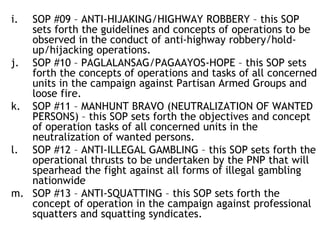
i. SOP #09 – ANTI-HIJAKING/HIGHWAY ROBBERY – this SOP
sets forth the guidelines and concepts of operations to be
observed in the conduct of anti-highway robbery/hold-
up/hijacking operations.
j. SOP #10 – PAGLALANSAG/PAGAAYOS-HOPE – this SOP sets
forth the concepts of operations and tasks of all concerned
units in the campaign against Partisan Armed Groups and
loose fire.
k. SOP #11 – MANHUNT BRAVO (NEUTRALIZATION OF WANTED
PERSONS) – this SOP sets forth the objectives and concept
of operation tasks of all concerned units in the
neutralization of wanted persons.
l. SOP #12 – ANTI-ILLEGAL GAMBLING – this SOP sets forth the
operational thrusts to be undertaken by the PNP that will
spearhead the fight against all forms of illegal gambling
nationwide
m. SOP #13 – ANTI-SQUATTING – this SOP sets forth the
concept of operation in the campaign against professional
squatters and squatting syndicates.
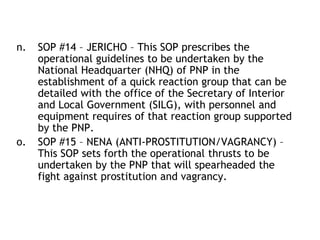
n. SOP #14 – JERICHO – This SOP prescribes the
operational guidelines to be undertaken by the
National Headquarter (NHQ) of PNP in the
establishment of a quick reaction group that can be
detailed with the office of the Secretary of Interior
and Local Government (SILG), with personnel and
equipment requires of that reaction group supported
by the PNP.
o. SOP #15 – NENA (ANTI-PROSTITUTION/VAGRANCY) –
This SOP sets forth the operational thrusts to be
undertaken by the PNP that will spearheaded the
fight against prostitution and vagrancy.
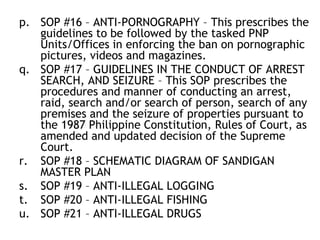
p. SOP #16 – ANTI-PORNOGRAPHY – This prescribes the
guidelines to be followed by the tasked PNP
Units/Offices in enforcing the ban on pornographic
pictures, videos and magazines.
q. SOP #17 – GUIDELINES IN THE CONDUCT OF ARREST
SEARCH, AND SEIZURE – This SOP prescribes the
procedures and manner of conducting an arrest,
raid, search and/or search of person, search of any
premises and the seizure of properties pursuant to
the 1987 Philippine Constitution, Rules of Court, as
amended and updated decision of the Supreme
Court.
r. SOP #18 – SCHEMATIC DIAGRAM OF SANDIGAN
MASTER PLAN
s. SOP #19 – ANTI-ILLEGAL LOGGING
t. SOP #20 – ANTI-ILLEGAL FISHING
u. SOP #21 – ANTI-ILLEGAL DRUGS
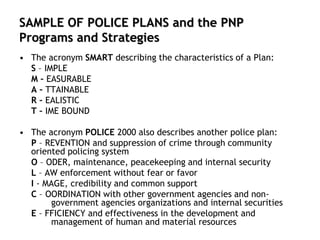
SAMPLE OF POLICE PLANS and the PNP
Programs and Strategies
• The acronym SMART describing the characteristics of a Plan:
S – IMPLE
M – EASURABLE
A – TTAINABLE
R – EALISTIC
T – IME BOUND
• The acronym POLICE 2000 also describes another police plan:
P – REVENTION and suppression of crime through community
oriented policing system
O – ODER, maintenance, peacekeeping and internal security
L – AW enforcement without fear or favor
I - MAGE, credibility and common support
C – OORDINATION with other government agencies and non-
government agencies organizations and internal securities
E – FFICIENCY and effectiveness in the development and
management of human and material resources
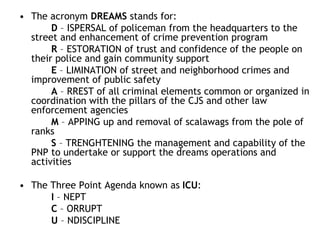
• The acronym DREAMS stands for:
D – ISPERSAL of policeman from the headquarters to the
street and enhancement of crime prevention program
R – ESTORATION of trust and confidence of the people on
their police and gain community support
E – LIMINATION of street and neighborhood crimes and
improvement of public safety
A – RREST of all criminal elements common or organized in
coordination with the pillars of the CJS and other law
enforcement agencies
M – APPING up and removal of scalawags from the pole of
ranks
S – TRENGHTENING the management and capability of the
PNP to undertake or support the dreams operations and
activities
• The Three Point Agenda known as ICU:
I – NEPT
C – ORRUPT
U – NDISCIPLINE
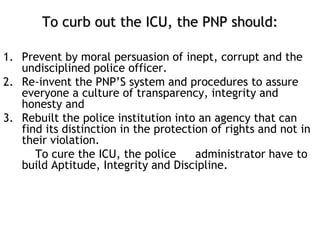
To curb out the ICU, the PNP should:
1. Prevent by moral persuasion of inept, corrupt and the
undisciplined police officer.
2. Re-invent the PNP’S system and procedures to assure
everyone a culture of transparency, integrity and
honesty and
3. Rebuilt the police institution into an agency that can
find its distinction in the protection of rights and not in
their violation.
To cure the ICU, the police administrator have to
build Aptitude, Integrity and Discipline.
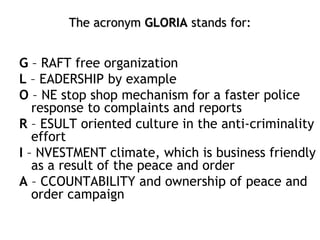
The acronym GLORIA stands for:
G – RAFT free organization
L – EADERSHIP by example
O – NE stop shop mechanism for a faster police
response to complaints and reports
R – ESULT oriented culture in the anti-criminality
effort
I – NVESTMENT climate, which is business friendly
as a result of the peace and order
A – CCOUNTABILITY and ownership of peace and
order campaign
DECISION MAKING:
An Essential Element in Planning
What is Managerial Decision?
To decide to make up one’s mind. A decision is
a choice from among a set of available
alternatives. Managerial decisions are choices
between alternative courses of action translated
into administrative behavior designed to achieve
an organization’s mission through the
accomplishment of specifically targeted goals and
objectives.
What are the elements of Managerial Decisions?
In coming up with the appropriate decisions, police
managers should consider the following elements:
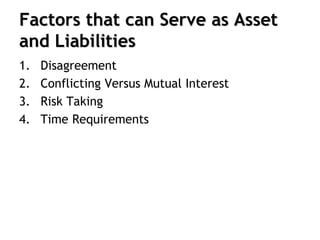
1. Choices – If a police administrator does not have the
opportunity or the ability to make a choice, there is no real
decision. Following rules, obeying orders or being coerced
to act in certain ways cannot without a great deal of
distortion be construed as making decisions.
2. Alternatives – There must be more than one possible
course of action available in order for the police
administrator to have a choice. Effective police managers
look for and try to create a realistic option for resolving
problems.
3. Targets – Goals and objectives come together to perform a
vital function. They activate give direction to the decision-
making process.
4. Behavior – Making decision is irrelevant unless they are
translated into action.
What is the importance of Decision-
Making in Police Planning?
Police planning is involved in a problem-
solving process. Problem solving and decision-
making are used interchangeably in the
context of management and administration
because police managers spend most of their
time making decisions to resolve problems.
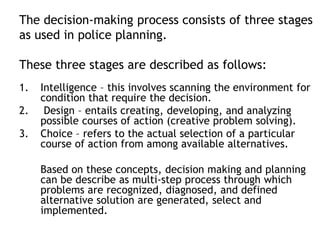
The decision-making process consists of three stages
as used in police planning.
These three stages are described as follows:
1. Intelligence – this involves scanning the environment for
condition that require the decision.
2. Design – entails creating, developing, and analyzing
possible courses of action (creative problem solving).
3. Choice – refers to the actual selection of a particular
course of action from among available alternatives.
Based on these concepts, decision making and planning
can be describe as multi-step process through which
problems are recognized, diagnosed, and defined
alternative solution are generated, select and
implemented.
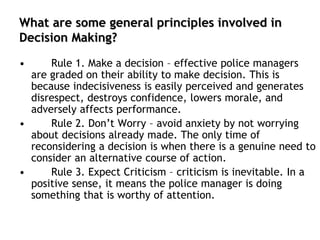
What are some general principles involved in
Decision Making?
• Rule 1. Make a decision – effective police managers
are graded on their ability to make decision. This is
because indecisiveness is easily perceived and generates
disrespect, destroys confidence, lowers morale, and
adversely affects performance.
• Rule 2. Don’t Worry – avoid anxiety by not worrying
about decisions already made. The only time of
reconsidering a decision is when there is a genuine need to
consider an alternative course of action.
• Rule 3. Expect Criticism – criticism is inevitable. In a
positive sense, it means the police manager is doing
something that is worthy of attention.
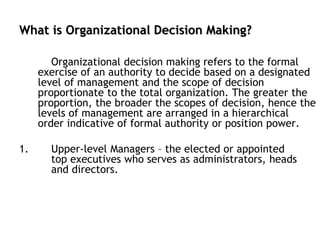
What is Organizational Decision Making?
Organizational decision making refers to the formal
exercise of an authority to decide based on a designated
level of management and the scope of decision
proportionate to the total organization. The greater the
proportion, the broader the scopes of decision, hence the
levels of management are arranged in a hierarchical
order indicative of formal authority or position power.
1. Upper-level Managers – the elected or appointed
top executives who serves as administrators, heads
and directors.
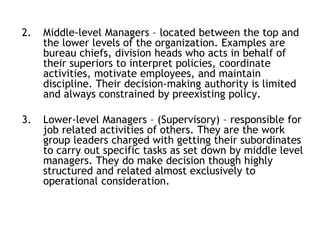
2. Middle-level Managers – located between the top and
the lower levels of the organization. Examples are
bureau chiefs, division heads who acts in behalf of
their superiors to interpret policies, coordinate
activities, motivate employees, and maintain
discipline. Their decision-making authority is limited
and always constrained by preexisting policy.
3. Lower-level Managers – (Supervisory) – responsible for
job related activities of others. They are the work
group leaders charged with getting their subordinates
to carry out specific tasks as set down by middle level
managers. They do make decision though highly
structured and related almost exclusively to
operational consideration.
What are the influences on
Decision?
A. Internal Factors
1. The specificity of organization’s mission, goals and
objectives.
2. The delegation of sufficient authority to enable
managers to carry out their assigned duties.
3. The degree of autonomy given to management
personnel at different levels in the organization.
4. The leeway granted to the managers by
departmental policies, procedures, rules, and
regulation.
5. The availability of valid, reliable, and objective
information on which to base decision.
6. The time and energy used to select, retain qualified
managers.
7. The nature, extent and effect of intra-organizational
conflict.
8. The adequacy of the reward system in promoting
timely ad effective decision-making.
A. External Factors
1. Social Instability
2. Rising Expectation
3. Professional Ethics
4. legal Constraints
5. Dwindling Resources
6. Political Conflict
7. Technological change
Internal and external environmental
factors are never under the direct control
of the decision-maker. Effective decision-
maker learns and accepts to cope with this
uncertainly, complexity, and risk.
Situational Variables
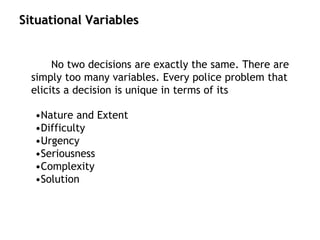
No two decisions are exactly the same. There are
simply too many variables. Every police problem that
elicits a decision is unique in terms of its
•Nature and Extent
•Difficulty
•Urgency
•Seriousness
•Complexity
•Solution
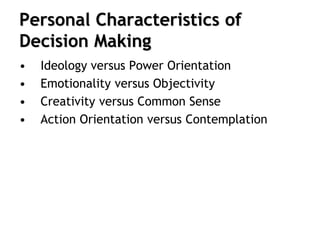
Personal Variables
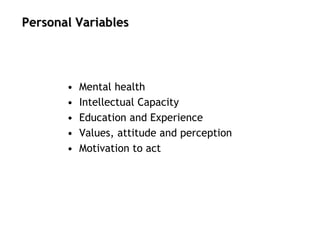
• Mental health
• Intellectual Capacity
• Education and Experience
• Values, attitude and perception
• Motivation to act
Nine (9) Steps in Rational Decision Making
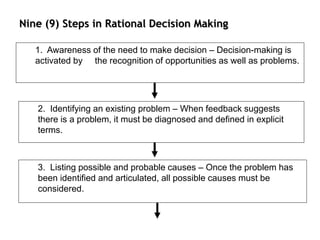
1. Awareness of the need to make decision – Decision-making is
activated by the recognition of opportunities as well as problems.
2. Identifying an existing problem – When feedback suggests
there is a problem, it must be diagnosed and defined in explicit
terms.
3. Listing possible and probable causes – Once the problem has
been identified and articulated, all possible causes must be
considered.
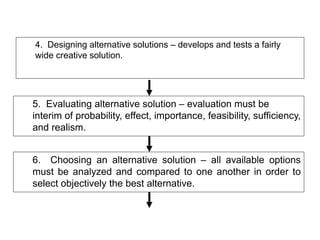
4. Designing alternative solutions – develops and tests a fairly
wide creative solution.
5. Evaluating alternative solution – evaluation must be
interim of probability, effect, importance, feasibility, sufficiency,
and realism.
6. Choosing an alternative solution – all available options
must be analyzed and compared to one another in order to
select objectively the best alternative.
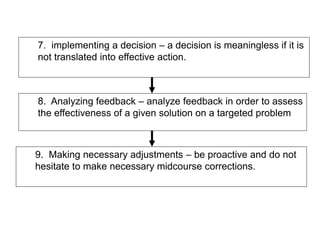
9. Making necessary adjustments – be proactive and do not
hesitate to make necessary midcourse corrections.
7. implementing a decision – a decision is meaningless if it is
not translated into effective action.
8. Analyzing feedback – analyze feedback in order to assess
the effectiveness of a given solution on a targeted problem
What are the Rules of Effective Decision-
Making?
1. Differentiate between really big decisions
and little problems
2. Rely on existing policies, procedures, rules,
an regulations whenever possible
3. consult and check with significant others
before making major organizational
decisions
4. avoid making crisis decisions
5. Do not attempt to anticipate all eventualities
associated with resolution of the problem
6. Do not expect to make the right decision all of
the time
7. Cultivate decisiveness
8. Implement major decisions once they have
been made
9. Accept decision making as a challenge rather
than unwanted chore.
DISASTER AND EMERGENCY PLANNING
Emergency and disaster planning is one of the most
important interrelated function in a security
system. It is important in any organization as
physical security, fire protection, guard forces,
security of documents and personnel security.
Emergency and disaster planning refers to the
preparation in advance of protective and safety
measures for unforeseen events resulting from
natural and human actions.
Disaster plans outline the actions to be taken by those
designated for specific job. This will result in
expeditious and orderly execution of relief and
assistance to protect properties and lives. These plans
must also be rehearsed so that when the bell ring,
there will be speed and not haste in the execution.
Speed is the accurate accomplishment of a plan as per
schedule, while haste is doing a job quickly with
errors. Plans therefore must be made when any or all
of the emergencies arise. Those plans, being special in
nature, must be prepared with people whose
expertise in their respective field is legion together
with the coordination and help of management,
security force, law enforcement agencies, and
selected employees.
Planning is necessary to meet disaster and
emergency conditions and it must be continuing
and duly supported by management. On aspect of
the plans will be to consider recovery measures to
be undertaken by the organization. Being prepared
for the eventuality gives better chances of
protection and eventual recovery than those not
prepared. Without planning, the emergency or
disaster can become catastrophic. With a good,
suitable plan to follow, the unusual becomes
ordinary, hence, the mental preparedness for easy
survival and recovery.
Understanding Disaster
A DISASTER is a sudden, unforeseen,
extraordinary occurrence. It can be considered
as an EMERGENCY but an emergency may not
always be a disaster.
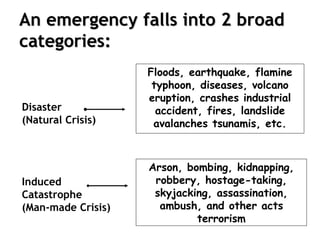
An emergency falls into 2 broad
categories:
Disaster
(Natural Crisis)
Induced
Catastrophe
(Man-made Crisis)
Floods, earthquake, flamine
typhoon, diseases, volcano
eruption, crashes industrial
accident, fires, landslide
avalanches tsunamis, etc.
Arson, bombing, kidnapping,
robbery, hostage-taking,
skyjacking, assassination,
ambush, and other acts
terrorism
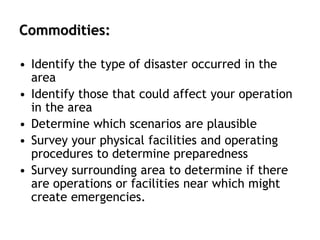
Commodities:
• Identify the type of disaster occurred in the
area
• Identify those that could affect your operation
in the area
• Determine which scenarios are plausible
• Survey your physical facilities and operating
procedures to determine preparedness
• Survey surrounding area to determine if there
are operations or facilities near which might
create emergencies.
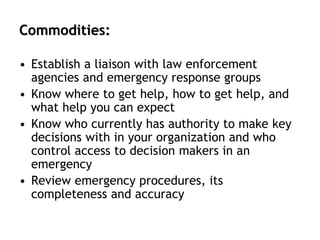
Commodities:
• Establish a liaison with law enforcement
agencies and emergency response groups
• Know where to get help, how to get help, and
what help you can expect
• Know who currently has authority to make key
decisions with in your organization and who
control access to decision makers in an
emergency
• Review emergency procedures, its
completeness and accuracy
Elements of Effective Crisis (Disaster)
Management
“Like any other construction project, the
crisis (disaster) management pyramid requires a
solid foundation”
8
7
6
5
4
3
2
1
The Crisis (Disaster) Management Pyramid
Placed within the pyramid are
the following
• Think about the unpopular (1)
This is recognizing the management’s willingness and
involvement. There must be a clear recognition that
emergencies distinct possibilities is anytime and that
preparation for them must begin NOW!
• Recognizing dangers and opportunities (2)
• Defining the control and crisis response (3)
“To do the right thing at the right season is a great
art” – AESOP
• Harness and Environment (4)
– Ability to organize, willingness and delegate
– Providing an atmosphere in which personnel can do job
for which they are selected
– Providing the right facilities and backups
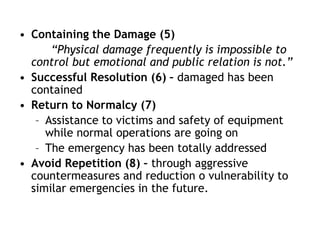
• Containing the Damage (5)
“Physical damage frequently is impossible to
control but emotional and public relation is not.”
• Successful Resolution (6) – damaged has been
contained
• Return to Normalcy (7)
– Assistance to victims and safety of equipment
while normal operations are going on
– The emergency has been totally addressed
• Avoid Repetition (8) – through aggressive
countermeasures and reduction o vulnerability to
similar emergencies in the future.
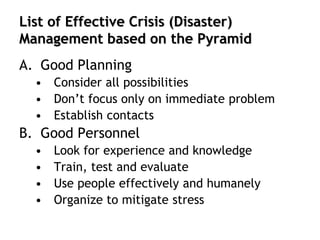
List of Effective Crisis (Disaster)
Management based on the Pyramid
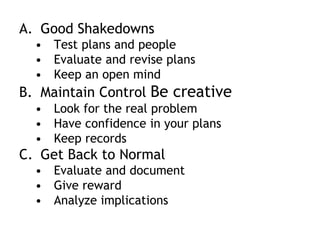
A. Good Planning
• Consider all possibilities
• Don’t focus only on immediate problem
• Establish contacts
B. Good Personnel
• Look for experience and knowledge
• Train, test and evaluate
• Use people effectively and humanely
• Organize to mitigate stress
A. Good Shakedowns
• Test plans and people
• Evaluate and revise plans
• Keep an open mind
B. Maintain Control Be creative
• Look for the real problem
• Have confidence in your plans
• Keep records
C. Get Back to Normal
• Evaluate and document
• Give reward
• Analyze implications
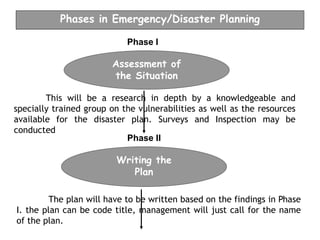
Phases in Emergency/Disaster Planning
Phase I
Assessment of
the Situation
This will be a research in depth by a knowledgeable and
specially trained group on the vulnerabilities as well as the resources
available for the disaster plan. Surveys and Inspection may be
conducted
Phase II
Writing the
Plan
The plan will have to be written based on the findings in Phase
I. the plan can be code title, management will just call for the name
of the plan.
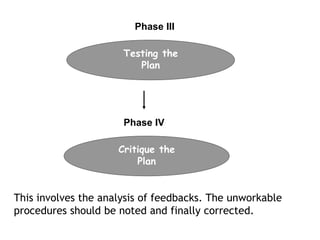
Phase III
Phase IV
Testing the
Plan
Critique the
Plan
This involves the analysis of feedbacks. The unworkable
procedures should be noted and finally corrected.
Checklist for Reviewing Policies,
Procedures and Plans
• Compile and review your organization’s policies
on various contingencies before establishing
your plans
• Ensure that these policies are known
throughout the organization and that they are
included in your emergency manuals
• Ensure that your procedures and plans are
consistent with your organization’s established
policies and goals
• Identify appropriate outside consultants and other
sources of assistance in developing and
implementing your plans and procedures
• Ensure that the appropriate personnel have any
security clearances or background checks which
might be required
• Establish a viable record-keeping system and
procedures to ensure they are followed
Organizing Disaster Management
Team
Disaster team leadership is vested primary tasks is
to ensure that the control is maintained over the
team’s activities, information flow, and the
implementation of decisions and organizational
policies. For these reason, the team leader should be
a person who has demonstrated abilit7y to function
under pressure, must have sufficient authority to
make on the spot decisions with in the framework of
overall organization’s policy, access to decision
makers when required, and the ability to recognize
which decisions to make independently an which to
refer to upper management.
Disaster Action Team Duties
• Supervise the formulation of policies
• Ensure the development of procedures
• Participate in preparing plans
• Oversee and anticipate in exercise of plans
• Select crisis management/disaster center
• Participate in personnel training
• Review preparation of materials
• Delegate authority
• Brief personnel
• Ensure the assembly of supplies
• Ensure preparation of rest, food, medical areas
On Pre-event
During the Event
• Establish shift schedules immediately
• Delegate tasks
• Focus underlying problem
• Maintain control
• Follow organizational policies
• Use prepared procedures
• Innovate as needed
• Ensure that information is shared with the entire team
• Review all press release and public statements
• Double check or confirm informations if possible
• Aid victim and their families
• Try to anticipate future consequences
• Control stress of team members
• Ensure log maintenance
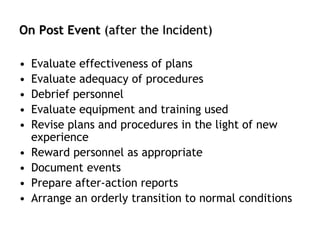
On Post Event (after the Incident)
• Evaluate effectiveness of plans
• Evaluate adequacy of procedures
• Debrief personnel
• Evaluate equipment and training used
• Revise plans and procedures in the light of new
experience
• Reward personnel as appropriate
• Document events
• Prepare after-action reports
• Arrange an orderly transition to normal conditions
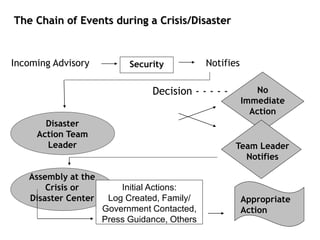
The Chain of Events during a Crisis/Disaster
Incoming Advisory Security Notifies
Disaster
Action Team
Leader
Decision - - - - - No
Immediate
Action
Team Leader
Notifies
Assembly at the
Crisis or
Disaster Center
Initial Actions:
Log Created, Family/
Government Contacted,
Press Guidance, Others
Appropriate
Action
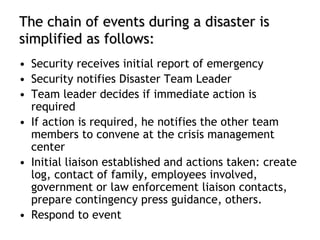
The chain of events during a disaster is
simplified as follows:
• Security receives initial report of emergency
• Security notifies Disaster Team Leader
• Team leader decides if immediate action is
required
• If action is required, he notifies the other team
members to convene at the crisis management
center
• Initial liaison established and actions taken: create
log, contact of family, employees involved,
government or law enforcement liaison contacts,
prepare contingency press guidance, others.
• Respond to event
Crowd Control and Riot Prevention
• Riot, in general is an offense against the public
peace. It is interpreted as a tumultuous
disturbance by several persons who have unlawfully
assembled to assist one another, by the use of
force if necessary, against anyone opposing them in
the execution of some enterprise of a private
nature, and who execute such enterprise in a
violent manner, to the terror of the people.
• Under the law, it is punishable for any
organizer or leader of any meeting attended by
armed persons for the purpose of committing
any of the crimes punishable under the Revised
Penal Code, or any meeting in which the
audience is incited to the commission of the
crimes of treason, rebellion or insurrection,
sedition or assault upon a person in authority or
his agents (Art. 146, RPC). It is also punishable
for any person who shall cause any serious
disturbance in a public place, office, or
establishment, or shall interrupt or disturb
public functions or gatherings or peaceful
meetings (Art. 153, RPC).
Some Basic Definition of Terms
• Tumultuous – The disturbance or
interruption shall be deemed tumultuous if
caused by more than three persons who are
armed or provided with means of violence.
• Outcry – The means to shout subversive or
proactive words tending to stir up the people
to obtain by means of force or violence.
• Crowd – It consists of a body of individual people
with no organization, no single partnership. Each
individual’s behavior is fairly controlled and ruled
by reason. All the participants have been thrown
by circumstance into a crowd for some common
purpose that may give them a least one thing in
common.
• Mob – A mob takes on the semblance of
organization with some common motive for action,
such as revenge for a crime committed on the
scene where the crowd assembled, an aggravated
fight, or a confrontation with the police. At time
like this, there is already a strong feeling of
togetherness (“we are one” attitude).
• Riot – It is a violent confusion in a crowd. Once
a mob started to become violent, it becomes a
riot.
What is the Role of Planning in Crowd Control
or Riot Prevention?
A sound organizational planning, training,
logistical support and a high departmental
morale are the essential success elements in
modern counter-riot operations.
The control of violent civil disorder
involving large segments of the population,
especially in congested urban areas, requires a
disciplined, aggressive police counter-action
which at the same time adheres to the basic
law enforcement precepts. This is done through
effective police operational planning.
• Through planning, the law violators can be
arrested and processed with in the existing
legal frameworks by the exercise of reasonable
force. Without an immediate decisive police
action, the continually recurring conditions of
civil unrest and lawlessness could quickly
evolve into a full-scale riot. Police planning
could provide the best police reaction and
order can be restored with a minimum of
property damage and injury.
What are the Police Purpose and
Objectives in Anti-Riot
Operations?
• Containment – Unlawful assembly and riot are as
contagious as plagued unless they are quarantined from
the unaffected areas of the community. In here, all
persons who are at scene should be advised to leave
the area, thereby reducing the number of potential
anti-police combatants.
• Dispersal – The crowd of unlawful assembly or riot
should be dispersed at once. It may appear at first to
be a legal assembly but the nature of assembly at the
time of the arrival of the police may clearly distinguish
it as being unlawful. Once it is determined, the
responsibility of the police to command the people to
disperse. Crowd control formations may be done if
necessary to expedite their movements.
• Prevention of Entry or Reentry – The police have
to protect the area once the people have been moved
out or dissipated into smaller groups to prevent them
from returning. Enforce quarantine by not allowing the
group to resume their actions.
• Arrest Violator – One of the first acts of the police
upon arrival at the scene of the disturbance is to locate
and isolate individuals who are inciting the crowd to
violate or fragrantly violating the law. Prevent any
attempt by the crow or mob to rescue those arrested by
enforcing total quarantine.
• Establish Priorities – Depending upon the
circumstances, it is always necessary to establish
priorities. Assessing the situation to determine the
nature of assistance and number of men needed is part
of the planning process.
What are the Basic Procedures in
Anti-Riot Operations?
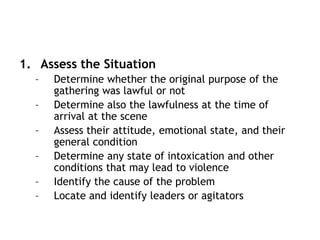
1. Assess the Situation
– Determine whether the original purpose of the
gathering was lawful or not
– Determine also the lawfulness at the time of
arrival at the scene
– Assess their attitude, emotional state, and their
general condition
– Determine any state of intoxication and other
conditions that may lead to violence
– Identify the cause of the problem
– Locate and identify leaders or agitators
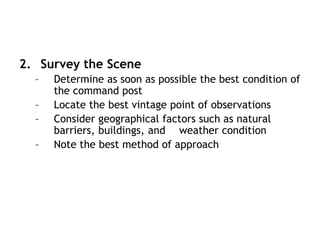
2. Survey the Scene
– Determine as soon as possible the best condition of
the command post
– Locate the best vintage point of observations
– Consider geographical factors such as natural
barriers, buildings, and weather condition
– Note the best method of approach
3. Communicate
– Report on your assessment, keeping your
assessment brief but concise, giving your superior
the sufficient data with which to proceed for plans
of action
– Ask for assistance or help from the command post
hence remain close to the radio as possible until
additional units arrived or to communicate new
developments.
4. Maintain a Watchful Waiting
– Make your presence known to the people in the
vicinity
– If the crowd is too much to handle, stay near the
command post and wait for additional supports
units
– Use radio or other means of communications to
call for assistance
– Make preparations for decisive police action.
5. Concentrate on Rescue and Self-Defense
– Take care of the immediate needs of the situation
until help arrives
– Apply first aid to the injured people and self
protection must be considered
– Remember the primary objective of protecting
lives, property and the restoration of order
6. Maintain an Open Line of Communication
– Keep the dispatcher advised on the progress of the
scene
– Continue directing the support units to the scene
and the general perimeter control
7. Establish a Command Post
– Follow what is in your contingency plan for civil
disturbance
– Make every officer aware of the command post for
proper coordination
8. Take immediate action for serious violations
– Arrest perpetrators
– Isolate the leaders or agitators from the crowd
– Show full police force strength
9. Give the dispersal order
– Disperse the crowd upon order
– Anti-riot formations and procedures must be used
– Use of force necessary for dispersal maybe considered
What are the General Guidelines
in Handling Riot?
1. Preplanning must be high on the agenda
whenever the department anticipates any
disorder or major disturbance.
2. Meet with responsible leaders at the scene
and express your concern for assuring them
their constitutional guarantees. Request
them to disperse the crowd before
attempting to take police action.
3. Maintain order and attempt to quell the
disturbance without attempting to punish
any of the violators.
4. Use only the force that is necessary but
take positive and decisive action.
5. Post the quarantine area with signs and
barricades, if necessary.
6. Keep the traffic lane open for emergency
and support vehicle.
7. Consider the fact that most impressive
police action at the scene of any type of
major disturbance is the expeditious
removal of the leaders by a well disciplined
squad of officers.
8. For riot control, consider the following:
– Surprise Offensive – The police action in its initial
stages at a riot must be dramatic. The elements of
surprise may enhance effectiveness of riot control.
– Security of Information – Plans for action and
communications regarding the movement of personnel
and equipment should be kept confidential
– Maximum utilization of Force – A show of police force
should be made in a well-organized manner, compact,
and efficient in a military-type squad formation.
– Flexibility of Assignments – Officers and terms should
be flexibility assigned to various places where the
need is greatest.
– Simplicity – Keep the plan as simple as possible and
the instructions are direct to avoid mass confusion
among the officers.
What are the Special Problems in
Crowd Control and Riot
Operations?
Snipers – Certain psychopathic people may attempt
to take advantage of the mass confusion and excitement at a
riot scene by taking a concealed position and shooting at
people with some type of weapons, usually rifle.
How to handle this?
– clear the area of innocent bystanders
– isolate the area and guard against possible escape of
the suspects
– use whatever force necessary to take him into
custody
– assign anti-snipers team especially in aggravated
situations
• Arsonist – Persons holding torch in their hands are
potential arsonists. They must be taken into custody
immediately.
• Looters – Acts of simple misdemeanor thefts or
may consists of robbery of breaking and entering. Take
the suspects into custody by whatever means are
necessary.
DECISION-MAKING MODELS
1. The Rational Model
2. The Incremental Model
3. Heuristic Model
4. Organizational Process Model
5. Government Politics Model
Group Decision Making
Group Assets
– Greater Total Knowledge and Information
– Greater Number of Approaches to a Problem
– Participation in Problem Solving Increases
Acceptance
– Better Comprehension of the Decision
Group Liabilities
– Social Pressure
– Individual Domination
– Groupthink
Factors that can Serve as Asset
and Liabilities
1. Disagreement
2. Conflicting Versus Mutual Interest
3. Risk Taking
4. Time Requirements
Brainstorming
1. Sessions should last 40 minutes to an hour
2. Problem to be discussed should not be
revealed before the session
3. The problem should be stated clearly and not
too broadly
4. A small conference table should be used
Personal Characteristics of
Decision Making
• Ideology versus Power Orientation
• Emotionality versus Objectivity
• Creativity versus Common Sense
• Action Orientation versus Contemplation
Common Errors in Decision Making
1. Cognitive Nearsightedness
2. Assumption That the Future will Repeat itself
3. Oversimplification
4. Overreliance on One’s Own Experience
5. Preconceived Notions
6. Unwillingness to Experiment
7. Reluctance to Decide

poluce.ppt

  • 1.
    POLICE OPERATIONAL PLANNING Inthis chapter, the basic concepts in POLICE planning are being discussed to reinforce the topics in the previous chapters. This is so because the word PLANNING became a common terminology in Police Organizations, in Police Management and Administration as well as in the other fields of Criminal Justice.
  • 2.
    Police administrators sometimesdo not appreciate the importance of planning because of the pattern of career development. It is ironic that the pattern of career development for typical police managers carries with it seeds that sometimes blossom into a negative view of planning. However, planning is an integral element of good management and good decision-making. Management needs to anticipate and shape events; it is weak if it merely responds to them.
  • 3.
    What is aPlan? A plan is an organize schedule or sequence by methodical activities intended to attain a goal and objectives for the accomplishment of mission or assignment. It is a method or way of doing something in order to attain objectives. Plan provides answer to 5W’s and 1 H. What is Planning? Hudzik and Cordner defined planning as “thinking about the future, thinking about what we want the future would be, and thinking about what we need to do now to achieve it.”
  • 4.
    Planning is amanagement function concerned with visualizing future situations, making estimates concerning them, identifying issues, needs and potential danger points, analyzing and evaluating the alternative ways and means for reaching desired goals according to a certain schedule, estimating the necessary funds, and resources to do the work, and initiating action in time to prepare what may be needed to cope with the changing conditions and contingent events.
  • 5.
    What is PolicePlanning? Police Planning is an attempt by police administrators in trying to allocate anticipated resources to meet anticipated service demands. It is the systematic and orderly determination of facts and events as basis for policy formulation and decision affecting law enforcement management.
  • 6.
    What is OperationalPlanning? • Operational Planning is the use of rational design or pattern for all departmental undertaking rather than relying on change in an operational environment. It is the preparation and development of procedures and techniques in accomplishing of each of the primary tasks and functions of an organization.
  • 7.
    What is PoliceOperational Planning? • Police Operational Planning is the act of determining policies and guidelines for police activities and operations and providing controls and safeguards for such activities and operations in the department. It may also be the process of formulating coordinated sequence of methodical activities and allocation of resources to the line units of the police organization for the attainment of the mandated objectives or goals. • Objectives are a specific commitment to achieve a measurable result within a specific period of time. Goals are general statement of intention and typically with time horizon, or it is an achievable end state that can be measured and observed. Making choices about goals is one of the most important aspects of planning. Relate this definitions with their description as defined in chapter one.
  • 8.
    • The processof police operational planning involves strategies or tactics, procedures, policies or guidelines. A Strategy is a broad design or method; or a plan to attain a stated goal or objectives. Tactics are specific design, method or course of action to attain a particular objective in consonance with strategy. Procedures are sequences of activities to reach a point or to attain what is desired. A policy is a product of prudence or wisdom in the management of human affairs, or policy is a course of action which could be a program of actions adopted by an individual, group, organization, or government, or the set of principles on which they are based. Guidelines are rules of action for the rank and file to show them how they are expected to obtain the desired effect.
  • 9.
    STRATEGIC PLANNING Strategic planningis a series of preliminary decisions on a framework, which in turn guides subsequent decisions that generate the nature and direction of an organization. This is usually long range in nature. The reasons for Strategic Planning are:
  • 10.
    1. VISION –A vision of what a police department should be. 2. LONG-RANGE THINKING – Keeping in mind that strategy is deciding where we want to be 3. STRATEGIC FOCUS 4. CONGRUENCE 5. A STRATEGIC RESPONSE TO CHANGE 6. STRATEGIC FRAMEWORK
  • 11.
    What is theStrategic Planning process? • TASK 1 – Develop Mission and Objectives • TASK 2 – Diagnose Environmental Threats and Opportunities • TASK 3 – Assess Organizational Strengths and Weaknesses • TASK 4 – Generate Alternative Strategies • TASK 5 – Develop Strategic Plan • TASK 6 - Develop Tactical Plan • TASK 7 – Assess Results of Strategic and Tactical Plan • TASK 8 – Repeat Planning Process
  • 12.
    In the process,the police administrator can use the potent tool of alternatives. Alternatives (options) are means by which goals and objectives can be attained. They maybe policies, strategies or specific actions aimed at eliminating a problem. Alternative do not have to be substitutes for one another or should perform the same function. For example, our goal is to “improve officer-survival skills.” The plan is to train the officers on militaristic and combat shooting. The alternatives could be: Alternative 1 – modify police vehicles Alternative 2 – issuing bulletproof vests Alternative 3 – utilizing computer assisted dispatch system Alternative 4 – increasing first-line supervision, etc
  • 13.
    FUNDAMENTALS OF POLICE PLANNING Whatare the Objectives of Police Planning? 1. To increase the chances of success by focusing on results and not so much on the objectives. 2. To force analytical thinking and evaluation of alternatives for better decisions. 3. To establish a framework for decision making consistent with the goal of the organization. 4. To orient people to action instead of reaction. 5. To modify the day-to-day style of operation to future management. 6. To provide decision making with flexibility. 7. To provide basis for measuring original accomplishments or individual performance. 8. To increase employee and personnel involvement and to improve communication.
  • 14.
    What can beexpected in planning? 1. Improve analysis of problems 2. Provide better information for decision-making 3. Help to clarify goals, objectives, priorities 4. Result is more effective allocation of resources 5. Improve inter-and intradepartmental cooperation and coordination 6. Improve the performance of programs 7. Give the police department a clear sense of direction 8. Provide the opportunity for greater public support 9. Increase the commitment of personnel
  • 15.
    What are thecharacteristics of a good police plan? 1. With clearly defined Objectives or Goals. 2. Simplicity, Directness and Clarity 3. Flexibility 4. Possibility of Attainment 5. Must provide Standard of Operation 6. Economy in terms of Resources needed for implementation
  • 16.
    What are theguidelines in Planning? The five (5) W’s and one (1) H 1.What to do – mission/objective 2.Why to do – reason/philosophy 3.When to do – date/time 4.Where to do – place 5.Who will do – people involve 6.How to do – strategy
  • 17.
    What are theresponsibilities in Planning? • Broad External Policy Planning – is the responsibility of the legislative branch of the government. The main concern of the police in this broad external policy planning is assisting the legislature in their determining of police guideline through the passage of appropriate laws or ordinances for the police to enforce. • Internal Policy Planning – is the responsibility of the C/PNP and other chiefs of the different units or headquarters within their area of jurisdiction to achieve the objectives or mission of the police organization. They are responsible for planning, organizing, staffing, directing, coordinating, controlling, reporting and budgeting for the police organization within existing policies and available resources. For maximum police effectiveness, they shall be responsible for the technical operation of the police organization and management of its personnel.
  • 18.
    What are theapproaches in Police Planning? 1. Synoptic Approaches 2. Incremental Approach 3. Transactive Approach 4. Advocacy Approach 5. Radical Approach A variety of approaches are employed in the planning processes. Each is unique and can be understood as a method of operationalizing the word planning. There are basically five major approaches to planning which are:
  • 19.
    What is SynopticPlanning? • Synoptic planning or the rational comprehensive approach is the dominant tradition in planning. It is also the point of departure for most other planning approaches. • This model is based on a problem-oriented approach to planning especially appropriate for police agencies. It relies heavily on the problem identification and analysis of the planning process. It can assist police administrators in formulating goals and priorities in terms that are focused on specific problems and solutions that often confront law enforcement.
  • 20.
    Steps in SynopticPlanning • Prepare for Planning – The task of planning should be detailed in a work chart that specifies (a) what events and actions are necessary, (b) when they must take place, (c) who is to be involved in each action and for how long, and (d) how the various actions will interlock with one another. • Describe the present situation – Planning must have a mean for evaluation. Without an accurate beginning database there is no reference point on which to formulate success or failure. • Develop projections and consider alternative future states – Projections should be written with an attempt to link the current situation with the future, keeping in mind the desirable outcomes. It is important for the police executive to project the current situations into the future to determine possible, probable and desirable future states while considering the social, legislative, and political trends existing in the community.
  • 21.
    • Identify andanalyze problems – the discovery of the problems assumes that a system to monitor and evaluate the current arena is already on place. Closely related to the detection and identification of issues is the ability of the police to define the nature of the problem, that is to able to describe the magnitude, cause, duration, and the expense of the issues at hand. A complete understanding of the problem leads to the development of the means to deal with the issues. • Set goals – Making choices about goals is one of the most important aspects of planning. It makes no sense to establish a goal that does not address a specific problem. Remembering that the police departments are problem oriented, choices about goals and objectives should adhere to the synoptic model. • Identify alternative course of action – As stated earlier, alternatives are means by which goals and objectives can be attained. These are options or possible things to be done in case the main or original plan is not applicable.
  • 22.
    Select preferred alternatives– there are three techniques to select alternative: 1. Strategic analysis – this include the study on the courses of actions; suitability studies; feasibility studies; acceptability studies; and judgment. • Suitability – each course of action is evaluated in accordance with general policies, rules and laws. • Feasibility – these include the appraisal of the effects of a number of factors weigh separately and together. • Acceptability – those judged to be suitable and feasible are then realized in acceptability studies. 2. Cost – effectiveness Analysis – This technique is sometimes called cost-benefit or cost performance analysis. The purpose of this form of selection is that the alternative chosen should maximize the ratio of benefit to cost. 3. Must-wants Analysis – This method of selecting a preferred course of action combines the strengths of both strategic and cost effectiveness analysis. Must wants analysis is concerned with both the subjective weights of suitability, feasibility, and acceptability and the objectives weights of cost versus benefits.
  • 23.
    • Plan andcarryout implementation – The police administrator must be aware that the implementation requires a great deal of tact and skill. It maybe more important how an alternative is introduced to a police department than what actually is. • Monitor and evaluate progress – Evaluation requires comparing what actually happened with what was planned for-and this may not be a simple undertaking. Feedback must be obtained concerning the results of the planning cycle, the efficiency of the implementation process, and the effectiveness of new procedures, projects or programs. This is an important step of synoptic planning, trying to figure out what, if anything happened as a result of implementing a selected alternative. • Summation of the synoptic planning approach – This can be done by making a summary of the presentation, could be tabular or other forms of presentation. • Repeat the Planning Process – repetition of the process of planning enables the planner to thresh out possible flaws in the plan.
  • 24.
    What is IncrementalPlanning? Incrementalism concludes that long range and comprehensive planning are not only too difficult, but inherently bad. The problems are seen as too difficult when they are grouped together and easier to solve when they are taken one at a time and broken down into gradual adjustments over time. What is Transactive Planning? Transactive planning is carried out in face-to-face interaction with the people who are to be affected by the plan and not to an anonymous target community of beneficiaries. Techniques include field surveys and interpersonal dialogue marked by a process of mutual learning.
  • 25.
    What is AdvocacyPlanning? Beneficial aspects of this approach include a greater sensitivity to the unintended and negative side effects of plans. What is Radical Planning? The first mainstream involves collective actions to achieve concrete results in the immediate future. The second mainstream is critical of large-scale social processes and how they permeate the character of social and economic life at all levels, which, in turn, determine the structure and evolution of social problems.
  • 26.
    CONSIDERATIONS IN POLICEPLANNING 1. Primary Doctrines • Fundamental Doctrines – These are the basic principles in planning, organization and management of the PNP in support of the overall pursuits of the PNP Vision, Mission and strategic action plan of the attainment of the national objectives. • Operational Doctrines – These are the principles and rules governing the planning, organization and direction and employment of the PNP forces in the accomplishment of basic security operational mission in the maintenance of peace and order, crime prevention and suppression, internal security and public safety operation. • Functional Doctrines – These provide guidance for specialized activities of the PNP in the broad field of interest such as personnel, intelligence, operations, logistics, planning, etc.
  • 27.
    2. Secondary Doctrines •Complimentary Doctrines – Formulated jointly by two or more bureaus in order to effect a certain operation with regard to public safety and peace and order. These essentially involve the participation of the other bureaus of the Bureau of Jail and Management and Penology (BJMP), Bureau of Fire and Protection (BFP), Philippine National Public Safety College (PPSC), National Bureau of Investigation (NBI) and other law enforcement agencies. • Ethical Doctrines – These define the fundamental principles governing the rules of conduct, attitude, behavior and ethical norm of the PNP. 3. The Principles of Police Organization The principles of organization are presented in chapter three. These principles are considered in police planning in order not to violate them but rather for the effective and efficient development of police plans.
  • 28.
    4. The Four(4) Primal Conditions of the Police Organization • Authority – The right to exercise, to decide, and to command by virtue of rank and position. Doctrine – It provides for the organizations objectives. It provides the various actions. Hence, policies, procedures, rules and regulations of the organization are based on the statement of doctrines. • Cooperation or Coordination • Discipline – It is imposed by command or self- restraint to insure supportive behavior.
  • 29.
    Classifications of PolicePlan According to coverage: Police Plans could be Local Plans (within police precincts, sub-stations, and stations), Regional Plans, and National Plans. According to Time: Police Plans are classified as: 1. Strategic or Long Range Plan – It relates to plan which are strategic or long range in application and it determine the organization’s original goals and strategy. Example: Police Action Plan on the Strategy DREAMS and Program P-O-L-I-C-E 2000, Three Point Agenda, and GLORIA (These are discussed on the latter part of this Chapter).
  • 30.
    2. Intermediate orMedium Range Planning – It relates to plans, which determine quantity and quality efforts and accomplishments. It refers to the process of determining the contribution on efforts that can make or provide with allocated resources. Example: 6 Masters Plans: • Master Plan Sandigan-Milenyo (Anti-Crime Master Plan) • Master Plan Sandugo (Support to Internal Security Operations Master Plan) • Master Plan Banat (Anti-Illegal Drugs Master Plan) • Master Plan Sang-ingat (Security Operations Master Plan) • Master Plan Saklolo (Disaster Management Master Plan) • Sangyaman (Protection and Preservtion of Environment, Cultural Properties, and Natural resources Master Plan)
  • 31.
    3. Operational orShort Range Planning – Refers to the productions of plans, which determine the schedule of special activity and are applicable from one week or less than year duration. Plan that addresses immediate need which are specific and how it can be accomplished on time with available allocated resources. Examples of OPLANS • Oplan Jumbo – Aviation Security Group Strategic Plan against terrorist attacks • Oplan Salikop – Criminal Investigation and Detection Group (CIDG) Strategic Plan against Organized Crime Groups • LOI PAGPAPALA is the entry point in the conceptualization of the PNP Pastoral Program for the next five years with a Total Human Development Approach (THD Approach). • The TMG through its “OPLAN DISIPLINA” that resulted in the apprehension of 110,975 persons, the confiscation of 470 unlawfully attached gadgets to vehicles, and rendering various forms of motorists’ assistance. • OPLAN BANTAY DALAMPASIGAN that sets forth the operational guidelines on the heightened security measures and sea borne security patrols.
  • 32.
    Factors affecting PolicePlanning 1. Condition – a consideration of political atmosphere, public opinion; ideological aspirations; peace and order; national/community ethics, behavior and discipline in the area where the plan will be implemented. 2. Time – It is the period available to establish plan before putting it into effort. Consider the time of execution/implementation, the time interval and time allowed for the revisions and modifications of plan. 3. Resources Available – Allocation of manpower, money and materials 4. Skills and Attitudes of Management – Refers to the level of experiences of the personnel who are involved in the preparation of the plan and those who will execute the plan. Applicability of good management principles shall be exploited. 5. Social and Political Environment – Refers to social and political practices, which will be affected b the plan or plan affecting these practices, beliefs and norms of society. 6. Physical Facilities – Refers to machinery, instrument or tools in the attainment of the goals of the plan. A certain system or structural designs in order to meet expected results. 7. Collection and Analysis of Data – Ready sources and basis of good decision-making by the makers of the plan may be properly obtain through research and other means of information gathering techniques.
  • 33.
    Parts of aPolice Operational Plan 1. Security Classification 2. Number of Copies and Pages 3. Name of Headquarters 4. Plan Title or Name 5. Reference – The source of authority in formulating a plan is based on: • Organizational Policy or Guidelines • Orders of Superior Officers or Authorities • Documents, maps, books, etc. 6. Situation – General Situation and Specific Situation
  • 34.
    7. Mission 8. TaskAllocation 9. Coordinating Instructions – Refers to the manner of giving alarm or signal when encountering such problems which needs immediate action 10. Command – Refers to the relationship between operating personnel or units with that of Police Headquarters; who to summon for assistance. 11. Signal – Defines communication network, which is to be used during a particular operation like using passwords. 12. Signature 13. Distribution – Refers to what unit will be given copies of the plan. For instance, A – All units, B – Selected units, C – Very selected, and D – Only 1 unit
  • 35.
    TYPES OF PLANin general • Reactive Plans are developed as a result of crisis. A particular problem may occur for which the department has no plan and must quickly develop one, sometimes without careful preparation. • Proactive Plans are developed in anticipation of problems. Although not all police problems are predictable, many are, and it is possible for a police department to prepare a response in advance. • Visionary Plans are essential statements that identify the role of the police in the community and the future condition or state to which the department can aspire. A vision may also include a statement of values to be used to guide the decision making process in the department.
  • 36.
    • Strategic Plansare designed to meet the long-range, overall goals of the organization. Such plans allow the department to adapt anticipated changes or develop a new philosophy or model of policing (e.g. community policing). One of the most important aspects of strategic planning is to focus on external environmental factors that affect the goals and objectives of the department and how they will be achieved. Important environmental factors include personnel needs, population trends, technological innovations, business trends and demand, crime problems, and community attitudes. • Operational Plans are designed to meet the specific tasks requires to implement strategic plans. There are four types of operational plan:
  • 37.
    1. Standing Plansprovide the basic framework for responding to organizational problems. The organizational vision and values, strategic statement, policies, procedures, and rules and regulations are examples of standing plans. Standing plans also include guidelines for responding to different types of incidents; for example, a civil disturbance, hostage situation, crime in progress, and felony car stops. 2. Functional Plans include the framework for the operation of the major functional units in the organization, such as patrol and investigations. It also includes the design of the structure, how different functions and units are to relate and coordinate activities, and how resources are to be allocated.
  • 38.
    3. Operational-efficiency, effectiveness,and productivity plans are essentially the measures or comparisons to be used to assess police activities and behavior (outputs) and results (outcomes). If one of the goals of the police department is to reduce the crime rate, any change that occurs can be compared to past crime rates in the same community or crime in other communities, a state, or the nation. If the crime rates were reduced while holding or reducing costs, it would reflect an improvement not only in effectiveness but also in departmental productivity. 4. Time-specific Plans are concerned with specific purpose and conclude when an objective is accomplished or a problem is solved. Specific police programs or projects such as drug crackdown, crime prevention program, and neighborhood clean-up campaign are good examples of time-specific plans.
  • 39.
    KINDS OF POLICEPLANS • Policy and Procedural Plans – to properly achieve the administrative planning responsibility within in the unit, the Commander shall develop unit plans relating to: (a) policies or procedure; (b) tactics; (c) operations; (d) extra-office activities; and (e) management. Further, standard-operating procedures shall be planned to guide members in routine and field operations and in some special operations in accordance with the following procedures: Field Procedure – Procedures intended to be used in all situations of all kinds shall be outlined as a guide to officers and men in the field. Examples o these procedures are those related to reporting, to dispatching, to raids, arrest, stopping suspicious persons, receiving complaints, touring beats, and investigation of crimes. The use of physical force and clubs, restraining devices, firearms, tear gas and the like shall, in dealing with groups or individuals, shall also be outlined.
  • 40.
    Headquarters Procedures –Included in these procedures are the duties of the dispatcher, jailer, matron, and other personnel concerned which may be reflected in the duty manual. Procedures that involve coordinated action on activity of several offices, however, shall be established separately as in the case of using telephone for local or long distance calls, the radio teletype, and other similar devices. Special Operation Procedures – Certain special operations also necessitate the preparation of procedures as guides. Included are the operation of the special unit charged with the searching and preservation of physical evidence at the crime scenes and accidents, the control o licenses, dissemination of information about wanted persons, inspection of the PNP headquarters, and the like.
  • 41.
    • Tactical Plans– These are the procedures for coping with specific situations at known locations. Included in this category are plans for dealing with an attack against buildings with alarm systems and an attack against the PNP headquarters by lawless elements. Plans shall be likewise be made for blockade and jail emergencies and for special community events, such as longer public meetings, athletic contests, parades, religious activities, carnivals, strikes, demonstrations, and other street affairs. • Operational Plans – these are plans for the operations of special divisions like the patrol, detective, traffic, fire and juvenile divisions. Operational plans shall be prepared to accomplish each of the primary police tasks. For example, patrol activities must be planned, the force must be distributed among the shifts and territorially among beats, in proportion to the needs of the service, and special details must be planned to meet unexpected needs. Likewise in the crime prevention and in traffic, juvenile and
  • 42.
    vice control, campaignsmust be planned and assignments made to assure the accomplishment of the police purpose in meeting both average and regular needs. Each division or unit has primary responsibility to plan operations in its field and also to execute the plans, either by its own personnel or, as staff agency, by utilizing members of the other divisions. Plans for operations of special division consist of two types, namely: (1) those designed to meet everyday, year- around needs, which are the regular operating program of the divisions; and (2) those designed to meet usual needs, the result of intermittent and usually unexpected variations in activities that demand their attention.
  • 43.
    Regular Operating Programs– these operating division/units shall have specific plans to meet current needs. The manpower shall be distributed throughout the area of jurisdiction in proportion to need. Assignments schedules shall be prepared that integrate such factors as relief days, lunch periods, hours, nature, and location of regular work. Plans shall assure suitable supervision, which become difficult when the regular assignment is integrated to deal with this short time periodic needs. Meeting usual needs – the usual needs may arise in any field of police activity and nearly always met in the detective, vise and juvenile division by temporary readjustment of regular assignment.
  • 44.
    • Extra-office Plans– the active interest and the participation of individual citizen is also a vital to the success of the PNP programs that the PNP shall continuously seek to motivate, promote and maintain an active public concern in its affairs. These are plans made to organize the community to assist in the accomplishment of objectives in the fields of traffic control, organize crime, and juvenile delinquency prevention. The organization may be called safety councils for crime commissions and community councils for the delinquency prevention. They shall assist in coordinating community effort, in promoting public support, and in combating organized crime. Organization and operating plans for civil defense shall also be prepared or used in case of emergency or war in coordination with the office of the Civil Defense.
  • 45.
    • Management Plans– Plans of management shall map out in advance all operations involved in the organization management of personnel and material and in procurement and disbursement of money, such as the following: Budget Planning – present and future money needs for personal, equipment and capital investments must be estimated. Plans for supporting budget request must be made if needed appropriations are to be obtained. Accounting Procedures – procedures shall be established and expenditure reports be provided to assist in making administrative decisions and holding expenditures within the appropriations. Specifications and Purchasing Procedures – Specifications shall be drawn for equipment and supplies. Purchasing procedures shall likewise be established to
  • 46.
    insure the checkingof deliveries against specification of orders. Plans and specifications shall be drafted for new building and for modeling old ones. Personnel – procedures shall be established to assure the carrying out of personnel programs and the allocation of personnel among the component organization units in proportions need. Organization – a basic organization plan of the command/unit shall be made and be posted for the guidance of the force. For the organization to be meaningful, it shall be accompanied by the duty manual which shall define relationships between the component units in terms of specific responsibilities. The duty manual incorporates rules and regulations and shall contain the following: definition of terms, organization of rank, and the like, provided the same shall not be in conflict with this manual.
  • 47.
    STEPS IN POLICEOPERATIONAL PLANNING 1. Frame of Reference – This shall based on a careful view of the matters relating to the situation for which plans are being developed. Opinions or ideas of persons who may speak with authority of the subjects and views of the police commanders, other government officials, and other professionals shall be considered. 2. Clarifying the Problems – This calls for the identification of the problems, understanding both its records and its possible solution. A situation must exist for which something must and can be done. For example, an area in a city or municipality is victimized by a series of robbers. There is a need for reaching the preliminary decision that robberies may be reduced in the area, and that the pattern of operation, in general, is one by which the police can reduce them.
  • 48.
    3. Collecting allPertinent Facts – No attempt shall be made to develop a plan until all facts relating to it have been carefully reviewed to determine the modus operandi, suspects, types of victims, and such other information as may be necessary. Facts relating to such matters as availability, deployment, and the use of present personnel shall be gathered. 4. Developing the Facts – After all data have been gathered, a careful analysis and evaluation shall be made. These provide the basis from which a plan or plans are evolved. Only such facts as any have relevance shall be considered.
  • 49.
    5. Developing AlternativePlans – In the initial phases of plan development, several alternative measures shall appear to be logically comparable to the needs of a situation. As the alternative solutions are evaluated, one of the proposed plans shall usually prove more logical than the others. 6. Selecting the Most Appropriate Alternative – A careful consideration of all facts usually leads to the selection of the best alternative proposal. 7. Selling the Plans – A plan, to be effectively carried out, must be accepted by persons concerned at the appropriate level of the plan’s development. For example, in a robbery case, the patrol division head may be preparing the plan. At the outset, the detective chief is concerned and shall be consulted. As the planning develops, there may be a need it involve the head of the personnel, records and communication units and all patrol officers.
  • 50.
    8. Arranging forthe Execution of the Plan – the execution of a plan requires the issuance of orders and directives to units and personnel concern, the establishment of a schedule, and the provision of manpower and the equipment for carrying out the plan. Briefing shall be held and assurance shall be received that all involved personnel understood when, how, and what is to be done. 9. Evaluating the Effectiveness of the Plan – The results of the plan shall be determined. This is necessary in order to know whether a correct alternative was chosen, whether the plan was correct, which phase was poorly implemented, and whether additional planning may be necessary. Also, the effects of the executed plan or other operations and on total police operations shall be determined. Follow-up is the control factor essential for effective command management.
  • 51.
    How Operational plansare executed in the PNP? The plans are made, same shall be put into operation and the result thereof evaluated accordingly. Operations in the PNP shall be directed by the police commander to attain the following objectives: (1) protection of persons and property; (2) preservation of peace and order; (3) prevention of crimes; (4) repression of suppression of criminal activities; (5) apprehension of criminals; (6) enforcement of laws and ordinances and regulations of conduct; (8) prompt execution of criminal writs and processes of the courts; and (9) coordination and cooperation with other law enforcement agencies. • Prevention of Crimes – This activity requires the members of the PNP to mingle with the members of the community where criminal activities originate and bred and criminalistic tendencies of individuals are motivated to indulge in anti-social behavior; and seek to minimize the causes of crime. This activity or mission also requires the individual members of the PNP to understand the people and the environment in which they live.
  • 52.
    • Repression orSuppression of Criminal Activities – This activity or mission emphasizes the presence of an adequate patrol system including the continuous effort toward eliminating or reducing hazards as the principal means of reducing the opportunities for criminal action. The saying “the mouse will play while the cat is away” is equally true in law enforcement and in public safety. The presence of a policeman in uniform would be deterred or discouraged the would-be criminal or would-be offender-regulations. Crime repression means the elimination of the opportunity that exists on the part of the would-be criminal to commit a crime. • Preservation of Peace and Order – This activity or mission requires the individual members of the PNP to gain the sympathy of the community to close ranks in combating crimes and any other anti-social behavior of the non-conformists of the law and order. The community, therefore, should be informed through proper education, of their share and involvement in law enforcement and public safety.
  • 53.
    • Protection ofLives Properties – The responsibilities of the members of the PNP in providing for the safety and convenience of the public are analogous with those of the doctor. The doctor protects life by combating diseases while the PNP promotes public safety of accidents and in guarding the citizens public safety by the elimination of hazards of accidents and in guarding the citizens against the attacks of the bad elements of the society. The policeman though, has a collateral responsibility in his obligation to protect life and property – a responsibility that is fundamental to every duty he performs. The police have the obligation to preserve the citizen’s constitutional guarantees of liberty and the pursuit of happiness. • Enforcement of Laws and Ordinances - these activities and mission requires the members of the PNP to constructively integrate or enforce and implement the laws of the land and city/municipal ordinances without regard to the personal circumstances of the individual citizens and any other persons sojourning in the Philippines. This is to provide tranquility among members of society. These also include the regulations of non- criminal conduct, specifically to obtain compliance through education of the public in the dangers inherent in the disobedience of regulations. This makes use of warnings, either oral or written, which informs the citizen but not to personalize.
  • 54.
    • Apprehension ofCriminals – this activity defines specifically the power of the police as possessed by every member of the integrated police, as a means to discourage the would-be offender. The consequence of arrest and prosecution has a deterrent effect intended to make crime or any unlawful act less worthwhile. Consequently, apprehension and the imposition of punishment for the corresponding unlawful act are committed, lessens repetition by causing suspects to be incarcerated, and provides an opportunity for reformation of those convicted by final judgment. This activity also includes the recovery of stolen property in order to restrain those who are accessories to the crime and thereby benefiting from the gains of crime. • Coordination and Cooperation with other Agencies – This activity requires the duty of a commander of any unit of the PNP and its unit subordinates to establish report or good relationship with other law enforcement agencies of the government. Through rapport, a police station commander and his subordinates ma be able to maintain a harmonious working relationship with other law enforcement agencies of the government whereby coordination and cooperation between them maybe established. Coordination is an essential conduct of command.
  • 55.
    • Safeguard PublicHealth and Morals – This involves many activities or mission peripheral to basic law enforcement and public safety. Such as for instance, sanitation, search and rescue operations, licensing, inspection of buildings in order to determine whether or not the Presidential Decree on fire prevention is strictly obeyed. This also includes supervising elections, escorts duties, civic actions, and many other activities or missions related to law-enforcement and public safety.
  • 56.
    FIELD OPERATIONS: Howplanning affects them? Field Operations shall be directed by the police commander and the subordinate commanders and the same shall be aimed at the accomplishment of the following primary tasks more effectively and economically: • Patrol – The patrol force shall accomplish the primary responsibility of safeguarding the community through the protection of persons and property, the preservation of the peace, the prevention o crime, the suppression of criminal activities, the apprehension of criminals, the enforcement of laws and ordinances and regulations of conduct, and performing necessary service and inspections.
  • 57.
    • Investigation –The basic purpose of the investigation division unit shall be to investigate certain designated crimes and clear them by the recovery of stolen property and the arrest and conviction of the perpetrators. To this end, the investigation division shall supervise the investigation made by patrolman and undertake additional investigation as may be necessary of all felonies. • Traffic Patrol – Police control of streets ort highways, vehicles, and people shall facilitate the safe and rapid movement of vehicles and pedestrians. To this end, the inconvenience, dangers and economic losses that arise from this moment, congestion, delays, stopping and parking of vehicles must be lessened. Control of traffic shall be accomplished in three (3) ways:
  • 58.
    a. Causes ofaccidents and congestion shall be discovered, facts gathered and analyzed for this purpose; b. Causes shall be remedied; charges shall be made in physical condition that create hazards, and legislation shall be enacted to regulated drivers and pedestrians; and c. The public shall be educated in the provisions of traffic and ordinances. Motorists and pedestrians shall be trained in satisfactory movement habits, and compliance with regulations shall be obtained by enforcement. The police shall initiate action and coordinate the efforts of the agencies that are concerned in the activities.
  • 59.
    • Vice Control– it shall be the determinant of the PNP in the control of vices to treat vice offenses as they shall do to any violation, and exert efforts to eliminate them, as there attempt to eliminate robbery, theft, and public disturbance. Control of vice, shall be based on law rather than on moral precepts, and intensive operations shall be directed towards their elimination. A primary interest in vice control results from the close coordination between vice and criminal activities. Constant raids of known vice dens shall be undertaken. • Juvenile Delinquency Control – effective crime control necessitates preventing the development of individuals as criminals. The police commander shall recognize a need for preventing crime or correcting conditions that induce criminality and by rehabilitating the delinquent.
  • 60.
    STANDARD OPERATING PROCEDURES (SOPs) StandardOperating Procedures or SOPs are products of police operational planning adopted by the police organization to guide the police officer5s in the conduct of their duties and functions, especially during field operations.
  • 61.
    The following arePolice Security Service Package of the PNP with the following standard operating procedures and guidelines: a. SOP #01 – POLICE BEAT PATROL PROCEDURES – This SOP prescribes the basic procedures to be observed by all PNP Units and mobile patrol elements in the conduct of visibility patrols. b. SOP #02 – BANTAY KALYE – This SOP prescribes the deployment of 85% of the PNP in the field to increase police visibility and intensifies anti-crime campaign nationwide. c. SOP #03 – SIYASAT – this SOP prescribes the guidelines in the conduct of inspections to ensure police visibility.
  • 62.
    e. SOP #05– LIGTAS (ANTI-KIDNAPPING) – with the creation of the Presidential Anti-organization Crime Task Force (PAOCTF), the PNP is now in support role in campaign against kidnapping in terms of personal requirements. SOP #05 sets forth the PNP’s guidelines in its fight against kidnapping activities. f. SOP #06 – ANTI-CARNAPPING – This SOP prescribes the conduct of an all-out and sustained anti car napping campaign to stop/minimize car napping activities, neutralize syndicated car napping groups, identify/prosecute government personnel involved in car napping activities, and to effectively address other criminal activities related to car napping. g. SOP #07 – ANTI-TERRORISM –this prescribes the operational guidelines in the conduct of operations against terrorists and other lawless elements involved in terrorist activities. h. SOP #08 – JOINT ANTI-BANK ROBBERRY ACTION COMMITTEE (ANTI-BANK ROBBERY) – this SOP provides overall planning, integration, orchestration or coordination, and monitoring of all efforts to ensure the successful implementation.
  • 63.
    i. SOP #09– ANTI-HIJAKING/HIGHWAY ROBBERY – this SOP sets forth the guidelines and concepts of operations to be observed in the conduct of anti-highway robbery/hold- up/hijacking operations. j. SOP #10 – PAGLALANSAG/PAGAAYOS-HOPE – this SOP sets forth the concepts of operations and tasks of all concerned units in the campaign against Partisan Armed Groups and loose fire. k. SOP #11 – MANHUNT BRAVO (NEUTRALIZATION OF WANTED PERSONS) – this SOP sets forth the objectives and concept of operation tasks of all concerned units in the neutralization of wanted persons. l. SOP #12 – ANTI-ILLEGAL GAMBLING – this SOP sets forth the operational thrusts to be undertaken by the PNP that will spearhead the fight against all forms of illegal gambling nationwide m. SOP #13 – ANTI-SQUATTING – this SOP sets forth the concept of operation in the campaign against professional squatters and squatting syndicates.
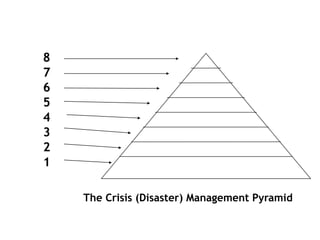
  • 64.
    n. SOP #14– JERICHO – This SOP prescribes the operational guidelines to be undertaken by the National Headquarter (NHQ) of PNP in the establishment of a quick reaction group that can be detailed with the office of the Secretary of Interior and Local Government (SILG), with personnel and equipment requires of that reaction group supported by the PNP. o. SOP #15 – NENA (ANTI-PROSTITUTION/VAGRANCY) – This SOP sets forth the operational thrusts to be undertaken by the PNP that will spearheaded the fight against prostitution and vagrancy.
  • 65.
    p. SOP #16– ANTI-PORNOGRAPHY – This prescribes the guidelines to be followed by the tasked PNP Units/Offices in enforcing the ban on pornographic pictures, videos and magazines. q. SOP #17 – GUIDELINES IN THE CONDUCT OF ARREST SEARCH, AND SEIZURE – This SOP prescribes the procedures and manner of conducting an arrest, raid, search and/or search of person, search of any premises and the seizure of properties pursuant to the 1987 Philippine Constitution, Rules of Court, as amended and updated decision of the Supreme Court. r. SOP #18 – SCHEMATIC DIAGRAM OF SANDIGAN MASTER PLAN s. SOP #19 – ANTI-ILLEGAL LOGGING t. SOP #20 – ANTI-ILLEGAL FISHING u. SOP #21 – ANTI-ILLEGAL DRUGS
  • 66.
    SAMPLE OF POLICEPLANS and the PNP Programs and Strategies • The acronym SMART describing the characteristics of a Plan: S – IMPLE M – EASURABLE A – TTAINABLE R – EALISTIC T – IME BOUND • The acronym POLICE 2000 also describes another police plan: P – REVENTION and suppression of crime through community oriented policing system O – ODER, maintenance, peacekeeping and internal security L – AW enforcement without fear or favor I - MAGE, credibility and common support C – OORDINATION with other government agencies and non- government agencies organizations and internal securities E – FFICIENCY and effectiveness in the development and management of human and material resources
  • 67.
    • The acronymDREAMS stands for: D – ISPERSAL of policeman from the headquarters to the street and enhancement of crime prevention program R – ESTORATION of trust and confidence of the people on their police and gain community support E – LIMINATION of street and neighborhood crimes and improvement of public safety A – RREST of all criminal elements common or organized in coordination with the pillars of the CJS and other law enforcement agencies M – APPING up and removal of scalawags from the pole of ranks S – TRENGHTENING the management and capability of the PNP to undertake or support the dreams operations and activities • The Three Point Agenda known as ICU: I – NEPT C – ORRUPT U – NDISCIPLINE
  • 68.
    To curb outthe ICU, the PNP should: 1. Prevent by moral persuasion of inept, corrupt and the undisciplined police officer. 2. Re-invent the PNP’S system and procedures to assure everyone a culture of transparency, integrity and honesty and 3. Rebuilt the police institution into an agency that can find its distinction in the protection of rights and not in their violation. To cure the ICU, the police administrator have to build Aptitude, Integrity and Discipline.
  • 69.
    The acronym GLORIAstands for: G – RAFT free organization L – EADERSHIP by example O – NE stop shop mechanism for a faster police response to complaints and reports R – ESULT oriented culture in the anti-criminality effort I – NVESTMENT climate, which is business friendly as a result of the peace and order A – CCOUNTABILITY and ownership of peace and order campaign
  • 70.
    DECISION MAKING: An EssentialElement in Planning
  • 71.
    What is ManagerialDecision? To decide to make up one’s mind. A decision is a choice from among a set of available alternatives. Managerial decisions are choices between alternative courses of action translated into administrative behavior designed to achieve an organization’s mission through the accomplishment of specifically targeted goals and objectives.
  • 72.
    What are theelements of Managerial Decisions? In coming up with the appropriate decisions, police managers should consider the following elements: 1. Choices – If a police administrator does not have the opportunity or the ability to make a choice, there is no real decision. Following rules, obeying orders or being coerced to act in certain ways cannot without a great deal of distortion be construed as making decisions. 2. Alternatives – There must be more than one possible course of action available in order for the police administrator to have a choice. Effective police managers look for and try to create a realistic option for resolving problems. 3. Targets – Goals and objectives come together to perform a vital function. They activate give direction to the decision- making process. 4. Behavior – Making decision is irrelevant unless they are translated into action.
  • 73.
    What is theimportance of Decision- Making in Police Planning? Police planning is involved in a problem- solving process. Problem solving and decision- making are used interchangeably in the context of management and administration because police managers spend most of their time making decisions to resolve problems.
  • 74.
    The decision-making processconsists of three stages as used in police planning. These three stages are described as follows: 1. Intelligence – this involves scanning the environment for condition that require the decision. 2. Design – entails creating, developing, and analyzing possible courses of action (creative problem solving). 3. Choice – refers to the actual selection of a particular course of action from among available alternatives. Based on these concepts, decision making and planning can be describe as multi-step process through which problems are recognized, diagnosed, and defined alternative solution are generated, select and implemented.
  • 75.
    What are somegeneral principles involved in Decision Making? • Rule 1. Make a decision – effective police managers are graded on their ability to make decision. This is because indecisiveness is easily perceived and generates disrespect, destroys confidence, lowers morale, and adversely affects performance. • Rule 2. Don’t Worry – avoid anxiety by not worrying about decisions already made. The only time of reconsidering a decision is when there is a genuine need to consider an alternative course of action. • Rule 3. Expect Criticism – criticism is inevitable. In a positive sense, it means the police manager is doing something that is worthy of attention.
  • 76.
    What is OrganizationalDecision Making? Organizational decision making refers to the formal exercise of an authority to decide based on a designated level of management and the scope of decision proportionate to the total organization. The greater the proportion, the broader the scopes of decision, hence the levels of management are arranged in a hierarchical order indicative of formal authority or position power. 1. Upper-level Managers – the elected or appointed top executives who serves as administrators, heads and directors.
  • 77.
    2. Middle-level Managers– located between the top and the lower levels of the organization. Examples are bureau chiefs, division heads who acts in behalf of their superiors to interpret policies, coordinate activities, motivate employees, and maintain discipline. Their decision-making authority is limited and always constrained by preexisting policy. 3. Lower-level Managers – (Supervisory) – responsible for job related activities of others. They are the work group leaders charged with getting their subordinates to carry out specific tasks as set down by middle level managers. They do make decision though highly structured and related almost exclusively to operational consideration.
  • 78.
    What are theinfluences on Decision? A. Internal Factors 1. The specificity of organization’s mission, goals and objectives. 2. The delegation of sufficient authority to enable managers to carry out their assigned duties. 3. The degree of autonomy given to management personnel at different levels in the organization. 4. The leeway granted to the managers by departmental policies, procedures, rules, and regulation.
  • 79.
    5. The availabilityof valid, reliable, and objective information on which to base decision. 6. The time and energy used to select, retain qualified managers. 7. The nature, extent and effect of intra-organizational conflict. 8. The adequacy of the reward system in promoting timely ad effective decision-making.
  • 80.
    A. External Factors 1.Social Instability 2. Rising Expectation 3. Professional Ethics 4. legal Constraints 5. Dwindling Resources 6. Political Conflict 7. Technological change
  • 81.
    Internal and externalenvironmental factors are never under the direct control of the decision-maker. Effective decision- maker learns and accepts to cope with this uncertainly, complexity, and risk.
  • 82.
    Situational Variables No twodecisions are exactly the same. There are simply too many variables. Every police problem that elicits a decision is unique in terms of its •Nature and Extent •Difficulty •Urgency •Seriousness •Complexity •Solution
  • 83.
    Personal Variables • Mentalhealth • Intellectual Capacity • Education and Experience • Values, attitude and perception • Motivation to act
  • 84.
    Nine (9) Stepsin Rational Decision Making 1. Awareness of the need to make decision – Decision-making is activated by the recognition of opportunities as well as problems. 2. Identifying an existing problem – When feedback suggests there is a problem, it must be diagnosed and defined in explicit terms. 3. Listing possible and probable causes – Once the problem has been identified and articulated, all possible causes must be considered.
  • 85.
    4. Designing alternativesolutions – develops and tests a fairly wide creative solution. 5. Evaluating alternative solution – evaluation must be interim of probability, effect, importance, feasibility, sufficiency, and realism. 6. Choosing an alternative solution – all available options must be analyzed and compared to one another in order to select objectively the best alternative.
  • 86.
    9. Making necessaryadjustments – be proactive and do not hesitate to make necessary midcourse corrections. 7. implementing a decision – a decision is meaningless if it is not translated into effective action. 8. Analyzing feedback – analyze feedback in order to assess the effectiveness of a given solution on a targeted problem
  • 87.
    What are theRules of Effective Decision- Making? 1. Differentiate between really big decisions and little problems 2. Rely on existing policies, procedures, rules, an regulations whenever possible 3. consult and check with significant others before making major organizational decisions 4. avoid making crisis decisions
  • 88.
    5. Do notattempt to anticipate all eventualities associated with resolution of the problem 6. Do not expect to make the right decision all of the time 7. Cultivate decisiveness 8. Implement major decisions once they have been made 9. Accept decision making as a challenge rather than unwanted chore.
  • 89.
    DISASTER AND EMERGENCYPLANNING Emergency and disaster planning is one of the most important interrelated function in a security system. It is important in any organization as physical security, fire protection, guard forces, security of documents and personnel security. Emergency and disaster planning refers to the preparation in advance of protective and safety measures for unforeseen events resulting from natural and human actions.
  • 90.
    Disaster plans outlinethe actions to be taken by those designated for specific job. This will result in expeditious and orderly execution of relief and assistance to protect properties and lives. These plans must also be rehearsed so that when the bell ring, there will be speed and not haste in the execution. Speed is the accurate accomplishment of a plan as per schedule, while haste is doing a job quickly with errors. Plans therefore must be made when any or all of the emergencies arise. Those plans, being special in nature, must be prepared with people whose expertise in their respective field is legion together with the coordination and help of management, security force, law enforcement agencies, and selected employees.
  • 91.
    Planning is necessaryto meet disaster and emergency conditions and it must be continuing and duly supported by management. On aspect of the plans will be to consider recovery measures to be undertaken by the organization. Being prepared for the eventuality gives better chances of protection and eventual recovery than those not prepared. Without planning, the emergency or disaster can become catastrophic. With a good, suitable plan to follow, the unusual becomes ordinary, hence, the mental preparedness for easy survival and recovery.
  • 92.
    Understanding Disaster A DISASTERis a sudden, unforeseen, extraordinary occurrence. It can be considered as an EMERGENCY but an emergency may not always be a disaster.
  • 93.
    An emergency fallsinto 2 broad categories: Disaster (Natural Crisis) Induced Catastrophe (Man-made Crisis) Floods, earthquake, flamine typhoon, diseases, volcano eruption, crashes industrial accident, fires, landslide avalanches tsunamis, etc. Arson, bombing, kidnapping, robbery, hostage-taking, skyjacking, assassination, ambush, and other acts terrorism
  • 94.
    Commodities: • Identify thetype of disaster occurred in the area • Identify those that could affect your operation in the area • Determine which scenarios are plausible • Survey your physical facilities and operating procedures to determine preparedness • Survey surrounding area to determine if there are operations or facilities near which might create emergencies.
  • 95.
    Commodities: • Establish aliaison with law enforcement agencies and emergency response groups • Know where to get help, how to get help, and what help you can expect • Know who currently has authority to make key decisions with in your organization and who control access to decision makers in an emergency • Review emergency procedures, its completeness and accuracy
  • 96.
    Elements of EffectiveCrisis (Disaster) Management “Like any other construction project, the crisis (disaster) management pyramid requires a solid foundation”
  • 97.
  • 98.
    Placed within thepyramid are the following • Think about the unpopular (1) This is recognizing the management’s willingness and involvement. There must be a clear recognition that emergencies distinct possibilities is anytime and that preparation for them must begin NOW! • Recognizing dangers and opportunities (2) • Defining the control and crisis response (3) “To do the right thing at the right season is a great art” – AESOP • Harness and Environment (4) – Ability to organize, willingness and delegate – Providing an atmosphere in which personnel can do job for which they are selected – Providing the right facilities and backups
  • 99.
    • Containing theDamage (5) “Physical damage frequently is impossible to control but emotional and public relation is not.” • Successful Resolution (6) – damaged has been contained • Return to Normalcy (7) – Assistance to victims and safety of equipment while normal operations are going on – The emergency has been totally addressed • Avoid Repetition (8) – through aggressive countermeasures and reduction o vulnerability to similar emergencies in the future.
  • 100.
    List of EffectiveCrisis (Disaster) Management based on the Pyramid A. Good Planning • Consider all possibilities • Don’t focus only on immediate problem • Establish contacts B. Good Personnel • Look for experience and knowledge • Train, test and evaluate • Use people effectively and humanely • Organize to mitigate stress
  • 101.
    A. Good Shakedowns •Test plans and people • Evaluate and revise plans • Keep an open mind B. Maintain Control Be creative • Look for the real problem • Have confidence in your plans • Keep records C. Get Back to Normal • Evaluate and document • Give reward • Analyze implications
  • 102.
    Phases in Emergency/DisasterPlanning Phase I Assessment of the Situation This will be a research in depth by a knowledgeable and specially trained group on the vulnerabilities as well as the resources available for the disaster plan. Surveys and Inspection may be conducted Phase II Writing the Plan The plan will have to be written based on the findings in Phase I. the plan can be code title, management will just call for the name of the plan.
  • 103.
    Phase III Phase IV Testingthe Plan Critique the Plan This involves the analysis of feedbacks. The unworkable procedures should be noted and finally corrected.
  • 104.
    Checklist for ReviewingPolicies, Procedures and Plans • Compile and review your organization’s policies on various contingencies before establishing your plans • Ensure that these policies are known throughout the organization and that they are included in your emergency manuals • Ensure that your procedures and plans are consistent with your organization’s established policies and goals
  • 105.
    • Identify appropriateoutside consultants and other sources of assistance in developing and implementing your plans and procedures • Ensure that the appropriate personnel have any security clearances or background checks which might be required • Establish a viable record-keeping system and procedures to ensure they are followed
  • 106.
    Organizing Disaster Management Team Disasterteam leadership is vested primary tasks is to ensure that the control is maintained over the team’s activities, information flow, and the implementation of decisions and organizational policies. For these reason, the team leader should be a person who has demonstrated abilit7y to function under pressure, must have sufficient authority to make on the spot decisions with in the framework of overall organization’s policy, access to decision makers when required, and the ability to recognize which decisions to make independently an which to refer to upper management.
  • 107.
    Disaster Action TeamDuties • Supervise the formulation of policies • Ensure the development of procedures • Participate in preparing plans • Oversee and anticipate in exercise of plans • Select crisis management/disaster center • Participate in personnel training • Review preparation of materials • Delegate authority • Brief personnel • Ensure the assembly of supplies • Ensure preparation of rest, food, medical areas On Pre-event
  • 108.
    During the Event •Establish shift schedules immediately • Delegate tasks • Focus underlying problem • Maintain control • Follow organizational policies • Use prepared procedures • Innovate as needed • Ensure that information is shared with the entire team • Review all press release and public statements • Double check or confirm informations if possible • Aid victim and their families • Try to anticipate future consequences • Control stress of team members • Ensure log maintenance
  • 109.
    On Post Event(after the Incident) • Evaluate effectiveness of plans • Evaluate adequacy of procedures • Debrief personnel • Evaluate equipment and training used • Revise plans and procedures in the light of new experience • Reward personnel as appropriate • Document events • Prepare after-action reports • Arrange an orderly transition to normal conditions
  • 110.
    The Chain ofEvents during a Crisis/Disaster Incoming Advisory Security Notifies Disaster Action Team Leader Decision - - - - - No Immediate Action Team Leader Notifies Assembly at the Crisis or Disaster Center Initial Actions: Log Created, Family/ Government Contacted, Press Guidance, Others Appropriate Action
  • 111.
    The chain ofevents during a disaster is simplified as follows: • Security receives initial report of emergency • Security notifies Disaster Team Leader • Team leader decides if immediate action is required • If action is required, he notifies the other team members to convene at the crisis management center • Initial liaison established and actions taken: create log, contact of family, employees involved, government or law enforcement liaison contacts, prepare contingency press guidance, others. • Respond to event
  • 112.
    Crowd Control andRiot Prevention • Riot, in general is an offense against the public peace. It is interpreted as a tumultuous disturbance by several persons who have unlawfully assembled to assist one another, by the use of force if necessary, against anyone opposing them in the execution of some enterprise of a private nature, and who execute such enterprise in a violent manner, to the terror of the people.
  • 113.
    • Under thelaw, it is punishable for any organizer or leader of any meeting attended by armed persons for the purpose of committing any of the crimes punishable under the Revised Penal Code, or any meeting in which the audience is incited to the commission of the crimes of treason, rebellion or insurrection, sedition or assault upon a person in authority or his agents (Art. 146, RPC). It is also punishable for any person who shall cause any serious disturbance in a public place, office, or establishment, or shall interrupt or disturb public functions or gatherings or peaceful meetings (Art. 153, RPC).
  • 114.
    Some Basic Definitionof Terms • Tumultuous – The disturbance or interruption shall be deemed tumultuous if caused by more than three persons who are armed or provided with means of violence. • Outcry – The means to shout subversive or proactive words tending to stir up the people to obtain by means of force or violence.
  • 115.
    • Crowd –It consists of a body of individual people with no organization, no single partnership. Each individual’s behavior is fairly controlled and ruled by reason. All the participants have been thrown by circumstance into a crowd for some common purpose that may give them a least one thing in common. • Mob – A mob takes on the semblance of organization with some common motive for action, such as revenge for a crime committed on the scene where the crowd assembled, an aggravated fight, or a confrontation with the police. At time like this, there is already a strong feeling of togetherness (“we are one” attitude). • Riot – It is a violent confusion in a crowd. Once a mob started to become violent, it becomes a riot.
  • 116.
    What is theRole of Planning in Crowd Control or Riot Prevention? A sound organizational planning, training, logistical support and a high departmental morale are the essential success elements in modern counter-riot operations. The control of violent civil disorder involving large segments of the population, especially in congested urban areas, requires a disciplined, aggressive police counter-action which at the same time adheres to the basic law enforcement precepts. This is done through effective police operational planning.
  • 117.
    • Through planning,the law violators can be arrested and processed with in the existing legal frameworks by the exercise of reasonable force. Without an immediate decisive police action, the continually recurring conditions of civil unrest and lawlessness could quickly evolve into a full-scale riot. Police planning could provide the best police reaction and order can be restored with a minimum of property damage and injury.
  • 118.
    What are thePolice Purpose and Objectives in Anti-Riot Operations?
  • 119.
    • Containment –Unlawful assembly and riot are as contagious as plagued unless they are quarantined from the unaffected areas of the community. In here, all persons who are at scene should be advised to leave the area, thereby reducing the number of potential anti-police combatants. • Dispersal – The crowd of unlawful assembly or riot should be dispersed at once. It may appear at first to be a legal assembly but the nature of assembly at the time of the arrival of the police may clearly distinguish it as being unlawful. Once it is determined, the responsibility of the police to command the people to disperse. Crowd control formations may be done if necessary to expedite their movements.
  • 120.
    • Prevention ofEntry or Reentry – The police have to protect the area once the people have been moved out or dissipated into smaller groups to prevent them from returning. Enforce quarantine by not allowing the group to resume their actions. • Arrest Violator – One of the first acts of the police upon arrival at the scene of the disturbance is to locate and isolate individuals who are inciting the crowd to violate or fragrantly violating the law. Prevent any attempt by the crow or mob to rescue those arrested by enforcing total quarantine. • Establish Priorities – Depending upon the circumstances, it is always necessary to establish priorities. Assessing the situation to determine the nature of assistance and number of men needed is part of the planning process.
  • 121.
    What are theBasic Procedures in Anti-Riot Operations?
  • 122.
    1. Assess theSituation – Determine whether the original purpose of the gathering was lawful or not – Determine also the lawfulness at the time of arrival at the scene – Assess their attitude, emotional state, and their general condition – Determine any state of intoxication and other conditions that may lead to violence – Identify the cause of the problem – Locate and identify leaders or agitators
  • 123.
    2. Survey theScene – Determine as soon as possible the best condition of the command post – Locate the best vintage point of observations – Consider geographical factors such as natural barriers, buildings, and weather condition – Note the best method of approach
  • 124.
    3. Communicate – Reporton your assessment, keeping your assessment brief but concise, giving your superior the sufficient data with which to proceed for plans of action – Ask for assistance or help from the command post hence remain close to the radio as possible until additional units arrived or to communicate new developments.
  • 125.
    4. Maintain aWatchful Waiting – Make your presence known to the people in the vicinity – If the crowd is too much to handle, stay near the command post and wait for additional supports units – Use radio or other means of communications to call for assistance – Make preparations for decisive police action.
  • 126.
    5. Concentrate onRescue and Self-Defense – Take care of the immediate needs of the situation until help arrives – Apply first aid to the injured people and self protection must be considered – Remember the primary objective of protecting lives, property and the restoration of order 6. Maintain an Open Line of Communication – Keep the dispatcher advised on the progress of the scene – Continue directing the support units to the scene and the general perimeter control
  • 127.
    7. Establish aCommand Post – Follow what is in your contingency plan for civil disturbance – Make every officer aware of the command post for proper coordination 8. Take immediate action for serious violations – Arrest perpetrators – Isolate the leaders or agitators from the crowd – Show full police force strength 9. Give the dispersal order – Disperse the crowd upon order – Anti-riot formations and procedures must be used – Use of force necessary for dispersal maybe considered
  • 128.
    What are theGeneral Guidelines in Handling Riot?
  • 129.
    1. Preplanning mustbe high on the agenda whenever the department anticipates any disorder or major disturbance. 2. Meet with responsible leaders at the scene and express your concern for assuring them their constitutional guarantees. Request them to disperse the crowd before attempting to take police action. 3. Maintain order and attempt to quell the disturbance without attempting to punish any of the violators.
  • 130.
    4. Use onlythe force that is necessary but take positive and decisive action. 5. Post the quarantine area with signs and barricades, if necessary. 6. Keep the traffic lane open for emergency and support vehicle. 7. Consider the fact that most impressive police action at the scene of any type of major disturbance is the expeditious removal of the leaders by a well disciplined squad of officers.
  • 131.
    8. For riotcontrol, consider the following: – Surprise Offensive – The police action in its initial stages at a riot must be dramatic. The elements of surprise may enhance effectiveness of riot control. – Security of Information – Plans for action and communications regarding the movement of personnel and equipment should be kept confidential – Maximum utilization of Force – A show of police force should be made in a well-organized manner, compact, and efficient in a military-type squad formation. – Flexibility of Assignments – Officers and terms should be flexibility assigned to various places where the need is greatest. – Simplicity – Keep the plan as simple as possible and the instructions are direct to avoid mass confusion among the officers.
  • 132.
    What are theSpecial Problems in Crowd Control and Riot Operations?
  • 133.
    Snipers – Certainpsychopathic people may attempt to take advantage of the mass confusion and excitement at a riot scene by taking a concealed position and shooting at people with some type of weapons, usually rifle. How to handle this? – clear the area of innocent bystanders – isolate the area and guard against possible escape of the suspects – use whatever force necessary to take him into custody – assign anti-snipers team especially in aggravated situations
  • 134.
    • Arsonist –Persons holding torch in their hands are potential arsonists. They must be taken into custody immediately. • Looters – Acts of simple misdemeanor thefts or may consists of robbery of breaking and entering. Take the suspects into custody by whatever means are necessary.
  • 135.
    DECISION-MAKING MODELS 1. TheRational Model 2. The Incremental Model 3. Heuristic Model 4. Organizational Process Model 5. Government Politics Model
  • 136.
    Group Decision Making GroupAssets – Greater Total Knowledge and Information – Greater Number of Approaches to a Problem – Participation in Problem Solving Increases Acceptance – Better Comprehension of the Decision Group Liabilities – Social Pressure – Individual Domination – Groupthink
  • 137.
    Factors that canServe as Asset and Liabilities 1. Disagreement 2. Conflicting Versus Mutual Interest 3. Risk Taking 4. Time Requirements
  • 138.
    Brainstorming 1. Sessions shouldlast 40 minutes to an hour 2. Problem to be discussed should not be revealed before the session 3. The problem should be stated clearly and not too broadly 4. A small conference table should be used
  • 139.
    Personal Characteristics of DecisionMaking • Ideology versus Power Orientation • Emotionality versus Objectivity • Creativity versus Common Sense • Action Orientation versus Contemplation
  • 140.
    Common Errors inDecision Making 1. Cognitive Nearsightedness 2. Assumption That the Future will Repeat itself 3. Oversimplification 4. Overreliance on One’s Own Experience 5. Preconceived Notions 6. Unwillingness to Experiment 7. Reluctance to Decide