Piaget’s Psychological
Development
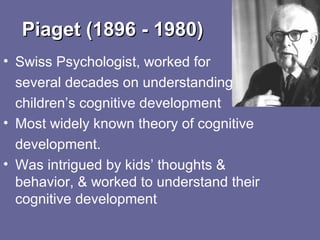
Piaget (1896 - 1980)Piaget (1896 - 1980)
• Swiss Psychologist, worked for
several decades on understanding
children’s cognitive development
• Most widely known theory of cognitive
development.
• Was intrigued by kids’ thoughts &
behavior, & worked to understand their
cognitive development
Piaget: BackgroundPiaget: Background
• Young Piaget was incredibly precocious
– Published first paper at 10
– Wrote on mollusks, based on these writings
was asked to be curator of mollusks at a
museum in Geneva (he declined in order to
finish secondary school)
– Earned his doctorate in natural sciences at 21
– Began to study psychology, applying
intelligence tests to school children
Constructivism
• Assumption that learning is an active
process of construction rather than a
passive assimilation of information or rote
memorization.
• Credited for founding constructivism
• Has had a large influence on American
schools
…Piaget and Constructivism
• Best known for idea that individuals
construct their understanding, that
learning is a constructive process
– Active learning as opposed to simply
absorbing info from a teacher, book, etc.
– The child is seen as a ‘little scientist’
constructing understandings of the world
largely alone
…….Piaget & Constructivism.Piaget & Constructivism
• believed all learning is constructed,
whether it is something we are taught or
something we learn on our own.
• Whether or not we are taught in a
“constructivist” manner, Piaget believed
we are constructing knowledge in all our
learning.
Piaget & Learning
• Two main states – equilibriumequilibrium &
disequilibriumdisequilibrium
• Believed that we are driven or motivated
to learn when we are in disequilibrium
– We want to understand things
Piaget & LearningPiaget & Learning
• Equilibration: assimilation & accommodation
• We adjust our ideas to make sense of reality
• Assimilation:
• process of matching external reality to an
existing cognitive structure.
• Accommodation:
• When there’s an inconsistency between the
learner’s cognitive structure & the thing being
learned the child will reorganize her thoughts
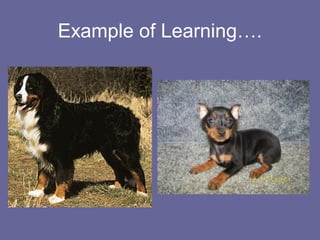
Example of Learning….
Constructivism, Learning, &Constructivism, Learning, &
EducationEducation
• Not interested in applying his theory to
school-based education, he called this
“The American question”
• Constructivist educators create an
environment which encourages children
to construct their own knowledge.
– But according to Piaget, we construct our
learning regardless of how it is presented.
Piaget’s Stages of CognitivePiaget’s Stages of Cognitive
DevelopmentDevelopment
• A child’s capacity to understand certain
concepts is based on the child’s
developmental stage
Piaget’s Four StagesPiaget’s Four Stages
• Believed that all children develop according to
four stages based on how they see the world.
– He thought the age may vary some, but that we all
go through the stages in the same order.
1. Sensori-motor (birth –2 years)
2. Preoperational (~2-7)
3. Concrete operational (~7-11)
4. Formal operations (~12-15)
Sensorimotor StageSensorimotor Stage
• Birth to about 2 years, rapid change is
seen throughout
• The child will:
– Explore the world through senses & motor
activity
– Early on, baby can’t tell difference between
themselves & the environment
– If they can’t see something then it doesn’t
exist
– Begin to understand cause & effect
– Can later follow something with their eyes
Preoperational StagePreoperational Stage
• About 2 to about 7
– Better speech communication
– Can imagine the future & reflect on the past
– Develop basic numerical abilities
– Still pretty egocentric, but learning to be able
to delay gratification
– Can’t understand conservation of matter
– Has difficulty distinguishing fantasy from
reality (ex: cartoon characters are real
people).
……more preoperationalmore preoperational
• Conservation of matter – understanding
that something doesn’t change even
though it looks different, shape is not
related to quantity
• Ex: Are ten coins set in a long line more
than ten coins in a pile?
• Ex: Is there less water if it is poured into
a bigger container?
Piaget’sPiaget’s
PrePre--
OperationalOperational
StageStage
Inability to understand
conservation of matter.
Concrete Operational StageConcrete Operational Stage
• From about 7 to about 11
– Abstract reasoning ability & ability to
generalize from the concrete increases
– Understands conservation of matter
Formal OperationsFormal Operations
• From about 12 to about 15
– Be able to think about hypothetical
situations
– Form & test hypotheses
– Organize information
– Reason scientifically
…… Piaget’s DevelopmentPiaget’s Development
• Development happens from one stage to
another through interaction with the
environment.
• Changes from stage to stage may occur
abruptly and kids will differ in how long
they are in each stage.
• Cognitive development can only happen
after genetically controlled biological
growth occurs.
……Piaget’s DevelopmentPiaget’s Development
• Development leads to learning
– Drive for development is internal
– The child can only learn certain things when
she is at the right developmental stage
– Environmental factors can influence but not
direct development
– Development will happen naturally through
regular interaction with social environment
Piaget & EducationPiaget & Education
• Piaget did not think it was possible to
hurry along or skip stages through
education
• Regardless, many American schools will
try to teach to the stages in an attempt to
accelerate development
Problems with Piaget’s TheoryProblems with Piaget’s Theory
• Children often grasp ideas earlier than
what Piaget found
• Cognitive development across domains
is inconsistent (e.g. better at reading
than math)
• Studies have shown that development
can to some degree be accelerated

[Behav. sci] piaget’s psychological development by SIMS Lahore

  • 1.
  • 2.
    Piaget (1896 -1980)Piaget (1896 - 1980) • Swiss Psychologist, worked for several decades on understanding children’s cognitive development • Most widely known theory of cognitive development. • Was intrigued by kids’ thoughts & behavior, & worked to understand their cognitive development
  • 3.
    Piaget: BackgroundPiaget: Background •Young Piaget was incredibly precocious – Published first paper at 10 – Wrote on mollusks, based on these writings was asked to be curator of mollusks at a museum in Geneva (he declined in order to finish secondary school) – Earned his doctorate in natural sciences at 21 – Began to study psychology, applying intelligence tests to school children
  • 4.
    Constructivism • Assumption thatlearning is an active process of construction rather than a passive assimilation of information or rote memorization. • Credited for founding constructivism • Has had a large influence on American schools
  • 5.
    …Piaget and Constructivism •Best known for idea that individuals construct their understanding, that learning is a constructive process – Active learning as opposed to simply absorbing info from a teacher, book, etc. – The child is seen as a ‘little scientist’ constructing understandings of the world largely alone
  • 6.
    …….Piaget & Constructivism.Piaget& Constructivism • believed all learning is constructed, whether it is something we are taught or something we learn on our own. • Whether or not we are taught in a “constructivist” manner, Piaget believed we are constructing knowledge in all our learning.
  • 7.
    Piaget & Learning •Two main states – equilibriumequilibrium & disequilibriumdisequilibrium • Believed that we are driven or motivated to learn when we are in disequilibrium – We want to understand things
  • 8.
    Piaget & LearningPiaget& Learning • Equilibration: assimilation & accommodation • We adjust our ideas to make sense of reality • Assimilation: • process of matching external reality to an existing cognitive structure. • Accommodation: • When there’s an inconsistency between the learner’s cognitive structure & the thing being learned the child will reorganize her thoughts
  • 9.
  • 10.
    Constructivism, Learning, &Constructivism,Learning, & EducationEducation • Not interested in applying his theory to school-based education, he called this “The American question” • Constructivist educators create an environment which encourages children to construct their own knowledge. – But according to Piaget, we construct our learning regardless of how it is presented.
  • 11.
    Piaget’s Stages ofCognitivePiaget’s Stages of Cognitive DevelopmentDevelopment • A child’s capacity to understand certain concepts is based on the child’s developmental stage
  • 12.
    Piaget’s Four StagesPiaget’sFour Stages • Believed that all children develop according to four stages based on how they see the world. – He thought the age may vary some, but that we all go through the stages in the same order. 1. Sensori-motor (birth –2 years) 2. Preoperational (~2-7) 3. Concrete operational (~7-11) 4. Formal operations (~12-15)
  • 13.
    Sensorimotor StageSensorimotor Stage •Birth to about 2 years, rapid change is seen throughout • The child will: – Explore the world through senses & motor activity – Early on, baby can’t tell difference between themselves & the environment – If they can’t see something then it doesn’t exist – Begin to understand cause & effect – Can later follow something with their eyes
  • 14.
    Preoperational StagePreoperational Stage •About 2 to about 7 – Better speech communication – Can imagine the future & reflect on the past – Develop basic numerical abilities – Still pretty egocentric, but learning to be able to delay gratification – Can’t understand conservation of matter – Has difficulty distinguishing fantasy from reality (ex: cartoon characters are real people).
  • 15.
    ……more preoperationalmore preoperational •Conservation of matter – understanding that something doesn’t change even though it looks different, shape is not related to quantity • Ex: Are ten coins set in a long line more than ten coins in a pile? • Ex: Is there less water if it is poured into a bigger container?
  • 16.
  • 17.
    Concrete Operational StageConcreteOperational Stage • From about 7 to about 11 – Abstract reasoning ability & ability to generalize from the concrete increases – Understands conservation of matter
  • 18.
    Formal OperationsFormal Operations •From about 12 to about 15 – Be able to think about hypothetical situations – Form & test hypotheses – Organize information – Reason scientifically
  • 19.
    …… Piaget’s DevelopmentPiaget’sDevelopment • Development happens from one stage to another through interaction with the environment. • Changes from stage to stage may occur abruptly and kids will differ in how long they are in each stage. • Cognitive development can only happen after genetically controlled biological growth occurs.
  • 20.
    ……Piaget’s DevelopmentPiaget’s Development •Development leads to learning – Drive for development is internal – The child can only learn certain things when she is at the right developmental stage – Environmental factors can influence but not direct development – Development will happen naturally through regular interaction with social environment
  • 21.
    Piaget & EducationPiaget& Education • Piaget did not think it was possible to hurry along or skip stages through education • Regardless, many American schools will try to teach to the stages in an attempt to accelerate development
  • 22.
    Problems with Piaget’sTheoryProblems with Piaget’s Theory • Children often grasp ideas earlier than what Piaget found • Cognitive development across domains is inconsistent (e.g. better at reading than math) • Studies have shown that development can to some degree be accelerated