BEER
What is Beer?
• century’s old process of converting sugared water to fermented liquid
• some of the oldest recipes ever found have been beer recipes
• beer was a necessity in ancient times
• poor water quality
• social and medical contributions
What’s in a Beer?
• BARLEY – the body & soul of beer
• YEAST – the life of beer
• HOPS – the spice of beer
• WATER – the integrity & purity of beer
• ADJUNCTS – Additive grains like rice or corn, fruit or spices
Barley – “Body & Soul”
Barleymalt givesbeer:
• NATURAL enzymes to covert starch to sugar needed for
fermentation
• MALTY sweet flavor
• COLOR
• FOAMY head
Two row & six row barley malt are used in the brewing process.
Variety of barley malts helps determine the color, texture and flavor of
beer.
Yeast – “Life of Beer”
Yeastis the catalyst of change:
• one cell micro-organism
• produces carbon dioxide and alcohol
Two types of yeast are used to produce beer:
• ALE – top fermenting
• LAGER – bottom fermenting
There are literally thousands of brewers yeast that create a variety beer
styles.
Hops – “Spice of Beer”
Hopflowersare usedto:
• MICROBIAL STABILIZATION hops have antiseptic qualities
• HOP AROMA fruity flowery characteristics
• BITTERNESS balances malt sweetness
• FOAM STABILIZATION enhances head properties
There are two primary hop styles:
• Aroma Hops – Saaz, Fuggle & Hallertua
• Bitter Hops – Brewer’s Gold & Unique
Hops are grown around the world between the 35th and 55th degrees
of latitude and harvested in fall.
Water – “Integrity & Purity”
Water’s rolein beer:
• water makes up 92% of beer
• through filtration or boiling; impurities, aromas & flavor differences
can be mitigated
Water styles can effect flavor:
• hard water – helps add crisp cleaness
• soft water – adds smoothness
Adjuncts – “The Wild Card”
Adjunctsadd to beer:
• adjuncts are added to change the flavor, character or profile of beer.
• used to supplement main starch source to provide better foam
retention, color or aroma
Adjuncts fall into two categories:
• Grains:
• corn, rice, wheat, oats or rye
• Specialty Ingredients:
• sweets – honey or maple
• fruits – raspberry, cherry or cranberry
• spices – cinnamon, coriander or clove
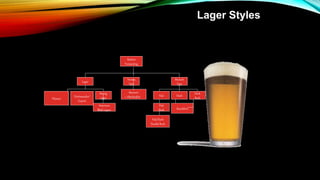
What is a Lager?
• lager means “to store”
• bottom fermenting yeasts
• ferment at lower temperatures (50°)
• lagered close to freezing for several weeks
• characterized by a crisp-tasting, lighter body and less-fruity aroma –
rounded, smooth beer
• over last 150 years or so lagers have become the predominate beers
Lager Styles
Bottom
Fermenting
Lager
Vienna
Type
Munich
Type
Pilsener
Dortmunder/
Export
Strong
Lager
American
Malt Liquor
Marzen/
Oktoberfest Pale Dark
Dark
Bock
Pale
Bock
Pale/Dark
Double Bock
Rauchbier
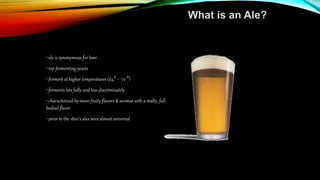
What is an Ale?
• ale is synonymous for beer
• top fermenting yeasts
• ferment at higher temperatures (64° – 72 °)
• ferments less fully and less discriminately
• characterized by more-fruity flavors & aromas with a malty, full
bodied flavor
• prior to the 1800’s ales were almost universal
Top
Fermenting
Wheat
Beers
Pure
Yeast
Lactic
Fermentation
Spontaneous
Fermentation
South
German
Weissbier/
Weizen
Weizenbock
Berliner
Weisse
Lambic
Gueuze
Faro
Kriek
Frambooise
Other
Fruit
Beers
Sweet
Stout
Porter
Oatmeal
Stout
Dry
Stout
Imperial
Stout
Ale Types
American
Ale
Cream
Ale
Bitter
Best
Bitter
Strong
Bitter
So English
Brown
Ale
No English
Brown
Ale
Old
Ale
Pale/Dark
Barley
Wine
Light
Ale
Pale
Ale
Irish
Red Ale
Strong
Scotch Ale
Pale
Mild
Dark
Mild
Belgian
Brown/”Red”
India
Pale Ale
Belgian
Ales
Altbier
Hoppy
Face ™
Saisons Trappisten
Belgian
Witbier/
White/
Blanche
Dunkel-
Weizen
American
Hefeweizen
Ale Styles
Why Beer?
• Beer is a $91.6 billion dollar category and accounts for over half of beverage alcohol dollar
sales.
• Beer has a 52% share of alcohol retail dollar sales and is 85% of alcohol consumption.
Shareof TotalBeverageAlcohol
RetailDollarSales
Wine
9%
Beer
85%
Liquor
6%
Shareof TotalBeverageAlcohol
Consumption(Gallons)
Wine
15%
Beer
52% Liquor
33%
Micro & Craft Category Growth
• whether Ale, Stout, Marzen, Porter, Lager or Wheat….. Micro / Craft Beers’ Share of the
Beer Category Growing
3.1%
4.7%
3.1%
4.8%
3.2%
4.9%
3.5%
5.3%
4.0%
6.1%
4.2%
6.6%
0.0%
1.0%
2.0%
3.0%
4.0%
5.0%
6.0%
7.0%
2002 2003 2004 2005 2006 YTD 04/22/2007
MICRO / CRAFT BEER - SHARE OF BEER CATEGORY
Case Share Dollar Share
Why Craft Beers?
• Micro and Craft Beers add interest and variety to your beer portfolio.
• Although small, the category is growing in sales and share of total
beer volume.
• Segment is fragmented with over 900 brands to choose from…select
carefully.
• Anheuser-Busch distributes many top selling / high growth micro /
craft beers to help you get the most from your valuable retail space.
Import Category Growth
• Import segment off-premise case sales have grown by nearly 12 million cases in 5 years!
• Import share of total beer category has grown 3% in 5 years!
6%3%4%
13%
15%
12%
47%
5%4%5%
11%
14%
15%
46%
Segment Share of Off-Premise Case Sales
2002 2006
What is a “Specialty/Craft” Beer?
• all Malt Brewing Process
• no “filler” adjuncts to lighten beer
• tend to be non-pasteurized, using additional filtration for clarity if
desired
• small Batch Production
• tend to produce beer in smaller vessels
• regional based
• between 15,000 and 2 million BE’s
What’s the Difference?
• Imports= brewer supplied products for outside USA
• import Companies or holding/distribution companies
• Crown Imports, Heineken USA, Anheuser-Busch, Inc.
• Craft /Specialtybeers = regional / national Brewers
• independent or regional distribution networks
• Sam Adams, Leinenkugel’s, Redhook
• Micro beers = Local/Regional Brewers
• independent distribution networks or self distribution
• Summit, Surly, Flat Earth Brewing. Co.
Why Import & Specialties?
• changing Consumers
• boomer market
• “gen X’ers” coming of age
• discretionary income
• evolving marketplace
• consumers are demanding broader selection, unique and
interesting products
• profitability
• higher perceived value
• higher margins / profit generators
Opportunities for you?
• profit generators
• higher margins
• incremental sales
• added ring totals
• impulse purchases
• selection
• value add for your consumers
• point of difference from competition
• become more of a destination
How should I do this?
• selection
• commitment to the category
• pricing
• be competitive but these are profit generators
• sampling
• awareness builders
• brewery sponsored / funded programs
• employee focus
• education
• dedicated people
Opportunity Selling?
• Food Pairings
• beer is an excellent complement to food
• Amber Ales – wild game, meats & cheeses
• Hefeweizens – salads, summer fair
• IPA – spicy foods (Mexican or Asian)
• Porters – deserts
• cooking with beer
• secret ingredient
• adds depth and flavor
• versatility
• Heat – cool temperatures
• Air - oxidation
• Light – low light conditions
2001 – A Space Odyssey
Bottle Beer – Do’s & Don’ts
• Always pour bottle beer into a glass
• drinking from the bottle traps carbonation and flavor which can
leave you feeling bloated
• pouring into a glass releases carbonation, flavor and aroma of the
beer
• pour beer down the center of glass to release carbonation and
flavor
• pouring down the side of the glass minimizes foam and traps
carbonation leaving the beer flat looking and gassy tasting.
Thank you.
How about a beer?
Chef Sunil Kumar
Research Scholar & Teaching Associate
IHTM MDU Rohtak and IHM Rohtak Haryana
124001 ph.no. 9996000499
Facebook id: ihmsunilkumar

Beer ppt

  • 2.
  • 3.
    What is Beer? •century’s old process of converting sugared water to fermented liquid • some of the oldest recipes ever found have been beer recipes • beer was a necessity in ancient times • poor water quality • social and medical contributions
  • 4.
    What’s in aBeer? • BARLEY – the body & soul of beer • YEAST – the life of beer • HOPS – the spice of beer • WATER – the integrity & purity of beer • ADJUNCTS – Additive grains like rice or corn, fruit or spices
  • 5.
    Barley – “Body& Soul” Barleymalt givesbeer: • NATURAL enzymes to covert starch to sugar needed for fermentation • MALTY sweet flavor • COLOR • FOAMY head Two row & six row barley malt are used in the brewing process. Variety of barley malts helps determine the color, texture and flavor of beer.
  • 6.
    Yeast – “Lifeof Beer” Yeastis the catalyst of change: • one cell micro-organism • produces carbon dioxide and alcohol Two types of yeast are used to produce beer: • ALE – top fermenting • LAGER – bottom fermenting There are literally thousands of brewers yeast that create a variety beer styles.
  • 7.
    Hops – “Spiceof Beer” Hopflowersare usedto: • MICROBIAL STABILIZATION hops have antiseptic qualities • HOP AROMA fruity flowery characteristics • BITTERNESS balances malt sweetness • FOAM STABILIZATION enhances head properties There are two primary hop styles: • Aroma Hops – Saaz, Fuggle & Hallertua • Bitter Hops – Brewer’s Gold & Unique Hops are grown around the world between the 35th and 55th degrees of latitude and harvested in fall.
  • 8.
    Water – “Integrity& Purity” Water’s rolein beer: • water makes up 92% of beer • through filtration or boiling; impurities, aromas & flavor differences can be mitigated Water styles can effect flavor: • hard water – helps add crisp cleaness • soft water – adds smoothness
  • 9.
    Adjuncts – “TheWild Card” Adjunctsadd to beer: • adjuncts are added to change the flavor, character or profile of beer. • used to supplement main starch source to provide better foam retention, color or aroma Adjuncts fall into two categories: • Grains: • corn, rice, wheat, oats or rye • Specialty Ingredients: • sweets – honey or maple • fruits – raspberry, cherry or cranberry • spices – cinnamon, coriander or clove
  • 10.
    What is aLager? • lager means “to store” • bottom fermenting yeasts • ferment at lower temperatures (50°) • lagered close to freezing for several weeks • characterized by a crisp-tasting, lighter body and less-fruity aroma – rounded, smooth beer • over last 150 years or so lagers have become the predominate beers
  • 11.
  • 12.
    What is anAle? • ale is synonymous for beer • top fermenting yeasts • ferment at higher temperatures (64° – 72 °) • ferments less fully and less discriminately • characterized by more-fruity flavors & aromas with a malty, full bodied flavor • prior to the 1800’s ales were almost universal
  • 13.
    Top Fermenting Wheat Beers Pure Yeast Lactic Fermentation Spontaneous Fermentation South German Weissbier/ Weizen Weizenbock Berliner Weisse Lambic Gueuze Faro Kriek Frambooise Other Fruit Beers Sweet Stout Porter Oatmeal Stout Dry Stout Imperial Stout Ale Types American Ale Cream Ale Bitter Best Bitter Strong Bitter So English Brown Ale NoEnglish Brown Ale Old Ale Pale/Dark Barley Wine Light Ale Pale Ale Irish Red Ale Strong Scotch Ale Pale Mild Dark Mild Belgian Brown/”Red” India Pale Ale Belgian Ales Altbier Hoppy Face ™ Saisons Trappisten Belgian Witbier/ White/ Blanche Dunkel- Weizen American Hefeweizen Ale Styles
  • 14.
    Why Beer? • Beeris a $91.6 billion dollar category and accounts for over half of beverage alcohol dollar sales. • Beer has a 52% share of alcohol retail dollar sales and is 85% of alcohol consumption. Shareof TotalBeverageAlcohol RetailDollarSales Wine 9% Beer 85% Liquor 6% Shareof TotalBeverageAlcohol Consumption(Gallons) Wine 15% Beer 52% Liquor 33%
  • 15.
    Micro & CraftCategory Growth • whether Ale, Stout, Marzen, Porter, Lager or Wheat….. Micro / Craft Beers’ Share of the Beer Category Growing 3.1% 4.7% 3.1% 4.8% 3.2% 4.9% 3.5% 5.3% 4.0% 6.1% 4.2% 6.6% 0.0% 1.0% 2.0% 3.0% 4.0% 5.0% 6.0% 7.0% 2002 2003 2004 2005 2006 YTD 04/22/2007 MICRO / CRAFT BEER - SHARE OF BEER CATEGORY Case Share Dollar Share
  • 16.
    Why Craft Beers? •Micro and Craft Beers add interest and variety to your beer portfolio. • Although small, the category is growing in sales and share of total beer volume. • Segment is fragmented with over 900 brands to choose from…select carefully. • Anheuser-Busch distributes many top selling / high growth micro / craft beers to help you get the most from your valuable retail space.
  • 17.
    Import Category Growth •Import segment off-premise case sales have grown by nearly 12 million cases in 5 years! • Import share of total beer category has grown 3% in 5 years! 6%3%4% 13% 15% 12% 47% 5%4%5% 11% 14% 15% 46% Segment Share of Off-Premise Case Sales 2002 2006
  • 18.
    What is a“Specialty/Craft” Beer? • all Malt Brewing Process • no “filler” adjuncts to lighten beer • tend to be non-pasteurized, using additional filtration for clarity if desired • small Batch Production • tend to produce beer in smaller vessels • regional based • between 15,000 and 2 million BE’s
  • 19.
    What’s the Difference? •Imports= brewer supplied products for outside USA • import Companies or holding/distribution companies • Crown Imports, Heineken USA, Anheuser-Busch, Inc. • Craft /Specialtybeers = regional / national Brewers • independent or regional distribution networks • Sam Adams, Leinenkugel’s, Redhook • Micro beers = Local/Regional Brewers • independent distribution networks or self distribution • Summit, Surly, Flat Earth Brewing. Co.
  • 20.
    Why Import &Specialties? • changing Consumers • boomer market • “gen X’ers” coming of age • discretionary income • evolving marketplace • consumers are demanding broader selection, unique and interesting products • profitability • higher perceived value • higher margins / profit generators
  • 21.
    Opportunities for you? •profit generators • higher margins • incremental sales • added ring totals • impulse purchases • selection • value add for your consumers • point of difference from competition • become more of a destination
  • 22.
    How should Ido this? • selection • commitment to the category • pricing • be competitive but these are profit generators • sampling • awareness builders • brewery sponsored / funded programs • employee focus • education • dedicated people
  • 23.
    Opportunity Selling? • FoodPairings • beer is an excellent complement to food • Amber Ales – wild game, meats & cheeses • Hefeweizens – salads, summer fair • IPA – spicy foods (Mexican or Asian) • Porters – deserts • cooking with beer • secret ingredient • adds depth and flavor • versatility
  • 24.
    • Heat –cool temperatures • Air - oxidation • Light – low light conditions 2001 – A Space Odyssey
  • 25.
    Bottle Beer –Do’s & Don’ts • Always pour bottle beer into a glass • drinking from the bottle traps carbonation and flavor which can leave you feeling bloated • pouring into a glass releases carbonation, flavor and aroma of the beer • pour beer down the center of glass to release carbonation and flavor • pouring down the side of the glass minimizes foam and traps carbonation leaving the beer flat looking and gassy tasting.
  • 26.
    Thank you. How abouta beer? Chef Sunil Kumar Research Scholar & Teaching Associate IHTM MDU Rohtak and IHM Rohtak Haryana 124001 ph.no. 9996000499 Facebook id: ihmsunilkumar