Page 1
DRAFT BEE INDUSTRY
ROADMAP:
2011-2015
Prepared in collaboration with:
UPLB Bee Program
BEENET Philippines Foundation, Inc.
Beekeepers Association of the Philippines, Inc.
Evelyn Juanillo
Coordinator
DA- BAR
Page 2
I. INDUSTRY PROFILE
• Philippine annual honey production = 50-110 mt
• Equivalent to PhP21.8 M
• Average annual yield per colony is 0.022 mt
• Products: pollen, propolis, beeswax
• Value-added products: honey wine, honey and
propolis soap, shampoo, honey cider and propolis
ointment
Page 3
I. INDUSTRY PROFILE
• Honey production in Luzon – November to
May
• Visayas – September to November; peaks
from March to May
• Mindanao – year round
• Effects of climate change impact on local
vegetation affects honey flow
Page 4
I. INDUSTRY PROFILE
• Phil. Honey was classified as either multi-floral
or unifloral based on the Harmonized Methods
of the European Commission and the Codex
Alimentarius
• No color grading or classification
• Prices were dictated by market categories and
supply and demand
Page 5
II. INDUSTRY SITUATION
A. CURRENT PRODUCTION
• Apis mellifera 103.4 tons
• Apis dorsata 37.0 tons
• Apis cerana 3.5 tons
• Trigona spp 5.5 tons
 Total Value: PhP 25.40 M
 Contribution to local demand: 33.9%
 Total Number of Beekeepers: 434
 Total Number of Colonies: 5,369
NOTE: VALUES FROM HIVED AND DOCUMENTED HARVEST OF WILD COLONIES
Page 6
II. INDUSTRY SITUATION
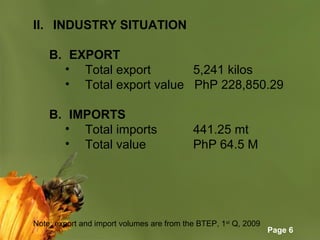
B. EXPORT
• Total export 5,241 kilos
• Total export value PhP 228,850.29
B. IMPORTS
• Total imports 441.25 mt
• Total value PhP 64.5 M
Note: export and import volumes are from the BTEP, 1st
Q, 2009
Page 7
II. INDUSTRY SITUATION
D. MAJOR PRODUCERS
Beekeepers Network Philippines Foundation, Inc.
Cebu Honeybeekeepers Association (Chai)
Beekeepers Association of the Philippines
Guinobatan Beekeepers Cooperative
Malabanan Multi-Purpose Cooperative
Panabo Beekeepers Cooperative
Philippine Apicultural Foundation
Davao Del Sur Beekeepers Multi-Purpose Cooperative
Kiotoy Multipurpose Cooperative
Bicolandia Beeraisers Association
Borbon Beekeepers Assn. Inc.
Page 8
II. INDUSTRY SITUATION
D. MAJOR PRODUCERS
Cordillera Beekeepers Assn. Inc.
Cordillera Beekeepers Overseas Workers Assn. Inc.
Irisan Beekeepers Assn. Inc.
Kennon Road Beekeepers Assn. Inc.
La Union Beekeepers Assn. Inc.
Maco Beekeepers Assn. Inc.
Puerto Princesa Beekeeping Program
Tadiangan Beekeepers And Livelihood Association,
Inc.
United Beekeepers Assn. Inc.
Cepedeco
Other Beekeeping Associations and Cooperatives
Page 9
II. INDUSTRY SITUATION
E. R & D INSTITUTIONS
Benguet State University
Camarines Sur State Agricultural College
Cavite State University
Don Mariano Marcos Memorial State
University
Mariano Marcos State University
Philippine Normal University
Saint Louis University
University of the Philippines Los Baños
Page 10
II. INDUSTRY SITUATION
F. MAJOR IMPORTERS (12)
Apollo Chemicals
PHILUSA Corporation
Carica Health Products
Rustans
Fly Ace Corp.
Colgate-Palmolive Phil.
Nestle Philippines
XTC Inc.
Golden Star Marketing Inc.
Fortune tobacco
Jollibee
Unilever
Page 11
II. INDUSTRY SITUATION
G. SAFETY NETS
Product quality; applying international standards
for local and imported produce.
 Honey and pollen analysis.
 Pathological and chemical residue analysis.
 Self-monitoring and reporting among
various
beekeeping organizations.
 Coordination of R&D institutions with
concerned government agencies like BFAD,
FNRI and DTI.
Page 12
II. INDUSTRY SITUATION
G. SAFETY NETS
Bees and equipment
 Quarantine of imported queens and other bee
species.
 Restrictions on source and importation of Apis
spp. colonies
 Pathological tests on local colonies.
 Quarantine and certification for migratory
colonies.
Page 13
II. INDUSTRY SITUATION
H. BENEFITS
 Generates employment – local and foreign job
generation
 Increases agricultural productivity – food
security
 Market of bees and bee products – income
generation
 Enhances biodiversity
Page 14
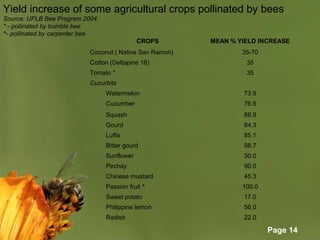
CROPS MEAN % YIELD INCREASE
Coconut ( Native San Ramon) 35-70
Cotton (Deltapine 16) 35
Tomato * 35
Cucurbits
Watermelon 73.9
Cucumber 76.5
Squash 88.9
Gourd 84.3
Luffa 85.1
Bitter gourd 98.7
Sunflower 30.0
Pechay 90.0
Chinese mustard 45.3
Passion fruit ^ 100.0
Sweet potato 17.0
Philippine lemon 56.0
Radish 22.0
Yield increase of some agricultural crops pollinated by bees
Source: UPLB Bee Program.2004.
* - pollinated by bumble bee
^- pollinated by carpenter bee
Page 15
II. INDUSTRY SITUATION
I. INDUSTRY OPPORTUNITIES
 Market led
 Climatic and geographical advantage
 Prospects for pollination
 Diversified bee products
 High honey prices
Page 16
II. INDUSTRY SITUATION
I. INDUSTRY OPPORTUNITIES
 High consumer preference for local honey and
other bee products
 Manpower exportation of beekeepers
 Ecotourism
Page 17
III. INDUSTRY RISK
A. IMMEDIATE CONCERNS
 
 Quality control of bees and bee products
 Increase production
 Security – quarantine, insurance, financing
 R & D needs on genetic diversity, bee 
breeding, pollination and socio-economic 
constraints in technology adoption
 Advocacy and legislation
 Community development 
Page 18
III. INDUSTRY RISK
B. HIGH IMPACT THREATS
 Critical pests and diseases
 Further decrease in access to native
flora resources
 
Page 19
IV. THE BEE INDUSTRY ROADMAP
A. VISION
       “A profitable bee industry that supports
agriculture, forestry and biodiversity
conservation and capable of supplying
quality bees and bee products to local and
foreign markets”
Page 20
IV. THE BEE INDUSTRY ROADMAP
B. MISSION
       “To provide a collaborative forum for
industry, funding agencies, and RD and E
providers to lead research, innovation and
adoption to benefit the Philippine bee
industry”
Page 21
IV. THE BEE INDUSTRY ROADMAP
C. GOALS
 Strengthen the multi-disciplinary RDE programs
 Training and capacity development
 Support enterprise development
 Integrate apiculture in the farming systems 
 Conserve and manage indigenous bee species
 Institutionalize policies on importation and 
quarantine 
Page 22
IV. THE BEE INDUSTRY ROADMAP
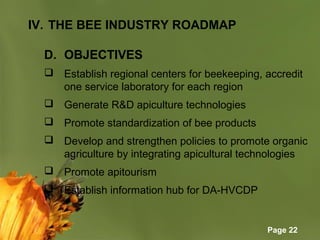
D. OBJECTIVES
 Establish regional centers for beekeeping, accredit 
one service laboratory for each region
 Generate R&D apiculture technologies
 Promote standardization of bee products
 Develop and strengthen policies to promote organic 
agriculture by integrating apicultural technologies
 Promote apitourism
 Establish information hub for DA-HVCDP
Page 23
IV. THE BEE INDUSTRY ROADMAP
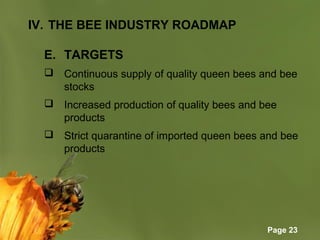
E. TARGETS
 Continuous supply of quality queen bees and bee 
stocks
 Increased production of quality bees and bee 
products
 Strict quarantine of imported queen bees and bee 
products
Page 24
IV. THE BEE INDUSTRY ROADMAP
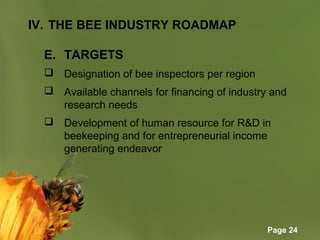
E. TARGETS
 Designation of bee inspectors per region
 Available channels for financing of industry and 
research needs
 Development of human resource for R&D in 
beekeeping and for entrepreneurial income 
generating endeavor
Page 25
IV. THE BEE INDUSTRY ROADMAP
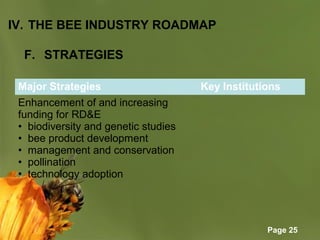
F. STRATEGIES
Major Strategies Key Institutions
Enhancement of and increasing
funding for RD&E
• biodiversity and genetic studies
• bee product development
• management and conservation
• pollination
• technology adoption
Page 26
IV. THE BEE INDUSTRY ROADMAP
F. STRATEGIES
Major Strategies Key Institutions
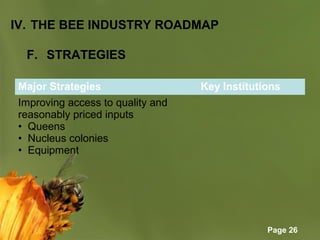
Improving access to quality and
reasonably priced inputs
• Queens
• Nucleus colonies
• Equipment
Page 27
IV. THE BEE INDUSTRY ROADMAP
F. STRATEGIES
Major Strategies Key Institutions
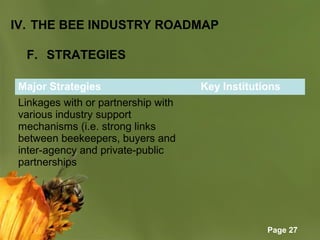
Linkages with or partnership with
various industry support
mechanisms (i.e. strong links
between beekeepers, buyers and
inter-agency and private-public
partnerships
Page 28
IV. THE BEE INDUSTRY ROADMAP
F. STRATEGIES
Major Strategies Key Institutions
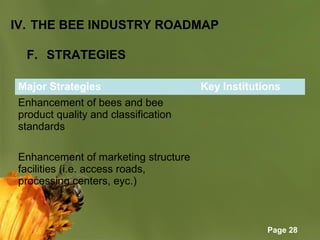
Enhancement of bees and bee
product quality and classification
standards
Enhancement of marketing structure
facilities (i.e. access roads,
processing centers, eyc.)
Page 29
IV. THE BEE INDUSTRY ROADMAP
F. STRATEGIES
Major Strategies Key Institutions
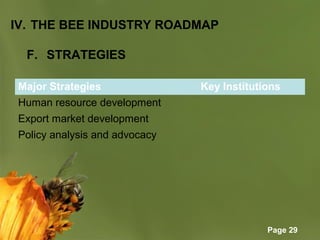
Human resource development
Export market development
Policy analysis and advocacy
Page 30
IV. THE BEE INDUSTRY ROADMAP
G. EXTERNAL AND AGRICULTURE
PRIORITIES
Priorities for the bee industry roadmap need to be
integrated and coordinated with the:
• Broader national RD & E thrust of the Philippine
government including the initiatives set by the DA
under the HVCDP and DA-BAR
• Regional agreements and initiatives
• International bee research trends
• Investment by other associated industries
Page 31
IV. BEE ROADMAP WORKPLAN SCHEDULE
Page 32
Thank you.
Evelyn Juanillo
DA- BAR

bee industry roadmap

  • 1.
    Page 1 DRAFT BEEINDUSTRY ROADMAP: 2011-2015 Prepared in collaboration with: UPLB Bee Program BEENET Philippines Foundation, Inc. Beekeepers Association of the Philippines, Inc. Evelyn Juanillo Coordinator DA- BAR
  • 2.
    Page 2 I. INDUSTRYPROFILE • Philippine annual honey production = 50-110 mt • Equivalent to PhP21.8 M • Average annual yield per colony is 0.022 mt • Products: pollen, propolis, beeswax • Value-added products: honey wine, honey and propolis soap, shampoo, honey cider and propolis ointment
  • 3.
    Page 3 I. INDUSTRYPROFILE • Honey production in Luzon – November to May • Visayas – September to November; peaks from March to May • Mindanao – year round • Effects of climate change impact on local vegetation affects honey flow
  • 4.
    Page 4 I. INDUSTRYPROFILE • Phil. Honey was classified as either multi-floral or unifloral based on the Harmonized Methods of the European Commission and the Codex Alimentarius • No color grading or classification • Prices were dictated by market categories and supply and demand
  • 5.
    Page 5 II. INDUSTRYSITUATION A. CURRENT PRODUCTION • Apis mellifera 103.4 tons • Apis dorsata 37.0 tons • Apis cerana 3.5 tons • Trigona spp 5.5 tons  Total Value: PhP 25.40 M  Contribution to local demand: 33.9%  Total Number of Beekeepers: 434  Total Number of Colonies: 5,369 NOTE: VALUES FROM HIVED AND DOCUMENTED HARVEST OF WILD COLONIES
  • 6.
    Page 6 II. INDUSTRYSITUATION B. EXPORT • Total export 5,241 kilos • Total export value PhP 228,850.29 B. IMPORTS • Total imports 441.25 mt • Total value PhP 64.5 M Note: export and import volumes are from the BTEP, 1st Q, 2009
  • 7.
    Page 7 II. INDUSTRYSITUATION D. MAJOR PRODUCERS Beekeepers Network Philippines Foundation, Inc. Cebu Honeybeekeepers Association (Chai) Beekeepers Association of the Philippines Guinobatan Beekeepers Cooperative Malabanan Multi-Purpose Cooperative Panabo Beekeepers Cooperative Philippine Apicultural Foundation Davao Del Sur Beekeepers Multi-Purpose Cooperative Kiotoy Multipurpose Cooperative Bicolandia Beeraisers Association Borbon Beekeepers Assn. Inc.
  • 8.
    Page 8 II. INDUSTRYSITUATION D. MAJOR PRODUCERS Cordillera Beekeepers Assn. Inc. Cordillera Beekeepers Overseas Workers Assn. Inc. Irisan Beekeepers Assn. Inc. Kennon Road Beekeepers Assn. Inc. La Union Beekeepers Assn. Inc. Maco Beekeepers Assn. Inc. Puerto Princesa Beekeeping Program Tadiangan Beekeepers And Livelihood Association, Inc. United Beekeepers Assn. Inc. Cepedeco Other Beekeeping Associations and Cooperatives
  • 9.
    Page 9 II. INDUSTRYSITUATION E. R & D INSTITUTIONS Benguet State University Camarines Sur State Agricultural College Cavite State University Don Mariano Marcos Memorial State University Mariano Marcos State University Philippine Normal University Saint Louis University University of the Philippines Los Baños
  • 10.
    Page 10 II. INDUSTRYSITUATION F. MAJOR IMPORTERS (12) Apollo Chemicals PHILUSA Corporation Carica Health Products Rustans Fly Ace Corp. Colgate-Palmolive Phil. Nestle Philippines XTC Inc. Golden Star Marketing Inc. Fortune tobacco Jollibee Unilever
  • 11.
    Page 11 II. INDUSTRYSITUATION G. SAFETY NETS Product quality; applying international standards for local and imported produce.  Honey and pollen analysis.  Pathological and chemical residue analysis.  Self-monitoring and reporting among various beekeeping organizations.  Coordination of R&D institutions with concerned government agencies like BFAD, FNRI and DTI.
  • 12.
    Page 12 II. INDUSTRYSITUATION G. SAFETY NETS Bees and equipment  Quarantine of imported queens and other bee species.  Restrictions on source and importation of Apis spp. colonies  Pathological tests on local colonies.  Quarantine and certification for migratory colonies.
  • 13.
    Page 13 II. INDUSTRYSITUATION H. BENEFITS  Generates employment – local and foreign job generation  Increases agricultural productivity – food security  Market of bees and bee products – income generation  Enhances biodiversity
  • 14.
    Page 14 CROPS MEAN% YIELD INCREASE Coconut ( Native San Ramon) 35-70 Cotton (Deltapine 16) 35 Tomato * 35 Cucurbits Watermelon 73.9 Cucumber 76.5 Squash 88.9 Gourd 84.3 Luffa 85.1 Bitter gourd 98.7 Sunflower 30.0 Pechay 90.0 Chinese mustard 45.3 Passion fruit ^ 100.0 Sweet potato 17.0 Philippine lemon 56.0 Radish 22.0 Yield increase of some agricultural crops pollinated by bees Source: UPLB Bee Program.2004. * - pollinated by bumble bee ^- pollinated by carpenter bee
  • 15.
    Page 15 II. INDUSTRYSITUATION I. INDUSTRY OPPORTUNITIES  Market led  Climatic and geographical advantage  Prospects for pollination  Diversified bee products  High honey prices
  • 16.
    Page 16 II. INDUSTRYSITUATION I. INDUSTRY OPPORTUNITIES  High consumer preference for local honey and other bee products  Manpower exportation of beekeepers  Ecotourism
  • 17.
    Page 17 III. INDUSTRYRISK A. IMMEDIATE CONCERNS    Quality control of bees and bee products  Increase production  Security – quarantine, insurance, financing  R & D needs on genetic diversity, bee  breeding, pollination and socio-economic  constraints in technology adoption  Advocacy and legislation  Community development 
  • 18.
    Page 18 III. INDUSTRYRISK B. HIGH IMPACT THREATS  Critical pests and diseases  Further decrease in access to native flora resources  
  • 19.
    Page 19 IV. THEBEE INDUSTRY ROADMAP A. VISION        “A profitable bee industry that supports agriculture, forestry and biodiversity conservation and capable of supplying quality bees and bee products to local and foreign markets”
  • 20.
    Page 20 IV. THEBEE INDUSTRY ROADMAP B. MISSION        “To provide a collaborative forum for industry, funding agencies, and RD and E providers to lead research, innovation and adoption to benefit the Philippine bee industry”
  • 21.
    Page 21 IV. THEBEE INDUSTRY ROADMAP C. GOALS  Strengthen the multi-disciplinary RDE programs  Training and capacity development  Support enterprise development  Integrate apiculture in the farming systems   Conserve and manage indigenous bee species  Institutionalize policies on importation and  quarantine 
  • 22.
    Page 22 IV. THEBEE INDUSTRY ROADMAP D. OBJECTIVES  Establish regional centers for beekeeping, accredit  one service laboratory for each region  Generate R&D apiculture technologies  Promote standardization of bee products  Develop and strengthen policies to promote organic  agriculture by integrating apicultural technologies  Promote apitourism  Establish information hub for DA-HVCDP
  • 23.
    Page 23 IV. THEBEE INDUSTRY ROADMAP E. TARGETS  Continuous supply of quality queen bees and bee  stocks  Increased production of quality bees and bee  products  Strict quarantine of imported queen bees and bee  products
  • 24.
    Page 24 IV. THEBEE INDUSTRY ROADMAP E. TARGETS  Designation of bee inspectors per region  Available channels for financing of industry and  research needs  Development of human resource for R&D in  beekeeping and for entrepreneurial income  generating endeavor
  • 25.
    Page 25 IV. THEBEE INDUSTRY ROADMAP F. STRATEGIES Major Strategies Key Institutions Enhancement of and increasing funding for RD&E • biodiversity and genetic studies • bee product development • management and conservation • pollination • technology adoption
  • 26.
    Page 26 IV. THEBEE INDUSTRY ROADMAP F. STRATEGIES Major Strategies Key Institutions Improving access to quality and reasonably priced inputs • Queens • Nucleus colonies • Equipment
  • 27.
    Page 27 IV. THEBEE INDUSTRY ROADMAP F. STRATEGIES Major Strategies Key Institutions Linkages with or partnership with various industry support mechanisms (i.e. strong links between beekeepers, buyers and inter-agency and private-public partnerships
  • 28.
    Page 28 IV. THEBEE INDUSTRY ROADMAP F. STRATEGIES Major Strategies Key Institutions Enhancement of bees and bee product quality and classification standards Enhancement of marketing structure facilities (i.e. access roads, processing centers, eyc.)
  • 29.
    Page 29 IV. THEBEE INDUSTRY ROADMAP F. STRATEGIES Major Strategies Key Institutions Human resource development Export market development Policy analysis and advocacy
  • 30.
    Page 30 IV. THEBEE INDUSTRY ROADMAP G. EXTERNAL AND AGRICULTURE PRIORITIES Priorities for the bee industry roadmap need to be integrated and coordinated with the: • Broader national RD & E thrust of the Philippine government including the initiatives set by the DA under the HVCDP and DA-BAR • Regional agreements and initiatives • International bee research trends • Investment by other associated industries
  • 31.
    Page 31 IV. BEEROADMAP WORKPLAN SCHEDULE
  • 32.
    Page 32 Thank you. EvelynJuanillo DA- BAR