K.M. Govt. Girls P.G. College
Badalpur, GB Nagar
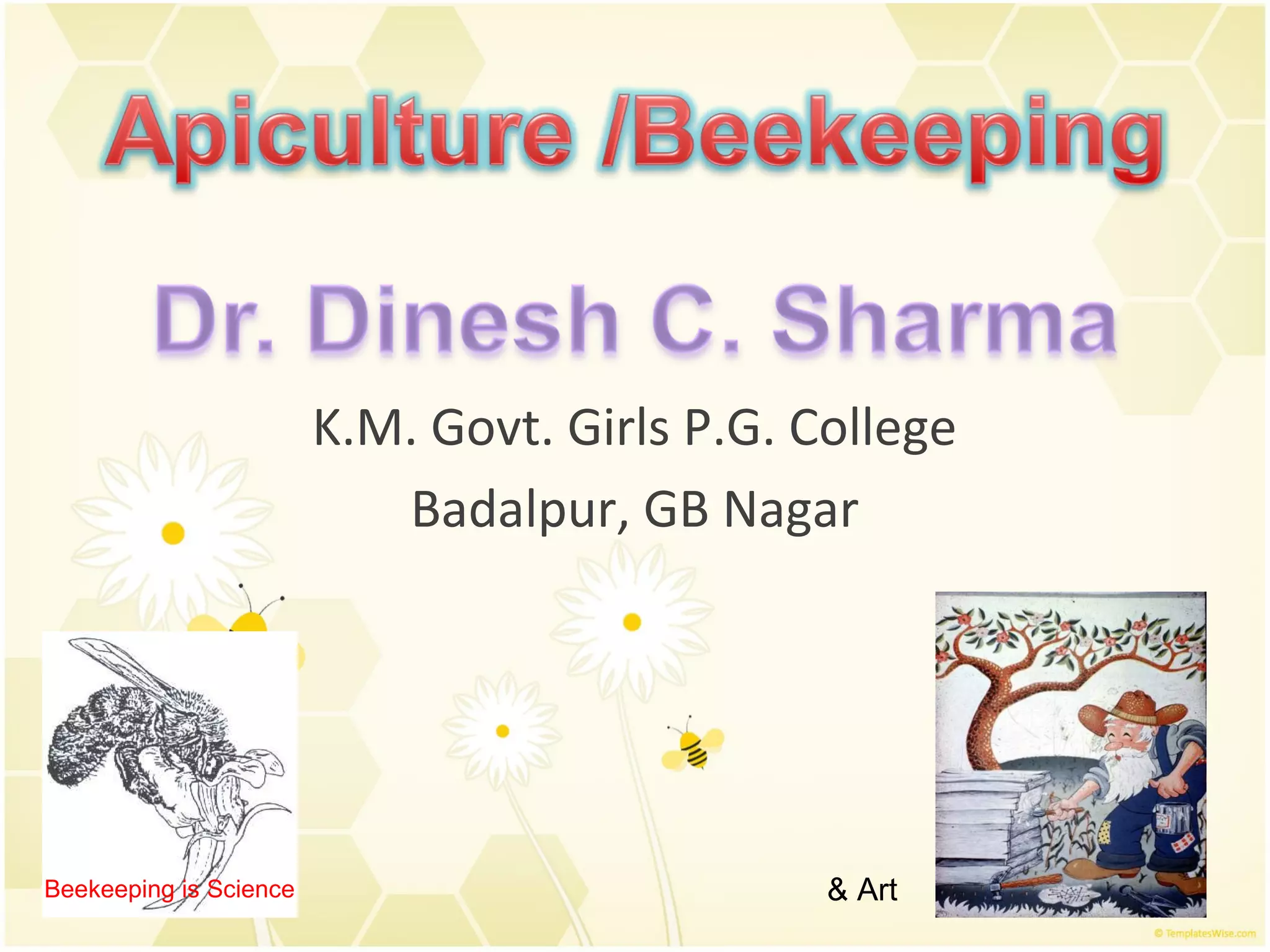
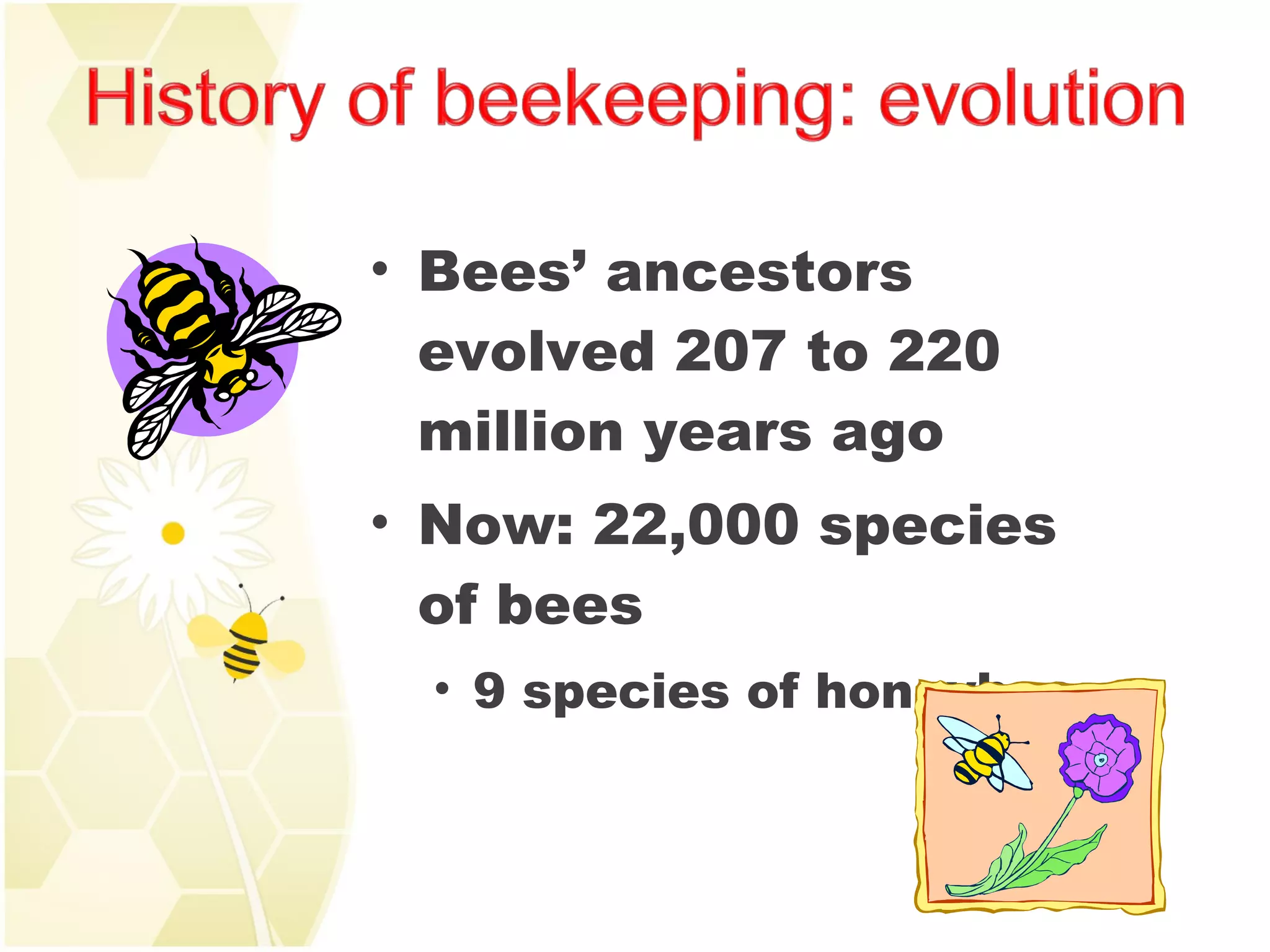
Beekeeping is Science & Art
Five products:
• Honey
• Beeswax
• Pollination
• Queen bees
• Packaged bees
Men has been using honey
as tasteful and nutritive food
since centuries honey is
produced by a king of insect-
The honey bees. The
artificial or domesticated
rearing of honey bees, for
procuring honey on
commercial scale is called
apiculture or bee.
In acient times, method of
extraction of honey from honey
comb was very crude and crucial
as fire or smog was used. But
now honey extraction is used.
Mehring presented the idea of
artificial “comb foundation”. In
India it was first started in Bengal
and Punjab. A “Central bee
research training institute” has
been established in Pune (1962).
• 50,000 female workers
• Hundreds of drones
• 1 queen
• And a beekeeper
http://ag.arizona.edu/pubs/insects/ahb/act3.html
Skep beekeeping
Revolutionary war-era
beekeeping – 2 gums & 2 skeps
Note photo on right from movie on the life of a
revolutionary-era farmer in colonial America. Farmer and
son are shown harvesting a gum hive. Different cultures
keep bees the same way today.
• Bees’ ancestors
evolved 207 to 220
million years ago
• Now: 22,000 species
of bees
• 9 species of honeybee
A bit of history to serve as
background – humans began
by finding bee nests and
stealing honey as shown in
rock painting from Spain
dated about 10,000 years
ago. Books by Eva Crane
(1983 and 1990) are good
resources for history and
current status of beekeeping.
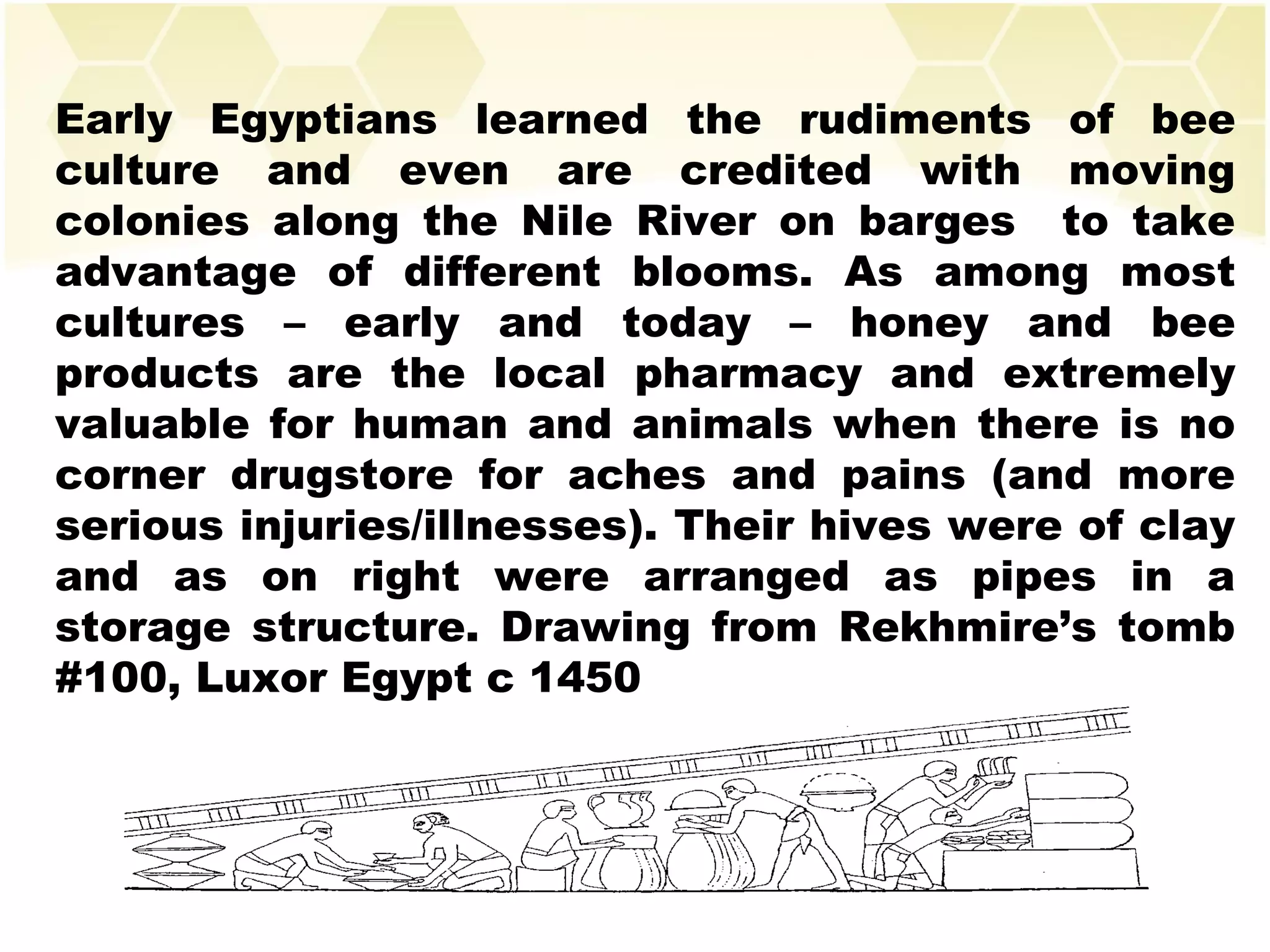
Early Egyptians learned the rudiments of bee
culture and even are credited with moving
colonies along the Nile River on barges to take
advantage of different blooms. As among most
cultures – early and today – honey and bee
products are the local pharmacy and extremely
valuable for human and animals when there is no
corner drugstore for aches and pains (and more
serious injuries/illnesses). Their hives were of clay
and as on right were arranged as pipes in a
storage structure. Drawing from Rekhmire’s tomb
#100, Luxor Egypt c 1450
Humans learned
how to better keep
colonies at
different rates in
different cultures,
including use of
tools like
sheltered walls
and use of
smokers.
History of beekeeping: gathering honey
• Ancient times: cave
paintings
• Hunter-gatherers today
(or at least during the
late 1900s)
• !Kung: a “sacramental
adventure”
• Mbuti: hunting season
as a time of festivity and
magic Mesolithic rock painting showing honey
collection from a wild nest
Valencia, Spain
History of beekeeping: early beekeeping
• Egypt: 2400 BC
• Food for the wealthy
• Importance of the bee for the
Pharoah
• Greeks and Romans
• Offered to the gods
• Aristotle and Virgil described
beekeeping
http://dodona777.wordpress.com/2009/03/26/honey-bees-about-to-become-extinct/
History of beekeeping: early beekeeping
• Europe and Russia
• Holes in trees or hanging
hollow logs, AD 400
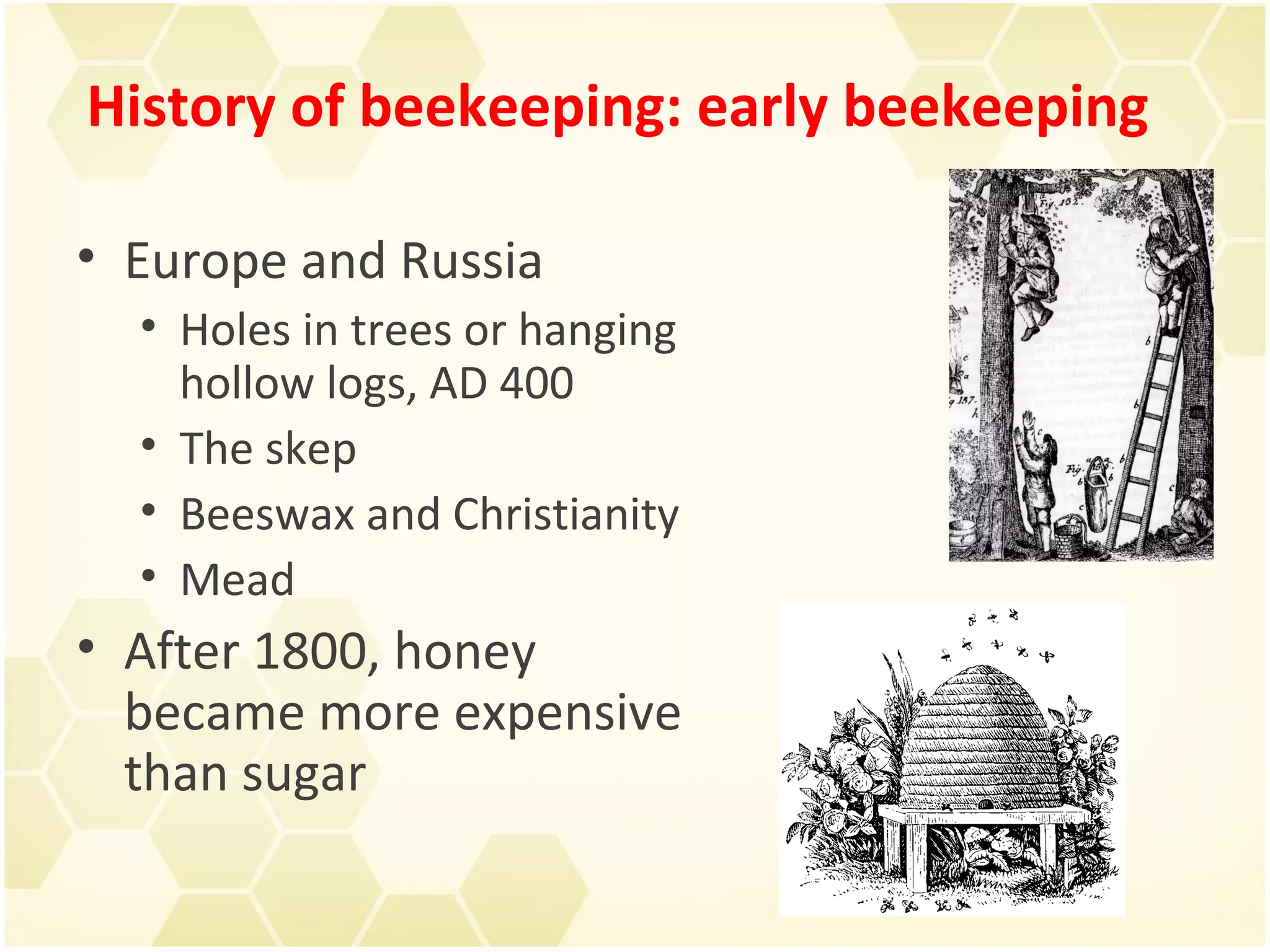
• The skep
• Beeswax and Christianity
• Mead
• After 1800, honey
became more expensive
than sugar
• North America
• Honey and maple syrup
• Mormons
Brigham Young
History of beekeeping: early bee
migration
http://www.my-discount-hotels.com/beekeeping-supplies-new-zealand.html
• New Zealand
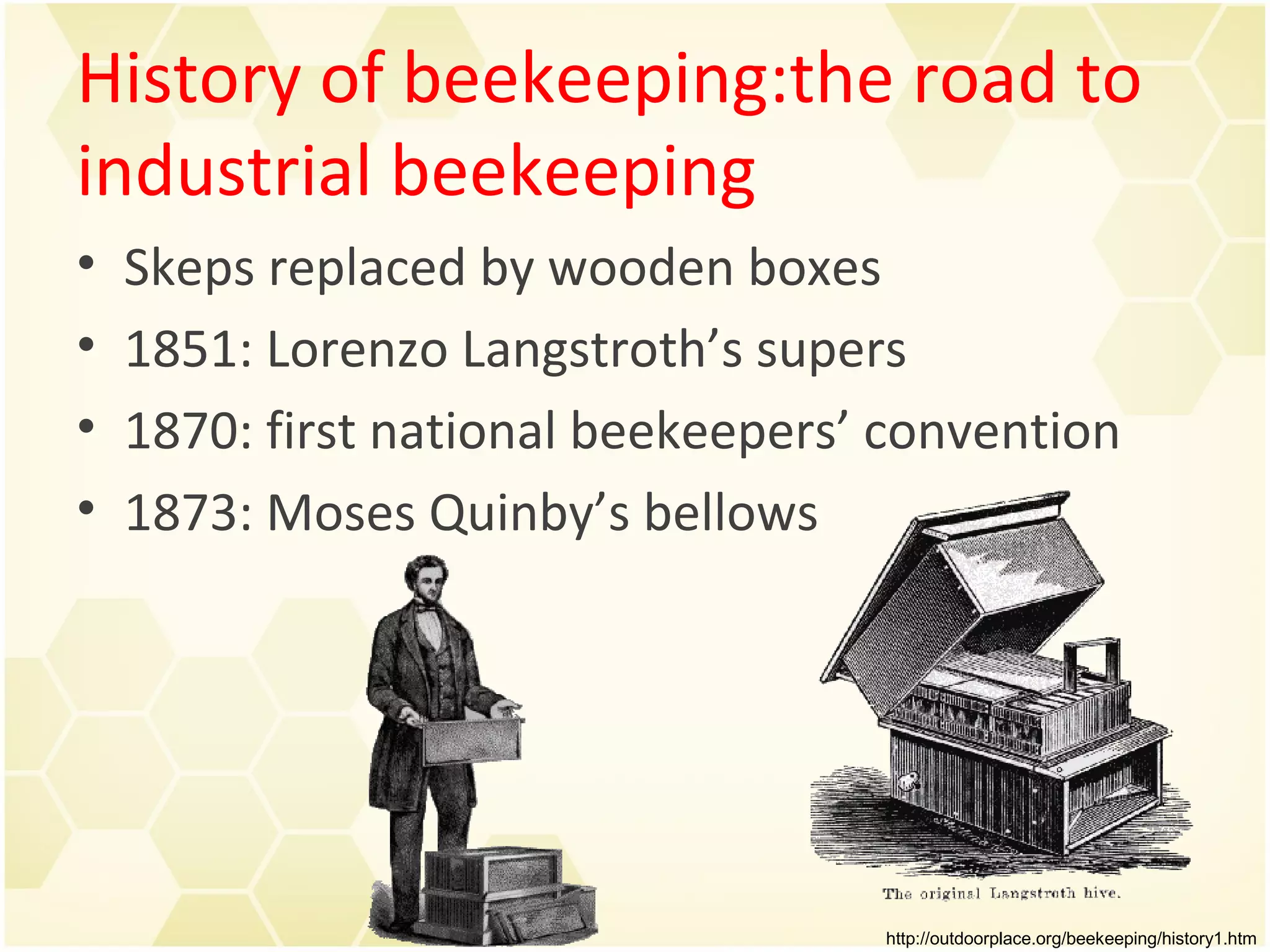
History of beekeeping:the road to
industrial beekeeping
• Skeps replaced by wooden boxes
• 1851: Lorenzo Langstroth’s supers
• 1870: first national beekeepers’ convention
• 1873: Moses Quinby’s bellows
http://outdoorplace.org/beekeeping/history1.htm
Rev L.L. Langstroth
L.L. Langstroth, father of
modern beekeeping, was
one of first to understand
bee space and patent a
hive and write a book (the
present text ‘Hive and the
Honey Bee’ is successor)
on how to use his modern
hive – termed a movable
frame hive.
History of beekeeping:the road to
industrial beekeeping
• John Harbison and California
• 1857: 67 colonies transported by boat
• 1870: 2,000 colonies
• 1884: California produced 2,000,000 lbs/year
• 1909: first bees rented for pollination in New
Jersey
http://ucanr.org/repository/CAO/landingpage.cfm?article=ca.v050n04p24&fulltext=yes
Scientific Beekeeping
• Tracheal mite outbreak
throughout Europe 1904
• Brother Adam, German
beekeeping monk
• Artificial insemination
• Breeds for good colonies, high
production, and disease
resistance
• Chemicals for pest control
beginning in 1940s
• Honey contamination
http://perso.fundp.ac.be/~jvandyck/homage/artcl/EO99princBAen.html
Classification of Honey bee
Arthropoda
Insect
Hymenoptera
Apidae
Apis
Species of Honey bee
Apis dorsata-
Rock bee, Giant bee, Bombara, Sarang
Largest in Size
Yielding maximum (15kg/year) honey
Comb are Large (1x15 meter)
Can’t be domesticated because of
migratory habit and ferocious nature
Species of Honey bee
Apis indica-
Common India variety of medium Size
Build several parallel combs (30 cms)
Yielding medium(3-4kg/year) honey
Easily domesticated
Gentle in nature
Species of Honey bee
Apis millifera-
European bee or western bee
Common India variety of medium Size
Build several parallel combs (30 cms)
Yielding (100-400lbs /year) honey
Easily domesticated, Docile in nature,
Easily procured to be hired
Species of Honey bee
Apis florea-
Smallest Indian variety
Common India variety of medium Size
Small single comb (15 cms)
Yielding small amount of honey
Rearing is easy
Species of Honey bee
Apis adamsoni-
African bee
Build largest comb
Yield is very high (100kg/year)
Dangerous, not easy to rear
Beekeeping Today: U.S.
• 6 million colonies 1940s, 2.3
million today
• 70% decrease in total number of
beekeeping operations since
1982
• Today, 87.7% of colonies are in
1,400 commercial operations
• U.S. government provides price
supports, since 1949
Honey Production Today: U.S.
• Yield increasing 0.5 pound per colony per year
• About 50 pounds
• Profits: $50 per hive per year
• Time input: about 5 hours per hive per year
• Original input can be paid off in second year
• Nectar from alfalfa and clover, especially Michigan to
Montana, also Florida and Texas
http://www.flickr.com/photos/23385633@N03/2803270650/in/set-72157606685957698/
Pollination Today: U.S.
• Still the most efficient
way to pollinate crops
that need pollination:
• Almonds, plums, cherries,
alfalfa, avocados,
vegetable seed, melons,
sunflowers, apples, prunes
• 1/3 of our diet comes
from bee-pollinated crops
• 900,000 colonies
http://www.utsc.utoronto.ca/~wellness/wpp/nutri/main_resources_aa.html
http://www.theage.com.au/news/national/drought-dries-up-timbercorps-plans/2007/11/23/1195753307266.html
Wemen almond farm, the second
largest almond farm in the world,
Australia
Pollination Today: U.S.
• Migratory cycles in Pacific Northwest and East
Coast
• 2.42 rentals per hive per year
http://www.fullbloomapiaries.com/pollination.html
Trade
• Honey: usually blend of honeys, flash-
heated, micro-filtered
• Growing interest in rarer honeys through
organic movement
• Falling U.S. honey production
• U.S. imports 50% more honey that produced
Global Trade: top 10 (2004)
Honey exports Honey imports
Country Weight
(thousand
metric tons)
Percentage
of total
China 81.3 24.2%
Argentina 65.2 18.6%
Mexico 23.4 6.9%
Germany 22.4 6.6%
Brazil 21 6.2%
Vietnam 15.6 4.6%
Hungary 15 4.4%
Canada 14 4.2%
Uruguay 13.4 4%
India 10.4 3.1%
Country Money Spent
(millions of US
dollars)
Percentage
of total
Germany 230.7 27.5%
United
States
149.6 17.8%
U.K. 75.1 8.9%
Japan 65 7.7%
France 54.5 6.5%
Italy 41.6 5%
Spain 31.5 3.7%
Saudi Arabia 26 3.1%
Switzerland 23.1 2.8%
Netherlands 56 3.7%
Outline
• Background
• History
• State of beekeeping today
– Problems
– Benefits
• Beekeeping and sustainability
Bee diseases and mites
• 1980s: bee mite parasites
• Varroa mite
• Foul brood
http://wallpaperstock.net/honeycomb-wallpapers_w4679.html
http://www.honeybeekeeping.co.uk/cms/beekeeping-news/american-foulbrood-hits-scotland/
Healthy Honeycomb American Foul Brood European Foul Brood
CCD: Colony Collapse Disorder
• What causes CCD?
• Multiple viruses and mites
• Pesticides
• Lack of natural forage
• About 1/3 of colonies in US lost
each year since 2006
• Industrial beekeepers make up
losses by splitting colonies or
buying new queens
• So far, prices have not been
affected
http://momomax.wordpress.com/2007/04/27/honey-stop-fucking-with-the-environment/
CCD
• This beekeeper used to own 18,000 colonies
• Costs $200 per year to maintain a colony to be able
to pollinate an almond crop
• These pallets’ bees are dead
• This represents $500,000 lost (2500 hives)
Pesticide Issues
• Pesticides harm bees’ immune systems,
lower learning abilities, make them
disoriented, and kill them
• Growing resistance by bee pests
• Pollination: pesticides kill 11% of
California’s bees per year
Bee diseases and pesticides: the future
• Bee migration and trade make
diseases hard to contain
• Growing resistance to pesticides
• More pesticides on crops
• More pesticides in colonies
Outline
• Background
• History
• State of beekeeping today
– Problems
– Benefits
• Beekeeping and sustainability
Additional source of income
• Nepal: honey earns 3.62 times more
than crop farming
• Important where land holdings are not
sufficient for feeding a family
• Ghana: Netherlands Development
Organization
• Ghana imports 30 tons honey annually
• Lower risks, low initial investment, break
even in second year
• Zimbabwe: “land of milk and honey”
• 300 communal farmers earn $1 million
per year ($3,000 per farmer)
• Relies on local resources: land, trees,
bees
Gender Roles: in past
• Hunter-gatherer: men
• Ancient Egypt, Greece, Rome:
men
• Medieval Europe: women, even
high class women
• Books by men
Gender Roles: Today
• Tropical Africa: men, except for
women with honey pots on
ground
• Muslim women in purdah: hives
in house walls
• U.S.: women mostly hobbyists
• Moriah Yetter: Idaho commercial
beekeeper
Outline
• Background
• History
• State of beekeeping today
– Problems
– Benefits
• Beekeeping and sustainability
Sustainable Agriculture
• Kirk Webster:
• Wildness and biodiversity
• Horizontal breeding and selection
• Mindset
• Willie Robson: British beekeeper
• Chain Bridge Honey Farm
• 15 employees
• Deliver to 350 shops: honey and
other products
http://outdoorplace.org/beekeeping/history1.htm
http://www.chainbridgehoney.co.uk/
Partners for Sustainable Pollination
• Encourages farmers to provide
more flowering plants to native
honey bees and native pollinators
• Encourages bee friendly farming
certification
•Does not mention farmers using
pesticides. Hmm…
http://www.pfspbees.org/index.htm
Sustainable Agriculture
http://www.beesfordevelopment.org/index
Bees for Development
promotes sustainable
beekeeping to support
livelihoods and to conserve
biodiversity.
They aim to assist people
living in poor and remote
areas of the world, and to
raise awareness about the
value of beekeeping for
sustainable development.
Sustainable Agriculture
• Locally produced honey
• Urban beekeeping
http://www.guardian.co.uk/environment/gallery/2009/jul/02/week-in-wildlife?picture=349691930
http://www.thedailygreen.com/environmental-news/blogs/bees/
http://www.cityfarmer.info/2009/08/25/paris-rooftops-swarm-with-bees-as-urban-honey-industry-takes-off/
London
Manhattan
Paris: 300 hives
Conclusions
• Trend toward industrial beekeeping
• Growing resistance to antibiotics, threats of pesticides
• More sustainable options
Works Cited2009a Ghana; Reducing Poverty Through Beekeeping. Africa News, September 15.
2009b Zimbabwe; Beekeeping Can Contribute to Poverty Alleviation. Africa News, November 16.
Borst, Peter L.
2009 What's new in beekeeping. Part two - scientific beekeeping. American bee journal 149(4):349-351.
Burgett, Michael, et al.
2010 U.S. pollination markets: Recent changes and historical perspective. American bee journal 150(1):35-41.
Connor, Larry
2010 The traveling beekeeper: Time for resistant bees--a plan for the individual beekeeper. American bee journal 150(1):66-67.
Crane, Eva
1999 The World History of Beekeeping and Honey Hunting. New York: Routledge.
Daberkow, Stan, et al.
2009 U.S. honey markets: Recent changes and historical perspective. American bee journal 149(12):1125-1129.
Ellis, Hattie
2004 Sweetness & Light: the Mysterious History of the Honeybee. New York: Harmony Books.
Ezenwa, Sylvia A.
2009 Continuing efforts to safeguard U.S. honey imports. Part 1. American bee journal 149(4):366-368.
Flottum, Kim
2010 The Cost of Colony Collapse Disorder, as You've Never Seen It Calculated Before. In The Beekeeper, Vol. 2010: The Daily Green: The consumer's guide to the
green revolution.
Hicks, Cecil
2010 Moriah Yetter- Idaho commercial beekeeper. American bee journal 150(1):71-73.
New Crop Opportunities Center
2005 Beekeeping and Honey Production. U.o. Kentucky, ed.
Partners for Sustainable Pollination
2009 Partners for Sustainable Pollination, Vol. 2010.
Pokhrel, Suroj
2008 The Ecological Problems and Possible Solutions of Beekeeping in Hills and Terai of Chitwan, Nepal. The Journal of Agriculture and Environment 9:23-33.
—
2009 Comparative Benefits of Beekeeping Enterprise in Chitwan, Nepal. The Journal of Agriculture and Environment 10:39-50.
Shrestha, Jagadish Bhakta
2008 Honeybees: The Pollinator Sustaining Crop Diversity. The Journal of Agriculture and Environment 9:90-92.
Siebert, John W.
1980 Beekeeping, Pollination, and Externalities in California Agriculture. American Journal of Agricultural Economics 62(2):165-171.
Webster, Kirk
2008 A New Paradigm for American Beekeeping. American bee journal:257-259.
—
2009 What's missing from the current discussion and work related to bees that is preventing us from making good progress? Part I. American bee journal
149(4):359-362.
Wilson, Bee
2004 The Hive: The Story of the Honeybee and Us. New York: Thomas Dunne Books.
Workman, Daniel
2007 Top Honey Exporting Countries: Re-labelled Bee Product Scams Scream Out for WTO Controls: suite101.com.
Apiculture Bee keeping

Apiculture Bee keeping

  • 1.
    K.M. Govt. GirlsP.G. College Badalpur, GB Nagar Beekeeping is Science & Art
  • 2.
    Five products: • Honey •Beeswax • Pollination • Queen bees • Packaged bees
  • 3.
    Men has beenusing honey as tasteful and nutritive food since centuries honey is produced by a king of insect- The honey bees. The artificial or domesticated rearing of honey bees, for procuring honey on commercial scale is called apiculture or bee.
  • 4.
    In acient times,method of extraction of honey from honey comb was very crude and crucial as fire or smog was used. But now honey extraction is used. Mehring presented the idea of artificial “comb foundation”. In India it was first started in Bengal and Punjab. A “Central bee research training institute” has been established in Pune (1962).
  • 5.
    • 50,000 femaleworkers • Hundreds of drones • 1 queen • And a beekeeper http://ag.arizona.edu/pubs/insects/ahb/act3.html
  • 6.
    Skep beekeeping Revolutionary war-era beekeeping– 2 gums & 2 skeps Note photo on right from movie on the life of a revolutionary-era farmer in colonial America. Farmer and son are shown harvesting a gum hive. Different cultures keep bees the same way today.
  • 7.
    • Bees’ ancestors evolved207 to 220 million years ago • Now: 22,000 species of bees • 9 species of honeybee
  • 8.
    A bit ofhistory to serve as background – humans began by finding bee nests and stealing honey as shown in rock painting from Spain dated about 10,000 years ago. Books by Eva Crane (1983 and 1990) are good resources for history and current status of beekeeping.
  • 9.
    Early Egyptians learnedthe rudiments of bee culture and even are credited with moving colonies along the Nile River on barges to take advantage of different blooms. As among most cultures – early and today – honey and bee products are the local pharmacy and extremely valuable for human and animals when there is no corner drugstore for aches and pains (and more serious injuries/illnesses). Their hives were of clay and as on right were arranged as pipes in a storage structure. Drawing from Rekhmire’s tomb #100, Luxor Egypt c 1450
  • 10.
    Humans learned how tobetter keep colonies at different rates in different cultures, including use of tools like sheltered walls and use of smokers.
  • 11.
    History of beekeeping:gathering honey • Ancient times: cave paintings • Hunter-gatherers today (or at least during the late 1900s) • !Kung: a “sacramental adventure” • Mbuti: hunting season as a time of festivity and magic Mesolithic rock painting showing honey collection from a wild nest Valencia, Spain
  • 12.
    History of beekeeping:early beekeeping • Egypt: 2400 BC • Food for the wealthy • Importance of the bee for the Pharoah • Greeks and Romans • Offered to the gods • Aristotle and Virgil described beekeeping http://dodona777.wordpress.com/2009/03/26/honey-bees-about-to-become-extinct/
  • 13.
    History of beekeeping:early beekeeping • Europe and Russia • Holes in trees or hanging hollow logs, AD 400 • The skep • Beeswax and Christianity • Mead • After 1800, honey became more expensive than sugar
  • 14.
    • North America •Honey and maple syrup • Mormons Brigham Young History of beekeeping: early bee migration http://www.my-discount-hotels.com/beekeeping-supplies-new-zealand.html • New Zealand
  • 15.
    History of beekeeping:theroad to industrial beekeeping • Skeps replaced by wooden boxes • 1851: Lorenzo Langstroth’s supers • 1870: first national beekeepers’ convention • 1873: Moses Quinby’s bellows http://outdoorplace.org/beekeeping/history1.htm
  • 16.
    Rev L.L. Langstroth L.L.Langstroth, father of modern beekeeping, was one of first to understand bee space and patent a hive and write a book (the present text ‘Hive and the Honey Bee’ is successor) on how to use his modern hive – termed a movable frame hive.
  • 17.
    History of beekeeping:theroad to industrial beekeeping • John Harbison and California • 1857: 67 colonies transported by boat • 1870: 2,000 colonies • 1884: California produced 2,000,000 lbs/year • 1909: first bees rented for pollination in New Jersey http://ucanr.org/repository/CAO/landingpage.cfm?article=ca.v050n04p24&fulltext=yes
  • 18.
    Scientific Beekeeping • Trachealmite outbreak throughout Europe 1904 • Brother Adam, German beekeeping monk • Artificial insemination • Breeds for good colonies, high production, and disease resistance • Chemicals for pest control beginning in 1940s • Honey contamination http://perso.fundp.ac.be/~jvandyck/homage/artcl/EO99princBAen.html
  • 19.
    Classification of Honeybee Arthropoda Insect Hymenoptera Apidae Apis
  • 20.
    Species of Honeybee Apis dorsata- Rock bee, Giant bee, Bombara, Sarang Largest in Size Yielding maximum (15kg/year) honey Comb are Large (1x15 meter) Can’t be domesticated because of migratory habit and ferocious nature
  • 21.
    Species of Honeybee Apis indica- Common India variety of medium Size Build several parallel combs (30 cms) Yielding medium(3-4kg/year) honey Easily domesticated Gentle in nature
  • 22.
    Species of Honeybee Apis millifera- European bee or western bee Common India variety of medium Size Build several parallel combs (30 cms) Yielding (100-400lbs /year) honey Easily domesticated, Docile in nature, Easily procured to be hired
  • 23.
    Species of Honeybee Apis florea- Smallest Indian variety Common India variety of medium Size Small single comb (15 cms) Yielding small amount of honey Rearing is easy
  • 24.
    Species of Honeybee Apis adamsoni- African bee Build largest comb Yield is very high (100kg/year) Dangerous, not easy to rear
  • 25.
    Beekeeping Today: U.S. •6 million colonies 1940s, 2.3 million today • 70% decrease in total number of beekeeping operations since 1982 • Today, 87.7% of colonies are in 1,400 commercial operations • U.S. government provides price supports, since 1949
  • 26.
    Honey Production Today:U.S. • Yield increasing 0.5 pound per colony per year • About 50 pounds • Profits: $50 per hive per year • Time input: about 5 hours per hive per year • Original input can be paid off in second year • Nectar from alfalfa and clover, especially Michigan to Montana, also Florida and Texas http://www.flickr.com/photos/23385633@N03/2803270650/in/set-72157606685957698/
  • 27.
    Pollination Today: U.S. •Still the most efficient way to pollinate crops that need pollination: • Almonds, plums, cherries, alfalfa, avocados, vegetable seed, melons, sunflowers, apples, prunes • 1/3 of our diet comes from bee-pollinated crops • 900,000 colonies http://www.utsc.utoronto.ca/~wellness/wpp/nutri/main_resources_aa.html http://www.theage.com.au/news/national/drought-dries-up-timbercorps-plans/2007/11/23/1195753307266.html Wemen almond farm, the second largest almond farm in the world, Australia
  • 28.
    Pollination Today: U.S. •Migratory cycles in Pacific Northwest and East Coast • 2.42 rentals per hive per year http://www.fullbloomapiaries.com/pollination.html
  • 29.
    Trade • Honey: usuallyblend of honeys, flash- heated, micro-filtered • Growing interest in rarer honeys through organic movement • Falling U.S. honey production • U.S. imports 50% more honey that produced
  • 30.
    Global Trade: top10 (2004) Honey exports Honey imports Country Weight (thousand metric tons) Percentage of total China 81.3 24.2% Argentina 65.2 18.6% Mexico 23.4 6.9% Germany 22.4 6.6% Brazil 21 6.2% Vietnam 15.6 4.6% Hungary 15 4.4% Canada 14 4.2% Uruguay 13.4 4% India 10.4 3.1% Country Money Spent (millions of US dollars) Percentage of total Germany 230.7 27.5% United States 149.6 17.8% U.K. 75.1 8.9% Japan 65 7.7% France 54.5 6.5% Italy 41.6 5% Spain 31.5 3.7% Saudi Arabia 26 3.1% Switzerland 23.1 2.8% Netherlands 56 3.7%
  • 31.
    Outline • Background • History •State of beekeeping today – Problems – Benefits • Beekeeping and sustainability
  • 32.
    Bee diseases andmites • 1980s: bee mite parasites • Varroa mite • Foul brood http://wallpaperstock.net/honeycomb-wallpapers_w4679.html http://www.honeybeekeeping.co.uk/cms/beekeeping-news/american-foulbrood-hits-scotland/ Healthy Honeycomb American Foul Brood European Foul Brood
  • 33.
    CCD: Colony CollapseDisorder • What causes CCD? • Multiple viruses and mites • Pesticides • Lack of natural forage • About 1/3 of colonies in US lost each year since 2006 • Industrial beekeepers make up losses by splitting colonies or buying new queens • So far, prices have not been affected http://momomax.wordpress.com/2007/04/27/honey-stop-fucking-with-the-environment/
  • 34.
    CCD • This beekeeperused to own 18,000 colonies • Costs $200 per year to maintain a colony to be able to pollinate an almond crop • These pallets’ bees are dead • This represents $500,000 lost (2500 hives)
  • 35.
    Pesticide Issues • Pesticidesharm bees’ immune systems, lower learning abilities, make them disoriented, and kill them • Growing resistance by bee pests • Pollination: pesticides kill 11% of California’s bees per year
  • 36.
    Bee diseases andpesticides: the future • Bee migration and trade make diseases hard to contain • Growing resistance to pesticides • More pesticides on crops • More pesticides in colonies
  • 37.
    Outline • Background • History •State of beekeeping today – Problems – Benefits • Beekeeping and sustainability
  • 38.
    Additional source ofincome • Nepal: honey earns 3.62 times more than crop farming • Important where land holdings are not sufficient for feeding a family • Ghana: Netherlands Development Organization • Ghana imports 30 tons honey annually • Lower risks, low initial investment, break even in second year • Zimbabwe: “land of milk and honey” • 300 communal farmers earn $1 million per year ($3,000 per farmer) • Relies on local resources: land, trees, bees
  • 39.
    Gender Roles: inpast • Hunter-gatherer: men • Ancient Egypt, Greece, Rome: men • Medieval Europe: women, even high class women • Books by men
  • 40.
    Gender Roles: Today •Tropical Africa: men, except for women with honey pots on ground • Muslim women in purdah: hives in house walls • U.S.: women mostly hobbyists • Moriah Yetter: Idaho commercial beekeeper
  • 41.
    Outline • Background • History •State of beekeeping today – Problems – Benefits • Beekeeping and sustainability
  • 42.
    Sustainable Agriculture • KirkWebster: • Wildness and biodiversity • Horizontal breeding and selection • Mindset • Willie Robson: British beekeeper • Chain Bridge Honey Farm • 15 employees • Deliver to 350 shops: honey and other products http://outdoorplace.org/beekeeping/history1.htm http://www.chainbridgehoney.co.uk/
  • 43.
    Partners for SustainablePollination • Encourages farmers to provide more flowering plants to native honey bees and native pollinators • Encourages bee friendly farming certification •Does not mention farmers using pesticides. Hmm… http://www.pfspbees.org/index.htm
  • 44.
    Sustainable Agriculture http://www.beesfordevelopment.org/index Bees forDevelopment promotes sustainable beekeeping to support livelihoods and to conserve biodiversity. They aim to assist people living in poor and remote areas of the world, and to raise awareness about the value of beekeeping for sustainable development.
  • 45.
    Sustainable Agriculture • Locallyproduced honey • Urban beekeeping http://www.guardian.co.uk/environment/gallery/2009/jul/02/week-in-wildlife?picture=349691930 http://www.thedailygreen.com/environmental-news/blogs/bees/ http://www.cityfarmer.info/2009/08/25/paris-rooftops-swarm-with-bees-as-urban-honey-industry-takes-off/ London Manhattan Paris: 300 hives
  • 46.
    Conclusions • Trend towardindustrial beekeeping • Growing resistance to antibiotics, threats of pesticides • More sustainable options
  • 47.
    Works Cited2009a Ghana;Reducing Poverty Through Beekeeping. Africa News, September 15. 2009b Zimbabwe; Beekeeping Can Contribute to Poverty Alleviation. Africa News, November 16. Borst, Peter L. 2009 What's new in beekeeping. Part two - scientific beekeeping. American bee journal 149(4):349-351. Burgett, Michael, et al. 2010 U.S. pollination markets: Recent changes and historical perspective. American bee journal 150(1):35-41. Connor, Larry 2010 The traveling beekeeper: Time for resistant bees--a plan for the individual beekeeper. American bee journal 150(1):66-67. Crane, Eva 1999 The World History of Beekeeping and Honey Hunting. New York: Routledge. Daberkow, Stan, et al. 2009 U.S. honey markets: Recent changes and historical perspective. American bee journal 149(12):1125-1129. Ellis, Hattie 2004 Sweetness & Light: the Mysterious History of the Honeybee. New York: Harmony Books. Ezenwa, Sylvia A. 2009 Continuing efforts to safeguard U.S. honey imports. Part 1. American bee journal 149(4):366-368. Flottum, Kim 2010 The Cost of Colony Collapse Disorder, as You've Never Seen It Calculated Before. In The Beekeeper, Vol. 2010: The Daily Green: The consumer's guide to the green revolution. Hicks, Cecil 2010 Moriah Yetter- Idaho commercial beekeeper. American bee journal 150(1):71-73. New Crop Opportunities Center 2005 Beekeeping and Honey Production. U.o. Kentucky, ed. Partners for Sustainable Pollination 2009 Partners for Sustainable Pollination, Vol. 2010. Pokhrel, Suroj 2008 The Ecological Problems and Possible Solutions of Beekeeping in Hills and Terai of Chitwan, Nepal. The Journal of Agriculture and Environment 9:23-33. — 2009 Comparative Benefits of Beekeeping Enterprise in Chitwan, Nepal. The Journal of Agriculture and Environment 10:39-50. Shrestha, Jagadish Bhakta 2008 Honeybees: The Pollinator Sustaining Crop Diversity. The Journal of Agriculture and Environment 9:90-92. Siebert, John W. 1980 Beekeeping, Pollination, and Externalities in California Agriculture. American Journal of Agricultural Economics 62(2):165-171. Webster, Kirk 2008 A New Paradigm for American Beekeeping. American bee journal:257-259. — 2009 What's missing from the current discussion and work related to bees that is preventing us from making good progress? Part I. American bee journal 149(4):359-362. Wilson, Bee 2004 The Hive: The Story of the Honeybee and Us. New York: Thomas Dunne Books. Workman, Daniel 2007 Top Honey Exporting Countries: Re-labelled Bee Product Scams Scream Out for WTO Controls: suite101.com.