1
Distributor’s perception and satisfaction level about sudha
REPORT SUBMITTED IN PARTIAL FULFILLMENT OF REQUIREMENT
FOR
INTEGRATED MASTER OF BUSINESS ADMINISTRATION
BY
MAMTA KUMARI
(IMBA/3019/11)
UNDER THE GUIDANCE OF
INDUSTRYGUIDE COLLEG GUIDE
MR.R.PRASAD PROF. A.KMAHANTY
(Chief Executive)(H.O.D, Management,)(ProjectDairy, Dehrion sone)B.I.T, Allahabad
DECLARATION
2
I hereby declare that the project entitled “distributors perception and satisfactionlevel
about sudha”is an original and authentic work done by me and is based upon the study
conducted by me.
This project report was undertaken as a part of IMBA programme of BIT,Mesra,Ranchi.
Mamta kumari
(IMBA/3019/11)
TABLE OF CONTENT
S.no Topic Page no.
1 Acknowledgement 04
3
2 Executive summary 05
3. Introduction to Indian Diary Industry 6-11
4 Factors affecting the Competitiveness of Dairy Sector 12
5 Market Structure 13-14
6 Identifying the critical issue in the Dairy chain 15-16
7 Company profile-COMFED 17
8 Area of Operation 22
9 Procurement and Marketing 23-24
10 Milk and Milk product 25-26
11 SWOT Analysis 27
12 Scope of the Study 28
13 Objective of the Study 29
14 Limitation of the Study 30
15 Research Methodology 31
16 Data Interpretation 32-41
17 Findings 42
18 Suggestions 43
19 Annexure 44-45
20 Bibliography 46
Acknowledgement
4
At the very outset, I would like to express my heartfelt gratitude to SHAHBAD DUGDH
UTPADAK SAHAKARI SANGH,Product dairy, Dehri-On Sone for allowing me to do a
project “distributor’sperception and satisfaction level aboutsudha”.
I felt this project interesting and challenging one. My thanks is to Mr. RavindraPrasad who
was very kind in explaining how to use the challenges that lay ahead me. I feel indebted to Mr.
Rupesh kumar. for explaining to me the intricacies and peculiarities of milk business which
came handy on various occasions and allowed us to retain our focus and finish my research with
the satisfaction of a job well done .I would also like to commit my hearty thanks to Mr.
Abhishek kr.Ranjan for his help and valuable supportthroughout the project term. It was a
great learning experience to work under their guidelines.
I am extremely thankful to my faculty guide Dr. (Prof) A.K Mahanty at BIT Allahabad
Campus ,who guided during my training.In the end we would like to say that it was a great
experience working on this project.
Executive summary
The project was started on 1st of June after knowing all the relevant information about the
different milk varieties available, under the guidance of Mr. .R. Prasad (Chief Executive) &Mr.
Abhishek.
5
SHAHBAD DUGDH UTPADAK SAHAKARI SANGH, Productdairy, Dehri-On Sone, is
one of the member milk union of COMFED, where the milk procurement pasteurization and
marketing is taking place.
It was a great experience to undergo Summer Internship Training on “Distributors perception
and satisfaction level about sudha”.
During study I tried my best to know about the various departments of the company, from
production to marketing of milk.
I found that marketing plays key role in the company. Through this study, I tried to find out
distributors perception towards the company, which may help the marketing department of the
company as well as the company.
The study was focus to find out the satisfaction level of distributors and Identification of their
problem areas and helping them in order to increase sales and promotion of brand. Forthis I
used the method of personal interviews and questionnaires.. For this I visited around 10
distributors in the area, i.e., Sasaram, Dehri, Aurangabad and spoketo them.
A major source of information in this category being secondarydata analysis.Research question
were framed which was further divided into subcomponents and following the subcomponenta
questionnaire is designed to conductdescriptive research.
INTRODUCTION TO THE INDIANDAIRY
INDUSTRY
The world's biggest dairy producing country is growing fast and looking to becomeanexport
powerhousedespitemajor quality problems
6
India is the world's largest milk producing country and is growing fast, with an
eye toward becoming a major dairy exporter.
.
Consumer Habits and Practices
Milk has b een an integral p art o f Ind ian fo o d fo r c enturies . T he p er
c ap itaavailability of milk in India has grown from 172 gm. per personper day in 1972 to
182gmin 1992 and 203 gm. in 1998-99.This is expected to increase to 212gms for 2008.
However a large part of the population cannot afford milk. At this per capita
consumption it is below the world average of 285 gm. and even less than 220
gm. recommended by the Nutritional Advisory Committee of the Indian Council of
Medical Research.
Packaging Technology
Milk was initially sold door-to-door by the local milkman. When the dairy co-
operatives initially started marketing branded milk, it was sold in glass bottles sealed with foil.
Over the years, several developments in packaging media have taken place. In
theearly 80's, plastic pouches replaced the bottles. Plastic pouches made
transportation andstorage very convenient, besides reducing costs. Milk packed in
plastic pouches/bottleshave a shelf life of just 1-2 days, that too only if refrigerated.
In 1996, Tetra Packs wereintroduced in India. Tetra Packs are aseptic laminate packs
made of aluminum, paper, board and plastic. Milk stored in tetra packsand treated under
Ultra High Temperature (UHT) technique can be stored for four monthswithout refrigeration.
Most of the dairy co-operatives in Andhra Pradesh, Tamil Nadu, Punjaband Rajasthan
sell milk in tetra packs. However tetra packed milk is costlier by Rs5-7compared to
plastic pouches. In 2008-00 Nestle launched its UHT milk. Amul
toorelaunched its Amul Taaza brand of UHT milk. The UHT milk market is
expected togrow at a rate of more than 10-12% in coming years.
Regulatory Framework
The dairy industry was de-licensed in 1991 with a view to encourage
privateinvestment and flow of capital and new technology in the segment. Although de-
licensingattracted a large number of players, concerns on issues like excess
capacity, sale of contaminated/ substandard quality of milk etc. induced the Government to
promulgate theMMPO (Milk and Milk Products Order) in 2008. Milk and Milk Products Order
(MMPO) regulates milk and milk products production in the country. The
order requires no permission for units handling less than 10,000 liters of liquid milk per
day or milk solidsup to 500 TPA. MMPO prescribes State registration to plants producing
between 10,000to 75,000 liters of milk per day or manufacturing milk products containing
7
between 500 to3, 750tons of milk solids per year. Plants producing over 75,000 liters
per day or morethan 3, 750 to ns p er year o f milk s o lid s have to b e
regis tered with the C entra lGovernment. The stringent regulations, government
controls and licensing requirementsfor new capacities have restricted large Indian and MNC
players from making significantinvestments in this product category. Most of the private
sector players have restrictedthemselves to manufacture of value added milk products like
baby food, dairy whiteners,condensed milk etc.All the milk products exceptmalted foods are
covered in the category of industriesfor which foreign equity participation up to 51% is
automatically allowed. Ice cream, which wasearlier reserved for manufacturing in the
small-scale sector, has now been de-reserved. Ass uc h, no lic ens e is req uired fo r
s etting up o f large -s c ale p ro d uc tio n fac ilities fo r manufacture of ice cream.
The Food Safety and Standards Authority of India (FSSAI) regulates food safety in India. Dairy
products are regulated under the Food Safety and Standards Regulations (FSSR), which replaced
the Milk and Milk Products Order, 1992 on August 5, 2011. The FSSR applies equally to domestic
and imported food, and requires that food business operators (including food processors,
manufacturers, exporters, or importers) hold a license to carry out business in India. Individuals are
not allowed to start or carry out any food business without a license from the FSSAI. The FSSR
also prohibits the use of animal-derived rennet in cheeses.
While the FSSAI sets standards for the safety of domestically produced and imported milk and
milk products into India, the Ministry of Agriculture’s DAHD is responsible for issuing sanitary
permits for milk and milk product imports into India.
Penetration ofmilk products
Western table spreads such as butter, margarine and jams are not very popular
inInd ia. All Ind ia p enetratio n o f b utter/ margarine is o nly 4% . T his
is als o largely represented by urban areas, where penetration is higher at
9%. In rural areas, butter/margarine have penetrated in 2.1% of households only.
The use of these products in thelarge metros is higher, with penetration at 15%.
Manufacturing Process
Milk is pasteurized by treating it to high temperature for a short time. The main aim
intreating milk with high temperature is to destroy the disease causing pathogens
and toimprove keeping quality.Separation machine is typically a high powered
centrifuge. The centrifugal force makesmilk fat globules and emerges as cream from
the separator bowl. Separation of cream produces skim milk from which several dairy
8
products are made.Baby food: Fresh milk, which is received from farmers/ traders, is
chilled and stored.ThenMSK skimmed/ wet skimmed milk and sugar are added in turbo
mixture to achievethe desired specifications of ingredients in the milk. This is
followed by addition of vitamins and minerals. This milk which contains ingredients to
specifications is filtered,cooled, analyzed and then purified. Then it passes through
specific pasteurization and istaken to evaporator for pre-condensing. Pre-
condensate is homogenized, cooled and stored. Cooled pre-condensate is heated
and dried in spray drier (Ergo). Then sugar isadded. The powder is then passed through
chemical analysis to check quality and is filledin tins through filling machines. These tins
are gassed during gas mix and then sealed, packed and dispatched in cardboard cartons.
Butter:
Whole milk is first separated into skim milk and cream by centrifugal force in aseparator. The cream is then
pasteurized either through batch process or a continuous p r o c e s s . I n b a t c h p r o c e s s ,
c r e a m is he a t e d t o a mini m u m o f 7 4 0 C a nd he ld a t t he temperature for 30 minutes,
while in continuous process it is heated at 850 C and is heldfor only 15 seconds. The heat treatment destroys
bacteria, inactivates enzymes and givesthe cream a cooked flavor .After pasteurization, a tempering
process is applied in which cream is held at 100 C toallow rearrangement of the fat crystals. The
cream is then churned to produce butter.Continuous churning converts cream into butter in a few
minutes while batch churning takes a longer time. Composition and color adjustment is also done at the
churning stage and a salt solution is added to give the finished butter a salty taste. About 13 liters of milk with
6% fat is required to produce 1 kg of butter.
9
Cheese:
T h e r e a r e t h o u s a n d s o f v a r i e t i e s o f c h e e s e i n t h e w o r l d . T h e t y p e
o f manufacturing process used in the production of cheese determines its flavor, whichranges
from extremely mild to very sharp, and its texture, which can be semi-solid toalmost stone hard.
Cheese making requires four main ingredients - good quality milk,rennet or coagulating acids,
culture and salt. Cheese is generally made from cow's milk.About 10 liters of milk with 3% fat is
required for making 1 kg of cheese. Natural Cheeseis made by coagulating or curdling milk, stirring &
heating the curd, draining off thewhey and collecting or pressing the curd. The desired flavor
and texture is obtained byvarying the temperature, humid it y and time period of the
curing process. Sweetened condensed milk is usually made from fresh milk by adding sugar to the milk
pre-warming
And concentrating the mixture in the high vacuum. The syrupy milk is then cooled so thatthe lactose crystallizes
as very fine crystals and then the product is coagulated.
Future Prospects
Post forecasts calendar year (CY) 2014 fluid milk production at a record 140.6 million tons,
approximately 4.5 percent more than CY 2013 on the assumptions of a normal monsoon, increased
demand for milk and dairy products and rising consumer income. CY 2013 fluid milk production
has been marginally decreased and estimated at 134.5 million tons.
As a result of strong prices and increased export demand, Post forecasts CY 2014 Non Fat Dry
Milk (NFDM) production to increase by 19,000 metric tons to 489,000 metric tons. CY 2013
production estimate for NFDM is revised higher at 470,000 metric tons. While most NFDM
producers faced difficulties throughout 2012, market for NFDM has picked up in 2013 due to
strong prices and export ban lifted in June 2012. Increased demand for reconstituted milk during
the lean season (April-August) and consistent exports of NFDM are also the major drivers
supporting increased production. The NFDM market is used as a way to establish a procurement
10
system and maintain cash flow while slowly developing a marketing network for high-value
perishable goods.
Following India’s rising production trend, Post forecasts CY 2014 production of combined butter
and ghee (clarified butter) to increase approximately by 3 percent over CY 2013 to 4.88 million
metric tons as a result of increase in income of an average Indian consumer leading to increased
domestic demand. However, CY 2013 production estimates are marginally revised down to 4.74
million metric tons in order to match with the current market situation. (Note: Post Production,
supply and demand (PSD) estimates for fluid milk, NFDM and butter have been revised to reflect
the calendar year in lieu of the April/March marketing year)
India ranks first in the world in milk production and it has gone up from 53.9 million tons in 1990-
91 to 127 million tons in 2011-12. The country accounts for around 17 percent of world’s total
dairy production. As per Economic Survey Statistics, 2012-13, the per capita availability of milk
has increased from 176 grams per day in 1990-91 to 290 grams per day in 2011-12 and this is
comparable with the world per capita availability of milk at 289 grams per day for 2011. Strong
farm gate prices supported by growth of the Indian economy and the rising domestic demand for
value-added dairy products are factors contributing to increased production. Growing private
investment in dairy processing facilities is also expected to provide further impetus to India’s milk
production over the coming years. Farmers working directly with formal sector buyers have access
to modern extension services, thus improving the herd size, management, feeding, fertility and
veterinary care. Many of these extension service providers offer artificial inseminations further
improving milk yields with new dairy cattle genetics. Artificial insemination services are expected
to grow in the future, as the government of India continues to develop protocols for imported
genetics products as well as encourage the growth of genetics services throughout the country.
11
Factors affecting the competitiveness of the dairy sector
To assess the dairy sector’s competiveness, a performance analysis looked at five factors: demand
conditions, market structure, factor conditions, related supporting industries, and government and
the enabling environment.
Demand conditions
Demand for dairy products in India is likely to grow significantly in the coming years, driven by
more consumers, higher incomes and greater interest in nutrition. Consumption of processed and
packaged dairy products is increasing in urban areas. Because of the increasing competition from
the private sector, several national and international brands have entered the market and expanded
consumers’ expectation of quality – although only among a small proportion of the population. In
many parts of the country, people still prefer unpacked and unprocessed milk delivered by a local
milkman because of its taste and the perception of freshness. The price elasticity for milk is high,
thus demand for milk is very sensitive to price changes.
12
Table 1: Demand conditions
Market size and growth Market growth is due to high per capita consumption, increasing
population and health consciousness
Consumption patterns Consumption of processed and packaged dairy products is
increasing in urban areas
Consumption patterns Unpackaged milk is still preferred because of taste and price
Sophistication of consumers Consumer awareness on product quality is increasing but in a very
small portion of the population
Receptivity to new products Mostly urban consumers have a very low but increasing interest in
new products
Price elasticity Price elasticity is high
Impact of market opening on demand Consumers now have a variety of quality products
Market structure
Until 2002, cooperatives traditionally were the dominant players in the formal sector. With
liberalization of the dairy industry, private investment has increased quite significantly. However,
the organized sector’s share in milk procurement is very low because a large proportion of the milk
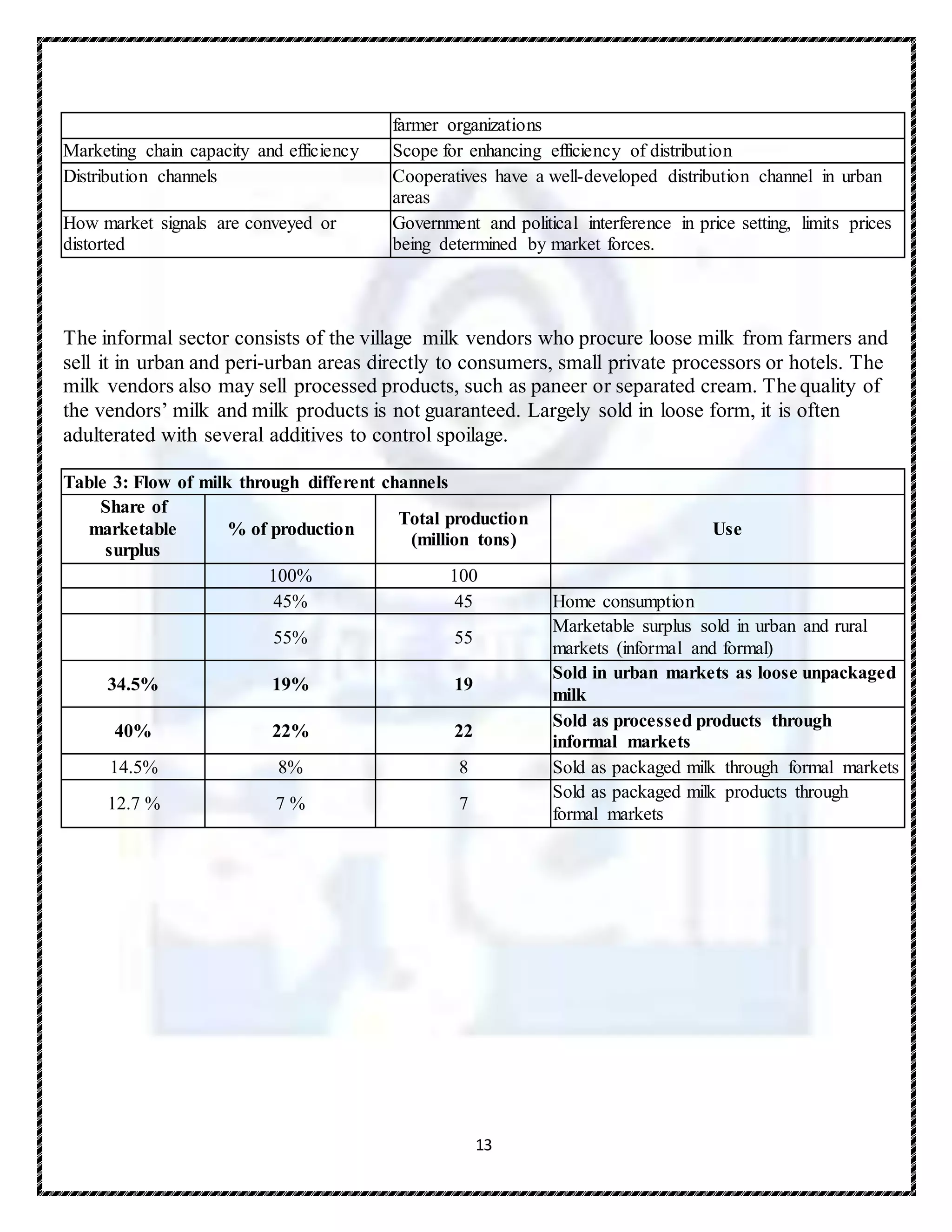
and milk products are sold through the informal channel (Table 3). The informal demand absorbs
approximately 41 percent of the milk and milk products produced in the country, accounting for
about 75 percent of the marketable surplus of milk. The formal channel, with its packaged milk and
dairy products, accounts for only about 25 percent of the marketable surplus, which is about 15
percent of production.
Performance Still large share of produce; 85% of marketable surplus goes
through informal channel
Quality of milk through informal channel is an issue and to some
extent in formal channel as well
Competitive structure Little competition to cooperatives because private sector was not
allowed in the sector until recently
Entry of supermarkets in retailing of milk is increasing the
competitive structure
Governance (value chain type) Governance of cooperative structures is constraining efficiency and
expansion
Role of "lead" or organizing firms Role of lead agency has been hampered by government interference
in cooperatives
Farmer organization Immense scope for improving management and governance through
13
farmer organizations
Marketing chain capacity and efficiency Scope for enhancing efficiency of distribution
Distribution channels Cooperatives have a well-developed distribution channel in urban
areas
How market signals are conveyed or
distorted
Government and political interference in price setting, limits prices
being determined by market forces.
The informal sector consists of the village milk vendors who procure loose milk from farmers and
sell it in urban and peri-urban areas directly to consumers, small private processors or hotels. The
milk vendors also may sell processed products, such as paneer or separated cream. The quality of
the vendors’ milk and milk products is not guaranteed. Largely sold in loose form, it is often
adulterated with several additives to control spoilage.
Table 3: Flow of milk through different channels
Share of
marketable
surplus
% of production
Total production
(million tons)
Use
100% 100
45% 45 Home consumption
55% 55
Marketable surplus sold in urban and rural
markets (informal and formal)
34.5% 19% 19
Sold in urban markets as loose unpackaged
milk
40% 22% 22
Sold as processed products through
informal markets
14.5% 8% 8 Sold as packaged milk through formal markets
12.7 % 7 % 7
Sold as packaged milk products through
formal markets
14
Stage Priority Agent Issues
Policy
environment
Developing livestock policy
Breed development
Dept. of Animal
Husbandry,
Dairying and
Fisheries
Lack of a coherent livestock development policy
Ineffective implementation of policy and projects due to
lack of clarity in roles of different agencies
Lack of resources
Lack of clarity between roles of different departments
Lack of regulation for quality of feed and medicines
Services Disease control/
health/breeding/extension
services
Support to dairy farmer
organizations/women’s self-
help groups
Dept. of Animal
Husbandry,
Dairying and
Fisheries
Cooperatives
NGOs
Private dairies
Inadequate coverage of veterinarian and breeding
services
Non-existent extension services
Scope to enhance activities of NGOs in these areas
Lack of private sector involvement in dairy development
services and activities
Inputs Feed supply
Fodder
Medicines/vaccine supply
Cooperative
Feed companies
Medicine
companies
Medicine store
Quality/cost of feed
Ineffective approach for management of common
property resources
Quality of medicines
Formal credit for animal
purchase
Banks/financial
institution
Cooperatives
Very poor access to formal credit at the farm level
15
Self-help group
Informal loans for animal
purchase or other dairy
needs
Trader
Private company
agent
Very high rate of interest; farmer has to sell milk at low
price to the trader if he/she has borrowed money from the
trader
Production Dairy farming
Selling milk
cooperatives/traders/private
dairy agents
Farmer Poor management and feeding practices because of lack
of information in the absence of extension activities.
Low productivity because of poor genetic potential, poor
feeding and management practices, poor access to health
and breeding services, lack of good-quality animals
Availability of milk per household very low
Low profitability from dairy enterprise
16
Marketing/
processing
Collection of milk from
farmers through village
society, processing and
marketing of milk in cities
and urban areas
Cooperative
society
Lack of coverage of villages
Lack of transparency in milk testing and
pricing
Lack of democracy in village societies
Marketing only in peri-urban/urban areas
Maintaining quality of milk/infrastructure
Milk prices declared by cooperatives kept
low and used as a benchmark price by
other players
Purchase milk from farmers
and selling milk and
processed products to
consumers
Trader No transparency in milk pricing
Adulteration and quality of milk and milk
products
Unhygienic conditions for milk processing
Purchase of milk from
farmers through village
agents, processing and
selling milk
Private dairy No transparency in pricing of milk
Quality of milk
Retailing Selling of milk and milk
products processed by
cooperatives and private
dairies
Retailers
17
The Bihar State Milk Co-OperativeFederation
Led. (COMFED)
Organization
The Bihar State Milk Co-Operative Federation Led. (COMFED) was established in 1983 as the
implementing agency of operational Flood programme of dairy development on “Anand”pattern in Bihar.
Physical Performance
18
The physical performance indicators are showing a steady growth. The policy decisions taken to make it a
truly farmers organization is shown the achievements listed below.
DCS Organization and Membership
“Sudha” milk and milk product has become a symbol of quality. As on date nine out of ten dairy plants are
ISO: 9001:2000 and HACCP: IS: 15000:1998 certified.
Organization of Dairy Cooperative Societies (DCS) and Membership
Particulars 1987-88 1997-98 2003-04 2006-07 2010-11 2011-12
DCS Organization 1669 2884 4018 5819 9760 11638
DCS Functional 1462 2306 3285 4540 6937 8823
Membership ('000) 65.60 147.20 213.58 284.42 533.16 629.20
Milk Procurement Enhancement Program (TIP)
The technical inputs program is one of the crucial activities of the milk unions / Compfed and is the major
strength responsible for the success of dairy cooperatives. The main technical inputs given to milk
producers include breeding facility, animal health cover, feed & fodder and extension/training services.
The inputs provided to the farmers are elaborated below.
Artificial Insemination (AI) Program
Artificial insemination with frozen semen using liquid nitrogen (LN) technology is done by static (single)
and mobile (cluster) AI workers who are self-employed persons specially trained by Compfed. The
progress of establishment of AI centers is as follows:
Milk Union 1987-88 1997-98 2003-04 2006-07 2010-11 2011-12
Patna 120 136(48) 222(96) 250((116) 382(184) 441(218)
Barauni 57 104(35) 162(53) 178(55) 292(150) 344(202)
Muzaffarpur 20 70(28) 129(61) 189(106) 260(177) 300(200)
Samastipur 29 103(35) 185(112) 183(105) 341(171) 395(210)
Shahabad 0 50(15) 160(47) 194(52) 333(105) 333(105)
Bhagalpur 0 6(0) 10(00) 21(00) 87(62) 101(101)
Magadh 0 0 11(06) 30(12) 71(34) 80(36)
Kosi 0 0 0 0(00) 10(10) 20(20)
Ranchi 0 2(0) 17(03) 05(02) 07(02) 07(02)
Total 226 471(161) 896(378) 1050(448) 1783(895) 2021(1094)
AI's Performed
19
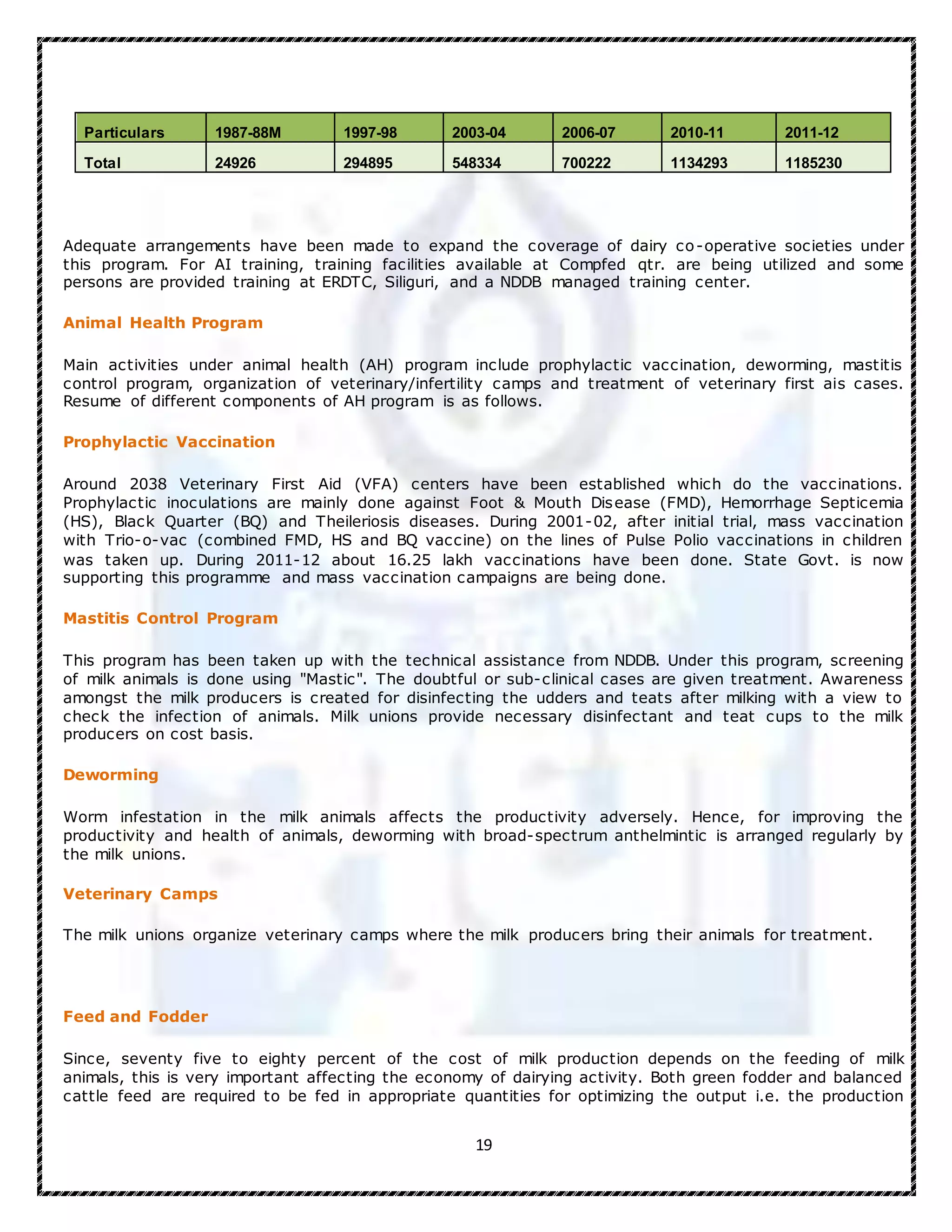
Particulars 1987-88M 1997-98 2003-04 2006-07 2010-11 2011-12
Total 24926 294895 548334 700222 1134293 1185230
Adequate arrangements have been made to expand the coverage of dairy co-operative societies under
this program. For AI training, training facilities available at Compfed qtr. are being utilized and some
persons are provided training at ERDTC, Siliguri, and a NDDB managed training center.
Animal Health Program
Main activities under animal health (AH) program include prophylactic vaccination, deworming, mastitis
control program, organization of veterinary/infertility camps and treatment of veterinary first ais cases.
Resume of different components of AH program is as follows.
Prophylactic Vaccination
Around 2038 Veterinary First Aid (VFA) centers have been established which do the vaccinations.
Prophylactic inoculations are mainly done against Foot & Mouth Disease (FMD), Hemorrhage Septicemia
(HS), Black Quarter (BQ) and Theileriosis diseases. During 2001-02, after initial trial, mass vaccination
with Trio-o-vac (combined FMD, HS and BQ vaccine) on the lines of Pulse Polio vaccinations in children
was taken up. During 2011-12 about 16.25 lakh vaccinations have been done. State Govt. is now
supporting this programme and mass vaccination campaigns are being done.
Mastitis Control Program
This program has been taken up with the technical assistance from NDDB. Under this program, screening
of milk animals is done using "Mastic". The doubtful or sub-clinical cases are given treatment. Awareness
amongst the milk producers is created for disinfecting the udders and teats after milking with a view to
check the infection of animals. Milk unions provide necessary disinfectant and teat cups to the milk
producers on cost basis.
Deworming
Worm infestation in the milk animals affects the productivity adversely. Hence, for improving the
productivity and health of animals, deworming with broad-spectrum anthelmintic is arranged regularly by
the milk unions.
Veterinary Camps
The milk unions organize veterinary camps where the milk producers bring their animals for treatment.
Feed and Fodder
Since, seventy five to eighty percent of the cost of milk production depends on the feeding of milk
animals, this is very important affecting the economy of dairying activity. Both green fodder and balanced
cattle feed are required to be fed in appropriate quantities for optimizing the output i.e. the production
20
and also to maintain the health of the animal. The farmers in select dairy co-operative societies are being
provided training through a computerized nutrition balancing system with the help of National Dairy
Development Board.
Adult Cattle feed (ACF) and Bypass Protein Feed (BPF) is manufactured by our cattle feed plants (CFP)
located at Patna, Ranchi and Muzaffarpur. The total installed capacity of these plants is 260 Metric Tonsper
Day (MTD) thecattle feed produced by these plants is supplied on cost basis to the farmers. Besides
manufacturing BPF and ACF, CFP Ranchi also manufactures other livestock feeds to meet the requirement
of Govt. farms in Bihar and Jharkhand. During 2011-12, the sale of cattle feed to DCS was 61.10 thousand
MTs.
Green fodder is equally important in animal nutrition. Besides providing important nutrients, it helps in
reducing the intake of balanced cattle feed and in turn the cost of production. After prolonged extension
work and persuasion, the farmers have started not only the cultivation of different fodders in their fields
but have started the production of fodder seeds.
Another important scheme under fodder development has been the treatment of straw with urea, which
not only increases the palatability of dry fodder but increases its nutritional value also. Feeding of urea
treated straw helps in reducing the cost of production of milk. Farmers have now taken it up on regular
basis and during 2011-12 about 15873 MTs of straw has been treated.
Training / Manpower Development
Capacity building / skill up gradation has been given maximum emphasis in implanting the dairy
development program. This has been achieved through regular training of milk producers, management
committee members (MCM) of DCS, staff of DCS / milk unions of Compfed. Training of milk producers,
DCS staff and MCM has been mainly arranged at the Compfed training center at Patna. Training programs
organized at Compfed's training center include programs of Society Operation for Secretaries, Orientation
of MCM, AI & VFA training, Dairy Animal Management, and Legal Literacy & Women Empowerment.
Refresher courses and tailor made programs as per need of milk unions is also organized.
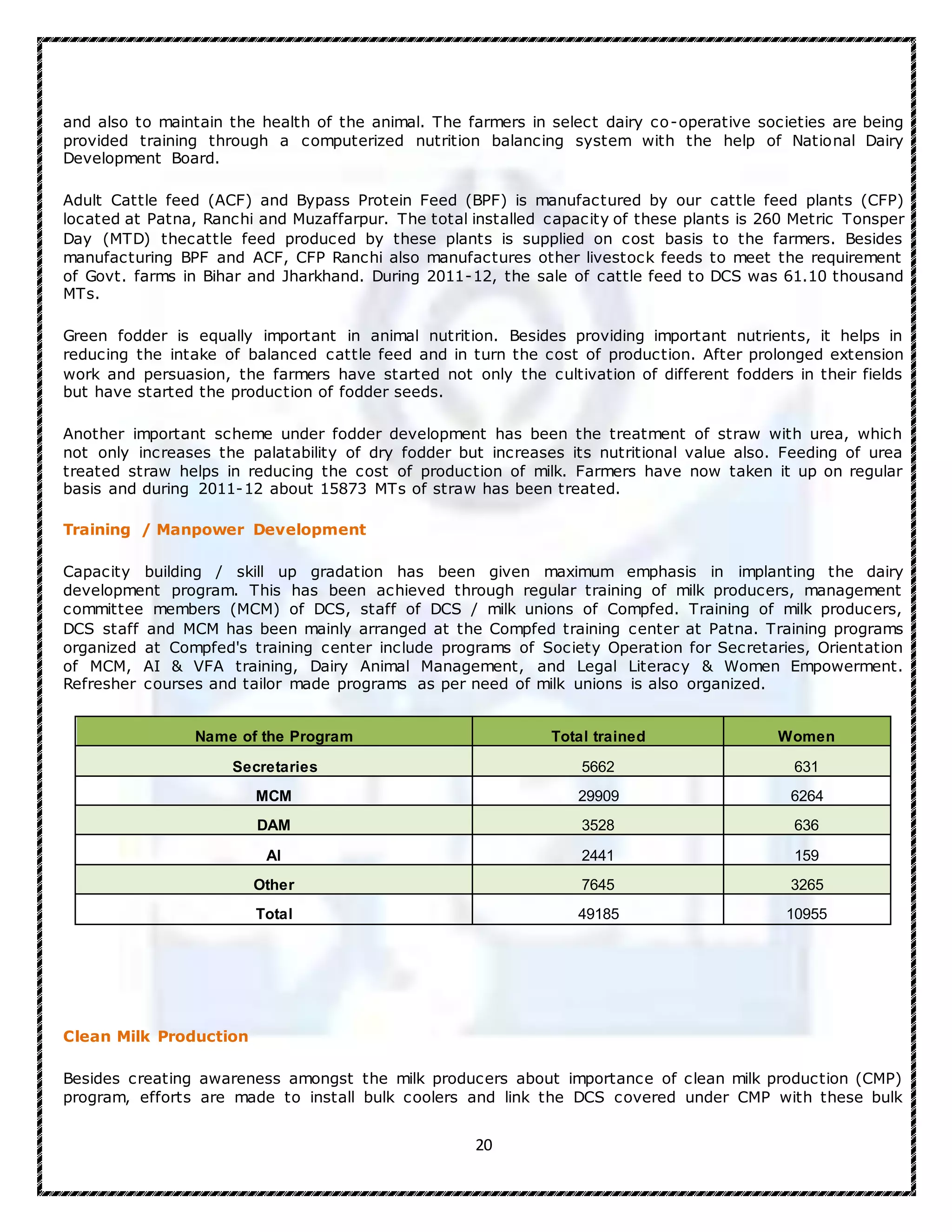
Name of the Program Total trained Women
Secretaries 5662 631
MCM 29909 6264
DAM 3528 636
Al 2441 159
Other 7645 3265
Total 49185 10955
Clean Milk Production
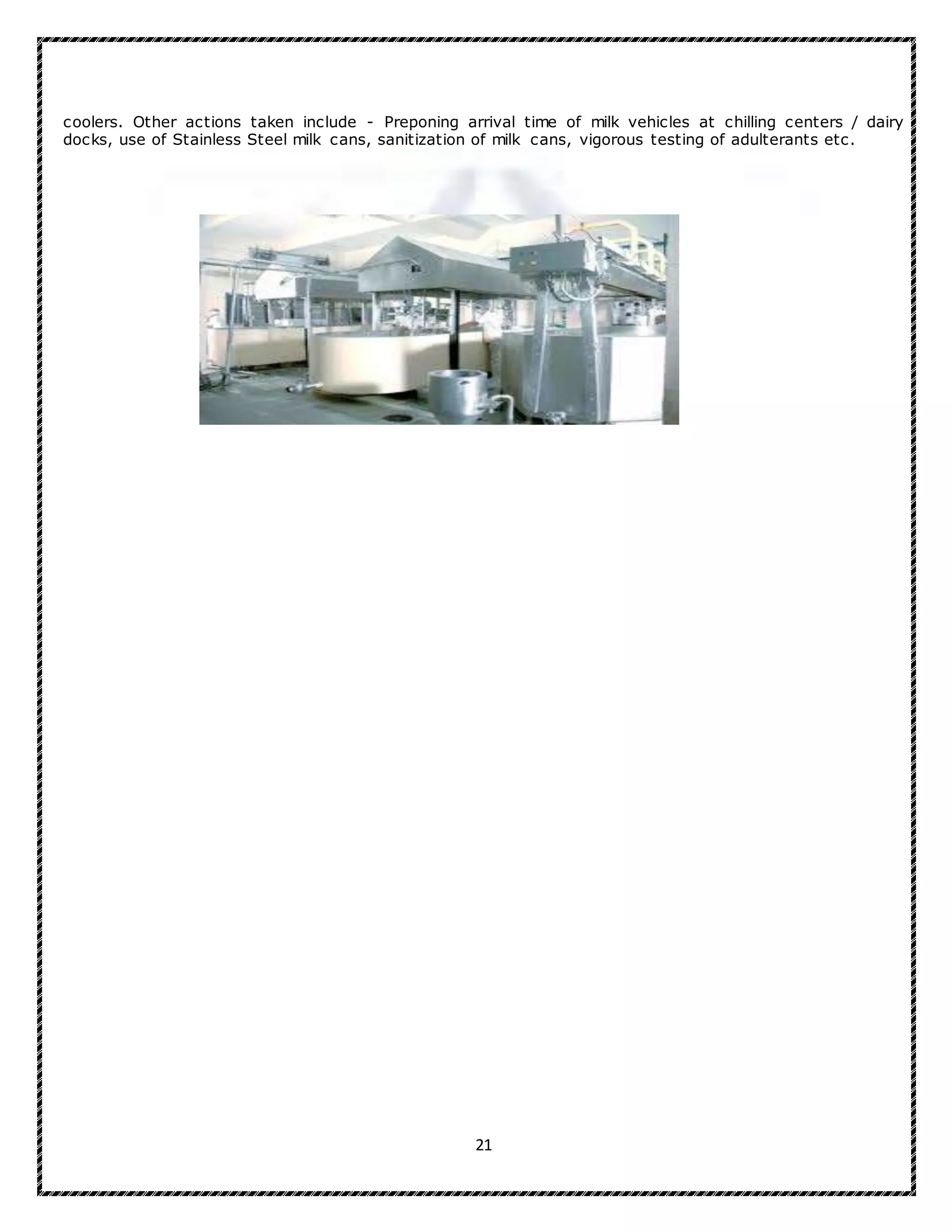
Besides creating awareness amongst the milk producers about importance of clean milk production (CMP)
program, efforts are made to install bulk coolers and link the DCS covered under CMP with these bulk
21
coolers. Other actions taken include - Preponing arrival time of milk vehicles at chilling centers / dairy
docks, use of Stainless Steel milk cans, sanitization of milk cans, vigorous testing of adulterants etc.
22
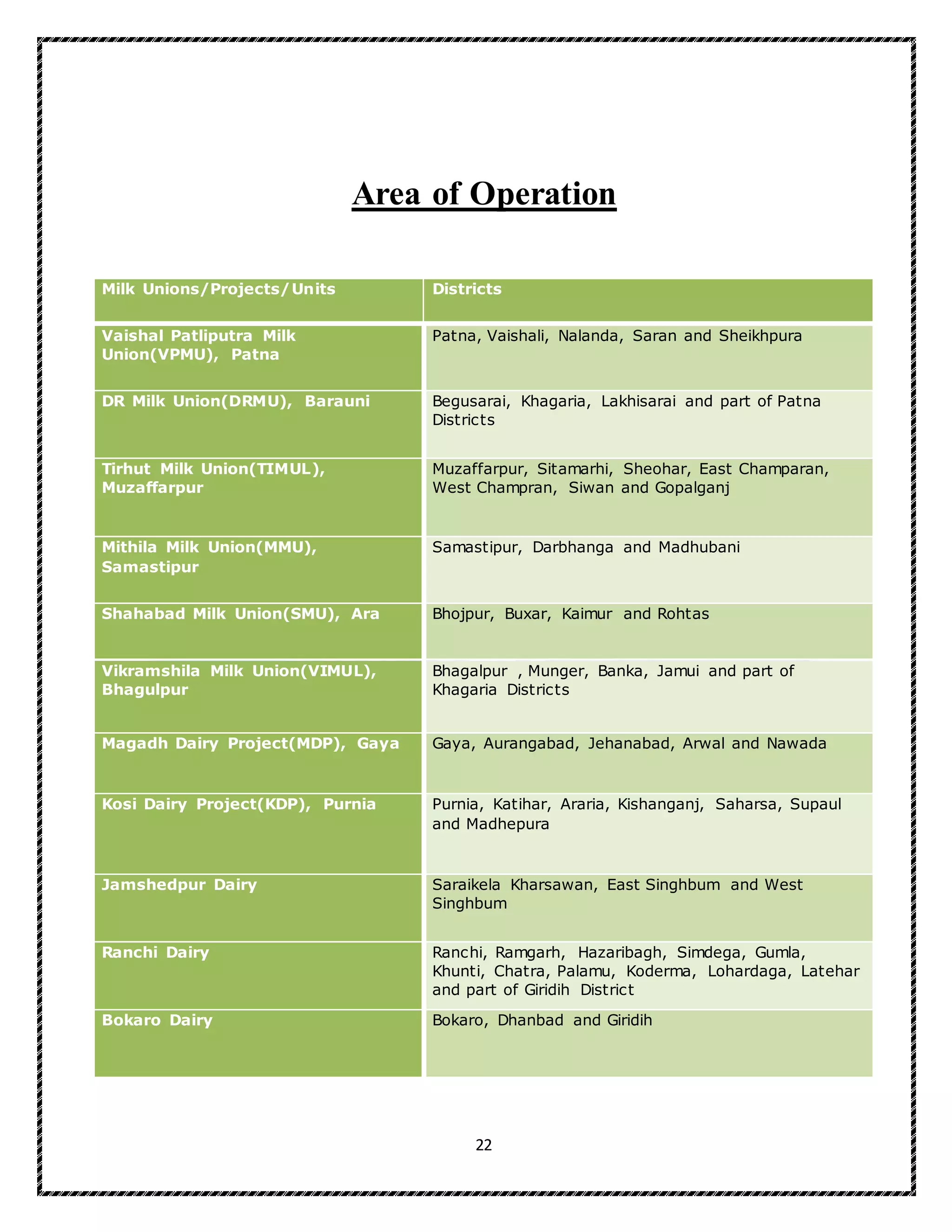
Area of Operation
Milk Unions/Projects/Units Districts
Vaishal Patliputra Milk
Union(VPMU), Patna
Patna, Vaishali, Nalanda, Saran and Sheikhpura
DR Milk Union(DRMU), Barauni Begusarai, Khagaria, Lakhisarai and part of Patna
Districts
Tirhut Milk Union(TIMUL),
Muzaffarpur
Muzaffarpur, Sitamarhi, Sheohar, East Champaran,
West Champran, Siwan and Gopalganj
Mithila Milk Union(MMU),
Samastipur
Samastipur, Darbhanga and Madhubani
Shahabad Milk Union(SMU), Ara Bhojpur, Buxar, Kaimur and Rohtas
Vikramshila Milk Union(VIMUL),
Bhagulpur
Bhagalpur , Munger, Banka, Jamui and part of
Khagaria Districts
Magadh Dairy Project(MDP), Gaya Gaya, Aurangabad, Jehanabad, Arwal and Nawada
Kosi Dairy Project(KDP), Purnia Purnia, Katihar, Araria, Kishanganj, Saharsa, Supaul
and Madhepura
Jamshedpur Dairy Saraikela Kharsawan, East Singhbum and West
Singhbum
Ranchi Dairy Ranchi, Ramgarh, Hazaribagh, Simdega, Gumla,
Khunti, Chatra, Palamu, Koderma, Lohardaga, Latehar
and part of Giridih District
Bokaro Dairy Bokaro, Dhanbad and Giridih
23
Procurement
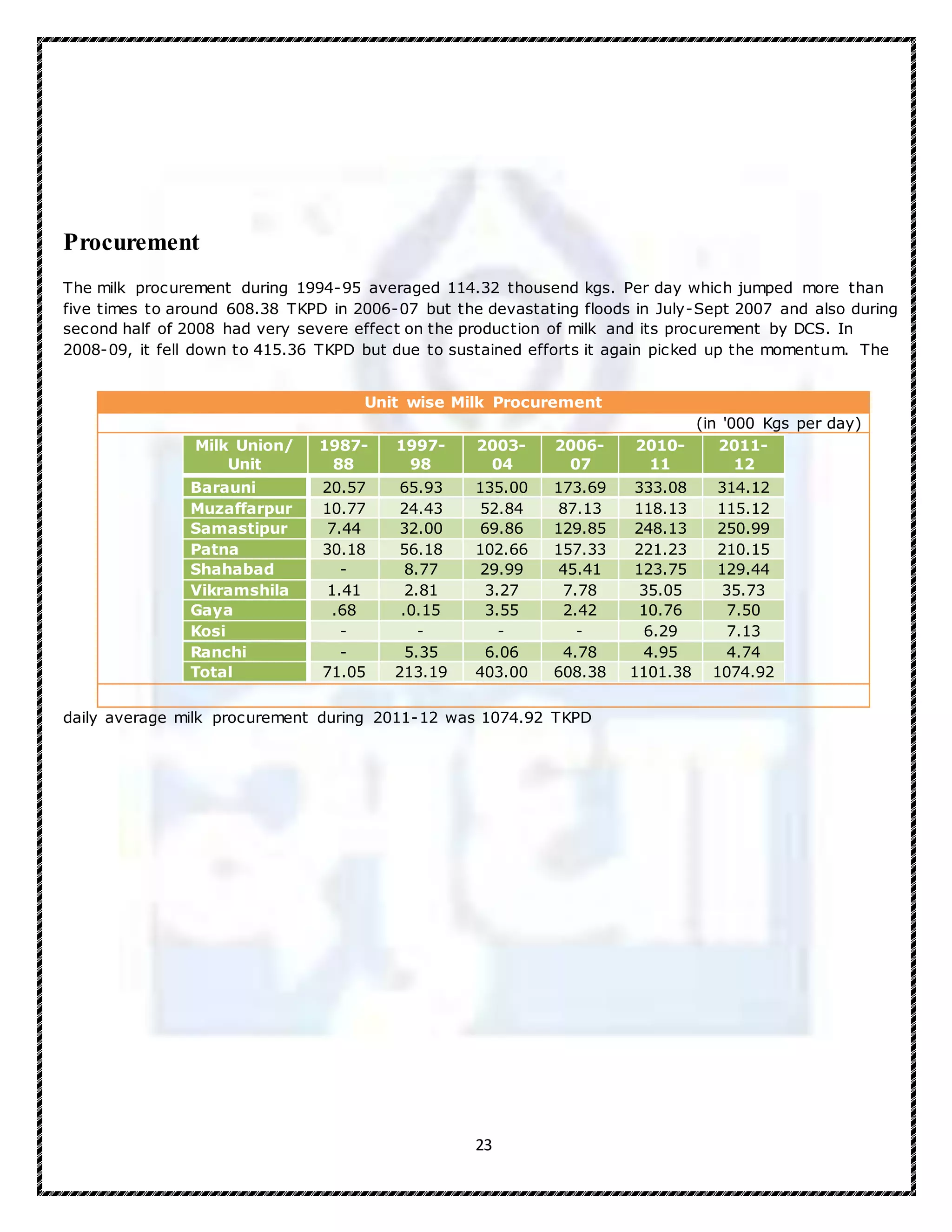
The milk procurement during 1994-95 averaged 114.32 thousend kgs. Per day which jumped more than
five times to around 608.38 TKPD in 2006-07 but the devastating floods in July-Sept 2007 and also during
second half of 2008 had very severe effect on the production of milk and its procurement by DCS. In
2008-09, it fell down to 415.36 TKPD but due to sustained efforts it again picked up the momentum. The
daily average milk procurement during 2011-12 was 1074.92 TKPD
Unit wise Milk Procurement
(in '000 Kgs per day)
Milk Union/
Unit
1987-
88
1997-
98
2003-
04
2006-
07
2010-
11
2011-
12
Barauni 20.57 65.93 135.00 173.69 333.08 314.12
Muzaffarpur 10.77 24.43 52.84 87.13 118.13 115.12
Samastipur 7.44 32.00 69.86 129.85 248.13 250.99
Patna 30.18 56.18 102.66 157.33 221.23 210.15
Shahabad - 8.77 29.99 45.41 123.75 129.44
Vikramshila 1.41 2.81 3.27 7.78 35.05 35.73
Gaya .68 .0.15 3.55 2.42 10.76 7.50
Kosi - - - - 6.29 7.13
Ranchi - 5.35 6.06 4.78 4.95 4.74
Total 71.05 213.19 403.00 608.38 1101.38 1074.92
24
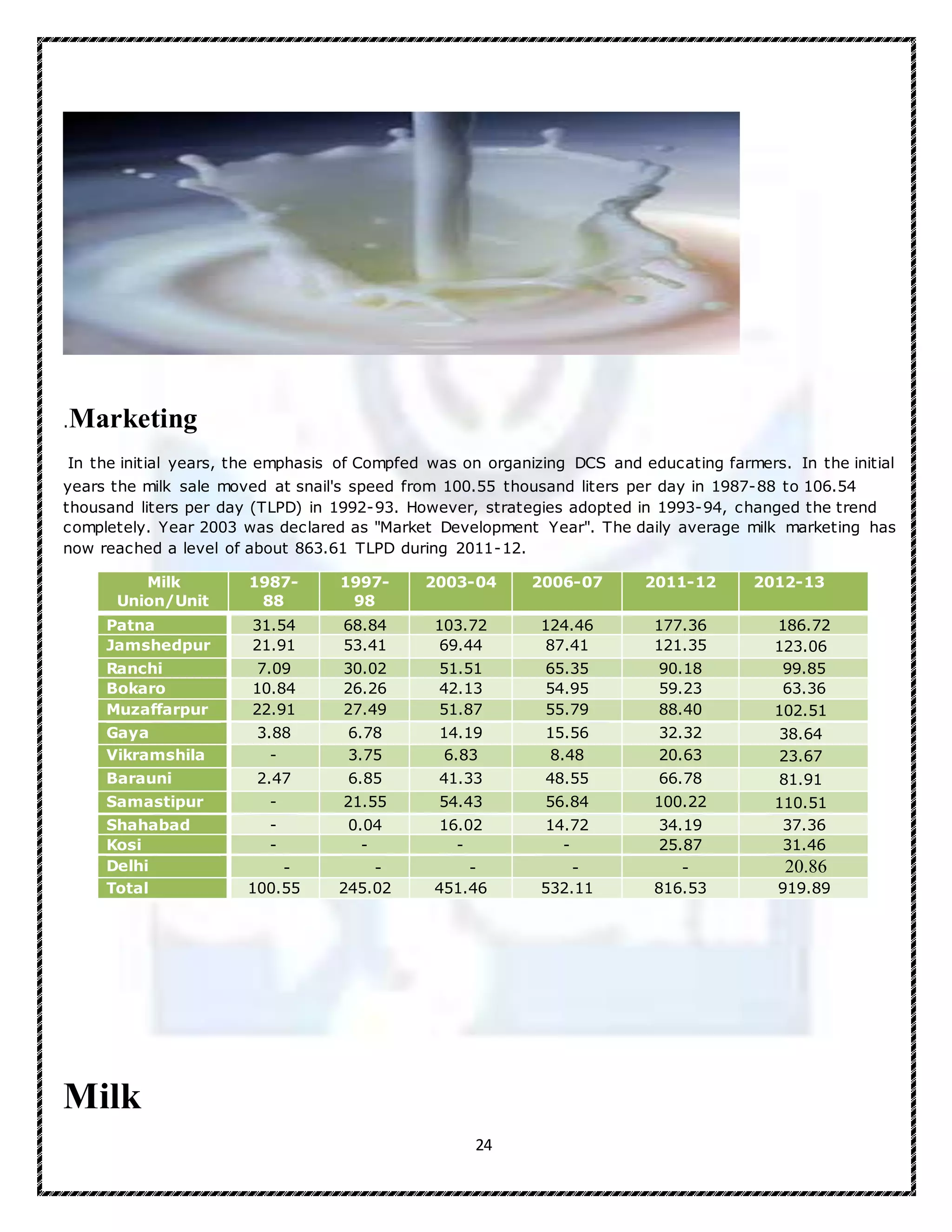
.Marketing
In the initial years, the emphasis of Compfed was on organizing DCS and educating farmers. In the initial
years the milk sale moved at snail's speed from 100.55 thousand liters per day in 1987-88 to 106.54
thousand liters per day (TLPD) in 1992-93. However, strategies adopted in 1993-94, changed the trend
completely. Year 2003 was declared as "Market Development Year". The daily average milk marketing has
now reached a level of about 863.61 TLPD during 2011-12.
Milk
Union/Unit
1987-
88
1997-
98
2003-04 2006-07 2011-12 2012-13
Patna 31.54 68.84 103.72 124.46 177.36 186.72
Jamshedpur 21.91 53.41 69.44 87.41 121.35 123.06
Ranchi 7.09 30.02 51.51 65.35 90.18 99.85
Bokaro 10.84 26.26 42.13 54.95 59.23 63.36
Muzaffarpur 22.91 27.49 51.87 55.79 88.40 102.51
Gaya 3.88 6.78 14.19 15.56 32.32 38.64
Vikramshila - 3.75 6.83 8.48 20.63 23.67
Barauni 2.47 6.85 41.33 48.55 66.78 81.91
Samastipur - 21.55 54.43 56.84 100.22 110.51
Shahabad - 0.04 16.02 14.72 34.19 37.36
Kosi - - - - 25.87 31.46
Delhi - - - - - 20.86
Total 100.55 245.02 451.46 532.11 816.53 919.89
Milk
25
Serial
No.
Milk Milk Type Fat SNF
1. Sudha Gold Full Cream Milk 6.0% 9.0%
2. Sudha Gold Sudha Shakti 4.5% 8.5%
3. Sudha Gold Cow Milk 3.5% 8.5%
4. Sudha Healthy Toned Milk 3.0% 8.5%
5. Sudha Smart Double Toned Milk 1.5% 9.0%
Milk product
S. No. Milk Products S. No. Milk Products
1. Ghee 200 ml (Poly) 30. Rasogulla 100 gm
2. Ghee 500 ml (Poly) 31. Rasogulla 250 gm
3. Ghee 500 ml (Cartoon) 32. Rasogulla 500 gm
4. Ghee 15 Kg (Tin) 33. Rasogulla 1 Kg Tin
5. Table butter 50 gm 34. Rasogulla 5 Kg Jar
6. Table butter 100 gm 35. Rasogulla 10 Kg Jar
7. Table butter 500 gm 36. Gulab Jamun 100 gm
8. Paneer 100 gm 37. Gulab Jamun 250 gm
9. Paneer 200 gm 38. Gulab Jamun 500 gm
10. Paneer 500 gm 39. Gulab Jamun 1 Kg Tin
11. Lassi 200 ml 40. Gulab Jamun 5 Kg Jar
12. Mango Lassi 200 ml 41. Gulab Jamun 10 Kg Jar
26
13. Matha 200 ml 42. Balusahi 100 gm
14. Misti Dahi 100 gm 43. Balusahi 250 gm
15. Mango Dahi 100 gm 44. Balusahi 500 gm
16. Plain Dahi 200 gm 45. Balusahi 1 Kg Tin
17. Plain Dahi 400 gm 46. Balusahi 5 Kg Jar
18. Plain Dahi 500 gm (P) 47. Balusahi 10 Kg Jar
19. Plain Dahi 5 Kg Jar 48. Surbhi 100 gm
20. Plain Dahi 16 Kg Jar 49. Milk Cake 100 gm
21. Plain Dahi 18 Kg Jar 50. Milk Cake 250 gm
22. Flavoured Milk 200 ml
(Kesar/Elaichi)
51. Kalakand 100 gm
23. Flavoured Milk 200 ml (C) 52. Kalakand 250 gm
24. Peda 100 gm 53. Sugar Free Kalakand 100 gm
25. Peda 250 gm 54. Sugar Free Peda 100 gm
26. Khoa Mithai 100 gm 55. Soanpapdi 250 gm
27. Khoa Mithai 250 gm 56. Soanpapdi 400 gm
28. Khoa Plain 500 gm 57. Soanpapdi 2 Kg Jar
29. Gift Pack 1000 gms 58. Plain Dahi 2 Kg Jar
SWOT Analysis
27
Strength:
1. The COMFED group is India‘s one
of largest dairy sectorenterprise.
2. The company has strong brand
image for its products.
3. Well qualified and technically
sound people in the organization.
Weakness:
.
1. Absence of a strong
distribution channel.
2. Company has a poor market
share in entire Delhi.
3. No effective promotional
efforts are being taken by the
company.
.Opportunities:
1. Delhi is one of the biggest markets
for milk productin the country.
2. Per capita consumption of milk is
still below the world average
Threats:
1. Presence of established players
like Mother dairy, Amul.
2. Margin is very low in dairy
industry.
3. Uncertainty in market factors
and changing market scenario.
28
Scope of the study
The scopeofthe study is to know the mindset and perception of the distributors. The study will
help the company to understand the behavior of distributors while procuring milk.
The study will help to know the expectation of the distributors from the company.This study
will help to improve their services and to make effective marketing strategies to meet customers
and distributors expectations. The scopeis restricted to specified area.
OBJECTIVE OF THE STUDY
29
1.To find out penetration level among dealers of sudha milk distributors in the specified region.
2. To study distributors perception and satisfaction level with sudha.
3. To calculate display percentage and physical reach of sudha milk in consumer (FMCG
category).
4. To find out assortment breadth provided by sudha to its customers in the specified region.
LIMITATIONS OF THE STUDY:
30
1. The survey is geographically covered only in Rohtas and Aurangabad. Data collection in
other regions may producedifferent results.
2. Few of responses may not be genuine because of time factor.
3. Few respondents were reluctant and not interested to give the feedback.
4. The research was to be completed within a set deadline. Evidently, more time would have
resulted in more effectiveness of the research.
RESEARCH METHODOLOGY
Research in common refers to a search for knowledge. Once can also define research as a scientific and
systematic search for pertinent information on a specific topic. In fact, research is an art of scientific
31
investigation. The Advanced Learner’s Dictionary of Current English lays down the meaning of research as “a
careful investigation or inquiry especially through search for new facts in any branch of knowledge
DATA SOURCE-This methodology include both,
 Primary data collection
 Secondary data collection
Primary data collection included simple questionnaire. This questionnaire has closed end questions. Primary
data was collected by meeting people personally. Personal interview was taken from dairy distributors.
Secondary research: COMFED website, past record.
RESEARCH APPROACH- Survey research approach was followed.
CONTACT METHOD-
Personal interview- distributors were interviewed personally.
RESEARCH INSTRUMENT- A structured questionnaire was used as research instrument.
SAMPLING PLAN:
In sampling plan, decision about sample unit, sample size and sample procedure is taken.
 Sample unit- existing distributors of sudha dairy.
 Sample size- The sample size was 10.
 Sampling Technique - Convenient sampling, Field survey.
 Method of data analysis
Data has been analyzed with the help of,MS-EXCEL through pie chart, bar graph.
DATA INTERPRETATION
Que: 01which of the milk products do you also sell?
S.No RESPONSES NO. OF
RESPONDENTS
% OF RESPONSES
32
1 Butter milk 10 10
2 Paneer 10 10
3 Lassi 10 10
4 Curd 10 10
5 Ice cream 0 0
6 Peda 10 10
TOTAL 10 100
Inference:
Here,from our responses we can conclude that all the distributers procure butter
milk,lassi,paneer,curd,peda but they do not deal with ice cream.
Que: 02 In which area are you selling (Radius in Km)
S.No RESPONSES NO. OF
RESPONDENTS
% OF RESPONSES
1 0-10 1 10
20%
20%
20%
20%
0%
20%
NO. OF RESPONDENTS
1 Butter milk
2 paneer
3 lassi
4 curd
5 Ice cream
6 peda
33
2 10-25 2 20
3 25-50 3 30
4 50-100 4 40
TOTAL 10 100
Inference:
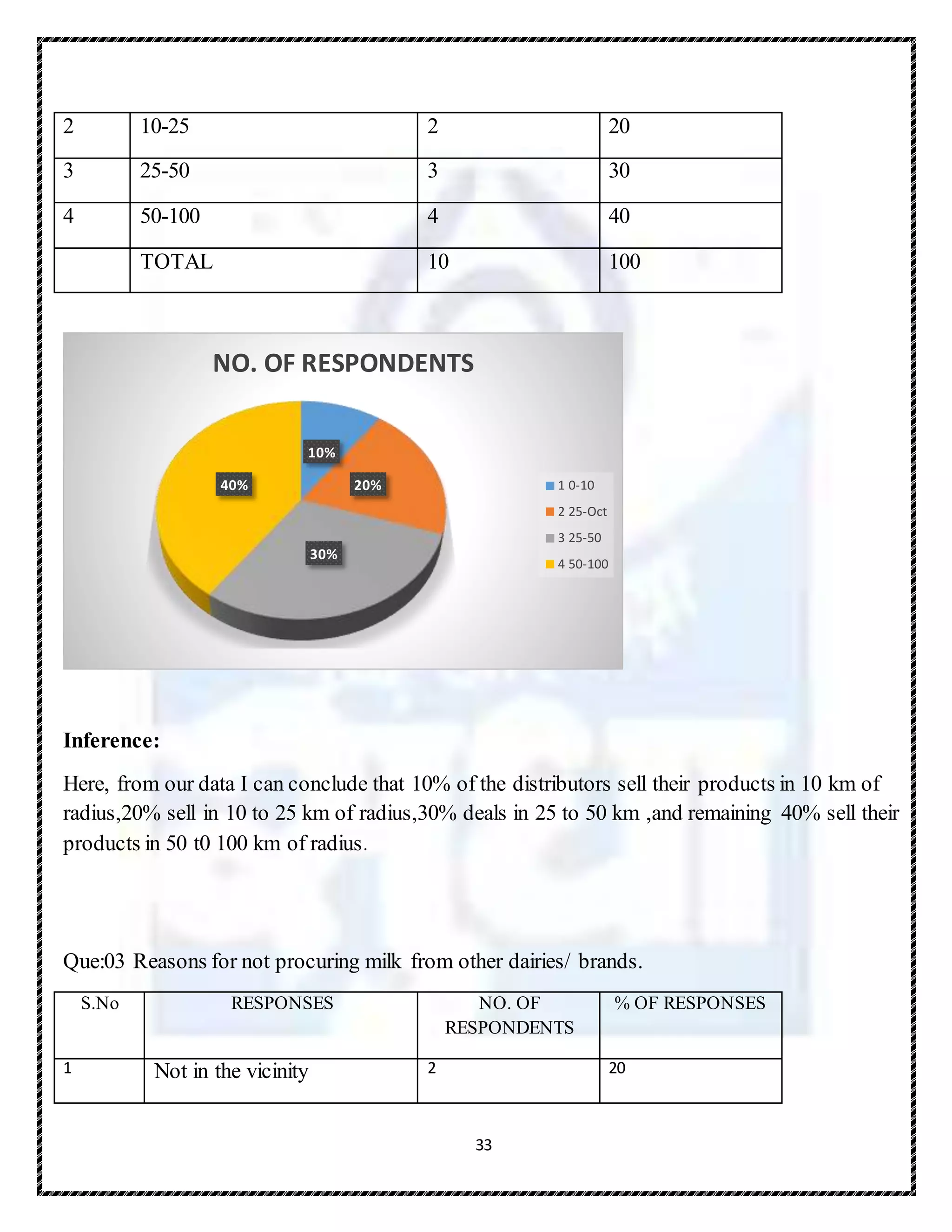
Here, from our data I can conclude that 10% of the distributors sell their products in 10 km of
radius,20% sell in 10 to 25 km of radius,30% deals in 25 to 50 km ,and remaining 40% sell their
products in 50 t0 100 km of radius.
Que:03 Reasons for not procuring milk from other dairies/ brands.
10%
20%
30%
40%
NO. OF RESPONDENTS
1 0-10
2 25-Oct
3 25-50
4 50-100
S.No RESPONSES NO. OF
RESPONDENTS
% OF RESPONSES
1 Not in the vicinity 2 20
34
Inference:
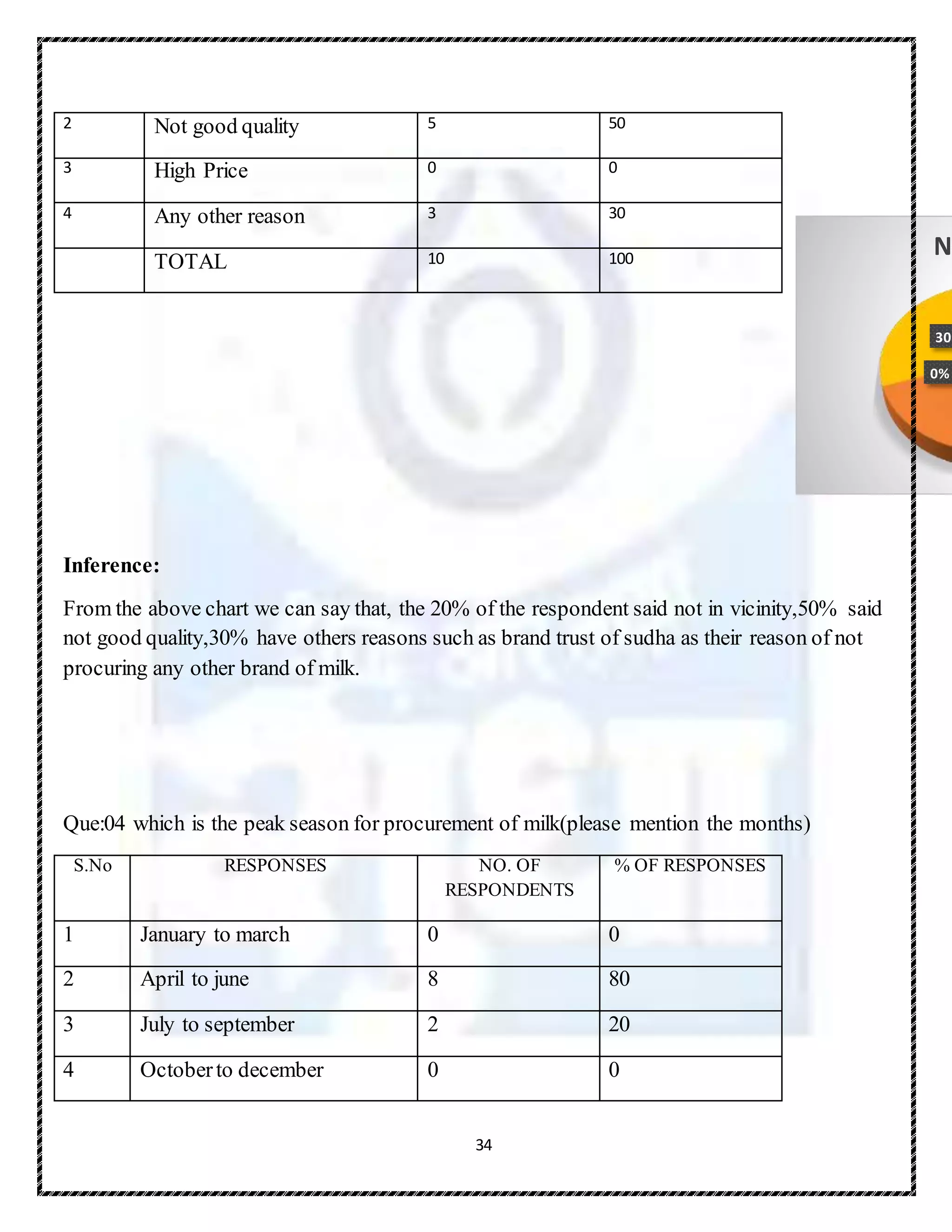
From the above chart we can say that, the 20% of the respondent said not in vicinity,50% said
not good quality,30% have others reasons such as brand trust of sudha as their reason of not
procuring any other brand of milk.
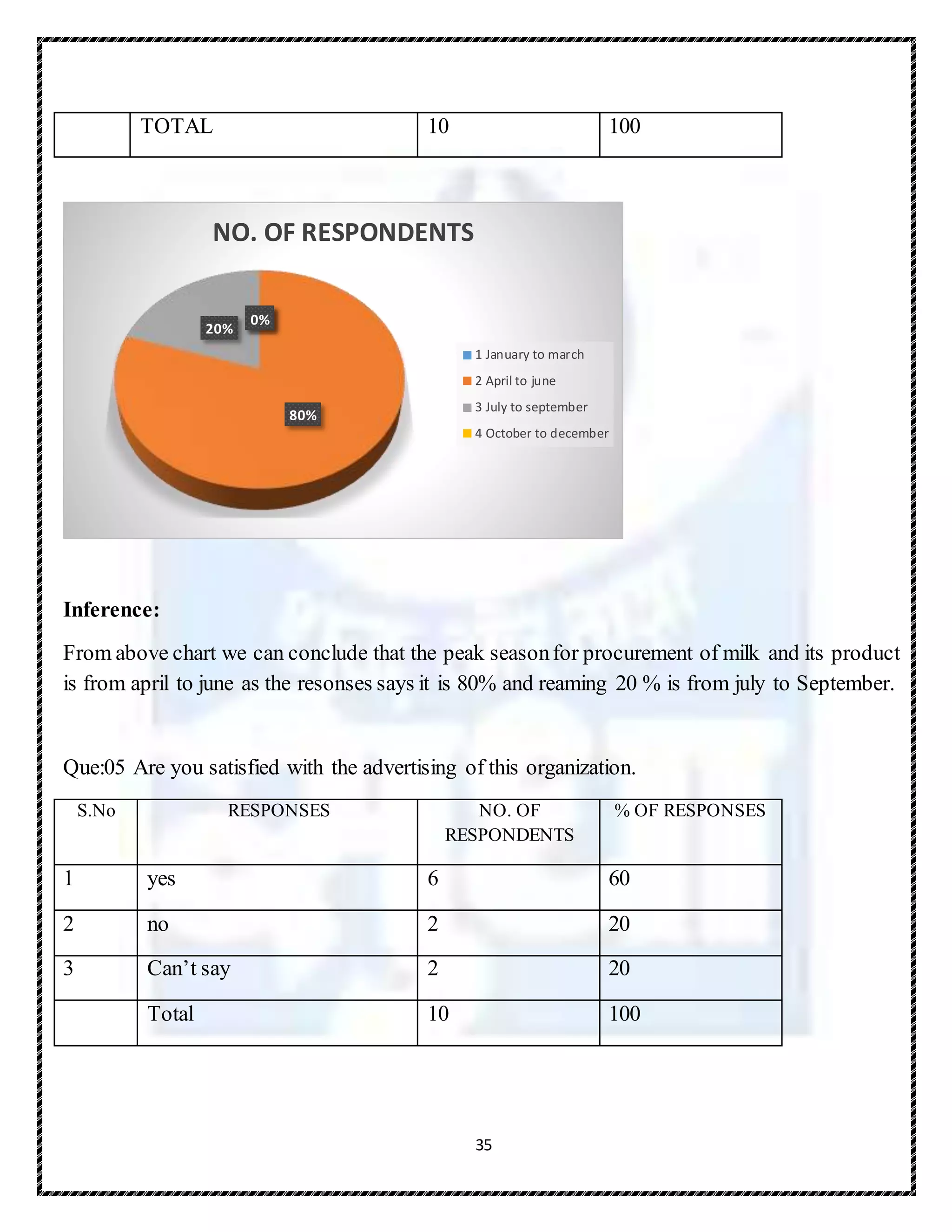
Que:04 which is the peak season for procurement of milk(please mention the months)
S.No RESPONSES NO. OF
RESPONDENTS
% OF RESPONSES
1 January to march 0 0
2 April to june 8 80
3 July to september 2 20
4 Octoberto december 0 0
0%
30%
N
2 Not good quality 5 50
3 High Price 0 0
4 Any other reason 3 30
TOTAL 10 100
35
TOTAL 10 100
Inference:
From above chart we can conclude that the peak seasonfor procurement of milk and its product
is from april to june as the resonses says it is 80% and reaming 20 % is from july to September.
Que:05 Are you satisfied with the advertising of this organization.
S.No RESPONSES NO. OF
RESPONDENTS
% OF RESPONSES
1 yes 6 60
2 no 2 20
3 Can’t say 2 20
Total 10 100
0%
80%
20%
0%
NO. OF RESPONDENTS
1 January to march
2 April to june
3 July to september
4 October to december
36
Inference:
From the above chart we can conclude that 60% of the distributors are satisfied with the
advertisement, 20% are not and remaining 20 % are neutral.
Que 06: Are you satisfied by the schemes and offers of the organization?
S.No RESPONSES NO. OF
RESPONDENTS
% OF RESPONSES
1 yes 3 30
2 no 6 60
3 Can’t say 1 10
TOTAL 10 100
60%20%
20%
NO. OF RESPONDENTS
1 yes
2 no
3 Can’t say
37
Inference:
From the above data we can say that,30% respondents are satisfied, 60% are not satisfied and
10% are neutral about the schemes and offers given by the organization.
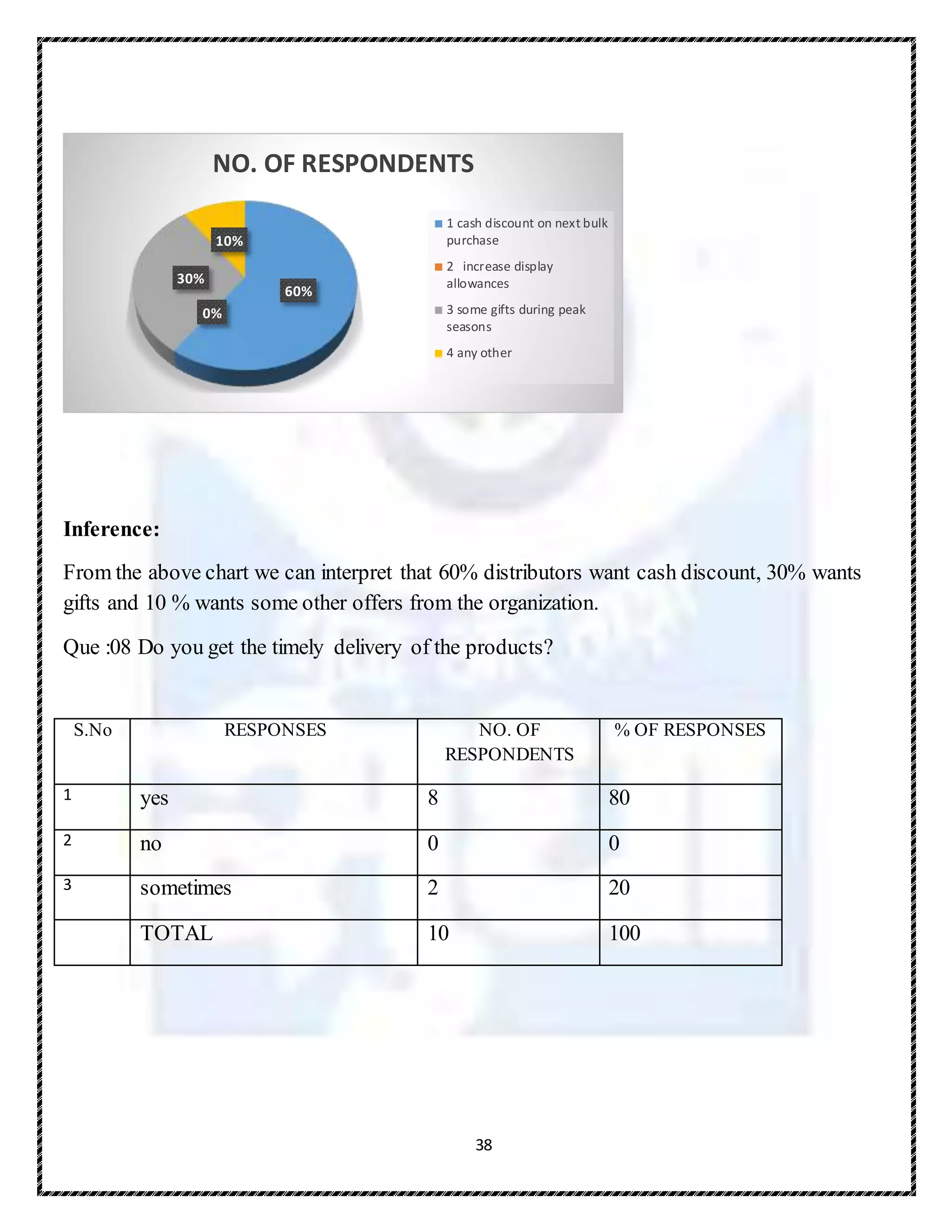
Que 07: If not satisfied what other offers and schemes you want from the manufacturers?
S.No RESPONSES NO. OF
RESPONDENTS
% OF RESPONSES
1 cash discount on next bulk
purchase
6 60
2 increase display allowances 0 0
3 some gifts during peak seasons 3 30
4 any other 1 10
TOTAL 10 100
30%
60%
10%
NO. OF RESPONDENTS
1 yes
2 no
3 Can’t say
38
Inference:
From the above chart we can interpret that 60% distributors want cash discount, 30% wants
gifts and 10 % wants some other offers from the organization.
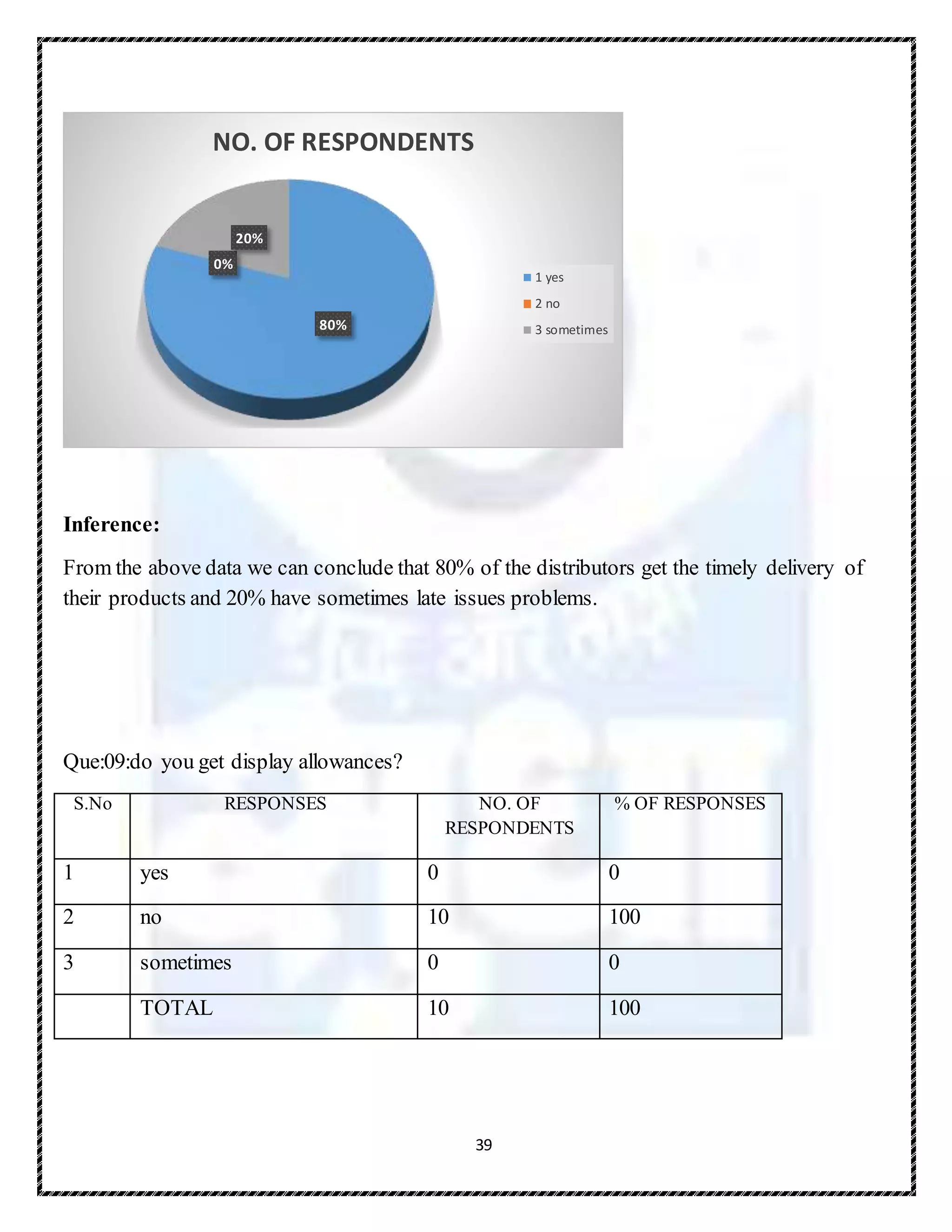
Que :08 Do you get the timely delivery of the products?
S.No RESPONSES NO. OF
RESPONDENTS
% OF RESPONSES
1 yes 8 80
2 no 0 0
3 sometimes 2 20
TOTAL 10 100
60%
0%
30%
10%
NO. OF RESPONDENTS
1 cash discount on next bulk
purchase
2 increase display
allowances
3 some gifts during peak
seasons
4 any other
39
Inference:
From the above data we can conclude that 80% of the distributors get the timely delivery of
their products and 20% have sometimes late issues problems.
Que:09:do you get display allowances?
S.No RESPONSES NO. OF
RESPONDENTS
% OF RESPONSES
1 yes 0 0
2 no 10 100
3 sometimes 0 0
TOTAL 10 100
80%
0%
20%
NO. OF RESPONDENTS
1 yes
2 no
3 sometimes
40
Inference:
From the above data we can conclude very clearly that our organization do not pay display
allowances to the distributors.
Que 10: Do company personnel take tours?
S.No RESPONSES NO. OF
RESPONDENTS
% OF RESPONSES
1 yes 8 80
2 no 0 0
3 sometimes 2 20
TOTAL 10 100
0%
100%
0%
NO. OF RESPONDENTS
1 yes
2 no
3 sometimes
41
Inference:
Fromthe abovechart we can concludethat 80% of the distributors place is visited by the
company personnelregularly and remain 20 % rarely.
Findings
1. Most of the respondents sell almost all milk products ofthe company.
2. Ice cream is not sold by any of the distributors.
3. Company has good brand image in the area and distributors are satisfied with the
quality of the product.
4. Distributors are not satisfied with the schemes and offers of the company as their
expectations are not met by the company.
5. The peak seasonof procurement of milk by the distributors is mainly in the months of
April to July due to summer.
80%
0%
20%
NO. OF RESPONDENTS
1 yes
2 no
3 sometimes
42
6. The distributors do not get any display allowances from the company.
7. The distributors get timely delivery of the products and are often visited by company
personnel.
SUGGESTIONS
1.The sudha brand is having trust name in the market where it operates and still the market is
open to acquire,company may take advantage of it through advertisement.
2.The company may keep one employee as Customer Relation Executive who will co-ordinate
between customers and company and also with retailors,who may also promotesudha milk
effectively on regular basis.
43
3.Coin milk parlor at suitable places can be establish.
4. Company should pay display allowances to the distributors.
5. Company should have close watch on customer to know their changing needs and wants and
also on the competitors for benchmarking.
6. Company should also provide some gifts or other discount to distributors to maintain healthy
and economical relationship with them.
Annexure:QUESTIONNAIRE
You are requested to give us your thoughts to this subject by providing your responses to the
questionnaire attached herewith. The information provided by you will help us conduct our
survey successfully. The response should be frank. Your responses will be kept fully
confidential and will be used for academic purpose.
Date: _ _ / _ _ / _ _ Serial Number: _ _ _
Name: …………………………… Age:
…………………….…………
Address:………………………… Phone:
...........................................
Block: ………………….
Town/ City: ………………….
44
Que:01 Which of the milk products do you also sell?
o Butter Milk
o Paneer
o Curd
o lassi
o Ice Cream
o Ghee
o peda
o Any Other
Que:02 In which area are you selling (Radius in Km)
o 0 to 10 10 to 25
o 25 to 50 25 to 100
Que:03 Reasons for not procuring milk from other dairies/ brands.
A. Not in the vicinity B. Not good quality C.
High Price
D. Any other reason (specify)…………………………………………………
Que:04 which is the peak season for procurement of milk(please mention the months)
January to march April to June
July to September Octoberto December
Que:05 Are you satisfied with the advertising of this organization.
Yes No Can’t say
Que 06: Are you satisfied by the schemes and offers of the organization?
Yes No Can’t say
45
Que 07: If not satisfied what other offers and schemes you want from the manufacturers?
a) cash discount on next bulk purchase
b) increase display allowances
c) some gifts during peak seasons
d) any other ………
Que 08:Do you get the timely delivery of the products?
Yes No Can’t say
Que:09:do you get display allowances?
Yes No sometimes
Que 10: do company personnel take tours?
Yes No sometime
Bibliography
REFERENCEBOOKS:
1) Marketing Research(Author -GC Beri)
(Published byTata
McGrawHill Publishing Co.LTD.,NewDelhi)
Third Edition(2002)
2) Marketing Management (Author –Rajan Saxena)
(Publish byTataMcGrawHill Publishing Co.LTD.,New Delhi)
Second Edition(2001)
3) Marketing Management (Author- Philip Kotler)
(Publish byPrenTice-hall ofIndia PVT.LTD.,New Delhi)
46
Ninth Edition
4) ResearchMethodology(Author –Bhandrai)
Print 2004, secondedition
WEBLIOGRAPHY
1. WWW.COMFED.COM
2. WWW.ECONOMIC SURVEY .COM

sudha project

  • 1.
    1 Distributor’s perception andsatisfaction level about sudha REPORT SUBMITTED IN PARTIAL FULFILLMENT OF REQUIREMENT FOR INTEGRATED MASTER OF BUSINESS ADMINISTRATION BY MAMTA KUMARI (IMBA/3019/11) UNDER THE GUIDANCE OF INDUSTRYGUIDE COLLEG GUIDE MR.R.PRASAD PROF. A.KMAHANTY (Chief Executive)(H.O.D, Management,)(ProjectDairy, Dehrion sone)B.I.T, Allahabad DECLARATION
  • 2.
    2 I hereby declarethat the project entitled “distributors perception and satisfactionlevel about sudha”is an original and authentic work done by me and is based upon the study conducted by me. This project report was undertaken as a part of IMBA programme of BIT,Mesra,Ranchi. Mamta kumari (IMBA/3019/11) TABLE OF CONTENT S.no Topic Page no. 1 Acknowledgement 04
  • 3.
    3 2 Executive summary05 3. Introduction to Indian Diary Industry 6-11 4 Factors affecting the Competitiveness of Dairy Sector 12 5 Market Structure 13-14 6 Identifying the critical issue in the Dairy chain 15-16 7 Company profile-COMFED 17 8 Area of Operation 22 9 Procurement and Marketing 23-24 10 Milk and Milk product 25-26 11 SWOT Analysis 27 12 Scope of the Study 28 13 Objective of the Study 29 14 Limitation of the Study 30 15 Research Methodology 31 16 Data Interpretation 32-41 17 Findings 42 18 Suggestions 43 19 Annexure 44-45 20 Bibliography 46 Acknowledgement
  • 4.
    4 At the veryoutset, I would like to express my heartfelt gratitude to SHAHBAD DUGDH UTPADAK SAHAKARI SANGH,Product dairy, Dehri-On Sone for allowing me to do a project “distributor’sperception and satisfaction level aboutsudha”. I felt this project interesting and challenging one. My thanks is to Mr. RavindraPrasad who was very kind in explaining how to use the challenges that lay ahead me. I feel indebted to Mr. Rupesh kumar. for explaining to me the intricacies and peculiarities of milk business which came handy on various occasions and allowed us to retain our focus and finish my research with the satisfaction of a job well done .I would also like to commit my hearty thanks to Mr. Abhishek kr.Ranjan for his help and valuable supportthroughout the project term. It was a great learning experience to work under their guidelines. I am extremely thankful to my faculty guide Dr. (Prof) A.K Mahanty at BIT Allahabad Campus ,who guided during my training.In the end we would like to say that it was a great experience working on this project. Executive summary The project was started on 1st of June after knowing all the relevant information about the different milk varieties available, under the guidance of Mr. .R. Prasad (Chief Executive) &Mr. Abhishek.
  • 5.
    5 SHAHBAD DUGDH UTPADAKSAHAKARI SANGH, Productdairy, Dehri-On Sone, is one of the member milk union of COMFED, where the milk procurement pasteurization and marketing is taking place. It was a great experience to undergo Summer Internship Training on “Distributors perception and satisfaction level about sudha”. During study I tried my best to know about the various departments of the company, from production to marketing of milk. I found that marketing plays key role in the company. Through this study, I tried to find out distributors perception towards the company, which may help the marketing department of the company as well as the company. The study was focus to find out the satisfaction level of distributors and Identification of their problem areas and helping them in order to increase sales and promotion of brand. Forthis I used the method of personal interviews and questionnaires.. For this I visited around 10 distributors in the area, i.e., Sasaram, Dehri, Aurangabad and spoketo them. A major source of information in this category being secondarydata analysis.Research question were framed which was further divided into subcomponents and following the subcomponenta questionnaire is designed to conductdescriptive research. INTRODUCTION TO THE INDIANDAIRY INDUSTRY The world's biggest dairy producing country is growing fast and looking to becomeanexport powerhousedespitemajor quality problems
  • 6.
    6 India is theworld's largest milk producing country and is growing fast, with an eye toward becoming a major dairy exporter. . Consumer Habits and Practices Milk has b een an integral p art o f Ind ian fo o d fo r c enturies . T he p er c ap itaavailability of milk in India has grown from 172 gm. per personper day in 1972 to 182gmin 1992 and 203 gm. in 1998-99.This is expected to increase to 212gms for 2008. However a large part of the population cannot afford milk. At this per capita consumption it is below the world average of 285 gm. and even less than 220 gm. recommended by the Nutritional Advisory Committee of the Indian Council of Medical Research. Packaging Technology Milk was initially sold door-to-door by the local milkman. When the dairy co- operatives initially started marketing branded milk, it was sold in glass bottles sealed with foil. Over the years, several developments in packaging media have taken place. In theearly 80's, plastic pouches replaced the bottles. Plastic pouches made transportation andstorage very convenient, besides reducing costs. Milk packed in plastic pouches/bottleshave a shelf life of just 1-2 days, that too only if refrigerated. In 1996, Tetra Packs wereintroduced in India. Tetra Packs are aseptic laminate packs made of aluminum, paper, board and plastic. Milk stored in tetra packsand treated under Ultra High Temperature (UHT) technique can be stored for four monthswithout refrigeration. Most of the dairy co-operatives in Andhra Pradesh, Tamil Nadu, Punjaband Rajasthan sell milk in tetra packs. However tetra packed milk is costlier by Rs5-7compared to plastic pouches. In 2008-00 Nestle launched its UHT milk. Amul toorelaunched its Amul Taaza brand of UHT milk. The UHT milk market is expected togrow at a rate of more than 10-12% in coming years. Regulatory Framework The dairy industry was de-licensed in 1991 with a view to encourage privateinvestment and flow of capital and new technology in the segment. Although de- licensingattracted a large number of players, concerns on issues like excess capacity, sale of contaminated/ substandard quality of milk etc. induced the Government to promulgate theMMPO (Milk and Milk Products Order) in 2008. Milk and Milk Products Order (MMPO) regulates milk and milk products production in the country. The order requires no permission for units handling less than 10,000 liters of liquid milk per day or milk solidsup to 500 TPA. MMPO prescribes State registration to plants producing between 10,000to 75,000 liters of milk per day or manufacturing milk products containing
  • 7.
    7 between 500 to3,750tons of milk solids per year. Plants producing over 75,000 liters per day or morethan 3, 750 to ns p er year o f milk s o lid s have to b e regis tered with the C entra lGovernment. The stringent regulations, government controls and licensing requirementsfor new capacities have restricted large Indian and MNC players from making significantinvestments in this product category. Most of the private sector players have restrictedthemselves to manufacture of value added milk products like baby food, dairy whiteners,condensed milk etc.All the milk products exceptmalted foods are covered in the category of industriesfor which foreign equity participation up to 51% is automatically allowed. Ice cream, which wasearlier reserved for manufacturing in the small-scale sector, has now been de-reserved. Ass uc h, no lic ens e is req uired fo r s etting up o f large -s c ale p ro d uc tio n fac ilities fo r manufacture of ice cream. The Food Safety and Standards Authority of India (FSSAI) regulates food safety in India. Dairy products are regulated under the Food Safety and Standards Regulations (FSSR), which replaced the Milk and Milk Products Order, 1992 on August 5, 2011. The FSSR applies equally to domestic and imported food, and requires that food business operators (including food processors, manufacturers, exporters, or importers) hold a license to carry out business in India. Individuals are not allowed to start or carry out any food business without a license from the FSSAI. The FSSR also prohibits the use of animal-derived rennet in cheeses. While the FSSAI sets standards for the safety of domestically produced and imported milk and milk products into India, the Ministry of Agriculture’s DAHD is responsible for issuing sanitary permits for milk and milk product imports into India. Penetration ofmilk products Western table spreads such as butter, margarine and jams are not very popular inInd ia. All Ind ia p enetratio n o f b utter/ margarine is o nly 4% . T his is als o largely represented by urban areas, where penetration is higher at 9%. In rural areas, butter/margarine have penetrated in 2.1% of households only. The use of these products in thelarge metros is higher, with penetration at 15%. Manufacturing Process Milk is pasteurized by treating it to high temperature for a short time. The main aim intreating milk with high temperature is to destroy the disease causing pathogens and toimprove keeping quality.Separation machine is typically a high powered centrifuge. The centrifugal force makesmilk fat globules and emerges as cream from the separator bowl. Separation of cream produces skim milk from which several dairy
  • 8.
    8 products are made.Babyfood: Fresh milk, which is received from farmers/ traders, is chilled and stored.ThenMSK skimmed/ wet skimmed milk and sugar are added in turbo mixture to achievethe desired specifications of ingredients in the milk. This is followed by addition of vitamins and minerals. This milk which contains ingredients to specifications is filtered,cooled, analyzed and then purified. Then it passes through specific pasteurization and istaken to evaporator for pre-condensing. Pre- condensate is homogenized, cooled and stored. Cooled pre-condensate is heated and dried in spray drier (Ergo). Then sugar isadded. The powder is then passed through chemical analysis to check quality and is filledin tins through filling machines. These tins are gassed during gas mix and then sealed, packed and dispatched in cardboard cartons. Butter: Whole milk is first separated into skim milk and cream by centrifugal force in aseparator. The cream is then pasteurized either through batch process or a continuous p r o c e s s . I n b a t c h p r o c e s s , c r e a m is he a t e d t o a mini m u m o f 7 4 0 C a nd he ld a t t he temperature for 30 minutes, while in continuous process it is heated at 850 C and is heldfor only 15 seconds. The heat treatment destroys bacteria, inactivates enzymes and givesthe cream a cooked flavor .After pasteurization, a tempering process is applied in which cream is held at 100 C toallow rearrangement of the fat crystals. The cream is then churned to produce butter.Continuous churning converts cream into butter in a few minutes while batch churning takes a longer time. Composition and color adjustment is also done at the churning stage and a salt solution is added to give the finished butter a salty taste. About 13 liters of milk with 6% fat is required to produce 1 kg of butter.
  • 9.
    9 Cheese: T h er e a r e t h o u s a n d s o f v a r i e t i e s o f c h e e s e i n t h e w o r l d . T h e t y p e o f manufacturing process used in the production of cheese determines its flavor, whichranges from extremely mild to very sharp, and its texture, which can be semi-solid toalmost stone hard. Cheese making requires four main ingredients - good quality milk,rennet or coagulating acids, culture and salt. Cheese is generally made from cow's milk.About 10 liters of milk with 3% fat is required for making 1 kg of cheese. Natural Cheeseis made by coagulating or curdling milk, stirring & heating the curd, draining off thewhey and collecting or pressing the curd. The desired flavor and texture is obtained byvarying the temperature, humid it y and time period of the curing process. Sweetened condensed milk is usually made from fresh milk by adding sugar to the milk pre-warming And concentrating the mixture in the high vacuum. The syrupy milk is then cooled so thatthe lactose crystallizes as very fine crystals and then the product is coagulated. Future Prospects Post forecasts calendar year (CY) 2014 fluid milk production at a record 140.6 million tons, approximately 4.5 percent more than CY 2013 on the assumptions of a normal monsoon, increased demand for milk and dairy products and rising consumer income. CY 2013 fluid milk production has been marginally decreased and estimated at 134.5 million tons. As a result of strong prices and increased export demand, Post forecasts CY 2014 Non Fat Dry Milk (NFDM) production to increase by 19,000 metric tons to 489,000 metric tons. CY 2013 production estimate for NFDM is revised higher at 470,000 metric tons. While most NFDM producers faced difficulties throughout 2012, market for NFDM has picked up in 2013 due to strong prices and export ban lifted in June 2012. Increased demand for reconstituted milk during the lean season (April-August) and consistent exports of NFDM are also the major drivers supporting increased production. The NFDM market is used as a way to establish a procurement
  • 10.
    10 system and maintaincash flow while slowly developing a marketing network for high-value perishable goods. Following India’s rising production trend, Post forecasts CY 2014 production of combined butter and ghee (clarified butter) to increase approximately by 3 percent over CY 2013 to 4.88 million metric tons as a result of increase in income of an average Indian consumer leading to increased domestic demand. However, CY 2013 production estimates are marginally revised down to 4.74 million metric tons in order to match with the current market situation. (Note: Post Production, supply and demand (PSD) estimates for fluid milk, NFDM and butter have been revised to reflect the calendar year in lieu of the April/March marketing year) India ranks first in the world in milk production and it has gone up from 53.9 million tons in 1990- 91 to 127 million tons in 2011-12. The country accounts for around 17 percent of world’s total dairy production. As per Economic Survey Statistics, 2012-13, the per capita availability of milk has increased from 176 grams per day in 1990-91 to 290 grams per day in 2011-12 and this is comparable with the world per capita availability of milk at 289 grams per day for 2011. Strong farm gate prices supported by growth of the Indian economy and the rising domestic demand for value-added dairy products are factors contributing to increased production. Growing private investment in dairy processing facilities is also expected to provide further impetus to India’s milk production over the coming years. Farmers working directly with formal sector buyers have access to modern extension services, thus improving the herd size, management, feeding, fertility and veterinary care. Many of these extension service providers offer artificial inseminations further improving milk yields with new dairy cattle genetics. Artificial insemination services are expected to grow in the future, as the government of India continues to develop protocols for imported genetics products as well as encourage the growth of genetics services throughout the country.
  • 11.
    11 Factors affecting thecompetitiveness of the dairy sector To assess the dairy sector’s competiveness, a performance analysis looked at five factors: demand conditions, market structure, factor conditions, related supporting industries, and government and the enabling environment. Demand conditions Demand for dairy products in India is likely to grow significantly in the coming years, driven by more consumers, higher incomes and greater interest in nutrition. Consumption of processed and packaged dairy products is increasing in urban areas. Because of the increasing competition from the private sector, several national and international brands have entered the market and expanded consumers’ expectation of quality – although only among a small proportion of the population. In many parts of the country, people still prefer unpacked and unprocessed milk delivered by a local milkman because of its taste and the perception of freshness. The price elasticity for milk is high, thus demand for milk is very sensitive to price changes.
  • 12.
    12 Table 1: Demandconditions Market size and growth Market growth is due to high per capita consumption, increasing population and health consciousness Consumption patterns Consumption of processed and packaged dairy products is increasing in urban areas Consumption patterns Unpackaged milk is still preferred because of taste and price Sophistication of consumers Consumer awareness on product quality is increasing but in a very small portion of the population Receptivity to new products Mostly urban consumers have a very low but increasing interest in new products Price elasticity Price elasticity is high Impact of market opening on demand Consumers now have a variety of quality products Market structure Until 2002, cooperatives traditionally were the dominant players in the formal sector. With liberalization of the dairy industry, private investment has increased quite significantly. However, the organized sector’s share in milk procurement is very low because a large proportion of the milk and milk products are sold through the informal channel (Table 3). The informal demand absorbs approximately 41 percent of the milk and milk products produced in the country, accounting for about 75 percent of the marketable surplus of milk. The formal channel, with its packaged milk and dairy products, accounts for only about 25 percent of the marketable surplus, which is about 15 percent of production. Performance Still large share of produce; 85% of marketable surplus goes through informal channel Quality of milk through informal channel is an issue and to some extent in formal channel as well Competitive structure Little competition to cooperatives because private sector was not allowed in the sector until recently Entry of supermarkets in retailing of milk is increasing the competitive structure Governance (value chain type) Governance of cooperative structures is constraining efficiency and expansion Role of "lead" or organizing firms Role of lead agency has been hampered by government interference in cooperatives Farmer organization Immense scope for improving management and governance through
  • 13.
    13 farmer organizations Marketing chaincapacity and efficiency Scope for enhancing efficiency of distribution Distribution channels Cooperatives have a well-developed distribution channel in urban areas How market signals are conveyed or distorted Government and political interference in price setting, limits prices being determined by market forces. The informal sector consists of the village milk vendors who procure loose milk from farmers and sell it in urban and peri-urban areas directly to consumers, small private processors or hotels. The milk vendors also may sell processed products, such as paneer or separated cream. The quality of the vendors’ milk and milk products is not guaranteed. Largely sold in loose form, it is often adulterated with several additives to control spoilage. Table 3: Flow of milk through different channels Share of marketable surplus % of production Total production (million tons) Use 100% 100 45% 45 Home consumption 55% 55 Marketable surplus sold in urban and rural markets (informal and formal) 34.5% 19% 19 Sold in urban markets as loose unpackaged milk 40% 22% 22 Sold as processed products through informal markets 14.5% 8% 8 Sold as packaged milk through formal markets 12.7 % 7 % 7 Sold as packaged milk products through formal markets
  • 14.
    14 Stage Priority AgentIssues Policy environment Developing livestock policy Breed development Dept. of Animal Husbandry, Dairying and Fisheries Lack of a coherent livestock development policy Ineffective implementation of policy and projects due to lack of clarity in roles of different agencies Lack of resources Lack of clarity between roles of different departments Lack of regulation for quality of feed and medicines Services Disease control/ health/breeding/extension services Support to dairy farmer organizations/women’s self- help groups Dept. of Animal Husbandry, Dairying and Fisheries Cooperatives NGOs Private dairies Inadequate coverage of veterinarian and breeding services Non-existent extension services Scope to enhance activities of NGOs in these areas Lack of private sector involvement in dairy development services and activities Inputs Feed supply Fodder Medicines/vaccine supply Cooperative Feed companies Medicine companies Medicine store Quality/cost of feed Ineffective approach for management of common property resources Quality of medicines Formal credit for animal purchase Banks/financial institution Cooperatives Very poor access to formal credit at the farm level
  • 15.
    15 Self-help group Informal loansfor animal purchase or other dairy needs Trader Private company agent Very high rate of interest; farmer has to sell milk at low price to the trader if he/she has borrowed money from the trader Production Dairy farming Selling milk cooperatives/traders/private dairy agents Farmer Poor management and feeding practices because of lack of information in the absence of extension activities. Low productivity because of poor genetic potential, poor feeding and management practices, poor access to health and breeding services, lack of good-quality animals Availability of milk per household very low Low profitability from dairy enterprise
  • 16.
    16 Marketing/ processing Collection of milkfrom farmers through village society, processing and marketing of milk in cities and urban areas Cooperative society Lack of coverage of villages Lack of transparency in milk testing and pricing Lack of democracy in village societies Marketing only in peri-urban/urban areas Maintaining quality of milk/infrastructure Milk prices declared by cooperatives kept low and used as a benchmark price by other players Purchase milk from farmers and selling milk and processed products to consumers Trader No transparency in milk pricing Adulteration and quality of milk and milk products Unhygienic conditions for milk processing Purchase of milk from farmers through village agents, processing and selling milk Private dairy No transparency in pricing of milk Quality of milk Retailing Selling of milk and milk products processed by cooperatives and private dairies Retailers
  • 17.
    17 The Bihar StateMilk Co-OperativeFederation Led. (COMFED) Organization The Bihar State Milk Co-Operative Federation Led. (COMFED) was established in 1983 as the implementing agency of operational Flood programme of dairy development on “Anand”pattern in Bihar. Physical Performance
  • 18.
    18 The physical performanceindicators are showing a steady growth. The policy decisions taken to make it a truly farmers organization is shown the achievements listed below. DCS Organization and Membership “Sudha” milk and milk product has become a symbol of quality. As on date nine out of ten dairy plants are ISO: 9001:2000 and HACCP: IS: 15000:1998 certified. Organization of Dairy Cooperative Societies (DCS) and Membership Particulars 1987-88 1997-98 2003-04 2006-07 2010-11 2011-12 DCS Organization 1669 2884 4018 5819 9760 11638 DCS Functional 1462 2306 3285 4540 6937 8823 Membership ('000) 65.60 147.20 213.58 284.42 533.16 629.20 Milk Procurement Enhancement Program (TIP) The technical inputs program is one of the crucial activities of the milk unions / Compfed and is the major strength responsible for the success of dairy cooperatives. The main technical inputs given to milk producers include breeding facility, animal health cover, feed & fodder and extension/training services. The inputs provided to the farmers are elaborated below. Artificial Insemination (AI) Program Artificial insemination with frozen semen using liquid nitrogen (LN) technology is done by static (single) and mobile (cluster) AI workers who are self-employed persons specially trained by Compfed. The progress of establishment of AI centers is as follows: Milk Union 1987-88 1997-98 2003-04 2006-07 2010-11 2011-12 Patna 120 136(48) 222(96) 250((116) 382(184) 441(218) Barauni 57 104(35) 162(53) 178(55) 292(150) 344(202) Muzaffarpur 20 70(28) 129(61) 189(106) 260(177) 300(200) Samastipur 29 103(35) 185(112) 183(105) 341(171) 395(210) Shahabad 0 50(15) 160(47) 194(52) 333(105) 333(105) Bhagalpur 0 6(0) 10(00) 21(00) 87(62) 101(101) Magadh 0 0 11(06) 30(12) 71(34) 80(36) Kosi 0 0 0 0(00) 10(10) 20(20) Ranchi 0 2(0) 17(03) 05(02) 07(02) 07(02) Total 226 471(161) 896(378) 1050(448) 1783(895) 2021(1094) AI's Performed
  • 19.
    19 Particulars 1987-88M 1997-982003-04 2006-07 2010-11 2011-12 Total 24926 294895 548334 700222 1134293 1185230 Adequate arrangements have been made to expand the coverage of dairy co-operative societies under this program. For AI training, training facilities available at Compfed qtr. are being utilized and some persons are provided training at ERDTC, Siliguri, and a NDDB managed training center. Animal Health Program Main activities under animal health (AH) program include prophylactic vaccination, deworming, mastitis control program, organization of veterinary/infertility camps and treatment of veterinary first ais cases. Resume of different components of AH program is as follows. Prophylactic Vaccination Around 2038 Veterinary First Aid (VFA) centers have been established which do the vaccinations. Prophylactic inoculations are mainly done against Foot & Mouth Disease (FMD), Hemorrhage Septicemia (HS), Black Quarter (BQ) and Theileriosis diseases. During 2001-02, after initial trial, mass vaccination with Trio-o-vac (combined FMD, HS and BQ vaccine) on the lines of Pulse Polio vaccinations in children was taken up. During 2011-12 about 16.25 lakh vaccinations have been done. State Govt. is now supporting this programme and mass vaccination campaigns are being done. Mastitis Control Program This program has been taken up with the technical assistance from NDDB. Under this program, screening of milk animals is done using "Mastic". The doubtful or sub-clinical cases are given treatment. Awareness amongst the milk producers is created for disinfecting the udders and teats after milking with a view to check the infection of animals. Milk unions provide necessary disinfectant and teat cups to the milk producers on cost basis. Deworming Worm infestation in the milk animals affects the productivity adversely. Hence, for improving the productivity and health of animals, deworming with broad-spectrum anthelmintic is arranged regularly by the milk unions. Veterinary Camps The milk unions organize veterinary camps where the milk producers bring their animals for treatment. Feed and Fodder Since, seventy five to eighty percent of the cost of milk production depends on the feeding of milk animals, this is very important affecting the economy of dairying activity. Both green fodder and balanced cattle feed are required to be fed in appropriate quantities for optimizing the output i.e. the production
  • 20.
    20 and also tomaintain the health of the animal. The farmers in select dairy co-operative societies are being provided training through a computerized nutrition balancing system with the help of National Dairy Development Board. Adult Cattle feed (ACF) and Bypass Protein Feed (BPF) is manufactured by our cattle feed plants (CFP) located at Patna, Ranchi and Muzaffarpur. The total installed capacity of these plants is 260 Metric Tonsper Day (MTD) thecattle feed produced by these plants is supplied on cost basis to the farmers. Besides manufacturing BPF and ACF, CFP Ranchi also manufactures other livestock feeds to meet the requirement of Govt. farms in Bihar and Jharkhand. During 2011-12, the sale of cattle feed to DCS was 61.10 thousand MTs. Green fodder is equally important in animal nutrition. Besides providing important nutrients, it helps in reducing the intake of balanced cattle feed and in turn the cost of production. After prolonged extension work and persuasion, the farmers have started not only the cultivation of different fodders in their fields but have started the production of fodder seeds. Another important scheme under fodder development has been the treatment of straw with urea, which not only increases the palatability of dry fodder but increases its nutritional value also. Feeding of urea treated straw helps in reducing the cost of production of milk. Farmers have now taken it up on regular basis and during 2011-12 about 15873 MTs of straw has been treated. Training / Manpower Development Capacity building / skill up gradation has been given maximum emphasis in implanting the dairy development program. This has been achieved through regular training of milk producers, management committee members (MCM) of DCS, staff of DCS / milk unions of Compfed. Training of milk producers, DCS staff and MCM has been mainly arranged at the Compfed training center at Patna. Training programs organized at Compfed's training center include programs of Society Operation for Secretaries, Orientation of MCM, AI & VFA training, Dairy Animal Management, and Legal Literacy & Women Empowerment. Refresher courses and tailor made programs as per need of milk unions is also organized. Name of the Program Total trained Women Secretaries 5662 631 MCM 29909 6264 DAM 3528 636 Al 2441 159 Other 7645 3265 Total 49185 10955 Clean Milk Production Besides creating awareness amongst the milk producers about importance of clean milk production (CMP) program, efforts are made to install bulk coolers and link the DCS covered under CMP with these bulk
  • 21.
    21 coolers. Other actionstaken include - Preponing arrival time of milk vehicles at chilling centers / dairy docks, use of Stainless Steel milk cans, sanitization of milk cans, vigorous testing of adulterants etc.
  • 22.
    22 Area of Operation MilkUnions/Projects/Units Districts Vaishal Patliputra Milk Union(VPMU), Patna Patna, Vaishali, Nalanda, Saran and Sheikhpura DR Milk Union(DRMU), Barauni Begusarai, Khagaria, Lakhisarai and part of Patna Districts Tirhut Milk Union(TIMUL), Muzaffarpur Muzaffarpur, Sitamarhi, Sheohar, East Champaran, West Champran, Siwan and Gopalganj Mithila Milk Union(MMU), Samastipur Samastipur, Darbhanga and Madhubani Shahabad Milk Union(SMU), Ara Bhojpur, Buxar, Kaimur and Rohtas Vikramshila Milk Union(VIMUL), Bhagulpur Bhagalpur , Munger, Banka, Jamui and part of Khagaria Districts Magadh Dairy Project(MDP), Gaya Gaya, Aurangabad, Jehanabad, Arwal and Nawada Kosi Dairy Project(KDP), Purnia Purnia, Katihar, Araria, Kishanganj, Saharsa, Supaul and Madhepura Jamshedpur Dairy Saraikela Kharsawan, East Singhbum and West Singhbum Ranchi Dairy Ranchi, Ramgarh, Hazaribagh, Simdega, Gumla, Khunti, Chatra, Palamu, Koderma, Lohardaga, Latehar and part of Giridih District Bokaro Dairy Bokaro, Dhanbad and Giridih
  • 23.
    23 Procurement The milk procurementduring 1994-95 averaged 114.32 thousend kgs. Per day which jumped more than five times to around 608.38 TKPD in 2006-07 but the devastating floods in July-Sept 2007 and also during second half of 2008 had very severe effect on the production of milk and its procurement by DCS. In 2008-09, it fell down to 415.36 TKPD but due to sustained efforts it again picked up the momentum. The daily average milk procurement during 2011-12 was 1074.92 TKPD Unit wise Milk Procurement (in '000 Kgs per day) Milk Union/ Unit 1987- 88 1997- 98 2003- 04 2006- 07 2010- 11 2011- 12 Barauni 20.57 65.93 135.00 173.69 333.08 314.12 Muzaffarpur 10.77 24.43 52.84 87.13 118.13 115.12 Samastipur 7.44 32.00 69.86 129.85 248.13 250.99 Patna 30.18 56.18 102.66 157.33 221.23 210.15 Shahabad - 8.77 29.99 45.41 123.75 129.44 Vikramshila 1.41 2.81 3.27 7.78 35.05 35.73 Gaya .68 .0.15 3.55 2.42 10.76 7.50 Kosi - - - - 6.29 7.13 Ranchi - 5.35 6.06 4.78 4.95 4.74 Total 71.05 213.19 403.00 608.38 1101.38 1074.92
  • 24.
    24 .Marketing In the initialyears, the emphasis of Compfed was on organizing DCS and educating farmers. In the initial years the milk sale moved at snail's speed from 100.55 thousand liters per day in 1987-88 to 106.54 thousand liters per day (TLPD) in 1992-93. However, strategies adopted in 1993-94, changed the trend completely. Year 2003 was declared as "Market Development Year". The daily average milk marketing has now reached a level of about 863.61 TLPD during 2011-12. Milk Union/Unit 1987- 88 1997- 98 2003-04 2006-07 2011-12 2012-13 Patna 31.54 68.84 103.72 124.46 177.36 186.72 Jamshedpur 21.91 53.41 69.44 87.41 121.35 123.06 Ranchi 7.09 30.02 51.51 65.35 90.18 99.85 Bokaro 10.84 26.26 42.13 54.95 59.23 63.36 Muzaffarpur 22.91 27.49 51.87 55.79 88.40 102.51 Gaya 3.88 6.78 14.19 15.56 32.32 38.64 Vikramshila - 3.75 6.83 8.48 20.63 23.67 Barauni 2.47 6.85 41.33 48.55 66.78 81.91 Samastipur - 21.55 54.43 56.84 100.22 110.51 Shahabad - 0.04 16.02 14.72 34.19 37.36 Kosi - - - - 25.87 31.46 Delhi - - - - - 20.86 Total 100.55 245.02 451.46 532.11 816.53 919.89 Milk
  • 25.
    25 Serial No. Milk Milk TypeFat SNF 1. Sudha Gold Full Cream Milk 6.0% 9.0% 2. Sudha Gold Sudha Shakti 4.5% 8.5% 3. Sudha Gold Cow Milk 3.5% 8.5% 4. Sudha Healthy Toned Milk 3.0% 8.5% 5. Sudha Smart Double Toned Milk 1.5% 9.0% Milk product S. No. Milk Products S. No. Milk Products 1. Ghee 200 ml (Poly) 30. Rasogulla 100 gm 2. Ghee 500 ml (Poly) 31. Rasogulla 250 gm 3. Ghee 500 ml (Cartoon) 32. Rasogulla 500 gm 4. Ghee 15 Kg (Tin) 33. Rasogulla 1 Kg Tin 5. Table butter 50 gm 34. Rasogulla 5 Kg Jar 6. Table butter 100 gm 35. Rasogulla 10 Kg Jar 7. Table butter 500 gm 36. Gulab Jamun 100 gm 8. Paneer 100 gm 37. Gulab Jamun 250 gm 9. Paneer 200 gm 38. Gulab Jamun 500 gm 10. Paneer 500 gm 39. Gulab Jamun 1 Kg Tin 11. Lassi 200 ml 40. Gulab Jamun 5 Kg Jar 12. Mango Lassi 200 ml 41. Gulab Jamun 10 Kg Jar
  • 26.
    26 13. Matha 200ml 42. Balusahi 100 gm 14. Misti Dahi 100 gm 43. Balusahi 250 gm 15. Mango Dahi 100 gm 44. Balusahi 500 gm 16. Plain Dahi 200 gm 45. Balusahi 1 Kg Tin 17. Plain Dahi 400 gm 46. Balusahi 5 Kg Jar 18. Plain Dahi 500 gm (P) 47. Balusahi 10 Kg Jar 19. Plain Dahi 5 Kg Jar 48. Surbhi 100 gm 20. Plain Dahi 16 Kg Jar 49. Milk Cake 100 gm 21. Plain Dahi 18 Kg Jar 50. Milk Cake 250 gm 22. Flavoured Milk 200 ml (Kesar/Elaichi) 51. Kalakand 100 gm 23. Flavoured Milk 200 ml (C) 52. Kalakand 250 gm 24. Peda 100 gm 53. Sugar Free Kalakand 100 gm 25. Peda 250 gm 54. Sugar Free Peda 100 gm 26. Khoa Mithai 100 gm 55. Soanpapdi 250 gm 27. Khoa Mithai 250 gm 56. Soanpapdi 400 gm 28. Khoa Plain 500 gm 57. Soanpapdi 2 Kg Jar 29. Gift Pack 1000 gms 58. Plain Dahi 2 Kg Jar SWOT Analysis
  • 27.
    27 Strength: 1. The COMFEDgroup is India‘s one of largest dairy sectorenterprise. 2. The company has strong brand image for its products. 3. Well qualified and technically sound people in the organization. Weakness: . 1. Absence of a strong distribution channel. 2. Company has a poor market share in entire Delhi. 3. No effective promotional efforts are being taken by the company. .Opportunities: 1. Delhi is one of the biggest markets for milk productin the country. 2. Per capita consumption of milk is still below the world average Threats: 1. Presence of established players like Mother dairy, Amul. 2. Margin is very low in dairy industry. 3. Uncertainty in market factors and changing market scenario.
  • 28.
    28 Scope of thestudy The scopeofthe study is to know the mindset and perception of the distributors. The study will help the company to understand the behavior of distributors while procuring milk. The study will help to know the expectation of the distributors from the company.This study will help to improve their services and to make effective marketing strategies to meet customers and distributors expectations. The scopeis restricted to specified area. OBJECTIVE OF THE STUDY
  • 29.
    29 1.To find outpenetration level among dealers of sudha milk distributors in the specified region. 2. To study distributors perception and satisfaction level with sudha. 3. To calculate display percentage and physical reach of sudha milk in consumer (FMCG category). 4. To find out assortment breadth provided by sudha to its customers in the specified region. LIMITATIONS OF THE STUDY:
  • 30.
    30 1. The surveyis geographically covered only in Rohtas and Aurangabad. Data collection in other regions may producedifferent results. 2. Few of responses may not be genuine because of time factor. 3. Few respondents were reluctant and not interested to give the feedback. 4. The research was to be completed within a set deadline. Evidently, more time would have resulted in more effectiveness of the research. RESEARCH METHODOLOGY Research in common refers to a search for knowledge. Once can also define research as a scientific and systematic search for pertinent information on a specific topic. In fact, research is an art of scientific
  • 31.
    31 investigation. The AdvancedLearner’s Dictionary of Current English lays down the meaning of research as “a careful investigation or inquiry especially through search for new facts in any branch of knowledge DATA SOURCE-This methodology include both,  Primary data collection  Secondary data collection Primary data collection included simple questionnaire. This questionnaire has closed end questions. Primary data was collected by meeting people personally. Personal interview was taken from dairy distributors. Secondary research: COMFED website, past record. RESEARCH APPROACH- Survey research approach was followed. CONTACT METHOD- Personal interview- distributors were interviewed personally. RESEARCH INSTRUMENT- A structured questionnaire was used as research instrument. SAMPLING PLAN: In sampling plan, decision about sample unit, sample size and sample procedure is taken.  Sample unit- existing distributors of sudha dairy.  Sample size- The sample size was 10.  Sampling Technique - Convenient sampling, Field survey.  Method of data analysis Data has been analyzed with the help of,MS-EXCEL through pie chart, bar graph. DATA INTERPRETATION Que: 01which of the milk products do you also sell? S.No RESPONSES NO. OF RESPONDENTS % OF RESPONSES
  • 32.
    32 1 Butter milk10 10 2 Paneer 10 10 3 Lassi 10 10 4 Curd 10 10 5 Ice cream 0 0 6 Peda 10 10 TOTAL 10 100 Inference: Here,from our responses we can conclude that all the distributers procure butter milk,lassi,paneer,curd,peda but they do not deal with ice cream. Que: 02 In which area are you selling (Radius in Km) S.No RESPONSES NO. OF RESPONDENTS % OF RESPONSES 1 0-10 1 10 20% 20% 20% 20% 0% 20% NO. OF RESPONDENTS 1 Butter milk 2 paneer 3 lassi 4 curd 5 Ice cream 6 peda
  • 33.
    33 2 10-25 220 3 25-50 3 30 4 50-100 4 40 TOTAL 10 100 Inference: Here, from our data I can conclude that 10% of the distributors sell their products in 10 km of radius,20% sell in 10 to 25 km of radius,30% deals in 25 to 50 km ,and remaining 40% sell their products in 50 t0 100 km of radius. Que:03 Reasons for not procuring milk from other dairies/ brands. 10% 20% 30% 40% NO. OF RESPONDENTS 1 0-10 2 25-Oct 3 25-50 4 50-100 S.No RESPONSES NO. OF RESPONDENTS % OF RESPONSES 1 Not in the vicinity 2 20
  • 34.
    34 Inference: From the abovechart we can say that, the 20% of the respondent said not in vicinity,50% said not good quality,30% have others reasons such as brand trust of sudha as their reason of not procuring any other brand of milk. Que:04 which is the peak season for procurement of milk(please mention the months) S.No RESPONSES NO. OF RESPONDENTS % OF RESPONSES 1 January to march 0 0 2 April to june 8 80 3 July to september 2 20 4 Octoberto december 0 0 0% 30% N 2 Not good quality 5 50 3 High Price 0 0 4 Any other reason 3 30 TOTAL 10 100
  • 35.
    35 TOTAL 10 100 Inference: Fromabove chart we can conclude that the peak seasonfor procurement of milk and its product is from april to june as the resonses says it is 80% and reaming 20 % is from july to September. Que:05 Are you satisfied with the advertising of this organization. S.No RESPONSES NO. OF RESPONDENTS % OF RESPONSES 1 yes 6 60 2 no 2 20 3 Can’t say 2 20 Total 10 100 0% 80% 20% 0% NO. OF RESPONDENTS 1 January to march 2 April to june 3 July to september 4 October to december
  • 36.
    36 Inference: From the abovechart we can conclude that 60% of the distributors are satisfied with the advertisement, 20% are not and remaining 20 % are neutral. Que 06: Are you satisfied by the schemes and offers of the organization? S.No RESPONSES NO. OF RESPONDENTS % OF RESPONSES 1 yes 3 30 2 no 6 60 3 Can’t say 1 10 TOTAL 10 100 60%20% 20% NO. OF RESPONDENTS 1 yes 2 no 3 Can’t say
  • 37.
    37 Inference: From the abovedata we can say that,30% respondents are satisfied, 60% are not satisfied and 10% are neutral about the schemes and offers given by the organization. Que 07: If not satisfied what other offers and schemes you want from the manufacturers? S.No RESPONSES NO. OF RESPONDENTS % OF RESPONSES 1 cash discount on next bulk purchase 6 60 2 increase display allowances 0 0 3 some gifts during peak seasons 3 30 4 any other 1 10 TOTAL 10 100 30% 60% 10% NO. OF RESPONDENTS 1 yes 2 no 3 Can’t say
  • 38.
    38 Inference: From the abovechart we can interpret that 60% distributors want cash discount, 30% wants gifts and 10 % wants some other offers from the organization. Que :08 Do you get the timely delivery of the products? S.No RESPONSES NO. OF RESPONDENTS % OF RESPONSES 1 yes 8 80 2 no 0 0 3 sometimes 2 20 TOTAL 10 100 60% 0% 30% 10% NO. OF RESPONDENTS 1 cash discount on next bulk purchase 2 increase display allowances 3 some gifts during peak seasons 4 any other
  • 39.
    39 Inference: From the abovedata we can conclude that 80% of the distributors get the timely delivery of their products and 20% have sometimes late issues problems. Que:09:do you get display allowances? S.No RESPONSES NO. OF RESPONDENTS % OF RESPONSES 1 yes 0 0 2 no 10 100 3 sometimes 0 0 TOTAL 10 100 80% 0% 20% NO. OF RESPONDENTS 1 yes 2 no 3 sometimes
  • 40.
    40 Inference: From the abovedata we can conclude very clearly that our organization do not pay display allowances to the distributors. Que 10: Do company personnel take tours? S.No RESPONSES NO. OF RESPONDENTS % OF RESPONSES 1 yes 8 80 2 no 0 0 3 sometimes 2 20 TOTAL 10 100 0% 100% 0% NO. OF RESPONDENTS 1 yes 2 no 3 sometimes
  • 41.
    41 Inference: Fromthe abovechart wecan concludethat 80% of the distributors place is visited by the company personnelregularly and remain 20 % rarely. Findings 1. Most of the respondents sell almost all milk products ofthe company. 2. Ice cream is not sold by any of the distributors. 3. Company has good brand image in the area and distributors are satisfied with the quality of the product. 4. Distributors are not satisfied with the schemes and offers of the company as their expectations are not met by the company. 5. The peak seasonof procurement of milk by the distributors is mainly in the months of April to July due to summer. 80% 0% 20% NO. OF RESPONDENTS 1 yes 2 no 3 sometimes
  • 42.
    42 6. The distributorsdo not get any display allowances from the company. 7. The distributors get timely delivery of the products and are often visited by company personnel. SUGGESTIONS 1.The sudha brand is having trust name in the market where it operates and still the market is open to acquire,company may take advantage of it through advertisement. 2.The company may keep one employee as Customer Relation Executive who will co-ordinate between customers and company and also with retailors,who may also promotesudha milk effectively on regular basis.
  • 43.
    43 3.Coin milk parlorat suitable places can be establish. 4. Company should pay display allowances to the distributors. 5. Company should have close watch on customer to know their changing needs and wants and also on the competitors for benchmarking. 6. Company should also provide some gifts or other discount to distributors to maintain healthy and economical relationship with them. Annexure:QUESTIONNAIRE You are requested to give us your thoughts to this subject by providing your responses to the questionnaire attached herewith. The information provided by you will help us conduct our survey successfully. The response should be frank. Your responses will be kept fully confidential and will be used for academic purpose. Date: _ _ / _ _ / _ _ Serial Number: _ _ _ Name: …………………………… Age: …………………….………… Address:………………………… Phone: ........................................... Block: …………………. Town/ City: ………………….
  • 44.
    44 Que:01 Which ofthe milk products do you also sell? o Butter Milk o Paneer o Curd o lassi o Ice Cream o Ghee o peda o Any Other Que:02 In which area are you selling (Radius in Km) o 0 to 10 10 to 25 o 25 to 50 25 to 100 Que:03 Reasons for not procuring milk from other dairies/ brands. A. Not in the vicinity B. Not good quality C. High Price D. Any other reason (specify)………………………………………………… Que:04 which is the peak season for procurement of milk(please mention the months) January to march April to June July to September Octoberto December Que:05 Are you satisfied with the advertising of this organization. Yes No Can’t say Que 06: Are you satisfied by the schemes and offers of the organization? Yes No Can’t say
  • 45.
    45 Que 07: Ifnot satisfied what other offers and schemes you want from the manufacturers? a) cash discount on next bulk purchase b) increase display allowances c) some gifts during peak seasons d) any other ……… Que 08:Do you get the timely delivery of the products? Yes No Can’t say Que:09:do you get display allowances? Yes No sometimes Que 10: do company personnel take tours? Yes No sometime Bibliography REFERENCEBOOKS: 1) Marketing Research(Author -GC Beri) (Published byTata McGrawHill Publishing Co.LTD.,NewDelhi) Third Edition(2002) 2) Marketing Management (Author –Rajan Saxena) (Publish byTataMcGrawHill Publishing Co.LTD.,New Delhi) Second Edition(2001) 3) Marketing Management (Author- Philip Kotler) (Publish byPrenTice-hall ofIndia PVT.LTD.,New Delhi)
  • 46.
    46 Ninth Edition 4) ResearchMethodology(Author–Bhandrai) Print 2004, secondedition WEBLIOGRAPHY 1. WWW.COMFED.COM 2. WWW.ECONOMIC SURVEY .COM