Becoming Genius 3: Ontology
— The Esoteric Teaching —
dharmasar@gmail.com
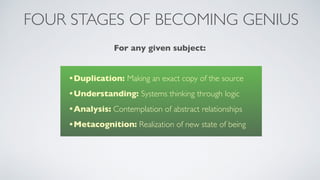
•Duplication: Making an exact copy of the source
•Understanding: Systems thinking through logic
•Analysis: Contemplation of abstract relationships
•Metacognition: Realization of new state of being
FOUR STAGES OF BECOMING GENIUS
For any given subject:
BEING, DOING AND HAVING
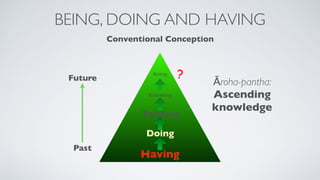
Having
Doing
Thinking
Knowing
?Being
Conventional Conception
Āroha-pantha:
Ascending
knowledge
Past
Future
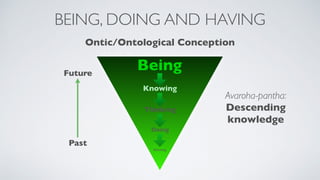
BEING, DOING AND HAVING
Ontic/Ontological Conception
Being
Knowing
Thinking
Doing
Having
Avaroha-pantha:
Descending
knowledge
Past
Future
BEING, DOING AND HAVING
Ontology Definition
On•to•lo•gy, n. from onto-, from the Greek ὤν,
ὄντος “being; that which is”, and -λογία, -logia:
“science, study, theory”)
The theoretical, philosophical study of the nature of
being, becoming, existence, or reality, as well as the
basic categories of being and their relations.
BEING, DOING AND HAVING
Ontics Definition
On•tic, adj. from the Greek ὄν, genitive ὄντος:
“being; that which is”; whatever is physical, real, or
factual existence.
Ontics pertains to what is actually present
(phenomena), as opposed to the nature or
properties of that being (ontology).
ABOUT ONTOLOGY
Ontology in general is the science of being; but here we
are concerned with the ontology of human beings (the
nature and function of beingness for human beings).
Specifically we are concerned with the ontology of
Genius (the nature and function of being for a Genius
and the actions of genius-level intelligence).Who you
are being when being a Genius shapes your perceptions,
emotions, creative imagination, thinking, planning and
consequently your actions in the exercise of that genius.
ABOUT ONTOLOGY
• One can explore the nature and function of human beings from various perspectives:
for example from psychology, anthropology, economics, neuroscience or ontology.
• A psychological perspective 

examines human nature from the perspective of mental functions
• An evolutionary perspective 

examines human nature from the evolutionary drive for survival and sex
• A neuroscience perspective 

examines human nature according to brain function
• An ontological perspective 

examines human nature in terms of Being and Becoming
ABOUT ONTOLOGY
• Ontology is simply another perspective from which to
examine human nature.While connected with and
informed by the other perspectives, ontology specifically
examines the nature of being and experience.
• When exploring the being of a Genius from an ontological
perspective, we are concerned with the ways of being that
constitute being a Genius and that result in the effective
exercise of Genius as your natural self-expression.
ABOUT ONTOLOGY
While the formal term for the study of being is ontology, the method of
experiential self-inquiry into being and action for human beings is called
phenomenology.The phenomenological approach contrasts with traditional
theoretical analysis from an ‘objective’ perspective.We use the
phenomenological methodology to provide actionable access to what the
ontological model reveals and opens up as an as-lived experience.
Being a Genius and the effective exercise of genius as your natural self-
expression do not come from learning about, and trying to emulate the
characteristics or styles of great Geniuses, or learning what Geniuses do
and trying to imitate that—and certainly not from merely having a title: a
designated position of thought leadership or decision authority.
ABOUT ONTOLOGY
Epistemological mastery of a subject leaves you knowing it.
Ontological mastery of a subject leaves you being it.
Gaining experiential access to being a Genius and the effective
exercise of genius as your natural self-expression also requires
dealing with factors present in all human beings that constrain our
freedom to be and do—by constraining and shaping our perceptions,
emotions, creative imagination, thinking and planning.When one is
free from these ontological constraints—your way of being and
acting results naturally in your personal best in any situation. Our
purpose in this series is to help you accomplish this for yourself.
Ontological Education
EXPERIENTIAL EDUCATION
The intention of this series is to leave you being a Genius and
exercising genius effectively as your natural self-expression.The
experiential approach gives you the opportunity to experience
the Being and action of a Genius.
Ordinary informational education would have you learn the
characteristics, styles and skills of famous Geniuses, then try to
remember and apply them when appropriate. That’s not being—
that’s imitating. Imitative action can never be authentic enough to
engender the confidence and expertise required for real Genius.
EXPERIENTIAL EDUCATION
Therefore, this series is not designed to leave you merely knowing about
genius and Geniuses, and able to intelligently discuss the issues around them.
Rather, the series is designed to give you actual access to being a Genius and
exercising your genius effectively in your life as your natural self-expression.
Learning by Being means there’s nothing to remember; no rules, charts or
references to look up; no set procedure or process to go through when an
opportunity for genius arises. You simply respond immediately, intuitively,
spontaneously and confidently to the challenges of learning with your entire
energy and being.
EXPERIENTIAL EDUCATION
Therefore you will not get to be an authentic Genius and exercise your
genius as your natural self-expression by going to school.You need to
take apprenticeship from someone who has mastered the personal
qualities and skills required for being a Genius and exercising genius as
his natural self-expression.
This requires a willingness to work hard on yourself to acquire the
relevant skills and qualities by experience, and to voluntarily serve your
master to free up his time and energy to teach you.This was the method
used by monks and wise men of old to master becoming a Genius.The
best servants become the best masters.
EXPERIENTIAL EDUCATION
The experiential methodology of Becoming Genius is based on
phenomenology.This means your learning experience is driven not
by theory, but by your direct personal experience and participation.
There is no free lunch; the benefit you will get is proportional to
your effort to apply the material. On the other hand, the potential
benefit you can realize is determined and limited only by your
effort and participation—the time, energy, commitment and the
value of your background—that you bring to the experience.You
can choose now whether to just window-shop, or to maximize the
value you get from the series by full participation.
ONTOLOGICAL EDUCATION
Ontology/Ontics is a fundamental breakthrough in thought
similar in scope and impact to Einstein’s Theory of Relativity,
in that it completely transforms our viewpoint and
experience of life. As such, just as Relativity necessitated a
new branch of mathematics to communicate it effectively,
communicating the ontological viewpoint to others requires a
new form of presentation: experiential ontological education.
Taking on the question of “What is Genius?” as an ontological inquiry
required us first to stand in awe at the scope and impact of the question
itself; then, to get clear on what it is to be a Genius and to exercise
genius effectively as a lived experience (rather than as a description,
explanation or theory).
Getting to the core of being a Genius, and the actions of effective genius,
requires a suitable living laboratory. This requirement naturally led to
the need to create or train Geniuses, and the natural laboratory for us
to explore this question is ourselves and our experience.
ONTOLOGICAL EDUCATION
We discussed earlier how your ontology affects your
consciousness. But specifically how does that work? Remember,
you can be conscious of a phenomenon only if it is present in your
ontology.The following section presents an example.
We will present an ontological analysis of three common states of
consciousness. By understanding these states of being from an
ontological perspective, you will then gain the ability to observe
them in yourself, and gain access to controlling them at will.
ONTOLOGY AND CONSCIOUSNESS
DEFINITION: IMMEDIATE
im•me•di•ate, adj. relating to or existing at
the present time; of knowledge or reaction
gained or shown without reasoning; intuitive.
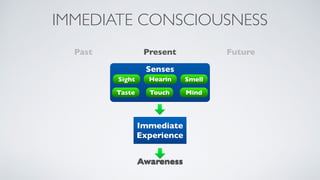
Past FuturePresent
Awareness
IMMEDIATE CONSCIOUSNESS
Senses
Sight Hearin Smell
Taste Touch Mind
Immediate
Experience
REFLECTIVE EXPERIENCE
Reflective Definition
re•flec•tive, adj. regarding the capacity of humans
to exercise introspection and the willingness to
learn more about their fundamental nature,
purpose and essence. Relating to or characterized
by deep thought; thoughtful.
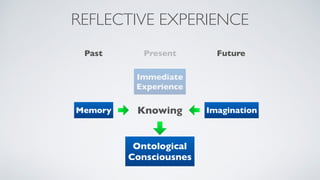
REFLECTIVE EXPERIENCE
Knowing
Ontological

Consciousnes
Past Future
Memory Imagination
Present
Immediate
Experience
REFLEXIVE EXPERIENCE
Reflexive Definition
re•flex•ive, adj. of a relation always holding
between a term and itself; of a method or
theory in the social sciences taking account of
itself, or of the effect of the personality or
presence of the researcher on what is being
investigated.
REFLEXIVE EXPERIENCE
Present
Awareness
Ontic

Consciousnes
Immediate
Experience
Past Future
ImaginatioMemory
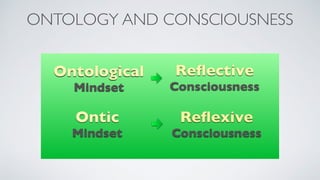
ONTOLOGY AND CONSCIOUSNESS
Ontological
Mindset
Reflective
Consciousness
Ontic
Mindset
Reflexive
Consciousness
“Likewise the reason... for the state of non-return, by
concentration; that for Arahantship by understanding.
For the stream-enterer is called ‘perfected in the kinds
of virtue’; and likewise the once-returner. But the non-
returner is called ‘perfected in concentration’.”

— Visuddhimagga 1.14
ONTOLOGICAL CONSCIOUSNESS
“For a monk rightly contemplating this duality in this way
—heedful, ardent, & resolute—one of two fruits can be
expected: either gnosis right here & now, or—if there be
any remnant of clinging-sustenance—non-return.”

— Dvayatanupassana Sutta (SN 3.12)
ONTIC CONSCIOUSNESS
ONTOLOGYVS. ONTICS
• The ontological approach gives us reflective experience: knowledge about
being: categories, names, analysis of past and prediction of future
phenomena.
• Ontology can help us understand our past being and experience, but
cannot change them.
• The ontic approach gives us reflexive experience: direct knowledge of
being: present-time immediate experience, feelings and meaning.
• Ontics can help us observe and change our experience and consciousness
in the present by bringing awareness into immediate experience
(phenomenology).
• The ontological approach is traditional and orthodox, but limited by the
past. It can help us to understand our past being and experience, but not
to change them.
• The ontic approach is radical and creative: it gives direct knowledge of
being. It can help us to change our experience and consciousness by
bringing awareness into immediate experience.
• The ontic approach is demonstrated by the Buddha in the Suttas; the
ontological approach is found in later works.
• Enlightenment occurs in real time, in the here-&-now.Therefore, ontics is
the more appropriate approach to being.
ONTOLOGYVS. ONTICS
ONTOLOGICAL ANALYSIS
Ontological analysis is a method of analyzing the states of
being and consciousness required for mastery of a subject.
This gives access to a context that creates the being
necessary to master the subject.
Ontological analysis is simple in principle: the categories
exposed in the taxonomy you created by mind-mapping are
analyzed in terms of ontological triples.
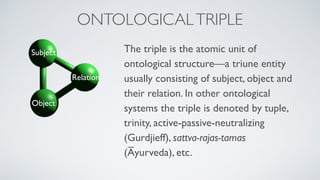
The triple is the atomic unit of
ontological structure—a triune entity
usually consisting of subject, object and
their relation. In other ontological
systems the triple is denoted by tuple,
trinity, active-passive-neutralizing
(Gurdjieff), sattva-rajas-tamas
(Āyurveda), etc.
ONTOLOGICALTRIPLE
Subject
Object
Relation
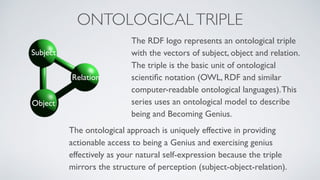
The ontological approach is uniquely effective in providing
actionable access to being a Genius and exercising genius
effectively as your natural self-expression because the triple
mirrors the structure of perception (subject-object-relation).
The RDF logo represents an ontological triple
with the vectors of subject, object and relation.
The triple is the basic unit of ontological
scientific notation (OWL, RDF and similar
computer-readable ontological languages).This
series uses an ontological model to describe
being and Becoming Genius.
Subject
Object
Relation
ONTOLOGICALTRIPLE

Becoming Genius 3: Ontology

  • 1.
    Becoming Genius 3:Ontology — The Esoteric Teaching — dharmasar@gmail.com
  • 2.
    •Duplication: Making anexact copy of the source •Understanding: Systems thinking through logic •Analysis: Contemplation of abstract relationships •Metacognition: Realization of new state of being FOUR STAGES OF BECOMING GENIUS For any given subject:
  • 3.
    BEING, DOING ANDHAVING Having Doing Thinking Knowing ?Being Conventional Conception Āroha-pantha: Ascending knowledge Past Future
  • 4.
    BEING, DOING ANDHAVING Ontic/Ontological Conception Being Knowing Thinking Doing Having Avaroha-pantha: Descending knowledge Past Future
  • 5.
    BEING, DOING ANDHAVING Ontology Definition On•to•lo•gy, n. from onto-, from the Greek ὤν, ὄντος “being; that which is”, and -λογία, -logia: “science, study, theory”) The theoretical, philosophical study of the nature of being, becoming, existence, or reality, as well as the basic categories of being and their relations.
  • 6.
    BEING, DOING ANDHAVING Ontics Definition On•tic, adj. from the Greek ὄν, genitive ὄντος: “being; that which is”; whatever is physical, real, or factual existence. Ontics pertains to what is actually present (phenomena), as opposed to the nature or properties of that being (ontology).
  • 7.
    ABOUT ONTOLOGY Ontology ingeneral is the science of being; but here we are concerned with the ontology of human beings (the nature and function of beingness for human beings). Specifically we are concerned with the ontology of Genius (the nature and function of being for a Genius and the actions of genius-level intelligence).Who you are being when being a Genius shapes your perceptions, emotions, creative imagination, thinking, planning and consequently your actions in the exercise of that genius.
  • 8.
    ABOUT ONTOLOGY • Onecan explore the nature and function of human beings from various perspectives: for example from psychology, anthropology, economics, neuroscience or ontology. • A psychological perspective 
 examines human nature from the perspective of mental functions • An evolutionary perspective 
 examines human nature from the evolutionary drive for survival and sex • A neuroscience perspective 
 examines human nature according to brain function • An ontological perspective 
 examines human nature in terms of Being and Becoming
  • 9.
    ABOUT ONTOLOGY • Ontologyis simply another perspective from which to examine human nature.While connected with and informed by the other perspectives, ontology specifically examines the nature of being and experience. • When exploring the being of a Genius from an ontological perspective, we are concerned with the ways of being that constitute being a Genius and that result in the effective exercise of Genius as your natural self-expression.
  • 10.
    ABOUT ONTOLOGY While theformal term for the study of being is ontology, the method of experiential self-inquiry into being and action for human beings is called phenomenology.The phenomenological approach contrasts with traditional theoretical analysis from an ‘objective’ perspective.We use the phenomenological methodology to provide actionable access to what the ontological model reveals and opens up as an as-lived experience. Being a Genius and the effective exercise of genius as your natural self- expression do not come from learning about, and trying to emulate the characteristics or styles of great Geniuses, or learning what Geniuses do and trying to imitate that—and certainly not from merely having a title: a designated position of thought leadership or decision authority.
  • 11.
    ABOUT ONTOLOGY Epistemological masteryof a subject leaves you knowing it. Ontological mastery of a subject leaves you being it. Gaining experiential access to being a Genius and the effective exercise of genius as your natural self-expression also requires dealing with factors present in all human beings that constrain our freedom to be and do—by constraining and shaping our perceptions, emotions, creative imagination, thinking and planning.When one is free from these ontological constraints—your way of being and acting results naturally in your personal best in any situation. Our purpose in this series is to help you accomplish this for yourself. Ontological Education
  • 12.
    EXPERIENTIAL EDUCATION The intentionof this series is to leave you being a Genius and exercising genius effectively as your natural self-expression.The experiential approach gives you the opportunity to experience the Being and action of a Genius. Ordinary informational education would have you learn the characteristics, styles and skills of famous Geniuses, then try to remember and apply them when appropriate. That’s not being— that’s imitating. Imitative action can never be authentic enough to engender the confidence and expertise required for real Genius.
  • 13.
    EXPERIENTIAL EDUCATION Therefore, thisseries is not designed to leave you merely knowing about genius and Geniuses, and able to intelligently discuss the issues around them. Rather, the series is designed to give you actual access to being a Genius and exercising your genius effectively in your life as your natural self-expression. Learning by Being means there’s nothing to remember; no rules, charts or references to look up; no set procedure or process to go through when an opportunity for genius arises. You simply respond immediately, intuitively, spontaneously and confidently to the challenges of learning with your entire energy and being.
  • 14.
    EXPERIENTIAL EDUCATION Therefore youwill not get to be an authentic Genius and exercise your genius as your natural self-expression by going to school.You need to take apprenticeship from someone who has mastered the personal qualities and skills required for being a Genius and exercising genius as his natural self-expression. This requires a willingness to work hard on yourself to acquire the relevant skills and qualities by experience, and to voluntarily serve your master to free up his time and energy to teach you.This was the method used by monks and wise men of old to master becoming a Genius.The best servants become the best masters.
  • 15.
    EXPERIENTIAL EDUCATION The experientialmethodology of Becoming Genius is based on phenomenology.This means your learning experience is driven not by theory, but by your direct personal experience and participation. There is no free lunch; the benefit you will get is proportional to your effort to apply the material. On the other hand, the potential benefit you can realize is determined and limited only by your effort and participation—the time, energy, commitment and the value of your background—that you bring to the experience.You can choose now whether to just window-shop, or to maximize the value you get from the series by full participation.
  • 16.
    ONTOLOGICAL EDUCATION Ontology/Ontics isa fundamental breakthrough in thought similar in scope and impact to Einstein’s Theory of Relativity, in that it completely transforms our viewpoint and experience of life. As such, just as Relativity necessitated a new branch of mathematics to communicate it effectively, communicating the ontological viewpoint to others requires a new form of presentation: experiential ontological education.
  • 17.
    Taking on thequestion of “What is Genius?” as an ontological inquiry required us first to stand in awe at the scope and impact of the question itself; then, to get clear on what it is to be a Genius and to exercise genius effectively as a lived experience (rather than as a description, explanation or theory). Getting to the core of being a Genius, and the actions of effective genius, requires a suitable living laboratory. This requirement naturally led to the need to create or train Geniuses, and the natural laboratory for us to explore this question is ourselves and our experience. ONTOLOGICAL EDUCATION
  • 18.
    We discussed earlierhow your ontology affects your consciousness. But specifically how does that work? Remember, you can be conscious of a phenomenon only if it is present in your ontology.The following section presents an example. We will present an ontological analysis of three common states of consciousness. By understanding these states of being from an ontological perspective, you will then gain the ability to observe them in yourself, and gain access to controlling them at will. ONTOLOGY AND CONSCIOUSNESS
  • 19.
    DEFINITION: IMMEDIATE im•me•di•ate, adj.relating to or existing at the present time; of knowledge or reaction gained or shown without reasoning; intuitive.
  • 20.
    Past FuturePresent Awareness IMMEDIATE CONSCIOUSNESS Senses SightHearin Smell Taste Touch Mind Immediate Experience
  • 21.
    REFLECTIVE EXPERIENCE Reflective Definition re•flec•tive,adj. regarding the capacity of humans to exercise introspection and the willingness to learn more about their fundamental nature, purpose and essence. Relating to or characterized by deep thought; thoughtful.
  • 22.
  • 23.
    REFLEXIVE EXPERIENCE Reflexive Definition re•flex•ive,adj. of a relation always holding between a term and itself; of a method or theory in the social sciences taking account of itself, or of the effect of the personality or presence of the researcher on what is being investigated.
  • 24.
  • 25.
  • 26.
    “Likewise the reason...for the state of non-return, by concentration; that for Arahantship by understanding. For the stream-enterer is called ‘perfected in the kinds of virtue’; and likewise the once-returner. But the non- returner is called ‘perfected in concentration’.”
 — Visuddhimagga 1.14 ONTOLOGICAL CONSCIOUSNESS
  • 27.
    “For a monkrightly contemplating this duality in this way —heedful, ardent, & resolute—one of two fruits can be expected: either gnosis right here & now, or—if there be any remnant of clinging-sustenance—non-return.”
 — Dvayatanupassana Sutta (SN 3.12) ONTIC CONSCIOUSNESS
  • 28.
    ONTOLOGYVS. ONTICS • Theontological approach gives us reflective experience: knowledge about being: categories, names, analysis of past and prediction of future phenomena. • Ontology can help us understand our past being and experience, but cannot change them. • The ontic approach gives us reflexive experience: direct knowledge of being: present-time immediate experience, feelings and meaning. • Ontics can help us observe and change our experience and consciousness in the present by bringing awareness into immediate experience (phenomenology).
  • 29.
    • The ontologicalapproach is traditional and orthodox, but limited by the past. It can help us to understand our past being and experience, but not to change them. • The ontic approach is radical and creative: it gives direct knowledge of being. It can help us to change our experience and consciousness by bringing awareness into immediate experience. • The ontic approach is demonstrated by the Buddha in the Suttas; the ontological approach is found in later works. • Enlightenment occurs in real time, in the here-&-now.Therefore, ontics is the more appropriate approach to being. ONTOLOGYVS. ONTICS
  • 30.
    ONTOLOGICAL ANALYSIS Ontological analysisis a method of analyzing the states of being and consciousness required for mastery of a subject. This gives access to a context that creates the being necessary to master the subject. Ontological analysis is simple in principle: the categories exposed in the taxonomy you created by mind-mapping are analyzed in terms of ontological triples.
  • 31.
    The triple isthe atomic unit of ontological structure—a triune entity usually consisting of subject, object and their relation. In other ontological systems the triple is denoted by tuple, trinity, active-passive-neutralizing (Gurdjieff), sattva-rajas-tamas (Āyurveda), etc. ONTOLOGICALTRIPLE Subject Object Relation
  • 32.
    The ontological approachis uniquely effective in providing actionable access to being a Genius and exercising genius effectively as your natural self-expression because the triple mirrors the structure of perception (subject-object-relation). The RDF logo represents an ontological triple with the vectors of subject, object and relation. The triple is the basic unit of ontological scientific notation (OWL, RDF and similar computer-readable ontological languages).This series uses an ontological model to describe being and Becoming Genius. Subject Object Relation ONTOLOGICALTRIPLE