Axiology is the philosophical study of value and worth. It includes the fields of ethics, which studies concepts of right and good, and aesthetics, which studies beauty and art. Axiology examines notions of what is and should be valued. It aims to understand values with mathematical rigor. Axiology provides a unified framework for studying various questions in economics, ethics, aesthetics, and logic regarding values and value theory.
Introduction to the branches of philosophy including Axiology, Hermeneutics, and Aesthetics.
Axiology is the study of values, encompassing ethics and aesthetics, and emphasizes the significance of value theory. Exploration of different types of values and the importance of Axiology in moral and aesthetic discussions.
The role of values in education, promoting peace and social conduct, and addressing challenges to value cultivation. Challenges in modern society impacting values, including family structures, misdirected education, and media influence.
The need for community involvement in education and parental participation to support students' value development.
Emphasizing a holistic and integrated curriculum that supports personal development and includes broader life experiences.
Definition and background of hermeneutics, including its focus on interpretation and meaning in various texts.
Explanation of the different levels of hermeneutic inquiry, focusing on historical, cultural, and ontological aspects.
Overview of various types of hermeneutics including Mesopotamian, Talmudic, Vedic, Buddhist, Biblical, and modern hermeneutics.
Axiology (from Greekἀξία, axia, "value, worth";
and -λογία, -logia) is the philosophical study
of value. It is either the collective term
for ethics and aesthetics, philosophical fields that
depend crucially on notions of worth, or the
foundation for these fields, and thus similar
to value theory and meta-ethics. The term was first
used by Paul Lapie, in 1902, and Eduard von
Hartmann, in 1908.
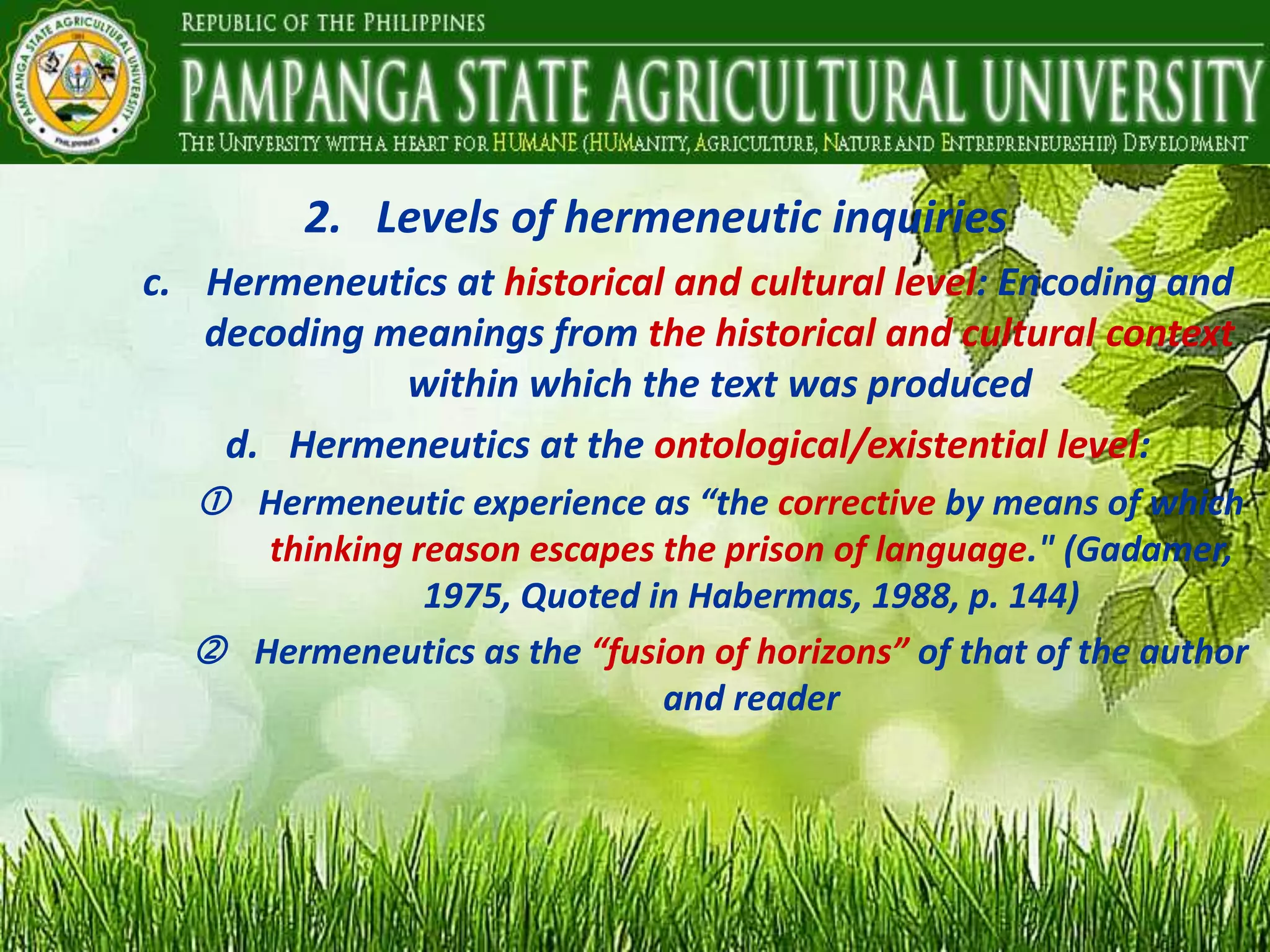
3.
Axiology is theGreek word for the study of
values
Values generally are of two types: what one
does value and what one should value.
Axiology studies mainly two kinds of
values: ethics and aesthetics.
•
4.
Ethics investigates theconcepts of "right" and
"good" in individual and social conduct.
Aesthetics studies the concepts of "beauty" and
"harmony.“
Formal axiology, the attempt to lay out principles
regarding value with mathematical rigor, is
exemplified by Robert S. Hartman's science of
value.
5.
Axiology, (from Greekaxios, “worthy”; logos,
“science”), also called THEORY OF VALUE, the
philosophical study of goodness, or value, in the
widest sense of these terms. Its significance lies (1)
in the considerable expansion that it has given to
the meaning of the term value and (2) in the
unification that it has provided for the study of a
variety of questions—economic, moral, aesthetic,
and even logical—that had often been considered
in relative isolation. (Britannica)
6.
The branch ofPhilosophy concerned with the general
problem of values that is, the nature, origin, and
permanence of values-is called Axiology. Axiology focuses
on questions about what ‘ought to be’. It deals with the
nature of values and relates to the teaching of moral
values and character development. Most philosophers
include, as subdivision of axiology, Ethics, the branch of
Philosophy that is concerned with morals; and Aesthetics,
the branch that is concerned with the problems of beauty
and art.
7.
•Values guide ourdecision as to what is good, true and
right. Thus they depend as much on your feelings as on
our thoughts. These values include the simple difference
between right and wrong, a belief in God, the importance
of hard work, self respect.
•Value based education is a tool which not only provides
us a profession but also a purpose in life.
•Value based education is a key dimension of building
peace, tolerance, social conduct, justice and intercultural
understanding. For the real progress of a country, it is very
necessary to develop values in all citizens and to achieving
this goal, teacher plays an important part.
8.
Challenges
•Nuclear family systemdecreases the values because
parents have not much time for their children. In joint
family a great deal of care, love and wellbeing. The old
received as much care and attention as the very young
and the all children were shared by a sort of common
wealth and a source of joy and happiness. Story telling
have always been an effective way of presenting values,
concept and ideas.
9.
•Misdirected education systeminstead of
developing a person as human being it is only
directed towards superficial, surface level
achievements. Education today is nothing but a
profit making business, it will go on to become our
source of bread and butter. It is designed purely
for money making and not for man making and
only promotes negative qualities like jealously
hatred and rivalry instead of virtues like kindness,
compassion and honesty.
10.
•Shortage of well-traineddedicated teachers, value based
curriculum, innovative teaching methods, materials and
service learning approach.
•Today there is a rapid advancement in technology and science
is taken place. With the rise in material advancement, we are
lacking our cultural and moral standards. There is more greed,
more selfishness, lack of sincerity and integrity
•Politics oriented student’s unions
•Media is one of the leading causes for value deterioration.
Television, videogames, music lyrics that have violent
connotations has a negative effect on a child’ psychology.
11.
•Tit for tatattitude, demanding nature of children, self
interest dominates public interest, no interest in religious
practices, no respect for elders and teachers.
• Lack of refresher programs, scholarships for teachers,
extra burden of work like election, polio drops, guiding
duty, census survey etc and absence of sacrifice among
teachers for their students.
• Urbanization has bad impact on the culture and rural life
values, including socialization
12.
•Implementations involves allmembers of the school
community (student, parents, teachers, community, and
members
• Values reflected across the whole school in : -
•The articulated school mission, purpose and values. - All
school policies and guidelines.
•The behavior of students, teachers, school staff and
parents.
•The curriculum and learning materials in all subjects’
areas.
13.
• Good educationis a joint effort of the school and parents.
Though the school can do a lot for the children it cannot do
everything. The home is the first place where he/ she get
his/her education. So parents should give much time for
their children. Parents should monitor their wards watching
of TV program and allow only those programs which are
educative and morally conducive for the integral growth of
their wards.
14.
• Parents shouldcooperate with the school in enforcing
regularity and discipline in the children.
• Education must give supreme priority to the development
of the rational potential within each pupil. Educators must
stress the importance of the development of both the
intellect and will and to teach pupil how to think. Knowing
how to think in order to make good decision will make it
possible for students to cope with life’s problems and to
steer themselves on to the course for good life. To carry out
this objective, school must re organize pupil’s experiences
in order to enhance their meaning, thereby enabling them
to direct more fully and more competently the course of
their own future experiences.
15.
Whereas the goalof education is the development of the
rational potential of the pupil, education must include
those subjects that assist in the intellectual development of
the pupil because they contain the accumulated wisdom of
civilized man, the humanity ought to be given dominance.
Yogic activity should be including in curriculum. Education is
life itself; therefore, the curriculum too must be life itself. It
cannot be limited to the academic. A problem centered,
pupil centered, experience centered curriculum featuring
such approaches as shared activities, critical evaluation,
pupil involvement in decision making, community service
projects.
16.
The meanings ofhermeneutics:
a. Marin Jay points out that hermeneutics “originally a Greek
term, it referred to the god Hermes. The sayer or announcer
of divine messages ― often, to be sure in oracular and
ambiguous form. Hermeneutics retained its early emphasis
on saying as it accumulated other meanings, such as
interpreting, translating, and explaining.” (Jay, 1982, P. 90)
1. The meanings of hermeneutics:
b. Paul Ricoeur’s provides a working definition of hermeneutics
as follow:
“Hermeneutics is the theory of the operations of understanding
in the relation to the interpretation of texts.” (Ricoeur, 1981a,
p.43)
17.
1. The meaningsof hermeneutics:
b. "What is hermeneutics? Any meaningful expression—be it an
utterance, verbal or nonverbal, or an artifact of any kind, such
as tool, an institution, or a written document—can be identified
from a double perspective, both as an observable event and as
an understandable objectification of meaning. We can describe,
explain, or predict a noise equivalent to the sounds of a spoken
sentence without having the slight idea what this utterance
means. To grasp (and state) its meaning, one has to participate
in some (actual or imagined) communicative action in the course
of which the sentence in question is used in such a way that it is
intelligible to speakers, hearers, and bystanders belonging to the
same speech community." (Habermas, 1996, p. 23-24)
18.
2. Levels ofhermeneutic inquiries
c. Hermeneutics at historical and cultural level: Encoding and
decoding meanings from the historical and cultural context
within which the text was produced
d. Hermeneutics at the ontological/existential level:
Hermeneutic experience as “the corrective by means of which
thinking reason escapes the prison of language." (Gadamer,
1975, Quoted in Habermas, 1988, p. 144)
Hermeneutics as the “fusion of horizons” of that of the author
and reader
19.
2. Levels ofhermeneutic inquiries
a. Hermeneutics at literal level: Decoding the authentic
meanings embedded in literal texts or in utterances in
dialogues
b. Hermeneutics at ontological level:
Encoding and decoding meanings from the ontological condition of
the author
Encoding and decoding meanings from the ontological condition of
the world referred in the text










![Effects of-globalization-in-education (3) [autosaved]](https://cdn.slidesharecdn.com/ss_thumbnails/effects-of-globalization-in-education3autosaved-200227081923-thumbnail.jpg?width=640&height=640&fit=bounds)


