
Creativity-The Unique Soft SkillVarinder KumarAssociate Professor in Commerce
Future is challengingChange is the law of nature that never changes.Uncertainty is certainFace high and dry airs of higher mountains otherwise chances of chilling are too high.
Future TechnologiesNano technologyBio technologyInformation technologyNeuro TechnologyJames Canton, 2006
Five Minds for The FutureDisciplined mind (specialised mind master of particular discipline), Synthesizing mind (mind capable of taking relevant information for decision making), Creating mind(mind focused at creativity by making association among different things), Respectful mind (mind capable of responding sympathetically and constructively to differences among different mindsets), andEthical mind( mind taking the ethical dimensions of different decisions).  -Howard Gardner, pioneer of multiple intelligence
CreativityCreativity stands for originality, something new,Some creations have profound and pervasive influence on the other works-like Upanishads, Geeta, Darwin’ theory of Evolution, Thus SpakeZarathutra
Sources of CreativityThe various sources of creativity includes: Solitude, Expert knowledge of the subject, Silence-absence of talks and thoughts Motivation-Money and Meaning( Story of dogs),Victor FrankleOpenness to new experiences, Belief in existence- “Events are happening and deeds are done and we are just witnessing it”(Buddha) or “What so ever is destined to happen shall happen” (Raman Maharishi).  The only choice we have is either to identify pains and pleasures with body-mind Keeping yourself empty from negativity,  Approaching the problem with fresh mind, Feeling of flow.
Concept of flowA state of mind when consciousness is full of experiences and these experiences are in harmony with each other.Effortless action as the person feels that in those moments he or she stands out as the best in their lives.“being in the zone”(Athletes), “aesthetic rapture”(artists and musicians)Flow occurs when challenges and skills are high. When challenges are low, skills high-state of boredom, if skills low, challenges high, there is anxiety. In such state when goals are clear, feedback relevant, and challenges and skills are in balance, attention(not Tension) becomes ordered and fully invested. The person feels deep involvement, psychic energy is completely focused.
Behaviour of Creative PersonsMihalayCsikszentmihalyi , pioneer of the concept of flow interviewed 91 remarkable persons from 1990 to 1995 to know the behaviour of creative persons.Included in those 91 persons were 26 scientists,   14 were noble prize winners.Such noble prize winners include Yalow(Biology), Eigen, J. Karle, Pauling, Prigogine(Chemistry), Bardeen, Bethe, Chandrasekhar(Physics and Astronomy), Stigler(Economics)
Behaviour of Creative PersonsCreative individuals have a great deal of physical energy, but they are also often quiet and at rest.Creative individuals tend to be smart, yet also naïve at the same time.Creative individuals are both playful and disciplined as well as responsible and casual in their approach.Creative individuals alternate between imagination and fantasy at one end and a rooted sense of reality at the other.Creative people seem to imbibe opposite tendencies on the continuum between extroversion and introversion.
Behaviour of Creative Persons6.   Creative individuals are also remarkably humble and proud at the same time.Creative individuals are beyond their gender role and display masculine as well as feminine tendencies.Creative people are rebellious and independent as well as traditional and conservative also.Creative people are passionate about their work yet are very objective about it.Creative people usually expose themselves to suffering and pain yet feel great deal of enjoyment.-MihalyCsikszentmihalyi
Story Of Gurdjief/Nelson MandelaI am dealing in energy.Whether there is good business or bad business, we shall always make profits.(Gurdjieff)The persons who have imprisoned me are themselves imprisoned of their wrong perceptions.Choice-either look at bars or stars.
Four Perspective of ScientificCreativity LogicGeniusChanceSpirit of Time Why scientific creativity-because of objectivityObjective art and subjective art-Gurdjieff.With awareness/mindfulness-objectivity
1. LogicInductive logic-Francis BaconDeductive Logic-Newton, Darwin(Malthus and Charles Lyell).Inductive logic has been used to rediscover Kepler’s Third Law of planetary motion, Black’s law of temperature equilibrium, Ohm’s Law of current and resistance,
Role and Limitation of LogicLogic has a substantial but circumscribed part to play in scientific creativity.New discoveries demand original solution than routine processes of deduction can not offer.Logic often limits the combinational operations.Logic defines, determines and demarcates the degree of randomness in the combinational processes.
Historical Examples of Limitation of LogicScientists may not notice the inherent problems  in their logical process until their findings are reviewed by their peers.Quantum revolution dispensed with some basic logical principles that have governed science for centuries.GottlobFrege, having spent many years developing a complete mathematical logic was pointed out by Betrand Russell(mathematician awarded noble prize for literature/philosophy) about logical contradiction that undermined the entire enterprise.
2. GeniusScientific creativity requires some special abilities or traits above those average or mediocrity.Theory of Multiple Intelligence-Gardner Scientific discoveries follow Darwin process of natural selection where 95% species do not survive. Similarly genius has vast knowledge but hardly 5% survives and known to the world.Genius in truth means little more than the faculty of perceiving in an unhabitual way.William James
3. Chance FactorsChance is the only source of true noveltyFrancis Crick (co discovered of DNA)Discovery process might be best described as disorderly, unpredictable and chaotic.Ideas emerge more by happy accident than by design or deliberation.“brevity, suddenness and immediate certainty”-Poincare (mathematician)Eurela(I have found it)Chance favours only the prepared mind.Louis Pasteur.Slow and Sudden method of enlightenment-Buddha/Patanjali
Chance factors-some representative episodesColumbus-New World(1492)Grimaldi-interference of light(1663)Hauy-geometric laws of crystallography(1781)Galvani-animal electricity(1791)Davy-laughing gas anesthesia(1798)Oersted- eletromagnetism(1820)Schonbein-ozone (1839)Daguerre-photography (daguerrotype)(1839)Perkin-synthetic coal-tar dyes(1856)Kirchhoff-D-line in the solar spectrum(1859)Nobel-dynamite(1866)
Chance FactorsEdison-phonography(1877)Pasteur-vaccination (1878)Fahlberg-saccharin(1879)Rontgen-X-rays(1895)Bacquerel-radioactivity(1896)Richet-induced    sensitization(anaphylaxis)(1902)Pavlov-classical conditioning(1902)Fleming-penicillin(1928)Dam-vitamin K(1929)Domagk-sulfa drugs(Prontosil) (1932)Plunkett-teflon(1938)De Maestral-velcro(1948)
 4.Spirit of TimeSociologists of science have argued that discoveries and inventions are the inevitable product of the social cultural system.“discoveries and inventions become virtually inevitable (1) as prerequisite kinds of knowledge accumulate in man’s cultural store (2) as the attention of a sufficient number of developments internal to the particular science, or by both” –Robert Merton(1961Example of solar energy destined to happen!
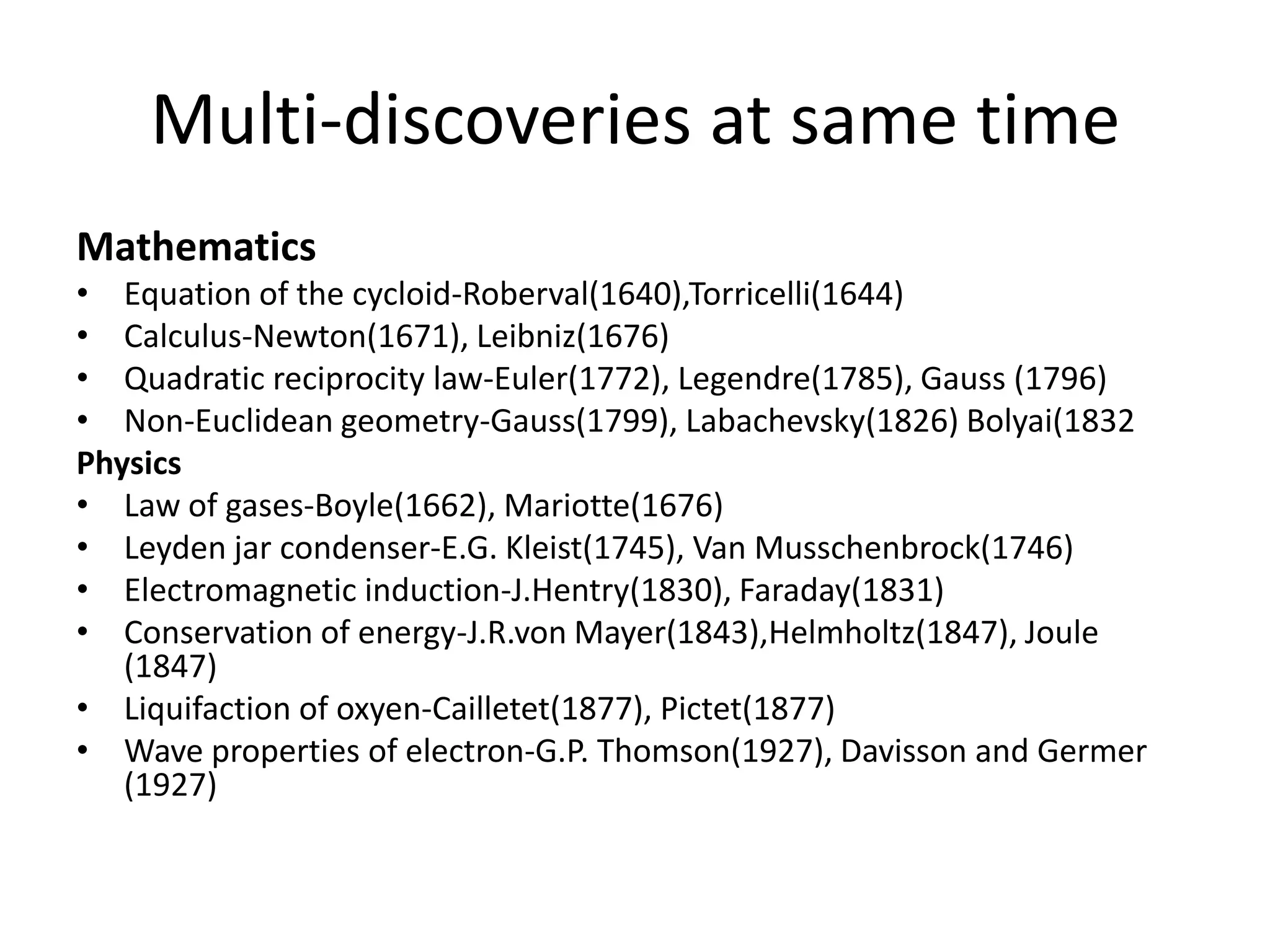
Multi-discoveries at same timeMathematicsEquation of the cycloid-Roberval(1640),Torricelli(1644)Calculus-Newton(1671), Leibniz(1676)Quadratic reciprocity law-Euler(1772), Legendre(1785), Gauss (1796)Non-Euclidean geometry-Gauss(1799), Labachevsky(1826) Bolyai(1832PhysicsLaw of gases-Boyle(1662), Mariotte(1676)Leyden jar condenser-E.G. Kleist(1745), Van Musschenbrock(1746)Electromagnetic induction-J.Hentry(1830), Faraday(1831)Conservation of energy-J.R.von Mayer(1843),Helmholtz(1847), Joule (1847)Liquifaction of oxyen-Cailletet(1877), Pictet(1877)Wave properties of electron-G.P. Thomson(1927), Davisson and Germer (1927)
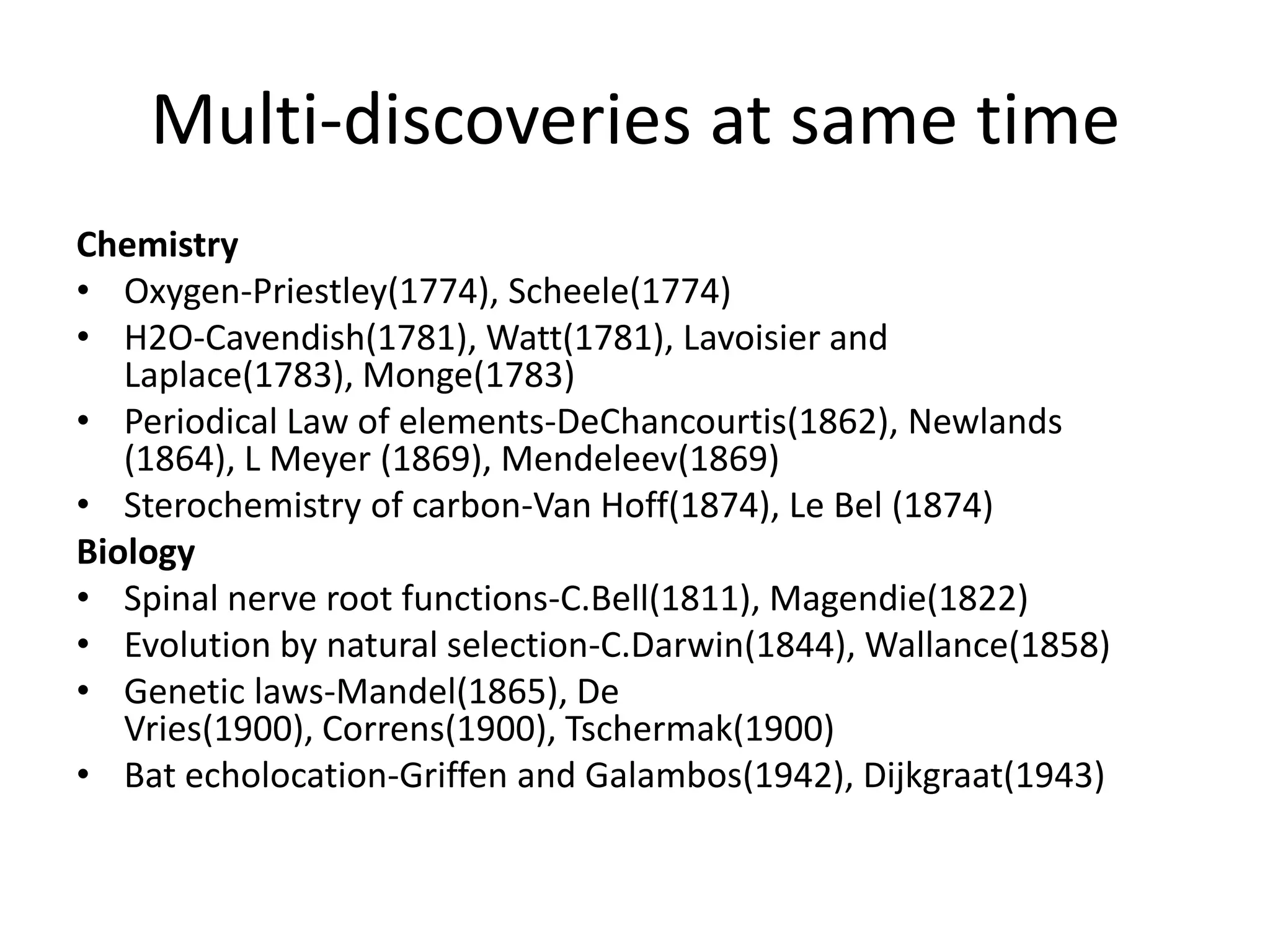
Multi-discoveries at same timeChemistryOxygen-Priestley(1774), Scheele(1774)H2O-Cavendish(1781), Watt(1781), Lavoisier and Laplace(1783), Monge(1783)Periodical Law of elements-DeChancourtis(1862), Newlands (1864), L Meyer (1869), Mendeleev(1869)Sterochemistry of carbon-Van Hoff(1874), Le Bel (1874)BiologySpinal nerve root functions-C.Bell(1811), Magendie(1822)Evolution by natural selection-C.Darwin(1844), Wallance(1858)Genetic laws-Mandel(1865), De Vries(1900), Correns(1900), Tschermak(1900)Bat echolocation-Griffen and Galambos(1942), Dijkgraat(1943)
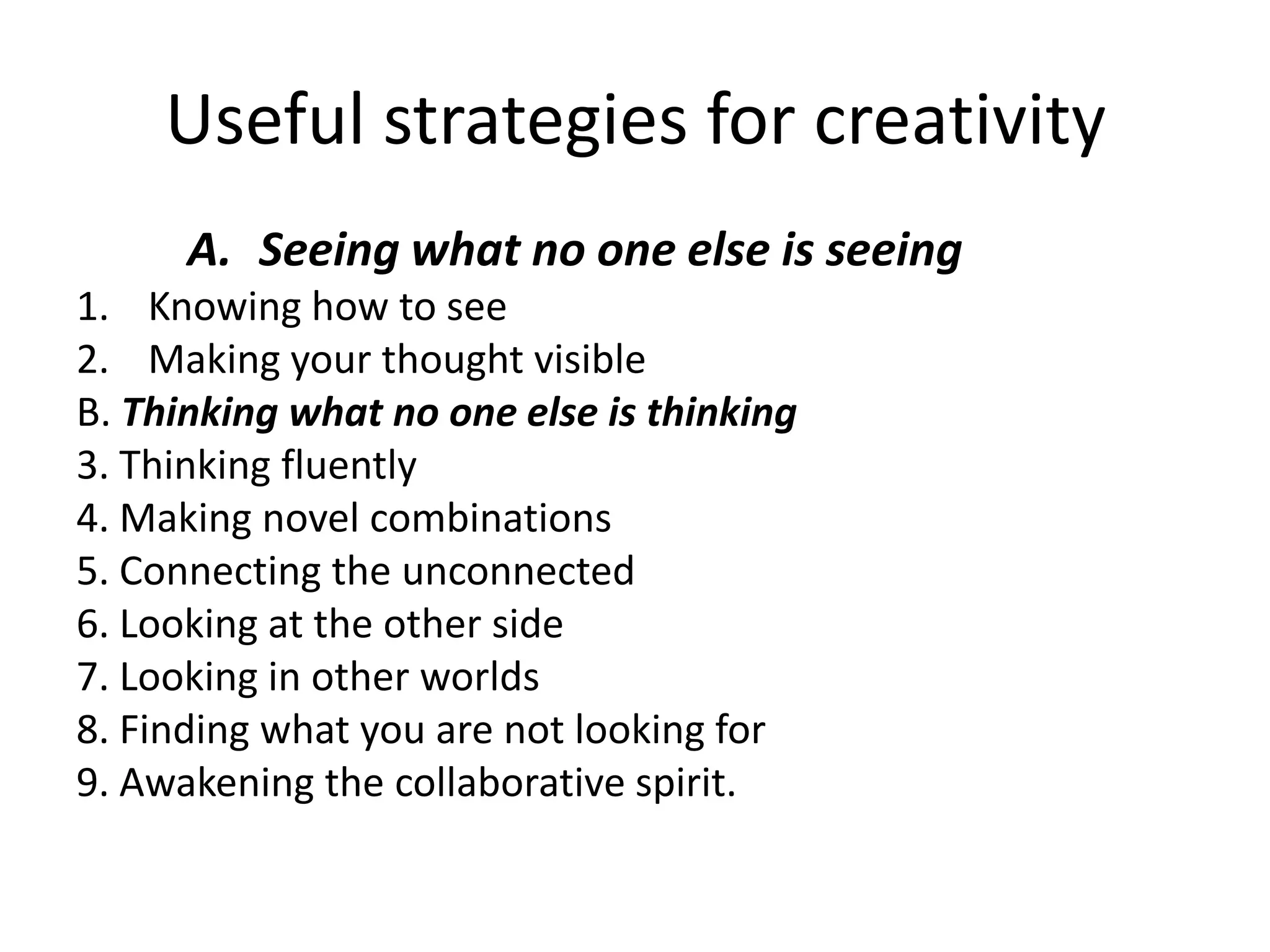
Useful strategies for creativitySeeing what no one else is seeingKnowing how to seeMaking your thought visibleB. Thinking what no one else is thinking3. Thinking fluently4. Making novel combinations5. Connecting the unconnected6. Looking at the other side7. Looking in other worlds8. Finding what you are not looking for9. Awakening the collaborative spirit.
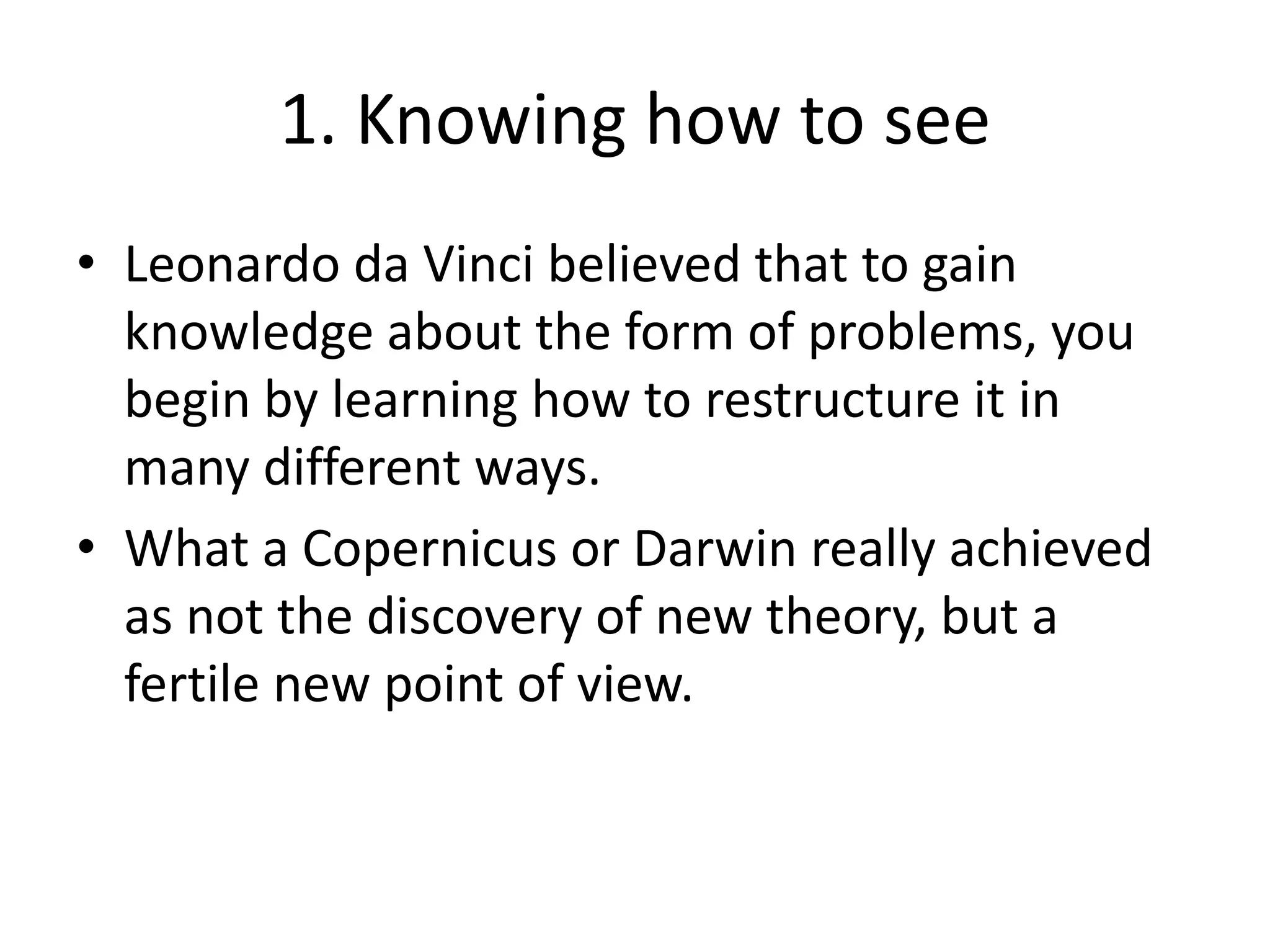
1. Knowing how to seeLeonardo da Vinci believed that to gain knowledge about the form of problems, you begin by learning how to restructure it in many different ways.What a Copernicus or Darwin really achieved as not the discovery of new theory, but a fertile new point of view.
2. Making your thoughts visibleGalileo revolutionized science by making his thought visible with diagrams and drawings, while his contemporaries used conventional verbal and algebraic approaches.Einstein, Edison and Darwin also used to put their thoughts in various diagrams to cover the jumps in logic.Tony Buzan, a British Brain researcher suggested mind mapping technique in early 1970s as a whole brain alternative to linear thinking.Francis Crick and James Watson built and experimented with single and double chained three-dimensional models that led to the discovery that DNA modecule is in the shape of “double helix” and won Noble Prize in 1962.
3. Thinking fluentlyCreative geniuses think fluently and flexibly, to generate quantities of ideas Creative geniuses think fluently because they  Defer judgment looking for ideas,    Generate many ideas as possible,    List their ideas as they occur     Allow their subconscious to generate ideas by incubating their subjectGeniuses are flexible thinkers because they extend their thinking by incorporating random, chance, and unrelated factors into their thinking processes.
3. Thinking fluentlyEinstein is best known for his theory of relativity, but he published 248 other papers.Darwin is known for his theory of evolution, but he wrote 119 other publications in his lifetime.Freud published 330 papers and Maslow 165 (psychology)Edison may be best known for his light bulb and phonograph, but he held 1093 patents.Edison looked at creativity as simply good, honest hard work.  Genius 1% inspiration and 99% perspiration.It took him 9000 experiments to perfect the light bulb and 50,000 experiments to invent the storage cell battery.Creativity follow Darwin theory(Simonton)
4.Making Nobel ConnectionsGeniuses are geniuses because they form more novel combinations than the merely talented.(Dean Keith Simonton)The law of heredity on which the modern science of genetics is based are the result of the work of Gregor Mendel who combined mathematics and biology to create this new science.Thomas Edison’s invention of a practical system of lighting involved combining wiring  in parallel circuits with high resistance filaments in his bulbs, two things that were not considered possible.
5. Connecting the UnconnectedChance discoveries favor the open, active mind that is consciously searching for connections.James Watt not the first person to notice steam escaping from a tea pot, but he was the first to make a connection between steam and transportation, and he invented the high pressure steam engine.
6. Looking at the other sidePeople commonly assume a set of boundaries to limit the solution. The solution may be outside those boundaries.Lateral Thinking-Edward D. Bono diagramThinking beyond squareBlue Ocean Strategies-exploring new business and making the competition irrelevant.
7. Looking in other worldAlexander Graham Bell observed the similarities between the inner workings of ear and the ability of a stout piece of membrane to move steel, and conceived the telephone.Thomas Edison invented the phonograph, in one day, after developing an analogy between a toy funnel and the motions of a paper man and sound vibrations.Newton’s legendary tale about the apple
8. Finding what you were not looking for.The discovery of the electromagnetic laws was a creative accident when the relationship between electricity and magnetism was first observed in 1820 by Oerstedin a public lecture at which he was demonstrating the known fact that electricity and magnetism were completely independent phenomena.  This time the experiment failed-an electric current produced a magnetic effect.
9. Awakening the Collaborative SpiritDr. David Bohm researched the lives of Einstein, Heisenberg, Pauli, and Bohr. He noticed that the breakthroughs in quantum physics is the result of dialogues among various scientists. The major breakthroughs are the result of open, simple and honest conversation among various scientists.
9. Awakening Collaborative SpiritConsider the discovery of DNA’s structure.  It is the result of successful collaboration of James Watson(microbiologist), Maurice Wilkins(X-ray crystallographer), Francis Crick (physicist) and Linus Pauling (chemist). Their different styles of work were key aspect to the discovery.What we can learn: dialogue (not discussion full of argumentation and interruption, with purpose to offend or defend)pursued with spirit to know and grow.Word democracy and dialogue have same roots.
DialogueDialogue is conducive to creativityDialogue involves:Personal mastery-you can not expect persons to deliver goods who have no goods. Suspension of mind, Authentic respect for others’ mind, not like in the marriage of camels, donkeys are singing songs in praise of figure of camels who appreciate their voice in reciprocity-neither know aesthetic sense. Listening totally-LISTEN and SILENTWith listening totally one can transcend duality.
Wishing For you creative future

Creativity The Unique Soft Skill

  • 1.
    Creativity-The Unique SoftSkillVarinder KumarAssociate Professor in Commerce
  • 2.
    Future is challengingChangeis the law of nature that never changes.Uncertainty is certainFace high and dry airs of higher mountains otherwise chances of chilling are too high.
  • 3.
    Future TechnologiesNano technologyBiotechnologyInformation technologyNeuro TechnologyJames Canton, 2006
  • 4.
    Five Minds forThe FutureDisciplined mind (specialised mind master of particular discipline), Synthesizing mind (mind capable of taking relevant information for decision making), Creating mind(mind focused at creativity by making association among different things), Respectful mind (mind capable of responding sympathetically and constructively to differences among different mindsets), andEthical mind( mind taking the ethical dimensions of different decisions). -Howard Gardner, pioneer of multiple intelligence
  • 5.
    CreativityCreativity stands fororiginality, something new,Some creations have profound and pervasive influence on the other works-like Upanishads, Geeta, Darwin’ theory of Evolution, Thus SpakeZarathutra
  • 6.
    Sources of CreativityThevarious sources of creativity includes: Solitude, Expert knowledge of the subject, Silence-absence of talks and thoughts Motivation-Money and Meaning( Story of dogs),Victor FrankleOpenness to new experiences, Belief in existence- “Events are happening and deeds are done and we are just witnessing it”(Buddha) or “What so ever is destined to happen shall happen” (Raman Maharishi). The only choice we have is either to identify pains and pleasures with body-mind Keeping yourself empty from negativity, Approaching the problem with fresh mind, Feeling of flow.
  • 7.
    Concept of flowAstate of mind when consciousness is full of experiences and these experiences are in harmony with each other.Effortless action as the person feels that in those moments he or she stands out as the best in their lives.“being in the zone”(Athletes), “aesthetic rapture”(artists and musicians)Flow occurs when challenges and skills are high. When challenges are low, skills high-state of boredom, if skills low, challenges high, there is anxiety. In such state when goals are clear, feedback relevant, and challenges and skills are in balance, attention(not Tension) becomes ordered and fully invested. The person feels deep involvement, psychic energy is completely focused.
  • 8.
    Behaviour of CreativePersonsMihalayCsikszentmihalyi , pioneer of the concept of flow interviewed 91 remarkable persons from 1990 to 1995 to know the behaviour of creative persons.Included in those 91 persons were 26 scientists, 14 were noble prize winners.Such noble prize winners include Yalow(Biology), Eigen, J. Karle, Pauling, Prigogine(Chemistry), Bardeen, Bethe, Chandrasekhar(Physics and Astronomy), Stigler(Economics)
  • 9.
    Behaviour of CreativePersonsCreative individuals have a great deal of physical energy, but they are also often quiet and at rest.Creative individuals tend to be smart, yet also naïve at the same time.Creative individuals are both playful and disciplined as well as responsible and casual in their approach.Creative individuals alternate between imagination and fantasy at one end and a rooted sense of reality at the other.Creative people seem to imbibe opposite tendencies on the continuum between extroversion and introversion.
  • 10.
    Behaviour of CreativePersons6. Creative individuals are also remarkably humble and proud at the same time.Creative individuals are beyond their gender role and display masculine as well as feminine tendencies.Creative people are rebellious and independent as well as traditional and conservative also.Creative people are passionate about their work yet are very objective about it.Creative people usually expose themselves to suffering and pain yet feel great deal of enjoyment.-MihalyCsikszentmihalyi
  • 11.
    Story Of Gurdjief/NelsonMandelaI am dealing in energy.Whether there is good business or bad business, we shall always make profits.(Gurdjieff)The persons who have imprisoned me are themselves imprisoned of their wrong perceptions.Choice-either look at bars or stars.
  • 12.
    Four Perspective ofScientificCreativity LogicGeniusChanceSpirit of Time Why scientific creativity-because of objectivityObjective art and subjective art-Gurdjieff.With awareness/mindfulness-objectivity
  • 13.
    1. LogicInductive logic-FrancisBaconDeductive Logic-Newton, Darwin(Malthus and Charles Lyell).Inductive logic has been used to rediscover Kepler’s Third Law of planetary motion, Black’s law of temperature equilibrium, Ohm’s Law of current and resistance,
  • 14.
    Role and Limitationof LogicLogic has a substantial but circumscribed part to play in scientific creativity.New discoveries demand original solution than routine processes of deduction can not offer.Logic often limits the combinational operations.Logic defines, determines and demarcates the degree of randomness in the combinational processes.
  • 15.
    Historical Examples ofLimitation of LogicScientists may not notice the inherent problems in their logical process until their findings are reviewed by their peers.Quantum revolution dispensed with some basic logical principles that have governed science for centuries.GottlobFrege, having spent many years developing a complete mathematical logic was pointed out by Betrand Russell(mathematician awarded noble prize for literature/philosophy) about logical contradiction that undermined the entire enterprise.
  • 16.
    2. GeniusScientific creativityrequires some special abilities or traits above those average or mediocrity.Theory of Multiple Intelligence-Gardner Scientific discoveries follow Darwin process of natural selection where 95% species do not survive. Similarly genius has vast knowledge but hardly 5% survives and known to the world.Genius in truth means little more than the faculty of perceiving in an unhabitual way.William James
  • 17.
    3. Chance FactorsChanceis the only source of true noveltyFrancis Crick (co discovered of DNA)Discovery process might be best described as disorderly, unpredictable and chaotic.Ideas emerge more by happy accident than by design or deliberation.“brevity, suddenness and immediate certainty”-Poincare (mathematician)Eurela(I have found it)Chance favours only the prepared mind.Louis Pasteur.Slow and Sudden method of enlightenment-Buddha/Patanjali
  • 18.
    Chance factors-some representativeepisodesColumbus-New World(1492)Grimaldi-interference of light(1663)Hauy-geometric laws of crystallography(1781)Galvani-animal electricity(1791)Davy-laughing gas anesthesia(1798)Oersted- eletromagnetism(1820)Schonbein-ozone (1839)Daguerre-photography (daguerrotype)(1839)Perkin-synthetic coal-tar dyes(1856)Kirchhoff-D-line in the solar spectrum(1859)Nobel-dynamite(1866)
  • 19.
    Chance FactorsEdison-phonography(1877)Pasteur-vaccination (1878)Fahlberg-saccharin(1879)Rontgen-X-rays(1895)Bacquerel-radioactivity(1896)Richet-induced sensitization(anaphylaxis)(1902)Pavlov-classical conditioning(1902)Fleming-penicillin(1928)Dam-vitamin K(1929)Domagk-sulfa drugs(Prontosil) (1932)Plunkett-teflon(1938)De Maestral-velcro(1948)
  • 20.
    4.Spirit ofTimeSociologists of science have argued that discoveries and inventions are the inevitable product of the social cultural system.“discoveries and inventions become virtually inevitable (1) as prerequisite kinds of knowledge accumulate in man’s cultural store (2) as the attention of a sufficient number of developments internal to the particular science, or by both” –Robert Merton(1961Example of solar energy destined to happen!
  • 21.
    Multi-discoveries at sametimeMathematicsEquation of the cycloid-Roberval(1640),Torricelli(1644)Calculus-Newton(1671), Leibniz(1676)Quadratic reciprocity law-Euler(1772), Legendre(1785), Gauss (1796)Non-Euclidean geometry-Gauss(1799), Labachevsky(1826) Bolyai(1832PhysicsLaw of gases-Boyle(1662), Mariotte(1676)Leyden jar condenser-E.G. Kleist(1745), Van Musschenbrock(1746)Electromagnetic induction-J.Hentry(1830), Faraday(1831)Conservation of energy-J.R.von Mayer(1843),Helmholtz(1847), Joule (1847)Liquifaction of oxyen-Cailletet(1877), Pictet(1877)Wave properties of electron-G.P. Thomson(1927), Davisson and Germer (1927)
  • 22.
    Multi-discoveries at sametimeChemistryOxygen-Priestley(1774), Scheele(1774)H2O-Cavendish(1781), Watt(1781), Lavoisier and Laplace(1783), Monge(1783)Periodical Law of elements-DeChancourtis(1862), Newlands (1864), L Meyer (1869), Mendeleev(1869)Sterochemistry of carbon-Van Hoff(1874), Le Bel (1874)BiologySpinal nerve root functions-C.Bell(1811), Magendie(1822)Evolution by natural selection-C.Darwin(1844), Wallance(1858)Genetic laws-Mandel(1865), De Vries(1900), Correns(1900), Tschermak(1900)Bat echolocation-Griffen and Galambos(1942), Dijkgraat(1943)
  • 23.
    Useful strategies forcreativitySeeing what no one else is seeingKnowing how to seeMaking your thought visibleB. Thinking what no one else is thinking3. Thinking fluently4. Making novel combinations5. Connecting the unconnected6. Looking at the other side7. Looking in other worlds8. Finding what you are not looking for9. Awakening the collaborative spirit.
  • 24.
    1. Knowing howto seeLeonardo da Vinci believed that to gain knowledge about the form of problems, you begin by learning how to restructure it in many different ways.What a Copernicus or Darwin really achieved as not the discovery of new theory, but a fertile new point of view.
  • 25.
    2. Making yourthoughts visibleGalileo revolutionized science by making his thought visible with diagrams and drawings, while his contemporaries used conventional verbal and algebraic approaches.Einstein, Edison and Darwin also used to put their thoughts in various diagrams to cover the jumps in logic.Tony Buzan, a British Brain researcher suggested mind mapping technique in early 1970s as a whole brain alternative to linear thinking.Francis Crick and James Watson built and experimented with single and double chained three-dimensional models that led to the discovery that DNA modecule is in the shape of “double helix” and won Noble Prize in 1962.
  • 26.
    3. Thinking fluentlyCreativegeniuses think fluently and flexibly, to generate quantities of ideas Creative geniuses think fluently because they Defer judgment looking for ideas, Generate many ideas as possible, List their ideas as they occur Allow their subconscious to generate ideas by incubating their subjectGeniuses are flexible thinkers because they extend their thinking by incorporating random, chance, and unrelated factors into their thinking processes.
  • 27.
    3. Thinking fluentlyEinsteinis best known for his theory of relativity, but he published 248 other papers.Darwin is known for his theory of evolution, but he wrote 119 other publications in his lifetime.Freud published 330 papers and Maslow 165 (psychology)Edison may be best known for his light bulb and phonograph, but he held 1093 patents.Edison looked at creativity as simply good, honest hard work. Genius 1% inspiration and 99% perspiration.It took him 9000 experiments to perfect the light bulb and 50,000 experiments to invent the storage cell battery.Creativity follow Darwin theory(Simonton)
  • 28.
    4.Making Nobel ConnectionsGeniusesare geniuses because they form more novel combinations than the merely talented.(Dean Keith Simonton)The law of heredity on which the modern science of genetics is based are the result of the work of Gregor Mendel who combined mathematics and biology to create this new science.Thomas Edison’s invention of a practical system of lighting involved combining wiring in parallel circuits with high resistance filaments in his bulbs, two things that were not considered possible.
  • 29.
    5. Connecting theUnconnectedChance discoveries favor the open, active mind that is consciously searching for connections.James Watt not the first person to notice steam escaping from a tea pot, but he was the first to make a connection between steam and transportation, and he invented the high pressure steam engine.
  • 30.
    6. Looking atthe other sidePeople commonly assume a set of boundaries to limit the solution. The solution may be outside those boundaries.Lateral Thinking-Edward D. Bono diagramThinking beyond squareBlue Ocean Strategies-exploring new business and making the competition irrelevant.
  • 31.
    7. Looking inother worldAlexander Graham Bell observed the similarities between the inner workings of ear and the ability of a stout piece of membrane to move steel, and conceived the telephone.Thomas Edison invented the phonograph, in one day, after developing an analogy between a toy funnel and the motions of a paper man and sound vibrations.Newton’s legendary tale about the apple
  • 32.
    8. Finding whatyou were not looking for.The discovery of the electromagnetic laws was a creative accident when the relationship between electricity and magnetism was first observed in 1820 by Oerstedin a public lecture at which he was demonstrating the known fact that electricity and magnetism were completely independent phenomena. This time the experiment failed-an electric current produced a magnetic effect.
  • 33.
    9. Awakening theCollaborative SpiritDr. David Bohm researched the lives of Einstein, Heisenberg, Pauli, and Bohr. He noticed that the breakthroughs in quantum physics is the result of dialogues among various scientists. The major breakthroughs are the result of open, simple and honest conversation among various scientists.
  • 34.
    9. Awakening CollaborativeSpiritConsider the discovery of DNA’s structure. It is the result of successful collaboration of James Watson(microbiologist), Maurice Wilkins(X-ray crystallographer), Francis Crick (physicist) and Linus Pauling (chemist). Their different styles of work were key aspect to the discovery.What we can learn: dialogue (not discussion full of argumentation and interruption, with purpose to offend or defend)pursued with spirit to know and grow.Word democracy and dialogue have same roots.
  • 35.
    DialogueDialogue is conduciveto creativityDialogue involves:Personal mastery-you can not expect persons to deliver goods who have no goods. Suspension of mind, Authentic respect for others’ mind, not like in the marriage of camels, donkeys are singing songs in praise of figure of camels who appreciate their voice in reciprocity-neither know aesthetic sense. Listening totally-LISTEN and SILENTWith listening totally one can transcend duality.
  • 36.
    Wishing For youcreative future