Online education is rapidly expanding and transforming the role of instructors and learning experiences for students. A survey found that nearly 70% of higher education institutions now consider online education critical to their long-term strategy, up from less than 50% in 2001. The number of students taking at least one online course per year has increased to over 7 million students, or 33.5% of higher education students. As online learning grows, students will need to develop greater self-discipline to succeed in online courses. Instructors will also transition to becoming facilitators of learning rather than deliverers of information.
Introduction
Online educationaldelivery options are rapidly expanding
Online education enables learning to take place when you need it
and where you need it
Online education expands opportunities for learners to customize
learning experiences based upon their individual interests and
needs
Social networking expands opportunities for informal learning for
both students and instructors
Online education is dramatically transforming the role of instructors
3.
Expansion Trends forOnline
Learning
According to a recent survey of over 2,800 higher learning
institutions conducted by the Alfred P. Sloan Foundation, less than
one-half of all higher education institutions reported online
education was critical to their long-term strategy in 2001.
In 2013, that number was at an all-time high of close to seventy
percent.
In the same report by the Alfred P. Sloan Foundation, only 9.7
percent of higher education institutions reported that online
education was not critical to their long-term strategy
4.
Online Education expandseducational
access beyond the physical campus
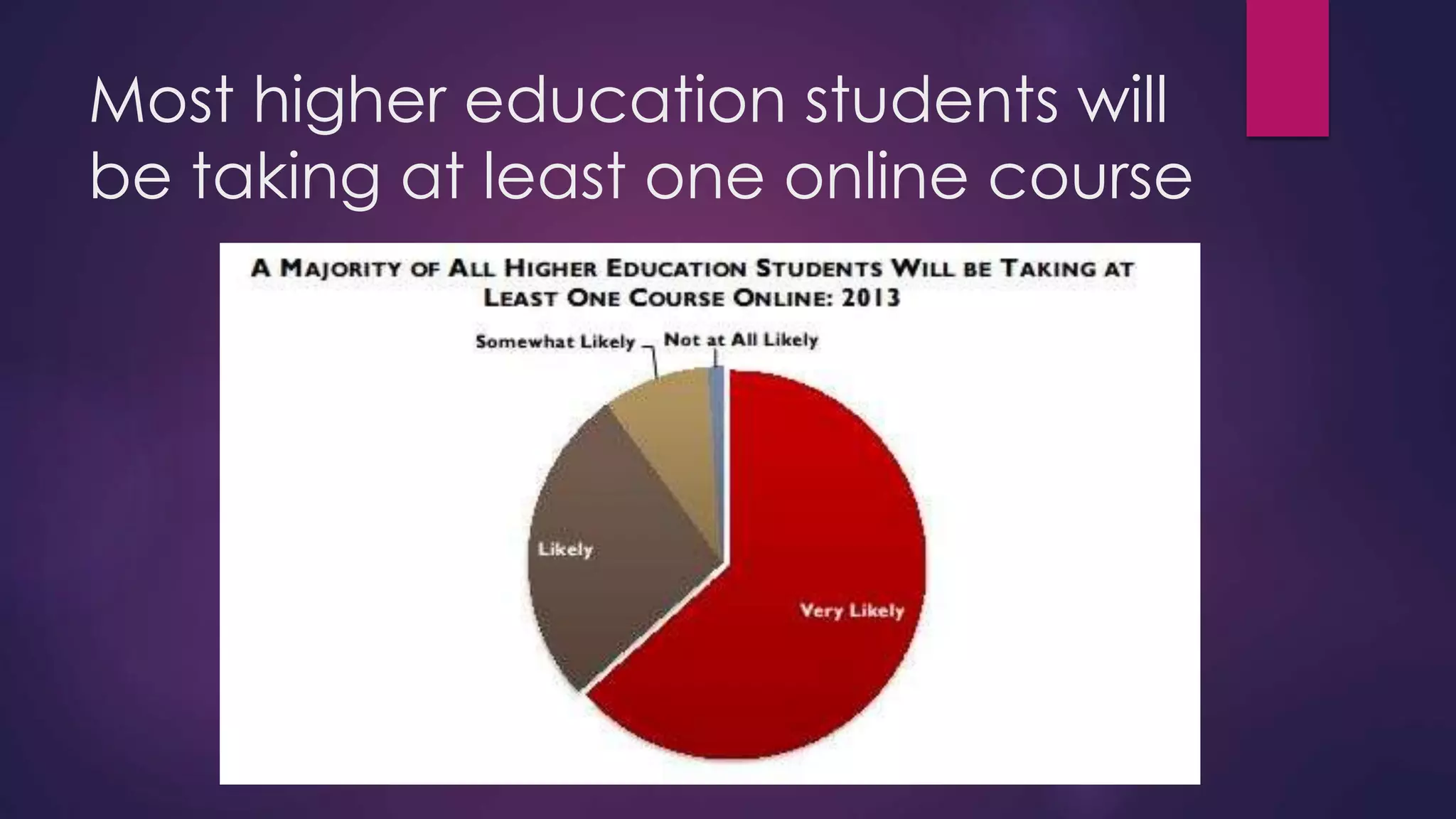
The number of students taking at least one online course increased
by over 411,000 to a new total of 7.1 million in 2013.
The proportion of higher education students taking at least one
online course is at an all-time high of 33.5 percent.
Two-thirds of chief academic officers believe that there will be
substantial use of student-directed, self-paced components in future
online courses
Online learning canincrease the
relevance of learning for students
With online learning and online courses, student are able to extend
their learning environments anywhere where there is access to the
Internet
Students may choose to focus more on areas they need and will no
longer be bound to sitting through lectures and activities that cover
information they already have
With social networking students can choose to learn about things
they are interested in
8.
Online learning willrequire
increased self-discipline for students
While online learning expands opportunities for students, leaders of
higher education recognize it also requires greater discipline on the
part of students
According to the 2013 Sloan survey, more than 68% of the surveyed
institutions agreed that students need more discipline to succeed in
an online course than in a face-to-face course.
Online teachers will need to develop strategies to help strengthen
self-discipline among the growing population of online learners
9.
Social Networking expandsinformal
learning opportunities
Social networking sites like Facebook will increasingly enable
learners to focus on information they are interested in
Students can collaborate with others throughout the world
Students aren’t limited to sharing and gaining knowledge within the
same grade level
10.
Online learning willdramatically
change the role of the instructor
Instructors will no longer be the deliverer of information
Instructors will increasing become facilitators of learning
Student-centered learning will replace Instructor-centered learning
11.
Conclusion
Online learningopportunities and options will continue to grow, and
the number of students taking online courses will continue to
expand
Learning will be more customized to the needs of the learner
Students will need to develop an increased level of self-discipline to
succeed in the online learning environment
The role of the instructor will change dramatically with the growth of
online delivery models
Editor's Notes
#5 Allen, Elaine. Grade Change: Tracking Online Education in the United States. Rep. no. 978-0-9840288-4-9. N.p.: Babson Survey Research Group, 2014. Print.
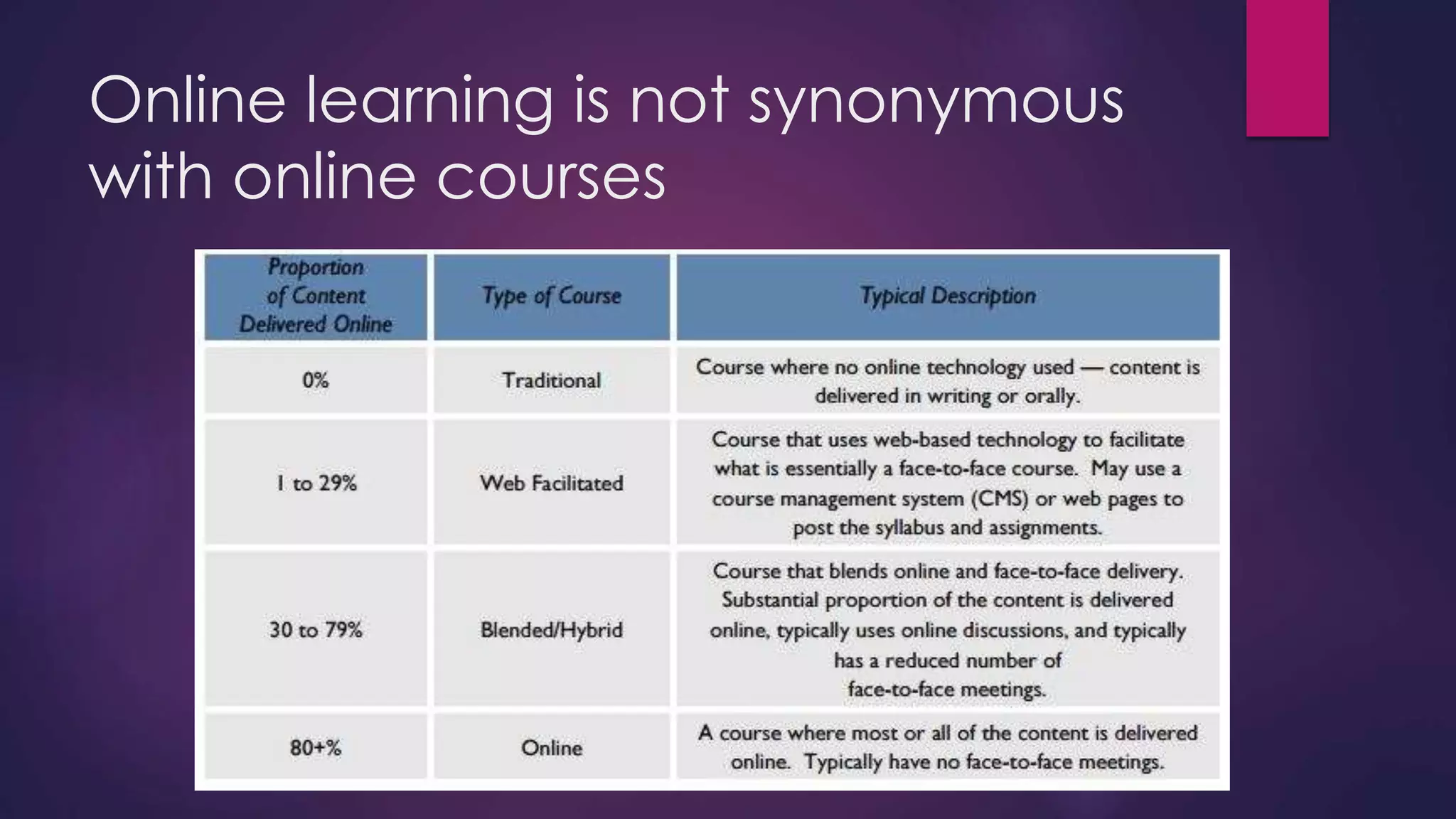
#6 The chart above provides a means to classify the different types of web-based learning found on campuses today. From the chart we see there can be quite a difference in the proportion of content delivered online. When we say “online learning”, it may refer to web facilitated, blended/hybrid or online. True online courses are those that deliver over 80% of content online.
Allen, Elaine. Grade Change: Tracking Online Education in the United States. Rep. no. 978-0-9840288-4-9. N.p.: Babson Survey Research Group, 2014. Print.
#7 Allen, Elaine. Grade Change: Tracking Online Education in the United States. Rep. no. 978-0-9840288-4-9. N.p.: Babson Survey Research Group, 2014. Print.
#9 Allen, Elaine. Grade Change: Tracking Online Education in the United States. Rep. no. 978-0-9840288-4-9. N.p.: Babson Survey Research Group, 2014. Print.