S o l v i n g t h e T E F T h ro u g h
S t u d e n t C e n t r i c i t y
Benjamin Stein
Director, Student Success - Hobsons
London, UK | February 2017
Harder than ever to get the
right student to the
university
Retaining students becomes
critical
Connecting students with their future
The critical change over the last few years is that the vast majority of
universities are no longer in a process of selecting; they are in a process of
recruiting. Very few institutions have been able to both increase their
average tariff and increase student numbers. The price of expansion for
most institutions is a lowering of the entry threshold.
The HE market for hopes and dreams: UCAS on results day
Wonkhe
Harder than ever to get the
right student to the university
Retaining students
becomes critical
Connecting students with their future
Such variability is not simply a statistic, nor even simply a squandering of
taxpayers’ money. It is worse: it represents thousands of life opportunities
wasted, of young dreams unfulfilled, all because of teaching that was not
as good as it should have been, or because students were recruited who
were not capable of benefitting from higher education.
Success as a Knowledge Economy: Teaching Excellence, Social Mobility and
Student Choice
Department for Business, Innovation and Skills
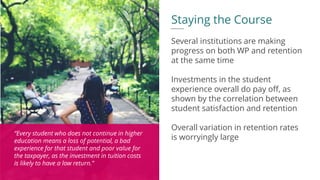
“Every student who does not continue in higher
education means a loss of potential, a bad
experience for that student and poor value for
the taxpayer, as the investment in tuition costs
is likely to have a low return.”
Staying the Course
Several institutions are making
progress on both WP and retention
at the same time
Investments in the student
experience overall do pay off, as
shown by the correlation between
student satisfaction and retention
Overall variation in retention rates
is worryingly large
Staying the Course
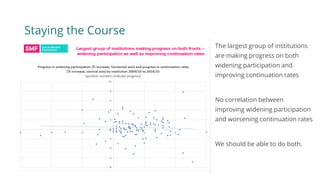
The largest group of institutions
are making progress on both
widening participation and
improving continuation rates
No correlation between
improving widening participation
and worsening continuation rates
We should be able to do both.
Staying the Course
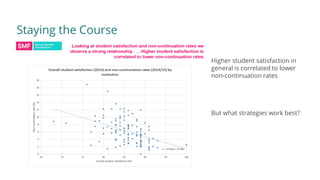
Higher student satisfaction in
general is correlated to lower
non-continuation rates
But what strategies work best?
T E F
How to respond: defining student-centricity
Awash in jargon
Orienting university resources,
people and process around their
potential impact on the student
A mindset that encompasses and
supports retention, engagement,
satisfaction and other critical
concepts
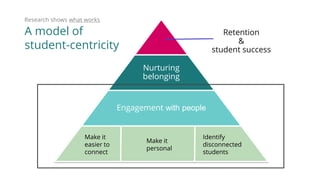
Retention
&
student success
Nurturing
belonging
Engagement with people
Make it
easier to
connect
Make it
personal
Identify
disconnected
students
Research shows what works
A model of
student-centricity
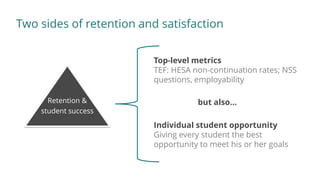
Retention &
student success
Individual student opportunity
Giving every student the best
opportunity to meet his or her goals
Top-level metrics
TEF: HESA non-continuation rates; NSS
questions, employability
Two sides of retention and satisfaction
but also…
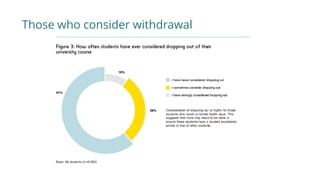
Those who consider withdrawal
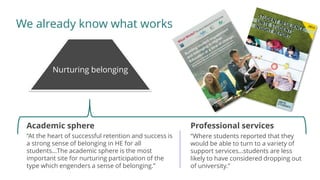
Nurturing belonging
We already know what works
“At the heart of successful retention and success is
a strong sense of belonging in HE for all
students…The academic sphere is the most
important site for nurturing participation of the
type which engenders a sense of belonging.”
Academic sphere Professional services
“Where students reported that they
would be able to turn to a variety of
support services…students are less
likely to have considered dropping out
of university.”
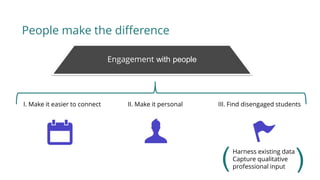
People make the difference
Engagement with people
I. Make it easier to connect II. Make it personal III. Find disengaged students
Harness existing data
Capture qualitative
professional input(
Student Success and Engagement
Professional
services
Early alert Personal
tutoring
Data &
analytics
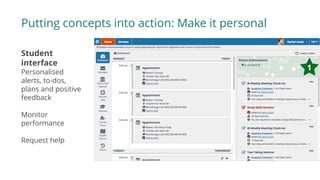
Putting concepts into action: Make it personal
Student
interface
Personalised
alerts, to-dos,
plans and positive
feedback
Monitor
performance
Request help
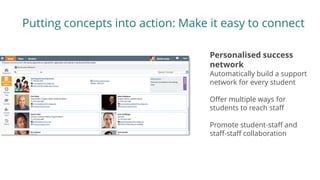
Putting concepts into action: Make it easy to connect
Personalised success
network
Automatically build a support
network for every student
Offer multiple ways for
students to reach staff
Promote student-staff and
staff-staff collaboration
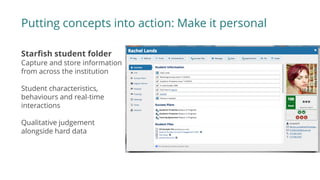
Putting concepts into action: Make it personal
Starfish student folder
Capture and store information
from across the institution
Student characteristics,
behaviours and real-time
interactions
Qualitative judgement
alongside hard data
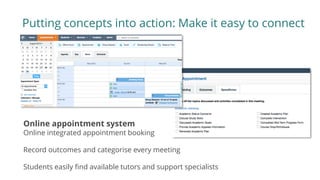
Putting concepts into action: Make it easy to connect
Online appointment system
Online integrated appointment booking
Record outcomes and categorise every meeting
Students easily find available tutors and support specialists
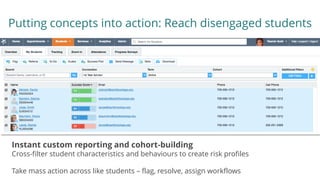
Putting concepts into action: Reach disengaged students
Instant custom reporting and cohort-building
Cross-filter student characteristics and behaviours to create risk profiles
Take mass action across like students – flag, resolve, assign workflows
In the real world
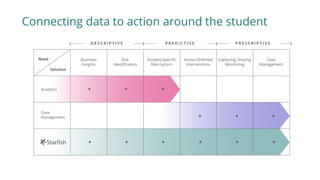
Connecting data to action around the student
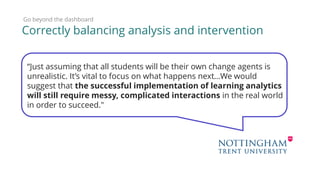
Correctly balancing analysis and intervention
Go beyond the dashboard
“Just assuming that all students will be their own change agents is
unrealistic. It’s vital to focus on what happens next…We would
suggest that the successful implementation of learning analytics
will still require messy, complicated interactions in the real world
in order to succeed."
A community of practice
Making it easy for
students to connect
Academic departments opting in by
year
2014: 3
2015: 5
2016: 9
“I think the system is a great idea, it’s
pretty intuitive to use. I think Starfish
would make it more likely that people
would approach staff to discuss their
academic problems.”
-Student,
Imperial College London
Success Stories
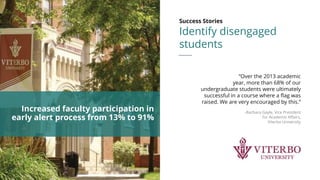
“Over the 2013 academic
year, more than 68% of our
undergraduate students were ultimately
successful in a course where a flag was
raised. We are very encouraged by this.”
-Barbara Gayle, Vice President
for Academic Affairs,
Viterbo University
Increased faculty participation in
early alert process from 13% to 91%
Identify disengaged
students
Success Stories
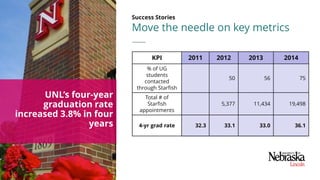
UNL’s four-year
graduation rate
increased 3.8% in four
years
Move the needle on key metrics
KPI 2011 2012 2013 2014
% of UG
students
contacted
through Starfish
50 56 75
Total # of
Starfish
appointments
5,377 11,434 19,498
4-yr grad rate 32.3 33.1 33.0 36.1
Success Stories
Consider the initial approach1
2
3
Three things you can do today
Academic/personal tutoring
Talk to us. Have us come see you. Visit our partner clients.
Get started. Technology catalyses important conversations.
Professional services
Institution-wide
Questions?
benjamin.stein@hobsons.com

Solving the TEF Through Student Centricity

  • 1.
    S o lv i n g t h e T E F T h ro u g h S t u d e n t C e n t r i c i t y Benjamin Stein Director, Student Success - Hobsons London, UK | February 2017
  • 2.
    Harder than everto get the right student to the university Retaining students becomes critical Connecting students with their future
  • 3.
    The critical changeover the last few years is that the vast majority of universities are no longer in a process of selecting; they are in a process of recruiting. Very few institutions have been able to both increase their average tariff and increase student numbers. The price of expansion for most institutions is a lowering of the entry threshold. The HE market for hopes and dreams: UCAS on results day Wonkhe
  • 4.
    Harder than everto get the right student to the university Retaining students becomes critical Connecting students with their future
  • 5.
    Such variability isnot simply a statistic, nor even simply a squandering of taxpayers’ money. It is worse: it represents thousands of life opportunities wasted, of young dreams unfulfilled, all because of teaching that was not as good as it should have been, or because students were recruited who were not capable of benefitting from higher education. Success as a Knowledge Economy: Teaching Excellence, Social Mobility and Student Choice Department for Business, Innovation and Skills
  • 6.
    “Every student whodoes not continue in higher education means a loss of potential, a bad experience for that student and poor value for the taxpayer, as the investment in tuition costs is likely to have a low return.” Staying the Course Several institutions are making progress on both WP and retention at the same time Investments in the student experience overall do pay off, as shown by the correlation between student satisfaction and retention Overall variation in retention rates is worryingly large
  • 7.
    Staying the Course Thelargest group of institutions are making progress on both widening participation and improving continuation rates No correlation between improving widening participation and worsening continuation rates We should be able to do both.
  • 8.
    Staying the Course Higherstudent satisfaction in general is correlated to lower non-continuation rates But what strategies work best?
  • 9.
  • 10.
    How to respond:defining student-centricity Awash in jargon Orienting university resources, people and process around their potential impact on the student A mindset that encompasses and supports retention, engagement, satisfaction and other critical concepts
  • 11.
    Retention & student success Nurturing belonging Engagement withpeople Make it easier to connect Make it personal Identify disconnected students Research shows what works A model of student-centricity
  • 12.
    Retention & student success Individualstudent opportunity Giving every student the best opportunity to meet his or her goals Top-level metrics TEF: HESA non-continuation rates; NSS questions, employability Two sides of retention and satisfaction but also…
  • 13.
  • 14.
    Nurturing belonging We alreadyknow what works “At the heart of successful retention and success is a strong sense of belonging in HE for all students…The academic sphere is the most important site for nurturing participation of the type which engenders a sense of belonging.” Academic sphere Professional services “Where students reported that they would be able to turn to a variety of support services…students are less likely to have considered dropping out of university.”
  • 15.
    People make thedifference Engagement with people I. Make it easier to connect II. Make it personal III. Find disengaged students Harness existing data Capture qualitative professional input(
  • 16.
    Student Success andEngagement Professional services Early alert Personal tutoring Data & analytics
  • 17.
    Putting concepts intoaction: Make it personal Student interface Personalised alerts, to-dos, plans and positive feedback Monitor performance Request help
  • 18.
    Putting concepts intoaction: Make it easy to connect Personalised success network Automatically build a support network for every student Offer multiple ways for students to reach staff Promote student-staff and staff-staff collaboration
  • 19.
    Putting concepts intoaction: Make it personal Starfish student folder Capture and store information from across the institution Student characteristics, behaviours and real-time interactions Qualitative judgement alongside hard data
  • 20.
    Putting concepts intoaction: Make it easy to connect Online appointment system Online integrated appointment booking Record outcomes and categorise every meeting Students easily find available tutors and support specialists
  • 21.
    Putting concepts intoaction: Reach disengaged students Instant custom reporting and cohort-building Cross-filter student characteristics and behaviours to create risk profiles Take mass action across like students – flag, resolve, assign workflows
  • 22.
  • 23.
    Connecting data toaction around the student
  • 24.
    Correctly balancing analysisand intervention Go beyond the dashboard “Just assuming that all students will be their own change agents is unrealistic. It’s vital to focus on what happens next…We would suggest that the successful implementation of learning analytics will still require messy, complicated interactions in the real world in order to succeed."
  • 25.
  • 26.
  • 27.
    Making it easyfor students to connect Academic departments opting in by year 2014: 3 2015: 5 2016: 9 “I think the system is a great idea, it’s pretty intuitive to use. I think Starfish would make it more likely that people would approach staff to discuss their academic problems.” -Student, Imperial College London Success Stories
  • 28.
    “Over the 2013academic year, more than 68% of our undergraduate students were ultimately successful in a course where a flag was raised. We are very encouraged by this.” -Barbara Gayle, Vice President for Academic Affairs, Viterbo University Increased faculty participation in early alert process from 13% to 91% Identify disengaged students Success Stories
  • 29.
    UNL’s four-year graduation rate increased3.8% in four years Move the needle on key metrics KPI 2011 2012 2013 2014 % of UG students contacted through Starfish 50 56 75 Total # of Starfish appointments 5,377 11,434 19,498 4-yr grad rate 32.3 33.1 33.0 36.1 Success Stories
  • 30.
    Consider the initialapproach1 2 3 Three things you can do today Academic/personal tutoring Talk to us. Have us come see you. Visit our partner clients. Get started. Technology catalyses important conversations. Professional services Institution-wide
  • 31.