[ECE 2010]
Dr. R.K.Mugelan, Asst. Professor (Sr), SENSE, VIT
Course Outline
 Objective
 To give an overview of the fundamental concepts in
control systems and their applications
 Outcome
 Ability to apply mathematics and science in engineering
applications
 Understanding of the subject related concepts and of
contemporary issues
 Design thinking capability
Dr. R.K.Mugelan, Asst. Prof. (Sr), SENSE, VIT
2
Course Content
Dr. R.K.Mugelan, Asst. Prof. (Sr), SENSE, VIT
3
 Module:1 Introduction
 Module:2 Mathematical Modelling of Physical Systems
 Module:3 Controller and Compensator Design
 Module:4 Time Domain Response
 Module:5 Characterization of Systems
 Module:6 Frequency Domain Response
 Module:7 State Space Analysis
 Module:8 Contemporary Issues
References
Dr. R.K.Mugelan, Asst. Prof. (Sr), SENSE, VIT
4
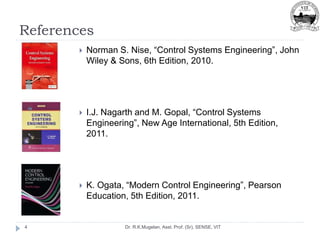
 Norman S. Nise, “Control Systems Engineering”, John
Wiley & Sons, 6th Edition, 2010.
 I.J. Nagarth and M. Gopal, “Control Systems
Engineering”, New Age International, 5th Edition,
2011.
 K. Ogata, “Modern Control Engineering”, Pearson
Education, 5th Edition, 2011.
Mobile Apps
Dr. R.K.Mugelan, Asst. Prof. (Sr), SENSE, VIT
5
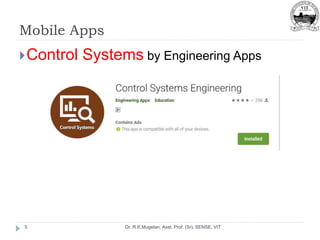
Control Systems by Engineering Apps
Introduction to Control Systems
Basic blocks – Types and Scope
Dr. R.K.Mugelan, Asst. Prof. (Sr), SENSE, VIT
6
System
Dr. R.K.Mugelan, Asst. Prof. (Sr), SENSE, VIT
7
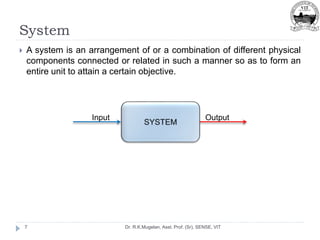
 A system is an arrangement of or a combination of different physical
components connected or related in such a manner so as to form an
entire unit to attain a certain objective.
Output
Input
Input
Dr. R.K.Mugelan, Asst. Prof. (Sr), SENSE, VIT
8
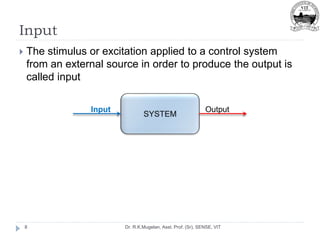
 The stimulus or excitation applied to a control system
from an external source in order to produce the output is
called input
Output
Input
Output
Dr. R.K.Mugelan, Asst. Prof. (Sr), SENSE, VIT
9
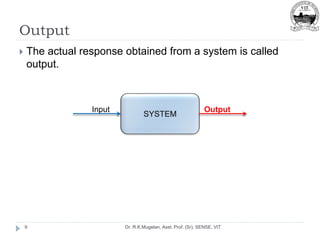
 The actual response obtained from a system is called
output.
Output
Input
Control
Dr. R.K.Mugelan, Asst. Prof. (Sr), SENSE, VIT
10
 It means to regulate, direct or command a system so
that the desired objective is attained.
Control System
Dr. R.K.Mugelan, Asst. Prof. (Sr), SENSE, VIT
11
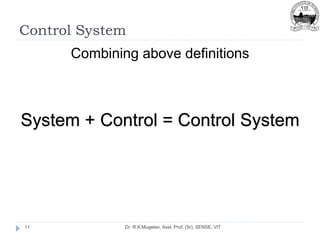
Combining above definitions
System + Control = Control System
Control System
Dr. R.K.Mugelan, Asst. Prof. (Sr), SENSE, VIT
12
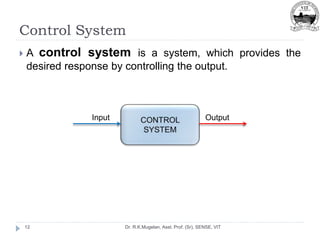
 A control system is a system, which provides the
desired response by controlling the output.
Output
Input
Difference Between
System & Control System
Dr. R.K.Mugelan, Asst. Prof. (Sr), SENSE, VIT
13
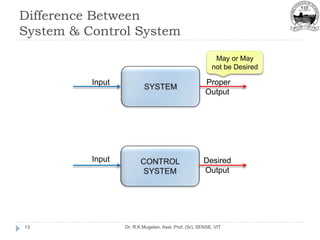
Proper
Output
Input
Desired
Output
Input
May or May
not be Desired
Difference Between
System & Control System
Dr. R.K.Mugelan, Asst. Prof. (Sr), SENSE, VIT
14
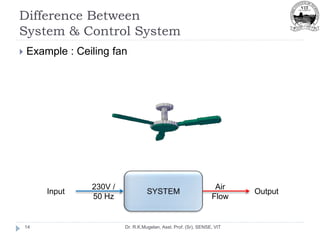
 Example : Ceiling fan
Air
Flow
230V /
50 Hz
Input Output
Difference Between
System & Control System
Dr. R.K.Mugelan, Asst. Prof. (Sr), SENSE, VIT
15
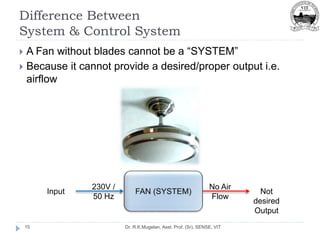
 A Fan without blades cannot be a “SYSTEM”
 Because it cannot provide a desired/proper output i.e.
airflow
No Air
Flow
230V /
50 Hz
Input Not
desired
Output
Difference Between
System & Control System
Dr. R.K.Mugelan, Asst. Prof. (Sr), SENSE, VIT
16
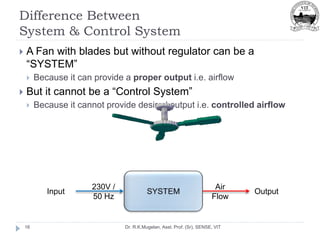
 A Fan with blades but without regulator can be a
“SYSTEM”
 Because it can provide a proper output i.e. airflow
 But it cannot be a “Control System”
 Because it cannot provide desired output i.e. controlled airflow
Air
Flow
230V /
50 Hz
Input Output
Difference Between
System & Control System
Dr. R.K.Mugelan, Asst. Prof. (Sr), SENSE, VIT
17
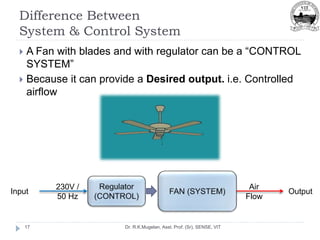
 A Fan with blades and with regulator can be a “CONTROL
SYSTEM”
 Because it can provide a Desired output. i.e. Controlled
airflow
230V /
50 Hz
Input
Air
Flow
Output
Classification of Control Systems
Dr. R.K.Mugelan, Asst. Prof. (Sr), SENSE, VIT
18
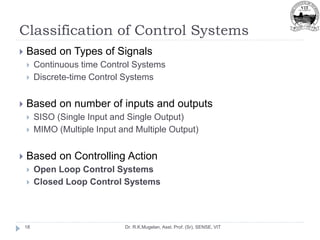
 Based on Types of Signals
 Continuous time Control Systems
 Discrete-time Control Systems
 Based on number of inputs and outputs
 SISO (Single Input and Single Output)
 MIMO (Multiple Input and Multiple Output)
 Based on Controlling Action
 Open Loop Control Systems
 Closed Loop Control Systems
Open Loop Control System
Dr. R.K.Mugelan, Asst. Prof. (Sr), SENSE, VIT
19
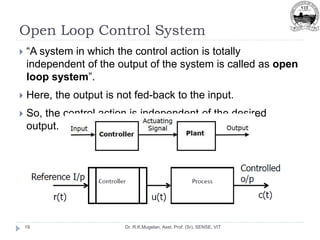
 “A system in which the control action is totally
independent of the output of the system is called as open
loop system”.
 Here, the output is not fed-back to the input.
 So, the control action is independent of the desired
output.
OLCS: Example
Dr. R.K.Mugelan, Asst. Prof. (Sr), SENSE, VIT
20
 Electric hand drier
 Hot air (output) comes out as long as you keep your hand under the
machine, irrespective of how much your hand is dried.
OLCS: Example
Dr. R.K.Mugelan, Asst. Prof. (Sr), SENSE, VIT
21
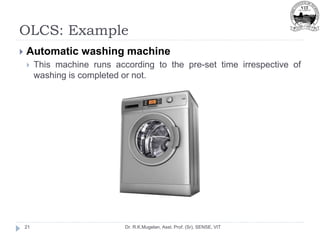
 Automatic washing machine
 This machine runs according to the pre-set time irrespective of
washing is completed or not.
OLCS: Example
Dr. R.K.Mugelan, Asst. Prof. (Sr), SENSE, VIT
22
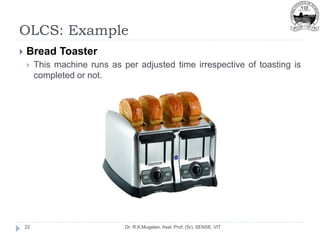
 Bread Toaster
 This machine runs as per adjusted time irrespective of toasting is
completed or not.
OLCS: Example
Dr. R.K.Mugelan, Asst. Prof. (Sr), SENSE, VIT
23
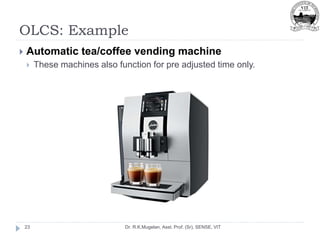
 Automatic tea/coffee vending machine
 These machines also function for pre adjusted time only.
OLCS: Example
Dr. R.K.Mugelan, Asst. Prof. (Sr), SENSE, VIT
24
 Light Switch
 lamps glow whenever light switch is on irrespective of light is
required or not.
 Volume on Stereo System
 Volume is adjusted manually irrespective of output volume level.
OLCS: Advantages
Dr. R.K.Mugelan, Asst. Prof. (Sr), SENSE, VIT
25
 Simple in construction and design.
 Economical.
 Easy to maintain.
 Generally stable.
 Ease of use.
OLCS: Disadvantages
Dr. R.K.Mugelan, Asst. Prof. (Sr), SENSE, VIT
26
 They are inaccurate
 They are unreliable
 Any change in output cannot be corrected automatically.
Closed Loop Control System
Dr. R.K.Mugelan, Asst. Prof. (Sr), SENSE, VIT
27
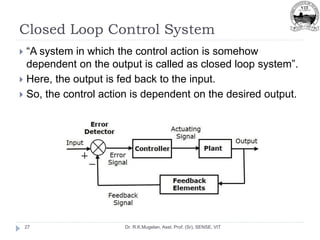
 “A system in which the control action is somehow
dependent on the output is called as closed loop system”.
 Here, the output is fed back to the input.
 So, the control action is dependent on the desired output.
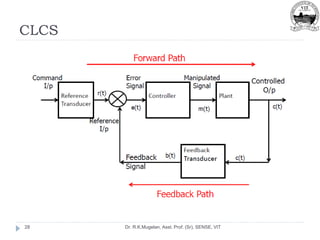
CLCS
Dr. R.K.Mugelan, Asst. Prof. (Sr), SENSE, VIT
28
Example : CLCS
Dr. R.K.Mugelan, Asst. Prof. (Sr), SENSE, VIT
29
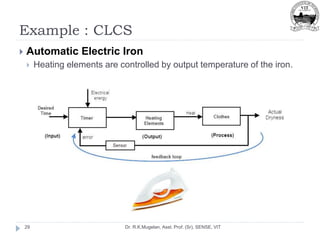
 Automatic Electric Iron
 Heating elements are controlled by output temperature of the iron.
Example: CLCS
Dr. R.K.Mugelan, Asst. Prof. (Sr), SENSE, VIT
30
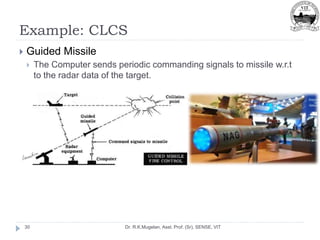
 Guided Missile
 The Computer sends periodic commanding signals to missile w.r.t
to the radar data of the target.
Example: CLCS
Dr. R.K.Mugelan, Asst. Prof. (Sr), SENSE, VIT
31
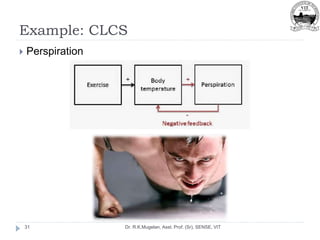
 Perspiration
CLCS: Advantages
Dr. R.K.Mugelan, Asst. Prof. (Sr), SENSE, VIT
32
 Closed loop control systems are more accurate even in
the presence of non-linearity.
 Highly accurate as any error arising is corrected due to
presence of feedback signal.
 Bandwidth range is large.
 Facilitates automation.
 The sensitivity of system may be made small to make
system more stable.
 This system is less affected by noise.
CLCS: Disadvantages
Dr. R.K.Mugelan, Asst. Prof. (Sr), SENSE, VIT
33
 They are costlier.
 They are complicated to design.
 Required more maintenance.
 Feedback leads to oscillatory response.
 Overall gain is reduced due to presence of feedback.
 Stability is the major problem and more care is needed to
design a stable closed loop system.
Difference between OLCS & CLCS
Dr. R.K.Mugelan, Asst. Prof. (Sr), SENSE, VIT
34
Open Loop Control System
 The open loop systems are
simple & economical.
 They consume less power.
 The OL systems are easier to
construct because of less
number of components
required.
 The open loop systems are
inaccurate & unreliable
Closed Loop Control System
 The closed loop systems are
complex and costlier
 They consume more power.
 The CL systems are not easy to
construct because of more
number of components
required.
 The closed loop systems are
accurate & more reliable.
Difference between OLCS & CLCS
Dr. R.K.Mugelan, Asst. Prof. (Sr), SENSE, VIT
35
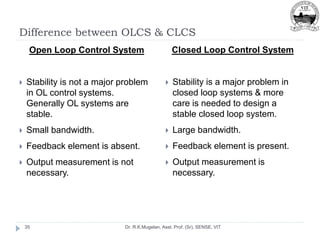
Open Loop Control System
 Stability is not a major problem
in OL control systems.
Generally OL systems are
stable.
 Small bandwidth.
 Feedback element is absent.
 Output measurement is not
necessary.
Closed Loop Control System
 Stability is a major problem in
closed loop systems & more
care is needed to design a
stable closed loop system.
 Large bandwidth.
 Feedback element is present.
 Output measurement is
necessary.
Feedback System
Dr. R.K.Mugelan, Asst. Prof. (Sr), SENSE, VIT
36
 There are two types of feedback −
 Positive feedback
 Negative feedback
Positive Feedback
Dr. R.K.Mugelan, Asst. Prof. (Sr), SENSE, VIT
37
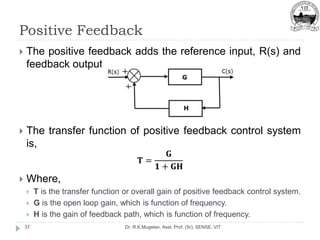
 The positive feedback adds the reference input, R(s) and
feedback output.
 The transfer function of positive feedback control system
is,
𝐓 =
𝐆
𝟏 + 𝐆𝐇
 Where,
 T is the transfer function or overall gain of positive feedback control system.
 G is the open loop gain, which is function of frequency.
 H is the gain of feedback path, which is function of frequency.
Negative Feedback
Dr. R.K.Mugelan, Asst. Prof. (Sr), SENSE, VIT
38
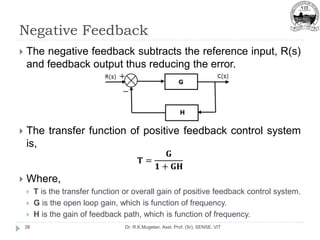
 The negative feedback subtracts the reference input, R(s)
and feedback output thus reducing the error.
 The transfer function of positive feedback control system
is,
𝐓 =
𝐆
𝟏 + 𝐆𝐇
 Where,
 T is the transfer function or overall gain of positive feedback control system.
 G is the open loop gain, which is function of frequency.
 H is the gain of feedback path, which is function of frequency.
Feedback Systems
Dr. R.K.Mugelan, Asst. Prof. (Sr), SENSE, VIT
39
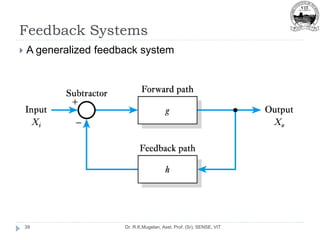
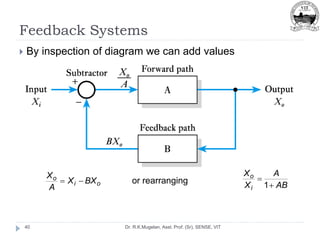
 A generalized feedback system
Feedback Systems
Dr. R.K.Mugelan, Asst. Prof. (Sr), SENSE, VIT
40
 By inspection of diagram we can add values
or rearranging
o
i
o BX
X
A
X


AB
A
X
X
i
o


1
Feedback Systems
Dr. R.K.Mugelan, Asst. Prof. (Sr), SENSE, VIT
41
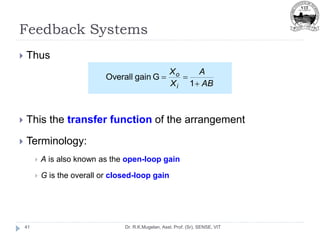
 Thus
 This the transfer function of the arrangement
 Terminology:
 A is also known as the open-loop gain
 G is the overall or closed-loop gain
AB
A
X
X
i
o



1
G
gain
Overall
Feedback Systems
Dr. R.K.Mugelan, Asst. Prof. (Sr), SENSE, VIT
42
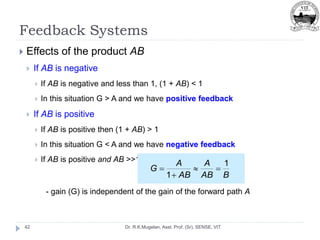
 Effects of the product AB
 If AB is negative
 If AB is negative and less than 1, (1 + AB) < 1
 In this situation G > A and we have positive feedback
 If AB is positive
 If AB is positive then (1 + AB) > 1
 In this situation G < A and we have negative feedback
 If AB is positive and AB >>1
- gain (G) is independent of the gain of the forward path A
B
AB
A
AB
A
G
1
1




Example
Dr. R.K.Mugelan, Asst. Prof. (Sr), SENSE, VIT
43
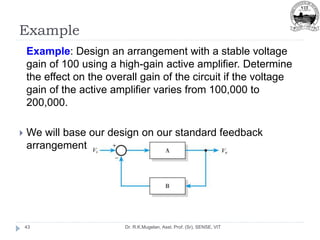
Example: Design an arrangement with a stable voltage
gain of 100 using a high-gain active amplifier. Determine
the effect on the overall gain of the circuit if the voltage
gain of the active amplifier varies from 100,000 to
200,000.
 We will base our design on our standard feedback
arrangement
Example
Dr. R.K.Mugelan, Asst. Prof. (Sr), SENSE, VIT
44
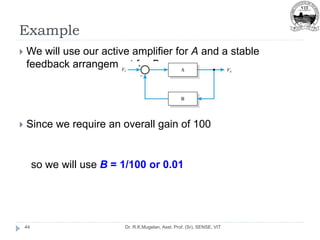
 We will use our active amplifier for A and a stable
feedback arrangement for B
 Since we require an overall gain of 100
so we will use B = 1/100 or 0.01
Example
Dr. R.K.Mugelan, Asst. Prof. (Sr), SENSE, VIT
45
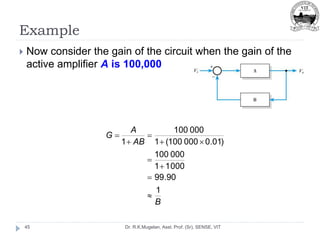
 Now consider the gain of the circuit when the gain of the
active amplifier A is 100,000
B
AB
A
G
1
90
.
99
000
1
1
000
100
)
01
.
0
000
100
(
1
000
100
1









Example
Dr. R.K.Mugelan, Asst. Prof. (Sr), SENSE, VIT
46
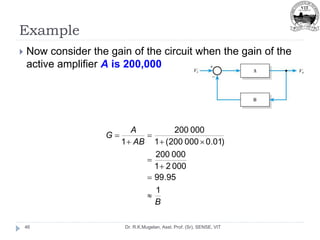
 Now consider the gain of the circuit when the gain of the
active amplifier A is 200,000
B
AB
A
G
1
95
.
99
000
2
1
000
200
)
01
.
0
000
200
(
1
000
200
1









Example
Dr. R.K.Mugelan, Asst. Prof. (Sr), SENSE, VIT
47
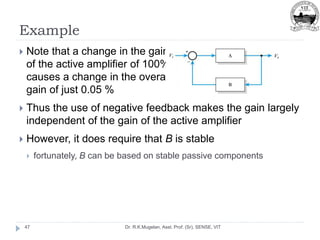
 Note that a change in the gain
of the active amplifier of 100%
causes a change in the overall
gain of just 0.05 %
 Thus the use of negative feedback makes the gain largely
independent of the gain of the active amplifier
 However, it does require that B is stable
 fortunately, B can be based on stable passive components
Other Types of Control Systems
Dr. R.K.Mugelan, Asst. Prof. (Sr), SENSE, VIT
48
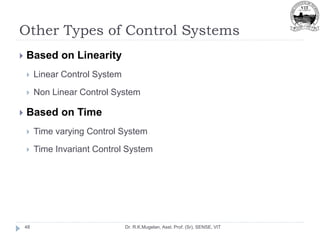
 Based on Linearity
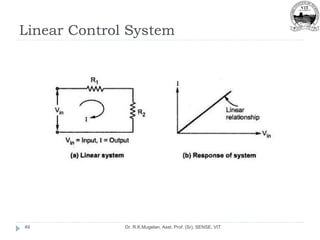
 Linear Control System
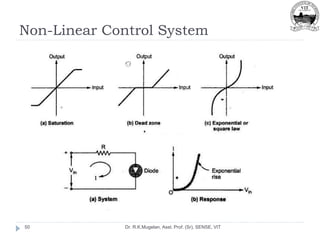
 Non Linear Control System
 Based on Time
 Time varying Control System
 Time Invariant Control System
Linear Control System
Dr. R.K.Mugelan, Asst. Prof. (Sr), SENSE, VIT
49
Non-Linear Control System
Dr. R.K.Mugelan, Asst. Prof. (Sr), SENSE, VIT
50

Introduction to Control System

  • 1.
    [ECE 2010] Dr. R.K.Mugelan,Asst. Professor (Sr), SENSE, VIT
  • 2.
    Course Outline  Objective To give an overview of the fundamental concepts in control systems and their applications  Outcome  Ability to apply mathematics and science in engineering applications  Understanding of the subject related concepts and of contemporary issues  Design thinking capability Dr. R.K.Mugelan, Asst. Prof. (Sr), SENSE, VIT 2
  • 3.
    Course Content Dr. R.K.Mugelan,Asst. Prof. (Sr), SENSE, VIT 3  Module:1 Introduction  Module:2 Mathematical Modelling of Physical Systems  Module:3 Controller and Compensator Design  Module:4 Time Domain Response  Module:5 Characterization of Systems  Module:6 Frequency Domain Response  Module:7 State Space Analysis  Module:8 Contemporary Issues
  • 4.
    References Dr. R.K.Mugelan, Asst.Prof. (Sr), SENSE, VIT 4  Norman S. Nise, “Control Systems Engineering”, John Wiley & Sons, 6th Edition, 2010.  I.J. Nagarth and M. Gopal, “Control Systems Engineering”, New Age International, 5th Edition, 2011.  K. Ogata, “Modern Control Engineering”, Pearson Education, 5th Edition, 2011.
  • 5.
    Mobile Apps Dr. R.K.Mugelan,Asst. Prof. (Sr), SENSE, VIT 5 Control Systems by Engineering Apps
  • 6.
    Introduction to ControlSystems Basic blocks – Types and Scope Dr. R.K.Mugelan, Asst. Prof. (Sr), SENSE, VIT 6
  • 7.
    System Dr. R.K.Mugelan, Asst.Prof. (Sr), SENSE, VIT 7  A system is an arrangement of or a combination of different physical components connected or related in such a manner so as to form an entire unit to attain a certain objective. Output Input
  • 8.
    Input Dr. R.K.Mugelan, Asst.Prof. (Sr), SENSE, VIT 8  The stimulus or excitation applied to a control system from an external source in order to produce the output is called input Output Input
  • 9.
    Output Dr. R.K.Mugelan, Asst.Prof. (Sr), SENSE, VIT 9  The actual response obtained from a system is called output. Output Input
  • 10.
    Control Dr. R.K.Mugelan, Asst.Prof. (Sr), SENSE, VIT 10  It means to regulate, direct or command a system so that the desired objective is attained.
  • 11.
    Control System Dr. R.K.Mugelan,Asst. Prof. (Sr), SENSE, VIT 11 Combining above definitions System + Control = Control System
  • 12.
    Control System Dr. R.K.Mugelan,Asst. Prof. (Sr), SENSE, VIT 12  A control system is a system, which provides the desired response by controlling the output. Output Input
  • 13.
    Difference Between System &Control System Dr. R.K.Mugelan, Asst. Prof. (Sr), SENSE, VIT 13 Proper Output Input Desired Output Input May or May not be Desired
  • 14.
    Difference Between System &Control System Dr. R.K.Mugelan, Asst. Prof. (Sr), SENSE, VIT 14  Example : Ceiling fan Air Flow 230V / 50 Hz Input Output
  • 15.
    Difference Between System &Control System Dr. R.K.Mugelan, Asst. Prof. (Sr), SENSE, VIT 15  A Fan without blades cannot be a “SYSTEM”  Because it cannot provide a desired/proper output i.e. airflow No Air Flow 230V / 50 Hz Input Not desired Output
  • 16.
    Difference Between System &Control System Dr. R.K.Mugelan, Asst. Prof. (Sr), SENSE, VIT 16  A Fan with blades but without regulator can be a “SYSTEM”  Because it can provide a proper output i.e. airflow  But it cannot be a “Control System”  Because it cannot provide desired output i.e. controlled airflow Air Flow 230V / 50 Hz Input Output
  • 17.
    Difference Between System &Control System Dr. R.K.Mugelan, Asst. Prof. (Sr), SENSE, VIT 17  A Fan with blades and with regulator can be a “CONTROL SYSTEM”  Because it can provide a Desired output. i.e. Controlled airflow 230V / 50 Hz Input Air Flow Output
  • 18.
    Classification of ControlSystems Dr. R.K.Mugelan, Asst. Prof. (Sr), SENSE, VIT 18  Based on Types of Signals  Continuous time Control Systems  Discrete-time Control Systems  Based on number of inputs and outputs  SISO (Single Input and Single Output)  MIMO (Multiple Input and Multiple Output)  Based on Controlling Action  Open Loop Control Systems  Closed Loop Control Systems
  • 19.
    Open Loop ControlSystem Dr. R.K.Mugelan, Asst. Prof. (Sr), SENSE, VIT 19  “A system in which the control action is totally independent of the output of the system is called as open loop system”.  Here, the output is not fed-back to the input.  So, the control action is independent of the desired output.
  • 20.
    OLCS: Example Dr. R.K.Mugelan,Asst. Prof. (Sr), SENSE, VIT 20  Electric hand drier  Hot air (output) comes out as long as you keep your hand under the machine, irrespective of how much your hand is dried.
  • 21.
    OLCS: Example Dr. R.K.Mugelan,Asst. Prof. (Sr), SENSE, VIT 21  Automatic washing machine  This machine runs according to the pre-set time irrespective of washing is completed or not.
  • 22.
    OLCS: Example Dr. R.K.Mugelan,Asst. Prof. (Sr), SENSE, VIT 22  Bread Toaster  This machine runs as per adjusted time irrespective of toasting is completed or not.
  • 23.
    OLCS: Example Dr. R.K.Mugelan,Asst. Prof. (Sr), SENSE, VIT 23  Automatic tea/coffee vending machine  These machines also function for pre adjusted time only.
  • 24.
    OLCS: Example Dr. R.K.Mugelan,Asst. Prof. (Sr), SENSE, VIT 24  Light Switch  lamps glow whenever light switch is on irrespective of light is required or not.  Volume on Stereo System  Volume is adjusted manually irrespective of output volume level.
  • 25.
    OLCS: Advantages Dr. R.K.Mugelan,Asst. Prof. (Sr), SENSE, VIT 25  Simple in construction and design.  Economical.  Easy to maintain.  Generally stable.  Ease of use.
  • 26.
    OLCS: Disadvantages Dr. R.K.Mugelan,Asst. Prof. (Sr), SENSE, VIT 26  They are inaccurate  They are unreliable  Any change in output cannot be corrected automatically.
  • 27.
    Closed Loop ControlSystem Dr. R.K.Mugelan, Asst. Prof. (Sr), SENSE, VIT 27  “A system in which the control action is somehow dependent on the output is called as closed loop system”.  Here, the output is fed back to the input.  So, the control action is dependent on the desired output.
  • 28.
    CLCS Dr. R.K.Mugelan, Asst.Prof. (Sr), SENSE, VIT 28
  • 29.
    Example : CLCS Dr.R.K.Mugelan, Asst. Prof. (Sr), SENSE, VIT 29  Automatic Electric Iron  Heating elements are controlled by output temperature of the iron.
  • 30.
    Example: CLCS Dr. R.K.Mugelan,Asst. Prof. (Sr), SENSE, VIT 30  Guided Missile  The Computer sends periodic commanding signals to missile w.r.t to the radar data of the target.
  • 31.
    Example: CLCS Dr. R.K.Mugelan,Asst. Prof. (Sr), SENSE, VIT 31  Perspiration
  • 32.
    CLCS: Advantages Dr. R.K.Mugelan,Asst. Prof. (Sr), SENSE, VIT 32  Closed loop control systems are more accurate even in the presence of non-linearity.  Highly accurate as any error arising is corrected due to presence of feedback signal.  Bandwidth range is large.  Facilitates automation.  The sensitivity of system may be made small to make system more stable.  This system is less affected by noise.
  • 33.
    CLCS: Disadvantages Dr. R.K.Mugelan,Asst. Prof. (Sr), SENSE, VIT 33  They are costlier.  They are complicated to design.  Required more maintenance.  Feedback leads to oscillatory response.  Overall gain is reduced due to presence of feedback.  Stability is the major problem and more care is needed to design a stable closed loop system.
  • 34.
    Difference between OLCS& CLCS Dr. R.K.Mugelan, Asst. Prof. (Sr), SENSE, VIT 34 Open Loop Control System  The open loop systems are simple & economical.  They consume less power.  The OL systems are easier to construct because of less number of components required.  The open loop systems are inaccurate & unreliable Closed Loop Control System  The closed loop systems are complex and costlier  They consume more power.  The CL systems are not easy to construct because of more number of components required.  The closed loop systems are accurate & more reliable.
  • 35.
    Difference between OLCS& CLCS Dr. R.K.Mugelan, Asst. Prof. (Sr), SENSE, VIT 35 Open Loop Control System  Stability is not a major problem in OL control systems. Generally OL systems are stable.  Small bandwidth.  Feedback element is absent.  Output measurement is not necessary. Closed Loop Control System  Stability is a major problem in closed loop systems & more care is needed to design a stable closed loop system.  Large bandwidth.  Feedback element is present.  Output measurement is necessary.
  • 36.
    Feedback System Dr. R.K.Mugelan,Asst. Prof. (Sr), SENSE, VIT 36  There are two types of feedback −  Positive feedback  Negative feedback
  • 37.
    Positive Feedback Dr. R.K.Mugelan,Asst. Prof. (Sr), SENSE, VIT 37  The positive feedback adds the reference input, R(s) and feedback output.  The transfer function of positive feedback control system is, 𝐓 = 𝐆 𝟏 + 𝐆𝐇  Where,  T is the transfer function or overall gain of positive feedback control system.  G is the open loop gain, which is function of frequency.  H is the gain of feedback path, which is function of frequency.
  • 38.
    Negative Feedback Dr. R.K.Mugelan,Asst. Prof. (Sr), SENSE, VIT 38  The negative feedback subtracts the reference input, R(s) and feedback output thus reducing the error.  The transfer function of positive feedback control system is, 𝐓 = 𝐆 𝟏 + 𝐆𝐇  Where,  T is the transfer function or overall gain of positive feedback control system.  G is the open loop gain, which is function of frequency.  H is the gain of feedback path, which is function of frequency.
  • 39.
    Feedback Systems Dr. R.K.Mugelan,Asst. Prof. (Sr), SENSE, VIT 39  A generalized feedback system
  • 40.
    Feedback Systems Dr. R.K.Mugelan,Asst. Prof. (Sr), SENSE, VIT 40  By inspection of diagram we can add values or rearranging o i o BX X A X   AB A X X i o   1
  • 41.
    Feedback Systems Dr. R.K.Mugelan,Asst. Prof. (Sr), SENSE, VIT 41  Thus  This the transfer function of the arrangement  Terminology:  A is also known as the open-loop gain  G is the overall or closed-loop gain AB A X X i o    1 G gain Overall
  • 42.
    Feedback Systems Dr. R.K.Mugelan,Asst. Prof. (Sr), SENSE, VIT 42  Effects of the product AB  If AB is negative  If AB is negative and less than 1, (1 + AB) < 1  In this situation G > A and we have positive feedback  If AB is positive  If AB is positive then (1 + AB) > 1  In this situation G < A and we have negative feedback  If AB is positive and AB >>1 - gain (G) is independent of the gain of the forward path A B AB A AB A G 1 1    
  • 43.
    Example Dr. R.K.Mugelan, Asst.Prof. (Sr), SENSE, VIT 43 Example: Design an arrangement with a stable voltage gain of 100 using a high-gain active amplifier. Determine the effect on the overall gain of the circuit if the voltage gain of the active amplifier varies from 100,000 to 200,000.  We will base our design on our standard feedback arrangement
  • 44.
    Example Dr. R.K.Mugelan, Asst.Prof. (Sr), SENSE, VIT 44  We will use our active amplifier for A and a stable feedback arrangement for B  Since we require an overall gain of 100 so we will use B = 1/100 or 0.01
  • 45.
    Example Dr. R.K.Mugelan, Asst.Prof. (Sr), SENSE, VIT 45  Now consider the gain of the circuit when the gain of the active amplifier A is 100,000 B AB A G 1 90 . 99 000 1 1 000 100 ) 01 . 0 000 100 ( 1 000 100 1         
  • 46.
    Example Dr. R.K.Mugelan, Asst.Prof. (Sr), SENSE, VIT 46  Now consider the gain of the circuit when the gain of the active amplifier A is 200,000 B AB A G 1 95 . 99 000 2 1 000 200 ) 01 . 0 000 200 ( 1 000 200 1         
  • 47.
    Example Dr. R.K.Mugelan, Asst.Prof. (Sr), SENSE, VIT 47  Note that a change in the gain of the active amplifier of 100% causes a change in the overall gain of just 0.05 %  Thus the use of negative feedback makes the gain largely independent of the gain of the active amplifier  However, it does require that B is stable  fortunately, B can be based on stable passive components
  • 48.
    Other Types ofControl Systems Dr. R.K.Mugelan, Asst. Prof. (Sr), SENSE, VIT 48  Based on Linearity  Linear Control System  Non Linear Control System  Based on Time  Time varying Control System  Time Invariant Control System
  • 49.
    Linear Control System Dr.R.K.Mugelan, Asst. Prof. (Sr), SENSE, VIT 49
  • 50.
    Non-Linear Control System Dr.R.K.Mugelan, Asst. Prof. (Sr), SENSE, VIT 50