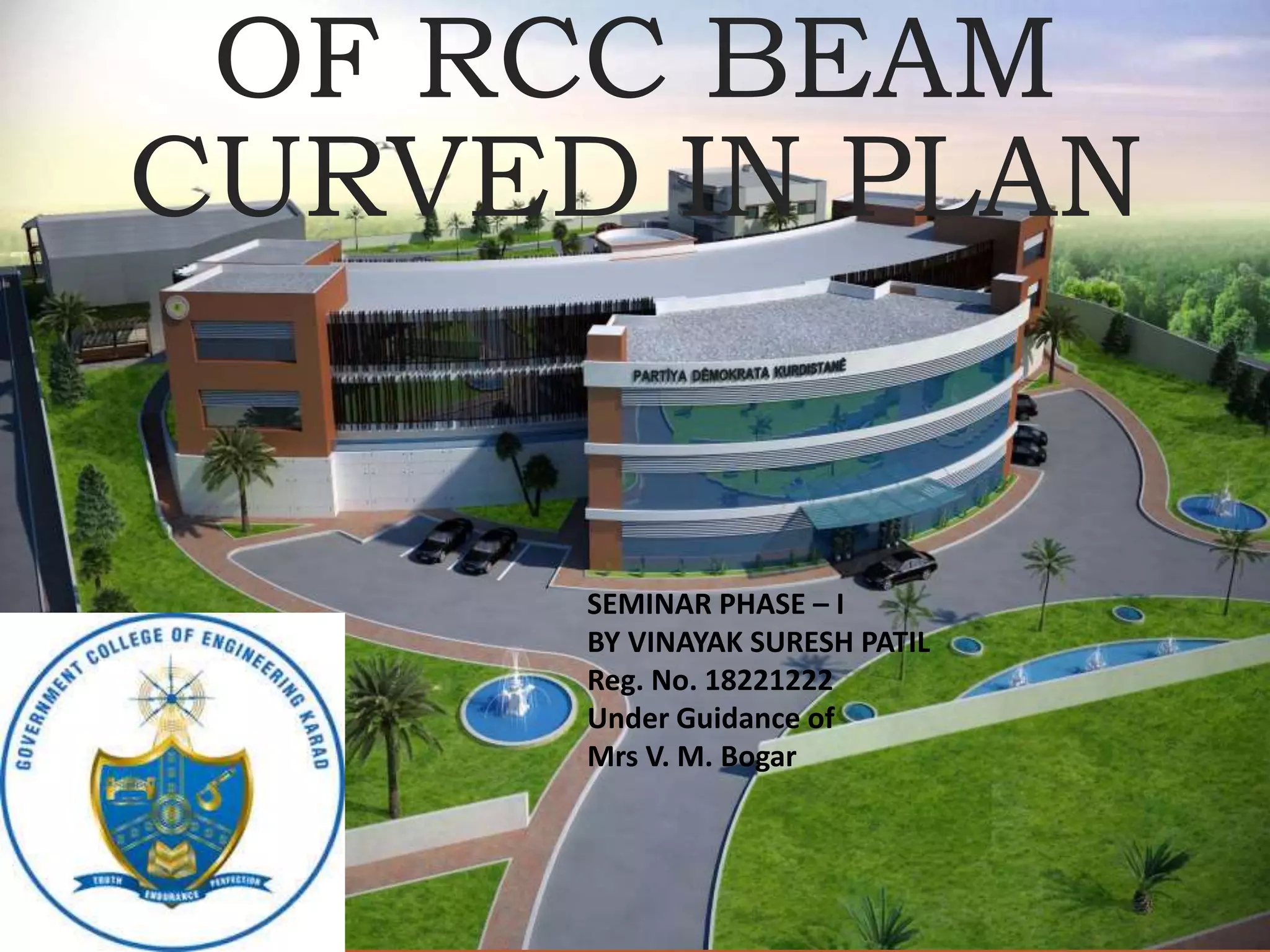
OF RCC BEAM
CURVED IN PLAN
SEMINAR PHASE – I
BY VINAYAK SURESH PATIL
Reg. No. 18221222
Under Guidance of
Mrs V. M. Bogar
Contents :
Introduction
Methodology
Analysis Methods
Design
Literature Review
Results
Conclusion
References
13/07/2019 VINAYAK SURESH PATIL 2
Introduction
 Curved beams are used to support circular reservoir, curved balconies
and curved ramps.
 In curved beams the centre of gravity of loads acting on a span lies
outside the lines joining supports.
 This will cause torsional moments in addition to bending moment and
shear force.
 Therefore one need to consider torsion reinforcement while designing
beam curved in plan.
13/07/2019 VINAYAK SURESH PATIL 3
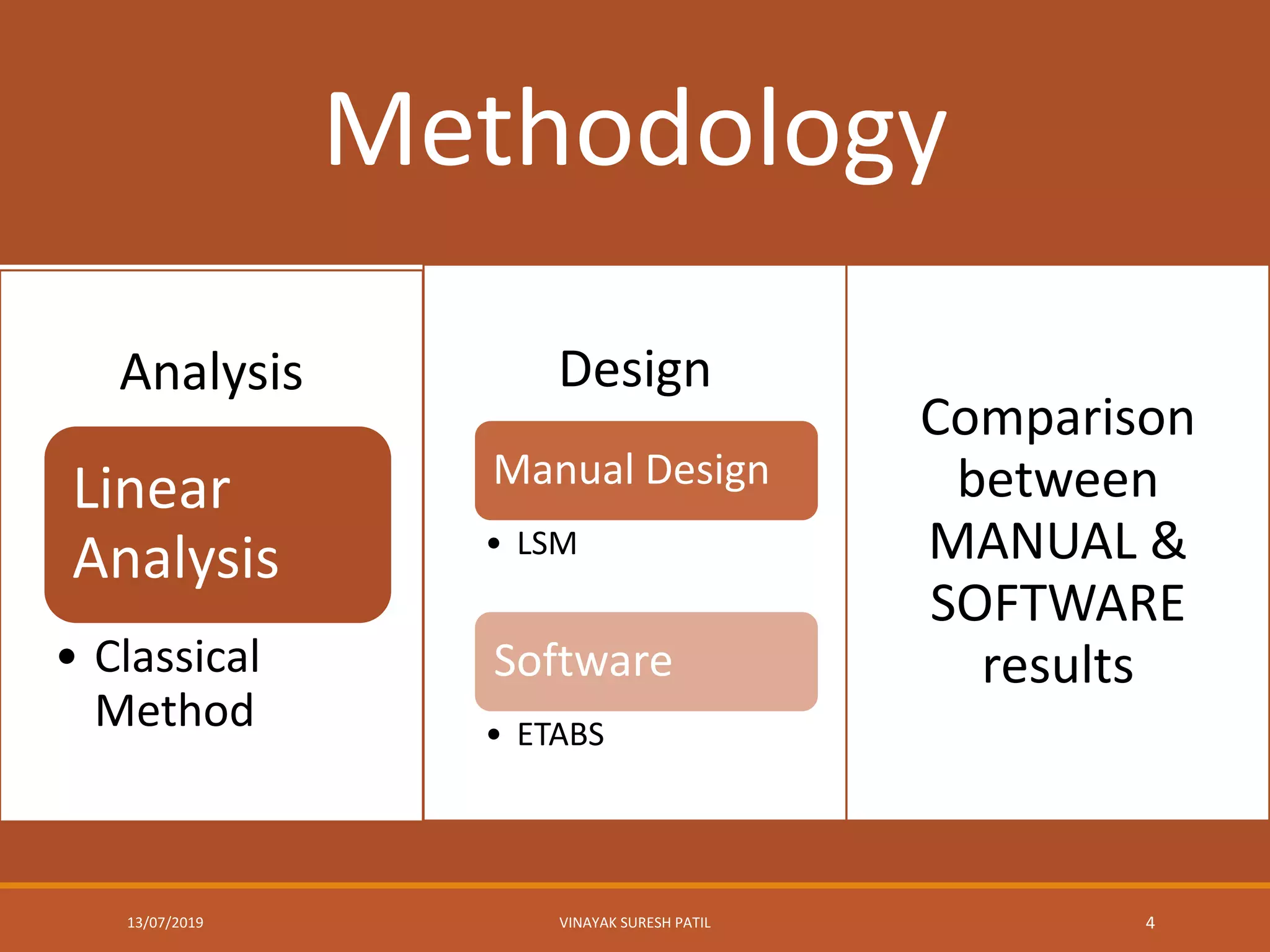
Methodology
Analysis Design
Comparison
between
MANUAL &
SOFTWARE
results
13/07/2019 VINAYAK SURESH PATIL 4
Linear
Analysis
• Classical
Method
Manual Design
• LSM
Software
• ETABS
Important values
•Support Moment = kwR2
•Mid-span Moment=k’wR2
•Maximum Torsion=k”wR2
•Shear Force = wR/2
In general,
•Bending Moment=wR2[-1+ 0.5**sin  +0.5*  *cot(/2)*cos]
•Twisting Moment=wR2[ - 0.5 + 0.5**cos +0.5*  *cot(/2)*sin]
k, k’, k” are values depending on no. of supports
13/07/2019 VINAYAK SURESH PATIL 5
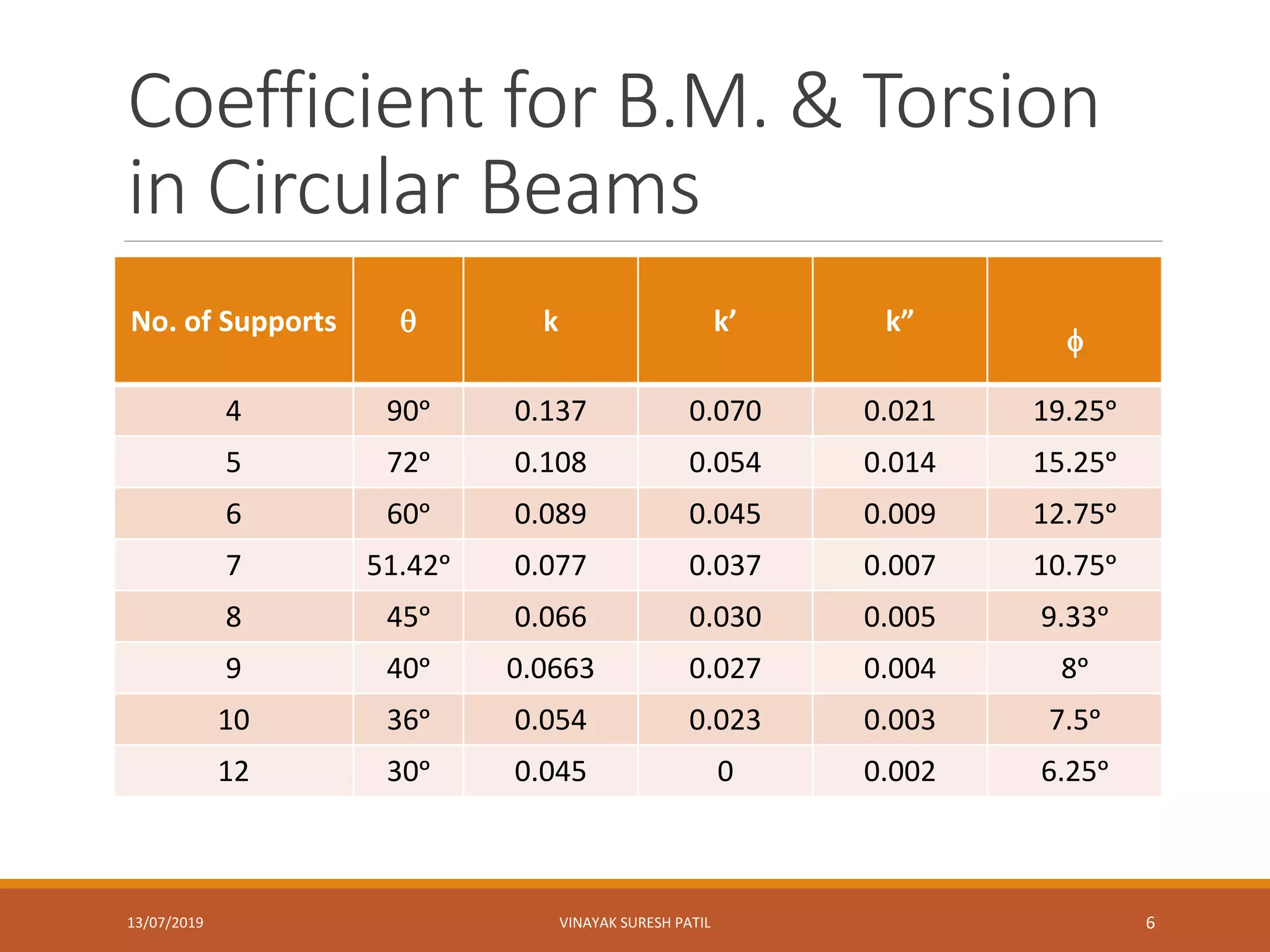
Coefficient for B.M. & Torsion
in Circular Beams
No. of Supports  k k’ k”

4 90ᵒ 0.137 0.070 0.021 19.25ᵒ
5 72ᵒ 0.108 0.054 0.014 15.25ᵒ
6 60ᵒ 0.089 0.045 0.009 12.75ᵒ
7 51.42ᵒ 0.077 0.037 0.007 10.75ᵒ
8 45ᵒ 0.066 0.030 0.005 9.33ᵒ
9 40ᵒ 0.0663 0.027 0.004 8ᵒ
10 36ᵒ 0.054 0.023 0.003 7.5ᵒ
12 30ᵒ 0.045 0 0.002 6.25ᵒ
13/07/2019 VINAYAK SURESH PATIL 6
• Design
MANUAL DESIGN
LSM
IS 456:2000 (PLAIN AND
REINFORCED CONCRETE) –
Provides the design method for
curved beam.
Check for combined action of
shear and maximum torsion.
SOFTWARE DESIGN
ETABS
ETABS gives the analysis and
design based on linear analysis of
curved beam.
Software design is based on same
IS code which can be compared
with manual result.
13/07/2019 VINAYAK SURESH PATIL 7
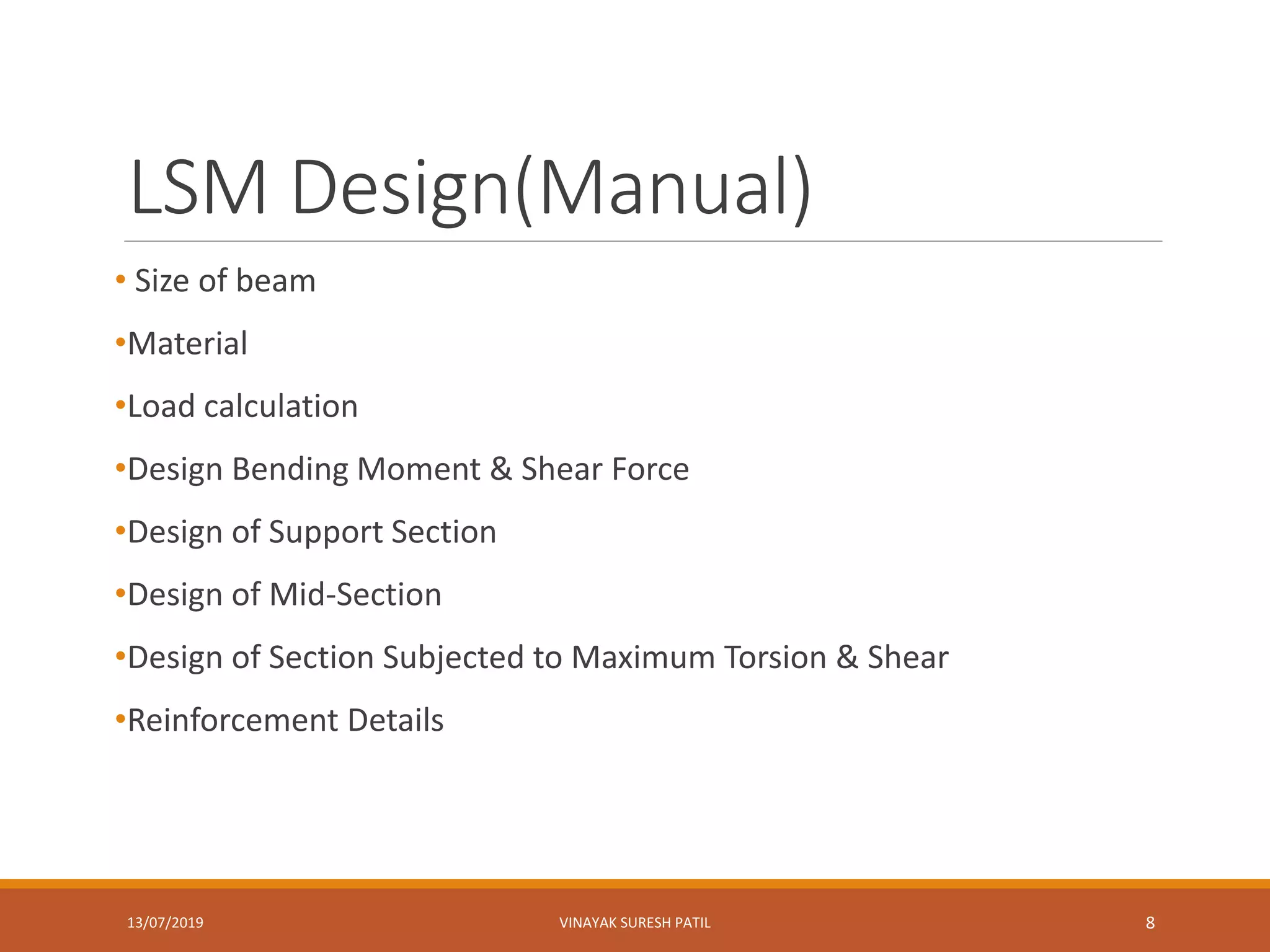
LSM Design(Manual)
• Size of beam
•Material
•Load calculation
•Design Bending Moment & Shear Force
•Design of Support Section
•Design of Mid-Section
•Design of Section Subjected to Maximum Torsion & Shear
•Reinforcement Details
13/07/2019 VINAYAK SURESH PATIL 8
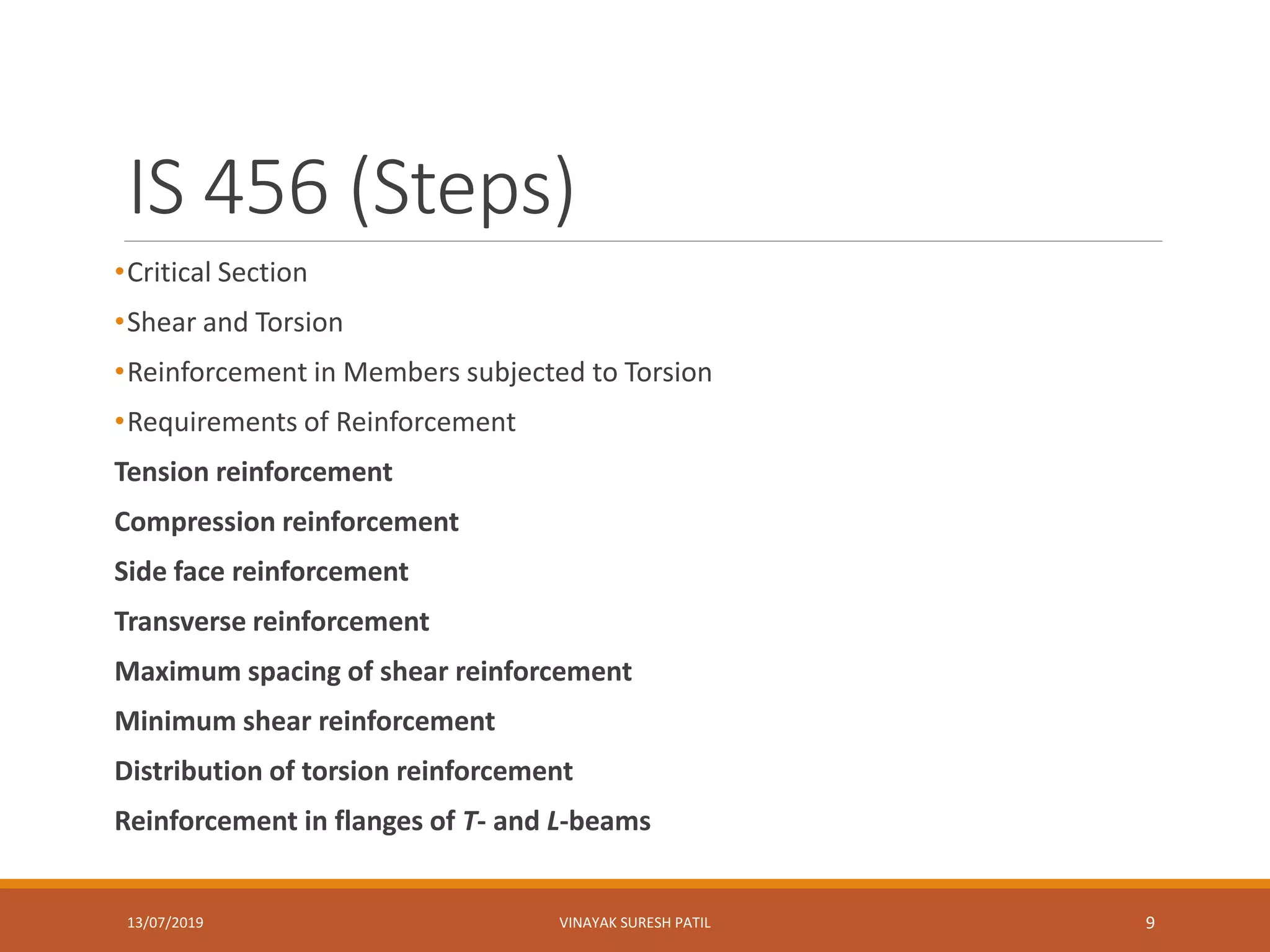
IS 456 (Steps)
•Critical Section
•Shear and Torsion
•Reinforcement in Members subjected to Torsion
•Requirements of Reinforcement
Tension reinforcement
Compression reinforcement
Side face reinforcement
Transverse reinforcement
Maximum spacing of shear reinforcement
Minimum shear reinforcement
Distribution of torsion reinforcement
Reinforcement in flanges of T- and L-beams
13/07/2019 VINAYAK SURESH PATIL 9
ETABS Design
•Modelling
•Material Specification
•Support Condition
•Load cases
•Analysis
•Results
13/07/2019 VINAYAK SURESH PATIL 10
Design Example
Determine the reinforcement required of a ring beam (Fig.6.16.3) of b =
400 mm, d = 650 mm, D = 700 mm and subjected to factored Mu = 200
kNm, factored Tu = 50 kNm and factored Vu = 100 kN. Use M 20 and Fe
415 for the design.
13/07/2019 VINAYAK SURESH PATIL 11
Design by Manual Method
13/07/2019 VINAYAK SURESH PATIL 12
Design by Software
13/07/2019 VINAYAK SURESH PATIL 13
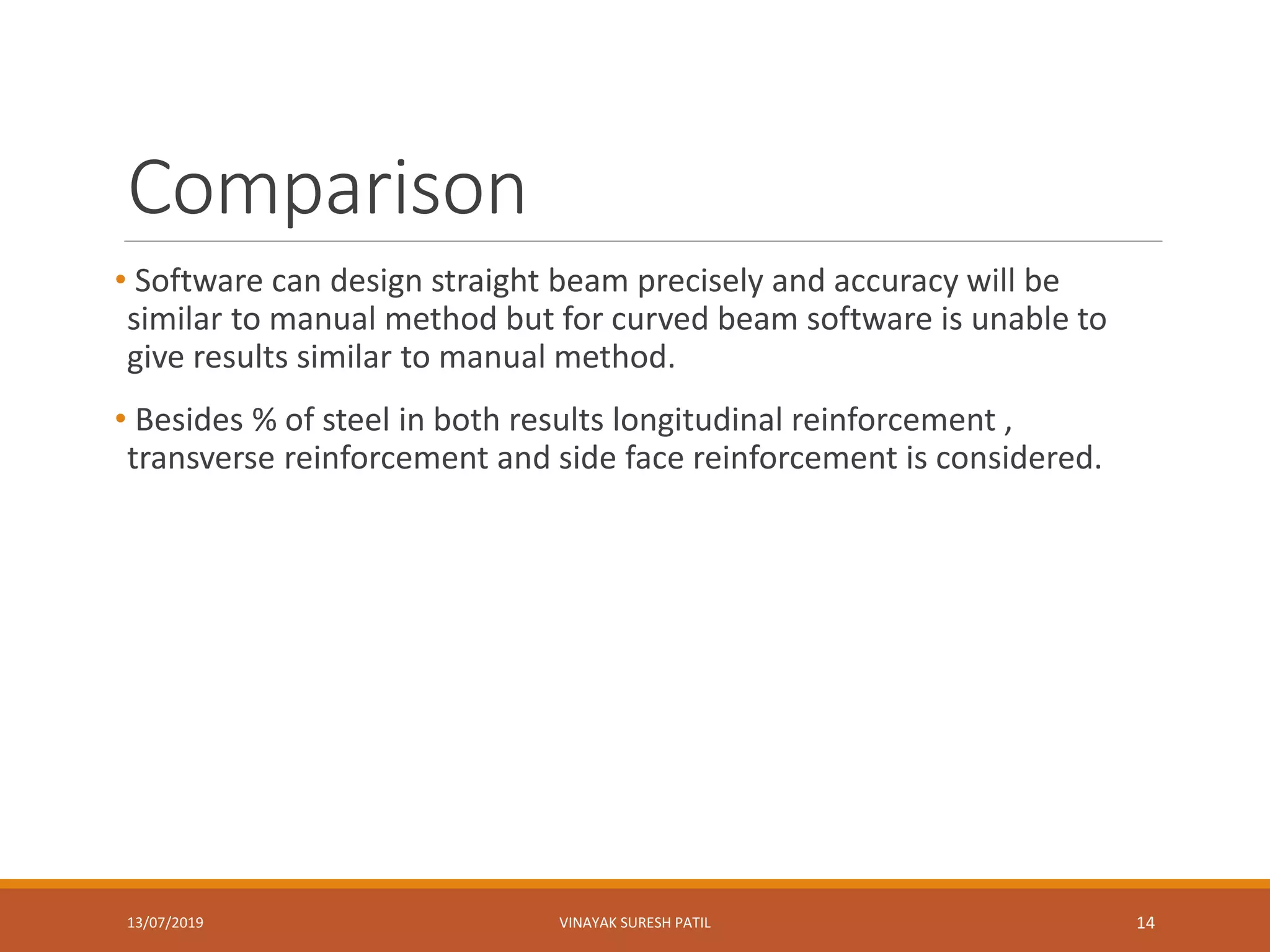
Comparison
• Software can design straight beam precisely and accuracy will be
similar to manual method but for curved beam software is unable to
give results similar to manual method.
• Besides % of steel in both results longitudinal reinforcement ,
transverse reinforcement and side face reinforcement is considered.
13/07/2019 VINAYAK SURESH PATIL 14
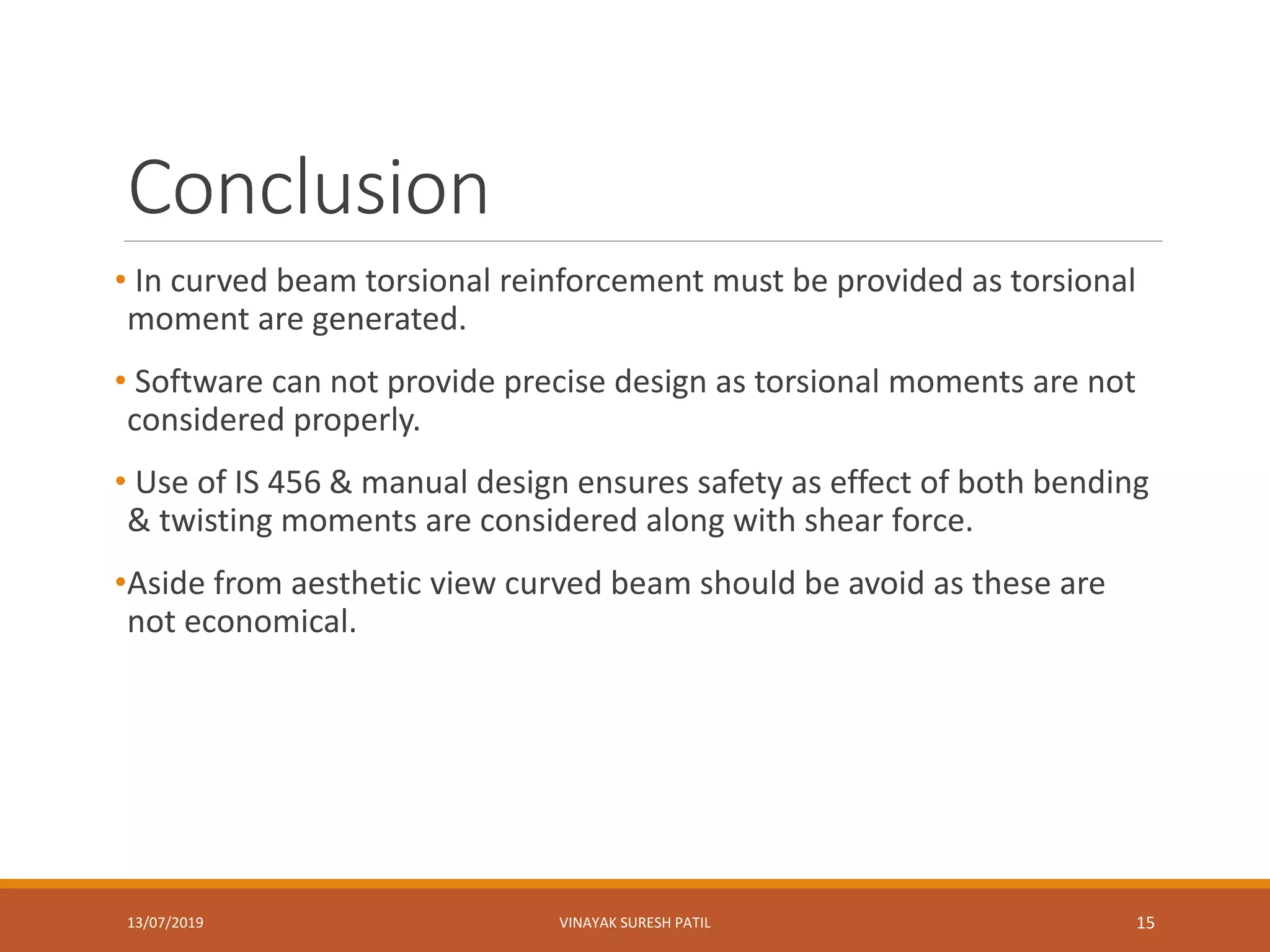
Conclusion
• In curved beam torsional reinforcement must be provided as torsional
moment are generated.
• Software can not provide precise design as torsional moments are not
considered properly.
• Use of IS 456 & manual design ensures safety as effect of both bending
& twisting moments are considered along with shear force.
•Aside from aesthetic view curved beam should be avoid as these are
not economical.
13/07/2019 VINAYAK SURESH PATIL 15
Refrences
• Analysis of Structures Vol. II Theory, Design and Details of Structures by
Prof. V. N. Vazirani, Dr. M. M. Ratwani, Dr. S. K. Duggal
•Advanced Reinforced Concrete Design by N. Krishna Raju
•www.sciencedirect.com
•https://www.researchgate.net
• www.ijera.com
•www.iiste.org
•www.icontrolpollution.com
•www.google.com
13/07/2019 VINAYAK SURESH PATIL 16
THANK YOU
13/07/2019 VINAYAK SURESH PATIL 17

Curved beam design

  • 1.
    OF RCC BEAM CURVEDIN PLAN SEMINAR PHASE – I BY VINAYAK SURESH PATIL Reg. No. 18221222 Under Guidance of Mrs V. M. Bogar
  • 2.
    Contents : Introduction Methodology Analysis Methods Design LiteratureReview Results Conclusion References 13/07/2019 VINAYAK SURESH PATIL 2
  • 3.
    Introduction  Curved beamsare used to support circular reservoir, curved balconies and curved ramps.  In curved beams the centre of gravity of loads acting on a span lies outside the lines joining supports.  This will cause torsional moments in addition to bending moment and shear force.  Therefore one need to consider torsion reinforcement while designing beam curved in plan. 13/07/2019 VINAYAK SURESH PATIL 3
  • 4.
    Methodology Analysis Design Comparison between MANUAL & SOFTWARE results 13/07/2019VINAYAK SURESH PATIL 4 Linear Analysis • Classical Method Manual Design • LSM Software • ETABS
  • 5.
    Important values •Support Moment= kwR2 •Mid-span Moment=k’wR2 •Maximum Torsion=k”wR2 •Shear Force = wR/2 In general, •Bending Moment=wR2[-1+ 0.5**sin  +0.5*  *cot(/2)*cos] •Twisting Moment=wR2[ - 0.5 + 0.5**cos +0.5*  *cot(/2)*sin] k, k’, k” are values depending on no. of supports 13/07/2019 VINAYAK SURESH PATIL 5
  • 6.
    Coefficient for B.M.& Torsion in Circular Beams No. of Supports  k k’ k”  4 90ᵒ 0.137 0.070 0.021 19.25ᵒ 5 72ᵒ 0.108 0.054 0.014 15.25ᵒ 6 60ᵒ 0.089 0.045 0.009 12.75ᵒ 7 51.42ᵒ 0.077 0.037 0.007 10.75ᵒ 8 45ᵒ 0.066 0.030 0.005 9.33ᵒ 9 40ᵒ 0.0663 0.027 0.004 8ᵒ 10 36ᵒ 0.054 0.023 0.003 7.5ᵒ 12 30ᵒ 0.045 0 0.002 6.25ᵒ 13/07/2019 VINAYAK SURESH PATIL 6
  • 7.
    • Design MANUAL DESIGN LSM IS456:2000 (PLAIN AND REINFORCED CONCRETE) – Provides the design method for curved beam. Check for combined action of shear and maximum torsion. SOFTWARE DESIGN ETABS ETABS gives the analysis and design based on linear analysis of curved beam. Software design is based on same IS code which can be compared with manual result. 13/07/2019 VINAYAK SURESH PATIL 7
  • 8.
    LSM Design(Manual) • Sizeof beam •Material •Load calculation •Design Bending Moment & Shear Force •Design of Support Section •Design of Mid-Section •Design of Section Subjected to Maximum Torsion & Shear •Reinforcement Details 13/07/2019 VINAYAK SURESH PATIL 8
  • 9.
    IS 456 (Steps) •CriticalSection •Shear and Torsion •Reinforcement in Members subjected to Torsion •Requirements of Reinforcement Tension reinforcement Compression reinforcement Side face reinforcement Transverse reinforcement Maximum spacing of shear reinforcement Minimum shear reinforcement Distribution of torsion reinforcement Reinforcement in flanges of T- and L-beams 13/07/2019 VINAYAK SURESH PATIL 9
  • 10.
    ETABS Design •Modelling •Material Specification •SupportCondition •Load cases •Analysis •Results 13/07/2019 VINAYAK SURESH PATIL 10
  • 11.
    Design Example Determine thereinforcement required of a ring beam (Fig.6.16.3) of b = 400 mm, d = 650 mm, D = 700 mm and subjected to factored Mu = 200 kNm, factored Tu = 50 kNm and factored Vu = 100 kN. Use M 20 and Fe 415 for the design. 13/07/2019 VINAYAK SURESH PATIL 11
  • 12.
    Design by ManualMethod 13/07/2019 VINAYAK SURESH PATIL 12
  • 13.
    Design by Software 13/07/2019VINAYAK SURESH PATIL 13
  • 14.
    Comparison • Software candesign straight beam precisely and accuracy will be similar to manual method but for curved beam software is unable to give results similar to manual method. • Besides % of steel in both results longitudinal reinforcement , transverse reinforcement and side face reinforcement is considered. 13/07/2019 VINAYAK SURESH PATIL 14
  • 15.
    Conclusion • In curvedbeam torsional reinforcement must be provided as torsional moment are generated. • Software can not provide precise design as torsional moments are not considered properly. • Use of IS 456 & manual design ensures safety as effect of both bending & twisting moments are considered along with shear force. •Aside from aesthetic view curved beam should be avoid as these are not economical. 13/07/2019 VINAYAK SURESH PATIL 15
  • 16.
    Refrences • Analysis ofStructures Vol. II Theory, Design and Details of Structures by Prof. V. N. Vazirani, Dr. M. M. Ratwani, Dr. S. K. Duggal •Advanced Reinforced Concrete Design by N. Krishna Raju •www.sciencedirect.com •https://www.researchgate.net • www.ijera.com •www.iiste.org •www.icontrolpollution.com •www.google.com 13/07/2019 VINAYAK SURESH PATIL 16
  • 17.