Rubrics for Assessing
    Student Writing,
Listening, and Speaking
     High School
Copyright © by the McGraw-Hill Companies, Inc. All rights reserved.
Permission is granted to reproduce the material contained herein on the
condition that such material be reproduced only for classroom use; be
provided to students, teachers, and families without charge; and be used
solely in conjunction with Glencoe Literature: The Reader’s Choice. Any
other reproduction, for use or sale, is prohibited without written
permission from the publisher.

Send all inquiries to:
Glencoe/McGraw-Hill
8787 Orion Place
Columbus, OH 43240-4027

ISBN-10: 0-07-876544-7
ISBN-13: 978-0-07-876544-5
Printed in the United States of America.

1 2 3 4 5 6 7 8 9 047 12 11 10 09 08 07
ii Rubrics for Assessing Student Writing, Listening, & Speaking            High School
Table of Contents
How to Use the Rubrics . . . . . . . . . . . . . . . . . . . . . . . . . . . . . . . . . . . . . . . . . . . . . . . . . . . . . . . . . . . . .2–3
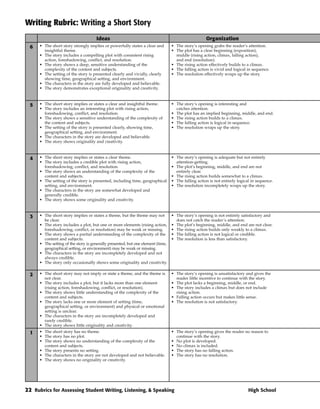
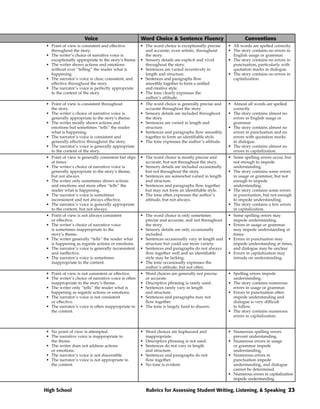
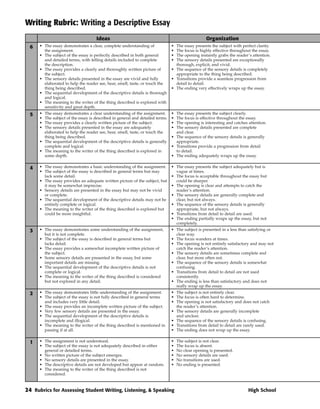
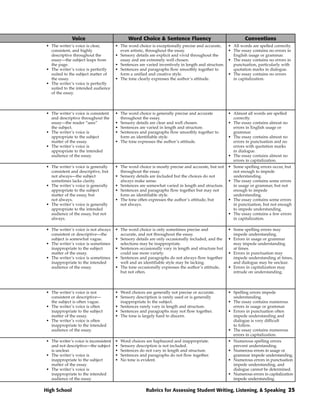
Writing Rubric: Response to Literature . . . . . . . . . . . . . . . . . . . . . . . . . . . . . . . . . . . . . . . . . . . . . . . .4–5
Writing Rubric: Autobiographical Narrative . . . . . . . . . . . . . . . . . . . . . . . . . . . . . . . . . . . . . . . . . . . .6–7
Writing Rubric: Biographical Narrative . . . . . . . . . . . . . . . . . . . . . . . . . . . . . . . . . . . . . . . . . . . . . . . .8–9
Writing Rubric: Reflective Essay . . . . . . . . . . . . . . . . . . . . . . . . . . . . . . . . . . . . . . . . . . . . . . . . . . . . 10–11
Writing Rubric: Literary Analysis . . . . . . . . . . . . . . . . . . . . . . . . . . . . . . . . . . . . . . . . . . . . . . . . . . .12–13
Writing Rubric: Research Report . . . . . . . . . . . . . . . . . . . . . . . . . . . . . . . . . . . . . . . . . . . . . . . . . . . .14–15
Writing Rubric: Historical Research Paper . . . . . . . . . . . . . . . . . . . . . . . . . . . . . . . . . . . . . . . . . . .16–17
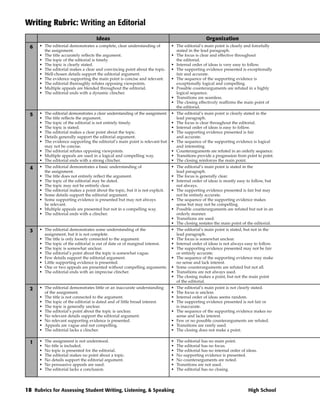
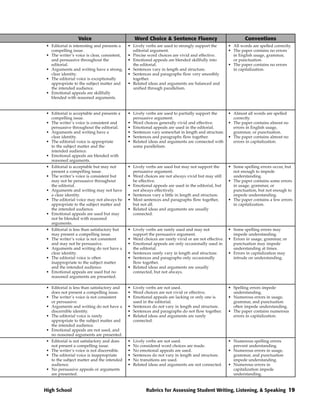
Writing Rubric: Editorial. . . . . . . . . . . . . . . . . . . . . . . . . . . . . . . . . . . . . . . . . . . . . . . . . . . . . . . . . . .18–19
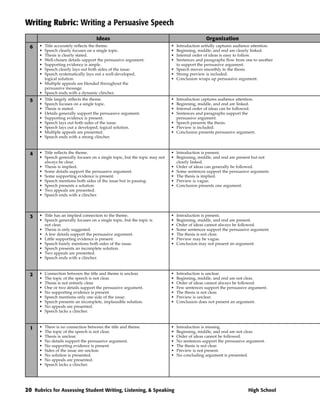
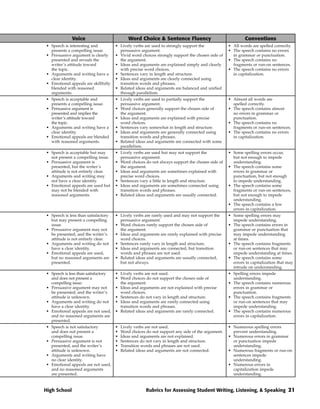
Writing Rubric: Persuasive Speech . . . . . . . . . . . . . . . . . . . . . . . . . . . . . . . . . . . . . . . . . . . . . . . . . .20–21
Writing Rubric: Short Story . . . . . . . . . . . . . . . . . . . . . . . . . . . . . . . . . . . . . . . . . . . . . . . . . . . . . . . .22–23
Writing Rubric: Descriptive Essay. . . . . . . . . . . . . . . . . . . . . . . . . . . . . . . . . . . . . . . . . . . . . . . . . . .24–25
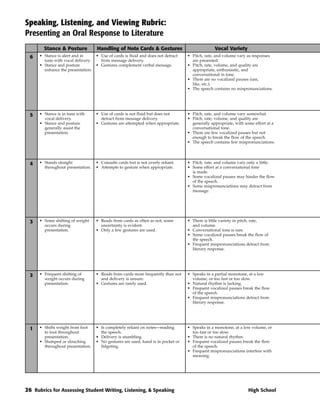
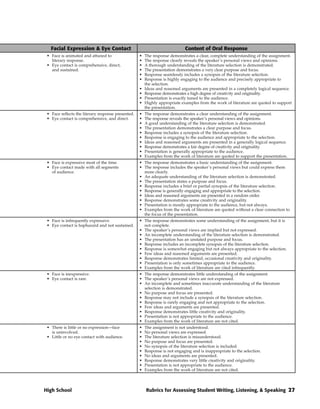
Speaking, Listening, and Viewing Rubric: Presenting an Oral Response
     to Literature . . . . . . . . . . . . . . . . . . . . . . . . . . . . . . . . . . . . . . . . . . . . . . . . . . . . . . . . . . . . . . . . . .26–27
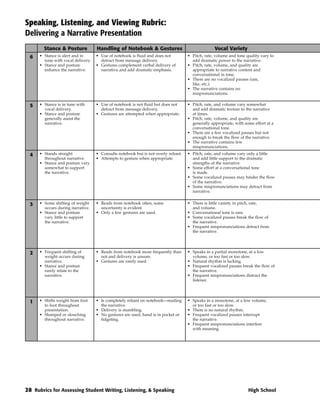
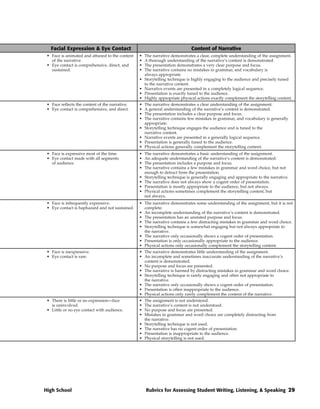
Speaking, Listening, and Viewing Rubric: Delivering a Narrative Presentation . . . . . . . . . . .28–29
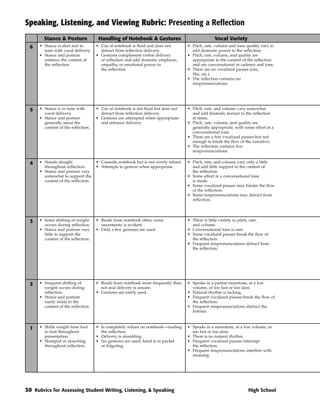
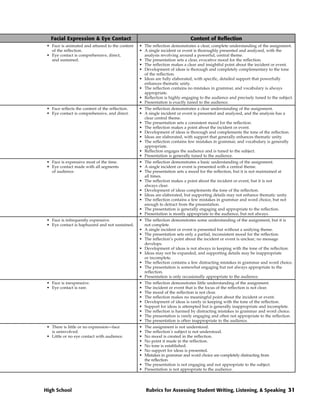
Speaking, Listening, and Viewing Rubric: Presenting a Reflection . . . . . . . . . . . . . . . . . . . . . . .30–31
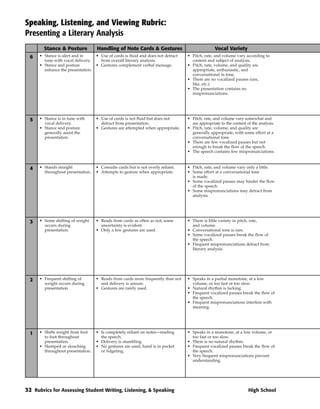
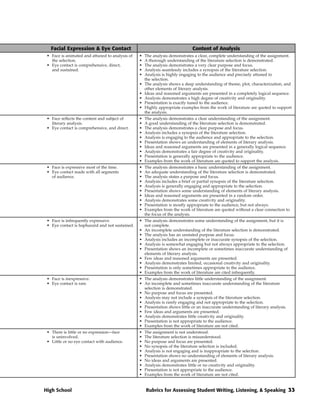
Speaking, Listening, and Viewing Rubric: Presenting a Literary Analysis . . . . . . . . . . . . . . . .32–33
Speaking, Listening, and Viewing Rubric: Delivering an Expository Presentation . . . . . . . . .34–35
Speaking, Listening, and Viewing Rubric: Delivering an Oral Report
     on an Historical Investigation . . . . . . . . . . . . . . . . . . . . . . . . . . . . . . . . . . . . . . . . . . . . . . . . . . .36–37
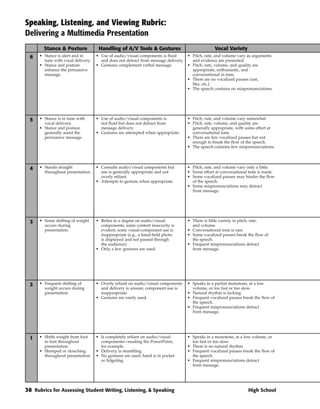
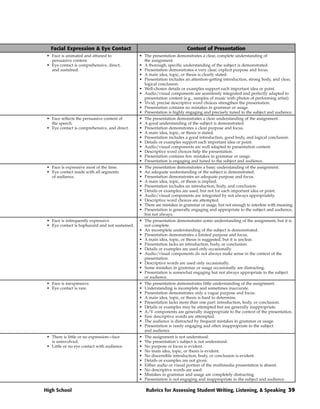
Speaking, Listening, and Viewing Rubric: Delivering a Multimedia Presentation . . . . . . . . . .38–39
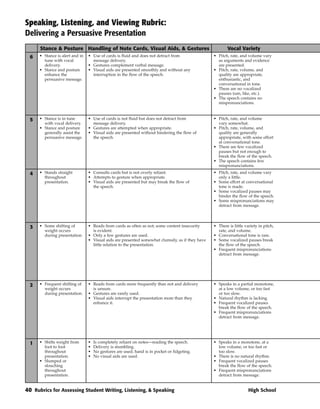
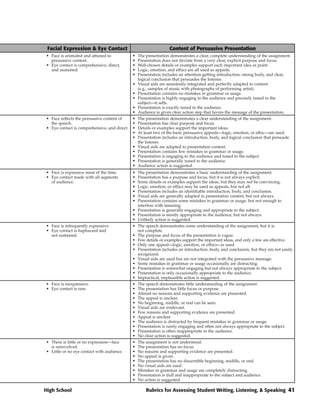
Speaking, Listening, and Viewing Rubric: Delivering a Persuasive Presentation . . . . . . . . . .40–41
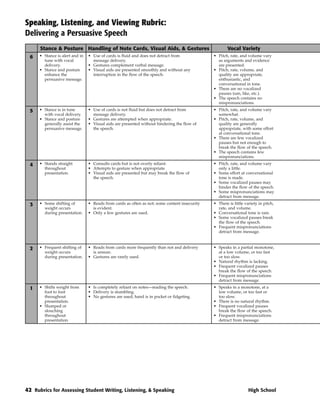
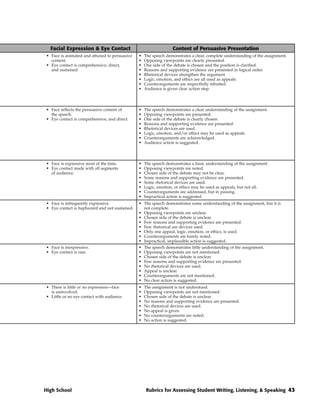
Speaking, Listening, and Viewing Rubric: Delivering a Persuasive Speech . . . . . . . . . . . . . . .42–43
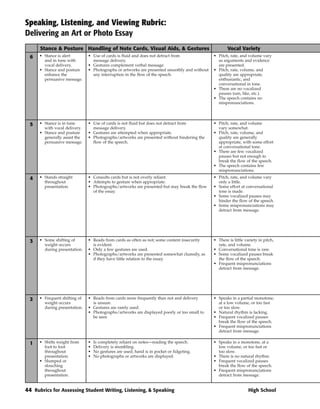
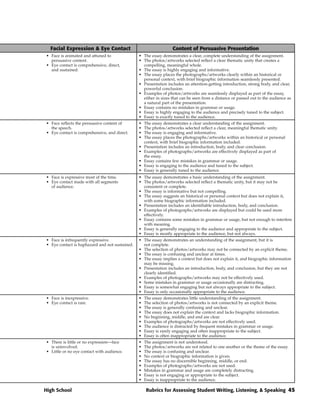
Speaking, Listening, and Viewing Rubric: Presenting an Art or Photo Essay . . . . . . . . . . . . . .44–45
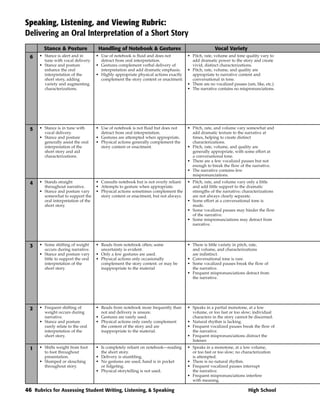
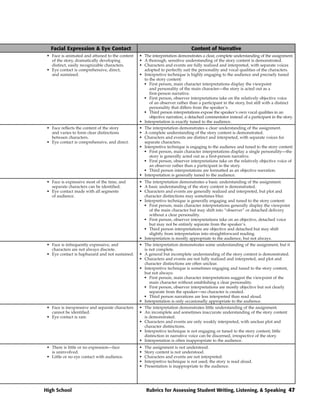
Speaking, Listening, and Viewing Rubric: Delivering an Oral Interpretation
     of a Short Story . . . . . . . . . . . . . . . . . . . . . . . . . . . . . . . . . . . . . . . . . . . . . . . . . . . . . . . . . . . . . . .46–47
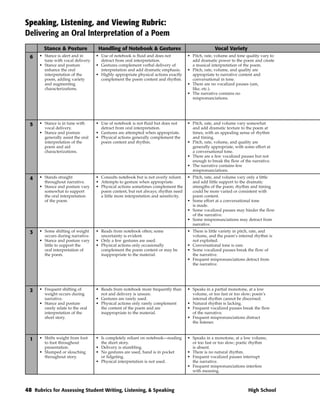
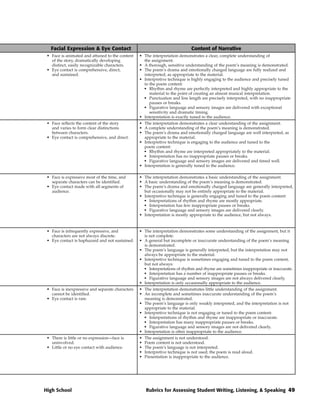
Speaking, Listening, and Viewing Rubric: Delivering an Oral Interpretation
     of a Poem . . . . . . . . . . . . . . . . . . . . . . . . . . . . . . . . . . . . . . . . . . . . . . . . . . . . . . . . . . . . . . . . . . . .48–49
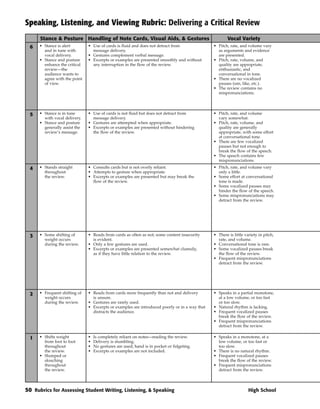
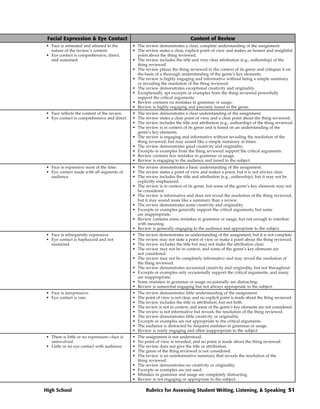
Speaking, Listening, and Viewing Rubric: Delivering a Critical Review . . . . . . . . . . . . . . . . . .50–51
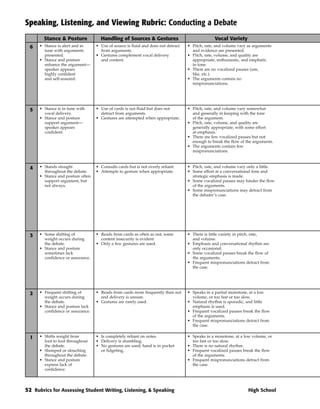
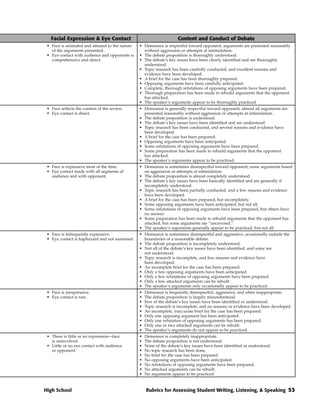
Speaking, Listening, and Viewing Rubric: Conducting a Debate . . . . . . . . . . . . . . . . . . . . . . . .52–53


High School                                                     Rubrics for Assessing Student Writing, Listening, & Speaking iii
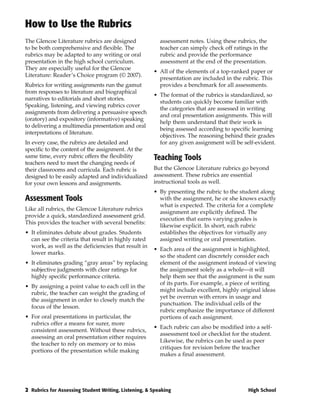
How to Use the Rubrics
The Glencoe Literature rubrics are designed              assessment notes. Using these rubrics, the
to be both comprehensive and flexible. The               teacher can simply check off ratings in the
rubrics may be adapted to any writing or oral            rubric and provide the performance
presentation in the high school curriculum.              assessment at the end of the presentation.
They are especially useful for the Glencoe
                                                      • All of the elements of a top-ranked paper or
Literature: Reader’s Choice program (© 2007).
                                                        presentation are included in the rubric. This
Rubrics for writing assignments run the gamut           provides a benchmark for all assessments.
from responses to literature and biographical
                                                      • The format of the rubrics is standardized, so
narratives to editorials and short stories.
                                                        students can quickly become familiar with
Speaking, listening, and viewing rubrics cover
                                                        the categories that are assessed in writing
assignments from delivering a persuasive speech
                                                        and oral presentation assignments. This will
(oratory) and expository (informative) speaking
                                                        help them understand that their work is
to delivering a multimedia presentation and oral
                                                        being assessed according to specific learning
interpretations of literature.
                                                        objectives. The reasoning behind their grades
In every case, the rubrics are detailed and             for any given assignment will be self-evident.
specific to the content of the assignment. At the
same time, every rubric offers the flexibility        Teaching Tools
teachers need to meet the changing needs of
their classrooms and curricula. Each rubric is        But the Glencoe Literature rubrics go beyond
designed to be easily adapted and individualized      assessment. These rubrics are essential
for your own lessons and assignments.                 instructional tools as well.
                                                      • By presenting the rubric to the student along
Assessment Tools                                        with the assignment, he or she knows exactly
                                                        what is expected. The criteria for a complete
Like all rubrics, the Glencoe Literature rubrics
                                                        assignment are explicitly defined. The
provide a quick, standardized assessment grid.
                                                        execution that earns varying grades is
This provides the teacher with several benefits:
                                                        likewise explicit. In short, each rubric
• It eliminates debate about grades. Students           establishes the objectives for virtually any
  can see the criteria that result in highly rated      assigned writing or oral presentation.
  work, as well as the deficiencies that result in
                                                      • Each area of the assignment is highlighted,
  lower marks.
                                                        so the student can discretely consider each
• It eliminates grading “gray areas” by replacing       element of the assignment instead of viewing
  subjective judgments with clear ratings for           the assignment solely as a whole—it will
  highly specific performance criteria.                 help them see that the assignment is the sum
                                                        of its parts. For example, a piece of writing
• By assigning a point value to each cell in the
                                                        might include excellent, highly original ideas
  rubric, the teacher can weight the grading of
                                                        yet be overrun with errors in usage and
  the assignment in order to closely match the
                                                        punctuation. The individual cells of the
  focus of the lesson.
                                                        rubric emphasize the importance of different
• For oral presentations in particular, the             portions of each assignment.
  rubrics offer a means for surer, more
                                                      • Each rubric can also be modified into a self-
  consistent assessment. Without these rubrics,
                                                        assessment tool or checklist for the student.
  assessing an oral presentation either requires
                                                        Likewise, the rubrics can be used as peer
  the teacher to rely on memory or to miss
                                                        critiques for revision before the teacher
  portions of the presentation while making
                                                        makes a final assessment.


2 Rubrics for Assessing Student Writing, Listening, & Speaking                              High School
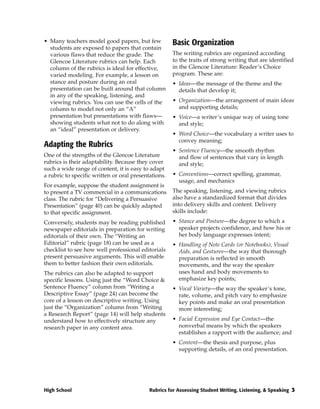
• Many teachers model good papers, but few            Basic Organization
  students are exposed to papers that contain
  various flaws that reduce the grade. The            The writing rubrics are organized according
  Glencoe Literature rubrics can help. Each           to the traits of strong writing that are identified
  column of the rubrics is ideal for effective,       in the Glencoe Literature: Reader’s Choice
  varied modeling. For example, a lesson on           program. These are:
  stance and posture during an oral                   • Ideas—the message of the theme and the
  presentation can be built around that column          details that develop it;
  in any of the speaking, listening, and
  viewing rubrics. You can use the cells of the       • Organization—the arrangement of main ideas
  column to model not only an “A”                       and supporting details;
  presentation but presentations with flaws—          • Voice—a writer’s unique way of using tone
  showing students what not to do along with            and style;
  an “ideal” presentation or delivery.
                                                      • Word Choice—the vocabulary a writer uses to
                                                        convey meaning;
Adapting the Rubrics
                                                      • Sentence Fluency—the smooth rhythm
One of the strengths of the Glencoe Literature          and flow of sentences that vary in length
rubrics is their adaptability. Because they cover       and style;
such a wide range of content, it is easy to adapt
a rubric to specific written or oral presentations.   • Conventions—correct spelling, grammar,
                                                        usage, and mechanics
For example, suppose the student assignment is
to present a TV commercial in a communications        The speaking, listening, and viewing rubrics
class. The rubric for “Delivering a Persuasive        also have a standardized format that divides
Presentation” (page 40) can be quickly adapted        into delivery skills and content. Delivery
to that specific assignment.                          skills include:
Conversely, students may be reading published         • Stance and Posture—the degree to which a
newspaper editorials in preparation for writing         speaker projects confidence, and how his or
editorials of their own. The “Writing an                her body language expresses intent;
Editorial” rubric (page 18) can be used as a          • Handling of Note Cards (or Notebooks), Visual
checklist to see how well professional editorials       Aids, and Gestures—the way that thorough
present persuasive arguments. This will enable          preparation is reflected in smooth
them to better fashion their own editorials.            movements, and the way the speaker
The rubrics can also be adapted to support              uses hand and body movements to
specific lessons. Using just the “Word Choice &         emphasize key points;
Sentence Fluency” column from “Writing a              • Vocal Variety—the way the speaker’s tone,
Descriptive Essay” (page 24) can become the             rate, volume, and pitch vary to emphasize
core of a lesson on descriptive writing. Using          key points and make an oral presentation
just the “Organization” column from “Writing            more interesting;
a Research Report” (page 14) will help students
understand how to effectively structure any           • Facial Expression and Eye Contact—the
research paper in any content area.                     nonverbal means by which the speakers
                                                        establishes a rapport with the audience; and
                                                      • Content—the thesis and purpose, plus
                                                        supporting details, of an oral presentation.


High School                                 Rubrics for Assessing Student Writing, Listening, & Speaking 3
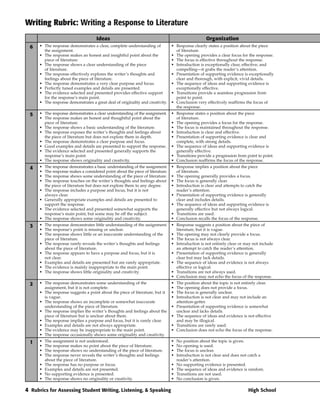
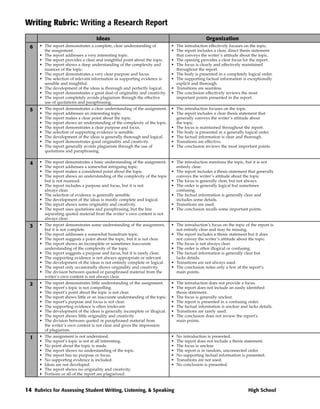
Writing Rubric: Writing a Response to Literature
                                      Ideas                                                         Organization
  6   • The response demonstrates a clear, complete understanding of             • Response clearly states a position about the piece
        the assignment.                                                            of literature.
      • The response makes an honest and insightful point about the              • The opening provides a clear focus for the response.
        piece of literature.                                                     • The focus is effective throughout the response.
      • The response shows a clear understanding of the piece                    • Introduction is exceptionally clear, effective, and
        of literature.                                                             compelling—it grabs the reader’s attention.
      • The response effectively explores the writer’s thoughts and              • Presentation of supporting evidence is exceptionally
        feelings about the piece of literature.                                    clear and thorough, with explicit, vivid details.
      • The response demonstrates a very clear purpose and focus.                • The sequence of ideas and supporting evidence is
      • Perfectly tuned examples and details are presented.                        exceptionally effective.
      • The evidence selected and presented provides effective support           • Transitions provide a seamless progression from
        for the response’s main point.                                             point to point.
      • The response demonstrates a great deal of originality and creativity.    • Conclusion very effectively reaffirms the focus of
                                                                                   the response.
  5   • The response demonstrates a clear understanding of the assignment.       • Response states a position about the piece
      • The response makes an honest and thoughtful point about the                of literature.
        piece of literature.                                                     • The opening provides a focus for the response.
      • The response shows a basic understanding of the literature.              • The focus is maintained throughout the response.
      • The response exposes the writer’s thoughts and feelings about            • Introduction is clear and effective.
        the piece of literature but does not explore them in depth.              • Presentation of supporting evidence is clear and
      • The response demonstrates a clear purpose and focus.                       complete, with strong details.
      • Good examples and details are presented to support the response.         • The sequence of ideas and supporting evidence is
      • The evidence selected and presented generally supports the                 generally effective.
        response’s main point.                                                   • Transitions provide a progression from point to point.
      • The response shows originality and creativity.                           • Conclusion reaffirms the focus of the response.
  4   •   The response demonstrates a basic understanding of the assignment.     • Response implies a position about the piece
      •   The response makes a considered point about the piece of literature.     of literature.
      •   The response shows some understanding of the piece of literature.      • The opening generally provides a focus.
      •   The response touches on the writer’s thoughts and feelings about       • The focus is generally clear.
          the piece of literature but does not explore them to any degree.       • Introduction is clear and attempts to catch the
      •   The response includes a purpose and focus, but it is not                 reader’s attention.
          always clear.                                                          • Presentation of supporting evidence is generally
      •   Generally appropriate examples and details are presented to              clear and includes details.
          support the response.                                                  • The sequence of ideas and supporting evidence is
      •   The evidence selected and presented somewhat supports the                generally effective but not always logical.
          response’s main point, but some may be off the subject.                • Transitions are used.
      •   The response shows some originality and creativity.                    • Conclusion recalls the focus of the response.
  3   • The response demonstrates little understanding of the assignment.        • Response suggests a position about the piece of
      • The response’s point is missing or unclear.                                literature, but it is vague.
      • The response shows little or an inaccurate understanding of the          • The opening may not clearly provide a focus.
        piece of literature.                                                     • The focus is not always clear.
      • The response rarely reveals the writer’s thoughts and feelings           • Introduction is not entirely clear or may not include
        about the piece of literature.                                             an attempt to catch the reader’s attention.
      • The response appears to have a purpose and focus, but it is              • Presentation of supporting evidence is generally
        not clear.                                                                 clear but may lack details.
      • Examples and details are presented but are rarely appropriate.           • The sequence of ideas and evidence is not always
      • The evidence is mainly inappropriate to the main point.                    effective or logical.
      • The response shows little originality and creativity.                    • Transitions are not always used.
                                                                                 • Conclusion may not echo the focus of the response.
  2   • The response demonstrates some understanding of the                      •   The position about the topic is not entirely clear.
        assignment, but it is not complete.                                      •   The opening does not provide a focus.
      • The response suggests a point about the piece of literature, but it      •   The focus is generally unclear.
        is vague.                                                                •   Introduction is not clear and may not include an
      • The response shows an incomplete or somewhat inaccurate                      attention-getter.
        understanding of the piece of literature.                                •   Presentation of supporting evidence is somewhat
      • The response implies the writer’s thoughts and feelings about the            unclear and lacks details.
        piece of literature but is unclear about them.                           •   The sequence of ideas and evidence is not effective
      • The response implies a purpose and focus, but it is rarely clear.            and may be illogical.
      • Examples and details are not always appropriate.                         •   Transitions are rarely used.
      • The evidence may be inappropriate to the main point.                     •   Conclusion does not echo the focus of the response.
      • The response occasionally shows some originality and creativity.
  1   •   The assignment is not understood.                                      •   No position about the topic is given.
      •   The response makes no point about the piece of literature.             •   No opening is used.
      •   The response shows no understanding of the piece of literature.        •   The focus is unclear.
      •   The response never reveals the writer’s thoughts and feelings          •   Introduction is not clear and does not catch a
          about the piece of literature.                                             reader’s attention.
      •   The response has no purpose or focus.                                  •   No supporting evidence is presented.
      •   Examples and details are not presented.                                •   The sequence of ideas and evidence is random.
      •   No supporting evidence is presented.                                   •   Transitions are not used.
      •   The response shows no originality or creativity.                       •   No conclusion is given.

4 Rubrics for Assessing Student Writing, Listening, & Speaking                                                             High School
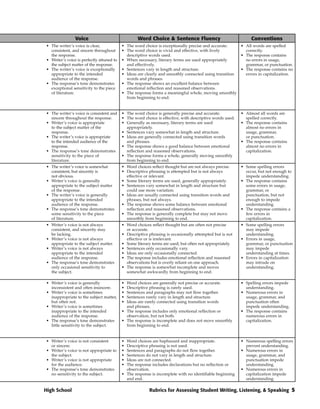
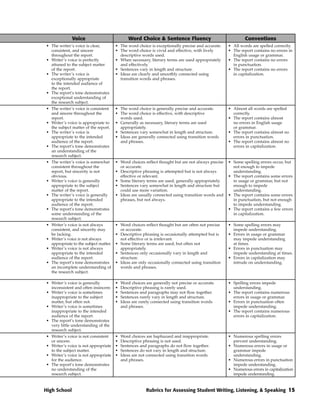
Voice                              Word Choice & Sentence Fluency                              Conventions
• The writer’s voice is clear,             • The word choice is exceptionally precise and accurate.    • All words are spelled
  consistent, and sincere throughout       • The word choice is vivid and effective, with lively         correctly.
  the response.                              descriptive words used.                                   • The response contains
• Writer’s voice is perfectly attuned to   • When necessary, literary terms are used appropriately       no errors in usage,
  the subject matter of the response.        and effectively.                                            grammar, or punctuation.
• The writer’s voice is exceptionally      • Sentences vary in length and structure.                   • The response contains no
  appropriate to the intended              • Ideas are clearly and smoothly connected using transition   errors in capitalization.
  audience of the response.                  words and phrases.
• The response’s tone demonstrates         • The response shows an excellent balance between
  exceptional sensitivity to the piece       emotional reflection and reasoned observations.
  of literature.                           • The response forms a meaningful whole, moving smoothly
                                             from beginning to end.


• The writer’s voice is consistent and     • The word choice is generally precise and accurate.           • Almost all words are
  sincere throughout the response.         • The word choice is effective, with descriptive words used.     spelled correctly.
• Writer’s voice is appropriate            • Generally as necessary, literary terms are used              • The response contains
  to the subject matter of the               appropriately.                                                 almost no errors in
  response.                                • Sentences vary somewhat in length and structure.               usage, grammar,
• The writer’s voice is appropriate        • Ideas are generally connected using transition words           or punctuation.
  to the intended audience of the            and phrases.                                                 • The response contains
  response.                                • The response shows a good balance between emotional            almost no errors in
• The response’s tone demonstrates           reflection and reasoned observations.                          capitalization.
  sensitivity to the piece of              • The response forms a whole, generally moving smoothly
  literature.                                from beginning to end.
• The writer’s voice is somewhat           • Word choices reflect thought but are not always precise.     • Some spelling errors
  consistent, but sincerity is             • Descriptive phrasing is attempted but is not always            occur, but not enough to
  not obvious.                               effective or relevant.                                         impede understanding.
• Writer’s voice is generally              • Some literary terms are used, generally appropriately.       • The response contains
  appropriate to the subject matter        • Sentences vary somewhat in length and structure but            some errors in usage,
  of the response.                           could use more variation.                                      grammar, or
• The writer’s voice is generally          • Ideas are usually connected using transition words and         punctuation, but not
  appropriate to the intended                phrases, but not always.                                       enough to impede
  audience of the response.                • The response shows some balance between emotional              understanding.
• The response’s tone demonstrates           reflection and reasoned observations.                        • The response contains a
  some sensitivity to the piece            • The response is generally complete but may not move            few errors in
  of literature.                             smoothly from beginning to end.                                capitalization.
• Writer’s voice is not always             • Word choices reflect thought but are often not precise       • Some spelling errors
  consistent, and sincerity may              or accurate.                                                   may impede
  be lacking.                              • Descriptive phrasing is occasionally attempted but is not      understanding.
• Writer’s voice is not always               effective or is irrelevant.                                  • Errors in usage,
  appropriate to the subject matter.       • Some literary terms are used, but often not appropriately.     grammar, or punctuation
• Writer’s voice is not always             • Sentences only occasionally vary.                              may impede
  appropriate to the intended              • Ideas are only occasionally connected.                         understanding at times.
  audience of the response.                • The response includes emotional reflection and reasoned      • Errors in capitalization
• The response’s tone demonstrates           observations but is overly reliant on one approach.            may intrude on
  only occasional sensitivity to           • The response is somewhat incomplete and moves                  understanding.
  the subject.                               somewhat awkwardly from beginning to end.

• Writer’s voice is generally              • Word choices are generally not precise or accurate.          • Spelling errors impede
  inconsistent and often insincere.        • Descriptive phrasing is rarely used.                           understanding.
• Writer’s voice is sometimes              • Sentences and paragraphs may not flow together.              • Numerous errors in
  inappropriate to the subject matter,     • Sentences rarely vary in length and structure.                 usage, grammar, and
  but often not.                           • Ideas are rarely connected using transition words              punctuation often
• Writer’s voice is sometimes                and phrases.                                                   impede understanding.
  inappropriate to the intended            • The response includes only emotional reflection or           • The response contains
  audience of the response.                  observation, but not both.                                     numerous errors in
• The response’s tone demonstrates         • The response is incomplete and does not move smoothly          capitalization.
  little sensitivity to the subject.         from beginning to end.


• Writer’s voice is not consistent         • Word choices are haphazard and inappropriate.                • Numerous spelling errors
  or sincere.                              • Descriptive phrasing is not used.                              prevent understanding.
• Writer’s voice is not appropriate to     • Sentences and paragraphs do not flow together.               • Numerous errors in
  the subject.                             • Sentences do not vary in length and structure.                 usage, grammar, and
• Writer’s voice is not appropriate        • Ideas are not connected.                                       punctuation impede
  for the audience.                        • The response includes declarations but no reflection or        understanding.
• The response’s tone demonstrates           observation.                                                 • Numerous errors in
  no sensitivity to the subject.           • The response is incomplete with no identifiable beginning      capitalization impede
                                             and end.                                                       understanding.

High School                                               Rubrics for Assessing Student Writing, Listening, & Speaking 5
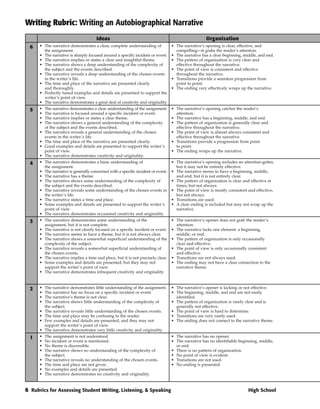
Writing Rubric: Writing an Autobiographical Narrative
                                      Ideas                                                         Organization
  6   • The narrative demonstrates a clear, complete understanding of             • The narrative’s opening is clear, effective, and
        the assignment.                                                             compelling—it grabs the reader‘s attention.
      • The narrative is sharply focused around a specific incident or event.     • The narrative has a clear beginning, middle, and end.
      • The narrative implies or states a clear and insightful theme.             • The pattern of organization is very clear and
      • The narrative shows a deep understanding of the complexity of               effective throughout the narrative.
        the subject and the events described.                                     • The point of view is consistent and effective
      • The narrative reveals a deep understanding of the chosen events             throughout the narrative.
        in the writer’s life.                                                     • Transitions provide a seamless progression from
      • The time and place of the narrative are presented clearly                   point to point.
        and thoroughly.                                                           • The ending very effectively wraps up the narrative.
      • Perfectly tuned examples and details are presented to support the
        writer’s point of view.
      • The narrative demonstrates a great deal of creativity and originality.
  5   •   The narrative demonstrates a clear understanding of the assignment.     • The narrative’s opening catches the reader‘s
      •   The narrative is focused around a specific incident or event.             attention.
      •   The narrative implies or states a clear theme.                          • The narrative has a beginning, middle, and end.
      •   The narrative shows a general understanding of the complexity           • The pattern of organization is generally clear and
          of the subject and the events described.                                  effective throughout the narrative.
      •   The narrative reveals a general understanding of the chosen             • The point of view is almost always consistent and
          events in the writer’s life.                                              effective throughout the narrative.
      •   The time and place of the narrative are presented clearly.              • Transitions provide a progression from point
      •   Good examples and details are presented to support the writer’s           to point.
          point of view.                                                          • The ending wraps up the narrative.
      •   The narrative demonstrates creativity and originality.
  4   • The narrative demonstrates a basic understanding of                       • The narrative’s opening includes an attention-getter,
        the assignment.                                                             but it may not be entirely effective.
      • The narrative is generally concerned with a specific incident or event.   • The narrative seems to have a beginning, middle,
      • The narrative has a theme.                                                  and end, but it is not entirely clear.
      • The narrative shows some understanding of the complexity of               • The pattern of organization is clear and effective at
        the subject and the events described.                                       times, but not always.
      • The narrative reveals some understanding of the chosen events in          • The point of view is mostly consistent and effective,
        the writer’s life.                                                          but not always.
      • The narrative states a time and place.                                    • Transitions are used.
      • Some examples and details are presented to support the writer’s           • A clear ending is included but may not wrap up the
        point of view.                                                              narrative.
      • The narrative demonstrates occasional creativity and originality.
  3   • The narrative demonstrates some understanding of the                      • The narrative’s opener does not grab the reader’s
        assignment, but it is not complete.                                         attention.
      • The narrative is not clearly focused on a specific incident or event.     • The narrative lacks one element: a beginning,
      • The narrative seems to have a theme, but it is not always clear.            middle, or end.
      • The narrative shows a somewhat superficial understanding of the           • The pattern of organization is only occasionally
        complexity of the subject.                                                  clear and effective.
      • The narrative reveals a somewhat superficial understanding of             • The point of view is only occasionally consistent
        the chosen events.                                                          and effective.
      • The narrative implies a time and place, but it is not precisely clear.    • Transitions are not always used.
      • Some examples and details are presented, but they may not                 • The ending may not have a clear connection to the
        support the writer’s point of view.                                         narrative theme.
      • The narrative demonstrates infrequent creativity and originality.


  2   •   The narrative demonstrates little understanding of the assignment.      • The narrative’s opener is lacking or not effective.
      •   The narrative has no focus on a specific incident or event.             • The beginning, middle, and end are not easily
      •   The narrative’s theme is not clear.                                       identified.
      •   The narrative shows little understanding of the complexity of           • The pattern of organization is rarely clear and is
          the subject.                                                              generally not effective.
      •   The narrative reveals little understanding of the chosen events.        • The point of view is hard to determine.
      •   The time and place may be confusing to the reader.                      • Transitions are very rarely used.
      •   Few examples and details are presented, and they may not                • The ending does not connect to the narrative theme.
          support the writer’s point of view.
      •   The narrative demonstrates very little creativity and originality.
  1   •   The assignment is not understood.                                       • The narrative has no opener.
      •   No incident or event is mentioned.                                      • The narrative has no identifiable beginning, middle,
      •   No theme is discernible.                                                  or end.
      •   The narrative shows no understanding of the complexity of               • There is no pattern of organization.
          the subject.                                                            • No point of view is evident.
      •   The narrative reveals no understanding of the chosen events.            • Transitions are not used.
      •   The time and place are not given.                                       • No ending is presented.
      •   No examples and details are presented.
      •   The narrative demonstrates no creativity and originality.


6 Rubrics for Assessing Student Writing, Listening, & Speaking                                                             High School
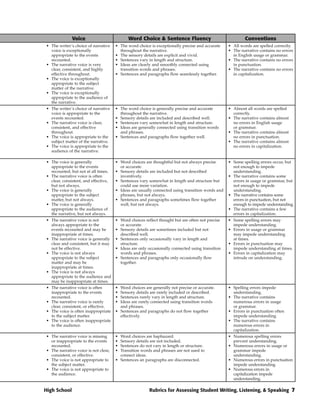
Voice                         Word Choice & Sentence Fluency                               Conventions
• The writer’s choice of narrative    • The word choice is exceptionally precise and accurate    • All words are spelled correctly.
  voice is exceptionally                throughout the narrative.                                • The narrative contains no errors
  appropriate to the events           • The sensory details are explicit and vivid.                in English usage or grammar.
  recounted.                          • Sentences vary in length and structure.                  • The narrative contains no errors
• The narrative voice is very         • Ideas are clearly and smoothly connected using             in punctuation.
  clear, consistent, and highly         transition words and phrases.                            • The narrative contains no errors
  effective throughout.               • Sentences and paragraphs flow seamlessly together.         in capitalization.
• The voice is exceptionally
  appropriate to the subject
  matter of the narrative.
• The voice is exceptionally
  appropriate to the audience of
  the narrative.
• The writer’s choice of narrative    • The word choice is generally precise and accurate        • Almost all words are spelled
  voice is appropriate to the           throughout the narrative.                                  correctly.
  events recounted.                   • Sensory details are included and described well.         • The narrative contains almost
• The narrative voice is clear,       • Sentences vary somewhat in length and structure.           no errors in English usage
  consistent, and effective           • Ideas are generally connected using transition words       or grammar.
  throughout.                           and phrases.                                             • The narrative contains almost
• The voice is appropriate to the     • Sentences and paragraphs flow together well.               no errors in punctuation.
  subject matter of the narrative.                                                               • The narrative contains almost
• The voice is appropriate to the                                                                  no errors in capitalization.
  audience of the narrative.

• The voice is generally              • Word choices are thoughtful but not always precise       • Some spelling errors occur, but
  appropriate to the events             or accurate.                                               not enough to impede
  recounted, but not at all times.    • Sensory details are included but not described             understanding.
• The narrative voice is often          inventively.                                             • The narrative contains some
  clear, consistent, and effective,   • Sentences vary somewhat in length and structure but        errors in usage or grammar, but
  but not always.                       could use more variation.                                  not enough to impede
• The voice is generally              • Ideas are usually connected using transition words and     understanding.
  appropriate to the subject            phrases, but not always.                                 • The narrative contains some
  matter, but not always.             • Sentences and paragraphs sometimes flow together           errors in punctuation, but not
• The voice is generally                well, but not always.                                      enough to impede understanding.
  appropriate to the audience of                                                                 • The narrative contains a few
  the narrative, but not always.                                                                   errors in capitalization.
• The narrative voice is not          • Word choices reflect thought but are often not precise   • Some spelling errors may
  always appropriate to the             or accurate.                                               impede understanding.
  events recounted and may be         • Sensory details are sometimes included but not           • Errors in usage or grammar
  inappropriate at times.               described well.                                            may impede understanding
• The narrative voice is generally    • Sentences only occasionally vary in length and             at times.
  clear and consistent, but it may      structure.                                               • Errors in punctuation may
  not be effective.                   • Ideas are only occasionally connected using transition     impede understanding at times.
• The voice is not always               words and phrases.                                       • Errors in capitalization may
  appropriate to the subject          • Sentences and paragraphs only occasionally flow            intrude on understanding.
  matter and may be                     together.
  inappropriate at times.
• The voice is not always
  appropriate to the audience and
  may be inappropriate at times.
• The narrative voice is often        • Word choices are generally not precise or accurate.      • Spelling errors impede
  inappropriate to the events         • Sensory details are rarely included or described.          understanding.
  recounted.                          • Sentences rarely vary in length and structure.           • The narrative contains
• The narrative voice is rarely       • Ideas are rarely connected using transition words          numerous errors in usage
  clear, consistent, or effective.      and phrases.                                               or grammar.
• The voice is often inappropriate    • Sentences and paragraphs do not flow together            • Errors in punctuation often
  to the subject matter.                effectively.                                               impede understanding.
• The voice is often inappropriate                                                               • The narrative contains
  to the audience.                                                                                 numerous errors in
                                                                                                   capitalization.
• The narrative voice is missing      • Word choices are haphazard.                              • Numerous spelling errors
  or inappropriate to the events      • Sensory details are not included.                          prevent understanding.
  recounted.                          • Sentences do not vary in length or structure.            • Numerous errors in usage or
• The narrative voice is not clear,   • Transition words and phrases are not used to               grammar impede
  consistent, or effective.             connect ideas.                                             understanding.
• The voice is not appropriate to     • Sentences an paragraphs are disconnected.                • Numerous errors in punctuation
  the subject matter.                                                                              impede understanding.
• The voice is not appropriate to                                                                • Numerous errors in
  the audience.                                                                                    capitalization impede
                                                                                                   understanding.

High School                                             Rubrics for Assessing Student Writing, Listening, & Speaking 7
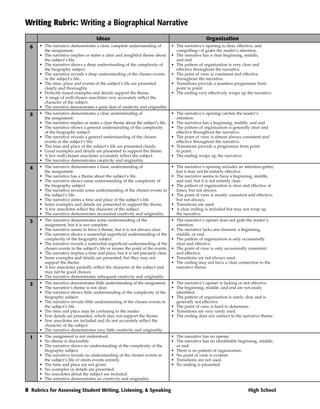
Writing Rubric: Writing a Biographical Narrative
                                      Ideas                                                         Organization
  6   • The narrative demonstrates a clear, complete understanding of             • The narrative’s opening is clear, effective, and
        the assignment.                                                             compelling—it grabs the reader‘s attention.
      • The narrative implies or states a clear and insightful theme about        • The narrative has a clear beginning, middle,
        the subject’s life.                                                         and end.
      • The narrative shows a deep understanding of the complexity of             • The pattern of organization is very clear and
        the biography subject.                                                      effective throughout the narrative.
      • The narrative reveals a deep understanding of the chosen events           • The point of view is consistent and effective
        in the subject’s life.                                                      throughout the narrative.
      • The time, place and events of the subject’s life are presented            • Transitions provide a seamless progression from
        clearly and thoroughly.                                                     point to point.
      • Perfectly tuned examples and details support the theme.                   • The ending very effectively wraps up the narrative.
      • A range of well-chosen anecdotes very accurately reflect the
        character of the subject.
      • The narrative demonstrates a great deal of creativity and originality.
  5   • The narrative demonstrates a clear understanding of                       • The narrative’s opening catches the reader‘s
        the assignment.                                                             attention.
      • The narrative implies or states a clear theme about the subject’s life.   • The narrative has a beginning, middle, and end.
      • The narrative shows a general understanding of the complexity             • The pattern of organization is generally clear and
        of the biography subject.                                                   effective throughout the narrative.
      • The narrative reveals a general understanding of the chosen               • The point of view is almost always consistent and
        events in the subject’s life.                                               effective throughout the narrative.
      • The time and place of the subject’s life are presented clearly.           • Transitions provide a progression from point
      • Good examples and details are presented to support the theme.               to point.
      • A few well-chosen anecdotes accurately reflect the subject.               • The ending wraps up the narrative.
      • The narrative demonstrates creativity and originality.
  4   • The narrative demonstrates a basic understanding of                       • The narrative’s opening includes an attention-getter,
        the assignment.                                                             but it may not be entirely effective.
      • The narrative has a theme about the subject’s life.                       • The narrative seems to have a beginning, middle,
      • The narrative shows some understanding of the complexity of                 and end, but it is not entirely clear.
        the biography subject.                                                    • The pattern of organization is clear and effective at
      • The narrative reveals some understanding of the chosen events in            times, but not always.
        the subject’s life.                                                       • The point of view is mostly consistent and effective,
      • The narrative states a time and place of the subject’s life.                but not always.
      • Some examples and details are presented to support the theme.             • Transitions are used.
      • A few anecdotes reflect the character of the subject.                     • A clear ending is included but may not wrap up
      • The narrative demonstrates occasional creativity and originality.           the narrative.
  3   • The narrative demonstrates some understanding of the                      • The narrative’s opener does not grab the reader’s
        assignment, but it is not complete.                                         attention.
      • The narrative seems to have a theme, but it is not always clear.          • The narrative lacks one element: a beginning,
      • The narrative shows a somewhat superficial understanding of the             middle, or end.
        complexity of the biography subject.                                      • The pattern of organization is only occasionally
      • The narrative reveals a somewhat superficial understanding of the           clear and effective.
        chosen events in the subject’s life or misses the point of the events.    • The point of view is only occasionally consistent
      • The narrative implies a time and place, but it is not precisely clear.      and effective.
      • Some examples and details are presented, but they may not                 • Transitions are not always used.
        support the theme.                                                        • The ending may not have a clear connection to the
      • A few anecdotes partially reflect the character of the subject and          narrative theme.
        may not be good choices.
      • The narrative demonstrates infrequent creativity and originality.
  2   • The narrative demonstrates little understanding of the assignment.        • The narrative’s opener is lacking or not effective.
      • The narrative’s theme is not clear.                                       • The beginning, middle, and end are not easily
      • The narrative shows little understanding of the complexity of the           identified.
        biography subject.                                                        • The pattern of organization is rarely clear and is
      • The narrative reveals little understanding of the chosen events in          generally not effective.
        the subject’s life.                                                       • The point of view is hard to determine.
      • The time and place may be confusing to the reader.                        • Transitions are very rarely used.
      • Few details are presented, which may not support the theme.               • The ending does not connect to the narrative theme.
      • Few anecdotes are included and do not accurately reflect the
        character of the subject.
      • The narrative demonstrates very little creativity and originality.
  1   • The assignment is not understood.                                         • The narrative has no opener.
      • No theme is discernible.                                                  • The narrative has no identifiable beginning, middle,
      • The narrative shows no understanding of the complexity of the               or end.
        biography subject.                                                        • There is no pattern of organization.
      • The narrative reveals no understanding of the chosen events in            • No point of view is evident.
        the subject’s life or omits events entirely.                              • Transitions are not used.
      • The time and place are not given.                                         • No ending is presented.
      • No examples or details are presented.
      • No anecdotes about the subject are included.
      • The narrative demonstrates no creativity and originality.

8 Rubrics for Assessing Student Writing, Listening, & Speaking                                                             High School
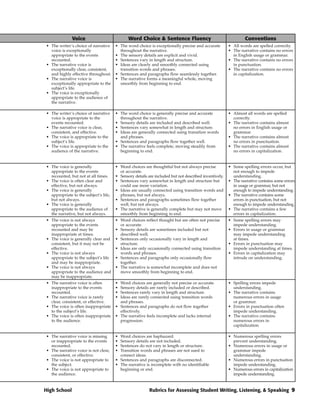
Voice                           Word Choice & Sentence Fluency                                    Conventions
• The writer’s choice of narrative     • The word choice is exceptionally precise and accurate         • All words are spelled correctly.
  voice is exceptionally                 throughout the narrative.                                     • The narrative contains no errors
  appropriate to the events            • The sensory details are explicit and vivid.                     in English usage or grammar.
  recounted.                           • Sentences vary in length and structure.                       • The narrative contains no errors
• The narrative voice is               • Ideas are clearly and smoothly connected using                  in punctuation.
  exceptionally clear, consistent,       transition words and phrases.                                 • The narrative contains no errors
  and highly effective throughout.     • Sentences and paragraphs flow seamlessly together.              in capitalization.
• The narrative voice is               • The narrative forms a meaningful whole, moving
  exceptionally appropriate to the       smoothly from beginning to end.
  subject’s life.
• The voice is exceptionally
  appropriate to the audience of
  the narrative.

• The writer’s choice of narrative     • The word choice is generally precise and accurate             • Almost all words are spelled
  voice is appropriate to the            throughout the narrative.                                       correctly.
  events recounted.                    • Sensory details are included and described well.              • The narrative contains almost
• The narrative voice is clear,        • Sentences vary somewhat in length and structure.                no errors in English usage or
  consistent, and effective.           • Ideas are generally connected using transition words            grammar.
• The voice is appropriate to the        and phrases.                                                  • The narrative contains almost
  subject’s life.                      • Sentences and paragraphs flow together well.                    no errors in punctuation.
• The voice is appropriate to the      • The narrative feels complete, moving steadily from            • The narrative contains almost
  audience of the narrative.             beginning to end.                                               no errors in capitalization.


• The voice is generally               • Word choices are thoughtful but not always precise            • Some spelling errors occur, but
  appropriate to the events              or accurate.                                                    not enough to impede
  recounted, but not at all times.     • Sensory details are included but not described inventively.     understanding.
• The voice is often clear and         • Sentences vary somewhat in length and structure but           • The narrative contains some errors
  effective, but not always.             could use more variation.                                       in usage or grammar, but not
• The voice is generally               • Ideas are usually connected using transition words and          enough to impede understanding.
  appropriate to the subject’s life,     phrases, but not always.                                      • The narrative contains some
  but not always.                      • Sentences and paragraphs sometimes flow together                errors in punctuation, but not
• The voice is generally                 well, but not always.                                           enough to impede understanding.
  appropriate to the audience of       • The narrative is generally complete but may not move          • The narrative contains a few
  the narrative, but not always.         smoothly from beginning to end.                                 errors in capitalization.
• The voice is not always              • Word choices reflect thought but are often not precise        • Some spelling errors may
  appropriate to the events              or accurate.                                                    impede understanding.
  recounted and may be                 • Sensory details are sometimes included but not                • Errors in usage or grammar
  inappropriate at times.                described well.                                                 may impede understanding
• The voice is generally clear and     • Sentences only occasionally vary in length and                  at times.
  consistent, but it may not be          structure.                                                    • Errors in punctuation may
  effective.                           • Ideas are only occasionally connected using transition          impede understanding at times.
• The voice is not always                words and phrases.                                            • Errors in capitalization may
  appropriate to the subject’s life    • Sentences and paragraphs only occasionally flow                 intrude on understanding.
  and may be inappropriate.              together.
• The voice is not always              • The narrative is somewhat incomplete and does not
  appropriate to the audience and        move smoothly from beginning to end.
  may be inappropriate.
• The narrative voice is often         • Word choices are generally not precise or accurate.           • Spelling errors impede
  inappropriate to the events          • Sensory details are rarely included or described.               understanding.
  recounted.                           • Sentences rarely vary in length and structure.                • The narrative contains
• The narrative voice is rarely        • Ideas are rarely connected using transition words               numerous errors in usage
  clear, consistent, or effective.       and phrases.                                                    or grammar.
• The voice is often inappropriate     • Sentences and paragraphs do not flow together                 • Errors in punctuation often
  to the subject’s life.                 effectively.                                                    impede understanding.
• The voice is often inappropriate     • The narrative feels incomplete and lacks internal             • The narrative contains
  to the audience.                       progression.                                                    numerous errors in
                                                                                                         capitalization.

• The narrative voice is missing       • Word choices are haphazard.                                   • Numerous spelling errors
  or inappropriate to the events       • Sensory details are not included.                               prevent understanding.
  recounted.                           • Sentences do not vary in length or structure.                 • Numerous errors in usage or
• The narrative voice is not clear,    • Transition words and phrases are not used to                    grammar impede
  consistent, or effective.              connect ideas.                                                  understanding.
• The voice is not appropriate to      • Sentences and paragraphs are disconnected.                    • Numerous errors in punctuation
  the subject.                         • The narrative is incomplete with no identifiable                impede understanding.
• The voice is not appropriate to        beginning or end.                                             • Numerous errors in capitalization
  the audience.                                                                                          impede understanding.


High School                                               Rubrics for Assessing Student Writing, Listening, & Speaking 9
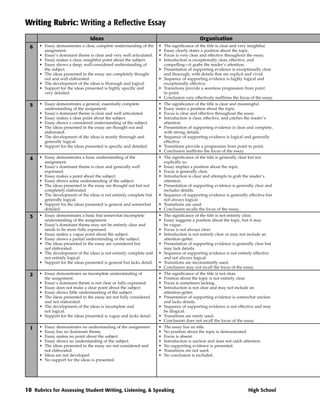
Writing Rubric: Writing a Reflective Essay
                                 Ideas                                                         Organization
  6   • Essay demonstrates a clear, complete understanding of the      •   The significance of the title is clear and very insightful.
        assignment.                                                    •   Essay clearly states a position about the topic.
      • Essay’s dominant theme is clear and very well articulated.     •   Focus is very clear and effective throughout the essay.
      • Essay makes a clear, insightful point about the subject.       •   Introduction is exceptionally clear, effective, and
      • Essay shows a deep, well-considered understanding of               compelling—it grabs the reader’s attention.
        the subject.                                                   •   Presentation of supporting evidence is exceptionally clear
      • The ideas presented in the essay are completely thought            and thorough, with details that are explicit and vivid.
        out and well elaborated.                                       •   Sequence of supporting evidence is highly logical and
      • The development of the ideas is thorough and logical.              exceptionally effective.
      • Support for the ideas presented is highly specific and         •   Transitions provide a seamless progression from point
        very detailed.                                                     to point.
                                                                       •   Conclusion very effectively reaffirms the focus of the essay.
  5   • Essay demonstrates a general, essentially complete             •   The significance of the title is clear and meaningful.
        understanding of the assignment.                               •   Essay states a position about the topic.
      • Essay’s dominant theme is clear and well articulated.          •   Focus is clear and effective throughout the essay.
      • Essay makes a clear point about the subject.                   •   Introduction is clear, effective, and catches the reader’s
      • Essay shows a considered understanding of the subject.             attention.
      • The ideas presented in the essay are thought out and           •   Presentation of supporting evidence is clear and complete,
        elaborated.                                                        with strong details.
      • The development of the ideas is mostly thorough and            •   Sequence of supporting evidence is logical and generally
        generally logical.                                                 effective.
      • Support for the ideas presented is specific and detailed.      •   Transitions provide a progression from point to point.
                                                                       •   Conclusion reaffirms the focus of the essay.
  4   • Essay demonstrates a basic understanding of the                • The significance of the title is generally clear but not
        assignment.                                                      explicitly so.
      • Essay’s dominant theme is clear and generally well             • Essay implies a position about the topic.
        expressed.                                                     • Focus is generally clear.
      • Essay makes a point about the subject.                         • Introduction is clear and attempts to grab the reader’s
      • Essay shows some understanding of the subject.                   attention.
      • The ideas presented in the essay are thought out but not       • Presentation of supporting evidence is generally clear and
        completely elaborated.                                           includes details.
      • The development of the ideas is not entirely complete but      • Sequence of supporting evidence is generally effective but
        generally logical.                                               not always logical.
      • Support for the ideas presented is general and somewhat        • Transitions are used.
        detailed.                                                      • Conclusion recalls the focus of the essay.
  3   • Essay demonstrates a basic but somewhat incomplete             • The significance of the title is not entirely clear.
        understanding of the assignment.                               • Essay suggests a position about the topic, but it may
      • Essay’s dominant theme may not be entirely clear and             be vague.
        needs to be more fully expressed.                              • Focus is not always clear.
      • Essay makes a vague point about the subject.                   • Introduction is not entirely clear or may not include an
      • Essay shows a partial understanding of the subject.              attention-getter.
      • The ideas presented in the essay are considered but            • Presentation of supporting evidence is generally clear but
        not elaborated.                                                  may lack details.
      • The development of the ideas is not entirely complete and      • Sequence of supporting evidence is not entirely effective
        not entirely logical.                                            and not always logical.
      • Support for the ideas presented is general but lacks detail.   • Transitions are inconsistently used.
                                                                       • Conclusion may not recall the focus of the essay.
  2   • Essay demonstrates an incomplete understanding of              •   The significance of the title is not clear.
        the assignment.                                                •   Position about the topic is not entirely clear.
      • Essay’s dominant theme is not clear or fully expressed.        •   Focus is sometimes lacking.
      • Essay does not make a clear point about the subject.           •   Introduction is not clear and may not include an
      • Essay shows little understanding of the subject.                   attention-getter.
      • The ideas presented in the essay are not fully considered      •   Presentation of supporting evidence is somewhat unclear
        and not elaborated.                                                and lacks details.
      • The development of the ideas is incomplete and                 •   Sequence of supporting evidence is not effective and may
        not logical.                                                       be illogical.
      • Support for the ideas presented is vague and lacks detail.     •   Transitions are rarely used.
                                                                       •   Conclusion does not recall the focus of the essay.
  1   • Essay demonstrates no understanding of the assignment.         •   The essay has no title.
      • Essay has no dominant theme.                                   •   No position about the topic is demonstrated.
      • Essay makes no point about the subject.                        •   Focus is absent.
      • Essay shows no understanding of the subject.                   •   Introduction is unclear and does not catch attention.
      • The ideas presented in the essay are not considered and        •   No supporting evidence is presented.
        not elaborated.                                                •   Transitions are not used.
      • Ideas are not developed.                                       •   No conclusion is included.
      • No support for the ideas is presented.


10 Rubrics for Assessing Student Writing, Listening, & Speaking                                                           High School
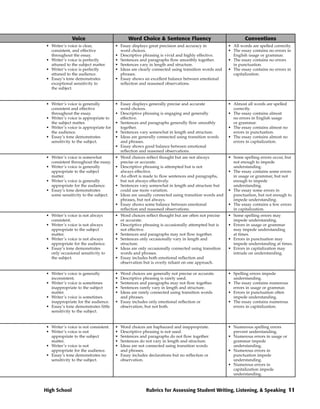
Voice                         Word Choice & Sentence Fluency                                Conventions
• Writer’s voice is clear,            • Essay displays great precision and accuracy in           • All words are spelled correctly.
  consistent, and effective             word choices.                                            • The essay contains no errors in
  throughout the essay.               • Descriptive phrasing is vivid and highly effective.        English usage or grammar.
• Writer’s voice is perfectly         • Sentences and paragraphs flow smoothly together.         • The essay contains no errors
  attuned to the subject matter.      • Sentences vary in length and structure.                    in punctuation.
• Writer’s voice is perfectly         • Ideas are clearly connected using transition words and   • The essay contains no errors in
  attuned to the audience.              phrases.                                                   capitalization.
• Essay’s tone demonstrates           • Essay shows an excellent balance between emotional
  exceptional sensitivity to            reflection and reasoned observations.
  the subject.


• Writer’s voice is generally         • Essay displays generally precise and accurate            • Almost all words are spelled
  consistent and effective              word choices.                                              correctly.
  throughout the essay.               • Descriptive phrasing is engaging and generally           • The essay contains almost
• Writer’s voice is appropriate to      effective.                                                 no errors in English usage
  the subject matter.                 • Sentences and paragraphs generally flow smoothly           or grammar.
• Writer’s voice is appropriate for     together.                                                • The essay contains almost no
  the audience.                       • Sentences vary somewhat in length and structure.           errors in punctuation.
• Essay’s tone demonstrates           • Ideas are generally connected using transition words     • The essay contains almost no
  sensitivity to the subject.           and phrases.                                               errors in capitalization.
                                      • Essay shows good balance between emotional
                                        reflection and reasoned observations.
• Writer’s voice is somewhat          • Word choices reflect thought but are not always          • Some spelling errors occur, but
  consistent throughout the essay.      precise or accurate.                                       not enough to impede
• Writer’s voice is generally         • Descriptive phrasing is attempted but is not               understanding.
  appropriate to the subject            always effective.                                        • The essay contains some errors
  matter.                             • An effort is made to flow sentences and paragraphs,        in usage or grammar, but not
• Writer’s voice is generally           but not always effectively.                                enough to impede
  appropriate for the audience.       • Sentences vary somewhat in length and structure but        understanding.
• Essay’s tone demonstrates             could use more variation.                                • The essay some errors in
  some sensitivity to the subject.    • Ideas are usually connected using transition words and     punctuation, but not enough to
                                        phrases, but not always.                                   impede understanding.
                                      • Essay shows some balance between emotional               • The essay contains a few errors
                                        reflection and reasoned observations.                      in capitalization.
• Writer’s voice is not always        • Word choices reflect thought but are often not precise   • Some spelling errors may
  consistent.                           or accurate.                                               impede understanding.
• Writer’s voice is not always        • Descriptive phrasing is occasionally attempted but is    • Errors in usage or grammar
  appropriate to the subject            not effective.                                             may impede understanding
  matter.                             • Sentences and paragraphs may not flow together.            at times.
• Writer’s voice is not always        • Sentences only occasionally vary in length and           • Errors in punctuation may
  appropriate for the audience.         structure.                                                 impede understanding at times.
• Essay’s tone demonstrates           • Ideas are only occasionally connected using transition   • Errors in capitalization may
  only occasional sensitivity to        words and phrases.                                         intrude on understanding.
  the subject.                        • Essay includes both emotional reflection and
                                        observation but is overly reliant on one approach.

• Writer’s voice is generally         • Word choices are generally not precise or accurate.      • Spelling errors impede
  inconsistent.                       • Descriptive phrasing is rarely used.                       understanding.
• Writer’s voice is sometimes         • Sentences and paragraphs may not flow together.          • The essay contains numerous
  inappropriate to the subject        • Sentences rarely vary in length and structure.             errors in usage or grammar.
  matter.                             • Ideas are rarely connected using transition words        • Errors in punctuation often
• Writer’s voice is sometimes           and phrases.                                               impede understanding.
  inappropriate for the audience.     • Essay includes only emotional reflection or              • The essay contains numerous
• Essay’s tone demonstrates little      observation, but not both.                                 errors in capitalization.
  sensitivity to the subject.


• Writer’s voice is not consistent.   • Word choices are haphazard and inappropriate.            • Numerous spelling errors
• Writer’s voice is not               • Descriptive phrasing is not used.                          prevent understanding.
  appropriate to the subject          • Sentences and paragraphs do not flow together.           • Numerous errors in usage or
  matter.                             • Sentences do not vary in length and structure.             grammar impede
• Writer’s voice is not               • Ideas are not connected using transition words             understanding.
  appropriate for the audience.         and phrases.                                             • Numerous errors in
• Essay’s tone demonstrates no        • Essay includes declarations but no reflection or           punctuation impede
  sensitivity to the subject.           observation.                                               understanding.
                                                                                                 • Numerous errors in
                                                                                                   capitalization impede
                                                                                                   understanding.


High School                                           Rubrics for Assessing Student Writing, Listening, & Speaking 11
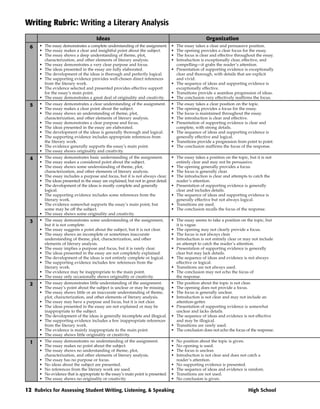
Writing Rubric: Writing a Literary Analysis
                                      Ideas                                                            Organization
  6   • The essay demonstrates a complete understanding of the assignment.         •   The essay takes a clear and persuasive position.
      • The essay makes a clear and insightful point about the subject.            •   The opening provides a clear focus for the essay.
      • The essay shows a deep understanding of theme, plot,                       •   The focus is clear and effective throughout the essay.
        characterization, and other elements of literary analysis.                 •   Introduction is exceptionally clear, effective, and
      • The essay demonstrates a very clear purpose and focus.                         compelling—it grabs the reader’s attention.
      • The ideas presented in the essay are fully elaborated.                     •   Presentation of supporting evidence is exceptionally
      • The development of the ideas is thorough and perfectly logical.                clear and thorough, with details that are explicit
      • The supporting evidence provides well-chosen direct references                 and vivid.
        from the literary work.                                                    •   The sequence of ideas and supporting evidence is
      • The evidence selected and presented provides effective support                 exceptionally effective.
        for the essay’s main point.                                                •   Transitions provide a seamless progression of ideas.
      • The essay demonstrates a great deal of originality and creativity.         •   The conclusion very effectively reaffirms the focus.
  5   • The essay demonstrates a clear understanding of the assignment.            • The essay takes a clear position on the topic.
      • The essay makes a clear point about the subject.                           • The opening provides a focus for the essay.
      • The essay shows an understanding of theme, plot,                           • The focus is maintained throughout the essay.
        characterization, and other elements of literary analysis.                 • The introduction is clear and effective.
      • The essay demonstrates a clear purpose and focus.                          • Presentation of supporting evidence is clear and
      • The ideas presented in the essay are elaborated.                             complete, with strong details.
      • The development of the ideas is generally thorough and logical.            • The sequence of ideas and supporting evidence is
      • The supporting evidence includes appropriate references from                 generally effective and logical.
        the literary work.                                                         • Transitions provide a progression from point to point.
      • The evidence generally supports the essay’s main point.                    • The conclusion reaffirms the focus of the response.
      • The essay shows originality and creativity.
  4   • The essay demonstrates basic understanding of the assignment.              • The essay takes a position on the topic, but it is not
      • The essay makes a considered point about the subject.                        entirely clear and may not be persuasive.
      • The essay shows some understanding of theme, plot,                         • The opening generally provides a focus.
        characterization, and other elements of literary analysis.                 • The focus is generally clear.
      • The essay includes a purpose and focus, but it is not always clear.        • The introduction is clear and attempts to catch the
      • The ideas presented in the essay are explained, but not in great detail.     reader’s attention.
      • The development of the ideas is mostly complete and generally              • Presentation of supporting evidence is generally
        logical.                                                                     clear and includes details.
      • The supporting evidence includes some references from the                  • The sequence of ideas and supporting evidence is
        literary work.                                                               generally effective but not always logical.
      • The evidence somewhat supports the essay’s main point, but                 • Transitions are used.
        some may be off the subject.                                               • The conclusion recalls the focus of the response.
      • The essay shows some originality and creativity.
  3   • The essay demonstrates some understanding of the assignment,               • The essay seems to take a position on the topic, but
        but it is not complete.                                                      it is vague.
      • The essay suggests a point about the subject, but it is not clear.         • The opening may not clearly provide a focus.
      • The essay shows an incomplete or sometimes inaccurate                      • The focus is not always clear.
        understanding of theme, plot, characterization, and other                  • Introduction is not entirely clear or may not include
        elements of literary analysis.                                               an attempt to catch the reader’s attention.
      • The essay implies a purpose and focus, but it is rarely clear.             • Presentation of supporting evidence is generally
      • The ideas presented in the essay are not completely explained.               clear but may lack details.
      • The development of the ideas is not entirely complete or logical.          • The sequence of ideas and evidence is not always
      • The supporting evidence includes few references from the                     effective or logical.
        literary work.                                                             • Transitions are not always used.
      • The evidence may be inappropriate to the main point.                       • The conclusion may not echo the focus of
      • The essay only occasionally shows originality or creativity.                 the response.
  2   • The essay demonstrates little understanding of the assignment.             •   The position about the topic is not clear.
      • The essay’s point about the subject is unclear or may be missing.          •   The opening does not provide a focus.
      • The essay shows little or an inaccurate understanding of theme,            •   The focus is generally unclear.
        plot, characterization, and other elements of literary analysis.           •   Introduction is not clear and may not include an
      • The essay may have a purpose and focus, but it is not clear.                   attention-getter.
      • The ideas presented in the essay are not explained or may be               •   Presentation of supporting evidence is somewhat
        inappropriate to the subject.                                                  unclear and lacks details.
      • The development of the ideas is generally incomplete and illogical.        •   The sequence of ideas and evidence is not effective
      • The supporting evidence includes a few inappropriate references                and may be illogical.
        from the literary work.                                                    •   Transitions are rarely used.
      • The evidence is mainly inappropriate to the main point.                    •   The conclusion does not echo the focus of the response.
      • The essay shows little originality or creativity.
  1   • The essay demonstrates no understanding of the assignment.                 •   No position about the topic is given.
      • The essay makes no point about the subject.                                •   No opening is used.
      • The essay shows no understanding of theme, plot,                           •   The focus is unclear.
        characterization, and other elements of literary analysis.                 •   Introduction is not clear and does not catch a
      • The essay has no purpose or focus.                                             reader’s attention.
      • No ideas about the subject are presented.                                  •   No supporting evidence is presented.
      • No references from the literary work are used.                             •   The sequence of ideas and evidence is random.
      • No evidence that is appropriate to the essay’s main point is presented.    •   Transitions are not used.
      • The essay shows no originality or creativity.                              •   No conclusion is given.

12 Rubrics for Assessing Student Writing, Listening, & Speaking                                                                High School
Voice                          Word Choice & Sentence Fluency                                 Conventions
• The writer’s voice is clear,         • The word choice is exceptionally precise and accurate.    • All words are spelled correctly.
  consistent, and sincere              • The word choice is vivid and effective, with lively       • The essay contains no errors
  throughout the essay.                  descriptive words used.                                     in English usage, grammar,
• Writer’s voice is perfectly          • When necessary, literary terms are used appropriately       or punctuation.
  attuned to the subject matter          and effectively.                                          • The essay contains no errors in
  of the essay.                        • Sentences vary in length and structure.                     capitalization.
• The writer’s voice is                • Ideas are clearly and smoothly connected using
  exceptionally appropriate to the       transition words and phrases.
  intended audience of the essay.      • The essay shows an excellent balance between
• The essay’s tone demonstrates          emotional reflection and reasoned observations.
  exceptional sensitivity to the
  piece of literature.
• The writer’s voice is consistent     • The word choice is generally precise and accurate.        • Almost all words are spelled
  and sincere throughout               • The word choice is effective, with descriptive              correctly.
  the essay.                             words used.                                               • The essay contains almost no
• Writer’s voice is appropriate to     • Generally as necessary, literary terms are used             errors in usage, grammar, or
  the subject matter of the essay.       appropriately.                                              punctuation.
• The writer’s voice is                • Sentences vary somewhat in length and structure.          • The essay contains almost no
  appropriate to the intended          • Ideas are generally connected using transition words        errors in capitalization.
  audience of the essay.                 and phrases.
• The essay’s tone demonstrates        • The essay shows a good balance between emotional
  sensitivity to the piece of            reflection and reasoned observations.
  literature.
• The writer’s voice is somewhat       • Word choices reflect thought but are not always precise   • Some spelling errors occur, but
  consistent throughout the essay,       or accurate.                                                not enough to impede
  but sincerity is not obvious.        • Descriptive phrasing is attempted but is not always         understanding.
• Writer’s voice is generally            effective or relevant.                                    • The essay contains some errors
  appropriate to the subject           • Some literary terms are used, generally appropriately.      in usage, grammar, or
  matter of the essay.                 • Sentences vary somewhat in length and structure but         punctuation, but not enough to
• The writer’s voice is generally        could use more variation.                                   impede understanding.
  appropriate to the intended          • Ideas are usually connected using transition words and    • The essay contains a few errors
  audience of the essay.                 phrases, but not always.                                    in capitalization.
• The essay’s tone demonstrates        • The essay shows some balance between emotional
  some sensitivity to the piece          reflection and reasoned observations.
  of literature.

• Writer’s voice is not always         • Word choices reflect thought but are often not precise    • Some spelling errors may
  consistent, and sincerity may          or accurate.                                                impede understanding.
  be lacking.                          • Descriptive phrasing is occasionally attempted but is     • Errors in usage, grammar, or
• Writer’s voice is not always           not effective or is irrelevant.                             punctuation may impede
  appropriate to the subject           • Some literary terms are used, but often not                 understanding at times.
  matter.                                appropriately.                                            • Errors in capitalization may
• Writer’s voice is not always         • Sentences only occasionally vary in length and              intrude on understanding.
  appropriate to the intended            structure.
  audience of the essay.               • Ideas are only occasionally connected using transition
• The essay’s tone demonstrates          words and phrases.
  only occasional sensitivity to       • The essay includes emotional reflection and reasoned
  the subject.                           observations but is overly reliant on one approach.

• Writer’s voice is generally          • Word choices are generally not precise or accurate.       • Spelling errors impede
  inconsistent and often insincere.    • Descriptive phrasing is rarely used.                        understanding.
• Writer’s voice is sometimes          • Sentences and paragraphs may not flow together.           • Numerous errors in usage,
  inappropriate to the subject         • Sentences rarely vary in length and structure.              grammar, or punctuation often
  matter, but often not.               • Ideas are rarely connected using transition words           impede understanding.
• Writer’s voice is sometimes            and phrases.                                              • The essay contains numerous
  inappropriate to the intended        • The essay includes only emotional reflection or             errors in capitalization.
  audience of the essay.                 observation, but not both.
• The essay’s tone demonstrates
  little sensitivity to the subject.


• Writer’s voice is not consistent     • Word choices are haphazard and inappropriate.             • Numerous spelling errors
  or sincere.                          • Descriptive phrasing is not used.                           prevent understanding.
• Writer’s voice is not appropriate    • Sentences and paragraphs do not flow together.            • Numerous errors in usage,
  to the subject matter.               • Sentences do not vary in length and structure.              grammar, and punctuation
• Writer’s voice is not appropriate    • Ideas are not connected using transition words              impede understanding.
  for the audience.                      and phrases.                                              • Numerous errors in
• The essay’s tone demonstrates        • The essay includes declarations but no reflection or        capitalization impede
  no sensitivity to the subject.         observation.                                                understanding.


High School                                            Rubrics for Assessing Student Writing, Listening, & Speaking 13
Writing Rubric: Writing a Research Report
                                      Ideas                                                         Organization
  6   • The report demonstrates a complete, clear understanding of               • The introduction effectively focuses on the topic.
        the assignment.                                                          • The report includes a clear, direct thesis statement
      • The report addresses a very interesting topic.                             that conveys the writer’s attitude about the topic.
      • The report provides a clear and insightful point about the topic.        • The opening provides a clear focus for the report.
      • The report shows a deep understanding of the complexity and              • The focus is clearly and effectively maintained
        nuances of the topic.                                                      throughout the report.
      • The report demonstrates a very clear purpose and focus.                  • The body is presented in a completely logical order.
      • The selection of relevant information as supporting evidence is          • The supporting factual information is exceptionally
        sensible and insightful.                                                   explicit and thorough.
      • The development of the ideas is thorough and perfectly logical.          • Transitions are seamless.
      • The report demonstrates a great deal of originality and creativity.      • The conclusion effectively reviews the most
      • The report completely avoids plagiarism through the effective              important points presented in the report.
        use of quotations and paraphrasing.
  5   •   The report demonstrates a clear understanding of the assignment.       • The introduction focuses on the topic.
      •   The report addresses an interesting topic.                             • The report includes a clear thesis statement that
      •   The report makes a clear point about the topic.                          generally conveys the writer’s attitude about
      •   The report shows an understanding of the complexity of the topic.        the topic.
      •   The report demonstrates a clear purpose and focus.                     • The focus is maintained throughout the report.
      •   The selection of supporting evidence is sensible.                      • The body is presented in a generally logical order.
      •   The development of the ideas is generally thorough and logical.        • The factual information is clear and thorough.
      •   The report demonstrates good originality and creativity.               • Transitions are effective.
      •   The report generally avoids plagiarism through the use of              • The conclusion reviews the most important points.
          quotations and paraphrasing.

  4   •   The report demonstrates a basic understanding of the assignment.       • The introduction mentions the topic, but it is not
      •   The report addresses a somewhat intriguing topic.                        entirely clear.
      •   The report makes a considered point about the topic.                   • The report includes a thesis statement that generally
      •   The report shows an understanding of the complexity of the topic         conveys the writer’s attitude about the topic.
          but is not nuanced.                                                    • The focus is generally clear, but not always.
      •   The report includes a purpose and focus, but it is not                 • The order is generally logical but sometimes
          always clear.                                                            confusing.
      •   The selection of evidence is generally sensible.                       • The factual information is generally clear and
      •   The development of the ideas is mostly complete and logical.             includes some details.
      •   The report shows some originality and creativity.                      • Transitions are used.
      •   The report uses quotations and paraphrasing, but the line              • The conclusion recalls some important points.
          separating quoted material from the writer’s own content is not
          always clear.
  3   • The report demonstrates some understanding of the assignment,            • The introduction’s focus on the topic of the report is
        but it is not complete.                                                    not entirely clear and may be missing.
      • The report addresses a somewhat humdrum topic.                           • The report includes a thesis statement but it does
      • The report suggests a point about the topic, but it is not clear.          not convey the writer’s attitude about the topic.
      • The report shows an incomplete or sometimes inaccurate                   • The focus is not always clear.
        understanding of the complexity of the topic.                            • The order is often illogical or confusing.
      • The report suggests a purpose and focus, but it is rarely clear.         • The factual information is generally clear but
      • The supporting evidence is not always appropriate or relevant.             lacks details.
      • The development of the ideas is not entirely complete or logical.        • Transitions are not always used.
      • The report only occasionally shows originality and creativity.           • The conclusion notes only a few of the report’s
      • The division between quoted or paraphrased material from the               main points.
        writer’s own content is not always clear.
  2   •   The report demonstrates little understanding of the assignment.        • The introduction does not provide a focus.
      •   The report’s topic is not compelling.                                  • The report does not include an easily identified
      •   The report’s point about the topic is not clear.                         thesis statement.
      •   The report shows little or an inaccurate understanding of the topic.   • The focus is generally unclear.
      •   The report’s purpose and focus is not clear.                           • The report is presented in a confusing order.
      •   The supporting evidence is often irrelevant.                           • The factual information is unclear and lacks details.
      •   The development of the ideas is generally incomplete or illogical.     • Transitions are rarely used.
      •   The report shows little originality and creativity.                    • The conclusion does not review the report’s
      •   The division between quoted or paraphrased material from                 main points.
          the writer’s own content is not clear and gives the impression
          of plagiarism.
  1   •   The assignment is not understood.                                      •   No introduction is presented.
      •   The report’s topic is not at all interesting.                          •   The report does not include a thesis statement.
      •   No point about the topic is made.                                      •   The focus is unclear.
      •   The report shows no understanding of the topic.                        •   The report is in random, unconnected order.
      •   The report has no purpose or focus.                                    •   No supporting factual information is presented.
      •   No supporting evidence is included.                                    •   Transitions are not used.
      •   Ideas are not developed.                                               •   No conclusion is presented.
      •   The report shows no originality and creativity.
      •   Portions or all of the report are plagiarized.


14 Rubrics for Assessing Student Writing, Listening, & Speaking                                                            High School
Voice                            Word Choice & Sentence Fluency                               Conventions
• The writer’s voice is clear,         • The word choice is exceptionally precise and accurate.    • All words are spelled correctly.
  consistent, and sincere              • The word choice is vivid and effective, with lively       • The report contains no errors in
  throughout the report.                 descriptive words used.                                     English usage or grammar.
• Writer’s voice is perfectly          • When necessary, literary terms are used appropriately     • The report contains no errors
  attuned to the subject matter          and effectively.                                            in punctuation.
  of the report.                       • Sentences vary in length and structure.                   • The report contains no errors
• The writer’s voice is                • Ideas are clearly and smoothly connected using              in capitalization.
  exceptionally appropriate              transition words and phrases.
  to the intended audience of
  the report.
• The report’s tone demonstrates
  exceptional understanding of
  the research subject.
• The writer’s voice is consistent     • The word choice is generally precise and accurate.        • Almost all words are spelled
  and sincere throughout the           • The word choice is effective, with descriptive              correctly.
  report.                                words used.                                               • The report contains almost
• Writer’s voice is appropriate to     • Generally as necessary, literary terms are used             no errors in English usage
  the subject matter of the report.      appropriately.                                              or grammar.
• The writer’s voice is                • Sentences vary somewhat in length and structure.          • The report contains almost no
  appropriate to the intended          • Ideas are generally connected using transition words        errors in punctuation.
  audience of the report.                and phrases.                                              • The report contains almost no
• The report’s tone demonstrates                                                                     errors in capitalization.
  an understanding of the
  research subject.
• The writer’s voice is somewhat       • Word choices reflect thought but are not always precise   • Some spelling errors occur, but
  consistent throughout the              or accurate.                                                not enough to impede
  report, but sincerity is not         • Descriptive phrasing is attempted but is not always         understanding.
  obvious.                               effective or relevant.                                    • The report contains some errors
• Writer’s voice is generally          • Some literary terms are used, generally appropriately.      in usage or grammar, but not
  appropriate to the subject           • Sentences vary somewhat in length and structure but         enough to impede
  matter of the report.                  could use more variation.                                   understanding.
• The writer’s voice is generally      • Ideas are usually connected using transition words and    • The report contains some errors
  appropriate to the intended            phrases, but not always.                                    in punctuation, but not enough
  audience of the report.                                                                            to impede understanding.
• The report’s tone demonstrates                                                                   • The report contains a few errors
  some understanding of the                                                                          in capitalization.
  research subject.
• Writer’s voice is not always         • Word choices reflect thought but are often not precise    • Some spelling errors may
  consistent, and sincerity may          or accurate.                                                impede understanding.
  be lacking.                          • Descriptive phrasing is occasionally attempted but is     • Errors in usage or grammar
• Writer’s voice is not always           not effective or is irrelevant.                             may impede understanding
  appropriate to the subject matter.   • Some literary terms are used, but often not                 at times.
• Writer’s voice is not always           appropriately.                                            • Errors in punctuation may
  appropriate to the intended          • Sentences only occasionally vary in length and              impede understanding at times.
  audience of the report.                structure.                                                • Errors in capitalization may
• The report’s tone demonstrates       • Ideas are only occasionally connected using transition      intrude on understanding.
  an incomplete understanding of         words and phrases.
  the research subject.

• Writer’s voice is generally          •   Word choices are generally not precise or accurate.     • Spelling errors impede
  inconsistent and often insincere.    •   Descriptive phrasing is rarely used.                      understanding.
• Writer’s voice is sometimes          •   Sentences and paragraphs may not flow together.         • The report contains numerous
  inappropriate to the subject         •   Sentences rarely vary in length and structure.            errors in usage or grammar.
  matter, but often not.               •   Ideas are rarely connected using transition words       • Errors in punctuation often
• Writer’s voice is sometimes              and phrases.                                              impede understanding.
  inappropriate to the intended                                                                    • The report contains numerous
  audience of the report.                                                                            errors in capitalization.
• The report’s tone demonstrates
  very little understanding of the
  research subject.
• Writer’s voice is not consistent     •   Word choices are haphazard and inappropriate.           • Numerous spelling errors
  or sincere.                          •   Descriptive phrasing is not used.                         prevent understanding.
• Writer’s voice is not appropriate    •   Sentences and paragraphs do not flow together.          • Numerous errors in usage or
  to the subject matter.               •   Sentences do not vary in length and structure.            grammar impede
• Writer’s voice is not appropriate    •   Ideas are not connected using transition words            understanding.
  for the audience.                        and phrases.                                            • Numerous errors in punctuation
• The report’s tone demonstrates                                                                     impede understanding.
  no understanding of the                                                                          • Numerous errors in capitalization
  research subject.                                                                                  impede understanding.


High School                                             Rubrics for Assessing Student Writing, Listening, & Speaking 15
Writing Rubric: Writing an Historical Research Paper
                                     Ideas                                                       Organization
  6   • The assignment is clearly and completely understood.                  • The paper includes a clear, direct thesis statement.
      • The title very effectively conveys the subject of the paper.          • The introduction effectively focuses on the general
      • The paper provides a clear and insightful point about the subject.      subject and specific topic of the paper.
      • The paper demonstrates a very clear purpose and focus.                • The focus is clearly and effectively maintained
      • The development of the ideas is thorough and perfectly logical.         throughout the paper.
      • The selection of the historical information as supporting evidence    • The body of the paper is completely logical.
        is sensible and insightful.                                           • The supporting historical evidence presented is
      • The ideas and supporting evidence are fully elaborated.                 exceptionally explicit and thorough.
      • All statements are supported with facts and details.                  • Transitions are seamless.
      • The paper completely avoids plagiarism through the effective use      • The conclusion effectively reviews the most
        of quotations and paraphrasing.                                         important points presented in the paper.

  5   • The paper demonstrates a clear understanding of the assignment.       • The paper includes a clear thesis statement.
      • The title conveys the subject of the paper.                           • The introduction focuses on the general subject and
      • The paper provides a clear point about the subject.                     topic of the paper.
      • The paper demonstrates a clear purpose and focus.                     • The focus is maintained throughout the paper.
      • The development of the ideas is generally complete and logical.       • The body of the paper is generally logical.
      • The selection of the historical information as supporting evidence    • The supporting historical evidence presented is
        is sensible.                                                            clear and thorough.
      • The ideas and supporting evidence are elaborated.                     • Transitions are effective.
      • Almost all statements are supported with facts and details.           • The conclusion reviews the most important points
      • The paper generally avoids plagiarism through the use of                presented in the paper.
        quotations and paraphrasing.
  4   • The paper demonstrates a basic understanding of the assignment.       • The paper includes a thesis statement.
      • The title does not entirely convey the subject of the paper.          • The introduction mentions the topic of the paper,
      • The paper implies a point about the subject without stating             but it is not entirely clear.
        it clearly.                                                           • The focus is generally clear throughout the paper,
      • The paper demonstrates a purpose and focus, but it is not               but not always.
        always clear.                                                         • The body of the paper is presented in an order that
      • The development of the ideas is mostly complete and logical.            is generally logical but sometimes confusing.
      • The selection of the historical information as supporting evidence    • The supporting historical evidence presented is
        is generally sensible, but some inclusions may be irrelevant.           generally clear and includes some details.
      • Most statements are supported with facts and details, but some        • Transitions are used.
        statements are unsubstantiated.                                       • The conclusion recalls some of the important points
      • The paper uses quotations and paraphrasing, but the line                presented in the paper.
        separating quoted material from the writer’s own content is not
        always clear.
  3   • The paper demonstrates some understanding of the assignment,          • The paper includes a thesis statement, but it is not
        but it is not complete.                                                 explicitly clear.
      • The relationship of the title to the subject of the paper is vague.   • The introduction’s focus on the topic of the paper is
      • The paper’s point about the subject is somewhat unclear.                not entirely clear and may be missing.
      • The paper suggests a purpose and focus, but it is rarely clear.       • The focus is not always clear.
      • The development of the ideas is not entirely complete or logical.     • The body of the paper is often illogical or confusing.
      • The selection of the historical information as supporting evidence    • The supporting historical evidence presented is
        may be unexplained or inappropriate to the paper’s main point.          generally clear but lacks details.
      • Only a few statements are supported with facts and details.           • Transitions are not always used.
      • The division between quoted or paraphrased material from the          • The conclusion notes only a few main points.
        writer’s own content is not always clear.

  2   • The paper demonstrates little understanding of the assignment.        • The paper does not include an easily identified
      • The paper has a title but it has no relationship to the subject of      thesis statement.
        the paper is vague.                                                   • The introduction does not provide a focus.
      • The paper’s point about the subject is unclear.                       • The focus is generally unclear.
      • The paper’s purpose and focus are not clear.                          • The body of the paper is in a confusing order.
      • The development of the ideas is generally incomplete and illogical.   • The supporting historical evidence presented is
      • The selection of the historical information as supporting evidence      unclear and lacks details.
        is not explained and may be irrelevant to the paper’s main point.     • Transitions are rarely used.
      • Too many statements are not supported with facts and details.         • The conclusion does not review the paper’s
      • The division between quoted or paraphrased material from                main points.
        the writer’s own content is not clear and gives the impression
        of plagiarism.
  1   •   The assignment is not understood.                                   • The paper has no thesis statement.
      •   The paper has no title.                                             • No introduction is presented.
      •   No point about the subject is made.                                 • The focus is unclear.
      •   The paper has no purpose or focus.                                  • The body of the paper is in random,
      •   Ideas are not developed.                                              unconnected order.
      •   No historical information as supporting evidence is presented.      • No supporting historical evidence is presented.
      •   No statements are substantiated in any way.                         • Transitions are not used.
      •   Portions or all of the paper are plagiarized.                       • No conclusion is presented.


16 Rubrics for Assessing Student Writing, Listening, & Speaking                                                         High School
Voice                           Word Choice & Sentence Fluency                               Conventions
• The writer’s voice is clear,        • The word choice is exceptionally precise and accurate.    • All words are spelled correctly.
  consistent, and sincere             • The word choice is vivid and effective, with lively       • The paper contains no errors in
  throughout the paper.                 descriptive words used.                                     English usage or grammar.
• Writer’s voice is perfectly         • When necessary, literary terms are used appropriately     • The paper contains no errors
  attuned to the subject matter of      and effectively.                                            in punctuation.
  the paper.                          • Sentences vary in length and structure.                   • The paper contains no errors
• The writer’s voice is               • Ideas are clearly and smoothly connected using              in capitalization.
  exceptionally appropriate to the      transition words and phrases.
  intended audience of the paper.
• The paper’s tone demonstrates
  exceptional understanding of
  the historical period discussed.
• The writer’s voice is consistent    • The word choice is generally precise and accurate.        • Almost all words are spelled
  and sincere throughout              • The word choice is effective, with descriptive              correctly.
  the paper.                            words used.                                               • The paper contains almost
• Writer’s voice is appropriate to    • Generally as necessary, literary terms are used             no errors in English usage
  the subject matter of the paper.      appropriately.                                              or grammar.
• The writer’s voice is               • Sentences vary somewhat in length and structure.          • The paper contains almost no
  appropriate to the intended         • Ideas are generally connected using transition words        errors in punctuation.
  audience of the paper.                and phrases.                                              • The paper contains almost no
• The paper’s tone demonstrates                                                                     errors in capitalization.
  an understanding of the
  historical period discussed.
• The writer’s voice is somewhat      • Word choices reflect thought but are not always precise   • Some spelling errors occur, but
  consistent throughout                 or accurate.                                                not enough to impede
  the paper, but sincerity is         • Descriptive phrasing is attempted but is not always         understanding.
  not obvious.                          effective or relevant.                                    • The paper contains some errors
• Writer’s voice is generally         • Some literary terms are used, generally appropriately.      in usage or grammar, but not
  appropriate to the subject          • Sentences vary somewhat in length and structure but         enough to impede
  matter of the paper.                  could use more variation.                                   understanding.
• The writer’s voice is generally     • Ideas are usually connected using transition words and    • The paper contains some errors
  appropriate to the intended           phrases, but not always.                                    in punctuation, but not enough
  audience of the paper.                                                                            to impede understanding.
• The paper’s tone demonstrates                                                                   • The paper contains a few errors
  some understanding of the                                                                         in capitalization.
  historical period.

• Writer’s voice is not always        • Word choices reflect thought but are often not precise    • Some spelling errors may
  consistent, and sincerity may         or accurate.                                                impede understanding.
  be lacking.                         • Descriptive phrasing is occasionally attempted but is     • Errors in usage or grammar
• Writer’s voice is not always          not effective or is irrelevant.                             may impede understanding
  appropriate to the subject          • Some literary terms are used, but often not                 at times.
  matter.                               appropriately.                                            • Errors in punctuation may
• Writer’s voice is not always        • Sentences only occasionally vary in length and              impede understanding at times.
  appropriate to the intended           structure.                                                • Errors in capitalization may
  audience of the paper.              • Ideas are only occasionally connected using transition      intrude on understanding.
• The paper’s tone demonstrates         words and phrases.
  an incomplete understanding of
  the historical period.
• Writer’s voice is generally         •   Word choices are generally not precise or accurate.     • Spelling errors impede
  inconsistent and often insincere.   •   Descriptive phrasing is rarely used.                      understanding.
• Writer’s voice is sometimes         •   Sentences and paragraphs may not flow together.         • The paper contains numerous
  inappropriate to the subject        •   Sentences rarely vary in length and structure.            errors in usage or grammar.
  matter, but often not.              •   Ideas are rarely connected using transition words       • Errors in punctuation often
• Writer’s voice is sometimes             and phrases.                                              impede understanding.
  inappropriate to the intended                                                                   • The paper contains numerous
  audience of the paper.                                                                            errors in capitalization.
• The paper’s tone demonstrates
  very little understanding of the
  historical period.

• Writer’s voice is not consistent    •   Word choices are haphazard and inappropriate.           • Numerous spelling errors
  or sincere.                         •   Descriptive phrasing is not used.                         prevent understanding.
• Writer’s voice is not appropriate   •   Sentences and paragraphs do not flow together.          • Numerous errors in usage or
  to the subject matter.              •   Sentences do not vary in length and structure.            grammar impede
• Writer’s voice is not appropriate   •   Ideas are not connected using transition words            understanding.
  for the audience.                       and phrases.                                            • Numerous errors in punctuation
• The paper’s tone demonstrates                                                                     impede understanding.
  no understanding of the                                                                         • Numerous errors in capitalization
  historical period.                                                                                impede understanding.

High School                                            Rubrics for Assessing Student Writing, Listening, & Speaking 17
Writing Rubric: Writing an Editorial
                                      Ideas                                                        Organization
  6   • The editorial demonstrates a complete, clear understanding of          • The editorial’s main point is clearly and forcefully
        the assignment.                                                          stated in the lead paragraph.
      • The title accurately reflects the argument.                            • The focus is clear and effective throughout
      • The topic of the editorial is timely.                                    the editorial.
      • The topic is clearly stated.                                           • Internal order of ideas is very easy to follow.
      • The editorial makes a clear and convincing point about the topic.      • The supporting evidence presented is exceptionally
      • Well-chosen details support the editorial argument.                      fair and accurate.
      • The evidence supporting the main point is concise and relevant.        • The sequence of the supporting evidence is
      • The editorial thoroughly refutes opposing viewpoints.                    exceptionally logical and compelling.
      • Multiple appeals are blended throughout the editorial.                 • Possible counterarguments are refuted in a highly
      • The editorial ends with a dynamic clincher.                              logical sequence.
                                                                               • Transitions are seamless.
                                                                               • The closing effectively reaffirms the main point of
                                                                                 the editorial.
  5   • The editorial demonstrates a clear understanding of the assignment.    • The editorial’s main point is clearly stated in the
      • The title reflects the argument.                                         lead paragraph.
      • The topic of the editorial is not entirely timely.                     • The focus is clear throughout the editorial.
      • The topic is stated.                                                   • Internal order of ideas is easy to follow.
      • The editorial makes a clear point about the topic.                     • The supporting evidence presented is fair
      • Details generally support the editorial argument.                        and accurate.
      • The evidence supporting the editorial’s main point is relevant but     • The sequence of the supporting evidence is logical
        may not be concise.                                                      and interesting.
      • The editorial refutes opposing viewpoints.                             • Counterarguments are refuted in an orderly sequence.
      • Multiple appeals are used in a logical and compelling way.             • Transitions provide a progression from point to point.
      • The editorial ends with a strong clincher.                             • The closing reinforces the main point.
  4   • The editorial demonstrates a basic understanding of                    • The editorial’s main point is stated in the
        the assignment.                                                          lead paragraph.
      • The title does not entirely reflect the argument.                      • The focus is generally clear.
      • The topic of the editorial may be dated.                               • Internal order of ideas is mostly easy to follow, but
      • The topic may not be entirely clear.                                     not always.
      • The editorial makes a point about the topic, but it is not explicit.   • The supporting evidence presented is fair but may
      • Some details support the editorial argument.                             not be entirely accurate.
      • Some supporting evidence is presented but may not always               • The sequence of the supporting evidence makes
        be relevant.                                                             sense but may not be compelling.
      • Multiple appeals are presented but not in a compelling way.            • Possible counterarguments are refuted but not in an
      • The editorial ends with a clincher.                                      orderly manner.
                                                                               • Transitions are used.
                                                                               • The closing restates the main point of the editorial.
  3   • The editorial demonstrates some understanding of the                   • The editorial’s main point is stated, but not in the
        assignment, but it is not complete.                                      lead paragraph.
      • The title is only loosely connected to the argument.                   • The focus is somewhat unclear.
      • The topic of the editorial is out of date or of marginal interest.     • Internal order of ideas is not always easy to follow.
      • The topic is somewhat unclear.                                         • The supporting evidence presented may not be fair
      • The editorial’s point about the topic is somewhat vague.                 or entirely accurate.
      • Few details support the editorial argument.                            • The sequence of the supporting evidence may make
      • Little supporting evidence is presented.                                 no sense and lack interest.
      • One or two appeals are presented without compelling arguments.         • Some counterarguments are refuted but not all.
      • The editorial ends with an imprecise clincher.                         • Transitions are not always used.
                                                                               • The closing makes a point, but not the main point
                                                                                 of the editorial.
  2   • The editorial demonstrates little or an inaccurate understanding       •   The editorial’s main point is not clearly stated.
        of the assignment.                                                     •   The focus is unclear.
      • The title is not connected to the argument.                            •   Internal order of ideas seems random.
      • The topic of the editorial is dated and of little broad interest.      •   The supporting evidence presented is not fair or
      • The topic is generally unclear.                                            is inaccurate.
      • The editorial’s point about the topic is unclear.                      •   The sequence of the supporting evidence makes no
      • No relevant details support the editorial argument.                        sense and lacks interest.
      • No relevant supporting evidence is presented.                          •   Few or no possible counterarguments are refuted.
      • Appeals are vague and not compelling.                                  •   Transitions are rarely used.
      • The editorial lacks a clincher.                                        •   The closing does not make a point.

  1   •   The assignment is not understood.                                    •   The editorial has no main point.
      •   No title is included.                                                •   The editorial has no focus.
      •   No topic is presented for the editorial.                             •   The editorial has no internal order of ideas.
      •   The editorial makes no point about a topic.                          •   No supporting evidence is presented.
      •   No details support the editorial argument.                           •   No counterarguments are noted.
      •   No persuasive appeals are used.                                      •   Transitions are not used.
      •   The editorial lacks a conclusion.                                    •   The editorial has no closing.


18 Rubrics for Assessing Student Writing, Listening, & Speaking                                                            High School
Voice                           Word Choice & Sentence Fluency                               Conventions
• Editorial is interesting and presents a    • Lively verbs are used to strongly support the         • All words are spelled correctly.
  compelling issue.                            editorial argument.                                   • The paper contains no errors
• The writer’s voice is clear, consistent,   • Precise word choices are vivid and effective.           in English usage, grammar,
  and persuasive throughout the              • Emotional appeals are blended skillfully into           or punctuation.
  editorial.                                   the editorial.                                        • The paper contains no errors
• Arguments and writing have a strong,       • Sentences vary in length and structure.                 in capitalization.
  clear identity.                            • Sentences and paragraphs flow very smoothly
• The editorial voice is exceptionally         together.
  appropriate to the subject matter and      • Related ideas and arguments are balanced and
  the intended audience.                       unified through parallelism.
• Emotional appeals are skillfully
  blended with reasoned arguments.


• Editorial is acceptable and presents a     • Lively verbs are used to partially support the        • Almost all words are spelled
  compelling issue.                            persuasive argument.                                    correctly.
• The writer’s voice is consistent and       • Word choices generally vivid and effective.           • The paper contains almost no
  persuasive throughout the editorial.       • Emotional appeals are used in the editorial.            errors in English usage,
• Arguments and writing have a               • Sentences vary somewhat in length and structure.        grammar, or punctuation.
  clear identity.                            • Sentences and paragraphs flow together.               • The paper contains almost no
• The editorial voice is appropriate         • Related ideas and arguments are connected with          errors in capitalization.
  to the subject matter and the                some parallelism.
  intended audience.
• Emotional appeals are blended with
  reasoned arguments.
• Editorial is acceptable but may not        • Lively verbs are used but may not support the         • Some spelling errors occur, but
  present a compelling issue.                  persuasive argument.                                    not enough to impede
• The writer’s voice is consistent but       • Word choices are not always vivid but may still         understanding.
  may not be persuasive throughout             be effective.                                         • The paper contains some errors
  the editorial.                             • Emotional appeals are used in the editorial, but        in usage, grammar, or
• Arguments and writing may not have           not always effectively.                                 punctuation, but not enough to
  a clear identity.                          • Sentences vary a little in length and structure.        impede understanding.
• The editorial voice may not always be      • Most sentences and paragraphs flow together,          • The paper contains a few errors
  appropriate to the subject matter and        but not all.                                            in capitalization.
  the intended audience.                     • Related ideas and arguments are usually
• Emotional appeals are used but may           connected.
  not be blended with reasoned
  arguments.
• Editorial is less than satisfactory but    • Lively verbs are rarely used and may not              • Some spelling errors may
  may present a compelling issue.              support the persuasive argument.                        impede understanding.
• The writer’s voice is not consistent       • Word choices are rarely vivid or are not effective.   • Errors in usage, grammar, or
  and may not be persuasive.                 • Emotional appeals are only occasionally used in         punctuation may impede
• Arguments and writing do not have a          the editorial.                                          understanding at times.
  clear identity.                            • Sentences rarely vary in length and structure.        • Errors in capitalization may
• The editorial voice is often               • Sentences and paragraphs only occasionally              intrude on understanding.
  inappropriate to the subject matter          flow together.
  and the intended audience.                 • Related ideas and arguments are usually
• Emotional appeals are used but no            connected, but not always.
  reasoned arguments are presented.

• Editorial is less than satisfactory and    • Lively verbs are not used.                            • Spelling errors impede
  does not present a compelling issue.       • Word choices are not vivid or effective.                understanding.
• The writer’s voice is not consistent       • Emotional appeals are lacking or only one is          • Numerous errors in usage,
  or persuasive.                               used in the editorial.                                  grammar, and punctuation
• Arguments and writing do not have a        • Sentences do not vary in length and structure.          often impede understanding.
  discernible identity.                      • Sentences and paragraphs do not flow together.        • The paper contains numerous
• The editorial voice is rarely              • Related ideas and arguments are rarely                  errors in capitalization.
  appropriate to the subject matter and        connected.
  the intended audience.
• Emotional appeals are not used, and
  no reasoned arguments are presented.
• Editorial is not satisfactory and does     •   Lively verbs are not used.                          • Numerous spelling errors
  not present a compelling issue.            •   No considered word choices are made.                  prevent understanding.
• The writer’s voice is not discernible.     •   No emotional appeals are used.                      • Numerous errors in usage,
• The editorial voice is inappropriate       •   Sentences do not vary in length and structure.        grammar, and punctuation
  to the subject matter and the intended     •   No transitions are used.                              impede understanding.
  audience.                                  •   Related ideas and arguments are not connected.      • Numerous errors in
• No persuasive appeals or arguments                                                                   capitalization impede
  are presented.                                                                                       understanding.


High School                                            Rubrics for Assessing Student Writing, Listening, & Speaking 19
Writing Rubric: Writing a Persuasive Speech
                                     Ideas                                                     Organization
  6   • Title accurately reflects the theme.                                • Introduction artfully captures audience attention.
      • Speech clearly focuses on a single topic.                           • Beginning, middle, and end are clearly linked.
      • Thesis is clearly stated.                                           • Internal order of ideas is easy to follow.
      • Well-chosen details support the persuasive argument.                • Sentences and paragraphs flow from one to another
      • Supporting evidence is ample.                                         to support the persuasive argument.
      • Speech clearly lays out both sides of the issue.                    • Speech moves smoothly to the thesis.
      • Speech systematically lays out a well-developed,                    • Strong preview is included.
        logical solution.                                                   • Conclusion wraps up persuasive argument.
      • Multiple appeals are blended throughout the
        persuasive message.
      • Speech ends with a dynamic clincher.
  5   •   Title largely reflects the theme.                                 • Introduction captures audience attention.
      •   Speech focuses on a single topic.                                 • Beginning, middle, and end are linked.
      •   Thesis is stated.                                                 • Internal order of ideas can be followed.
      •   Details generally support the persuasive argument.                • Sentences and paragraphs support the
      •   Supporting evidence is present.                                     persuasive argument.
      •   Speech lays out both sides of the issue.                          • Speech presents the thesis.
      •   Speech lays out a developed, logical solution.                    • Preview is included.
      •   Multiple appeals are presented.                                   • Conclusion presents persuasive argument.
      •   Speech ends with a strong clincher.


  4   • Title reflects the theme.                                           • Introduction is present.
      • Speech generally focuses on a single topic, but the topic may not   • Beginning, middle, and end are present but not
        always be clear.                                                      clearly linked.
      • Thesis is implied.                                                  • Order of ideas can generally be followed.
      • Some details support the persuasive argument.                       • Some sentences support the persuasive argument.
      • Some supporting evidence is present.                                • The thesis is implied.
      • Speech mentions both sides of the issue but in passing.             • Preview is vague.
      • Speech presents a solution.                                         • Conclusion presents one argument.
      • Two appeals are presented.
      • Speech ends with a clincher.


  3   • Title has an implied connection to the theme.                       •   Introduction is present.
      • Speech generally focuses on a single topic, but the topic is        •   Beginning, middle, and end are present.
        not clear.                                                          •   Order of ideas cannot always be followed.
      • Thesis is only suggested.                                           •   Some sentences support the persuasive argument.
      • A few details support the persuasive argument.                      •   The thesis is not clear.
      • Little supporting evidence is present.                              •   Preview may be vague.
      • Speech barely mentions both sides of the issue.                     •   Conclusion may not present an argument.
      • Speech presents an incomplete solution.
      • Two appeals are presented.
      • Speech ends with a clincher.


  2   •   Connection between the title and theme is unclear.                •   Introduction is unclear.
      •   The topic of the speech is not clear.                             •   Beginning, middle, and end are not clear.
      •   Thesis is not entirely clear.                                     •   Order of ideas cannot always be followed.
      •   One or two details support the persuasive argument.               •   Few sentences support the persuasive argument.
      •   No supporting evidence is present.                                •   The thesis is not clear.
      •   Speech mentions only one side of the issue.                       •   Preview is unclear.
      •   Speech presents an incomplete, implausible solution.              •   Conclusion does not present an argument.
      •   No appeals are presented.
      •   Speech lacks a clincher.


  1   •   There is no connection between the title and theme.               •   Introduction is missing.
      •   The topic of the speech is not clear.                             •   Beginning, middle, and end are not clear.
      •   Thesis is unclear.                                                •   Order of ideas cannot be followed.
      •   No details support the persuasive argument.                       •   No sentences support the persuasive argument.
      •   No supporting evidence is present.                                •   The thesis is not clear.
      •   Sides of the issue are unclear.                                   •   Preview is not present.
      •   No solution is presented.                                         •   No concluding argument is presented.
      •   No appeals are presented.
      •   Speech lacks a clincher.


20 Rubrics for Assessing Student Writing, Listening, & Speaking                                                     High School
Voice                          Word Choice & Sentence Fluency                               Conventions
• Speech is interesting and          • Lively verbs are used to strongly support the             • All words are spelled correctly.
  presents a compelling issue.         persuasive argument.                                      • The speech contains no errors
• Persuasive argument is clearly     • Vivid word choices strongly support the chosen side of      in grammar or punctuation.
  presented and reveals the            the argument.                                             • The speech contains no
  writer’s attitude toward           • Ideas and arguments are explained simply and clearly        fragments or run-on sentences.
  the topic.                           with precise word choices.                                • The speech contains no errors
• Arguments and writing have a       • Sentences vary in length and structure.                     in capitalization.
  clear identity.                    • Ideas and arguments are clearly connected using
• Emotional appeals are skillfully     transition words and phrases.
  blended with reasoned              • Related ideas and arguments are balanced and unified
  arguments.                           through parallelism.
• Speech is acceptable and           • Lively verbs are used to partially support the            • Almost all words are
  presents a compelling issue.         persuasive argument.                                        spelled correctly.
• Persuasive argument is             • Word choices generally support the chosen side of         • The speech contains almost
  presented and implies the            the argument.                                               no errors in grammar or
  writer’s attitude toward           • Ideas and arguments are explained with precise              punctuation.
  the topic.                           word choices.                                             • The speech contains no
• Arguments and writing have a       • Sentences vary somewhat in length and structure.            fragments or run-on sentences.
  clear identity.                    • Ideas and arguments are generally connected using         • The speech contains no errors
• Emotional appeals are blended        transition words and phrases.                               in capitalization.
  with reasoned arguments.           • Related ideas and arguments are connected with some
                                       parallelism.
• Speech is acceptable but may       • Lively verbs are used but may not support the             • Some spelling errors occur,
  not present a compelling issue.      persuasive argument.                                        but not enough to impede
• Persuasive argument is             • Word choices do not always support the chosen side of       understanding.
  presented, but the writer’s          the argument.                                             • The speech contains some
  attitude is not entirely clear.    • Ideas and arguments are sometimes explained with            errors in grammar or
• Arguments and writing may            precise word choices.                                       punctuation, but not enough
  not have a clear identity.         • Sentences vary a little in length and structure.            to impede understanding.
• Emotional appeals are used but     • Ideas and arguments are sometimes connected using         • The speech contains some
  may not be blended with              transition words and phrases.                               fragments or run-on sentences,
  reasoned arguments.                • Related ideas and arguments are usually connected.          but not enough to impede
                                                                                                   understanding.
                                                                                                 • The speech contains a few
                                                                                                   errors in capitalization.
• Speech is less than satisfactory   • Lively verbs are rarely used and may not support the      • Some spelling errors may
  but may present a compelling         persuasive argument.                                        impede understanding.
  issue.                             • Word choices rarely support the chosen side of            • The speech contains errors in
• Persuasive argument may not          the argument.                                               grammar or punctuation that
  be presented, and the writer’s     • Ideas and arguments are rarely explained with precise       may impede understanding
  attitude is not entirely clear.      word choices.                                               at times.
• Arguments and writing do not       • Sentences rarely vary in length and structure.            • The speech contains fragments
  have a clear identity.             • Ideas and arguments are connected, but transition           or run-on sentences that may
• Emotional appeals are used,          words and phrases are not used.                             impede understanding at times.
  but no reasoned arguments are      • Related ideas and arguments are usually connected,        • The speech contains some
  presented.                           but not always.                                             errors in capitalization that may
                                                                                                   intrude on understanding.
• Speech is less than satisfactory   • Lively verbs are not used.                                • Spelling errors impede
  and does not present a             • Word choices do not support the chosen side of              understanding.
  compelling issue.                    the argument.                                             • The speech contains numerous
• Persuasive argument may not        • Ideas and arguments are not explained with precise          errors in grammar or
  be presented, and the writer’s       word choices.                                               punctuation.
  attitude is unknown.               • Sentences do not vary in length and structure.            • The speech contains fragments
• Arguments and writing do not       • Ideas and arguments are rarely connected using              or run-on sentences that may
  have a clear identity.               transition words and phrases.                               impede understanding.
• Emotional appeals are not used,    • Related ideas and arguments are rarely connected.         • The speech contains numerous
  and no reasoned arguments are                                                                    errors in capitalization.
  presented.
• Speech is not satisfactory         •   Lively verbs are not used.                              • Numerous spelling errors
  and does not present a             •   Word choices do not support any side of the argument.     prevent understanding.
  compelling issue.                  •   Ideas and arguments are not explained.                  • Numerous errors in grammar
• Persuasive argument is not         •   Sentences do not vary in length and structure.            or punctuation impede
  presented, and the writer’s        •   Transition words and phrases are not used.                understanding.
  attitude is unknown.               •   Related ideas and arguments are not connected.          • Numerous fragments or run-on
• Arguments and writing have                                                                       sentences impede
  no clear identity.                                                                               understanding.
• Emotional appeals are not used,                                                                • Numerous errors in
  and no reasoned arguments                                                                        capitalization impede
  are presented.                                                                                   understanding.


High School                                           Rubrics for Assessing Student Writing, Listening, & Speaking 21
Writing Rubric: Writing a Short Story
                                      Ideas                                                          Organization
  6   • The short story strongly implies or powerfully states a clear and         • The story’s opening grabs the reader‘s attention.
        insightful theme.                                                         • The plot has a clear beginning (exposition),
      • The story includes a compelling plot with consistent rising                 middle (rising action, climax, falling action),
        action, foreshadowing, conflict, and resolution.                            and end (resolution).
      • The story shows a deep, sensitive understanding of the                    • The rising action effectively builds to a climax.
        complexity of the content and subjects.                                   • The falling action is vivid and logical in sequence.
      • The setting of the story is presented clearly and vividly, clearly        • The resolution effectively wraps up the story.
        showing time, geographical setting, and environment.
      • The characters in the story are fully developed and believable.
      • The story demonstrates exceptional originality and creativity.


  5   • The short story implies or states a clear and insightful theme.           • The story’s opening is interesting and
      • The story includes an interesting plot with rising action,                  catches attention.
        foreshadowing, conflict, and resolution.                                  • The plot has an implied beginning, middle, and end.
      • The story shows a sensitive understanding of the complexity of            • The rising action builds to a climax.
        the content and subjects.                                                 • The falling action is logical in sequence.
      • The setting of the story is presented clearly, showing time,              • The resolution wraps up the story.
        geographical setting, and environment.
      • The characters in the story are developed and believable.
      • The story shows originality and creativity.


  4   • The short story implies or states a clear theme.                          • The story’s opening is adequate but not entirely
      • The story includes a credible plot with rising action,                      attention-getting.
        foreshadowing, conflict, and resolution.                                  • The plot’s beginning, middle, and end are not
      • The story shows an understanding of the complexity of the                   entirely clear.
        content and subjects.                                                     • The rising action builds somewhat to a climax.
      • The setting of the story is presented, including time, geographical       • The falling action is not entirely logical in sequence.
        setting, and environment.                                                 • The resolution incompletely wraps up the story.
      • The characters in the story are somewhat developed and
        generally credible.
      • The story shows some originality and creativity.


  3   • The short story implies or states a theme, but the theme may not          • The story’s opening is not entirely satisfactory and
        be clear.                                                                   does not catch the reader’s attention.
      • The story includes a plot, but one or more elements (rising action,       • The plot’s beginning, middle, and end are not clear.
        foreshadowing, conflict, or resolution) may be weak or missing.           • The rising action builds only weakly to a climax.
      • The story shows a partial understanding of the complexity of the          • The falling action is not logical or credible.
        content and subjects.                                                     • The resolution is less than satisfactory.
      • The setting of the story is generally presented, but one element (time,
        geographical setting, or environment) may be weak or missing.
      • The characters in the story are incompletely developed and not
        always credible.
      • The story only occasionally shows some originality and creativity.

  2   • The short story may not imply or state a theme, and the theme is          • The story’s opening is unsatisfactory and gives the
        not clear.                                                                  reader little incentive to continue with the story.
      • The story includes a plot, but it lacks more than one element             • The plot lacks a beginning, middle, or end.
        (rising action, foreshadowing, conflict, or resolution).                  • The story includes a climax but does not include
      • The story shows little understanding of the complexity of the               rising action.
        content and subjects.                                                     • Falling action occurs but makes little sense.
      • The story lacks one or more element of setting (time,                     • The resolution is not satisfactory.
        geographical setting, or environment) and physical or emotional
        setting is unclear.
      • The characters in the story are incompletely developed and
        rarely credible.
      • The story shows little originality and creativity.
  1   • The short story has no theme.                                             • The story’s opening gives the reader no reason to
      • The story has no plot.                                                      continue with the story.
      • The story shows no understanding of the complexity of the                 • No plot is developed.
        content and subjects.                                                     • No climax is included.
      • The story presents no setting.                                            • The story has no falling action.
      • The characters in the story are not developed and not believable.         • The story has no resolution.
      • The story shows no originality or creativity.


22 Rubrics for Assessing Student Writing, Listening, & Speaking                                                              High School
Voice                          Word Choice & Sentence Fluency                         Conventions
• Point of view is consistent and effective         • The word choice is exceptionally precise    • All words are spelled correctly.
  throughout the story.                               and accurate, even artistic, throughout     • The story contains no errors in
• The writer’s choice of narrative voice is           the story.                                    English usage or grammar.
  exceptionally appropriate to the story’s theme.   • Sensory details are explicit and vivid      • The story contains no errors in
• The writer shows actions and emotions               throughout the story.                         punctuation, particularly with
  without ever “telling” the reader what is         • Sentences are varied inventively in           quotation marks in dialogue.
  happening.                                          length and structure.                       • The story contains no errors in
• The narrator’s voice is clear, consistent, and    • Sentences and paragraphs flow                 capitalization.
  effective throughout the story.                     smoothly together to form a unified
• The narrator’s voice is perfectly appropriate       and creative style.
  to the content of the story.                      • The tone clearly expresses the
                                                      author’s attitude.
• Point of view is consistent throughout            • The word choice is generally precise and    • Almost all words are spelled
  the story.                                          accurate throughout the story.                correctly.
• The writer’s choice of narrative voice is         • Sensory details are included throughout     • The story contains almost no
  generally appropriate to the story’s theme.         the story.                                    errors in English usage or
• The writer mostly shows actions and               • Sentences are varied in length and            grammar.
  emotions but sometimes “tells” the reader           structure.                                  • The story contains almost no
  what is happening.                                • Sentences and paragraphs flow smoothly        errors in punctuation and no
• The narrator’s voice is consistent and              together to form an identifiable style.       errors with quotation marks
  generally effective throughout the story.         • The tone expresses the author’s attitude.     in dialogue.
• The narrator’s voice is generally appropriate                                                   • The story contains almost no
  to the content of the story.                                                                      errors in capitalization.
• Point of view is generally consistent but slips   • The word choice is mostly precise and       • Some spelling errors occur, but
  at times.                                           accurate, but not throughout the story.       not enough to impede
• The writer’s choice of narrative voice is         • Sensory details are included occasionally     understanding.
  generally appropriate to the story’s theme,         but not throughout the story.               • The story contains some errors
  but not always.                                   • Sentences are somewhat varied in length       in usage or grammar, but not
• The writer only sometimes shows actions             and structure.                                enough to impede
  and emotions and more often “tells” the           • Sentences and paragraphs flow together        understanding.
  reader what is happening.                           but may not form an identifiable style.     • The story contains some errors
• The narrator’s voice is sometimes                 • The tone often expresses the author’s         in punctuation, but not enough
  inconsistent and not always effective.              attitude, but not always.                     to impede understanding.
• The narrator’s voice is generally appropriate                                                   • The story contains a few errors
  to the content, but not always.                                                                   in capitalization.
• Point of view is not always consistent            • The word choice is only sometimes           • Some spelling errors may
  or effective.                                       precise and accurate, and not throughout      impede understanding.
• The writer’s choice of narrative voice              the story.                                  • Errors in usage or grammar
  is sometimes inappropriate to the                 • Sensory details are only occasionally         may impede understanding at
  story’s theme.                                      included.                                     times.
• The writer generally “tells” the reader what      • Sentences occasionally vary in length and   • Errors in punctuation may
  is happening as regards actions or emotions.        structure but could use more variety.         impede understanding at times,
• The narrator’s voice is generally inconsistent    • Sentences and paragraphs do not always        and dialogue may be unclear.
  and ineffective.                                    flow together well and an identifiable      • Errors in capitalization may
• The narrator’s voice is sometimes                   style may be lacking.                         intrude on understanding.
  inappropriate to the content.                     • The tone occasionally expresses the
                                                      author’s attitude, but not often.
• Point of view is not consistent or effective.     • Word choices are generally not precise      • Spelling errors impede
• The writer’s choice of narrative voice is often     or accurate.                                  understanding.
  inappropriate to the story’s theme.               • Descriptive phrasing is rarely used.        • The story contains numerous
• The writer only “tells” the reader what is        • Sentences rarely vary in length               errors in usage or grammar.
  happening as regards actions or emotions.           and structure.                              • Errors in punctuation often
• The narrator’s voice is not consistent            • Sentences and paragraphs may not              impede understanding and
  or effective.                                       flow together.                                dialogue is very difficult
• The narrator’s voice is often inappropriate to    • The tone is largely hard to discern.          to follow.
  the content.                                                                                    • The story contains numerous
                                                                                                    errors in capitalization.


• No point of view is attempted.                    • Word choices are haphazard and              • Numerous spelling errors
• The narrative voice is inappropriate to             inappropriate.                                prevent understanding.
  the theme.                                        • Descriptive phrasing is not used.           • Numerous errors in usage
• The writer does not address actions               • Sentences do not vary in length               or grammar impede
  or emotions.                                        and structure.                                understanding.
• The narrator’s voice is not discernible.          • Sentences and paragraphs do not             • Numerous errors in
• The narrator’s voice is not appropriate to          flow together.                                punctuation impede
  the content.                                      • No tone is evident.                           understanding, and dialogue
                                                                                                    cannot be determined.
                                                                                                  • Numerous errors in capitalization
                                                                                                    impede understanding.

High School                                           Rubrics for Assessing Student Writing, Listening, & Speaking 23
Writing Rubric: Writing a Descriptive Essay
                                     Ideas                                                        Organization
  6   • The essay demonstrates a clear, complete understanding of              • The essay presents the subject with perfect clarity.
        the assignment.                                                        • The focus is highly effective throughout the essay.
      • The subject of the essay is perfectly described in both general        • The opening instantly grabs the reader’s attention.
        and detailed terms, with telling details included to complete          • The sensory details presented are exceptionally
        the description.                                                         thorough, explicit, and vivid.
      • The essay provides a clearly and thoroughly written picture of         • The sequence of the sensory details is completely
        the subject.                                                             appropriate to the thing being described.
      • The sensory details presented in the essay are vivid and fully         • Transitions provide a seamless progression from
        elaborated to help the reader see, hear, smell, taste, or touch the      detail to detail.
        thing being described.                                                 • The ending very effectively wraps up the essay.
      • The sequential development of the descriptive details is thorough
        and logical.
      • The meaning to the writer of the thing described is explored with
        sensitivity and great depth.
  5   • The essay demonstrates a clear understanding of the assignment.        • The essay presents the subject clearly.
      • The subject of the essay is described in general and detailed terms.   • The focus is effective throughout the essay.
      • The essay provides a clearly written picture of the subject.           • The opening is interesting and catches attention.
      • The sensory details presented in the essay are adequately              • The sensory details presented are complete
        elaborated to help the reader see, hear, smell, taste, or touch the      and clear.
        thing being described.                                                 • The sequence of the sensory details is generally
      • The sequential development of the descriptive details is generally       appropriate.
        complete and logical.                                                  • Transitions provide a progression from detail
      • The meaning to the writer of the thing described is explored in          to detail.
        some depth.                                                            • The ending adequately wraps up the essay.

  4   • The essay demonstrates a basic understanding of the assignment.        • The essay presents the subject adequately but is
      • The subject of the essay is described in general terms but may           vague at times.
        lack some detail.                                                      • The focus is acceptable throughout the essay but
      • The essay provides an adequate written picture of the subject, but       could be sharper.
        it may be somewhat imprecise.                                          • The opening is clear and attempts to catch the
      • Sensory details are presented in the essay but may not be vivid          reader’s attention.
        or complete.                                                           • The sensory details are generally complete and
      • The sequential development of the descriptive details may not be         clear, but not always.
        entirely complete or logical.                                          • The sequence of the sensory details is generally
      • The meaning to the writer of the thing described is explored but         appropriate, but not always.
        could be more insightful.                                              • Transitions from detail to detail are used.
                                                                               • The ending partially wraps up the essay, but not
                                                                                 completely.
  3   • The essay demonstrates some understanding of the assignment,           • The subject is presented in a less than satisfying or
        but it is not complete.                                                  clear way.
      • The subject of the essay is described in general terms but             • The focus wanders at times.
        lacks detail.                                                          • The opening is not entirely satisfactory and may not
      • The essay provides a somewhat incomplete written picture of              catch the reader’s attention.
        the subject.                                                           • The sensory details are sometimes complete and
      • Some sensory details are presented in the essay, but some                clear, but more often not.
        important details are missing.                                         • The sequence of the sensory details is somewhat
      • The sequential development of the descriptive details is not             confusing.
        complete or logical.                                                   • Transitions from detail to detail are not used
      • The meaning to the writer of the thing described is considered           consistently.
        but not explored in any detail.                                        • The ending is less than satisfactory and does not
                                                                                 really wrap up the essay.
  2   • The essay demonstrates little understanding of the assignment.         • The subject is not entirely clear.
      • The subject of the essay is not fully described in general terms       • The focus is often hard to determine.
        and includes very little detail.                                       • The opening is not satisfactory and does not catch
      • The essay provides an incomplete written picture of the subject.         the reader’s attention.
      • Very few sensory details are presented in the essay.                   • The sensory details are generally incomplete
      • The sequential development of the descriptive details is                 and unclear.
        incomplete and illogical.                                              • The sequence of the sensory details is confusing.
      • The meaning to the writer of the thing described is mentioned in       • Transitions from detail to detail are rarely used.
        passing if at all.                                                     • The ending does not wrap up the essay.

  1   • The assignment is not understood.                                      •   The subject is not clear.
      • The subject of the essay is not adequately described in either         •   The focus is absent.
        general or detailed terms.                                             •   No clear opening is presented.
      • No written picture of the subject emerges.                             •   No sensory details are used.
      • No sensory details are presented in the essay.                         •   No transitions are used.
      • The descriptive details are not developed but appear at random.        •   No ending is presented.
      • The meaning to the writer of the thing described is not
        considered.


24 Rubrics for Assessing Student Writing, Listening, & Speaking                                                         High School
Voice                            Word Choice & Sentence Fluency                                 Conventions
• The writer’s voice is clear,         • The word choice is exceptionally precise and accurate,      • All words are spelled correctly.
  consistent, and highly                 even artistic, throughout the essay.                        • The essay contains no errors in
  descriptive throughout the           • Sensory details are explicit and vivid throughout the         English usage or grammar.
  essay—the subject leaps from           essay and are extremely well chosen.                        • The essay contains no errors in
  the page.                            • Sentences are varied inventively in length and structure.     punctuation, particularly with
• The writer’s voice is perfectly      • Sentences and paragraphs flow smoothly together to            quotation marks in dialogue.
  suited to the subject matter of        form a unified and creative style.                          • The essay contains no errors
  the essay.                           • The tone clearly expresses the author’s attitude.             in capitalization.
• The writer’s voice is perfectly
  suited to the intended audience
  of the essay.


• The writer’s voice is consistent     • The word choice is generally precise and accurate           • Almost all words are spelled
  and descriptive throughout the         throughout the essay.                                         correctly.
  essay—the reader “sees”              • Sensory details are clear and well chosen.                  • The essay contains almost no
  the subject.                         • Sentences are varied in length and structure.                 errors in English usage or
• The writer’s voice is                • Sentences and paragraphs flow smoothly together to            grammar.
  appropriate to the subject             form an identifiable style.                                 • The essay contains almost no
  matter of the essay.                 • The tone expresses the author’s attitude.                     errors in punctuation and no
• The writer’s voice is                                                                                errors with quotation marks
  appropriate to the intended                                                                          in dialogue.
  audience of the essay.                                                                             • The essay contains almost no
                                                                                                       errors in capitalization.
• The writer’s voice is generally      • The word choice is mostly precise and accurate, but not     • Some spelling errors occur, but
  consistent and descriptive, but        throughout the essay.                                         not enough to impede
  not always—the subject               • Sensory details are included but the choices do not           understanding.
  sometimes lacks clarity.               always make sense.                                          • The essay contains some errors
• The writer’s voice is generally      • Sentences are somewhat varied in length and structure.        in usage or grammar, but not
  appropriate to the subject           • Sentences and paragraphs flow together but may not            enough to impede
  matter of the essay, but               form an identifiable style.                                   understanding.
  not always.                          • The tone often expresses the author’s attitude, but         • The essay contains some errors
• The writer’s voice is generally        not always.                                                   in punctuation, but not enough
  appropriate to the intended                                                                          to impede understanding.
  audience of the essay, but not                                                                     • The essay contains a few errors
  always.                                                                                              in capitalization.

• The writer’s voice is not always     • The word choice is only sometimes precise and               • Some spelling errors may
  consistent or descriptive—the          accurate, and not throughout the essay.                       impede understanding.
  subject is somewhat vague.           • Sensory details are only occasionally included, and the     • Errors in usage or grammar
• The writer’s voice is sometimes        selections may be inappropriate.                              may impede understanding
  inappropriate to the subject         • Sentences occasionally vary in length and structure but       at times.
  matter of the essay.                   could use more variety.                                     • Errors in punctuation may
• The writer’s voice is sometimes      • Sentences and paragraphs do not always flow together          impede understanding at times,
  inappropriate to the intended          well and an identifiable style may be lacking.                and dialogue may be unclear.
  audience of the essay.               • The tone occasionally expresses the author’s attitude,      • Errors in capitalization may
                                         but not often.                                                intrude on understanding.


• The writer’s voice is not            • Word choices are generally not precise or accurate.         • Spelling errors impede
  consistent or descriptive—           • Sensory description is rarely used or is generally            understanding.
  the subject is often vague.            inappropriate to the subject.                               • The essay contains numerous
• The writer’s voice is often          • Sentences rarely vary in length and structure.                errors in usage or grammar.
  inappropriate to the subject         • Sentences and paragraphs may not flow together.             • Errors in punctuation often
  matter of the essay.                 • The tone is largely hard to discern.                          impede understanding and
• The writer’s voice is often                                                                          dialogue is very difficult
  inappropriate to the intended                                                                        to follow.
  audience of the essay.                                                                             • The essay contains numerous
                                                                                                       errors in capitalization.
• The writer’s voice is inconsistent   •   Word choices are haphazard and inappropriate.             • Numerous spelling errors
  and not descriptive—the subject      •   Sensory description is not included.                        prevent understanding.
  is unclear.                          •   Sentences do not vary in length and structure.            • Numerous errors in usage or
• The writer’s voice is                •   Sentences and paragraphs do not flow together.              grammar impede understanding.
  inappropriate to the subject         •   No tone is evident.                                       • Numerous errors in punctuation
  matter of the essay.                                                                                 impede understanding, and
• The writer’s voice is                                                                                dialogue cannot be determined.
  inappropriate to the intended                                                                      • Numerous errors in capitalization
  audience of the essay.                                                                               impede understanding.

High School                                             Rubrics for Assessing Student Writing, Listening, & Speaking 25
Speaking, Listening, and Viewing Rubric:
Presenting an Oral Response to Literature
        Stance & Posture            Handling of Note Cards & Gestures                            Vocal Variety
  6   • Stance is alert and in      • Use of cards is fluid and does not detract   • Pitch, rate, and volume vary as responses
        tune with vocal delivery.     from message delivery.                         are presented.
      • Stance and posture          • Gestures complement verbal message.          • Pitch, rate, volume, and quality are
        enhance the presentation.                                                    appropriate, enthusiastic, and
                                                                                     conversational in tone.
                                                                                   • There are no vocalized pauses (um,
                                                                                     like, etc.).
                                                                                   • The speech contains no mispronunciations.


  5   • Stance is in tune with      • Use of cards is not fluid but does not       • Pitch, rate, and volume vary somewhat.
        vocal delivery.               detract from message delivery.               • Pitch, rate, volume, and quality are
      • Stance and posture          • Gestures are attempted when appropriate.       generally appropriate, with some effort at a
        generally assist the                                                         conversational tone.
        presentation.                                                              • There are few vocalized pauses but not
                                                                                     enough to break the flow of the speech.
                                                                                   • The speech contains few mispronunciations.


  4   • Stands straight             • Consults cards but is not overly reliant.    • Pitch, rate, and volume vary only a little.
        throughout presentation.    • Attempts to gesture when appropriate.        • Some effort at a conversational tone
                                                                                     is made.
                                                                                   • Some vocalized pauses may hinder the flow
                                                                                     of the speech.
                                                                                   • Some mispronunciations may detract from
                                                                                     message.


  3   • Some shifting of weight     • Reads from cards as often as not; some       • There is little variety in pitch, rate,
        occurs during                 uncertainty is evident.                        and volume.
        presentation.               • Only a few gestures are used.                • Conversational tone is rare.
                                                                                   • Some vocalized pauses break the flow of
                                                                                     the speech.
                                                                                   • Frequent mispronunciations detract from
                                                                                     literary response.


  2   • Frequent shifting of        • Reads from cards more frequently than not    • Speaks in a partial monotone, at a low
        weight occurs during          and delivery is unsure.                        volume, or too fast or too slow.
        presentation.               • Gestures are rarely used.                    • Natural rhythm is lacking.
                                                                                   • Frequent vocalized pauses break the flow
                                                                                     of the speech.
                                                                                   • Frequent mispronunciations detract from
                                                                                     literary response.


  1   • Shifts weight from foot     • Is completely reliant on notes—reading       • Speaks in a monotone, at a low volume, or
        to foot throughout            the speech.                                    too fast or too slow.
        presentation.               • Delivery is stumbling.                       • There is no natural rhythm.
      • Slumped or slouching        • No gestures are used, hand is in pocket or   • Frequent vocalized pauses break the flow
        throughout presentation.      fidgeting.                                     of the speech.
                                                                                   • Frequent mispronunciations interfere with
                                                                                     meaning.


26 Rubrics for Assessing Student Writing, Listening, & Speaking                                                    High School
Facial Expression & Eye Contact                                           Content of Oral Response
 • Face is animated and attuned to                  •   The response demonstrates a clear, complete understanding of the assignment.
   literary response.                               •   The response clearly reveals the speaker’s personal views and opinions.
 • Eye contact is comprehensive, direct,            •   A thorough understanding of the literature selection is demonstrated.
   and sustained.                                   •   The presentation demonstrates a very clear purpose and focus.
                                                    •   Response seamlessly includes a synopsis of the literature selection.
                                                    •   Response is highly engaging to the audience and precisely appropriate to
                                                        the selection.
                                                    •   Ideas and reasoned arguments are presented in a completely logical sequence.
                                                    •   Response demonstrates a high degree of creativity and originality.
                                                    •   Presentation is exactly tuned to the audience.
                                                    •   Highly appropriate examples from the work of literature are quoted to support
                                                        the presentation.
 • Face reflects the literary response presented.   •   The response demonstrates a clear understanding of the assignment.
 • Eye contact is comprehensive, and direct.        •   The response reveals the speaker’s personal views and opinions.
                                                    •   A good understanding of the literature selection is demonstrated.
                                                    •   The presentation demonstrates a clear purpose and focus.
                                                    •   Response includes a synopsis of the literature selection.
                                                    •   Response is engaging to the audience and appropriate to the selection.
                                                    •   Ideas and reasoned arguments are presented in a generally logical sequence.
                                                    •   Response demonstrates a fair degree of creativity and originality.
                                                    •   Presentation is generally appropriate to the audience.
                                                    •   Examples from the work of literature are quoted to support the presentation.
 • Face is expressive most of the time.             • The response demonstrates a basic understanding of the assignment.
 • Eye contact made with all segments               • The response includes the speaker’s personal views but could express them
   of audience.                                       more clearly.
                                                    • An adequate understanding of the literature selection is demonstrated.
                                                    • The presentation states a purpose and focus.
                                                    • Response includes a brief or partial synopsis of the literature selection.
                                                    • Response is generally engaging and appropriate to the selection.
                                                    • Ideas and reasoned arguments are presented in a random order.
                                                    • Response demonstrates some creativity and originality.
                                                    • Presentation is mostly appropriate to the audience, but not always.
                                                    • Examples from the work of literature are quoted without a clear connection to
                                                      the focus of the presentation.
 • Face is infrequently expressive.                 • The response demonstrates some understanding of the assignment, but it is
 • Eye contact is haphazard and not sustained.        not complete.
                                                    • The speaker’s personal views are implied but not expressed.
                                                    • An incomplete understanding of the literature selection is demonstrated.
                                                    • The presentation has an unstated purpose and focus.
                                                    • Response includes an incomplete synopsis of the literature selection.
                                                    • Response is somewhat engaging but not always appropriate to the selection.
                                                    • Few ideas and reasoned arguments are presented.
                                                    • Response demonstrates limited, occasional creativity and originality.
                                                    • Presentation is only sometimes appropriate to the audience.
                                                    • Examples from the work of literature are cited infrequently.
 • Face is inexpressive.                            • The response demonstrates little understanding of the assignment.
 • Eye contact is rare.                             • The speaker’s personal views are not expressed.
                                                    • An incomplete and sometimes inaccurate understanding of the literature
                                                      selection is demonstrated.
                                                    • No purpose and focus are presented.
                                                    • Response may not include a synopsis of the literature selection.
                                                    • Response is rarely engaging and not appropriate to the selection.
                                                    • Few ideas and arguments are presented.
                                                    • Response demonstrates little creativity and originality.
                                                    • Presentation is not appropriate to the audience.
                                                    • Examples from the work of literature are not cited.
 • There is little or no expression—face            •   The assignment is not understood.
   is uninvolved.                                   •   No personal views are expressed.
 • Little or no eye contact with audience.          •   The literature selection is misunderstood.
                                                    •   No purpose and focus are presented.
                                                    •   No synopsis of the literature selection is included.
                                                    •   Response is not engaging and is inappropriate to the selection.
                                                    •   No ideas and arguments are presented.
                                                    •   Response demonstrates very little creativity and originality.
                                                    •   Presentation is not appropriate to the audience.
                                                    •   Examples from the work of literature are not cited.


High School                                             Rubrics for Assessing Student Writing, Listening, & Speaking 27
Speaking, Listening, and Viewing Rubric:
Delivering a Narrative Presentation
        Stance & Posture            Handling of Notebook & Gestures                                Vocal Variety
  6   • Stance is alert and in      • Use of notebook is fluid and does not          • Pitch, rate, volume and tone quality vary to
        tune with vocal delivery.     detract from message delivery.                   add dramatic power to the narrative.
      • Stance and posture          • Gestures complement verbal delivery of         • Pitch, rate, volume, and quality are
        enhance the narrative.        narrative and add dramatic emphasis.             appropriate to narrative content and
                                                                                       conversational in tone.
                                                                                     • There are no vocalized pauses (um,
                                                                                       like, etc.).
                                                                                     • The narrative contains no
                                                                                       mispronunciations.

  5   • Stance is in tune with      • Use of notebook is not fluid but does not      • Pitch, rate, and volume vary somewhat
        vocal delivery.               detract from message delivery.                   and add dramatic texture to the narrative
      • Stance and posture          • Gestures are attempted when appropriate.         at times.
        generally assist the                                                         • Pitch, rate, volume, and quality are
        narrative.                                                                     generally appropriate, with some effort at a
                                                                                       conversational tone.
                                                                                     • There are a few vocalized pauses but not
                                                                                       enough to break the flow of the narrative.
                                                                                     • The narrative contains few
                                                                                       mispronunciations.
  4   • Stands straight             • Consults notebook but is not overly reliant.   • Pitch, rate, and volume vary only a little
        throughout narrative.       • Attempts to gesture when appropriate.            and add little support to the dramatic
      • Stance and posture vary                                                        strengths of the narrative.
        somewhat to support                                                          • Some effort at a conversational tone
        the narrative.                                                                 is made.
                                                                                     • Some vocalized pauses may hinder the flow
                                                                                       of the narrative.
                                                                                     • Some mispronunciations may detract from
                                                                                       narrative.


  3   • Some shifting of weight     • Reads from notebook often; some                • There is little variety in pitch, rate,
        occurs during narrative.      uncertainty is evident.                          and volume.
      • Stance and posture          • Only a few gestures are used.                  • Conversational tone is rare.
        vary little to support                                                       • Some vocalized pauses break the flow of
        the narrative.                                                                 the narrative.
                                                                                     • Frequent mispronunciations detract from
                                                                                       the narrative.


  2   • Frequent shifting of        • Reads from notebook more frequently than       • Speaks in a partial monotone, at a low
        weight occurs during          not and delivery is unsure.                      volume, or too fast or too slow.
        narrative.                  • Gestures are rarely used.                      • Natural rhythm is lacking.
      • Stance and posture                                                           • Frequent vocalized pauses break the flow of
        rarely relate to the                                                           the narrative.
        narrative.                                                                   • Frequent mispronunciations distract the
                                                                                       listener.


  1   • Shifts weight from foot     • Is completely reliant on notebook—reading      • Speaks in a monotone, at a low volume,
        to foot throughout            the narrative.                                   or too fast or too slow.
        presentation.               • Delivery is stumbling.                         • There is no natural rhythm.
      • Slumped or slouching        • No gestures are used, hand is in pocket or     • Frequent vocalized pauses interrupt
        throughout narrative.         fidgeting.                                       the narrative.
                                                                                     • Frequent mispronunciations interfere
                                                                                       with meaning.


28 Rubrics for Assessing Student Writing, Listening, & Speaking                                                      High School
Facial Expression & Eye Contact                                            Content of Narrative
 • Face is animated and attuned to the content   •   The narrative demonstrates a clear, complete understanding of the assignment.
   of the narrative.                             •   A thorough understanding of the narrative’s content is demonstrated.
 • Eye contact is comprehensive, direct, and     •   The presentation demonstrates a very clear purpose and focus.
   sustained.                                    •   The narrative contains no mistakes in grammar, and vocabulary is
                                                     always appropriate.
                                                 •   Storytelling technique is highly engaging to the audience and precisely tuned
                                                     to the narrative content.
                                                 •   Narrative events are presented in a completely logical sequence.
                                                 •   Presentation is exactly tuned to the audience.
                                                 •   Highly appropriate physical actions exactly complement the storytelling content.
 • Face reflects the content of the narrative.   •   The narrative demonstrates a clear understanding of the assignment.
 • Eye contact is comprehensive, and direct.     •   A general understanding of the narrative’s content is demonstrated.
                                                 •   The presentation includes a clear purpose and focus.
                                                 •   The narrative contains few mistakes in grammar, and vocabulary is generally
                                                     appropriate.
                                                 •   Storytelling technique engages the audience and is tuned to the
                                                     narrative content.
                                                 •   Narrative events are presented in a generally logical sequence.
                                                 •   Presentation is generally tuned to the audience.
                                                 •   Physical actions generally complement the storytelling content.
 • Face is expressive most of the time.          •   The narrative demonstrates a basic understanding of the assignment.
 • Eye contact made with all segments            •   An adequate understanding of the narrative’s content is demonstrated.
   of audience.                                  •   The presentation includes a purpose and focus.
                                                 •   The narrative contains a few mistakes in grammar and word choice, but not
                                                     enough to detract from the presentation.
                                                 •   Storytelling technique is generally engaging and appropriate to the narrative.
                                                 •   The narrative does not always show a cogent order of presentation.
                                                 •   Presentation is mostly appropriate to the audience, but not always.
                                                 •   Physical actions sometimes complement the storytelling content, but
                                                     not always.
 • Face is infrequently expressive.              • The narrative demonstrates some understanding of the assignment, but it is not
 • Eye contact is haphazard and not sustained.     complete.
                                                 • An incomplete understanding of the narrative’s content is demonstrated.
                                                 • The presentation has an unstated purpose and focus.
                                                 • The narrative contains a few distracting mistakes in grammar and word choice.
                                                 • Storytelling technique is somewhat engaging but not always appropriate to
                                                   the narrative.
                                                 • The narrative only occasionally shows a cogent order of presentation.
                                                 • Presentation is only occasionally appropriate to the audience.
                                                 • Physical actions only occasionally complement the storytelling content.
 • Face is inexpressive.                         • The narrative demonstrates little understanding of the assignment.
 • Eye contact is rare.                          • An incomplete and sometimes inaccurate understanding of the narrative’s
                                                   content is demonstrated.
                                                 • No purpose and focus are presented.
                                                 • The narrative is harmed by distracting mistakes in grammar and word choice.
                                                 • Storytelling technique is rarely engaging and often not appropriate to
                                                   the narrative.
                                                 • The narrative only occasionally shows a cogent order of presentation.
                                                 • Presentation is often inappropriate to the audience.
                                                 • Physical actions only rarely complement the content of the narrative.
 • There is little or no expression—face         •   The assignment is not understood.
   is uninvolved.                                •   The narrative’s content is not understood.
 • Little or no eye contact with audience.       •   No purpose and focus are presented.
                                                 •   Mistakes in grammar and word choice are completely distracting from
                                                     the narrative.
                                                 •   Storytelling technique is not used.
                                                 •   The narrative has no cogent order of presentation.
                                                 •   Presentation is inappropriate to the audience.
                                                 •   Physical storytelling is not used.


High School                                          Rubrics for Assessing Student Writing, Listening, & Speaking 29
Speaking, Listening, and Viewing Rubric: Presenting a Reflection
        Stance & Posture              Handling of Notebook & Gestures                               Vocal Variety
  6   • Stance is alert and in       • Use of notebook is fluid and does not          • Pitch, rate, volume and tone quality vary to
        tune with vocal delivery.      detract from reflection delivery.                add dramatic power to the reflection.
      • Stance and posture           • Gestures complement verbal delivery            • Pitch, rate, volume, and quality are
        enhance the content of         of reflection and add dramatic emphasis,         appropriate to the content of the reflection
        the reflection.                empathy, or emotional power to                   and are conversational in cadence and tone.
                                       the reflection.                                • There are no vocalized pauses (um,
                                                                                        like, etc.).
                                                                                      • The reflection contains no
                                                                                        mispronunciations.


  5   • Stance is in tune with       • Use of notebook is not fluid but does not      • Pitch, rate, and volume vary somewhat
        vocal delivery.                detract from reflection delivery.                and add dramatic texture to the reflection
      • Stance and posture           • Gestures are attempted when appropriate          at times.
        generally assist the           and enhance delivery.                          • Pitch, rate, volume, and quality are
        content of the reflection.                                                      generally appropriate, with some effort at a
                                                                                        conversational tone.
                                                                                      • There are a few vocalized pauses but not
                                                                                        enough to break the flow of the narrative.
                                                                                      • The reflection contains few
                                                                                        mispronunciations.

  4   • Stands straight              • Consults notebook but is not overly reliant.   • Pitch, rate, and volume vary only a little
        throughout reflection.       • Attempts to gesture when appropriate.            and add little support to the content of
      • Stance and posture vary                                                         the reflection.
        somewhat to support the                                                       • Some effort at a conversational tone
        content of the reflection.                                                      is made.
                                                                                      • Some vocalized pauses may hinder the flow
                                                                                        of the reflection.
                                                                                      • Some mispronunciations may detract from
                                                                                        reflection.


  3   • Some shifting of weight      • Reads from notebook often; some                • There is little variety in pitch, rate,
        occurs during reflection.      uncertainty is evident.                          and volume.
      • Stance and posture vary      • Only a few gestures are used.                  • Conversational tone is rare.
        little to support the                                                         • Some vocalized pauses break the flow of
        content of the reflection.                                                      the reflection.
                                                                                      • Frequent mispronunciations detract from
                                                                                        the reflection.


  2   • Frequent shifting of         • Reads from notebook more frequently than       • Speaks in a partial monotone, at a low
        weight occurs during           not and delivery is unsure.                      volume, or too fast or too slow.
        reflection.                  • Gestures are rarely used.                      • Natural rhythm is lacking.
      • Stance and posture                                                            • Frequent vocalized pauses break the flow of
        rarely relate to the                                                            the reflection.
        content of the reflection.                                                    • Frequent mispronunciations distract the
                                                                                        listener.


  1   • Shifts weight from foot      • Is completely reliant on notebook—reading      • Speaks in a monotone, at a low volume, or
        to foot throughout             the reflection.                                  too fast or too slow.
        presentation.                • Delivery is stumbling.                         • There is no natural rhythm.
      • Slumped or slouching         • No gestures are used; hand is in pocket        • Frequent vocalized pauses interrupt
        throughout reflection.         or fidgeting.                                    the reflection.
                                                                                      • Frequent mispronunciations interfere with
                                                                                        meaning.


30 Rubrics for Assessing Student Writing, Listening, & Speaking                                                       High School
Facial Expression & Eye Contact                                             Content of Reflection
 • Face is animated and attuned to the content    • The reflection demonstrates a clear, complete understanding of the assignment.
   of the reflection.                             • A single incident or event is thoroughly presented and analyzed, with the
 • Eye contact is comprehensive, direct,            analysis revolving around a powerful, central theme.
   and sustained.                                 • The presentation sets a clear, evocative mood for the reflection.
                                                  • The reflection makes a clear and insightful point about the incident or event.
                                                  • Development of ideas is thorough and completely complementary to the tone
                                                    of the reflection.
                                                  • Ideas are fully elaborated, with specific, detailed support that powerfully
                                                    enhances thematic unity.
                                                  • The reflection contains no mistakes in grammar, and vocabulary is always
                                                    appropriate.
                                                  • Reflection is highly engaging to the audience and precisely tuned to the subject.
                                                  • Presentation is exactly tuned to the audience.
 • Face reflects the content of the reflection.   • The reflection demonstrates a clear understanding of the assignment.
 • Eye contact is comprehensive, and direct.      • A single incident or event is presented and analyzed, and the analysis has a
                                                    clear central theme.
                                                  • The presentation sets a consistent mood for the reflection.
                                                  • The reflection makes a point about the incident or event.
                                                  • Development of ideas is thorough and complements the tone of the reflection.
                                                  • Ideas are elaborated, with support that generally enhances thematic unity.
                                                  • The reflection contains few mistakes in grammar, and vocabulary is generally
                                                    appropriate.
                                                  • Reflection engages the audience and is tuned to the subject.
                                                  • Presentation is generally tuned to the audience.
 • Face is expressive most of the time.           • The reflection demonstrates a basic understanding of the assignment.
 • Eye contact made with all segments             • A single incident or event is presented with a central theme.
   of audience.                                   • The presentation sets a mood for the reflection, but it is not maintained at
                                                    all times.
                                                  • The reflection makes a point about the incident or event, but it is not
                                                    always clear.
                                                  • Development of ideas complements the tone of the reflection.
                                                  • Ideas are elaborated, but supporting details may not enhance thematic unity.
                                                  • The reflection contains a few mistakes in grammar and word choice, but not
                                                    enough to detract from the presentation.
                                                  • The presentation is generally engaging and appropriate to the reflection.
                                                  • Presentation is mostly appropriate to the audience, but not always.
 • Face is infrequently expressive.               • The reflection demonstrates some understanding of the assignment, but it is
 • Eye contact is haphazard and not sustained.      not complete.
                                                  • A single incident or event is presented but without a unifying theme.
                                                  • The presentation sets only a partial, inconsistent mood for the reflection.
                                                  • The reflection’s point about the incident or event is unclear; no message
                                                    develops.
                                                  • Development of ideas is not always in keeping with the tone of the reflection.
                                                  • Ideas may not be expanded, and supporting details may be inappropriate
                                                    or incomplete.
                                                  • The reflection contains a few distracting mistakes in grammar and word choice.
                                                  • The presentation is somewhat engaging but not always appropriate to the
                                                    reflection.
                                                  • Presentation is only occasionally appropriate to the audience.
 • Face is inexpressive.                          •   The reflection demonstrates little understanding of the assignment.
 • Eye contact is rare.                           •   The incident or event that is the focus of the reflection is not clear.
                                                  •   The mood of the reflection is not clear.
                                                  •   The reflection makes no meaningful point about the incident or event.
                                                  •   Development of ideas is rarely in keeping with the tone of the reflection.
                                                  •   Support for ideas is attempted but is generally inappropriate and incomplete.
                                                  •   The reflection is harmed by distracting mistakes in grammar and word choice.
                                                  •   The presentation is rarely engaging and often not appropriate to the reflection.
                                                  •   The presentation is often inappropriate to the audience.
 • There is little or no expression—face          • The assignment is not understood.
   is uninvolved.                                 • The reflection’s subject is not understood.
 • Little or no eye contact with audience.        • No mood is created in the reflection.
                                                  • No point it made in the reflection.
                                                  • No tone is established.
                                                  • No support for ideas is presented.
                                                  • Mistakes in grammar and word choice are completely distracting from
                                                    the reflection.
                                                  • The presentation is not engaging and not appropriate to the subject.
                                                  • Presentation is not appropriate to the audience.


High School                                           Rubrics for Assessing Student Writing, Listening, & Speaking 31
Speaking, Listening, and Viewing Rubric:
Presenting a Literary Analysis
        Stance & Posture            Handling of Note Cards & Gestures                             Vocal Variety
  6   • Stance is alert and in      • Use of cards is fluid and does not detract   • Pitch, rate, and volume vary according to
        tune with vocal delivery.     from overall literary analysis.                content and subject of analysis.
      • Stance and posture          • Gestures complement verbal message.          • Pitch, rate, volume, and quality are
        enhance the presentation.                                                    appropriate, enthusiastic, and
                                                                                     conversational in tone.
                                                                                   • There are no vocalized pauses (um,
                                                                                     like, etc.).
                                                                                   • The presentation contains no
                                                                                     mispronunciations.


  5   • Stance is in tune with      • Use of cards is not fluid but does not       • Pitch, rate, and volume vary somewhat and
        vocal delivery.               detract from presentation.                     are appropriate to the content of the analysis.
      • Stance and posture          • Gestures are attempted when appropriate.     • Pitch, rate, volume, and quality are
        generally assist the                                                         generally appropriate, with some effort at a
        presentation.                                                                conversational tone.
                                                                                   • There are few vocalized pauses but not
                                                                                     enough to break the flow of the speech.
                                                                                   • The speech contains few mispronunciations.


  4   • Stands straight             • Consults cards but is not overly reliant.    • Pitch, rate, and volume vary only a little.
        throughout presentation.    • Attempts to gesture when appropriate.        • Some effort at a conversational tone
                                                                                     is made.
                                                                                   • Some vocalized pauses may hinder the flow
                                                                                     of the speech.
                                                                                   • Some mispronunciations may detract from
                                                                                     analysis.


  3   • Some shifting of weight     • Reads from cards as often as not; some       • There is little variety in pitch, rate,
        occurs during                 uncertainty is evident.                        and volume.
        presentation.               • Only a few gestures are used.                • Conversational tone is rare.
                                                                                   • Some vocalized pauses break the flow of
                                                                                     the speech.
                                                                                   • Frequent mispronunciations detract from
                                                                                     literary analysis.


  2   • Frequent shifting of        • Reads from cards more frequently than not    • Speaks in a partial monotone, at a low
        weight occurs during          and delivery is unsure.                        volume, or too fast or too slow.
        presentation.               • Gestures are rarely used.                    • Natural rhythm is lacking.
                                                                                   • Frequent vocalized pauses break the flow of
                                                                                     the speech.
                                                                                   • Frequent mispronunciations interfere with
                                                                                     meaning.


  1   • Shifts weight from foot     • Is completely reliant on notes—reading       • Speaks in a monotone, at a low volume, or
        to foot throughout            the speech.                                    too fast or too slow.
        presentation.               • Delivery is stumbling.                       • There is no natural rhythm.
      • Slumped or slouching        • No gestures are used, hand is in pocket      • Frequent vocalized pauses break the flow of
        throughout presentation.      or fidgeting.                                  the speech.
                                                                                   • Very frequent mispronunciations prevent
                                                                                     understanding.


32 Rubrics for Assessing Student Writing, Listening, & Speaking                                                      High School
Facial Expression & Eye Contact                                            Content of Analysis
 • Face is animated and attuned to analysis of   •   The analysis demonstrates a clear, complete understanding of the assignment.
   the selection.                                •   A thorough understanding of the literature selection is demonstrated.
 • Eye contact is comprehensive, direct,         •   The analysis demonstrates a very clear purpose and focus.
   and sustained.                                •   Analysis seamlessly includes a synopsis of the literature selection.
                                                 •   Analysis is highly engaging to the audience and precisely attuned to
                                                     the selection.
                                                 •   The analysis shows a deep understanding of theme, plot, characterization, and
                                                     other elements of literary analysis.
                                                 •   Ideas and reasoned arguments are presented in a completely logical sequence.
                                                 •   Analysis demonstrates a high degree of creativity and originality.
                                                 •   Presentation is exactly tuned to the audience.
                                                 •   Highly appropriate examples from the work of literature are quoted to support
                                                     the analysis.
 • Face reflects the content and subject of      •   The analysis demonstrates a clear understanding of the assignment.
   literary analysis.                            •   A good understanding of the literature selection is demonstrated.
 • Eye contact is comprehensive, and direct.     •   The analysis demonstrates a clear purpose and focus.
                                                 •   Analysis includes a synopsis of the literature selection.
                                                 •   Analysis is engaging to the audience and appropriate to the selection.
                                                 •   Presentation shows an understanding of elements of literary analysis.
                                                 •   Ideas and reasoned arguments are presented in a generally logical sequence.
                                                 •   Analysis demonstrates a fair degree of creativity and originality.
                                                 •   Presentation is generally appropriate to the audience.
                                                 •   Examples from the work of literature are quoted to support the analysis.
 • Face is expressive most of the time.          •   The analysis demonstrates a basic understanding of the assignment.
 • Eye contact made with all segments            •   An adequate understanding of the literature selection is demonstrated.
   of audience.                                  •   The analysis states a purpose and focus.
                                                 •   Analysis includes a brief or partial synopsis of the literature selection.
                                                 •   Analysis is generally engaging and appropriate to the selection.
                                                 •   Presentation shows some understanding of elements of literary analysis.
                                                 •   Ideas and reasoned arguments are presented in a random order.
                                                 •   Analysis demonstrates some creativity and originality.
                                                 •   Presentation is mostly appropriate to the audience, but not always.
                                                 •   Examples from the work of literature are quoted without a clear connection to
                                                     the focus of the analysis.
 • Face is infrequently expressive.              • The analysis demonstrates some understanding of the assignment, but it is
 • Eye contact is haphazard and not sustained.     not complete.
                                                 • An incomplete understanding of the literature selection is demonstrated.
                                                 • The analysis has an unstated purpose and focus.
                                                 • Analysis includes an incomplete or inaccurate synopsis of the selection.
                                                 • Analysis is somewhat engaging but not always appropriate to the selection.
                                                 • Presentation shows an incomplete or sometimes inaccurate understanding of
                                                   elements of literary analysis.
                                                 • Few ideas and reasoned arguments are presented.
                                                 • Analysis demonstrates limited, occasional creativity and originality.
                                                 • Presentation is only sometimes appropriate to the audience.
                                                 • Examples from the work of literature are cited infrequently.
 • Face is inexpressive.                         • The analysis demonstrates little understanding of the assignment.
 • Eye contact is rare.                          • An incomplete and sometimes inaccurate understanding of the literature
                                                   selection is demonstrated.
                                                 • No purpose and focus are presented.
                                                 • Analysis may not include a synopsis of the literature selection.
                                                 • Analysis is rarely engaging and not appropriate to the selection.
                                                 • Presentation shows little or an inaccurate understanding of literary analysis.
                                                 • Few ideas and arguments are presented.
                                                 • Analysis demonstrates little creativity and originality.
                                                 • Presentation is not appropriate to the audience.
                                                 • Examples from the work of literature are not cited.
 • There is little or no expression—face         •   The assignment is not understood.
   is uninvolved.                                •   The literature selection is misunderstood.
 • Little or no eye contact with audience.       •   No purpose and focus are presented.
                                                 •   No synopsis of the literature selection is included.
                                                 •   Analysis is not engaging and is inappropriate to the selection.
                                                 •   Presentation shows no understanding of elements of literary analysis.
                                                 •   No ideas and arguments are presented.
                                                 •   Analysis demonstrates little or no creativity and originality.
                                                 •   Presentation is not appropriate to the audience.
                                                 •   Examples from the work of literature are not cited.


High School                                          Rubrics for Assessing Student Writing, Listening, & Speaking 33
Speaking, Listening, and Viewing Rubric:
Delivering an Expository Presentation
        Stance & Posture             Handling of Note Cards & Gestures                              Vocal Variety
  6   • Stance is alert and in       • Use of note cards is fluid and does not        • Pitch, rate, volume and tone quality vary to
        tune with vocal delivery.      detract from presentation of information.        enhance interest in the presentation.
      • Stance and posture           • Gestures complement verbal delivery of         • Pitch, rate, volume, and quality are
        enhance the information        presentation and underscore the most             appropriate to the subject of the
        about the subject of           important points in the presentation.            presentation and are conversational in
        the presentation.            • If used, visual aids are presented smoothly      cadence and tone.
                                       and without any interruption in the flow of    • There are no vocalized pauses (um,
                                       the speech.                                      like, etc.).
                                                                                      • The presentation contains no
                                                                                        mispronunciations.

  5   • Stance is in tune with       • Use of note cards is not fluid but does not    • Pitch, rate, and volume vary somewhat and
        vocal delivery.                detract from presentation of information.        add texture to the presentation at times.
      • Stance and posture           • Gestures are attempted when appropriate        • Pitch, rate, volume, and quality are
        generally assist the           and enhance the informative nature of            generally appropriate, with some effort at a
        content of the                 the speech.                                      conversational tone.
        presentation.                • If used, visual aids are presented without     • There are a few vocalized pauses, but not
                                       hindering the flow of the speech.                enough to break the flow of the narrative.
                                                                                      • The presentation contains few
                                                                                        mispronunciations.

  4   • Stands straight              • Consults note cards but is not                 • Pitch, rate, and volume vary only a little
        throughout presentation.       overly reliant.                                  and add little support to the presentation.
      • Stance and posture vary      • Attempts to gesture when appropriate.          • Some effort at a conversational tone
        somewhat to support          • If used, visual aids are presented but may       is made.
        the content of the             break the flow of the speech.                  • Some vocalized pauses may hinder the flow
        presentation.                                                                   of the presentation.
                                                                                      • Some mispronunciations may detract from
                                                                                        the presentation.


  3   • Some shifting of weight      • Reads from note cards often; some              • There is little variety in pitch, rate,
        occurs during                  unsureness is evident.                           and volume.
        presentation.                • Only a few gestures are used.                  • Conversational tone is rare.
      • Stance and posture vary      • If used, visual aids are presented somewhat    • Some vocalized pauses break the flow of
        little to support the          clumsily, as if they have little relation to     the presentation.
        content of the reflection.     the presentation.                              • Frequent mispronunciations detract from
                                                                                        the presentation and distract the audience.


  2   • Frequent shifting of         • Reads from note cards more frequently than     • Speaks in a partial monotone, at a low
        weight occurs during           not, and delivery is unsure.                     volume, or too fast or too slow.
        presentation.                • Gestures are rarely used.                      • Natural rhythm is lacking.
      • Stance and posture           • If used, visual aids interrupt the             • Frequent vocalized pauses break the flow
        rarely relate to the           presentation more than they enhance it.          of the presentation and interfere with
        content of the reflection.                                                      understanding.
                                                                                      • Frequent mispronunciations interfere with
                                                                                        understanding.


  1   • Shifts weight from foot      • Is completely reliant on note cards—           • Speaks in a monotone, at a low volume, or
        to foot throughout             reading the presentation.                        too fast or too slow.
        presentation.                • Delivery is stumbling.                         • There is no natural rhythm.
      • Slumped or slouching         • No gestures are used; hand is in pocket        • Frequent vocalized pauses interrupt the
        throughout reflection.         or fidgeting.                                    presentation and disrupt its meaning.
                                     • If used, visual aids show no relationship to   • Frequent mispronunciations disrupt the
                                       the presentation.                                presentation’s meaning.


34 Rubrics for Assessing Student Writing, Listening, & Speaking                                                       High School
Facial Expression & Eye Contact                                          Content of Presentation
 • Face is animated and attuned to the       •   The presentation demonstrates a clear, complete understanding of the assignment.
   subject of the presentation.              •   A thorough, specific understanding of the subject is demonstrated.
 • Eye contact is comprehensive, direct,     •   Presentation demonstrates a very clear, explicit purpose and focus.
   and sustained.                            •   A main idea, topic, or thesis is clearly stated.
                                             •   Presentation includes an attention-getting introduction, strong body, and clear,
                                                 logical conclusion.
                                             •   Well-chosen details or examples support each important idea or point.
                                             •   Research seems complete—the audience is thoroughly informed about the subject.
                                             •   If used visual aids are seamlessly integrated and perfectly adapted to content.
                                             •   Presentation contains no mistakes in grammar or usage.
                                             •   Presentation is highly engaging and precisely tuned to the subject and audience.
 • Face reflects the content of the          •   The presentation demonstrates a clear understanding of the assignment.
   presentation.                             •   A good understanding of the subject is demonstrated.
 • Eye contact is comprehensive,             •   Presentation demonstrates a clear purpose and focus.
   and direct.                               •   A main idea, topic, or thesis is stated.
                                             •   Presentation includes a good introduction, good body, and logical conclusion.
                                             •   Details or examples support each important idea or point.
                                             •   Research seems adequate—the audience is informed about the subject.
                                             •   If used, visual aids are adapted to presentation content.
                                             •   Presentation contains few mistakes in grammar or usage.
                                             •   Presentation is engaging and tuned to the subject and audience.
 • Face is expressive most of the time.      • The presentation demonstrates a basic understanding of the assignment.
 • Eye contact made with all segments        • An adequate understanding of the subject is demonstrated.
   of audience.                              • Presentation demonstrates an adequate purpose and focus.
                                             • A main idea, topic, or thesis is implied.
                                             • Presentation includes an introduction, body, and conclusion.
                                             • Details or examples are used, but not for each important idea or point.
                                             • Research may appear somewhat lacking—the audience receives information about
                                               the subject, but it may be incomplete.
                                             • If used, visual aids are generally adapted to presentation content, but not always.
                                             • Presentation contains some mistakes in grammar or usage, but not enough to
                                               interfere with meaning.
                                             • Presentation is generally engaging and appropriate to the subject and audience, but
                                               not always.
 • Face is infrequently expressive.          • The presentation demonstrates some understanding of the assignment, but it is
 • Eye contact is haphazard and                not complete.
   not sustained.                            • An incomplete understanding of the subject is demonstrated.
                                             • Presentation demonstrates a limited purpose and focus.
                                             • A main idea, topic, or thesis is suggested, but it is unclear.
                                             • Presentation lacks an introduction, body, or conclusion.
                                             • Details or examples are used only occasionally.
                                             • Research is incomplete—the audience receives somewhat incomplete information
                                               about the subject.
                                             • If used, visual aids are not integrated with the informative message.
                                             • Some mistakes in grammar or usage occasionally are distracting.
                                             • Presentation is somewhat engaging but not always appropriate to the subject
                                               or audience.
 • Face is inexpressive.                     • The presentation demonstrates little understanding of the assignment.
 • Eye contact is rare.                      • An incomplete and sometimes inaccurate understanding of the subject is demonstrated.
                                             • Presentation demonstrates only a vague purpose and focus.
                                             • A main idea, topic, or thesis is hard to determine.
                                             • Presentation lacks more than one part: introduction, body, or conclusion.
                                             • Details or examples may be attempted but are generally inappropriate.
                                             • Research is inadequate—the audience receives unsatisfactory information about
                                               the subject.
                                             • If used, visual aids are generally inappropriate to the information presented.
                                             • The audience is distracted by frequent mistakes in grammar or usage.
                                             • Presentation is rarely engaging and often not appropriate to the subject or audience.
 • There is little or no expression—face     •   The assignment is not understood.
   is uninvolved.                            •   The presentation’s subject is not understood.
 • Little or no eye contact with audience.   •   No purpose or focus is evident.
                                             •   No main idea, topic, or thesis is evident.
                                             •   No discernible introduction, body, or conclusion is evident.
                                             •   Details or examples are not given.
                                             •   Research is absent—the topic is clearly insufficiently understood.
                                             •   If used, visual aids are irrelevant.
                                             •   Mistakes in grammar and usage are completely distracting.
                                             •   Presentation is not engaging and not appropriate to the subject or audience.

High School                                           Rubrics for Assessing Student Writing, Listening, & Speaking 35
Speaking, Listening, and Viewing Rubric:
Delivering an Oral Report on an Historical Investigation
        Stance & Posture             Handling of Note Cards & Gestures                                Vocal Variety
  6   • Stance is alert and in       • Use of note cards is fluid and does not          • Pitch, rate, volume and tone quality vary to
        tune with vocal delivery.      detract from presentation of information.          enhance interest in the presentation.
      • Stance and posture           • Gestures complement verbal delivery of           • Pitch, rate, volume, and quality are
        enhance the information        presentation and underscore the most               appropriate to the subject of the
        about the subject of           important points in the presentation.              presentation and are conversational in
        the presentation.            • If used, visual aids are presented smoothly        cadence and tone.
                                       and without any interruption in the flow of      • There are no vocalized pauses (um,
                                       the speech.                                        like, etc.).
                                                                                        • The presentation contains no
                                                                                          mispronunciations.

  5   • Stance is in tune with       • Use of note cards is not fluid but does not      • Pitch, rate, and volume vary somewhat and
        vocal delivery.                detract from presentation of information.          add texture to the presentation at times.
      • Stance and posture           • Gestures are attempted when appropriate          • Pitch, rate, volume, and quality are
        generally assist the           and enhance the informative nature of              generally appropriate, with some effort at a
        content of the                 the speech.                                        conversational tone.
        presentation.                • If used, visual aids are presented without       • There are a few vocalized pauses, but not
                                       hindering the flow of the speech.                  enough to break the flow of the narrative.
                                                                                        • The presentation contains few
                                                                                          mispronunciations.


  4   • Stands straight              • Consults note cards but is not overly reliant.   • Pitch, rate, and volume vary only a little
        throughout presentation.     • Attempts to gesture when appropriate.              and add little support to the presentation.
      • Stance and posture vary      • If used, visual aids are presented but may       • Some effort at a conversational tone
        somewhat to support            break the flow of the speech.                      is made.
        the content of the                                                              • Some vocalized pauses may hinder the flow
        presentation.                                                                     of the presentation.
                                                                                        • Some mispronunciations may detract from
                                                                                          the presentation.


  3   • Some shifting of weight      • Reads from note cards often; some                • There is little variety in pitch, rate,
        occurs during                  unsureness is evident.                             and volume.
        presentation.                • Only a few gestures are used.                    • Conversational tone is rare.
      • Stance and posture vary      • If used, visual aids are presented somewhat      • Some vocalized pauses break the flow of
        little to support the          clumsily, as if they have little relation to       the presentation.
        content of the reflection.     the presentation.                                • Frequent mispronunciations detract from
                                                                                          the presentation and distract the audience.


  2   • Frequent shifting of         • Reads from note cards more frequently than       • Speaks in a partial monotone, at a low
        weight occurs during           not, and delivery is unsure.                       volume, or too fast or too slow.
        presentation.                • Gestures are rarely used.                        • Natural rhythm is lacking.
      • Stance and posture           • If used, visual aids interrupt the               • Frequent vocalized pauses break the flow
        rarely relate to the           presentation more than they enhance it.            of the presentation and interfere with
        content of the reflection.                                                        understanding.
                                                                                        • Frequent mispronunciations interfere with
                                                                                          understanding.


  1   • Shifts weight from foot      • Is completely reliant on note cards—             • Speaks in a monotone, at a low volume, or
        to foot throughout             reading the presentation.                          too fast or too slow.
        presentation.                • Delivery is stumbling.                           • There is no natural rhythm.
      • Slumped or slouching         • No gestures are used; hand is in pocket          • Frequent vocalized pauses interrupt the
        throughout reflection.         or fidgeting.                                      presentation and disrupt its meaning.
                                     • If used, visual aids are distracting.            • Frequent mispronunciations disrupt the
                                                                                          presentation’s meaning.


36 Rubrics for Assessing Student Writing, Listening, & Speaking                                                         High School
Facial Expression & Eye Contact                                               Content of Report
 • Face is animated and attuned to the       •   The report demonstrates a clear, complete understanding of the assignment.
   subject of the presentation.              •   A thorough, specific understanding of the subject is demonstrated.
 • Eye contact is comprehensive, direct,     •   Report demonstrates a very clear, explicit purpose and focus.
   and sustained.                            •   A main idea, topic, or thesis is clearly stated.
                                             •   Ideas are presented in a logical order.
                                             •   Well-chosen details or examples support each important idea or point.
                                             •   All facts are clearly substantiated, and sources are seamlessly cited.
                                             •   Visual aids, if used, are accurate and precisely appropriate to the research presented.
                                             •   Vivid, precise descriptive word choices strengthen the report.
                                             •   Report contains no mistakes in grammar or usage.
                                             •   Report is highly engaging and precisely tuned to the subject and audience.
 • Face reflects the content of the          •   The report demonstrates a clear understanding of the assignment.
   presentation.                             •   A good understanding of the subject is demonstrated.
 • Eye contact is comprehensive,             •   Report demonstrates a clear purpose and focus.
   and direct.                               •   A main idea, topic, or thesis is stated.
                                             •   Ideas are generally in a logical order.
                                             •   Details or examples support each important idea or point.
                                             •   All facts are substantiated, and sources are cited.
                                             •   Visual aids, if used, are appropriate to the research presented.
                                             •   Descriptive word choices help the report.
                                             •   Report contains few mistakes in grammar or usage.
                                             •   Report is engaging to the audience and tuned to the subject and audience.
 • Face is expressive most of the time.      •   The report demonstrates a basic understanding of the assignment.
 • Eye contact made with all segments        •   An adequate understanding of the subject is demonstrated.
   of audience.                              •   Report demonstrates an adequate purpose and focus.
                                             •   A main idea, topic, or thesis is implied.
                                             •   Ideas are usually in a logical order, but not always.
                                             •   Details or examples are used, but not for each important idea or point.
                                             •   Almost all facts are substantiated and sourced, but not every one.
                                             •   Visual aids, if used, are usually appropriate to the research, but not always.
                                             •   Descriptive word choices are attempted.
                                             •   There are mistakes in grammar or usage, but not enough to interfere with meaning.
                                             •   Report is generally engaging and appropriate to the subject and audience, but
                                                 not always.
 • Face is infrequently expressive.          • The report demonstrates some understanding of the assignment, but it is
 • Eye contact is haphazard and                not complete.
   not sustained.                            • An incomplete understanding of the subject is demonstrated.
                                             • Report demonstrates a limited purpose and focus.
                                             • A main idea, topic, or thesis is suggested, but it is unclear.
                                             • Ideas may be incomplete or not in a logical order.
                                             • Details or examples are used only occasionally.
                                             • Some facts are substantiated and sourced, but too many are undocumented.
                                             • Visual aids, if used, are sometimes irrelevant to the research presentation.
                                             • Descriptive words are used only occasionally.
                                             • Some mistakes in grammar or usage occasionally are distracting.
                                             • Report is interesting but not always appropriate to the subject and audience.
 • Face is inexpressive.                     • The report demonstrates little understanding of the assignment.
 • Eye contact is rare.                      • An incomplete and sometimes inaccurate understanding of the subject
                                               is demonstrated.
                                             • Report demonstrates only a vague purpose and focus.
                                             • A main idea, topic, or thesis is hard to determine.
                                             • Ideas are incomplete and in an illogical order.
                                             • Details or examples may be attempted but are generally inappropriate.
                                             • Few facts are substantiated and sourced.
                                             • Visual aids, if used, are often irrelevant to the research presentation.
                                             • Few descriptive words are attempted.
                                             • The audience is distracted by frequent mistakes in grammar or usage.
                                             • Report is rarely engaging and often inappropriate to the subject and audience.
 • There is little or no expression—face     •   The assignment is not understood.
   is uninvolved.                            •   The report’s subject is not understood.
 • Little or no eye contact with audience.   •   No purpose or focus is evident.
                                             •   No main idea, topic, or thesis is evident.
                                             •   Ideas are incomplete and presented randomly.
                                             •   Details or examples are not given, and no facts are substantiated.
                                             •   Visual aids, if used, are irrelevant to the research presentation.
                                             •   No descriptive words are used.
                                             •   Mistakes in grammar and usage are completely distracting.
                                             •   Report is not engaging inappropriate to the subject and audience.

High School                                            Rubrics for Assessing Student Writing, Listening, & Speaking 37
Speaking, Listening, and Viewing Rubric:
Delivering a Multimedia Presentation
        Stance & Posture             Handling of A/V Tools & Gestures                           Vocal Variety
  6   • Stance is alert and in      • Use of audio/visual components is fluid     • Pitch, rate, and volume vary as arguments
        tune with vocal delivery.     and does not detract from message delivery.   and evidence are presented.
      • Stance and posture          • Gestures complement verbal message.         • Pitch, rate, volume, and quality are
        enhance the persuasive                                                      appropriate, enthusiastic, and
        message.                                                                    conversational in tone.
                                                                                  • There are no vocalized pauses (um,
                                                                                    like, etc.).
                                                                                  • The speech contains no mispronunciations.


  5   • Stance is in tune with      • Use of audio/visual components is           • Pitch, rate, and volume vary somewhat.
        vocal delivery.               not fluid but does not detract from         • Pitch, rate, volume, and quality are
      • Stance and posture            message delivery.                             generally appropriate, with some effort at
        generally assist the        • Gestures are attempted when appropriate.      conversational tone.
        persuasive message.                                                       • There are few vocalized pauses but not
                                                                                    enough to break the flow of the speech.
                                                                                  • The speech contains few mispronunciations.


  4   • Stands straight             • Consults audio/visual components but        • Pitch, rate, and volume vary only a little.
        throughout presentation.      use is generally appropriate and not        • Some effort at conversational tone is made.
                                      overly reliant.                             • Some vocalized pauses may hinder the flow
                                    • Attempts to gesture when appropriate.         of the speech.
                                                                                  • Some mispronunciations may detract
                                                                                    from message.


  3   • Some shifting of weight     • Relies to a degree on audio/visual          • There is little variety in pitch, rate,
        occurs during                 components; some content insecurity is        and volume.
        presentation.                 evident; some visual-component use is       • Conversational tone is rare.
                                      inappropriate (e.g., a hand-held photo      • Some vocalized pauses break the flow of
                                      is displayed and not passed through           the speech.
                                      the audience).                              • Frequent mispronunciations detract
                                    • Only a few gestures are used.                 from message.


  2   • Frequent shifting of        • Overly reliant on audio/visual components   • Speaks in a partial monotone, at a low
        weight occurs during          and delivery is unsure; component use is      volume, or too fast or too slow.
        presentation.                 inappropriate.                              • Natural rhythm is lacking.
                                    • Gestures are rarely used.                   • Frequent vocalized pauses break the flow of
                                                                                    the speech.
                                                                                  • Frequent mispronunciations detract
                                                                                    from message.


  1   • Shifts weight from foot     • Is completely reliant on audio/visual       • Speaks in a monotone, at a low volume, or
        to foot throughout            components—reading the PowerPoint,            too fast or too slow.
        presentation.                 for example.                                • There is no natural rhythm.
      • Slumped or slouching        • Delivery is stumbling.                      • Frequent vocalized pauses break the flow of
        throughout presentation.    • No gestures are used; hand is in pocket       the speech.
                                      or fidgeting.                               • Frequent mispronunciations detract
                                                                                    from message.


38 Rubrics for Assessing Student Writing, Listening, & Speaking                                                  High School
Facial Expression & Eye Contact                                          Content of Presentation
 • Face is animated and attuned to               • The presentation demonstrates a clear, complete understanding of
   persuasive content.                             the assignment.
 • Eye contact is comprehensive, direct,         • A thorough, specific understanding of the subject is demonstrated.
   and sustained.                                • Presentation demonstrates a very clear, explicit purpose and focus.
                                                 • A main idea, topic, or thesis is clearly stated.
                                                 • Presentation includes an attention-getting introduction, strong body, and clear,
                                                   logical conclusion.
                                                 • Well-chosen details or examples support each important idea or point.
                                                 • Audio/visual components are seamlessly integrated and perfectly adapted to
                                                   presentation content (e.g., samples of music with photos of performing artist).
                                                 • Vivid, precise descriptive word choices strengthen the presentation.
                                                 • Presentation contains no mistakes in grammar or usage.
                                                 • Presentation is highly engaging and precisely tuned to the subject and audience.
 • Face reflects the persuasive content of       •   The presentation demonstrates a clear understanding of the assignment.
   the speech.                                   •   A good understanding of the subject is demonstrated.
 • Eye contact is comprehensive, and direct.     •   Presentation demonstrates a clear purpose and focus.
                                                 •   A main idea, topic, or thesis is stated.
                                                 •   Presentation includes a good introduction, good body, and logical conclusion.
                                                 •   Details or examples support each important idea or point.
                                                 •   Audio/visual components are well adapted to presentation content.
                                                 •   Descriptive word choices help the presentation.
                                                 •   Presentation contains few mistakes in grammar or usage.
                                                 •   Presentation is engaging and tuned to the subject and audience.
 • Face is expressive most of the time.          •   The presentation demonstrates a basic understanding of the assignment.
 • Eye contact made with all segments            •   An adequate understanding of the subject is demonstrated.
   of audience.                                  •   Presentation demonstrates an adequate purpose and focus.
                                                 •   A main idea, topic, or thesis is implied.
                                                 •   Presentation includes an introduction, body, and conclusion.
                                                 •   Details or examples are used, but not for each important idea or point.
                                                 •   Audio/visual components are integrated by not always appropriately.
                                                 •   Descriptive word choices are attempted.
                                                 •   There are mistakes in grammar or usage, but not enough to interfere with meaning.
                                                 •   Presentation is generally engaging and appropriate to the subject and audience,
                                                     but not always.
 • Face is infrequently expressive.              • The presentation demonstrates some understanding of the assignment, but it is
 • Eye contact is haphazard and not sustained.     not complete.
                                                 • An incomplete understanding of the subject is demonstrated.
                                                 • Presentation demonstrates a limited purpose and focus.
                                                 • A main idea, topic, or thesis is suggested, but it is unclear.
                                                 • Presentation lacks an introduction, body, or conclusion.
                                                 • Details or examples are used only occasionally.
                                                 • Audio/visual components do not always make sense in the context of the
                                                   presentation.
                                                 • Descriptive words are used only occasionally.
                                                 • Some mistakes in grammar or usage occasionally are distracting.
                                                 • Presentation is somewhat engaging but not always appropriate to the subject
                                                   or audience.
 • Face is inexpressive.                         •   The presentation demonstrates little understanding of the assignment.
 • Eye contact is rare.                          •   Understanding is incomplete and sometimes inaccurate.
                                                 •   Presentation demonstrates only a vague purpose and focus.
                                                 •   A main idea, topic, or thesis is hard to determine.
                                                 •   Presentation lacks more than one part: introduction, body, or conclusion.
                                                 •   Details or examples may be attempted but are generally inappropriate.
                                                 •   A/V components are generally inappropriate to the context of the presentation.
                                                 •   Few descriptive words are attempted.
                                                 •   The audience is distracted by frequent mistakes in grammar or usage.
                                                 •   Presentation is rarely engaging and often inappropriate to the subject
                                                     and audience.
 • There is little or no expression—face         •   The assignment is not understood.
   is uninvolved.                                •   The presentation’s subject is not understood.
 • Little or no eye contact with audience.       •   No purpose or focus is evident.
                                                 •   No main idea, topic, or thesis is evident.
                                                 •   No discernible introduction, body, or conclusion is evident.
                                                 •   Details or examples are not given.
                                                 •   Either audio or visual portion of the multimedia presentation is absent.
                                                 •   No descriptive words are used.
                                                 •   Mistakes in grammar and usage are completely distracting.
                                                 •   Presentation is not engaging and inappropriate to the subject and audience.

High School                                          Rubrics for Assessing Student Writing, Listening, & Speaking 39
Speaking, Listening, and Viewing Rubric:
Delivering a Persuasive Presentation
      Stance & Posture Handling of Note Cards, Visual Aids, & Gestures                                    Vocal Variety
  6   • Stance is alert and in   • Use of cards is fluid and does not detract from                • Pitch, rate, and volume vary
        tune with vocal            message delivery.                                                as arguments and evidence
        delivery.                • Gestures complement verbal message.                              are presented.
      • Stance and posture       • Visual aids are presented smoothly and without any             • Pitch, rate, volume, and
        enhance the                interruption in the flow of the speech.                          quality are appropriate,
        persuasive message.                                                                         enthusiastic, and
                                                                                                    conversational in tone.
                                                                                                  • There are no vocalized
                                                                                                    pauses (um, like, etc.).
                                                                                                  • The speech contains no
                                                                                                    mispronunciations.


  5   • Stance is in tune        • Use of cards is not fluid but does not detract from            • Pitch, rate, and volume
        with vocal delivery.       message delivery.                                                vary somewhat.
      • Stance and posture       • Gestures are attempted when appropriate.                       • Pitch, rate, volume, and
        generally assist the     • Visual aids are presented without hindering the flow of          quality are generally
        persuasive message.        the speech.                                                      appropriate, with some effort
                                                                                                    at conversational tone.
                                                                                                  • There are few vocalized
                                                                                                    pauses but not enough to
                                                                                                    break the flow of the speech.
                                                                                                  • The speech contains few
                                                                                                    mispronunciations.
  4   • Stands straight          • Consults cards but is not overly reliant.                      • Pitch, rate, and volume vary
        throughout               • Attempts to gesture when appropriate.                            only a little.
        presentation.            • Visual aids are presented but may break the flow of            • Some effort at conversational
                                   the speech.                                                      tone is made.
                                                                                                  • Some vocalized pauses may
                                                                                                    hinder the flow of the speech.
                                                                                                  • Some mispronunciations may
                                                                                                    detract from message.


  3   • Some shifting of         • Reads from cards as often as not; some content insecurity      • There is little variety in pitch,
        weight occurs              is evident.                                                      rate, and volume.
        during presentation.     • Only a few gestures are used.                                  • Conversational tone is rare.
                                 • Visual aids are presented somewhat clumsily, as if they have   • Some vocalized pauses break
                                   little relation to the presentation.                             the flow of the speech.
                                                                                                  • Frequent mispronunciations
                                                                                                    detract from message.


  2   • Frequent shifting of     • Reads from cards more frequently than not and delivery         • Speaks in a partial monotone,
        weight occurs              is unsure.                                                       at a low volume, or too fast
        during presentation.     • Gestures are rarely used.                                        or too slow.
                                 • Visual aids interrupt the presentation more than they          • Natural rhythm is lacking.
                                   enhance it.                                                    • Frequent vocalized pauses
                                                                                                    break the flow of the speech.
                                                                                                  • Frequent mispronunciations
                                                                                                    detract from message.


  1   • Shifts weight from       •   Is completely reliant on notes—reading the speech.           • Speaks in a monotone, at a
        foot to foot             •   Delivery is stumbling.                                         low volume, or too fast or
        throughout               •   No gestures are used; hand is in pocket or fidgeting.          too slow.
        presentation.            •   No visual aids are used.                                     • There is no natural rhythm.
      • Slumped or                                                                                • Frequent vocalized pauses
        slouching                                                                                   break the flow of the speech.
        throughout                                                                                • Frequent mispronunciations
        presentation.                                                                               detract from message.


40 Rubrics for Assessing Student Writing, Listening, & Speaking                                                       High School
Facial Expression & Eye Contact                                   Content of Persuasive Presentation
• Face is animated and attuned to             •   The presentation demonstrates a clear, complete understanding of the assignment.
  persuasive content.                         •   Presentation does not deviate from a very clear, explicit purpose and focus.
• Eye contact is comprehensive, direct,       •   Well-chosen details or examples support each important idea or point.
  and sustained.                              •   Logic, emotion, and ethics are all used as appeals.
                                              •   Presentation includes an attention-getting introduction, strong body, and clear,
                                                  logical conclusion that persuades the listener.
                                              •   Visual aids are seamlessly integrated and perfectly adapted to content
                                                  (e.g., samples of music with photographs of performing artist).
                                              •   Presentation contains no mistakes in grammar or usage.
                                              •   Presentation is highly engaging to the audience and precisely tuned to the
                                                  subject—it sells.
                                              •   Presentation is exactly tuned to the audience.
                                              •   Audience is given clear action step that favors the message of the presentation.
• Face reflects the persuasive content of     •   The presentation demonstrates a clear understanding of the assignment.
  the speech.                                 •   Presentation has clear purpose and focus.
• Eye contact is comprehensive, and direct.   •   Details or examples support the important ideas.
                                              •   At least two of the basic persuasive appeals—logic, emotion, or ethic—are used.
                                              •   Presentation includes an introduction, body, and logical conclusion that persuade
                                                  the listener.
                                              •   Visual aids are adapted to presentation content.
                                              •   Presentation contains few mistakes in grammar or usage.
                                              •   Presentation is engaging to the audience and tuned to the subject.
                                              •   Presentation is generally tuned to the audience.
                                              •   Audience action is suggested.
• Face is expressive most of the time.        • The presentation demonstrates a basic understanding of the assignment.
• Eye contact made with all segments          • Presentation has a purpose and focus, but it is not always explicit.
  of audience.                                • Some details or examples support the ideas, but they may not be convincing.
                                              • Logic, emotion, or ethics may be used as appeals, but not all.
                                              • Presentation includes an identifiable introduction, body, and conclusion.
                                              • Visual aids are generally adapted to presentation content, but not always.
                                              • Presentation contains some mistakes in grammar or usage, but not enough to
                                                interfere with meaning.
                                              • Presentation is generally engaging and appropriate to the subject.
                                              • Presentation is mostly appropriate to the audience, but not always.
                                              • Unlikely action is suggested.
• Face is infrequently expressive.            • The speech demonstrates some understanding of the assignment, but it is
• Eye contact is haphazard and                  not complete.
  not sustained.                              • The purpose and focus of the presentation is vague.
                                              • Few details or examples support the important ideas, and only a few are effective.
                                              • Only one appeal—logic, emotion, or ethics—is used.
                                              • Presentation includes an introduction, body, and conclusion, but they are not easily
                                                recognized.
                                              • Visual aids are used but are not integrated with the persuasive message.
                                              • Some mistakes in grammar or usage occasionally are distracting.
                                              • Presentation is somewhat engaging but not always appropriate to the subject.
                                              • Presentation is only occasionally appropriate to the audience.
                                              • Impractical, implausible action is suggested.
• Face is inexpressive.                       •   The speech demonstrates little understanding of the assignment.
• Eye contact is rare.                        •   The presentation has little focus or purpose.
                                              •   Almost no reasons and supporting evidence are presented.
                                              •   The appeal is unclear.
                                              •   No beginning, middle, or end can be seen.
                                              •   Visual aids are irrelevant.
                                              •   Few reasons and supporting evidence are presented.
                                              •   Appeal is unclear.
                                              •   The audience is distracted by frequent mistakes in grammar or usage.
                                              •   Presentation is rarely engaging and often not always appropriate to the subject.
                                              •   Presentation is often inappropriate to the audience.
                                              •   No clear action is suggested.
• There is little or no expression—face       •   The assignment is not understood.
  is uninvolved.                              •   The presentation has no focus.
• Little or no eye contact with audience.     •   No reasons and supporting evidence are presented.
                                              •   No appeal is given.
                                              •   The presentation has no discernible beginning, middle, or end.
                                              •   No visual aids are used.
                                              •   Mistakes in grammar and usage are completely distracting.
                                              •   Presentation is dull and inappropriate to the subject and audience.
                                              •   No action is suggested.

High School                                           Rubrics for Assessing Student Writing, Listening, & Speaking 41
Speaking, Listening, and Viewing Rubric:
Delivering a Persuasive Speech
      Stance & Posture Handling of Note Cards, Visual Aids, & Gestures                                 Vocal Variety
  6   • Stance is alert and in   • Use of cards is fluid and does not detract from             • Pitch, rate, and volume vary
        tune with vocal            message delivery.                                             as arguments and evidence
        delivery.                • Gestures complement verbal message.                           are presented.
      • Stance and posture       • Visual aids are presented smoothly and without any          • Pitch, rate, volume, and
        enhance the                interruption in the flow of the speech.                       quality are appropriate,
        persuasive message.                                                                      enthusiastic, and
                                                                                                 conversational in tone.
                                                                                               • There are no vocalized
                                                                                                 pauses (um, like, etc.).
                                                                                               • The speech contains no
                                                                                                 mispronunciations.
  5   • Stance is in tune        • Use of cards is not fluid but does not detract from         • Pitch, rate, and volume vary
        with vocal delivery.       message delivery.                                             somewhat.
      • Stance and posture       • Gestures are attempted when appropriate.                    • Pitch, rate, volume, and
        generally assist the     • Visual aids are presented without hindering the flow of       quality are generally
        persuasive message.        the speech.                                                   appropriate, with some effort
                                                                                                 at conversational tone.
                                                                                               • There are few vocalized
                                                                                                 pauses but not enough to
                                                                                                 break the flow of the speech.
                                                                                               • The speech contains few
                                                                                                 mispronunciations.
  4   • Stands straight          • Consults cards but is not overly reliant.                   • Pitch, rate, and volume vary
        throughout               • Attempts to gesture when appropriate.                         only a little.
        presentation.            • Visual aids are presented but may break the flow of         • Some effort at conversational
                                   the speech.                                                   tone is made.
                                                                                               • Some vocalized pauses may
                                                                                                 hinder the flow of the speech.
                                                                                               • Some mispronunciations may
                                                                                                 detract from message.
  3   • Some shifting of         • Reads from cards as often as not; some content insecurity   • There is little variety in pitch,
        weight occurs              is evident.                                                   rate, and volume.
        during presentation.     • Only a few gestures are used.                               • Conversational tone is rare.
                                                                                               • Some vocalized pauses break
                                                                                                 the flow of the speech.
                                                                                               • Frequent mispronunciations
                                                                                                 detract from message.


  2   • Frequent shifting of     • Reads from cards more frequently than not and delivery      • Speaks in a partial monotone,
        weight occurs              is unsure.                                                    at a low volume, or too fast
        during presentation.     • Gestures are rarely used.                                     or too slow.
                                                                                               • Natural rhythm is lacking.
                                                                                               • Frequent vocalized pauses
                                                                                                 break the flow of the speech.
                                                                                               • Frequent mispronunciations
                                                                                                 detract from message.
  1   • Shifts weight from       • Is completely reliant on notes—reading the speech.          • Speaks in a monotone, at a
        foot to foot             • Delivery is stumbling.                                        low volume, or too fast or
        throughout               • No gestures are used; hand is in pocket or fidgeting.         too slow.
        presentation.                                                                          • There is no natural rhythm.
      • Slumped or                                                                             • Frequent vocalized pauses
        slouching                                                                                break the flow of the speech.
        throughout                                                                             • Frequent mispronunciations
        presentation.                                                                            detract from message.


42 Rubrics for Assessing Student Writing, Listening, & Speaking                                                    High School
Facial Expression & Eye Contact                                  Content of Persuasive Presentation
• Face is animated and attuned to persuasive    •   The speech demonstrates a clear, complete understanding of the assignment.
  content.                                      •   Opposing viewpoints are clearly presented.
• Eye contact is comprehensive, direct,         •   One side of the debate is chosen and the position is clarified.
  and sustained.                                •   Reasons and supporting evidence are presented in logical order.
                                                •   Rhetorical devices strengthen the argument.
                                                •   Logic, emotion, and ethics are all used as appeals.
                                                •   Counterarguments are respectfully rebutted.
                                                •   Audience is given clear action step.


• Face reflects the persuasive content of       •   The speech demonstrates a clear understanding of the assignment.
  the speech.                                   •   Opposing viewpoints are presented.
• Eye contact is comprehensive, and direct.     •   One side of the debate is clearly chosen.
                                                •   Reasons and supporting evidence are presented.
                                                •   Rhetorical devices are used.
                                                •   Logic, emotion, and/or ethics may be used as appeals.
                                                •   Counterarguments are acknowledged.
                                                •   Audience action is suggested.


• Face is expressive most of the time.          •   The speech demonstrates a basic understanding of the assignment.
• Eye contact made with all segments            •   Opposing viewpoints are noted.
  of audience.                                  •   Chosen side of the debate may not be clear.
                                                •   Some reasons and supporting evidence are presented.
                                                •   Some rhetorical devices are used.
                                                •   Logic, emotion, or ethics may be used as appeals, but not all.
                                                •   Counterarguments are addressed, but in passing.
                                                •   Impractical action is suggested.
• Face is infrequently expressive.              • The speech demonstrates some understanding of the assignment, but it is
• Eye contact is haphazard and not sustained.     not complete.
                                                • Opposing viewpoints are unclear.
                                                • Chosen side of the debate is unclear.
                                                • Few reasons and supporting evidence are presented.
                                                • Few rhetorical are devices used.
                                                • Only one appeal, logic, emotion, or ethics, is used.
                                                • Counterarguments are barely noted.
                                                • Impractical, implausible action is suggested.
• Face is inexpressive.                         •   The speech demonstrates little understanding of the assignment.
• Eye contact is rare.                          •   Opposing viewpoints are not mentioned.
                                                •   Chosen side of the debate is unclear.
                                                •   Few reasons and supporting evidence are presented.
                                                •   No rhetorical devices are used.
                                                •   Appeal is unclear.
                                                •   Counterarguments are not mentioned.
                                                •   No clear action is suggested.
• There is little or no expression—face         •   The assignment is not understood.
  is uninvolved.                                •   Opposing viewpoints are not mentioned.
• Little or no eye contact with audience.       •   Chosen side of the debate is unclear.
                                                •   No reasons and supporting evidence are presented.
                                                •   No rhetorical devices are used.
                                                •   No appeal is given.
                                                •   No counterarguments are noted.
                                                •   No action is suggested.


High School                                          Rubrics for Assessing Student Writing, Listening, & Speaking 43
Speaking, Listening, and Viewing Rubric:
Delivering an Art or Photo Essay
      Stance & Posture Handling of Note Cards, Visual Aids, & Gestures                                Vocal Variety
  6   • Stance is alert        • Use of cards is fluid and does not detract from              • Pitch, rate, and volume vary
        and in tune with         message delivery.                                              as arguments and evidence
        vocal delivery.        • Gestures complement verbal message.                            are presented.
      • Stance and posture     • Photographs or artworks are presented smoothly and without   • Pitch, rate, volume, and
        enhance the              any interruption in the flow of the speech.                    quality are appropriate,
        persuasive message.                                                                     enthusiastic, and
                                                                                                conversational in tone.
                                                                                              • There are no vocalized
                                                                                                pauses (um, like, etc.).
                                                                                              • The speech contains no
                                                                                                mispronunciations.


  5   • Stance is in tune      • Use of cards is not fluid but does not detract from          • Pitch, rate, and volume
        with vocal delivery.     message delivery.                                              vary somewhat.
      • Stance and posture     • Gestures are attempted when appropriate.                     • Pitch, rate, volume, and
        generally assist the   • Photographs/artworks are presented without hindering the       quality are generally
        persuasive message.      flow of the speech.                                            appropriate, with some effort
                                                                                                at conversational tone.
                                                                                              • There are few vocalized
                                                                                                pauses but not enough to
                                                                                                break the flow of the speech.
                                                                                              • The speech contains few
                                                                                                mispronunciations.
  4   • Stands straight        • Consults cards but is not overly reliant.                    • Pitch, rate, and volume vary
        throughout             • Attempts to gesture when appropriate.                          only a little.
        presentation.          • Photographs/artworks are presented but may break the flow    • Some effort at conversational
                                 of the essay.                                                  tone is made.
                                                                                              • Some vocalized pauses may
                                                                                                hinder the flow of the speech.
                                                                                              • Some mispronunciations may
                                                                                                detract from message.


  3   • Some shifting of       • Reads from cards as often as not; some content insecurity    • There is little variety in pitch,
        weight occurs            is evident.                                                    rate, and volume.
        during presentation.   • Only a few gestures are used.                                • Conversational tone is rare.
                               • Photographs/artworks are presented somewhat clumsily, as     • Some vocalized pauses break
                                 if they have little relation to the essay.                     the flow of the speech.
                                                                                              • Frequent mispronunciations
                                                                                                detract from message.


  2   • Frequent shifting of   • Reads from cards more frequently than not and delivery       • Speaks in a partial monotone,
        weight occurs            is unsure.                                                     at a low volume, or too fast
        during presentation.   • Gestures are rarely used.                                      or too slow.
                               • Photographs/artworks are displayed poorly or too small to    • Natural rhythm is lacking.
                                 be seen                                                      • Frequent vocalized pauses
                                                                                                break the flow of the speech.
                                                                                              • Frequent mispronunciations
                                                                                                detract from message.

  1   • Shifts weight from     •   Is completely reliant on notes—reading the speech.         • Speaks in a monotone, at a
        foot to foot           •   Delivery is stumbling.                                       low volume, or too fast or
        throughout             •   No gestures are used; hand is in pocket or fidgeting.        too slow.
        presentation.          •   No photographs or artworks are displayed.                  • There is no natural rhythm.
      • Slumped or                                                                            • Frequent vocalized pauses
        slouching                                                                               break the flow of the speech.
        throughout                                                                            • Frequent mispronunciations
        presentation.                                                                           detract from message.


44 Rubrics for Assessing Student Writing, Listening, & Speaking                                                   High School
Facial Expression & Eye Contact                                  Content of Persuasive Presentation
• Face is animated and attuned to               • The essay demonstrates a clear, complete understanding of the assignment.
  persuasive content.                           • The photos/artworks selected reflect a clear thematic unity that creates a
• Eye contact is comprehensive, direct,           compelling, meaningful whole.
  and sustained.                                • The essay is highly engaging and informative.
                                                • The essay places the photographs/artworks clearly within an historical or
                                                  personal context, with brief biographic information seamlessly presented.
                                                • Presentation includes an attention-getting introduction, strong body, and clear,
                                                  powerful conclusion.
                                                • Examples of photos/artworks are seamlessly displayed as part of the essay,
                                                  either in sizes that can be seen from a distance or passed out to the audience as
                                                  a natural part of the presentation.
                                                • Essay contains no mistakes in grammar or usage.
                                                • Essay is highly engaging to the audience and precisely tuned to the subject.
                                                • Essay is exactly tuned to the audience.
• Face reflects the persuasive content of       •   The essay demonstrates a clear understanding of the assignment.
  the speech.                                   •   The photos/artworks selected reflect a clear, meaningful thematic unity.
• Eye contact is comprehensive, and direct.     •   The essay is engaging and informative.
                                                •   The essay places the photographs/artworks within an historical or personal
                                                    context, with brief biographic information included.
                                                •   Presentation includes an introduction, body, and clear conclusion.
                                                •   Examples of photographs/artworks are effectively displayed as part of
                                                    the essay.
                                                •   Essay contains few mistakes in grammar or usage.
                                                •   Essay is engaging to the audience and tuned to the subject.
                                                •   Essay is generally tuned to the audience.
• Face is expressive most of the time.          • The essay demonstrates a basic understanding of the assignment.
• Eye contact made with all segments            • The photos/artworks selected reflect a thematic unity, but it may not be
  of audience.                                    consistent or complete.
                                                • The essay is informative but not compelling.
                                                • The essay suggests an historical or personal context but does not explain it,
                                                  with some biographic information included.
                                                • Presentation includes an identifiable introduction, body, and conclusion.
                                                • Examples of photographs/artworks are displayed but could be used more
                                                  effectively.
                                                • Essay contains some mistakes in grammar or usage, but not enough to interfere
                                                  with meaning.
                                                • Essay is generally engaging to the audience and appropriate to the subject.
                                                • Essay is mostly appropriate to the audience, but not always.
• Face is infrequently expressive.              • The essay demonstrates an understanding of the assignment, but it is
• Eye contact is haphazard and not sustained.     not complete.
                                                • The selection of photos/artworks may not be connected by an explicit theme.
                                                • The essay is confusing and unclear at times.
                                                • The essay implies a context but does not explain it, and biographic information
                                                  may be missing.
                                                • Presentation includes an introduction, body, and conclusion, but they are not
                                                  clearly identified.
                                                • Examples of photographs/artworks may not be effectively used.
                                                • Some mistakes in grammar or usage occasionally are distracting.
                                                • Essay is somewhat engaging but not always appropriate to the subject.
                                                • Essay is only occasionally appropriate to the audience.
• Face is inexpressive.                         •   The essay demonstrates little understanding of the assignment.
• Eye contact is rare.                          •   The selection of photos/artworks is not connected by an explicit theme.
                                                •   The essay is generally confusing and unclear.
                                                •   The essay does not explain the context and lacks biographic information.
                                                •   No beginning, middle, and end are clear.
                                                •   Examples of photographs/artworks are not effectively used.
                                                •   The audience is distracted by frequent mistakes in grammar or usage.
                                                •   Essay is rarely engaging and often inappropriate to the subject.
                                                •   Essay is often inappropriate to the audience.
• There is little or no expression—face         •   The assignment is not understood.
  is uninvolved.                                •   The photos/artworks are not related to one another or the theme of the essay.
• Little or no eye contact with audience.       •   The essay is confusing and unclear.
                                                •   No context or biographic information is given.
                                                •   The essay has no discernible beginning, middle, or end.
                                                •   Examples of photographs/artworks are not used.
                                                •   Mistakes in grammar and usage are completely distracting.
                                                •   Essay is not engaging or appropriate to the subject.
                                                •   Essay is inappropriate to the audience.

High School                                          Rubrics for Assessing Student Writing, Listening, & Speaking 45
Speaking, Listening, and Viewing Rubric:
Delivering an Oral Interpretation of a Short Story
        Stance & Posture              Handling of Notebook & Gestures                                Vocal Variety
  6   • Stance is alert and in       • Use of notebook is fluid and does not          • Pitch, rate, volume and tone quality vary to
        tune with vocal delivery.      detract from oral interpretation.                add dramatic power to the story and create
      • Stance and posture           • Gestures complement verbal delivery of           vivid, distinct characterizations.
        enhance the oral               interpretation and add dramatic emphasis.      • Pitch, rate, volume, and quality are
        interpretation of the        • Highly appropriate physical actions exactly      appropriate to narrative content and
        short story, adding            complement the story content or enactment.       conversational in tone.
        variety and augmenting                                                        • There are no vocalized pauses (um, like, etc.).
        characterizations.                                                            • The narrative contains no mispronunciations.


  5   • Stance is in tune with       • Use of notebook is not fluid but does not      • Pitch, rate, and volume vary somewhat and
        vocal delivery.                detract from oral interpretation.                add dramatic texture to the narrative at
      • Stance and posture           • Gestures are attempted when appropriate.         times, helping to create distinct
        generally assist the oral    • Physical actions generally complement the        characterizations.
        interpretation of the          story content or enactment.                    • Pitch, rate, volume, and quality are
        short story and aid                                                             generally appropriate, with some effort at
        characterizations.                                                              a conversational tone.
                                                                                      • There are a few vocalized pauses but not
                                                                                        enough to break the flow of the narrative.
                                                                                      • The narrative contains few
                                                                                        mispronunciations.
  4   • Stands straight              • Consults notebook but is not overly reliant.   • Pitch, rate, and volume vary only a little
        throughout narrative.        • Attempts to gesture when appropriate.            and add little support to the dramatic
      • Stance and posture vary      • Physical actions sometimes complement the        strengths of the narrative; characterizations
        somewhat to support the        story content or enactment, but not always.      are not always clearly separate.
        oral interpretation of the                                                    • Some effort at a conversational tone is
        short story.                                                                    made.
                                                                                      • Some vocalized pauses may hinder the flow
                                                                                        of the narrative.
                                                                                      • Some mispronunciations may detract from
                                                                                        narrative.


  3   • Some shifting of weight      • Reads from notebook often; some                • There is little variety in pitch, rate,
        occurs during narrative.       uncertainty is evident.                          and volume, and characterizations
      • Stance and posture vary      • Only a few gestures are used.                    are indistinct.
        little to support the oral   • Physical actions only occasionally             • Conversational tone is rare.
        interpretation of the          complement the story content. or may be        • Some vocalized pauses break the flow of
        short story.                   inappropriate to the material                    the narrative.
                                                                                      • Frequent mispronunciations detract from
                                                                                        the narrative.


  2   • Frequent shifting of         • Reads from notebook more frequently than       • Speaks in a partial monotone, at a low
        weight occurs during           not and delivery is unsure.                      volume, or too fast or too slow; individual
        narrative.                   • Gestures are rarely used.                        characters in the story cannot be discerned.
      • Stance and posture           • Physical actions only rarely complement        • Natural rhythm is lacking.
        rarely relate to the oral      the content of the story and are               • Frequent vocalized pauses break the flow of
        interpretation of the          inappropriate to the material.                   the narrative.
        short story.                                                                  • Frequent mispronunciations distract the
                                                                                        listener.
  1   • Shifts weight from foot      • Is completely reliant on notebook—reading      • Speaks in a monotone, at a low volume,
        to foot throughout             the short story.                                 or too fast or too slow; no characterization
        presentation.                • Delivery is stumbling.                           is attempted.
      • Slumped or slouching         • No gestures are used, hand is in pocket        • There is no natural rhythm.
        throughout story.              or fidgeting.                                  • Frequent vocalized pauses interrupt
                                     • Physical storytelling is not used.               the narrative.
                                                                                      • Frequent mispronunciations interfere
                                                                                        with meaning.

46 Rubrics for Assessing Student Writing, Listening, & Speaking                                                         High School
Facial Expression & Eye Contact                                              Content of Narrative
 • Face is animated and attuned to the content    • The interpretation demonstrates a clear, complete understanding of the assignment.
   of the story, dramatically developing          • A thorough, sensitive understanding of the story content is demonstrated.
   distinct, easily recognizable characters.      • Characters and events are fully realized and interpreted, with separate voices
 • Eye contact is comprehensive, direct,            adopted to perfectly suit the personality and vocal qualities of the characters.
   and sustained.                                 • Interpretive technique is highly engaging to the audience and precisely tuned
                                                    to the story content:
                                                    • First person, main character interpretations display the viewpoint
                                                       and personality of the main character—the story is acted out as a
                                                       first-person narrative.
                                                    • First person, observer interpretations take on the relatively objective voice
                                                       of an observer rather than a participant in the story, but still with a distinct
                                                       personality that differs from the speaker’s.
                                                    • Third person interpretations expose the speaker’s own vocal qualities in an
                                                       objective narration, a detached commentator instead of a participant in the story.
                                                  • Interpretation is exactly tuned to the audience.
 • Face reflects the content of the story         • The interpretation demonstrates a clear understanding of the assignment.
   and varies to form clear distinctions          • A complete understanding of the story content is demonstrated.
   between characters.                            • Characters and events are distinct and interpreted, with separate voices for
 • Eye contact is comprehensive, and direct.        separate characters.
                                                  • Interpretive technique is engaging to the audience and tuned to the story content:
                                                    • First person, main character interpretations display a single personality—the
                                                       story is generally acted out as a first-person narrative.
                                                    • First person, observer interpretations take on the relatively objective voice of
                                                       an observer rather than a participant in the story.
                                                    • Third person interpretations are formatted as an objective narration.
                                                  • Interpretation is generally tuned to the audience.
 • Face is expressive most of the time, and       • The interpretation demonstrates a basic understanding of the assignment.
   separate characters can be identified.         • A basic understanding of the story content is demonstrated.
 • Eye contact made with all segments             • Characters and events are generally realized and interpreted, but plot and
   of audience.                                     character distinctions may sometimes blur.
                                                  • Interpretive technique is generally engaging and tuned to the story content:
                                                    • First person, main character interpretations generally display the viewpoint
                                                       of the main character but may shift into “observer” or detached delivery
                                                       without a clear personality.
                                                    • First person, observer interpretations take on an objective, detached voice
                                                       but may not be entirely separate from the speaker’s.
                                                    • Third person interpretations are objective and detached but may shift
                                                       slightly from interpretation into straightforward reading.
                                                  • Interpretation is mostly appropriate to the audience, but not always.
 • Face is infrequently expressive, and           • The interpretation demonstrates some understanding of the assignment, but it
   characters are not always discrete.              is not complete.
 • Eye contact is haphazard and not sustained.    • A general but incomplete understanding of the story content is demonstrated.
                                                  • Characters and events are not fully realized and interpreted, and plot and
                                                    character distinctions are often unclear.
                                                  • Interpretive technique is sometimes engaging and tuned to the story content,
                                                    but not always:
                                                    • First person, main character interpretations suggest the viewpoint of the
                                                       main character without establishing a clear personality.
                                                    • First person, observer interpretations are mostly objective but not clearly
                                                       separate from the speaker—no character is created.
                                                    • Third person narrations are less interpreted than read aloud.
                                                  • Interpretation is only occasionally appropriate to the audience.
 • Face is inexpressive and separate characters   • The interpretation demonstrates little understanding of the assignment.
   cannot be identified.                          • An incomplete and sometimes inaccurate understanding of the story content
 • Eye contact is rare.                             is demonstrated.
                                                  • Characters and events are only weakly interpreted, with unclear plot and
                                                    character distinctions.
                                                  • Interpretive technique is not engaging or tuned to the story content; little
                                                    distinction in narrative voice can be discerned, irrespective of the story.
                                                  • Interpretation is often inappropriate to the audience.
 • There is little or no expression—face          •   The assignment is not understood.
   is uninvolved.                                 •   Story content is not understood.
 • Little or no eye contact with audience.        •   Characters and events are not interpreted.
                                                  •   Interpretive technique is not used; the story is read aloud.
                                                  •   Presentation is inappropriate to the audience.


High School                                           Rubrics for Assessing Student Writing, Listening, & Speaking 47
Speaking, Listening, and Viewing Rubric:
Delivering an Oral Interpretation of a Poem
        Stance & Posture             Handling of Notebook & Gestures                                Vocal Variety
  6   • Stance is alert and in      • Use of notebook is fluid and does not           • Pitch, rate, volume and tone quality vary to
        tune with vocal delivery.     detract from oral interpretation.                 add dramatic power to the poem and create
      • Stance and posture          • Gestures complement verbal delivery of            a musical interpretation of the poem.
        enhance the oral              interpretation and add dramatic emphasis.       • Pitch, rate, volume, and quality are
        interpretation of the       • Highly appropriate physical actions exactly       appropriate to narrative content and
        poem, adding variety          complement the poem content and rhythm.           conversational in tone.
        and augmenting                                                                • There are no vocalized pauses (um,
        characterizations.                                                              like, etc.).
                                                                                      • The narrative contains no
                                                                                        mispronunciations.


  5   • Stance is in tune with      • Use of notebook is not fluid but does not       • Pitch, rate, and volume vary somewhat
        vocal delivery.               detract from oral interpretation.                 and add dramatic texture to the poem at
      • Stance and posture          • Gestures are attempted when appropriate.          times, with an appealing sense of rhythm
        generally assist the oral   • Physical actions generally complement the         and timing.
        interpretation of the         poem content and rhythm.                        • Pitch, rate, volume, and quality are
        poem and aid                                                                    generally appropriate, with some effort at
        characterizations.                                                              a conversational tone.
                                                                                      • There are a few vocalized pauses but not
                                                                                        enough to break the flow of the narrative.
                                                                                      • The narrative contains few
                                                                                        mispronunciations.
  4   • Stands straight             • Consults notebook but is not overly reliant.    • Pitch, rate, and volume vary only a little
        throughout narrative.       • Attempts to gesture when appropriate.             and add little support to the dramatic
      • Stance and posture vary     • Physical actions sometimes complement the         strengths of the poem; rhythm and timing
        somewhat to support           poem content, but not always; rhythm need         could be more varied or consistent with
        the oral interpretation       a little more interpretation and sensitivity.     poem content.
        of the poem.                                                                  • Some effort at a conversational tone
                                                                                        is made.
                                                                                      • Some vocalized pauses may hinder the flow
                                                                                        of the narrative.
                                                                                      • Some mispronunciations may detract from
                                                                                        narrative.
  3   • Some shifting of weight     • Reads from notebook often; some                 • There is little variety in pitch, rate, and
        occurs during narrative.      uncertainty is evident.                           volume, and the poem’s internal rhythm is
      • Stance and posture vary     • Only a few gestures are used.                     not exploited.
        little to support the       • Physical actions only occasionally              • Conversational tone is rare.
        oral interpretation of        complement the poem content or may be           • Some vocalized pauses break the flow of
        the poem.                     inappropriate to the material.                    the narrative.
                                                                                      • Frequent mispronunciations detract from
                                                                                        the narrative.


  2   • Frequent shifting of        • Reads from notebook more frequently than        • Speaks in a partial monotone, at a low
        weight occurs during          not and delivery is unsure.                       volume, or too fast or too slow; poem’s
        narrative.                  • Gestures are rarely used.                         internal rhythm cannot be discerned.
      • Stance and posture          • Physical actions only rarely complement         • Natural rhythm is lacking.
        rarely relate to the oral     the content of the poem and are                 • Frequent vocalized pauses break the flow
        interpretation of the         inappropriate to the material.                    of the narrative.
        short story.                                                                  • Frequent mispronunciations distract
                                                                                        the listener.


  1   • Shifts weight from foot     • Is completely reliant on notebook—reading       • Speaks in a monotone, at a low volume,
        to foot throughout            the short story.                                  or too fast or too slow; poetic rhythm
        presentation.               • Delivery is stumbling.                            is absent.
      • Slumped or slouching        • No gestures are used, hand is in pocket         • There is no natural rhythm.
        throughout story.             or fidgeting.                                   • Frequent vocalized pauses interrupt
                                    • Physical interpretation is not used.              the narrative.
                                                                                      • Frequent mispronunciations interfere
                                                                                        with meaning.


48 Rubrics for Assessing Student Writing, Listening, & Speaking                                                       High School
Facial Expression & Eye Contact                                             Content of Narrative
 • Face is animated and attuned to the content    • The interpretation demonstrates a clear, complete understanding of
   of the story, dramatically developing            the assignment.
   distinct, easily recognizable characters.      • A thorough, sensitive understanding of the poem’s meaning is demonstrated.
 • Eye contact is comprehensive, direct,          • The poem’s drama and emotionally charged language are fully realized and
   and sustained.                                   interpreted, as appropriate to the material.
                                                  • Interpretive technique is highly engaging to the audience and precisely tuned
                                                    to the poem content:
                                                    • Rhythm and rhyme are perfectly interpreted and highly appropriate to the
                                                       material to the point of creating an almost musical interpretation.
                                                    • Punctuation and line length are precisely interpreted, with no inappropriate
                                                       pauses or breaks.
                                                    • Figurative language and sensory images are delivered with exceptional
                                                       sensitivity and dramatic timing.
                                                  • Interpretation is exactly tuned to the audience.
 • Face reflects the content of the story         • The interpretation demonstrates a clear understanding of the assignment.
   and varies to form clear distinctions          • A complete understanding of the poem’s meaning is demonstrated.
   between characters.                            • The poem’s drama and emotionally charged language are well interpreted, as
 • Eye contact is comprehensive, and direct.        appropriate to the material.
                                                  • Interpretive technique is engaging to the audience and tuned to the
                                                    poem content:
                                                    • Rhythm and rhyme are interpreted appropriately to the material.
                                                    • Interpretation has no inappropriate pauses or breaks.
                                                    • Figurative language and sensory images are delivered and timed well.
                                                  • Interpretation is generally tuned to the audience.

 • Face is expressive most of the time, and       • The interpretation demonstrates a basic understanding of the assignment.
   separate characters can be identified.         • A basic understanding of the poem’s meaning is demonstrated.
 • Eye contact made with all segments of          • The poem’s drama and emotionally charged language are generally interpreted,
   audience.                                        but occasionally may not be entirely appropriate to the material.
                                                  • Interpretive technique is generally engaging and tuned to the poem content:
                                                    • Interpretations of rhythm and rhyme are mostly appropriate.
                                                    • Interpretation has few inappropriate pauses or breaks.
                                                    • Figurative language and sensory images are delivered clearly.
                                                  • Interpretation is mostly appropriate to the audience, but not always.


 • Face is infrequently expressive, and           • The interpretation demonstrates some understanding of the assignment, but it
   characters are not always discrete.              is not complete.
 • Eye contact is haphazard and not sustained.    • A general but incomplete or inaccurate understanding of the poem’s meaning
                                                    is demonstrated.
                                                  • The poem’s language is generally interpreted, but the interpretation may not
                                                    always be appropriate to the material.
                                                  • Interpretive technique is sometimes engaging and tuned to the poem content,
                                                    but not always:
                                                    • Interpretations of rhythm and rhyme are sometimes inappropriate or inaccurate.
                                                    • Interpretation has a number of inappropriate pauses or breaks.
                                                    • Figurative language and sensory images are not always delivered clearly.
                                                  • Interpretation is only occasionally appropriate to the audience.
 • Face is inexpressive and separate characters   • The interpretation demonstrates little understanding of the assignment.
   cannot be identified.                          • An incomplete and sometimes inaccurate understanding of the poem’s
 • Eye contact is rare.                             meaning is demonstrated.
                                                  • The poem’s language is only weakly interpreted, and the interpretation is not
                                                    appropriate to the material.
                                                  • Interpretive technique is not engaging or tuned to the poem content:
                                                    • Interpretations of rhythm and rhyme are inappropriate or inaccurate.
                                                    • Interpretation has many inappropriate pauses or breaks.
                                                    • Figurative language and sensory images are not delivered clearly.
                                                  • Interpretation is often inappropriate to the audience.
 • There is little or no expression—face is       •   The assignment is not understood.
   uninvolved.                                    •   Poem content is not understood.
 • Little or no eye contact with audience.        •   The poem’s language is not interpreted.
                                                  •   Interpretive technique is not used; the poem is read aloud.
                                                  •   Presentation is inappropriate to the audience.


High School                                           Rubrics for Assessing Student Writing, Listening, & Speaking 49
Speaking, Listening, and Viewing Rubric: Delivering a Critical Review
      Stance & Posture Handling of Note Cards, Visual Aids, & Gestures                                 Vocal Variety
  6   • Stance is alert        • Use of cards is fluid and does not detract from               • Pitch, rate, and volume vary
        and in tune with         message delivery.                                               as arguments and evidence
        vocal delivery.        • Gestures complement verbal message.                             are presented.
      • Stance and posture     • Excerpts or examples are presented smoothly and without       • Pitch, rate, volume, and
        enhance the critical     any interruption in the flow of the review.                     quality are appropriate,
        review—the                                                                               enthusiastic, and
        audience wants to                                                                        conversational in tone.
        agree with the point                                                                   • There are no vocalized
        of view.                                                                                 pauses (um, like, etc.).
                                                                                               • The review contains no
                                                                                                 mispronunciations.


  5   • Stance is in tune      • Use of cards is not fluid but does not detract from           • Pitch, rate, and volume
        with vocal delivery.     message delivery.                                               vary somewhat.
      • Stance and posture     • Gestures are attempted when appropriate.                      • Pitch, rate, volume, and
        generally assist the   • Excerpts or examples are presented without hindering            quality are generally
        review’s message.        the flow of the review.                                         appropriate, with some effort
                                                                                                 at conversational tone.
                                                                                               • There are few vocalized
                                                                                                 pauses but not enough to
                                                                                                 break the flow of the speech.
                                                                                               • The speech contains few
                                                                                                 mispronunciations.
  4   • Stands straight        • Consults cards but is not overly reliant.                     • Pitch, rate, and volume vary
        throughout             • Attempts to gesture when appropriate.                           only a little.
        the review.            • Excerpts or examples are presented but may break the          • Some effort at conversational
                                 flow of the review.                                             tone is made.
                                                                                               • Some vocalized pauses may
                                                                                                 hinder the flow of the speech.
                                                                                               • Some mispronunciations may
                                                                                                 detract from the review.


  3   • Some shifting of       • Reads from cards as often as not; some content insecurity     • There is little variety in pitch,
        weight occurs            is evident.                                                     rate, and volume.
        during the review.     • Only a few gestures are used.                                 • Conversational tone is rare.
                               • Excerpts or examples are presented somewhat clumsily,         • Some vocalized pauses break
                                 as if they have little relation to the review.                  the flow of the review.
                                                                                               • Frequent mispronunciations
                                                                                                 detract from the review.


  2   • Frequent shifting of   • Reads from cards more frequently than not and delivery        • Speaks in a partial monotone,
        weight occurs            is unsure.                                                      at a low volume, or too fast
        during the review.     • Gestures are rarely used.                                       or too slow.
                               • Excerpts or examples are introduced poorly or in a way that   • Natural rhythm is lacking.
                                 distracts the audience.                                       • Frequent vocalized pauses
                                                                                                 break the flow of the review.
                                                                                               • Frequent mispronunciations
                                                                                                 detract from the review.

  1   • Shifts weight          •   Is completely reliant on notes—reading the review.          • Speaks in a monotone, at a
        from foot to foot      •   Delivery is stumbling.                                        low volume, or too fast or
        throughout             •   No gestures are used; hand is in pocket or fidgeting.         too slow.
        the review.            •   Excerpts or examples are not included.                      • There is no natural rhythm.
      • Slumped or                                                                             • Frequent vocalized pauses
        slouching                                                                                break the flow of the review.
        throughout                                                                             • Frequent mispronunciations
        the review.                                                                              detract from the review.


50 Rubrics for Assessing Student Writing, Listening, & Speaking                                                    High School
Facial Expression & Eye Contact                                              Content of Review
• Face is animated and attuned to the        • The review demonstrates a clear, complete understanding of the assignment.
  nature of the review’s content.            • The review states a clear, explicit point of view and makes an honest and insightful
• Eye contact is comprehensive, direct,        point about the thing reviewed.
  and sustained.                             • The review includes the title and very clear attribution (e.g., authorship) of the
                                               thing reviewed.
                                             • The review places the thing reviewed in the context of its genre and critiques it on
                                               the basis of a thorough understanding of the genre’s key elements.
                                             • The review is highly engaging and informative without being a simple summary
                                               or revealing the resolution of the thing reviewed.
                                             • The review demonstrates exceptional creativity and originality.
                                             • Exceptionally apt excerpts or examples from the thing reviewed powerfully
                                               support the critical arguments.
                                             • Review contains no mistakes in grammar or usage.
                                             • Review is highly engaging and precisely tuned to the genre.
• Face reflects the content of the review.   •   The review demonstrates a clear understanding of the assignment.
• Eye contact is comprehensive and direct.   •   The review states a clear point of view and a clear point about the thing reviewed.
                                             •   The review includes the title and attribution (e.g., authorship) of the thing reviewed.
                                             •   The review is in context of its genre and is based on an understanding of the
                                                 genre’s key elements.
                                             •   The review is engaging and informative without revealing the resolution of the
                                                 thing reviewed, but may sound like a simple summary at times.
                                             •   The review demonstrates good creativity and originality.
                                             •   Excerpts or examples from the thing reviewed support the critical arguments.
                                             •   Review contains few mistakes in grammar or usage.
                                             •   Review is engaging to the audience and tuned to the subject.
• Face is expressive most of the time.       • The review demonstrates a basic understanding of the assignment.
• Eye contact made with all segments of      • The review states a point of view and makes a point, but it is not always clear.
  audience.                                  • The review includes the title and attribution (e.g., authorship), but it may not be
                                               explicitly emphasized.
                                             • The review is in context of its genre, but some of the genre’s key elements may not
                                               be considered.
                                             • The review is informative and does not reveal the resolution of the thing reviewed,
                                               but it may sound more like a summary than a review.
                                             • The review demonstrates some creativity and originality.
                                             • Excerpts or examples generally support the critical arguments, but some
                                               are inappropriate.
                                             • Review contains some mistakes in grammar or usage, but not enough to interfere
                                               with meaning.
                                             • Review is generally engaging to the audience and appropriate to the subject.
• Face is infrequently expressive.           •   The review demonstrates an understanding of the assignment, but it is not complete.
• Eye contact is haphazard and not           •   The review may not state a point of view or make a point about the thing reviewed.
  sustained.                                 •   The review includes the title but may not make the attribution clear.
                                             •   The review may not be in context, and some of the genre’s key elements are
                                                 not considered.
                                             •   The review may not be completely informative and may reveal the resolution of
                                                 the thing reviewed.
                                             •   The review demonstrates occasional creativity and originality, but not throughout.
                                             •   Excerpts or examples only occasionally support the critical arguments, and many
                                                 are inappropriate.
                                             •   Some mistakes in grammar or usage occasionally are distracting.
                                             •   Review is somewhat engaging but not always appropriate to the subject.
• Face is inexpressive.                      •   The review demonstrates little understanding of the assignment.
• Eye contact is rare.                       •   The point of view is not clear, and no explicit point is made about the thing reviewed.
                                             •   The review includes the title or attribution, but not both.
                                             •   The review is not in context, and some of the genre’s key elements are not considered.
                                             •   The review is not informative but reveals the resolution of the thing reviewed.
                                             •   The review demonstrates little creativity or originality.
                                             •   Excerpts or examples are not appropriate to the critical arguments.
                                             •   The audience is distracted by frequent mistakes in grammar or usage.
                                             •   Review is rarely engaging and often inappropriate to the subject.
• There is little or no expression—face is   •   The assignment is not understood.
  uninvolved.                                •   No point of view is revealed, and no point is made about the thing reviewed.
• Little or no eye contact with audience.    •   The review does not give the title or attribution.
                                             •   The genre of the thing reviewed is not considered.
                                             •   The review is an uninformative summary that reveals the resolution of the
                                                 thing reviewed.
                                             •   The review demonstrates no creativity or originality.
                                             •   Excerpts or examples are not used.
                                             •   Mistakes in grammar and usage are completely distracting.
                                             •   Review is not engaging or appropriate to the subject.

High School                                          Rubrics for Assessing Student Writing, Listening, & Speaking 51
Speaking, Listening, and Viewing Rubric: Conducting a Debate
        Stance & Posture             Handling of Sources & Gestures                              Vocal Variety
  6   • Stance is alert and in     • Use of source is fluid and does not detract   • Pitch, rate, and volume vary as arguments
        tune with arguments          from arguments.                                 and evidence are presented.
        presented.                 • Gestures complement vocal delivery            • Pitch, rate, volume, and quality are
      • Stance and posture           and content.                                    appropriate, enthusiastic, and emphatic
        enhance the argument—                                                        in tone.
        speaker appears                                                            • There are no vocalized pauses (um,
        highly confident                                                             like, etc.).
        and self-assured.                                                          • The arguments contain no
                                                                                     mispronunciations.


  5   • Stance is in tune with     • Use of cards is not fluid but does not        • Pitch, rate, and volume vary somewhat
        vocal delivery.              detract from arguments.                         and generally in keeping with the tone
      • Stance and posture         • Gestures are attempted when appropriate.        of the argument.
        support argument—                                                          • Pitch, rate, volume, and quality are
        speaker appears                                                              generally appropriate, with some effort
        confident.                                                                   at emphasis.
                                                                                   • There are few vocalized pauses but not
                                                                                     enough to break the flow of the arguments.
                                                                                   • The arguments contain few
                                                                                     mispronunciations.


  4   • Stands straight            • Consults cards but is not overly reliant.     • Pitch, rate, and volume vary only a little.
        throughout the debate.     • Attempts to gesture when appropriate.         • Some effort at a conversational tone and
      • Stance and posture often                                                     strategic emphasis is made.
        support argument, but                                                      • Some vocalized pauses may hinder the flow
        not always.                                                                  of the arguments.
                                                                                   • Some mispronunciations may detract from
                                                                                     the debater’s case.


  3   • Some shifting of           • Reads from cards as often as not; some        • There is little variety in pitch, rate,
        weight occurs during         content insecurity is evident.                  and volume.
        the debate.                • Only a few gestures are used.                 • Emphasis and conversational rhythm are
      • Stance and posture                                                           only occasional.
        sometimes lack                                                             • Some vocalized pauses break the flow of
        confidence or assurance.                                                     the arguments.
                                                                                   • Frequent mispronunciations detract from
                                                                                     the case.


  2   • Frequent shifting of       • Reads from cards more frequently than not     • Speaks in a partial monotone, at a low
        weight occurs during         and delivery is unsure.                         volume, or too fast or too slow.
        the debate.                • Gestures are rarely used.                     • Natural rhythm is sporadic, and little
      • Stance and posture lack                                                      emphasis is used.
        confidence or assurance.                                                   • Frequent vocalized pauses break the flow
                                                                                     of the arguments.
                                                                                   • Frequent mispronunciations detract from
                                                                                     the case.

  1   • Shifts weight from         • Is completely reliant on notes.               • Speaks in a monotone, at a low volume, or
        foot to foot throughout    • Delivery is stumbling.                          too fast or too slow.
        the debate.                • No gestures are used; hand is in pocket       • There is no natural rhythm.
      • Slumped or slouching         or fidgeting.                                 • Frequent vocalized pauses break the flow
        throughout the debate.                                                       of the arguments.
      • Stance and posture                                                         • Frequent mispronunciations detract from
        express lack of                                                              the case.
        confidence.


52 Rubrics for Assessing Student Writing, Listening, & Speaking                                                   High School
Facial Expression & Eye Contact                                    Content and Conduct of Debate
 • Face is animated and attuned to the nature    • Demeanor is respectful toward opponent; arguments are presented reasonably
   of the arguments presented.                     without aggression or attempts at intimidation.
 • Eye contact with audience and opponents is    • The debate proposition is thoroughly understood.
   comprehensive and direct.                     • The debate’s key issues have been clearly identified and are thoroughly
                                                   understood.
                                                 • Topic research has been carefully conducted, and excellent reasons and
                                                   evidence have been developed.
                                                 • A brief for the case has been thoroughly prepared.
                                                 • Opposing arguments have been carefully anticipated.
                                                 • Complete, thorough refutations of opposing arguments have been prepared.
                                                 • Thorough preparation has been made to rebuild arguments that the opponent
                                                   has attacked.
                                                 • The speaker’s arguments appear to be thoroughly practiced.
 • Face reflects the content of the review.      • Demeanor is generally respectful toward opponent; almost all arguments are
 • Eye contact is direct.                          presented reasonably without aggression or attempts at intimidation.
                                                 • The debate proposition is understood.
                                                 • The debate’s key issues have been identified and are understood.
                                                 • Topic research has been conducted, and several reasons and evidence have
                                                   been developed.
                                                 • A brief for the case has been prepared.
                                                 • Opposing arguments have been anticipated.
                                                 • Some refutations of opposing arguments have been prepared.
                                                 • Some preparation has been made to rebuild arguments that the opponent
                                                   has attacked.
                                                 • The speaker’s arguments appear to be practiced.
 • Face is expressive most of the time.          • Demeanor is sometimes disrespectful toward opponent; some arguments based
 • Eye contact made with all segments of           on aggression or attempts at intimidation.
   audience and with opponent.                   • The debate proposition is almost completely understood.
                                                 • The debate’s key issues have been basically identified and are generally if
                                                   incompletely understood.
                                                 • Topic research has been partially conducted, and a few reasons and evidence
                                                   have been developed.
                                                 • A brief for the case has been prepared, but incompletely.
                                                 • Some opposing arguments have been anticipated, but not all.
                                                 • Some refutations of opposing arguments have been prepared, but others have
                                                   no answer.
                                                 • Some preparation has been made to rebuild arguments that the opponent has
                                                   attacked, but some arguments are “uncovered.”
                                                 • The speaker’s arguments generally appear to be practiced, but not all.
 • Face is infrequently expressive.              • Demeanor is sometimes disrespectful and aggressive, occasionally outside the
 • Eye contact is haphazard and not sustained.     boundaries of a reasonable debate.
                                                 • The debate proposition is incompletely understood.
                                                 • Not all of the debate’s key issues have been identified, and some are
                                                   not understood.
                                                 • Topic research is incomplete, and few reasons and evidence have
                                                   been developed.
                                                 • An incomplete brief for the case has been prepared.
                                                 • Only a few opposing arguments have been anticipated.
                                                 • Only a few refutations of opposing arguments have been prepared.
                                                 • Only a few attacked arguments can be rebuilt.
                                                 • The speaker’s arguments only occasionally appear to be practiced.
 • Face is inexpressive.                         •   Demeanor is frequently disrespectful, aggressive, and often inappropriate.
 • Eye contact is rare.                          •   The debate proposition is largely misunderstood.
                                                 •   Few of the debate’s key issues have been identified or understood.
                                                 •   Topic research is incomplete, and no reasons or evidence have been developed.
                                                 •   An incomplete, inaccurate brief for the case has been prepared.
                                                 •   Only one opposing argument has been anticipated.
                                                 •   Only one refutation of opposing arguments has been prepared.
                                                 •   Only one or two attacked arguments can be rebuilt.
                                                 •   The speaker’s arguments do not appear to be practiced.
 • There is little or no expression—face         •   Demeanor is completely inappropriate.
   is uninvolved.                                •   The debate proposition is not understood.
 • Little or no eye contact with audience        •   None of the debate’s key issues have been identified or understood.
   or opponent.                                  •   No topic research has been done.
                                                 •   No brief for the case has been prepared.
                                                 •   No opposing arguments have been anticipated.
                                                 •   No refutations of opposing arguments have been prepared.
                                                 •   No attacked arguments can be rebuilt.
                                                 •   No arguments appear to be practiced.


High School                                          Rubrics for Assessing Student Writing, Listening, & Speaking 53

High school rubrics

  • 1.
    Rubrics for Assessing Student Writing, Listening, and Speaking High School
  • 2.
    Copyright © bythe McGraw-Hill Companies, Inc. All rights reserved. Permission is granted to reproduce the material contained herein on the condition that such material be reproduced only for classroom use; be provided to students, teachers, and families without charge; and be used solely in conjunction with Glencoe Literature: The Reader’s Choice. Any other reproduction, for use or sale, is prohibited without written permission from the publisher. Send all inquiries to: Glencoe/McGraw-Hill 8787 Orion Place Columbus, OH 43240-4027 ISBN-10: 0-07-876544-7 ISBN-13: 978-0-07-876544-5 Printed in the United States of America. 1 2 3 4 5 6 7 8 9 047 12 11 10 09 08 07 ii Rubrics for Assessing Student Writing, Listening, & Speaking High School
  • 3.
    Table of Contents Howto Use the Rubrics . . . . . . . . . . . . . . . . . . . . . . . . . . . . . . . . . . . . . . . . . . . . . . . . . . . . . . . . . . . . .2–3 Writing Rubric: Response to Literature . . . . . . . . . . . . . . . . . . . . . . . . . . . . . . . . . . . . . . . . . . . . . . . .4–5 Writing Rubric: Autobiographical Narrative . . . . . . . . . . . . . . . . . . . . . . . . . . . . . . . . . . . . . . . . . . . .6–7 Writing Rubric: Biographical Narrative . . . . . . . . . . . . . . . . . . . . . . . . . . . . . . . . . . . . . . . . . . . . . . . .8–9 Writing Rubric: Reflective Essay . . . . . . . . . . . . . . . . . . . . . . . . . . . . . . . . . . . . . . . . . . . . . . . . . . . . 10–11 Writing Rubric: Literary Analysis . . . . . . . . . . . . . . . . . . . . . . . . . . . . . . . . . . . . . . . . . . . . . . . . . . .12–13 Writing Rubric: Research Report . . . . . . . . . . . . . . . . . . . . . . . . . . . . . . . . . . . . . . . . . . . . . . . . . . . .14–15 Writing Rubric: Historical Research Paper . . . . . . . . . . . . . . . . . . . . . . . . . . . . . . . . . . . . . . . . . . .16–17 Writing Rubric: Editorial. . . . . . . . . . . . . . . . . . . . . . . . . . . . . . . . . . . . . . . . . . . . . . . . . . . . . . . . . . .18–19 Writing Rubric: Persuasive Speech . . . . . . . . . . . . . . . . . . . . . . . . . . . . . . . . . . . . . . . . . . . . . . . . . .20–21 Writing Rubric: Short Story . . . . . . . . . . . . . . . . . . . . . . . . . . . . . . . . . . . . . . . . . . . . . . . . . . . . . . . .22–23 Writing Rubric: Descriptive Essay. . . . . . . . . . . . . . . . . . . . . . . . . . . . . . . . . . . . . . . . . . . . . . . . . . .24–25 Speaking, Listening, and Viewing Rubric: Presenting an Oral Response to Literature . . . . . . . . . . . . . . . . . . . . . . . . . . . . . . . . . . . . . . . . . . . . . . . . . . . . . . . . . . . . . . . . . .26–27 Speaking, Listening, and Viewing Rubric: Delivering a Narrative Presentation . . . . . . . . . . .28–29 Speaking, Listening, and Viewing Rubric: Presenting a Reflection . . . . . . . . . . . . . . . . . . . . . . .30–31 Speaking, Listening, and Viewing Rubric: Presenting a Literary Analysis . . . . . . . . . . . . . . . .32–33 Speaking, Listening, and Viewing Rubric: Delivering an Expository Presentation . . . . . . . . .34–35 Speaking, Listening, and Viewing Rubric: Delivering an Oral Report on an Historical Investigation . . . . . . . . . . . . . . . . . . . . . . . . . . . . . . . . . . . . . . . . . . . . . . . . . . .36–37 Speaking, Listening, and Viewing Rubric: Delivering a Multimedia Presentation . . . . . . . . . .38–39 Speaking, Listening, and Viewing Rubric: Delivering a Persuasive Presentation . . . . . . . . . .40–41 Speaking, Listening, and Viewing Rubric: Delivering a Persuasive Speech . . . . . . . . . . . . . . .42–43 Speaking, Listening, and Viewing Rubric: Presenting an Art or Photo Essay . . . . . . . . . . . . . .44–45 Speaking, Listening, and Viewing Rubric: Delivering an Oral Interpretation of a Short Story . . . . . . . . . . . . . . . . . . . . . . . . . . . . . . . . . . . . . . . . . . . . . . . . . . . . . . . . . . . . . . .46–47 Speaking, Listening, and Viewing Rubric: Delivering an Oral Interpretation of a Poem . . . . . . . . . . . . . . . . . . . . . . . . . . . . . . . . . . . . . . . . . . . . . . . . . . . . . . . . . . . . . . . . . . . .48–49 Speaking, Listening, and Viewing Rubric: Delivering a Critical Review . . . . . . . . . . . . . . . . . .50–51 Speaking, Listening, and Viewing Rubric: Conducting a Debate . . . . . . . . . . . . . . . . . . . . . . . .52–53 High School Rubrics for Assessing Student Writing, Listening, & Speaking iii
  • 4.
    How to Usethe Rubrics The Glencoe Literature rubrics are designed assessment notes. Using these rubrics, the to be both comprehensive and flexible. The teacher can simply check off ratings in the rubrics may be adapted to any writing or oral rubric and provide the performance presentation in the high school curriculum. assessment at the end of the presentation. They are especially useful for the Glencoe • All of the elements of a top-ranked paper or Literature: Reader’s Choice program (© 2007). presentation are included in the rubric. This Rubrics for writing assignments run the gamut provides a benchmark for all assessments. from responses to literature and biographical • The format of the rubrics is standardized, so narratives to editorials and short stories. students can quickly become familiar with Speaking, listening, and viewing rubrics cover the categories that are assessed in writing assignments from delivering a persuasive speech and oral presentation assignments. This will (oratory) and expository (informative) speaking help them understand that their work is to delivering a multimedia presentation and oral being assessed according to specific learning interpretations of literature. objectives. The reasoning behind their grades In every case, the rubrics are detailed and for any given assignment will be self-evident. specific to the content of the assignment. At the same time, every rubric offers the flexibility Teaching Tools teachers need to meet the changing needs of their classrooms and curricula. Each rubric is But the Glencoe Literature rubrics go beyond designed to be easily adapted and individualized assessment. These rubrics are essential for your own lessons and assignments. instructional tools as well. • By presenting the rubric to the student along Assessment Tools with the assignment, he or she knows exactly what is expected. The criteria for a complete Like all rubrics, the Glencoe Literature rubrics assignment are explicitly defined. The provide a quick, standardized assessment grid. execution that earns varying grades is This provides the teacher with several benefits: likewise explicit. In short, each rubric • It eliminates debate about grades. Students establishes the objectives for virtually any can see the criteria that result in highly rated assigned writing or oral presentation. work, as well as the deficiencies that result in • Each area of the assignment is highlighted, lower marks. so the student can discretely consider each • It eliminates grading “gray areas” by replacing element of the assignment instead of viewing subjective judgments with clear ratings for the assignment solely as a whole—it will highly specific performance criteria. help them see that the assignment is the sum of its parts. For example, a piece of writing • By assigning a point value to each cell in the might include excellent, highly original ideas rubric, the teacher can weight the grading of yet be overrun with errors in usage and the assignment in order to closely match the punctuation. The individual cells of the focus of the lesson. rubric emphasize the importance of different • For oral presentations in particular, the portions of each assignment. rubrics offer a means for surer, more • Each rubric can also be modified into a self- consistent assessment. Without these rubrics, assessment tool or checklist for the student. assessing an oral presentation either requires Likewise, the rubrics can be used as peer the teacher to rely on memory or to miss critiques for revision before the teacher portions of the presentation while making makes a final assessment. 2 Rubrics for Assessing Student Writing, Listening, & Speaking High School
  • 5.
    • Many teachersmodel good papers, but few Basic Organization students are exposed to papers that contain various flaws that reduce the grade. The The writing rubrics are organized according Glencoe Literature rubrics can help. Each to the traits of strong writing that are identified column of the rubrics is ideal for effective, in the Glencoe Literature: Reader’s Choice varied modeling. For example, a lesson on program. These are: stance and posture during an oral • Ideas—the message of the theme and the presentation can be built around that column details that develop it; in any of the speaking, listening, and viewing rubrics. You can use the cells of the • Organization—the arrangement of main ideas column to model not only an “A” and supporting details; presentation but presentations with flaws— • Voice—a writer’s unique way of using tone showing students what not to do along with and style; an “ideal” presentation or delivery. • Word Choice—the vocabulary a writer uses to convey meaning; Adapting the Rubrics • Sentence Fluency—the smooth rhythm One of the strengths of the Glencoe Literature and flow of sentences that vary in length rubrics is their adaptability. Because they cover and style; such a wide range of content, it is easy to adapt a rubric to specific written or oral presentations. • Conventions—correct spelling, grammar, usage, and mechanics For example, suppose the student assignment is to present a TV commercial in a communications The speaking, listening, and viewing rubrics class. The rubric for “Delivering a Persuasive also have a standardized format that divides Presentation” (page 40) can be quickly adapted into delivery skills and content. Delivery to that specific assignment. skills include: Conversely, students may be reading published • Stance and Posture—the degree to which a newspaper editorials in preparation for writing speaker projects confidence, and how his or editorials of their own. The “Writing an her body language expresses intent; Editorial” rubric (page 18) can be used as a • Handling of Note Cards (or Notebooks), Visual checklist to see how well professional editorials Aids, and Gestures—the way that thorough present persuasive arguments. This will enable preparation is reflected in smooth them to better fashion their own editorials. movements, and the way the speaker The rubrics can also be adapted to support uses hand and body movements to specific lessons. Using just the “Word Choice & emphasize key points; Sentence Fluency” column from “Writing a • Vocal Variety—the way the speaker’s tone, Descriptive Essay” (page 24) can become the rate, volume, and pitch vary to emphasize core of a lesson on descriptive writing. Using key points and make an oral presentation just the “Organization” column from “Writing more interesting; a Research Report” (page 14) will help students understand how to effectively structure any • Facial Expression and Eye Contact—the research paper in any content area. nonverbal means by which the speakers establishes a rapport with the audience; and • Content—the thesis and purpose, plus supporting details, of an oral presentation. High School Rubrics for Assessing Student Writing, Listening, & Speaking 3
  • 6.
    Writing Rubric: Writinga Response to Literature Ideas Organization 6 • The response demonstrates a clear, complete understanding of • Response clearly states a position about the piece the assignment. of literature. • The response makes an honest and insightful point about the • The opening provides a clear focus for the response. piece of literature. • The focus is effective throughout the response. • The response shows a clear understanding of the piece • Introduction is exceptionally clear, effective, and of literature. compelling—it grabs the reader’s attention. • The response effectively explores the writer’s thoughts and • Presentation of supporting evidence is exceptionally feelings about the piece of literature. clear and thorough, with explicit, vivid details. • The response demonstrates a very clear purpose and focus. • The sequence of ideas and supporting evidence is • Perfectly tuned examples and details are presented. exceptionally effective. • The evidence selected and presented provides effective support • Transitions provide a seamless progression from for the response’s main point. point to point. • The response demonstrates a great deal of originality and creativity. • Conclusion very effectively reaffirms the focus of the response. 5 • The response demonstrates a clear understanding of the assignment. • Response states a position about the piece • The response makes an honest and thoughtful point about the of literature. piece of literature. • The opening provides a focus for the response. • The response shows a basic understanding of the literature. • The focus is maintained throughout the response. • The response exposes the writer’s thoughts and feelings about • Introduction is clear and effective. the piece of literature but does not explore them in depth. • Presentation of supporting evidence is clear and • The response demonstrates a clear purpose and focus. complete, with strong details. • Good examples and details are presented to support the response. • The sequence of ideas and supporting evidence is • The evidence selected and presented generally supports the generally effective. response’s main point. • Transitions provide a progression from point to point. • The response shows originality and creativity. • Conclusion reaffirms the focus of the response. 4 • The response demonstrates a basic understanding of the assignment. • Response implies a position about the piece • The response makes a considered point about the piece of literature. of literature. • The response shows some understanding of the piece of literature. • The opening generally provides a focus. • The response touches on the writer’s thoughts and feelings about • The focus is generally clear. the piece of literature but does not explore them to any degree. • Introduction is clear and attempts to catch the • The response includes a purpose and focus, but it is not reader’s attention. always clear. • Presentation of supporting evidence is generally • Generally appropriate examples and details are presented to clear and includes details. support the response. • The sequence of ideas and supporting evidence is • The evidence selected and presented somewhat supports the generally effective but not always logical. response’s main point, but some may be off the subject. • Transitions are used. • The response shows some originality and creativity. • Conclusion recalls the focus of the response. 3 • The response demonstrates little understanding of the assignment. • Response suggests a position about the piece of • The response’s point is missing or unclear. literature, but it is vague. • The response shows little or an inaccurate understanding of the • The opening may not clearly provide a focus. piece of literature. • The focus is not always clear. • The response rarely reveals the writer’s thoughts and feelings • Introduction is not entirely clear or may not include about the piece of literature. an attempt to catch the reader’s attention. • The response appears to have a purpose and focus, but it is • Presentation of supporting evidence is generally not clear. clear but may lack details. • Examples and details are presented but are rarely appropriate. • The sequence of ideas and evidence is not always • The evidence is mainly inappropriate to the main point. effective or logical. • The response shows little originality and creativity. • Transitions are not always used. • Conclusion may not echo the focus of the response. 2 • The response demonstrates some understanding of the • The position about the topic is not entirely clear. assignment, but it is not complete. • The opening does not provide a focus. • The response suggests a point about the piece of literature, but it • The focus is generally unclear. is vague. • Introduction is not clear and may not include an • The response shows an incomplete or somewhat inaccurate attention-getter. understanding of the piece of literature. • Presentation of supporting evidence is somewhat • The response implies the writer’s thoughts and feelings about the unclear and lacks details. piece of literature but is unclear about them. • The sequence of ideas and evidence is not effective • The response implies a purpose and focus, but it is rarely clear. and may be illogical. • Examples and details are not always appropriate. • Transitions are rarely used. • The evidence may be inappropriate to the main point. • Conclusion does not echo the focus of the response. • The response occasionally shows some originality and creativity. 1 • The assignment is not understood. • No position about the topic is given. • The response makes no point about the piece of literature. • No opening is used. • The response shows no understanding of the piece of literature. • The focus is unclear. • The response never reveals the writer’s thoughts and feelings • Introduction is not clear and does not catch a about the piece of literature. reader’s attention. • The response has no purpose or focus. • No supporting evidence is presented. • Examples and details are not presented. • The sequence of ideas and evidence is random. • No supporting evidence is presented. • Transitions are not used. • The response shows no originality or creativity. • No conclusion is given. 4 Rubrics for Assessing Student Writing, Listening, & Speaking High School
  • 7.
    Voice Word Choice & Sentence Fluency Conventions • The writer’s voice is clear, • The word choice is exceptionally precise and accurate. • All words are spelled consistent, and sincere throughout • The word choice is vivid and effective, with lively correctly. the response. descriptive words used. • The response contains • Writer’s voice is perfectly attuned to • When necessary, literary terms are used appropriately no errors in usage, the subject matter of the response. and effectively. grammar, or punctuation. • The writer’s voice is exceptionally • Sentences vary in length and structure. • The response contains no appropriate to the intended • Ideas are clearly and smoothly connected using transition errors in capitalization. audience of the response. words and phrases. • The response’s tone demonstrates • The response shows an excellent balance between exceptional sensitivity to the piece emotional reflection and reasoned observations. of literature. • The response forms a meaningful whole, moving smoothly from beginning to end. • The writer’s voice is consistent and • The word choice is generally precise and accurate. • Almost all words are sincere throughout the response. • The word choice is effective, with descriptive words used. spelled correctly. • Writer’s voice is appropriate • Generally as necessary, literary terms are used • The response contains to the subject matter of the appropriately. almost no errors in response. • Sentences vary somewhat in length and structure. usage, grammar, • The writer’s voice is appropriate • Ideas are generally connected using transition words or punctuation. to the intended audience of the and phrases. • The response contains response. • The response shows a good balance between emotional almost no errors in • The response’s tone demonstrates reflection and reasoned observations. capitalization. sensitivity to the piece of • The response forms a whole, generally moving smoothly literature. from beginning to end. • The writer’s voice is somewhat • Word choices reflect thought but are not always precise. • Some spelling errors consistent, but sincerity is • Descriptive phrasing is attempted but is not always occur, but not enough to not obvious. effective or relevant. impede understanding. • Writer’s voice is generally • Some literary terms are used, generally appropriately. • The response contains appropriate to the subject matter • Sentences vary somewhat in length and structure but some errors in usage, of the response. could use more variation. grammar, or • The writer’s voice is generally • Ideas are usually connected using transition words and punctuation, but not appropriate to the intended phrases, but not always. enough to impede audience of the response. • The response shows some balance between emotional understanding. • The response’s tone demonstrates reflection and reasoned observations. • The response contains a some sensitivity to the piece • The response is generally complete but may not move few errors in of literature. smoothly from beginning to end. capitalization. • Writer’s voice is not always • Word choices reflect thought but are often not precise • Some spelling errors consistent, and sincerity may or accurate. may impede be lacking. • Descriptive phrasing is occasionally attempted but is not understanding. • Writer’s voice is not always effective or is irrelevant. • Errors in usage, appropriate to the subject matter. • Some literary terms are used, but often not appropriately. grammar, or punctuation • Writer’s voice is not always • Sentences only occasionally vary. may impede appropriate to the intended • Ideas are only occasionally connected. understanding at times. audience of the response. • The response includes emotional reflection and reasoned • Errors in capitalization • The response’s tone demonstrates observations but is overly reliant on one approach. may intrude on only occasional sensitivity to • The response is somewhat incomplete and moves understanding. the subject. somewhat awkwardly from beginning to end. • Writer’s voice is generally • Word choices are generally not precise or accurate. • Spelling errors impede inconsistent and often insincere. • Descriptive phrasing is rarely used. understanding. • Writer’s voice is sometimes • Sentences and paragraphs may not flow together. • Numerous errors in inappropriate to the subject matter, • Sentences rarely vary in length and structure. usage, grammar, and but often not. • Ideas are rarely connected using transition words punctuation often • Writer’s voice is sometimes and phrases. impede understanding. inappropriate to the intended • The response includes only emotional reflection or • The response contains audience of the response. observation, but not both. numerous errors in • The response’s tone demonstrates • The response is incomplete and does not move smoothly capitalization. little sensitivity to the subject. from beginning to end. • Writer’s voice is not consistent • Word choices are haphazard and inappropriate. • Numerous spelling errors or sincere. • Descriptive phrasing is not used. prevent understanding. • Writer’s voice is not appropriate to • Sentences and paragraphs do not flow together. • Numerous errors in the subject. • Sentences do not vary in length and structure. usage, grammar, and • Writer’s voice is not appropriate • Ideas are not connected. punctuation impede for the audience. • The response includes declarations but no reflection or understanding. • The response’s tone demonstrates observation. • Numerous errors in no sensitivity to the subject. • The response is incomplete with no identifiable beginning capitalization impede and end. understanding. High School Rubrics for Assessing Student Writing, Listening, & Speaking 5
  • 8.
    Writing Rubric: Writingan Autobiographical Narrative Ideas Organization 6 • The narrative demonstrates a clear, complete understanding of • The narrative’s opening is clear, effective, and the assignment. compelling—it grabs the reader‘s attention. • The narrative is sharply focused around a specific incident or event. • The narrative has a clear beginning, middle, and end. • The narrative implies or states a clear and insightful theme. • The pattern of organization is very clear and • The narrative shows a deep understanding of the complexity of effective throughout the narrative. the subject and the events described. • The point of view is consistent and effective • The narrative reveals a deep understanding of the chosen events throughout the narrative. in the writer’s life. • Transitions provide a seamless progression from • The time and place of the narrative are presented clearly point to point. and thoroughly. • The ending very effectively wraps up the narrative. • Perfectly tuned examples and details are presented to support the writer’s point of view. • The narrative demonstrates a great deal of creativity and originality. 5 • The narrative demonstrates a clear understanding of the assignment. • The narrative’s opening catches the reader‘s • The narrative is focused around a specific incident or event. attention. • The narrative implies or states a clear theme. • The narrative has a beginning, middle, and end. • The narrative shows a general understanding of the complexity • The pattern of organization is generally clear and of the subject and the events described. effective throughout the narrative. • The narrative reveals a general understanding of the chosen • The point of view is almost always consistent and events in the writer’s life. effective throughout the narrative. • The time and place of the narrative are presented clearly. • Transitions provide a progression from point • Good examples and details are presented to support the writer’s to point. point of view. • The ending wraps up the narrative. • The narrative demonstrates creativity and originality. 4 • The narrative demonstrates a basic understanding of • The narrative’s opening includes an attention-getter, the assignment. but it may not be entirely effective. • The narrative is generally concerned with a specific incident or event. • The narrative seems to have a beginning, middle, • The narrative has a theme. and end, but it is not entirely clear. • The narrative shows some understanding of the complexity of • The pattern of organization is clear and effective at the subject and the events described. times, but not always. • The narrative reveals some understanding of the chosen events in • The point of view is mostly consistent and effective, the writer’s life. but not always. • The narrative states a time and place. • Transitions are used. • Some examples and details are presented to support the writer’s • A clear ending is included but may not wrap up the point of view. narrative. • The narrative demonstrates occasional creativity and originality. 3 • The narrative demonstrates some understanding of the • The narrative’s opener does not grab the reader’s assignment, but it is not complete. attention. • The narrative is not clearly focused on a specific incident or event. • The narrative lacks one element: a beginning, • The narrative seems to have a theme, but it is not always clear. middle, or end. • The narrative shows a somewhat superficial understanding of the • The pattern of organization is only occasionally complexity of the subject. clear and effective. • The narrative reveals a somewhat superficial understanding of • The point of view is only occasionally consistent the chosen events. and effective. • The narrative implies a time and place, but it is not precisely clear. • Transitions are not always used. • Some examples and details are presented, but they may not • The ending may not have a clear connection to the support the writer’s point of view. narrative theme. • The narrative demonstrates infrequent creativity and originality. 2 • The narrative demonstrates little understanding of the assignment. • The narrative’s opener is lacking or not effective. • The narrative has no focus on a specific incident or event. • The beginning, middle, and end are not easily • The narrative’s theme is not clear. identified. • The narrative shows little understanding of the complexity of • The pattern of organization is rarely clear and is the subject. generally not effective. • The narrative reveals little understanding of the chosen events. • The point of view is hard to determine. • The time and place may be confusing to the reader. • Transitions are very rarely used. • Few examples and details are presented, and they may not • The ending does not connect to the narrative theme. support the writer’s point of view. • The narrative demonstrates very little creativity and originality. 1 • The assignment is not understood. • The narrative has no opener. • No incident or event is mentioned. • The narrative has no identifiable beginning, middle, • No theme is discernible. or end. • The narrative shows no understanding of the complexity of • There is no pattern of organization. the subject. • No point of view is evident. • The narrative reveals no understanding of the chosen events. • Transitions are not used. • The time and place are not given. • No ending is presented. • No examples and details are presented. • The narrative demonstrates no creativity and originality. 6 Rubrics for Assessing Student Writing, Listening, & Speaking High School
  • 9.
    Voice Word Choice & Sentence Fluency Conventions • The writer’s choice of narrative • The word choice is exceptionally precise and accurate • All words are spelled correctly. voice is exceptionally throughout the narrative. • The narrative contains no errors appropriate to the events • The sensory details are explicit and vivid. in English usage or grammar. recounted. • Sentences vary in length and structure. • The narrative contains no errors • The narrative voice is very • Ideas are clearly and smoothly connected using in punctuation. clear, consistent, and highly transition words and phrases. • The narrative contains no errors effective throughout. • Sentences and paragraphs flow seamlessly together. in capitalization. • The voice is exceptionally appropriate to the subject matter of the narrative. • The voice is exceptionally appropriate to the audience of the narrative. • The writer’s choice of narrative • The word choice is generally precise and accurate • Almost all words are spelled voice is appropriate to the throughout the narrative. correctly. events recounted. • Sensory details are included and described well. • The narrative contains almost • The narrative voice is clear, • Sentences vary somewhat in length and structure. no errors in English usage consistent, and effective • Ideas are generally connected using transition words or grammar. throughout. and phrases. • The narrative contains almost • The voice is appropriate to the • Sentences and paragraphs flow together well. no errors in punctuation. subject matter of the narrative. • The narrative contains almost • The voice is appropriate to the no errors in capitalization. audience of the narrative. • The voice is generally • Word choices are thoughtful but not always precise • Some spelling errors occur, but appropriate to the events or accurate. not enough to impede recounted, but not at all times. • Sensory details are included but not described understanding. • The narrative voice is often inventively. • The narrative contains some clear, consistent, and effective, • Sentences vary somewhat in length and structure but errors in usage or grammar, but but not always. could use more variation. not enough to impede • The voice is generally • Ideas are usually connected using transition words and understanding. appropriate to the subject phrases, but not always. • The narrative contains some matter, but not always. • Sentences and paragraphs sometimes flow together errors in punctuation, but not • The voice is generally well, but not always. enough to impede understanding. appropriate to the audience of • The narrative contains a few the narrative, but not always. errors in capitalization. • The narrative voice is not • Word choices reflect thought but are often not precise • Some spelling errors may always appropriate to the or accurate. impede understanding. events recounted and may be • Sensory details are sometimes included but not • Errors in usage or grammar inappropriate at times. described well. may impede understanding • The narrative voice is generally • Sentences only occasionally vary in length and at times. clear and consistent, but it may structure. • Errors in punctuation may not be effective. • Ideas are only occasionally connected using transition impede understanding at times. • The voice is not always words and phrases. • Errors in capitalization may appropriate to the subject • Sentences and paragraphs only occasionally flow intrude on understanding. matter and may be together. inappropriate at times. • The voice is not always appropriate to the audience and may be inappropriate at times. • The narrative voice is often • Word choices are generally not precise or accurate. • Spelling errors impede inappropriate to the events • Sensory details are rarely included or described. understanding. recounted. • Sentences rarely vary in length and structure. • The narrative contains • The narrative voice is rarely • Ideas are rarely connected using transition words numerous errors in usage clear, consistent, or effective. and phrases. or grammar. • The voice is often inappropriate • Sentences and paragraphs do not flow together • Errors in punctuation often to the subject matter. effectively. impede understanding. • The voice is often inappropriate • The narrative contains to the audience. numerous errors in capitalization. • The narrative voice is missing • Word choices are haphazard. • Numerous spelling errors or inappropriate to the events • Sensory details are not included. prevent understanding. recounted. • Sentences do not vary in length or structure. • Numerous errors in usage or • The narrative voice is not clear, • Transition words and phrases are not used to grammar impede consistent, or effective. connect ideas. understanding. • The voice is not appropriate to • Sentences an paragraphs are disconnected. • Numerous errors in punctuation the subject matter. impede understanding. • The voice is not appropriate to • Numerous errors in the audience. capitalization impede understanding. High School Rubrics for Assessing Student Writing, Listening, & Speaking 7
  • 10.
    Writing Rubric: Writinga Biographical Narrative Ideas Organization 6 • The narrative demonstrates a clear, complete understanding of • The narrative’s opening is clear, effective, and the assignment. compelling—it grabs the reader‘s attention. • The narrative implies or states a clear and insightful theme about • The narrative has a clear beginning, middle, the subject’s life. and end. • The narrative shows a deep understanding of the complexity of • The pattern of organization is very clear and the biography subject. effective throughout the narrative. • The narrative reveals a deep understanding of the chosen events • The point of view is consistent and effective in the subject’s life. throughout the narrative. • The time, place and events of the subject’s life are presented • Transitions provide a seamless progression from clearly and thoroughly. point to point. • Perfectly tuned examples and details support the theme. • The ending very effectively wraps up the narrative. • A range of well-chosen anecdotes very accurately reflect the character of the subject. • The narrative demonstrates a great deal of creativity and originality. 5 • The narrative demonstrates a clear understanding of • The narrative’s opening catches the reader‘s the assignment. attention. • The narrative implies or states a clear theme about the subject’s life. • The narrative has a beginning, middle, and end. • The narrative shows a general understanding of the complexity • The pattern of organization is generally clear and of the biography subject. effective throughout the narrative. • The narrative reveals a general understanding of the chosen • The point of view is almost always consistent and events in the subject’s life. effective throughout the narrative. • The time and place of the subject’s life are presented clearly. • Transitions provide a progression from point • Good examples and details are presented to support the theme. to point. • A few well-chosen anecdotes accurately reflect the subject. • The ending wraps up the narrative. • The narrative demonstrates creativity and originality. 4 • The narrative demonstrates a basic understanding of • The narrative’s opening includes an attention-getter, the assignment. but it may not be entirely effective. • The narrative has a theme about the subject’s life. • The narrative seems to have a beginning, middle, • The narrative shows some understanding of the complexity of and end, but it is not entirely clear. the biography subject. • The pattern of organization is clear and effective at • The narrative reveals some understanding of the chosen events in times, but not always. the subject’s life. • The point of view is mostly consistent and effective, • The narrative states a time and place of the subject’s life. but not always. • Some examples and details are presented to support the theme. • Transitions are used. • A few anecdotes reflect the character of the subject. • A clear ending is included but may not wrap up • The narrative demonstrates occasional creativity and originality. the narrative. 3 • The narrative demonstrates some understanding of the • The narrative’s opener does not grab the reader’s assignment, but it is not complete. attention. • The narrative seems to have a theme, but it is not always clear. • The narrative lacks one element: a beginning, • The narrative shows a somewhat superficial understanding of the middle, or end. complexity of the biography subject. • The pattern of organization is only occasionally • The narrative reveals a somewhat superficial understanding of the clear and effective. chosen events in the subject’s life or misses the point of the events. • The point of view is only occasionally consistent • The narrative implies a time and place, but it is not precisely clear. and effective. • Some examples and details are presented, but they may not • Transitions are not always used. support the theme. • The ending may not have a clear connection to the • A few anecdotes partially reflect the character of the subject and narrative theme. may not be good choices. • The narrative demonstrates infrequent creativity and originality. 2 • The narrative demonstrates little understanding of the assignment. • The narrative’s opener is lacking or not effective. • The narrative’s theme is not clear. • The beginning, middle, and end are not easily • The narrative shows little understanding of the complexity of the identified. biography subject. • The pattern of organization is rarely clear and is • The narrative reveals little understanding of the chosen events in generally not effective. the subject’s life. • The point of view is hard to determine. • The time and place may be confusing to the reader. • Transitions are very rarely used. • Few details are presented, which may not support the theme. • The ending does not connect to the narrative theme. • Few anecdotes are included and do not accurately reflect the character of the subject. • The narrative demonstrates very little creativity and originality. 1 • The assignment is not understood. • The narrative has no opener. • No theme is discernible. • The narrative has no identifiable beginning, middle, • The narrative shows no understanding of the complexity of the or end. biography subject. • There is no pattern of organization. • The narrative reveals no understanding of the chosen events in • No point of view is evident. the subject’s life or omits events entirely. • Transitions are not used. • The time and place are not given. • No ending is presented. • No examples or details are presented. • No anecdotes about the subject are included. • The narrative demonstrates no creativity and originality. 8 Rubrics for Assessing Student Writing, Listening, & Speaking High School
  • 11.
    Voice Word Choice & Sentence Fluency Conventions • The writer’s choice of narrative • The word choice is exceptionally precise and accurate • All words are spelled correctly. voice is exceptionally throughout the narrative. • The narrative contains no errors appropriate to the events • The sensory details are explicit and vivid. in English usage or grammar. recounted. • Sentences vary in length and structure. • The narrative contains no errors • The narrative voice is • Ideas are clearly and smoothly connected using in punctuation. exceptionally clear, consistent, transition words and phrases. • The narrative contains no errors and highly effective throughout. • Sentences and paragraphs flow seamlessly together. in capitalization. • The narrative voice is • The narrative forms a meaningful whole, moving exceptionally appropriate to the smoothly from beginning to end. subject’s life. • The voice is exceptionally appropriate to the audience of the narrative. • The writer’s choice of narrative • The word choice is generally precise and accurate • Almost all words are spelled voice is appropriate to the throughout the narrative. correctly. events recounted. • Sensory details are included and described well. • The narrative contains almost • The narrative voice is clear, • Sentences vary somewhat in length and structure. no errors in English usage or consistent, and effective. • Ideas are generally connected using transition words grammar. • The voice is appropriate to the and phrases. • The narrative contains almost subject’s life. • Sentences and paragraphs flow together well. no errors in punctuation. • The voice is appropriate to the • The narrative feels complete, moving steadily from • The narrative contains almost audience of the narrative. beginning to end. no errors in capitalization. • The voice is generally • Word choices are thoughtful but not always precise • Some spelling errors occur, but appropriate to the events or accurate. not enough to impede recounted, but not at all times. • Sensory details are included but not described inventively. understanding. • The voice is often clear and • Sentences vary somewhat in length and structure but • The narrative contains some errors effective, but not always. could use more variation. in usage or grammar, but not • The voice is generally • Ideas are usually connected using transition words and enough to impede understanding. appropriate to the subject’s life, phrases, but not always. • The narrative contains some but not always. • Sentences and paragraphs sometimes flow together errors in punctuation, but not • The voice is generally well, but not always. enough to impede understanding. appropriate to the audience of • The narrative is generally complete but may not move • The narrative contains a few the narrative, but not always. smoothly from beginning to end. errors in capitalization. • The voice is not always • Word choices reflect thought but are often not precise • Some spelling errors may appropriate to the events or accurate. impede understanding. recounted and may be • Sensory details are sometimes included but not • Errors in usage or grammar inappropriate at times. described well. may impede understanding • The voice is generally clear and • Sentences only occasionally vary in length and at times. consistent, but it may not be structure. • Errors in punctuation may effective. • Ideas are only occasionally connected using transition impede understanding at times. • The voice is not always words and phrases. • Errors in capitalization may appropriate to the subject’s life • Sentences and paragraphs only occasionally flow intrude on understanding. and may be inappropriate. together. • The voice is not always • The narrative is somewhat incomplete and does not appropriate to the audience and move smoothly from beginning to end. may be inappropriate. • The narrative voice is often • Word choices are generally not precise or accurate. • Spelling errors impede inappropriate to the events • Sensory details are rarely included or described. understanding. recounted. • Sentences rarely vary in length and structure. • The narrative contains • The narrative voice is rarely • Ideas are rarely connected using transition words numerous errors in usage clear, consistent, or effective. and phrases. or grammar. • The voice is often inappropriate • Sentences and paragraphs do not flow together • Errors in punctuation often to the subject’s life. effectively. impede understanding. • The voice is often inappropriate • The narrative feels incomplete and lacks internal • The narrative contains to the audience. progression. numerous errors in capitalization. • The narrative voice is missing • Word choices are haphazard. • Numerous spelling errors or inappropriate to the events • Sensory details are not included. prevent understanding. recounted. • Sentences do not vary in length or structure. • Numerous errors in usage or • The narrative voice is not clear, • Transition words and phrases are not used to grammar impede consistent, or effective. connect ideas. understanding. • The voice is not appropriate to • Sentences and paragraphs are disconnected. • Numerous errors in punctuation the subject. • The narrative is incomplete with no identifiable impede understanding. • The voice is not appropriate to beginning or end. • Numerous errors in capitalization the audience. impede understanding. High School Rubrics for Assessing Student Writing, Listening, & Speaking 9
  • 12.
    Writing Rubric: Writinga Reflective Essay Ideas Organization 6 • Essay demonstrates a clear, complete understanding of the • The significance of the title is clear and very insightful. assignment. • Essay clearly states a position about the topic. • Essay’s dominant theme is clear and very well articulated. • Focus is very clear and effective throughout the essay. • Essay makes a clear, insightful point about the subject. • Introduction is exceptionally clear, effective, and • Essay shows a deep, well-considered understanding of compelling—it grabs the reader’s attention. the subject. • Presentation of supporting evidence is exceptionally clear • The ideas presented in the essay are completely thought and thorough, with details that are explicit and vivid. out and well elaborated. • Sequence of supporting evidence is highly logical and • The development of the ideas is thorough and logical. exceptionally effective. • Support for the ideas presented is highly specific and • Transitions provide a seamless progression from point very detailed. to point. • Conclusion very effectively reaffirms the focus of the essay. 5 • Essay demonstrates a general, essentially complete • The significance of the title is clear and meaningful. understanding of the assignment. • Essay states a position about the topic. • Essay’s dominant theme is clear and well articulated. • Focus is clear and effective throughout the essay. • Essay makes a clear point about the subject. • Introduction is clear, effective, and catches the reader’s • Essay shows a considered understanding of the subject. attention. • The ideas presented in the essay are thought out and • Presentation of supporting evidence is clear and complete, elaborated. with strong details. • The development of the ideas is mostly thorough and • Sequence of supporting evidence is logical and generally generally logical. effective. • Support for the ideas presented is specific and detailed. • Transitions provide a progression from point to point. • Conclusion reaffirms the focus of the essay. 4 • Essay demonstrates a basic understanding of the • The significance of the title is generally clear but not assignment. explicitly so. • Essay’s dominant theme is clear and generally well • Essay implies a position about the topic. expressed. • Focus is generally clear. • Essay makes a point about the subject. • Introduction is clear and attempts to grab the reader’s • Essay shows some understanding of the subject. attention. • The ideas presented in the essay are thought out but not • Presentation of supporting evidence is generally clear and completely elaborated. includes details. • The development of the ideas is not entirely complete but • Sequence of supporting evidence is generally effective but generally logical. not always logical. • Support for the ideas presented is general and somewhat • Transitions are used. detailed. • Conclusion recalls the focus of the essay. 3 • Essay demonstrates a basic but somewhat incomplete • The significance of the title is not entirely clear. understanding of the assignment. • Essay suggests a position about the topic, but it may • Essay’s dominant theme may not be entirely clear and be vague. needs to be more fully expressed. • Focus is not always clear. • Essay makes a vague point about the subject. • Introduction is not entirely clear or may not include an • Essay shows a partial understanding of the subject. attention-getter. • The ideas presented in the essay are considered but • Presentation of supporting evidence is generally clear but not elaborated. may lack details. • The development of the ideas is not entirely complete and • Sequence of supporting evidence is not entirely effective not entirely logical. and not always logical. • Support for the ideas presented is general but lacks detail. • Transitions are inconsistently used. • Conclusion may not recall the focus of the essay. 2 • Essay demonstrates an incomplete understanding of • The significance of the title is not clear. the assignment. • Position about the topic is not entirely clear. • Essay’s dominant theme is not clear or fully expressed. • Focus is sometimes lacking. • Essay does not make a clear point about the subject. • Introduction is not clear and may not include an • Essay shows little understanding of the subject. attention-getter. • The ideas presented in the essay are not fully considered • Presentation of supporting evidence is somewhat unclear and not elaborated. and lacks details. • The development of the ideas is incomplete and • Sequence of supporting evidence is not effective and may not logical. be illogical. • Support for the ideas presented is vague and lacks detail. • Transitions are rarely used. • Conclusion does not recall the focus of the essay. 1 • Essay demonstrates no understanding of the assignment. • The essay has no title. • Essay has no dominant theme. • No position about the topic is demonstrated. • Essay makes no point about the subject. • Focus is absent. • Essay shows no understanding of the subject. • Introduction is unclear and does not catch attention. • The ideas presented in the essay are not considered and • No supporting evidence is presented. not elaborated. • Transitions are not used. • Ideas are not developed. • No conclusion is included. • No support for the ideas is presented. 10 Rubrics for Assessing Student Writing, Listening, & Speaking High School
  • 13.
    Voice Word Choice & Sentence Fluency Conventions • Writer’s voice is clear, • Essay displays great precision and accuracy in • All words are spelled correctly. consistent, and effective word choices. • The essay contains no errors in throughout the essay. • Descriptive phrasing is vivid and highly effective. English usage or grammar. • Writer’s voice is perfectly • Sentences and paragraphs flow smoothly together. • The essay contains no errors attuned to the subject matter. • Sentences vary in length and structure. in punctuation. • Writer’s voice is perfectly • Ideas are clearly connected using transition words and • The essay contains no errors in attuned to the audience. phrases. capitalization. • Essay’s tone demonstrates • Essay shows an excellent balance between emotional exceptional sensitivity to reflection and reasoned observations. the subject. • Writer’s voice is generally • Essay displays generally precise and accurate • Almost all words are spelled consistent and effective word choices. correctly. throughout the essay. • Descriptive phrasing is engaging and generally • The essay contains almost • Writer’s voice is appropriate to effective. no errors in English usage the subject matter. • Sentences and paragraphs generally flow smoothly or grammar. • Writer’s voice is appropriate for together. • The essay contains almost no the audience. • Sentences vary somewhat in length and structure. errors in punctuation. • Essay’s tone demonstrates • Ideas are generally connected using transition words • The essay contains almost no sensitivity to the subject. and phrases. errors in capitalization. • Essay shows good balance between emotional reflection and reasoned observations. • Writer’s voice is somewhat • Word choices reflect thought but are not always • Some spelling errors occur, but consistent throughout the essay. precise or accurate. not enough to impede • Writer’s voice is generally • Descriptive phrasing is attempted but is not understanding. appropriate to the subject always effective. • The essay contains some errors matter. • An effort is made to flow sentences and paragraphs, in usage or grammar, but not • Writer’s voice is generally but not always effectively. enough to impede appropriate for the audience. • Sentences vary somewhat in length and structure but understanding. • Essay’s tone demonstrates could use more variation. • The essay some errors in some sensitivity to the subject. • Ideas are usually connected using transition words and punctuation, but not enough to phrases, but not always. impede understanding. • Essay shows some balance between emotional • The essay contains a few errors reflection and reasoned observations. in capitalization. • Writer’s voice is not always • Word choices reflect thought but are often not precise • Some spelling errors may consistent. or accurate. impede understanding. • Writer’s voice is not always • Descriptive phrasing is occasionally attempted but is • Errors in usage or grammar appropriate to the subject not effective. may impede understanding matter. • Sentences and paragraphs may not flow together. at times. • Writer’s voice is not always • Sentences only occasionally vary in length and • Errors in punctuation may appropriate for the audience. structure. impede understanding at times. • Essay’s tone demonstrates • Ideas are only occasionally connected using transition • Errors in capitalization may only occasional sensitivity to words and phrases. intrude on understanding. the subject. • Essay includes both emotional reflection and observation but is overly reliant on one approach. • Writer’s voice is generally • Word choices are generally not precise or accurate. • Spelling errors impede inconsistent. • Descriptive phrasing is rarely used. understanding. • Writer’s voice is sometimes • Sentences and paragraphs may not flow together. • The essay contains numerous inappropriate to the subject • Sentences rarely vary in length and structure. errors in usage or grammar. matter. • Ideas are rarely connected using transition words • Errors in punctuation often • Writer’s voice is sometimes and phrases. impede understanding. inappropriate for the audience. • Essay includes only emotional reflection or • The essay contains numerous • Essay’s tone demonstrates little observation, but not both. errors in capitalization. sensitivity to the subject. • Writer’s voice is not consistent. • Word choices are haphazard and inappropriate. • Numerous spelling errors • Writer’s voice is not • Descriptive phrasing is not used. prevent understanding. appropriate to the subject • Sentences and paragraphs do not flow together. • Numerous errors in usage or matter. • Sentences do not vary in length and structure. grammar impede • Writer’s voice is not • Ideas are not connected using transition words understanding. appropriate for the audience. and phrases. • Numerous errors in • Essay’s tone demonstrates no • Essay includes declarations but no reflection or punctuation impede sensitivity to the subject. observation. understanding. • Numerous errors in capitalization impede understanding. High School Rubrics for Assessing Student Writing, Listening, & Speaking 11
  • 14.
    Writing Rubric: Writinga Literary Analysis Ideas Organization 6 • The essay demonstrates a complete understanding of the assignment. • The essay takes a clear and persuasive position. • The essay makes a clear and insightful point about the subject. • The opening provides a clear focus for the essay. • The essay shows a deep understanding of theme, plot, • The focus is clear and effective throughout the essay. characterization, and other elements of literary analysis. • Introduction is exceptionally clear, effective, and • The essay demonstrates a very clear purpose and focus. compelling—it grabs the reader’s attention. • The ideas presented in the essay are fully elaborated. • Presentation of supporting evidence is exceptionally • The development of the ideas is thorough and perfectly logical. clear and thorough, with details that are explicit • The supporting evidence provides well-chosen direct references and vivid. from the literary work. • The sequence of ideas and supporting evidence is • The evidence selected and presented provides effective support exceptionally effective. for the essay’s main point. • Transitions provide a seamless progression of ideas. • The essay demonstrates a great deal of originality and creativity. • The conclusion very effectively reaffirms the focus. 5 • The essay demonstrates a clear understanding of the assignment. • The essay takes a clear position on the topic. • The essay makes a clear point about the subject. • The opening provides a focus for the essay. • The essay shows an understanding of theme, plot, • The focus is maintained throughout the essay. characterization, and other elements of literary analysis. • The introduction is clear and effective. • The essay demonstrates a clear purpose and focus. • Presentation of supporting evidence is clear and • The ideas presented in the essay are elaborated. complete, with strong details. • The development of the ideas is generally thorough and logical. • The sequence of ideas and supporting evidence is • The supporting evidence includes appropriate references from generally effective and logical. the literary work. • Transitions provide a progression from point to point. • The evidence generally supports the essay’s main point. • The conclusion reaffirms the focus of the response. • The essay shows originality and creativity. 4 • The essay demonstrates basic understanding of the assignment. • The essay takes a position on the topic, but it is not • The essay makes a considered point about the subject. entirely clear and may not be persuasive. • The essay shows some understanding of theme, plot, • The opening generally provides a focus. characterization, and other elements of literary analysis. • The focus is generally clear. • The essay includes a purpose and focus, but it is not always clear. • The introduction is clear and attempts to catch the • The ideas presented in the essay are explained, but not in great detail. reader’s attention. • The development of the ideas is mostly complete and generally • Presentation of supporting evidence is generally logical. clear and includes details. • The supporting evidence includes some references from the • The sequence of ideas and supporting evidence is literary work. generally effective but not always logical. • The evidence somewhat supports the essay’s main point, but • Transitions are used. some may be off the subject. • The conclusion recalls the focus of the response. • The essay shows some originality and creativity. 3 • The essay demonstrates some understanding of the assignment, • The essay seems to take a position on the topic, but but it is not complete. it is vague. • The essay suggests a point about the subject, but it is not clear. • The opening may not clearly provide a focus. • The essay shows an incomplete or sometimes inaccurate • The focus is not always clear. understanding of theme, plot, characterization, and other • Introduction is not entirely clear or may not include elements of literary analysis. an attempt to catch the reader’s attention. • The essay implies a purpose and focus, but it is rarely clear. • Presentation of supporting evidence is generally • The ideas presented in the essay are not completely explained. clear but may lack details. • The development of the ideas is not entirely complete or logical. • The sequence of ideas and evidence is not always • The supporting evidence includes few references from the effective or logical. literary work. • Transitions are not always used. • The evidence may be inappropriate to the main point. • The conclusion may not echo the focus of • The essay only occasionally shows originality or creativity. the response. 2 • The essay demonstrates little understanding of the assignment. • The position about the topic is not clear. • The essay’s point about the subject is unclear or may be missing. • The opening does not provide a focus. • The essay shows little or an inaccurate understanding of theme, • The focus is generally unclear. plot, characterization, and other elements of literary analysis. • Introduction is not clear and may not include an • The essay may have a purpose and focus, but it is not clear. attention-getter. • The ideas presented in the essay are not explained or may be • Presentation of supporting evidence is somewhat inappropriate to the subject. unclear and lacks details. • The development of the ideas is generally incomplete and illogical. • The sequence of ideas and evidence is not effective • The supporting evidence includes a few inappropriate references and may be illogical. from the literary work. • Transitions are rarely used. • The evidence is mainly inappropriate to the main point. • The conclusion does not echo the focus of the response. • The essay shows little originality or creativity. 1 • The essay demonstrates no understanding of the assignment. • No position about the topic is given. • The essay makes no point about the subject. • No opening is used. • The essay shows no understanding of theme, plot, • The focus is unclear. characterization, and other elements of literary analysis. • Introduction is not clear and does not catch a • The essay has no purpose or focus. reader’s attention. • No ideas about the subject are presented. • No supporting evidence is presented. • No references from the literary work are used. • The sequence of ideas and evidence is random. • No evidence that is appropriate to the essay’s main point is presented. • Transitions are not used. • The essay shows no originality or creativity. • No conclusion is given. 12 Rubrics for Assessing Student Writing, Listening, & Speaking High School
  • 15.
    Voice Word Choice & Sentence Fluency Conventions • The writer’s voice is clear, • The word choice is exceptionally precise and accurate. • All words are spelled correctly. consistent, and sincere • The word choice is vivid and effective, with lively • The essay contains no errors throughout the essay. descriptive words used. in English usage, grammar, • Writer’s voice is perfectly • When necessary, literary terms are used appropriately or punctuation. attuned to the subject matter and effectively. • The essay contains no errors in of the essay. • Sentences vary in length and structure. capitalization. • The writer’s voice is • Ideas are clearly and smoothly connected using exceptionally appropriate to the transition words and phrases. intended audience of the essay. • The essay shows an excellent balance between • The essay’s tone demonstrates emotional reflection and reasoned observations. exceptional sensitivity to the piece of literature. • The writer’s voice is consistent • The word choice is generally precise and accurate. • Almost all words are spelled and sincere throughout • The word choice is effective, with descriptive correctly. the essay. words used. • The essay contains almost no • Writer’s voice is appropriate to • Generally as necessary, literary terms are used errors in usage, grammar, or the subject matter of the essay. appropriately. punctuation. • The writer’s voice is • Sentences vary somewhat in length and structure. • The essay contains almost no appropriate to the intended • Ideas are generally connected using transition words errors in capitalization. audience of the essay. and phrases. • The essay’s tone demonstrates • The essay shows a good balance between emotional sensitivity to the piece of reflection and reasoned observations. literature. • The writer’s voice is somewhat • Word choices reflect thought but are not always precise • Some spelling errors occur, but consistent throughout the essay, or accurate. not enough to impede but sincerity is not obvious. • Descriptive phrasing is attempted but is not always understanding. • Writer’s voice is generally effective or relevant. • The essay contains some errors appropriate to the subject • Some literary terms are used, generally appropriately. in usage, grammar, or matter of the essay. • Sentences vary somewhat in length and structure but punctuation, but not enough to • The writer’s voice is generally could use more variation. impede understanding. appropriate to the intended • Ideas are usually connected using transition words and • The essay contains a few errors audience of the essay. phrases, but not always. in capitalization. • The essay’s tone demonstrates • The essay shows some balance between emotional some sensitivity to the piece reflection and reasoned observations. of literature. • Writer’s voice is not always • Word choices reflect thought but are often not precise • Some spelling errors may consistent, and sincerity may or accurate. impede understanding. be lacking. • Descriptive phrasing is occasionally attempted but is • Errors in usage, grammar, or • Writer’s voice is not always not effective or is irrelevant. punctuation may impede appropriate to the subject • Some literary terms are used, but often not understanding at times. matter. appropriately. • Errors in capitalization may • Writer’s voice is not always • Sentences only occasionally vary in length and intrude on understanding. appropriate to the intended structure. audience of the essay. • Ideas are only occasionally connected using transition • The essay’s tone demonstrates words and phrases. only occasional sensitivity to • The essay includes emotional reflection and reasoned the subject. observations but is overly reliant on one approach. • Writer’s voice is generally • Word choices are generally not precise or accurate. • Spelling errors impede inconsistent and often insincere. • Descriptive phrasing is rarely used. understanding. • Writer’s voice is sometimes • Sentences and paragraphs may not flow together. • Numerous errors in usage, inappropriate to the subject • Sentences rarely vary in length and structure. grammar, or punctuation often matter, but often not. • Ideas are rarely connected using transition words impede understanding. • Writer’s voice is sometimes and phrases. • The essay contains numerous inappropriate to the intended • The essay includes only emotional reflection or errors in capitalization. audience of the essay. observation, but not both. • The essay’s tone demonstrates little sensitivity to the subject. • Writer’s voice is not consistent • Word choices are haphazard and inappropriate. • Numerous spelling errors or sincere. • Descriptive phrasing is not used. prevent understanding. • Writer’s voice is not appropriate • Sentences and paragraphs do not flow together. • Numerous errors in usage, to the subject matter. • Sentences do not vary in length and structure. grammar, and punctuation • Writer’s voice is not appropriate • Ideas are not connected using transition words impede understanding. for the audience. and phrases. • Numerous errors in • The essay’s tone demonstrates • The essay includes declarations but no reflection or capitalization impede no sensitivity to the subject. observation. understanding. High School Rubrics for Assessing Student Writing, Listening, & Speaking 13
  • 16.
    Writing Rubric: Writinga Research Report Ideas Organization 6 • The report demonstrates a complete, clear understanding of • The introduction effectively focuses on the topic. the assignment. • The report includes a clear, direct thesis statement • The report addresses a very interesting topic. that conveys the writer’s attitude about the topic. • The report provides a clear and insightful point about the topic. • The opening provides a clear focus for the report. • The report shows a deep understanding of the complexity and • The focus is clearly and effectively maintained nuances of the topic. throughout the report. • The report demonstrates a very clear purpose and focus. • The body is presented in a completely logical order. • The selection of relevant information as supporting evidence is • The supporting factual information is exceptionally sensible and insightful. explicit and thorough. • The development of the ideas is thorough and perfectly logical. • Transitions are seamless. • The report demonstrates a great deal of originality and creativity. • The conclusion effectively reviews the most • The report completely avoids plagiarism through the effective important points presented in the report. use of quotations and paraphrasing. 5 • The report demonstrates a clear understanding of the assignment. • The introduction focuses on the topic. • The report addresses an interesting topic. • The report includes a clear thesis statement that • The report makes a clear point about the topic. generally conveys the writer’s attitude about • The report shows an understanding of the complexity of the topic. the topic. • The report demonstrates a clear purpose and focus. • The focus is maintained throughout the report. • The selection of supporting evidence is sensible. • The body is presented in a generally logical order. • The development of the ideas is generally thorough and logical. • The factual information is clear and thorough. • The report demonstrates good originality and creativity. • Transitions are effective. • The report generally avoids plagiarism through the use of • The conclusion reviews the most important points. quotations and paraphrasing. 4 • The report demonstrates a basic understanding of the assignment. • The introduction mentions the topic, but it is not • The report addresses a somewhat intriguing topic. entirely clear. • The report makes a considered point about the topic. • The report includes a thesis statement that generally • The report shows an understanding of the complexity of the topic conveys the writer’s attitude about the topic. but is not nuanced. • The focus is generally clear, but not always. • The report includes a purpose and focus, but it is not • The order is generally logical but sometimes always clear. confusing. • The selection of evidence is generally sensible. • The factual information is generally clear and • The development of the ideas is mostly complete and logical. includes some details. • The report shows some originality and creativity. • Transitions are used. • The report uses quotations and paraphrasing, but the line • The conclusion recalls some important points. separating quoted material from the writer’s own content is not always clear. 3 • The report demonstrates some understanding of the assignment, • The introduction’s focus on the topic of the report is but it is not complete. not entirely clear and may be missing. • The report addresses a somewhat humdrum topic. • The report includes a thesis statement but it does • The report suggests a point about the topic, but it is not clear. not convey the writer’s attitude about the topic. • The report shows an incomplete or sometimes inaccurate • The focus is not always clear. understanding of the complexity of the topic. • The order is often illogical or confusing. • The report suggests a purpose and focus, but it is rarely clear. • The factual information is generally clear but • The supporting evidence is not always appropriate or relevant. lacks details. • The development of the ideas is not entirely complete or logical. • Transitions are not always used. • The report only occasionally shows originality and creativity. • The conclusion notes only a few of the report’s • The division between quoted or paraphrased material from the main points. writer’s own content is not always clear. 2 • The report demonstrates little understanding of the assignment. • The introduction does not provide a focus. • The report’s topic is not compelling. • The report does not include an easily identified • The report’s point about the topic is not clear. thesis statement. • The report shows little or an inaccurate understanding of the topic. • The focus is generally unclear. • The report’s purpose and focus is not clear. • The report is presented in a confusing order. • The supporting evidence is often irrelevant. • The factual information is unclear and lacks details. • The development of the ideas is generally incomplete or illogical. • Transitions are rarely used. • The report shows little originality and creativity. • The conclusion does not review the report’s • The division between quoted or paraphrased material from main points. the writer’s own content is not clear and gives the impression of plagiarism. 1 • The assignment is not understood. • No introduction is presented. • The report’s topic is not at all interesting. • The report does not include a thesis statement. • No point about the topic is made. • The focus is unclear. • The report shows no understanding of the topic. • The report is in random, unconnected order. • The report has no purpose or focus. • No supporting factual information is presented. • No supporting evidence is included. • Transitions are not used. • Ideas are not developed. • No conclusion is presented. • The report shows no originality and creativity. • Portions or all of the report are plagiarized. 14 Rubrics for Assessing Student Writing, Listening, & Speaking High School
  • 17.
    Voice Word Choice & Sentence Fluency Conventions • The writer’s voice is clear, • The word choice is exceptionally precise and accurate. • All words are spelled correctly. consistent, and sincere • The word choice is vivid and effective, with lively • The report contains no errors in throughout the report. descriptive words used. English usage or grammar. • Writer’s voice is perfectly • When necessary, literary terms are used appropriately • The report contains no errors attuned to the subject matter and effectively. in punctuation. of the report. • Sentences vary in length and structure. • The report contains no errors • The writer’s voice is • Ideas are clearly and smoothly connected using in capitalization. exceptionally appropriate transition words and phrases. to the intended audience of the report. • The report’s tone demonstrates exceptional understanding of the research subject. • The writer’s voice is consistent • The word choice is generally precise and accurate. • Almost all words are spelled and sincere throughout the • The word choice is effective, with descriptive correctly. report. words used. • The report contains almost • Writer’s voice is appropriate to • Generally as necessary, literary terms are used no errors in English usage the subject matter of the report. appropriately. or grammar. • The writer’s voice is • Sentences vary somewhat in length and structure. • The report contains almost no appropriate to the intended • Ideas are generally connected using transition words errors in punctuation. audience of the report. and phrases. • The report contains almost no • The report’s tone demonstrates errors in capitalization. an understanding of the research subject. • The writer’s voice is somewhat • Word choices reflect thought but are not always precise • Some spelling errors occur, but consistent throughout the or accurate. not enough to impede report, but sincerity is not • Descriptive phrasing is attempted but is not always understanding. obvious. effective or relevant. • The report contains some errors • Writer’s voice is generally • Some literary terms are used, generally appropriately. in usage or grammar, but not appropriate to the subject • Sentences vary somewhat in length and structure but enough to impede matter of the report. could use more variation. understanding. • The writer’s voice is generally • Ideas are usually connected using transition words and • The report contains some errors appropriate to the intended phrases, but not always. in punctuation, but not enough audience of the report. to impede understanding. • The report’s tone demonstrates • The report contains a few errors some understanding of the in capitalization. research subject. • Writer’s voice is not always • Word choices reflect thought but are often not precise • Some spelling errors may consistent, and sincerity may or accurate. impede understanding. be lacking. • Descriptive phrasing is occasionally attempted but is • Errors in usage or grammar • Writer’s voice is not always not effective or is irrelevant. may impede understanding appropriate to the subject matter. • Some literary terms are used, but often not at times. • Writer’s voice is not always appropriately. • Errors in punctuation may appropriate to the intended • Sentences only occasionally vary in length and impede understanding at times. audience of the report. structure. • Errors in capitalization may • The report’s tone demonstrates • Ideas are only occasionally connected using transition intrude on understanding. an incomplete understanding of words and phrases. the research subject. • Writer’s voice is generally • Word choices are generally not precise or accurate. • Spelling errors impede inconsistent and often insincere. • Descriptive phrasing is rarely used. understanding. • Writer’s voice is sometimes • Sentences and paragraphs may not flow together. • The report contains numerous inappropriate to the subject • Sentences rarely vary in length and structure. errors in usage or grammar. matter, but often not. • Ideas are rarely connected using transition words • Errors in punctuation often • Writer’s voice is sometimes and phrases. impede understanding. inappropriate to the intended • The report contains numerous audience of the report. errors in capitalization. • The report’s tone demonstrates very little understanding of the research subject. • Writer’s voice is not consistent • Word choices are haphazard and inappropriate. • Numerous spelling errors or sincere. • Descriptive phrasing is not used. prevent understanding. • Writer’s voice is not appropriate • Sentences and paragraphs do not flow together. • Numerous errors in usage or to the subject matter. • Sentences do not vary in length and structure. grammar impede • Writer’s voice is not appropriate • Ideas are not connected using transition words understanding. for the audience. and phrases. • Numerous errors in punctuation • The report’s tone demonstrates impede understanding. no understanding of the • Numerous errors in capitalization research subject. impede understanding. High School Rubrics for Assessing Student Writing, Listening, & Speaking 15
  • 18.
    Writing Rubric: Writingan Historical Research Paper Ideas Organization 6 • The assignment is clearly and completely understood. • The paper includes a clear, direct thesis statement. • The title very effectively conveys the subject of the paper. • The introduction effectively focuses on the general • The paper provides a clear and insightful point about the subject. subject and specific topic of the paper. • The paper demonstrates a very clear purpose and focus. • The focus is clearly and effectively maintained • The development of the ideas is thorough and perfectly logical. throughout the paper. • The selection of the historical information as supporting evidence • The body of the paper is completely logical. is sensible and insightful. • The supporting historical evidence presented is • The ideas and supporting evidence are fully elaborated. exceptionally explicit and thorough. • All statements are supported with facts and details. • Transitions are seamless. • The paper completely avoids plagiarism through the effective use • The conclusion effectively reviews the most of quotations and paraphrasing. important points presented in the paper. 5 • The paper demonstrates a clear understanding of the assignment. • The paper includes a clear thesis statement. • The title conveys the subject of the paper. • The introduction focuses on the general subject and • The paper provides a clear point about the subject. topic of the paper. • The paper demonstrates a clear purpose and focus. • The focus is maintained throughout the paper. • The development of the ideas is generally complete and logical. • The body of the paper is generally logical. • The selection of the historical information as supporting evidence • The supporting historical evidence presented is is sensible. clear and thorough. • The ideas and supporting evidence are elaborated. • Transitions are effective. • Almost all statements are supported with facts and details. • The conclusion reviews the most important points • The paper generally avoids plagiarism through the use of presented in the paper. quotations and paraphrasing. 4 • The paper demonstrates a basic understanding of the assignment. • The paper includes a thesis statement. • The title does not entirely convey the subject of the paper. • The introduction mentions the topic of the paper, • The paper implies a point about the subject without stating but it is not entirely clear. it clearly. • The focus is generally clear throughout the paper, • The paper demonstrates a purpose and focus, but it is not but not always. always clear. • The body of the paper is presented in an order that • The development of the ideas is mostly complete and logical. is generally logical but sometimes confusing. • The selection of the historical information as supporting evidence • The supporting historical evidence presented is is generally sensible, but some inclusions may be irrelevant. generally clear and includes some details. • Most statements are supported with facts and details, but some • Transitions are used. statements are unsubstantiated. • The conclusion recalls some of the important points • The paper uses quotations and paraphrasing, but the line presented in the paper. separating quoted material from the writer’s own content is not always clear. 3 • The paper demonstrates some understanding of the assignment, • The paper includes a thesis statement, but it is not but it is not complete. explicitly clear. • The relationship of the title to the subject of the paper is vague. • The introduction’s focus on the topic of the paper is • The paper’s point about the subject is somewhat unclear. not entirely clear and may be missing. • The paper suggests a purpose and focus, but it is rarely clear. • The focus is not always clear. • The development of the ideas is not entirely complete or logical. • The body of the paper is often illogical or confusing. • The selection of the historical information as supporting evidence • The supporting historical evidence presented is may be unexplained or inappropriate to the paper’s main point. generally clear but lacks details. • Only a few statements are supported with facts and details. • Transitions are not always used. • The division between quoted or paraphrased material from the • The conclusion notes only a few main points. writer’s own content is not always clear. 2 • The paper demonstrates little understanding of the assignment. • The paper does not include an easily identified • The paper has a title but it has no relationship to the subject of thesis statement. the paper is vague. • The introduction does not provide a focus. • The paper’s point about the subject is unclear. • The focus is generally unclear. • The paper’s purpose and focus are not clear. • The body of the paper is in a confusing order. • The development of the ideas is generally incomplete and illogical. • The supporting historical evidence presented is • The selection of the historical information as supporting evidence unclear and lacks details. is not explained and may be irrelevant to the paper’s main point. • Transitions are rarely used. • Too many statements are not supported with facts and details. • The conclusion does not review the paper’s • The division between quoted or paraphrased material from main points. the writer’s own content is not clear and gives the impression of plagiarism. 1 • The assignment is not understood. • The paper has no thesis statement. • The paper has no title. • No introduction is presented. • No point about the subject is made. • The focus is unclear. • The paper has no purpose or focus. • The body of the paper is in random, • Ideas are not developed. unconnected order. • No historical information as supporting evidence is presented. • No supporting historical evidence is presented. • No statements are substantiated in any way. • Transitions are not used. • Portions or all of the paper are plagiarized. • No conclusion is presented. 16 Rubrics for Assessing Student Writing, Listening, & Speaking High School
  • 19.
    Voice Word Choice & Sentence Fluency Conventions • The writer’s voice is clear, • The word choice is exceptionally precise and accurate. • All words are spelled correctly. consistent, and sincere • The word choice is vivid and effective, with lively • The paper contains no errors in throughout the paper. descriptive words used. English usage or grammar. • Writer’s voice is perfectly • When necessary, literary terms are used appropriately • The paper contains no errors attuned to the subject matter of and effectively. in punctuation. the paper. • Sentences vary in length and structure. • The paper contains no errors • The writer’s voice is • Ideas are clearly and smoothly connected using in capitalization. exceptionally appropriate to the transition words and phrases. intended audience of the paper. • The paper’s tone demonstrates exceptional understanding of the historical period discussed. • The writer’s voice is consistent • The word choice is generally precise and accurate. • Almost all words are spelled and sincere throughout • The word choice is effective, with descriptive correctly. the paper. words used. • The paper contains almost • Writer’s voice is appropriate to • Generally as necessary, literary terms are used no errors in English usage the subject matter of the paper. appropriately. or grammar. • The writer’s voice is • Sentences vary somewhat in length and structure. • The paper contains almost no appropriate to the intended • Ideas are generally connected using transition words errors in punctuation. audience of the paper. and phrases. • The paper contains almost no • The paper’s tone demonstrates errors in capitalization. an understanding of the historical period discussed. • The writer’s voice is somewhat • Word choices reflect thought but are not always precise • Some spelling errors occur, but consistent throughout or accurate. not enough to impede the paper, but sincerity is • Descriptive phrasing is attempted but is not always understanding. not obvious. effective or relevant. • The paper contains some errors • Writer’s voice is generally • Some literary terms are used, generally appropriately. in usage or grammar, but not appropriate to the subject • Sentences vary somewhat in length and structure but enough to impede matter of the paper. could use more variation. understanding. • The writer’s voice is generally • Ideas are usually connected using transition words and • The paper contains some errors appropriate to the intended phrases, but not always. in punctuation, but not enough audience of the paper. to impede understanding. • The paper’s tone demonstrates • The paper contains a few errors some understanding of the in capitalization. historical period. • Writer’s voice is not always • Word choices reflect thought but are often not precise • Some spelling errors may consistent, and sincerity may or accurate. impede understanding. be lacking. • Descriptive phrasing is occasionally attempted but is • Errors in usage or grammar • Writer’s voice is not always not effective or is irrelevant. may impede understanding appropriate to the subject • Some literary terms are used, but often not at times. matter. appropriately. • Errors in punctuation may • Writer’s voice is not always • Sentences only occasionally vary in length and impede understanding at times. appropriate to the intended structure. • Errors in capitalization may audience of the paper. • Ideas are only occasionally connected using transition intrude on understanding. • The paper’s tone demonstrates words and phrases. an incomplete understanding of the historical period. • Writer’s voice is generally • Word choices are generally not precise or accurate. • Spelling errors impede inconsistent and often insincere. • Descriptive phrasing is rarely used. understanding. • Writer’s voice is sometimes • Sentences and paragraphs may not flow together. • The paper contains numerous inappropriate to the subject • Sentences rarely vary in length and structure. errors in usage or grammar. matter, but often not. • Ideas are rarely connected using transition words • Errors in punctuation often • Writer’s voice is sometimes and phrases. impede understanding. inappropriate to the intended • The paper contains numerous audience of the paper. errors in capitalization. • The paper’s tone demonstrates very little understanding of the historical period. • Writer’s voice is not consistent • Word choices are haphazard and inappropriate. • Numerous spelling errors or sincere. • Descriptive phrasing is not used. prevent understanding. • Writer’s voice is not appropriate • Sentences and paragraphs do not flow together. • Numerous errors in usage or to the subject matter. • Sentences do not vary in length and structure. grammar impede • Writer’s voice is not appropriate • Ideas are not connected using transition words understanding. for the audience. and phrases. • Numerous errors in punctuation • The paper’s tone demonstrates impede understanding. no understanding of the • Numerous errors in capitalization historical period. impede understanding. High School Rubrics for Assessing Student Writing, Listening, & Speaking 17
  • 20.
    Writing Rubric: Writingan Editorial Ideas Organization 6 • The editorial demonstrates a complete, clear understanding of • The editorial’s main point is clearly and forcefully the assignment. stated in the lead paragraph. • The title accurately reflects the argument. • The focus is clear and effective throughout • The topic of the editorial is timely. the editorial. • The topic is clearly stated. • Internal order of ideas is very easy to follow. • The editorial makes a clear and convincing point about the topic. • The supporting evidence presented is exceptionally • Well-chosen details support the editorial argument. fair and accurate. • The evidence supporting the main point is concise and relevant. • The sequence of the supporting evidence is • The editorial thoroughly refutes opposing viewpoints. exceptionally logical and compelling. • Multiple appeals are blended throughout the editorial. • Possible counterarguments are refuted in a highly • The editorial ends with a dynamic clincher. logical sequence. • Transitions are seamless. • The closing effectively reaffirms the main point of the editorial. 5 • The editorial demonstrates a clear understanding of the assignment. • The editorial’s main point is clearly stated in the • The title reflects the argument. lead paragraph. • The topic of the editorial is not entirely timely. • The focus is clear throughout the editorial. • The topic is stated. • Internal order of ideas is easy to follow. • The editorial makes a clear point about the topic. • The supporting evidence presented is fair • Details generally support the editorial argument. and accurate. • The evidence supporting the editorial’s main point is relevant but • The sequence of the supporting evidence is logical may not be concise. and interesting. • The editorial refutes opposing viewpoints. • Counterarguments are refuted in an orderly sequence. • Multiple appeals are used in a logical and compelling way. • Transitions provide a progression from point to point. • The editorial ends with a strong clincher. • The closing reinforces the main point. 4 • The editorial demonstrates a basic understanding of • The editorial’s main point is stated in the the assignment. lead paragraph. • The title does not entirely reflect the argument. • The focus is generally clear. • The topic of the editorial may be dated. • Internal order of ideas is mostly easy to follow, but • The topic may not be entirely clear. not always. • The editorial makes a point about the topic, but it is not explicit. • The supporting evidence presented is fair but may • Some details support the editorial argument. not be entirely accurate. • Some supporting evidence is presented but may not always • The sequence of the supporting evidence makes be relevant. sense but may not be compelling. • Multiple appeals are presented but not in a compelling way. • Possible counterarguments are refuted but not in an • The editorial ends with a clincher. orderly manner. • Transitions are used. • The closing restates the main point of the editorial. 3 • The editorial demonstrates some understanding of the • The editorial’s main point is stated, but not in the assignment, but it is not complete. lead paragraph. • The title is only loosely connected to the argument. • The focus is somewhat unclear. • The topic of the editorial is out of date or of marginal interest. • Internal order of ideas is not always easy to follow. • The topic is somewhat unclear. • The supporting evidence presented may not be fair • The editorial’s point about the topic is somewhat vague. or entirely accurate. • Few details support the editorial argument. • The sequence of the supporting evidence may make • Little supporting evidence is presented. no sense and lack interest. • One or two appeals are presented without compelling arguments. • Some counterarguments are refuted but not all. • The editorial ends with an imprecise clincher. • Transitions are not always used. • The closing makes a point, but not the main point of the editorial. 2 • The editorial demonstrates little or an inaccurate understanding • The editorial’s main point is not clearly stated. of the assignment. • The focus is unclear. • The title is not connected to the argument. • Internal order of ideas seems random. • The topic of the editorial is dated and of little broad interest. • The supporting evidence presented is not fair or • The topic is generally unclear. is inaccurate. • The editorial’s point about the topic is unclear. • The sequence of the supporting evidence makes no • No relevant details support the editorial argument. sense and lacks interest. • No relevant supporting evidence is presented. • Few or no possible counterarguments are refuted. • Appeals are vague and not compelling. • Transitions are rarely used. • The editorial lacks a clincher. • The closing does not make a point. 1 • The assignment is not understood. • The editorial has no main point. • No title is included. • The editorial has no focus. • No topic is presented for the editorial. • The editorial has no internal order of ideas. • The editorial makes no point about a topic. • No supporting evidence is presented. • No details support the editorial argument. • No counterarguments are noted. • No persuasive appeals are used. • Transitions are not used. • The editorial lacks a conclusion. • The editorial has no closing. 18 Rubrics for Assessing Student Writing, Listening, & Speaking High School
  • 21.
    Voice Word Choice & Sentence Fluency Conventions • Editorial is interesting and presents a • Lively verbs are used to strongly support the • All words are spelled correctly. compelling issue. editorial argument. • The paper contains no errors • The writer’s voice is clear, consistent, • Precise word choices are vivid and effective. in English usage, grammar, and persuasive throughout the • Emotional appeals are blended skillfully into or punctuation. editorial. the editorial. • The paper contains no errors • Arguments and writing have a strong, • Sentences vary in length and structure. in capitalization. clear identity. • Sentences and paragraphs flow very smoothly • The editorial voice is exceptionally together. appropriate to the subject matter and • Related ideas and arguments are balanced and the intended audience. unified through parallelism. • Emotional appeals are skillfully blended with reasoned arguments. • Editorial is acceptable and presents a • Lively verbs are used to partially support the • Almost all words are spelled compelling issue. persuasive argument. correctly. • The writer’s voice is consistent and • Word choices generally vivid and effective. • The paper contains almost no persuasive throughout the editorial. • Emotional appeals are used in the editorial. errors in English usage, • Arguments and writing have a • Sentences vary somewhat in length and structure. grammar, or punctuation. clear identity. • Sentences and paragraphs flow together. • The paper contains almost no • The editorial voice is appropriate • Related ideas and arguments are connected with errors in capitalization. to the subject matter and the some parallelism. intended audience. • Emotional appeals are blended with reasoned arguments. • Editorial is acceptable but may not • Lively verbs are used but may not support the • Some spelling errors occur, but present a compelling issue. persuasive argument. not enough to impede • The writer’s voice is consistent but • Word choices are not always vivid but may still understanding. may not be persuasive throughout be effective. • The paper contains some errors the editorial. • Emotional appeals are used in the editorial, but in usage, grammar, or • Arguments and writing may not have not always effectively. punctuation, but not enough to a clear identity. • Sentences vary a little in length and structure. impede understanding. • The editorial voice may not always be • Most sentences and paragraphs flow together, • The paper contains a few errors appropriate to the subject matter and but not all. in capitalization. the intended audience. • Related ideas and arguments are usually • Emotional appeals are used but may connected. not be blended with reasoned arguments. • Editorial is less than satisfactory but • Lively verbs are rarely used and may not • Some spelling errors may may present a compelling issue. support the persuasive argument. impede understanding. • The writer’s voice is not consistent • Word choices are rarely vivid or are not effective. • Errors in usage, grammar, or and may not be persuasive. • Emotional appeals are only occasionally used in punctuation may impede • Arguments and writing do not have a the editorial. understanding at times. clear identity. • Sentences rarely vary in length and structure. • Errors in capitalization may • The editorial voice is often • Sentences and paragraphs only occasionally intrude on understanding. inappropriate to the subject matter flow together. and the intended audience. • Related ideas and arguments are usually • Emotional appeals are used but no connected, but not always. reasoned arguments are presented. • Editorial is less than satisfactory and • Lively verbs are not used. • Spelling errors impede does not present a compelling issue. • Word choices are not vivid or effective. understanding. • The writer’s voice is not consistent • Emotional appeals are lacking or only one is • Numerous errors in usage, or persuasive. used in the editorial. grammar, and punctuation • Arguments and writing do not have a • Sentences do not vary in length and structure. often impede understanding. discernible identity. • Sentences and paragraphs do not flow together. • The paper contains numerous • The editorial voice is rarely • Related ideas and arguments are rarely errors in capitalization. appropriate to the subject matter and connected. the intended audience. • Emotional appeals are not used, and no reasoned arguments are presented. • Editorial is not satisfactory and does • Lively verbs are not used. • Numerous spelling errors not present a compelling issue. • No considered word choices are made. prevent understanding. • The writer’s voice is not discernible. • No emotional appeals are used. • Numerous errors in usage, • The editorial voice is inappropriate • Sentences do not vary in length and structure. grammar, and punctuation to the subject matter and the intended • No transitions are used. impede understanding. audience. • Related ideas and arguments are not connected. • Numerous errors in • No persuasive appeals or arguments capitalization impede are presented. understanding. High School Rubrics for Assessing Student Writing, Listening, & Speaking 19
  • 22.
    Writing Rubric: Writinga Persuasive Speech Ideas Organization 6 • Title accurately reflects the theme. • Introduction artfully captures audience attention. • Speech clearly focuses on a single topic. • Beginning, middle, and end are clearly linked. • Thesis is clearly stated. • Internal order of ideas is easy to follow. • Well-chosen details support the persuasive argument. • Sentences and paragraphs flow from one to another • Supporting evidence is ample. to support the persuasive argument. • Speech clearly lays out both sides of the issue. • Speech moves smoothly to the thesis. • Speech systematically lays out a well-developed, • Strong preview is included. logical solution. • Conclusion wraps up persuasive argument. • Multiple appeals are blended throughout the persuasive message. • Speech ends with a dynamic clincher. 5 • Title largely reflects the theme. • Introduction captures audience attention. • Speech focuses on a single topic. • Beginning, middle, and end are linked. • Thesis is stated. • Internal order of ideas can be followed. • Details generally support the persuasive argument. • Sentences and paragraphs support the • Supporting evidence is present. persuasive argument. • Speech lays out both sides of the issue. • Speech presents the thesis. • Speech lays out a developed, logical solution. • Preview is included. • Multiple appeals are presented. • Conclusion presents persuasive argument. • Speech ends with a strong clincher. 4 • Title reflects the theme. • Introduction is present. • Speech generally focuses on a single topic, but the topic may not • Beginning, middle, and end are present but not always be clear. clearly linked. • Thesis is implied. • Order of ideas can generally be followed. • Some details support the persuasive argument. • Some sentences support the persuasive argument. • Some supporting evidence is present. • The thesis is implied. • Speech mentions both sides of the issue but in passing. • Preview is vague. • Speech presents a solution. • Conclusion presents one argument. • Two appeals are presented. • Speech ends with a clincher. 3 • Title has an implied connection to the theme. • Introduction is present. • Speech generally focuses on a single topic, but the topic is • Beginning, middle, and end are present. not clear. • Order of ideas cannot always be followed. • Thesis is only suggested. • Some sentences support the persuasive argument. • A few details support the persuasive argument. • The thesis is not clear. • Little supporting evidence is present. • Preview may be vague. • Speech barely mentions both sides of the issue. • Conclusion may not present an argument. • Speech presents an incomplete solution. • Two appeals are presented. • Speech ends with a clincher. 2 • Connection between the title and theme is unclear. • Introduction is unclear. • The topic of the speech is not clear. • Beginning, middle, and end are not clear. • Thesis is not entirely clear. • Order of ideas cannot always be followed. • One or two details support the persuasive argument. • Few sentences support the persuasive argument. • No supporting evidence is present. • The thesis is not clear. • Speech mentions only one side of the issue. • Preview is unclear. • Speech presents an incomplete, implausible solution. • Conclusion does not present an argument. • No appeals are presented. • Speech lacks a clincher. 1 • There is no connection between the title and theme. • Introduction is missing. • The topic of the speech is not clear. • Beginning, middle, and end are not clear. • Thesis is unclear. • Order of ideas cannot be followed. • No details support the persuasive argument. • No sentences support the persuasive argument. • No supporting evidence is present. • The thesis is not clear. • Sides of the issue are unclear. • Preview is not present. • No solution is presented. • No concluding argument is presented. • No appeals are presented. • Speech lacks a clincher. 20 Rubrics for Assessing Student Writing, Listening, & Speaking High School
  • 23.
    Voice Word Choice & Sentence Fluency Conventions • Speech is interesting and • Lively verbs are used to strongly support the • All words are spelled correctly. presents a compelling issue. persuasive argument. • The speech contains no errors • Persuasive argument is clearly • Vivid word choices strongly support the chosen side of in grammar or punctuation. presented and reveals the the argument. • The speech contains no writer’s attitude toward • Ideas and arguments are explained simply and clearly fragments or run-on sentences. the topic. with precise word choices. • The speech contains no errors • Arguments and writing have a • Sentences vary in length and structure. in capitalization. clear identity. • Ideas and arguments are clearly connected using • Emotional appeals are skillfully transition words and phrases. blended with reasoned • Related ideas and arguments are balanced and unified arguments. through parallelism. • Speech is acceptable and • Lively verbs are used to partially support the • Almost all words are presents a compelling issue. persuasive argument. spelled correctly. • Persuasive argument is • Word choices generally support the chosen side of • The speech contains almost presented and implies the the argument. no errors in grammar or writer’s attitude toward • Ideas and arguments are explained with precise punctuation. the topic. word choices. • The speech contains no • Arguments and writing have a • Sentences vary somewhat in length and structure. fragments or run-on sentences. clear identity. • Ideas and arguments are generally connected using • The speech contains no errors • Emotional appeals are blended transition words and phrases. in capitalization. with reasoned arguments. • Related ideas and arguments are connected with some parallelism. • Speech is acceptable but may • Lively verbs are used but may not support the • Some spelling errors occur, not present a compelling issue. persuasive argument. but not enough to impede • Persuasive argument is • Word choices do not always support the chosen side of understanding. presented, but the writer’s the argument. • The speech contains some attitude is not entirely clear. • Ideas and arguments are sometimes explained with errors in grammar or • Arguments and writing may precise word choices. punctuation, but not enough not have a clear identity. • Sentences vary a little in length and structure. to impede understanding. • Emotional appeals are used but • Ideas and arguments are sometimes connected using • The speech contains some may not be blended with transition words and phrases. fragments or run-on sentences, reasoned arguments. • Related ideas and arguments are usually connected. but not enough to impede understanding. • The speech contains a few errors in capitalization. • Speech is less than satisfactory • Lively verbs are rarely used and may not support the • Some spelling errors may but may present a compelling persuasive argument. impede understanding. issue. • Word choices rarely support the chosen side of • The speech contains errors in • Persuasive argument may not the argument. grammar or punctuation that be presented, and the writer’s • Ideas and arguments are rarely explained with precise may impede understanding attitude is not entirely clear. word choices. at times. • Arguments and writing do not • Sentences rarely vary in length and structure. • The speech contains fragments have a clear identity. • Ideas and arguments are connected, but transition or run-on sentences that may • Emotional appeals are used, words and phrases are not used. impede understanding at times. but no reasoned arguments are • Related ideas and arguments are usually connected, • The speech contains some presented. but not always. errors in capitalization that may intrude on understanding. • Speech is less than satisfactory • Lively verbs are not used. • Spelling errors impede and does not present a • Word choices do not support the chosen side of understanding. compelling issue. the argument. • The speech contains numerous • Persuasive argument may not • Ideas and arguments are not explained with precise errors in grammar or be presented, and the writer’s word choices. punctuation. attitude is unknown. • Sentences do not vary in length and structure. • The speech contains fragments • Arguments and writing do not • Ideas and arguments are rarely connected using or run-on sentences that may have a clear identity. transition words and phrases. impede understanding. • Emotional appeals are not used, • Related ideas and arguments are rarely connected. • The speech contains numerous and no reasoned arguments are errors in capitalization. presented. • Speech is not satisfactory • Lively verbs are not used. • Numerous spelling errors and does not present a • Word choices do not support any side of the argument. prevent understanding. compelling issue. • Ideas and arguments are not explained. • Numerous errors in grammar • Persuasive argument is not • Sentences do not vary in length and structure. or punctuation impede presented, and the writer’s • Transition words and phrases are not used. understanding. attitude is unknown. • Related ideas and arguments are not connected. • Numerous fragments or run-on • Arguments and writing have sentences impede no clear identity. understanding. • Emotional appeals are not used, • Numerous errors in and no reasoned arguments capitalization impede are presented. understanding. High School Rubrics for Assessing Student Writing, Listening, & Speaking 21
  • 24.
    Writing Rubric: Writinga Short Story Ideas Organization 6 • The short story strongly implies or powerfully states a clear and • The story’s opening grabs the reader‘s attention. insightful theme. • The plot has a clear beginning (exposition), • The story includes a compelling plot with consistent rising middle (rising action, climax, falling action), action, foreshadowing, conflict, and resolution. and end (resolution). • The story shows a deep, sensitive understanding of the • The rising action effectively builds to a climax. complexity of the content and subjects. • The falling action is vivid and logical in sequence. • The setting of the story is presented clearly and vividly, clearly • The resolution effectively wraps up the story. showing time, geographical setting, and environment. • The characters in the story are fully developed and believable. • The story demonstrates exceptional originality and creativity. 5 • The short story implies or states a clear and insightful theme. • The story’s opening is interesting and • The story includes an interesting plot with rising action, catches attention. foreshadowing, conflict, and resolution. • The plot has an implied beginning, middle, and end. • The story shows a sensitive understanding of the complexity of • The rising action builds to a climax. the content and subjects. • The falling action is logical in sequence. • The setting of the story is presented clearly, showing time, • The resolution wraps up the story. geographical setting, and environment. • The characters in the story are developed and believable. • The story shows originality and creativity. 4 • The short story implies or states a clear theme. • The story’s opening is adequate but not entirely • The story includes a credible plot with rising action, attention-getting. foreshadowing, conflict, and resolution. • The plot’s beginning, middle, and end are not • The story shows an understanding of the complexity of the entirely clear. content and subjects. • The rising action builds somewhat to a climax. • The setting of the story is presented, including time, geographical • The falling action is not entirely logical in sequence. setting, and environment. • The resolution incompletely wraps up the story. • The characters in the story are somewhat developed and generally credible. • The story shows some originality and creativity. 3 • The short story implies or states a theme, but the theme may not • The story’s opening is not entirely satisfactory and be clear. does not catch the reader’s attention. • The story includes a plot, but one or more elements (rising action, • The plot’s beginning, middle, and end are not clear. foreshadowing, conflict, or resolution) may be weak or missing. • The rising action builds only weakly to a climax. • The story shows a partial understanding of the complexity of the • The falling action is not logical or credible. content and subjects. • The resolution is less than satisfactory. • The setting of the story is generally presented, but one element (time, geographical setting, or environment) may be weak or missing. • The characters in the story are incompletely developed and not always credible. • The story only occasionally shows some originality and creativity. 2 • The short story may not imply or state a theme, and the theme is • The story’s opening is unsatisfactory and gives the not clear. reader little incentive to continue with the story. • The story includes a plot, but it lacks more than one element • The plot lacks a beginning, middle, or end. (rising action, foreshadowing, conflict, or resolution). • The story includes a climax but does not include • The story shows little understanding of the complexity of the rising action. content and subjects. • Falling action occurs but makes little sense. • The story lacks one or more element of setting (time, • The resolution is not satisfactory. geographical setting, or environment) and physical or emotional setting is unclear. • The characters in the story are incompletely developed and rarely credible. • The story shows little originality and creativity. 1 • The short story has no theme. • The story’s opening gives the reader no reason to • The story has no plot. continue with the story. • The story shows no understanding of the complexity of the • No plot is developed. content and subjects. • No climax is included. • The story presents no setting. • The story has no falling action. • The characters in the story are not developed and not believable. • The story has no resolution. • The story shows no originality or creativity. 22 Rubrics for Assessing Student Writing, Listening, & Speaking High School
  • 25.
    Voice Word Choice & Sentence Fluency Conventions • Point of view is consistent and effective • The word choice is exceptionally precise • All words are spelled correctly. throughout the story. and accurate, even artistic, throughout • The story contains no errors in • The writer’s choice of narrative voice is the story. English usage or grammar. exceptionally appropriate to the story’s theme. • Sensory details are explicit and vivid • The story contains no errors in • The writer shows actions and emotions throughout the story. punctuation, particularly with without ever “telling” the reader what is • Sentences are varied inventively in quotation marks in dialogue. happening. length and structure. • The story contains no errors in • The narrator’s voice is clear, consistent, and • Sentences and paragraphs flow capitalization. effective throughout the story. smoothly together to form a unified • The narrator’s voice is perfectly appropriate and creative style. to the content of the story. • The tone clearly expresses the author’s attitude. • Point of view is consistent throughout • The word choice is generally precise and • Almost all words are spelled the story. accurate throughout the story. correctly. • The writer’s choice of narrative voice is • Sensory details are included throughout • The story contains almost no generally appropriate to the story’s theme. the story. errors in English usage or • The writer mostly shows actions and • Sentences are varied in length and grammar. emotions but sometimes “tells” the reader structure. • The story contains almost no what is happening. • Sentences and paragraphs flow smoothly errors in punctuation and no • The narrator’s voice is consistent and together to form an identifiable style. errors with quotation marks generally effective throughout the story. • The tone expresses the author’s attitude. in dialogue. • The narrator’s voice is generally appropriate • The story contains almost no to the content of the story. errors in capitalization. • Point of view is generally consistent but slips • The word choice is mostly precise and • Some spelling errors occur, but at times. accurate, but not throughout the story. not enough to impede • The writer’s choice of narrative voice is • Sensory details are included occasionally understanding. generally appropriate to the story’s theme, but not throughout the story. • The story contains some errors but not always. • Sentences are somewhat varied in length in usage or grammar, but not • The writer only sometimes shows actions and structure. enough to impede and emotions and more often “tells” the • Sentences and paragraphs flow together understanding. reader what is happening. but may not form an identifiable style. • The story contains some errors • The narrator’s voice is sometimes • The tone often expresses the author’s in punctuation, but not enough inconsistent and not always effective. attitude, but not always. to impede understanding. • The narrator’s voice is generally appropriate • The story contains a few errors to the content, but not always. in capitalization. • Point of view is not always consistent • The word choice is only sometimes • Some spelling errors may or effective. precise and accurate, and not throughout impede understanding. • The writer’s choice of narrative voice the story. • Errors in usage or grammar is sometimes inappropriate to the • Sensory details are only occasionally may impede understanding at story’s theme. included. times. • The writer generally “tells” the reader what • Sentences occasionally vary in length and • Errors in punctuation may is happening as regards actions or emotions. structure but could use more variety. impede understanding at times, • The narrator’s voice is generally inconsistent • Sentences and paragraphs do not always and dialogue may be unclear. and ineffective. flow together well and an identifiable • Errors in capitalization may • The narrator’s voice is sometimes style may be lacking. intrude on understanding. inappropriate to the content. • The tone occasionally expresses the author’s attitude, but not often. • Point of view is not consistent or effective. • Word choices are generally not precise • Spelling errors impede • The writer’s choice of narrative voice is often or accurate. understanding. inappropriate to the story’s theme. • Descriptive phrasing is rarely used. • The story contains numerous • The writer only “tells” the reader what is • Sentences rarely vary in length errors in usage or grammar. happening as regards actions or emotions. and structure. • Errors in punctuation often • The narrator’s voice is not consistent • Sentences and paragraphs may not impede understanding and or effective. flow together. dialogue is very difficult • The narrator’s voice is often inappropriate to • The tone is largely hard to discern. to follow. the content. • The story contains numerous errors in capitalization. • No point of view is attempted. • Word choices are haphazard and • Numerous spelling errors • The narrative voice is inappropriate to inappropriate. prevent understanding. the theme. • Descriptive phrasing is not used. • Numerous errors in usage • The writer does not address actions • Sentences do not vary in length or grammar impede or emotions. and structure. understanding. • The narrator’s voice is not discernible. • Sentences and paragraphs do not • Numerous errors in • The narrator’s voice is not appropriate to flow together. punctuation impede the content. • No tone is evident. understanding, and dialogue cannot be determined. • Numerous errors in capitalization impede understanding. High School Rubrics for Assessing Student Writing, Listening, & Speaking 23
  • 26.
    Writing Rubric: Writinga Descriptive Essay Ideas Organization 6 • The essay demonstrates a clear, complete understanding of • The essay presents the subject with perfect clarity. the assignment. • The focus is highly effective throughout the essay. • The subject of the essay is perfectly described in both general • The opening instantly grabs the reader’s attention. and detailed terms, with telling details included to complete • The sensory details presented are exceptionally the description. thorough, explicit, and vivid. • The essay provides a clearly and thoroughly written picture of • The sequence of the sensory details is completely the subject. appropriate to the thing being described. • The sensory details presented in the essay are vivid and fully • Transitions provide a seamless progression from elaborated to help the reader see, hear, smell, taste, or touch the detail to detail. thing being described. • The ending very effectively wraps up the essay. • The sequential development of the descriptive details is thorough and logical. • The meaning to the writer of the thing described is explored with sensitivity and great depth. 5 • The essay demonstrates a clear understanding of the assignment. • The essay presents the subject clearly. • The subject of the essay is described in general and detailed terms. • The focus is effective throughout the essay. • The essay provides a clearly written picture of the subject. • The opening is interesting and catches attention. • The sensory details presented in the essay are adequately • The sensory details presented are complete elaborated to help the reader see, hear, smell, taste, or touch the and clear. thing being described. • The sequence of the sensory details is generally • The sequential development of the descriptive details is generally appropriate. complete and logical. • Transitions provide a progression from detail • The meaning to the writer of the thing described is explored in to detail. some depth. • The ending adequately wraps up the essay. 4 • The essay demonstrates a basic understanding of the assignment. • The essay presents the subject adequately but is • The subject of the essay is described in general terms but may vague at times. lack some detail. • The focus is acceptable throughout the essay but • The essay provides an adequate written picture of the subject, but could be sharper. it may be somewhat imprecise. • The opening is clear and attempts to catch the • Sensory details are presented in the essay but may not be vivid reader’s attention. or complete. • The sensory details are generally complete and • The sequential development of the descriptive details may not be clear, but not always. entirely complete or logical. • The sequence of the sensory details is generally • The meaning to the writer of the thing described is explored but appropriate, but not always. could be more insightful. • Transitions from detail to detail are used. • The ending partially wraps up the essay, but not completely. 3 • The essay demonstrates some understanding of the assignment, • The subject is presented in a less than satisfying or but it is not complete. clear way. • The subject of the essay is described in general terms but • The focus wanders at times. lacks detail. • The opening is not entirely satisfactory and may not • The essay provides a somewhat incomplete written picture of catch the reader’s attention. the subject. • The sensory details are sometimes complete and • Some sensory details are presented in the essay, but some clear, but more often not. important details are missing. • The sequence of the sensory details is somewhat • The sequential development of the descriptive details is not confusing. complete or logical. • Transitions from detail to detail are not used • The meaning to the writer of the thing described is considered consistently. but not explored in any detail. • The ending is less than satisfactory and does not really wrap up the essay. 2 • The essay demonstrates little understanding of the assignment. • The subject is not entirely clear. • The subject of the essay is not fully described in general terms • The focus is often hard to determine. and includes very little detail. • The opening is not satisfactory and does not catch • The essay provides an incomplete written picture of the subject. the reader’s attention. • Very few sensory details are presented in the essay. • The sensory details are generally incomplete • The sequential development of the descriptive details is and unclear. incomplete and illogical. • The sequence of the sensory details is confusing. • The meaning to the writer of the thing described is mentioned in • Transitions from detail to detail are rarely used. passing if at all. • The ending does not wrap up the essay. 1 • The assignment is not understood. • The subject is not clear. • The subject of the essay is not adequately described in either • The focus is absent. general or detailed terms. • No clear opening is presented. • No written picture of the subject emerges. • No sensory details are used. • No sensory details are presented in the essay. • No transitions are used. • The descriptive details are not developed but appear at random. • No ending is presented. • The meaning to the writer of the thing described is not considered. 24 Rubrics for Assessing Student Writing, Listening, & Speaking High School
  • 27.
    Voice Word Choice & Sentence Fluency Conventions • The writer’s voice is clear, • The word choice is exceptionally precise and accurate, • All words are spelled correctly. consistent, and highly even artistic, throughout the essay. • The essay contains no errors in descriptive throughout the • Sensory details are explicit and vivid throughout the English usage or grammar. essay—the subject leaps from essay and are extremely well chosen. • The essay contains no errors in the page. • Sentences are varied inventively in length and structure. punctuation, particularly with • The writer’s voice is perfectly • Sentences and paragraphs flow smoothly together to quotation marks in dialogue. suited to the subject matter of form a unified and creative style. • The essay contains no errors the essay. • The tone clearly expresses the author’s attitude. in capitalization. • The writer’s voice is perfectly suited to the intended audience of the essay. • The writer’s voice is consistent • The word choice is generally precise and accurate • Almost all words are spelled and descriptive throughout the throughout the essay. correctly. essay—the reader “sees” • Sensory details are clear and well chosen. • The essay contains almost no the subject. • Sentences are varied in length and structure. errors in English usage or • The writer’s voice is • Sentences and paragraphs flow smoothly together to grammar. appropriate to the subject form an identifiable style. • The essay contains almost no matter of the essay. • The tone expresses the author’s attitude. errors in punctuation and no • The writer’s voice is errors with quotation marks appropriate to the intended in dialogue. audience of the essay. • The essay contains almost no errors in capitalization. • The writer’s voice is generally • The word choice is mostly precise and accurate, but not • Some spelling errors occur, but consistent and descriptive, but throughout the essay. not enough to impede not always—the subject • Sensory details are included but the choices do not understanding. sometimes lacks clarity. always make sense. • The essay contains some errors • The writer’s voice is generally • Sentences are somewhat varied in length and structure. in usage or grammar, but not appropriate to the subject • Sentences and paragraphs flow together but may not enough to impede matter of the essay, but form an identifiable style. understanding. not always. • The tone often expresses the author’s attitude, but • The essay contains some errors • The writer’s voice is generally not always. in punctuation, but not enough appropriate to the intended to impede understanding. audience of the essay, but not • The essay contains a few errors always. in capitalization. • The writer’s voice is not always • The word choice is only sometimes precise and • Some spelling errors may consistent or descriptive—the accurate, and not throughout the essay. impede understanding. subject is somewhat vague. • Sensory details are only occasionally included, and the • Errors in usage or grammar • The writer’s voice is sometimes selections may be inappropriate. may impede understanding inappropriate to the subject • Sentences occasionally vary in length and structure but at times. matter of the essay. could use more variety. • Errors in punctuation may • The writer’s voice is sometimes • Sentences and paragraphs do not always flow together impede understanding at times, inappropriate to the intended well and an identifiable style may be lacking. and dialogue may be unclear. audience of the essay. • The tone occasionally expresses the author’s attitude, • Errors in capitalization may but not often. intrude on understanding. • The writer’s voice is not • Word choices are generally not precise or accurate. • Spelling errors impede consistent or descriptive— • Sensory description is rarely used or is generally understanding. the subject is often vague. inappropriate to the subject. • The essay contains numerous • The writer’s voice is often • Sentences rarely vary in length and structure. errors in usage or grammar. inappropriate to the subject • Sentences and paragraphs may not flow together. • Errors in punctuation often matter of the essay. • The tone is largely hard to discern. impede understanding and • The writer’s voice is often dialogue is very difficult inappropriate to the intended to follow. audience of the essay. • The essay contains numerous errors in capitalization. • The writer’s voice is inconsistent • Word choices are haphazard and inappropriate. • Numerous spelling errors and not descriptive—the subject • Sensory description is not included. prevent understanding. is unclear. • Sentences do not vary in length and structure. • Numerous errors in usage or • The writer’s voice is • Sentences and paragraphs do not flow together. grammar impede understanding. inappropriate to the subject • No tone is evident. • Numerous errors in punctuation matter of the essay. impede understanding, and • The writer’s voice is dialogue cannot be determined. inappropriate to the intended • Numerous errors in capitalization audience of the essay. impede understanding. High School Rubrics for Assessing Student Writing, Listening, & Speaking 25
  • 28.
    Speaking, Listening, andViewing Rubric: Presenting an Oral Response to Literature Stance & Posture Handling of Note Cards & Gestures Vocal Variety 6 • Stance is alert and in • Use of cards is fluid and does not detract • Pitch, rate, and volume vary as responses tune with vocal delivery. from message delivery. are presented. • Stance and posture • Gestures complement verbal message. • Pitch, rate, volume, and quality are enhance the presentation. appropriate, enthusiastic, and conversational in tone. • There are no vocalized pauses (um, like, etc.). • The speech contains no mispronunciations. 5 • Stance is in tune with • Use of cards is not fluid but does not • Pitch, rate, and volume vary somewhat. vocal delivery. detract from message delivery. • Pitch, rate, volume, and quality are • Stance and posture • Gestures are attempted when appropriate. generally appropriate, with some effort at a generally assist the conversational tone. presentation. • There are few vocalized pauses but not enough to break the flow of the speech. • The speech contains few mispronunciations. 4 • Stands straight • Consults cards but is not overly reliant. • Pitch, rate, and volume vary only a little. throughout presentation. • Attempts to gesture when appropriate. • Some effort at a conversational tone is made. • Some vocalized pauses may hinder the flow of the speech. • Some mispronunciations may detract from message. 3 • Some shifting of weight • Reads from cards as often as not; some • There is little variety in pitch, rate, occurs during uncertainty is evident. and volume. presentation. • Only a few gestures are used. • Conversational tone is rare. • Some vocalized pauses break the flow of the speech. • Frequent mispronunciations detract from literary response. 2 • Frequent shifting of • Reads from cards more frequently than not • Speaks in a partial monotone, at a low weight occurs during and delivery is unsure. volume, or too fast or too slow. presentation. • Gestures are rarely used. • Natural rhythm is lacking. • Frequent vocalized pauses break the flow of the speech. • Frequent mispronunciations detract from literary response. 1 • Shifts weight from foot • Is completely reliant on notes—reading • Speaks in a monotone, at a low volume, or to foot throughout the speech. too fast or too slow. presentation. • Delivery is stumbling. • There is no natural rhythm. • Slumped or slouching • No gestures are used, hand is in pocket or • Frequent vocalized pauses break the flow throughout presentation. fidgeting. of the speech. • Frequent mispronunciations interfere with meaning. 26 Rubrics for Assessing Student Writing, Listening, & Speaking High School
  • 29.
    Facial Expression &Eye Contact Content of Oral Response • Face is animated and attuned to • The response demonstrates a clear, complete understanding of the assignment. literary response. • The response clearly reveals the speaker’s personal views and opinions. • Eye contact is comprehensive, direct, • A thorough understanding of the literature selection is demonstrated. and sustained. • The presentation demonstrates a very clear purpose and focus. • Response seamlessly includes a synopsis of the literature selection. • Response is highly engaging to the audience and precisely appropriate to the selection. • Ideas and reasoned arguments are presented in a completely logical sequence. • Response demonstrates a high degree of creativity and originality. • Presentation is exactly tuned to the audience. • Highly appropriate examples from the work of literature are quoted to support the presentation. • Face reflects the literary response presented. • The response demonstrates a clear understanding of the assignment. • Eye contact is comprehensive, and direct. • The response reveals the speaker’s personal views and opinions. • A good understanding of the literature selection is demonstrated. • The presentation demonstrates a clear purpose and focus. • Response includes a synopsis of the literature selection. • Response is engaging to the audience and appropriate to the selection. • Ideas and reasoned arguments are presented in a generally logical sequence. • Response demonstrates a fair degree of creativity and originality. • Presentation is generally appropriate to the audience. • Examples from the work of literature are quoted to support the presentation. • Face is expressive most of the time. • The response demonstrates a basic understanding of the assignment. • Eye contact made with all segments • The response includes the speaker’s personal views but could express them of audience. more clearly. • An adequate understanding of the literature selection is demonstrated. • The presentation states a purpose and focus. • Response includes a brief or partial synopsis of the literature selection. • Response is generally engaging and appropriate to the selection. • Ideas and reasoned arguments are presented in a random order. • Response demonstrates some creativity and originality. • Presentation is mostly appropriate to the audience, but not always. • Examples from the work of literature are quoted without a clear connection to the focus of the presentation. • Face is infrequently expressive. • The response demonstrates some understanding of the assignment, but it is • Eye contact is haphazard and not sustained. not complete. • The speaker’s personal views are implied but not expressed. • An incomplete understanding of the literature selection is demonstrated. • The presentation has an unstated purpose and focus. • Response includes an incomplete synopsis of the literature selection. • Response is somewhat engaging but not always appropriate to the selection. • Few ideas and reasoned arguments are presented. • Response demonstrates limited, occasional creativity and originality. • Presentation is only sometimes appropriate to the audience. • Examples from the work of literature are cited infrequently. • Face is inexpressive. • The response demonstrates little understanding of the assignment. • Eye contact is rare. • The speaker’s personal views are not expressed. • An incomplete and sometimes inaccurate understanding of the literature selection is demonstrated. • No purpose and focus are presented. • Response may not include a synopsis of the literature selection. • Response is rarely engaging and not appropriate to the selection. • Few ideas and arguments are presented. • Response demonstrates little creativity and originality. • Presentation is not appropriate to the audience. • Examples from the work of literature are not cited. • There is little or no expression—face • The assignment is not understood. is uninvolved. • No personal views are expressed. • Little or no eye contact with audience. • The literature selection is misunderstood. • No purpose and focus are presented. • No synopsis of the literature selection is included. • Response is not engaging and is inappropriate to the selection. • No ideas and arguments are presented. • Response demonstrates very little creativity and originality. • Presentation is not appropriate to the audience. • Examples from the work of literature are not cited. High School Rubrics for Assessing Student Writing, Listening, & Speaking 27
  • 30.
    Speaking, Listening, andViewing Rubric: Delivering a Narrative Presentation Stance & Posture Handling of Notebook & Gestures Vocal Variety 6 • Stance is alert and in • Use of notebook is fluid and does not • Pitch, rate, volume and tone quality vary to tune with vocal delivery. detract from message delivery. add dramatic power to the narrative. • Stance and posture • Gestures complement verbal delivery of • Pitch, rate, volume, and quality are enhance the narrative. narrative and add dramatic emphasis. appropriate to narrative content and conversational in tone. • There are no vocalized pauses (um, like, etc.). • The narrative contains no mispronunciations. 5 • Stance is in tune with • Use of notebook is not fluid but does not • Pitch, rate, and volume vary somewhat vocal delivery. detract from message delivery. and add dramatic texture to the narrative • Stance and posture • Gestures are attempted when appropriate. at times. generally assist the • Pitch, rate, volume, and quality are narrative. generally appropriate, with some effort at a conversational tone. • There are a few vocalized pauses but not enough to break the flow of the narrative. • The narrative contains few mispronunciations. 4 • Stands straight • Consults notebook but is not overly reliant. • Pitch, rate, and volume vary only a little throughout narrative. • Attempts to gesture when appropriate. and add little support to the dramatic • Stance and posture vary strengths of the narrative. somewhat to support • Some effort at a conversational tone the narrative. is made. • Some vocalized pauses may hinder the flow of the narrative. • Some mispronunciations may detract from narrative. 3 • Some shifting of weight • Reads from notebook often; some • There is little variety in pitch, rate, occurs during narrative. uncertainty is evident. and volume. • Stance and posture • Only a few gestures are used. • Conversational tone is rare. vary little to support • Some vocalized pauses break the flow of the narrative. the narrative. • Frequent mispronunciations detract from the narrative. 2 • Frequent shifting of • Reads from notebook more frequently than • Speaks in a partial monotone, at a low weight occurs during not and delivery is unsure. volume, or too fast or too slow. narrative. • Gestures are rarely used. • Natural rhythm is lacking. • Stance and posture • Frequent vocalized pauses break the flow of rarely relate to the the narrative. narrative. • Frequent mispronunciations distract the listener. 1 • Shifts weight from foot • Is completely reliant on notebook—reading • Speaks in a monotone, at a low volume, to foot throughout the narrative. or too fast or too slow. presentation. • Delivery is stumbling. • There is no natural rhythm. • Slumped or slouching • No gestures are used, hand is in pocket or • Frequent vocalized pauses interrupt throughout narrative. fidgeting. the narrative. • Frequent mispronunciations interfere with meaning. 28 Rubrics for Assessing Student Writing, Listening, & Speaking High School
  • 31.
    Facial Expression &Eye Contact Content of Narrative • Face is animated and attuned to the content • The narrative demonstrates a clear, complete understanding of the assignment. of the narrative. • A thorough understanding of the narrative’s content is demonstrated. • Eye contact is comprehensive, direct, and • The presentation demonstrates a very clear purpose and focus. sustained. • The narrative contains no mistakes in grammar, and vocabulary is always appropriate. • Storytelling technique is highly engaging to the audience and precisely tuned to the narrative content. • Narrative events are presented in a completely logical sequence. • Presentation is exactly tuned to the audience. • Highly appropriate physical actions exactly complement the storytelling content. • Face reflects the content of the narrative. • The narrative demonstrates a clear understanding of the assignment. • Eye contact is comprehensive, and direct. • A general understanding of the narrative’s content is demonstrated. • The presentation includes a clear purpose and focus. • The narrative contains few mistakes in grammar, and vocabulary is generally appropriate. • Storytelling technique engages the audience and is tuned to the narrative content. • Narrative events are presented in a generally logical sequence. • Presentation is generally tuned to the audience. • Physical actions generally complement the storytelling content. • Face is expressive most of the time. • The narrative demonstrates a basic understanding of the assignment. • Eye contact made with all segments • An adequate understanding of the narrative’s content is demonstrated. of audience. • The presentation includes a purpose and focus. • The narrative contains a few mistakes in grammar and word choice, but not enough to detract from the presentation. • Storytelling technique is generally engaging and appropriate to the narrative. • The narrative does not always show a cogent order of presentation. • Presentation is mostly appropriate to the audience, but not always. • Physical actions sometimes complement the storytelling content, but not always. • Face is infrequently expressive. • The narrative demonstrates some understanding of the assignment, but it is not • Eye contact is haphazard and not sustained. complete. • An incomplete understanding of the narrative’s content is demonstrated. • The presentation has an unstated purpose and focus. • The narrative contains a few distracting mistakes in grammar and word choice. • Storytelling technique is somewhat engaging but not always appropriate to the narrative. • The narrative only occasionally shows a cogent order of presentation. • Presentation is only occasionally appropriate to the audience. • Physical actions only occasionally complement the storytelling content. • Face is inexpressive. • The narrative demonstrates little understanding of the assignment. • Eye contact is rare. • An incomplete and sometimes inaccurate understanding of the narrative’s content is demonstrated. • No purpose and focus are presented. • The narrative is harmed by distracting mistakes in grammar and word choice. • Storytelling technique is rarely engaging and often not appropriate to the narrative. • The narrative only occasionally shows a cogent order of presentation. • Presentation is often inappropriate to the audience. • Physical actions only rarely complement the content of the narrative. • There is little or no expression—face • The assignment is not understood. is uninvolved. • The narrative’s content is not understood. • Little or no eye contact with audience. • No purpose and focus are presented. • Mistakes in grammar and word choice are completely distracting from the narrative. • Storytelling technique is not used. • The narrative has no cogent order of presentation. • Presentation is inappropriate to the audience. • Physical storytelling is not used. High School Rubrics for Assessing Student Writing, Listening, & Speaking 29
  • 32.
    Speaking, Listening, andViewing Rubric: Presenting a Reflection Stance & Posture Handling of Notebook & Gestures Vocal Variety 6 • Stance is alert and in • Use of notebook is fluid and does not • Pitch, rate, volume and tone quality vary to tune with vocal delivery. detract from reflection delivery. add dramatic power to the reflection. • Stance and posture • Gestures complement verbal delivery • Pitch, rate, volume, and quality are enhance the content of of reflection and add dramatic emphasis, appropriate to the content of the reflection the reflection. empathy, or emotional power to and are conversational in cadence and tone. the reflection. • There are no vocalized pauses (um, like, etc.). • The reflection contains no mispronunciations. 5 • Stance is in tune with • Use of notebook is not fluid but does not • Pitch, rate, and volume vary somewhat vocal delivery. detract from reflection delivery. and add dramatic texture to the reflection • Stance and posture • Gestures are attempted when appropriate at times. generally assist the and enhance delivery. • Pitch, rate, volume, and quality are content of the reflection. generally appropriate, with some effort at a conversational tone. • There are a few vocalized pauses but not enough to break the flow of the narrative. • The reflection contains few mispronunciations. 4 • Stands straight • Consults notebook but is not overly reliant. • Pitch, rate, and volume vary only a little throughout reflection. • Attempts to gesture when appropriate. and add little support to the content of • Stance and posture vary the reflection. somewhat to support the • Some effort at a conversational tone content of the reflection. is made. • Some vocalized pauses may hinder the flow of the reflection. • Some mispronunciations may detract from reflection. 3 • Some shifting of weight • Reads from notebook often; some • There is little variety in pitch, rate, occurs during reflection. uncertainty is evident. and volume. • Stance and posture vary • Only a few gestures are used. • Conversational tone is rare. little to support the • Some vocalized pauses break the flow of content of the reflection. the reflection. • Frequent mispronunciations detract from the reflection. 2 • Frequent shifting of • Reads from notebook more frequently than • Speaks in a partial monotone, at a low weight occurs during not and delivery is unsure. volume, or too fast or too slow. reflection. • Gestures are rarely used. • Natural rhythm is lacking. • Stance and posture • Frequent vocalized pauses break the flow of rarely relate to the the reflection. content of the reflection. • Frequent mispronunciations distract the listener. 1 • Shifts weight from foot • Is completely reliant on notebook—reading • Speaks in a monotone, at a low volume, or to foot throughout the reflection. too fast or too slow. presentation. • Delivery is stumbling. • There is no natural rhythm. • Slumped or slouching • No gestures are used; hand is in pocket • Frequent vocalized pauses interrupt throughout reflection. or fidgeting. the reflection. • Frequent mispronunciations interfere with meaning. 30 Rubrics for Assessing Student Writing, Listening, & Speaking High School
  • 33.
    Facial Expression &Eye Contact Content of Reflection • Face is animated and attuned to the content • The reflection demonstrates a clear, complete understanding of the assignment. of the reflection. • A single incident or event is thoroughly presented and analyzed, with the • Eye contact is comprehensive, direct, analysis revolving around a powerful, central theme. and sustained. • The presentation sets a clear, evocative mood for the reflection. • The reflection makes a clear and insightful point about the incident or event. • Development of ideas is thorough and completely complementary to the tone of the reflection. • Ideas are fully elaborated, with specific, detailed support that powerfully enhances thematic unity. • The reflection contains no mistakes in grammar, and vocabulary is always appropriate. • Reflection is highly engaging to the audience and precisely tuned to the subject. • Presentation is exactly tuned to the audience. • Face reflects the content of the reflection. • The reflection demonstrates a clear understanding of the assignment. • Eye contact is comprehensive, and direct. • A single incident or event is presented and analyzed, and the analysis has a clear central theme. • The presentation sets a consistent mood for the reflection. • The reflection makes a point about the incident or event. • Development of ideas is thorough and complements the tone of the reflection. • Ideas are elaborated, with support that generally enhances thematic unity. • The reflection contains few mistakes in grammar, and vocabulary is generally appropriate. • Reflection engages the audience and is tuned to the subject. • Presentation is generally tuned to the audience. • Face is expressive most of the time. • The reflection demonstrates a basic understanding of the assignment. • Eye contact made with all segments • A single incident or event is presented with a central theme. of audience. • The presentation sets a mood for the reflection, but it is not maintained at all times. • The reflection makes a point about the incident or event, but it is not always clear. • Development of ideas complements the tone of the reflection. • Ideas are elaborated, but supporting details may not enhance thematic unity. • The reflection contains a few mistakes in grammar and word choice, but not enough to detract from the presentation. • The presentation is generally engaging and appropriate to the reflection. • Presentation is mostly appropriate to the audience, but not always. • Face is infrequently expressive. • The reflection demonstrates some understanding of the assignment, but it is • Eye contact is haphazard and not sustained. not complete. • A single incident or event is presented but without a unifying theme. • The presentation sets only a partial, inconsistent mood for the reflection. • The reflection’s point about the incident or event is unclear; no message develops. • Development of ideas is not always in keeping with the tone of the reflection. • Ideas may not be expanded, and supporting details may be inappropriate or incomplete. • The reflection contains a few distracting mistakes in grammar and word choice. • The presentation is somewhat engaging but not always appropriate to the reflection. • Presentation is only occasionally appropriate to the audience. • Face is inexpressive. • The reflection demonstrates little understanding of the assignment. • Eye contact is rare. • The incident or event that is the focus of the reflection is not clear. • The mood of the reflection is not clear. • The reflection makes no meaningful point about the incident or event. • Development of ideas is rarely in keeping with the tone of the reflection. • Support for ideas is attempted but is generally inappropriate and incomplete. • The reflection is harmed by distracting mistakes in grammar and word choice. • The presentation is rarely engaging and often not appropriate to the reflection. • The presentation is often inappropriate to the audience. • There is little or no expression—face • The assignment is not understood. is uninvolved. • The reflection’s subject is not understood. • Little or no eye contact with audience. • No mood is created in the reflection. • No point it made in the reflection. • No tone is established. • No support for ideas is presented. • Mistakes in grammar and word choice are completely distracting from the reflection. • The presentation is not engaging and not appropriate to the subject. • Presentation is not appropriate to the audience. High School Rubrics for Assessing Student Writing, Listening, & Speaking 31
  • 34.
    Speaking, Listening, andViewing Rubric: Presenting a Literary Analysis Stance & Posture Handling of Note Cards & Gestures Vocal Variety 6 • Stance is alert and in • Use of cards is fluid and does not detract • Pitch, rate, and volume vary according to tune with vocal delivery. from overall literary analysis. content and subject of analysis. • Stance and posture • Gestures complement verbal message. • Pitch, rate, volume, and quality are enhance the presentation. appropriate, enthusiastic, and conversational in tone. • There are no vocalized pauses (um, like, etc.). • The presentation contains no mispronunciations. 5 • Stance is in tune with • Use of cards is not fluid but does not • Pitch, rate, and volume vary somewhat and vocal delivery. detract from presentation. are appropriate to the content of the analysis. • Stance and posture • Gestures are attempted when appropriate. • Pitch, rate, volume, and quality are generally assist the generally appropriate, with some effort at a presentation. conversational tone. • There are few vocalized pauses but not enough to break the flow of the speech. • The speech contains few mispronunciations. 4 • Stands straight • Consults cards but is not overly reliant. • Pitch, rate, and volume vary only a little. throughout presentation. • Attempts to gesture when appropriate. • Some effort at a conversational tone is made. • Some vocalized pauses may hinder the flow of the speech. • Some mispronunciations may detract from analysis. 3 • Some shifting of weight • Reads from cards as often as not; some • There is little variety in pitch, rate, occurs during uncertainty is evident. and volume. presentation. • Only a few gestures are used. • Conversational tone is rare. • Some vocalized pauses break the flow of the speech. • Frequent mispronunciations detract from literary analysis. 2 • Frequent shifting of • Reads from cards more frequently than not • Speaks in a partial monotone, at a low weight occurs during and delivery is unsure. volume, or too fast or too slow. presentation. • Gestures are rarely used. • Natural rhythm is lacking. • Frequent vocalized pauses break the flow of the speech. • Frequent mispronunciations interfere with meaning. 1 • Shifts weight from foot • Is completely reliant on notes—reading • Speaks in a monotone, at a low volume, or to foot throughout the speech. too fast or too slow. presentation. • Delivery is stumbling. • There is no natural rhythm. • Slumped or slouching • No gestures are used, hand is in pocket • Frequent vocalized pauses break the flow of throughout presentation. or fidgeting. the speech. • Very frequent mispronunciations prevent understanding. 32 Rubrics for Assessing Student Writing, Listening, & Speaking High School
  • 35.
    Facial Expression &Eye Contact Content of Analysis • Face is animated and attuned to analysis of • The analysis demonstrates a clear, complete understanding of the assignment. the selection. • A thorough understanding of the literature selection is demonstrated. • Eye contact is comprehensive, direct, • The analysis demonstrates a very clear purpose and focus. and sustained. • Analysis seamlessly includes a synopsis of the literature selection. • Analysis is highly engaging to the audience and precisely attuned to the selection. • The analysis shows a deep understanding of theme, plot, characterization, and other elements of literary analysis. • Ideas and reasoned arguments are presented in a completely logical sequence. • Analysis demonstrates a high degree of creativity and originality. • Presentation is exactly tuned to the audience. • Highly appropriate examples from the work of literature are quoted to support the analysis. • Face reflects the content and subject of • The analysis demonstrates a clear understanding of the assignment. literary analysis. • A good understanding of the literature selection is demonstrated. • Eye contact is comprehensive, and direct. • The analysis demonstrates a clear purpose and focus. • Analysis includes a synopsis of the literature selection. • Analysis is engaging to the audience and appropriate to the selection. • Presentation shows an understanding of elements of literary analysis. • Ideas and reasoned arguments are presented in a generally logical sequence. • Analysis demonstrates a fair degree of creativity and originality. • Presentation is generally appropriate to the audience. • Examples from the work of literature are quoted to support the analysis. • Face is expressive most of the time. • The analysis demonstrates a basic understanding of the assignment. • Eye contact made with all segments • An adequate understanding of the literature selection is demonstrated. of audience. • The analysis states a purpose and focus. • Analysis includes a brief or partial synopsis of the literature selection. • Analysis is generally engaging and appropriate to the selection. • Presentation shows some understanding of elements of literary analysis. • Ideas and reasoned arguments are presented in a random order. • Analysis demonstrates some creativity and originality. • Presentation is mostly appropriate to the audience, but not always. • Examples from the work of literature are quoted without a clear connection to the focus of the analysis. • Face is infrequently expressive. • The analysis demonstrates some understanding of the assignment, but it is • Eye contact is haphazard and not sustained. not complete. • An incomplete understanding of the literature selection is demonstrated. • The analysis has an unstated purpose and focus. • Analysis includes an incomplete or inaccurate synopsis of the selection. • Analysis is somewhat engaging but not always appropriate to the selection. • Presentation shows an incomplete or sometimes inaccurate understanding of elements of literary analysis. • Few ideas and reasoned arguments are presented. • Analysis demonstrates limited, occasional creativity and originality. • Presentation is only sometimes appropriate to the audience. • Examples from the work of literature are cited infrequently. • Face is inexpressive. • The analysis demonstrates little understanding of the assignment. • Eye contact is rare. • An incomplete and sometimes inaccurate understanding of the literature selection is demonstrated. • No purpose and focus are presented. • Analysis may not include a synopsis of the literature selection. • Analysis is rarely engaging and not appropriate to the selection. • Presentation shows little or an inaccurate understanding of literary analysis. • Few ideas and arguments are presented. • Analysis demonstrates little creativity and originality. • Presentation is not appropriate to the audience. • Examples from the work of literature are not cited. • There is little or no expression—face • The assignment is not understood. is uninvolved. • The literature selection is misunderstood. • Little or no eye contact with audience. • No purpose and focus are presented. • No synopsis of the literature selection is included. • Analysis is not engaging and is inappropriate to the selection. • Presentation shows no understanding of elements of literary analysis. • No ideas and arguments are presented. • Analysis demonstrates little or no creativity and originality. • Presentation is not appropriate to the audience. • Examples from the work of literature are not cited. High School Rubrics for Assessing Student Writing, Listening, & Speaking 33
  • 36.
    Speaking, Listening, andViewing Rubric: Delivering an Expository Presentation Stance & Posture Handling of Note Cards & Gestures Vocal Variety 6 • Stance is alert and in • Use of note cards is fluid and does not • Pitch, rate, volume and tone quality vary to tune with vocal delivery. detract from presentation of information. enhance interest in the presentation. • Stance and posture • Gestures complement verbal delivery of • Pitch, rate, volume, and quality are enhance the information presentation and underscore the most appropriate to the subject of the about the subject of important points in the presentation. presentation and are conversational in the presentation. • If used, visual aids are presented smoothly cadence and tone. and without any interruption in the flow of • There are no vocalized pauses (um, the speech. like, etc.). • The presentation contains no mispronunciations. 5 • Stance is in tune with • Use of note cards is not fluid but does not • Pitch, rate, and volume vary somewhat and vocal delivery. detract from presentation of information. add texture to the presentation at times. • Stance and posture • Gestures are attempted when appropriate • Pitch, rate, volume, and quality are generally assist the and enhance the informative nature of generally appropriate, with some effort at a content of the the speech. conversational tone. presentation. • If used, visual aids are presented without • There are a few vocalized pauses, but not hindering the flow of the speech. enough to break the flow of the narrative. • The presentation contains few mispronunciations. 4 • Stands straight • Consults note cards but is not • Pitch, rate, and volume vary only a little throughout presentation. overly reliant. and add little support to the presentation. • Stance and posture vary • Attempts to gesture when appropriate. • Some effort at a conversational tone somewhat to support • If used, visual aids are presented but may is made. the content of the break the flow of the speech. • Some vocalized pauses may hinder the flow presentation. of the presentation. • Some mispronunciations may detract from the presentation. 3 • Some shifting of weight • Reads from note cards often; some • There is little variety in pitch, rate, occurs during unsureness is evident. and volume. presentation. • Only a few gestures are used. • Conversational tone is rare. • Stance and posture vary • If used, visual aids are presented somewhat • Some vocalized pauses break the flow of little to support the clumsily, as if they have little relation to the presentation. content of the reflection. the presentation. • Frequent mispronunciations detract from the presentation and distract the audience. 2 • Frequent shifting of • Reads from note cards more frequently than • Speaks in a partial monotone, at a low weight occurs during not, and delivery is unsure. volume, or too fast or too slow. presentation. • Gestures are rarely used. • Natural rhythm is lacking. • Stance and posture • If used, visual aids interrupt the • Frequent vocalized pauses break the flow rarely relate to the presentation more than they enhance it. of the presentation and interfere with content of the reflection. understanding. • Frequent mispronunciations interfere with understanding. 1 • Shifts weight from foot • Is completely reliant on note cards— • Speaks in a monotone, at a low volume, or to foot throughout reading the presentation. too fast or too slow. presentation. • Delivery is stumbling. • There is no natural rhythm. • Slumped or slouching • No gestures are used; hand is in pocket • Frequent vocalized pauses interrupt the throughout reflection. or fidgeting. presentation and disrupt its meaning. • If used, visual aids show no relationship to • Frequent mispronunciations disrupt the the presentation. presentation’s meaning. 34 Rubrics for Assessing Student Writing, Listening, & Speaking High School
  • 37.
    Facial Expression &Eye Contact Content of Presentation • Face is animated and attuned to the • The presentation demonstrates a clear, complete understanding of the assignment. subject of the presentation. • A thorough, specific understanding of the subject is demonstrated. • Eye contact is comprehensive, direct, • Presentation demonstrates a very clear, explicit purpose and focus. and sustained. • A main idea, topic, or thesis is clearly stated. • Presentation includes an attention-getting introduction, strong body, and clear, logical conclusion. • Well-chosen details or examples support each important idea or point. • Research seems complete—the audience is thoroughly informed about the subject. • If used visual aids are seamlessly integrated and perfectly adapted to content. • Presentation contains no mistakes in grammar or usage. • Presentation is highly engaging and precisely tuned to the subject and audience. • Face reflects the content of the • The presentation demonstrates a clear understanding of the assignment. presentation. • A good understanding of the subject is demonstrated. • Eye contact is comprehensive, • Presentation demonstrates a clear purpose and focus. and direct. • A main idea, topic, or thesis is stated. • Presentation includes a good introduction, good body, and logical conclusion. • Details or examples support each important idea or point. • Research seems adequate—the audience is informed about the subject. • If used, visual aids are adapted to presentation content. • Presentation contains few mistakes in grammar or usage. • Presentation is engaging and tuned to the subject and audience. • Face is expressive most of the time. • The presentation demonstrates a basic understanding of the assignment. • Eye contact made with all segments • An adequate understanding of the subject is demonstrated. of audience. • Presentation demonstrates an adequate purpose and focus. • A main idea, topic, or thesis is implied. • Presentation includes an introduction, body, and conclusion. • Details or examples are used, but not for each important idea or point. • Research may appear somewhat lacking—the audience receives information about the subject, but it may be incomplete. • If used, visual aids are generally adapted to presentation content, but not always. • Presentation contains some mistakes in grammar or usage, but not enough to interfere with meaning. • Presentation is generally engaging and appropriate to the subject and audience, but not always. • Face is infrequently expressive. • The presentation demonstrates some understanding of the assignment, but it is • Eye contact is haphazard and not complete. not sustained. • An incomplete understanding of the subject is demonstrated. • Presentation demonstrates a limited purpose and focus. • A main idea, topic, or thesis is suggested, but it is unclear. • Presentation lacks an introduction, body, or conclusion. • Details or examples are used only occasionally. • Research is incomplete—the audience receives somewhat incomplete information about the subject. • If used, visual aids are not integrated with the informative message. • Some mistakes in grammar or usage occasionally are distracting. • Presentation is somewhat engaging but not always appropriate to the subject or audience. • Face is inexpressive. • The presentation demonstrates little understanding of the assignment. • Eye contact is rare. • An incomplete and sometimes inaccurate understanding of the subject is demonstrated. • Presentation demonstrates only a vague purpose and focus. • A main idea, topic, or thesis is hard to determine. • Presentation lacks more than one part: introduction, body, or conclusion. • Details or examples may be attempted but are generally inappropriate. • Research is inadequate—the audience receives unsatisfactory information about the subject. • If used, visual aids are generally inappropriate to the information presented. • The audience is distracted by frequent mistakes in grammar or usage. • Presentation is rarely engaging and often not appropriate to the subject or audience. • There is little or no expression—face • The assignment is not understood. is uninvolved. • The presentation’s subject is not understood. • Little or no eye contact with audience. • No purpose or focus is evident. • No main idea, topic, or thesis is evident. • No discernible introduction, body, or conclusion is evident. • Details or examples are not given. • Research is absent—the topic is clearly insufficiently understood. • If used, visual aids are irrelevant. • Mistakes in grammar and usage are completely distracting. • Presentation is not engaging and not appropriate to the subject or audience. High School Rubrics for Assessing Student Writing, Listening, & Speaking 35
  • 38.
    Speaking, Listening, andViewing Rubric: Delivering an Oral Report on an Historical Investigation Stance & Posture Handling of Note Cards & Gestures Vocal Variety 6 • Stance is alert and in • Use of note cards is fluid and does not • Pitch, rate, volume and tone quality vary to tune with vocal delivery. detract from presentation of information. enhance interest in the presentation. • Stance and posture • Gestures complement verbal delivery of • Pitch, rate, volume, and quality are enhance the information presentation and underscore the most appropriate to the subject of the about the subject of important points in the presentation. presentation and are conversational in the presentation. • If used, visual aids are presented smoothly cadence and tone. and without any interruption in the flow of • There are no vocalized pauses (um, the speech. like, etc.). • The presentation contains no mispronunciations. 5 • Stance is in tune with • Use of note cards is not fluid but does not • Pitch, rate, and volume vary somewhat and vocal delivery. detract from presentation of information. add texture to the presentation at times. • Stance and posture • Gestures are attempted when appropriate • Pitch, rate, volume, and quality are generally assist the and enhance the informative nature of generally appropriate, with some effort at a content of the the speech. conversational tone. presentation. • If used, visual aids are presented without • There are a few vocalized pauses, but not hindering the flow of the speech. enough to break the flow of the narrative. • The presentation contains few mispronunciations. 4 • Stands straight • Consults note cards but is not overly reliant. • Pitch, rate, and volume vary only a little throughout presentation. • Attempts to gesture when appropriate. and add little support to the presentation. • Stance and posture vary • If used, visual aids are presented but may • Some effort at a conversational tone somewhat to support break the flow of the speech. is made. the content of the • Some vocalized pauses may hinder the flow presentation. of the presentation. • Some mispronunciations may detract from the presentation. 3 • Some shifting of weight • Reads from note cards often; some • There is little variety in pitch, rate, occurs during unsureness is evident. and volume. presentation. • Only a few gestures are used. • Conversational tone is rare. • Stance and posture vary • If used, visual aids are presented somewhat • Some vocalized pauses break the flow of little to support the clumsily, as if they have little relation to the presentation. content of the reflection. the presentation. • Frequent mispronunciations detract from the presentation and distract the audience. 2 • Frequent shifting of • Reads from note cards more frequently than • Speaks in a partial monotone, at a low weight occurs during not, and delivery is unsure. volume, or too fast or too slow. presentation. • Gestures are rarely used. • Natural rhythm is lacking. • Stance and posture • If used, visual aids interrupt the • Frequent vocalized pauses break the flow rarely relate to the presentation more than they enhance it. of the presentation and interfere with content of the reflection. understanding. • Frequent mispronunciations interfere with understanding. 1 • Shifts weight from foot • Is completely reliant on note cards— • Speaks in a monotone, at a low volume, or to foot throughout reading the presentation. too fast or too slow. presentation. • Delivery is stumbling. • There is no natural rhythm. • Slumped or slouching • No gestures are used; hand is in pocket • Frequent vocalized pauses interrupt the throughout reflection. or fidgeting. presentation and disrupt its meaning. • If used, visual aids are distracting. • Frequent mispronunciations disrupt the presentation’s meaning. 36 Rubrics for Assessing Student Writing, Listening, & Speaking High School
  • 39.
    Facial Expression &Eye Contact Content of Report • Face is animated and attuned to the • The report demonstrates a clear, complete understanding of the assignment. subject of the presentation. • A thorough, specific understanding of the subject is demonstrated. • Eye contact is comprehensive, direct, • Report demonstrates a very clear, explicit purpose and focus. and sustained. • A main idea, topic, or thesis is clearly stated. • Ideas are presented in a logical order. • Well-chosen details or examples support each important idea or point. • All facts are clearly substantiated, and sources are seamlessly cited. • Visual aids, if used, are accurate and precisely appropriate to the research presented. • Vivid, precise descriptive word choices strengthen the report. • Report contains no mistakes in grammar or usage. • Report is highly engaging and precisely tuned to the subject and audience. • Face reflects the content of the • The report demonstrates a clear understanding of the assignment. presentation. • A good understanding of the subject is demonstrated. • Eye contact is comprehensive, • Report demonstrates a clear purpose and focus. and direct. • A main idea, topic, or thesis is stated. • Ideas are generally in a logical order. • Details or examples support each important idea or point. • All facts are substantiated, and sources are cited. • Visual aids, if used, are appropriate to the research presented. • Descriptive word choices help the report. • Report contains few mistakes in grammar or usage. • Report is engaging to the audience and tuned to the subject and audience. • Face is expressive most of the time. • The report demonstrates a basic understanding of the assignment. • Eye contact made with all segments • An adequate understanding of the subject is demonstrated. of audience. • Report demonstrates an adequate purpose and focus. • A main idea, topic, or thesis is implied. • Ideas are usually in a logical order, but not always. • Details or examples are used, but not for each important idea or point. • Almost all facts are substantiated and sourced, but not every one. • Visual aids, if used, are usually appropriate to the research, but not always. • Descriptive word choices are attempted. • There are mistakes in grammar or usage, but not enough to interfere with meaning. • Report is generally engaging and appropriate to the subject and audience, but not always. • Face is infrequently expressive. • The report demonstrates some understanding of the assignment, but it is • Eye contact is haphazard and not complete. not sustained. • An incomplete understanding of the subject is demonstrated. • Report demonstrates a limited purpose and focus. • A main idea, topic, or thesis is suggested, but it is unclear. • Ideas may be incomplete or not in a logical order. • Details or examples are used only occasionally. • Some facts are substantiated and sourced, but too many are undocumented. • Visual aids, if used, are sometimes irrelevant to the research presentation. • Descriptive words are used only occasionally. • Some mistakes in grammar or usage occasionally are distracting. • Report is interesting but not always appropriate to the subject and audience. • Face is inexpressive. • The report demonstrates little understanding of the assignment. • Eye contact is rare. • An incomplete and sometimes inaccurate understanding of the subject is demonstrated. • Report demonstrates only a vague purpose and focus. • A main idea, topic, or thesis is hard to determine. • Ideas are incomplete and in an illogical order. • Details or examples may be attempted but are generally inappropriate. • Few facts are substantiated and sourced. • Visual aids, if used, are often irrelevant to the research presentation. • Few descriptive words are attempted. • The audience is distracted by frequent mistakes in grammar or usage. • Report is rarely engaging and often inappropriate to the subject and audience. • There is little or no expression—face • The assignment is not understood. is uninvolved. • The report’s subject is not understood. • Little or no eye contact with audience. • No purpose or focus is evident. • No main idea, topic, or thesis is evident. • Ideas are incomplete and presented randomly. • Details or examples are not given, and no facts are substantiated. • Visual aids, if used, are irrelevant to the research presentation. • No descriptive words are used. • Mistakes in grammar and usage are completely distracting. • Report is not engaging inappropriate to the subject and audience. High School Rubrics for Assessing Student Writing, Listening, & Speaking 37
  • 40.
    Speaking, Listening, andViewing Rubric: Delivering a Multimedia Presentation Stance & Posture Handling of A/V Tools & Gestures Vocal Variety 6 • Stance is alert and in • Use of audio/visual components is fluid • Pitch, rate, and volume vary as arguments tune with vocal delivery. and does not detract from message delivery. and evidence are presented. • Stance and posture • Gestures complement verbal message. • Pitch, rate, volume, and quality are enhance the persuasive appropriate, enthusiastic, and message. conversational in tone. • There are no vocalized pauses (um, like, etc.). • The speech contains no mispronunciations. 5 • Stance is in tune with • Use of audio/visual components is • Pitch, rate, and volume vary somewhat. vocal delivery. not fluid but does not detract from • Pitch, rate, volume, and quality are • Stance and posture message delivery. generally appropriate, with some effort at generally assist the • Gestures are attempted when appropriate. conversational tone. persuasive message. • There are few vocalized pauses but not enough to break the flow of the speech. • The speech contains few mispronunciations. 4 • Stands straight • Consults audio/visual components but • Pitch, rate, and volume vary only a little. throughout presentation. use is generally appropriate and not • Some effort at conversational tone is made. overly reliant. • Some vocalized pauses may hinder the flow • Attempts to gesture when appropriate. of the speech. • Some mispronunciations may detract from message. 3 • Some shifting of weight • Relies to a degree on audio/visual • There is little variety in pitch, rate, occurs during components; some content insecurity is and volume. presentation. evident; some visual-component use is • Conversational tone is rare. inappropriate (e.g., a hand-held photo • Some vocalized pauses break the flow of is displayed and not passed through the speech. the audience). • Frequent mispronunciations detract • Only a few gestures are used. from message. 2 • Frequent shifting of • Overly reliant on audio/visual components • Speaks in a partial monotone, at a low weight occurs during and delivery is unsure; component use is volume, or too fast or too slow. presentation. inappropriate. • Natural rhythm is lacking. • Gestures are rarely used. • Frequent vocalized pauses break the flow of the speech. • Frequent mispronunciations detract from message. 1 • Shifts weight from foot • Is completely reliant on audio/visual • Speaks in a monotone, at a low volume, or to foot throughout components—reading the PowerPoint, too fast or too slow. presentation. for example. • There is no natural rhythm. • Slumped or slouching • Delivery is stumbling. • Frequent vocalized pauses break the flow of throughout presentation. • No gestures are used; hand is in pocket the speech. or fidgeting. • Frequent mispronunciations detract from message. 38 Rubrics for Assessing Student Writing, Listening, & Speaking High School
  • 41.
    Facial Expression &Eye Contact Content of Presentation • Face is animated and attuned to • The presentation demonstrates a clear, complete understanding of persuasive content. the assignment. • Eye contact is comprehensive, direct, • A thorough, specific understanding of the subject is demonstrated. and sustained. • Presentation demonstrates a very clear, explicit purpose and focus. • A main idea, topic, or thesis is clearly stated. • Presentation includes an attention-getting introduction, strong body, and clear, logical conclusion. • Well-chosen details or examples support each important idea or point. • Audio/visual components are seamlessly integrated and perfectly adapted to presentation content (e.g., samples of music with photos of performing artist). • Vivid, precise descriptive word choices strengthen the presentation. • Presentation contains no mistakes in grammar or usage. • Presentation is highly engaging and precisely tuned to the subject and audience. • Face reflects the persuasive content of • The presentation demonstrates a clear understanding of the assignment. the speech. • A good understanding of the subject is demonstrated. • Eye contact is comprehensive, and direct. • Presentation demonstrates a clear purpose and focus. • A main idea, topic, or thesis is stated. • Presentation includes a good introduction, good body, and logical conclusion. • Details or examples support each important idea or point. • Audio/visual components are well adapted to presentation content. • Descriptive word choices help the presentation. • Presentation contains few mistakes in grammar or usage. • Presentation is engaging and tuned to the subject and audience. • Face is expressive most of the time. • The presentation demonstrates a basic understanding of the assignment. • Eye contact made with all segments • An adequate understanding of the subject is demonstrated. of audience. • Presentation demonstrates an adequate purpose and focus. • A main idea, topic, or thesis is implied. • Presentation includes an introduction, body, and conclusion. • Details or examples are used, but not for each important idea or point. • Audio/visual components are integrated by not always appropriately. • Descriptive word choices are attempted. • There are mistakes in grammar or usage, but not enough to interfere with meaning. • Presentation is generally engaging and appropriate to the subject and audience, but not always. • Face is infrequently expressive. • The presentation demonstrates some understanding of the assignment, but it is • Eye contact is haphazard and not sustained. not complete. • An incomplete understanding of the subject is demonstrated. • Presentation demonstrates a limited purpose and focus. • A main idea, topic, or thesis is suggested, but it is unclear. • Presentation lacks an introduction, body, or conclusion. • Details or examples are used only occasionally. • Audio/visual components do not always make sense in the context of the presentation. • Descriptive words are used only occasionally. • Some mistakes in grammar or usage occasionally are distracting. • Presentation is somewhat engaging but not always appropriate to the subject or audience. • Face is inexpressive. • The presentation demonstrates little understanding of the assignment. • Eye contact is rare. • Understanding is incomplete and sometimes inaccurate. • Presentation demonstrates only a vague purpose and focus. • A main idea, topic, or thesis is hard to determine. • Presentation lacks more than one part: introduction, body, or conclusion. • Details or examples may be attempted but are generally inappropriate. • A/V components are generally inappropriate to the context of the presentation. • Few descriptive words are attempted. • The audience is distracted by frequent mistakes in grammar or usage. • Presentation is rarely engaging and often inappropriate to the subject and audience. • There is little or no expression—face • The assignment is not understood. is uninvolved. • The presentation’s subject is not understood. • Little or no eye contact with audience. • No purpose or focus is evident. • No main idea, topic, or thesis is evident. • No discernible introduction, body, or conclusion is evident. • Details or examples are not given. • Either audio or visual portion of the multimedia presentation is absent. • No descriptive words are used. • Mistakes in grammar and usage are completely distracting. • Presentation is not engaging and inappropriate to the subject and audience. High School Rubrics for Assessing Student Writing, Listening, & Speaking 39
  • 42.
    Speaking, Listening, andViewing Rubric: Delivering a Persuasive Presentation Stance & Posture Handling of Note Cards, Visual Aids, & Gestures Vocal Variety 6 • Stance is alert and in • Use of cards is fluid and does not detract from • Pitch, rate, and volume vary tune with vocal message delivery. as arguments and evidence delivery. • Gestures complement verbal message. are presented. • Stance and posture • Visual aids are presented smoothly and without any • Pitch, rate, volume, and enhance the interruption in the flow of the speech. quality are appropriate, persuasive message. enthusiastic, and conversational in tone. • There are no vocalized pauses (um, like, etc.). • The speech contains no mispronunciations. 5 • Stance is in tune • Use of cards is not fluid but does not detract from • Pitch, rate, and volume with vocal delivery. message delivery. vary somewhat. • Stance and posture • Gestures are attempted when appropriate. • Pitch, rate, volume, and generally assist the • Visual aids are presented without hindering the flow of quality are generally persuasive message. the speech. appropriate, with some effort at conversational tone. • There are few vocalized pauses but not enough to break the flow of the speech. • The speech contains few mispronunciations. 4 • Stands straight • Consults cards but is not overly reliant. • Pitch, rate, and volume vary throughout • Attempts to gesture when appropriate. only a little. presentation. • Visual aids are presented but may break the flow of • Some effort at conversational the speech. tone is made. • Some vocalized pauses may hinder the flow of the speech. • Some mispronunciations may detract from message. 3 • Some shifting of • Reads from cards as often as not; some content insecurity • There is little variety in pitch, weight occurs is evident. rate, and volume. during presentation. • Only a few gestures are used. • Conversational tone is rare. • Visual aids are presented somewhat clumsily, as if they have • Some vocalized pauses break little relation to the presentation. the flow of the speech. • Frequent mispronunciations detract from message. 2 • Frequent shifting of • Reads from cards more frequently than not and delivery • Speaks in a partial monotone, weight occurs is unsure. at a low volume, or too fast during presentation. • Gestures are rarely used. or too slow. • Visual aids interrupt the presentation more than they • Natural rhythm is lacking. enhance it. • Frequent vocalized pauses break the flow of the speech. • Frequent mispronunciations detract from message. 1 • Shifts weight from • Is completely reliant on notes—reading the speech. • Speaks in a monotone, at a foot to foot • Delivery is stumbling. low volume, or too fast or throughout • No gestures are used; hand is in pocket or fidgeting. too slow. presentation. • No visual aids are used. • There is no natural rhythm. • Slumped or • Frequent vocalized pauses slouching break the flow of the speech. throughout • Frequent mispronunciations presentation. detract from message. 40 Rubrics for Assessing Student Writing, Listening, & Speaking High School
  • 43.
    Facial Expression &Eye Contact Content of Persuasive Presentation • Face is animated and attuned to • The presentation demonstrates a clear, complete understanding of the assignment. persuasive content. • Presentation does not deviate from a very clear, explicit purpose and focus. • Eye contact is comprehensive, direct, • Well-chosen details or examples support each important idea or point. and sustained. • Logic, emotion, and ethics are all used as appeals. • Presentation includes an attention-getting introduction, strong body, and clear, logical conclusion that persuades the listener. • Visual aids are seamlessly integrated and perfectly adapted to content (e.g., samples of music with photographs of performing artist). • Presentation contains no mistakes in grammar or usage. • Presentation is highly engaging to the audience and precisely tuned to the subject—it sells. • Presentation is exactly tuned to the audience. • Audience is given clear action step that favors the message of the presentation. • Face reflects the persuasive content of • The presentation demonstrates a clear understanding of the assignment. the speech. • Presentation has clear purpose and focus. • Eye contact is comprehensive, and direct. • Details or examples support the important ideas. • At least two of the basic persuasive appeals—logic, emotion, or ethic—are used. • Presentation includes an introduction, body, and logical conclusion that persuade the listener. • Visual aids are adapted to presentation content. • Presentation contains few mistakes in grammar or usage. • Presentation is engaging to the audience and tuned to the subject. • Presentation is generally tuned to the audience. • Audience action is suggested. • Face is expressive most of the time. • The presentation demonstrates a basic understanding of the assignment. • Eye contact made with all segments • Presentation has a purpose and focus, but it is not always explicit. of audience. • Some details or examples support the ideas, but they may not be convincing. • Logic, emotion, or ethics may be used as appeals, but not all. • Presentation includes an identifiable introduction, body, and conclusion. • Visual aids are generally adapted to presentation content, but not always. • Presentation contains some mistakes in grammar or usage, but not enough to interfere with meaning. • Presentation is generally engaging and appropriate to the subject. • Presentation is mostly appropriate to the audience, but not always. • Unlikely action is suggested. • Face is infrequently expressive. • The speech demonstrates some understanding of the assignment, but it is • Eye contact is haphazard and not complete. not sustained. • The purpose and focus of the presentation is vague. • Few details or examples support the important ideas, and only a few are effective. • Only one appeal—logic, emotion, or ethics—is used. • Presentation includes an introduction, body, and conclusion, but they are not easily recognized. • Visual aids are used but are not integrated with the persuasive message. • Some mistakes in grammar or usage occasionally are distracting. • Presentation is somewhat engaging but not always appropriate to the subject. • Presentation is only occasionally appropriate to the audience. • Impractical, implausible action is suggested. • Face is inexpressive. • The speech demonstrates little understanding of the assignment. • Eye contact is rare. • The presentation has little focus or purpose. • Almost no reasons and supporting evidence are presented. • The appeal is unclear. • No beginning, middle, or end can be seen. • Visual aids are irrelevant. • Few reasons and supporting evidence are presented. • Appeal is unclear. • The audience is distracted by frequent mistakes in grammar or usage. • Presentation is rarely engaging and often not always appropriate to the subject. • Presentation is often inappropriate to the audience. • No clear action is suggested. • There is little or no expression—face • The assignment is not understood. is uninvolved. • The presentation has no focus. • Little or no eye contact with audience. • No reasons and supporting evidence are presented. • No appeal is given. • The presentation has no discernible beginning, middle, or end. • No visual aids are used. • Mistakes in grammar and usage are completely distracting. • Presentation is dull and inappropriate to the subject and audience. • No action is suggested. High School Rubrics for Assessing Student Writing, Listening, & Speaking 41
  • 44.
    Speaking, Listening, andViewing Rubric: Delivering a Persuasive Speech Stance & Posture Handling of Note Cards, Visual Aids, & Gestures Vocal Variety 6 • Stance is alert and in • Use of cards is fluid and does not detract from • Pitch, rate, and volume vary tune with vocal message delivery. as arguments and evidence delivery. • Gestures complement verbal message. are presented. • Stance and posture • Visual aids are presented smoothly and without any • Pitch, rate, volume, and enhance the interruption in the flow of the speech. quality are appropriate, persuasive message. enthusiastic, and conversational in tone. • There are no vocalized pauses (um, like, etc.). • The speech contains no mispronunciations. 5 • Stance is in tune • Use of cards is not fluid but does not detract from • Pitch, rate, and volume vary with vocal delivery. message delivery. somewhat. • Stance and posture • Gestures are attempted when appropriate. • Pitch, rate, volume, and generally assist the • Visual aids are presented without hindering the flow of quality are generally persuasive message. the speech. appropriate, with some effort at conversational tone. • There are few vocalized pauses but not enough to break the flow of the speech. • The speech contains few mispronunciations. 4 • Stands straight • Consults cards but is not overly reliant. • Pitch, rate, and volume vary throughout • Attempts to gesture when appropriate. only a little. presentation. • Visual aids are presented but may break the flow of • Some effort at conversational the speech. tone is made. • Some vocalized pauses may hinder the flow of the speech. • Some mispronunciations may detract from message. 3 • Some shifting of • Reads from cards as often as not; some content insecurity • There is little variety in pitch, weight occurs is evident. rate, and volume. during presentation. • Only a few gestures are used. • Conversational tone is rare. • Some vocalized pauses break the flow of the speech. • Frequent mispronunciations detract from message. 2 • Frequent shifting of • Reads from cards more frequently than not and delivery • Speaks in a partial monotone, weight occurs is unsure. at a low volume, or too fast during presentation. • Gestures are rarely used. or too slow. • Natural rhythm is lacking. • Frequent vocalized pauses break the flow of the speech. • Frequent mispronunciations detract from message. 1 • Shifts weight from • Is completely reliant on notes—reading the speech. • Speaks in a monotone, at a foot to foot • Delivery is stumbling. low volume, or too fast or throughout • No gestures are used; hand is in pocket or fidgeting. too slow. presentation. • There is no natural rhythm. • Slumped or • Frequent vocalized pauses slouching break the flow of the speech. throughout • Frequent mispronunciations presentation. detract from message. 42 Rubrics for Assessing Student Writing, Listening, & Speaking High School
  • 45.
    Facial Expression &Eye Contact Content of Persuasive Presentation • Face is animated and attuned to persuasive • The speech demonstrates a clear, complete understanding of the assignment. content. • Opposing viewpoints are clearly presented. • Eye contact is comprehensive, direct, • One side of the debate is chosen and the position is clarified. and sustained. • Reasons and supporting evidence are presented in logical order. • Rhetorical devices strengthen the argument. • Logic, emotion, and ethics are all used as appeals. • Counterarguments are respectfully rebutted. • Audience is given clear action step. • Face reflects the persuasive content of • The speech demonstrates a clear understanding of the assignment. the speech. • Opposing viewpoints are presented. • Eye contact is comprehensive, and direct. • One side of the debate is clearly chosen. • Reasons and supporting evidence are presented. • Rhetorical devices are used. • Logic, emotion, and/or ethics may be used as appeals. • Counterarguments are acknowledged. • Audience action is suggested. • Face is expressive most of the time. • The speech demonstrates a basic understanding of the assignment. • Eye contact made with all segments • Opposing viewpoints are noted. of audience. • Chosen side of the debate may not be clear. • Some reasons and supporting evidence are presented. • Some rhetorical devices are used. • Logic, emotion, or ethics may be used as appeals, but not all. • Counterarguments are addressed, but in passing. • Impractical action is suggested. • Face is infrequently expressive. • The speech demonstrates some understanding of the assignment, but it is • Eye contact is haphazard and not sustained. not complete. • Opposing viewpoints are unclear. • Chosen side of the debate is unclear. • Few reasons and supporting evidence are presented. • Few rhetorical are devices used. • Only one appeal, logic, emotion, or ethics, is used. • Counterarguments are barely noted. • Impractical, implausible action is suggested. • Face is inexpressive. • The speech demonstrates little understanding of the assignment. • Eye contact is rare. • Opposing viewpoints are not mentioned. • Chosen side of the debate is unclear. • Few reasons and supporting evidence are presented. • No rhetorical devices are used. • Appeal is unclear. • Counterarguments are not mentioned. • No clear action is suggested. • There is little or no expression—face • The assignment is not understood. is uninvolved. • Opposing viewpoints are not mentioned. • Little or no eye contact with audience. • Chosen side of the debate is unclear. • No reasons and supporting evidence are presented. • No rhetorical devices are used. • No appeal is given. • No counterarguments are noted. • No action is suggested. High School Rubrics for Assessing Student Writing, Listening, & Speaking 43
  • 46.
    Speaking, Listening, andViewing Rubric: Delivering an Art or Photo Essay Stance & Posture Handling of Note Cards, Visual Aids, & Gestures Vocal Variety 6 • Stance is alert • Use of cards is fluid and does not detract from • Pitch, rate, and volume vary and in tune with message delivery. as arguments and evidence vocal delivery. • Gestures complement verbal message. are presented. • Stance and posture • Photographs or artworks are presented smoothly and without • Pitch, rate, volume, and enhance the any interruption in the flow of the speech. quality are appropriate, persuasive message. enthusiastic, and conversational in tone. • There are no vocalized pauses (um, like, etc.). • The speech contains no mispronunciations. 5 • Stance is in tune • Use of cards is not fluid but does not detract from • Pitch, rate, and volume with vocal delivery. message delivery. vary somewhat. • Stance and posture • Gestures are attempted when appropriate. • Pitch, rate, volume, and generally assist the • Photographs/artworks are presented without hindering the quality are generally persuasive message. flow of the speech. appropriate, with some effort at conversational tone. • There are few vocalized pauses but not enough to break the flow of the speech. • The speech contains few mispronunciations. 4 • Stands straight • Consults cards but is not overly reliant. • Pitch, rate, and volume vary throughout • Attempts to gesture when appropriate. only a little. presentation. • Photographs/artworks are presented but may break the flow • Some effort at conversational of the essay. tone is made. • Some vocalized pauses may hinder the flow of the speech. • Some mispronunciations may detract from message. 3 • Some shifting of • Reads from cards as often as not; some content insecurity • There is little variety in pitch, weight occurs is evident. rate, and volume. during presentation. • Only a few gestures are used. • Conversational tone is rare. • Photographs/artworks are presented somewhat clumsily, as • Some vocalized pauses break if they have little relation to the essay. the flow of the speech. • Frequent mispronunciations detract from message. 2 • Frequent shifting of • Reads from cards more frequently than not and delivery • Speaks in a partial monotone, weight occurs is unsure. at a low volume, or too fast during presentation. • Gestures are rarely used. or too slow. • Photographs/artworks are displayed poorly or too small to • Natural rhythm is lacking. be seen • Frequent vocalized pauses break the flow of the speech. • Frequent mispronunciations detract from message. 1 • Shifts weight from • Is completely reliant on notes—reading the speech. • Speaks in a monotone, at a foot to foot • Delivery is stumbling. low volume, or too fast or throughout • No gestures are used; hand is in pocket or fidgeting. too slow. presentation. • No photographs or artworks are displayed. • There is no natural rhythm. • Slumped or • Frequent vocalized pauses slouching break the flow of the speech. throughout • Frequent mispronunciations presentation. detract from message. 44 Rubrics for Assessing Student Writing, Listening, & Speaking High School
  • 47.
    Facial Expression &Eye Contact Content of Persuasive Presentation • Face is animated and attuned to • The essay demonstrates a clear, complete understanding of the assignment. persuasive content. • The photos/artworks selected reflect a clear thematic unity that creates a • Eye contact is comprehensive, direct, compelling, meaningful whole. and sustained. • The essay is highly engaging and informative. • The essay places the photographs/artworks clearly within an historical or personal context, with brief biographic information seamlessly presented. • Presentation includes an attention-getting introduction, strong body, and clear, powerful conclusion. • Examples of photos/artworks are seamlessly displayed as part of the essay, either in sizes that can be seen from a distance or passed out to the audience as a natural part of the presentation. • Essay contains no mistakes in grammar or usage. • Essay is highly engaging to the audience and precisely tuned to the subject. • Essay is exactly tuned to the audience. • Face reflects the persuasive content of • The essay demonstrates a clear understanding of the assignment. the speech. • The photos/artworks selected reflect a clear, meaningful thematic unity. • Eye contact is comprehensive, and direct. • The essay is engaging and informative. • The essay places the photographs/artworks within an historical or personal context, with brief biographic information included. • Presentation includes an introduction, body, and clear conclusion. • Examples of photographs/artworks are effectively displayed as part of the essay. • Essay contains few mistakes in grammar or usage. • Essay is engaging to the audience and tuned to the subject. • Essay is generally tuned to the audience. • Face is expressive most of the time. • The essay demonstrates a basic understanding of the assignment. • Eye contact made with all segments • The photos/artworks selected reflect a thematic unity, but it may not be of audience. consistent or complete. • The essay is informative but not compelling. • The essay suggests an historical or personal context but does not explain it, with some biographic information included. • Presentation includes an identifiable introduction, body, and conclusion. • Examples of photographs/artworks are displayed but could be used more effectively. • Essay contains some mistakes in grammar or usage, but not enough to interfere with meaning. • Essay is generally engaging to the audience and appropriate to the subject. • Essay is mostly appropriate to the audience, but not always. • Face is infrequently expressive. • The essay demonstrates an understanding of the assignment, but it is • Eye contact is haphazard and not sustained. not complete. • The selection of photos/artworks may not be connected by an explicit theme. • The essay is confusing and unclear at times. • The essay implies a context but does not explain it, and biographic information may be missing. • Presentation includes an introduction, body, and conclusion, but they are not clearly identified. • Examples of photographs/artworks may not be effectively used. • Some mistakes in grammar or usage occasionally are distracting. • Essay is somewhat engaging but not always appropriate to the subject. • Essay is only occasionally appropriate to the audience. • Face is inexpressive. • The essay demonstrates little understanding of the assignment. • Eye contact is rare. • The selection of photos/artworks is not connected by an explicit theme. • The essay is generally confusing and unclear. • The essay does not explain the context and lacks biographic information. • No beginning, middle, and end are clear. • Examples of photographs/artworks are not effectively used. • The audience is distracted by frequent mistakes in grammar or usage. • Essay is rarely engaging and often inappropriate to the subject. • Essay is often inappropriate to the audience. • There is little or no expression—face • The assignment is not understood. is uninvolved. • The photos/artworks are not related to one another or the theme of the essay. • Little or no eye contact with audience. • The essay is confusing and unclear. • No context or biographic information is given. • The essay has no discernible beginning, middle, or end. • Examples of photographs/artworks are not used. • Mistakes in grammar and usage are completely distracting. • Essay is not engaging or appropriate to the subject. • Essay is inappropriate to the audience. High School Rubrics for Assessing Student Writing, Listening, & Speaking 45
  • 48.
    Speaking, Listening, andViewing Rubric: Delivering an Oral Interpretation of a Short Story Stance & Posture Handling of Notebook & Gestures Vocal Variety 6 • Stance is alert and in • Use of notebook is fluid and does not • Pitch, rate, volume and tone quality vary to tune with vocal delivery. detract from oral interpretation. add dramatic power to the story and create • Stance and posture • Gestures complement verbal delivery of vivid, distinct characterizations. enhance the oral interpretation and add dramatic emphasis. • Pitch, rate, volume, and quality are interpretation of the • Highly appropriate physical actions exactly appropriate to narrative content and short story, adding complement the story content or enactment. conversational in tone. variety and augmenting • There are no vocalized pauses (um, like, etc.). characterizations. • The narrative contains no mispronunciations. 5 • Stance is in tune with • Use of notebook is not fluid but does not • Pitch, rate, and volume vary somewhat and vocal delivery. detract from oral interpretation. add dramatic texture to the narrative at • Stance and posture • Gestures are attempted when appropriate. times, helping to create distinct generally assist the oral • Physical actions generally complement the characterizations. interpretation of the story content or enactment. • Pitch, rate, volume, and quality are short story and aid generally appropriate, with some effort at characterizations. a conversational tone. • There are a few vocalized pauses but not enough to break the flow of the narrative. • The narrative contains few mispronunciations. 4 • Stands straight • Consults notebook but is not overly reliant. • Pitch, rate, and volume vary only a little throughout narrative. • Attempts to gesture when appropriate. and add little support to the dramatic • Stance and posture vary • Physical actions sometimes complement the strengths of the narrative; characterizations somewhat to support the story content or enactment, but not always. are not always clearly separate. oral interpretation of the • Some effort at a conversational tone is short story. made. • Some vocalized pauses may hinder the flow of the narrative. • Some mispronunciations may detract from narrative. 3 • Some shifting of weight • Reads from notebook often; some • There is little variety in pitch, rate, occurs during narrative. uncertainty is evident. and volume, and characterizations • Stance and posture vary • Only a few gestures are used. are indistinct. little to support the oral • Physical actions only occasionally • Conversational tone is rare. interpretation of the complement the story content. or may be • Some vocalized pauses break the flow of short story. inappropriate to the material the narrative. • Frequent mispronunciations detract from the narrative. 2 • Frequent shifting of • Reads from notebook more frequently than • Speaks in a partial monotone, at a low weight occurs during not and delivery is unsure. volume, or too fast or too slow; individual narrative. • Gestures are rarely used. characters in the story cannot be discerned. • Stance and posture • Physical actions only rarely complement • Natural rhythm is lacking. rarely relate to the oral the content of the story and are • Frequent vocalized pauses break the flow of interpretation of the inappropriate to the material. the narrative. short story. • Frequent mispronunciations distract the listener. 1 • Shifts weight from foot • Is completely reliant on notebook—reading • Speaks in a monotone, at a low volume, to foot throughout the short story. or too fast or too slow; no characterization presentation. • Delivery is stumbling. is attempted. • Slumped or slouching • No gestures are used, hand is in pocket • There is no natural rhythm. throughout story. or fidgeting. • Frequent vocalized pauses interrupt • Physical storytelling is not used. the narrative. • Frequent mispronunciations interfere with meaning. 46 Rubrics for Assessing Student Writing, Listening, & Speaking High School
  • 49.
    Facial Expression &Eye Contact Content of Narrative • Face is animated and attuned to the content • The interpretation demonstrates a clear, complete understanding of the assignment. of the story, dramatically developing • A thorough, sensitive understanding of the story content is demonstrated. distinct, easily recognizable characters. • Characters and events are fully realized and interpreted, with separate voices • Eye contact is comprehensive, direct, adopted to perfectly suit the personality and vocal qualities of the characters. and sustained. • Interpretive technique is highly engaging to the audience and precisely tuned to the story content: • First person, main character interpretations display the viewpoint and personality of the main character—the story is acted out as a first-person narrative. • First person, observer interpretations take on the relatively objective voice of an observer rather than a participant in the story, but still with a distinct personality that differs from the speaker’s. • Third person interpretations expose the speaker’s own vocal qualities in an objective narration, a detached commentator instead of a participant in the story. • Interpretation is exactly tuned to the audience. • Face reflects the content of the story • The interpretation demonstrates a clear understanding of the assignment. and varies to form clear distinctions • A complete understanding of the story content is demonstrated. between characters. • Characters and events are distinct and interpreted, with separate voices for • Eye contact is comprehensive, and direct. separate characters. • Interpretive technique is engaging to the audience and tuned to the story content: • First person, main character interpretations display a single personality—the story is generally acted out as a first-person narrative. • First person, observer interpretations take on the relatively objective voice of an observer rather than a participant in the story. • Third person interpretations are formatted as an objective narration. • Interpretation is generally tuned to the audience. • Face is expressive most of the time, and • The interpretation demonstrates a basic understanding of the assignment. separate characters can be identified. • A basic understanding of the story content is demonstrated. • Eye contact made with all segments • Characters and events are generally realized and interpreted, but plot and of audience. character distinctions may sometimes blur. • Interpretive technique is generally engaging and tuned to the story content: • First person, main character interpretations generally display the viewpoint of the main character but may shift into “observer” or detached delivery without a clear personality. • First person, observer interpretations take on an objective, detached voice but may not be entirely separate from the speaker’s. • Third person interpretations are objective and detached but may shift slightly from interpretation into straightforward reading. • Interpretation is mostly appropriate to the audience, but not always. • Face is infrequently expressive, and • The interpretation demonstrates some understanding of the assignment, but it characters are not always discrete. is not complete. • Eye contact is haphazard and not sustained. • A general but incomplete understanding of the story content is demonstrated. • Characters and events are not fully realized and interpreted, and plot and character distinctions are often unclear. • Interpretive technique is sometimes engaging and tuned to the story content, but not always: • First person, main character interpretations suggest the viewpoint of the main character without establishing a clear personality. • First person, observer interpretations are mostly objective but not clearly separate from the speaker—no character is created. • Third person narrations are less interpreted than read aloud. • Interpretation is only occasionally appropriate to the audience. • Face is inexpressive and separate characters • The interpretation demonstrates little understanding of the assignment. cannot be identified. • An incomplete and sometimes inaccurate understanding of the story content • Eye contact is rare. is demonstrated. • Characters and events are only weakly interpreted, with unclear plot and character distinctions. • Interpretive technique is not engaging or tuned to the story content; little distinction in narrative voice can be discerned, irrespective of the story. • Interpretation is often inappropriate to the audience. • There is little or no expression—face • The assignment is not understood. is uninvolved. • Story content is not understood. • Little or no eye contact with audience. • Characters and events are not interpreted. • Interpretive technique is not used; the story is read aloud. • Presentation is inappropriate to the audience. High School Rubrics for Assessing Student Writing, Listening, & Speaking 47
  • 50.
    Speaking, Listening, andViewing Rubric: Delivering an Oral Interpretation of a Poem Stance & Posture Handling of Notebook & Gestures Vocal Variety 6 • Stance is alert and in • Use of notebook is fluid and does not • Pitch, rate, volume and tone quality vary to tune with vocal delivery. detract from oral interpretation. add dramatic power to the poem and create • Stance and posture • Gestures complement verbal delivery of a musical interpretation of the poem. enhance the oral interpretation and add dramatic emphasis. • Pitch, rate, volume, and quality are interpretation of the • Highly appropriate physical actions exactly appropriate to narrative content and poem, adding variety complement the poem content and rhythm. conversational in tone. and augmenting • There are no vocalized pauses (um, characterizations. like, etc.). • The narrative contains no mispronunciations. 5 • Stance is in tune with • Use of notebook is not fluid but does not • Pitch, rate, and volume vary somewhat vocal delivery. detract from oral interpretation. and add dramatic texture to the poem at • Stance and posture • Gestures are attempted when appropriate. times, with an appealing sense of rhythm generally assist the oral • Physical actions generally complement the and timing. interpretation of the poem content and rhythm. • Pitch, rate, volume, and quality are poem and aid generally appropriate, with some effort at characterizations. a conversational tone. • There are a few vocalized pauses but not enough to break the flow of the narrative. • The narrative contains few mispronunciations. 4 • Stands straight • Consults notebook but is not overly reliant. • Pitch, rate, and volume vary only a little throughout narrative. • Attempts to gesture when appropriate. and add little support to the dramatic • Stance and posture vary • Physical actions sometimes complement the strengths of the poem; rhythm and timing somewhat to support poem content, but not always; rhythm need could be more varied or consistent with the oral interpretation a little more interpretation and sensitivity. poem content. of the poem. • Some effort at a conversational tone is made. • Some vocalized pauses may hinder the flow of the narrative. • Some mispronunciations may detract from narrative. 3 • Some shifting of weight • Reads from notebook often; some • There is little variety in pitch, rate, and occurs during narrative. uncertainty is evident. volume, and the poem’s internal rhythm is • Stance and posture vary • Only a few gestures are used. not exploited. little to support the • Physical actions only occasionally • Conversational tone is rare. oral interpretation of complement the poem content or may be • Some vocalized pauses break the flow of the poem. inappropriate to the material. the narrative. • Frequent mispronunciations detract from the narrative. 2 • Frequent shifting of • Reads from notebook more frequently than • Speaks in a partial monotone, at a low weight occurs during not and delivery is unsure. volume, or too fast or too slow; poem’s narrative. • Gestures are rarely used. internal rhythm cannot be discerned. • Stance and posture • Physical actions only rarely complement • Natural rhythm is lacking. rarely relate to the oral the content of the poem and are • Frequent vocalized pauses break the flow interpretation of the inappropriate to the material. of the narrative. short story. • Frequent mispronunciations distract the listener. 1 • Shifts weight from foot • Is completely reliant on notebook—reading • Speaks in a monotone, at a low volume, to foot throughout the short story. or too fast or too slow; poetic rhythm presentation. • Delivery is stumbling. is absent. • Slumped or slouching • No gestures are used, hand is in pocket • There is no natural rhythm. throughout story. or fidgeting. • Frequent vocalized pauses interrupt • Physical interpretation is not used. the narrative. • Frequent mispronunciations interfere with meaning. 48 Rubrics for Assessing Student Writing, Listening, & Speaking High School
  • 51.
    Facial Expression &Eye Contact Content of Narrative • Face is animated and attuned to the content • The interpretation demonstrates a clear, complete understanding of of the story, dramatically developing the assignment. distinct, easily recognizable characters. • A thorough, sensitive understanding of the poem’s meaning is demonstrated. • Eye contact is comprehensive, direct, • The poem’s drama and emotionally charged language are fully realized and and sustained. interpreted, as appropriate to the material. • Interpretive technique is highly engaging to the audience and precisely tuned to the poem content: • Rhythm and rhyme are perfectly interpreted and highly appropriate to the material to the point of creating an almost musical interpretation. • Punctuation and line length are precisely interpreted, with no inappropriate pauses or breaks. • Figurative language and sensory images are delivered with exceptional sensitivity and dramatic timing. • Interpretation is exactly tuned to the audience. • Face reflects the content of the story • The interpretation demonstrates a clear understanding of the assignment. and varies to form clear distinctions • A complete understanding of the poem’s meaning is demonstrated. between characters. • The poem’s drama and emotionally charged language are well interpreted, as • Eye contact is comprehensive, and direct. appropriate to the material. • Interpretive technique is engaging to the audience and tuned to the poem content: • Rhythm and rhyme are interpreted appropriately to the material. • Interpretation has no inappropriate pauses or breaks. • Figurative language and sensory images are delivered and timed well. • Interpretation is generally tuned to the audience. • Face is expressive most of the time, and • The interpretation demonstrates a basic understanding of the assignment. separate characters can be identified. • A basic understanding of the poem’s meaning is demonstrated. • Eye contact made with all segments of • The poem’s drama and emotionally charged language are generally interpreted, audience. but occasionally may not be entirely appropriate to the material. • Interpretive technique is generally engaging and tuned to the poem content: • Interpretations of rhythm and rhyme are mostly appropriate. • Interpretation has few inappropriate pauses or breaks. • Figurative language and sensory images are delivered clearly. • Interpretation is mostly appropriate to the audience, but not always. • Face is infrequently expressive, and • The interpretation demonstrates some understanding of the assignment, but it characters are not always discrete. is not complete. • Eye contact is haphazard and not sustained. • A general but incomplete or inaccurate understanding of the poem’s meaning is demonstrated. • The poem’s language is generally interpreted, but the interpretation may not always be appropriate to the material. • Interpretive technique is sometimes engaging and tuned to the poem content, but not always: • Interpretations of rhythm and rhyme are sometimes inappropriate or inaccurate. • Interpretation has a number of inappropriate pauses or breaks. • Figurative language and sensory images are not always delivered clearly. • Interpretation is only occasionally appropriate to the audience. • Face is inexpressive and separate characters • The interpretation demonstrates little understanding of the assignment. cannot be identified. • An incomplete and sometimes inaccurate understanding of the poem’s • Eye contact is rare. meaning is demonstrated. • The poem’s language is only weakly interpreted, and the interpretation is not appropriate to the material. • Interpretive technique is not engaging or tuned to the poem content: • Interpretations of rhythm and rhyme are inappropriate or inaccurate. • Interpretation has many inappropriate pauses or breaks. • Figurative language and sensory images are not delivered clearly. • Interpretation is often inappropriate to the audience. • There is little or no expression—face is • The assignment is not understood. uninvolved. • Poem content is not understood. • Little or no eye contact with audience. • The poem’s language is not interpreted. • Interpretive technique is not used; the poem is read aloud. • Presentation is inappropriate to the audience. High School Rubrics for Assessing Student Writing, Listening, & Speaking 49
  • 52.
    Speaking, Listening, andViewing Rubric: Delivering a Critical Review Stance & Posture Handling of Note Cards, Visual Aids, & Gestures Vocal Variety 6 • Stance is alert • Use of cards is fluid and does not detract from • Pitch, rate, and volume vary and in tune with message delivery. as arguments and evidence vocal delivery. • Gestures complement verbal message. are presented. • Stance and posture • Excerpts or examples are presented smoothly and without • Pitch, rate, volume, and enhance the critical any interruption in the flow of the review. quality are appropriate, review—the enthusiastic, and audience wants to conversational in tone. agree with the point • There are no vocalized of view. pauses (um, like, etc.). • The review contains no mispronunciations. 5 • Stance is in tune • Use of cards is not fluid but does not detract from • Pitch, rate, and volume with vocal delivery. message delivery. vary somewhat. • Stance and posture • Gestures are attempted when appropriate. • Pitch, rate, volume, and generally assist the • Excerpts or examples are presented without hindering quality are generally review’s message. the flow of the review. appropriate, with some effort at conversational tone. • There are few vocalized pauses but not enough to break the flow of the speech. • The speech contains few mispronunciations. 4 • Stands straight • Consults cards but is not overly reliant. • Pitch, rate, and volume vary throughout • Attempts to gesture when appropriate. only a little. the review. • Excerpts or examples are presented but may break the • Some effort at conversational flow of the review. tone is made. • Some vocalized pauses may hinder the flow of the speech. • Some mispronunciations may detract from the review. 3 • Some shifting of • Reads from cards as often as not; some content insecurity • There is little variety in pitch, weight occurs is evident. rate, and volume. during the review. • Only a few gestures are used. • Conversational tone is rare. • Excerpts or examples are presented somewhat clumsily, • Some vocalized pauses break as if they have little relation to the review. the flow of the review. • Frequent mispronunciations detract from the review. 2 • Frequent shifting of • Reads from cards more frequently than not and delivery • Speaks in a partial monotone, weight occurs is unsure. at a low volume, or too fast during the review. • Gestures are rarely used. or too slow. • Excerpts or examples are introduced poorly or in a way that • Natural rhythm is lacking. distracts the audience. • Frequent vocalized pauses break the flow of the review. • Frequent mispronunciations detract from the review. 1 • Shifts weight • Is completely reliant on notes—reading the review. • Speaks in a monotone, at a from foot to foot • Delivery is stumbling. low volume, or too fast or throughout • No gestures are used; hand is in pocket or fidgeting. too slow. the review. • Excerpts or examples are not included. • There is no natural rhythm. • Slumped or • Frequent vocalized pauses slouching break the flow of the review. throughout • Frequent mispronunciations the review. detract from the review. 50 Rubrics for Assessing Student Writing, Listening, & Speaking High School
  • 53.
    Facial Expression &Eye Contact Content of Review • Face is animated and attuned to the • The review demonstrates a clear, complete understanding of the assignment. nature of the review’s content. • The review states a clear, explicit point of view and makes an honest and insightful • Eye contact is comprehensive, direct, point about the thing reviewed. and sustained. • The review includes the title and very clear attribution (e.g., authorship) of the thing reviewed. • The review places the thing reviewed in the context of its genre and critiques it on the basis of a thorough understanding of the genre’s key elements. • The review is highly engaging and informative without being a simple summary or revealing the resolution of the thing reviewed. • The review demonstrates exceptional creativity and originality. • Exceptionally apt excerpts or examples from the thing reviewed powerfully support the critical arguments. • Review contains no mistakes in grammar or usage. • Review is highly engaging and precisely tuned to the genre. • Face reflects the content of the review. • The review demonstrates a clear understanding of the assignment. • Eye contact is comprehensive and direct. • The review states a clear point of view and a clear point about the thing reviewed. • The review includes the title and attribution (e.g., authorship) of the thing reviewed. • The review is in context of its genre and is based on an understanding of the genre’s key elements. • The review is engaging and informative without revealing the resolution of the thing reviewed, but may sound like a simple summary at times. • The review demonstrates good creativity and originality. • Excerpts or examples from the thing reviewed support the critical arguments. • Review contains few mistakes in grammar or usage. • Review is engaging to the audience and tuned to the subject. • Face is expressive most of the time. • The review demonstrates a basic understanding of the assignment. • Eye contact made with all segments of • The review states a point of view and makes a point, but it is not always clear. audience. • The review includes the title and attribution (e.g., authorship), but it may not be explicitly emphasized. • The review is in context of its genre, but some of the genre’s key elements may not be considered. • The review is informative and does not reveal the resolution of the thing reviewed, but it may sound more like a summary than a review. • The review demonstrates some creativity and originality. • Excerpts or examples generally support the critical arguments, but some are inappropriate. • Review contains some mistakes in grammar or usage, but not enough to interfere with meaning. • Review is generally engaging to the audience and appropriate to the subject. • Face is infrequently expressive. • The review demonstrates an understanding of the assignment, but it is not complete. • Eye contact is haphazard and not • The review may not state a point of view or make a point about the thing reviewed. sustained. • The review includes the title but may not make the attribution clear. • The review may not be in context, and some of the genre’s key elements are not considered. • The review may not be completely informative and may reveal the resolution of the thing reviewed. • The review demonstrates occasional creativity and originality, but not throughout. • Excerpts or examples only occasionally support the critical arguments, and many are inappropriate. • Some mistakes in grammar or usage occasionally are distracting. • Review is somewhat engaging but not always appropriate to the subject. • Face is inexpressive. • The review demonstrates little understanding of the assignment. • Eye contact is rare. • The point of view is not clear, and no explicit point is made about the thing reviewed. • The review includes the title or attribution, but not both. • The review is not in context, and some of the genre’s key elements are not considered. • The review is not informative but reveals the resolution of the thing reviewed. • The review demonstrates little creativity or originality. • Excerpts or examples are not appropriate to the critical arguments. • The audience is distracted by frequent mistakes in grammar or usage. • Review is rarely engaging and often inappropriate to the subject. • There is little or no expression—face is • The assignment is not understood. uninvolved. • No point of view is revealed, and no point is made about the thing reviewed. • Little or no eye contact with audience. • The review does not give the title or attribution. • The genre of the thing reviewed is not considered. • The review is an uninformative summary that reveals the resolution of the thing reviewed. • The review demonstrates no creativity or originality. • Excerpts or examples are not used. • Mistakes in grammar and usage are completely distracting. • Review is not engaging or appropriate to the subject. High School Rubrics for Assessing Student Writing, Listening, & Speaking 51
  • 54.
    Speaking, Listening, andViewing Rubric: Conducting a Debate Stance & Posture Handling of Sources & Gestures Vocal Variety 6 • Stance is alert and in • Use of source is fluid and does not detract • Pitch, rate, and volume vary as arguments tune with arguments from arguments. and evidence are presented. presented. • Gestures complement vocal delivery • Pitch, rate, volume, and quality are • Stance and posture and content. appropriate, enthusiastic, and emphatic enhance the argument— in tone. speaker appears • There are no vocalized pauses (um, highly confident like, etc.). and self-assured. • The arguments contain no mispronunciations. 5 • Stance is in tune with • Use of cards is not fluid but does not • Pitch, rate, and volume vary somewhat vocal delivery. detract from arguments. and generally in keeping with the tone • Stance and posture • Gestures are attempted when appropriate. of the argument. support argument— • Pitch, rate, volume, and quality are speaker appears generally appropriate, with some effort confident. at emphasis. • There are few vocalized pauses but not enough to break the flow of the arguments. • The arguments contain few mispronunciations. 4 • Stands straight • Consults cards but is not overly reliant. • Pitch, rate, and volume vary only a little. throughout the debate. • Attempts to gesture when appropriate. • Some effort at a conversational tone and • Stance and posture often strategic emphasis is made. support argument, but • Some vocalized pauses may hinder the flow not always. of the arguments. • Some mispronunciations may detract from the debater’s case. 3 • Some shifting of • Reads from cards as often as not; some • There is little variety in pitch, rate, weight occurs during content insecurity is evident. and volume. the debate. • Only a few gestures are used. • Emphasis and conversational rhythm are • Stance and posture only occasional. sometimes lack • Some vocalized pauses break the flow of confidence or assurance. the arguments. • Frequent mispronunciations detract from the case. 2 • Frequent shifting of • Reads from cards more frequently than not • Speaks in a partial monotone, at a low weight occurs during and delivery is unsure. volume, or too fast or too slow. the debate. • Gestures are rarely used. • Natural rhythm is sporadic, and little • Stance and posture lack emphasis is used. confidence or assurance. • Frequent vocalized pauses break the flow of the arguments. • Frequent mispronunciations detract from the case. 1 • Shifts weight from • Is completely reliant on notes. • Speaks in a monotone, at a low volume, or foot to foot throughout • Delivery is stumbling. too fast or too slow. the debate. • No gestures are used; hand is in pocket • There is no natural rhythm. • Slumped or slouching or fidgeting. • Frequent vocalized pauses break the flow throughout the debate. of the arguments. • Stance and posture • Frequent mispronunciations detract from express lack of the case. confidence. 52 Rubrics for Assessing Student Writing, Listening, & Speaking High School
  • 55.
    Facial Expression &Eye Contact Content and Conduct of Debate • Face is animated and attuned to the nature • Demeanor is respectful toward opponent; arguments are presented reasonably of the arguments presented. without aggression or attempts at intimidation. • Eye contact with audience and opponents is • The debate proposition is thoroughly understood. comprehensive and direct. • The debate’s key issues have been clearly identified and are thoroughly understood. • Topic research has been carefully conducted, and excellent reasons and evidence have been developed. • A brief for the case has been thoroughly prepared. • Opposing arguments have been carefully anticipated. • Complete, thorough refutations of opposing arguments have been prepared. • Thorough preparation has been made to rebuild arguments that the opponent has attacked. • The speaker’s arguments appear to be thoroughly practiced. • Face reflects the content of the review. • Demeanor is generally respectful toward opponent; almost all arguments are • Eye contact is direct. presented reasonably without aggression or attempts at intimidation. • The debate proposition is understood. • The debate’s key issues have been identified and are understood. • Topic research has been conducted, and several reasons and evidence have been developed. • A brief for the case has been prepared. • Opposing arguments have been anticipated. • Some refutations of opposing arguments have been prepared. • Some preparation has been made to rebuild arguments that the opponent has attacked. • The speaker’s arguments appear to be practiced. • Face is expressive most of the time. • Demeanor is sometimes disrespectful toward opponent; some arguments based • Eye contact made with all segments of on aggression or attempts at intimidation. audience and with opponent. • The debate proposition is almost completely understood. • The debate’s key issues have been basically identified and are generally if incompletely understood. • Topic research has been partially conducted, and a few reasons and evidence have been developed. • A brief for the case has been prepared, but incompletely. • Some opposing arguments have been anticipated, but not all. • Some refutations of opposing arguments have been prepared, but others have no answer. • Some preparation has been made to rebuild arguments that the opponent has attacked, but some arguments are “uncovered.” • The speaker’s arguments generally appear to be practiced, but not all. • Face is infrequently expressive. • Demeanor is sometimes disrespectful and aggressive, occasionally outside the • Eye contact is haphazard and not sustained. boundaries of a reasonable debate. • The debate proposition is incompletely understood. • Not all of the debate’s key issues have been identified, and some are not understood. • Topic research is incomplete, and few reasons and evidence have been developed. • An incomplete brief for the case has been prepared. • Only a few opposing arguments have been anticipated. • Only a few refutations of opposing arguments have been prepared. • Only a few attacked arguments can be rebuilt. • The speaker’s arguments only occasionally appear to be practiced. • Face is inexpressive. • Demeanor is frequently disrespectful, aggressive, and often inappropriate. • Eye contact is rare. • The debate proposition is largely misunderstood. • Few of the debate’s key issues have been identified or understood. • Topic research is incomplete, and no reasons or evidence have been developed. • An incomplete, inaccurate brief for the case has been prepared. • Only one opposing argument has been anticipated. • Only one refutation of opposing arguments has been prepared. • Only one or two attacked arguments can be rebuilt. • The speaker’s arguments do not appear to be practiced. • There is little or no expression—face • Demeanor is completely inappropriate. is uninvolved. • The debate proposition is not understood. • Little or no eye contact with audience • None of the debate’s key issues have been identified or understood. or opponent. • No topic research has been done. • No brief for the case has been prepared. • No opposing arguments have been anticipated. • No refutations of opposing arguments have been prepared. • No attacked arguments can be rebuilt. • No arguments appear to be practiced. High School Rubrics for Assessing Student Writing, Listening, & Speaking 53