

Rubric Training
GoalsTo understand, develop and implement rubrics to drive classroom instructionTo use  a variety of assessment tools to monitor and evaluate student progress, performance and achievement
Think Pair ShareWhat types of assessments do you give your students?How do you evaluate these assessments?
Our assessments:
A Strategic CRISS Lesson PlanChoose significant content
Set clear and measurable goals
Plan assessment
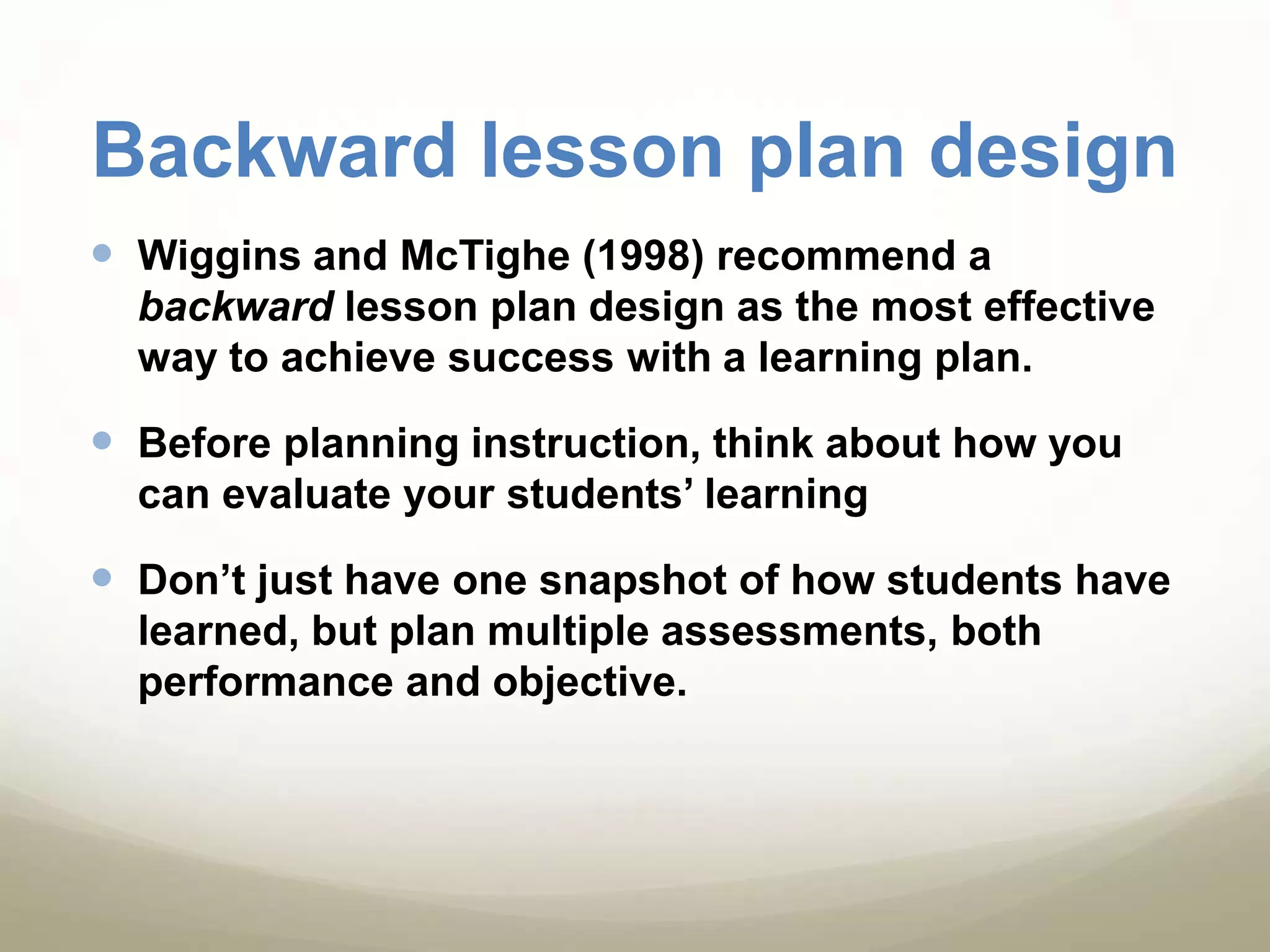
Plan instructionBackward lesson plan designWiggins and McTighe (1998) recommend a backward lesson plan design as the most effective way to achieve success with a learning plan.Before planning instruction, think about how you can evaluate your students’ learningDon’t just have one snapshot of how students have learned, but plan multiple assessments, both performance and objective.
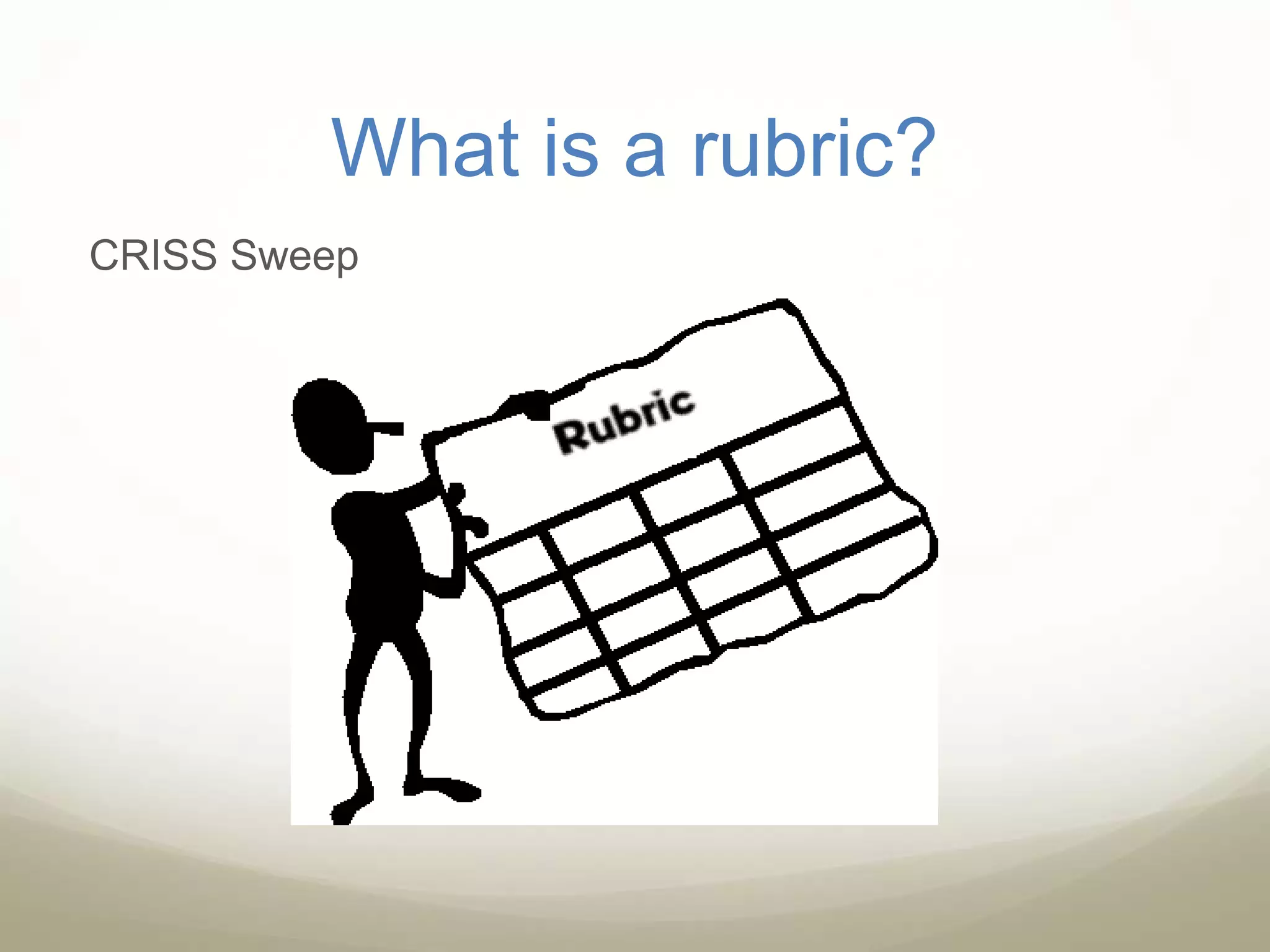
What is a rubric?CRISS Sweep
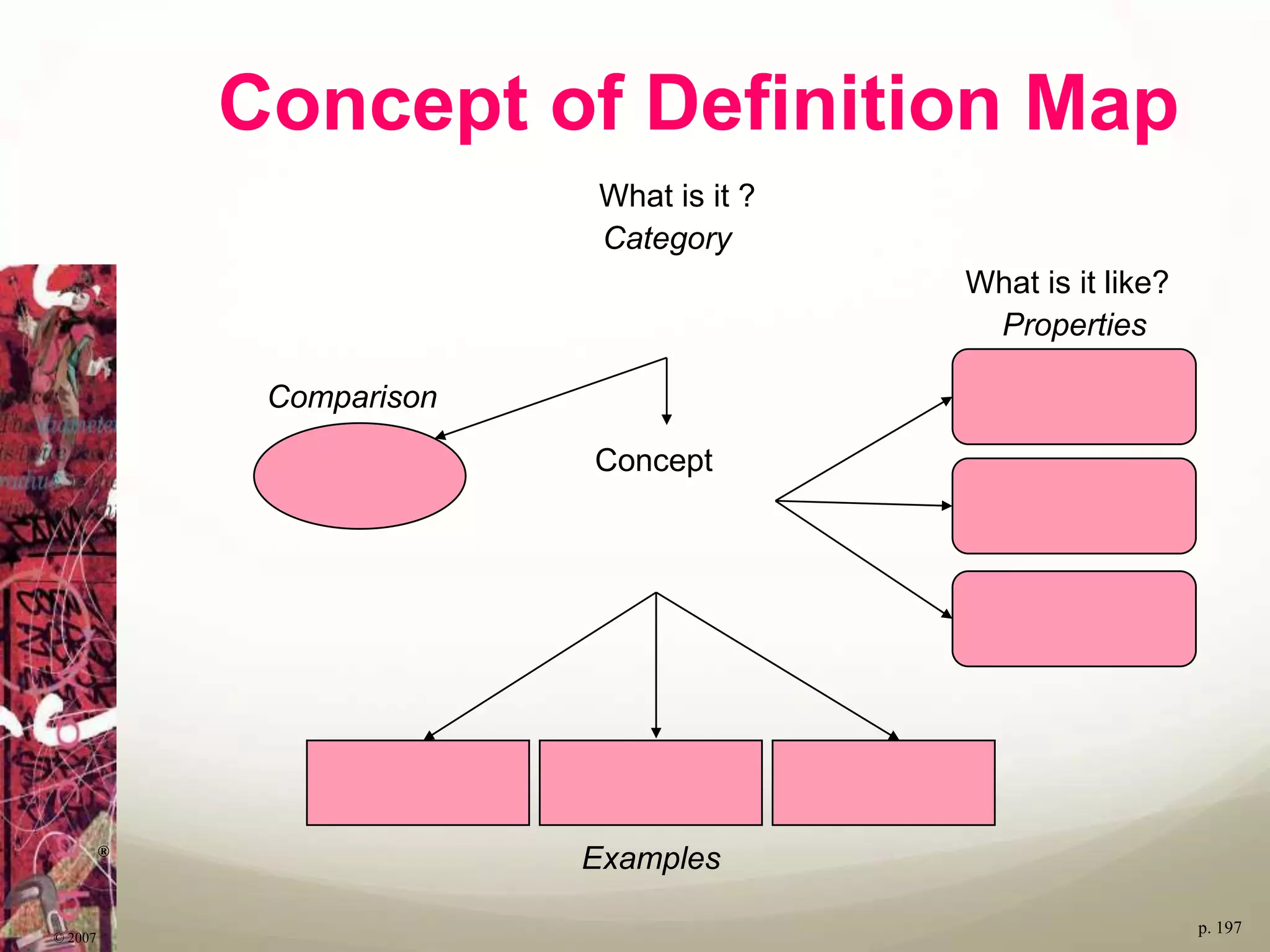
Concept of Definition MapWhat is it ?CategoryWhat is it like?PropertiesComparisonConceptExamples®p. 197© 2007
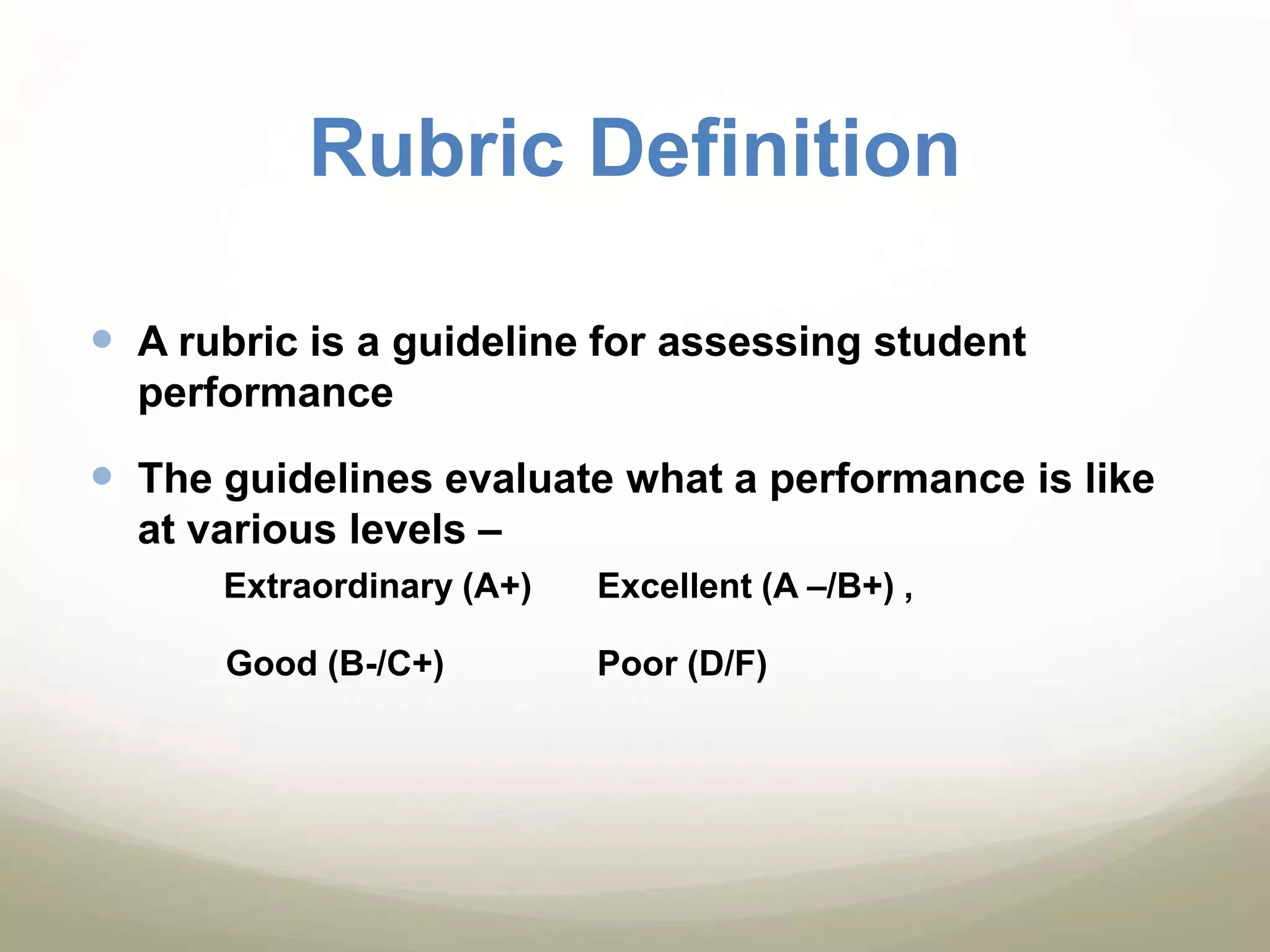
Rubric DefinitionA rubric is a guideline for assessing student performanceThe guidelines evaluate what a performance is like at various levels – Extraordinary (A+) 	Excellent (A –/B+) , 		 Good (B-/C+)		Poor (D/F)
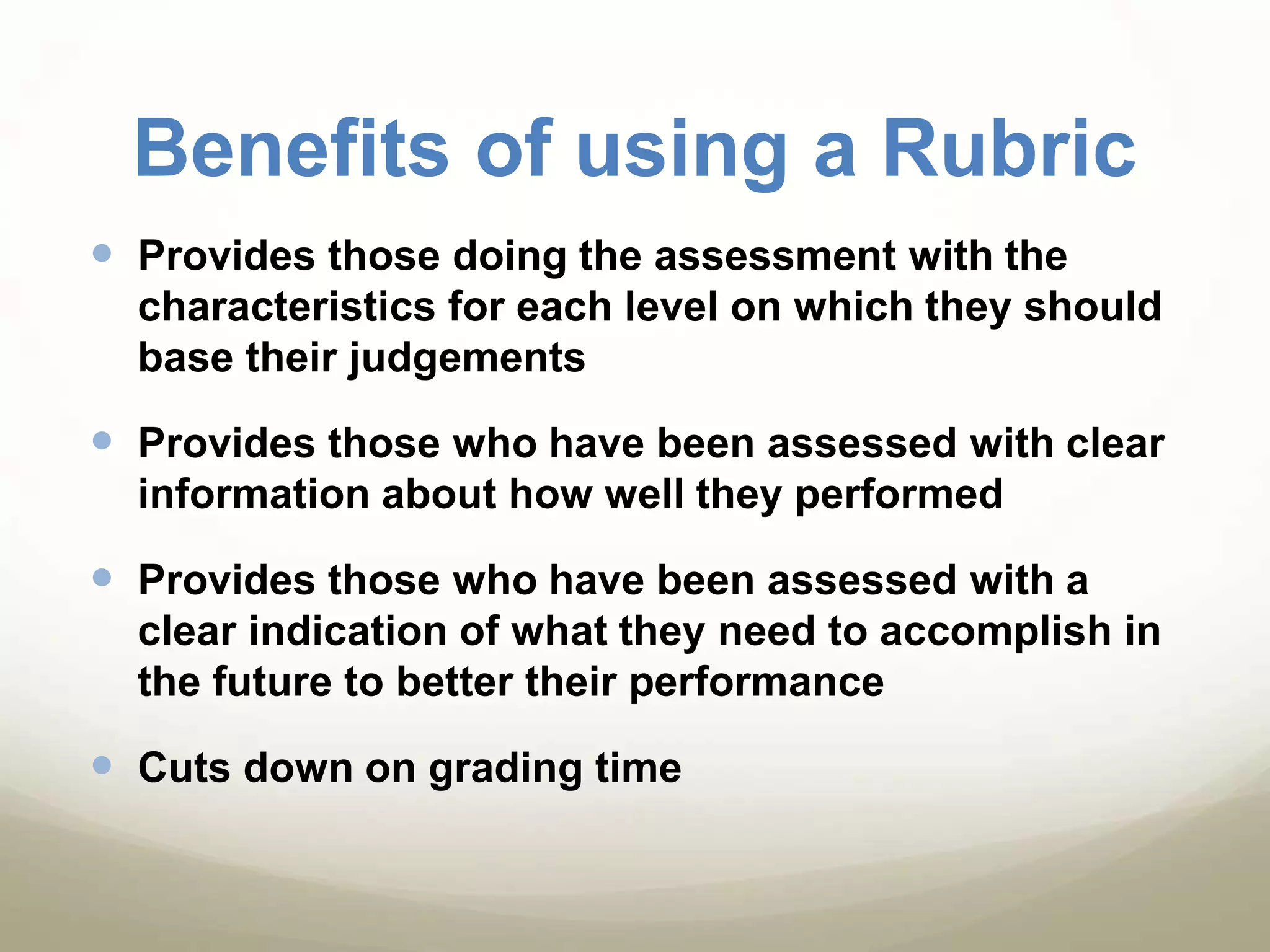
Benefits of using a RubricProvides those doing the assessment with the characteristics for each level on which they should base their judgementsProvides those who have been assessed with clear information about how well they performedProvides those who have been assessed with a clear indication of what they need to accomplish in the future to better their performanceCuts down on grading time
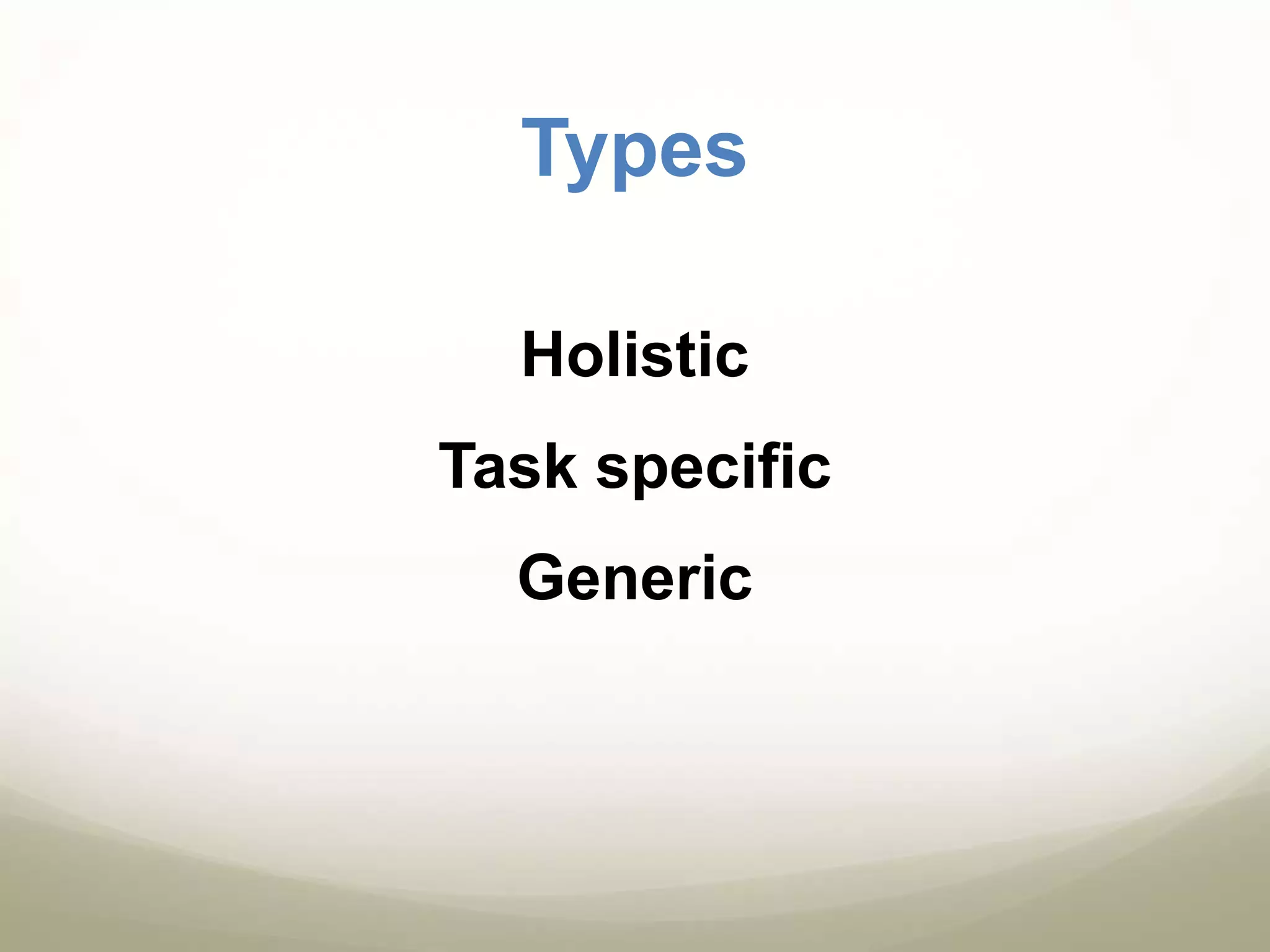
TypesHolisticTask specificGeneric
Holistic
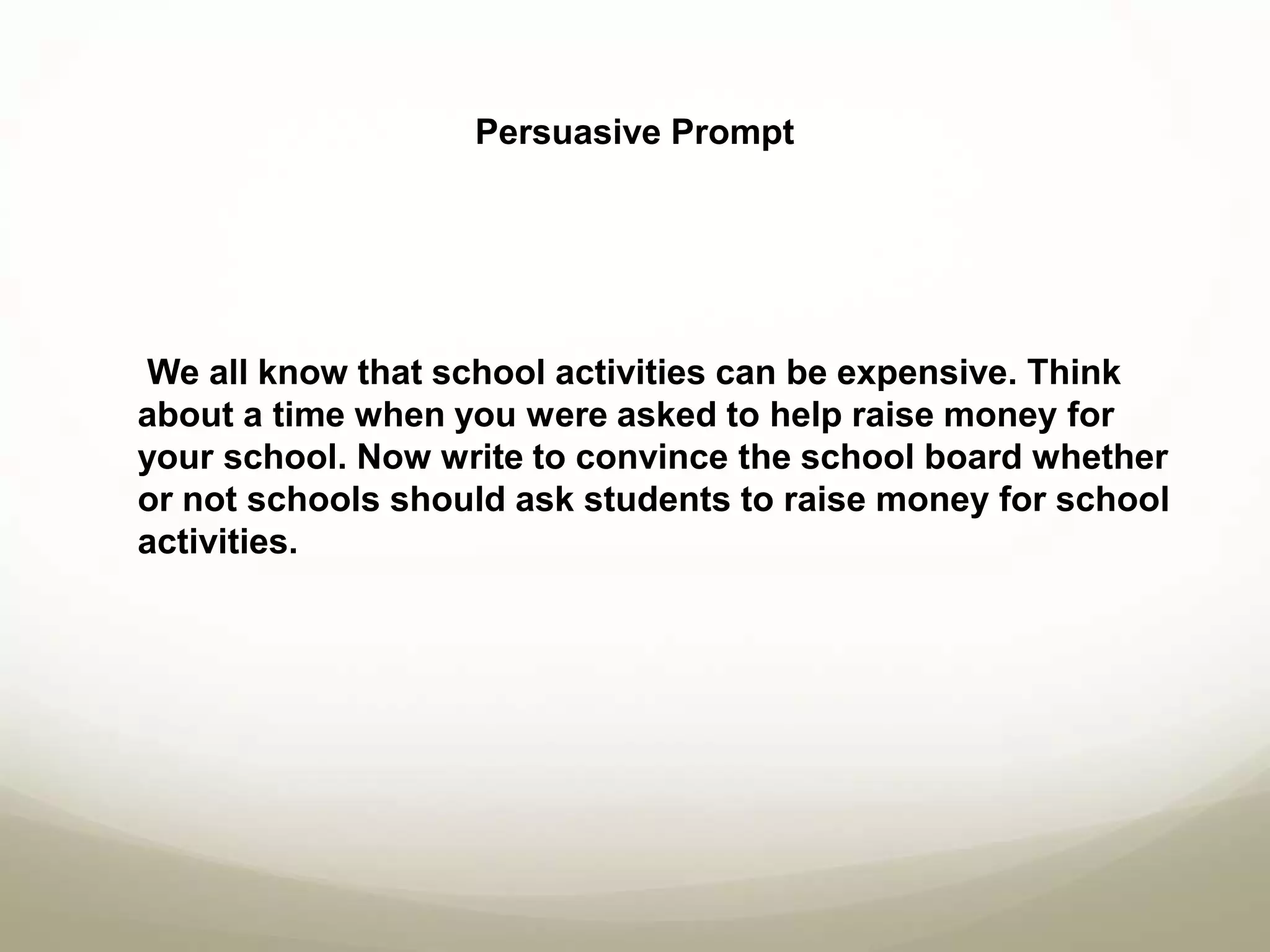
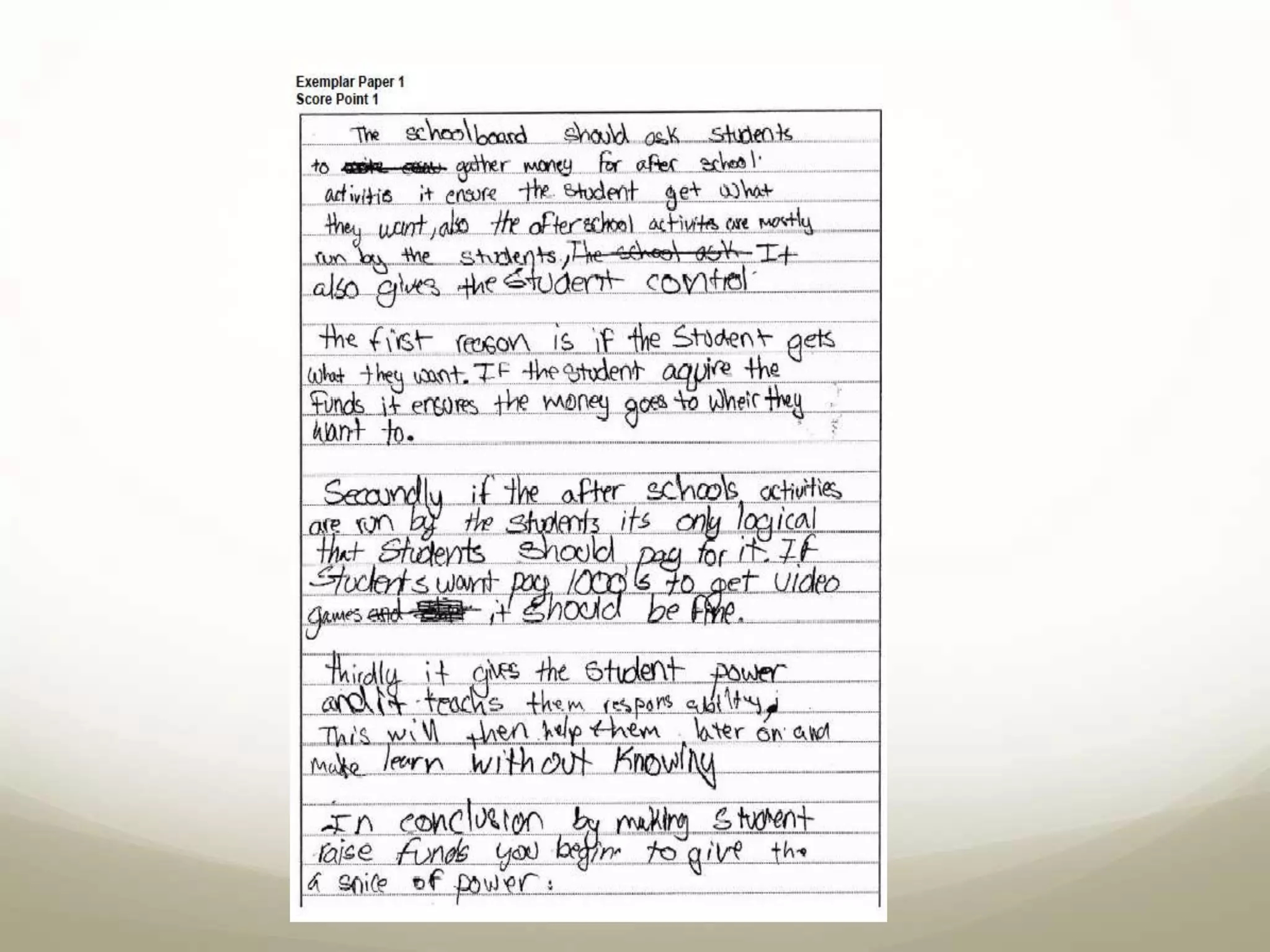
Persuasive Prompt We all know that school activities can be expensive. Think about a time when you were asked to help raise money for your school. Now write to convince the school board whether or not schools should ask students to raise money for school activities.
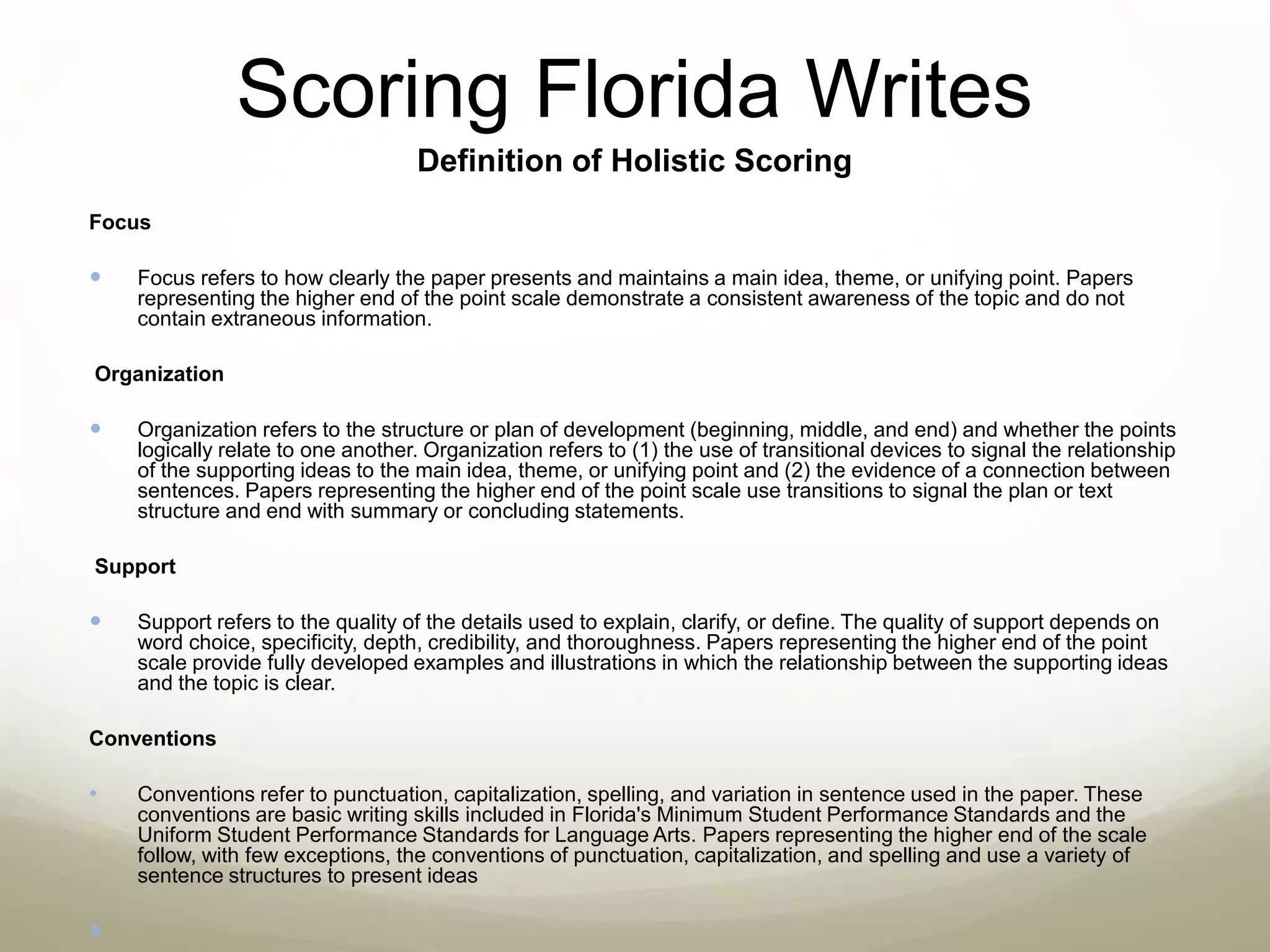
Scoring Florida WritesDefinition of Holistic Scoring Focus Focus refers to how clearly the paper presents and maintains a main idea, theme, or unifying point. Papers representing the higher end of the point scale demonstrate a consistent awareness of the topic and do not contain extraneous information.  Organization Organization refers to the structure or plan of development (beginning, middle, and end) and whether the points logically relate to one another. Organization refers to (1) the use of transitional devices to signal the relationship of the supporting ideas to the main idea, theme, or unifying point and (2) the evidence of a connection between sentences. Papers representing the higher end of the point scale use transitions to signal the plan or text structure and end with summary or concluding statements.  Support Support refers to the quality of the details used to explain, clarify, or define. The quality of support depends on word choice, specificity, depth, credibility, and thoroughness. Papers representing the higher end of the point scale provide fully developed examples and illustrations in which the relationship between the supporting ideas and the topic is clear. Conventions Conventions refer to punctuation, capitalization, spelling, and variation in sentence used in the paper. These conventions are basic writing skills included in Florida's Minimum Student Performance Standards and the Uniform Student Performance Standards for Language Arts. Papers representing the higher end of the scale follow, with few exceptions, the conventions of punctuation, capitalization, and spelling and use a variety of sentence structures to present ideas         
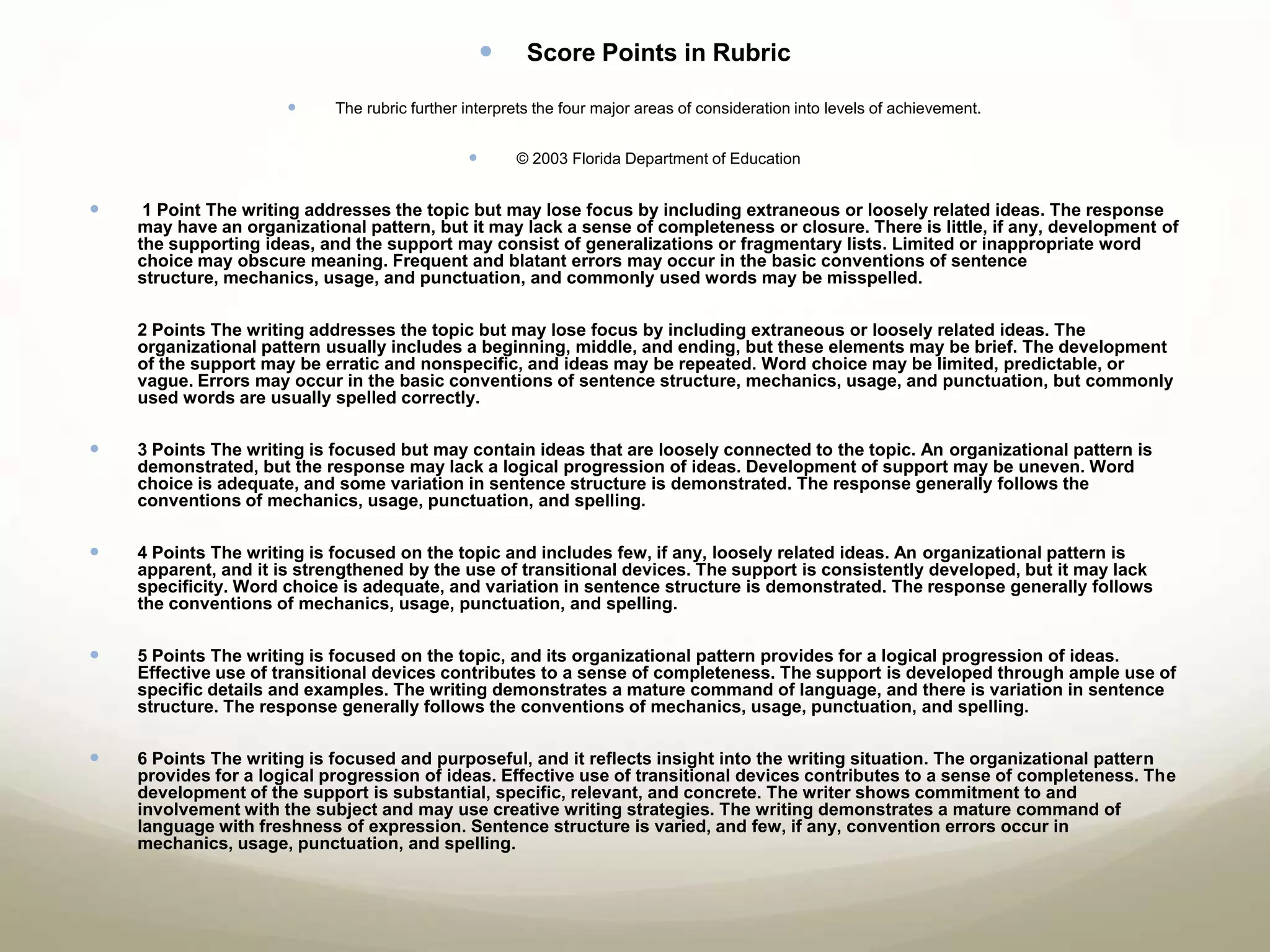
Score Points in Rubric The rubric further interprets the four major areas of consideration into levels of achievement. © 2003 Florida Department of Education  1 Point The writing addresses the topic but may lose focus by including extraneous or loosely related ideas. The response may have an organizational pattern, but it may lack a sense of completeness or closure. There is little, if any, development of the supporting ideas, and the support may consist of generalizations or fragmentary lists. Limited or inappropriate word choice may obscure meaning. Frequent and blatant errors may occur in the basic conventions of sentence structure, mechanics, usage, and punctuation, and commonly used words may be misspelled. 	2 Points The writing addresses the topic but may lose focus by including extraneous or loosely related ideas. The organizational pattern usually includes a beginning, middle, and ending, but these elements may be brief. The development of the support may be erratic and nonspecific, and ideas may be repeated. Word choice may be limited, predictable, or vague. Errors may occur in the basic conventions of sentence structure, mechanics, usage, and punctuation, but commonly used words are usually spelled correctly. 3 Points The writing is focused but may contain ideas that are loosely connected to the topic. An organizational pattern is demonstrated, but the response may lack a logical progression of ideas. Development of support may be uneven. Word choice is adequate, and some variation in sentence structure is demonstrated. The response generally follows the conventions of mechanics, usage, punctuation, and spelling. 4 Points The writing is focused on the topic and includes few, if any, loosely related ideas. An organizational pattern is apparent, and it is strengthened by the use of transitional devices. The support is consistently developed, but it may lack specificity. Word choice is adequate, and variation in sentence structure is demonstrated. The response generally follows the conventions of mechanics, usage, punctuation, and spelling. 5 Points The writing is focused on the topic, and its organizational pattern provides for a logical progression of ideas. Effective use of transitional devices contributes to a sense of completeness. The support is developed through ample use of specific details and examples. The writing demonstrates a mature command of language, and there is variation in sentence structure. The response generally follows the conventions of mechanics, usage, punctuation, and spelling. 6 Points The writing is focused and purposeful, and it reflects insight into the writing situation. The organizational pattern provides for a logical progression of ideas. Effective use of transitional devices contributes to a sense of completeness. The development of the support is substantial, specific, relevant, and concrete. The writer shows commitment to and involvement with the subject and may use creative writing strategies. The writing demonstrates a mature command of language with freshness of expression. Sentence structure is varied, and few, if any, convention errors occur in mechanics, usage, punctuation, and spelling.
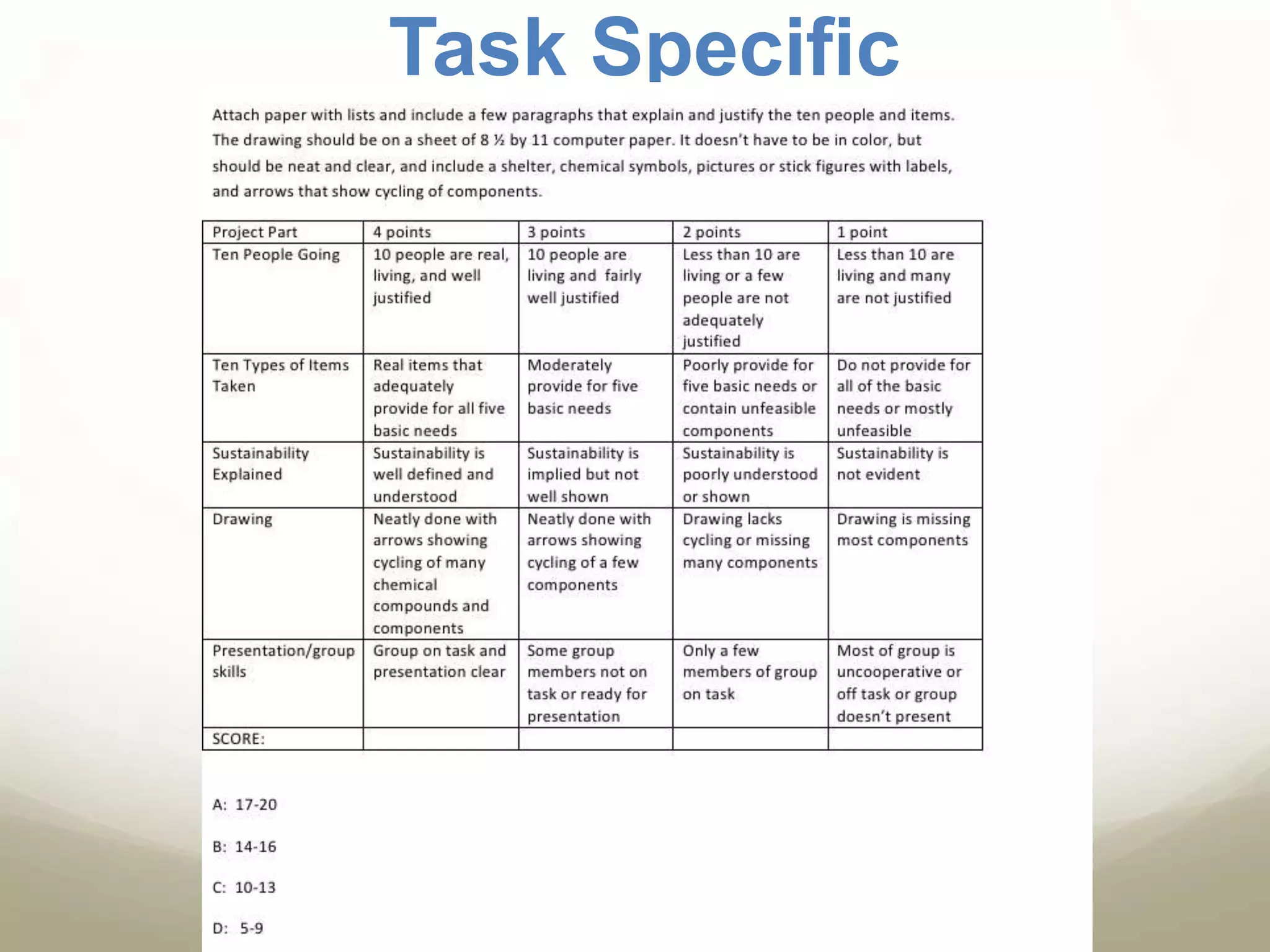
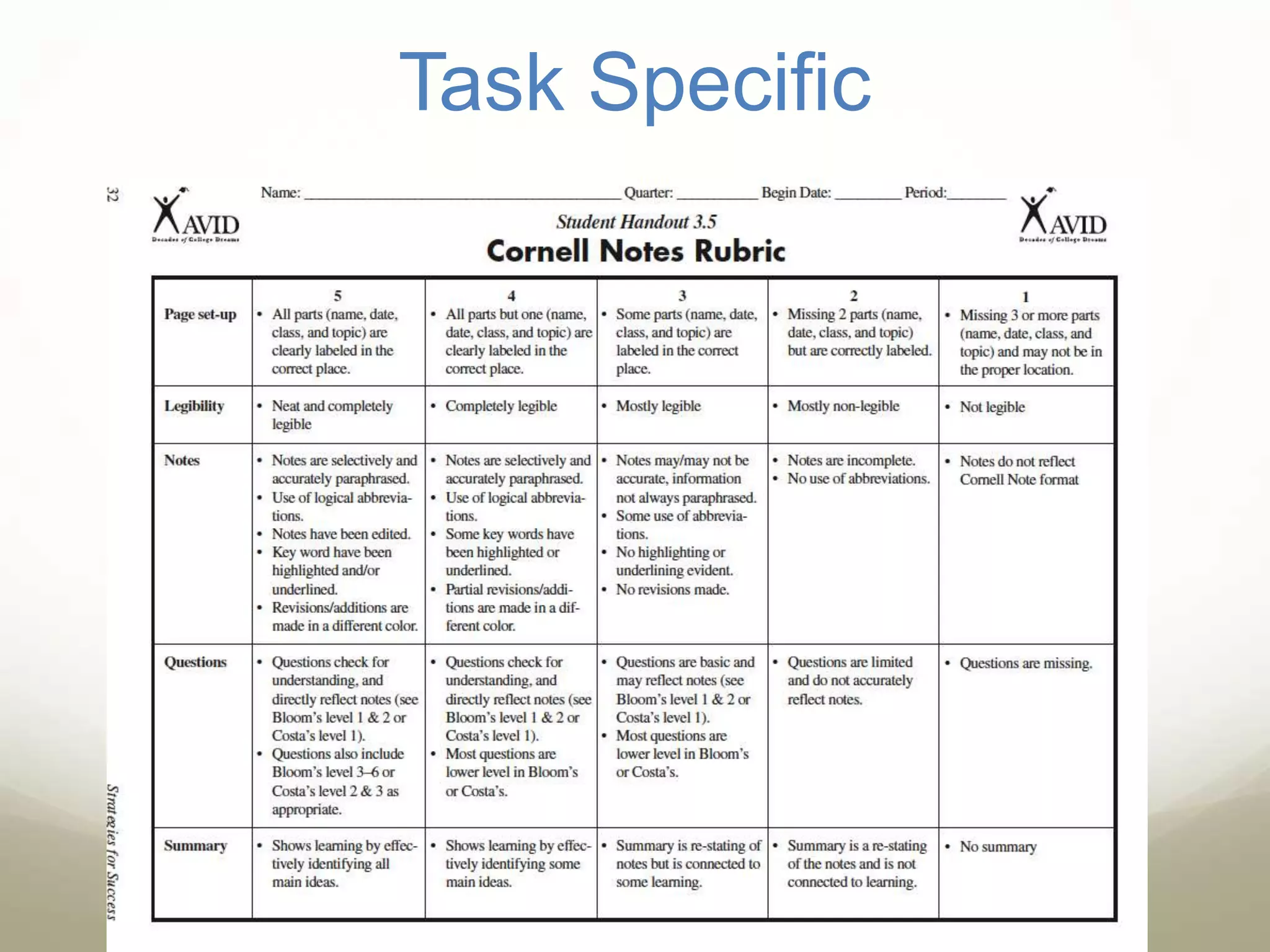
TaskSpecific
Task Specific
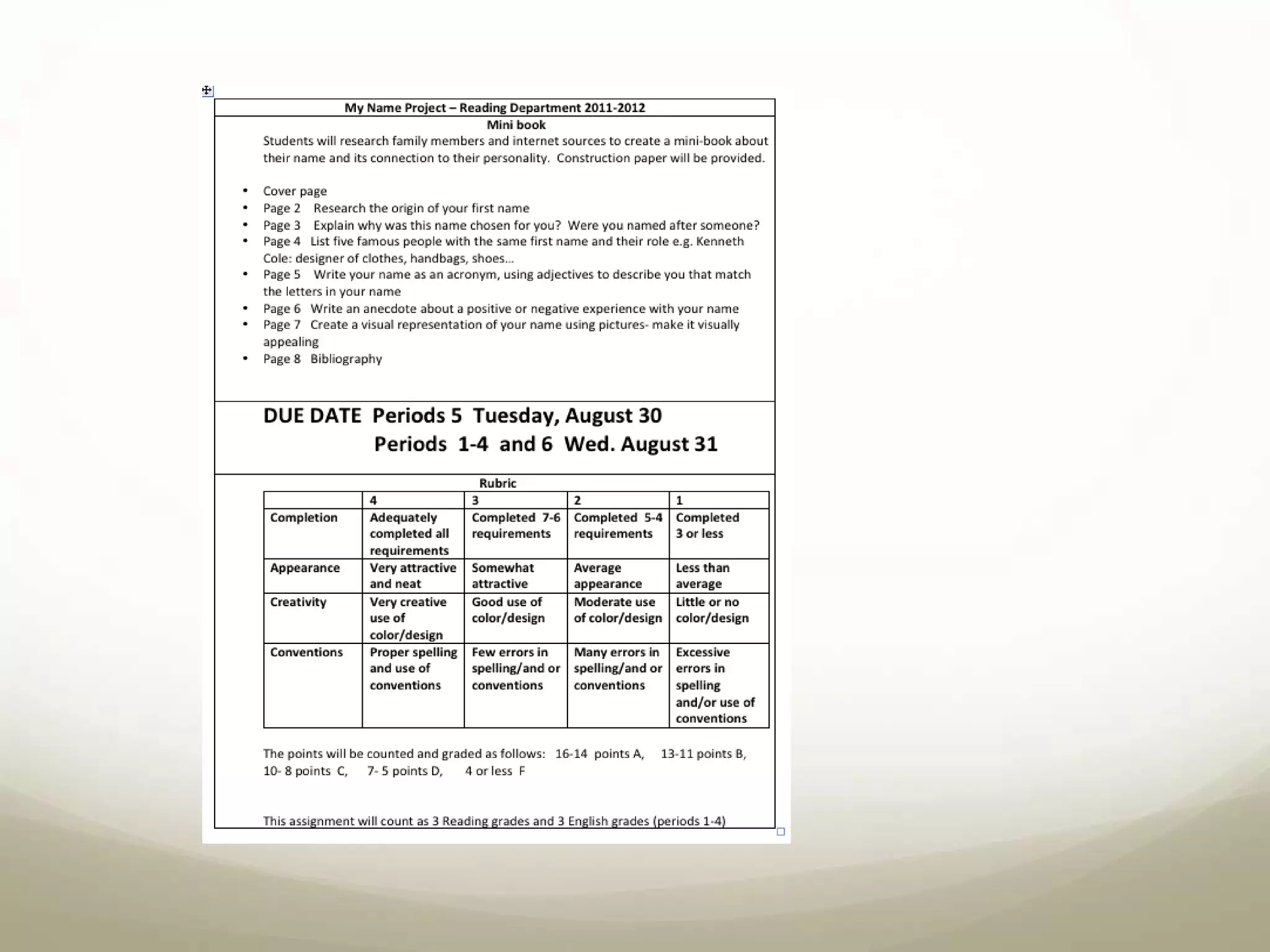
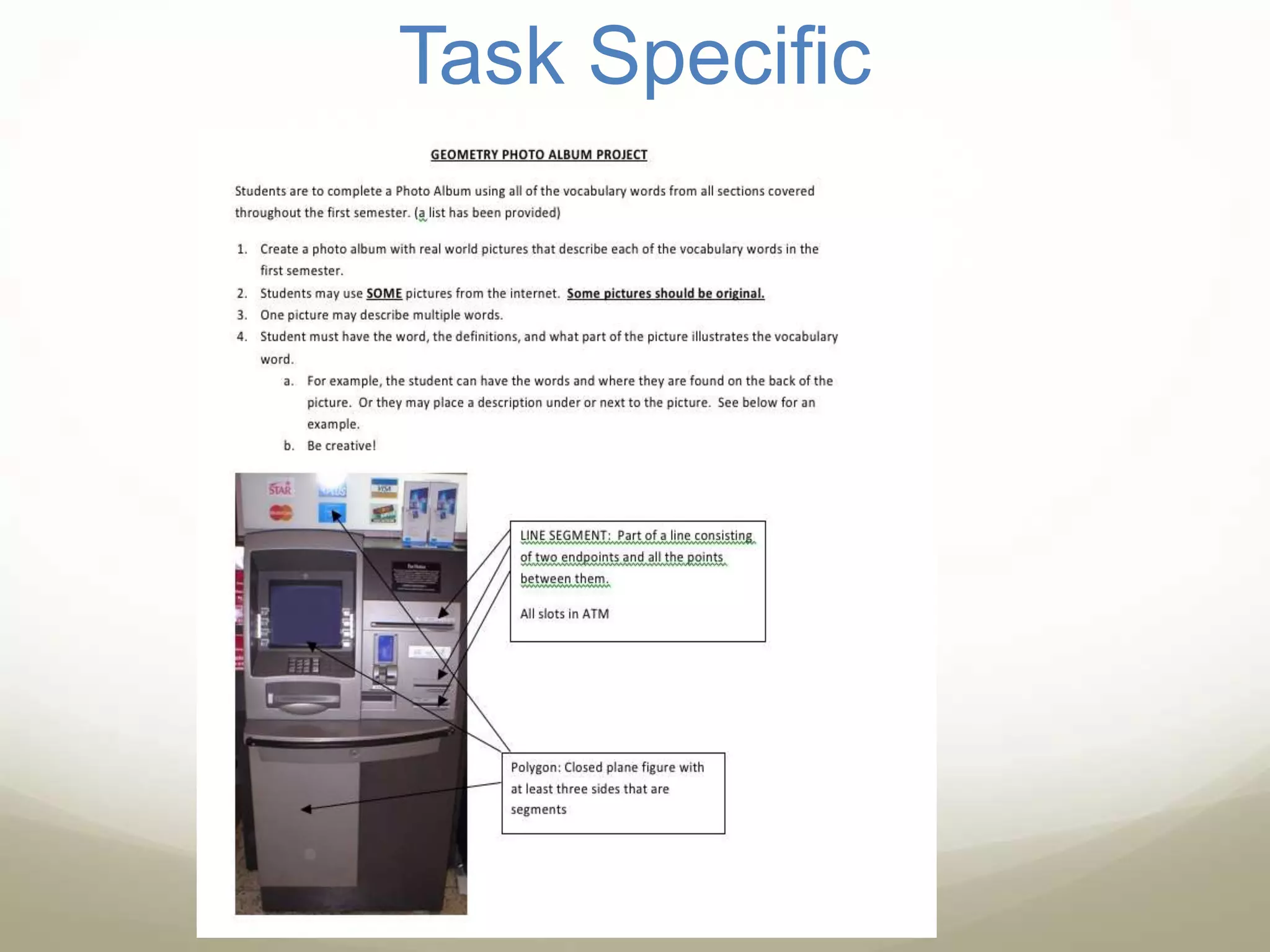
Task Specific
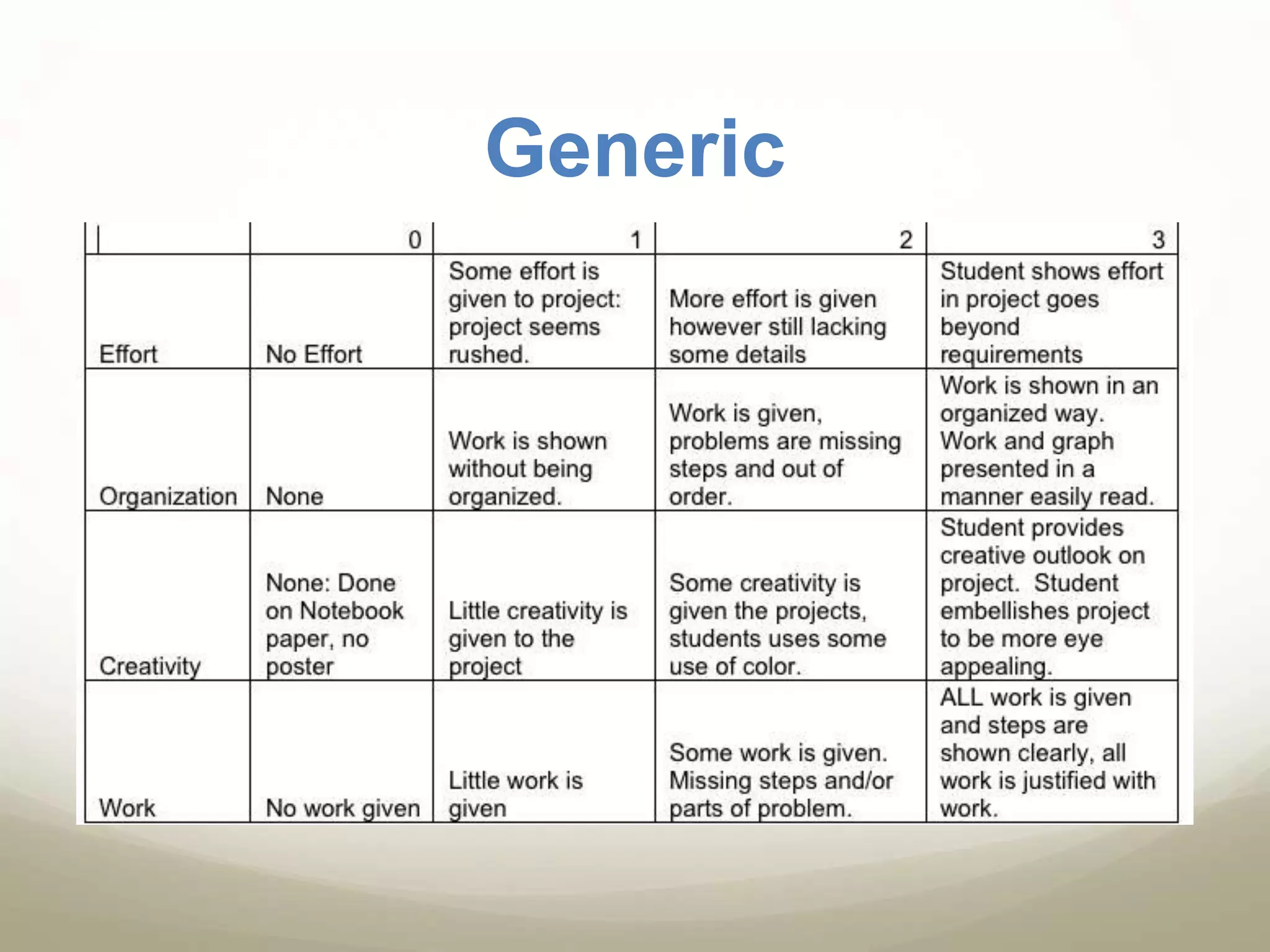
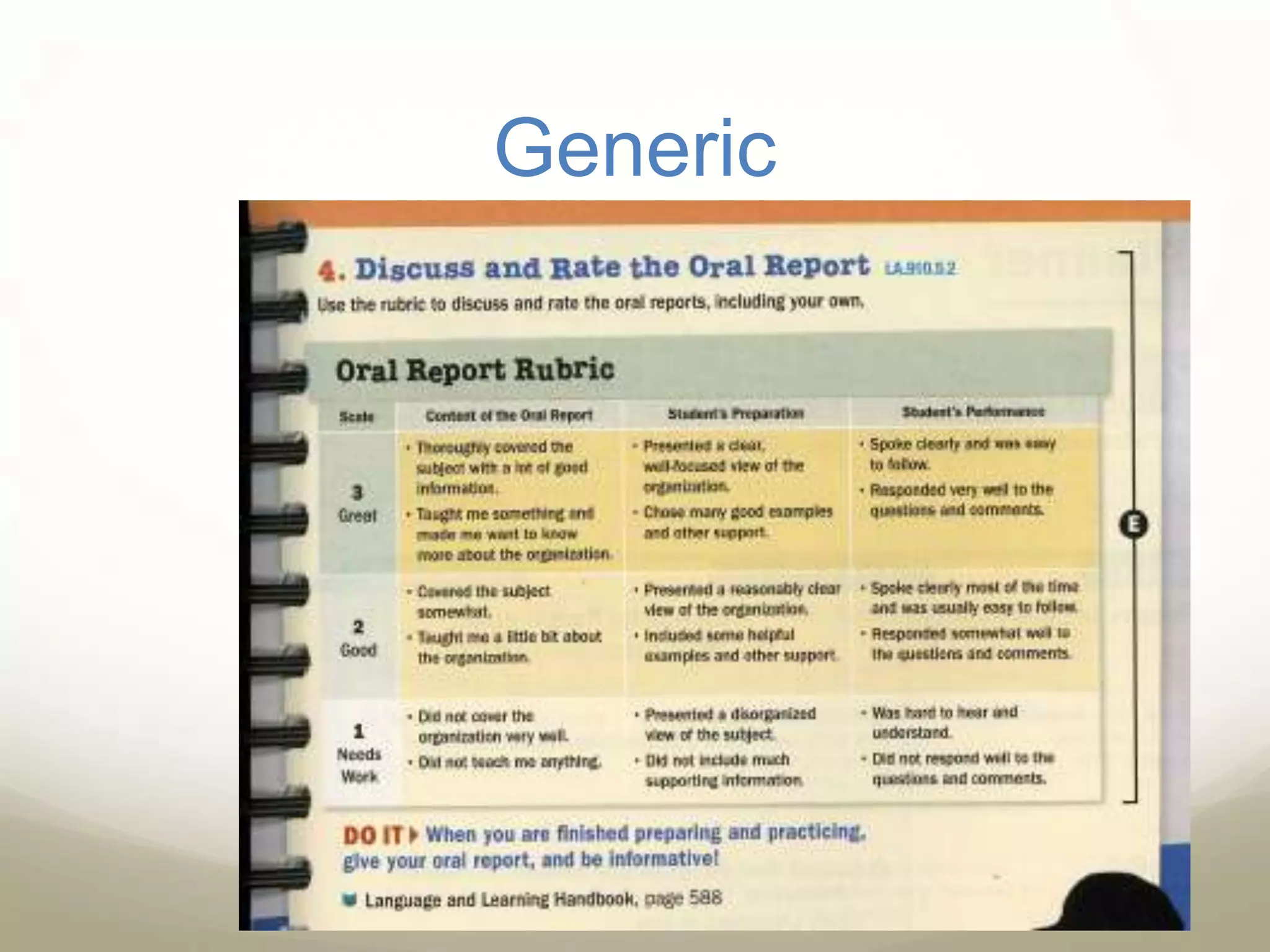
Generic
Generic
Create your own assessmentapplying backward planningFrom your content areaDesign a rubric for an upcoming lesson
A Strategic CRISS Lesson PlanChoose significant content
Set clear and measurable goals

Mbsh rubric training 1.final

  • 1.
  • 2.
    GoalsTo understand, developand implement rubrics to drive classroom instructionTo use a variety of assessment tools to monitor and evaluate student progress, performance and achievement
  • 3.
    Think Pair ShareWhattypes of assessments do you give your students?How do you evaluate these assessments?
  • 4.
  • 5.
    A Strategic CRISSLesson PlanChoose significant content
  • 6.
    Set clear andmeasurable goals
  • 7.
  • 8.
    Plan instructionBackward lessonplan designWiggins and McTighe (1998) recommend a backward lesson plan design as the most effective way to achieve success with a learning plan.Before planning instruction, think about how you can evaluate your students’ learningDon’t just have one snapshot of how students have learned, but plan multiple assessments, both performance and objective.
  • 9.
    What is arubric?CRISS Sweep
  • 10.
    Concept of DefinitionMapWhat is it ?CategoryWhat is it like?PropertiesComparisonConceptExamples®p. 197© 2007
  • 11.
    Rubric DefinitionA rubricis a guideline for assessing student performanceThe guidelines evaluate what a performance is like at various levels – Extraordinary (A+) Excellent (A –/B+) , Good (B-/C+) Poor (D/F)
  • 12.
    Benefits of usinga RubricProvides those doing the assessment with the characteristics for each level on which they should base their judgementsProvides those who have been assessed with clear information about how well they performedProvides those who have been assessed with a clear indication of what they need to accomplish in the future to better their performanceCuts down on grading time
  • 13.
  • 14.
  • 15.
    Persuasive Prompt Weall know that school activities can be expensive. Think about a time when you were asked to help raise money for your school. Now write to convince the school board whether or not schools should ask students to raise money for school activities.
  • 16.
    Scoring Florida WritesDefinitionof Holistic Scoring Focus Focus refers to how clearly the paper presents and maintains a main idea, theme, or unifying point. Papers representing the higher end of the point scale demonstrate a consistent awareness of the topic and do not contain extraneous information. Organization Organization refers to the structure or plan of development (beginning, middle, and end) and whether the points logically relate to one another. Organization refers to (1) the use of transitional devices to signal the relationship of the supporting ideas to the main idea, theme, or unifying point and (2) the evidence of a connection between sentences. Papers representing the higher end of the point scale use transitions to signal the plan or text structure and end with summary or concluding statements.  Support Support refers to the quality of the details used to explain, clarify, or define. The quality of support depends on word choice, specificity, depth, credibility, and thoroughness. Papers representing the higher end of the point scale provide fully developed examples and illustrations in which the relationship between the supporting ideas and the topic is clear. Conventions Conventions refer to punctuation, capitalization, spelling, and variation in sentence used in the paper. These conventions are basic writing skills included in Florida's Minimum Student Performance Standards and the Uniform Student Performance Standards for Language Arts. Papers representing the higher end of the scale follow, with few exceptions, the conventions of punctuation, capitalization, and spelling and use a variety of sentence structures to present ideas         
  • 17.
    Score Points inRubric The rubric further interprets the four major areas of consideration into levels of achievement. © 2003 Florida Department of Education  1 Point The writing addresses the topic but may lose focus by including extraneous or loosely related ideas. The response may have an organizational pattern, but it may lack a sense of completeness or closure. There is little, if any, development of the supporting ideas, and the support may consist of generalizations or fragmentary lists. Limited or inappropriate word choice may obscure meaning. Frequent and blatant errors may occur in the basic conventions of sentence structure, mechanics, usage, and punctuation, and commonly used words may be misspelled. 2 Points The writing addresses the topic but may lose focus by including extraneous or loosely related ideas. The organizational pattern usually includes a beginning, middle, and ending, but these elements may be brief. The development of the support may be erratic and nonspecific, and ideas may be repeated. Word choice may be limited, predictable, or vague. Errors may occur in the basic conventions of sentence structure, mechanics, usage, and punctuation, but commonly used words are usually spelled correctly. 3 Points The writing is focused but may contain ideas that are loosely connected to the topic. An organizational pattern is demonstrated, but the response may lack a logical progression of ideas. Development of support may be uneven. Word choice is adequate, and some variation in sentence structure is demonstrated. The response generally follows the conventions of mechanics, usage, punctuation, and spelling. 4 Points The writing is focused on the topic and includes few, if any, loosely related ideas. An organizational pattern is apparent, and it is strengthened by the use of transitional devices. The support is consistently developed, but it may lack specificity. Word choice is adequate, and variation in sentence structure is demonstrated. The response generally follows the conventions of mechanics, usage, punctuation, and spelling. 5 Points The writing is focused on the topic, and its organizational pattern provides for a logical progression of ideas. Effective use of transitional devices contributes to a sense of completeness. The support is developed through ample use of specific details and examples. The writing demonstrates a mature command of language, and there is variation in sentence structure. The response generally follows the conventions of mechanics, usage, punctuation, and spelling. 6 Points The writing is focused and purposeful, and it reflects insight into the writing situation. The organizational pattern provides for a logical progression of ideas. Effective use of transitional devices contributes to a sense of completeness. The development of the support is substantial, specific, relevant, and concrete. The writer shows commitment to and involvement with the subject and may use creative writing strategies. The writing demonstrates a mature command of language with freshness of expression. Sentence structure is varied, and few, if any, convention errors occur in mechanics, usage, punctuation, and spelling.
  • 19.
  • 20.
  • 22.
  • 23.
  • 24.
  • 25.
    Create your ownassessmentapplying backward planningFrom your content areaDesign a rubric for an upcoming lesson
  • 26.
    A Strategic CRISSLesson PlanChoose significant content
  • 27.
    Set clear andmeasurable goals
  • 28.
  • 29.
  • 30.
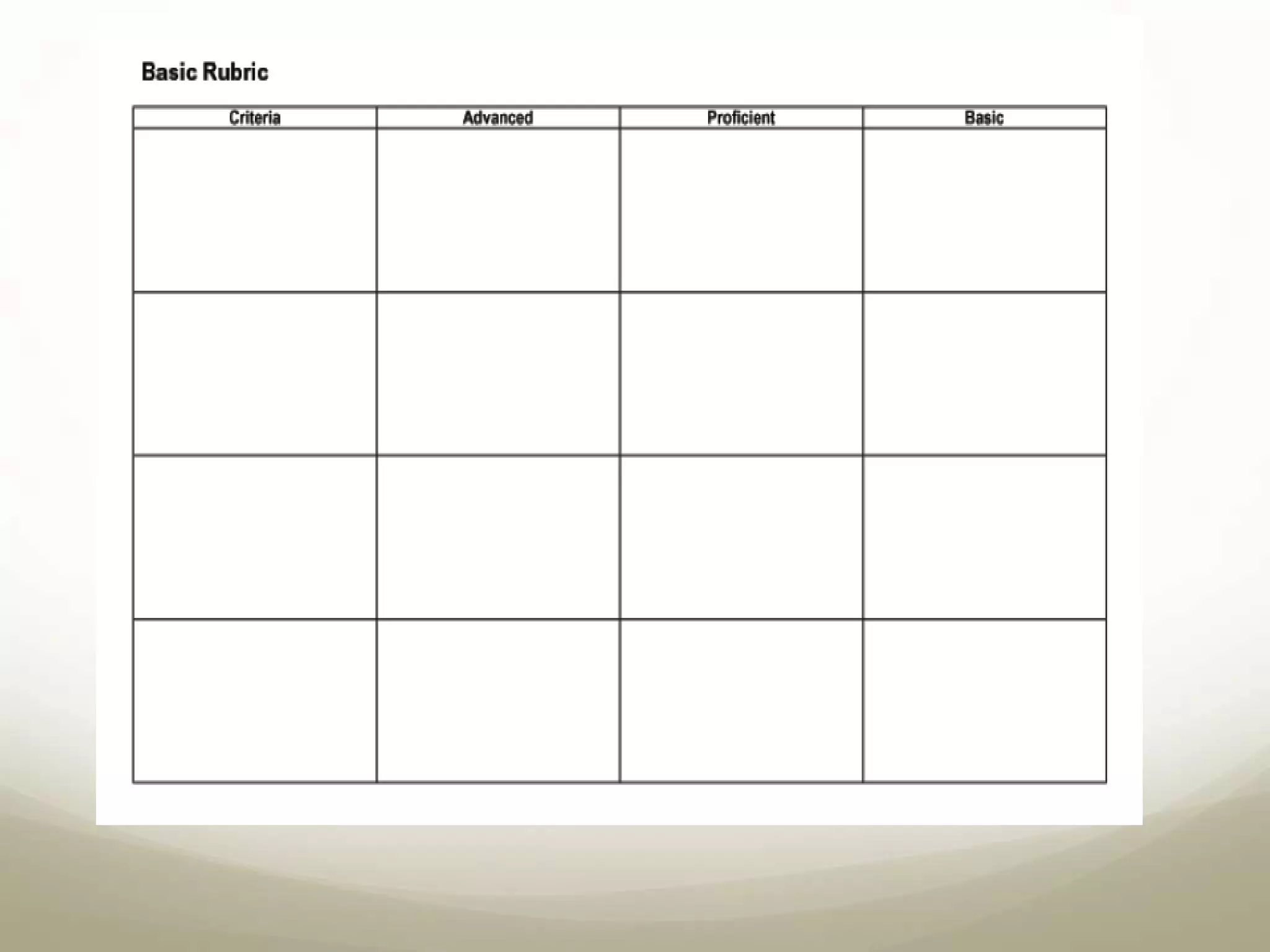
    Free Rubric TemplatesYoudon’t have to create your own. There are many free blank and generic templates on line. Just google free rubric templates.
  • 31.
    Thank you forattending