UNIT A: Cell Biology 
Chapter 2: The Molecules of Cells 
Chapter 3: Cell Structure and Function 
Chapter 4: DNA Structure and Gene 
Expression 
Chapter 5: Metabolism: Energy and 
Enzymes: Section 5.2 
Chapter 6: Cellular Respiration 
Chapter 7: Photosynthesis
UNIT A Chapter 5: Metabolism: Energy and Enzymes 
Chapter 5: Metabolism: Energy 
In this chapter you will learn about the numerous chemical reactions 
in our bodies involved in breaking down food to produce essential 
biological molecules and energy. 
TO PREVIOUS 
SLIDE 
and Enzymes 
What is the role of 
an enzyme? 
What factors 
influence the rate of 
enzyme activity?
UNIT A Chapter 5: Metabolism: Energy and Enzymes Section 5.2 
5.2 Enzymes and Metabolic Pathways 
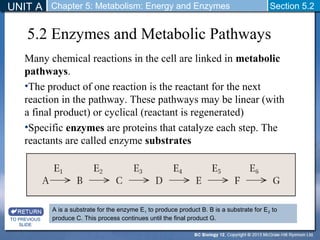
Many chemical reactions in the cell are linked in metabolic 
pathways. 
•The product of one reaction is the reactant for the next 
reaction in the pathway. These pathways may be linear (with 
a final product) or cyclical (reactant is regenerated) 
•Specific enzymes are proteins that catalyze each step. The 
reactants are called enzyme substrates 
A is a substrate for the enzyme E1 to produce product B. B is a substrate for E2 to 
produce C. This process continues until the final product G. 
TO PREVIOUS 
SLIDE
UNIT A Chapter 5: Metabolism: Energy and Enzymes Section 5.2 
Energy of Activation 
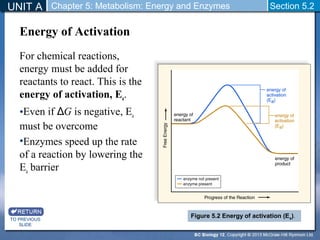
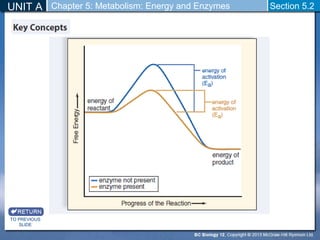
For chemical reactions, 
energy must be added for 
reactants to react. This is the 
energy of activation, Ea. 
•Even if ΔG is negative, Ea 
must be overcome 
•Enzymes speed up the rate 
of a reaction by lowering the 
Ea barrier 
TO PREVIOUS 
SLIDE 
Figure 5.2 Energy of activation (Ea).
UNIT A Chapter 5: Metabolism: Energy and Enzymes Section 5.2 
How Enzymes Function 
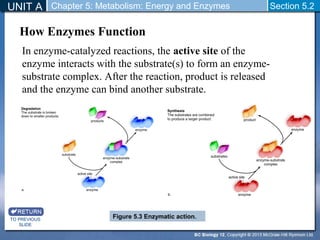
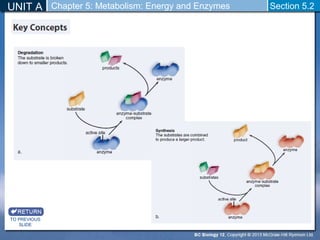
In enzyme-catalyzed reactions, the active site of the 
enzyme interacts with the substrate(s) to form an enzyme-substrate 
complex. After the reaction, product is released 
and the enzyme can bind another substrate. 
TO PREVIOUS 
SLIDE 
Figure 5.3 Enzymatic action.
UNIT A Chapter 5: Metabolism: Energy and Enzymes Section 5.2 
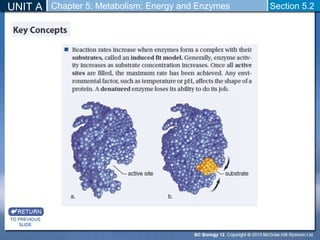
Induced-Fit Model 
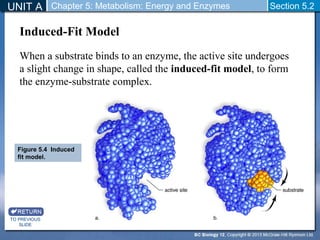
When a substrate binds to an enzyme, the active site undergoes 
a slight change in shape, called the induced-fit model, to form 
the enzyme-substrate complex. 
Figure 5.4 Induced 
fit model. 
TO PREVIOUS 
SLIDE
UNIT A Chapter 5: Metabolism: Energy and Enzymes Section 5.2 
Enzyme Names 
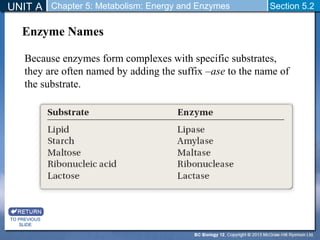
Because enzymes form complexes with specific substrates, 
they are often named by adding the suffix –ase to the name of 
the substrate. 
TO PREVIOUS 
SLIDE
UNIT A Chapter 5: Metabolism: Energy and Enzymes Section 5.2 
Factors Affecting Enzymatic Speed 
Several factors can regulate the activity of an enzyme. These 
include 
•the amount of substrate(s) present for the reaction 
•environmental conditions, such as temperature and pH 
•enzyme activation 
•enzyme inhibition 
•presence of cofactors 
TO PREVIOUS 
SLIDE
UNIT A Chapter 5: Metabolism: Energy and Enzymes Section 5.2 
Substrate Concentration 
Generally, enzyme activity increases as substrate 
concentration increases because 
•there are more collisions between the enzyme and substrate 
molecules 
•more substrate molecules are available to fill more active 
sites of enzymes 
However, a maximum rate exists. Once all active sites on an 
enzyme are filled with substrate, the reaction cannot go any 
faster. 
TO PREVIOUS 
SLIDE
UNIT A Chapter 5: Metabolism: Energy and Enzymes Section 5.2 
Temperature and pH 
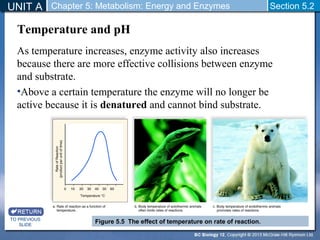
As temperature increases, enzyme activity also increases 
because there are more effective collisions between enzyme 
and substrate. 
•Above a certain temperature the enzyme will no longer be 
active because it is denatured and cannot bind substrate. 
TO PREVIOUS 
SLIDE Figure 5.5 The effect of temperature on rate of reaction.
UNIT A Chapter 5: Metabolism: Energy and Enzymes Section 5.2 
Temperature and pH 
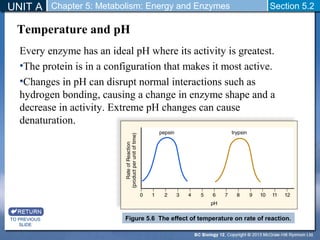
Every enzyme has an ideal pH where its activity is greatest. 
•The protein is in a configuration that makes it most active. 
•Changes in pH can disrupt normal interactions such as 
hydrogen bonding, causing a change in enzyme shape and a 
decrease in activity. Extreme pH changes can cause 
denaturation. 
TO PREVIOUS 
SLIDE 
Figure 5.6 The effect of temperature on rate of reaction.
UNIT A Chapter 5: Metabolism: Energy and Enzymes Section 5.2 
Enzyme Activation 
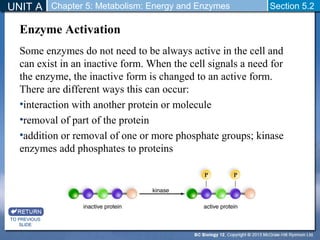
Some enzymes do not need to be always active in the cell and 
can exist in an inactive form. When the cell signals a need for 
the enzyme, the inactive form is changed to an active form. 
There are different ways this can occur: 
•interaction with another protein or molecule 
•removal of part of the protein 
•addition or removal of one or more phosphate groups; kinase 
enzymes add phosphates to proteins 
TO PREVIOUS 
SLIDE
UNIT A Chapter 5: Metabolism: Energy and Enzymes Section 5.2 
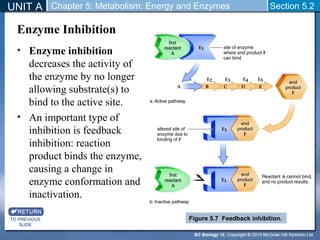
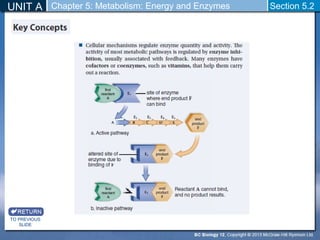
Enzyme Inhibition 
• Enzyme inhibition 
decreases the activity of 
the enzyme by no longer 
allowing substrate(s) to 
bind to the active site. 
• An important type of 
inhibition is feedback 
inhibition: reaction 
product binds the enzyme, 
causing a change in 
enzyme conformation and 
inactivation. 
TO PREVIOUS 
SLIDE 
Figure 5.7 Feedback inhibition.
UNIT A Chapter 5: Metabolism: Energy and Enzymes Section 5.2 
Enzyme Cofactors 
Many enzymes need an inorganic ion or organic nonprotein 
molecule to function properly. 
•The inorganic ions are called cofactors and include metals 
such as iron and zinc. 
•The organic nonproteins are called coenzymes and may 
contribute atoms to the reaction. Vitamins are small organic 
molecules required in our diet that are often components of 
coenzymes (for example, the vitamin niacin is part of the 
coenzyme NAD). 
TO PREVIOUS 
SLIDE
UNIT A Chapter 5: Metabolism: Energy and Enzymes Section 5.2 
TO PREVIOUS 
SLIDE 
Check Your Progress 
1. Summarize why enzymes are needed in biochemical 
pathways and how cells may regulate their activity. 
2. Explain why denaturing an enzyme causes a change 
in its ability to act as a catalyst. 
3. Discuss why the three-dimensional shape of an 
enzyme is important to its function.
UNIT A Chapter 5: Metabolism: Energy and Enzymes Section 5.2 
TO PREVIOUS 
SLIDE
UNIT A Chapter 5: Metabolism: Energy and Enzymes Section 5.2 
TO PREVIOUS 
SLIDE
UNIT A Chapter 5: Metabolism: Energy and Enzymes Section 5.2 
TO PREVIOUS 
SLIDE
UNIT A Chapter 5: Metabolism: Energy and Enzymes Section 5.2 
TO PREVIOUS 
SLIDE
UNIT A Chapter 5: Metabolism: Energy and Enzymes Section 5.2 
TO PREVIOUS 
SLIDE

Biology 12 - Enzymes and Metabolic Pathways - Section 5-2

  • 2.
    UNIT A: CellBiology Chapter 2: The Molecules of Cells Chapter 3: Cell Structure and Function Chapter 4: DNA Structure and Gene Expression Chapter 5: Metabolism: Energy and Enzymes: Section 5.2 Chapter 6: Cellular Respiration Chapter 7: Photosynthesis
  • 3.
    UNIT A Chapter5: Metabolism: Energy and Enzymes Chapter 5: Metabolism: Energy In this chapter you will learn about the numerous chemical reactions in our bodies involved in breaking down food to produce essential biological molecules and energy. TO PREVIOUS SLIDE and Enzymes What is the role of an enzyme? What factors influence the rate of enzyme activity?
  • 4.
    UNIT A Chapter5: Metabolism: Energy and Enzymes Section 5.2 5.2 Enzymes and Metabolic Pathways Many chemical reactions in the cell are linked in metabolic pathways. •The product of one reaction is the reactant for the next reaction in the pathway. These pathways may be linear (with a final product) or cyclical (reactant is regenerated) •Specific enzymes are proteins that catalyze each step. The reactants are called enzyme substrates A is a substrate for the enzyme E1 to produce product B. B is a substrate for E2 to produce C. This process continues until the final product G. TO PREVIOUS SLIDE
  • 5.
    UNIT A Chapter5: Metabolism: Energy and Enzymes Section 5.2 Energy of Activation For chemical reactions, energy must be added for reactants to react. This is the energy of activation, Ea. •Even if ΔG is negative, Ea must be overcome •Enzymes speed up the rate of a reaction by lowering the Ea barrier TO PREVIOUS SLIDE Figure 5.2 Energy of activation (Ea).
  • 6.
    UNIT A Chapter5: Metabolism: Energy and Enzymes Section 5.2 How Enzymes Function In enzyme-catalyzed reactions, the active site of the enzyme interacts with the substrate(s) to form an enzyme-substrate complex. After the reaction, product is released and the enzyme can bind another substrate. TO PREVIOUS SLIDE Figure 5.3 Enzymatic action.
  • 7.
    UNIT A Chapter5: Metabolism: Energy and Enzymes Section 5.2 Induced-Fit Model When a substrate binds to an enzyme, the active site undergoes a slight change in shape, called the induced-fit model, to form the enzyme-substrate complex. Figure 5.4 Induced fit model. TO PREVIOUS SLIDE
  • 8.
    UNIT A Chapter5: Metabolism: Energy and Enzymes Section 5.2 Enzyme Names Because enzymes form complexes with specific substrates, they are often named by adding the suffix –ase to the name of the substrate. TO PREVIOUS SLIDE
  • 9.
    UNIT A Chapter5: Metabolism: Energy and Enzymes Section 5.2 Factors Affecting Enzymatic Speed Several factors can regulate the activity of an enzyme. These include •the amount of substrate(s) present for the reaction •environmental conditions, such as temperature and pH •enzyme activation •enzyme inhibition •presence of cofactors TO PREVIOUS SLIDE
  • 10.
    UNIT A Chapter5: Metabolism: Energy and Enzymes Section 5.2 Substrate Concentration Generally, enzyme activity increases as substrate concentration increases because •there are more collisions between the enzyme and substrate molecules •more substrate molecules are available to fill more active sites of enzymes However, a maximum rate exists. Once all active sites on an enzyme are filled with substrate, the reaction cannot go any faster. TO PREVIOUS SLIDE
  • 11.
    UNIT A Chapter5: Metabolism: Energy and Enzymes Section 5.2 Temperature and pH As temperature increases, enzyme activity also increases because there are more effective collisions between enzyme and substrate. •Above a certain temperature the enzyme will no longer be active because it is denatured and cannot bind substrate. TO PREVIOUS SLIDE Figure 5.5 The effect of temperature on rate of reaction.
  • 12.
    UNIT A Chapter5: Metabolism: Energy and Enzymes Section 5.2 Temperature and pH Every enzyme has an ideal pH where its activity is greatest. •The protein is in a configuration that makes it most active. •Changes in pH can disrupt normal interactions such as hydrogen bonding, causing a change in enzyme shape and a decrease in activity. Extreme pH changes can cause denaturation. TO PREVIOUS SLIDE Figure 5.6 The effect of temperature on rate of reaction.
  • 13.
    UNIT A Chapter5: Metabolism: Energy and Enzymes Section 5.2 Enzyme Activation Some enzymes do not need to be always active in the cell and can exist in an inactive form. When the cell signals a need for the enzyme, the inactive form is changed to an active form. There are different ways this can occur: •interaction with another protein or molecule •removal of part of the protein •addition or removal of one or more phosphate groups; kinase enzymes add phosphates to proteins TO PREVIOUS SLIDE
  • 14.
    UNIT A Chapter5: Metabolism: Energy and Enzymes Section 5.2 Enzyme Inhibition • Enzyme inhibition decreases the activity of the enzyme by no longer allowing substrate(s) to bind to the active site. • An important type of inhibition is feedback inhibition: reaction product binds the enzyme, causing a change in enzyme conformation and inactivation. TO PREVIOUS SLIDE Figure 5.7 Feedback inhibition.
  • 15.
    UNIT A Chapter5: Metabolism: Energy and Enzymes Section 5.2 Enzyme Cofactors Many enzymes need an inorganic ion or organic nonprotein molecule to function properly. •The inorganic ions are called cofactors and include metals such as iron and zinc. •The organic nonproteins are called coenzymes and may contribute atoms to the reaction. Vitamins are small organic molecules required in our diet that are often components of coenzymes (for example, the vitamin niacin is part of the coenzyme NAD). TO PREVIOUS SLIDE
  • 16.
    UNIT A Chapter5: Metabolism: Energy and Enzymes Section 5.2 TO PREVIOUS SLIDE Check Your Progress 1. Summarize why enzymes are needed in biochemical pathways and how cells may regulate their activity. 2. Explain why denaturing an enzyme causes a change in its ability to act as a catalyst. 3. Discuss why the three-dimensional shape of an enzyme is important to its function.
  • 17.
    UNIT A Chapter5: Metabolism: Energy and Enzymes Section 5.2 TO PREVIOUS SLIDE
  • 18.
    UNIT A Chapter5: Metabolism: Energy and Enzymes Section 5.2 TO PREVIOUS SLIDE
  • 19.
    UNIT A Chapter5: Metabolism: Energy and Enzymes Section 5.2 TO PREVIOUS SLIDE
  • 20.
    UNIT A Chapter5: Metabolism: Energy and Enzymes Section 5.2 TO PREVIOUS SLIDE
  • 21.
    UNIT A Chapter5: Metabolism: Energy and Enzymes Section 5.2 TO PREVIOUS SLIDE

Editor's Notes

  • #2 Presentation title slide
  • #4 Chapter opener background notes Are you lactose intolerant? Do you know someone who is? As much as three-quarters of the world's population has some difficulty digesting lactose. Digesting a piece of cheese pizza can be very uncomfortable for those who are lactose intolerant because cheese and other dairy products contain lactose. What causes lactose intolerance?   Lactose is a disaccharide sugar that must be broken down chemically into its two smaller building blocks (galactose and glucose) before it can be absorbed into the bloodstream and used for energy. If it is not broken down, lactose remains in the digestive tract and can cause uncomfortable digestive symptoms. The breakdown of lactose requires an enzyme called lactase. People who are lactose intolerant do not produce enough lactase. A lactose intolerant person who wants to consume dairy products without discomfort must consume products that have been specially treated with enzymes or a lactase enzyme supplement with the dairy in their meal. Yogurt and buttermilk can often be tolerated by those with lactose intolerance because they contain bacterial cultures that aid in the digestion of lactose.   Why is it that some people can easily digest lactose when so many other people cannot? After young mammals are weaned, milk becomes a smaller component of the diet. In most mammals, lactase activity decreases and lactose intolerance usually begins. However, some humans have developed what is called lactase persistency. These individuals continue to produce lactase. Factors that contribute to lactase persistency include diet, culture, and genetics.   The breakdown of lactose is just one of myriad chemical reactions that occur in the human body. Almost every reaction that takes place in our bodies requires a specific enzyme. In this chapter, you will learn about the characteristics of enzymes and how enzymes function in the flow of energy and metabolism.
  • #5 metabolic pathway: a series of linked reactions that begin with a particular reactant and terminate with an end product enzymes: types of proteins that function as catalysts to speed up chemical reactions substrates: reactants in an enzymatic reaction
  • #6 Caption text Figure 5.2 Energy of activation (Ea). Enzymes speed the rate of reactions because they lower the amount of energy required for the reactants to react. energy of activation (Ea): the energy that must be added to cause molecules to react with one another
  • #7 Caption text Figure 5.3 Enzymatic action. An enzyme has an active site where the substrates and enzyme fit together in such a way that the substrates react. Following the reaction, the products are released, and the enzyme is free to act again. a. The enzymatic reaction can result in the degradation of a substrate into multiple products (catabolism) or, b. the synthesis of a product from multiple substrates (anabolism). active site: a small part of an enzyme that forms a complex with a substrate(s)
  • #8 Caption text Figure 5.4 Induced fit model. These computer-generated images show an enzyme called lysozyme that hydrolyzes its substrate, a polysaccharide that makes up bacterial cell walls. a. Shape of enzyme when no substrate is bound to it. b. After the substrate binds, the shape of the enzyme changes so that hydrolysis can better proceed. Induced-fit model: when the enzyme undergoes a slight change in shape in order to accommodate the substrate
  • #12 Caption text Figure 5.5 The effect of temperature on rate of reaction. a. Usually, the rate of an enzymatic reaction doubles with every 10°C rise in temperature. This enzymatic reaction is maximum at about 40°C. Then it decreases until the reaction stops altogether, because the enzyme has become denatured. b. The body temperature of ectothermic animals, which require an environmental source of heat, often limits rates of reactions. c. The body temperature of endothermic animals, which generate heat through their own metabolism, promotes rates of reaction. denatured: describes a protein that has had an irreversible change in its shape; occurs when proteins are exposed to extremes in heat and pH
  • #13 Caption text Figure 5.6 The effect of temperature on rate of reaction. The preferred pH for pepsin, an enzyme that acts in the stomach, is about 2, while the preferred pH for trypsin, an enzyme that acts in the small intestine, is about 8. At the preferred pH, an enzyme maintains its shape so that it can bind with its substrates.
  • #15 Caption text Figure 5.7 Feedback inhibition. a. In an active pathway, the first reactant (A) is able to bind to the active site of enzyme E1. b. Feedback inhibition occurs when the end product (F) of the metabolic pathway binds to the first enzyme of the pathway—at a site other than the active site. This binding causes the active site to change its shape. Now reactant A is unable to bind to the enzyme’s active site, and the whole pathway shuts down. enzyme inhibition: occurs when the substrate is unable to bind to the active site of an enzyme
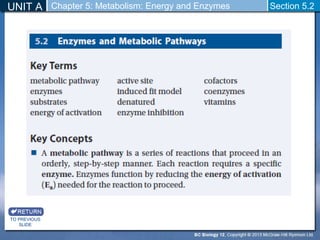
  • #16 cofactors: inorganic ion helpers required by enzymes to function properly coenzymes: organic, nonprotein molecule helpers required by enzymes to function properly vitamins: relatively small organic molecules that are required in trace amounts in diets for synthesis of coenzymes that affect health and fitness
  • #17 Answers 1. Enzymes are needed to reduce the activation energy of biochemical reactions, thus allowing reactions to occur under conditions of the cell. A cell can convert an enzyme from an inactive form to an active form by the addition or removal of phosphate groups. Cellular enzymes are subject to feedback inhibition. The presence of cofactors and enzymes in the cell regulates enzyme activity. 2. Denaturing changes the shape of the enzyme and its active site, altering the fit of the reactant with the enzyme. 3. How well the enzyme interacts with the reactants and the rate at which the product is formed is determined by its three-dimensional shape and its active site.