UNIT A: Cell Biology 
Chapter 2: The Molecules of Cells 
Chapter 3: Cell Structure and Function 
Chapter 4: DNA Structure and Gene 
Expression 
Chapter 5: Metabolism: Energy and 
Enzymes 
Chapter 6: Cellular Respiration: 
Section 6.1 
Chapter 7: Photosynthesis
UNIT A Chapter 6: Cellular Respiration 
In this chapter you will learn about the many chemical reactions, 
known as cellular respiration, that break down molecules such as 
glucose to produce the ATP that fuels physical activities. 
TO PREVIOUS SLIDE 
Chapter 6: Cellular Respiration 
Why are there differences 
between the aerobic and 
anaerobic pathways? 
How is the energy of a 
glucose molecule harvested by 
a cell? 
How are other organic 
nutrients, such as proteins and 
fats, used as energy?
UNIT A Chapter 6: Cellular Respiration Section 6.1 
6.1 Overview of Cellular Respiration 
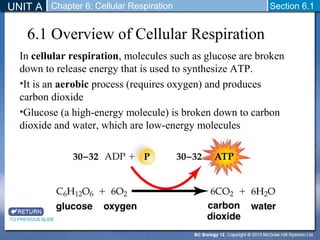
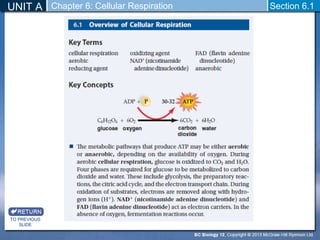
In cellular respiration, molecules such as glucose are broken 
down to release energy that is used to synthesize ATP. 
•It is an aerobic process (requires oxygen) and produces 
carbon dioxide 
•Glucose (a high-energy molecule) is broken down to carbon 
dioxide and water, which are low-energy molecules 
TO PREVIOUS SLIDE
UNIT A Chapter 6: Cellular Respiration Section 6.1 
Cellular Respiration 
Energy from the 
breakdown of glucose is 
released in incremental 
steps, and used to 
synthesize ATP. 
The energy in ATP is 
used for many cell 
reactions. The energy is 
released by the breaking 
of a bond and release of a 
phosphate group. 
TO PREVIOUS SLIDE 
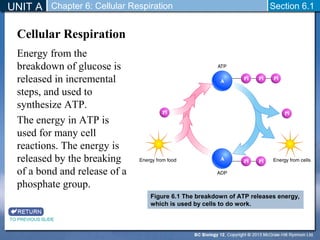
Figure 6.1 The breakdown of ATP releases energy, 
which is used by cells to do work.
UNIT A Chapter 6: Cellular Respiration 
Section 6.1 
Oxidation and Reduction 
Oxidation: an atom or molecule loses an electron 
Reduction: an atom or molecule gains an electron 
• The substance being oxidized is donating electrons and is 
called the reducing agent. The substance being reduced is 
accepting electrons and is called the oxidizing agent. 
• Compounds or atoms contain more energy in their reduced 
form than in their oxidized form. 
TO PREVIOUS SLIDE 
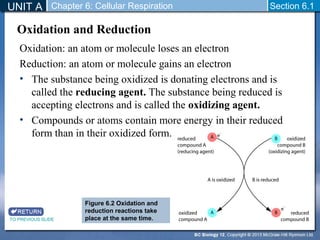
Figure 6.2 Oxidation and 
reduction reactions take 
place at the same time.
UNIT A Chapter 6: Cellular Respiration 
Section 6.1 
NAD+ and FAD 
Some enzymes use the coenzymes NAD+ (nicotinamide 
adenine dinucleotide) or FAD (flavin adenine dinucleotide), 
which act as electron carriers in reactions. 
•NAD+ receives two electrons and two H+, forming 
NADH + H+ 
•FAD receives two electrons and two H+, forming FADH2 
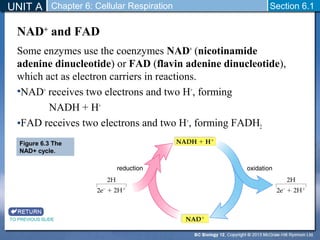
Figure 6.3 The 
NAD+ cycle. 
TO PREVIOUS SLIDE
UNIT A Chapter 6: Cellular Respiration 
Section 6.1 
Phases of Cellular Respiration 
The four phases of cellular respiration: glycolysis, preparatory 
reaction, citric acid cycle, and electron transport chain. 
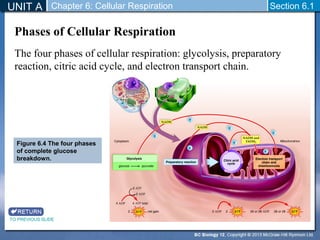
Figure 6.4 The four phases 
of complete glucose 
breakdown. 
TO PREVIOUS SLIDE
UNIT A Chapter 6: Cellular Respiration 
Section 6.1 
Phases of Cellular Respiration 
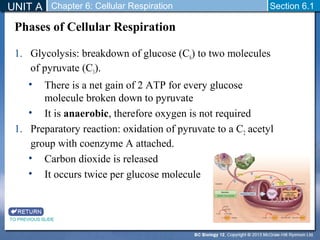
1. Glycolysis: breakdown of glucose (C6) to two molecules 
of pyruvate (C3). 
• There is a net gain of 2 ATP for every glucose 
molecule broken down to pyruvate 
• It is anaerobic, therefore oxygen is not required 
1. Preparatory reaction: oxidation of pyruvate to a C2 acetyl 
group with coenzyme A attached. 
• Carbon dioxide is released 
• It occurs twice per glucose molecule 
TO PREVIOUS SLIDE
UNIT A Section 6.1 
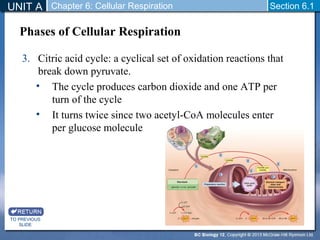
3. Citric acid cycle: a cyclical set of oxidation reactions that 
break down pyruvate. 
• The cycle produces carbon dioxide and one ATP per 
turn of the cycle 
• It turns twice since two acetyl-CoA molecules enter 
per glucose molecule 
TO PREVIOUS 
SLIDE 
Chapter 6: Cellular Respiration 
Phases of Cellular Respiration
UNIT A Section 6.1 
Phases of Cellular Respiration 
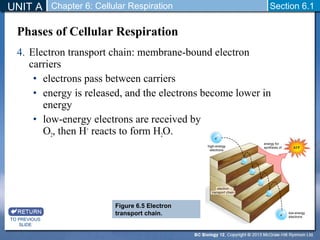
4. Electron transport chain: membrane-bound electron 
carriers 
• electrons pass between carriers 
• energy is released, and the electrons become lower in 
energy 
• low-energy electrons are received by 
O2, then H+ reacts to form H2O. 
TO PREVIOUS 
SLIDE 
Chapter 6: Cellular Respiration 
Figure 6.5 Electron 
transport chain.
UNIT A Section 6.1 
TO PREVIOUS 
SLIDE 
Chapter 6: Cellular Respiration 
Check Your Progress 
1. Explain the role of NAD+ and FAD in cellular 
respiration. 
2. Distinguish between the aerobic and anaerobic 
phases of cellular respiration. 
3. Summarize the location and function of each 
phase of cellular respiration.
UNIT A Section 6.1 
TO PREVIOUS 
SLIDE 
Chapter 6: Cellular Respiration

Biology 12 - Cellular Respiration - Section 6-1

  • 2.
    UNIT A: CellBiology Chapter 2: The Molecules of Cells Chapter 3: Cell Structure and Function Chapter 4: DNA Structure and Gene Expression Chapter 5: Metabolism: Energy and Enzymes Chapter 6: Cellular Respiration: Section 6.1 Chapter 7: Photosynthesis
  • 3.
    UNIT A Chapter6: Cellular Respiration In this chapter you will learn about the many chemical reactions, known as cellular respiration, that break down molecules such as glucose to produce the ATP that fuels physical activities. TO PREVIOUS SLIDE Chapter 6: Cellular Respiration Why are there differences between the aerobic and anaerobic pathways? How is the energy of a glucose molecule harvested by a cell? How are other organic nutrients, such as proteins and fats, used as energy?
  • 4.
    UNIT A Chapter6: Cellular Respiration Section 6.1 6.1 Overview of Cellular Respiration In cellular respiration, molecules such as glucose are broken down to release energy that is used to synthesize ATP. •It is an aerobic process (requires oxygen) and produces carbon dioxide •Glucose (a high-energy molecule) is broken down to carbon dioxide and water, which are low-energy molecules TO PREVIOUS SLIDE
  • 5.
    UNIT A Chapter6: Cellular Respiration Section 6.1 Cellular Respiration Energy from the breakdown of glucose is released in incremental steps, and used to synthesize ATP. The energy in ATP is used for many cell reactions. The energy is released by the breaking of a bond and release of a phosphate group. TO PREVIOUS SLIDE Figure 6.1 The breakdown of ATP releases energy, which is used by cells to do work.
  • 6.
    UNIT A Chapter6: Cellular Respiration Section 6.1 Oxidation and Reduction Oxidation: an atom or molecule loses an electron Reduction: an atom or molecule gains an electron • The substance being oxidized is donating electrons and is called the reducing agent. The substance being reduced is accepting electrons and is called the oxidizing agent. • Compounds or atoms contain more energy in their reduced form than in their oxidized form. TO PREVIOUS SLIDE Figure 6.2 Oxidation and reduction reactions take place at the same time.
  • 7.
    UNIT A Chapter6: Cellular Respiration Section 6.1 NAD+ and FAD Some enzymes use the coenzymes NAD+ (nicotinamide adenine dinucleotide) or FAD (flavin adenine dinucleotide), which act as electron carriers in reactions. •NAD+ receives two electrons and two H+, forming NADH + H+ •FAD receives two electrons and two H+, forming FADH2 Figure 6.3 The NAD+ cycle. TO PREVIOUS SLIDE
  • 8.
    UNIT A Chapter6: Cellular Respiration Section 6.1 Phases of Cellular Respiration The four phases of cellular respiration: glycolysis, preparatory reaction, citric acid cycle, and electron transport chain. Figure 6.4 The four phases of complete glucose breakdown. TO PREVIOUS SLIDE
  • 9.
    UNIT A Chapter6: Cellular Respiration Section 6.1 Phases of Cellular Respiration 1. Glycolysis: breakdown of glucose (C6) to two molecules of pyruvate (C3). • There is a net gain of 2 ATP for every glucose molecule broken down to pyruvate • It is anaerobic, therefore oxygen is not required 1. Preparatory reaction: oxidation of pyruvate to a C2 acetyl group with coenzyme A attached. • Carbon dioxide is released • It occurs twice per glucose molecule TO PREVIOUS SLIDE
  • 10.
    UNIT A Section6.1 3. Citric acid cycle: a cyclical set of oxidation reactions that break down pyruvate. • The cycle produces carbon dioxide and one ATP per turn of the cycle • It turns twice since two acetyl-CoA molecules enter per glucose molecule TO PREVIOUS SLIDE Chapter 6: Cellular Respiration Phases of Cellular Respiration
  • 11.
    UNIT A Section6.1 Phases of Cellular Respiration 4. Electron transport chain: membrane-bound electron carriers • electrons pass between carriers • energy is released, and the electrons become lower in energy • low-energy electrons are received by O2, then H+ reacts to form H2O. TO PREVIOUS SLIDE Chapter 6: Cellular Respiration Figure 6.5 Electron transport chain.
  • 12.
    UNIT A Section6.1 TO PREVIOUS SLIDE Chapter 6: Cellular Respiration Check Your Progress 1. Explain the role of NAD+ and FAD in cellular respiration. 2. Distinguish between the aerobic and anaerobic phases of cellular respiration. 3. Summarize the location and function of each phase of cellular respiration.
  • 13.
    UNIT A Section6.1 TO PREVIOUS SLIDE Chapter 6: Cellular Respiration

Editor's Notes

  • #2 Presentation title slide
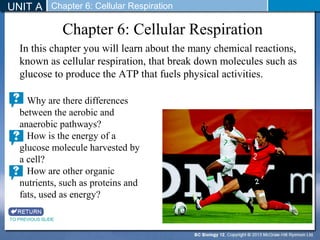
  • #4 Chapter opener background information During a typical 90-minute soccer game, such as the one shown here involving Canada’s Emily Zurrer, the starting players run an average of about 10 km. However, unlike the endurance running experienced by marathoners, soccer players experience periods of intense activity (sprinting) followed by brief periods of rest. This start-and-stop nature of the game means that the muscles of the athlete are constantly switching between aerobic and anaerobic metabolism. During aerobic metabolism, the muscle cells use oxygen in order to completely break down glucose, producing more ATP, a high-energy molecule used for muscle contraction. The breakdown of glucose in the presence of oxygen to produce carbon dioxide and water is called cellular respiration. However, running short, fast sprints quickly depletes oxygen levels and drives the muscles into anaerobic metabolism. Without oxygen, glucose cannot be broken down completely. It is changed into lactate. Once oxygen is restored to the muscles, the body is able to return to aerobic metabolism and dispose of the lactate. In this chapter, we will discuss the metabolic pathways of cellular respiration that allow the energy within a glucose molecule, and other organic nutrients, to be converted into ATP.
  • #5 cellular respiration: the process by which the chemical energy of carbohydrates is converted to that of ATP aerobic: a metabolic process that requires oxygen and gives off carbon dioxide; usually involves the complete breakdown of glucose
  • #6 Caption text Figure 6.1 The breakdown of ATP releases energy, which is used by cells to do work. Energy is released when a phosphate group (Pi) is removed. Addition of a phosphate group to ADP produces ATP.
  • #7 Caption text Figure 6.2 Oxidation and reduction reactions take place at the same time. If one compound is oxidized, another compound must be reduced. reducing agent: a molecule that donates its electrons during a redox reaction oxidizing agent: a molecule that accepts electrons during a redox reaction
  • #8 Caption text Figure 6.3 The NAD+ cycle. The coenzyme NAD+ accepts two hydrogen atoms (H+ + e–), and NADH + H+ results. When NADH passes on electrons, NAD+ results. Only a small amount of NAD+ needs to be present in a cell, because each NAD+ molecule is used over and over again. NAD+ (nicotinamide adenine dinucleotide): a coenzyme used as an electron carrier during cellular respiration FAD (flavin adenine dinucleotide): a coenzyme frequently used as an electron carrier during cellular respiration
  • #9 Caption text Figure 6.4 The four phases of complete glucose breakdown. The complete breakdown of glucose consists of four phases. Glycolysis in the cytoplasm produces pyruvate, which enters mitochondria if oxygen is available. The preparatory reaction and the citric acid cycle that follow occur inside the mitochondria. Also inside mitochondria, the electron transport chain receives the electrons that were removed from glucose breakdown products. The result of glucose breakdown is a maximum of 30 to 32 ATP, depending on the particular cell.
  • #10 anaerobic: a metabolic process that does not use oxygen
  • #12 Caption text Figure 6.5 Electron transport chain. High-energy electrons are delivered to the chain. As they pass from carrier to carrier, energy is released and used for ATP production.
  • #13 Answers 1. NAD+ and FAD serve as coenzymes for the enzymes involved in cellular respiration. Both molecules receive electrons and are reduced to either NADH or FADH2. These reduced molecules carry electrons to the electron transport chain within the mitochondria. 2. Glycolysis is an anaerobic process. It does not require O2 to proceed. The preparatory reaction, the citric acid cycle, and the electron transport chain all rely on the presence of O2 to proceed. 3. The complete breakdown of glucose occurs in four phases. Glycolysis in the cytoplasm produces pyruvate, which enters mitochondria if oxygen is available. The preparatory reaction and the citric acid cycle that follow occur inside the mitochondria in the fluid-filled space called the matrix. Also inside mitochondria, on the membrane that forms the cristae, the electron transport chain receives the electrons that were removed from glucose forming NADH or FADH2. The result of glucose breakdown is a maximum of 30 to 32 ATP, depending on the particular cell.