State-of-the-art
Contribution
BI-population CMA-ES Algorithms with
Surrogate Models and Line Searches
Ilya Loshchilov1
, Marc Schoenauer2
and Michèle Sebag 2
1
LIS, École Polytechnique Fédérale de Lausanne
2
TAO, INRIA − CNRS − Université Paris-Sud
July 6th, 2013
Ilya Loshchilov, Marc Schoenauer and Michèle Sebag BI-population CMA-ES with Surrogate Models and Line Searches 1/ 26
State-of-the-art
Contribution
Historical overview: BBOB’2012
Expensive Optimization
Self-adaptive surrogate-assisted CMA-ES (IPOP-saACM-ES and
BIPOP-saACM-ES) on noiseless1
and noisy testbeds2
.
BIPOP-saACM-ES demonstrates one of the best performance
among the algorithms of the BBOB-2009, 2010 and 2012.
Multimodal Optimization
Alternative restart strategies (NBIPOP-aCMA-ES and
NIPOP-aCMA-ES) on noiseless testbed3
.
NBIPOP-aCMA-ES is TOP-3 algorithm of the CEC’2013
(preliminary results).
1[Loshchilov, Schoenauer and Sebag; GECCO-BBOB 2012] "Black-box optimization
benchmarking of IPOP-saACM-ES and BIPOP-saACM-ES on the BBOB-2012 noiseless testbed"
2[Loshchilov, Schoenauer and Sebag; GECCO-BBOB 2012] "Black-box optimization
benchmarking of IPOP-saACM-ES on the BBOB-2012 noisy testbed"
3[Loshchilov, Schoenauer and Sebag; GECCO-BBOB 2012] "Black-box Optimization
Benchmarking of NIPOP-aCMA-ES and NBIPOP-aCMA-ES on the BBOB-2012 Noiseless Testbed"
Ilya Loshchilov, Marc Schoenauer and Michèle Sebag BI-population CMA-ES with Surrogate Models and Line Searches 2/ 26
State-of-the-art
Contribution
This talk: BBOB’2013
Expensive Optimization
saACM with intensive surrogate model exploitation
(BIPOP-saACM-ES-k) on noiseless testbed4
.
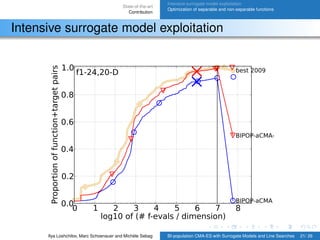
BIPOP-saACM-ES-k further improves BIPOP-saACM-ES.
Optimization of separable and non-separable functions
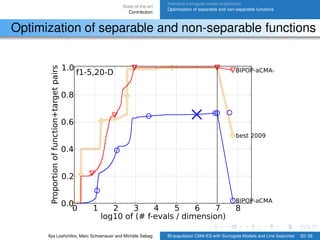
BIPOP-aCMA-STEP: a hybrid of BIPOP-aCMA and STEP
algorithm.
BIPOP-aCMA-STEP demonstrates a cheap way to identify and
exploit the separability.
Efficient Optimization
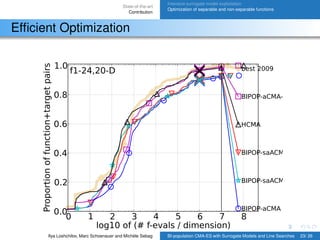
HCMA: a hybrid of BIPOP-saACM-ES-k, STEP and NEWUOA
algorithms.
4[Loshchilov, Schoenauer and Sebag; GECCO 2013] "Intensive Surrogate Model Exploitation in
Self-adaptive Surrogate-assisted CMA-ES (saACM-ES)"
Ilya Loshchilov, Marc Schoenauer and Michèle Sebag BI-population CMA-ES with Surrogate Models and Line Searches 3/ 26
State-of-the-art
Contribution
Content
1 State-of-the-art
Covariance Matrix Adaptation Evolution Strategy (CMA-ES)
s∗
ACM-ES: Self-Adaptive Surrogate-Assisted CMA-ES
2 Contribution
Intensive surrogate model exploitation
Optimization of separable and non-separable functions
Ilya Loshchilov, Marc Schoenauer and Michèle Sebag BI-population CMA-ES with Surrogate Models and Line Searches 4/ 26
State-of-the-art
Contribution
Covariance Matrix Adaptation Evolution Strategy (CMA-ES)
s∗ACM-ES: Self-Adaptive Surrogate-Assisted CMA-ES
(µ, λ)-Covariance Matrix Adaptation Evolution Strategy
Rank-µ Update 5 6
yi ∼ N (0, C) , C = I
xi = m + σ yi, σ = 1
sampling of λ
solutions
Cµ = 1
µ yi:λyT
i:λ
C ← (1 − 1) × C + 1 × Cµ
calculating C from
best µ out of λ
mnew ← m + 1
µ yi:λ
new distribution
The adaptation increases the probability of successful steps to appear again.
Other components of CMA-ES: step-size adaptation, evolution path.
5[Hansen et al., ECJ 2003] "Reducing the time complexity of the derandomized evolution strategy with covariance matrix adaptation
(CMA-ES)"
6 the slide adopted by courtesy of Nikolaus Hansen
Ilya Loshchilov, Marc Schoenauer and Michèle Sebag BI-population CMA-ES with Surrogate Models and Line Searches 5/ 26
State-of-the-art
Contribution
Covariance Matrix Adaptation Evolution Strategy (CMA-ES)
s∗ACM-ES: Self-Adaptive Surrogate-Assisted CMA-ES
Invariance: Guarantee for Generalization
Invariance properties of CMA-ES
Invariance to order-preserving
transformations in function space
true for all comparison-based algorithms
Translation and rotation invariance
thanks to C
−3 −2 −1 0 1 2 3
−3
−2
−1
0
1
2
3
−3 −2 −1 0 1 2 3
−3
−2
−1
0
1
2
3
CMA-ES is almost parameterless (as a consequence of invariances)
Tuning on a small set of functions Hansen & Ostermeier 2001
Default values generalize to whole classes
Exception: population size for multi-modal functions a b
a[Auger & Hansen, CEC 2005] "A restart CMA evolution strategy with increasing population size"
b[Loshchilov et al., PPSN 2012] "Alternative Restart Strategies for CMA-ES"
Ilya Loshchilov, Marc Schoenauer and Michèle Sebag BI-population CMA-ES with Surrogate Models and Line Searches 6/ 26
State-of-the-art
Contribution
Covariance Matrix Adaptation Evolution Strategy (CMA-ES)
s∗ACM-ES: Self-Adaptive Surrogate-Assisted CMA-ES
BIPOP-CMA-ES
BIPOP-CMA-ES: 7
(BIPOP-aCMA-ES 8
)
Regime-1 (large populations, IPOP part):
Each restart: λlarge = 2 ∗ λlarge , σ0
large = σ0
default
Regime-2 (small populations):
Each restart:
λsmall = λdefault
1
2
λlarge
λdefault
U[0,1]2
, σ0
small = σ0
default × 10−2U[0,1]
where U[0, 1] stands for the uniform distribution in [0, 1].
BIPOP-CMA-ES launches the first run with default population size
and initial step-size. In each restart, it selects the restart regime
with less function evaluations used so far.
7Hansen (GECCO BBOB 2009). "Benchmarking a BI-population CMA-ES on the BBOB-2009
function testbed"
8Loshchilov, Schoenauer and Sebag (GECCO BBOB 2012). "Black-box Optimization
Benchmarking of NIPOP-aCMA-ES and NBIPOP-aCMA-ES on the BBOB-2012 Noiseless Testbed"
Ilya Loshchilov, Marc Schoenauer and Michèle Sebag BI-population CMA-ES with Surrogate Models and Line Searches 7/ 26
State-of-the-art
Contribution
Covariance Matrix Adaptation Evolution Strategy (CMA-ES)
s∗ACM-ES: Self-Adaptive Surrogate-Assisted CMA-ES
Contents
1 State-of-the-art
Covariance Matrix Adaptation Evolution Strategy (CMA-ES)
s∗
ACM-ES: Self-Adaptive Surrogate-Assisted CMA-ES
2 Contribution
Intensive surrogate model exploitation
Optimization of separable and non-separable functions
Ilya Loshchilov, Marc Schoenauer and Michèle Sebag BI-population CMA-ES with Surrogate Models and Line Searches 8/ 26
State-of-the-art
Contribution
Covariance Matrix Adaptation Evolution Strategy (CMA-ES)
s∗ACM-ES: Self-Adaptive Surrogate-Assisted CMA-ES
s∗
ACM-ES: Self-Adaptive Surrogate-Assisted CMA-ES
Using Ranking SVM as the surrogate model
Build a global model using Ranking SVM 9
xi ≻ xj iff ˆF(xi) < ˆF(xj)
Comparison-based surrogate models → invariance to
rank-preserving transformations of F(x)
How to choose an appropriate Kernel?
Use covariance matrix C adapted by CMA-ES in Gaussian
kernel10
K(xi, xj) = e−
(xi−xj )T (xi−xj)
2σ2
; KC(xi, xj) = e−
(xi−xj )T C−1(xi−xj )
2σ2
Invariance to rotation of the search space thanks to C
9[Runarsson et al., PPSN 2006] "Ordinal Regression in Evolutionary Computation"
10[Loshchilov et al., PPSN 2010] "Comparison-based optimizers need comparison-based
surrogates"
Ilya Loshchilov, Marc Schoenauer and Michèle Sebag BI-population CMA-ES with Surrogate Models and Line Searches 9/ 26
State-of-the-art
Contribution
Covariance Matrix Adaptation Evolution Strategy (CMA-ES)
s∗ACM-ES: Self-Adaptive Surrogate-Assisted CMA-ES
s∗
ACM-ES: Self-Adaptive Surrogate-Assisted CMA-ES
Surrogate-assisted
CMA-ES with online
adaptation of model
hyper-parameters a
a[Loshchilov et al., GECCO 2012]
"Self-Adaptive Surrogate-Assisted Covariance
Matrix Adaptation Evolution Strategy"
Ilya Loshchilov, Marc Schoenauer and Michèle Sebag BI-population CMA-ES with Surrogate Models and Line Searches 10/ 26
State-of-the-art
Contribution
Covariance Matrix Adaptation Evolution Strategy (CMA-ES)
s∗ACM-ES: Self-Adaptive Surrogate-Assisted CMA-ES
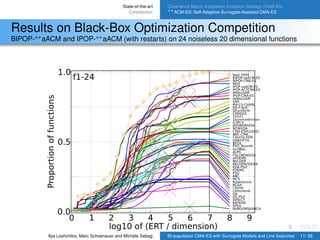
Results on Black-Box Optimization Competition
BIPOP-s∗aACM and IPOP-s∗aACM (with restarts) on 24 noiseless 20 dimensional functions
0 1 2 3 4 5 6 7 8 9
log10 of (ERT / dimension)
0.0
0.5
1.0
Proportionoffunctions
RANDOMSEARCH
SPSA
BAYEDA
DIRECT
DE-PSO
GA
LSfminbnd
LSstep
RCGA
Rosenbrock
MCS
ABC
PSO
POEMS
EDA-PSO
NELDERDOERR
NELDER
oPOEMS
FULLNEWUOA
ALPS
GLOBAL
PSO_Bounds
BFGS
ONEFIFTH
Cauchy-EDA
NBC-CMA
CMA-ESPLUSSEL
NEWUOA
AVGNEWUOA
G3PCX
1komma4mirser
1plus1
CMAEGS
DEuniform
DE-F-AUC
MA-LS-CHAIN
VNS
iAMALGAM
IPOP-CMA-ES
AMALGAM
IPOP-ACTCMA-ES
IPOP-saACM-ES
MOS
BIPOP-CMA-ES
BIPOP-saACM-ES
best 2009
f1-24
Ilya Loshchilov, Marc Schoenauer and Michèle Sebag BI-population CMA-ES with Surrogate Models and Line Searches 11/ 26
State-of-the-art
Contribution
Intensive surrogate model exploitation
Optimization of separable and non-separable functions
Contents
1 State-of-the-art
Covariance Matrix Adaptation Evolution Strategy (CMA-ES)
s∗
ACM-ES: Self-Adaptive Surrogate-Assisted CMA-ES
2 Contribution
Intensive surrogate model exploitation
Optimization of separable and non-separable functions
Ilya Loshchilov, Marc Schoenauer and Michèle Sebag BI-population CMA-ES with Surrogate Models and Line Searches 12/ 26
State-of-the-art
Contribution
Intensive surrogate model exploitation
Optimization of separable and non-separable functions
Intensive surrogate model exploitation
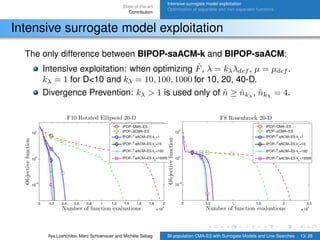
The only difference between BIPOP-saACM-k and BIPOP-saACM:
Intensive exploitation: when optimizing ˆF, λ = kλλdef , µ = µdef .
kλ = 1 for D<10 and kλ = 10, 100, 1000 for 10, 20, 40-D.
Divergence Prevention: kλ > 1 is used only of ˆn ≥ ˆnkλ
, ˆnkλ
= 4.
Ilya Loshchilov, Marc Schoenauer and Michèle Sebag BI-population CMA-ES with Surrogate Models and Line Searches 13/ 26
State-of-the-art
Contribution
Intensive surrogate model exploitation
Optimization of separable and non-separable functions
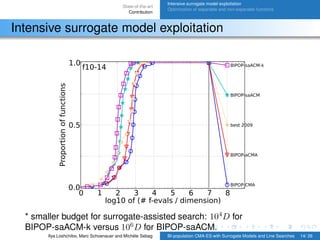
Intensive surrogate model exploitation
* smaller budget for surrogate-assisted search: 104
D for
BIPOP-saACM-k versus 106
D for BIPOP-saACM.
Ilya Loshchilov, Marc Schoenauer and Michèle Sebag BI-population CMA-ES with Surrogate Models and Line Searches 14/ 26
State-of-the-art
Contribution
Intensive surrogate model exploitation
Optimization of separable and non-separable functions
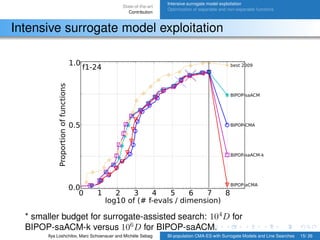
Intensive surrogate model exploitation
* smaller budget for surrogate-assisted search: 104
D for
BIPOP-saACM-k versus 106
D for BIPOP-saACM.
Ilya Loshchilov, Marc Schoenauer and Michèle Sebag BI-population CMA-ES with Surrogate Models and Line Searches 15/ 26
State-of-the-art
Contribution
Intensive surrogate model exploitation
Optimization of separable and non-separable functions
Contents
1 State-of-the-art
Covariance Matrix Adaptation Evolution Strategy (CMA-ES)
s∗
ACM-ES: Self-Adaptive Surrogate-Assisted CMA-ES
2 Contribution
Intensive surrogate model exploitation
Optimization of separable and non-separable functions
Ilya Loshchilov, Marc Schoenauer and Michèle Sebag BI-population CMA-ES with Surrogate Models and Line Searches 16/ 26
State-of-the-art
Contribution
Intensive surrogate model exploitation
Optimization of separable and non-separable functions
Select the easiest point (STEP) 11 12
Simple line search method based on iterative interval division.
Great optimizer of one-dimensional multimodal functions.
An extension to multi-dimensional (sequential) search
+ simple idea: sequentially optimize one dimension after another.
- some stopping criteria should be set a priori, e.g., number of
evaluations or target precision.
- no hint whether the problem is separable or not is available.
11[Swarzberg et al., CEC 1994] "The easiest way to optimize a function"
12[Posík et al., ECJ 2012] "Restarted local search algorithms for continuous black box
optimization"
Ilya Loshchilov, Marc Schoenauer and Michèle Sebag BI-population CMA-ES with Surrogate Models and Line Searches 17/ 26
State-of-the-art
Contribution
Intensive surrogate model exploitation
Optimization of separable and non-separable functions
Parallel multi-dimensional STEP
1. Check one new STEP point per each dimension.
2. Current estimate of the optimum x∗
= a solution composed of
best x∗
i -values from all variables.
3. If the current estimate is worse than the previous one, then the
problem is not separable.
Ilya Loshchilov, Marc Schoenauer and Michèle Sebag BI-population CMA-ES with Surrogate Models and Line Searches 18/ 26
State-of-the-art
Contribution
Intensive surrogate model exploitation
Optimization of separable and non-separable functions
BIPOP-aCMA-STEP
1. BIPOP-aCMA-STEP and STEP are running in parallel, a fraction
ρST EP = 0.5 of function evaluations is allocated to STEP.
2. At each iteration after nMinIterST EP = 10 iterations the STEP
can be stopped if its best solution is worse than the one of
BIPOP-aCMA-ES.
Ilya Loshchilov, Marc Schoenauer and Michèle Sebag BI-population CMA-ES with Surrogate Models and Line Searches 19/ 26
State-of-the-art
Contribution
Intensive surrogate model exploitation
Optimization of separable and non-separable functions
0 1 2 3 4 5 6 7 8
log10 of (# f-evals / dimension)
0.0
0.2
0.4
0.6
0.8
1.0
Proportionoffunction+targetpairs
BIPOP-aCMA
best 2009
BIPOP-aCMA-STEPf1-5,20-D
Ilya Loshchilov, Marc Schoenauer and Michèle Sebag BI-population CMA-ES with Surrogate Models and Line Searches 20/ 26
State-of-the-art
Contribution
Intensive surrogate model exploitation
Optimization of separable and non-separable functions
Intensive surrogate model exploitation
0 1 2 3 4 5 6 7 8
log10 of (# f-evals / dimension)
0.0
0.2
0.4
0.6
0.8
1.0
Proportionoffunction+targetpairs
BIPOP-aCMA
BIPOP-aCMA-STEP
best 2009f1-24,20-D
Ilya Loshchilov, Marc Schoenauer and Michèle Sebag BI-population CMA-ES with Surrogate Models and Line Searches 21/ 26
State-of-the-art
Contribution
Intensive surrogate model exploitation
Optimization of separable and non-separable functions
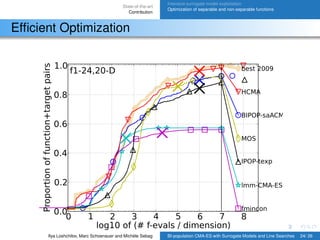
Efficient Optimization
HCMA = BIPOP-saACM-ES-k + STEP + NEWUOA13
1. NEWUOA with m = 2n + 1 for 10n functions evaluations.
2. BIPOP-saACM-ES-k and STEP with nMinIterST EP = 10 (e.g.,
10n evaluations).
13[Powell, 2006] "The NEWUOA software for unconstrained optimization without derivatives"
Ilya Loshchilov, Marc Schoenauer and Michèle Sebag BI-population CMA-ES with Surrogate Models and Line Searches 22/ 26
State-of-the-art
Contribution
Intensive surrogate model exploitation
Optimization of separable and non-separable functions
Efficient Optimization
Ilya Loshchilov, Marc Schoenauer and Michèle Sebag BI-population CMA-ES with Surrogate Models and Line Searches 23/ 26
State-of-the-art
Contribution
Intensive surrogate model exploitation
Optimization of separable and non-separable functions
Efficient Optimization
0 1 2 3 4 5 6 7 8
log10 of (# f-evals / dimension)
0.0
0.2
0.4
0.6
0.8
1.0
Proportionoffunction+targetpairs
fmincon
lmm-CMA-ES
IPOP-texp
MOS
BIPOP-saACM-k
HCMA
best 2009f1-24,20-D
Ilya Loshchilov, Marc Schoenauer and Michèle Sebag BI-population CMA-ES with Surrogate Models and Line Searches 24/ 26
State-of-the-art
Contribution
Intensive surrogate model exploitation
Optimization of separable and non-separable functions
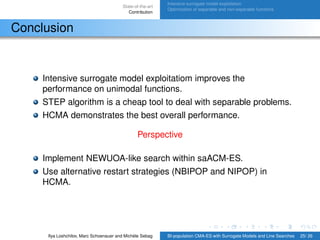
Conclusion
Intensive surrogate model exploitatiom improves the
performance on unimodal functions.
STEP algorithm is a cheap tool to deal with separable problems.
HCMA demonstrates the best overall performance.
Perspective
Implement NEWUOA-like search within saACM-ES.
Use alternative restart strategies (NBIPOP and NIPOP) in
HCMA.
Ilya Loshchilov, Marc Schoenauer and Michèle Sebag BI-population CMA-ES with Surrogate Models and Line Searches 25/ 26
State-of-the-art
Contribution
Intensive surrogate model exploitation
Optimization of separable and non-separable functions
Thank you for your attention!
Questions?
Ilya Loshchilov, Marc Schoenauer and Michèle Sebag BI-population CMA-ES with Surrogate Models and Line Searches 26/ 26

BI-population CMA-ES Algorithms with Surrogate Models and Line Searches

  • 1.
    State-of-the-art Contribution BI-population CMA-ES Algorithmswith Surrogate Models and Line Searches Ilya Loshchilov1 , Marc Schoenauer2 and Michèle Sebag 2 1 LIS, École Polytechnique Fédérale de Lausanne 2 TAO, INRIA − CNRS − Université Paris-Sud July 6th, 2013 Ilya Loshchilov, Marc Schoenauer and Michèle Sebag BI-population CMA-ES with Surrogate Models and Line Searches 1/ 26
  • 2.
    State-of-the-art Contribution Historical overview: BBOB’2012 ExpensiveOptimization Self-adaptive surrogate-assisted CMA-ES (IPOP-saACM-ES and BIPOP-saACM-ES) on noiseless1 and noisy testbeds2 . BIPOP-saACM-ES demonstrates one of the best performance among the algorithms of the BBOB-2009, 2010 and 2012. Multimodal Optimization Alternative restart strategies (NBIPOP-aCMA-ES and NIPOP-aCMA-ES) on noiseless testbed3 . NBIPOP-aCMA-ES is TOP-3 algorithm of the CEC’2013 (preliminary results). 1[Loshchilov, Schoenauer and Sebag; GECCO-BBOB 2012] "Black-box optimization benchmarking of IPOP-saACM-ES and BIPOP-saACM-ES on the BBOB-2012 noiseless testbed" 2[Loshchilov, Schoenauer and Sebag; GECCO-BBOB 2012] "Black-box optimization benchmarking of IPOP-saACM-ES on the BBOB-2012 noisy testbed" 3[Loshchilov, Schoenauer and Sebag; GECCO-BBOB 2012] "Black-box Optimization Benchmarking of NIPOP-aCMA-ES and NBIPOP-aCMA-ES on the BBOB-2012 Noiseless Testbed" Ilya Loshchilov, Marc Schoenauer and Michèle Sebag BI-population CMA-ES with Surrogate Models and Line Searches 2/ 26
  • 3.
    State-of-the-art Contribution This talk: BBOB’2013 ExpensiveOptimization saACM with intensive surrogate model exploitation (BIPOP-saACM-ES-k) on noiseless testbed4 . BIPOP-saACM-ES-k further improves BIPOP-saACM-ES. Optimization of separable and non-separable functions BIPOP-aCMA-STEP: a hybrid of BIPOP-aCMA and STEP algorithm. BIPOP-aCMA-STEP demonstrates a cheap way to identify and exploit the separability. Efficient Optimization HCMA: a hybrid of BIPOP-saACM-ES-k, STEP and NEWUOA algorithms. 4[Loshchilov, Schoenauer and Sebag; GECCO 2013] "Intensive Surrogate Model Exploitation in Self-adaptive Surrogate-assisted CMA-ES (saACM-ES)" Ilya Loshchilov, Marc Schoenauer and Michèle Sebag BI-population CMA-ES with Surrogate Models and Line Searches 3/ 26
  • 4.
    State-of-the-art Contribution Content 1 State-of-the-art Covariance MatrixAdaptation Evolution Strategy (CMA-ES) s∗ ACM-ES: Self-Adaptive Surrogate-Assisted CMA-ES 2 Contribution Intensive surrogate model exploitation Optimization of separable and non-separable functions Ilya Loshchilov, Marc Schoenauer and Michèle Sebag BI-population CMA-ES with Surrogate Models and Line Searches 4/ 26
  • 5.
    State-of-the-art Contribution Covariance Matrix AdaptationEvolution Strategy (CMA-ES) s∗ACM-ES: Self-Adaptive Surrogate-Assisted CMA-ES (µ, λ)-Covariance Matrix Adaptation Evolution Strategy Rank-µ Update 5 6 yi ∼ N (0, C) , C = I xi = m + σ yi, σ = 1 sampling of λ solutions Cµ = 1 µ yi:λyT i:λ C ← (1 − 1) × C + 1 × Cµ calculating C from best µ out of λ mnew ← m + 1 µ yi:λ new distribution The adaptation increases the probability of successful steps to appear again. Other components of CMA-ES: step-size adaptation, evolution path. 5[Hansen et al., ECJ 2003] "Reducing the time complexity of the derandomized evolution strategy with covariance matrix adaptation (CMA-ES)" 6 the slide adopted by courtesy of Nikolaus Hansen Ilya Loshchilov, Marc Schoenauer and Michèle Sebag BI-population CMA-ES with Surrogate Models and Line Searches 5/ 26
  • 6.
    State-of-the-art Contribution Covariance Matrix AdaptationEvolution Strategy (CMA-ES) s∗ACM-ES: Self-Adaptive Surrogate-Assisted CMA-ES Invariance: Guarantee for Generalization Invariance properties of CMA-ES Invariance to order-preserving transformations in function space true for all comparison-based algorithms Translation and rotation invariance thanks to C −3 −2 −1 0 1 2 3 −3 −2 −1 0 1 2 3 −3 −2 −1 0 1 2 3 −3 −2 −1 0 1 2 3 CMA-ES is almost parameterless (as a consequence of invariances) Tuning on a small set of functions Hansen & Ostermeier 2001 Default values generalize to whole classes Exception: population size for multi-modal functions a b a[Auger & Hansen, CEC 2005] "A restart CMA evolution strategy with increasing population size" b[Loshchilov et al., PPSN 2012] "Alternative Restart Strategies for CMA-ES" Ilya Loshchilov, Marc Schoenauer and Michèle Sebag BI-population CMA-ES with Surrogate Models and Line Searches 6/ 26
  • 7.
    State-of-the-art Contribution Covariance Matrix AdaptationEvolution Strategy (CMA-ES) s∗ACM-ES: Self-Adaptive Surrogate-Assisted CMA-ES BIPOP-CMA-ES BIPOP-CMA-ES: 7 (BIPOP-aCMA-ES 8 ) Regime-1 (large populations, IPOP part): Each restart: λlarge = 2 ∗ λlarge , σ0 large = σ0 default Regime-2 (small populations): Each restart: λsmall = λdefault 1 2 λlarge λdefault U[0,1]2 , σ0 small = σ0 default × 10−2U[0,1] where U[0, 1] stands for the uniform distribution in [0, 1]. BIPOP-CMA-ES launches the first run with default population size and initial step-size. In each restart, it selects the restart regime with less function evaluations used so far. 7Hansen (GECCO BBOB 2009). "Benchmarking a BI-population CMA-ES on the BBOB-2009 function testbed" 8Loshchilov, Schoenauer and Sebag (GECCO BBOB 2012). "Black-box Optimization Benchmarking of NIPOP-aCMA-ES and NBIPOP-aCMA-ES on the BBOB-2012 Noiseless Testbed" Ilya Loshchilov, Marc Schoenauer and Michèle Sebag BI-population CMA-ES with Surrogate Models and Line Searches 7/ 26
  • 8.
    State-of-the-art Contribution Covariance Matrix AdaptationEvolution Strategy (CMA-ES) s∗ACM-ES: Self-Adaptive Surrogate-Assisted CMA-ES Contents 1 State-of-the-art Covariance Matrix Adaptation Evolution Strategy (CMA-ES) s∗ ACM-ES: Self-Adaptive Surrogate-Assisted CMA-ES 2 Contribution Intensive surrogate model exploitation Optimization of separable and non-separable functions Ilya Loshchilov, Marc Schoenauer and Michèle Sebag BI-population CMA-ES with Surrogate Models and Line Searches 8/ 26
  • 9.
    State-of-the-art Contribution Covariance Matrix AdaptationEvolution Strategy (CMA-ES) s∗ACM-ES: Self-Adaptive Surrogate-Assisted CMA-ES s∗ ACM-ES: Self-Adaptive Surrogate-Assisted CMA-ES Using Ranking SVM as the surrogate model Build a global model using Ranking SVM 9 xi ≻ xj iff ˆF(xi) < ˆF(xj) Comparison-based surrogate models → invariance to rank-preserving transformations of F(x) How to choose an appropriate Kernel? Use covariance matrix C adapted by CMA-ES in Gaussian kernel10 K(xi, xj) = e− (xi−xj )T (xi−xj) 2σ2 ; KC(xi, xj) = e− (xi−xj )T C−1(xi−xj ) 2σ2 Invariance to rotation of the search space thanks to C 9[Runarsson et al., PPSN 2006] "Ordinal Regression in Evolutionary Computation" 10[Loshchilov et al., PPSN 2010] "Comparison-based optimizers need comparison-based surrogates" Ilya Loshchilov, Marc Schoenauer and Michèle Sebag BI-population CMA-ES with Surrogate Models and Line Searches 9/ 26
  • 10.
    State-of-the-art Contribution Covariance Matrix AdaptationEvolution Strategy (CMA-ES) s∗ACM-ES: Self-Adaptive Surrogate-Assisted CMA-ES s∗ ACM-ES: Self-Adaptive Surrogate-Assisted CMA-ES Surrogate-assisted CMA-ES with online adaptation of model hyper-parameters a a[Loshchilov et al., GECCO 2012] "Self-Adaptive Surrogate-Assisted Covariance Matrix Adaptation Evolution Strategy" Ilya Loshchilov, Marc Schoenauer and Michèle Sebag BI-population CMA-ES with Surrogate Models and Line Searches 10/ 26
  • 11.
    State-of-the-art Contribution Covariance Matrix AdaptationEvolution Strategy (CMA-ES) s∗ACM-ES: Self-Adaptive Surrogate-Assisted CMA-ES Results on Black-Box Optimization Competition BIPOP-s∗aACM and IPOP-s∗aACM (with restarts) on 24 noiseless 20 dimensional functions 0 1 2 3 4 5 6 7 8 9 log10 of (ERT / dimension) 0.0 0.5 1.0 Proportionoffunctions RANDOMSEARCH SPSA BAYEDA DIRECT DE-PSO GA LSfminbnd LSstep RCGA Rosenbrock MCS ABC PSO POEMS EDA-PSO NELDERDOERR NELDER oPOEMS FULLNEWUOA ALPS GLOBAL PSO_Bounds BFGS ONEFIFTH Cauchy-EDA NBC-CMA CMA-ESPLUSSEL NEWUOA AVGNEWUOA G3PCX 1komma4mirser 1plus1 CMAEGS DEuniform DE-F-AUC MA-LS-CHAIN VNS iAMALGAM IPOP-CMA-ES AMALGAM IPOP-ACTCMA-ES IPOP-saACM-ES MOS BIPOP-CMA-ES BIPOP-saACM-ES best 2009 f1-24 Ilya Loshchilov, Marc Schoenauer and Michèle Sebag BI-population CMA-ES with Surrogate Models and Line Searches 11/ 26
  • 12.
    State-of-the-art Contribution Intensive surrogate modelexploitation Optimization of separable and non-separable functions Contents 1 State-of-the-art Covariance Matrix Adaptation Evolution Strategy (CMA-ES) s∗ ACM-ES: Self-Adaptive Surrogate-Assisted CMA-ES 2 Contribution Intensive surrogate model exploitation Optimization of separable and non-separable functions Ilya Loshchilov, Marc Schoenauer and Michèle Sebag BI-population CMA-ES with Surrogate Models and Line Searches 12/ 26
  • 13.
    State-of-the-art Contribution Intensive surrogate modelexploitation Optimization of separable and non-separable functions Intensive surrogate model exploitation The only difference between BIPOP-saACM-k and BIPOP-saACM: Intensive exploitation: when optimizing ˆF, λ = kλλdef , µ = µdef . kλ = 1 for D<10 and kλ = 10, 100, 1000 for 10, 20, 40-D. Divergence Prevention: kλ > 1 is used only of ˆn ≥ ˆnkλ , ˆnkλ = 4. Ilya Loshchilov, Marc Schoenauer and Michèle Sebag BI-population CMA-ES with Surrogate Models and Line Searches 13/ 26
  • 14.
    State-of-the-art Contribution Intensive surrogate modelexploitation Optimization of separable and non-separable functions Intensive surrogate model exploitation * smaller budget for surrogate-assisted search: 104 D for BIPOP-saACM-k versus 106 D for BIPOP-saACM. Ilya Loshchilov, Marc Schoenauer and Michèle Sebag BI-population CMA-ES with Surrogate Models and Line Searches 14/ 26
  • 15.
    State-of-the-art Contribution Intensive surrogate modelexploitation Optimization of separable and non-separable functions Intensive surrogate model exploitation * smaller budget for surrogate-assisted search: 104 D for BIPOP-saACM-k versus 106 D for BIPOP-saACM. Ilya Loshchilov, Marc Schoenauer and Michèle Sebag BI-population CMA-ES with Surrogate Models and Line Searches 15/ 26
  • 16.
    State-of-the-art Contribution Intensive surrogate modelexploitation Optimization of separable and non-separable functions Contents 1 State-of-the-art Covariance Matrix Adaptation Evolution Strategy (CMA-ES) s∗ ACM-ES: Self-Adaptive Surrogate-Assisted CMA-ES 2 Contribution Intensive surrogate model exploitation Optimization of separable and non-separable functions Ilya Loshchilov, Marc Schoenauer and Michèle Sebag BI-population CMA-ES with Surrogate Models and Line Searches 16/ 26
  • 17.
    State-of-the-art Contribution Intensive surrogate modelexploitation Optimization of separable and non-separable functions Optimization of separable and non-separable functions Select the easiest point (STEP) 11 12 Simple line search method based on iterative interval division. Great optimizer of one-dimensional multimodal functions. An extension to multi-dimensional (sequential) search + simple idea: sequentially optimize one dimension after another. - some stopping criteria should be set a priori, e.g., number of evaluations or target precision. - no hint whether the problem is separable or not is available. 11[Swarzberg et al., CEC 1994] "The easiest way to optimize a function" 12[Posík et al., ECJ 2012] "Restarted local search algorithms for continuous black box optimization" Ilya Loshchilov, Marc Schoenauer and Michèle Sebag BI-population CMA-ES with Surrogate Models and Line Searches 17/ 26
  • 18.
    State-of-the-art Contribution Intensive surrogate modelexploitation Optimization of separable and non-separable functions Optimization of separable and non-separable functions Parallel multi-dimensional STEP 1. Check one new STEP point per each dimension. 2. Current estimate of the optimum x∗ = a solution composed of best x∗ i -values from all variables. 3. If the current estimate is worse than the previous one, then the problem is not separable. Ilya Loshchilov, Marc Schoenauer and Michèle Sebag BI-population CMA-ES with Surrogate Models and Line Searches 18/ 26
  • 19.
    State-of-the-art Contribution Intensive surrogate modelexploitation Optimization of separable and non-separable functions Optimization of separable and non-separable functions BIPOP-aCMA-STEP 1. BIPOP-aCMA-STEP and STEP are running in parallel, a fraction ρST EP = 0.5 of function evaluations is allocated to STEP. 2. At each iteration after nMinIterST EP = 10 iterations the STEP can be stopped if its best solution is worse than the one of BIPOP-aCMA-ES. Ilya Loshchilov, Marc Schoenauer and Michèle Sebag BI-population CMA-ES with Surrogate Models and Line Searches 19/ 26
  • 20.
    State-of-the-art Contribution Intensive surrogate modelexploitation Optimization of separable and non-separable functions Optimization of separable and non-separable functions 0 1 2 3 4 5 6 7 8 log10 of (# f-evals / dimension) 0.0 0.2 0.4 0.6 0.8 1.0 Proportionoffunction+targetpairs BIPOP-aCMA best 2009 BIPOP-aCMA-STEPf1-5,20-D Ilya Loshchilov, Marc Schoenauer and Michèle Sebag BI-population CMA-ES with Surrogate Models and Line Searches 20/ 26
  • 21.
    State-of-the-art Contribution Intensive surrogate modelexploitation Optimization of separable and non-separable functions Intensive surrogate model exploitation 0 1 2 3 4 5 6 7 8 log10 of (# f-evals / dimension) 0.0 0.2 0.4 0.6 0.8 1.0 Proportionoffunction+targetpairs BIPOP-aCMA BIPOP-aCMA-STEP best 2009f1-24,20-D Ilya Loshchilov, Marc Schoenauer and Michèle Sebag BI-population CMA-ES with Surrogate Models and Line Searches 21/ 26
  • 22.
    State-of-the-art Contribution Intensive surrogate modelexploitation Optimization of separable and non-separable functions Efficient Optimization HCMA = BIPOP-saACM-ES-k + STEP + NEWUOA13 1. NEWUOA with m = 2n + 1 for 10n functions evaluations. 2. BIPOP-saACM-ES-k and STEP with nMinIterST EP = 10 (e.g., 10n evaluations). 13[Powell, 2006] "The NEWUOA software for unconstrained optimization without derivatives" Ilya Loshchilov, Marc Schoenauer and Michèle Sebag BI-population CMA-ES with Surrogate Models and Line Searches 22/ 26
  • 23.
    State-of-the-art Contribution Intensive surrogate modelexploitation Optimization of separable and non-separable functions Efficient Optimization Ilya Loshchilov, Marc Schoenauer and Michèle Sebag BI-population CMA-ES with Surrogate Models and Line Searches 23/ 26
  • 24.
    State-of-the-art Contribution Intensive surrogate modelexploitation Optimization of separable and non-separable functions Efficient Optimization 0 1 2 3 4 5 6 7 8 log10 of (# f-evals / dimension) 0.0 0.2 0.4 0.6 0.8 1.0 Proportionoffunction+targetpairs fmincon lmm-CMA-ES IPOP-texp MOS BIPOP-saACM-k HCMA best 2009f1-24,20-D Ilya Loshchilov, Marc Schoenauer and Michèle Sebag BI-population CMA-ES with Surrogate Models and Line Searches 24/ 26
  • 25.
    State-of-the-art Contribution Intensive surrogate modelexploitation Optimization of separable and non-separable functions Conclusion Intensive surrogate model exploitatiom improves the performance on unimodal functions. STEP algorithm is a cheap tool to deal with separable problems. HCMA demonstrates the best overall performance. Perspective Implement NEWUOA-like search within saACM-ES. Use alternative restart strategies (NBIPOP and NIPOP) in HCMA. Ilya Loshchilov, Marc Schoenauer and Michèle Sebag BI-population CMA-ES with Surrogate Models and Line Searches 25/ 26
  • 26.
    State-of-the-art Contribution Intensive surrogate modelexploitation Optimization of separable and non-separable functions Thank you for your attention! Questions? Ilya Loshchilov, Marc Schoenauer and Michèle Sebag BI-population CMA-ES with Surrogate Models and Line Searches 26/ 26